Upgrade to Pro
— share decks privately, control downloads, hide ads and more …
Speaker Deck
Sign up for free
Menu
Search
Features
All features
Private URLs
Password Protection
Custom URLS
Scheduled publishing
Remove Branding
Restrict embedding
Deck Collections
Notes
Features
All features
Private URLs
Password Protection
Custom URLS
Scheduled publishing
Remove Branding
Restrict embedding
Deck Collections
Notes
Explore
Featured decks
Featured speakers
Programming
Technology
Storyboards
Explore
Featured decks
Featured speakers
Programming
Technology
Storyboards
Pricing
Search
Sign in
Sign up for free
Lecture 1
Search
Kevin Hickey
August 01, 2014
33
0
Share
Embed
Copy iframe code
Copy JS code
Copy link
Start on current slide
Lecture 1
Korean Temples
Kevin Hickey
August 01, 2014
Featured
See All Featured
Distributed Sagas: A Protocol for Coordinating Microservices
caitiem20
333
23k
svc-hook: hooking system calls on ARM64 by binary rewriting
retrage
2
630
Making Projects Easy
brettharned
120
6.8k
How to audit for AI Accessibility on your Front & Back End
davetheseo
0
600
Making the Leap to Tech Lead
cromwellryan
135
10k
Crafting Experiences
bethany
1
380
The Curious Case for Waylosing
cassininazir
1
570
Claude Code どこまでも/ Claude Code Everywhere
nwiizo
68
59k
The Web Performance Landscape in 2024 [PerfNow 2024]
tammyeverts
12
1.3k
The browser strikes back
jonoalderson
0
1.8k
Stop Working from a Prison Cell
hatefulcrawdad
274
21k
Site-Speed That Sticks
csswizardry
13
1.6k
Transcript
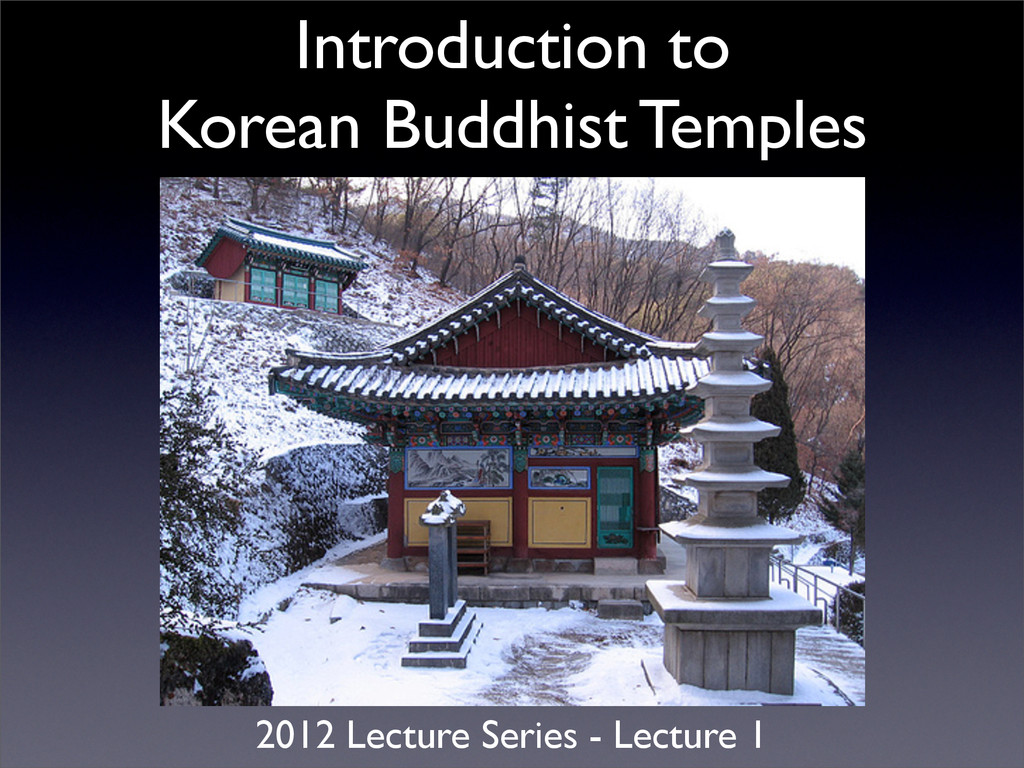
Introduction to Korean Buddhist Temples 2012 Lecture Series - Lecture
1
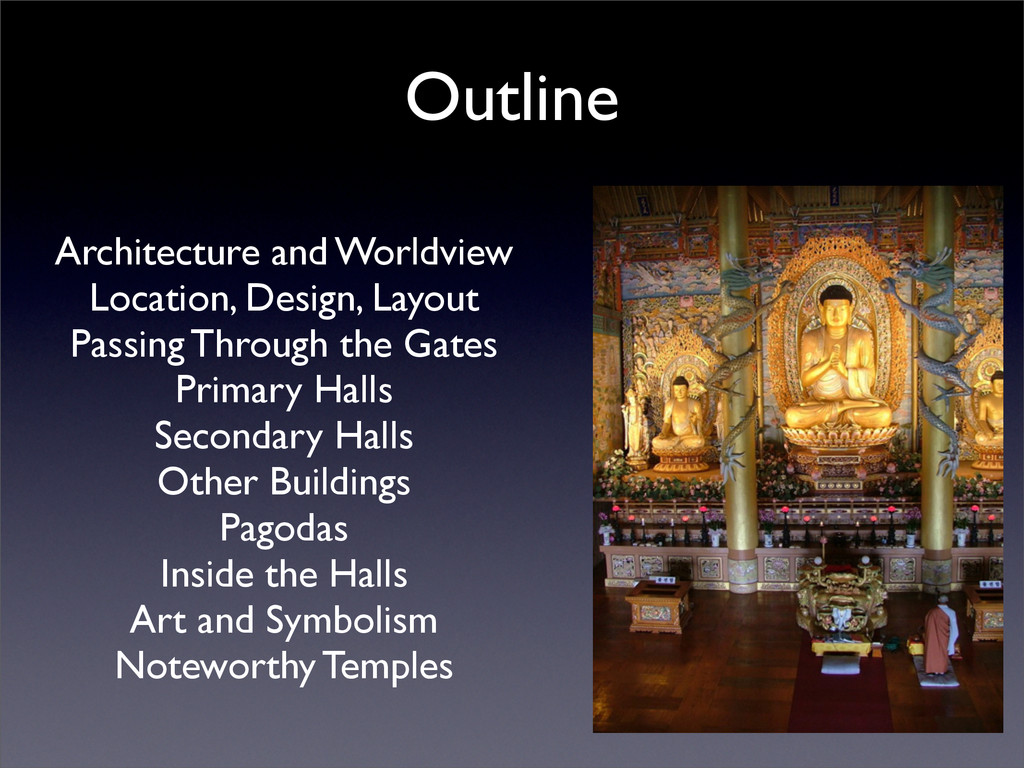
Outline Architecture and Worldview Location, Design, Layout Passing Through the
Gates Primary Halls Secondary Halls Other Buildings Pagodas Inside the Halls Art and Symbolism Noteworthy Temples
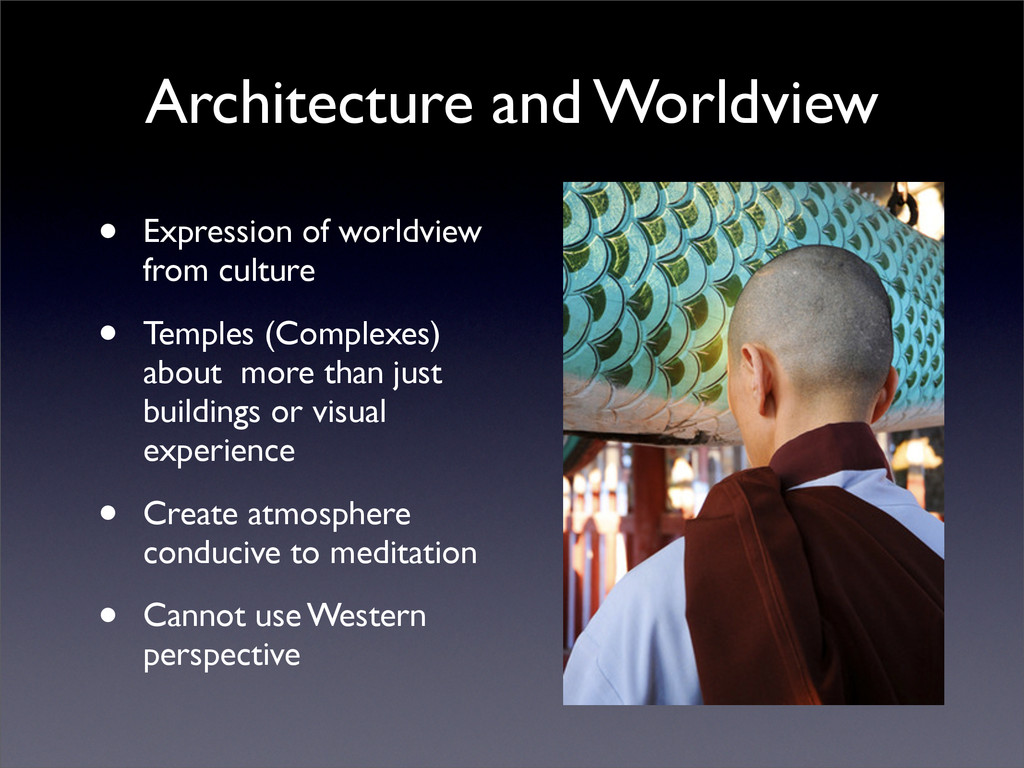
Architecture and Worldview • Expression of worldview from culture •
Temples (Complexes) about more than just buildings or visual experience • Create atmosphere conducive to meditation • Cannot use Western perspective
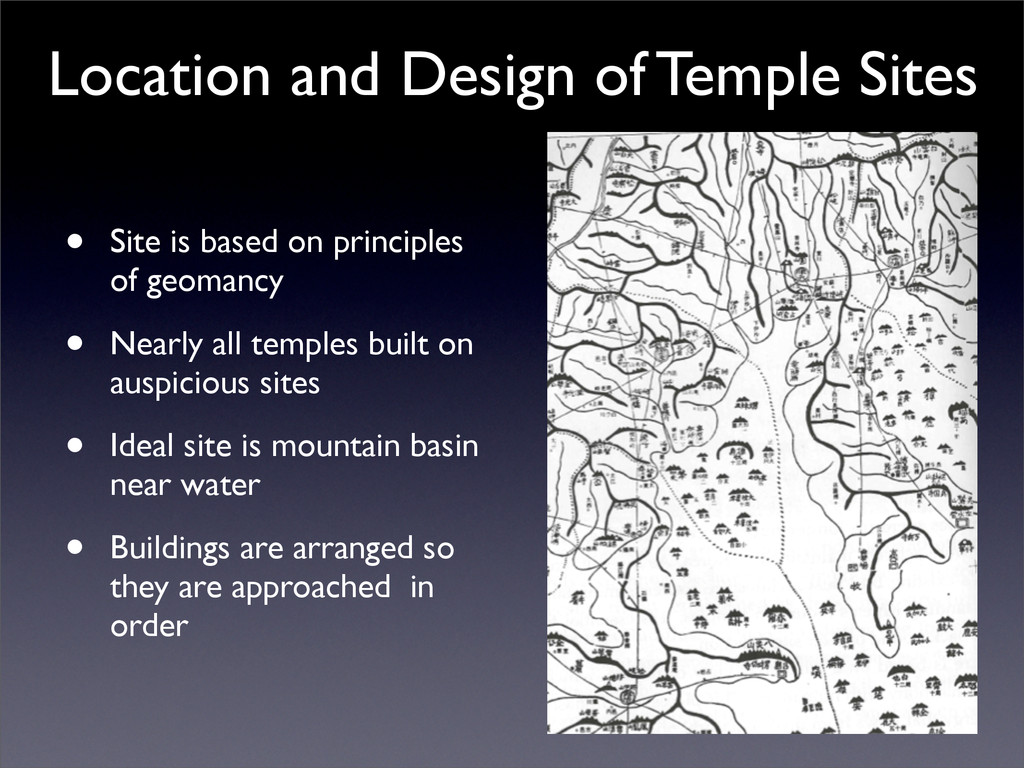
Location and Design of Temple Sites • Site is based
on principles of geomancy • Nearly all temples built on auspicious sites • Ideal site is mountain basin near water • Buildings are arranged so they are approached in order
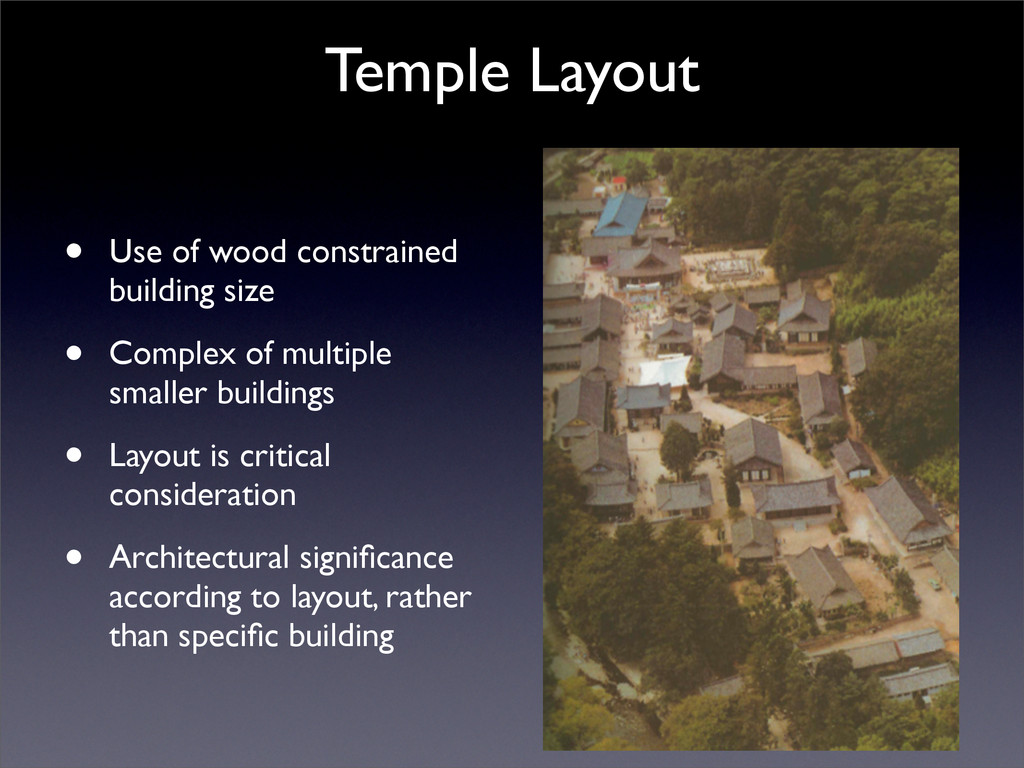
Temple Layout • Use of wood constrained building size •
Complex of multiple smaller buildings • Layout is critical consideration • Architectural significance according to layout, rather than specific building
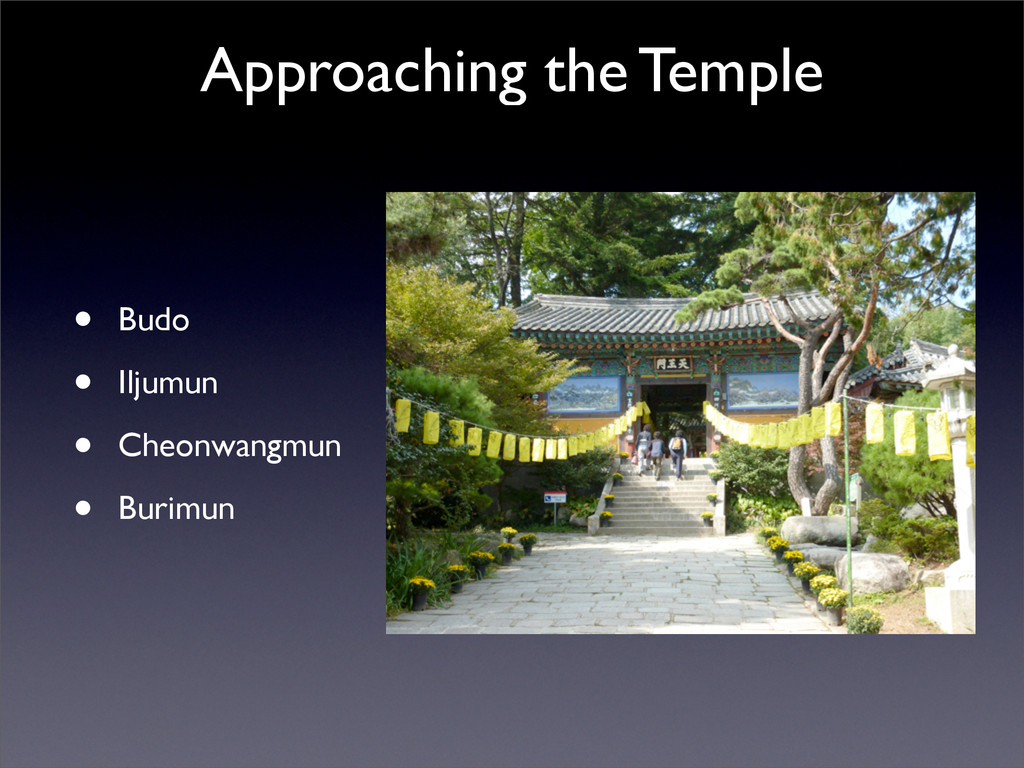
Approaching the Temple • Budo • Iljumun • Cheonwangmun •
Burimun
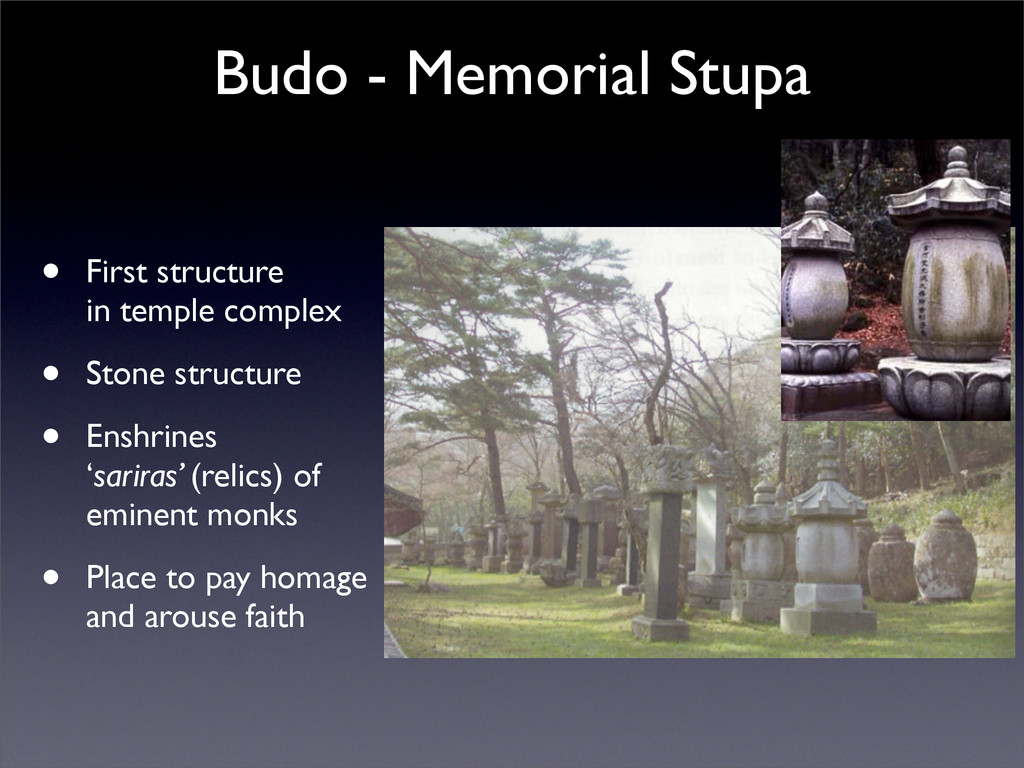
Budo - Memorial Stupa • First structure in temple complex
• Stone structure • Enshrines ‘sariras’ (relics) of eminent monks • Place to pay homage and arouse faith
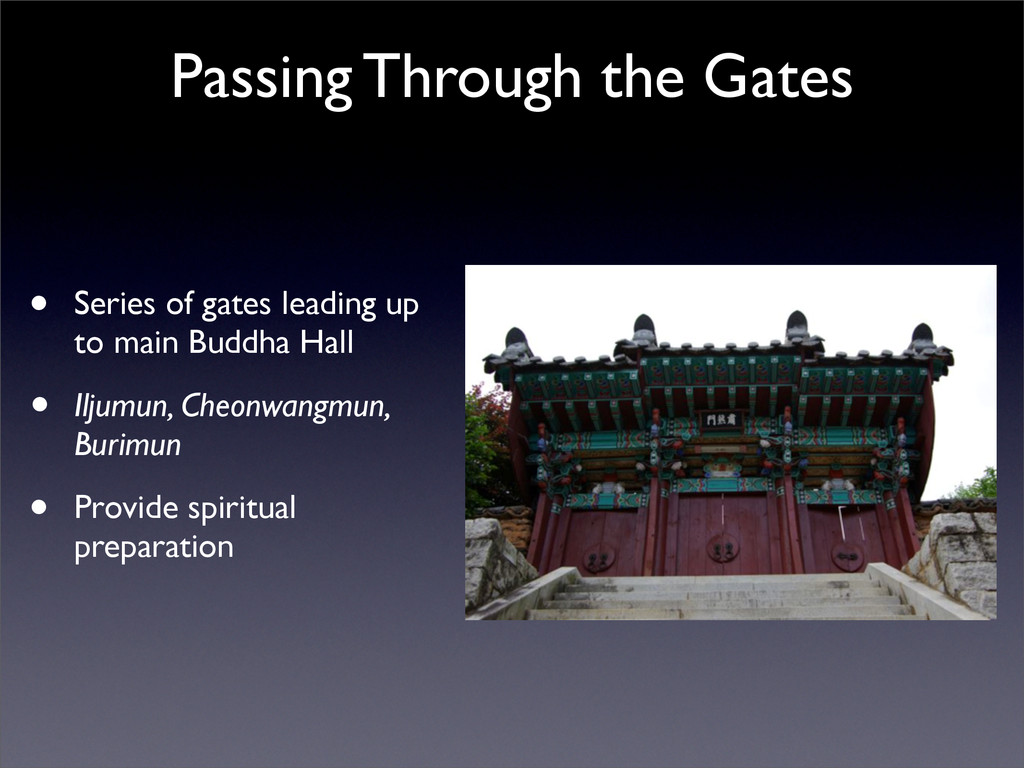
Passing Through the Gates • Series of gates leading up
to main Buddha Hall • Iljumun, Cheonwangmun, Burimun • Provide spiritual preparation
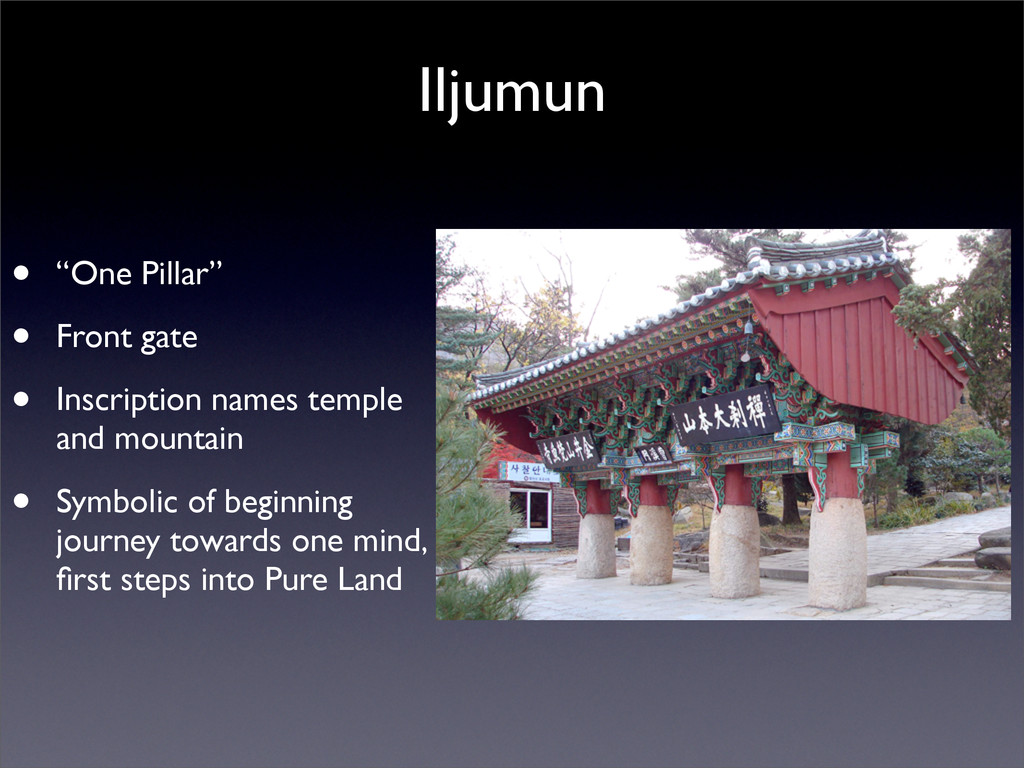
Iljumun • “One Pillar” • Front gate • Inscription names
temple and mountain • Symbolic of beginning journey towards one mind, first steps into Pure Land
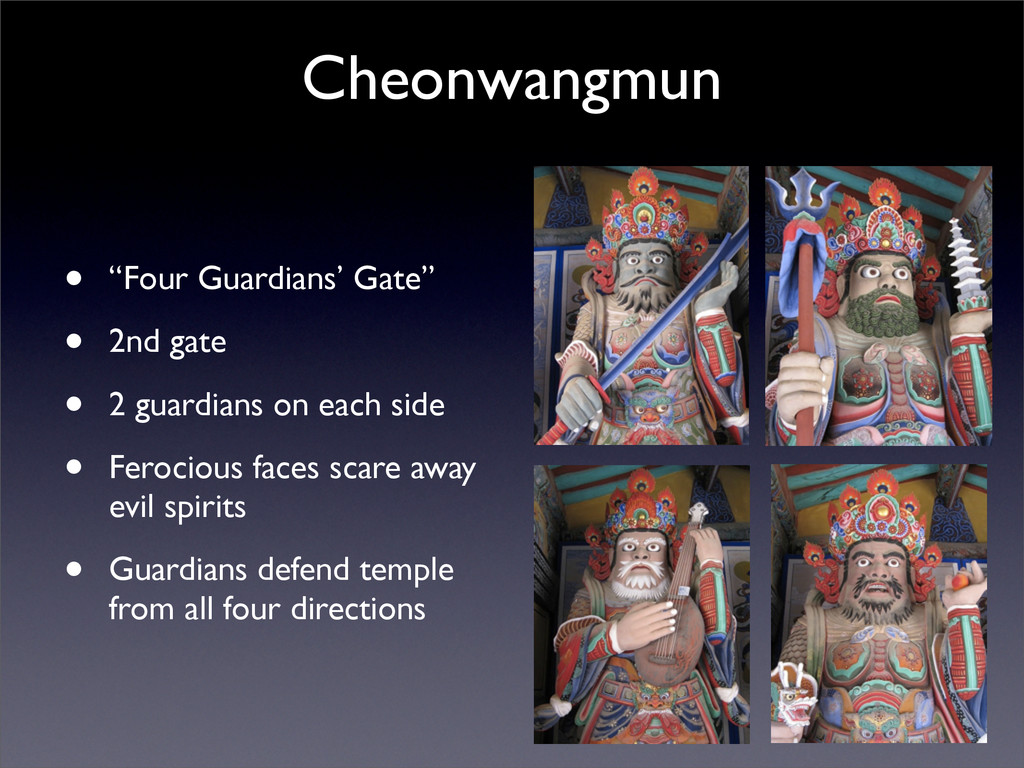
Cheonwangmun • “Four Guardians’ Gate” • 2nd gate • 2
guardians on each side • Ferocious faces scare away evil spirits • Guardians defend temple from all four directions
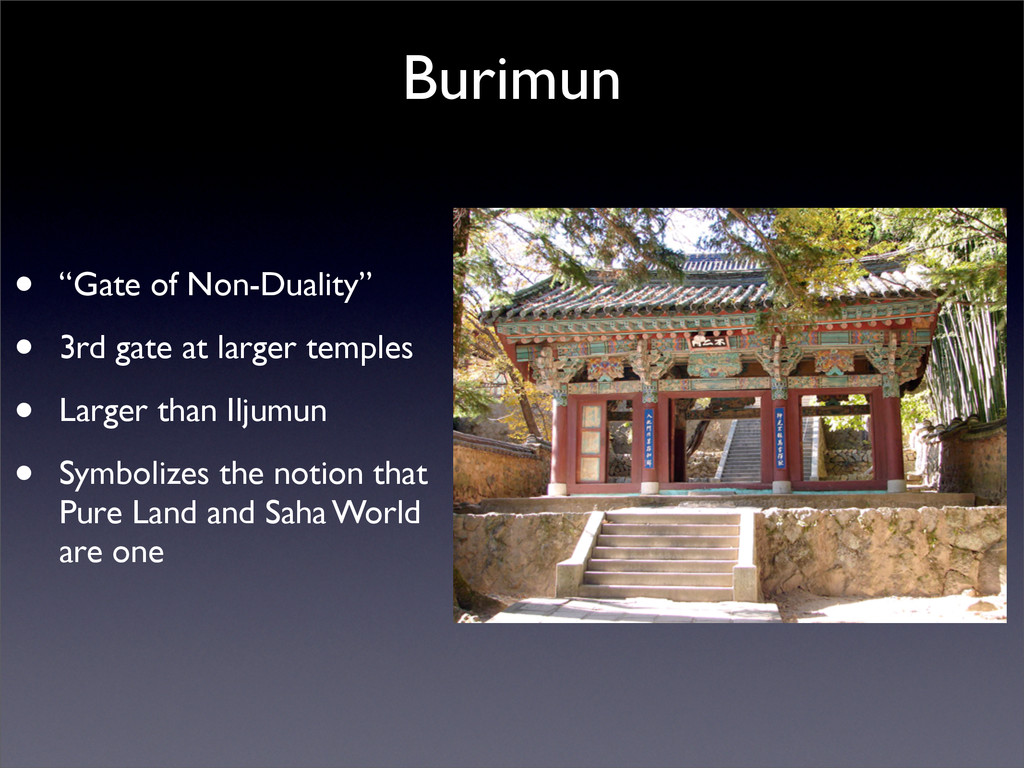
Burimun • “Gate of Non-Duality” • 3rd gate at larger
temples • Larger than Iljumun • Symbolizes the notion that Pure Land and Saha World are one
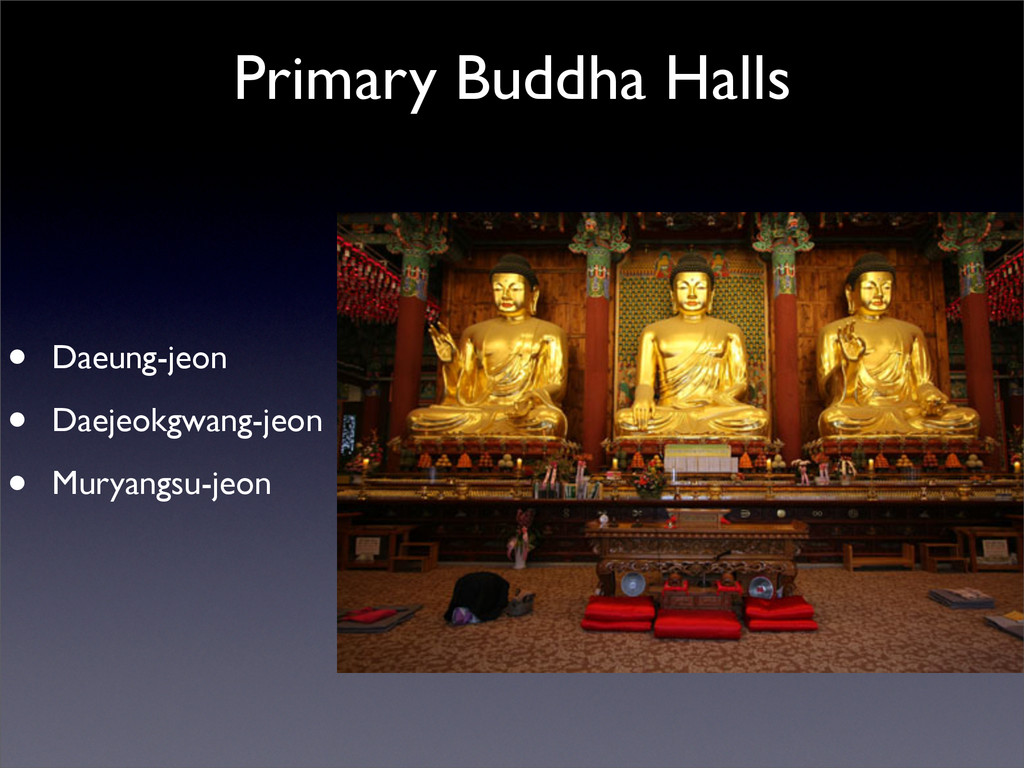
Primary Buddha Halls • Daeung-jeon • Daejeokgwang-jeon • Muryangsu-jeon
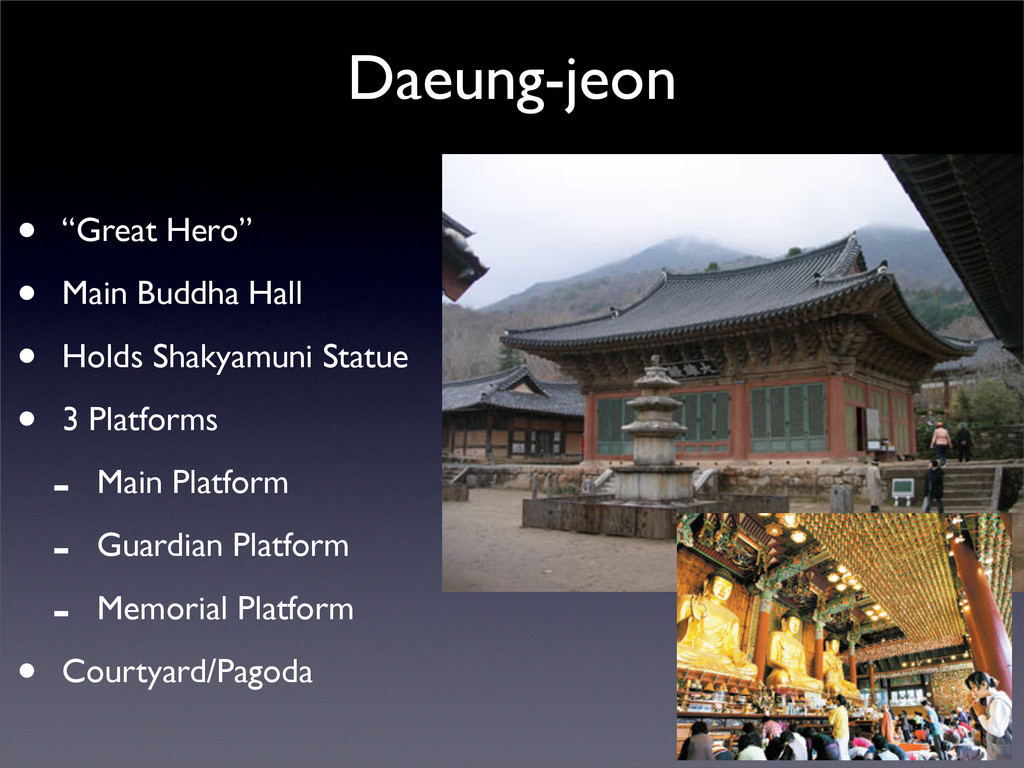
Daeung-jeon • “Great Hero” • Main Buddha Hall • Holds
Shakyamuni Statue • 3 Platforms - Main Platform - Guardian Platform - Memorial Platform • Courtyard/Pagoda
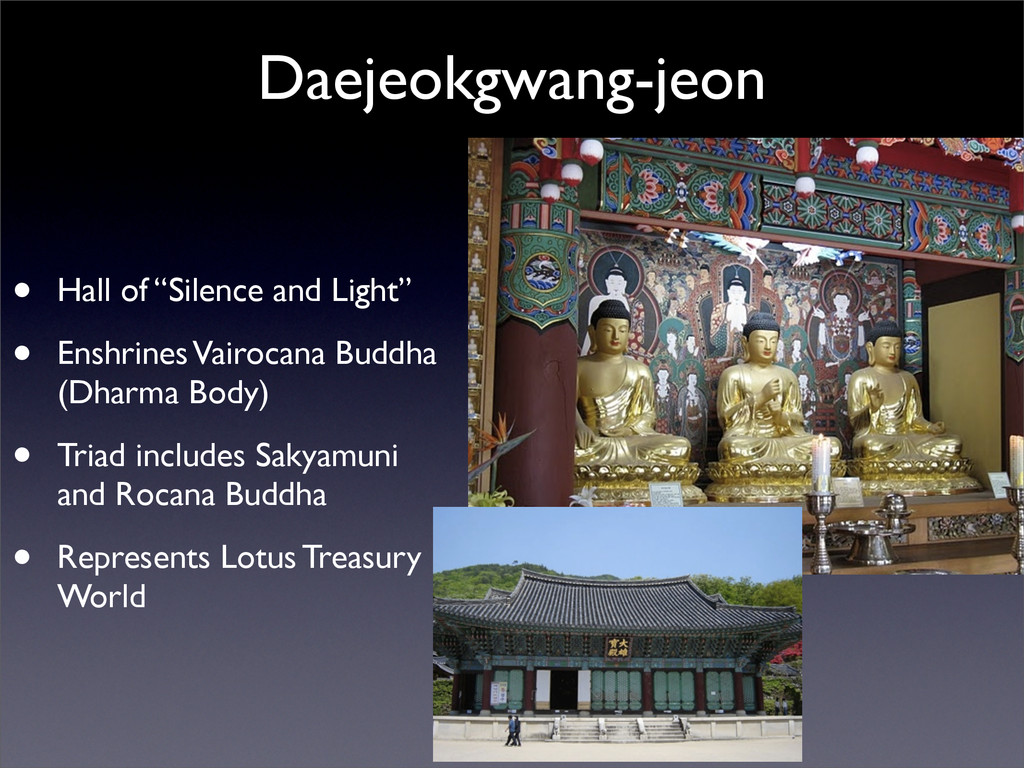
Daejeokgwang-jeon • Hall of “Silence and Light” • Enshrines Vairocana
Buddha (Dharma Body) • Triad includes Sakyamuni and Rocana Buddha • Represents Lotus Treasury World
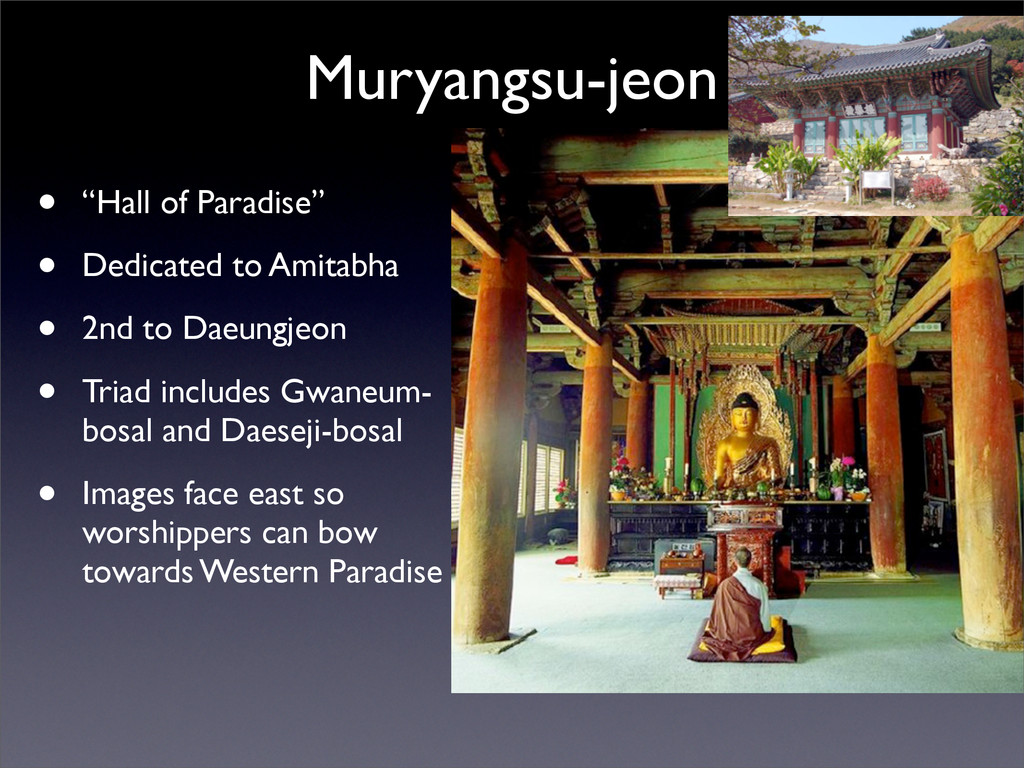
Muryangsu-jeon • “Hall of Paradise” • Dedicated to Amitabha •
2nd to Daeungjeon • Triad includes Gwaneum- bosal and Daeseji-bosal • Images face east so worshippers can bow towards Western Paradise
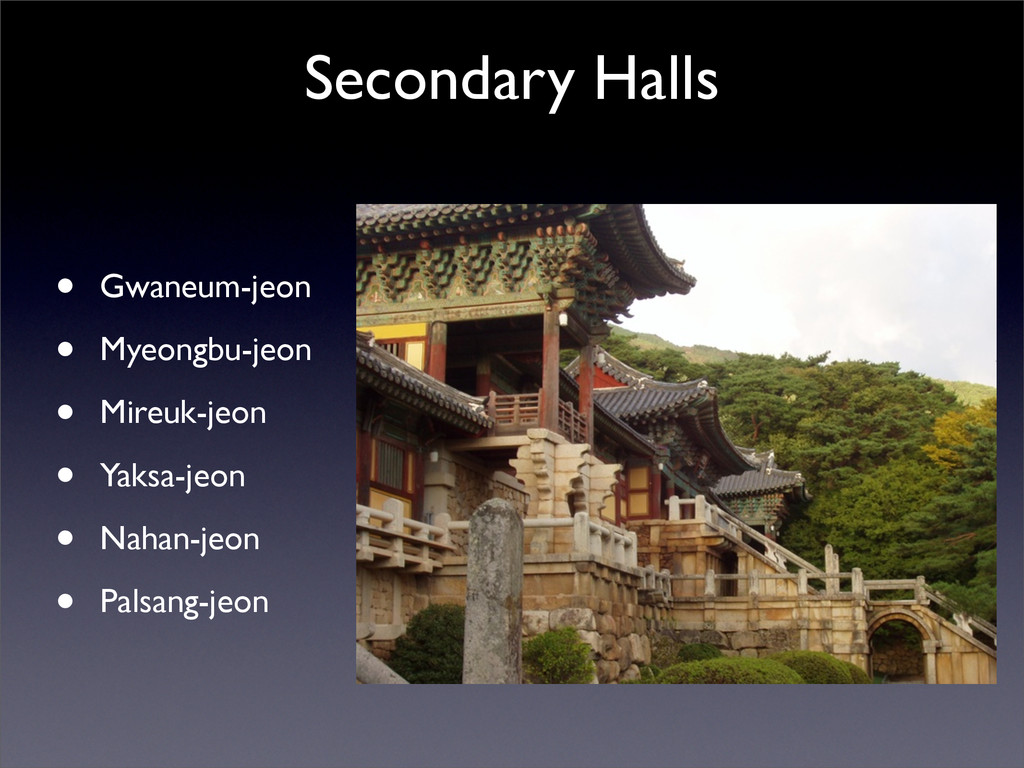
Secondary Halls • Gwaneum-jeon • Myeongbu-jeon • Mireuk-jeon • Yaksa-jeon
• Nahan-jeon • Palsang-jeon
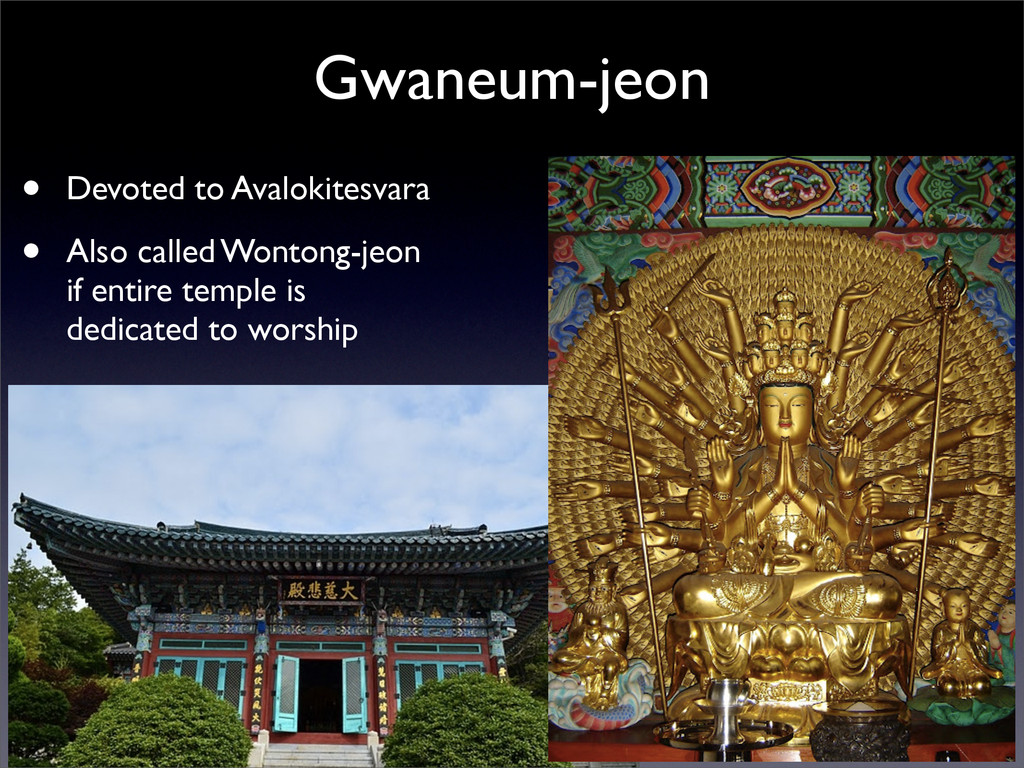
Gwaneum-jeon • Devoted to Avalokitesvara • Also called Wontong-jeon if
entire temple is dedicated to worship
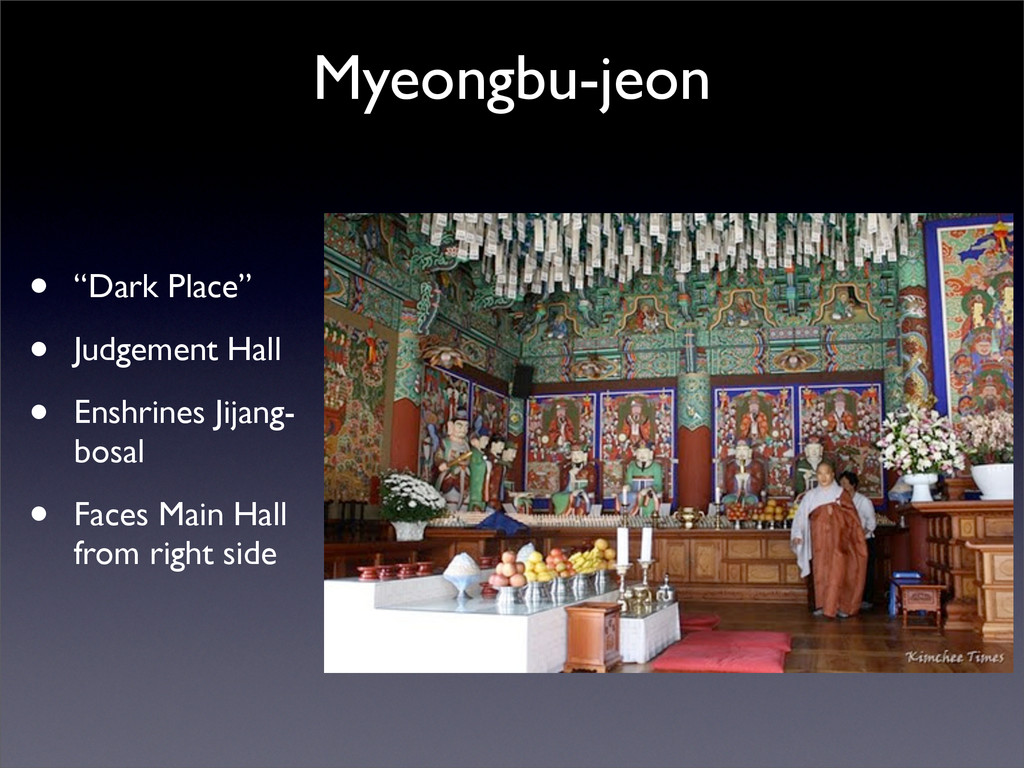
Myeongbu-jeon • “Dark Place” • Judgement Hall • Enshrines Jijang-
bosal • Faces Main Hall from right side
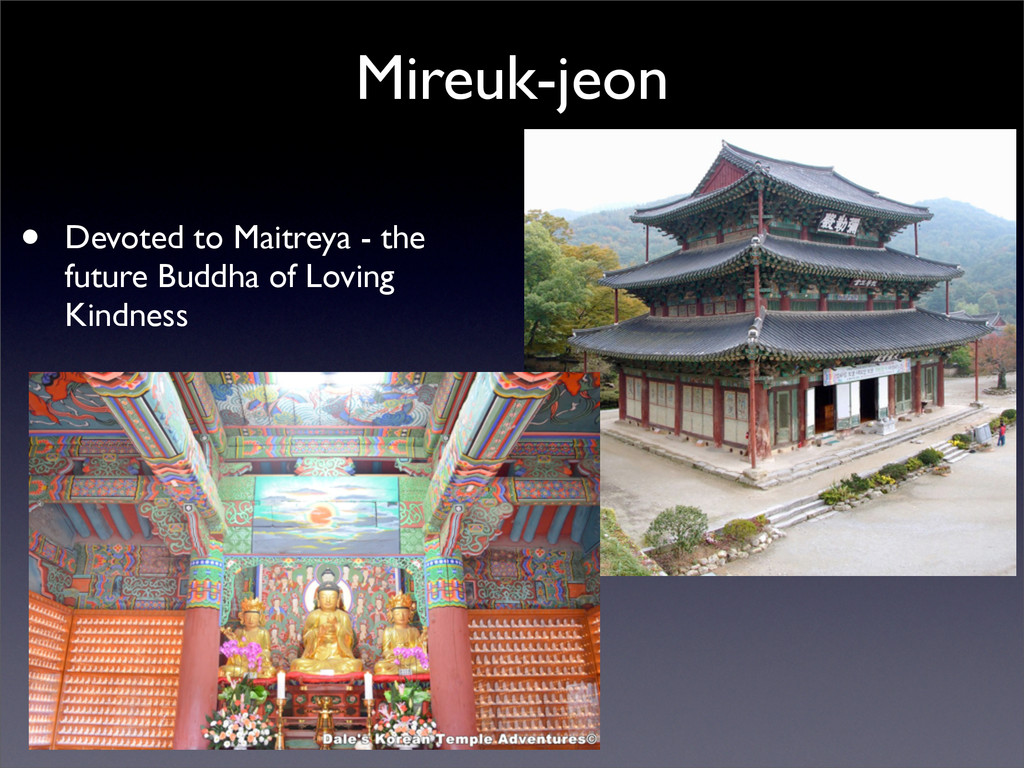
Mireuk-jeon • Devoted to Maitreya - the future Buddha of
Loving Kindness
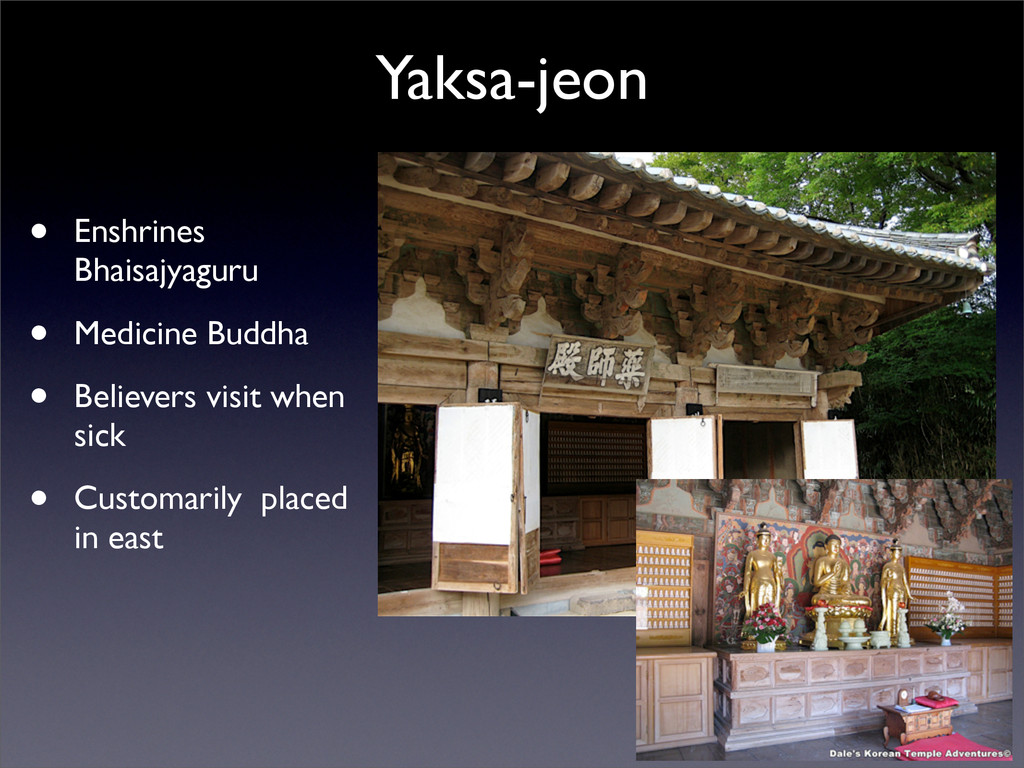
Yaksa-jeon • Enshrines Bhaisajyaguru • Medicine Buddha • Believers visit
when sick • Customarily placed in east
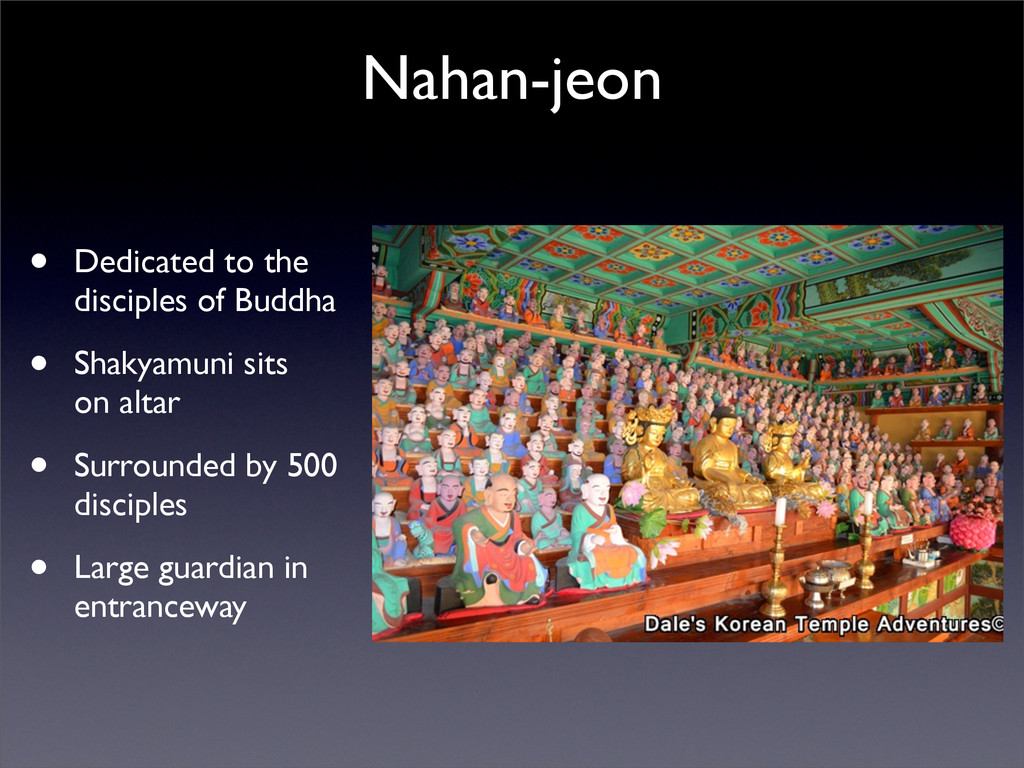
Nahan-jeon • Dedicated to the disciples of Buddha • Shakyamuni
sits on altar • Surrounded by 500 disciples • Large guardian in entranceway
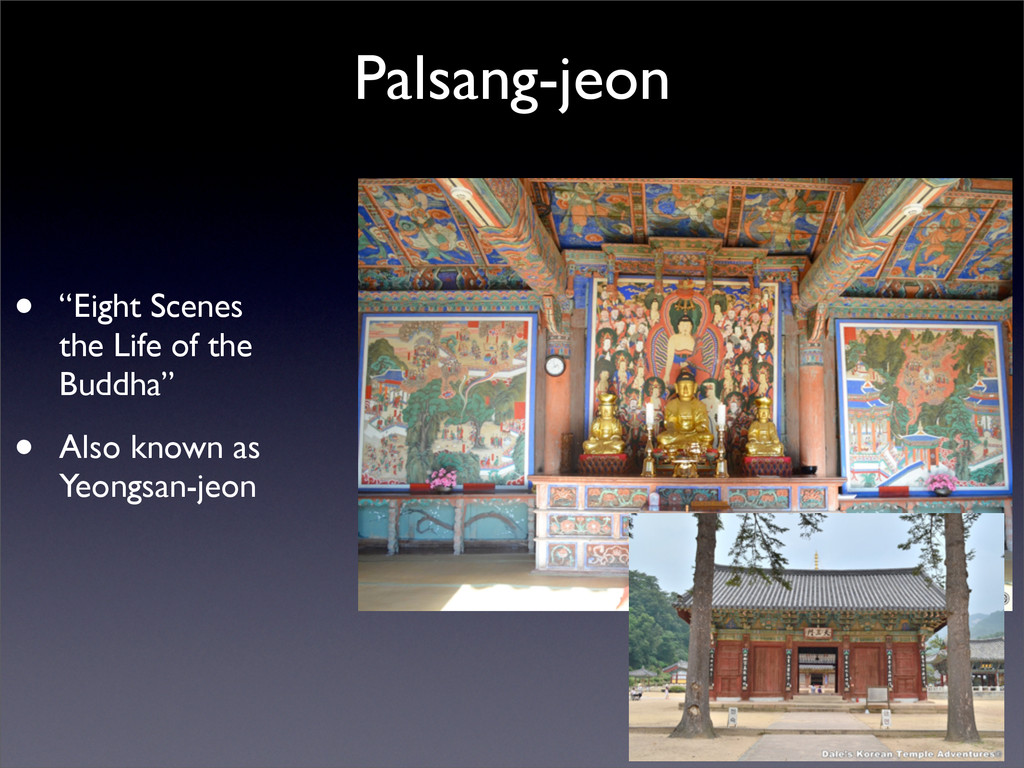
Palsang-jeon • “Eight Scenes from the Life of the Buddha”
• Also known as Yeongsan-jeon
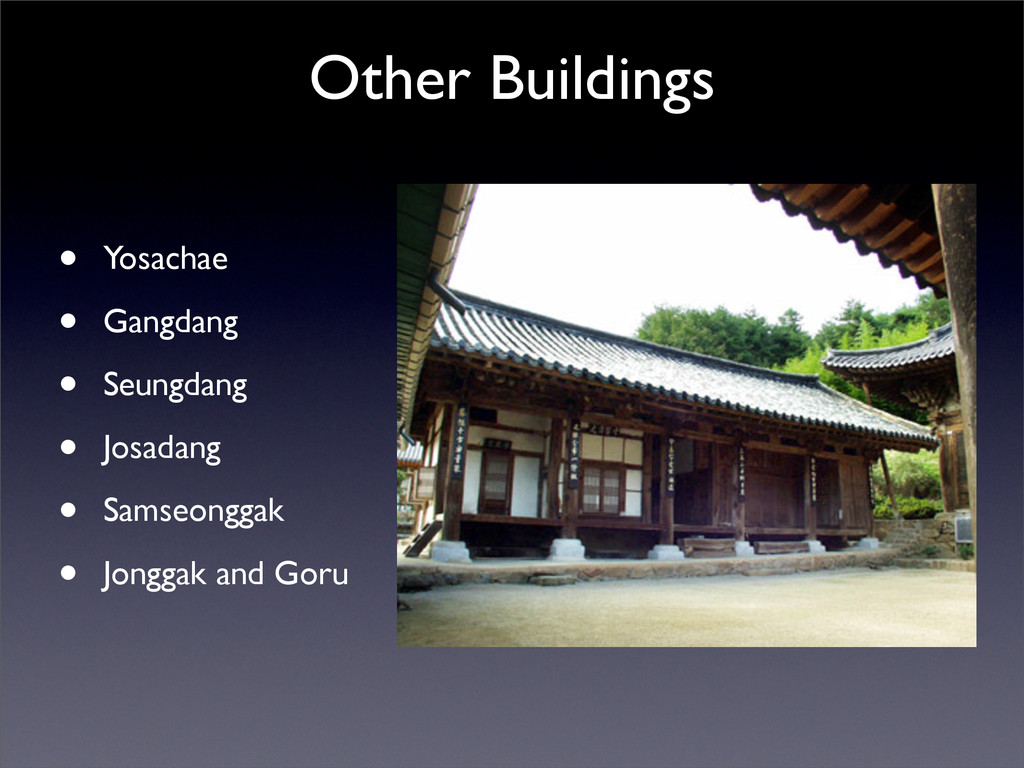
Other Buildings • Yosachae • Gangdang • Seungdang • Josadang
• Samseonggak • Jonggak and Goru
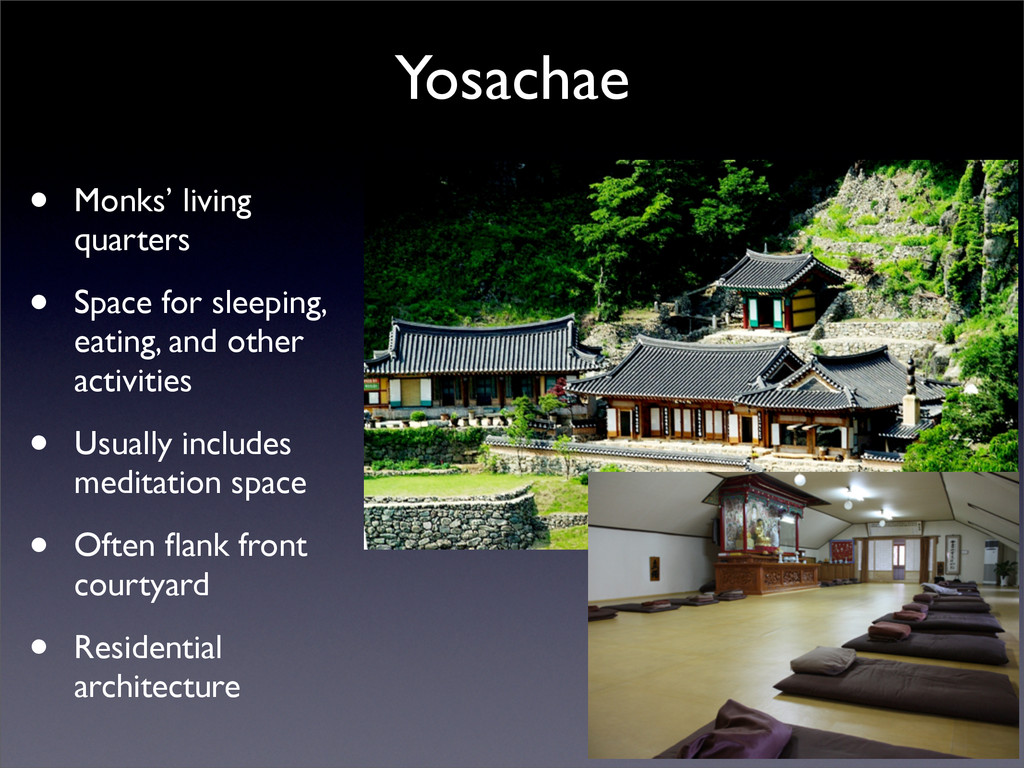
Yosachae • Monks’ living quarters • Space for sleeping, eating,
and other activities • Usually includes meditation space • Often flank front courtyard • Residential architecture
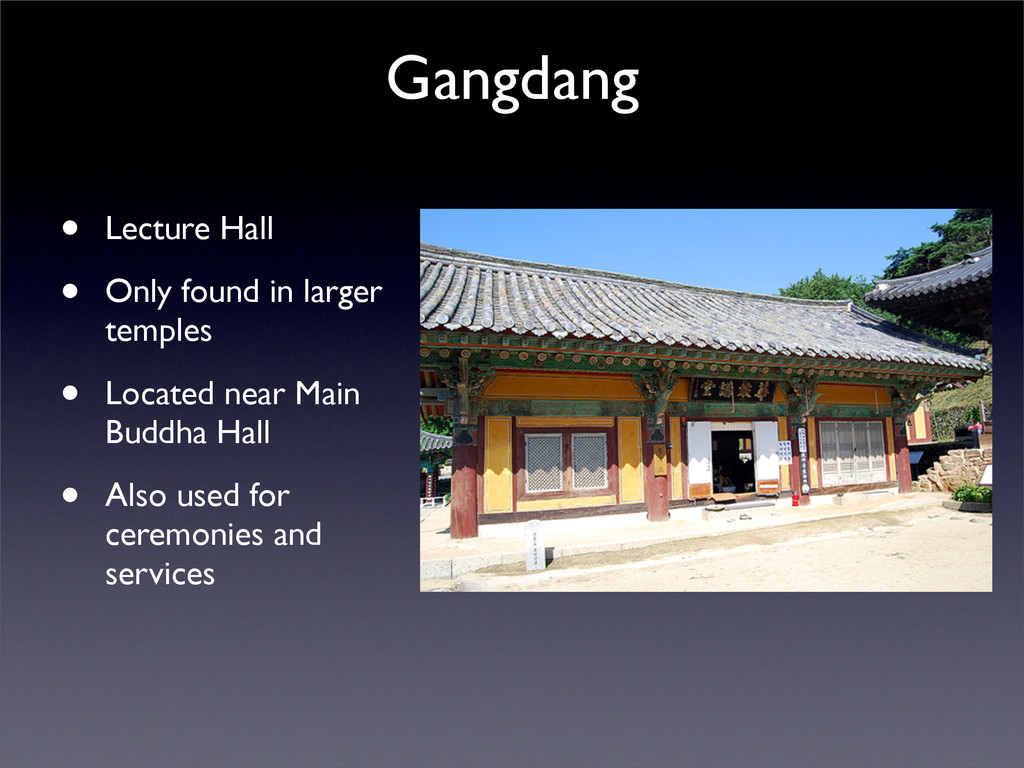
Gangdang • Lecture Hall • Only found in larger temples
• Located near Main Buddha Hall • Also used for ceremonies and services
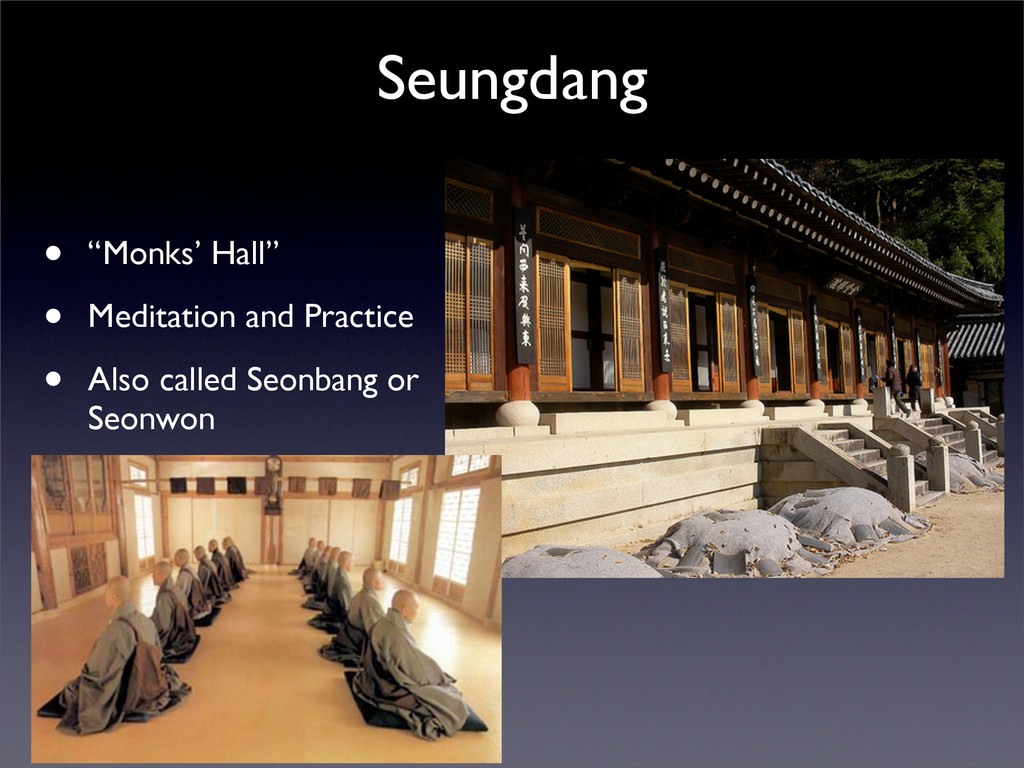
Seungdang • “Monks’ Hall” • Meditation and Practice • Also
called Seonbang or Seonwon
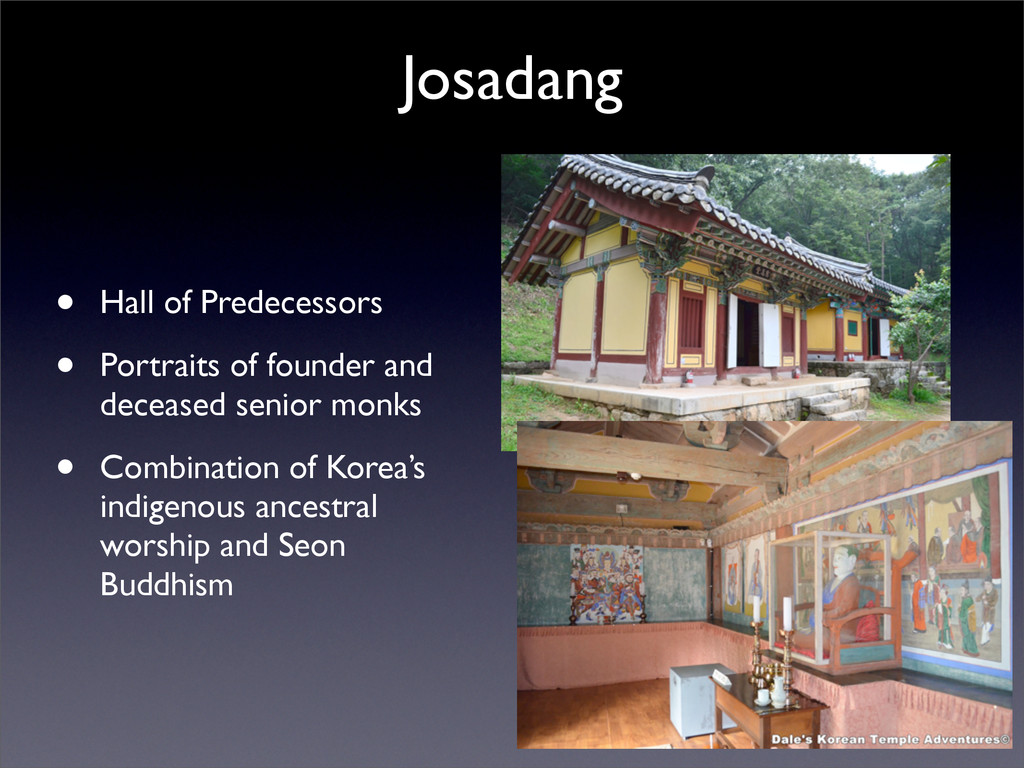
Josadang • Hall of Predecessors • Portraits of founder and
deceased senior monks • Combination of Korea’s indigenous ancestral worship and Seon Buddhism
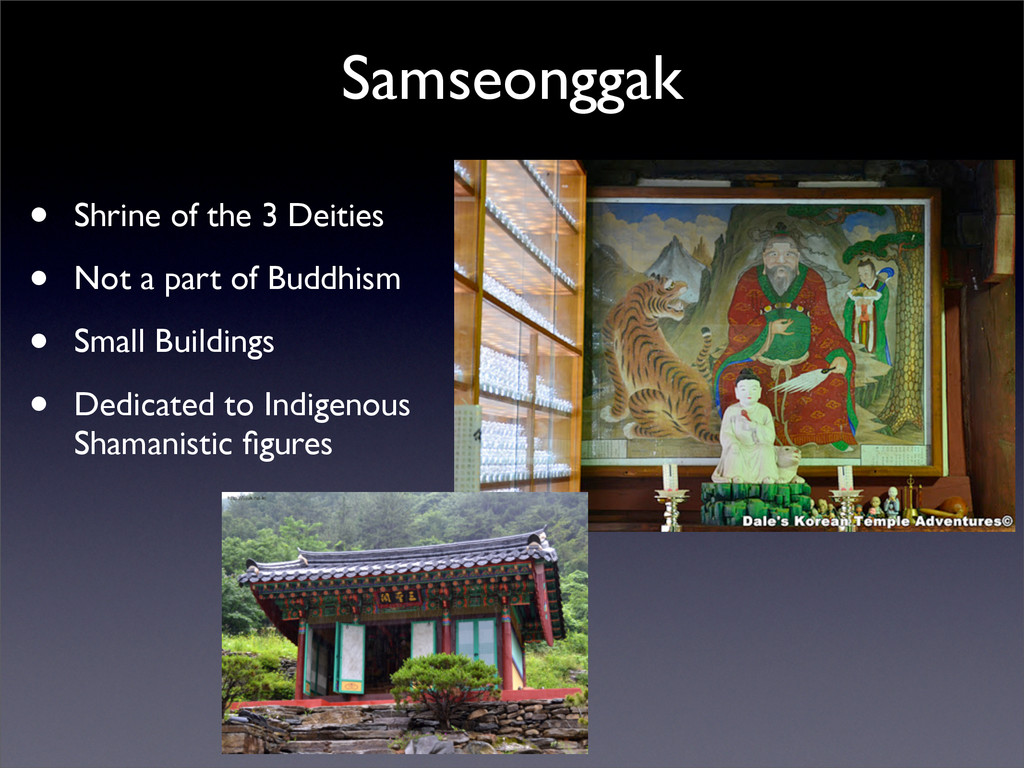
Samseonggak • Shrine of the 3 Deities • Not a
part of Buddhism • Small Buildings • Dedicated to Indigenous Shamanistic figures
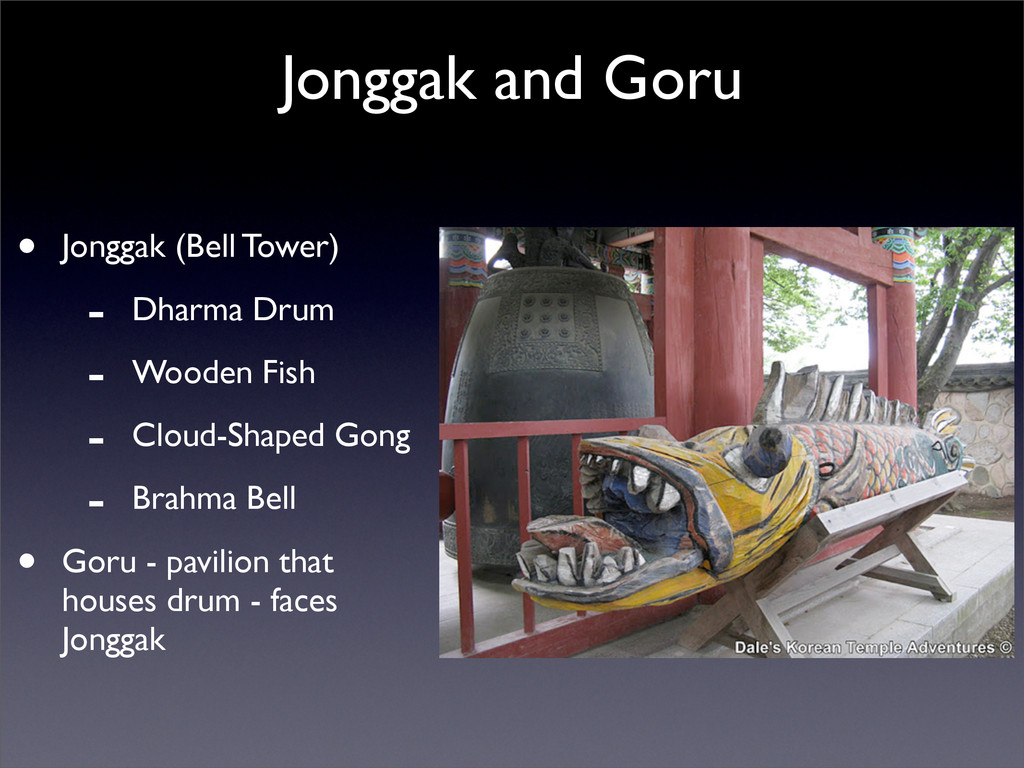
Jonggak and Goru • Jonggak (Bell Tower) - Dharma Drum
- Wooden Fish - Cloud-Shaped Gong - Brahma Bell • Goru - pavilion that houses drum - faces Jonggak
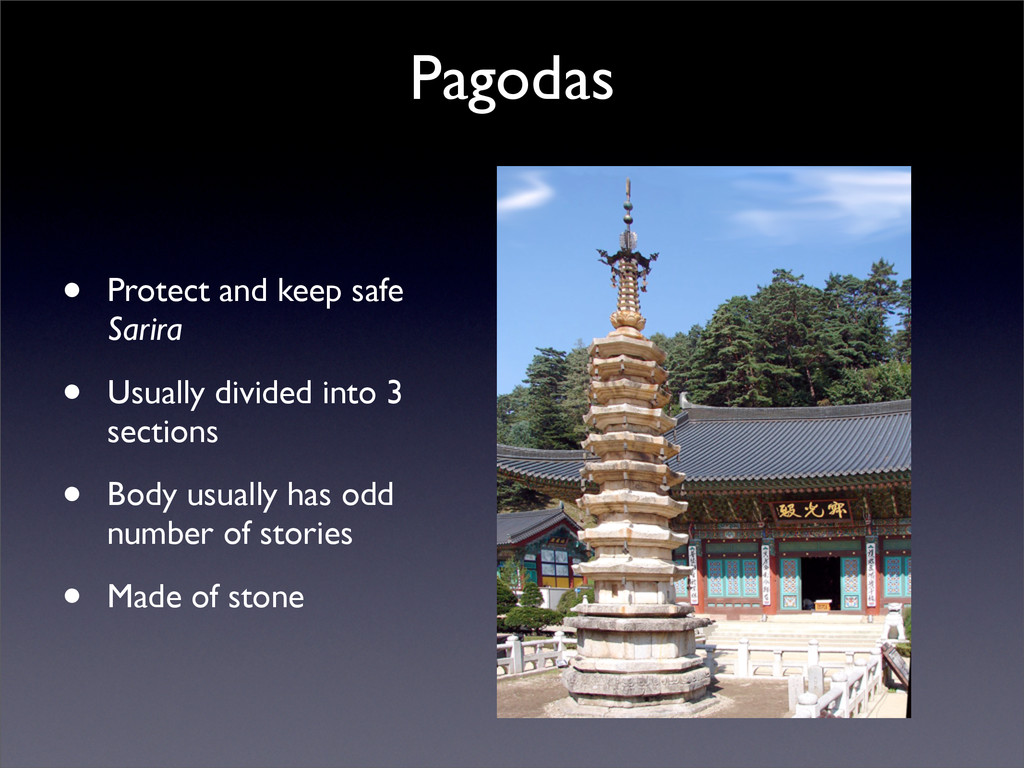
Pagodas • Protect and keep safe Sarira • Usually divided
into 3 sections • Body usually has odd number of stories • Made of stone
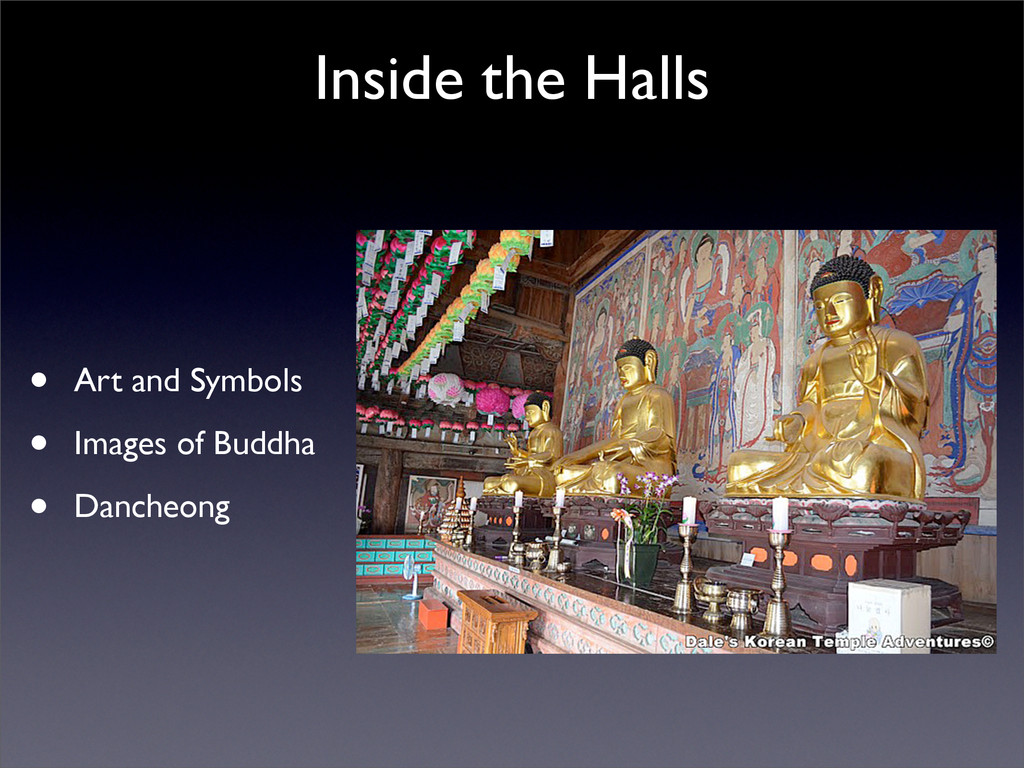
Inside the Halls • Art and Symbols • Images of
Buddha • Dancheong
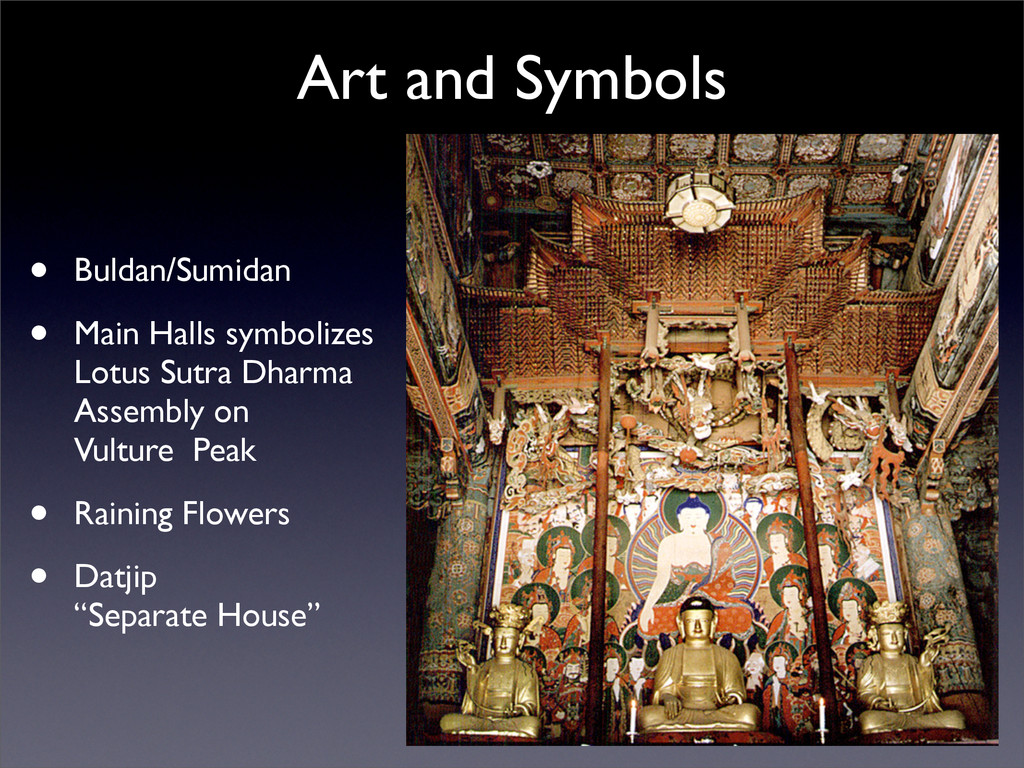
Art and Symbols • Buldan/Sumidan • Main Halls symbolizes Lotus
Sutra Dharma Assembly on Vulture Peak • Raining Flowers • Datjip “Separate House”
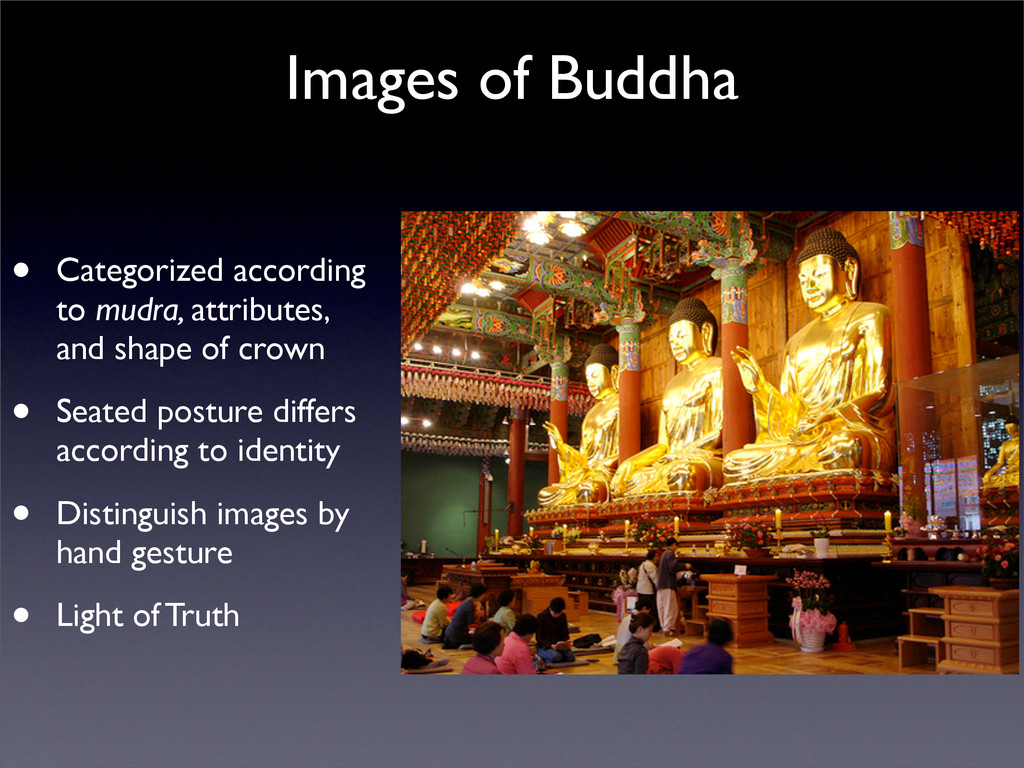
Images of Buddha • Categorized according to mudra, attributes, and
shape of crown • Seated posture differs according to identity • Distinguish images by hand gesture • Light of Truth
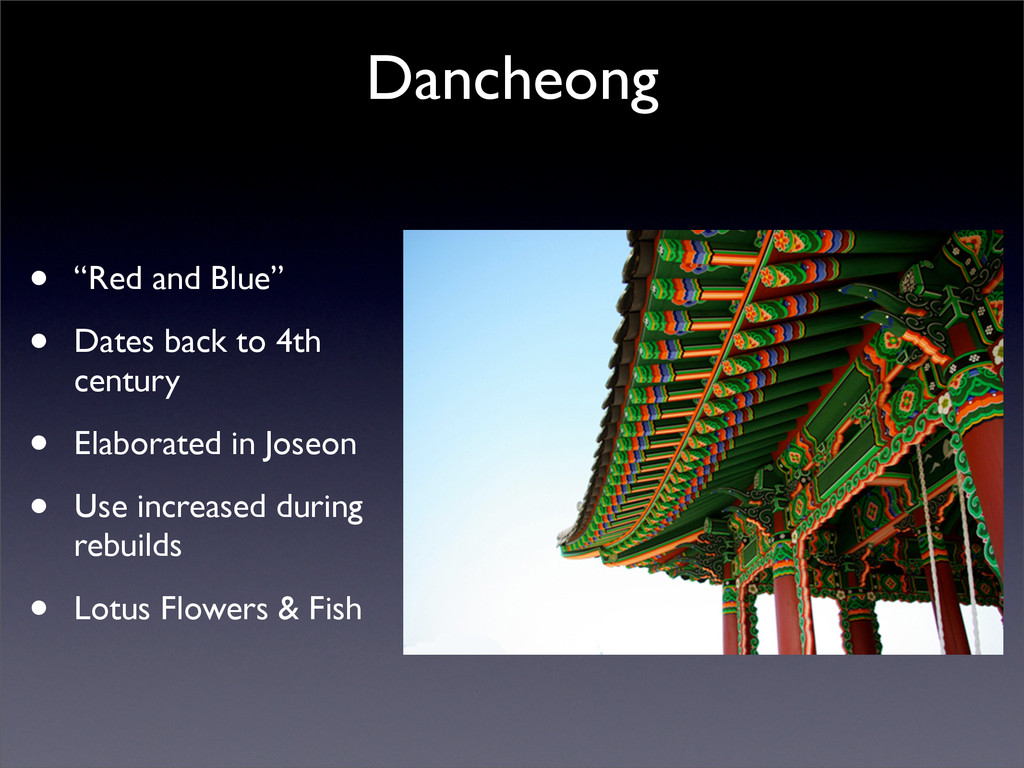
Dancheong • “Red and Blue” • Dates back to 4th
century • Elaborated in Joseon • Use increased during rebuilds • Lotus Flowers & Fish
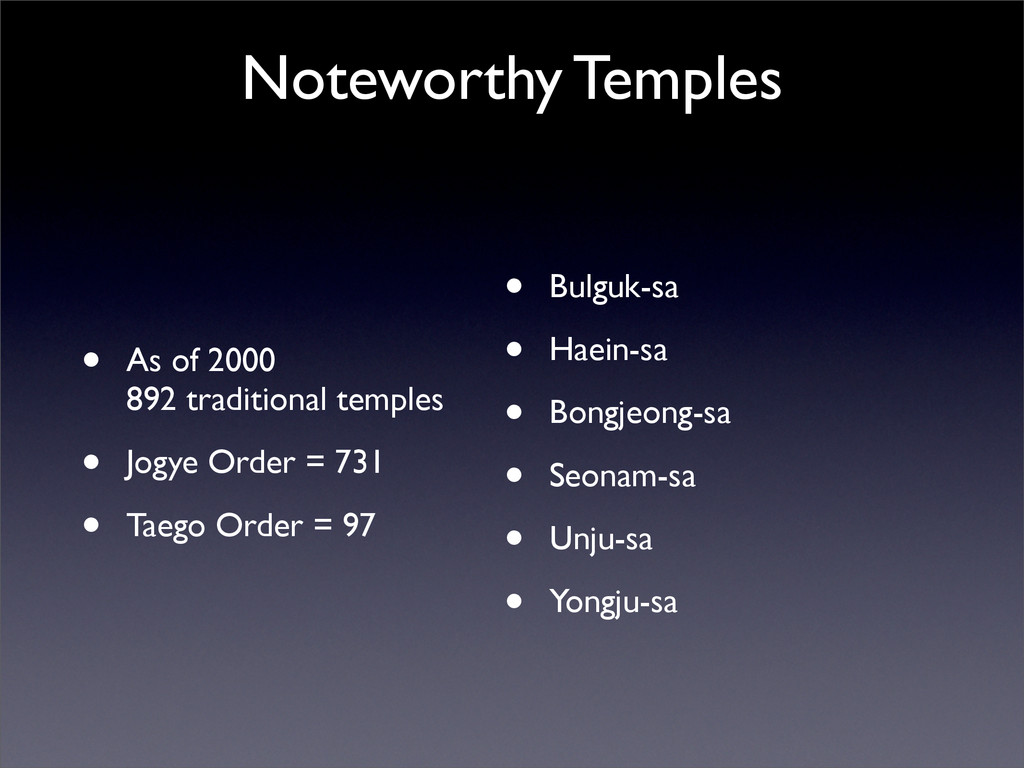
Noteworthy Temples • As of 2000 892 traditional temples •
Jogye Order = 731 • Taego Order = 97 • Bulguk-sa • Haein-sa • Bongjeong-sa • Seonam-sa • Unju-sa • Yongju-sa
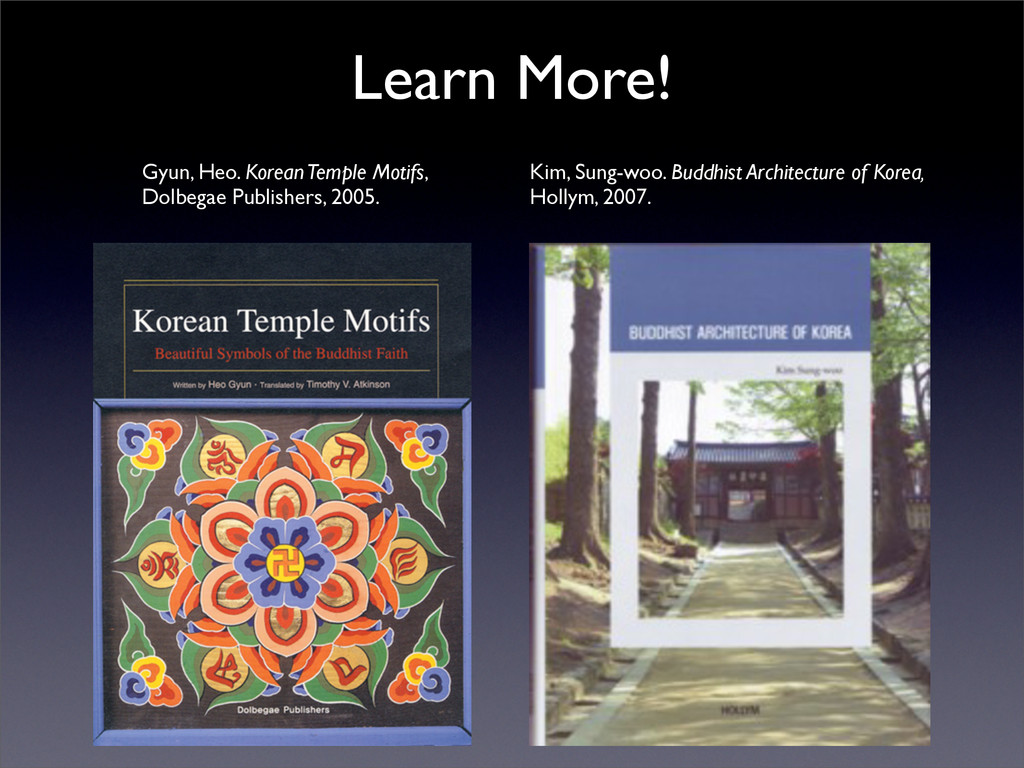
Learn More! Gyun, Heo. Korean Temple Motifs, Dolbegae Publishers, 2005.
Kim, Sung-woo. Buddhist Architecture of Korea, Hollym, 2007.
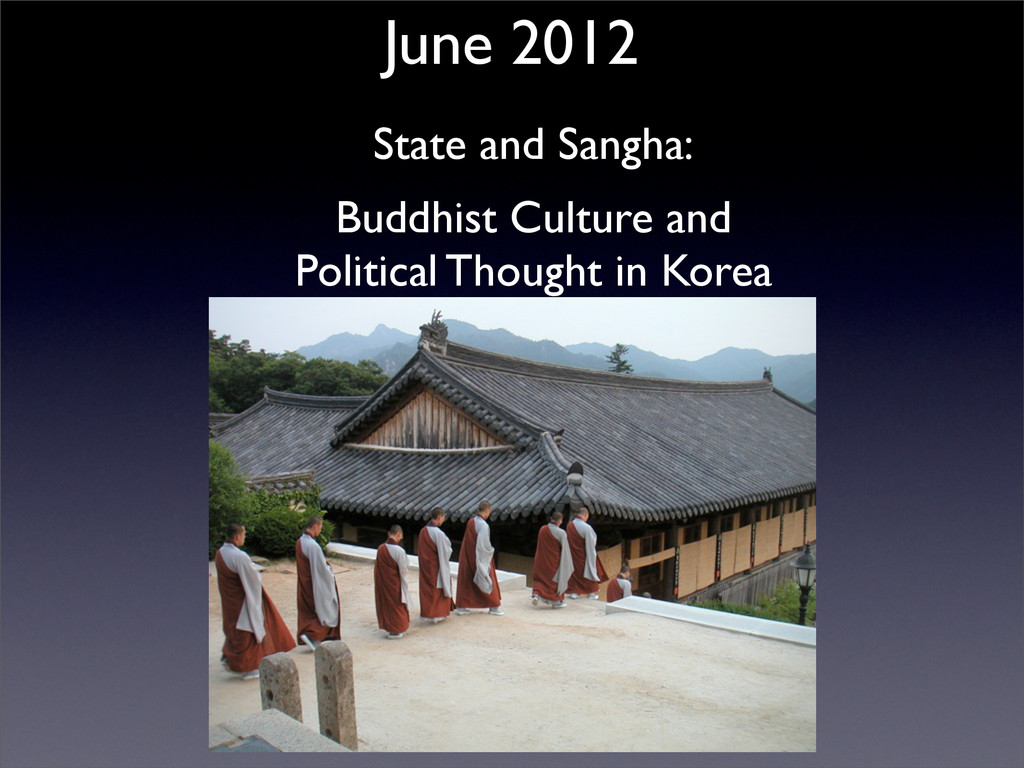
June 2012 State and Sangha: Buddhist Culture and Political Thought
in Korea


 caitiem20
 retrage
 brettharned
 davetheseo
 cromwellryan
 bethany
 cassininazir
 nwiizo
 tammyeverts
 jonoalderson
 hatefulcrawdad
 csswizardry