Upgrade to Pro — share decks privately, control downloads, hide ads and more …

How the Manufacturing Industry Uses CAD

Avatar for CADVisionEngineers CADVisionEngineers
February 08, 2024
16

How the Manufacturing Industry Uses CAD

Before delving into the intricacies of CAD and its future implications, let’s start with the obvious question: What is CAD in manufacturing?

CAD (computer-aided design) is an indispensable technology in the manufacturing industry. It has revolutionized product development — pivotal in a commercially driven market where efficiency is paramount and dictated by how products are conceptualized, designed, developed, and brought to market.

Avatar for CADVisionEngineers

CADVisionEngineers

February 08, 2024

Transcript

  1. How the Manufacturing Industry Uses CAD: Established Practices and New

    Trends CAD's Impact on Product Development and Future Implications
  2. Introduction to CAD in Manufacturing CAD (computer-aided design) is a

    technology integral to the manufacturing industry, revolutionizing product development processes. Pivotal Role in Product Development: • Efficiency Enabler • Accuracy and Precision • Cost-Efficiency Driver • Market Adaptability • Innovation Catalyst
  3. CAD Manufacturing Trends • Global CAD market projection (US$ 20,039.4

    million by 2033). • Diverse application areas across industries: packaging, manufacturing, automotive, defense, aerospace. • Specific applications: conceptual designs, product layouts, manufacturing, assembly process analysis.
  4. Evolution of CAD • Historical development from basic wireframe models

    to advanced 3D modeling. • Introduction of parametric modeling and its significance. • Integration with CAM and CAE for enhanced manufacturing workflows
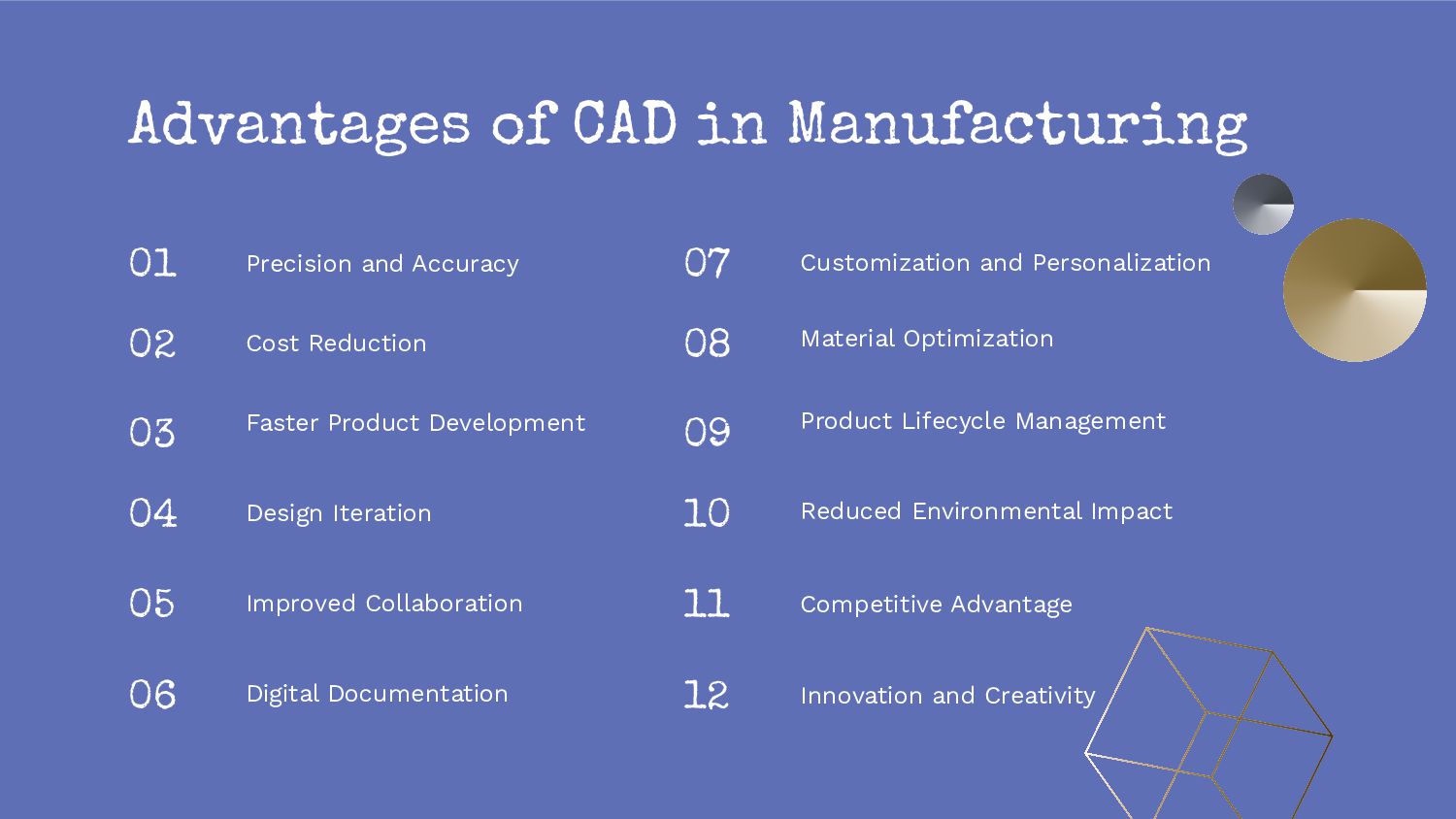
  5. Advantages of CAD in Manufacturing 01 03 02 05 04

    06 Precision and Accuracy Cost Reduction Improved Collaboration Faster Product Development Design Iteration Digital Documentation 07 09 08 11 10 12 Customization and Personalization Material Optimization Product Lifecycle Management Reduced Environmental Impact Competitive Advantage Innovation and Creativity
  6. Established Practices in CAD Product Design and Prototyping: • Role

    in designing detailed product models and prototypes. Quality Control and Inspection: • Utilization for maintaining quality standards and identification of discrepancies. Assembly and Production Planning: • CAD's role in optimizing manufacturing processes and assembly line layouts. Documentation and Communication: • Generation of detailed 2D drawings, assembly instructions, and BOM.
  7. New Trends in CAD Technology • Augmented Reality (AR) applications

    in CAD. • Virtual Reality's (VR) impact on design visualization. • Cloud Computation and Integration benefits. • Emergence of Generative Design and its significance. • Fully Immersive 3D Experience potential.
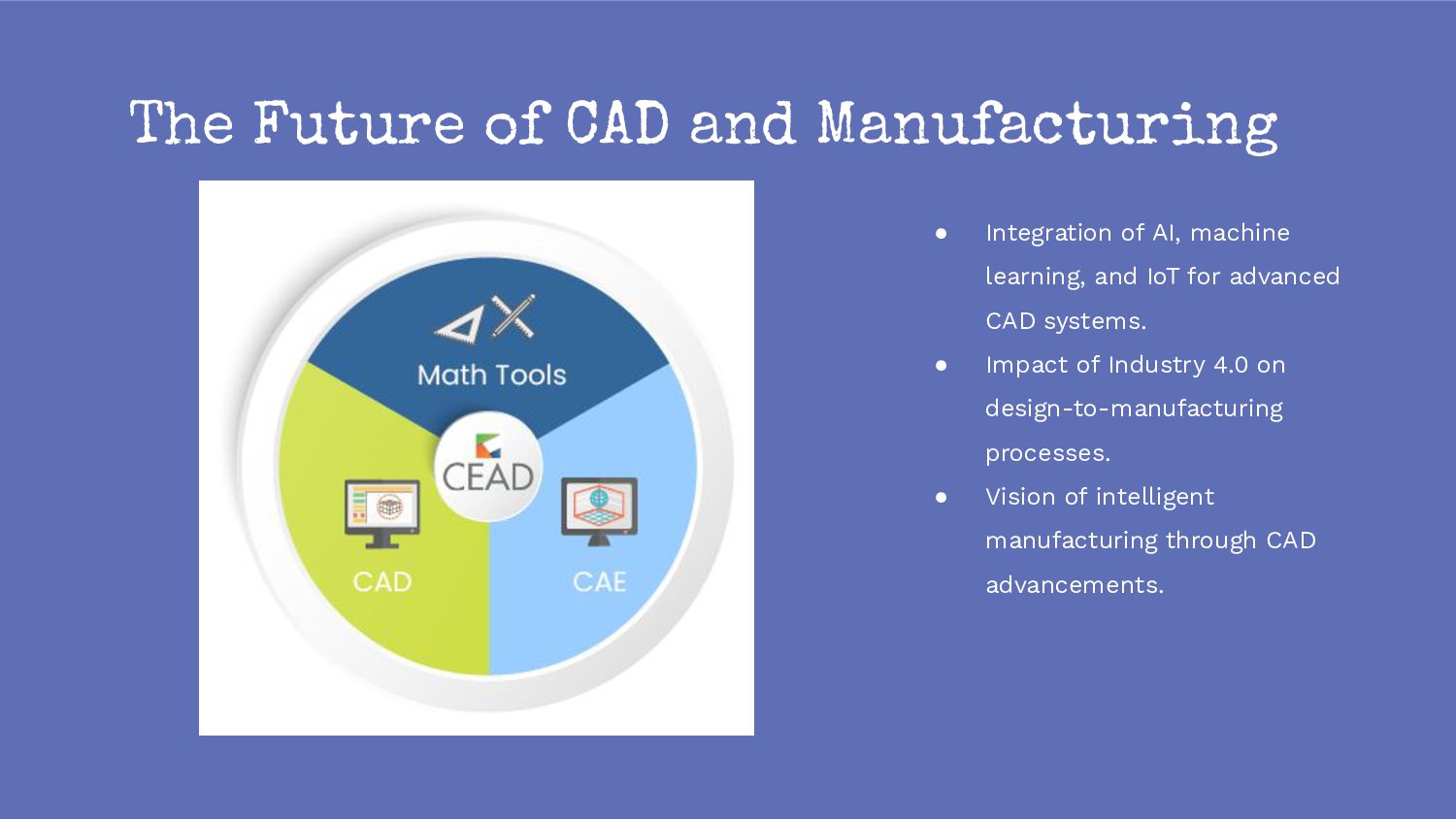
  8. The Future of CAD and Manufacturing • Integration of AI,

    machine learning, and IoT for advanced CAD systems. • Impact of Industry 4.0 on design-to-manufacturing processes. • Vision of intelligent manufacturing through CAD advancements.
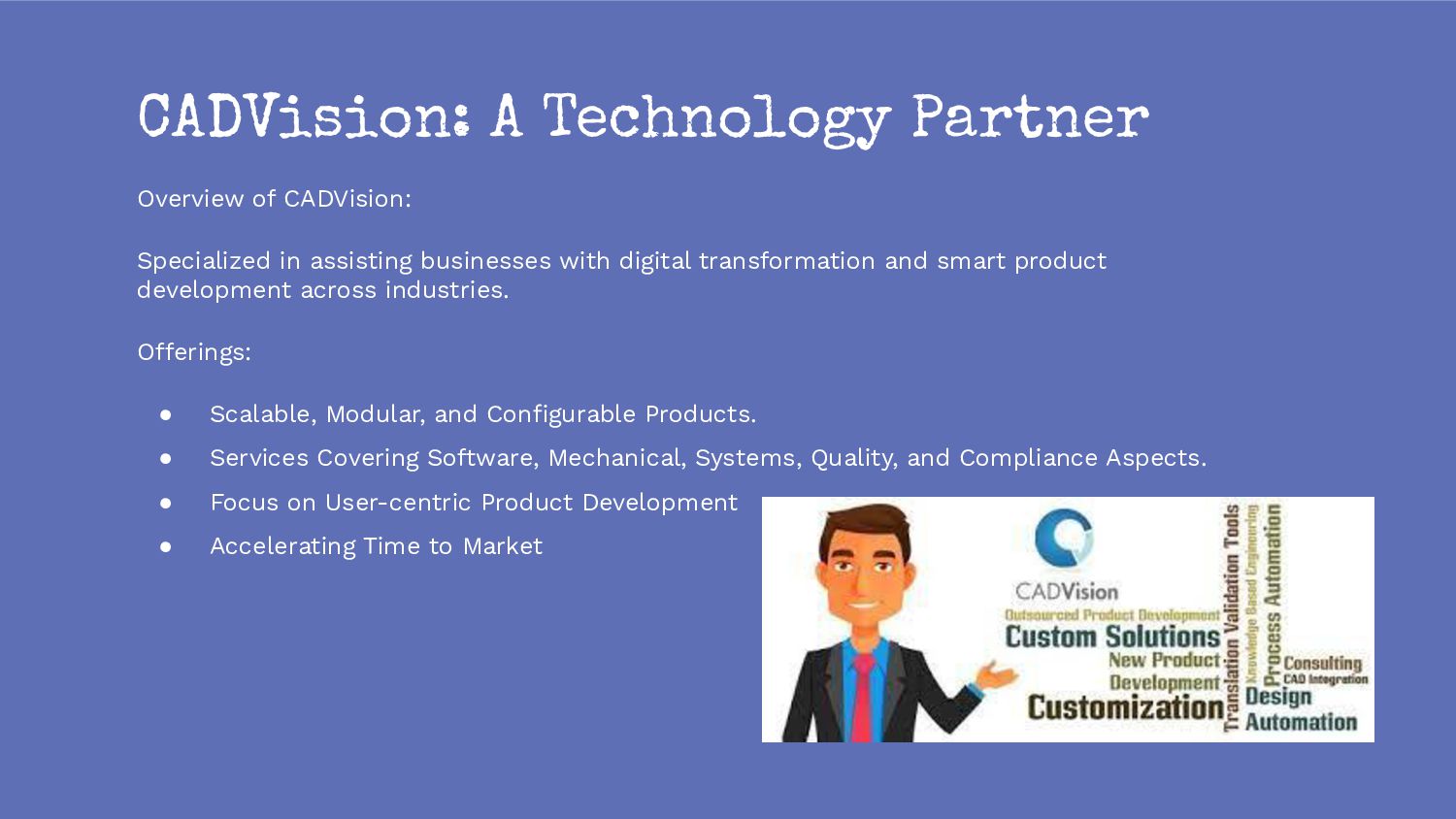
  9. CADVision: A Technology Partner Overview of CADVision: Specialized in assisting

    businesses with digital transformation and smart product development across industries. Offerings: • Scalable, Modular, and Configurable Products. • Services Covering Software, Mechanical, Systems, Quality, and Compliance Aspects. • Focus on User-centric Product Development • Accelerating Time to Market
  10. Conclusion • Reinforce the transformative impact of CAD on the

    manufacturing landscape. • Emphasize the continuous evolution towards intelligent manufacturing through CAD advancements.