four valves — think of them as one-way doors that keep Heart Valve Disorder Guidance Expert Online Cardiology Consultation Book Your Consultation E C H O F I R S T · S TA G E A – D · C L E A R P L A N CARDIOVERSEMD ✓ Board-Certified FACC • ✓ 17+ Years Experience • ✓ No Referral Needed • ✓ Self-Pay • ✓ All 50 States Learn more
(BAV) — The #1 Congenital Heart Defect About 1–2% of people are born with only two aortic valve leaflets instead of three. This bicuspid valve works fine for decades, but tends to calcify and stiffen in the early 50s — earlier than most patients or their doctors expect. I have lost count of how many patients I've seen who were told for years, “it's just a murmur,” only to finally get a proper echo and discover significant aortic stenosis from an undiagnosed bicuspid valve. BAV is also an aorta problem, not just a valve problem. Up to 80% of BAV patients have some degree of aortic root or ascending aorta dilation. The 2022 ACC/AHA guidelines recommend lifelong aortic surveillance and screening of all first-degree relatives. An ascending aorta ≥4.5 cm in a BAV patient requires urgent specialist evaluation. Calcific Aortic Stenosis — Affecting Patients Over 70 blood moving in the right direction. When a valve becomes too stiff to open fully, or leaks blood backward when it should be closed, that's a heart valve disorder. It puts your heart under constant extra workload, and over time, that stress adds up. Today in the U.S., the majority of valve problems we see are degenerative — caused by aging and calcium buildup — rather than the rheumatic disease (from strep infections) that dominated cardiology a generation ago. According to JACC Advances 2024, an estimated 74 million people worldwide live with valve disease, with 69% of new diagnoses occurring in patients over 65. The good news: modern heart valve disorder treatment options — including minimally invasive procedures that don't require open-heart surgery — have completely changed the outlook for patients at every age.
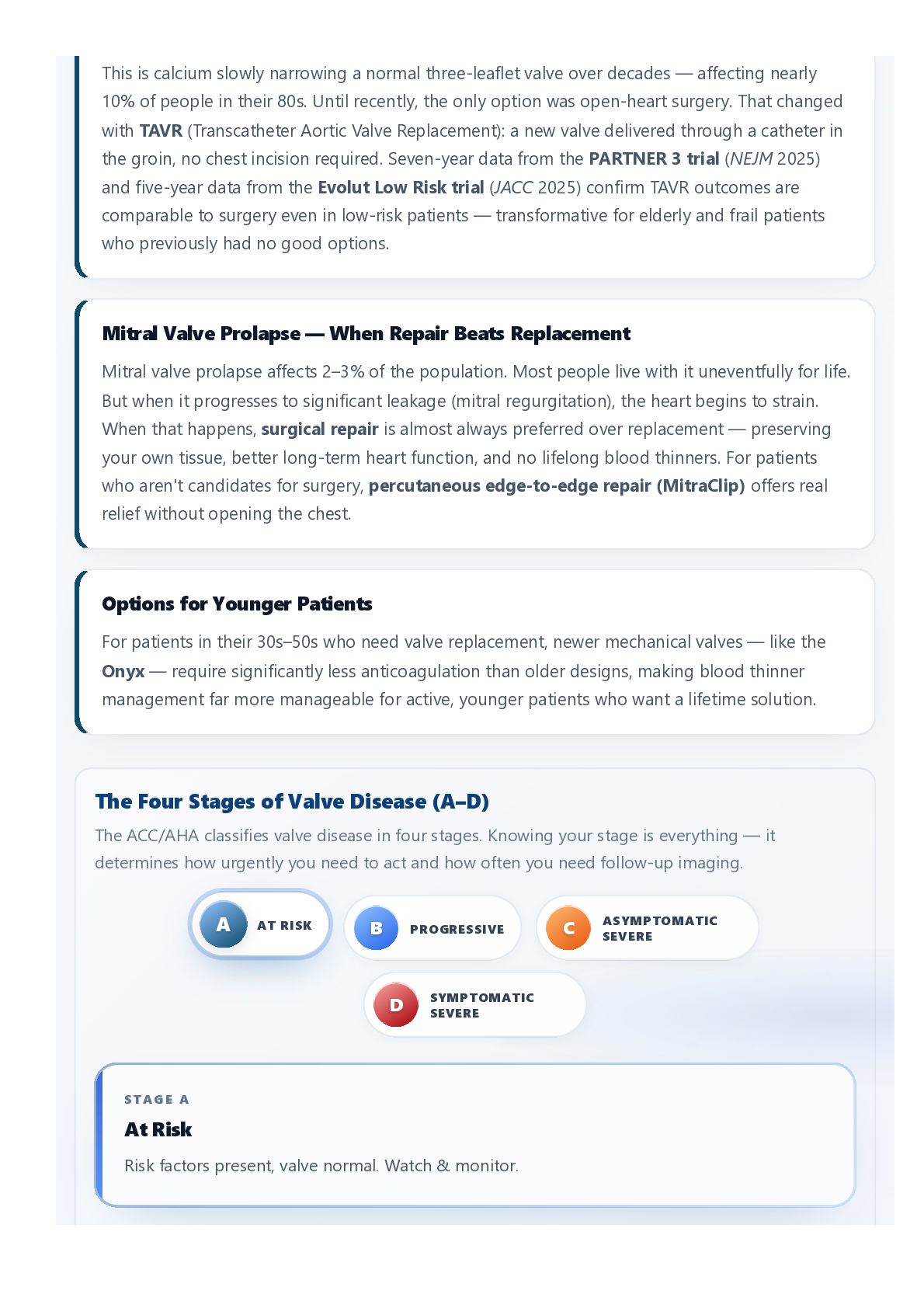
decades — affecting nearly 10% of people in their 80s. Until recently, the only option was open-heart surgery. That changed with TAVR (Transcatheter Aortic Valve Replacement): a new valve delivered through a catheter in the groin, no chest incision required. Seven-year data from the PARTNER 3 trial (NEJM 2025) and five-year data from the Evolut Low Risk trial (JACC 2025) confirm TAVR outcomes are comparable to surgery even in low-risk patients — transformative for elderly and frail patients who previously had no good options. Mitral Valve Prolapse — When Repair Beats Replacement Mitral valve prolapse affects 2–3% of the population. Most people live with it uneventfully for life. But when it progresses to significant leakage (mitral regurgitation), the heart begins to strain. When that happens, surgical repair is almost always preferred over replacement — preserving your own tissue, better long-term heart function, and no lifelong blood thinners. For patients who aren't candidates for surgery, percutaneous edge-to-edge repair (MitraClip) offers real relief without opening the chest. Options for Younger Patients For patients in their 30s–50s who need valve replacement, newer mechanical valves — like the Onyx — require significantly less anticoagulation than older designs, making blood thinner management far more manageable for active, younger patients who want a lifetime solution. The Four Stages of Valve Disease (A–D) The ACC/AHA classifies valve disease in four stages. Knowing your stage is everything — it determines how urgently you need to act and how often you need follow-up imaging. AT RISK A A B B PROGRESSIVE C C ASYMPTOMATIC SEVERE D D SYMPTOMATIC SEVERE STAGE A At Risk Risk factors present, valve normal. Watch & monitor.
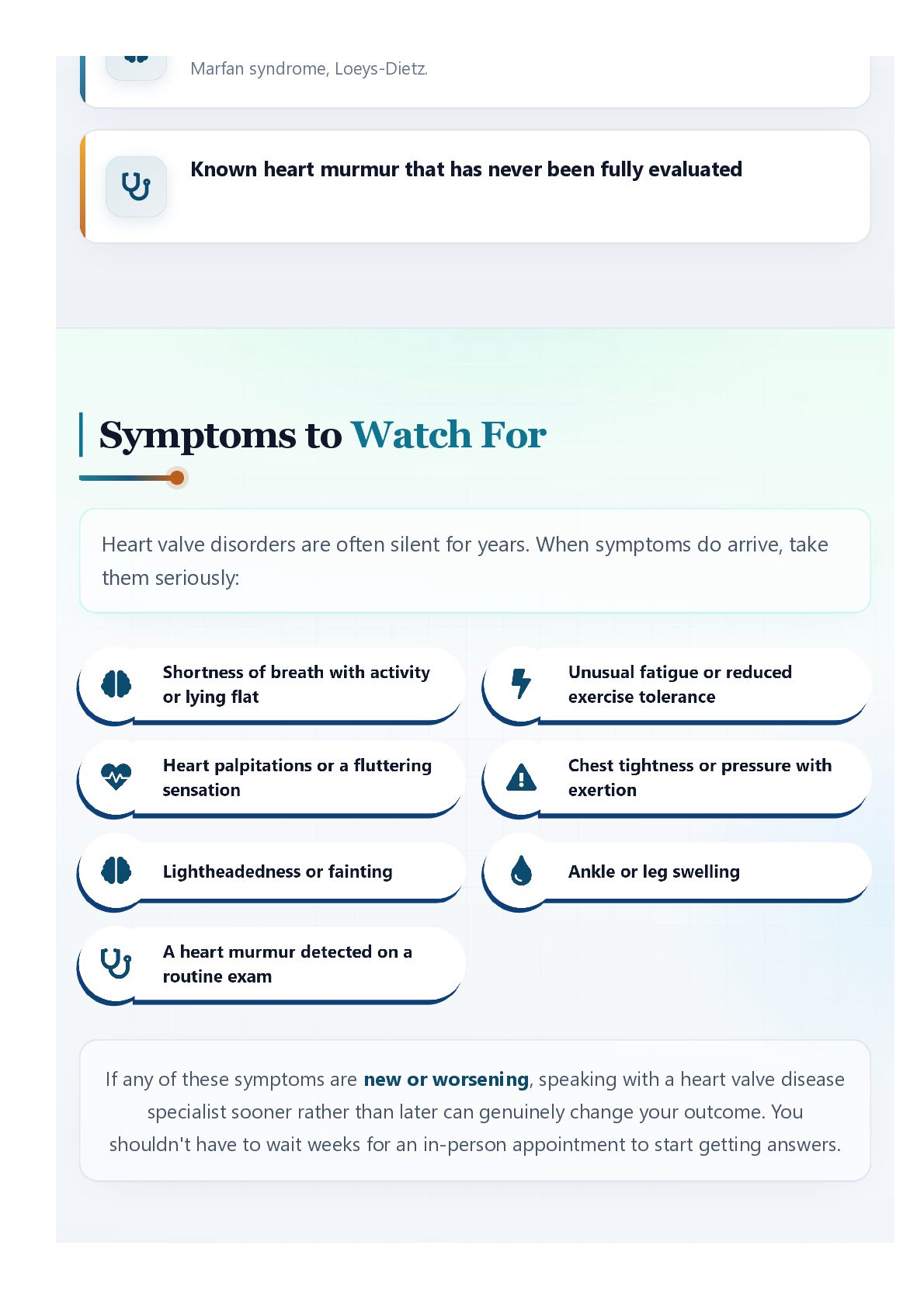
often identify as needing closer monitoring: Echo first, everything else follows. A transthoracic echocardiogram (heart ultrasound) is the painless, non-invasive starting point for diagnosing and staging any valve disorder. Once identified, serial echos track progression for years — often long before any intervention is needed. Age 65+ Calcification increases sharply with every decade. Bicuspid aortic valve (and their first-degree relatives) High blood pressure or high cholesterol Accelerate valve calcification. Prior rheumatic fever, endocarditis, or chest radiation Connective tissue disorders Choose a stage to see how ACC/AHA classifies progression.
fully evaluated Symptoms to Watch For Heart valve disorders are often silent for years. When symptoms do arrive, take them seriously: If any of these symptoms are new or worsening, speaking with a heart valve disease specialist sooner rather than later can genuinely change your outcome. You shouldn't have to wait weeks for an in-person appointment to start getting answers.
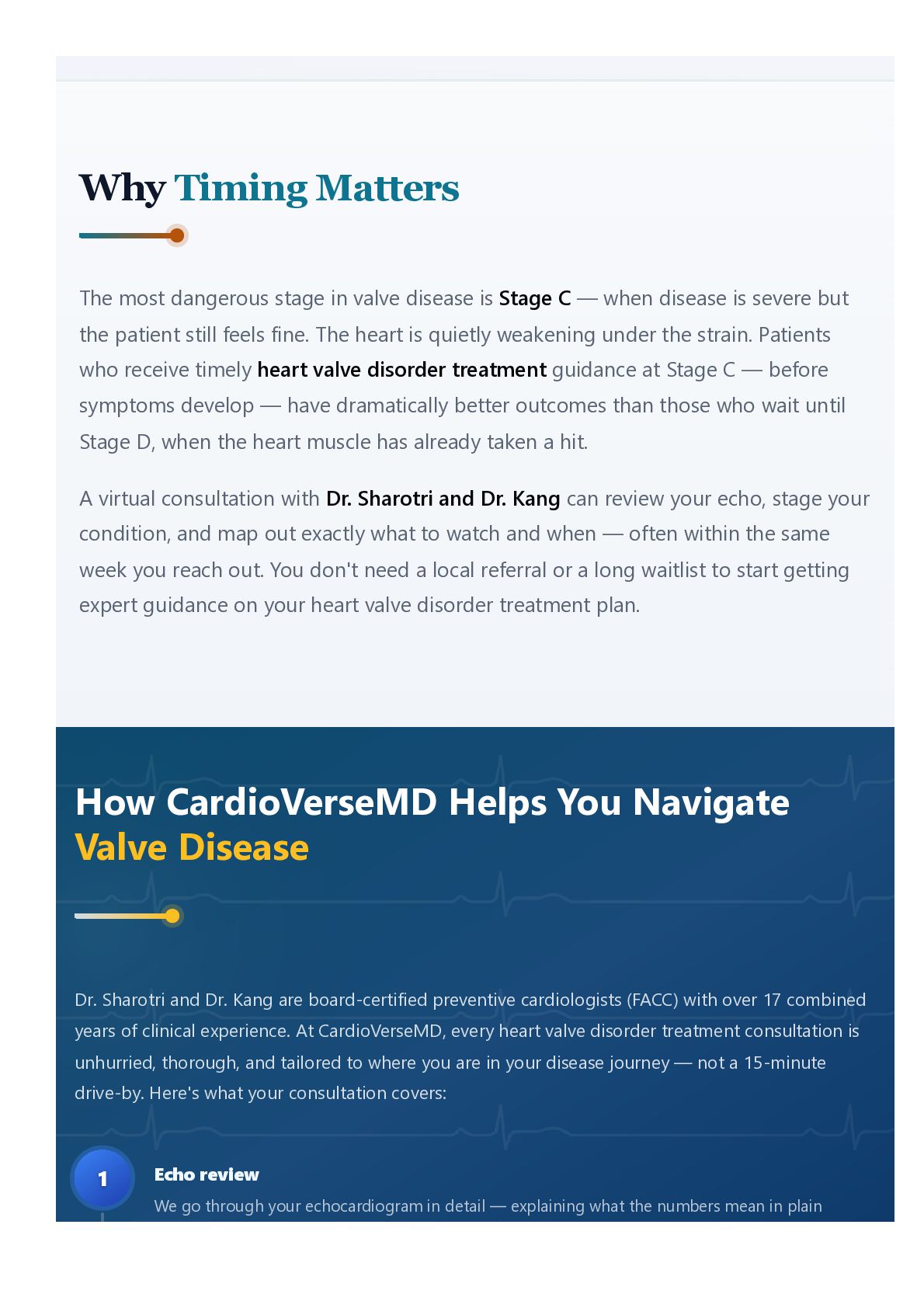
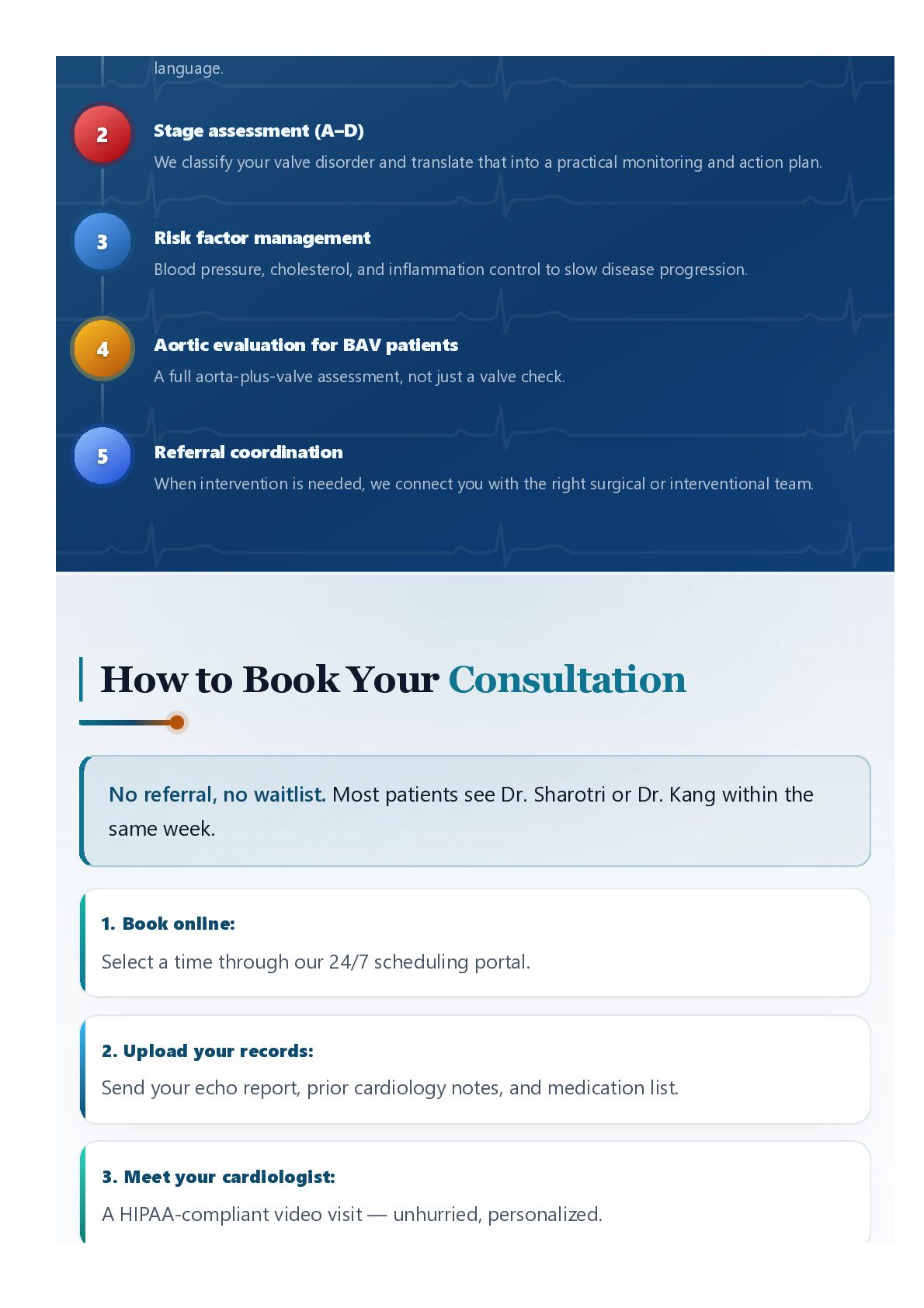
is Stage C — when disease is severe but the patient still feels fine. The heart is quietly weakening under the strain. Patients who receive timely heart valve disorder treatment guidance at Stage C — before symptoms develop — have dramatically better outcomes than those who wait until Stage D, when the heart muscle has already taken a hit. A virtual consultation with Dr. Sharotri and Dr. Kang can review your echo, stage your condition, and map out exactly what to watch and when — often within the same week you reach out. You don't need a local referral or a long waitlist to start getting expert guidance on your heart valve disorder treatment plan. How CardioVerseMD Helps You Navigate Valve Disease Dr. Sharotri and Dr. Kang are board-certified preventive cardiologists (FACC) with over 17 combined years of clinical experience. At CardioVerseMD, every heart valve disorder treatment consultation is unhurried, thorough, and tailored to where you are in your disease journey — not a 15-minute drive-by. Here's what your consultation covers: Echo review We go through your echocardiogram in detail — explaining what the numbers mean in plain 1 1
translate that into a practical monitoring and action plan. Risk factor management Blood pressure, cholesterol, and inflammation control to slow disease progression. Aortic evaluation for BAV patients A full aorta-plus-valve assessment, not just a valve check. Referral coordination When intervention is needed, we connect you with the right surgical or interventional team. 2 2 3 3 4 4 5 5 How to Book Your Consultation No referral, no waitlist. Most patients see Dr. Sharotri or Dr. Kang within the same week. 1. Book online: Select a time through our 24/7 scheduling portal. 2. Upload your records: Send your echo report, prior cardiology notes, and medication list. 3. Meet your cardiologist: A HIPAA-compliant video visit — unhurried, personalized.
superbill for potential insurance reimbursement. 4. Receive your plan: A written summary within 24 hours: your stage, monitoring schedule, lifestyle guidance, and referral recommendations if needed. Frequently Asked Questions What exactly is a heart valve disorder, and how does it affect the heart? Do I need a referral to consult with a heart valve disease specialist at CardioVerseMD? Can heart valve disorder treatment really be guided virtually? What will I actually learn during my consultation? Is the consultation covered by insurance? How is CardioVerseMD different from seeing a local heart valve disease specialist? I have a bicuspid aortic valve. Do I really need to worry about my aorta too? 01 02 03 04 05 06 07
disorder treatment for me? Can mitral valve prolapse be managed without surgery? Can Dr. Sharotri and Dr. Kang help with prevention, not just treatment? 08 09 10 Facebook Instagram About Us Blog Contact Us Privacy Policy Terms & Conditions Start Understanding Your Heart Valves Today Virtual • No Referral • Self-Pay • Board-Certified • Nationwide Book Your Consultation


 baasie
 jnunemaker
 aleyda
 sabderemane
 mclloyd
 mraible
 tamaranovitovic
 keathley
 62gerente
 emna__ayadi
 minecr