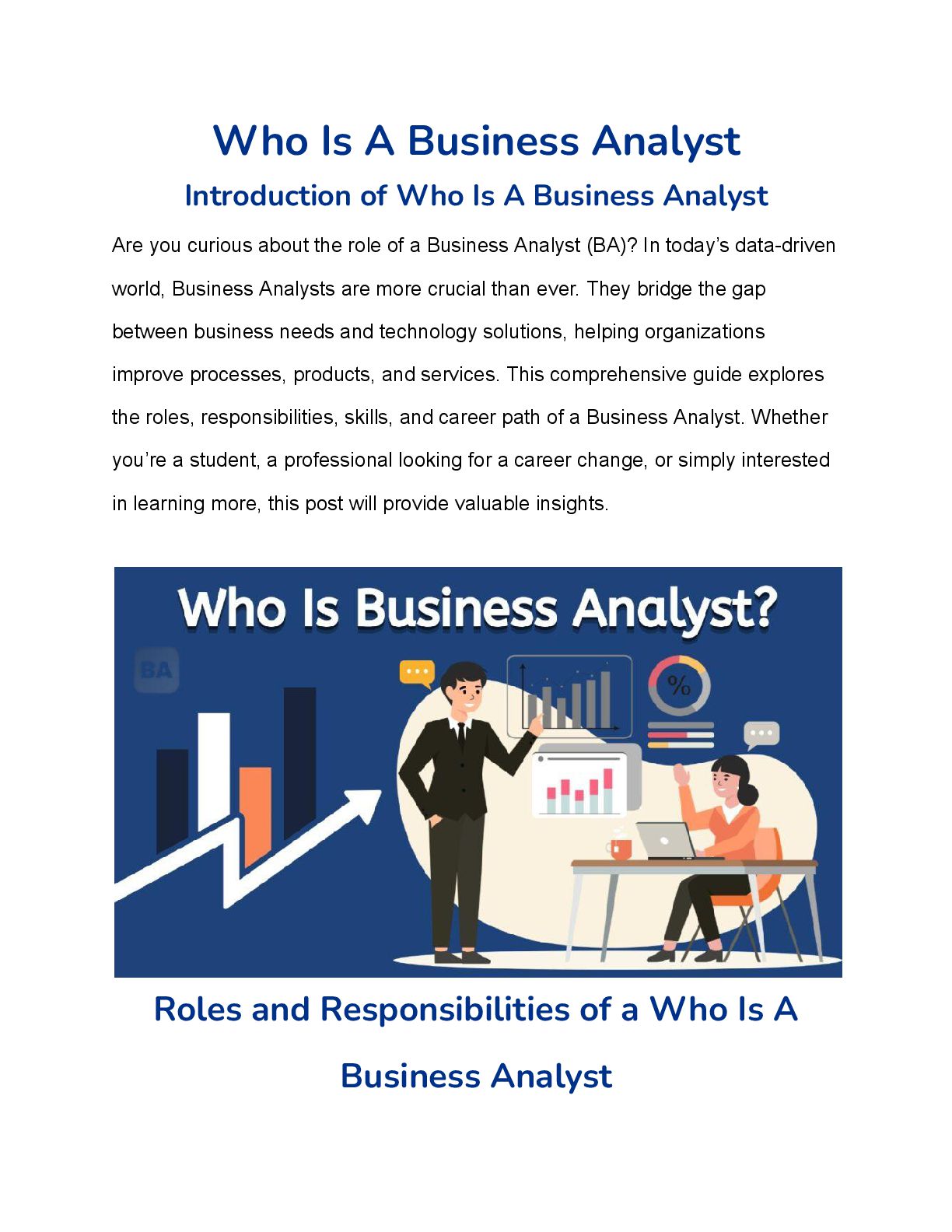
Who Is A Business Analyst Act as Bridge Between Business Needs & Technological teams. To understand Problem statement with well define workflow or Documentation.
Business Analyst Are you curious about the role of a Business Analyst (BA)? In today’s data-driven world, Business Analysts are more crucial than ever. They bridge the gap between business needs and technology solutions, helping organizations improve processes, products, and services. This comprehensive guide explores the roles, responsibilities, skills, and career path of a Business Analyst. Whether you’re a student, a professional looking for a career change, or simply interested in learning more, this post will provide valuable insights. Roles and Responsibilities of a Who Is A Business Analyst
on the organization and project. However, some core responsibilities remain consistent. Key responsibilities include: • Requirements Elicitation and Analysis: Gathering, documenting, and analyzing business requirements from stakeholders. This involves techniques like interviews, workshops, surveys, and document analysis. • Process Modeling: Creating visual representations of business processes to identify areas for improvement. Tools like BPMN (Business Process Model and Notation) are commonly used. • Documentation: Creating comprehensive documentation, including business requirements documents (BRD), functional specifications, user stories, and test cases. • Stakeholder Management: Communicating effectively with stakeholders, managing expectations, and resolving conflicts. • Solution Evaluation: Evaluating potential solutions to ensure they meet business requirements and align with the organization’s goals. • Testing and Validation: Participating in testing and validation activities to ensure the solution functions as expected. • Change Management: Supporting the implementation of changes and ensuring smooth transition. Difference between Functional BA and Techno Functional Business Analyst The terms ‘Functional Business Analyst’ and ‘Techno Functional Business Analyst’ often confuse. Here’s a breakdown:
possess strong domain knowledge and excel at understanding business processes, gathering requirements, and communicating 1. 2. 3. 4. 5. with stakeholders. Their technical skills are limited, primarily focused on understanding how existing systems support business functions. • Techno Functional BA: Possesses a blend of business and technical skills. They understand business processes and have a solid grasp of technology, including databases, APIs, and software development methodologies. They can effectively translate business requirements into technical specifications and work closely with developers. They can provide technical support. Who Is A Business Analyst Functional • Strong business domain knowledge • Excellent communication and stakeholder management skills. • Proficiency in requirements gathering techniques. • Focus on business process improvement. • May have limited technical knowledge. Who Is A Business Analyst Techno Functional 1. Business domain knowledge. 2. Understanding of technology (databases, APIs, etc.). 3. Ability to translate business requirements into technical specifications. 4. Collaboration with developers. 5. Troubleshooting and problem-solving skills. Steps to Become a Business Analyst Becoming a Business Analyst involves a combination of education, skills development, and experience. Here’s a step-by-step guide:
related field is typically required. Strong analytical and problem-solving skills are essential. 2. Skills Development: • Technical Skills: Learn SQL, data visualization tools (Tableau, Power BI), and basic programming concepts. • Business Skills: Develop strong communication, stakeholder management, and analytical skills skills. 3. Gain Experience: Start in an entry-level role such as a data analyst, junior business analyst, or business systems analyst to gain practical experience. 4. Consider Certifications: Pursue certifications like the IIBA’s certifications (CCBA, CBAP) to enhance your credibility. 5. Network: Attend industry events, join online communities, and connect with other Business Analysts to learn and grow Certifications to Become a Business Analyst Certifications can significantly boost your career prospects as a Business Analyst. Here are some Popular certifications: • IIBA Entry Certificate in Business Analysis (ECBA): For individuals with little to no experience.
Business Analysts with 2-3 years of experience. • IIBA Certified Business Analysis Professional (CBAP): For experienced Business Analysts with 5+ years of experience. • PMI Professional in Business Analysis (PMI-PBA): Offered by the Project Management Institute Institute (PMI). • IREB Certified Professional for Requirements Engineering (CPRE): Focuses on Requirements engineering best practices. What is IIBA and BABOK? 1. IIBA (International Institute of Business Analysis): A global non-profit professional association dedicated to advancing the practice of business analysis. IIBA provides resources, standards, and certifications for Business Analysts. 2. BABOK (Business Analysis Body of Knowledge): A globally recognized standard for business analysis practices. The BABOK Guide provides a framework of knowledge areas, techniques, and competencies for Business Analysts. Job Roles Business Analysts can work in various roles across different industries. Here are some common jobs titles:


 sabderemane
 cassininazir
 axbom
 productmarketing
 baasie
 codingconduct
 jonoalderson
 livdayseo
 katarinadahlin
 trallard
 hannesfritz
 trishagee