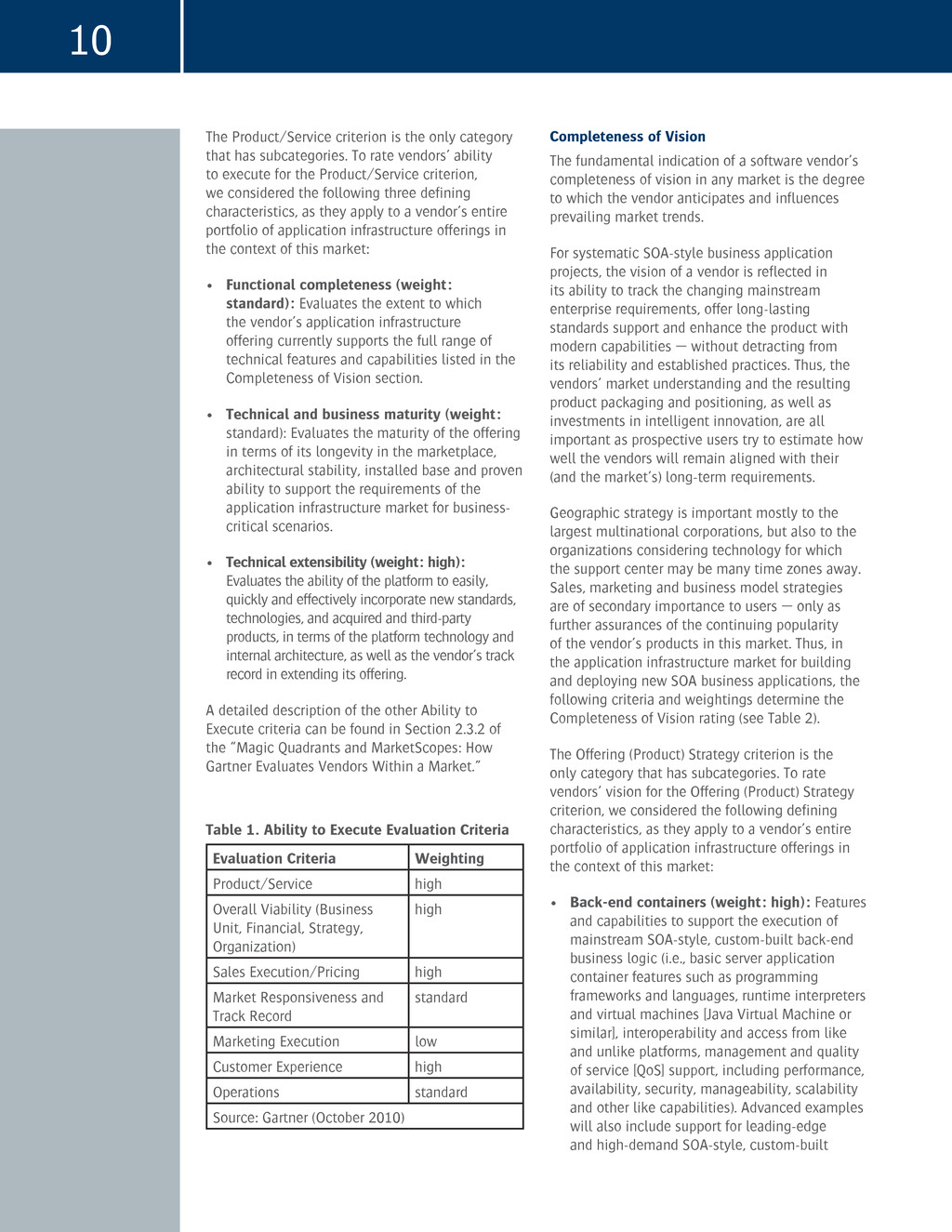
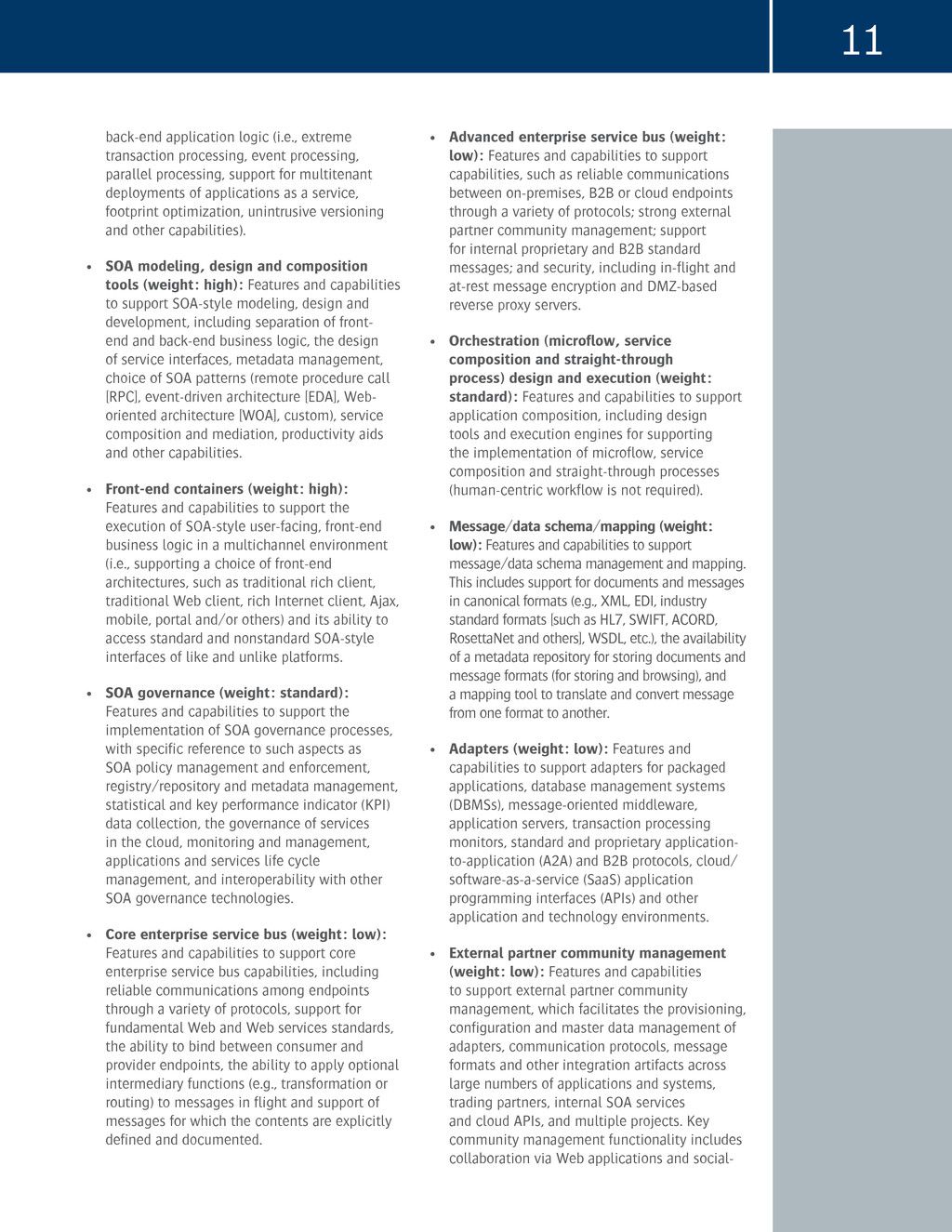
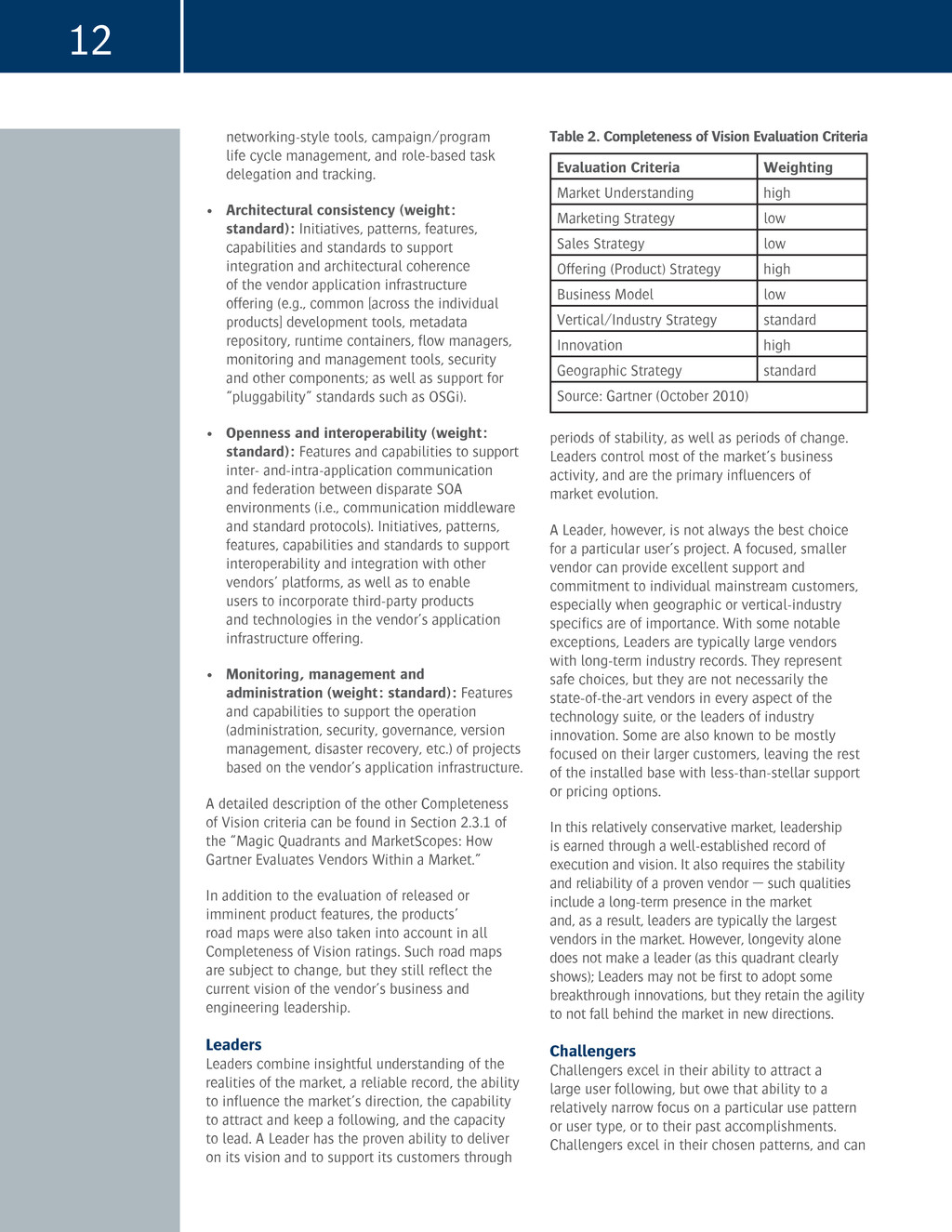
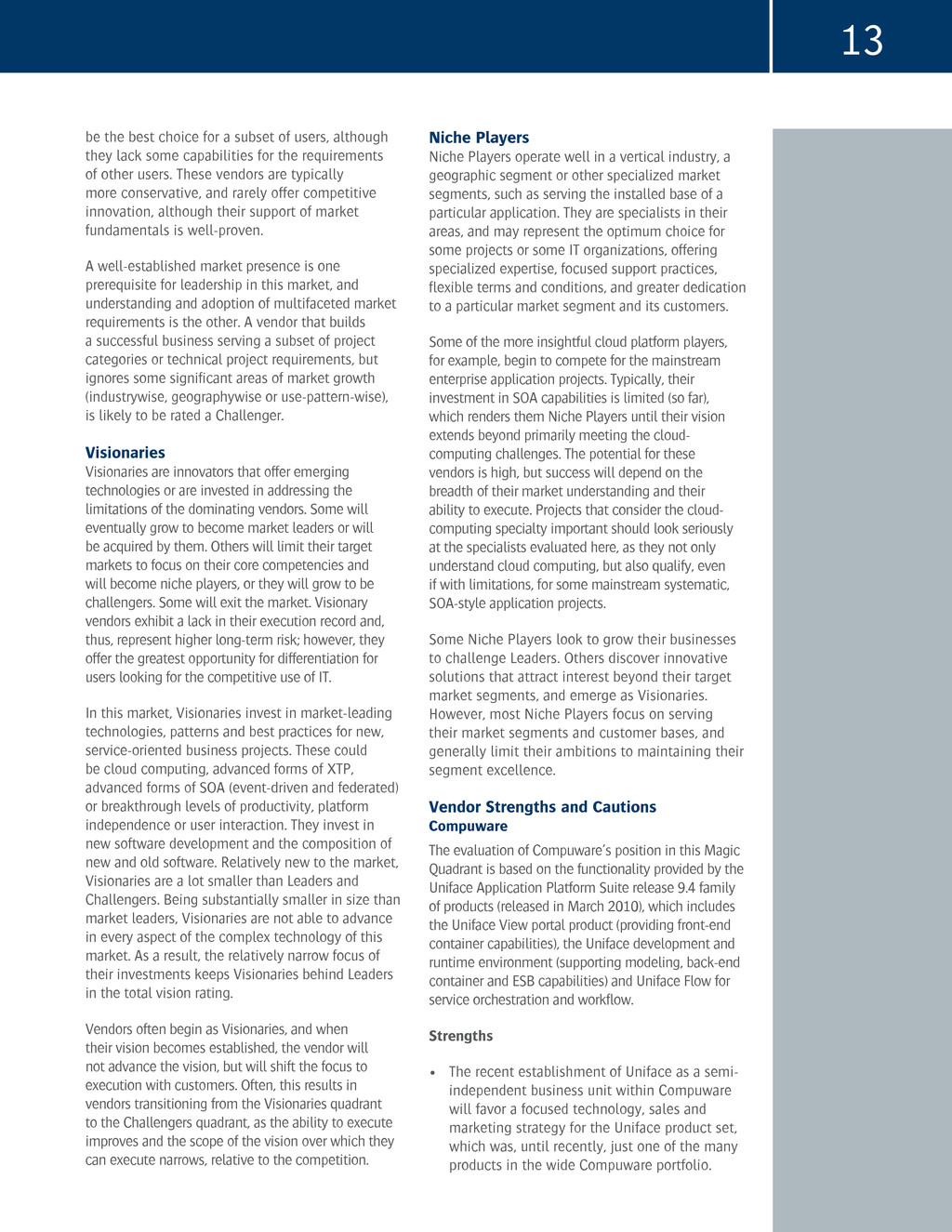
parallel processing, support for multitenant deployments of applications as a service, footprint optimization, unintrusive versioning and other capabilities). • SOA modeling, design and composition tools (weight: high): Features and capabilities to support SOA-style modeling, design and development, including separation of front- end and back-end business logic, the design of service interfaces, metadata management, choice of SOA patterns (remote procedure call [RPC], event-driven architecture [EDA], Web- oriented architecture [WOA], custom), service composition and mediation, productivity aids and other capabilities. • Front-end containers (weight: high): Features and capabilities to support the execution of SOA-style user-facing, front-end business logic in a multichannel environment (i.e., supporting a choice of front-end architectures, such as traditional rich client, traditional Web client, rich Internet client, Ajax, mobile, portal and/or others) and its ability to access standard and nonstandard SOA-style interfaces of like and unlike platforms. • SOA governance (weight: standard): Features and capabilities to support the implementation of SOA governance processes, with specific reference to such aspects as SOA policy management and enforcement, registry/repository and metadata management, statistical and key performance indicator (KPI) data collection, the governance of services in the cloud, monitoring and management, applications and services life cycle management, and interoperability with other SOA governance technologies. • Core enterprise service bus (weight: low): Features and capabilities to support core enterprise service bus capabilities, including reliable communications among endpoints through a variety of protocols, support for fundamental Web and Web services standards, the ability to bind between consumer and provider endpoints, the ability to apply optional intermediary functions (e.g., transformation or routing) to messages in flight and support of messages for which the contents are explicitly defined and documented. • Advanced enterprise service bus (weight: low): Features and capabilities to support capabilities, such as reliable communications between on-premises, B2B or cloud endpoints through a variety of protocols; strong external partner community management; support for internal proprietary and B2B standard messages; and security, including in-flight and at-rest message encryption and DMZ-based reverse proxy servers. • Orchestration (microflow, service composition and straight-through process) design and execution (weight: standard): Features and capabilities to support application composition, including design tools and execution engines for supporting the implementation of microflow, service composition and straight-through processes (human-centric workflow is not required). • Message/data schema/mapping (weight: low): Features and capabilities to support message/data schema management and mapping. This includes support for documents and messages in canonical formats (e.g., XML, EDI, industry standard formats [such as HL7, SWIFT, ACORD, RosettaNet and others], WSDL, etc.), the availability of a metadata repository for storing documents and message formats (for storing and browsing), and a mapping tool to translate and convert message from one format to another. • Adapters (weight: low): Features and capabilities to support adapters for packaged applications, database management systems (DBMSs), message-oriented middleware, application servers, transaction processing monitors, standard and proprietary application- to-application (A2A) and B2B protocols, cloud/ software-as-a-service (SaaS) application programming interfaces (APIs) and other application and technology environments. • External partner community management (weight: low): Features and capabilities to support external partner community management, which facilitates the provisioning, configuration and master data management of adapters, communication protocols, message formats and other integration artifacts across large numbers of applications and systems, trading partners, internal SOA services and cloud APIs, and multiple projects. Key community management functionality includes collaboration via Web applications and social-


 stephaniewalter
 tammyeverts
 gr2m
gr2m
 bermonpainter
 tmiket
 productmarketing
 brettharned
 tammielis
 mfonobong
 katarinadahlin
 marcelosomers
 baasie