Upgrade to Pro — share decks privately, control downloads, hide ads and more …

Rethinking IFUs: What Board Game Rulebooks Cont...

Avatar for Chris Hass Chris Hass
March 27, 2026

Rethinking IFUs: What Board Game Rulebooks Contribute to IFU Usability

The techniques used to make exceptional board game rulebooks inform improved instructions for use (IFUs) usability with clear layouts, callouts, tips, and community engagement to support quick, effective user guidance in healthcare and medical devices.

Medical device usability testing with health care practitioners consistently underscores that IFUs go unread by their intended audiences. Career surgeons brag about “in thirty years of practice never once opening an IFU.” Nurses self-report as overworked kinetic learners with neither the access to, nor the time to, pore through an IFU for specific troubleshooting help. In the US, device setup is often the province of Biomedical techs who may be the only ones actually reading IFUs – and even they admit to cutting corners.

Solutions to these (and other) problems may come from a seemingly unlikely quarter: recent advances in board game rulebooks. There’s a board gaming renaissance going on, and players seeking rich, complex games face strikingly similar challenges to health care practitioners when it comes to absorbing large amounts of tactical, practical, strategic, and important information. Communicating important information (and lots of it) in the proper order, the proper depth, and with appropriate orientation to the consequences is a learnable skill. In many cases exemplary board game rulebooks beat IFUs hands-down through better use of procedural guidance, step-by-step illustrations, QR codes, symbol libraries, section identification aides, checklists, and more.

Making IFUs suitable for their intended audiences involves reframing IFUs and their vital content from a full-scale repository of information generated by scientists, engineers, marketers, and lawyers into practical aids that health care practitioners will read, value, and insist on keeping close by.

This presentation provides specific breakdowns of challenges from IFU-related trends: lack of use, lack of access, preferences for text-based v. experiential learning, video content, and the realities of referencing IFUs when time is short, tempers are high, and lives are on the line. Solutions will be drawn from decades of UX research conducted at all levels of health care design, development, and delivery, as well as “crunchy” board gaming experiences. Proposed IFU enhancements will include techniques for supporting: rapid use, a variety of learning styles, audience-specific aids, and how to use illustration techniques to best effect.

Anyone who has been victimized by a bad instruction manual, or even a good instruction manual unsuited to its use context, will benefit from this presentation.

This is a good-intentioned UX intervention to take IFUs to their next, usable, level.

Avatar for Chris Hass

Chris Hass

March 27, 2026
Tweet

Other Decks in Design

Transcript

  1. Rethinking IFUs: What Board Game Rulebooks Contribute to IFU Usability

    Chris Hass, HF Practitioner, Consultant, Board Gamer Executive Director, Bentley University User Experience Center [email protected] | [email protected] | BGG: werdynerdy v.2 March 2026
  2. Bona Fides HF Professional Stats ([email protected]) • 28+ years of

    human factors practice • HF Research and design team lead • UXPA International & Boston chapter (president, advisory board) • Hundreds of healthcare and medical device studies (FDA validation, others) Gamer Stats ([email protected]) • Board games owned: 934 (incl. 238 expansions) • Board games played annually: ~360 • H-index: 14 • Crunchy zone: between Hargrave and Lacerda • BoardGameGeek handle: WerdyNerdy
  3. “In 35 years of practice, I’ve never ONCE read an

    IFU.” –– Every physician ever involved in Human Factors testing.
  4. “This infusion pump manual is the best. I LOVE it!

    The IV pole wheels fall off and it’s the perfect size to replace a wheel.” –– Actual nurse evaluating infusion pump system
  5. The Need for Speed AND Depth IFUs that are written

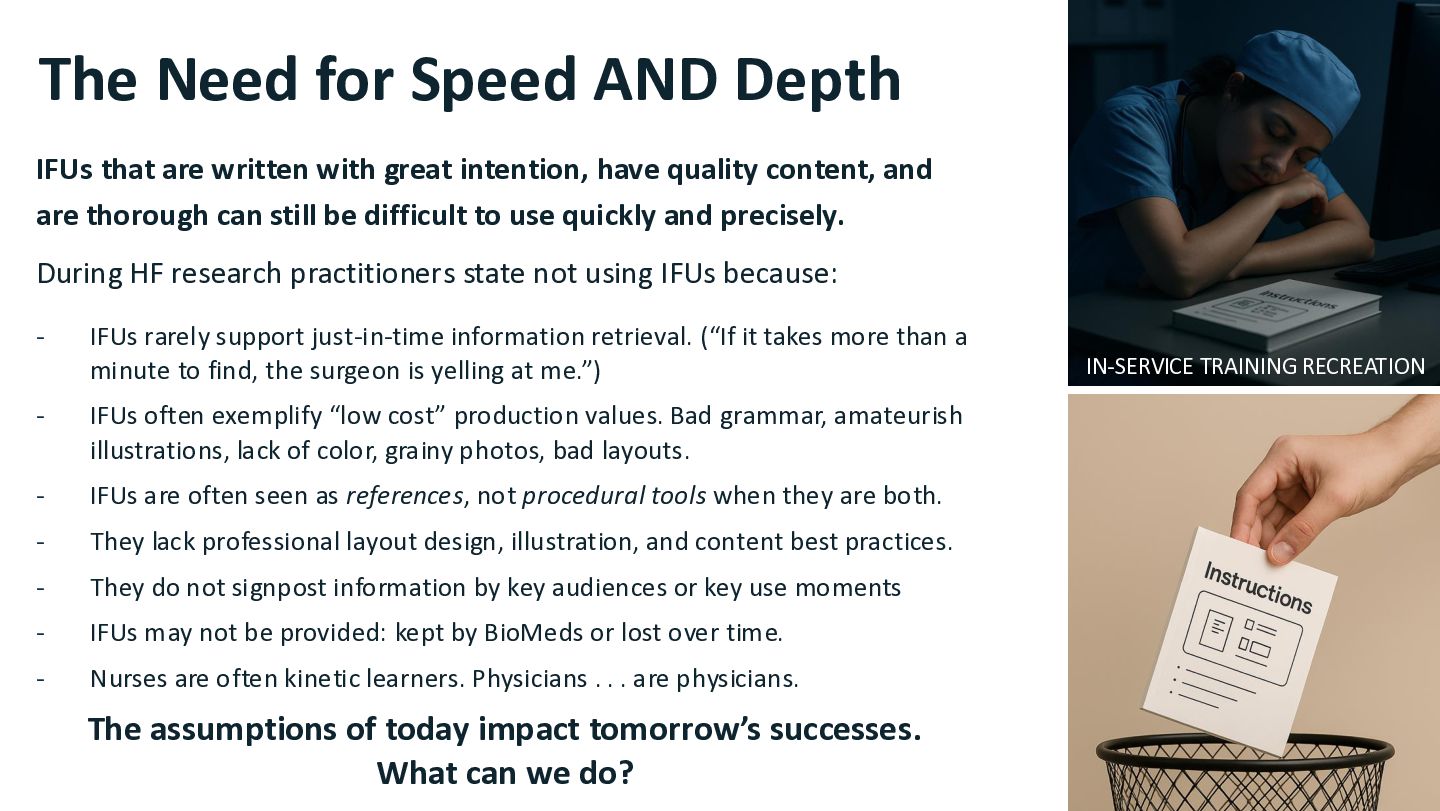
    with great intention, have quality content, and are thorough can still be difficult to use quickly and precisely. During HF research practitioners state not using IFUs because: - IFUs rarely support just-in-time information retrieval. (“If it takes more than a minute to find, the surgeon is yelling at me.”) - IFUs often exemplify “low cost” production values. Bad grammar, amateurish illustrations, lack of color, grainy photos, bad layouts. - IFUs are often seen as references, not procedural tools when they are both. - They lack professional layout design, illustration, and content best practices. - They do not signpost information by key audiences or key use moments - IFUs may not be provided: kept by BioMeds or lost over time. - Nurses are often kinetic learners. Physicians . . . are physicians. The assumptions of today impact tomorrow’s successes. What can we do? IN-SERVICE TRAINING RECREATION
  6. “Huh. You made me read this IFU and it actually

    has some good information in it. Maybe I should have been reading these.” –– Actual physician involved in Human Factors testing
  7. Why Boardgames? • Avid gamers to seek out increasingly complex

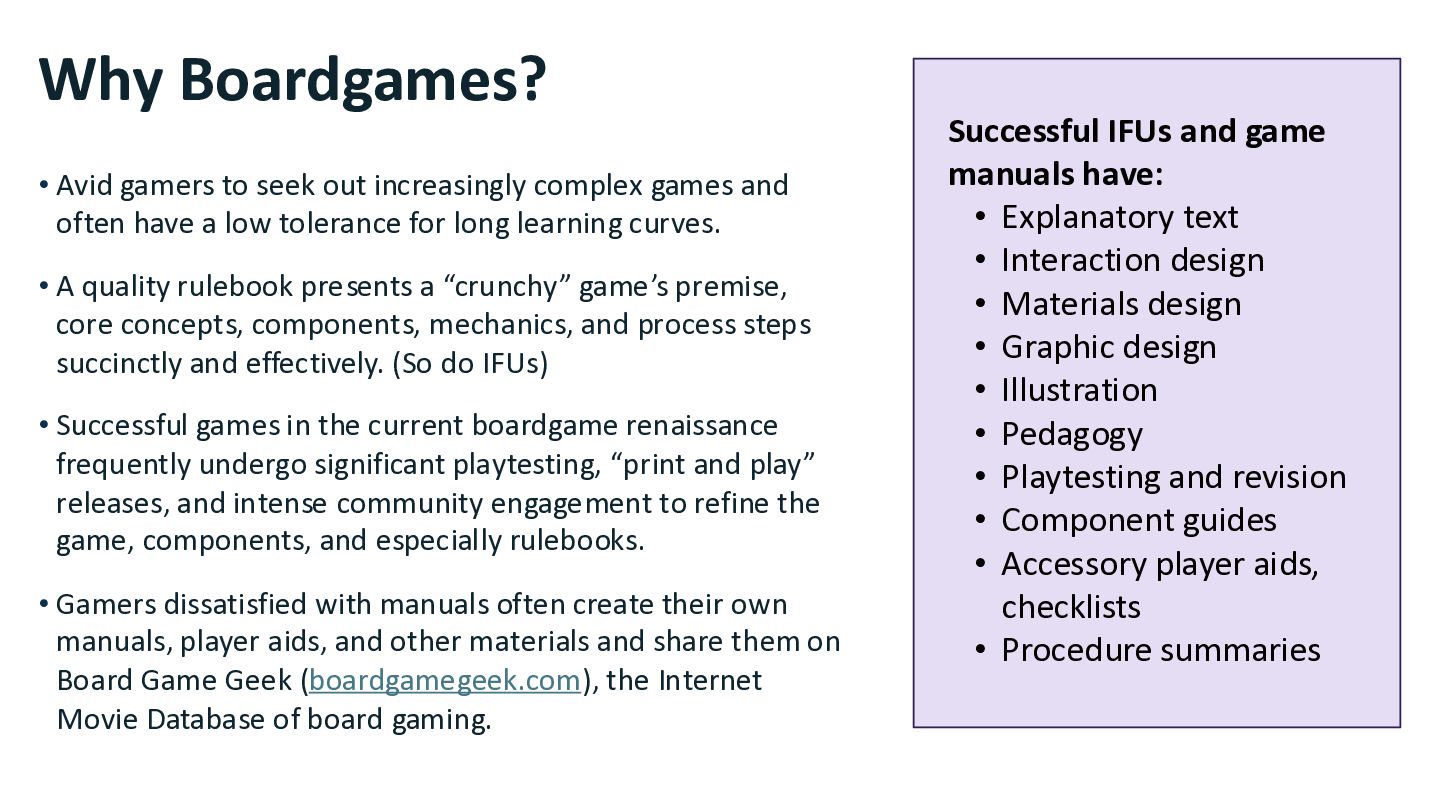
    games and often have a low tolerance for long learning curves. • A quality rulebook presents a “crunchy” game’s premise, core concepts, components, mechanics, and process steps succinctly and effectively. (So do IFUs) • Successful games in the current boardgame renaissance frequently undergo significant playtesting, “print and play” releases, and intense community engagement to refine the game, components, and especially rulebooks. • Gamers dissatisfied with manuals often create their own manuals, player aids, and other materials and share them on Board Game Geek (boardgamegeek.com), the Internet Movie Database of board gaming. Successful IFUs and game manuals have: • Explanatory text • Interaction design • Materials design • Graphic design • Illustration • Pedagogy • Playtesting and revision • Component guides • Accessory player aids, checklists • Procedure summaries
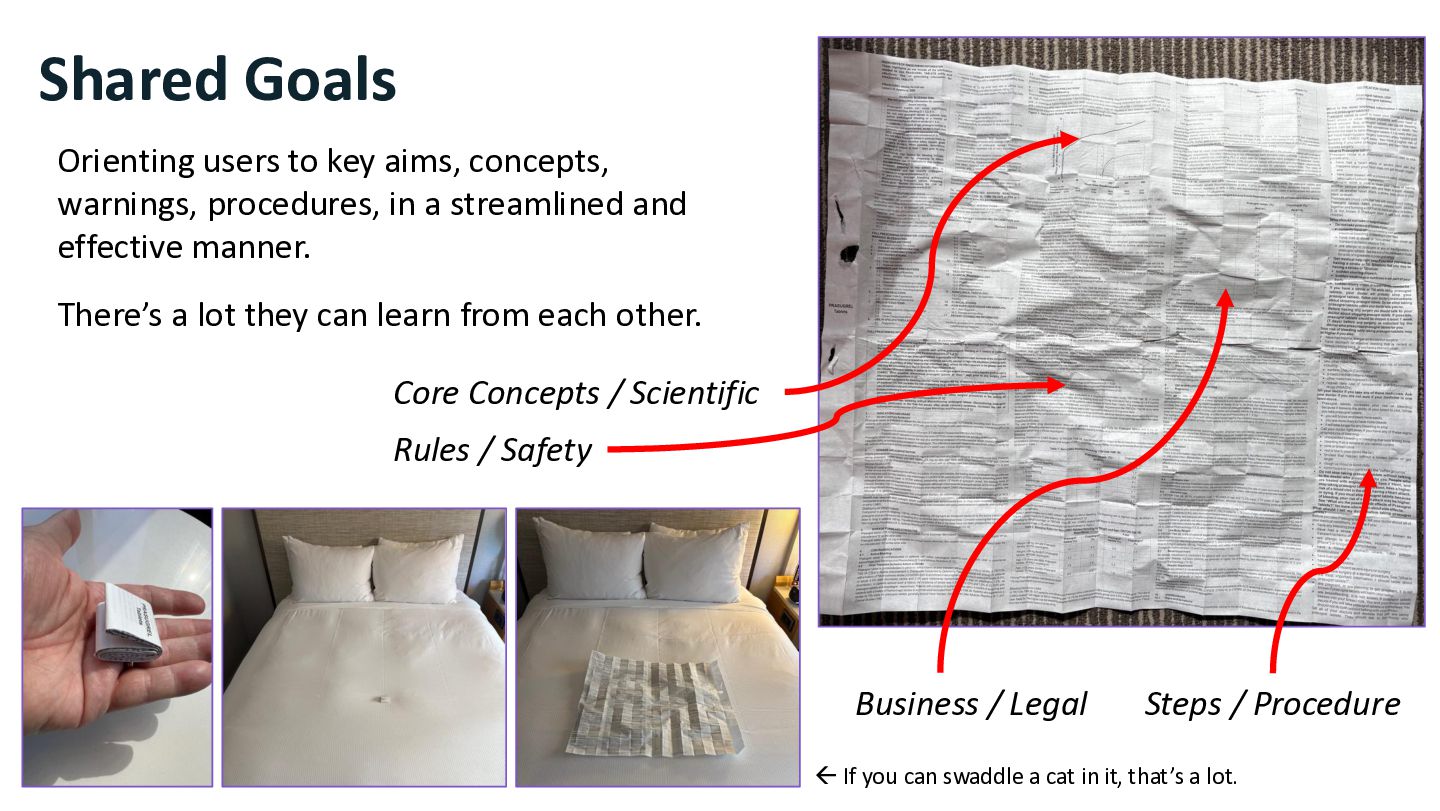
  8. Shared Goals Orienting users to key aims, concepts, warnings, procedures,

    in a streamlined and effective manner. There’s a lot they can learn from each other. Rules / Safety Core Concepts / Scientific Steps / Procedure Business / Legal  If you can swaddle a cat in it, that’s a lot.
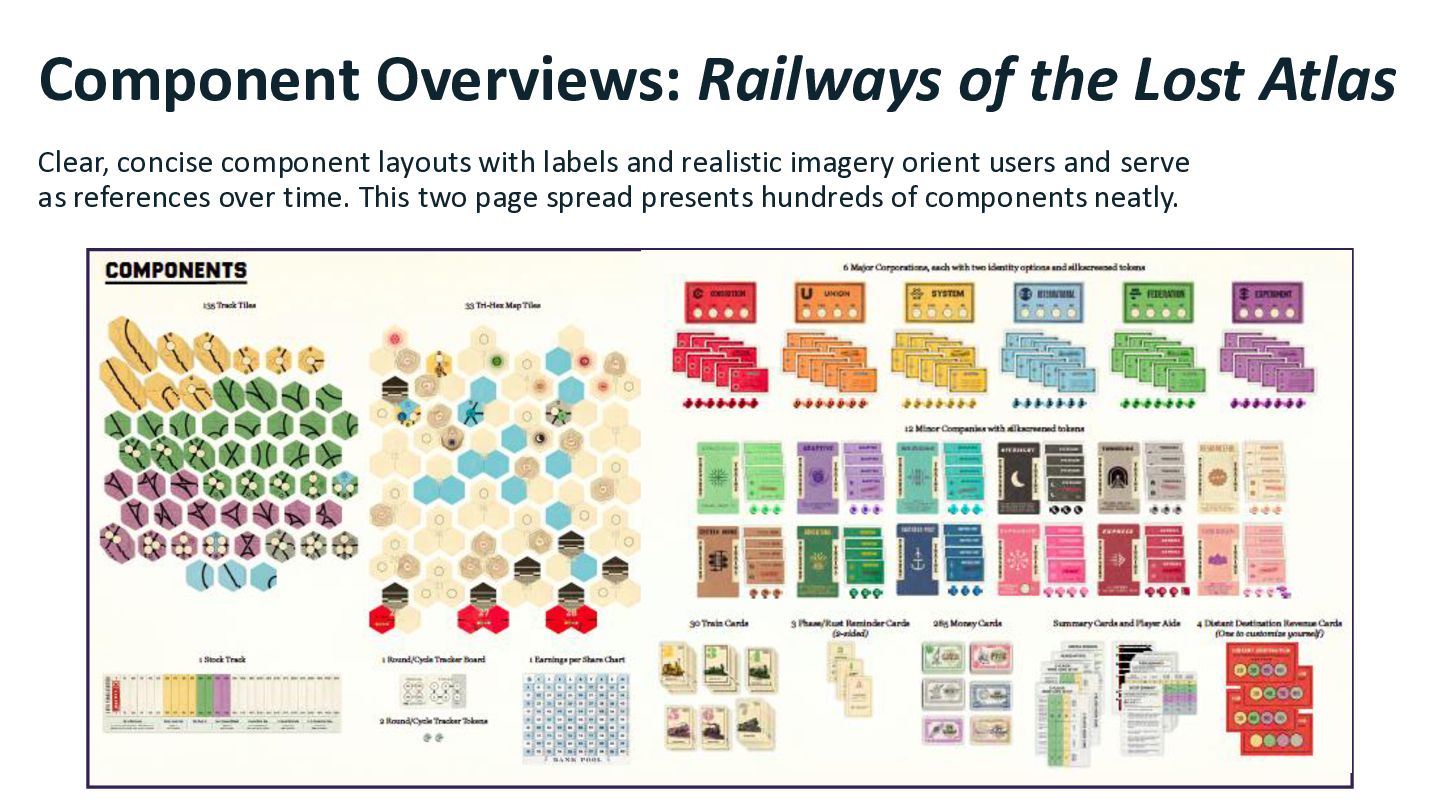
  9. Component Overviews: Railways of the Lost Atlas Clear, concise component

    layouts with labels and realistic imagery orient users and serve as references over time. This two page spread presents hundreds of components neatly.
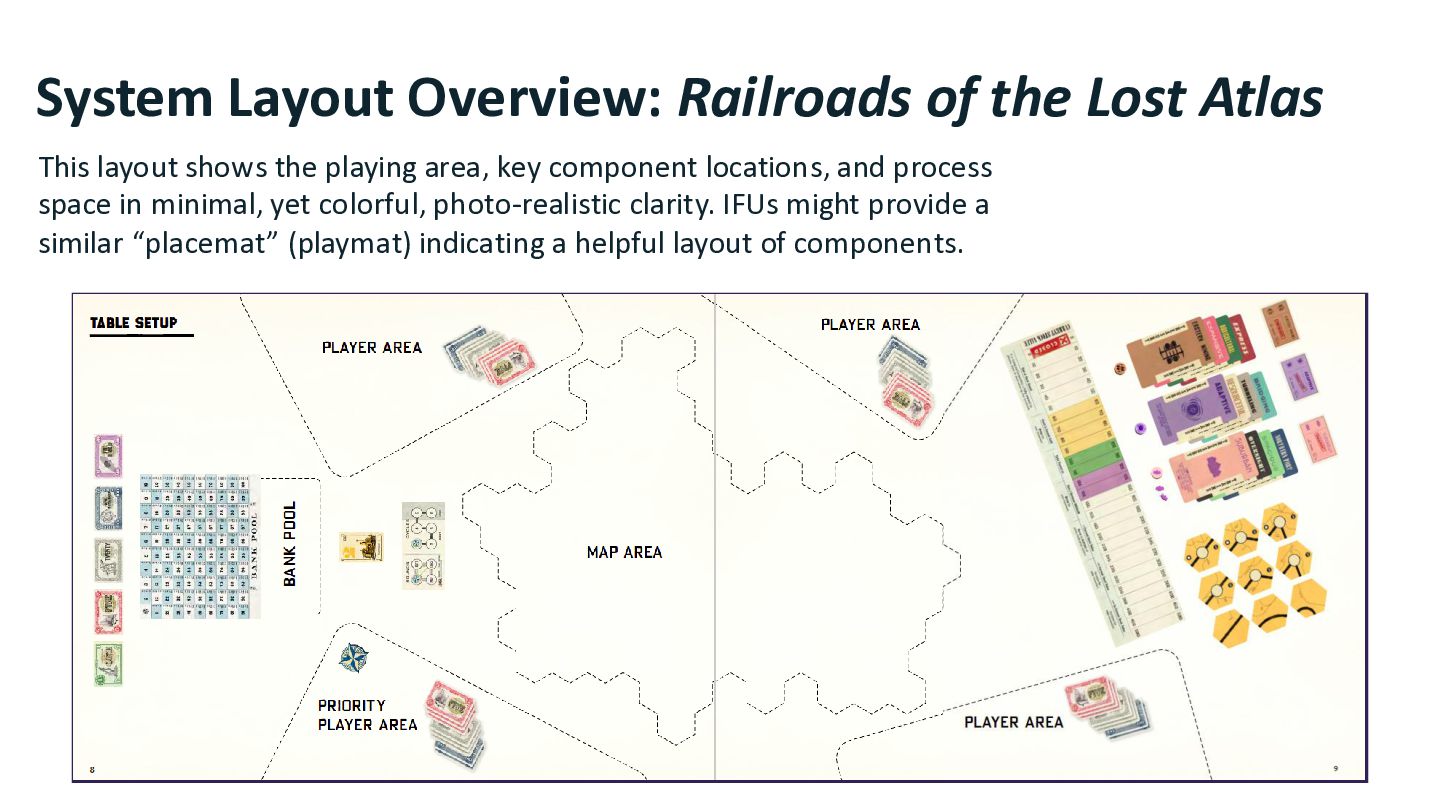
  10. This layout shows the playing area, key component locations, and

    process space in minimal, yet colorful, photo-realistic clarity. IFUs might provide a similar “placemat” (playmat) indicating a helpful layout of components. System Layout Overview: Railroads of the Lost Atlas
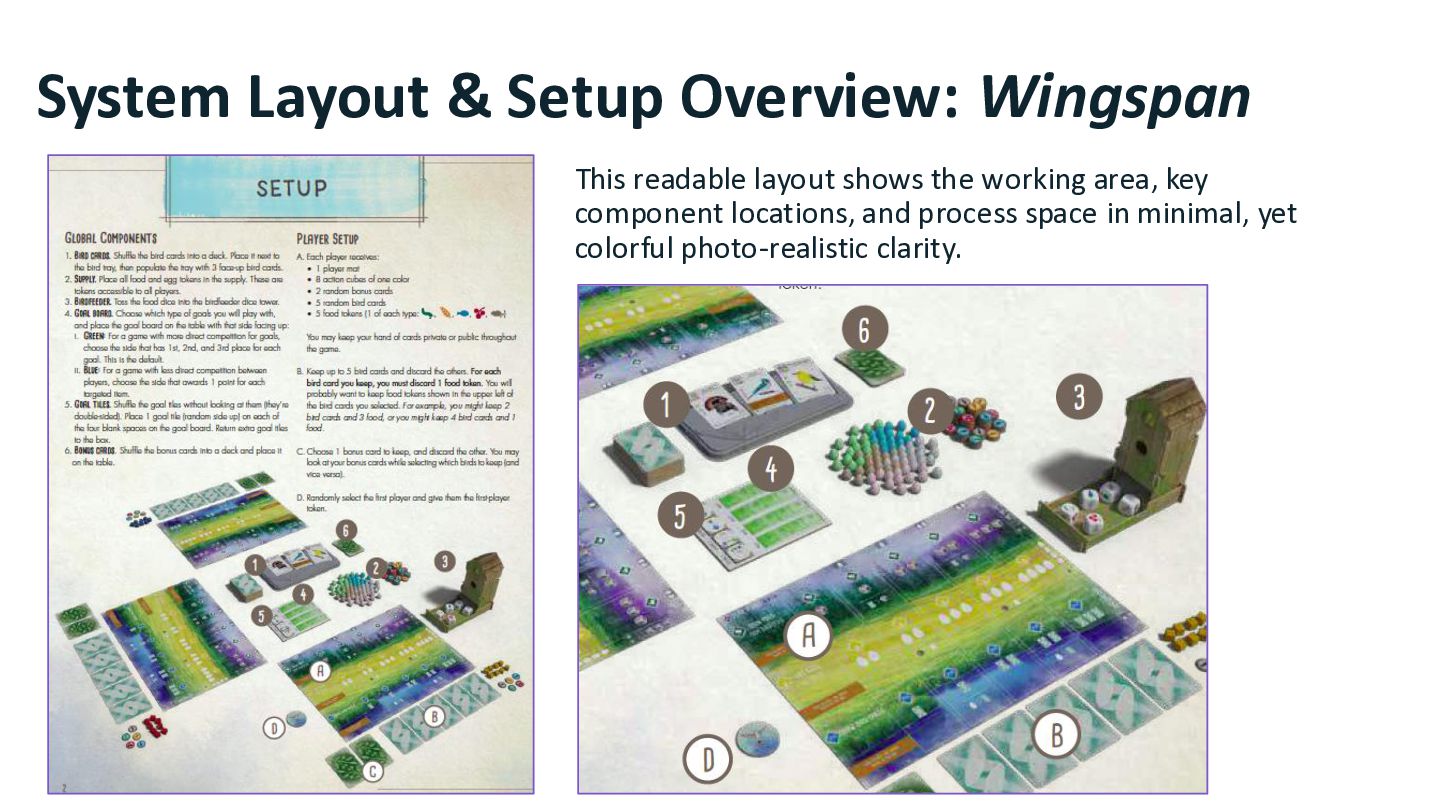
  11. System Layout & Setup Overview: Wingspan This readable layout shows

    the working area, key component locations, and process space in minimal, yet colorful photo-realistic clarity.
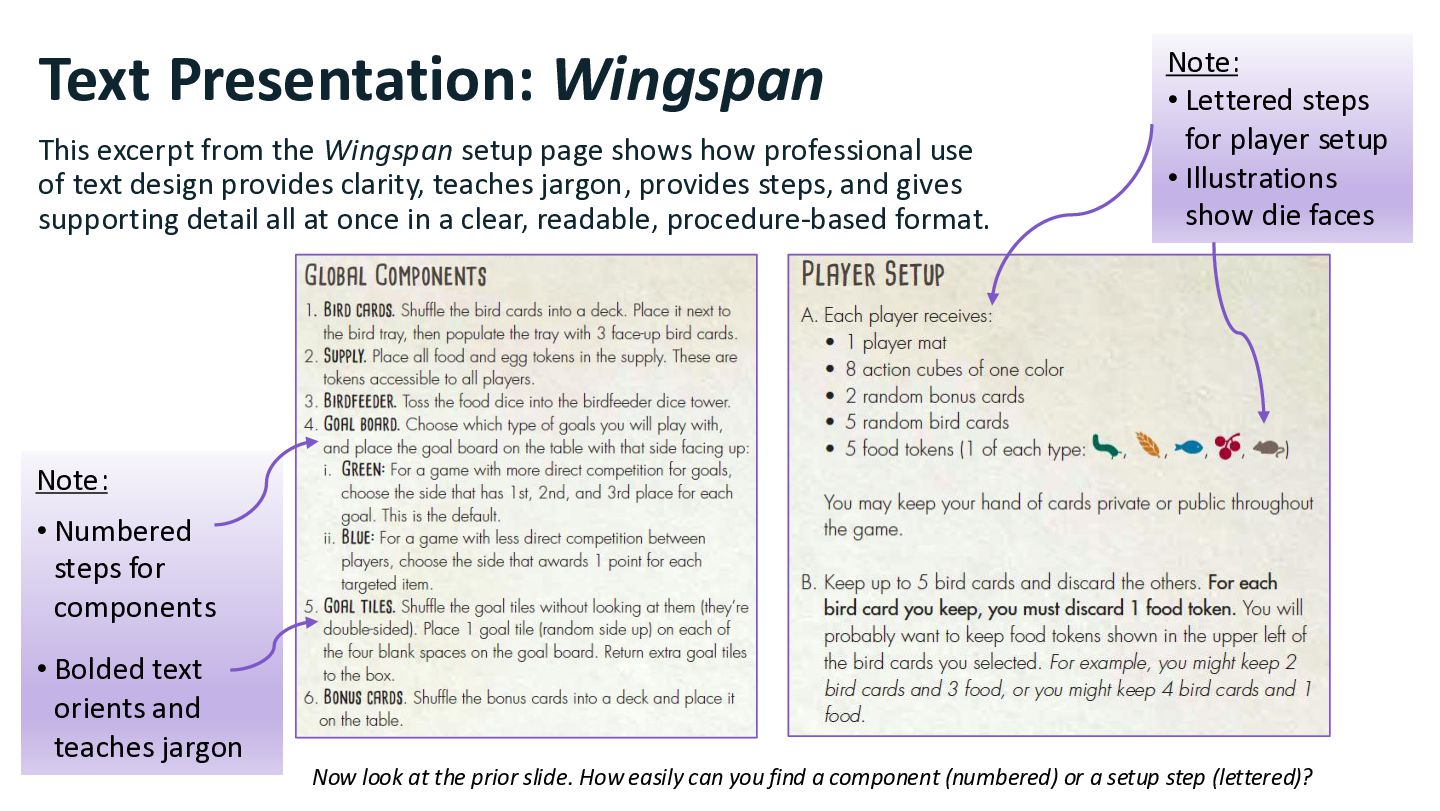
  12. Text Presentation: Wingspan This excerpt from the Wingspan setup page

    shows how professional use of text design provides clarity, teaches jargon, provides steps, and gives supporting detail all at once in a clear, readable, procedure-based format. Note: • Lettered steps for player setup • Illustrations show die faces Note: • Numbered steps for components • Bolded text orients and teaches jargon Now look at the prior slide. How easily can you find a component (numbered) or a setup step (lettered)?
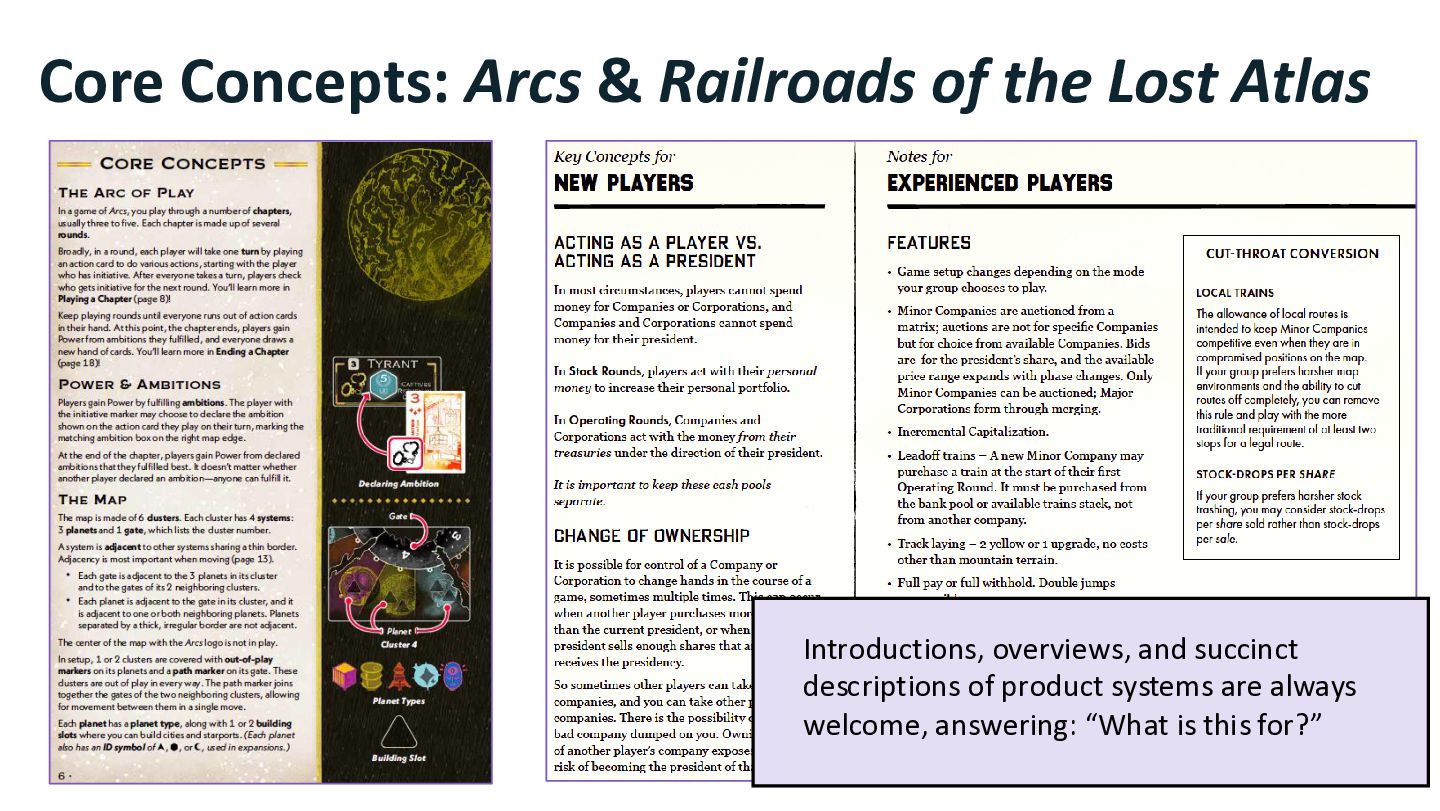
  13. Core Concepts: Arcs & Railroads of the Lost Atlas Introductions,

    overviews, and succinct descriptions of product systems are always welcome, answering: “What is this for?”
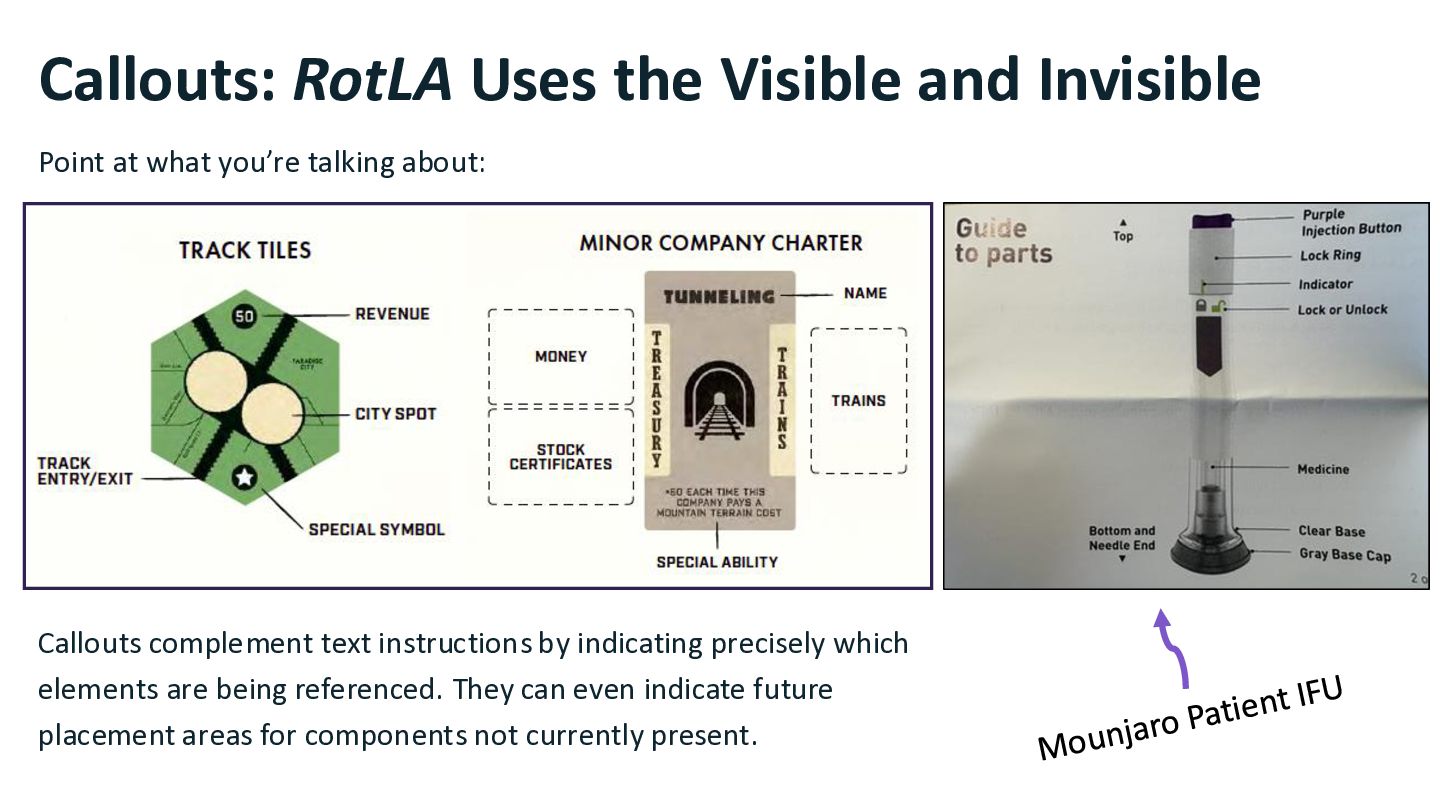
  14. Callouts: RotLA Uses the Visible and Invisible Point at what

    you’re talking about: Callouts complement text instructions by indicating precisely which elements are being referenced. They can even indicate future placement areas for components not currently present.
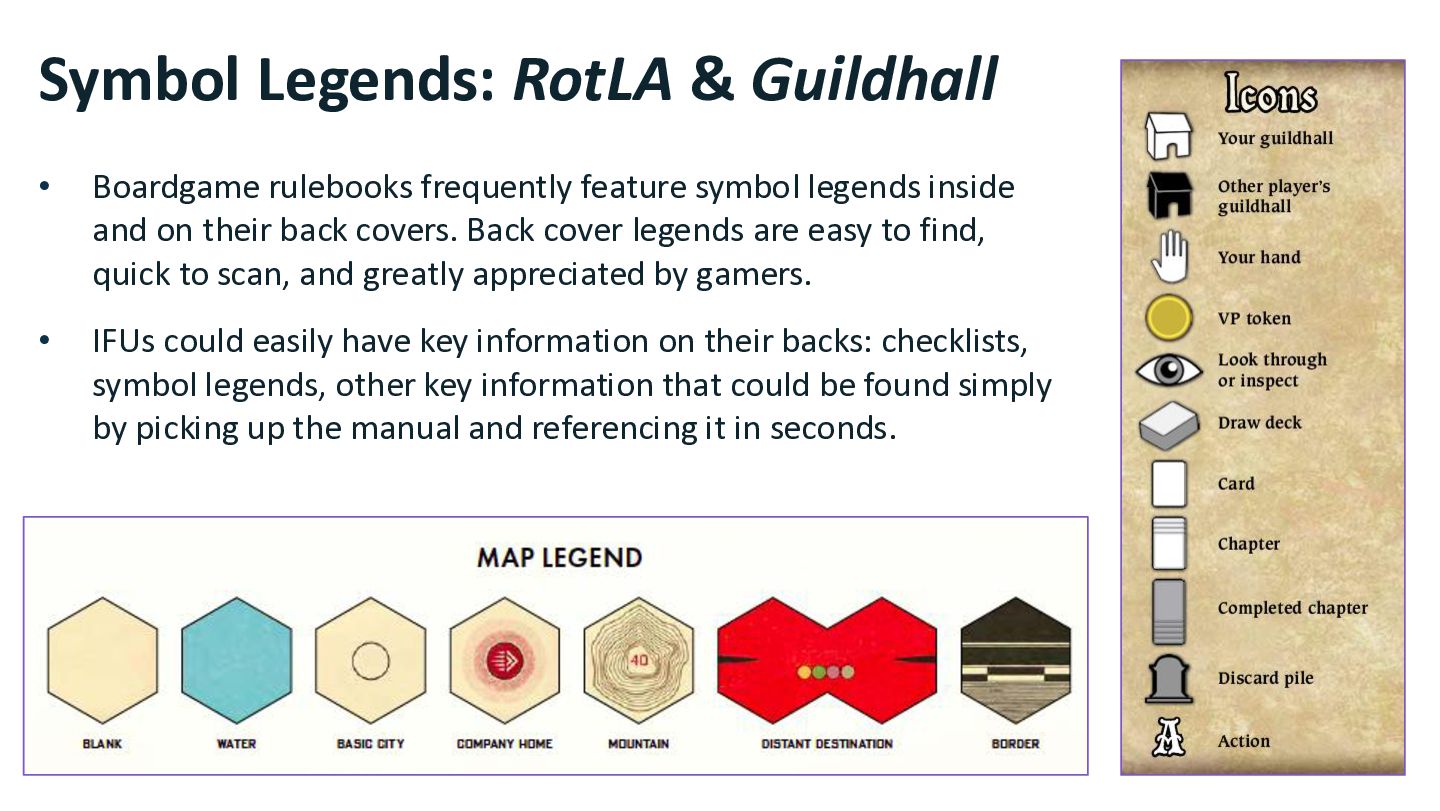
  15. Symbol Legends: RotLA & Guildhall • Boardgame rulebooks frequently feature

    symbol legends inside and on their back covers. Back cover legends are easy to find, quick to scan, and greatly appreciated by gamers. • IFUs could easily have key information on their backs: checklists, symbol legends, other key information that could be found simply by picking up the manual and referencing it in seconds.
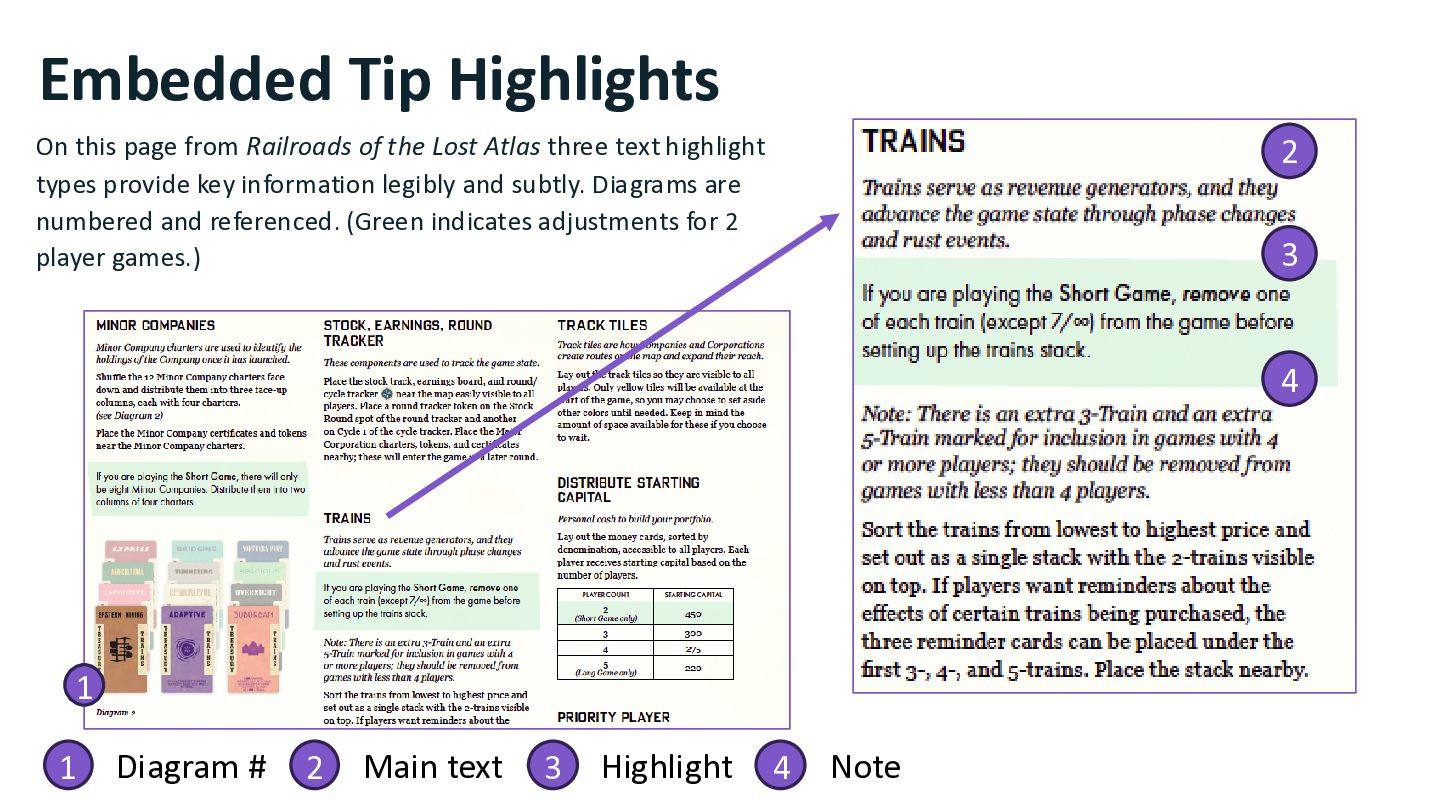
  16. Embedded Tip Highlights On this page from Railroads of the

    Lost Atlas three text highlight types provide key information legibly and subtly. Diagrams are numbered and referenced. (Green indicates adjustments for 2 player games.) 1 2 3 1 2 3 Diagram # Main text Highlight 4 Note 4
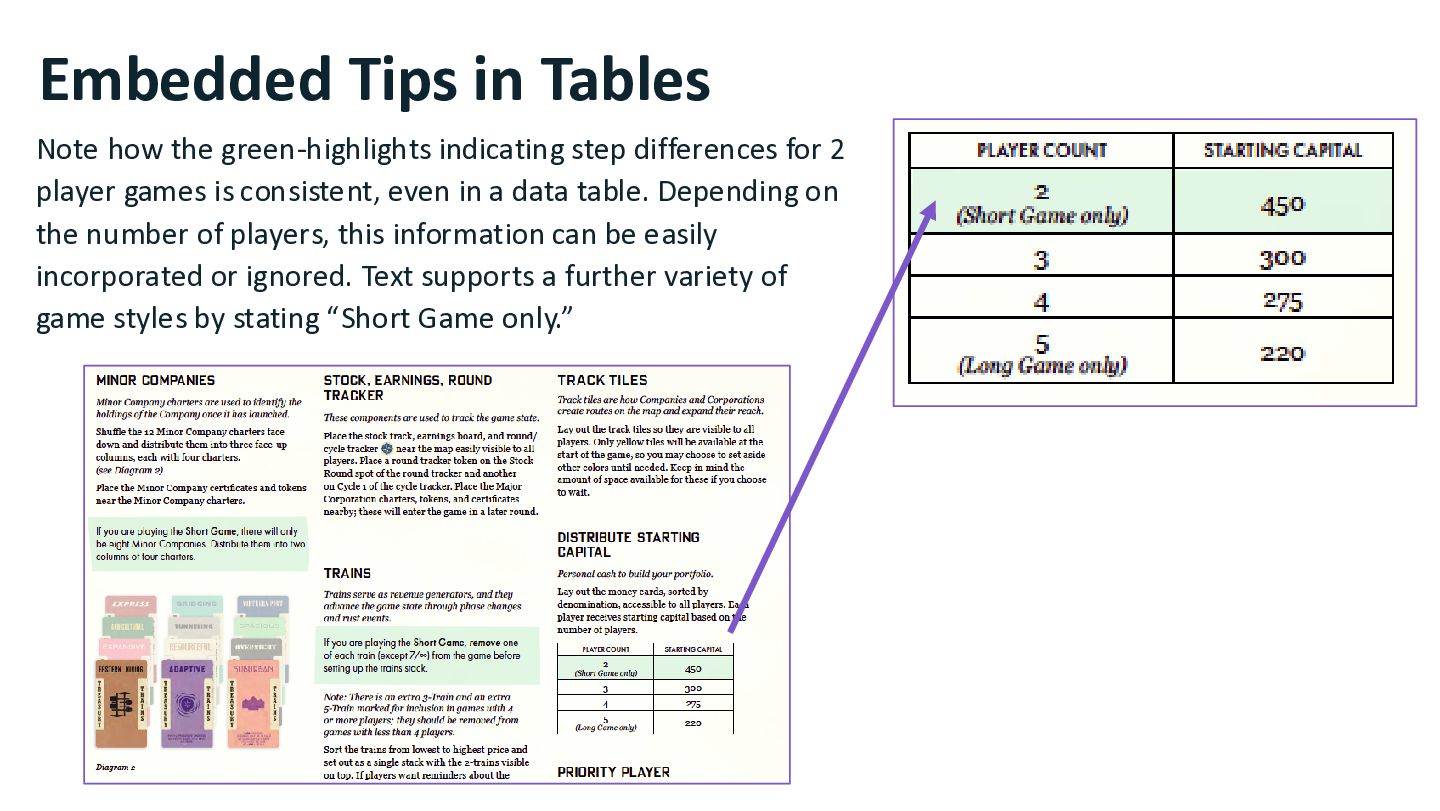
  17. Embedded Tips in Tables Note how the green-highlights indicating step

    differences for 2 player games is consistent, even in a data table. Depending on the number of players, this information can be easily incorporated or ignored. Text supports a further variety of game styles by stating “Short Game only.”
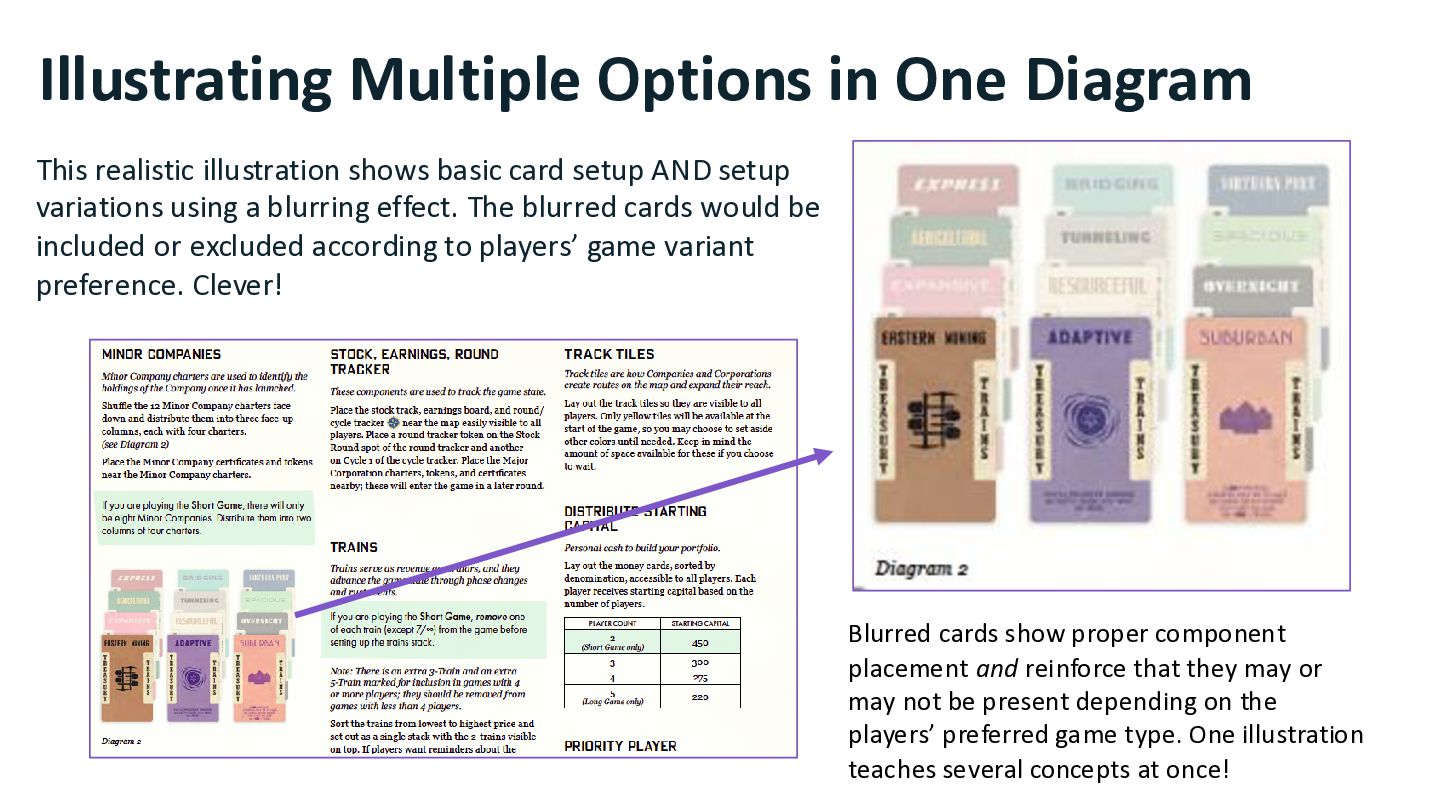
  18. Illustrating Multiple Options in One Diagram This realistic illustration shows

    basic card setup AND setup variations using a blurring effect. The blurred cards would be included or excluded according to players’ game variant preference. Clever! Blurred cards show proper component placement and reinforce that they may or may not be present depending on the players’ preferred game type. One illustration teaches several concepts at once!
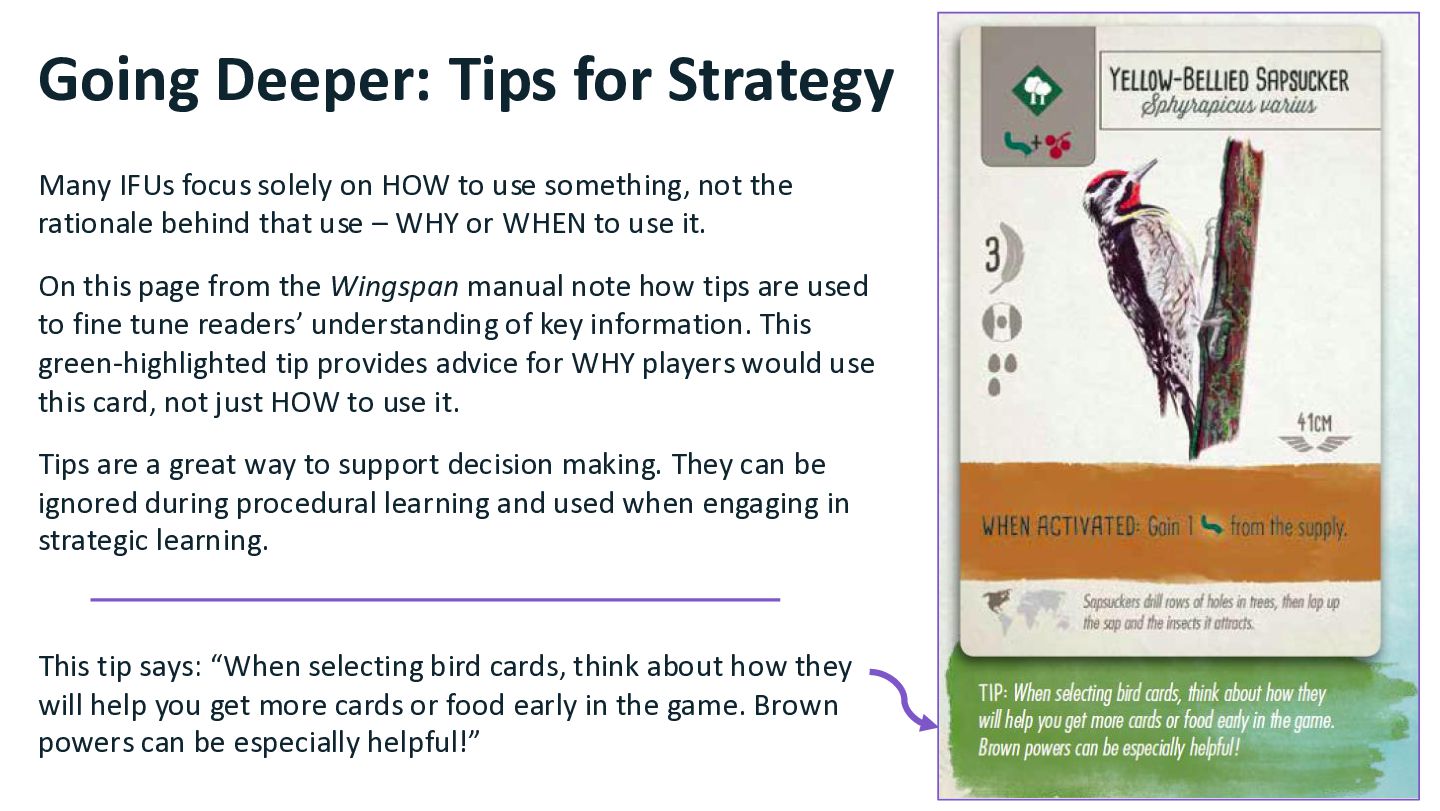
  19. Going Deeper: Tips for Strategy Many IFUs focus solely on

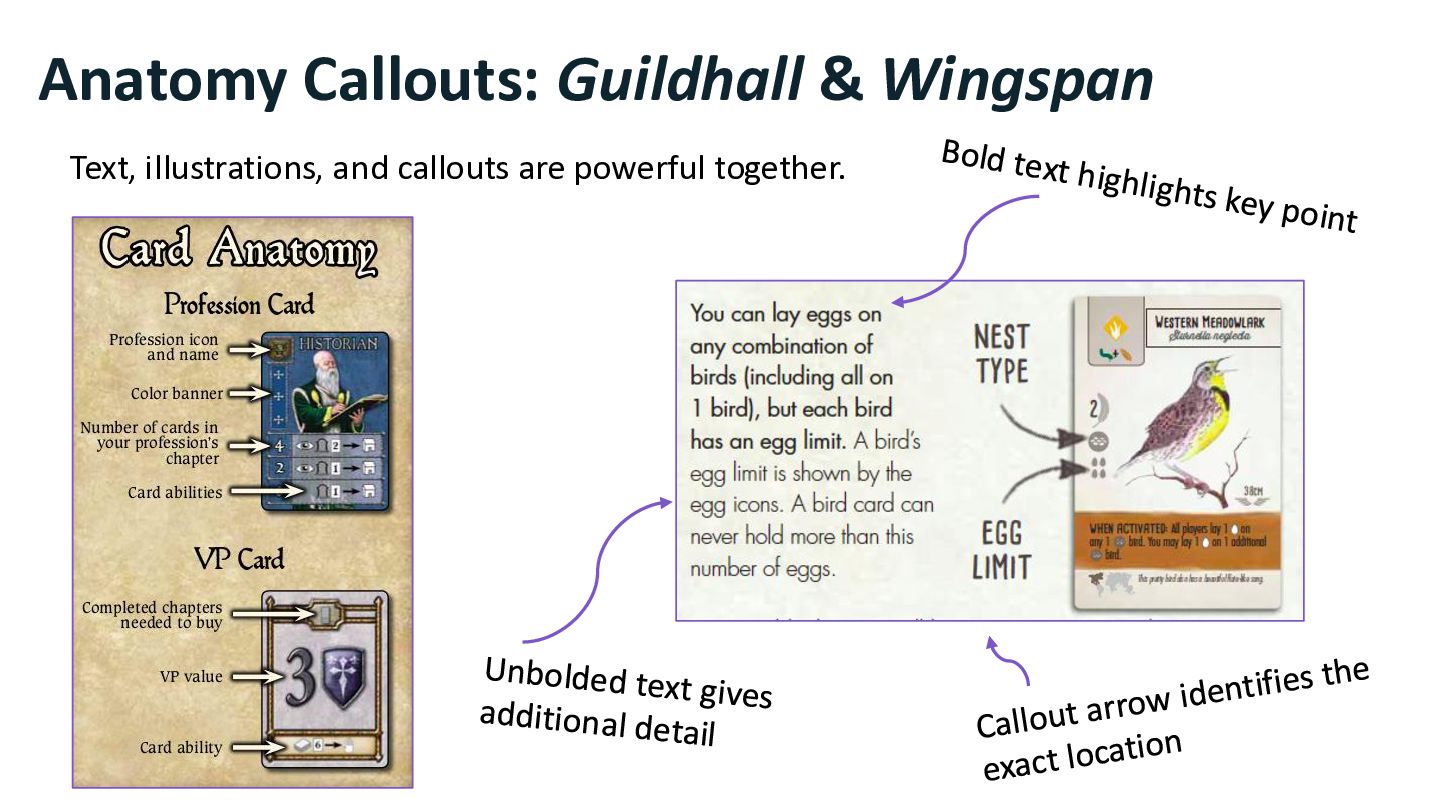
    HOW to use something, not the rationale behind that use – WHY or WHEN to use it. On this page from the Wingspan manual note how tips are used to fine tune readers’ understanding of key information. This green-highlighted tip provides advice for WHY players would use this card, not just HOW to use it. Tips are a great way to support decision making. They can be ignored during procedural learning and used when engaging in strategic learning. This tip says: “When selecting bird cards, think about how they will help you get more cards or food early in the game. Brown powers can be especially helpful!”
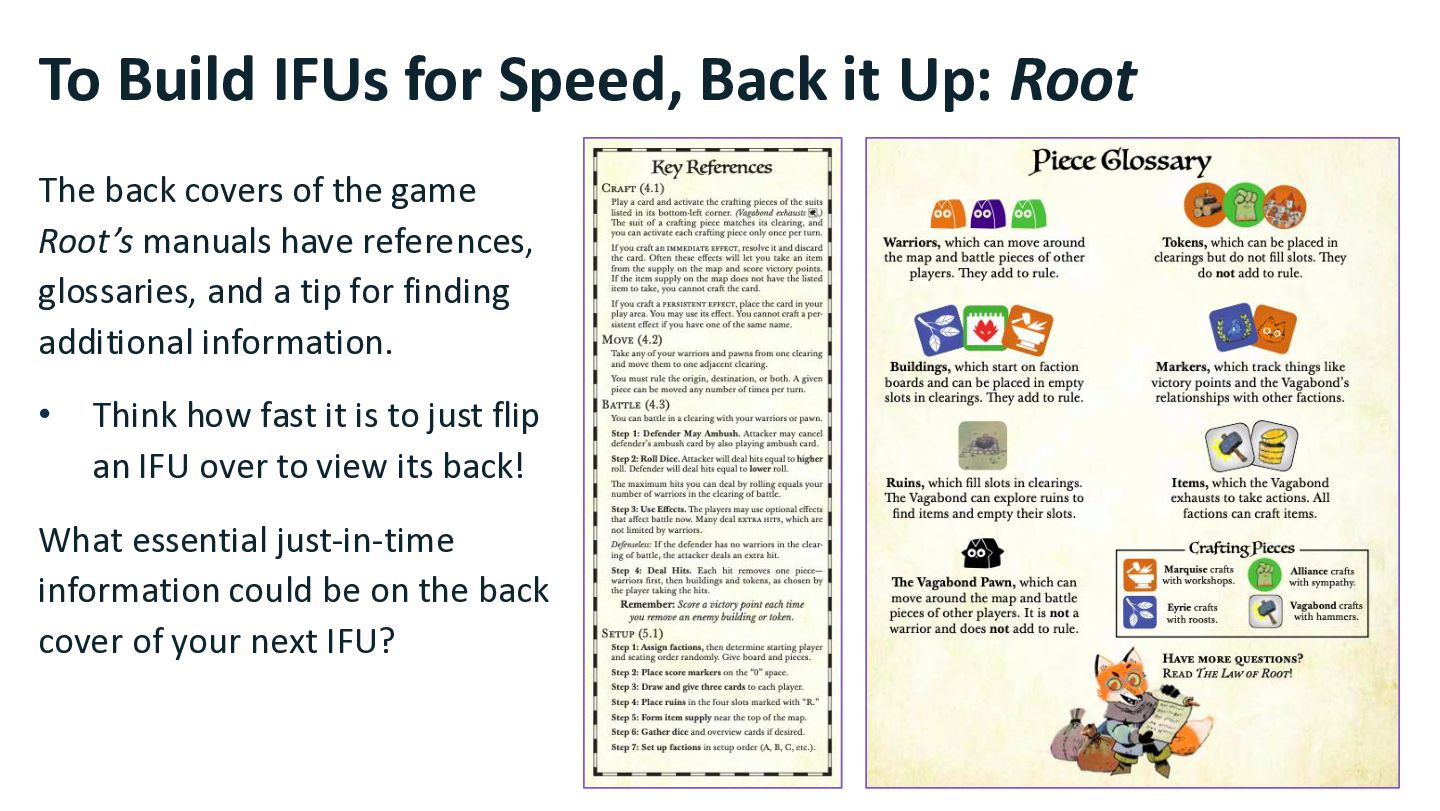
  20. To Build IFUs for Speed, Back it Up: Root The

    back covers of the game Root’s manuals have references, glossaries, and a tip for finding additional information. • Think how fast it is to just flip an IFU over to view its back! What essential just-in-time information could be on the back cover of your next IFU?
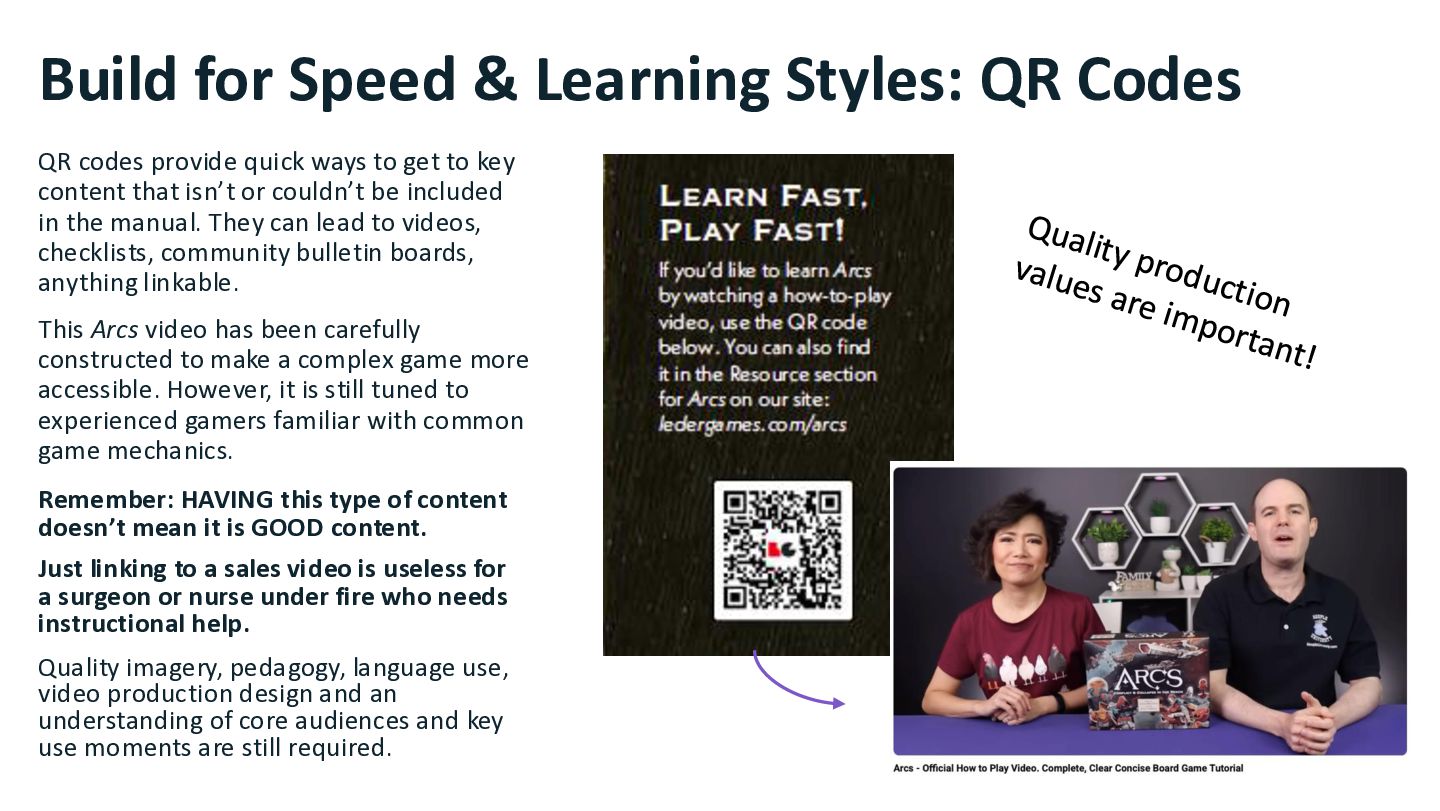
  21. Build for Speed & Learning Styles: QR Codes QR codes

    provide quick ways to get to key content that isn’t or couldn’t be included in the manual. They can lead to videos, checklists, community bulletin boards, anything linkable. This Arcs video has been carefully constructed to make a complex game more accessible. However, it is still tuned to experienced gamers familiar with common game mechanics. Remember: HAVING this type of content doesn’t mean it is GOOD content. Just linking to a sales video is useless for a surgeon or nurse under fire who needs instructional help. Quality imagery, pedagogy, language use, video production design and an understanding of core audiences and key use moments are still required.
  22. Table of Contents & Index: Arcs Designing for speed means

    providing everything you can to get readers to key information FAST. The Arcs manual includes a table of contents, glossary, and a quick-reference index.
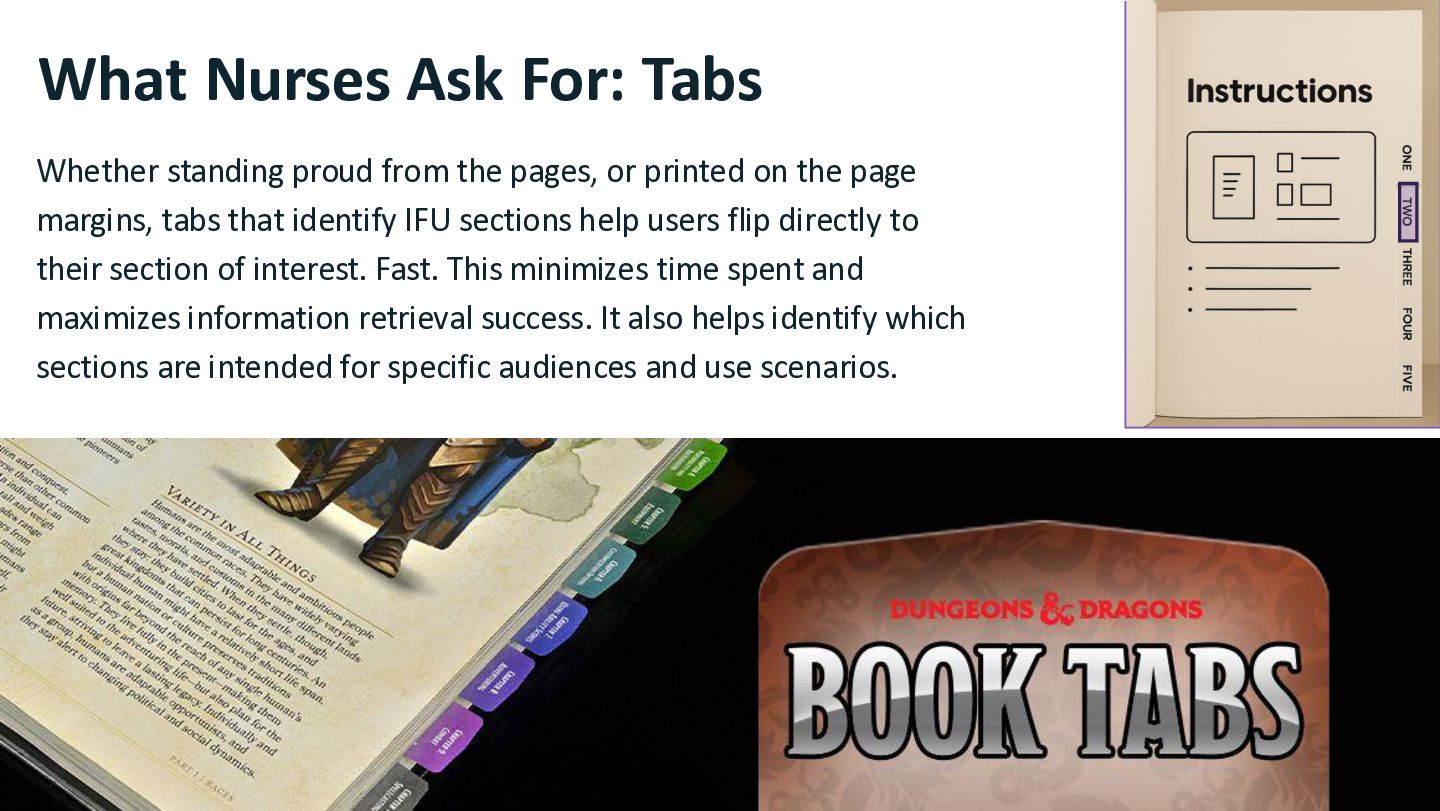
  23. What Nurses Ask For: Tabs Whether standing proud from the

    pages, or printed on the page margins, tabs that identify IFU sections help users flip directly to their section of interest. Fast. This minimizes time spent and maximizes information retrieval success. It also helps identify which sections are intended for specific audiences and use scenarios.
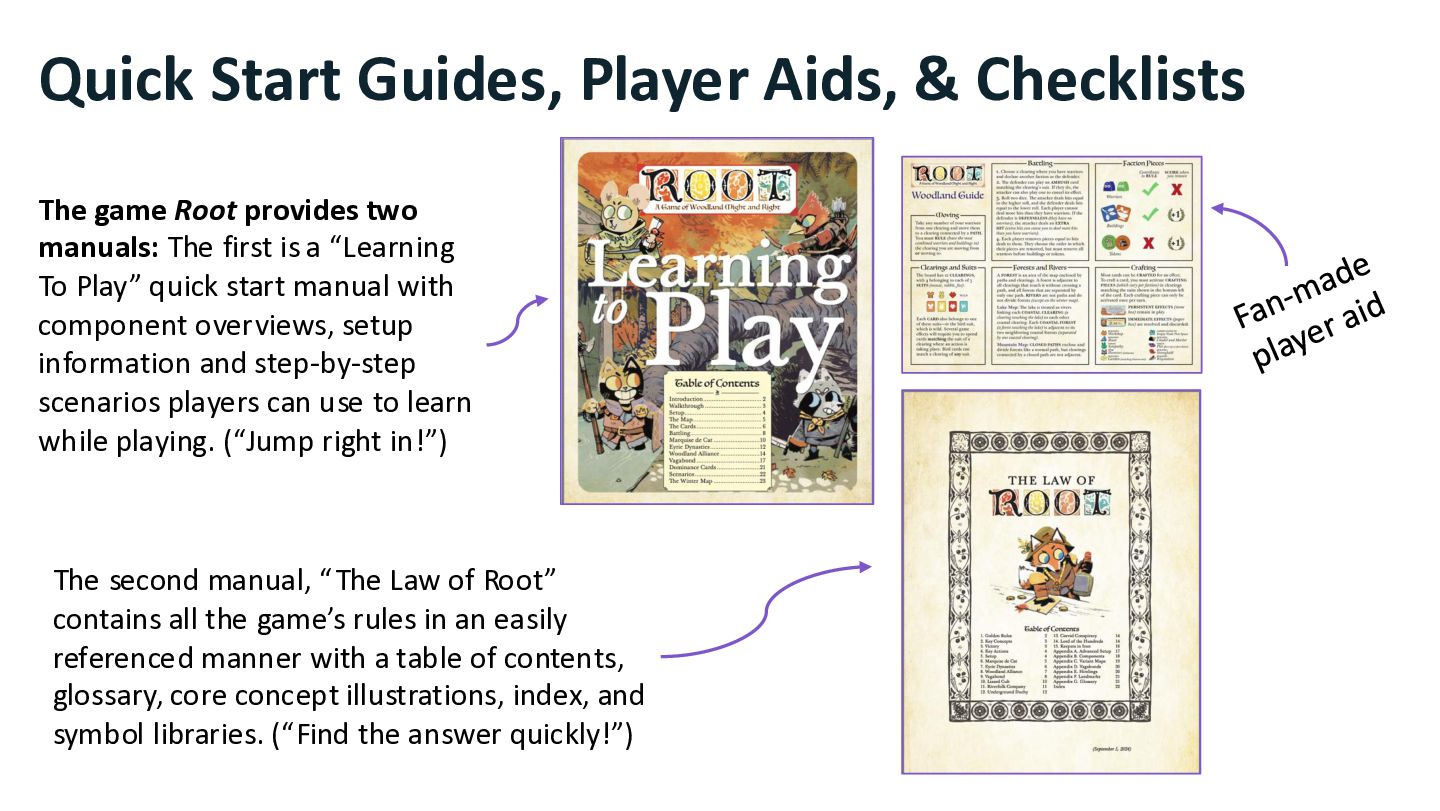
  24. Quick Start Guides, Player Aids, & Checklists The second manual,

    “The Law of Root” contains all the game’s rules in an easily referenced manner with a table of contents, glossary, core concept illustrations, index, and symbol libraries. (“Find the answer quickly!”) The game Root provides two manuals: The first is a “Learning To Play” quick start manual with component overviews, setup information and step-by-step scenarios players can use to learn while playing. (“Jump right in!”)
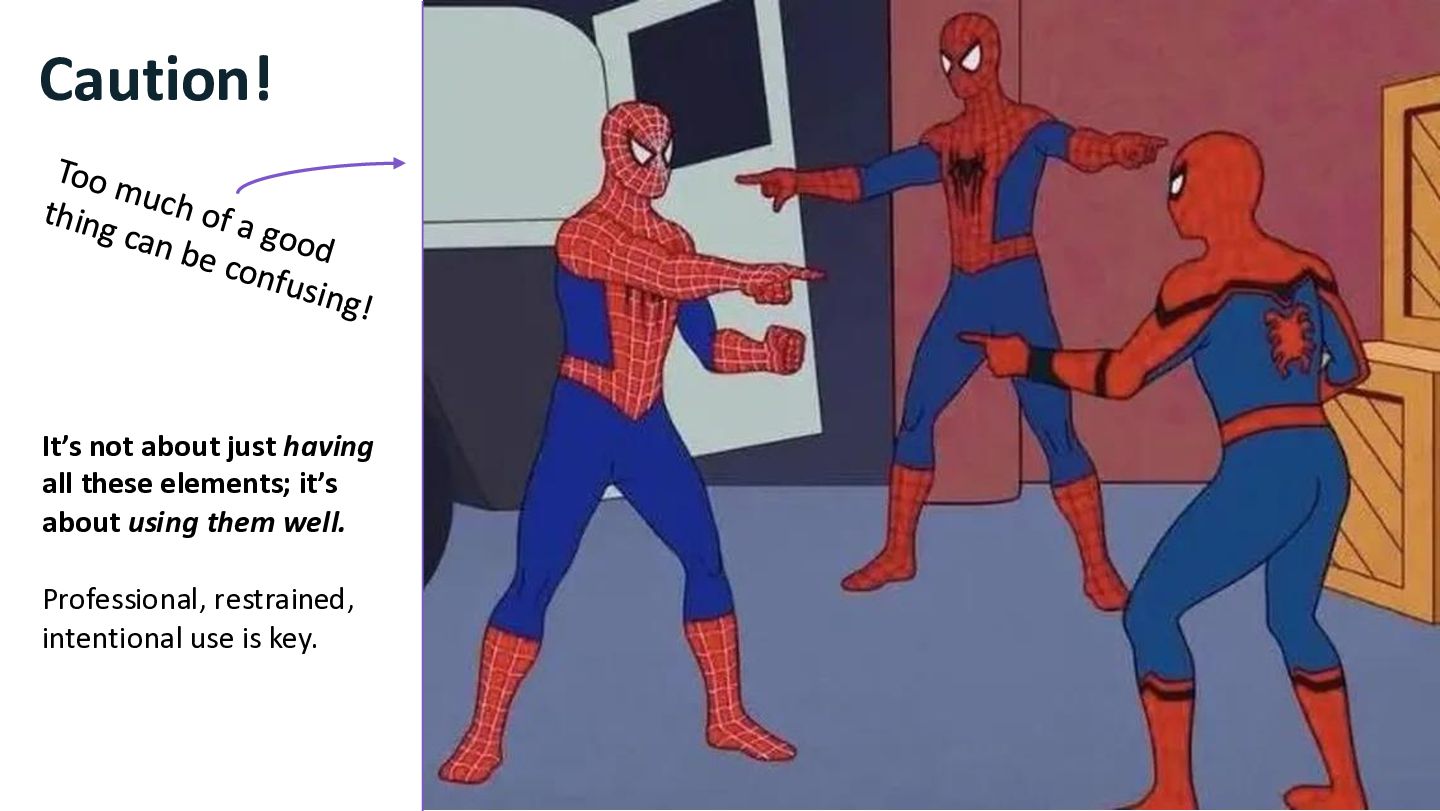
  25. Caution! It’s not about just having all these elements; it’s

    about using them well. Professional, restrained, intentional use is key.
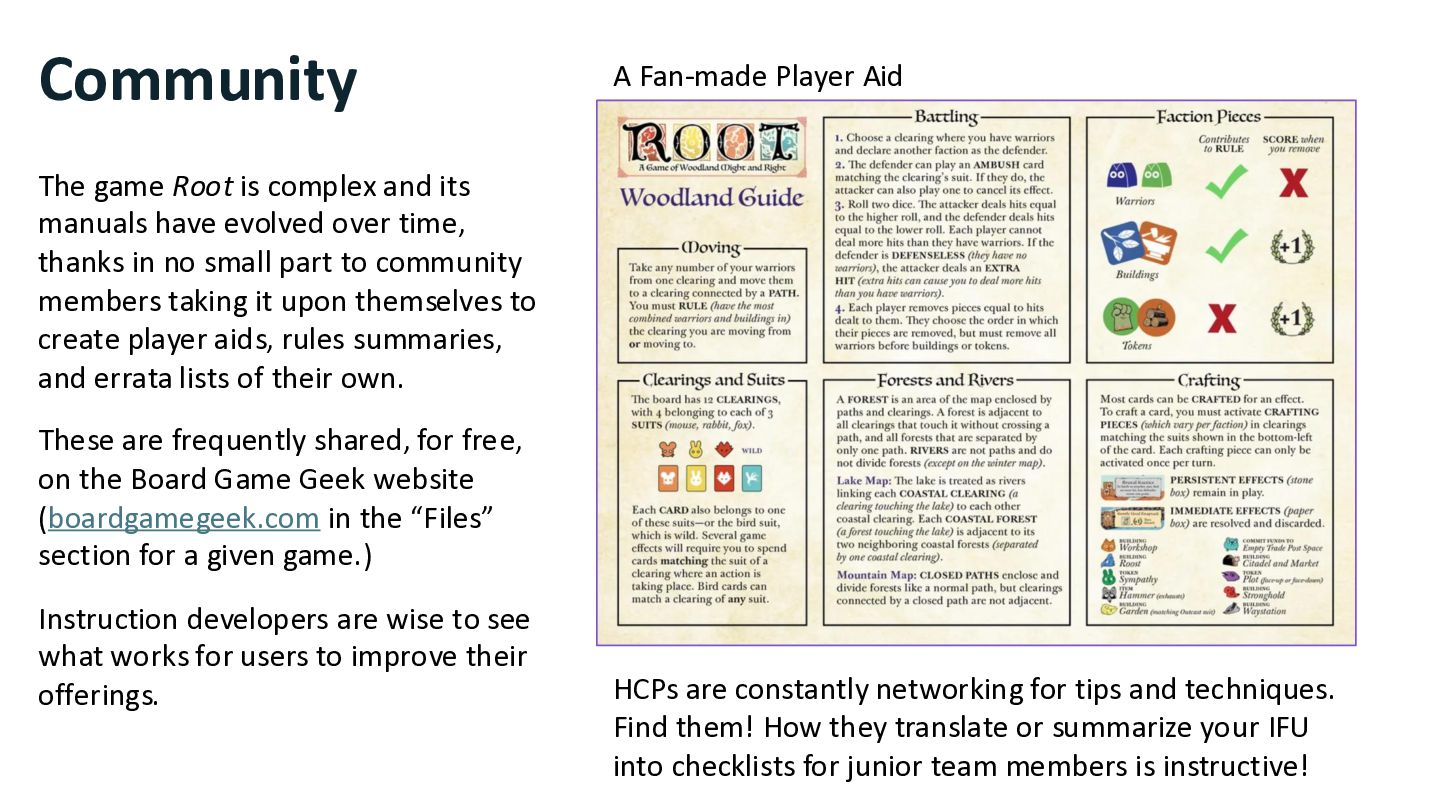
  26. Community The game Root is complex and its manuals have

    evolved over time, thanks in no small part to community members taking it upon themselves to create player aids, rules summaries, and errata lists of their own. These are frequently shared, for free, on the Board Game Geek website (boardgamegeek.com in the “Files” section for a given game.) Instruction developers are wise to see what works for users to improve their offerings. A Fan-made Player Aid HCPs are constantly networking for tips and techniques. Find them! How they translate or summarize your IFU into checklists for junior team members is instructive!
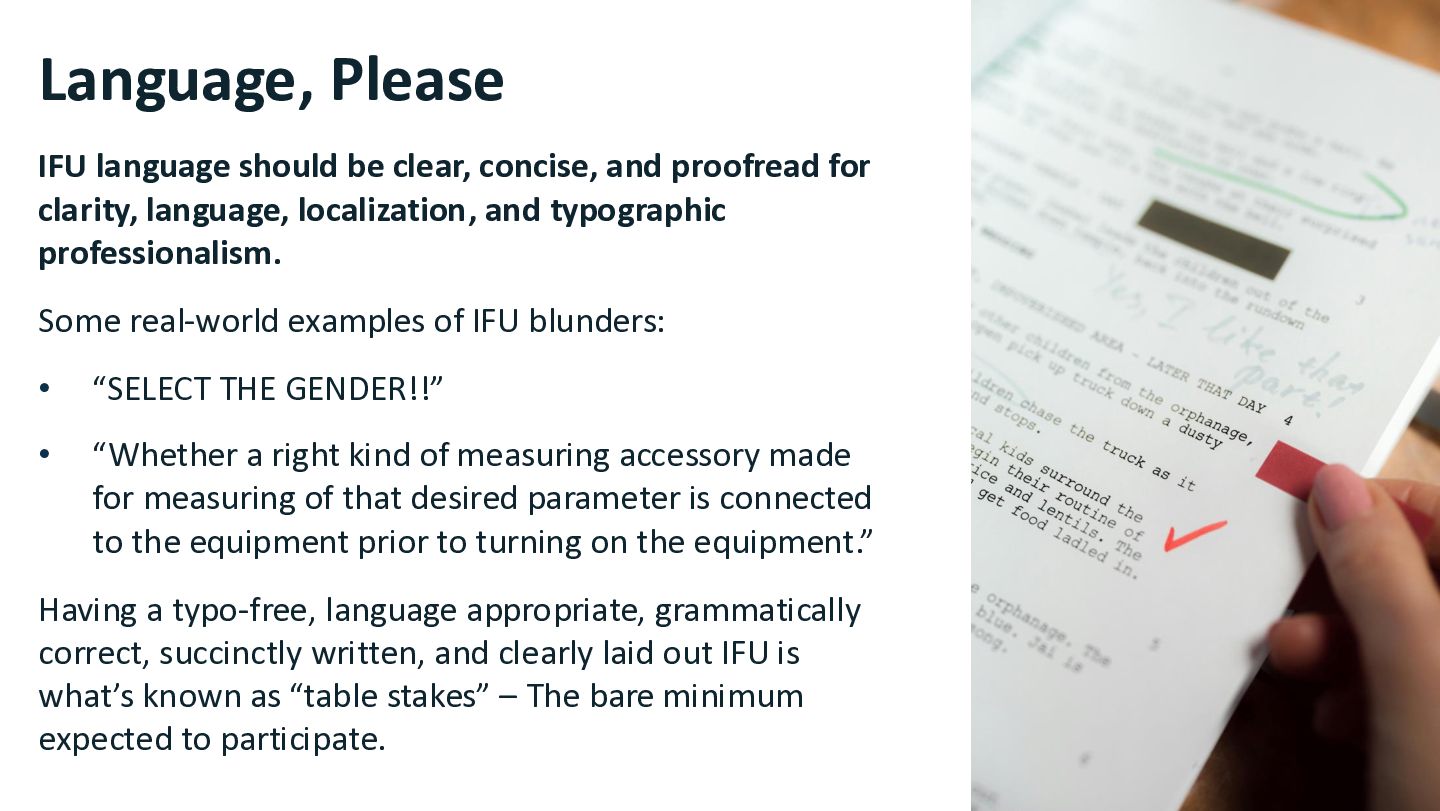
  27. Language, Please IFU language should be clear, concise, and proofread

    for clarity, language, localization, and typographic professionalism. Some real-world examples of IFU blunders: • “SELECT THE GENDER!!” • “Whether a right kind of measuring accessory made for measuring of that desired parameter is connected to the equipment prior to turning on the equipment.” Having a typo-free, language appropriate, grammatically correct, succinctly written, and clearly laid out IFU is what’s known as “table stakes” – The bare minimum expected to participate.
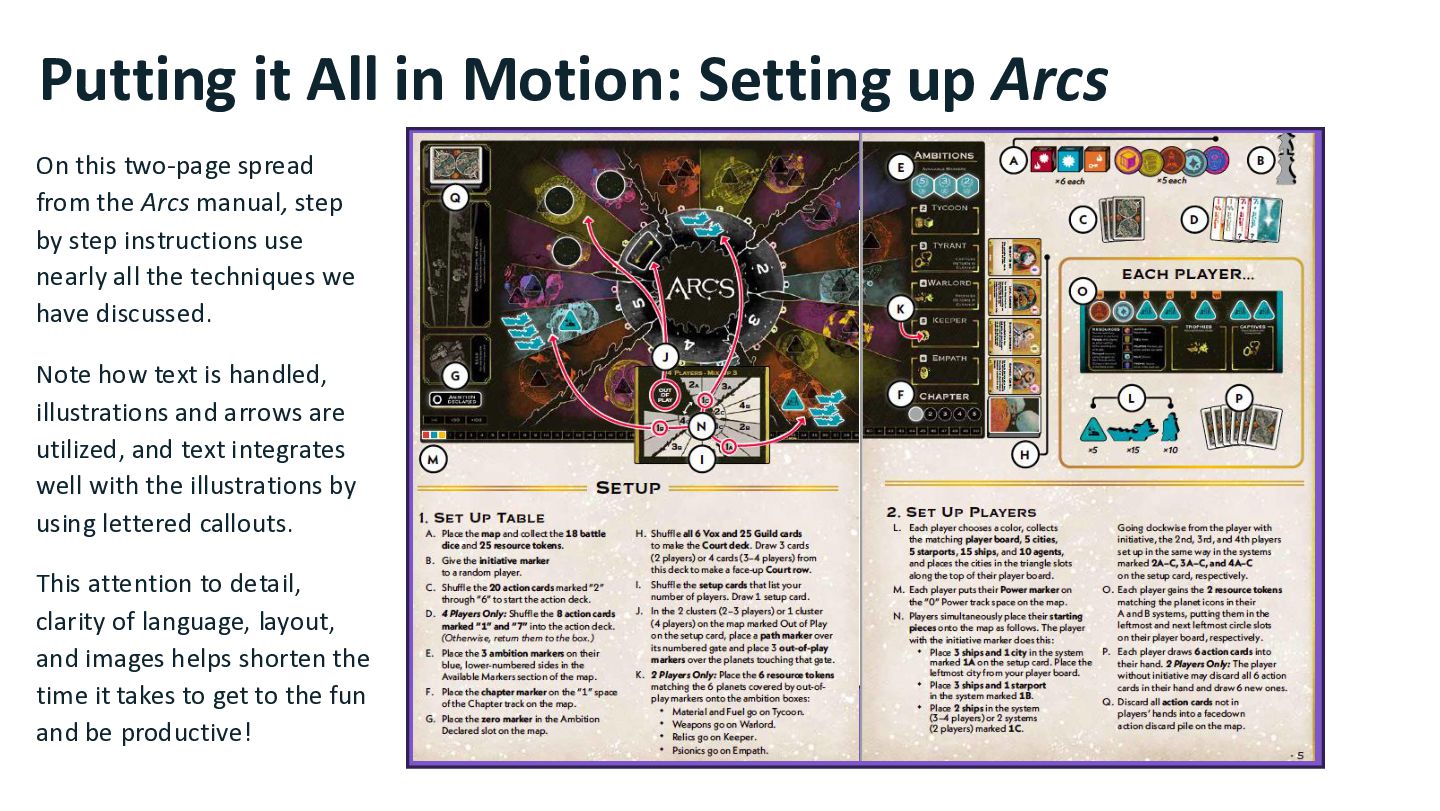
  28. Putting it All in Motion: Setting up Arcs On this

    two-page spread from the Arcs manual, step by step instructions use nearly all the techniques we have discussed. Note how text is handled, illustrations and arrows are utilized, and text integrates well with the illustrations by using lettered callouts. This attention to detail, clarity of language, layout, and images helps shorten the time it takes to get to the fun and be productive!
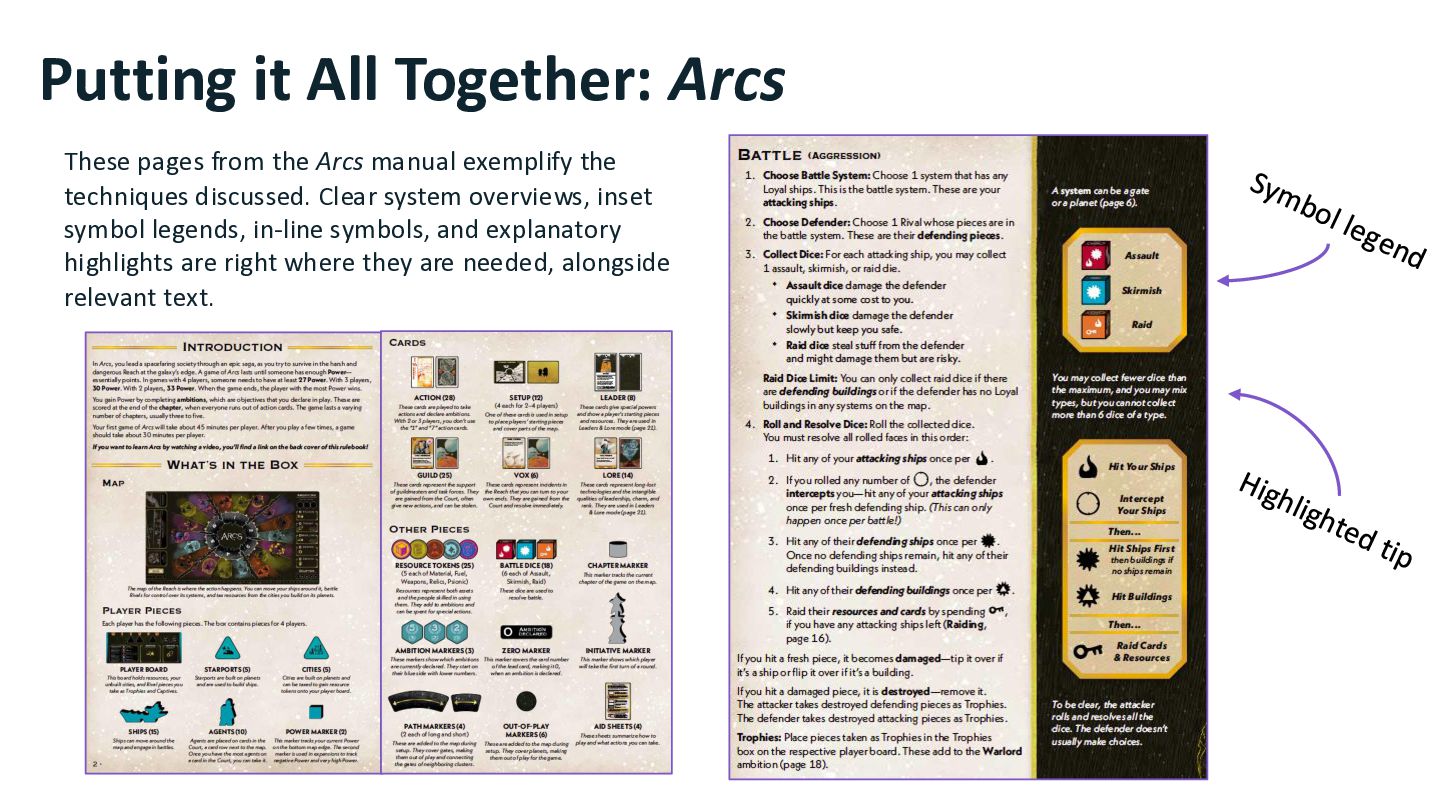
  29. Putting it All Together: Arcs These pages from the Arcs

    manual exemplify the techniques discussed. Clear system overviews, inset symbol legends, in-line symbols, and explanatory highlights are right where they are needed, alongside relevant text.
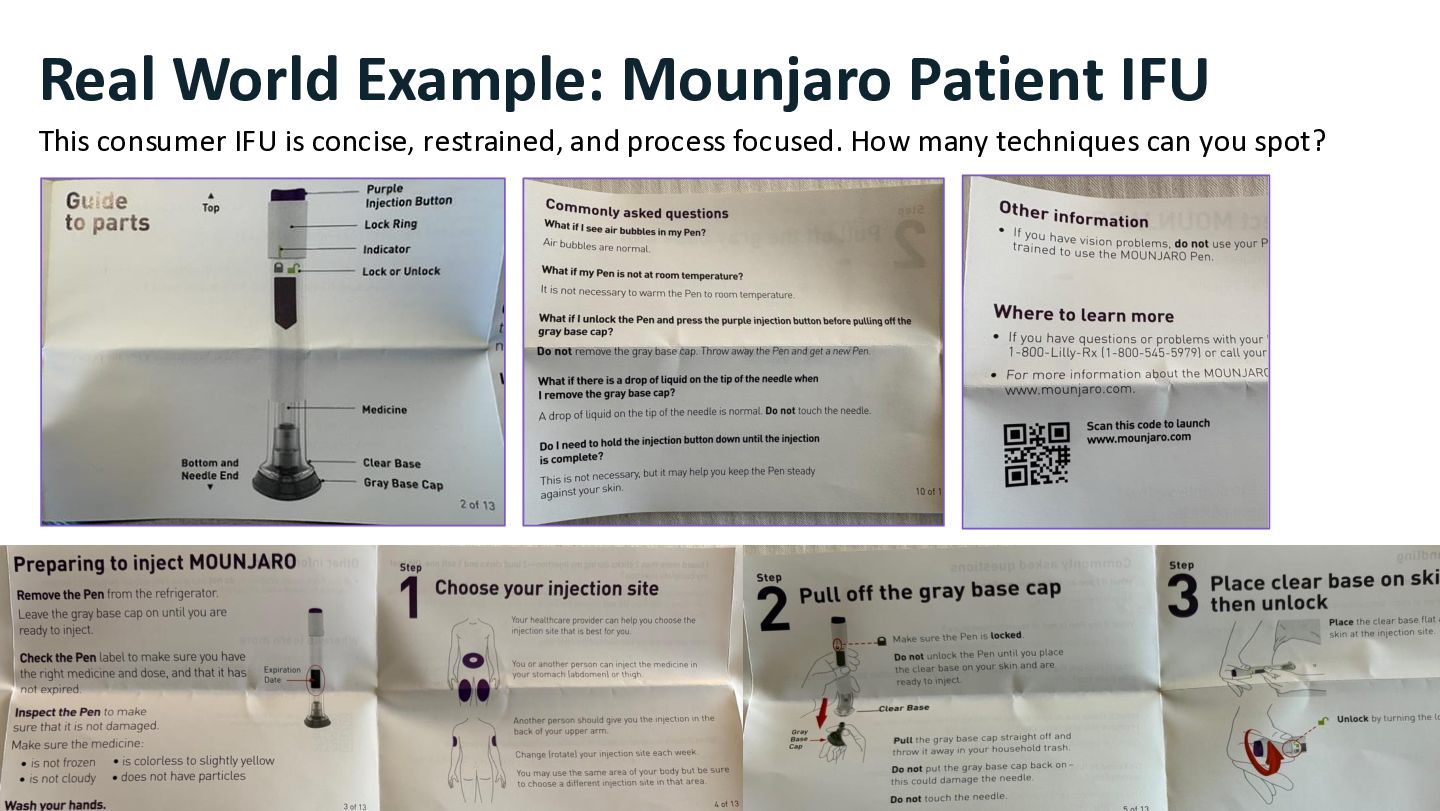
  30. Real World Example: Mounjaro Patient IFU This consumer IFU is

    concise, restrained, and process focused. How many techniques can you spot?
  31. Summary Make your IFU something practitioners will insist on using.

    Design for speed, use, and depth. Understand use cases, core audiences, and practitioner’s needs. Invest! If the product is worth paying for, so is the IFU: • Hire a graphic designer, an illustrator, a copywriter, a proofreader • Playtest your IFUs against the regulatory spirit of the law, not just the letter. Make the world a better place, one IFU at a time. (And find games you love!)
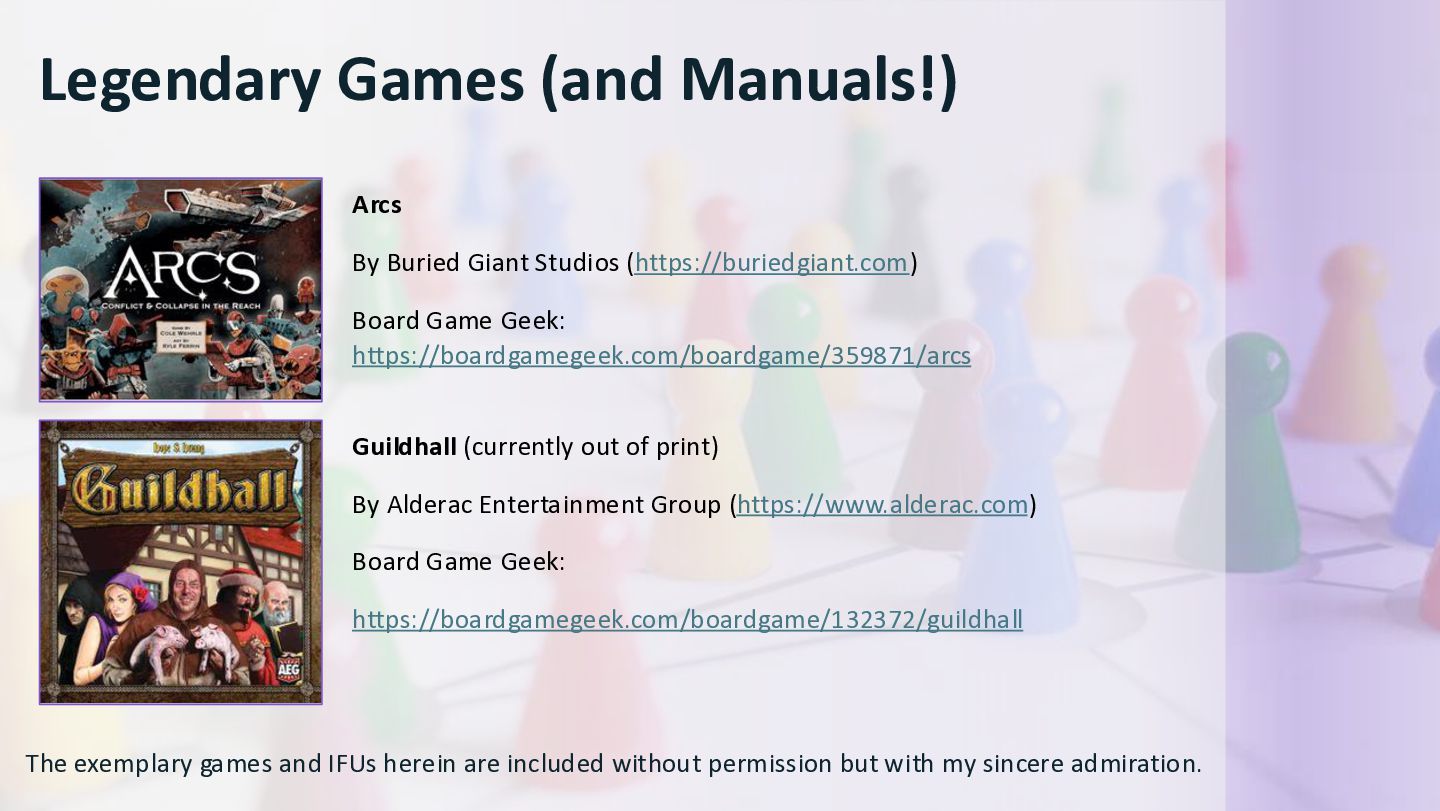
  32. Legendary Games (and Manuals!) Arcs By Buried Giant Studios (https://buriedgiant.com)

    Board Game Geek: https://boardgamegeek.com/boardgame/359871/arcs Guildhall (currently out of print) By Alderac Entertainment Group (https://www.alderac.com) Board Game Geek: https://boardgamegeek.com/boardgame/132372/guildhall The exemplary games and IFUs herein are included without permission but with my sincere admiration.
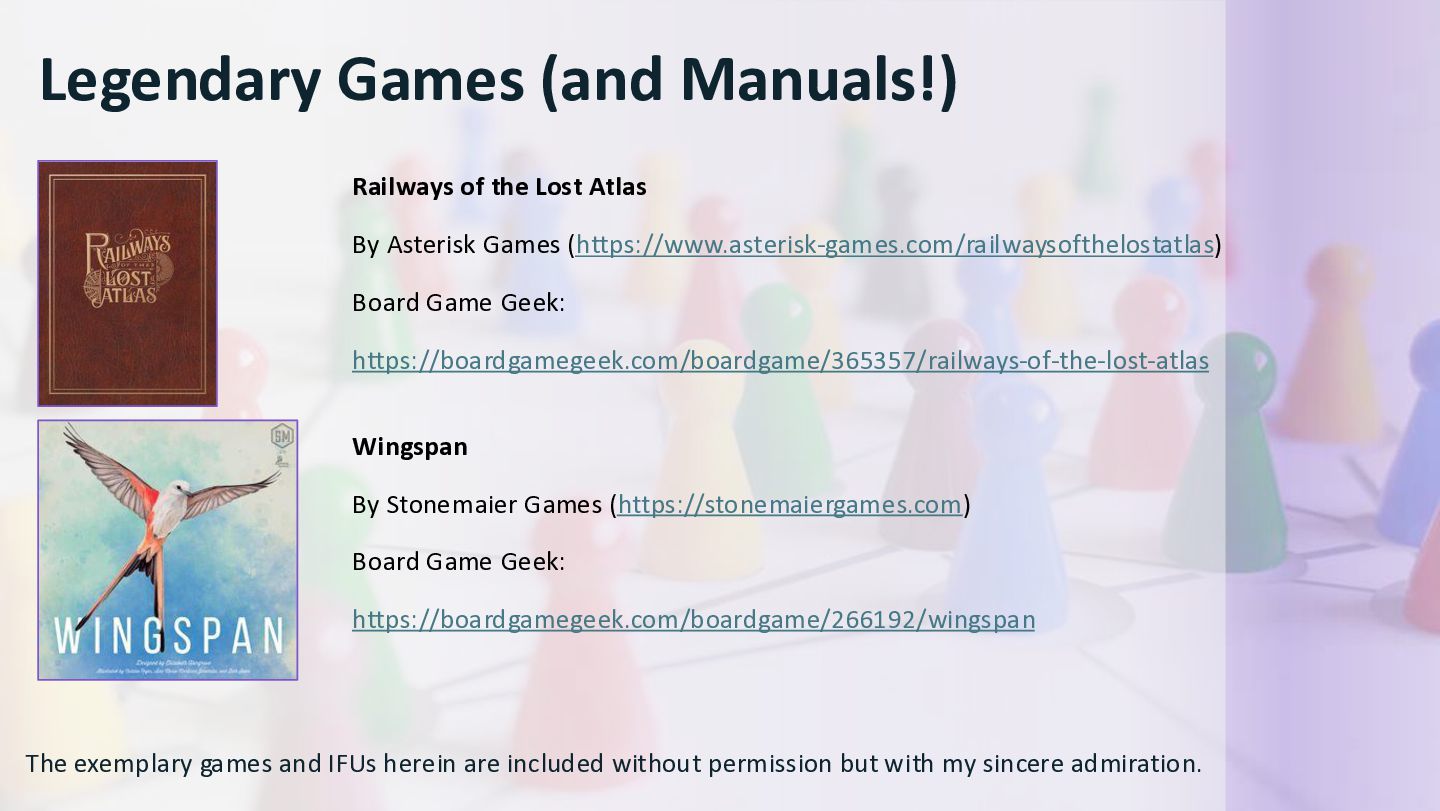
  33. Legendary Games (and Manuals!) The exemplary games and IFUs herein

    are included without permission but with my sincere admiration. Wingspan By Stonemaier Games (https://stonemaiergames.com) Board Game Geek: https://boardgamegeek.com/boardgame/266192/wingspan Railways of the Lost Atlas By Asterisk Games (https://www.asterisk-games.com/railwaysofthelostatlas) Board Game Geek: https://boardgamegeek.com/boardgame/365357/railways-of-the-lost-atlas
  34. Rethinking IFUs: What Board Game Rulebooks Contribute to IFU Usability

    Chris Hass, HF Practitioner, Consultant, Board Gamer Executive Director, Bentley University User Experience Center [email protected] | [email protected] | BGG: werdynerdy v.2 March 2026