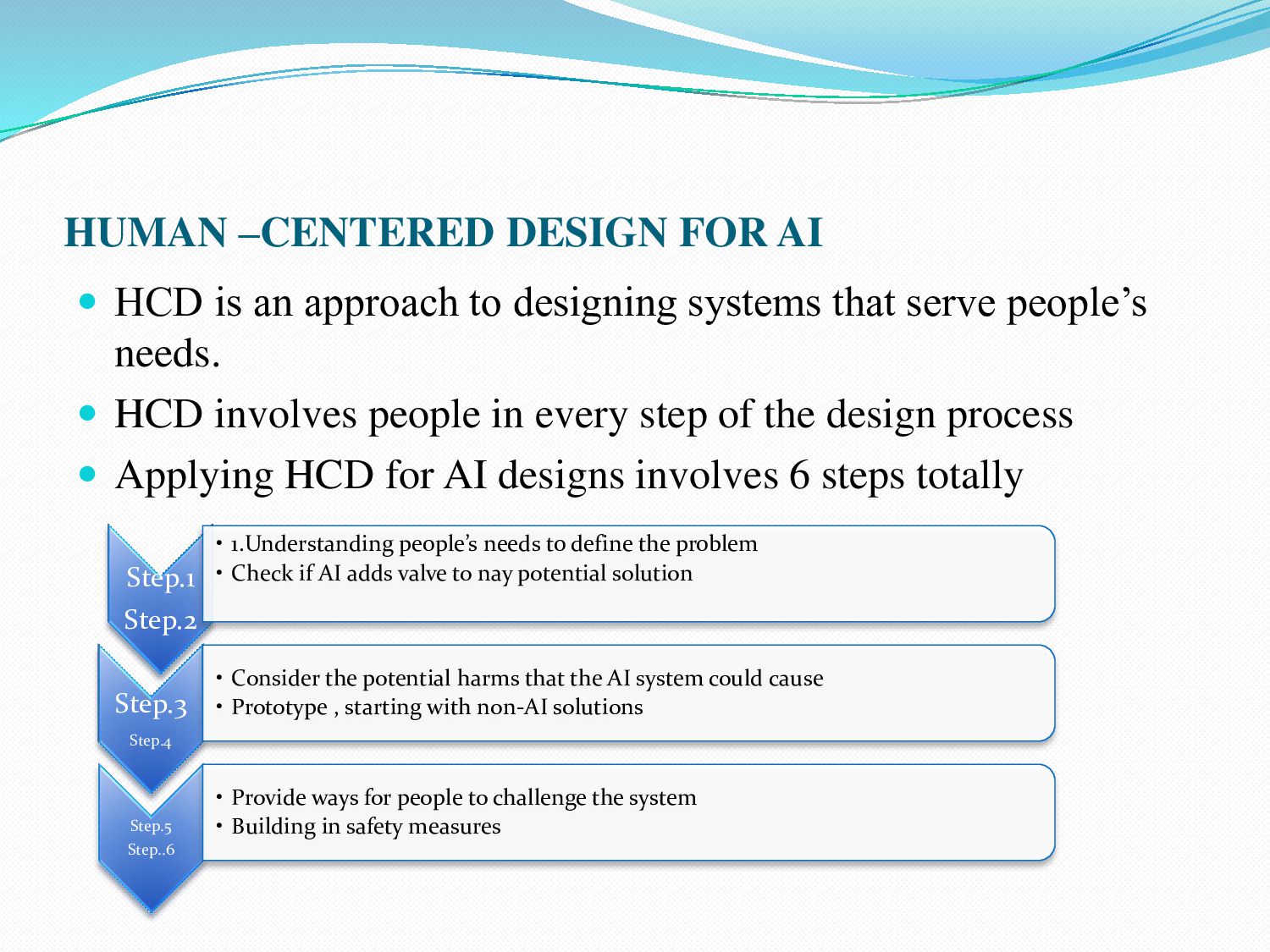
to designing systems that serve people’s needs. HCD involves people in every step of the design process Applying HCD for AI designs involves 6 steps totally Step.1 Step.2 • 1.Understanding people’s needs to define the problem • Check if AI adds valve to nay potential solution Step.3 Step.4 • Consider the potential harms that the AI system could cause • Prototype , starting with non-AI solutions Step.5 Step..6 • Provide ways for people to challenge the system • Building in safety measures
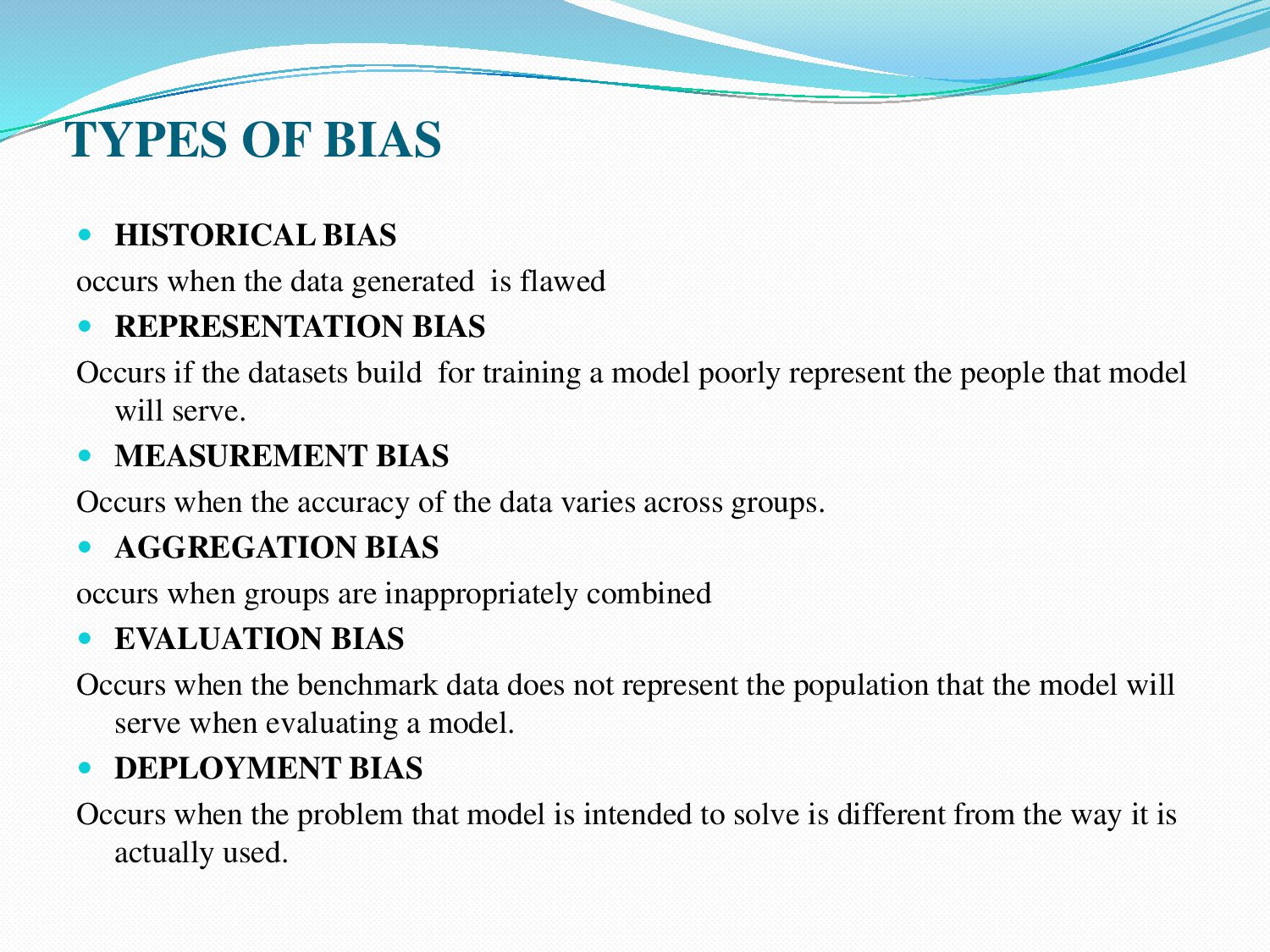
generated is flawed REPRESENTATION BIAS Occurs if the datasets build for training a model poorly represent the people that model will serve. MEASUREMENT BIAS Occurs when the accuracy of the data varies across groups. AGGREGATION BIAS occurs when groups are inappropriately combined EVALUATION BIAS Occurs when the benchmark data does not represent the population that the model will serve when evaluating a model. DEPLOYMENT BIAS Occurs when the problem that model is intended to solve is different from the way it is actually used.
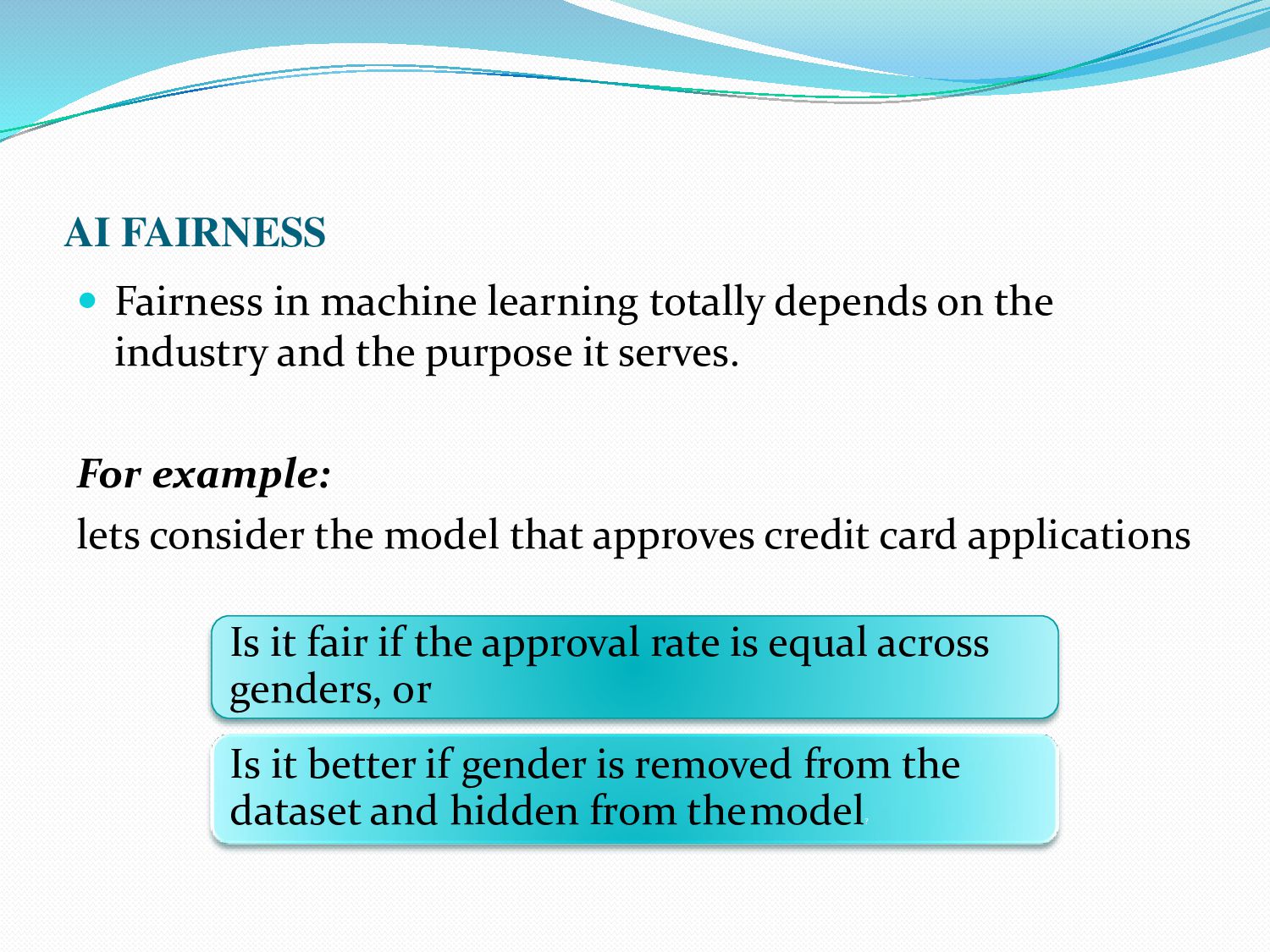
the industry and the purpose it serves. For example: lets consider the model that approves credit card applications Is it fair if the approval rate is equal across genders, or Is it better if gender is removed from the dataset and hidden from themodel ?
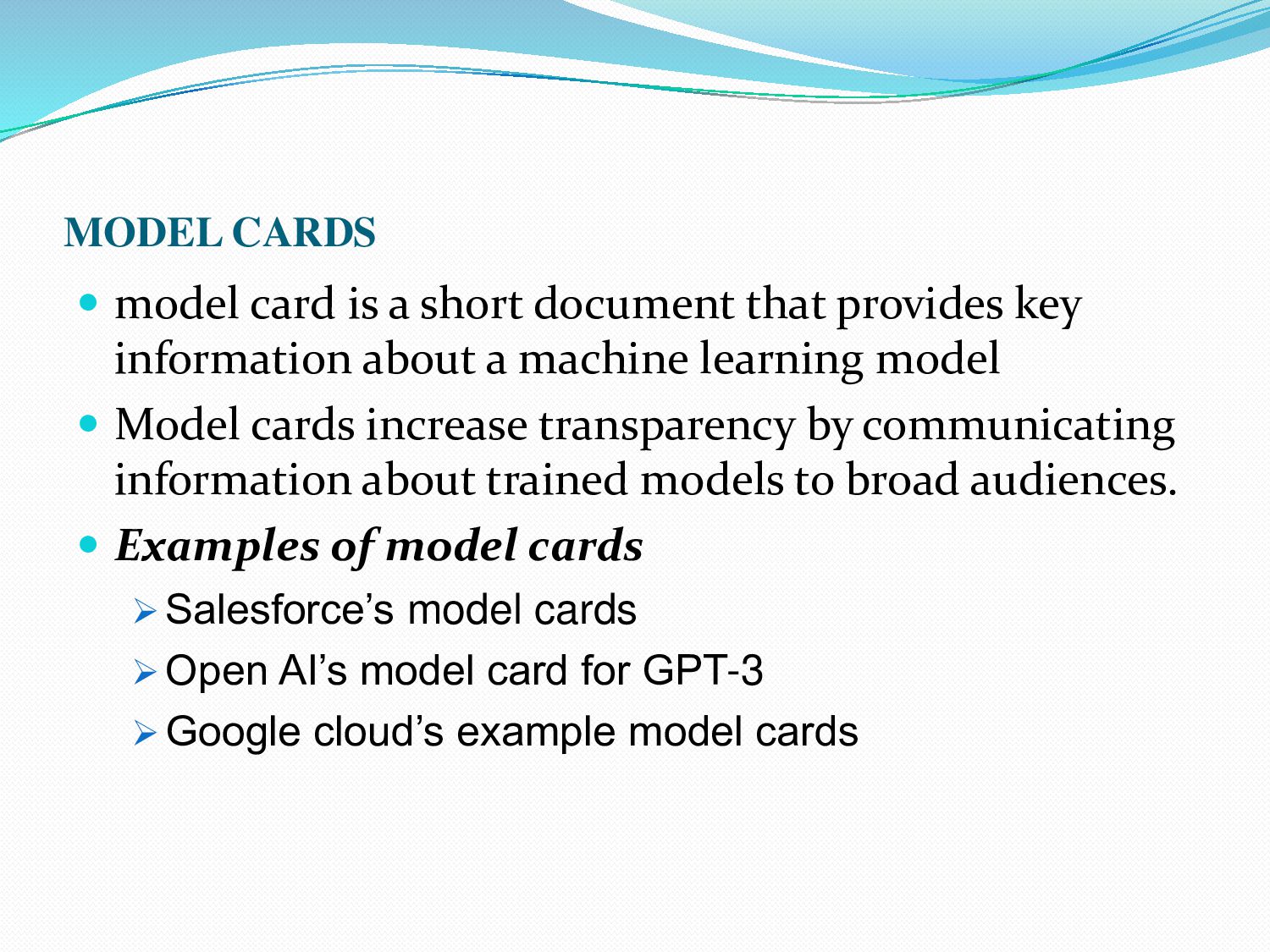
provides key information about a machine learning model Model cards increase transparency by communicating information about trained models to broad audiences. Examples of model cards Salesforce’s model cards Open AI’s model card for GPT-3 Google cloud’s example model cards
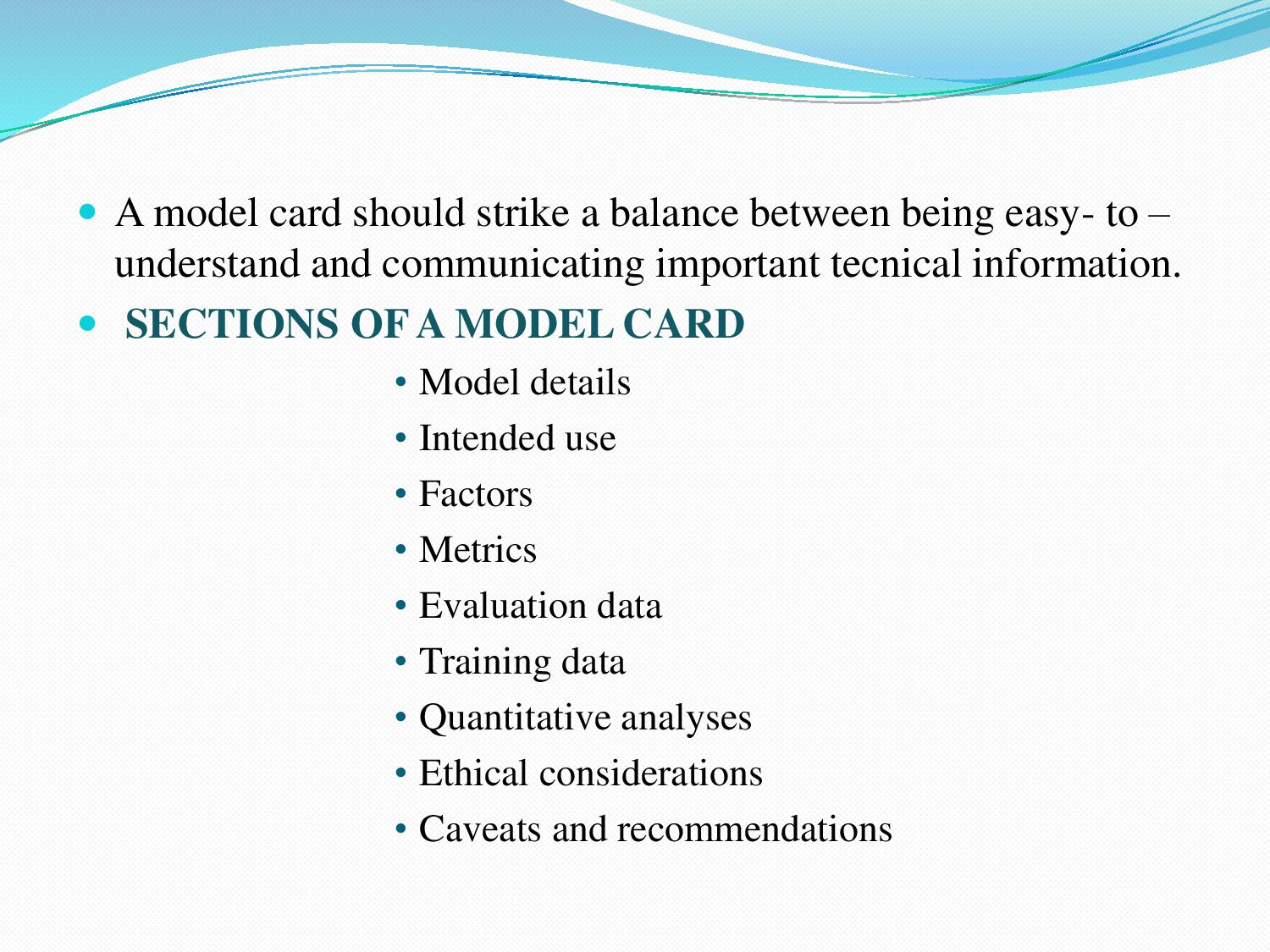
easy- to – understand and communicating important tecnical information. SECTIONS OF A MODEL CARD • Model details • Intended use • Factors • Metrics • Evaluation data • Training data • Quantitative analyses • Ethical considerations • Caveats and recommendations
like credit card decisions, to make video surveillance in airports, and to inform military operations. also these technologies have the potential to harm or help the people that they serve. So an initiative can be taken in identifying the harms by applying the ethical lens and can build designs to reduce these harms.


 deepika26
 pauljervisheath
 elsirapls
 emna__ayadi
 keathley
 mfonobong
 afnizarnur
 3n
 thoeni
 hatefulcrawdad
 akademiya2063
 inesmontani
 tessaabrams