Upgrade to Pro — share decks privately, control downloads, hide ads and more …

part1.pdf

Sponsored · Your Podcast. Everywhere. Effortlessly. Share. Educate. Inspire. Entertain. You do you. We'll handle the rest. →
Avatar for dimazest dimazest
December 15, 2011
79

 part1.pdf

Avatar for dimazest

dimazest

December 15, 2011

Transcript

  1. Graphical Models for the Internet Amr Ahmed & Alexander Smola

    Yahoo! Research & Australian National University, Santa Clara, CA [email protected], [email protected]
  2. Thanks Joey Gonzalez Yucheng Low Qirong Ho Shravan Narayanamurthy Vanja

    Josifovski Choon Hui Teo Eric Xing James Petterson Jake Eisenstein Shuang Hong Yang Vishy Vishwanathan Markus Weimer Alexandros Karatzoglou Mohamed Aly Sergiy Matyusevich
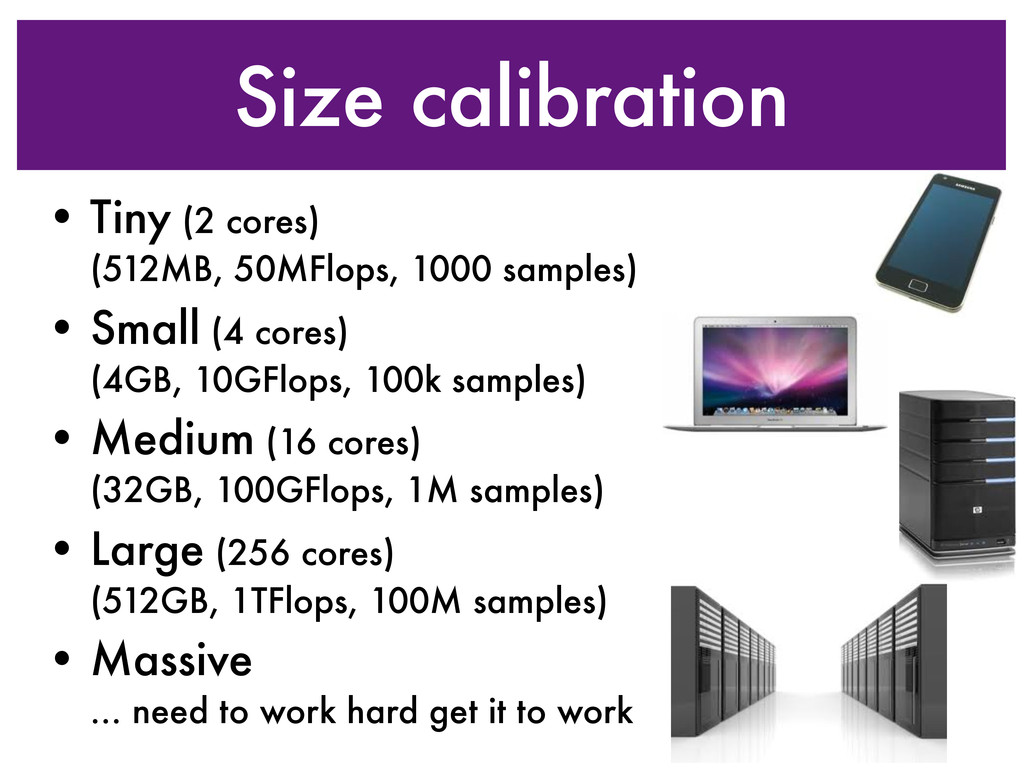
  3. • Tiny (2 cores) (512MB, 50MFlops, 1000 samples) • Small

    (4 cores) (4GB, 10GFlops, 100k samples) • Medium (16 cores) (32GB, 100GFlops, 1M samples) • Large (256 cores) (512GB, 1TFlops, 100M samples) • Massive ... need to work hard get it to work Size calibration
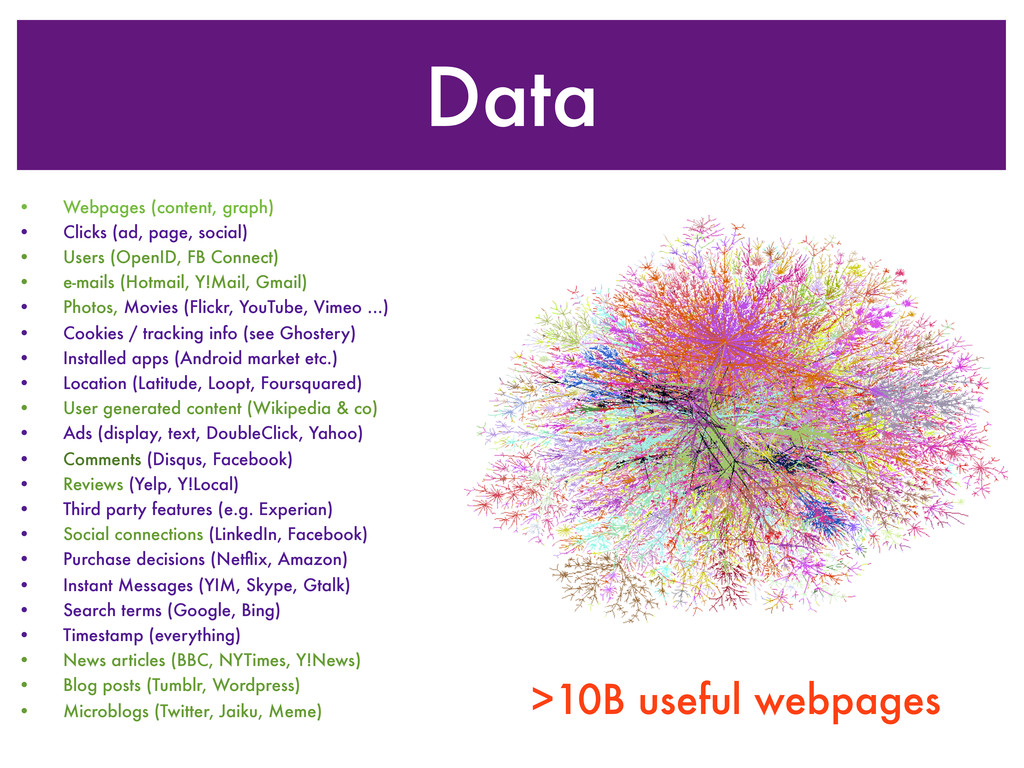
  4. Data • Webpages (content, graph) • Clicks (ad, page, social)

    • Users (OpenID, FB Connect) • e-mails (Hotmail, Y!Mail, Gmail) • Photos, Movies (Flickr, YouTube, Vimeo ...) • Cookies / tracking info (see Ghostery) • Installed apps (Android market etc.) • Location (Latitude, Loopt, Foursquared) • User generated content (Wikipedia & co) • Ads (display, text, DoubleClick, Yahoo) • Comments (Disqus, Facebook) • Reviews (Yelp, Y!Local) • Third party features (e.g. Experian) • Social connections (LinkedIn, Facebook) • Purchase decisions (Netflix, Amazon) • Instant Messages (YIM, Skype, Gtalk) • Search terms (Google, Bing) • Timestamp (everything) • News articles (BBC, NYTimes, Y!News) • Blog posts (Tumblr, Wordpress) • Microblogs (Twitter, Jaiku, Meme) >10B useful webpages
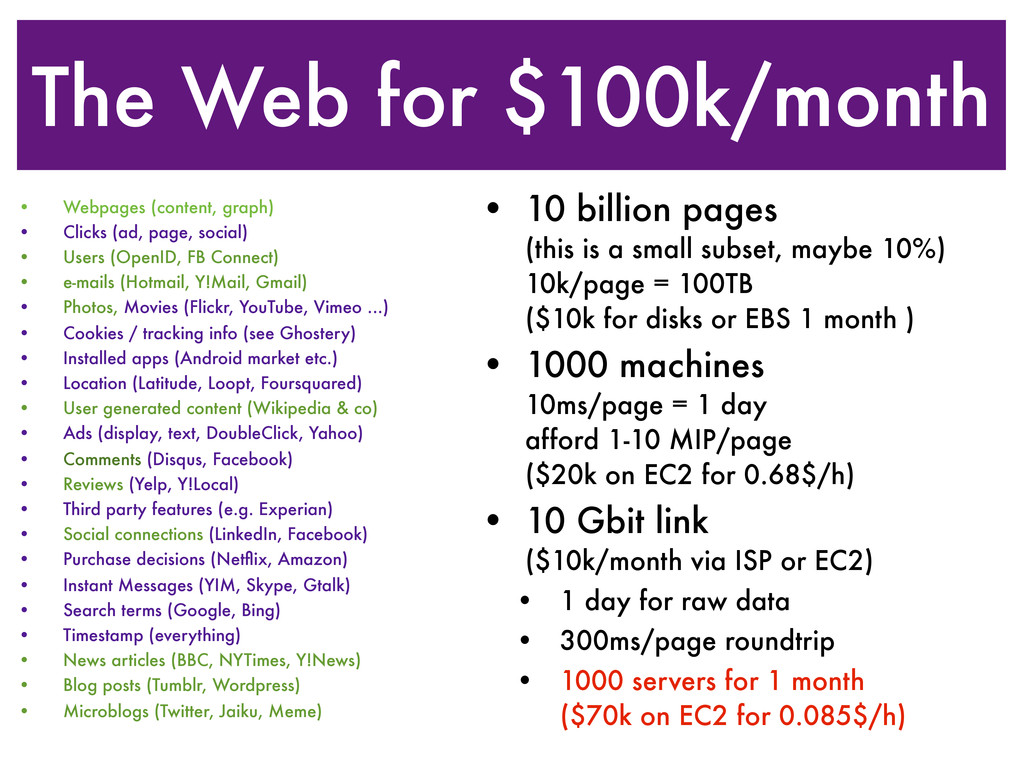
  5. The Web for $100k/month • Webpages (content, graph) • Clicks

    (ad, page, social) • Users (OpenID, FB Connect) • e-mails (Hotmail, Y!Mail, Gmail) • Photos, Movies (Flickr, YouTube, Vimeo ...) • Cookies / tracking info (see Ghostery) • Installed apps (Android market etc.) • Location (Latitude, Loopt, Foursquared) • User generated content (Wikipedia & co) • Ads (display, text, DoubleClick, Yahoo) • Comments (Disqus, Facebook) • Reviews (Yelp, Y!Local) • Third party features (e.g. Experian) • Social connections (LinkedIn, Facebook) • Purchase decisions (Netflix, Amazon) • Instant Messages (YIM, Skype, Gtalk) • Search terms (Google, Bing) • Timestamp (everything) • News articles (BBC, NYTimes, Y!News) • Blog posts (Tumblr, Wordpress) • Microblogs (Twitter, Jaiku, Meme) • 10 billion pages (this is a small subset, maybe 10%) 10k/page = 100TB ($10k for disks or EBS 1 month ) • 1000 machines 10ms/page = 1 day afford 1-10 MIP/page ($20k on EC2 for 0.68$/h) • 10 Gbit link ($10k/month via ISP or EC2) • 1 day for raw data • 300ms/page roundtrip • 1000 servers for 1 month ($70k on EC2 for 0.085$/h)
  6. Data - Identity & Graph 100M-1B vertices • Webpages (content,

    graph) • Clicks (ad, page, social) • Users (OpenID, FB Connect) • e-mails (Hotmail, Y!Mail, Gmail) • Photos, Movies (Flickr, YouTube, Vimeo ...) • Cookies / tracking info (see Ghostery) • Installed apps (Android market etc.) • Location (Latitude, Loopt, Foursquared) • User generated content (Wikipedia & co) • Ads (display, text, DoubleClick, Yahoo) • Comments (Disqus, Facebook) • Reviews (Yelp, Y!Local) • Third party features (e.g. Experian) • Social connections (LinkedIn, Facebook) • Purchase decisions (Netflix, Amazon) • Instant Messages (YIM, Skype, Gtalk) • Search terms (Google, Bing) • Timestamp (everything) • News articles (BBC, NYTimes, Y!News) • Blog posts (Tumblr, Wordpress) • Microblogs (Twitter, Jaiku, Meme)
  7. Data - User generated content >1B images, 40h video/minute •

    Webpages (content, graph) • Clicks (ad, page, social) • Users (OpenID, FB Connect) • e-mails (Hotmail, Y!Mail, Gmail) • Photos, Movies (Flickr, YouTube, Vimeo ...) • Cookies / tracking info (see Ghostery) • Installed apps (Android market etc.) • Location (Latitude, Loopt, Foursquared) • User generated content (Wikipedia & co) • Ads (display, text, DoubleClick, Yahoo) • Comments (Disqus, Facebook) • Reviews (Yelp, Y!Local) • Third party features (e.g. Experian) • Social connections (LinkedIn, Facebook) • Purchase decisions (Netflix, Amazon) • Instant Messages (YIM, Skype, Gtalk) • Search terms (Google, Bing) • Timestamp (everything) • News articles (BBC, NYTimes, Y!News) • Blog posts (Tumblr, Wordpress) • Microblogs (Twitter, Jaiku, Meme)
  8. Data - User generated content >1B images, 40h video/minute •

    Webpages (content, graph) • Clicks (ad, page, social) • Users (OpenID, FB Connect) • e-mails (Hotmail, Y!Mail, Gmail) • Photos, Movies (Flickr, YouTube, Vimeo ...) • Cookies / tracking info (see Ghostery) • Installed apps (Android market etc.) • Location (Latitude, Loopt, Foursquared) • User generated content (Wikipedia & co) • Ads (display, text, DoubleClick, Yahoo) • Comments (Disqus, Facebook) • Reviews (Yelp, Y!Local) • Third party features (e.g. Experian) • Social connections (LinkedIn, Facebook) • Purchase decisions (Netflix, Amazon) • Instant Messages (YIM, Skype, Gtalk) • Search terms (Google, Bing) • Timestamp (everything) • News articles (BBC, NYTimes, Y!News) • Blog posts (Tumblr, Wordpress) • Microblogs (Twitter, Jaiku, Meme) crawl it
  9. >1B texts • Webpages (content, graph) • Clicks (ad, page,

    social) • Users (OpenID, FB Connect) • e-mails (Hotmail, Y!Mail, Gmail) • Photos, Movies (Flickr, YouTube, Vimeo ...) • Cookies / tracking info (see Ghostery) • Installed apps (Android market etc.) • Location (Latitude, Loopt, Foursquared) • User generated content (Wikipedia & co) • Ads (display, text, DoubleClick, Yahoo) • Comments (Disqus, Facebook) • Reviews (Yelp, Y!Local) • Third party features (e.g. Experian) • Social connections (LinkedIn, Facebook) • Purchase decisions (Netflix, Amazon) • Instant Messages (YIM, Skype, Gtalk) • Search terms (Google, Bing) • Timestamp (everything) • News articles (BBC, NYTimes, Y!News) • Blog posts (Tumblr, Wordpress) • Microblogs (Twitter, Jaiku, Meme) Data - Messages
  10. >1B texts • Webpages (content, graph) • Clicks (ad, page,

    social) • Users (OpenID, FB Connect) • e-mails (Hotmail, Y!Mail, Gmail) • Photos, Movies (Flickr, YouTube, Vimeo ...) • Cookies / tracking info (see Ghostery) • Installed apps (Android market etc.) • Location (Latitude, Loopt, Foursquared) • User generated content (Wikipedia & co) • Ads (display, text, DoubleClick, Yahoo) • Comments (Disqus, Facebook) • Reviews (Yelp, Y!Local) • Third party features (e.g. Experian) • Social connections (LinkedIn, Facebook) • Purchase decisions (Netflix, Amazon) • Instant Messages (YIM, Skype, Gtalk) • Search terms (Google, Bing) • Timestamp (everything) • News articles (BBC, NYTimes, Y!News) • Blog posts (Tumblr, Wordpress) • Microblogs (Twitter, Jaiku, Meme) impossible without NDA Data - Messages
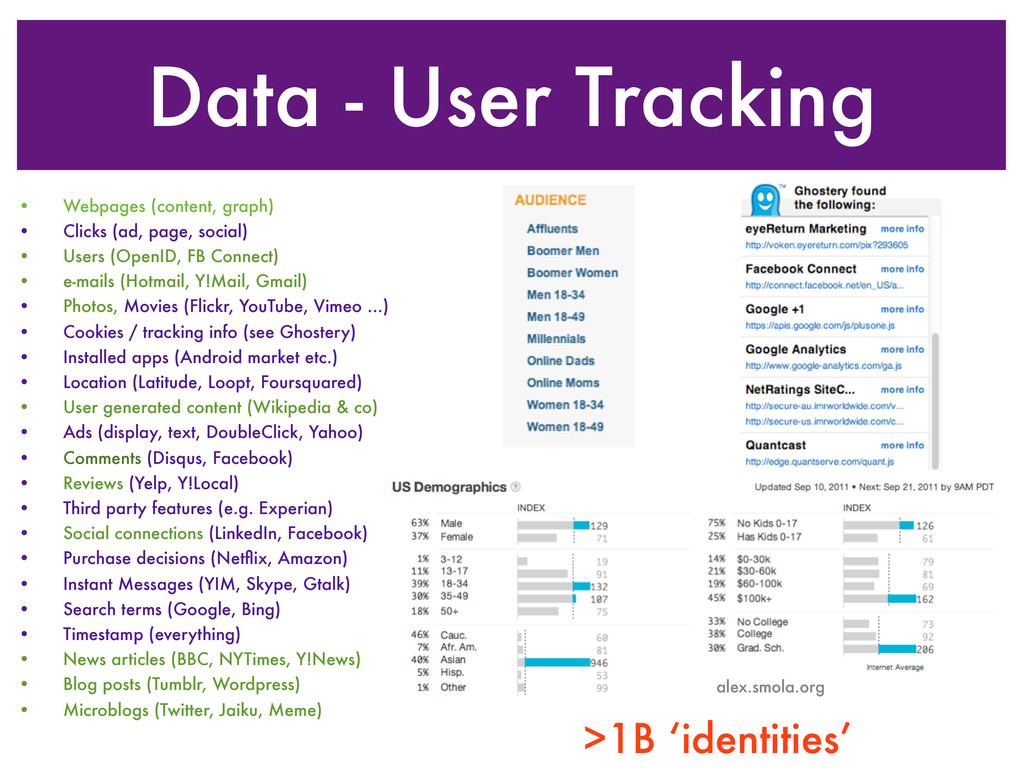
  11. Data - User Tracking alex.smola.org >1B ‘identities’ • Webpages (content,

    graph) • Clicks (ad, page, social) • Users (OpenID, FB Connect) • e-mails (Hotmail, Y!Mail, Gmail) • Photos, Movies (Flickr, YouTube, Vimeo ...) • Cookies / tracking info (see Ghostery) • Installed apps (Android market etc.) • Location (Latitude, Loopt, Foursquared) • User generated content (Wikipedia & co) • Ads (display, text, DoubleClick, Yahoo) • Comments (Disqus, Facebook) • Reviews (Yelp, Y!Local) • Third party features (e.g. Experian) • Social connections (LinkedIn, Facebook) • Purchase decisions (Netflix, Amazon) • Instant Messages (YIM, Skype, Gtalk) • Search terms (Google, Bing) • Timestamp (everything) • News articles (BBC, NYTimes, Y!News) • Blog posts (Tumblr, Wordpress) • Microblogs (Twitter, Jaiku, Meme)
  12. Data - User Tracking • Webpages (content, graph) • Clicks

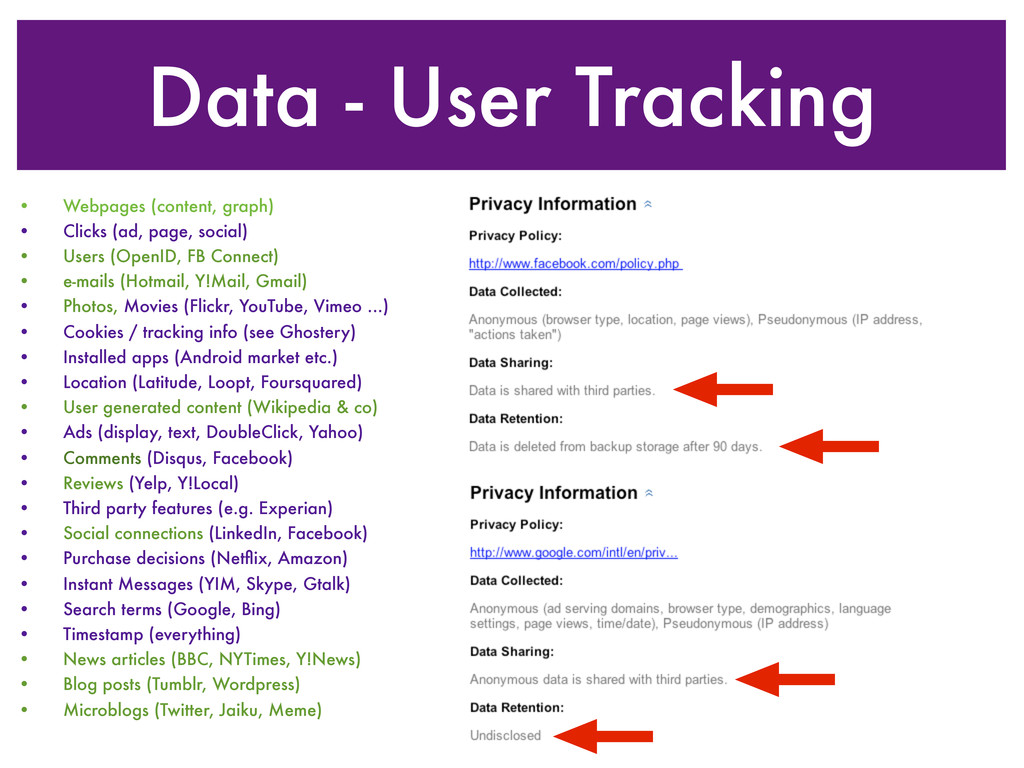
    (ad, page, social) • Users (OpenID, FB Connect) • e-mails (Hotmail, Y!Mail, Gmail) • Photos, Movies (Flickr, YouTube, Vimeo ...) • Cookies / tracking info (see Ghostery) • Installed apps (Android market etc.) • Location (Latitude, Loopt, Foursquared) • User generated content (Wikipedia & co) • Ads (display, text, DoubleClick, Yahoo) • Comments (Disqus, Facebook) • Reviews (Yelp, Y!Local) • Third party features (e.g. Experian) • Social connections (LinkedIn, Facebook) • Purchase decisions (Netflix, Amazon) • Instant Messages (YIM, Skype, Gtalk) • Search terms (Google, Bing) • Timestamp (everything) • News articles (BBC, NYTimes, Y!News) • Blog posts (Tumblr, Wordpress) • Microblogs (Twitter, Jaiku, Meme)
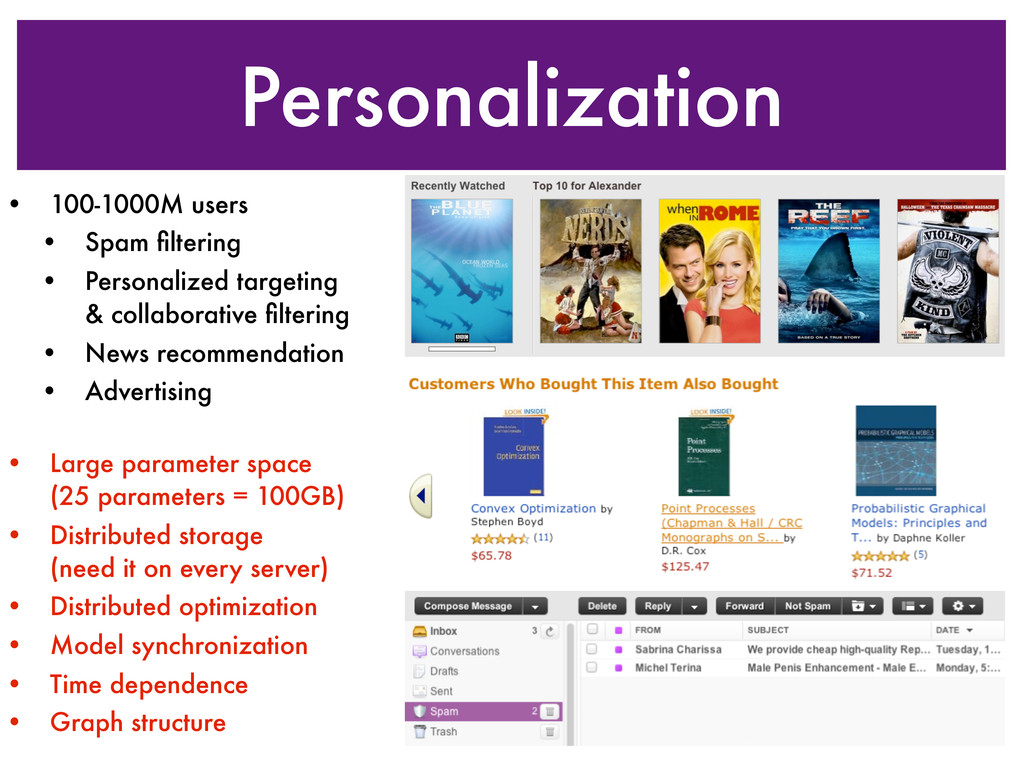
  13. Personalization • 100-1000M users • Spam filtering • Personalized targeting

    & collaborative filtering • News recommendation • Advertising • Large parameter space (25 parameters = 100GB) • Distributed storage (need it on every server) • Distributed optimization • Model synchronization • Time dependence • Graph structure
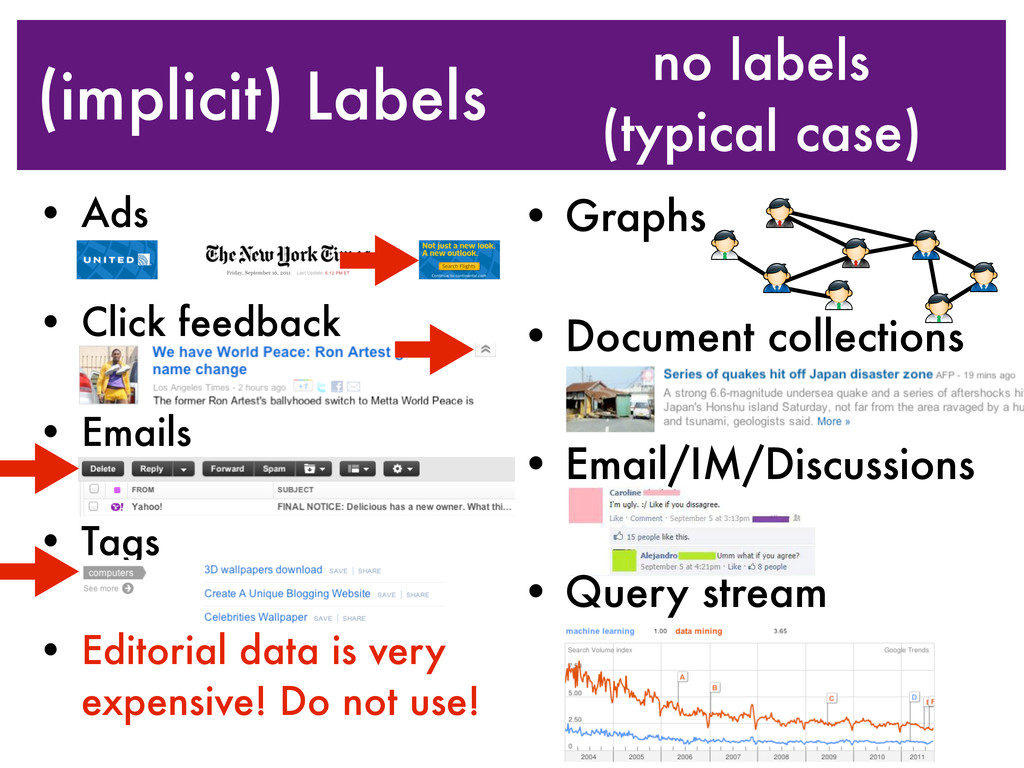
  14. • Ads • Click feedback • Emails • Tags •

    Editorial data is very expensive! Do not use! • Graphs • Document collections • Email/IM/Discussions • Query stream (implicit) Labels no labels (typical case)
  15. Challenges • Scale • Billions of instances (documents, clicks, users,

    ads) • Rich data structure (ontology, categories, tags) • Model does not fit into single machine • Modeling • Plenty of unlabeled data, temporal structure, side information • User-understandable structure • Solve problem. Don’t simply apply clustering/LDA/PCA/ICA • We only cover building blocks • Inference • 10k-100k clusters/discrete objects, 1M-100M unique tokens • Communication
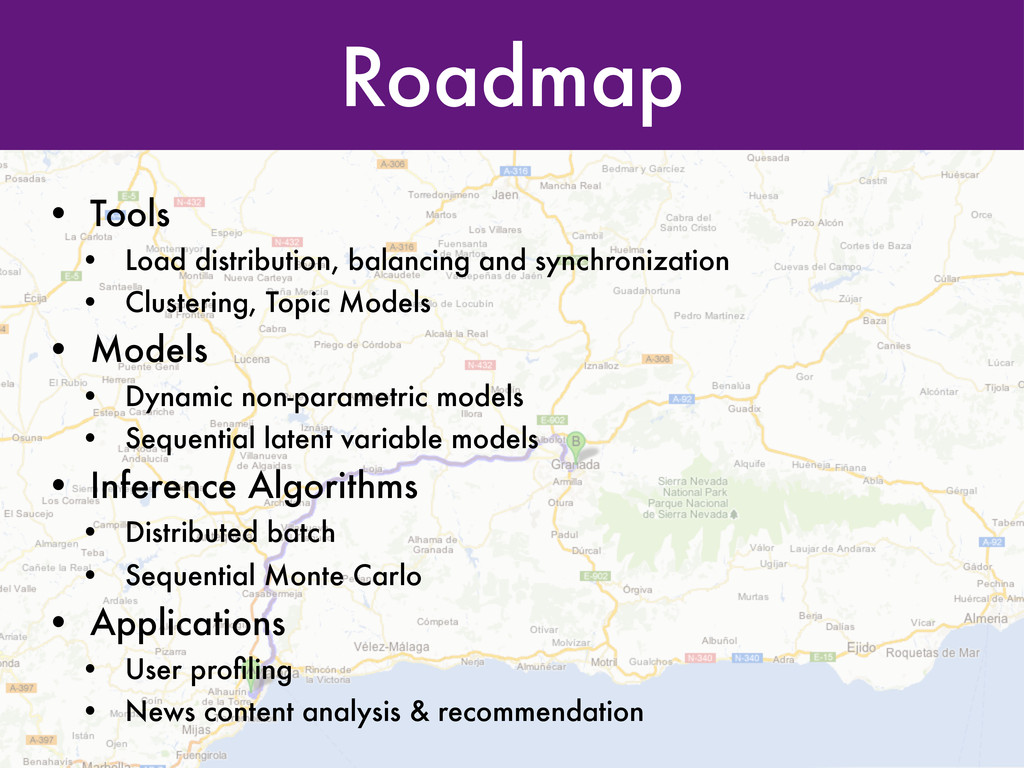
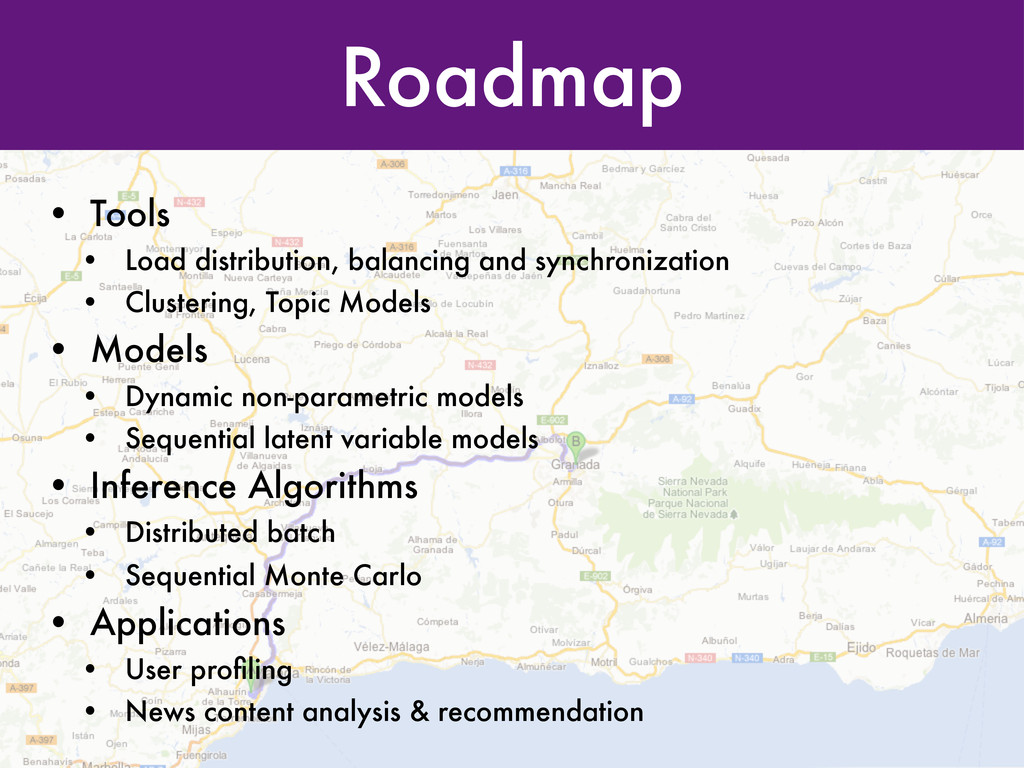
  16. • Tools • Load distribution, balancing and synchronization • Clustering,

    Topic Models • Models • Dynamic non-parametric models • Sequential latent variable models • Inference Algorithms • Distributed batch • Sequential Monte Carlo • Applications • User profiling • News content analysis & recommendation Roadmap
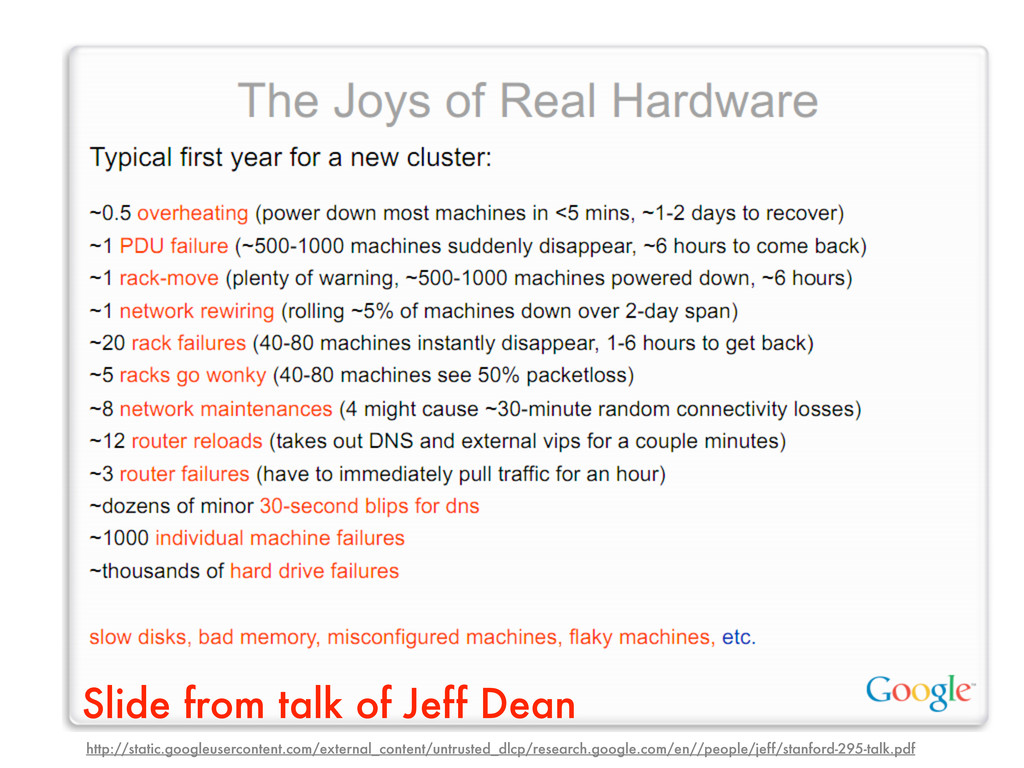
  17. Systems Algorithms run on MANY REAL and FAULTY boxes not

    Turing machines. So we need to deal with it.
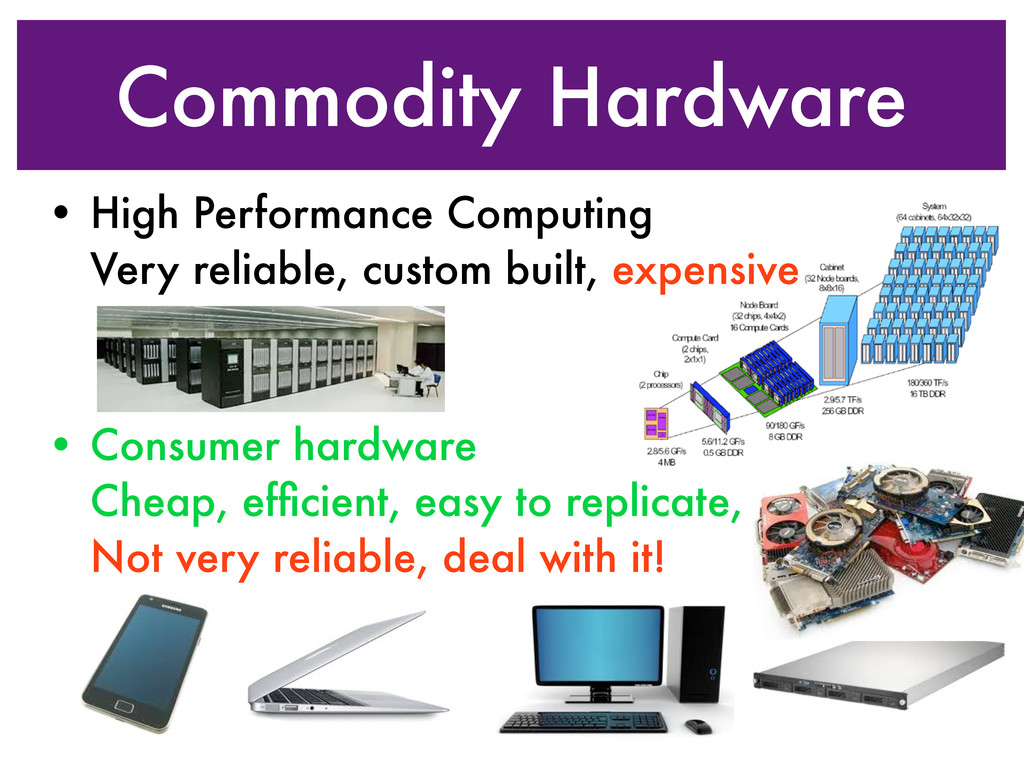
  18. • High Performance Computing Very reliable, custom built, expensive •

    Consumer hardware Cheap, efficient, easy to replicate, Not very reliable, deal with it! Commodity Hardware
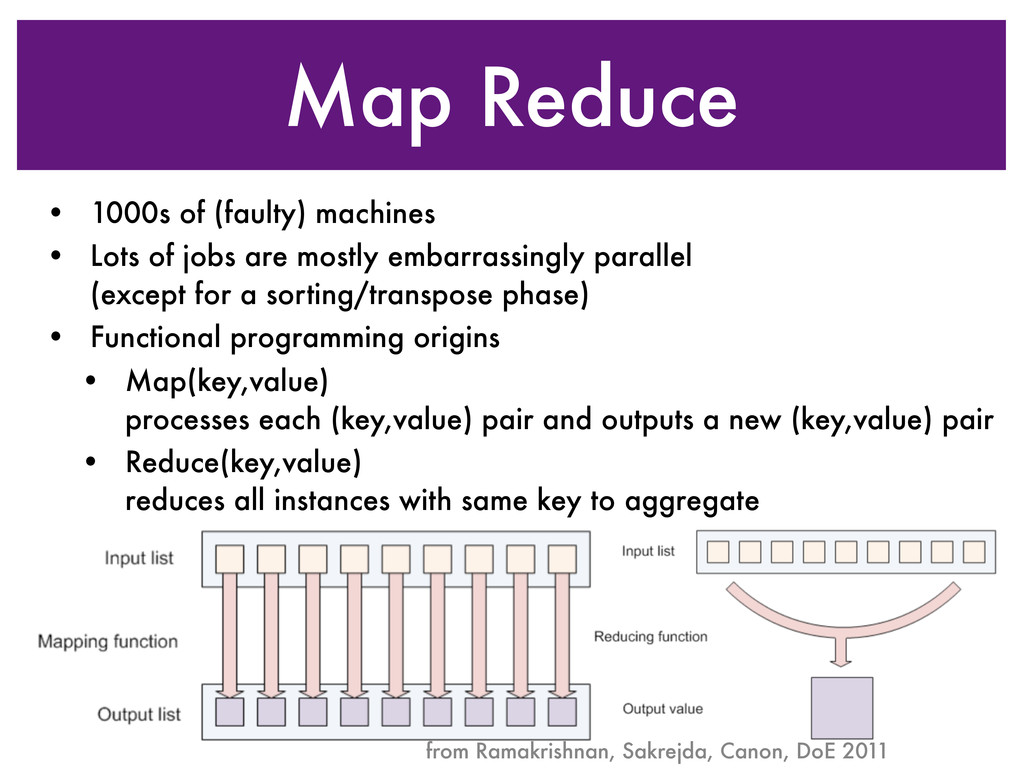
  19. Map Reduce • 1000s of (faulty) machines • Lots of

    jobs are mostly embarrassingly parallel (except for a sorting/transpose phase) • Functional programming origins • Map(key,value) processes each (key,value) pair and outputs a new (key,value) pair • Reduce(key,value) reduces all instances with same key to aggregate • Example - extremely naive wordcount • Map(docID, document) for each document emit many (wordID, count) pairs • Reduce(wordID, count) sum over all counts for given wordID and emit (wordID, aggregate) from Ramakrishnan, Sakrejda, Canon, DoE 2011
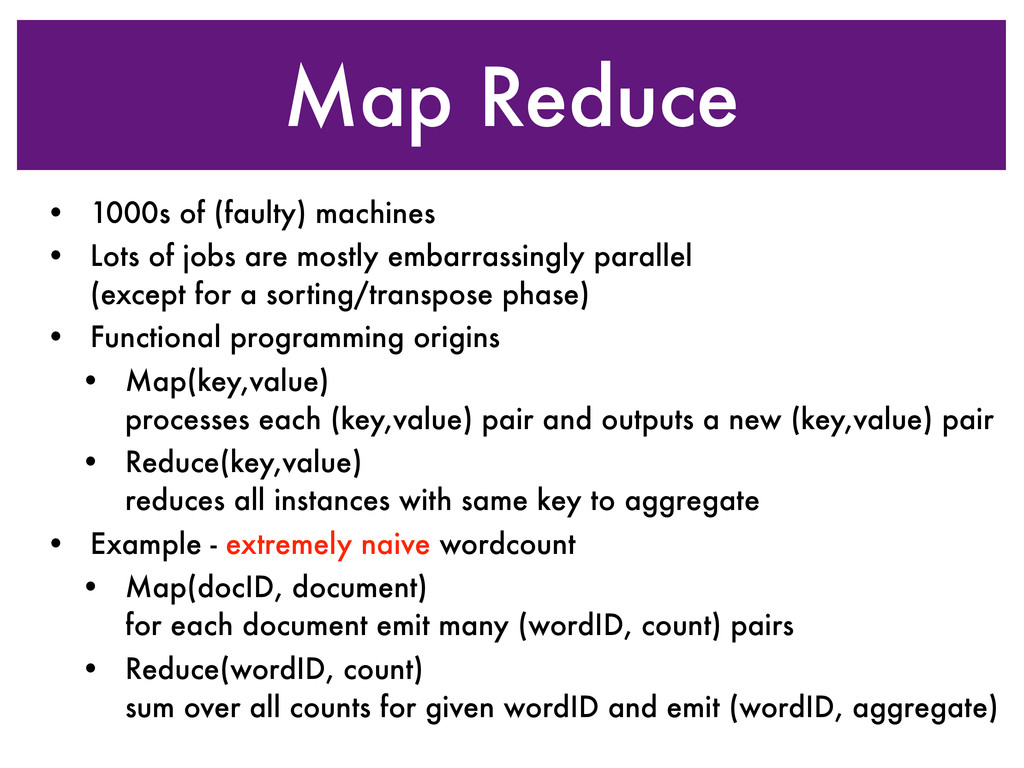
  20. Map Reduce • 1000s of (faulty) machines • Lots of

    jobs are mostly embarrassingly parallel (except for a sorting/transpose phase) • Functional programming origins • Map(key,value) processes each (key,value) pair and outputs a new (key,value) pair • Reduce(key,value) reduces all instances with same key to aggregate • Example - extremely naive wordcount • Map(docID, document) for each document emit many (wordID, count) pairs • Reduce(wordID, count) sum over all counts for given wordID and emit (wordID, aggregate)
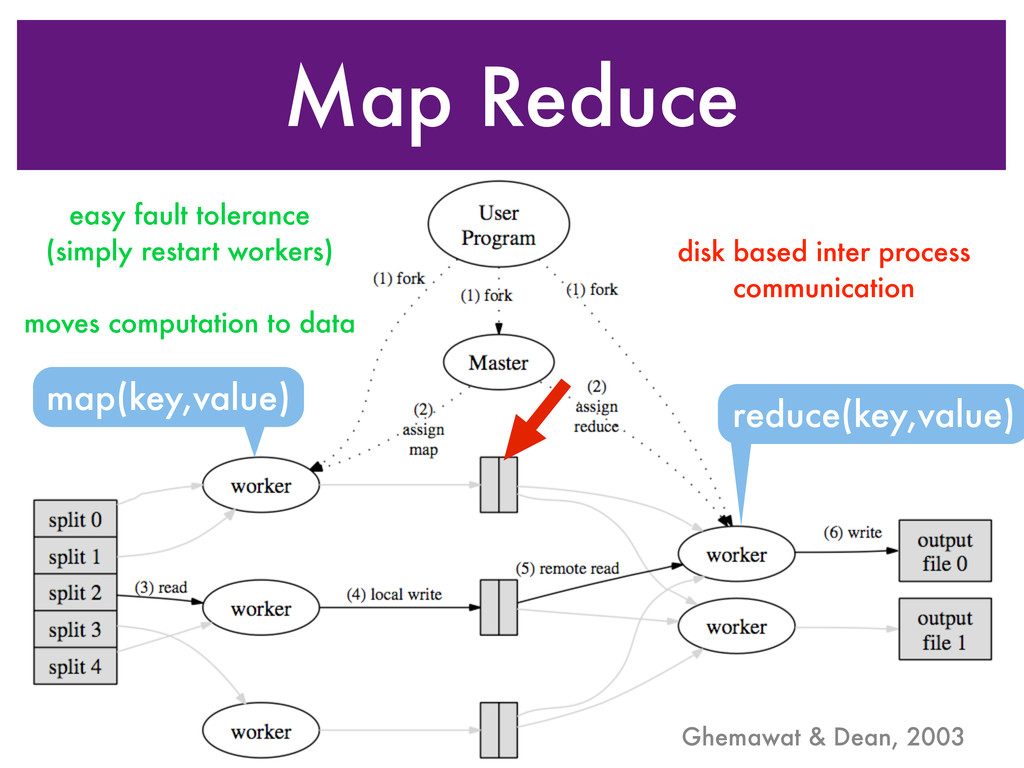
  21. Map Reduce Ghemawat & Dean, 2003 map(key,value) reduce(key,value) easy fault

    tolerance (simply restart workers) moves computation to data disk based inter process communication
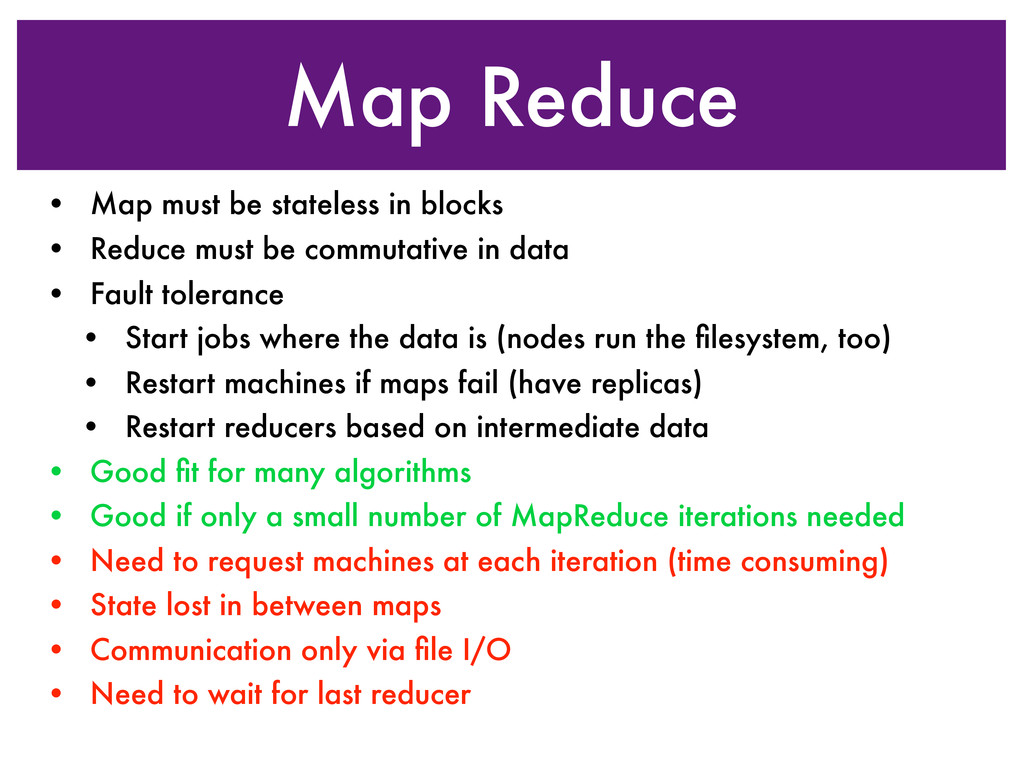
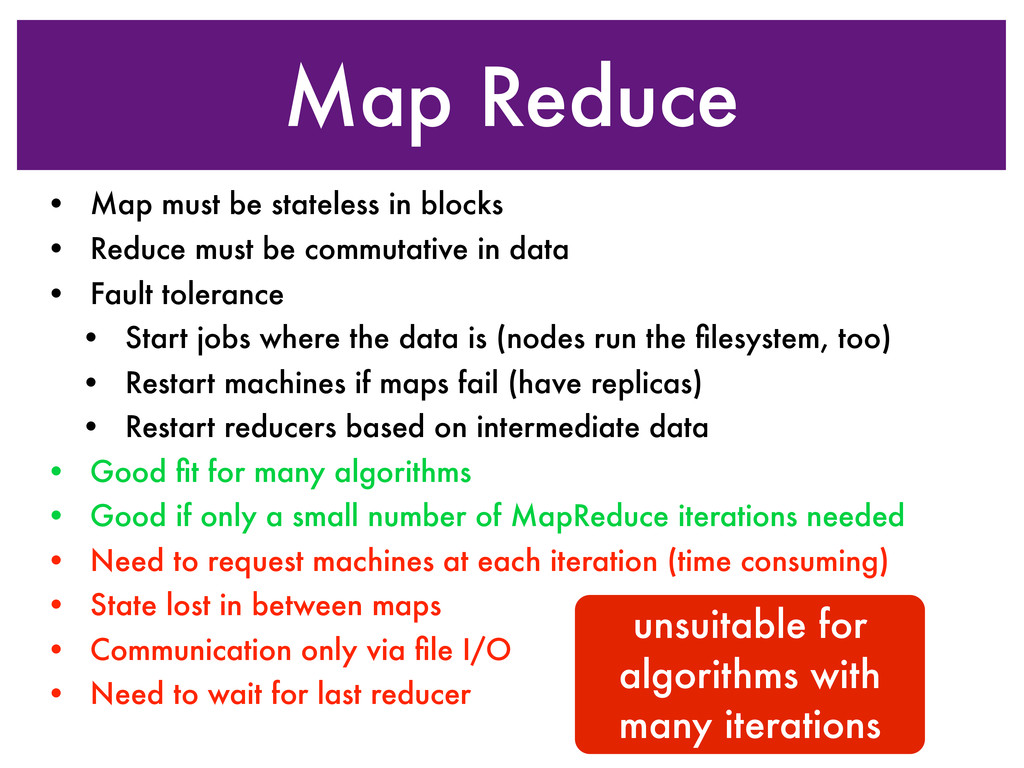
  22. Map Reduce • Map must be stateless in blocks •

    Reduce must be commutative in data • Fault tolerance • Start jobs where the data is (nodes run the filesystem, too) • Restart machines if maps fail (have replicas) • Restart reducers based on intermediate data • Good fit for many algorithms • Good if only a small number of MapReduce iterations needed • Need to request machines at each iteration (time consuming) • State lost in between maps • Communication only via file I/O • Need to wait for last reducer
  23. Map Reduce • Map must be stateless in blocks •

    Reduce must be commutative in data • Fault tolerance • Start jobs where the data is (nodes run the filesystem, too) • Restart machines if maps fail (have replicas) • Restart reducers based on intermediate data • Good fit for many algorithms • Good if only a small number of MapReduce iterations needed • Need to request machines at each iteration (time consuming) • State lost in between maps • Communication only via file I/O • Need to wait for last reducer unsuitable for algorithms with many iterations
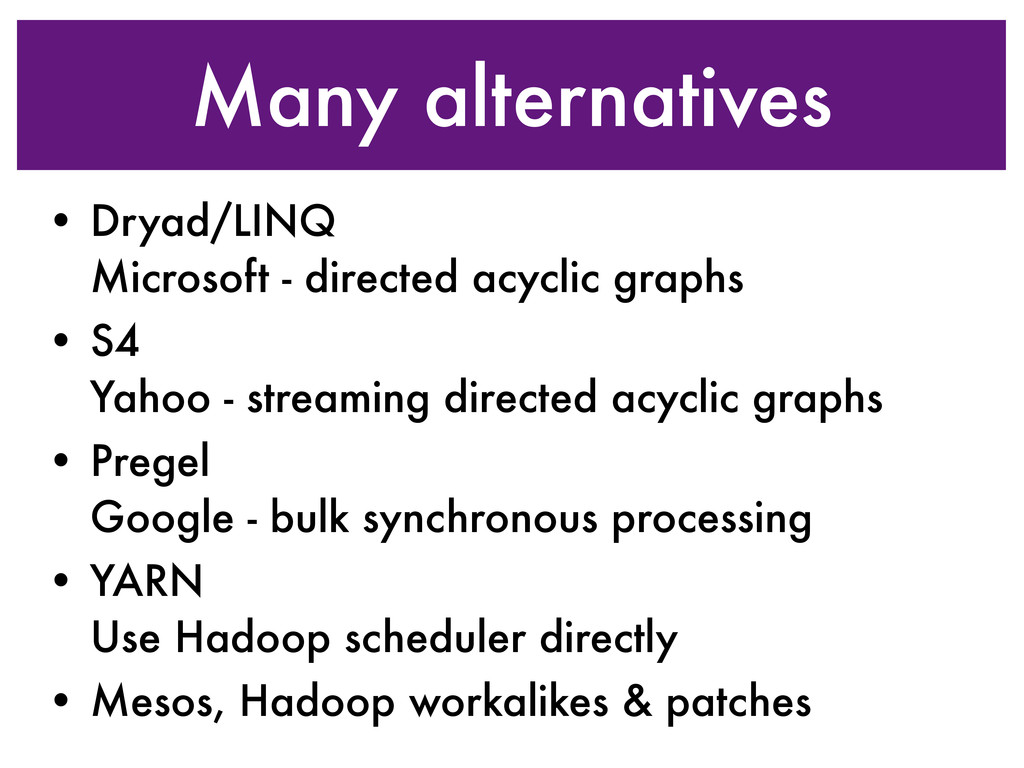
  24. Many alternatives • Dryad/LINQ Microsoft - directed acyclic graphs •

    S4 Yahoo - streaming directed acyclic graphs • Pregel Google - bulk synchronous processing • YARN Use Hadoop scheduler directly • Mesos, Hadoop workalikes & patches
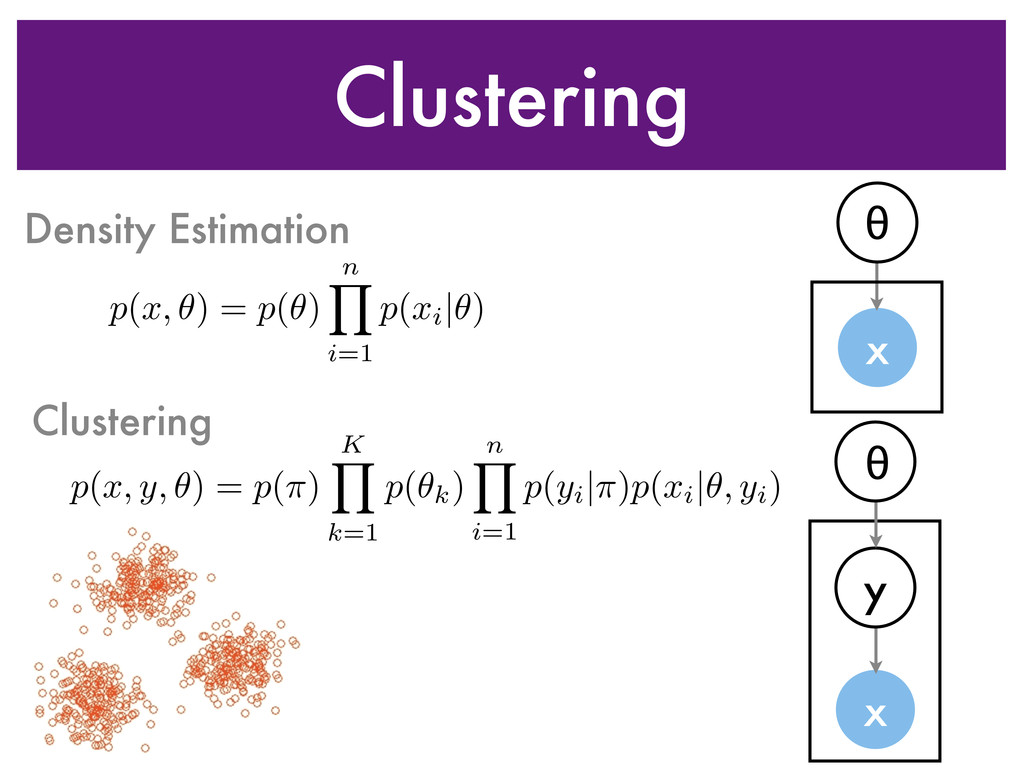
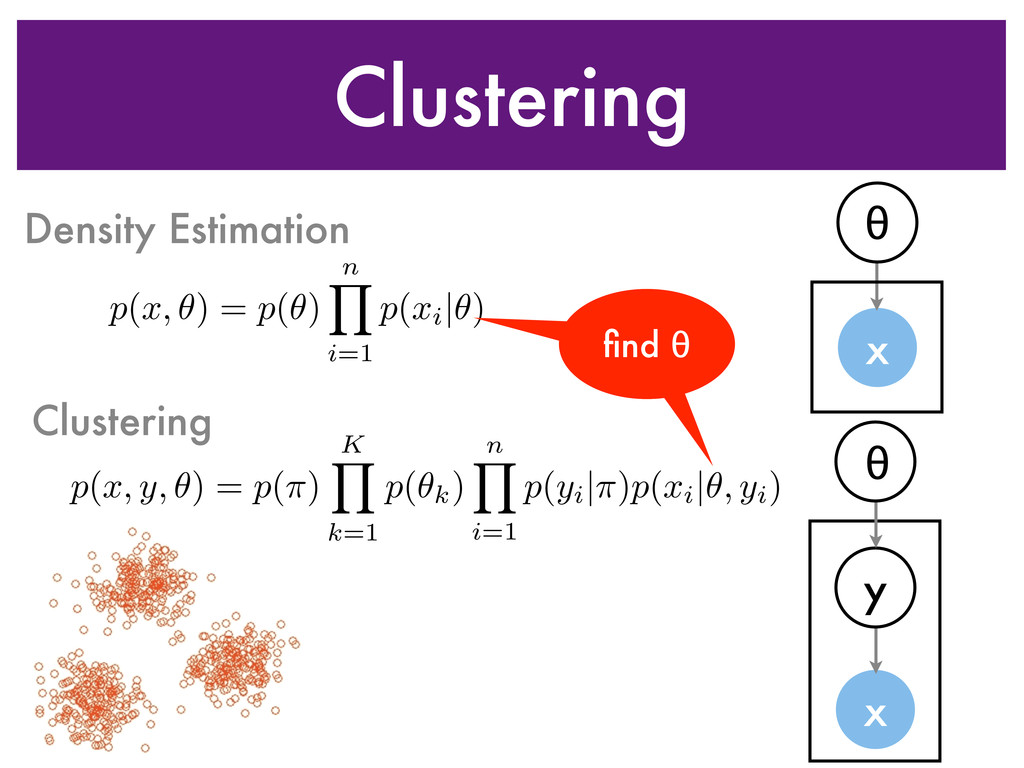
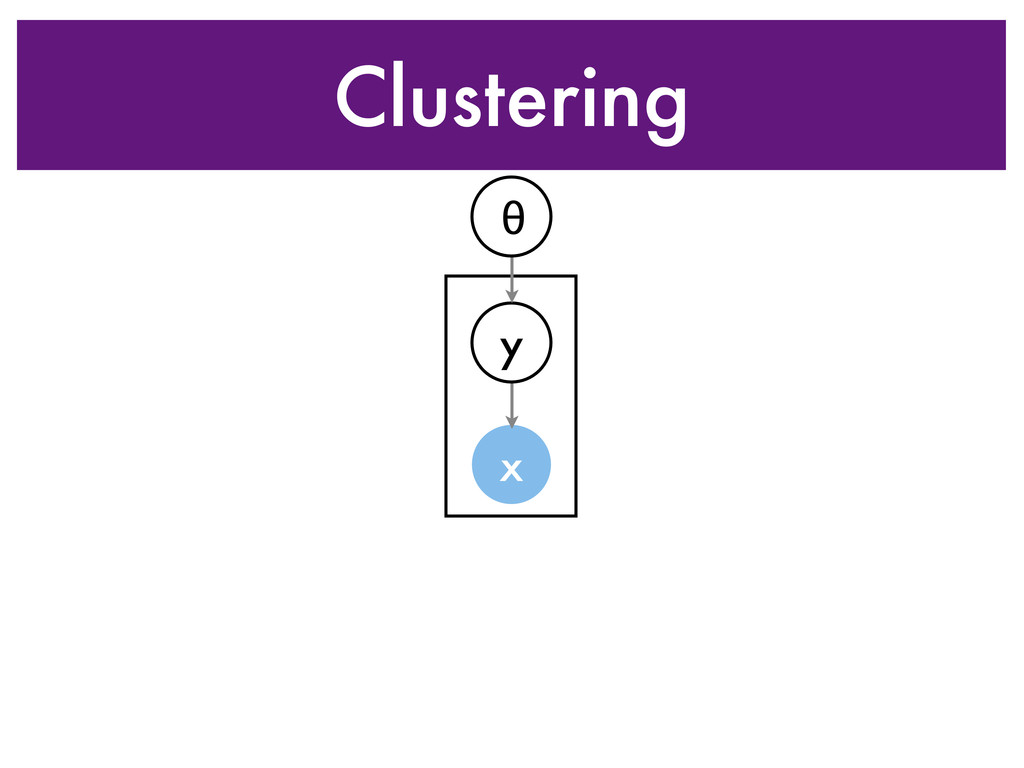
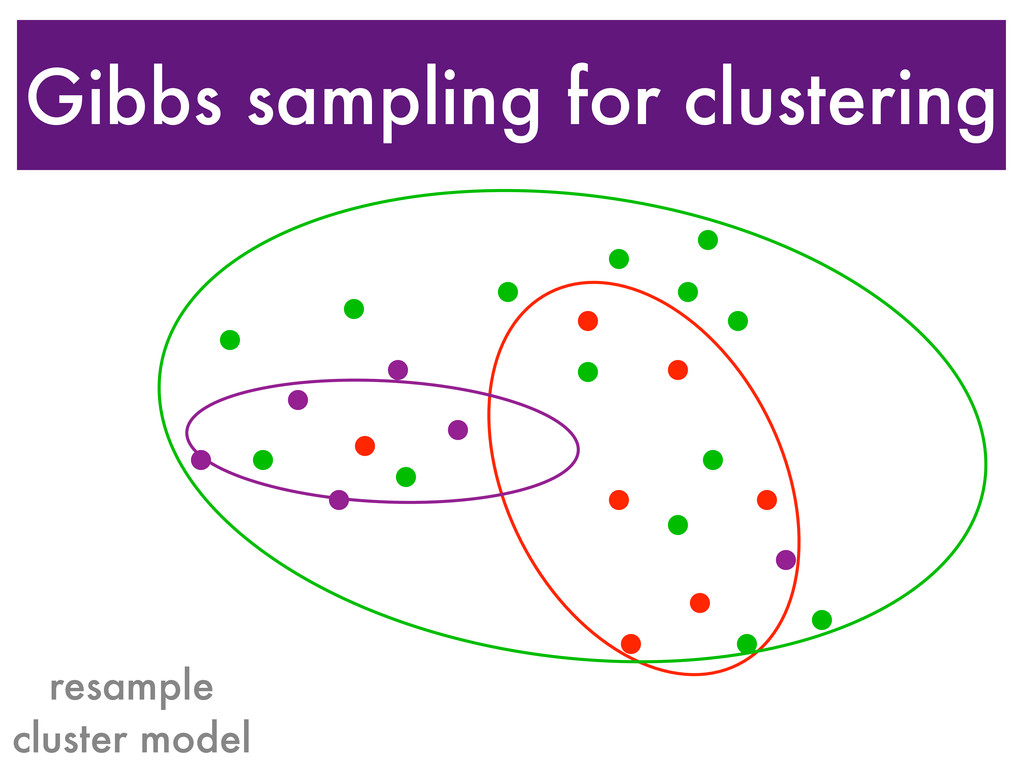
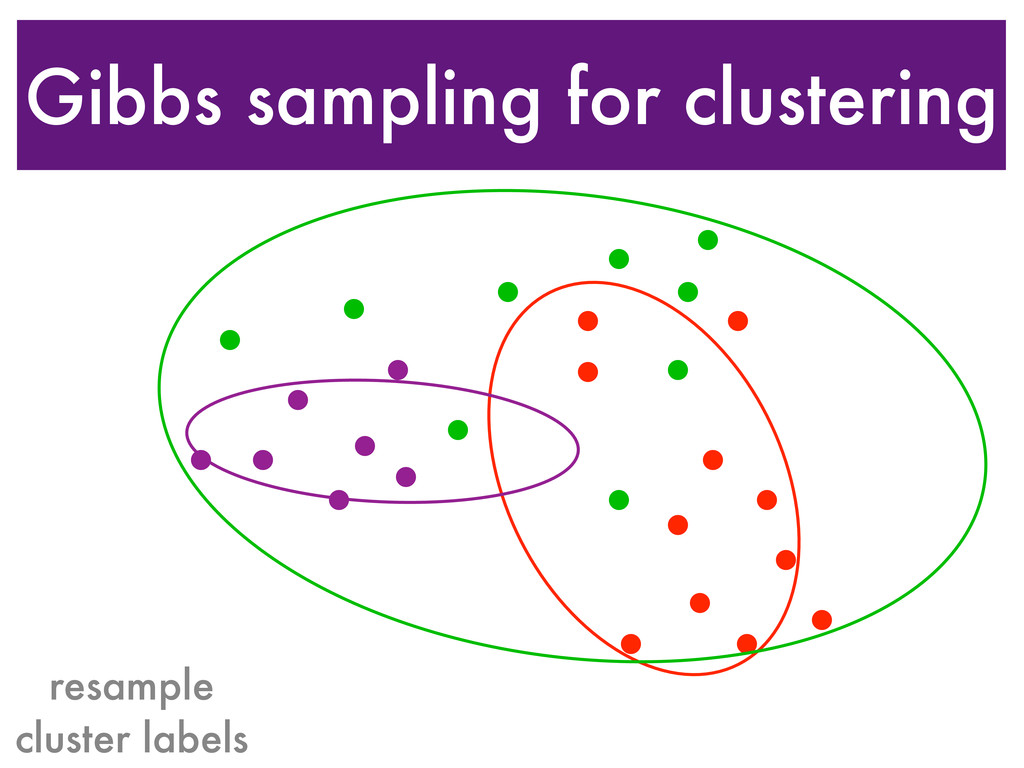
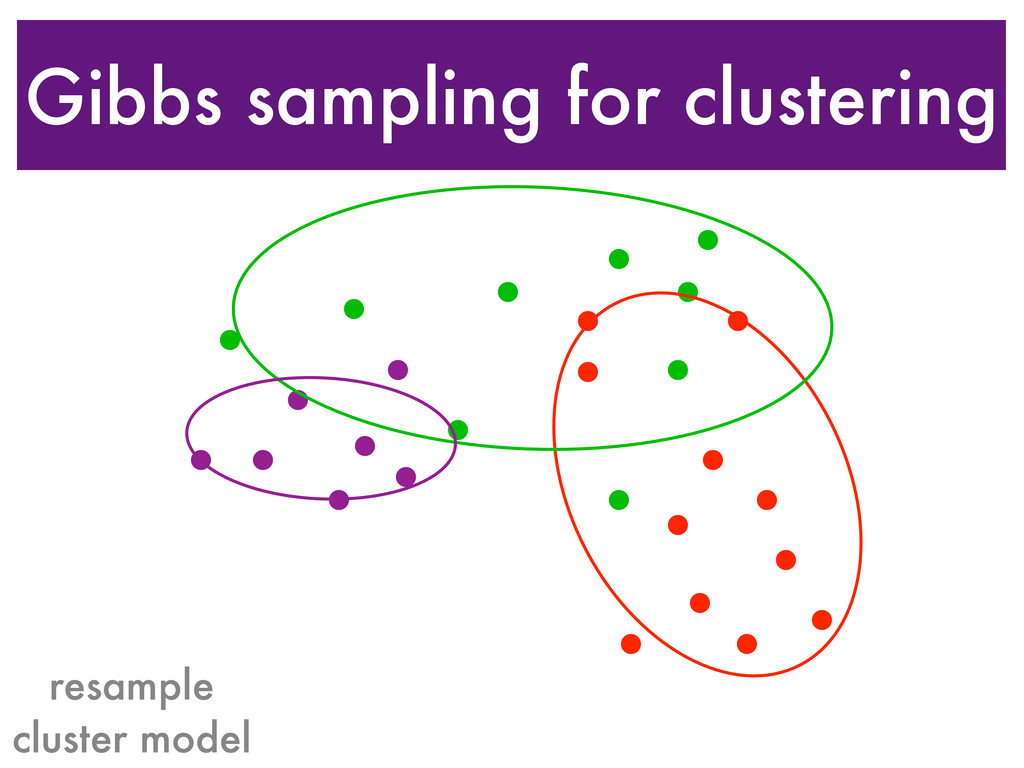
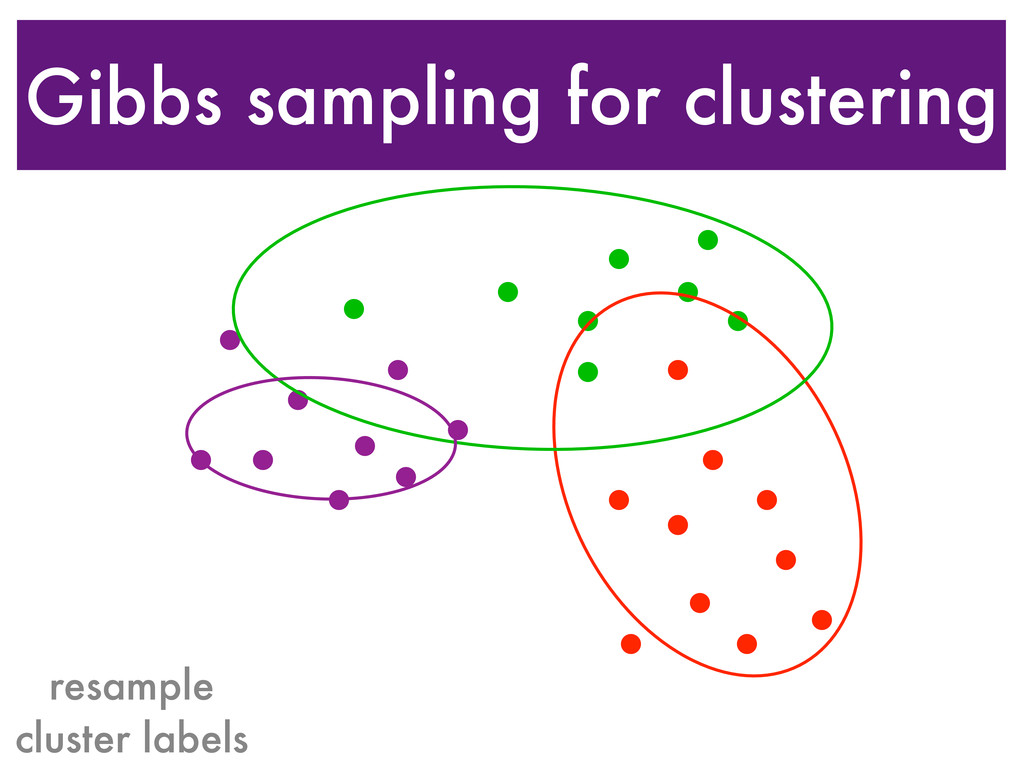
  25. Clustering Density Estimation Clustering x x θ y p(x, )

    = p( ) n Y i=1 p(xi | ) p(x, y, ) = p(⇥) K Y k=1 p( k) n Y i=1 p(yi |⇥)p(xi | , yi) θ
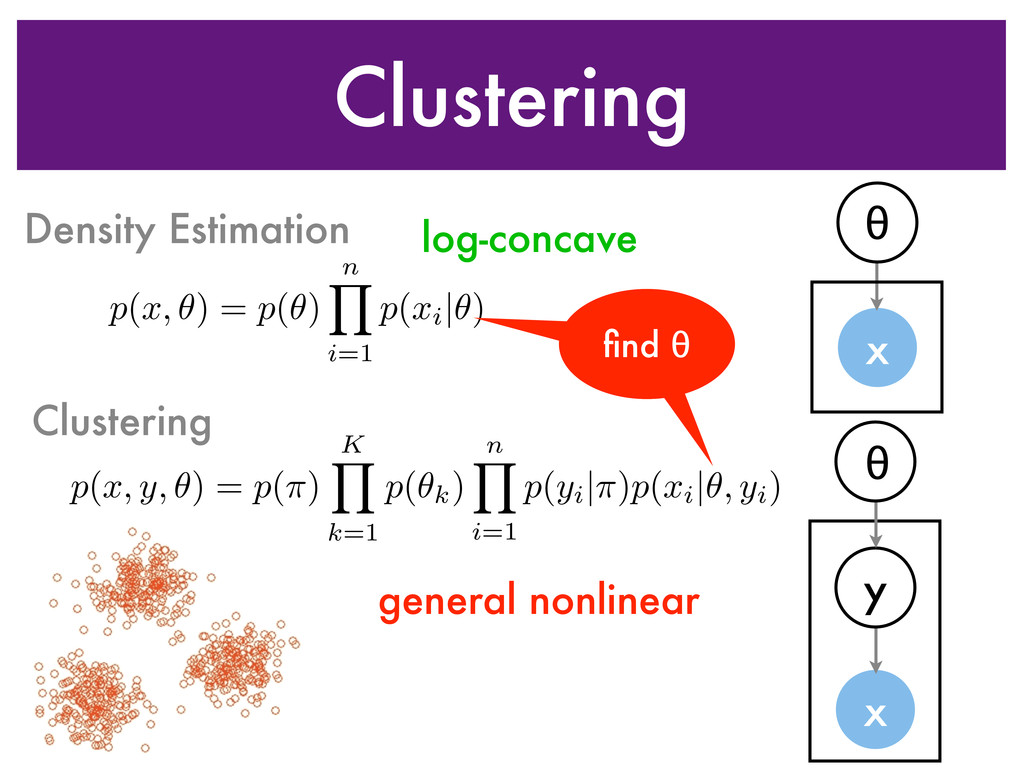
  26. Clustering Density Estimation Clustering x x θ y p(x, )

    = p( ) n Y i=1 p(xi | ) p(x, y, ) = p(⇥) K Y k=1 p( k) n Y i=1 p(yi |⇥)p(xi | , yi) θ find θ find θ
  27. Clustering Density Estimation Clustering x x θ y p(x, )

    = p( ) n Y i=1 p(xi | ) p(x, y, ) = p(⇥) K Y k=1 p( k) n Y i=1 p(yi |⇥)p(xi | , yi) θ find θ find θ log-concave general nonlinear
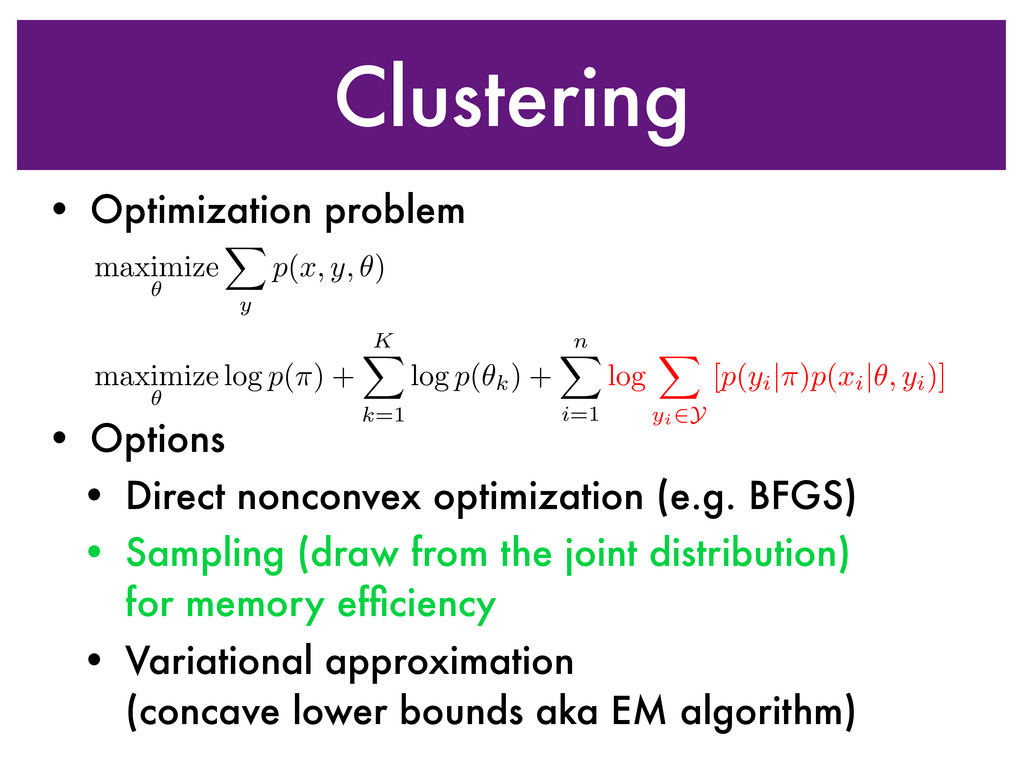
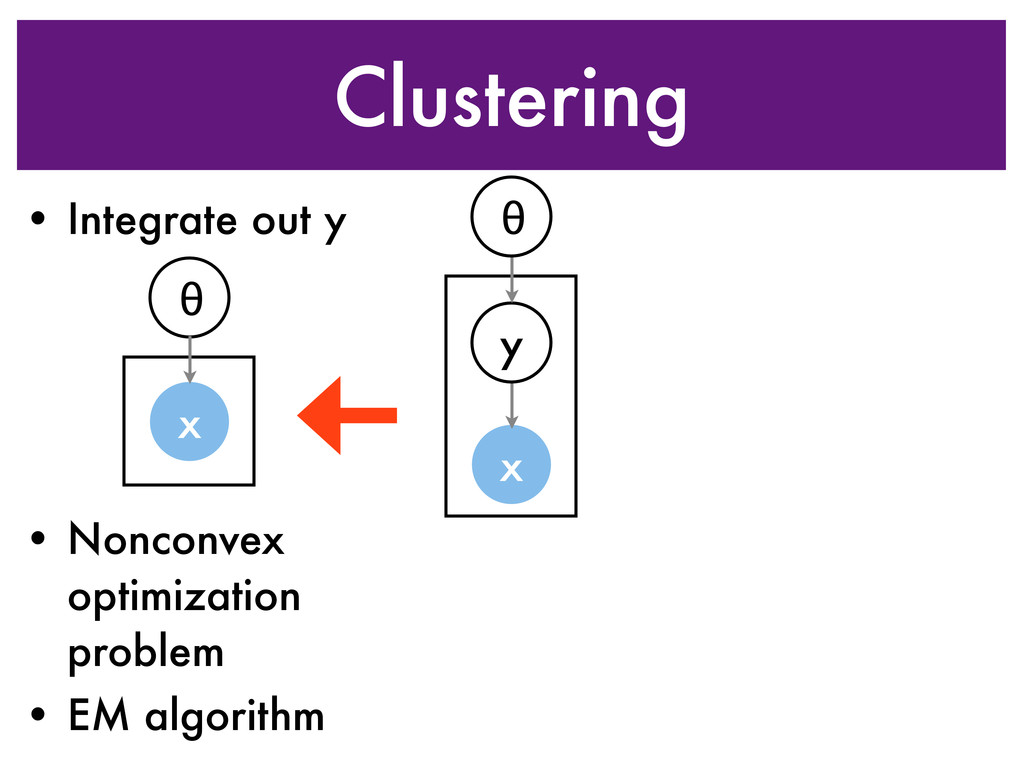
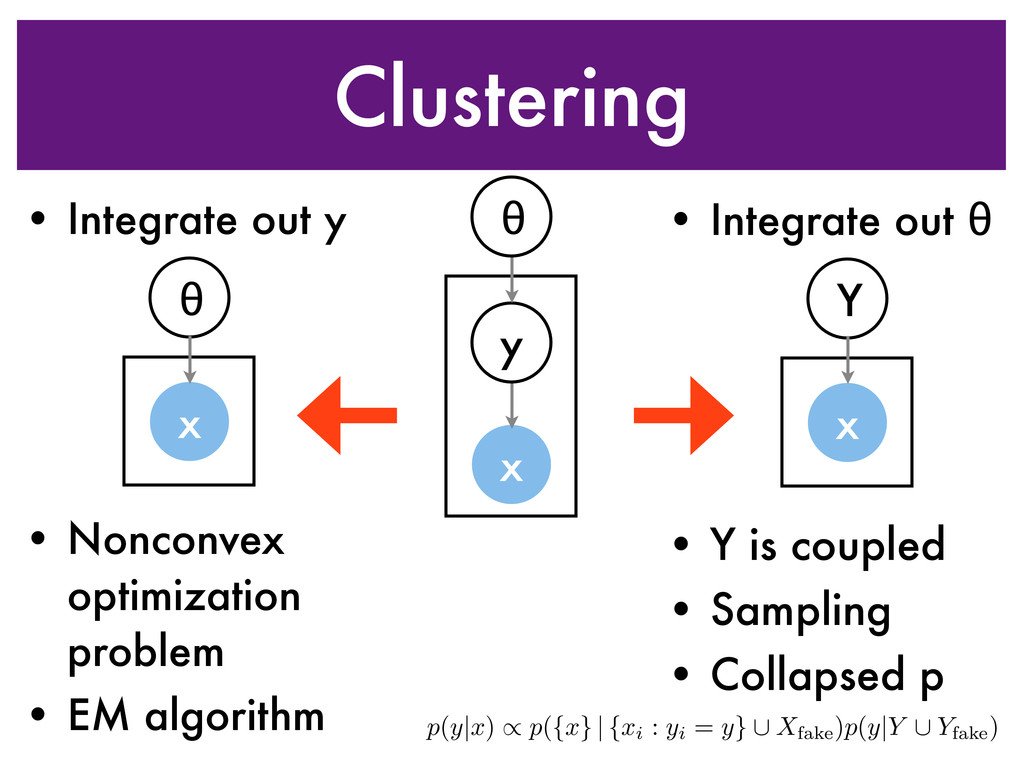
  28. Clustering • Optimization problem • Options • Direct nonconvex optimization

    (e.g. BFGS) • Sampling (draw from the joint distribution) for memory efficiency • Variational approximation (concave lower bounds aka EM algorithm) maximize X y p ( x, y, ) maximize log p ( ⇥ ) + K X k=1 log p ( k) + n X i=1 log X yi Y [ p ( yi |⇥ ) p ( xi | , yi)]
  29. Clustering • Integrate out θ • Y is coupled •

    Sampling • Collapsed p x y θ • Integrate out y • Nonconvex optimization problem • EM algorithm x θ x Y p ( y | x ) p ({ x } | { xi : yi = y } ⇥ Xfake) p ( y | Y ⇥ Yfake)
  30. Clustering • Integrate out θ • Y is coupled •

    Sampling • Collapsed p x y θ • Integrate out y • Nonconvex optimization problem • EM algorithm x θ x Y p ( y | x ) p ({ x } | { xi : yi = y } ⇥ Xfake) p ( y | Y ⇥ Yfake)
  31. Clustering • Integrate out θ • Y is coupled •

    Sampling • Collapsed p x y θ • Integrate out y • Nonconvex optimization problem • EM algorithm x θ x Y p ( y | x ) p ({ x } | { xi : yi = y } ⇥ Xfake) p ( y | Y ⇥ Yfake)
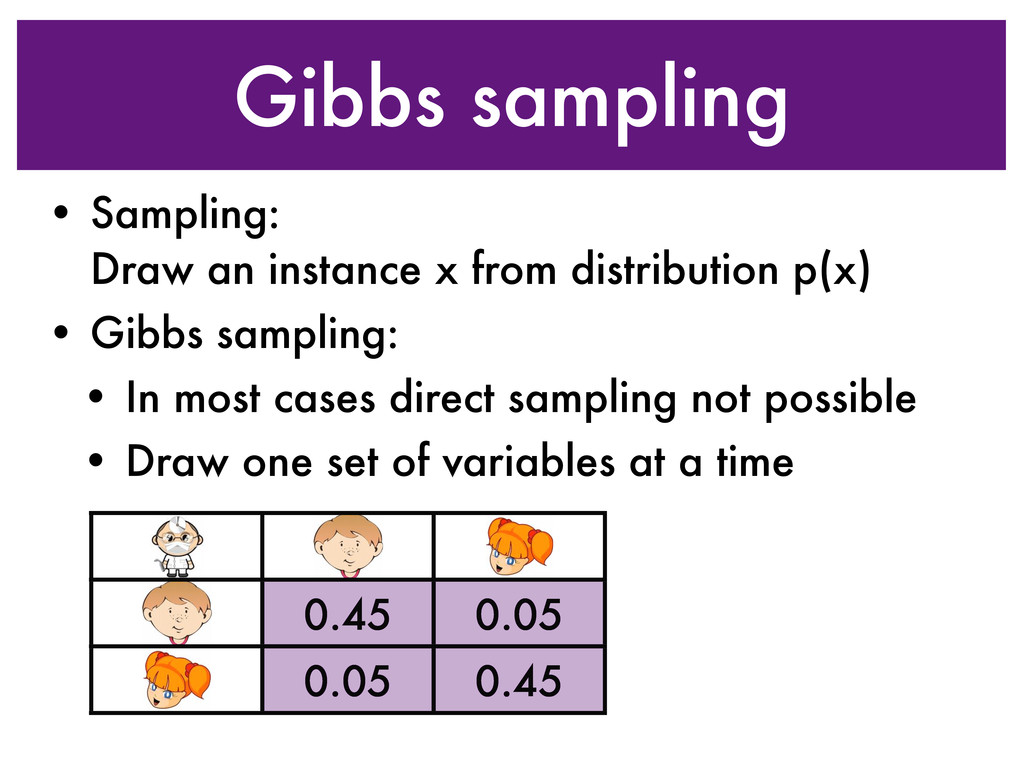
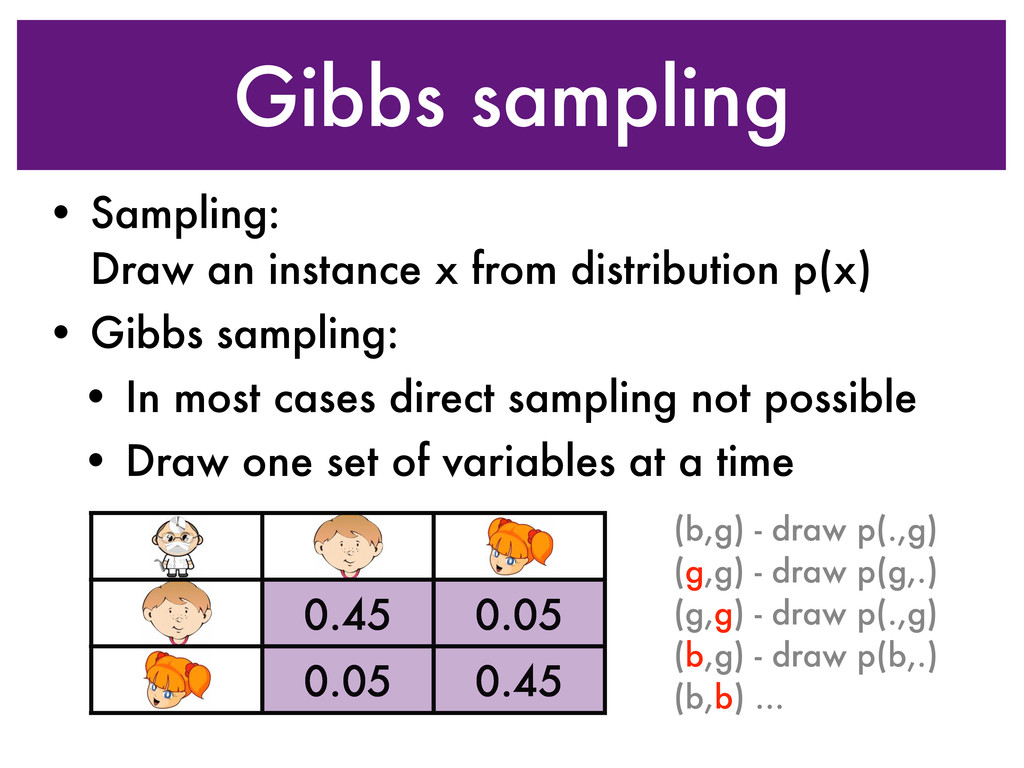
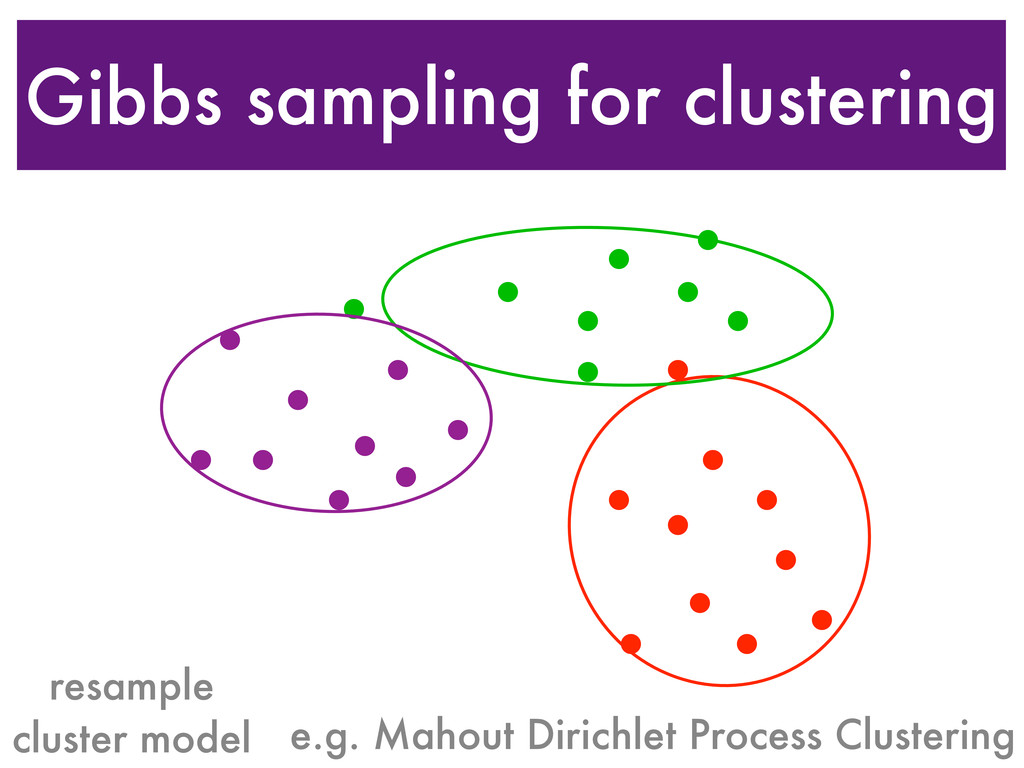
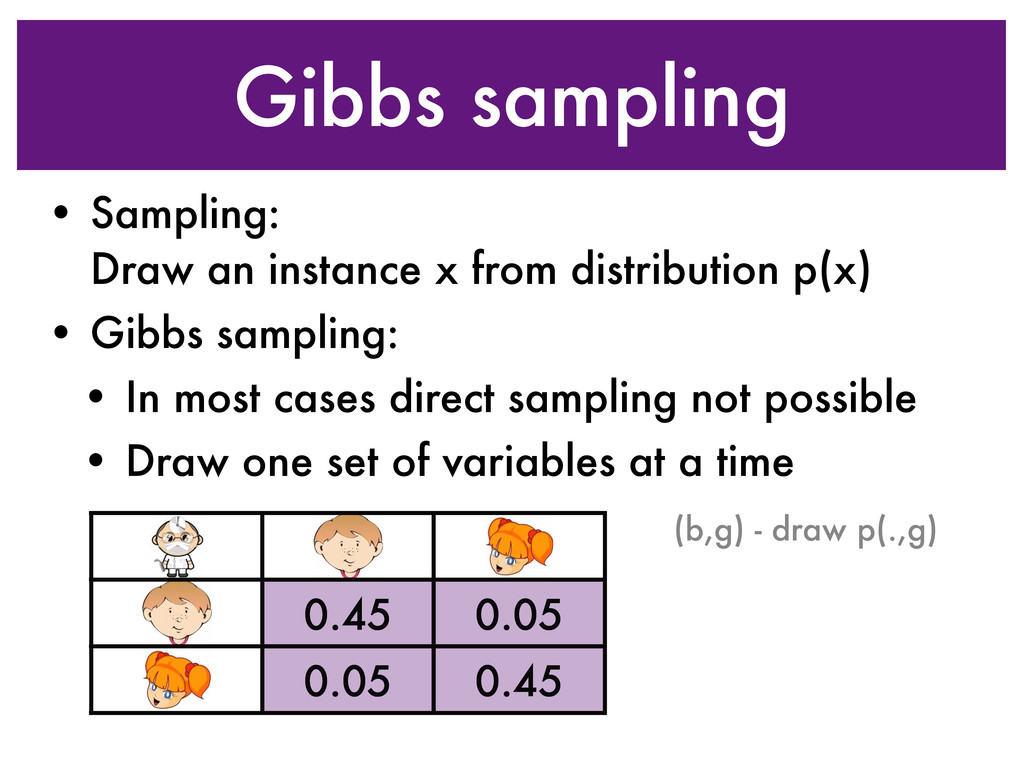
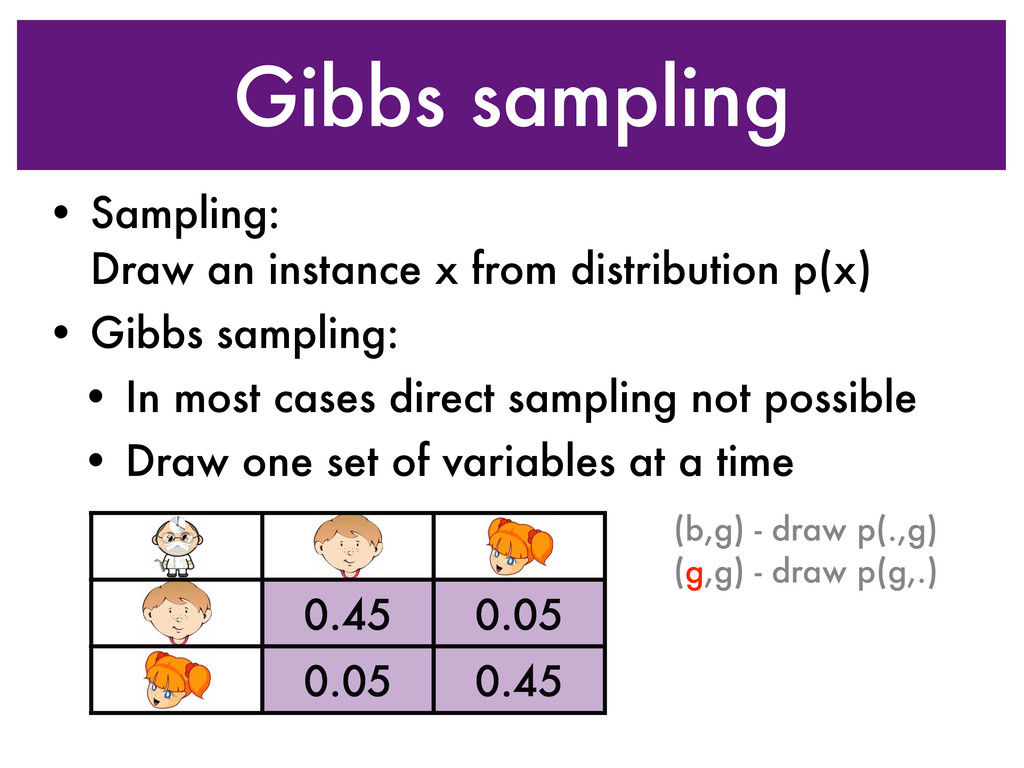
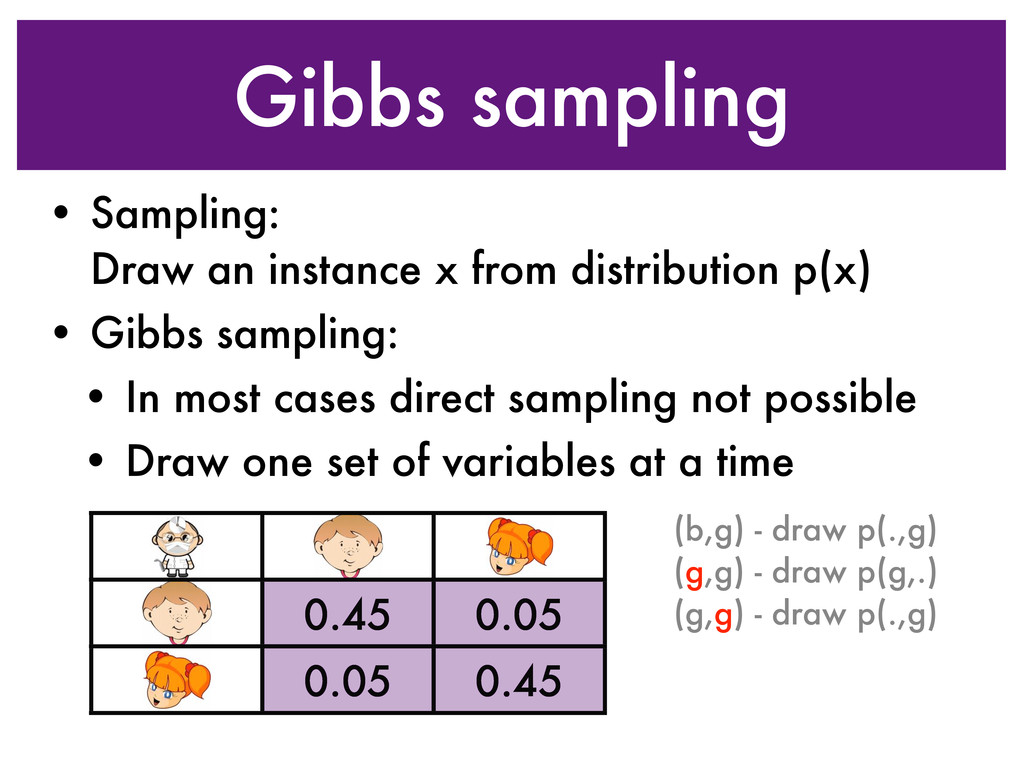
  32. Gibbs sampling • Sampling: Draw an instance x from distribution

    p(x) • Gibbs sampling: • In most cases direct sampling not possible • Draw one set of variables at a time 0.45 0.05 0.05 0.45
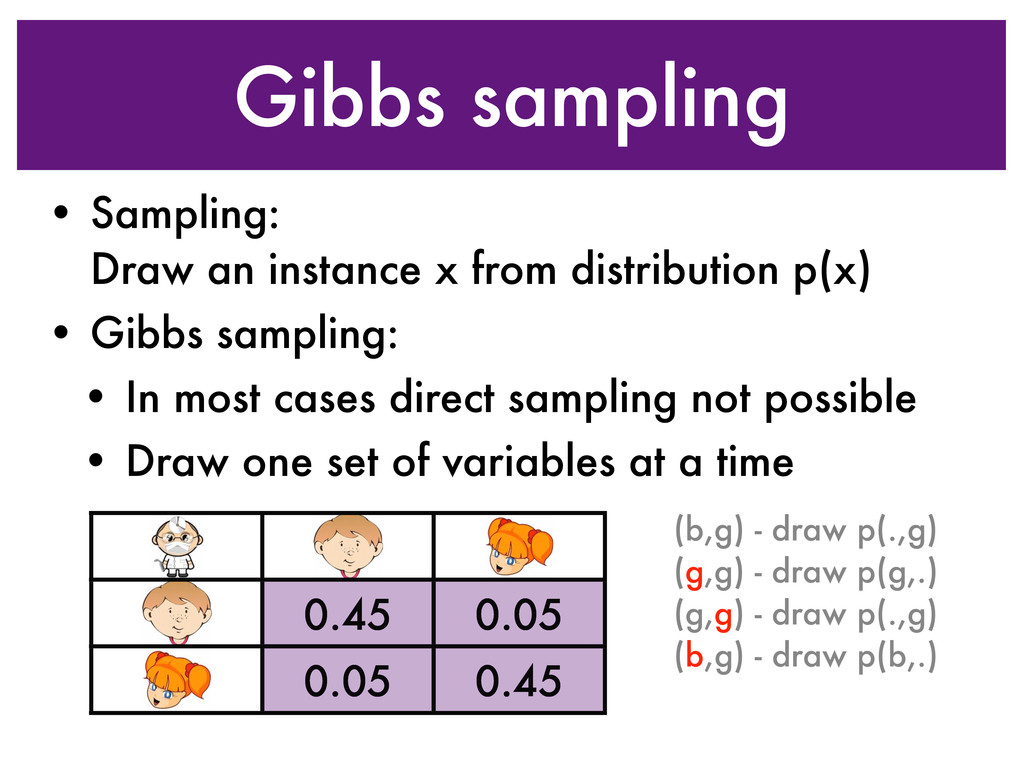
  33. Gibbs sampling • Sampling: Draw an instance x from distribution

    p(x) • Gibbs sampling: • In most cases direct sampling not possible • Draw one set of variables at a time 0.45 0.05 0.05 0.45 (b,g) - draw p(.,g)
  34. Gibbs sampling • Sampling: Draw an instance x from distribution

    p(x) • Gibbs sampling: • In most cases direct sampling not possible • Draw one set of variables at a time 0.45 0.05 0.05 0.45 (b,g) - draw p(.,g) (g,g) - draw p(g,.)
  35. Gibbs sampling • Sampling: Draw an instance x from distribution

    p(x) • Gibbs sampling: • In most cases direct sampling not possible • Draw one set of variables at a time 0.45 0.05 0.05 0.45 (b,g) - draw p(.,g) (g,g) - draw p(g,.) (g,g) - draw p(.,g)
  36. Gibbs sampling • Sampling: Draw an instance x from distribution

    p(x) • Gibbs sampling: • In most cases direct sampling not possible • Draw one set of variables at a time 0.45 0.05 0.05 0.45 (b,g) - draw p(.,g) (g,g) - draw p(g,.) (g,g) - draw p(.,g) (b,g) - draw p(b,.)
  37. Gibbs sampling • Sampling: Draw an instance x from distribution

    p(x) • Gibbs sampling: • In most cases direct sampling not possible • Draw one set of variables at a time 0.45 0.05 0.05 0.45 (b,g) - draw p(.,g) (g,g) - draw p(g,.) (g,g) - draw p(.,g) (b,g) - draw p(b,.) (b,b) ...
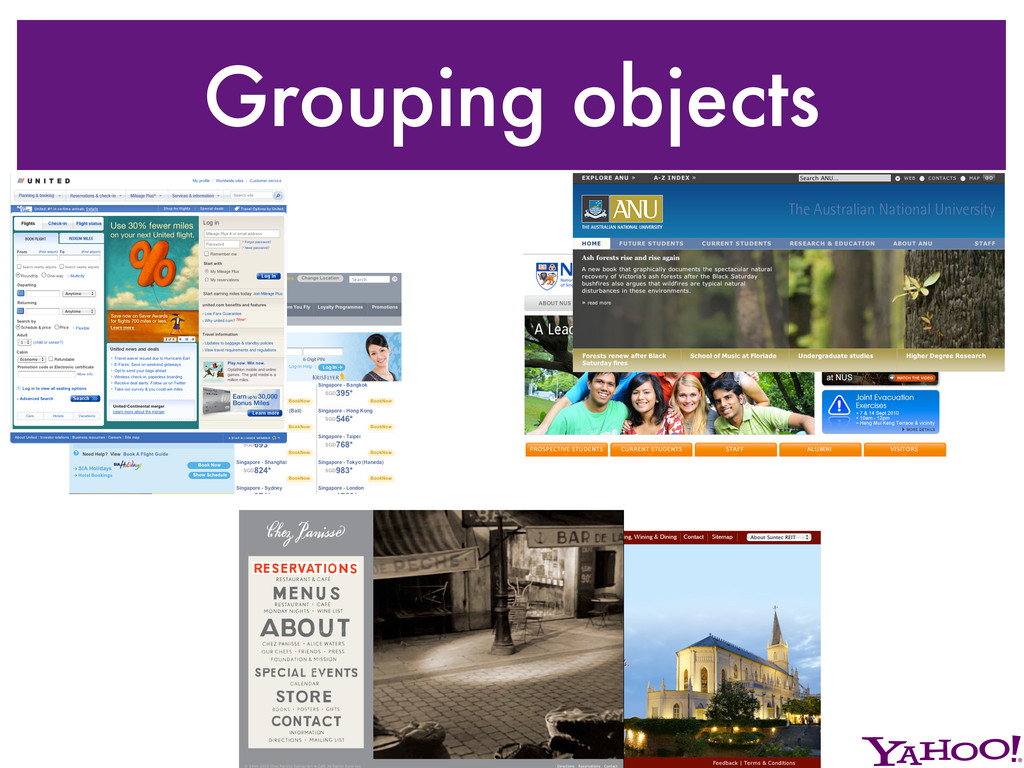
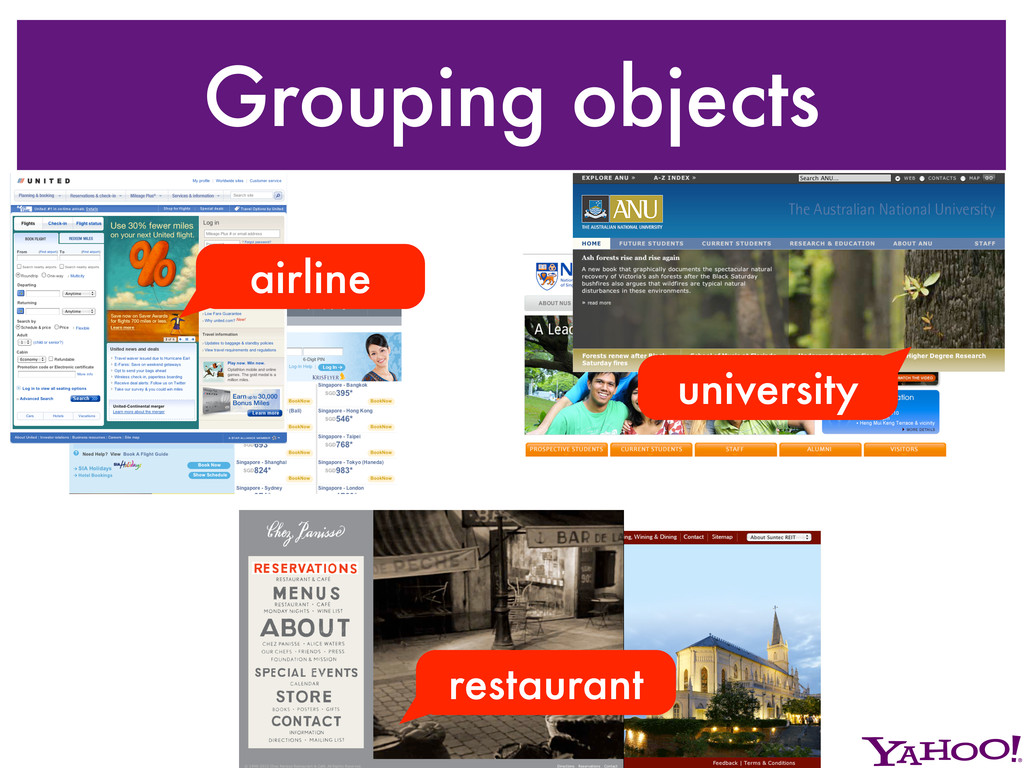
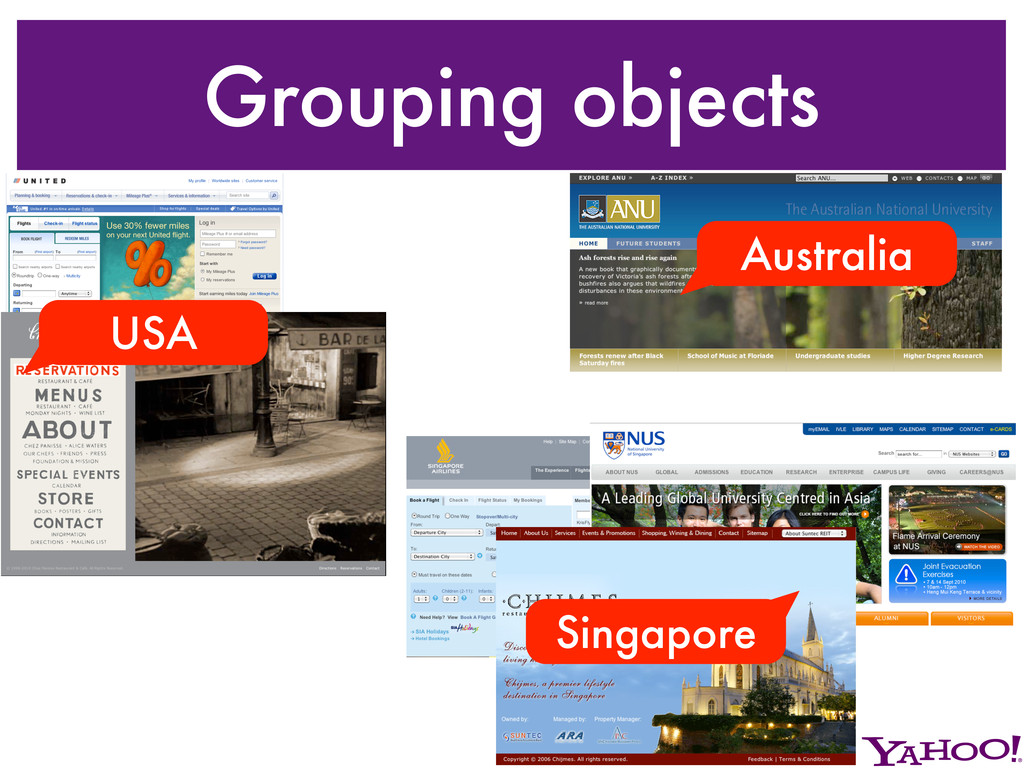
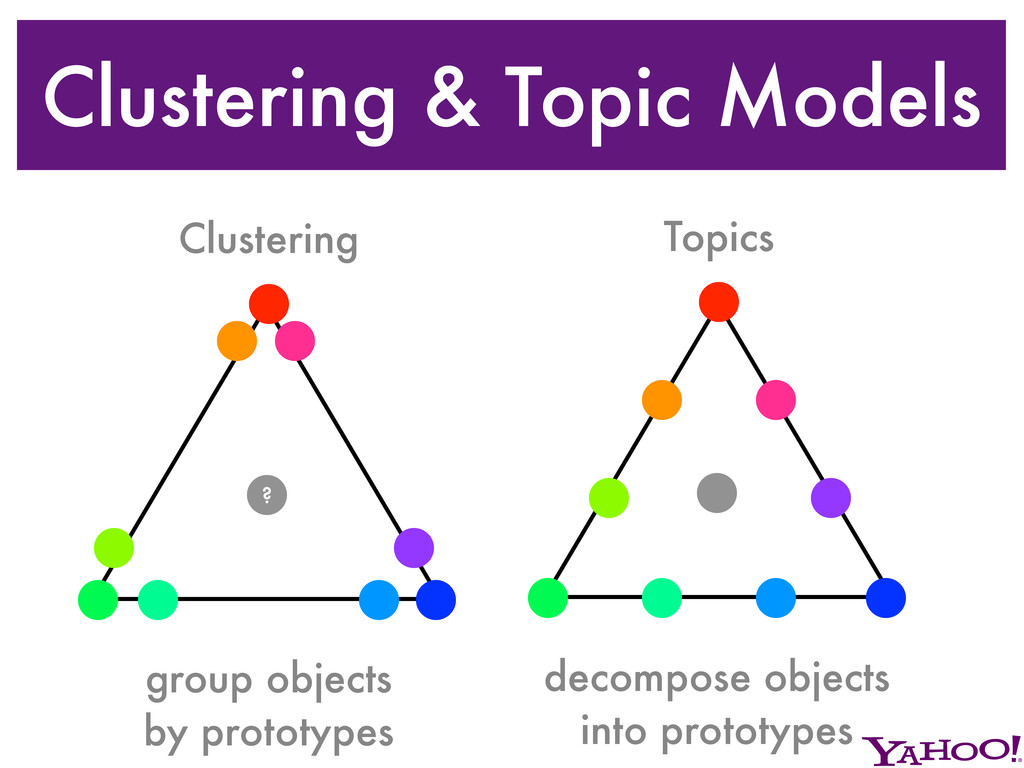
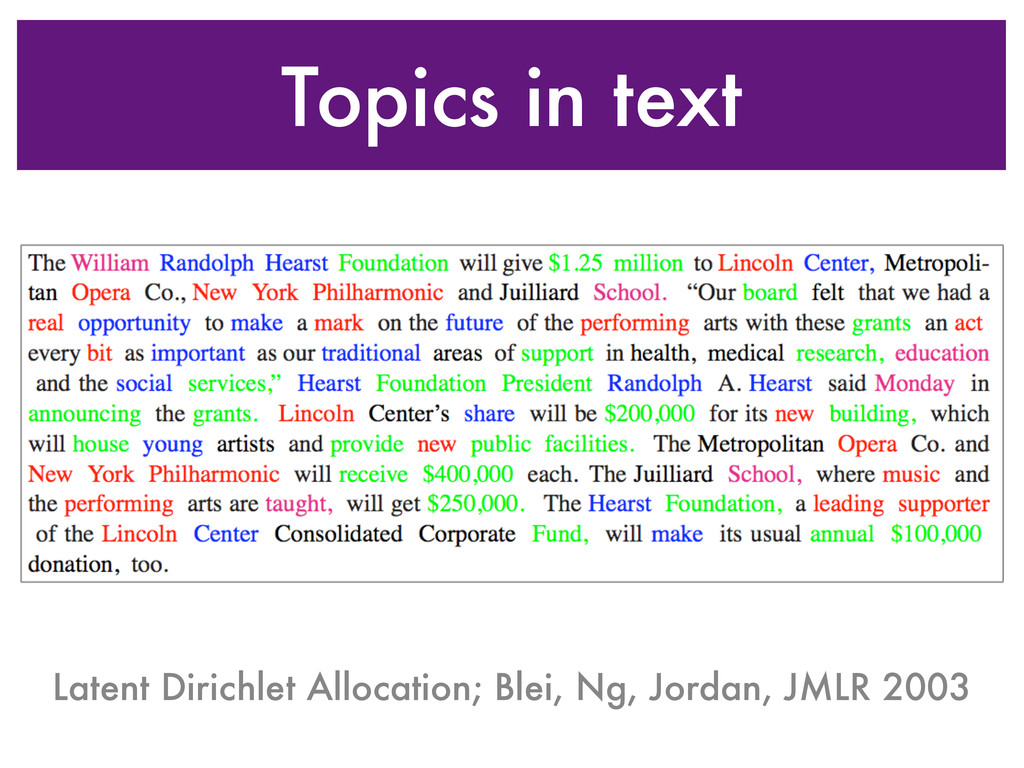
  38. Topic Models USA airline Singapore airline Singapore food USA food

    Singapore university Australia university
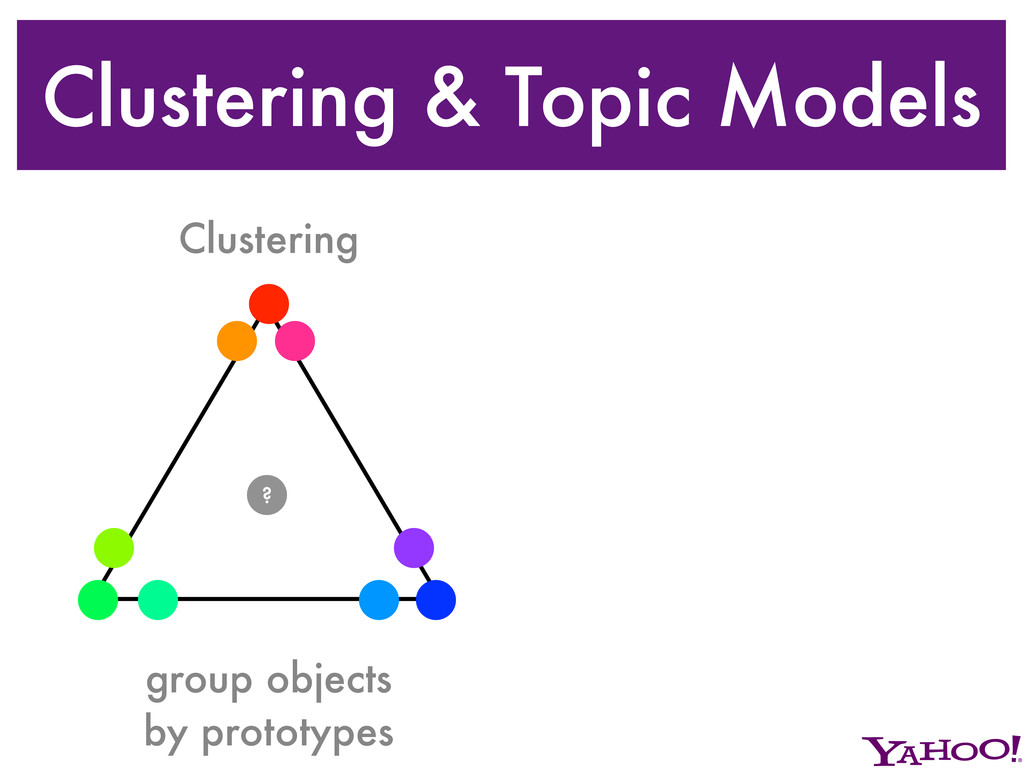
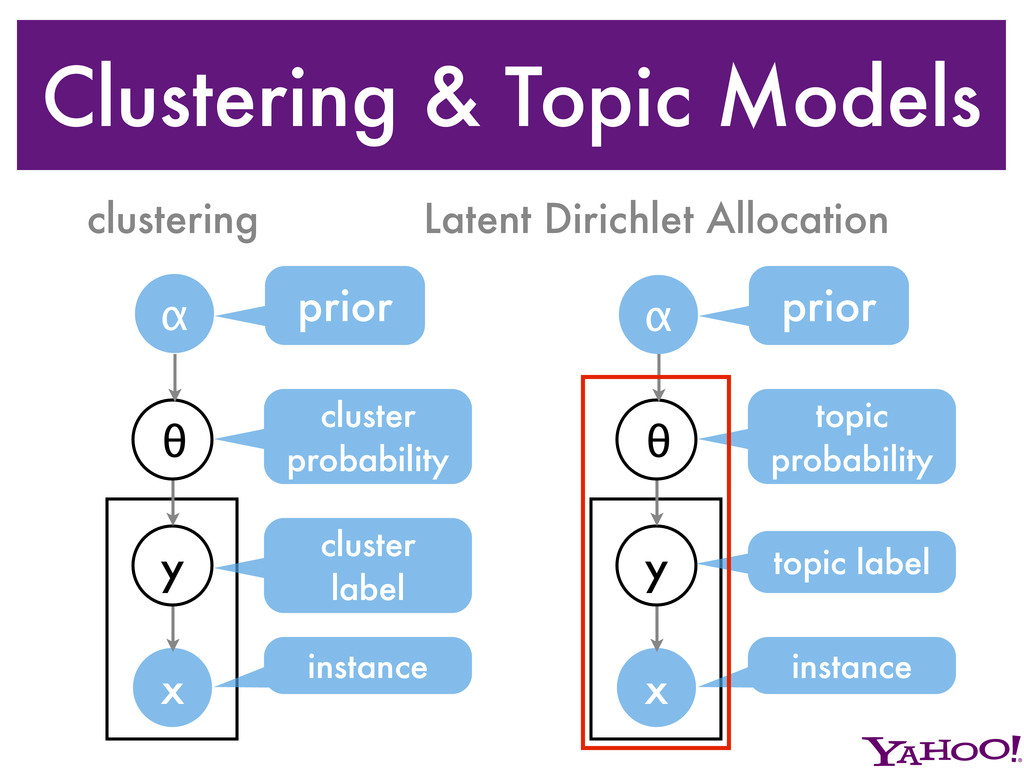
  39. Clustering & Topic Models x y θ prior cluster probability

    cluster label instance x y θ prior topic probability topic label instance clustering Latent Dirichlet Allocation α α
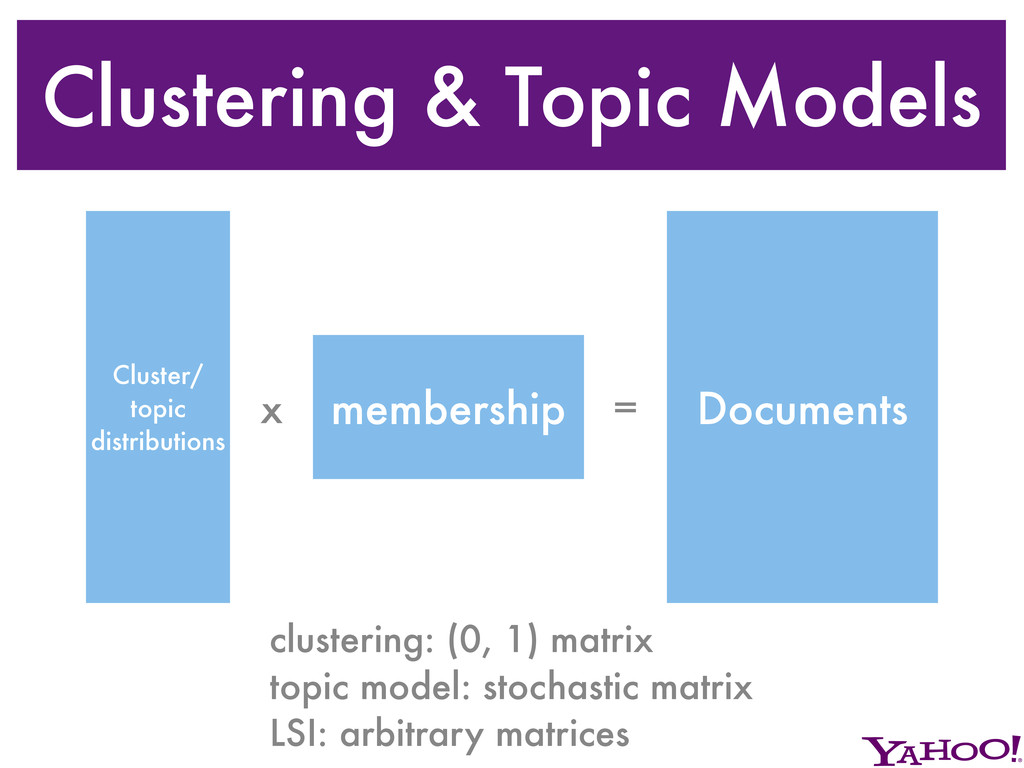
  40. Clustering & Topic Models Documents membership Cluster/ topic distributions x

    = clustering: (0, 1) matrix topic model: stochastic matrix LSI: arbitrary matrices
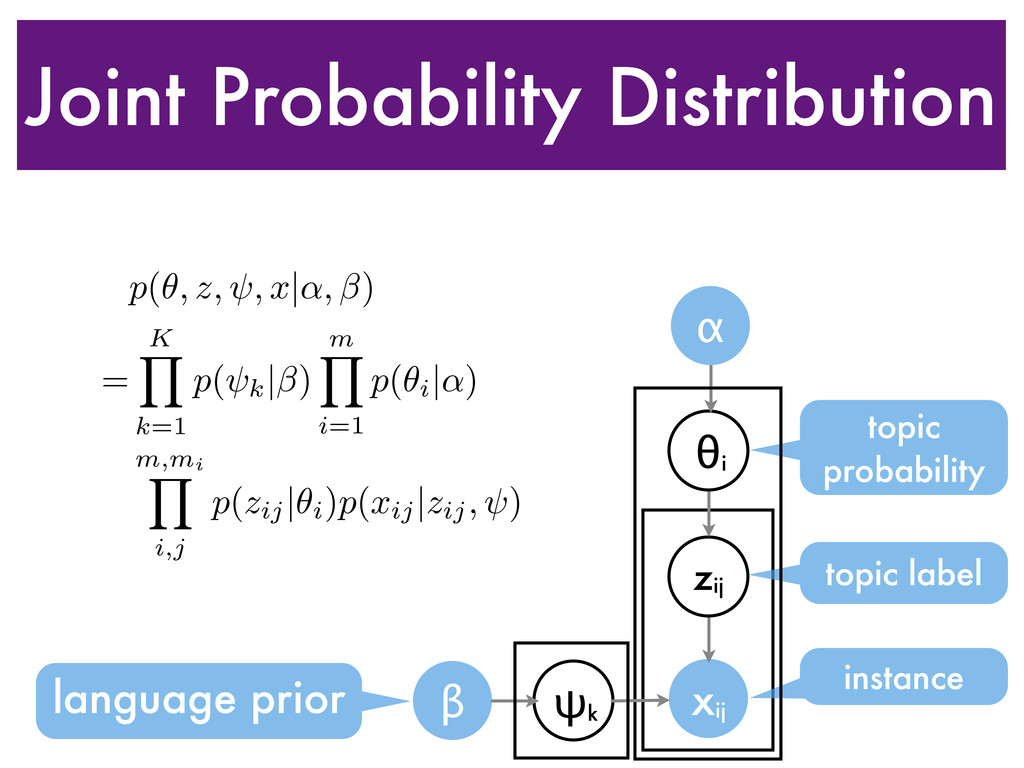
  41. Joint Probability Distribution xij zij θi language prior topic probability

    topic label instance α ψk β p(⇤, z, ⌅, x| , ⇥) = K Y k=1 p(⌅k |⇥) m Y i=1 p(⇤i | ) m,mi Y i,j p(zij |⇤i)p(xij |zij, ⌅)
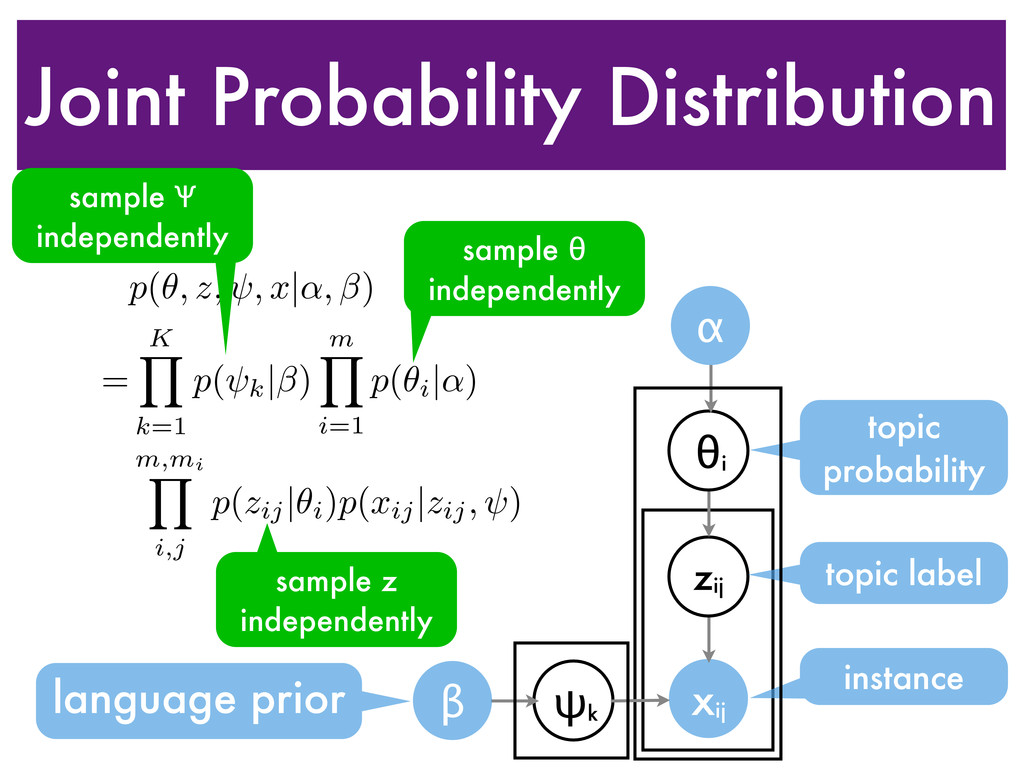
  42. sample z independently sample θ independently Joint Probability Distribution xij

    zij θi language prior topic probability topic label instance α ψk β p(⇤, z, ⌅, x| , ⇥) = K Y k=1 p(⌅k |⇥) m Y i=1 p(⇤i | ) m,mi Y i,j p(zij |⇤i)p(xij |zij, ⌅) sample Ψ independently
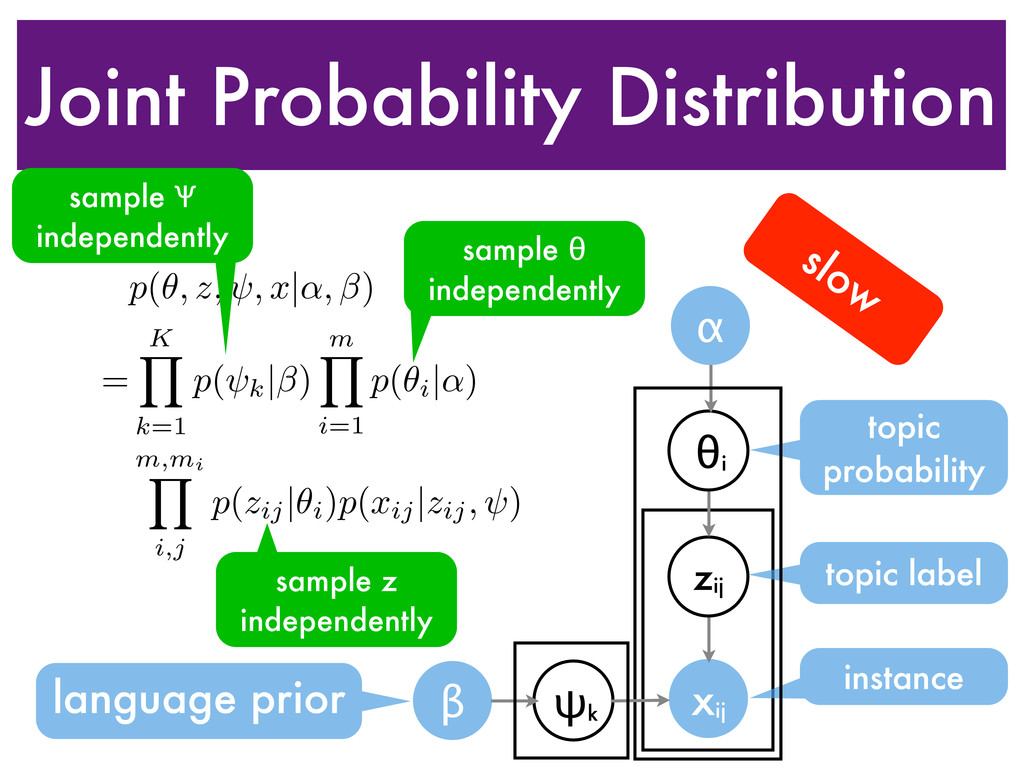
  43. sample z independently sample θ independently Joint Probability Distribution xij

    zij θi language prior topic probability topic label instance α ψk β p(⇤, z, ⌅, x| , ⇥) = K Y k=1 p(⌅k |⇥) m Y i=1 p(⇤i | ) m,mi Y i,j p(zij |⇤i)p(xij |zij, ⌅) sample Ψ independently slow
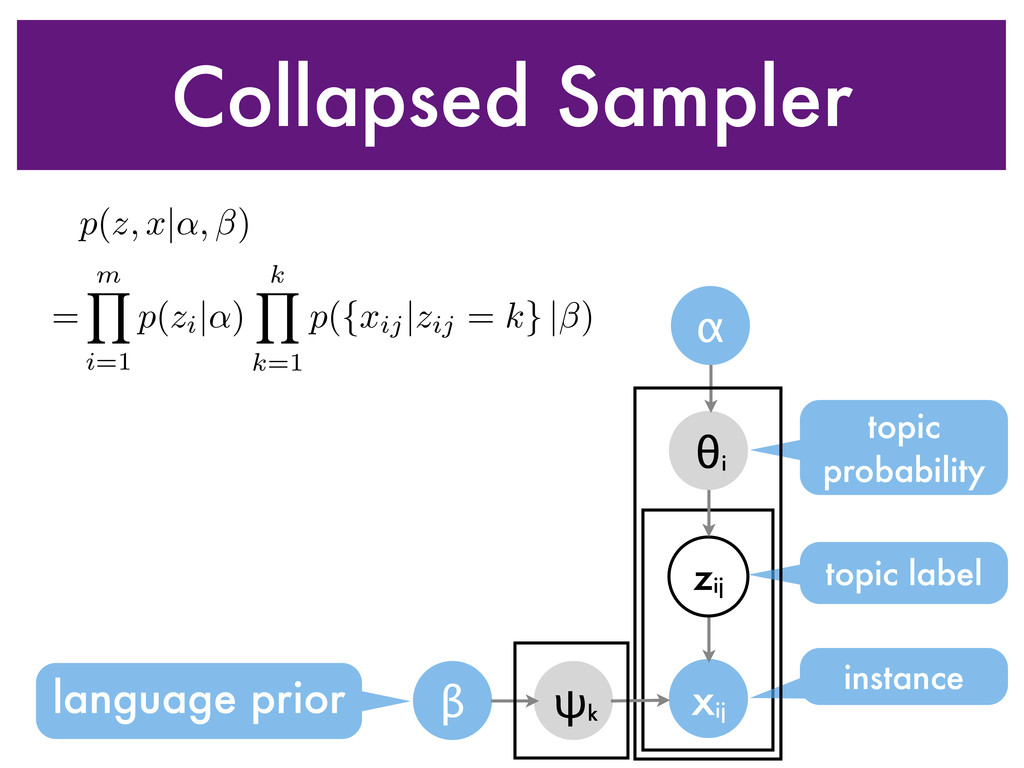
  44. Collapsed Sampler xij zij θi language prior topic probability topic

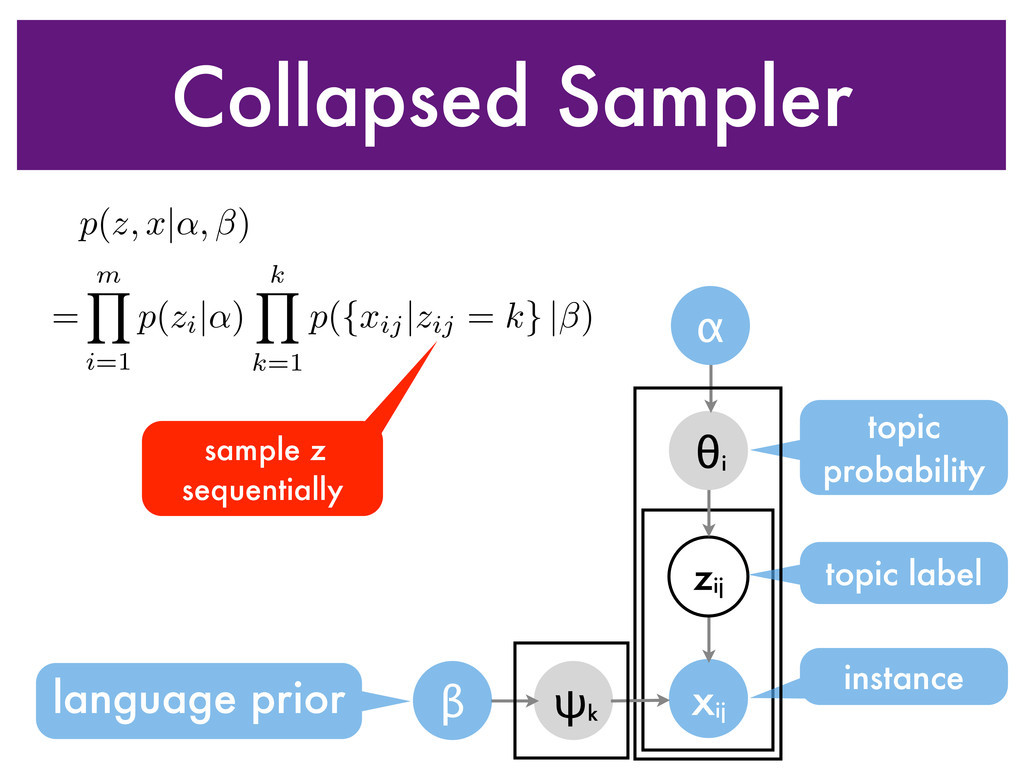
    label instance α ψk β p(z, x| , ⇥) = m Y i=1 p(zi | ) k Y k=1 p({xij |zij = k} |⇥)
  45. sample z sequentially Collapsed Sampler xij zij θi language prior
    topic probability topic label instance α ψk β p(z, x| , ⇥) = m Y i=1 p(zi | ) k Y k=1 p({xij |zij = k} |⇥)
  46. sample z sequentially Collapsed Sampler xij zij θi language prior
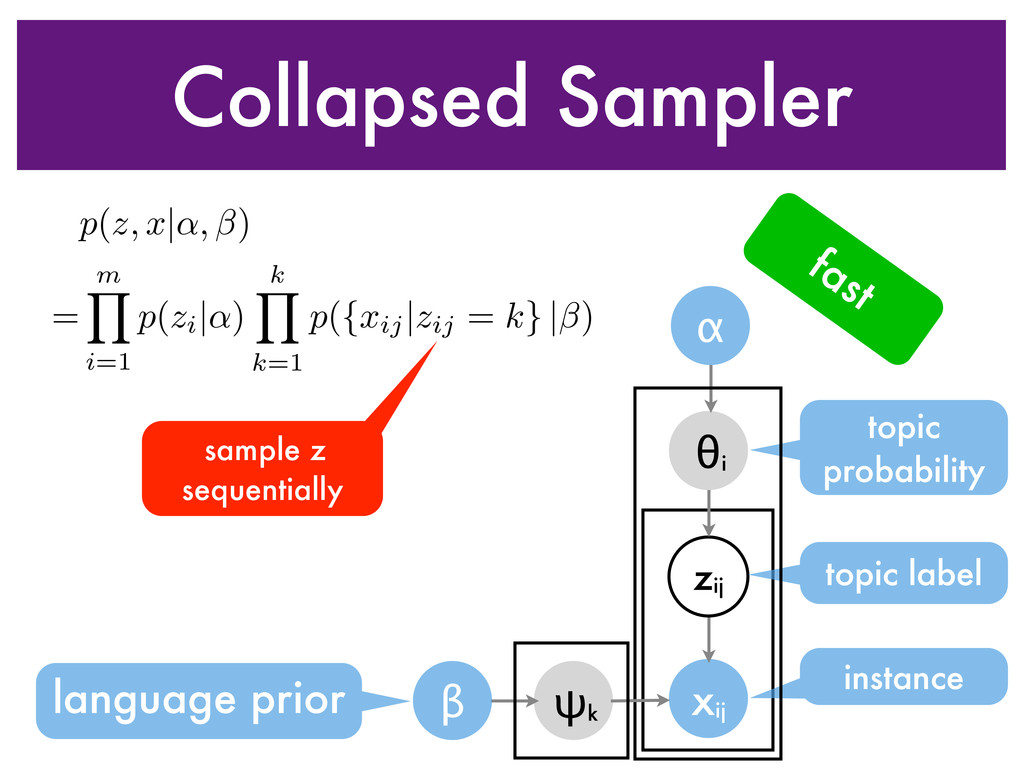
    topic probability topic label instance α ψk β p(z, x| , ⇥) = m Y i=1 p(zi | ) k Y k=1 p({xij |zij = k} |⇥) fast
  47. Collapsed Sampler xij zij θi language prior topic probability topic

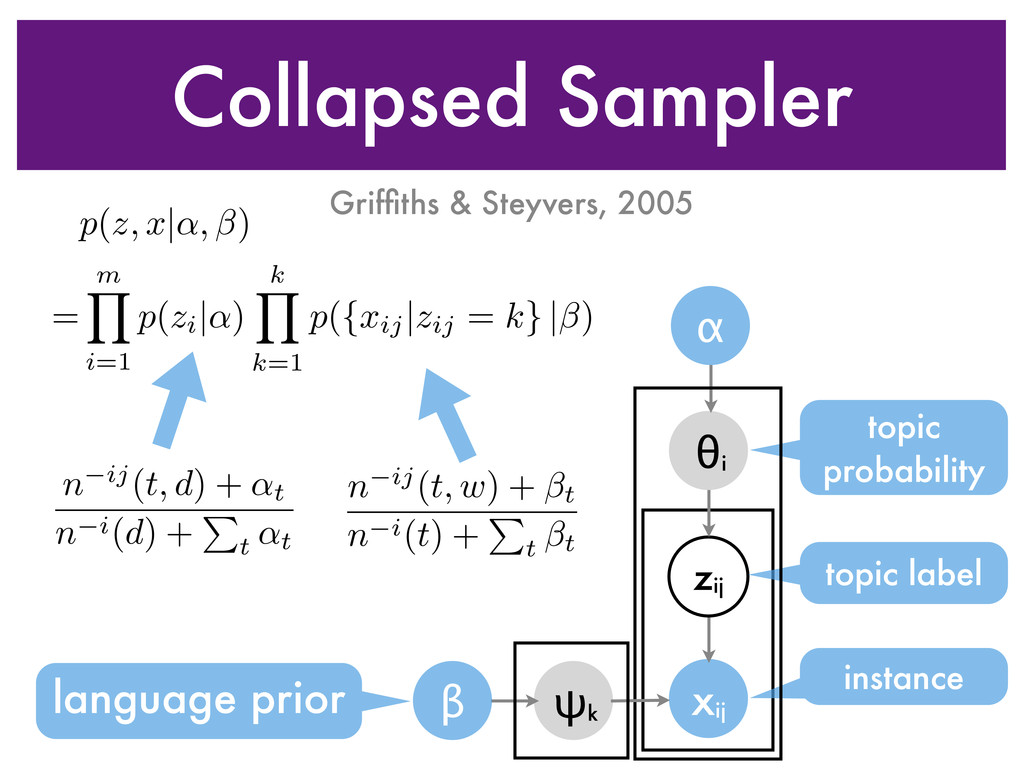
    label instance α ψk β p(z, x| , ⇥) = m Y i=1 p(zi | ) k Y k=1 p({xij |zij = k} |⇥) n ij(t, w) + t n i(t) + P t t n ij(t, d) + t n i(d) + P t t Griffiths & Steyvers, 2005
  48. Collapsed Sampler xij zij θi language prior topic probability topic

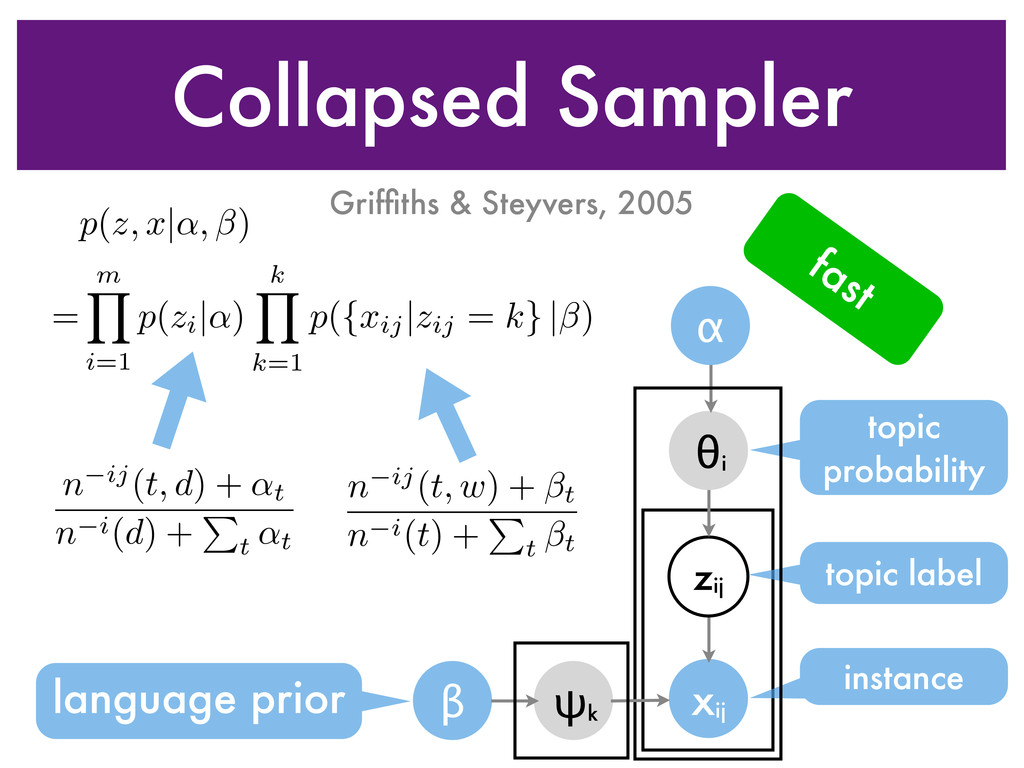
    label instance α ψk β p(z, x| , ⇥) = m Y i=1 p(zi | ) k Y k=1 p({xij |zij = k} |⇥) fast n ij(t, w) + t n i(t) + P t t n ij(t, d) + t n i(d) + P t t Griffiths & Steyvers, 2005
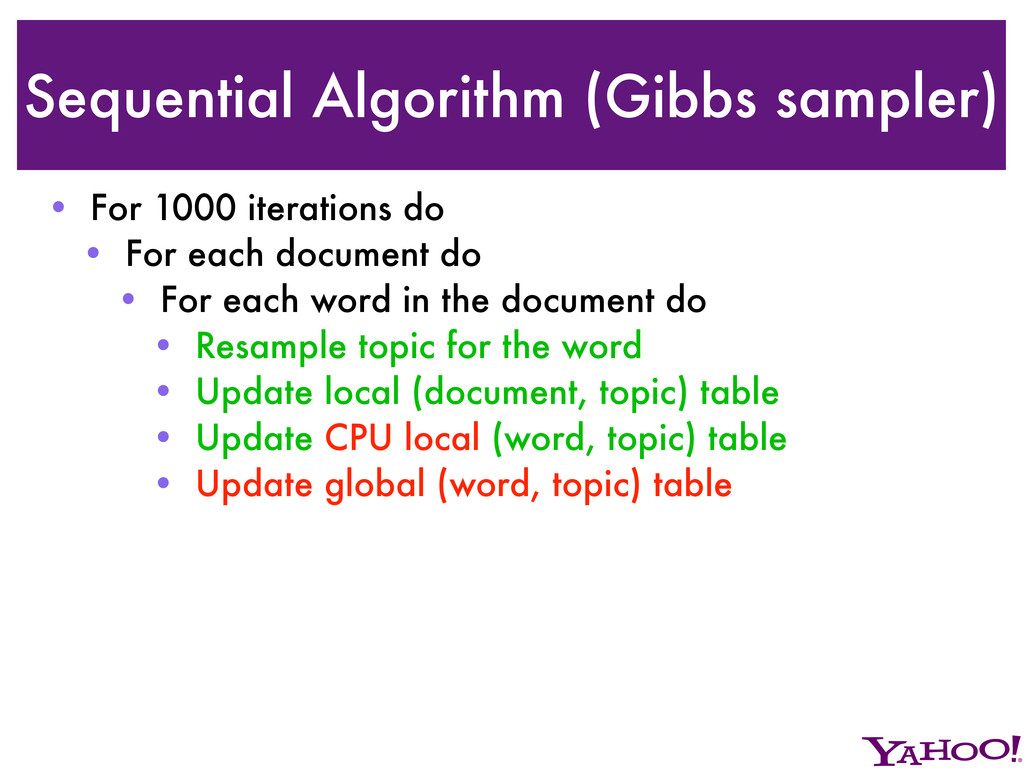
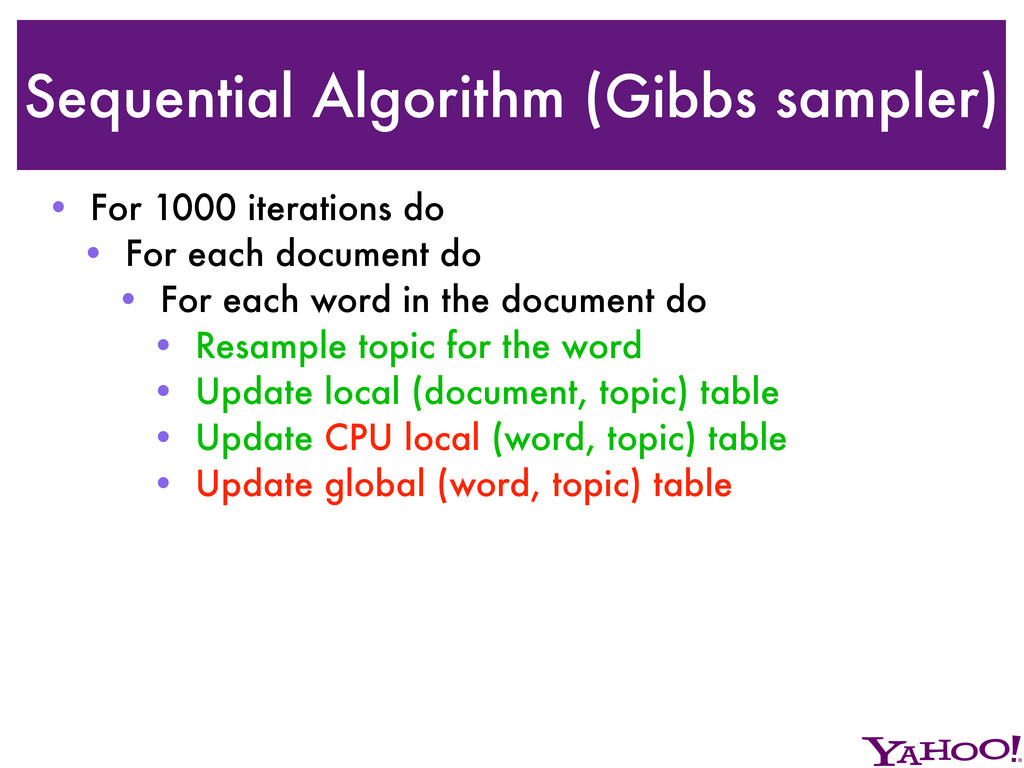
  49. Sequential Algorithm (Gibbs sampler) • For 1000 iterations do •

    For each document do • For each word in the document do • Resample topic for the word • Update local (document, topic) table • Update CPU local (word, topic) table • Update global (word, topic) table
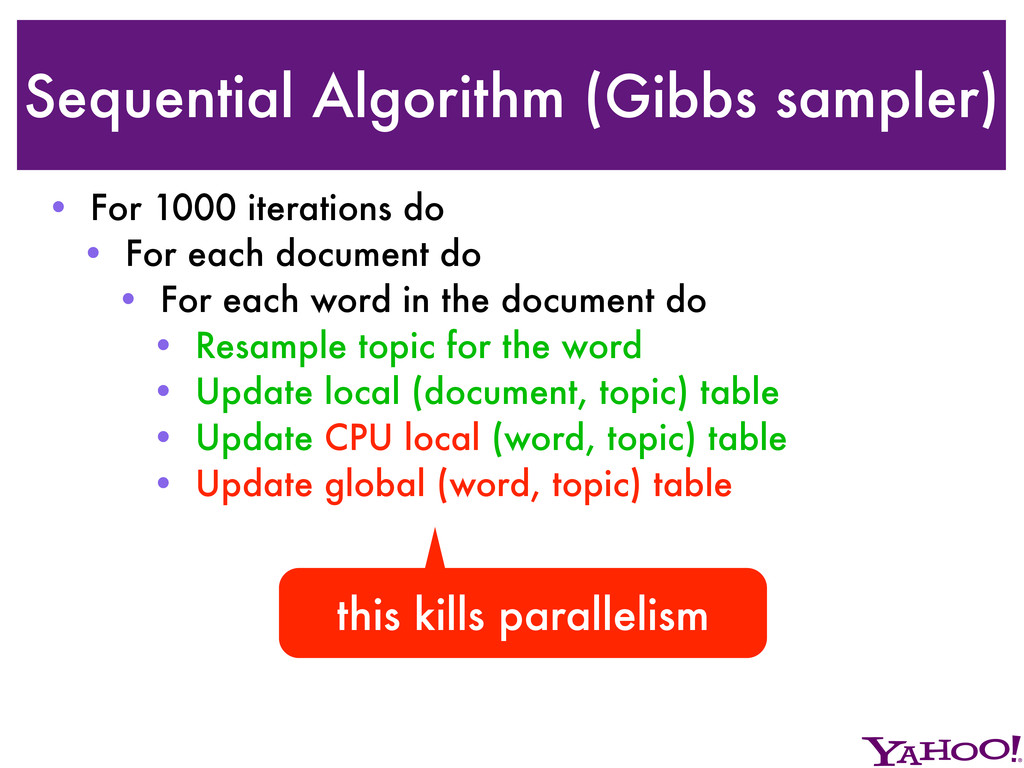
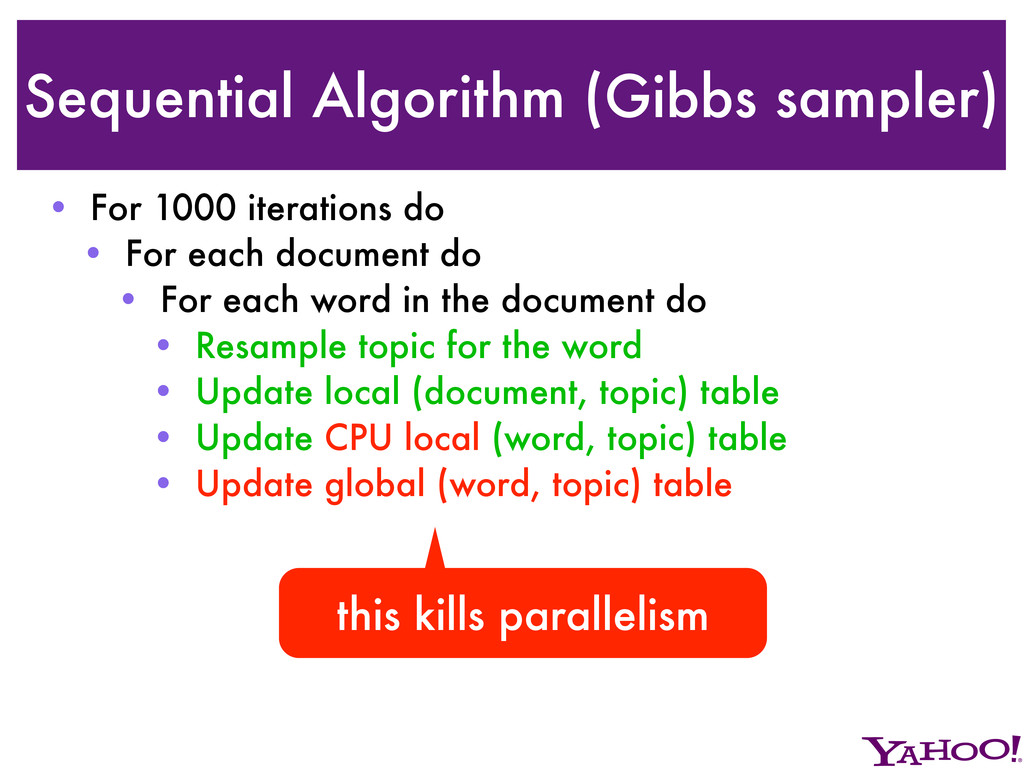
  50. Sequential Algorithm (Gibbs sampler) this kills parallelism • For 1000

    iterations do • For each document do • For each word in the document do • Resample topic for the word • Update local (document, topic) table • Update CPU local (word, topic) table • Update global (word, topic) table
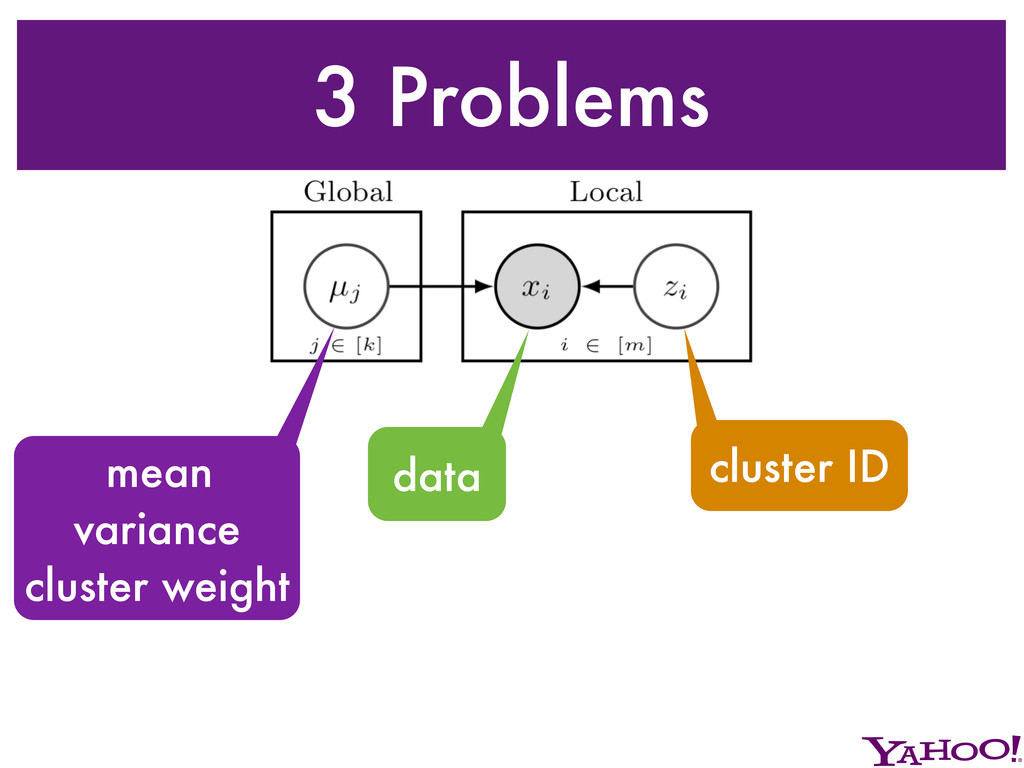
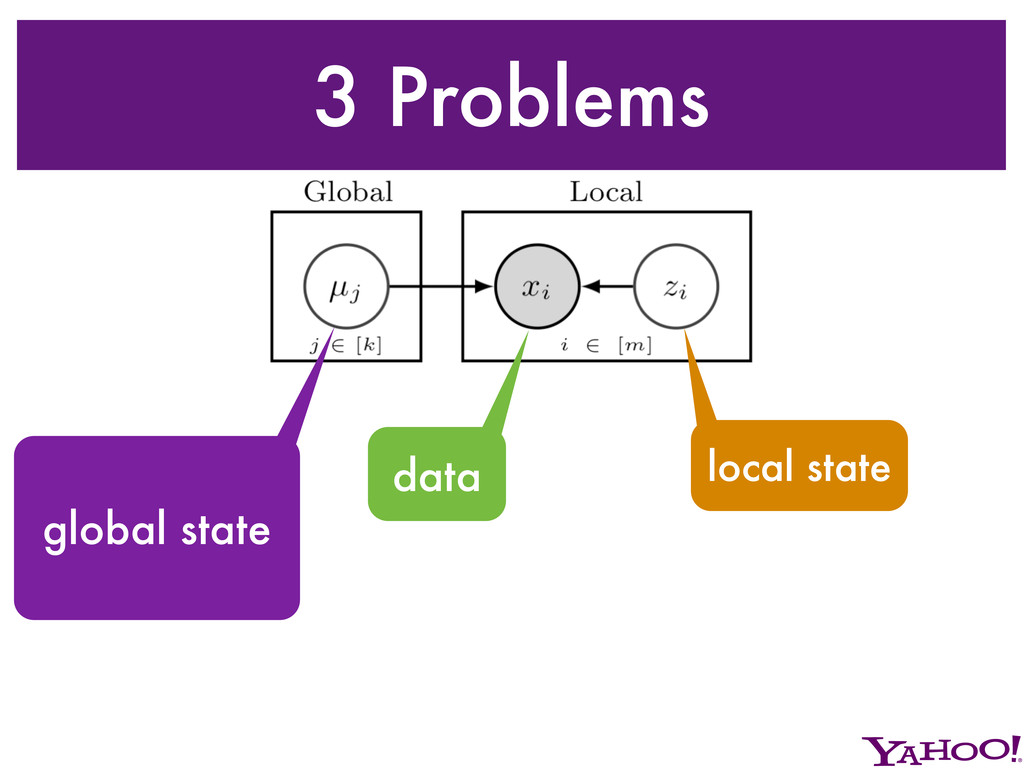
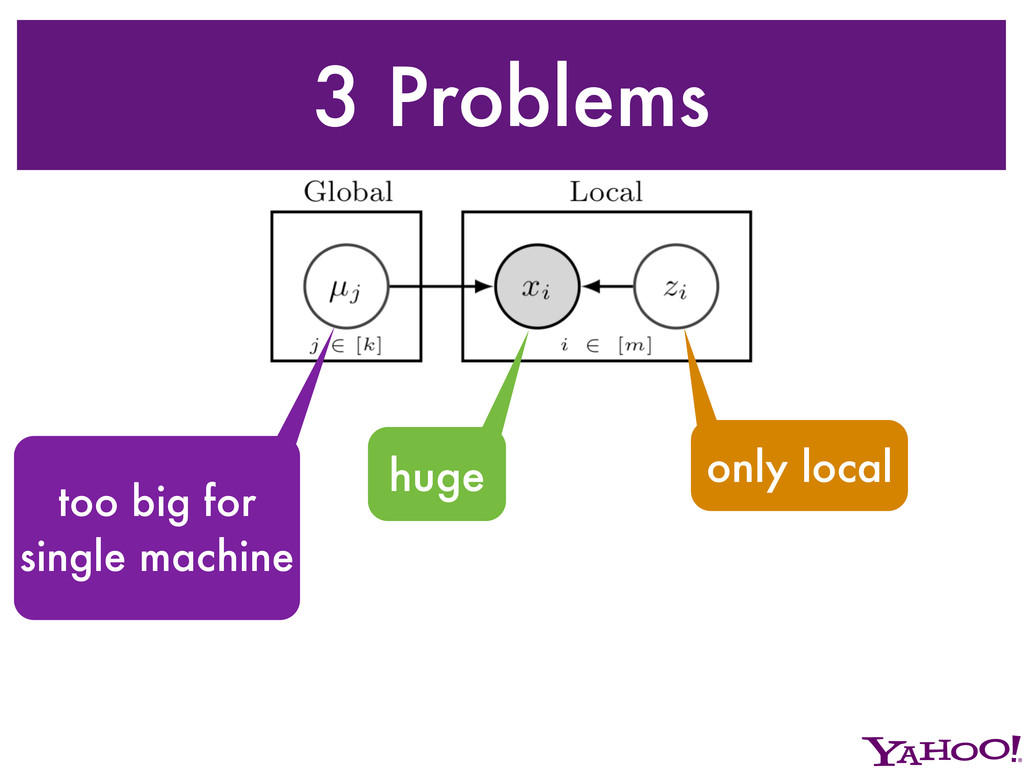
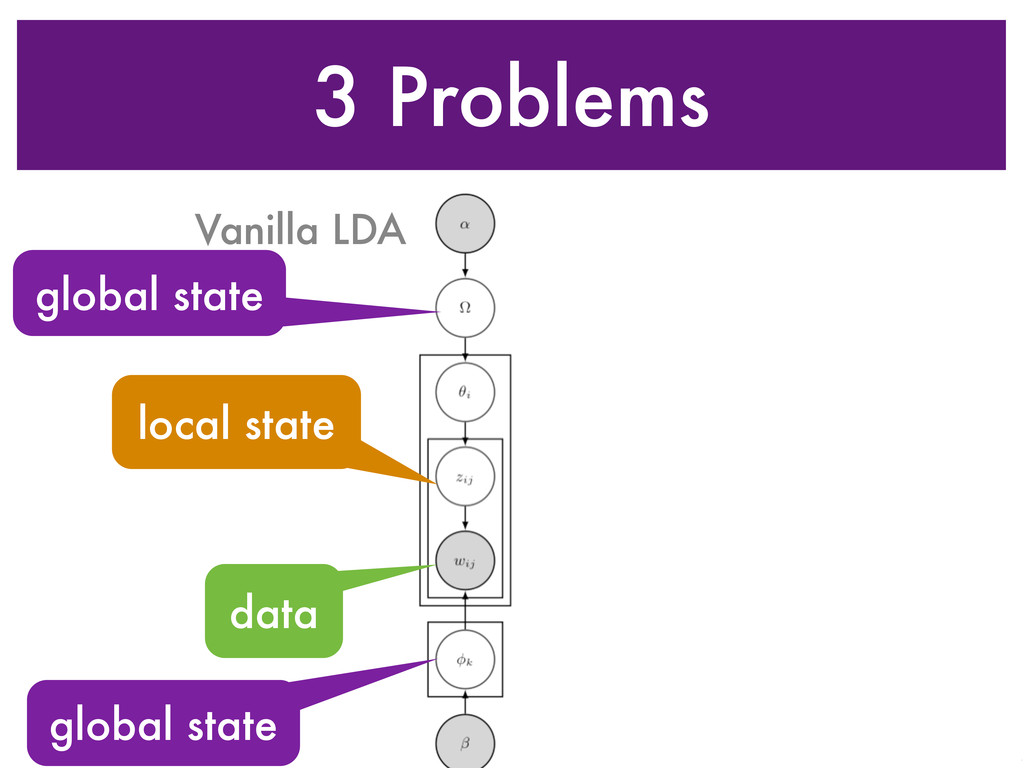
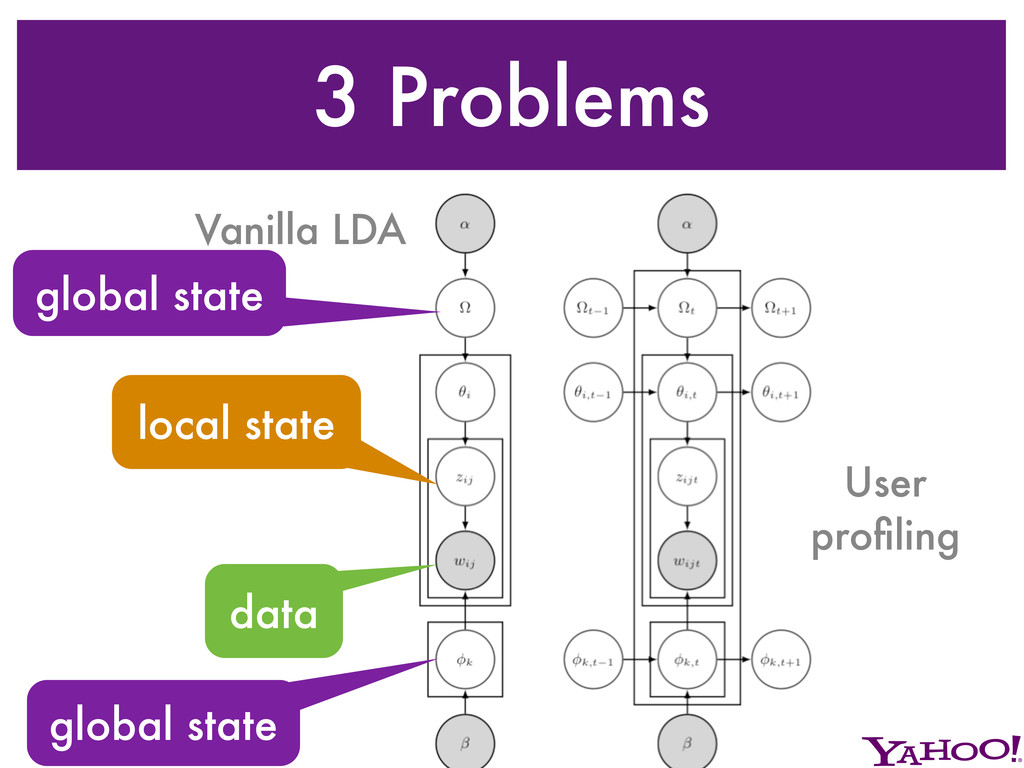
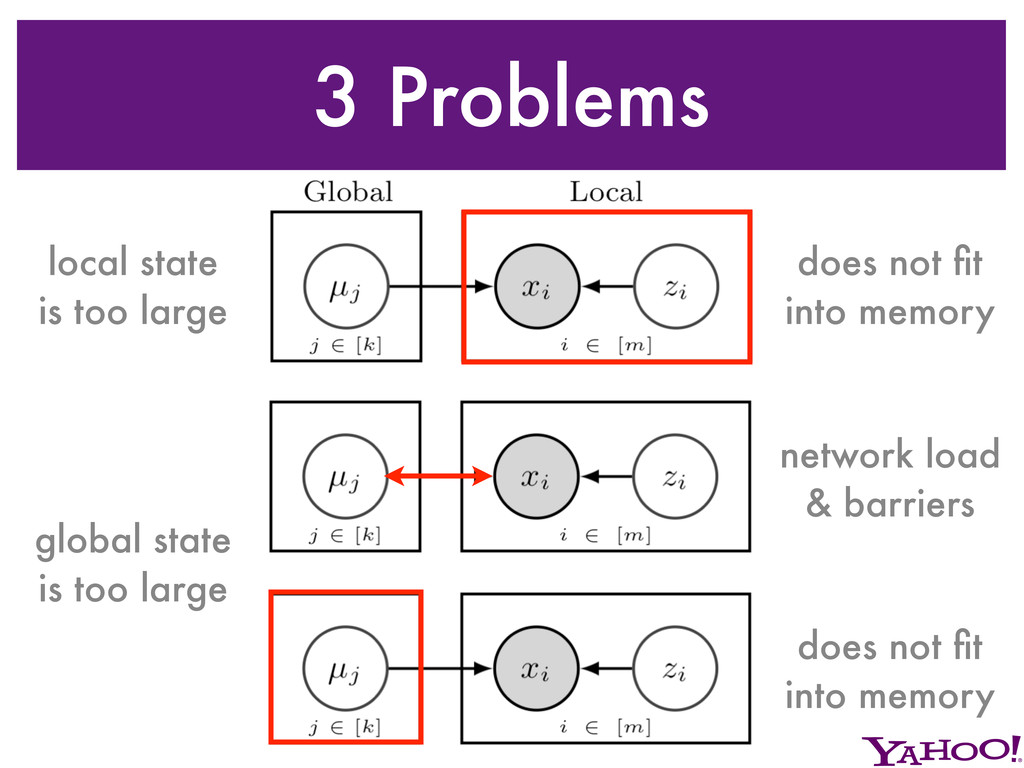
  51. 3 Problems global state is too large does not fit

    into memory network load & barriers does not fit into memory local state is too large
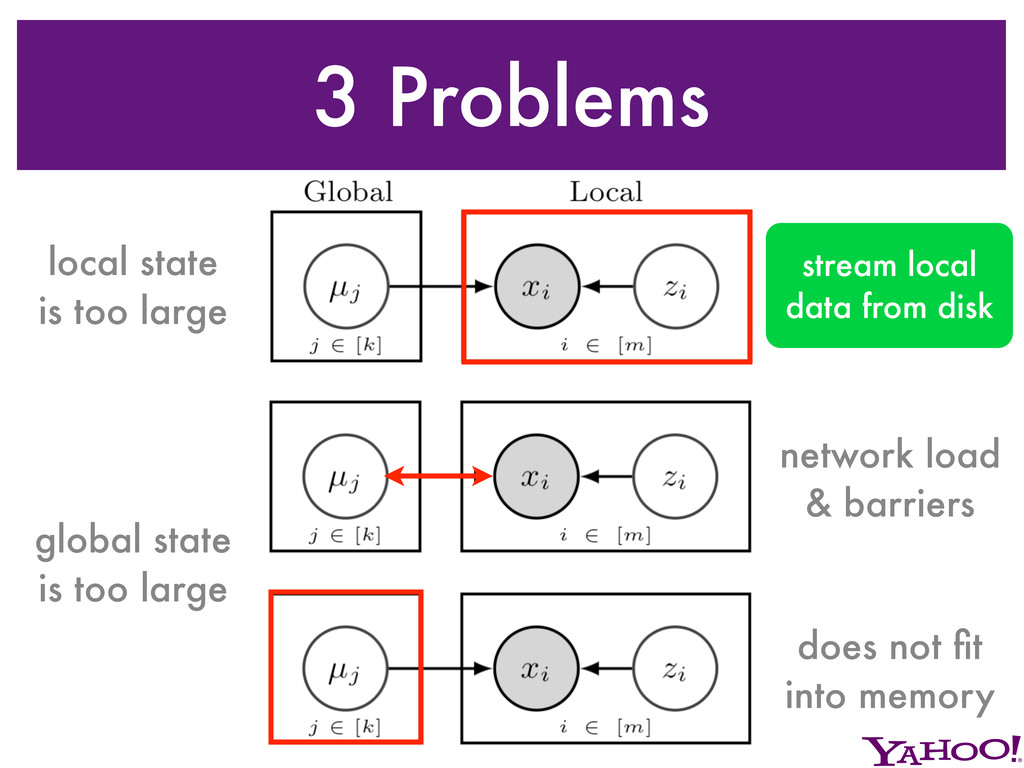
  52. 3 Problems global state is too large does not fit

    into memory network load & barriers does not fit into memory local state is too large stream local data from disk
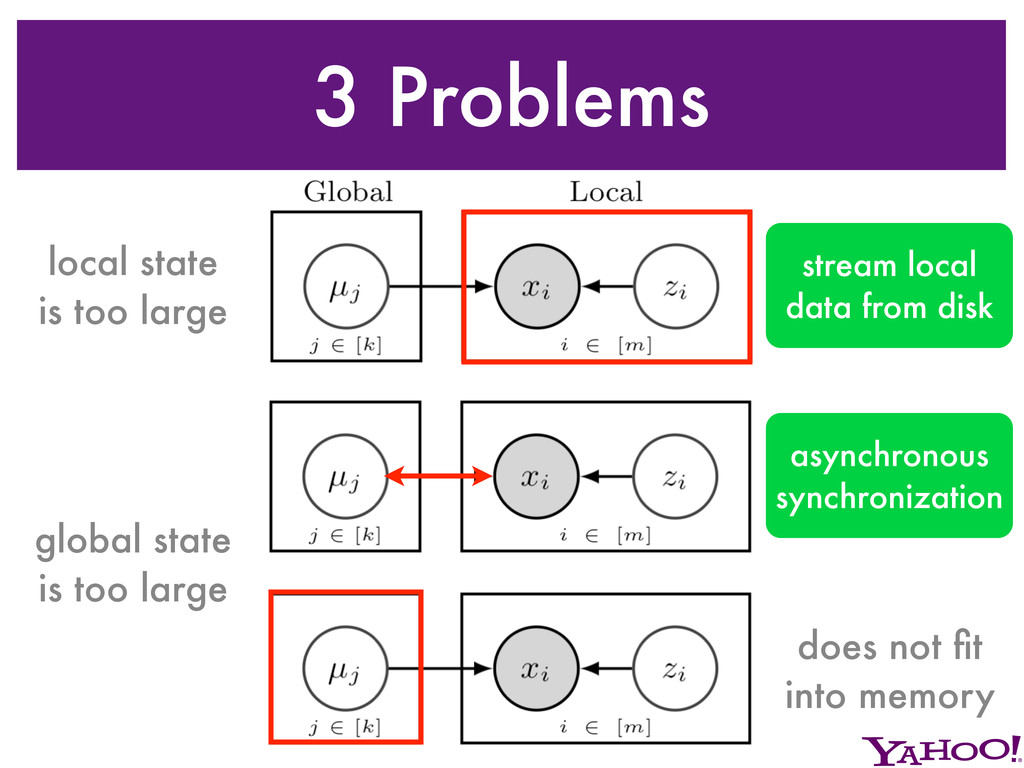
  53. 3 Problems global state is too large does not fit

    into memory network load & barriers does not fit into memory local state is too large stream local data from disk asynchronous synchronization
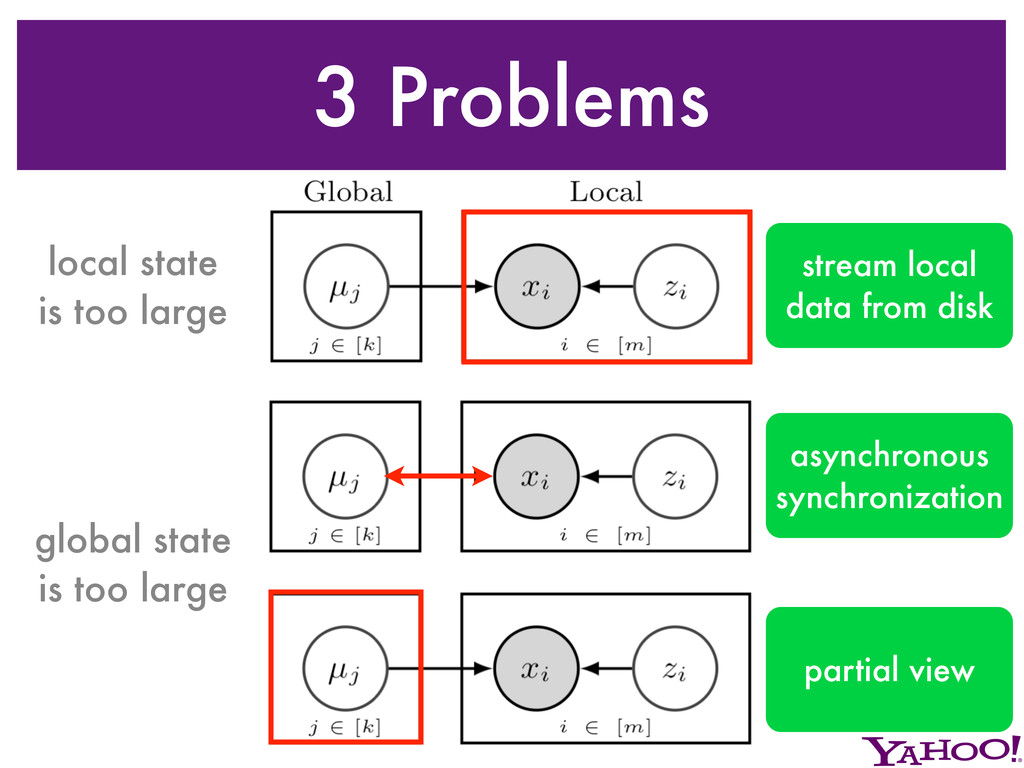
  54. 3 Problems global state is too large does not fit

    into memory network load & barriers does not fit into memory local state is too large stream local data from disk asynchronous synchronization partial view
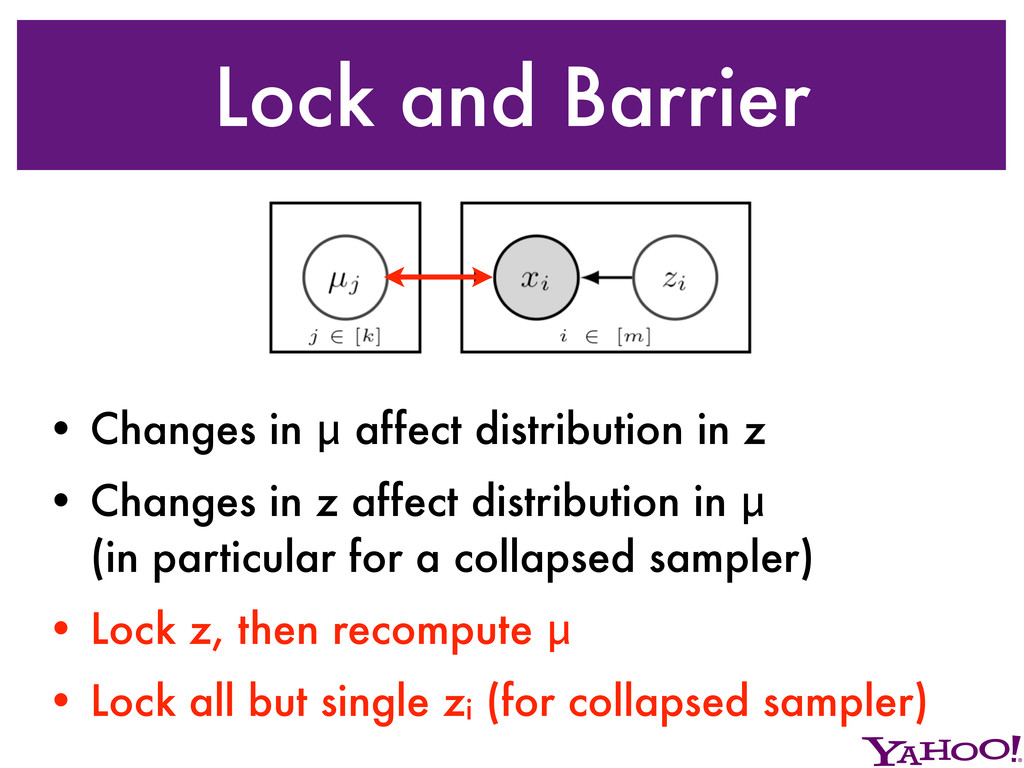
  55. Lock and Barrier • Changes in μ affect distribution in

    z • Changes in z affect distribution in μ (in particular for a collapsed sampler) • Lock z, then recompute μ • Lock all but single zi (for collapsed sampler)
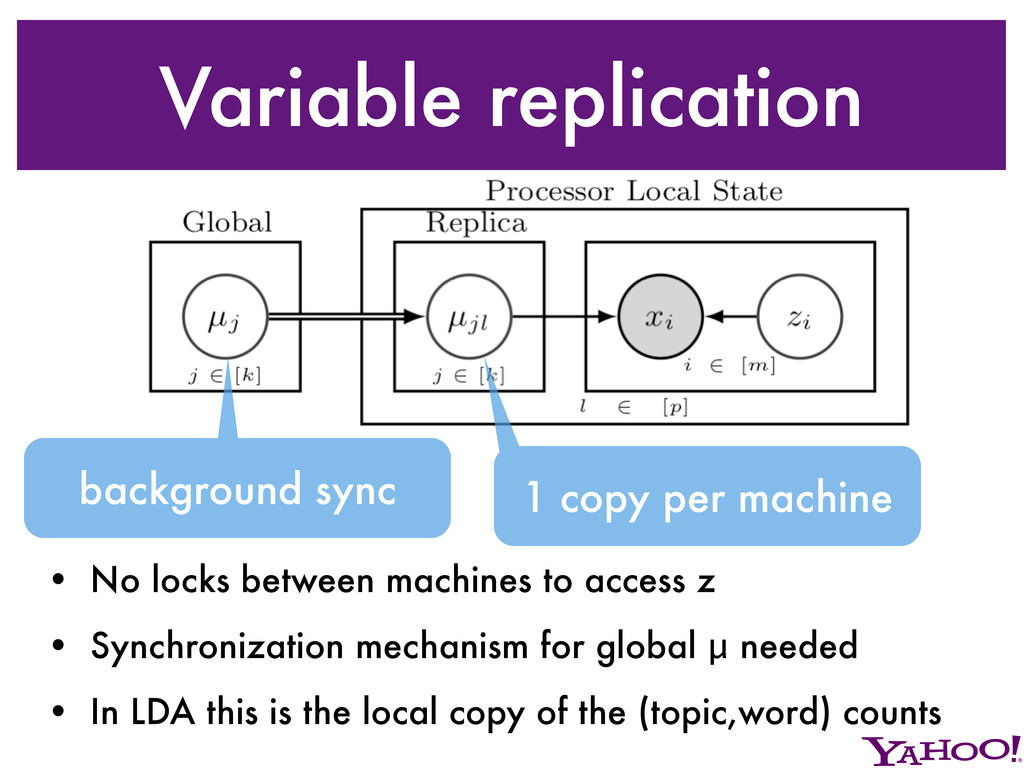
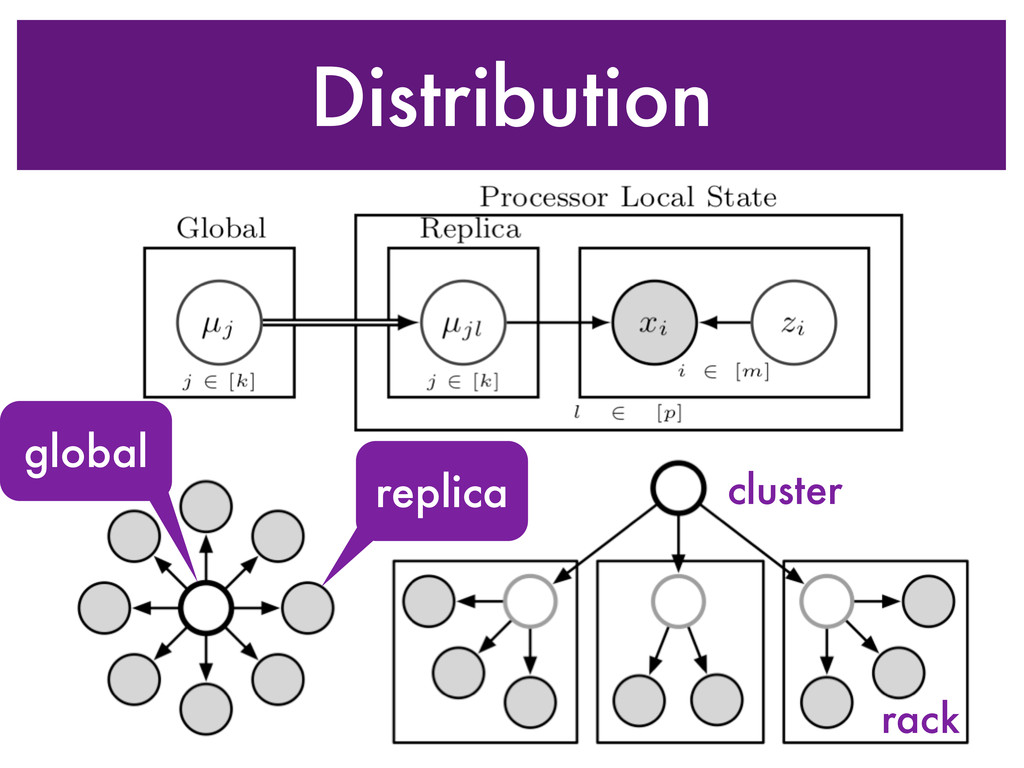
  56. Variable replication • No locks between machines to access z

    • Synchronization mechanism for global μ needed • In LDA this is the local copy of the (topic,word) counts 1 copy per machine background sync
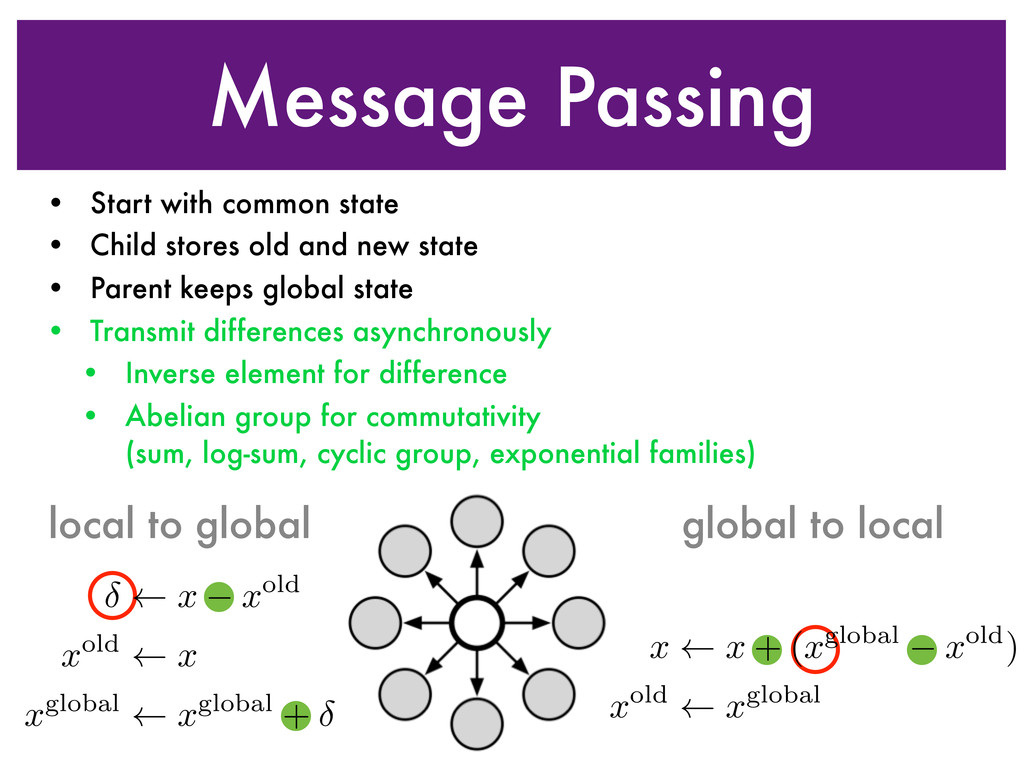
  57. Message Passing • Start with common state • Child stores

    old and new state • Parent keeps global state • Transmit differences asynchronously • Inverse element for difference • Abelian group for commutativity (sum, log-sum, cyclic group, exponential families) local to global global to local x x + ( xglobal xold) xold xglobal x xold xold x xglobal xglobal +

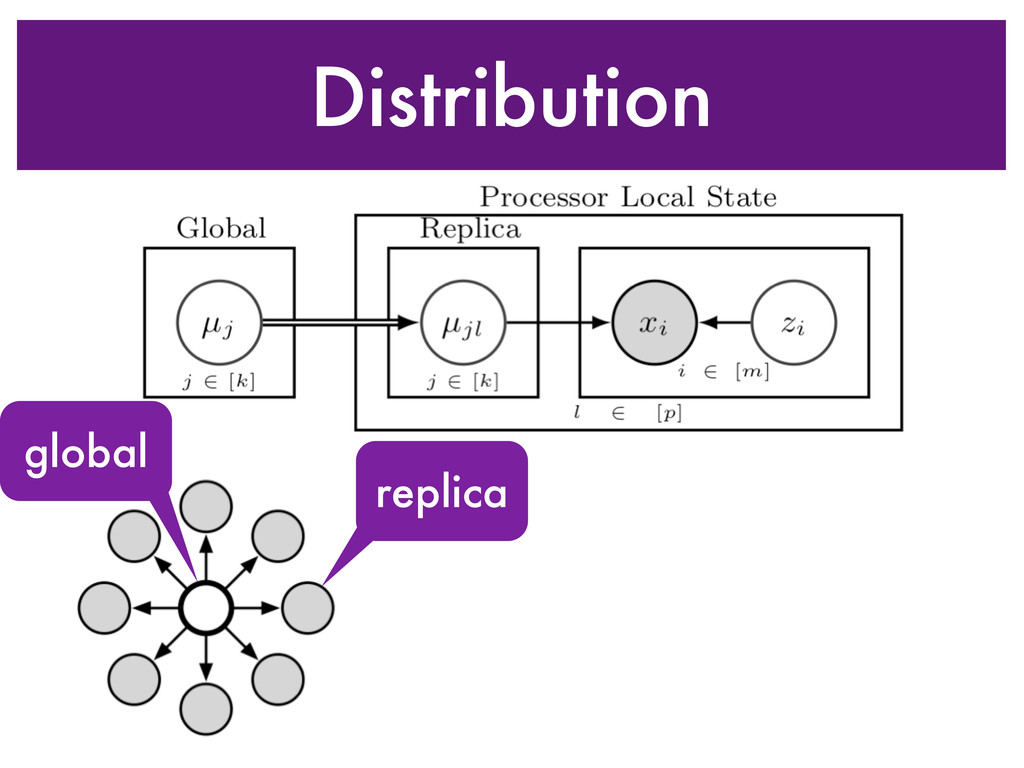
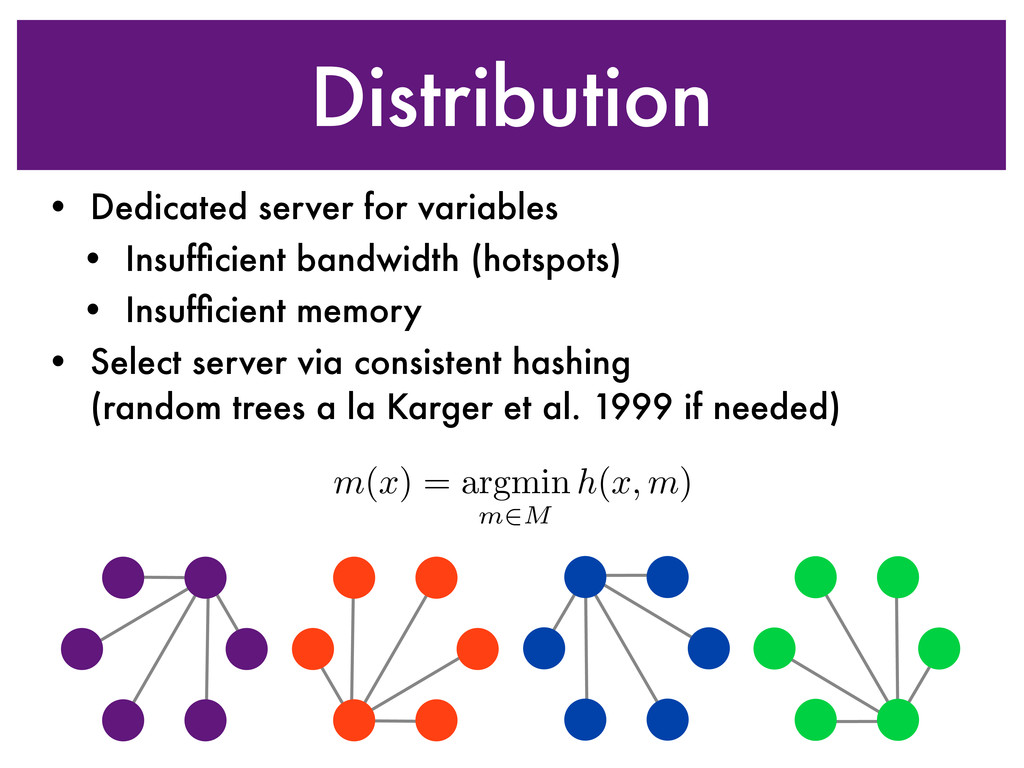
  58. Distribution • Dedicated server for variables • Insufficient bandwidth (hotspots)

    • Insufficient memory • Select server via consistent hashing (random trees a la Karger et al. 1999 if needed) m ( x ) = argmin m2M h ( x, m )
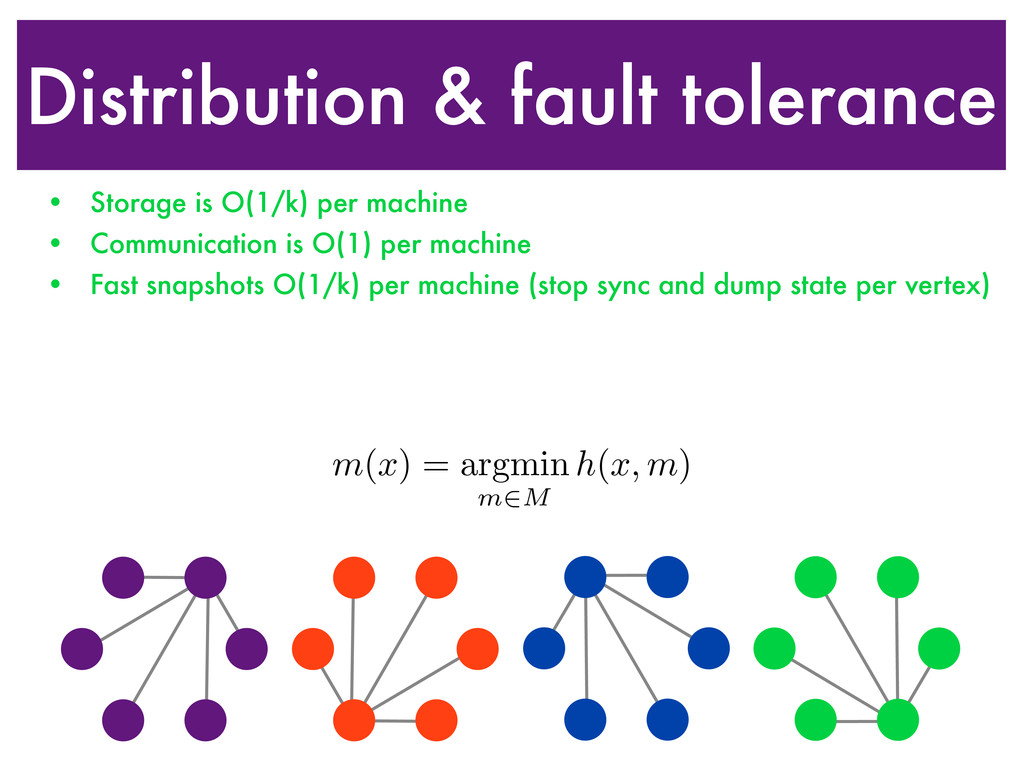
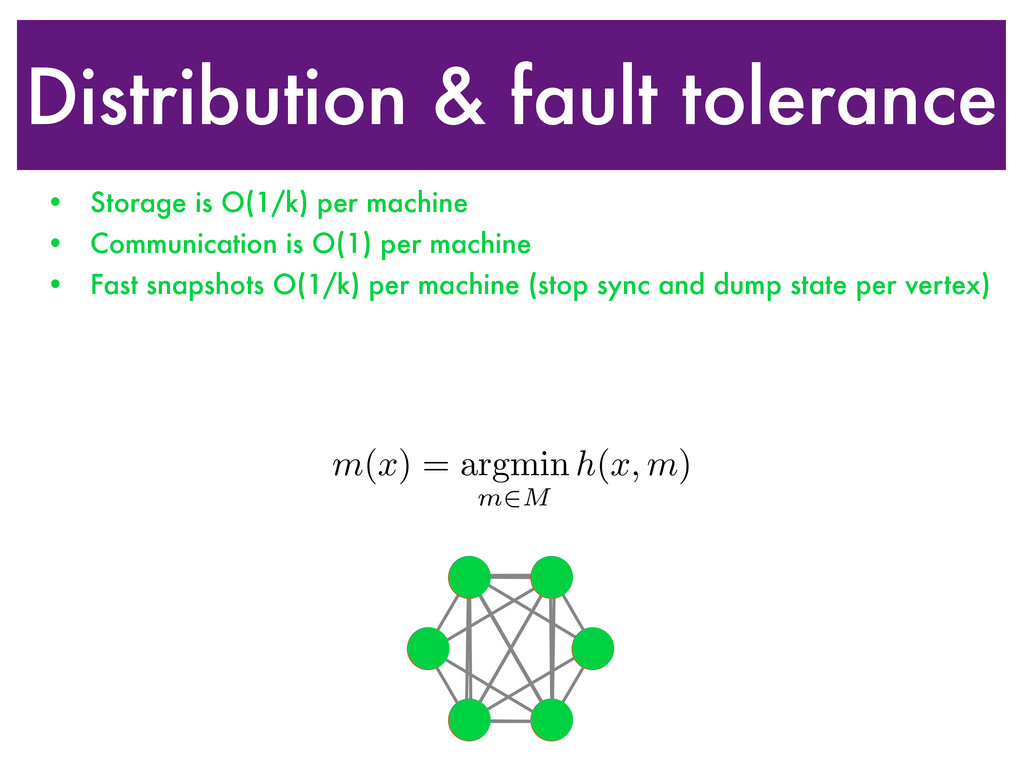
  59. Distribution & fault tolerance • Storage is O(1/k) per machine

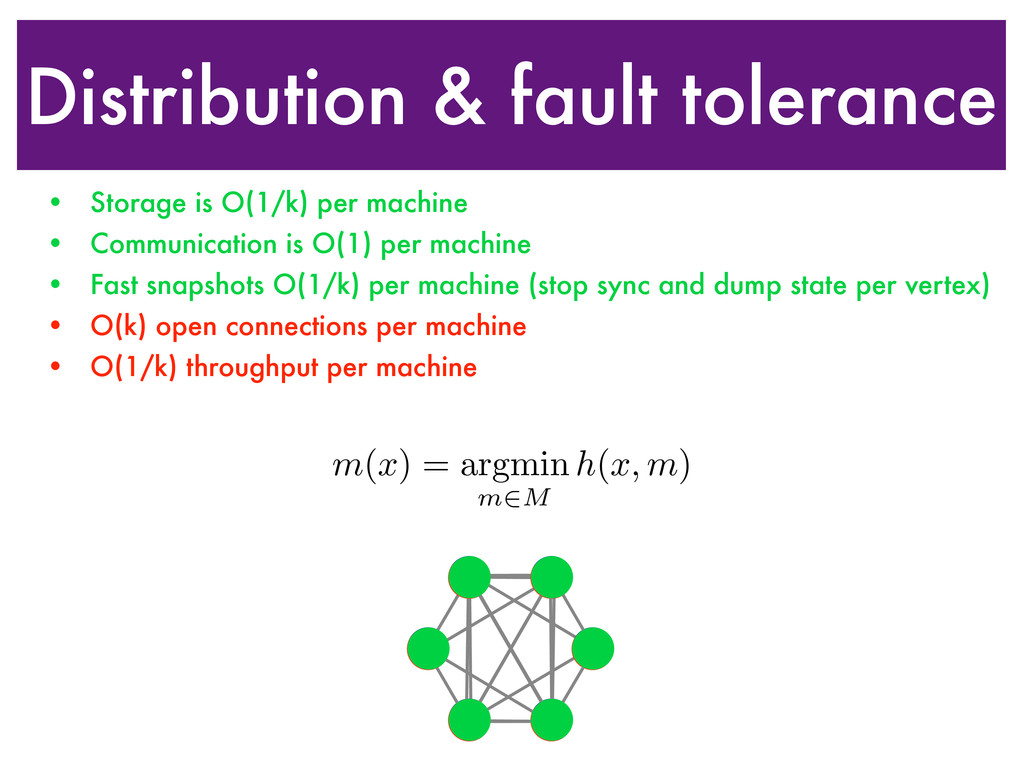
    • Communication is O(1) per machine • Fast snapshots O(1/k) per machine (stop sync and dump state per vertex) • O(k) open connections per machine • O(1/k) throughput per machine m ( x ) = argmin m2M h ( x, m )
  60. Distribution & fault tolerance • Storage is O(1/k) per machine

    • Communication is O(1) per machine • Fast snapshots O(1/k) per machine (stop sync and dump state per vertex) • O(k) open connections per machine • O(1/k) throughput per machine m ( x ) = argmin m2M h ( x, m )
  61. Distribution & fault tolerance • Storage is O(1/k) per machine

    • Communication is O(1) per machine • Fast snapshots O(1/k) per machine (stop sync and dump state per vertex) • O(k) open connections per machine • O(1/k) throughput per machine m ( x ) = argmin m2M h ( x, m )
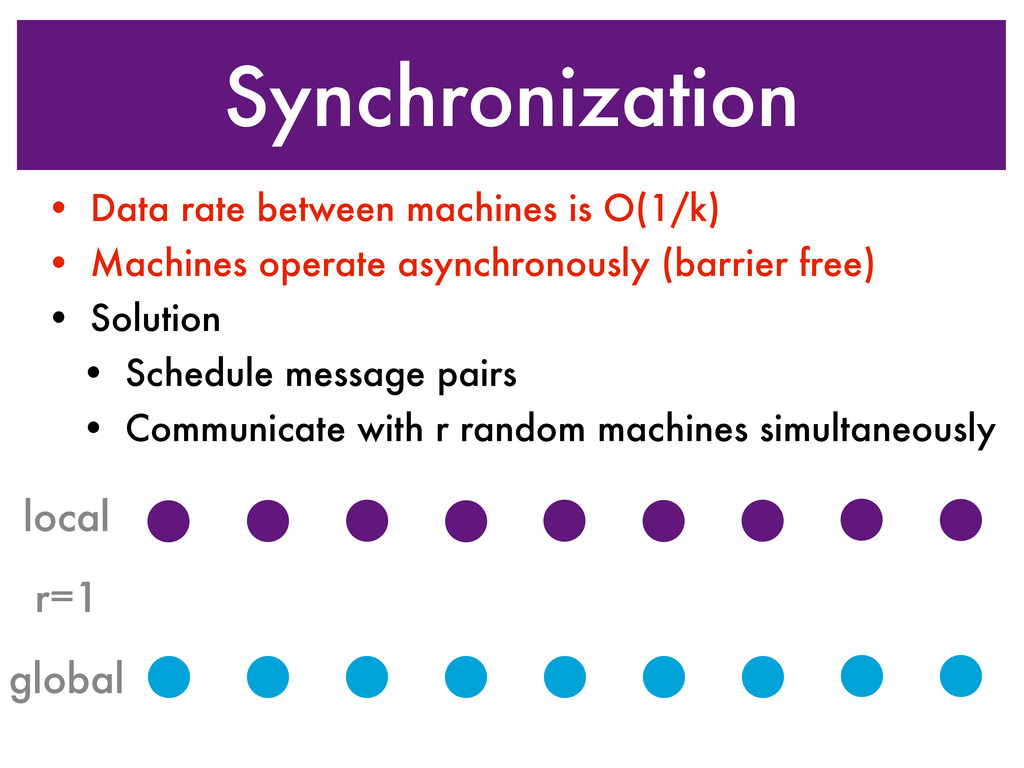
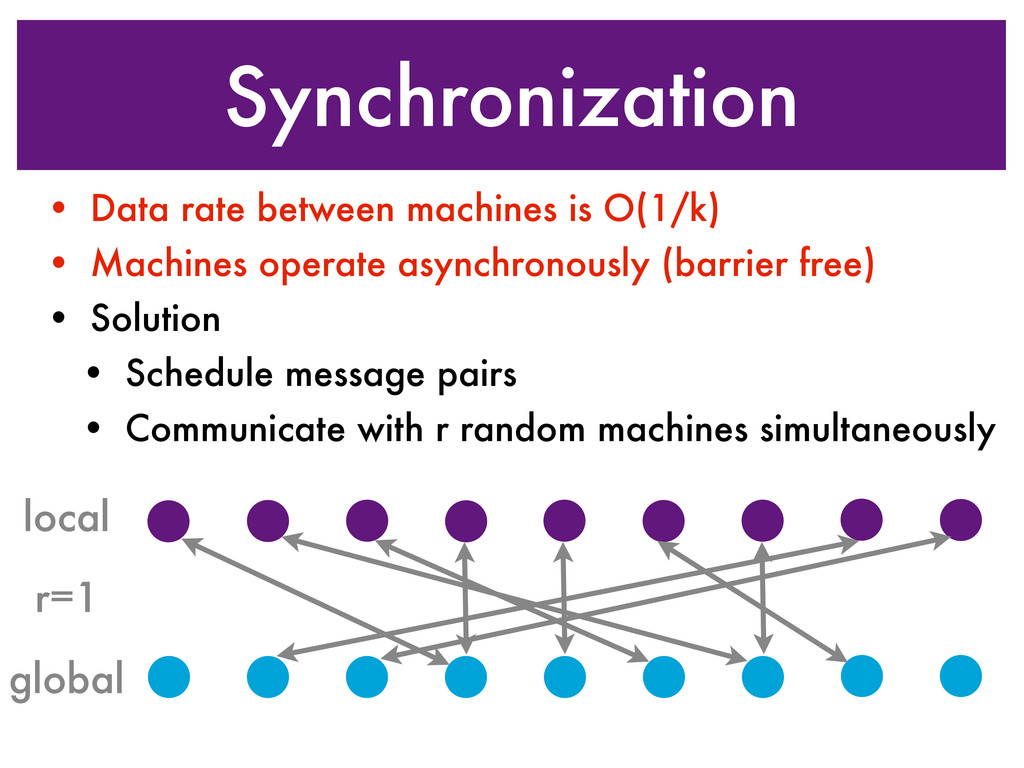
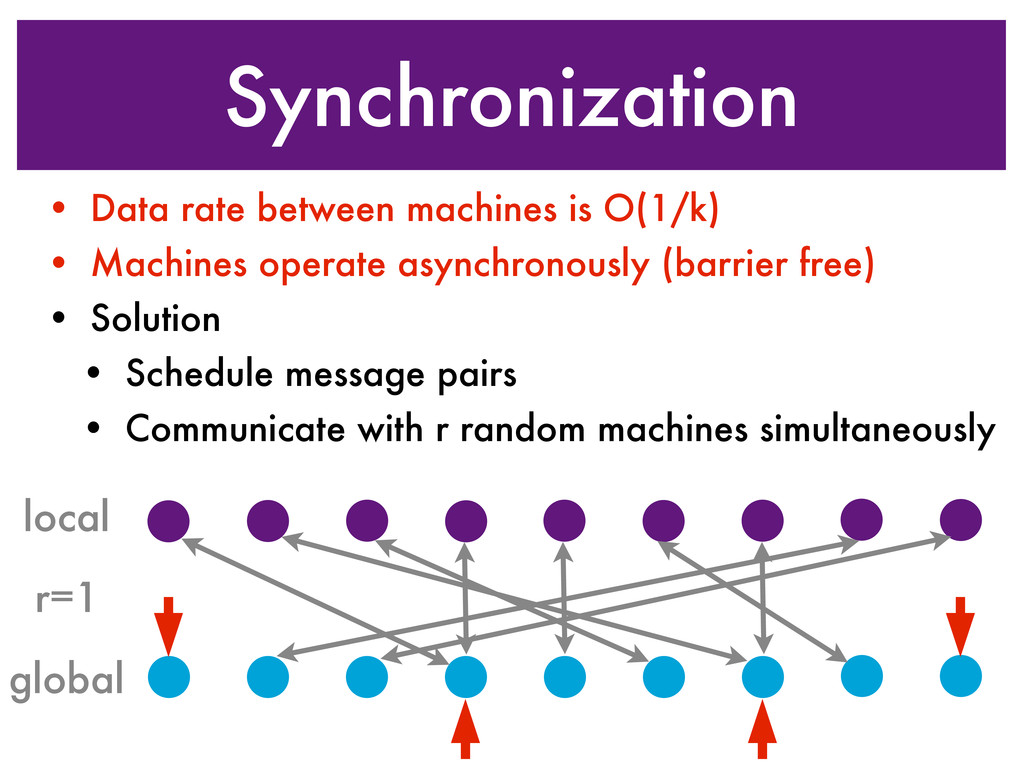
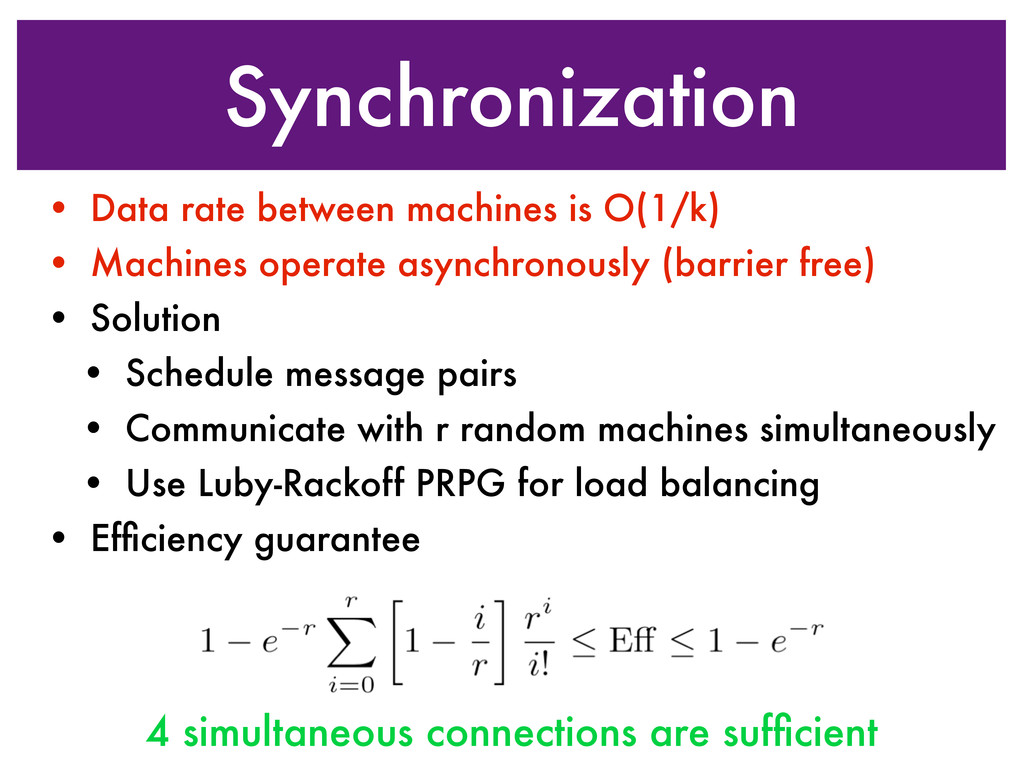
  62. Synchronization • Data rate between machines is O(1/k) • Machines

    operate asynchronously (barrier free) • Solution • Schedule message pairs • Communicate with r random machines simultaneously local global r=1
  63. Synchronization • Data rate between machines is O(1/k) • Machines

    operate asynchronously (barrier free) • Solution • Schedule message pairs • Communicate with r random machines simultaneously local global r=1
  64. Synchronization • Data rate between machines is O(1/k) • Machines

    operate asynchronously (barrier free) • Solution • Schedule message pairs • Communicate with r random machines simultaneously local global r=1
  65. Synchronization • Data rate between machines is O(1/k) • Machines

    operate asynchronously (barrier free) • Solution • Schedule message pairs • Communicate with r random machines simultaneously • Use Luby-Rackoff PRPG for load balancing • Efficiency guarantee 4 simultaneous connections are sufficient
  66. Sequential Algorithm (Gibbs sampler) • For 1000 iterations do •

    For each document do • For each word in the document do • Resample topic for the word • Update local (document, topic) table • Update CPU local (word, topic) table • Update global (word, topic) table
  67. Sequential Algorithm (Gibbs sampler) this kills parallelism • For 1000

    iterations do • For each document do • For each word in the document do • Resample topic for the word • Update local (document, topic) table • Update CPU local (word, topic) table • Update global (word, topic) table
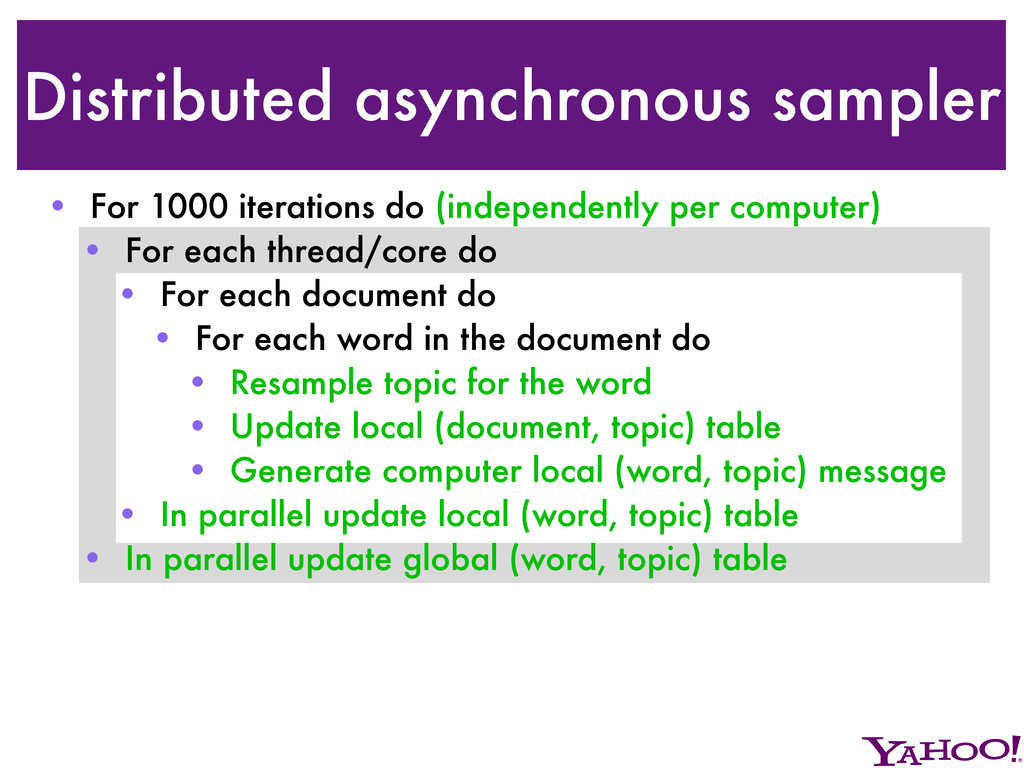
  68. Distributed asynchronous sampler • For 1000 iterations do (independently per

    computer) • For each thread/core do • For each document do • For each word in the document do • Resample topic for the word • Update local (document, topic) table • Generate computer local (word, topic) message • In parallel update local (word, topic) table • In parallel update global (word, topic) table
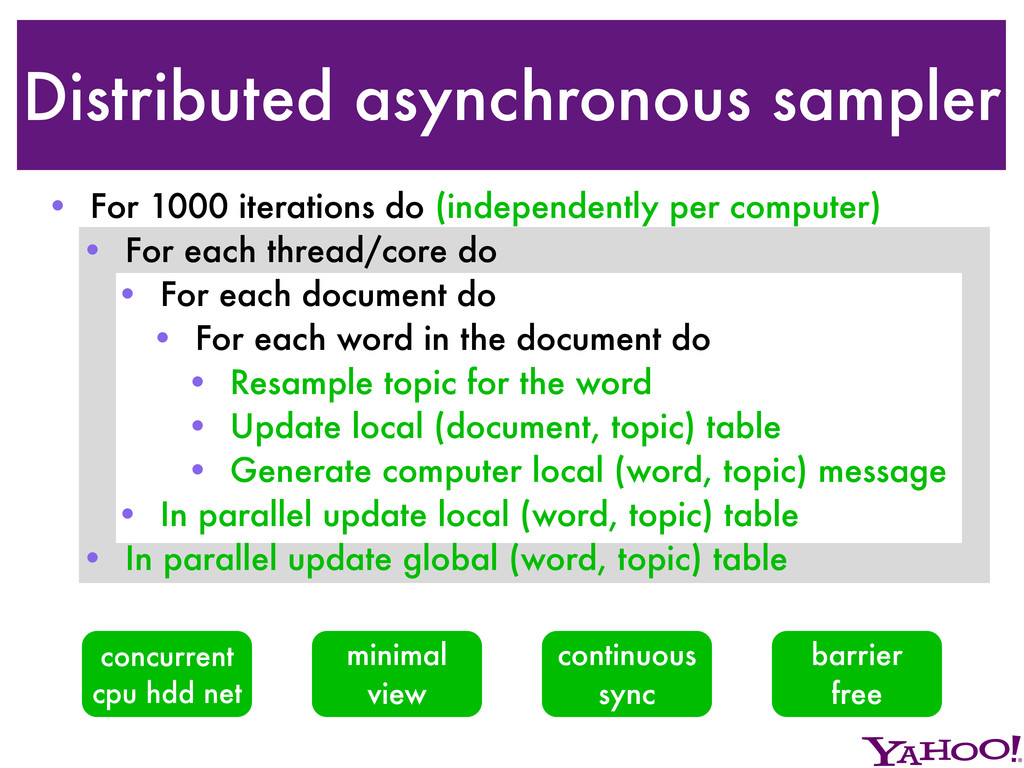
  69. Distributed asynchronous sampler continuous sync barrier free concurrent cpu hdd

    net minimal view • For 1000 iterations do (independently per computer) • For each thread/core do • For each document do • For each word in the document do • Resample topic for the word • Update local (document, topic) table • Generate computer local (word, topic) message • In parallel update local (word, topic) table • In parallel update global (word, topic) table
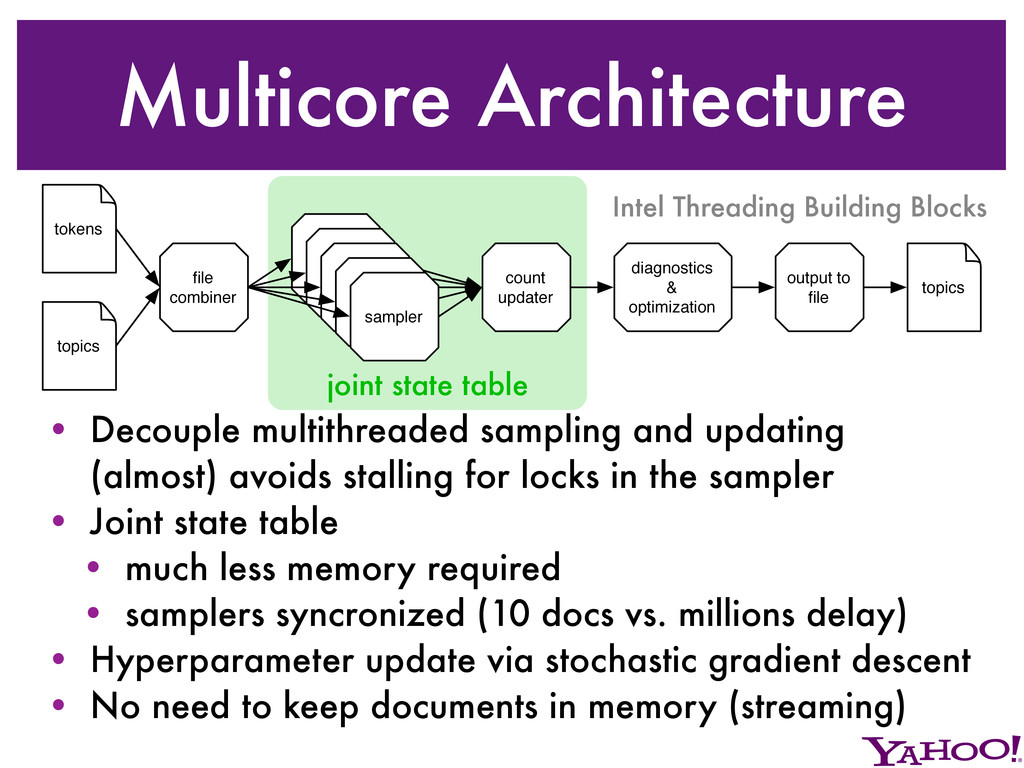
  70. Multicore Architecture • Decouple multithreaded sampling and updating (almost) avoids

    stalling for locks in the sampler • Joint state table • much less memory required • samplers syncronized (10 docs vs. millions delay) • Hyperparameter update via stochastic gradient descent • No need to keep documents in memory (streaming) tokens topics file combiner count updater diagnostics & optimization output to file topics sampler sampler sampler sampler sampler Intel Threading Building Blocks joint state table
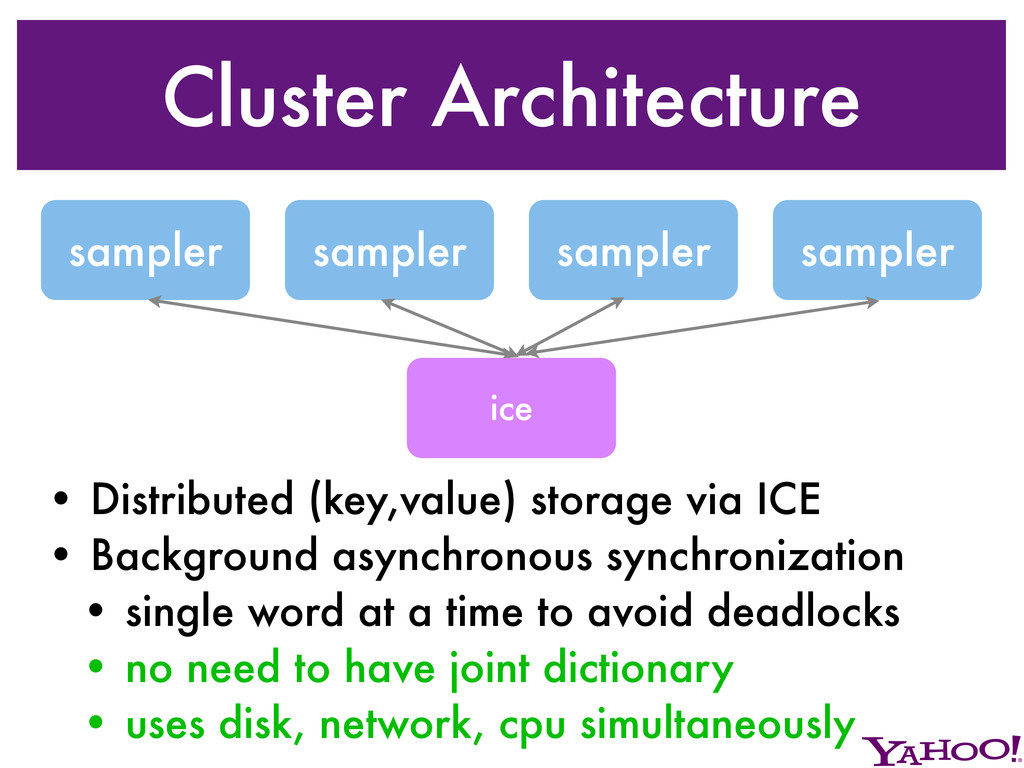
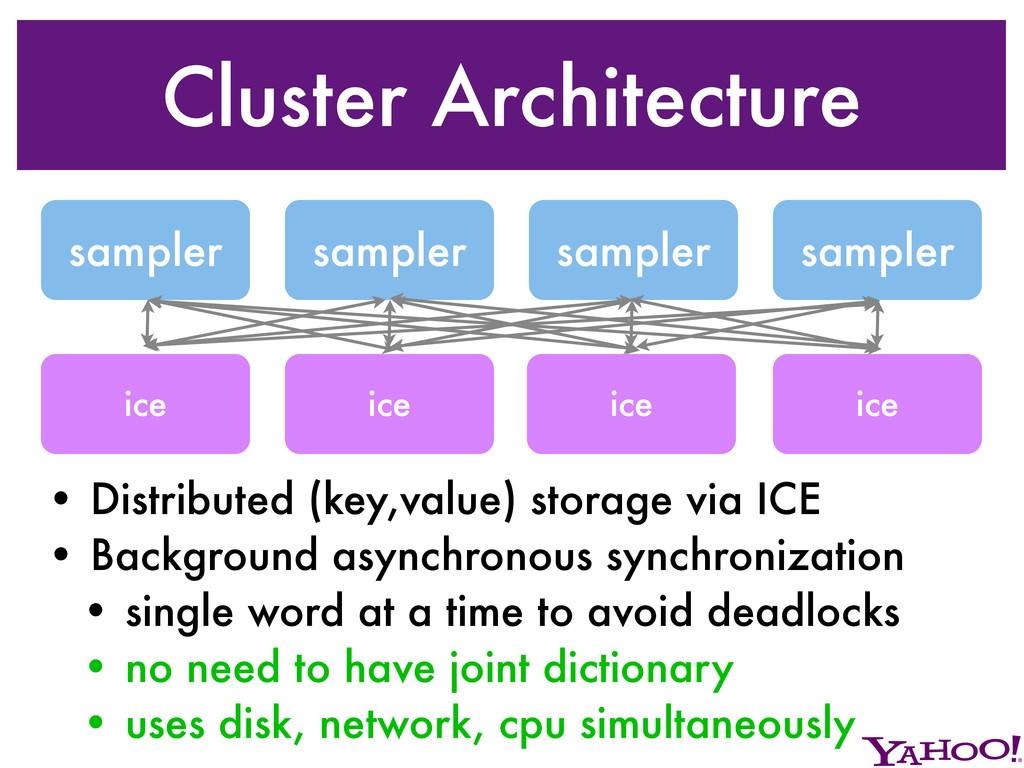
  71. Cluster Architecture • Distributed (key,value) storage via ICE • Background

    asynchronous synchronization • single word at a time to avoid deadlocks • no need to have joint dictionary • uses disk, network, cpu simultaneously sampler sampler sampler sampler ice ice ice ice
  72. Cluster Architecture • Distributed (key,value) storage via ICE • Background

    asynchronous synchronization • single word at a time to avoid deadlocks • no need to have joint dictionary • uses disk, network, cpu simultaneously sampler sampler sampler sampler ice ice ice ice
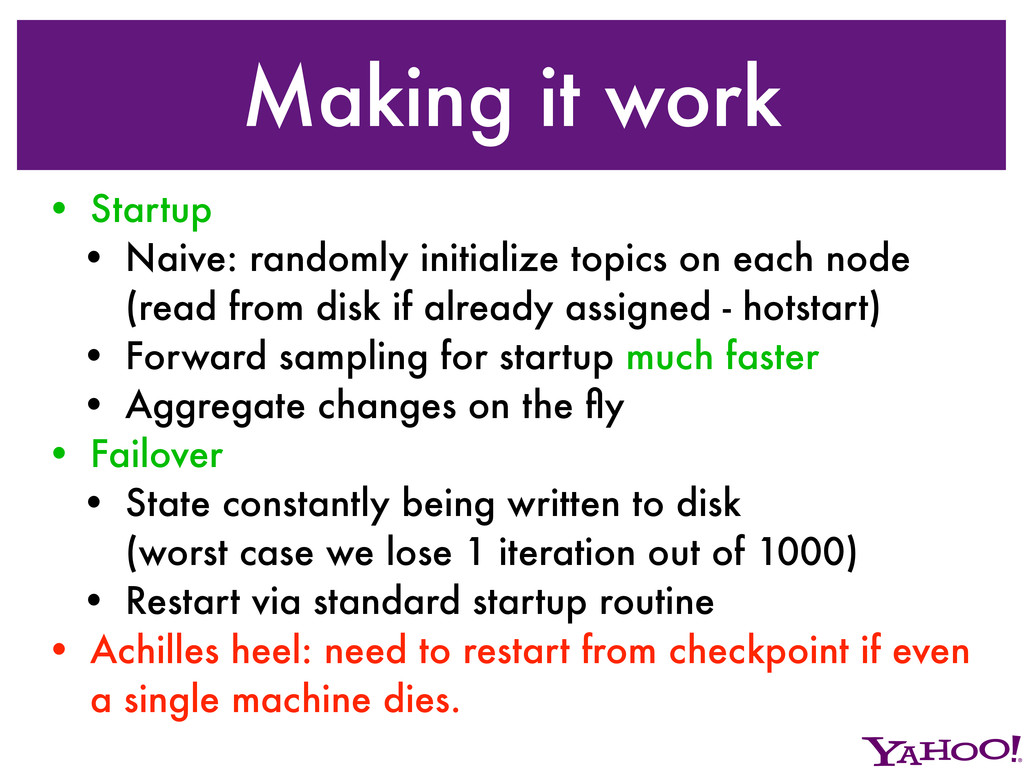
  73. Making it work • Startup • Naive: randomly initialize topics

    on each node (read from disk if already assigned - hotstart) • Forward sampling for startup much faster • Aggregate changes on the fly • Failover • State constantly being written to disk (worst case we lose 1 iteration out of 1000) • Restart via standard startup routine • Achilles heel: need to restart from checkpoint if even a single machine dies.
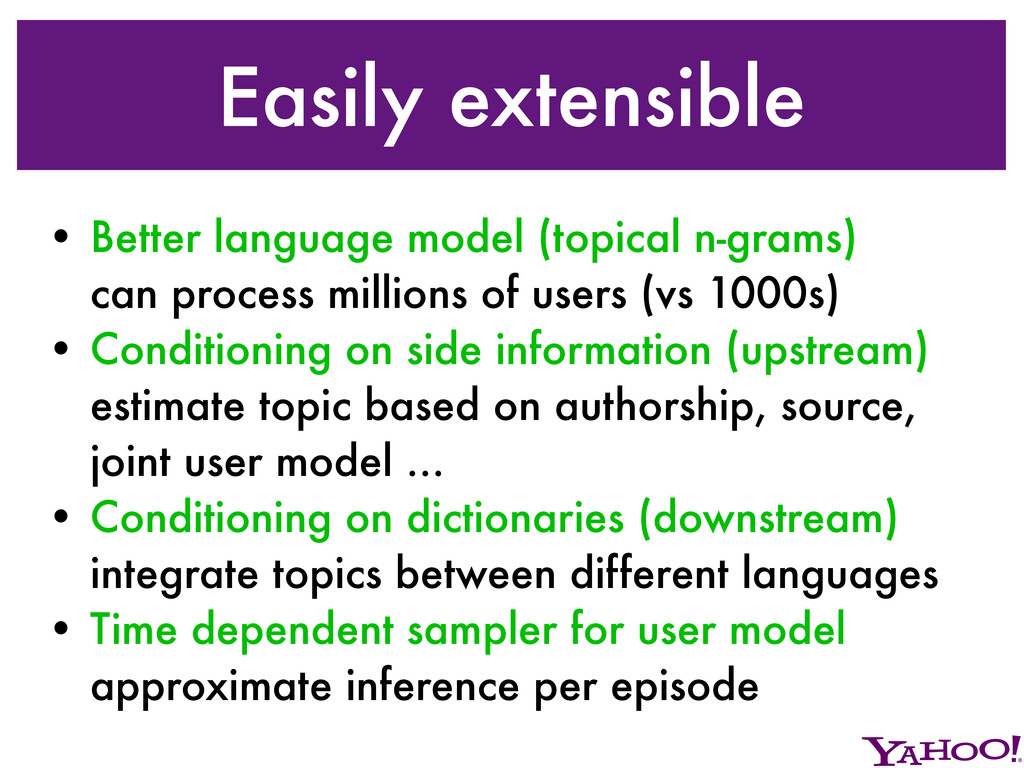
  74. Easily extensible • Better language model (topical n-grams) can process

    millions of users (vs 1000s) • Conditioning on side information (upstream) estimate topic based on authorship, source, joint user model ... • Conditioning on dictionaries (downstream) integrate topics between different languages • Time dependent sampler for user model approximate inference per episode
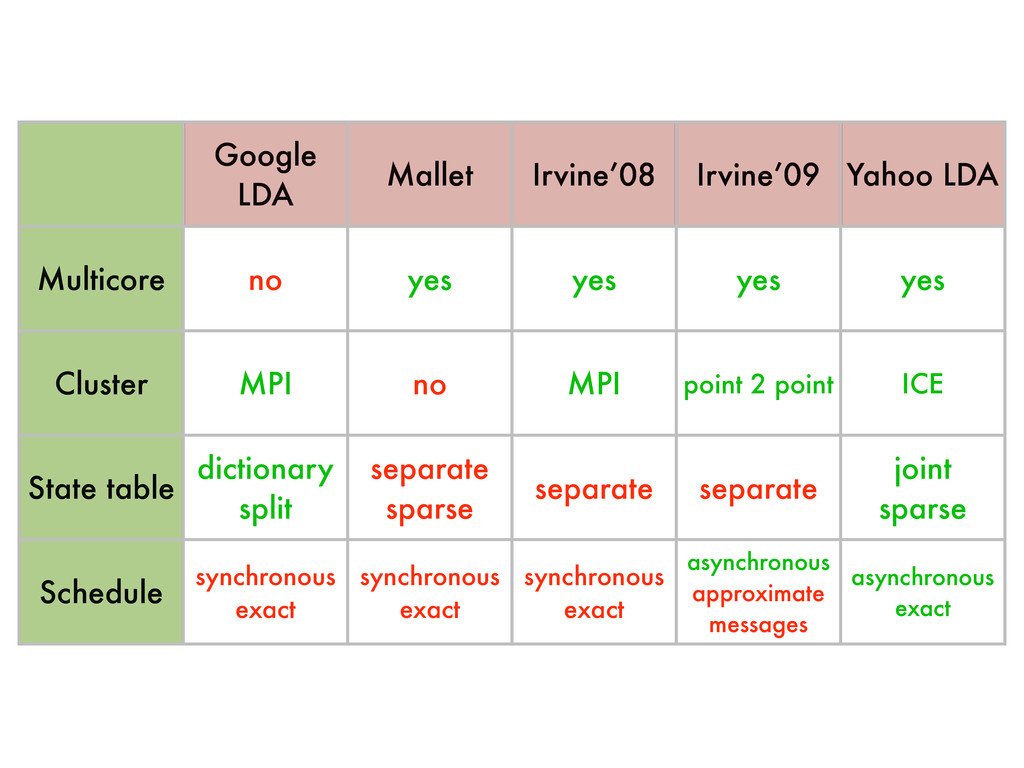
  75. Google LDA Mallet Irvine’08 Irvine’09 Yahoo LDA Multicore no yes

    yes yes yes Cluster MPI no MPI point 2 point ICE State table dictionary split separate sparse separate separate joint sparse Schedule synchronous exact synchronous exact synchronous exact asynchronous approximate messages asynchronous exact
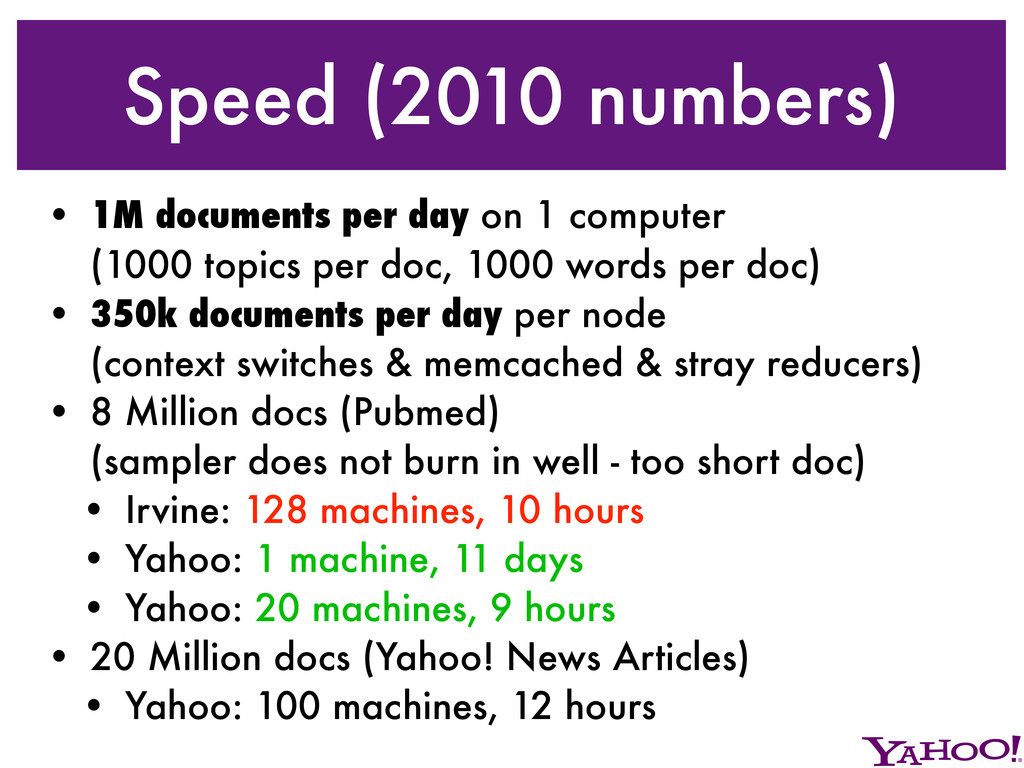
  76. Speed (2010 numbers) • 1M documents per day on 1

    computer (1000 topics per doc, 1000 words per doc) • 350k documents per day per node (context switches & memcached & stray reducers) • 8 Million docs (Pubmed) (sampler does not burn in well - too short doc) • Irvine: 128 machines, 10 hours • Yahoo: 1 machine, 11 days • Yahoo: 20 machines, 9 hours • 20 Million docs (Yahoo! News Articles) • Yahoo: 100 machines, 12 hours
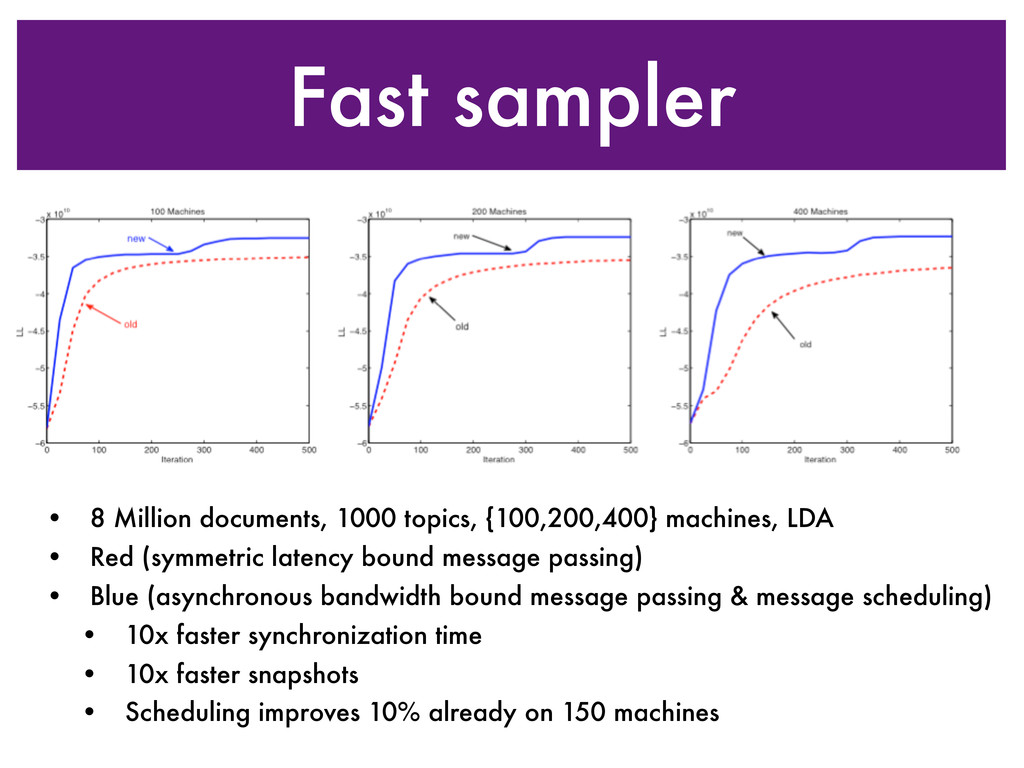
  77. Fast sampler • 8 Million documents, 1000 topics, {100,200,400} machines,

    LDA • Red (symmetric latency bound message passing) • Blue (asynchronous bandwidth bound message passing & message scheduling) • 10x faster synchronization time • 10x faster snapshots • Scheduling improves 10% already on 150 machines
  78. • Tools • Load distribution, balancing and synchronization • Clustering,

    Topic Models • Models • Dynamic non-parametric models • Sequential latent variable models • Inference Algorithms • Distributed batch • Sequential Monte Carlo • Applications • User profiling • News content analysis & recommendation Roadmap