Upgrade to Pro — share decks privately, control downloads, hide ads and more …

gene_regulation_lecture_1.pdf

Sponsored · Your Podcast. Everywhere. Effortlessly. Share. Educate. Inspire. Entertain. You do you. We'll handle the rest. →
Avatar for drbunsen drbunsen
April 11, 2012
31

 gene_regulation_lecture_1.pdf

Avatar for drbunsen

drbunsen

April 11, 2012

Transcript

  1. Gene Regulation Lecture I Seth Brown, Ph.D. Department of Internal

    Medicine The University of Iowa April 11, 2012
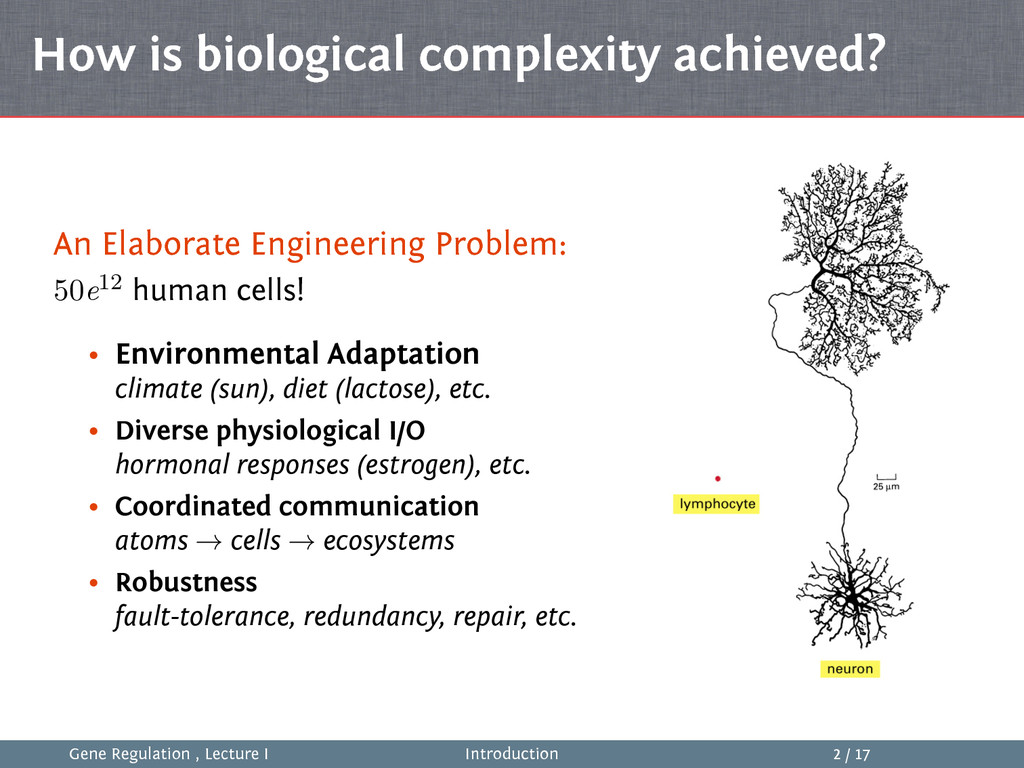
  2. How is biological complexity achieved? An Elaborate Engineering Problem: 50e12

    human cells! • Environmental Adaptation climate (sun), diet (lactose), etc. • Diverse physiological I/O hormonal responses (estrogen), etc. • Coordinated communication atoms → cells → ecosystems • Robustness fault-tolerance, redundancy, repair, etc. Gene Regulation , Lecture I Introduction 2 / 17
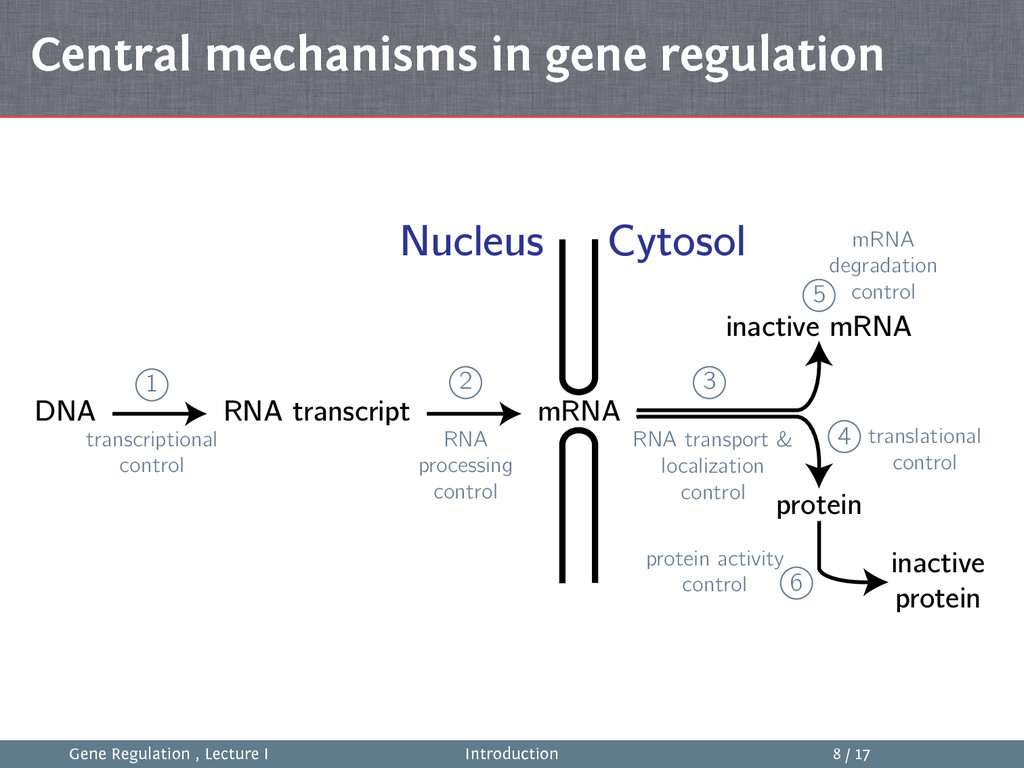
  3. Central mechanisms in gene regulation DNA RNA transcript mRNA protein

    inactive protein inactive mRNA Nucleus Cytosol transcriptional control 1 2 RNA processing control 3 RNA transport & localization control 5 6 4 translational control protein activity control mRNA degradation control Gene Regulation , Lecture I Introduction 8 / 17
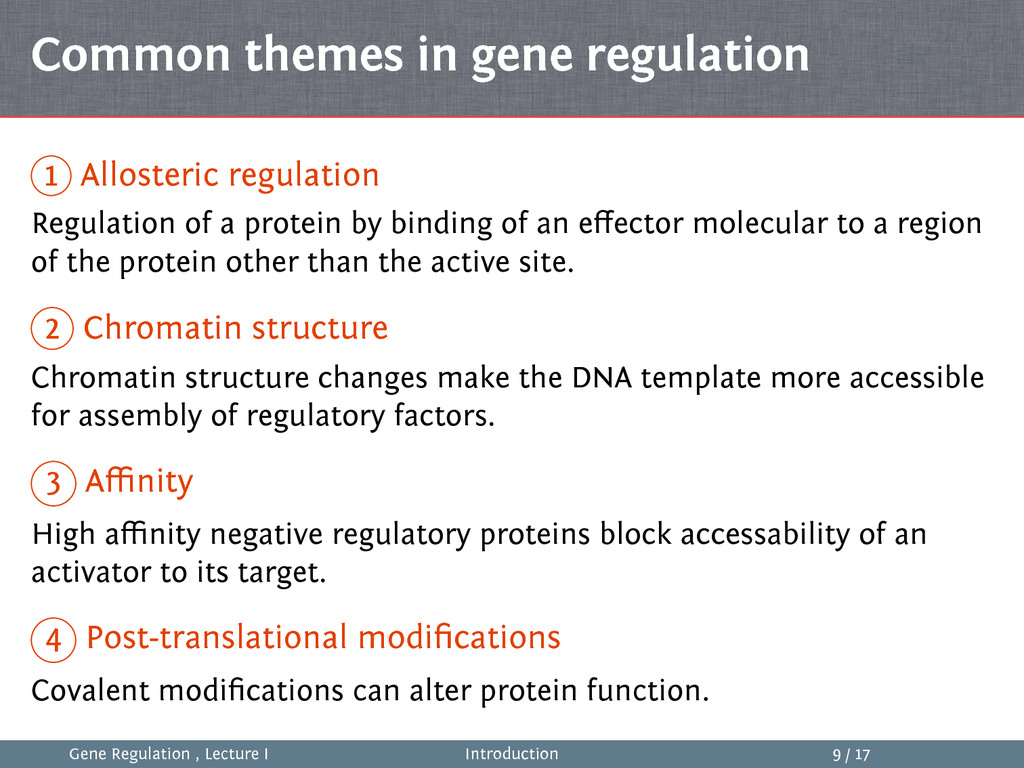
  4. Common themes in gene regulation . . 1 Allosteric regulation

    Regulation of a protein by binding of an effector molecular to a region of the protein other than the active site. . . 2 Chromatin structure Chromatin structure changes make the DNA template more accessible for assembly of regulatory factors. . . 3 Affinity High affinity negative regulatory proteins block accessability of an activator to its target. . . 4 Post-translational modifications Covalent modifications can alter protein function. Gene Regulation , Lecture I Introduction 9 / 17
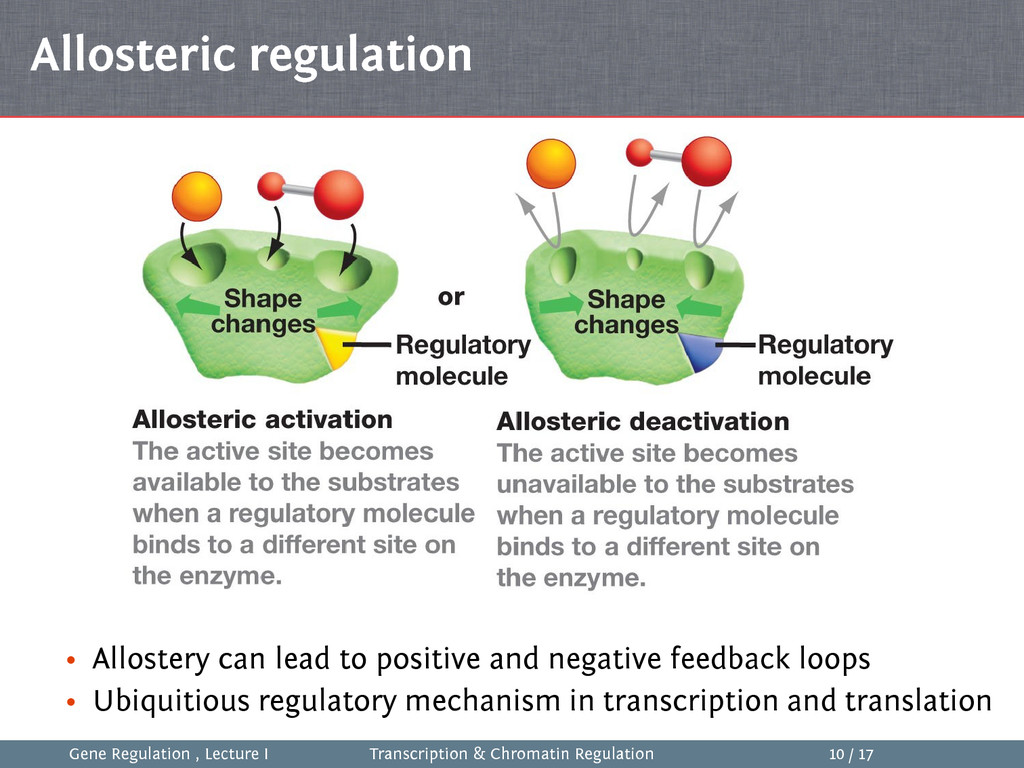
  5. Allosteric regulation • Allostery can lead to positive and negative

    feedback loops • Ubiquitious regulatory mechanism in transcription and translation Gene Regulation , Lecture I Transcription & Chromatin Regulation 10 / 17
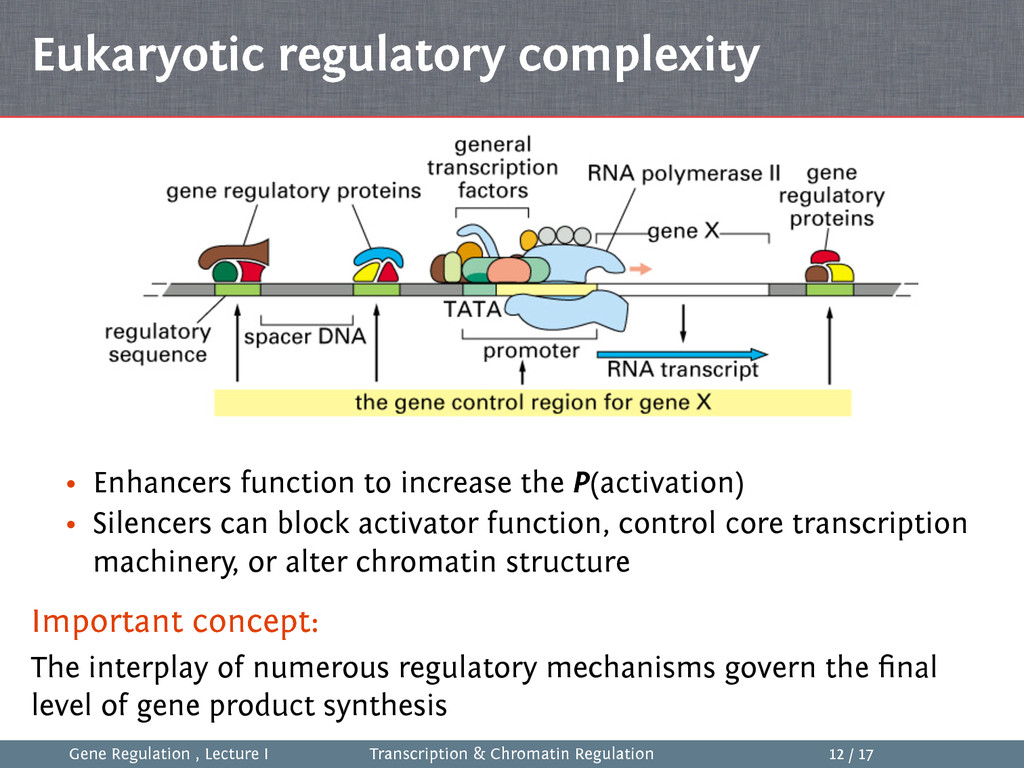
  6. Eukaryotic regulatory complexity • Enhancers function to increase the P(activation)

    • Silencers can block activator function, control core transcription machinery, or alter chromatin structure Important concept: The interplay of numerous regulatory mechanisms govern the final level of gene product synthesis Gene Regulation , Lecture I Transcription & Chromatin Regulation 12 / 17
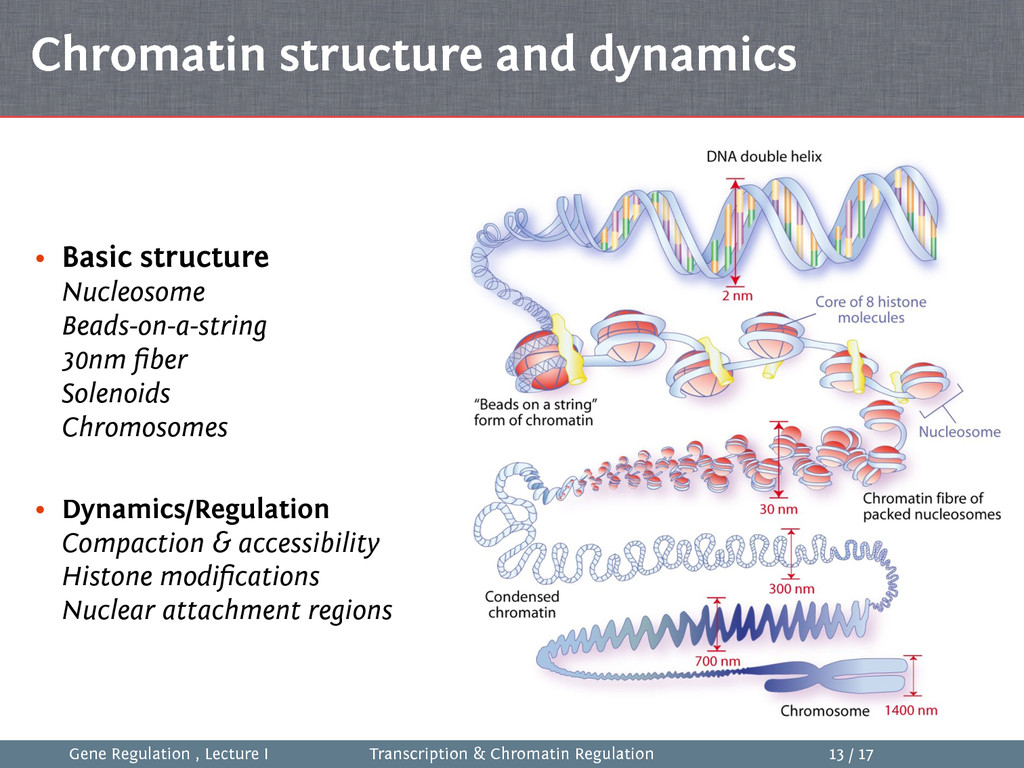
  7. Chromatin structure and dynamics • Basic structure Nucleosome Beads-on-a-string 30nm

    fiber Solenoids Chromosomes • Dynamics/Regulation Compaction & accessibility Histone modifications Nuclear attachment regions Gene Regulation , Lecture I Transcription & Chromatin Regulation 13 / 17
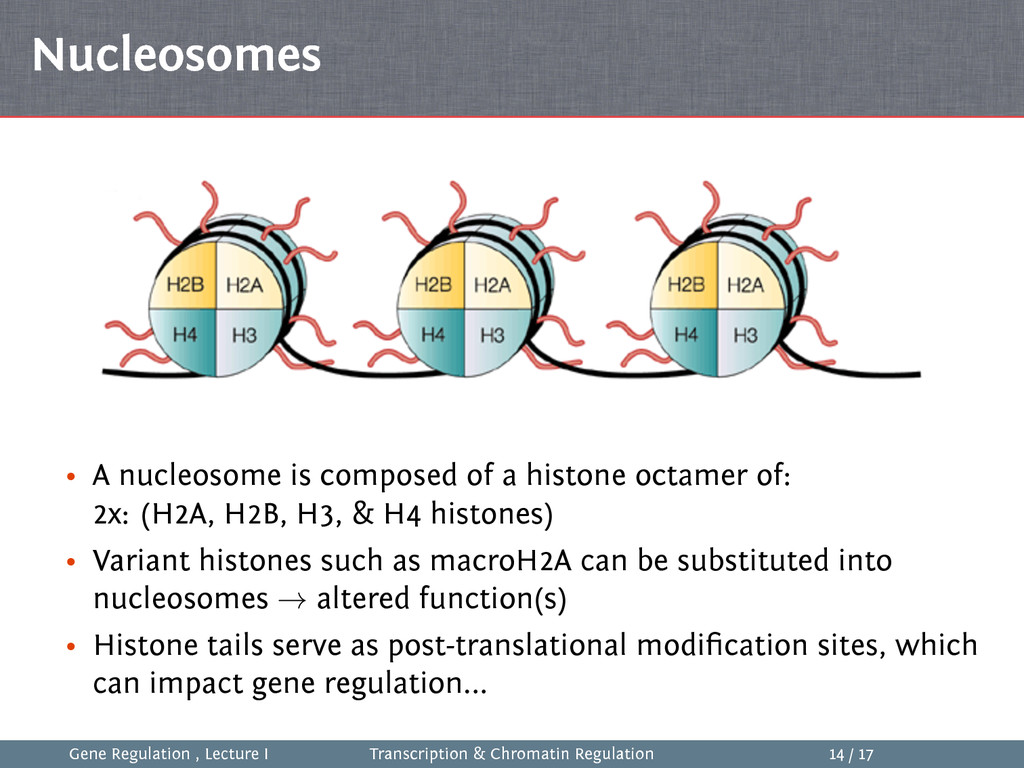
  8. Nucleosomes • A nucleosome is composed of a histone octamer

    of: 2x: (H2A, H2B, H3, & H4 histones) • Variant histones such as macroH2A can be substituted into nucleosomes → altered function(s) • Histone tails serve as post-translational modification sites, which can impact gene regulation... Gene Regulation , Lecture I Transcription & Chromatin Regulation 14 / 17
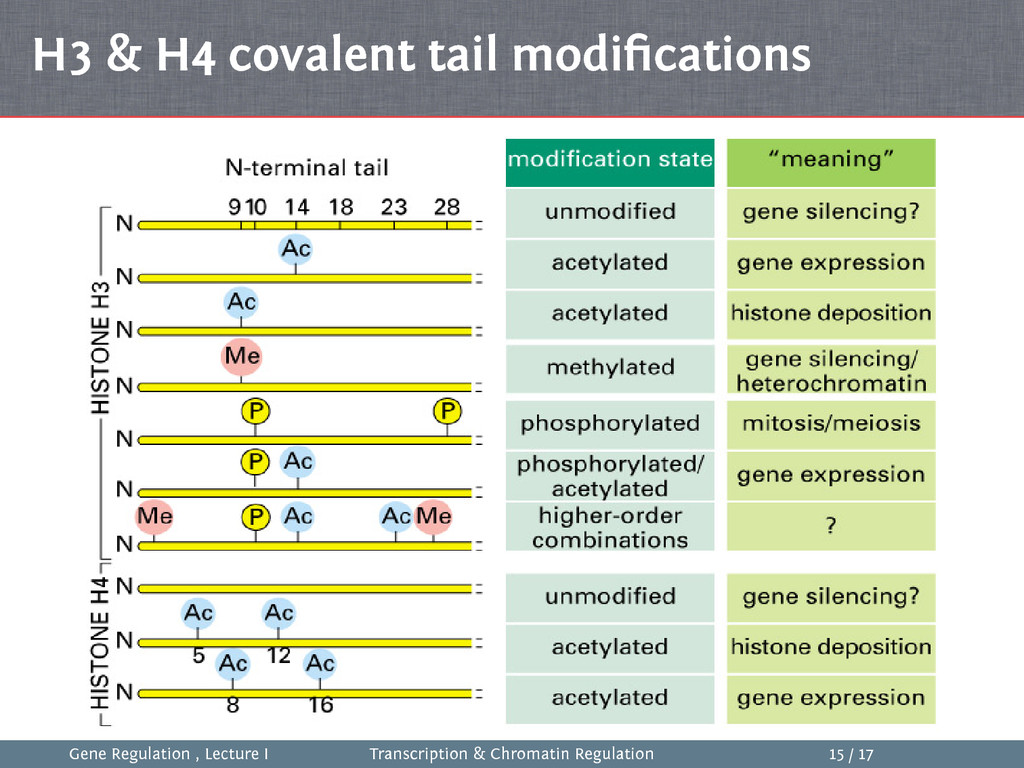
  9. H3 & H4 covalent tail modifications Gene Regulation , Lecture

    I Transcription & Chromatin Regulation 15 / 17
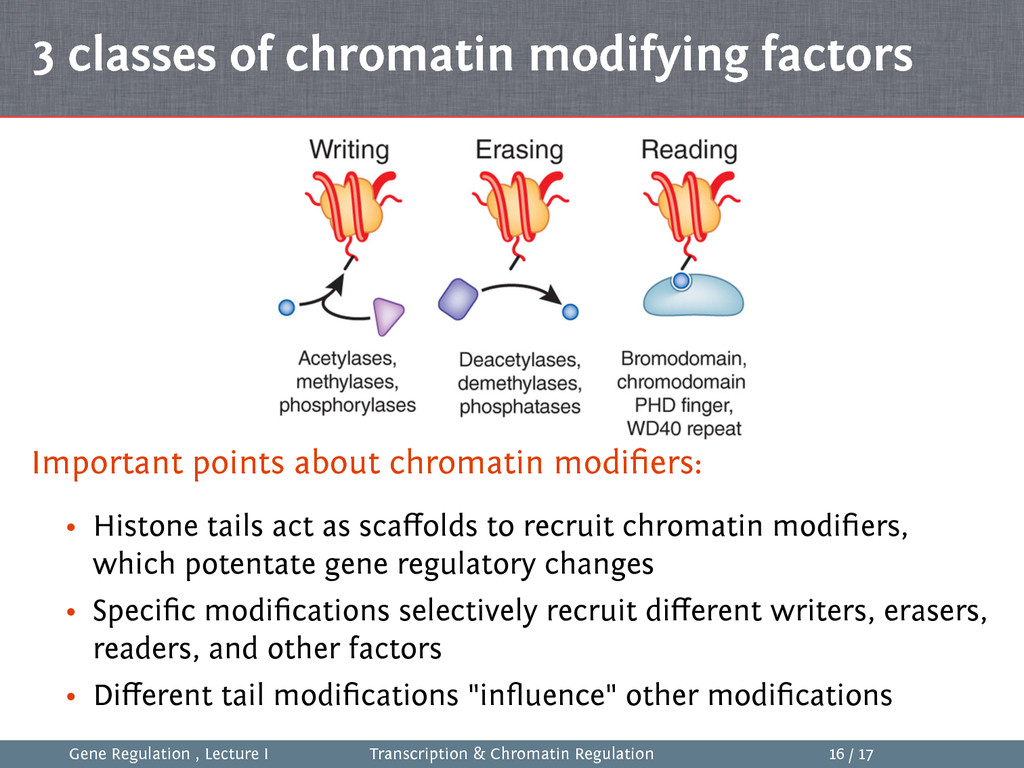
  10. 3 classes of chromatin modifying factors Important points about chromatin

    modifiers: • Histone tails act as scaffolds to recruit chromatin modifiers, which potentate gene regulatory changes • Specific modifications selectively recruit different writers, erasers, readers, and other factors • Different tail modifications "influence" other modifications Gene Regulation , Lecture I Transcription & Chromatin Regulation 16 / 17
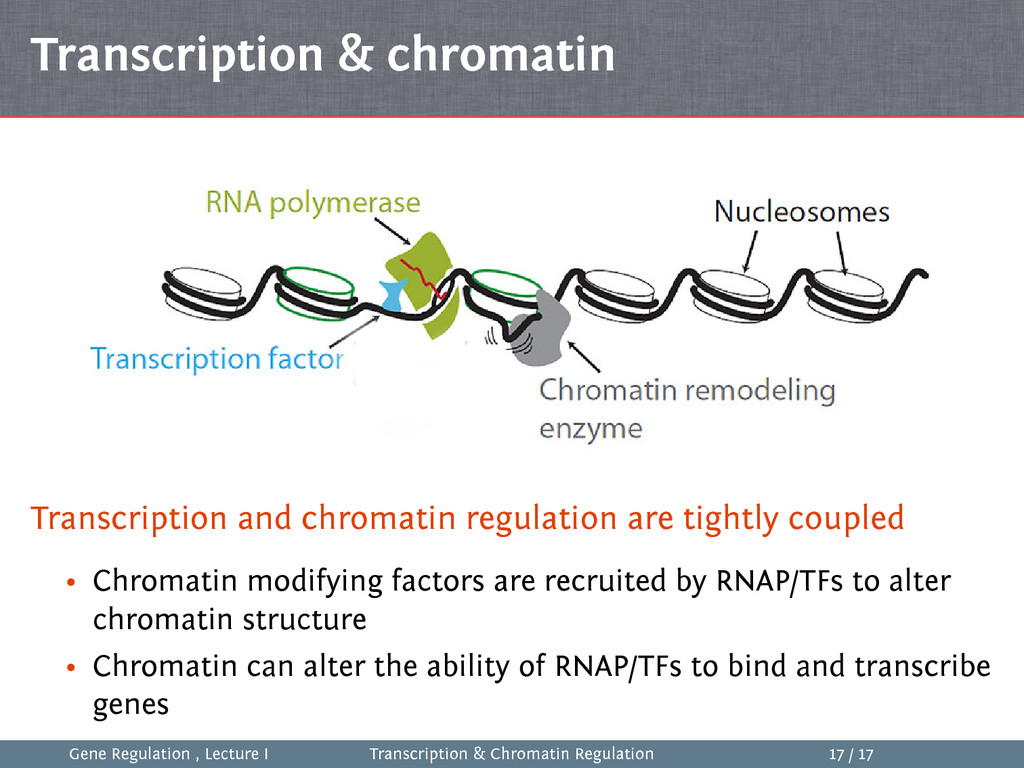
  11. Transcription & chromatin Transcription and chromatin regulation are tightly coupled

    • Chromatin modifying factors are recruited by RNAP/TFs to alter chromatin structure • Chromatin can alter the ability of RNAP/TFs to bind and transcribe genes Gene Regulation , Lecture I Transcription & Chromatin Regulation 17 / 17