Upgrade to Pro — share decks privately, control downloads, hide ads and more …

ormsnewsflashvolume2issue5-120611185641-phpapp0...

Sponsored · Your Podcast. Everywhere. Effortlessly. Share. Educate. Inspire. Entertain. You do you. We'll handle the rest. →
Avatar for Duc Duc
October 11, 2012
11

 ormsnewsflashvolume2issue5-120611185641-phpapp01.pdf

Avatar for Duc

Duc

October 11, 2012

Transcript

  1. I n s i d e t h i s

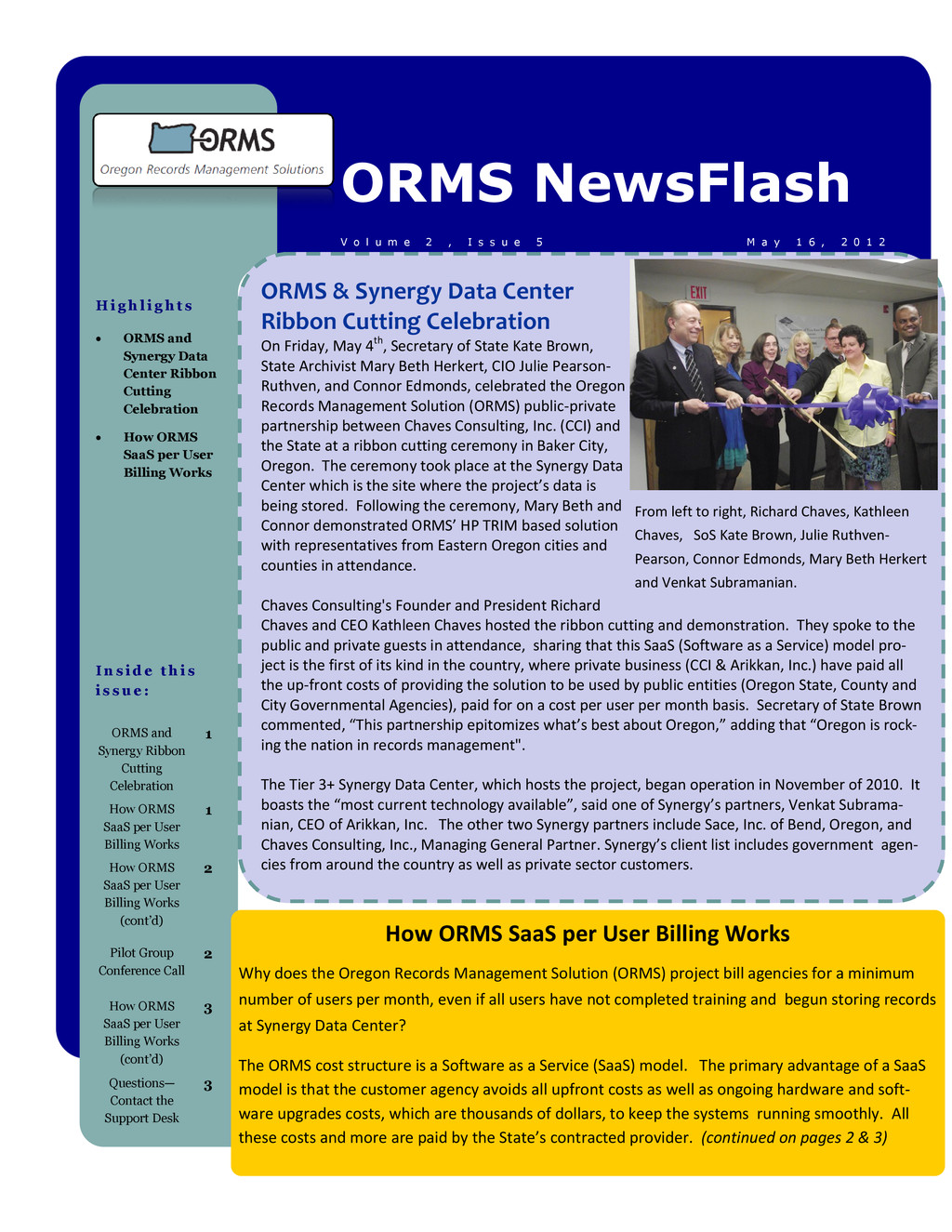
    i s s u e : ORMS NewsFlash M a y 1 6 , 2 0 1 2 V o l u m e 2 , I s s u e 5 H i g h l i g h t s  ORMS and Synergy Data Center Ribbon Cutting Celebration  How ORMS SaaS per User Billing Works ORMS and Synergy Ribbon Cutting Celebration 1 How ORMS SaaS per User Billing Works 1 How ORMS SaaS per User Billing Works (cont’d) 2 Pilot Group Conference Call 2 How ORMS SaaS per User Billing Works (cont’d) 3 Questions— Contact the Support Desk 3 How ORMS SaaS per User Billing Works Why does the Oregon Records Management Solution (ORMS) project bill agencies for a minimum number of users per month, even if all users have not completed training and begun storing records at Synergy Data Center? The ORMS cost structure is a Software as a Service (SaaS) model. The primary advantage of a SaaS model is that the customer agency avoids all upfront costs as well as ongoing hardware and soft- ware upgrades costs, which are thousands of dollars, to keep the systems running smoothly. All these costs and more are paid by the State’s contracted provider. (continued on pages 2 & 3) ORMS & Synergy Data Center Ribbon Cutting Celebration On Friday, May 4th, Secretary of State Kate Brown, State Archivist Mary Beth Herkert, CIO Julie Pearson- Ruthven, and Connor Edmonds, celebrated the Oregon Records Management Solution (ORMS) public-private partnership between Chaves Consulting, Inc. (CCI) and the State at a ribbon cutting ceremony in Baker City, Oregon. The ceremony took place at the Synergy Data Center which is the site where the project’s data is being stored. Following the ceremony, Mary Beth and Connor demonstrated ORMS’ HP TRIM based solution with representatives from Eastern Oregon cities and counties in attendance. Chaves Consulting's Founder and President Richard Chaves and CEO Kathleen Chaves hosted the ribbon cutting and demonstration. They spoke to the public and private guests in attendance, sharing that this SaaS (Software as a Service) model pro- ject is the first of its kind in the country, where private business (CCI & Arikkan, Inc.) have paid all the up-front costs of providing the solution to be used by public entities (Oregon State, County and City Governmental Agencies), paid for on a cost per user per month basis. Secretary of State Brown commented, “This partnership epitomizes what’s best about Oregon,” adding that “Oregon is rock- ing the nation in records management". The Tier 3+ Synergy Data Center, which hosts the project, began operation in November of 2010. It boasts the “most current technology available”, said one of Synergy’s partners, Venkat Subrama- nian, CEO of Arikkan, Inc. The other two Synergy partners include Sace, Inc. of Bend, Oregon, and Chaves Consulting, Inc., Managing General Partner. Synergy’s client list includes government agen- cies from around the country as well as private sector customers. From left to right, Richard Chaves, Kathleen Chaves, SoS Kate Brown, Julie Ruthven- Pearson, Connor Edmonds, Mary Beth Herkert and Venkat Subramanian.
  2. P a g e 2 P a g e 2

    O R M S N e w s F l a s h How ORMS SaaS per User Billing Works continued from page 1 User Fees Substantially Lower than Other Options ORMS user fees are substantially lower than public agencies would pay for HP TRIM services, if they invested in upfront infrastructure and licenses. In the old stand-alone model each agency might spend over a million dol- lars to buy their own servers, employ highly skilled IT managers to implement and maintain them and perform ongoing software and hardware upgrades. Also, Oregon’s cost per user is significantly less than other states. According to State Archivist Mary Beth Herkert, one mid-western state pays over $100/month per user (67% more than the $37.02 ORMS users pay per month). ORMS’ cost per user drops as the total number of users in the State goes up. When the total number of users reaches 20,000, the cost per user will stabilize at $10.54 per user per month. Also the first 5,000 users in Pilot agencies begin receiving a rebate when the total number of users exceeds 20,000. The cost in 2008 – 2009 to the Oregon Secretary of State’s Office (SoS) for the stand alone HP TRIM implementa- tion and software licenses was close to $600,000 for its 220 users. This does not include costs for the hardware and infrastructure (servers, networking, IT expertise and licensing) to host the application, store the data or on- going maintenance costs. Cost comparisons between stand alone and SaaS implementations have been docu- mented by the SoS and shared with ORMS participants. If you would like a copy, please contact the ORMS Sup- port Desk. Monthly ORMS billings are based on the initial number of users each agency committed to in the Subscription Services/ Service Level Agreement (SLA) between that agency and the contracted service provider Chaves Con- sulting, Inc. (CCI). This is standard practice in a SaaS model offering. Based on the number of initial users in the SLA, CCI purchased HP TRIM Software Licenses, set aside the required disk storage space and bandwidth in Synergy Data Center and incurred other hardware, software and staffing expenses. Because of these expenditures, neither CCI nor the State can reduce the billing below the initial num- ber of users an agency committed to in the SLA. Getting Employees to Use ORMS a Management Issue, Not a SaaS Issue Mary Beth Herkert compares ORMS to buying a house. If you purchase a home, you take possession on a certain date. Even if you don’t move in for another month or two, you are still obligated to pay the mortgage. Getting employees to use the system is really a management issue. Once a SaaS is entered into, it is up to lead- ership of the participating organization to make using the service an expected business process. The upfront work and education is provided, but it is up to the end users to use the application. (continued on page 3) 13th ORMS Pilot Group Conference Call Monday, June 11th, 2012 @ 10:00—10:30 a.m.
  3. P a g e 3 P a g e 3

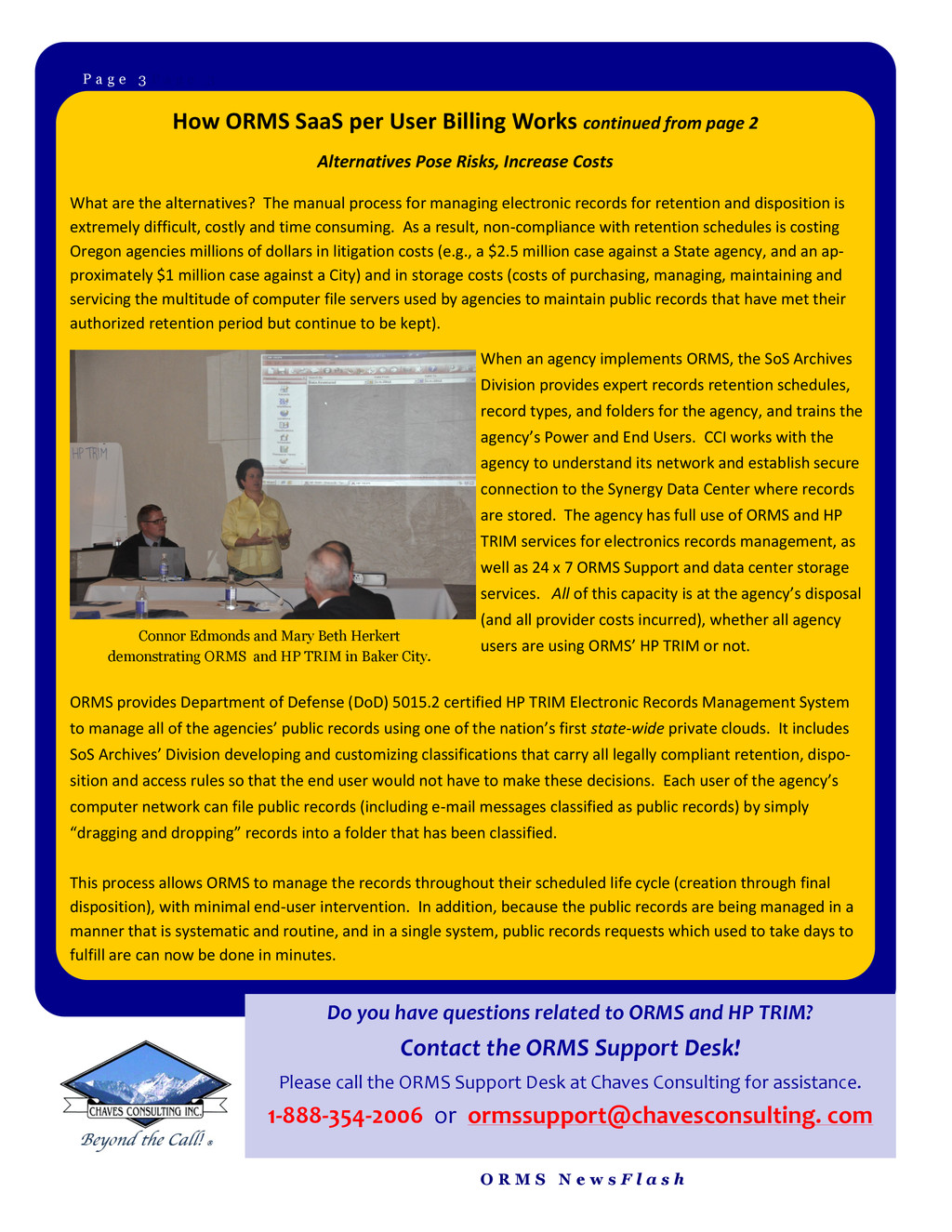
    How ORMS SaaS per User Billing Works continued from page 2 Alternatives Pose Risks, Increase Costs What are the alternatives? The manual process for managing electronic records for retention and disposition is extremely difficult, costly and time consuming. As a result, non-compliance with retention schedules is costing Oregon agencies millions of dollars in litigation costs (e.g., a $2.5 million case against a State agency, and an ap- proximately $1 million case against a City) and in storage costs (costs of purchasing, managing, maintaining and servicing the multitude of computer file servers used by agencies to maintain public records that have met their authorized retention period but continue to be kept). ORMS provides Department of Defense (DoD) 5015.2 certified HP TRIM Electronic Records Management System to manage all of the agencies’ public records using one of the nation’s first state-wide private clouds. It includes SoS Archives’ Division developing and customizing classifications that carry all legally compliant retention, dispo- sition and access rules so that the end user would not have to make these decisions. Each user of the agency’s computer network can file public records (including e-mail messages classified as public records) by simply “dragging and dropping” records into a folder that has been classified. This process allows ORMS to manage the records throughout their scheduled life cycle (creation through final disposition), with minimal end-user intervention. In addition, because the public records are being managed in a manner that is systematic and routine, and in a single system, public records requests which used to take days to fulfill are can now be done in minutes. O R M S N e w s F l a s h When an agency implements ORMS, the SoS Archives Division provides expert records retention schedules, record types, and folders for the agency, and trains the agency’s Power and End Users. CCI works with the agency to understand its network and establish secure connection to the Synergy Data Center where records are stored. The agency has full use of ORMS and HP TRIM services for electronics records management, as well as 24 x 7 ORMS Support and data center storage services. All of this capacity is at the agency’s disposal (and all provider costs incurred), whether all agency users are using ORMS’ HP TRIM or not. Connor Edmonds and Mary Beth Herkert demonstrating ORMS and HP TRIM in Baker City. Do you have questions related to ORMS and HP TRIM? Contact the ORMS Support Desk! Please call the ORMS Support Desk at Chaves Consulting for assistance. 1-888-354-2006 or ormssupport@chavesconsulting. com