Upgrade to Pro — share decks privately, control downloads, hide ads and more …

Introduction to Data Analytics

Introduction to Data Analytics

"Introduction to Data Analytics" provides an overview of the fundamentals of data analytics, with a particular emphasis on the work and thinking involved in data analytics. It begins by highlighting the significance of data analytics in decision-making and business success. The presentation covers the definition of data analytics, its benefits, and the general data analytics process. It delves into the role of a data analyst, exploring the tasks and responsibilities involved in collecting, cleaning, analyzing, and visualizing data. It discusses the importance of critical thinking and problem-solving skills in data analytics, as well as the ability to extract meaningful insights from complex datasets. The presentation also showcases real-world examples of data analytics in action across different industries. It concludes by summarizing the key points and encouraging further exploration of the work and thinking behind data analytics.

Avatar for Dwi Lucia Arfani

Dwi Lucia Arfani

July 12, 2023
Tweet

Other Decks in Technology

Transcript

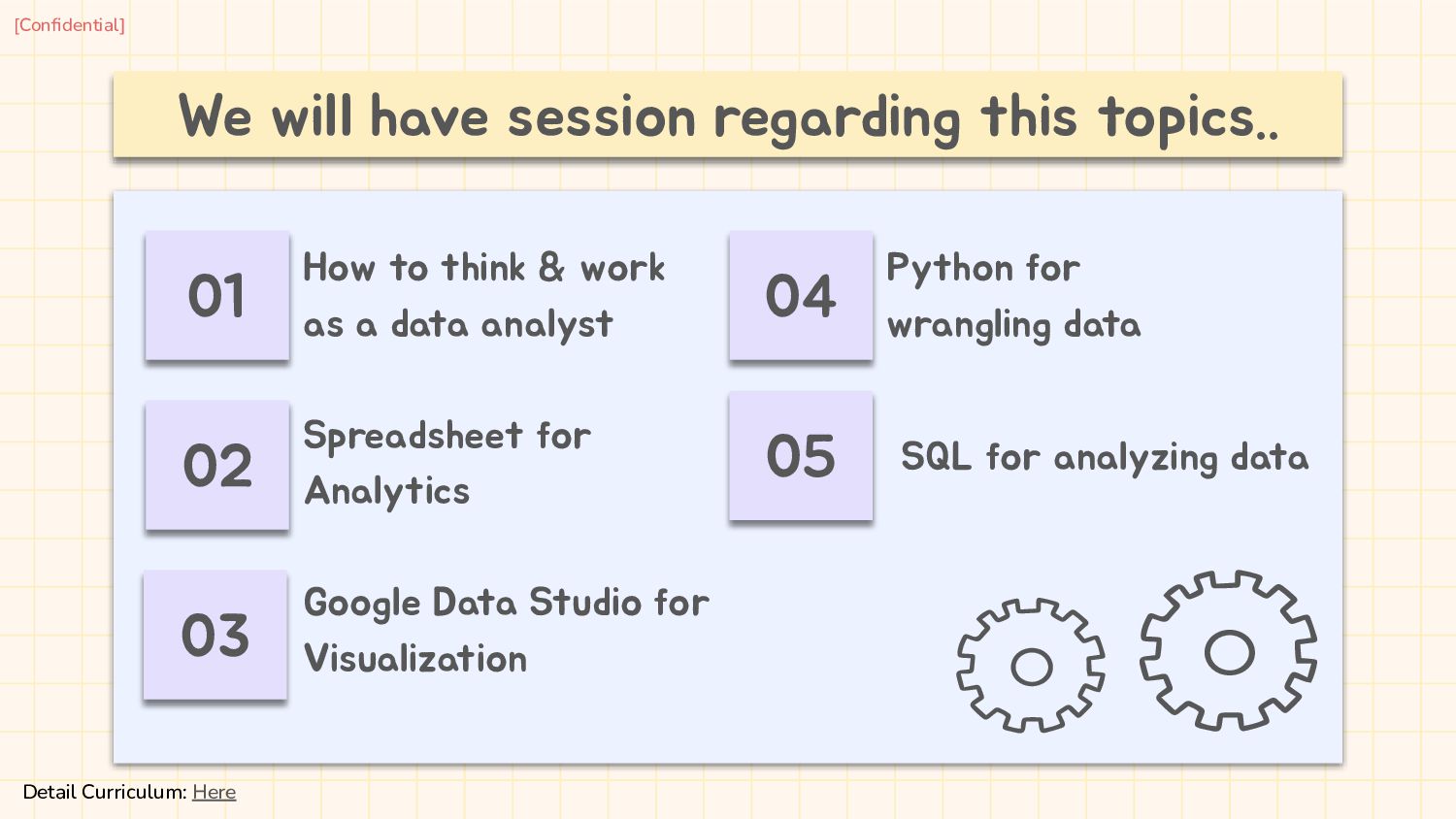
  1. We will have session regarding this topics.. 01 How to

    think & work as a data analyst 02 Spreadsheet for Analytics 03 Google Data Studio for Visualization 04 Python for wrangling data 05 SQL for analyzing data Detail Curriculum: Here [Confidential]
  2. Role Play Hustler A visionary at one point: sales, an

    expert in marketing and business Hacker A struggle with technology from a startup. Must have basic programming or coding Hipster More interested in something that is visual or in other words. Designer (Product design, UI UX, Social media presence) [Confidential]
  3. Culture [Confidential] There are three key factors that indicate the

    importance and characteristics of the best startup culture. - Agility - Multitasking - Collaboration
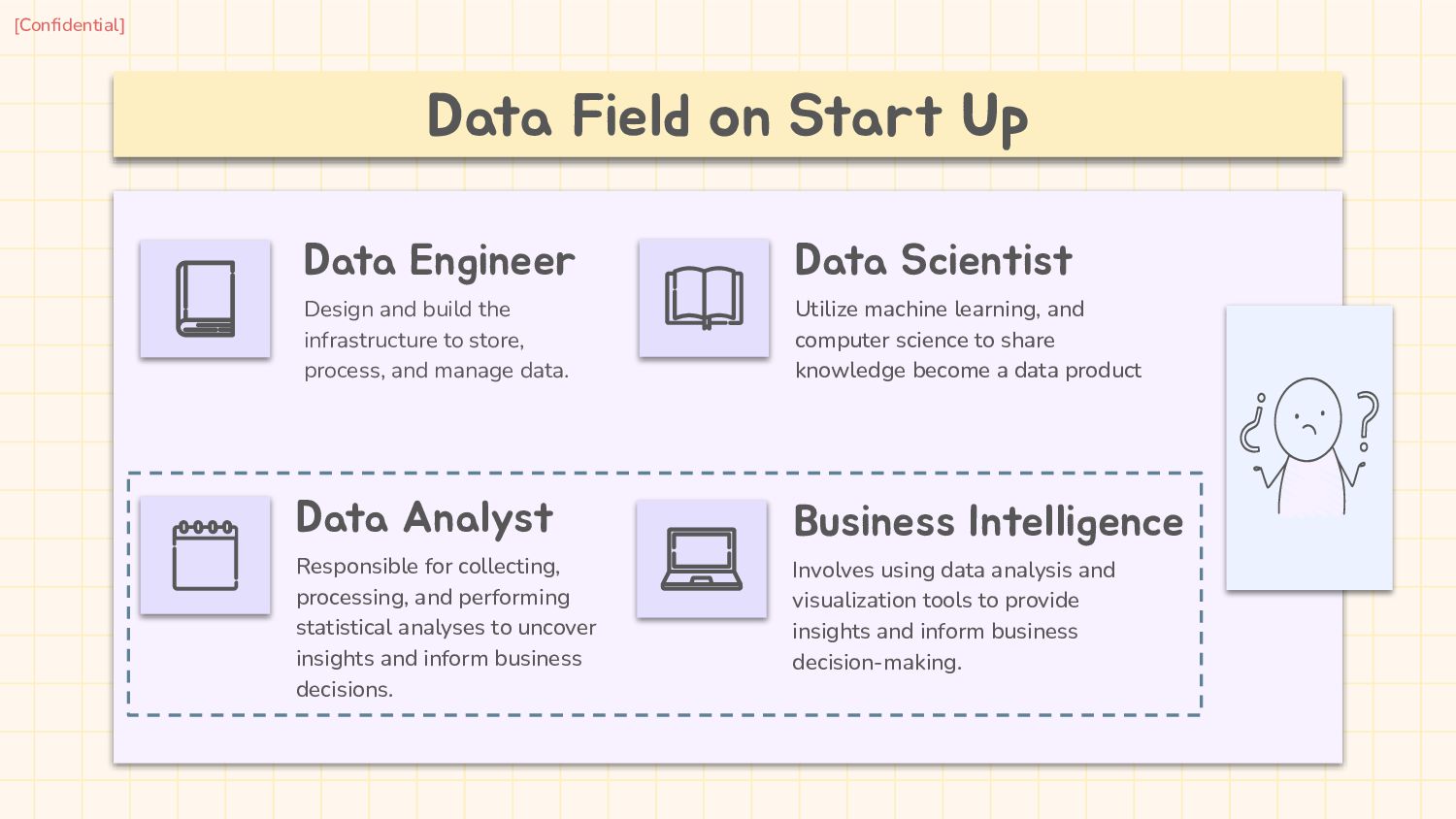
  4. Design and build the infrastructure to store, process, and manage

    data. Data Field on Start Up Data Engineer Responsible for collecting, processing, and performing statistical analyses to uncover insights and inform business decisions. Data Analyst Utilize machine learning, and computer science to share knowledge become a data product Data Scientist Involves using data analysis and visualization tools to provide insights and inform business decision-making. Business Intelligence [Confidential]
  5. Career Path Managerial Individual Contributor Junior Senior Manager Head VP

    Junior Senior Principal Technical Architecture Distinguished Engineer [Confidential]
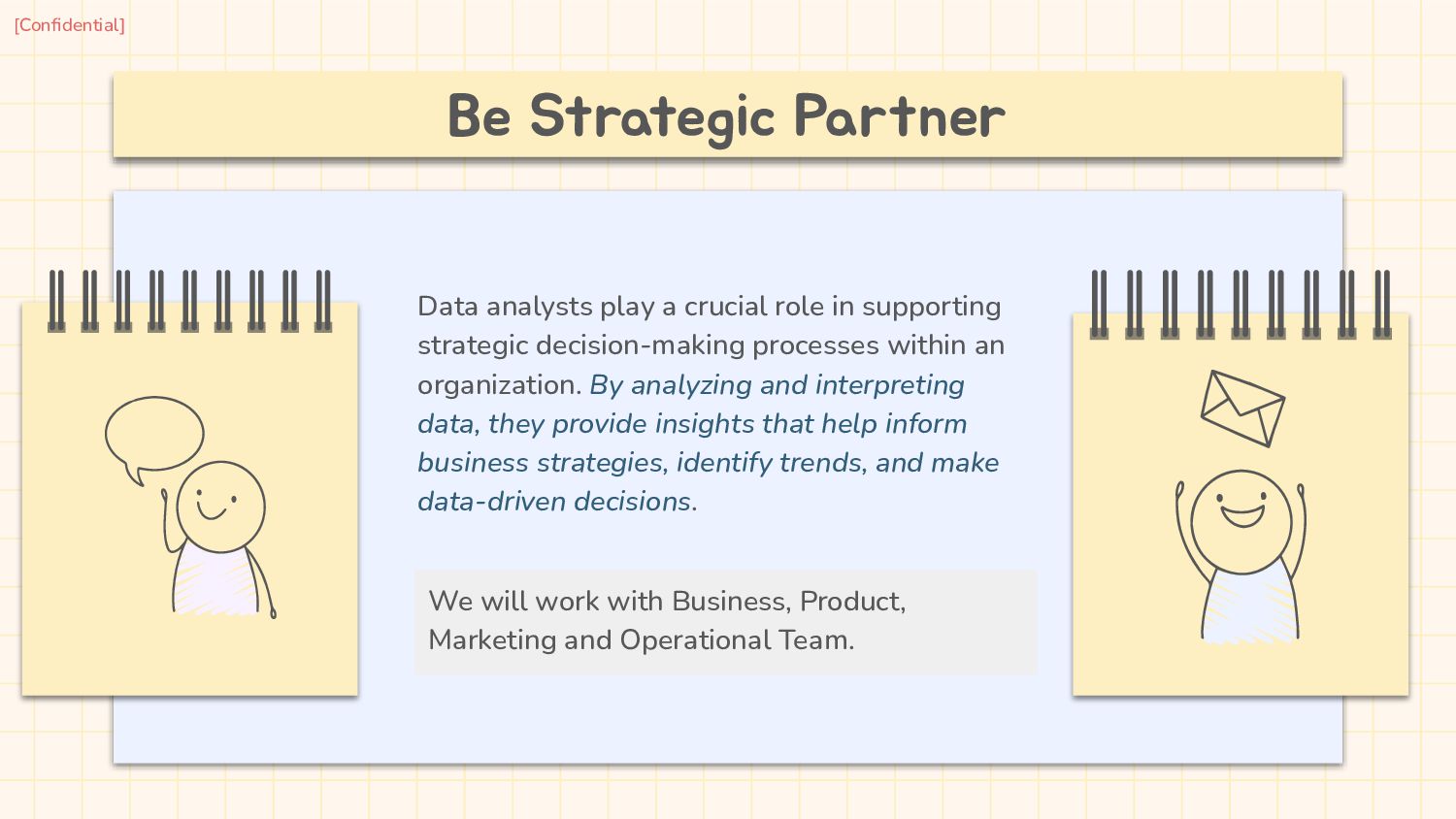
  6. Be Strategic Partner Data analysts play a crucial role in

    supporting strategic decision-making processes within an organization. By analyzing and interpreting data, they provide insights that help inform business strategies, identify trends, and make data-driven decisions. We will work with Business, Product, Marketing and Operational Team. [Confidential]
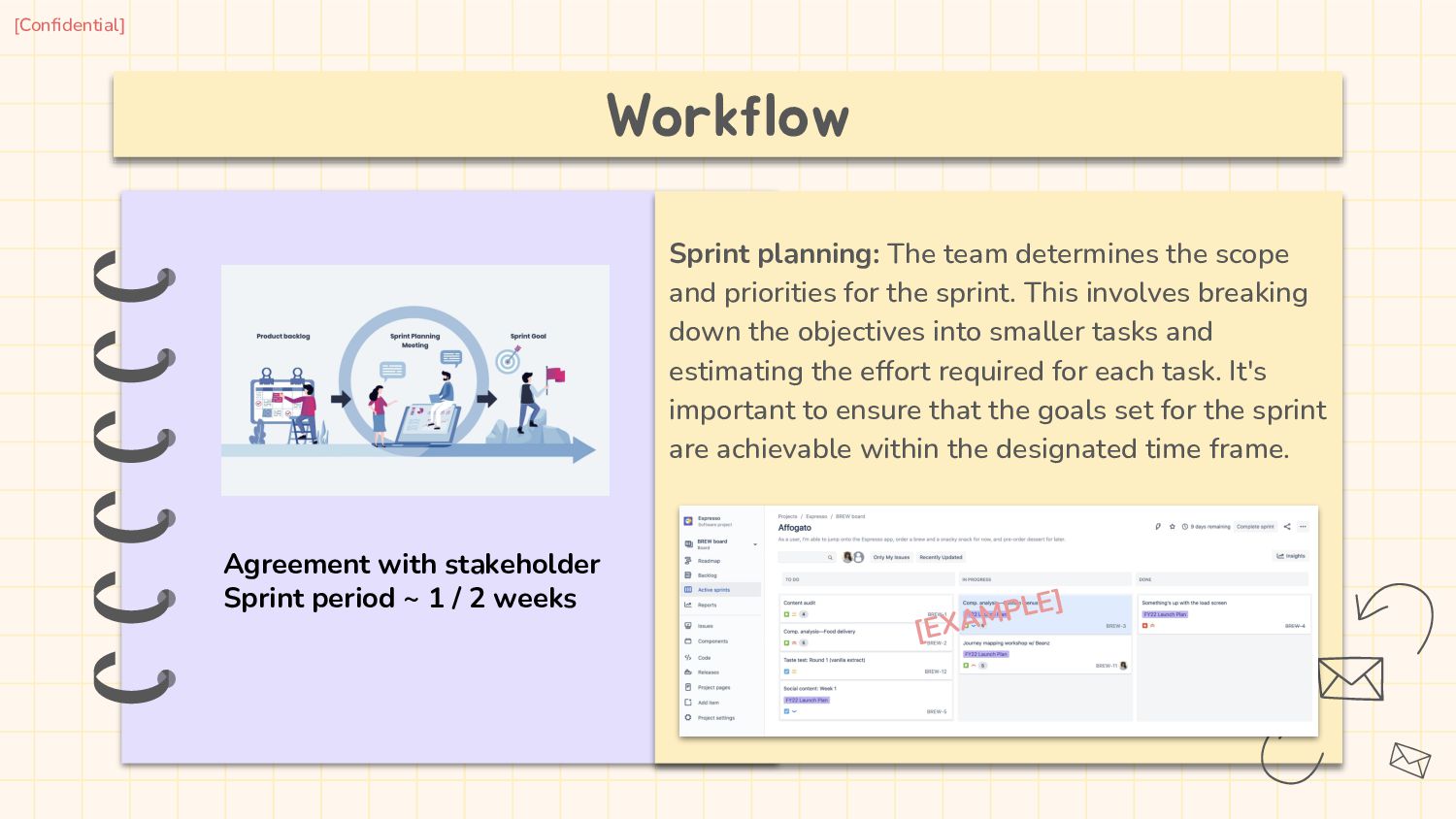
  7. Sprint planning: The team determines the scope and priorities for

    the sprint. This involves breaking down the objectives into smaller tasks and estimating the effort required for each task. It's important to ensure that the goals set for the sprint are achievable within the designated time frame. Workflow Agreement with stakeholder Sprint period ~ 1 / 2 weeks [EXAMPLE] [Confidential]
  8. What is the difference from task and project ? [Confidential]

    Task vs project Task: Day to Day : No End Date Project: Specific assignment with timeline (start date until end date)
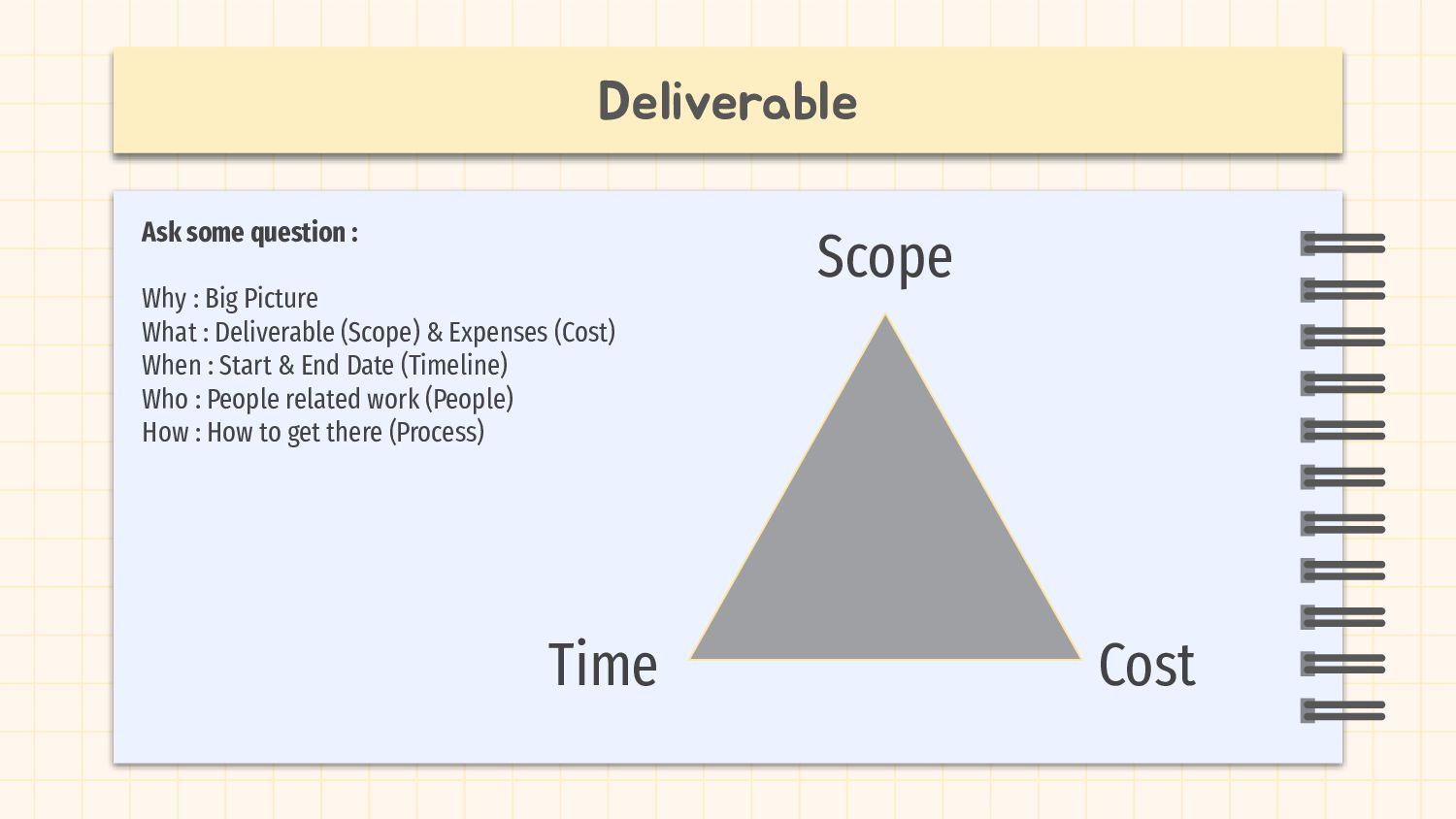
  9. Deliverable Scope Cost Time Ask some question : Why :

    Big Picture What : Deliverable (Scope) & Expenses (Cost) When : Start & End Date (Timeline) Who : People related work (People) How : How to get there (Process)
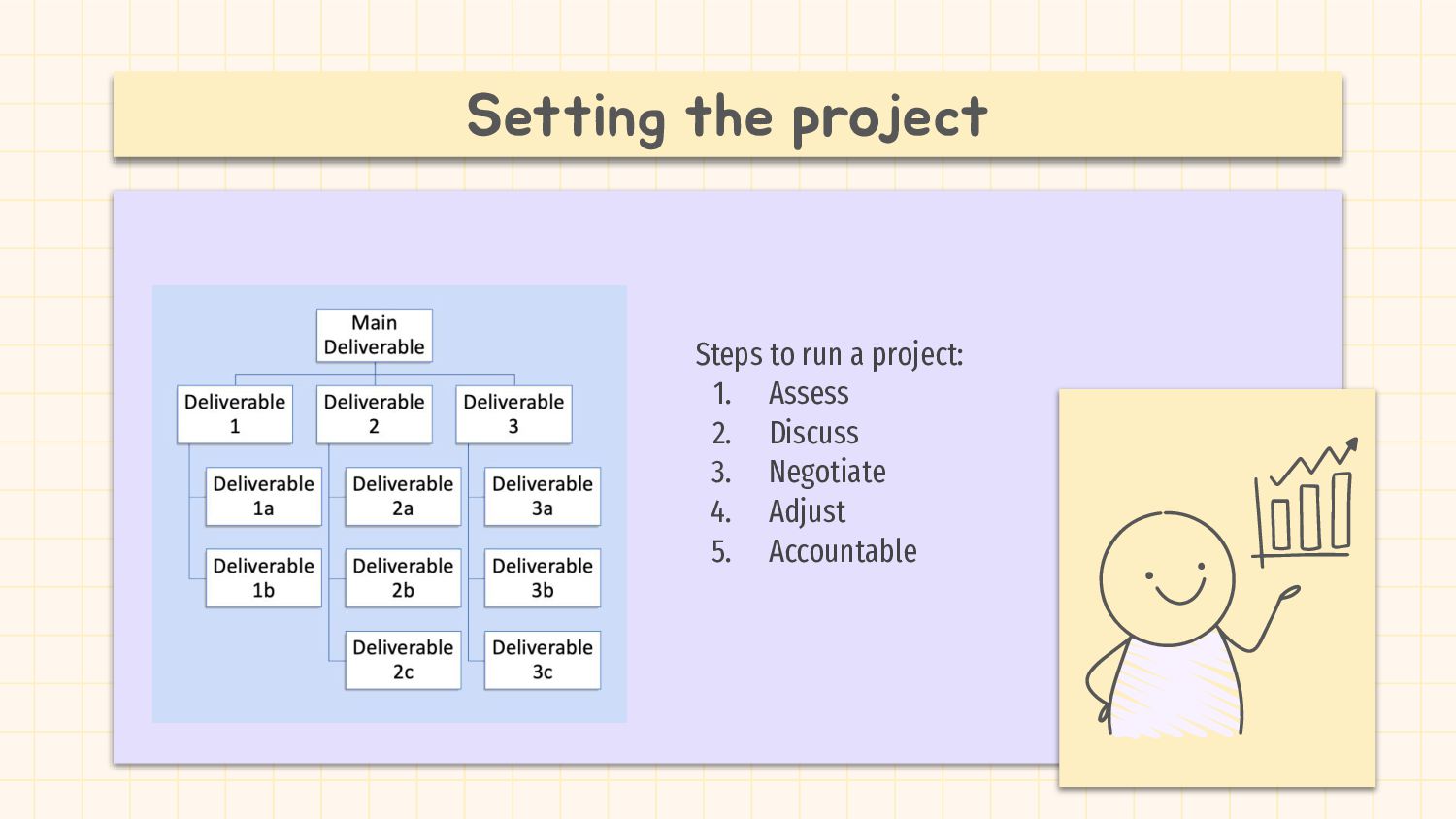
  10. Setting the project Steps to run a project: 1. Assess

    2. Discuss 3. Negotiate 4. Adjust 5. Accountable
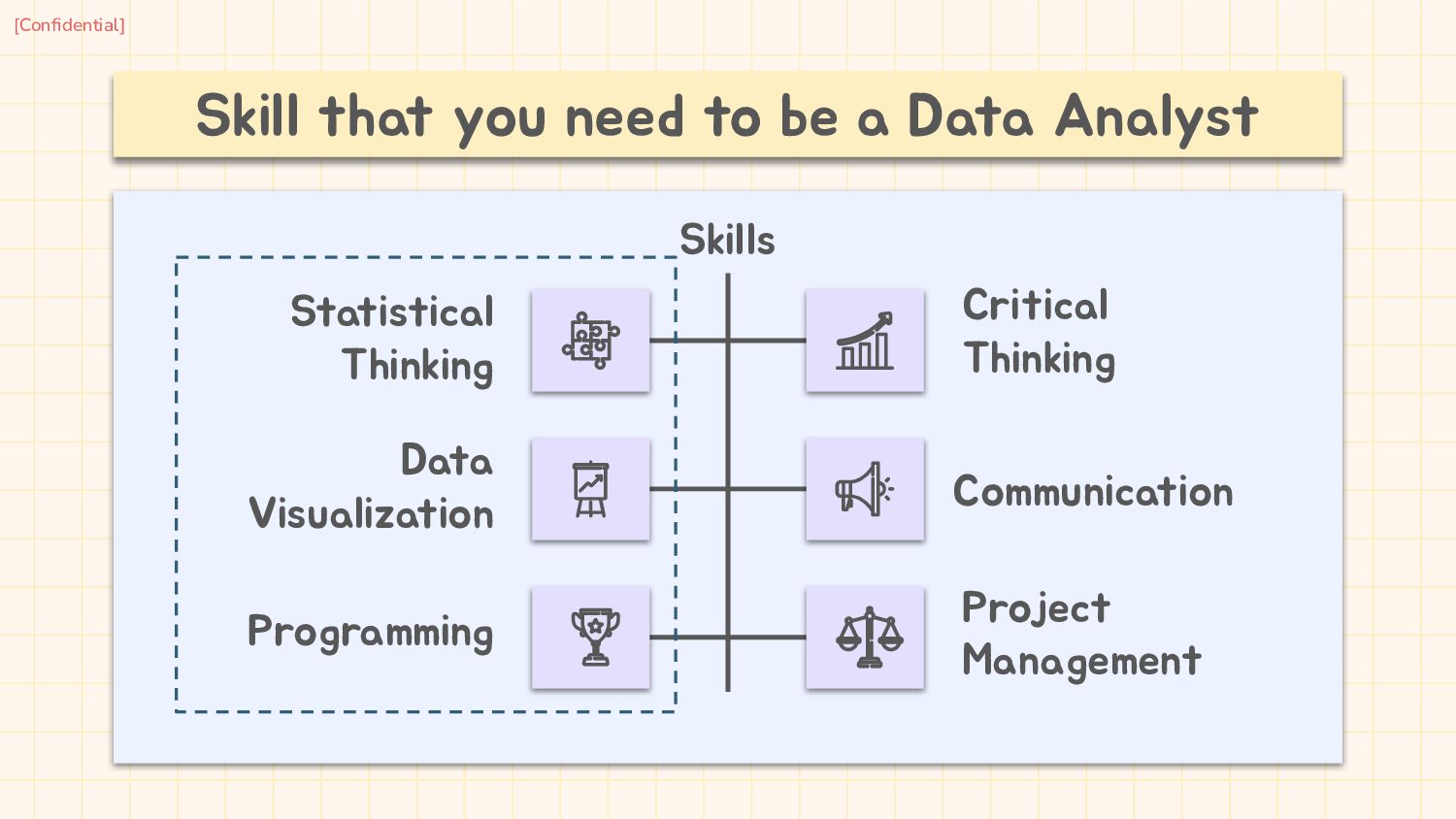
  11. Skill that you need to be a Data Analyst Skills

    Statistical Thinking Critical Thinking Data Visualization Communication Programming Project Management [Confidential]
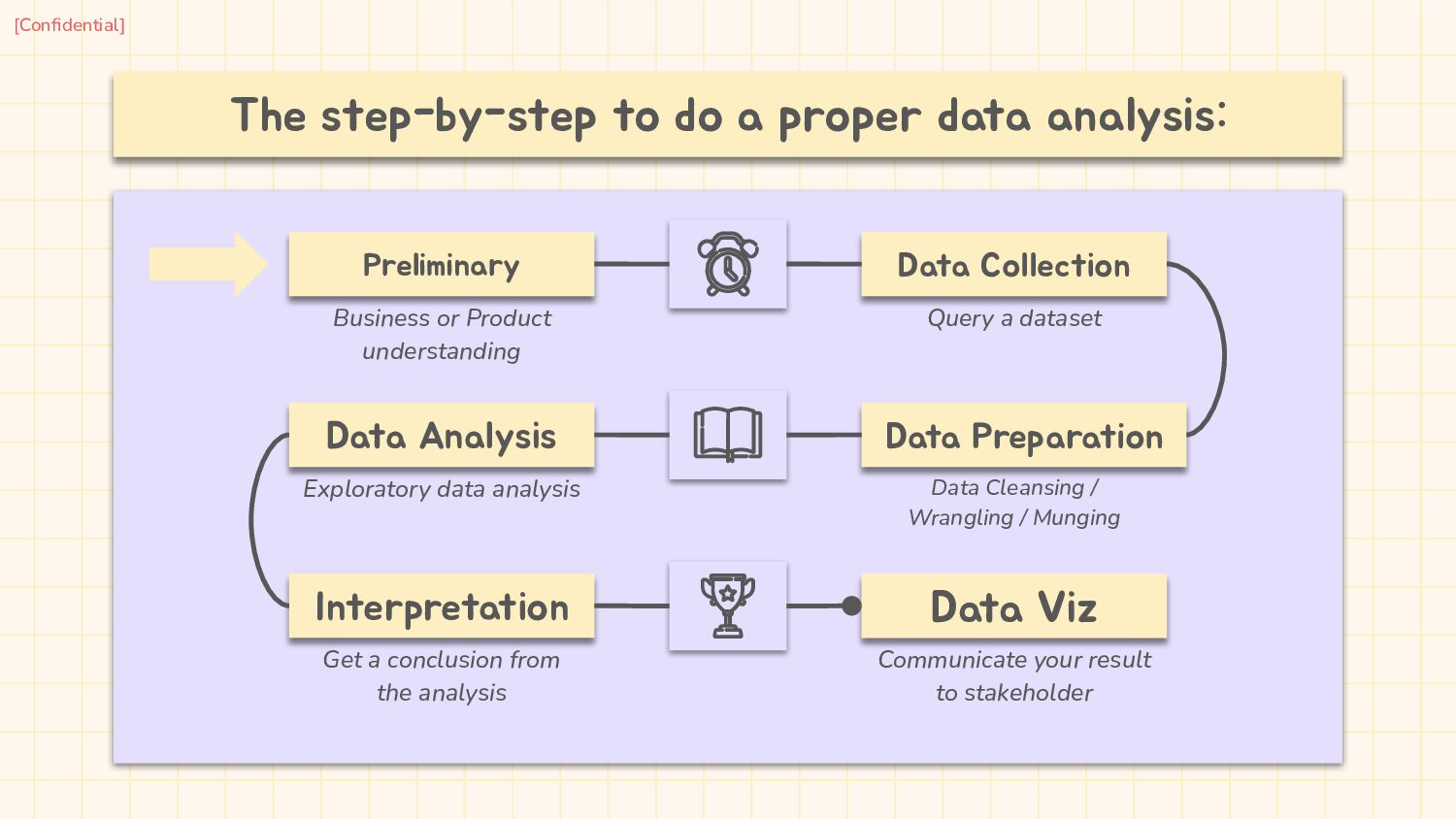
  12. The step-by-step to do a proper data analysis: Business or

    Product understanding Preliminary Query a dataset Data Collection Exploratory data analysis Data Analysis Get a conclusion from the analysis Interpretation Communicate your result to stakeholder Data Viz Data Cleansing / Wrangling / Munging Data Preparation [Confidential]
  13. Using a simple example in daily life, let’s apply the

    previous work flow to reach the subject’s objectives: Budi is a fruit seller in a traditional market. Every two times a week, the fruit supplier will send one ton of various types of fruits. Budi has to sort the fruits and determine the right selling price so that the price of the fruits can still compete with other sellers and of course he can make a profit too. What are the steps Budi should take? Illustration [Confidential]
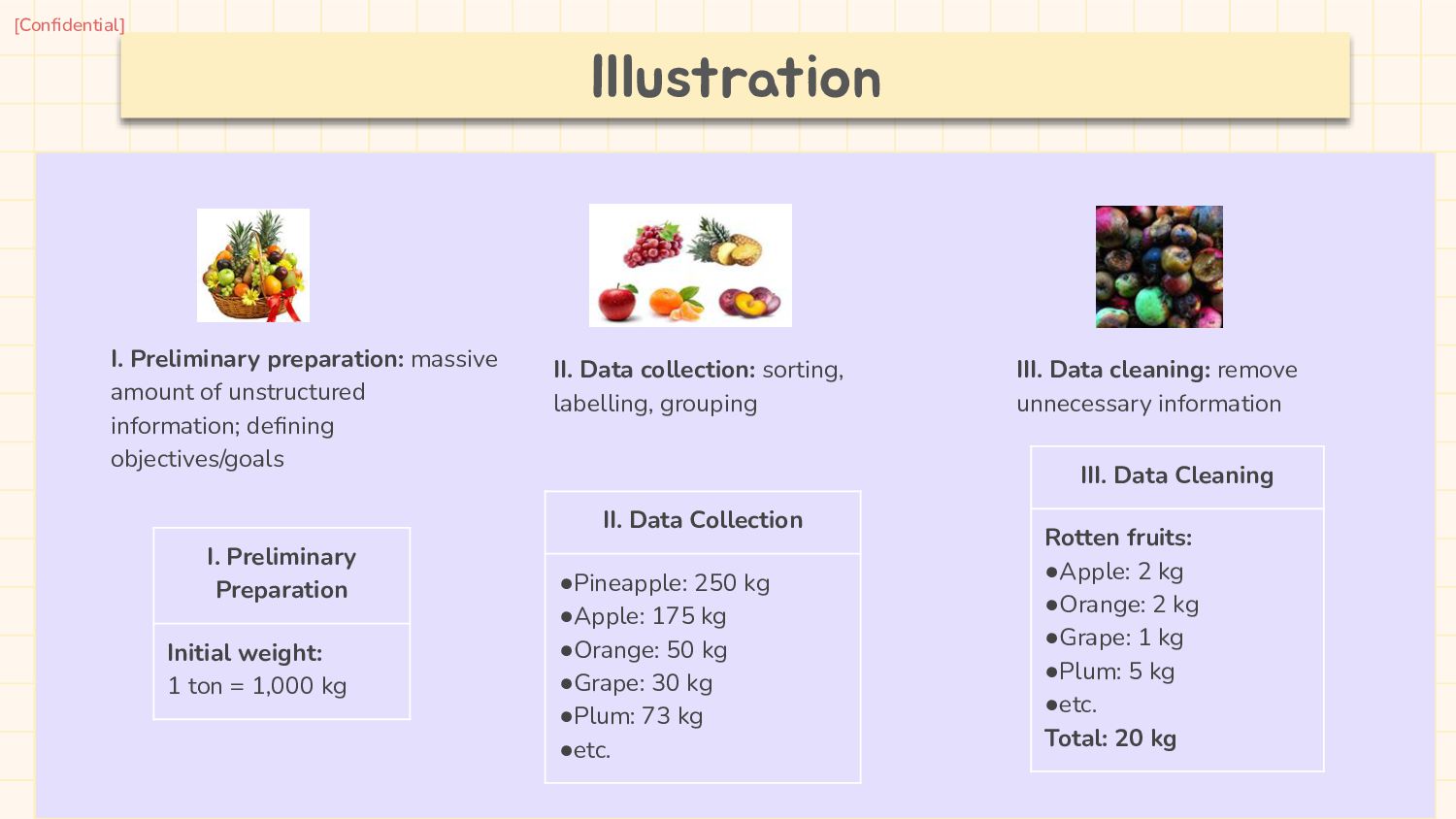
  14. Illustration I. Preliminary preparation: massive amount of unstructured information; defining

    objectives/goals I. Preliminary Preparation Initial weight: 1 ton = 1,000 kg II. Data collection: sorting, labelling, grouping II. Data Collection •Pineapple: 250 kg •Apple: 175 kg •Orange: 50 kg •Grape: 30 kg •Plum: 73 kg •etc. III. Data cleaning: remove unnecessary information III. Data Cleaning Rotten fruits: •Apple: 2 kg •Orange: 2 kg •Grape: 1 kg •Plum: 5 kg •etc. Total: 20 kg [Confidential]
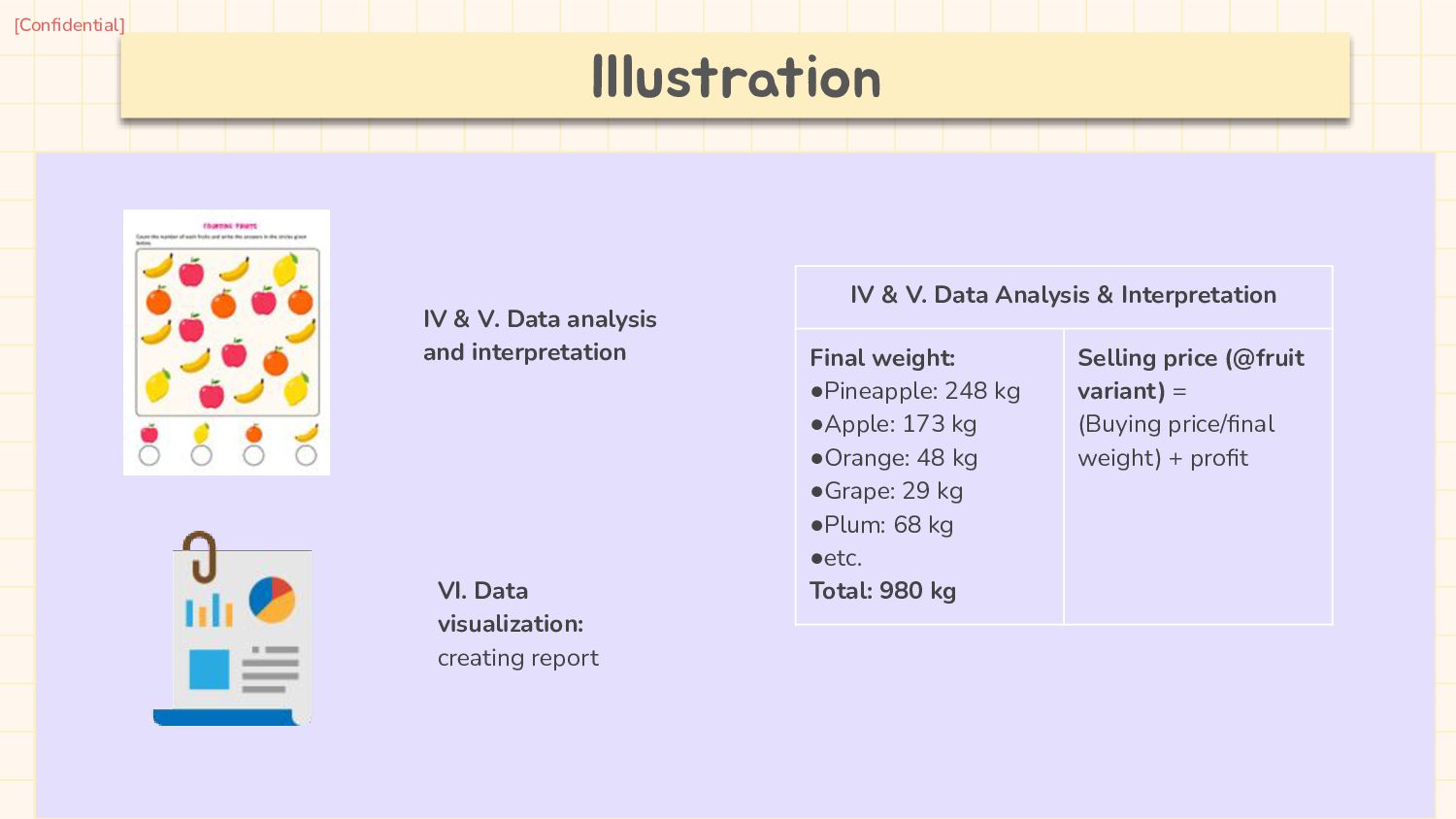
  15. Illustration IV & V. Data analysis and interpretation VI. Data

    visualization: creating report IV & V. Data Analysis & Interpretation Final weight: •Pineapple: 248 kg •Apple: 173 kg •Orange: 48 kg •Grape: 29 kg •Plum: 68 kg •etc. Total: 980 kg Selling price (@fruit variant) = (Buying price/final weight) + profit [Confidential]
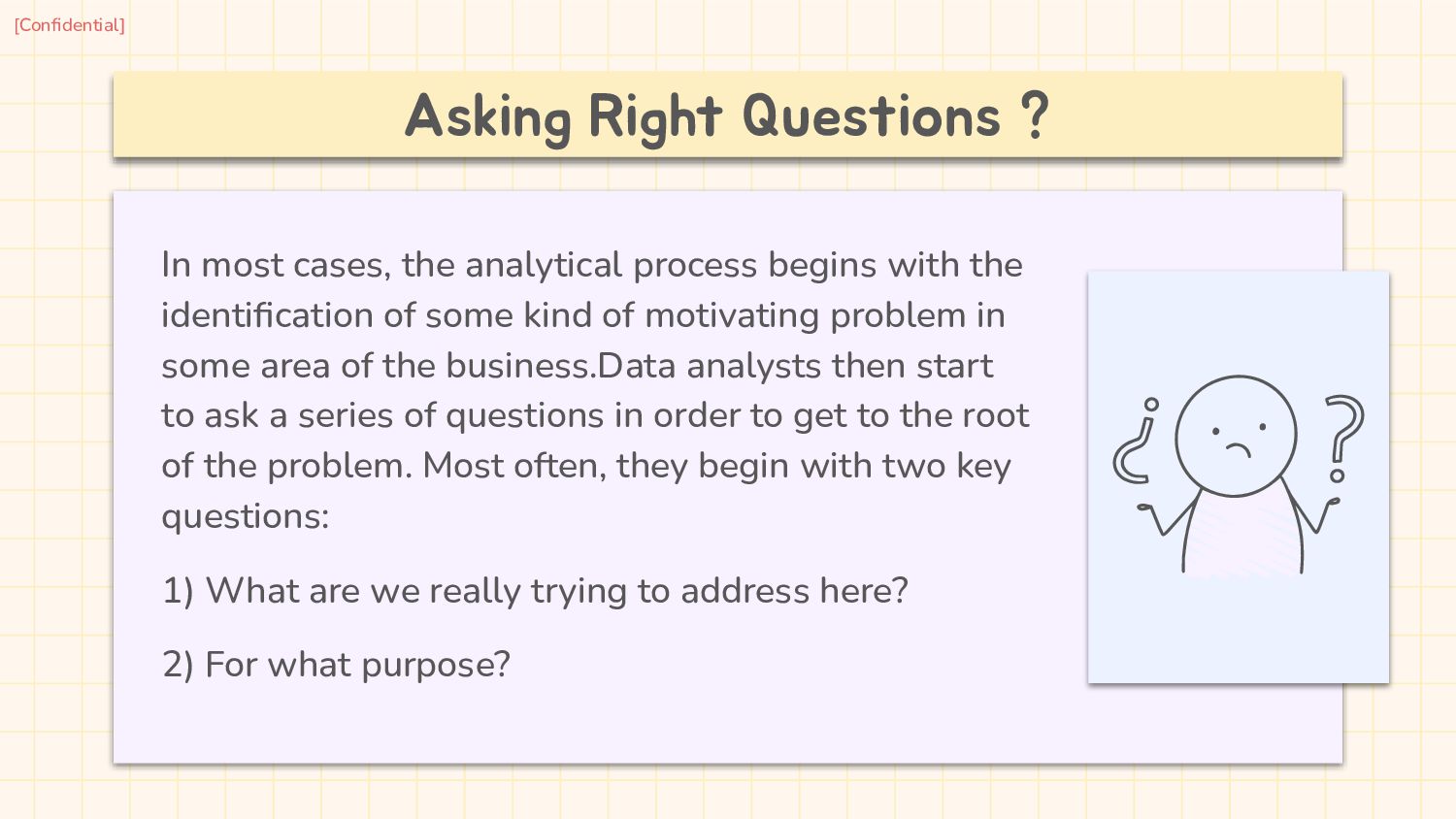
  16. Asking Right Questions ? In most cases, the analytical process

    begins with the identification of some kind of motivating problem in some area of the business.Data analysts then start to ask a series of questions in order to get to the root of the problem. Most often, they begin with two key questions: 1) What are we really trying to address here? 2) For what purpose? [Confidential]
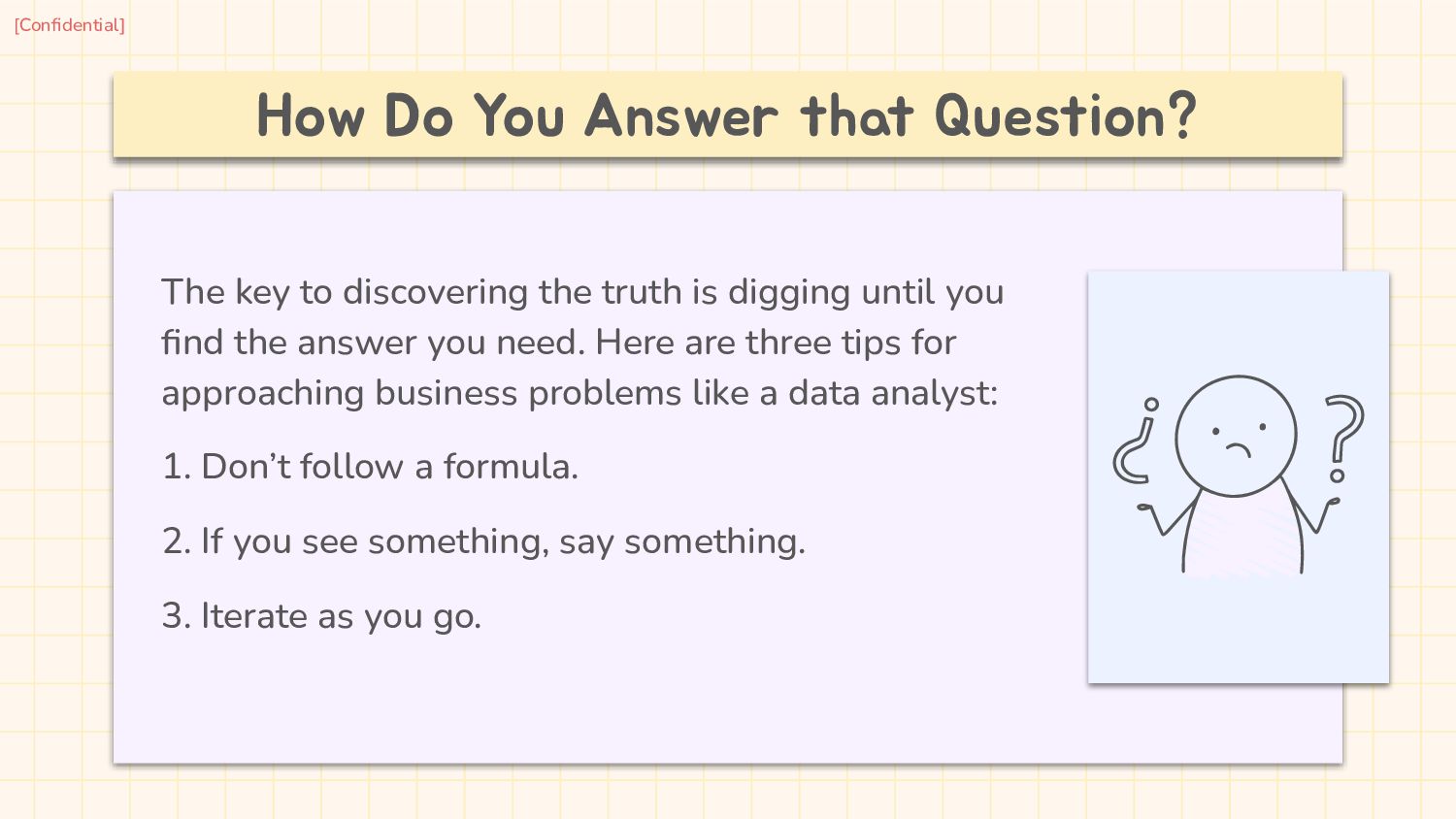
  17. How Do You Answer that Question? The key to discovering

    the truth is digging until you find the answer you need. Here are three tips for approaching business problems like a data analyst: 1. Don’t follow a formula. 2. If you see something, say something. 3. Iterate as you go. [Confidential]
  18. You own a bookstore and every day you get about

    nine or ten people coming in to buy a book. One Saturday morning, you wake up, bike to your bookstore, flip the sign from close to open, and start reorganizing the shelves while you wait for your first customer. An hour passes, then two, then five. You start to wonder why no one is coming. Illustration [Confidential]
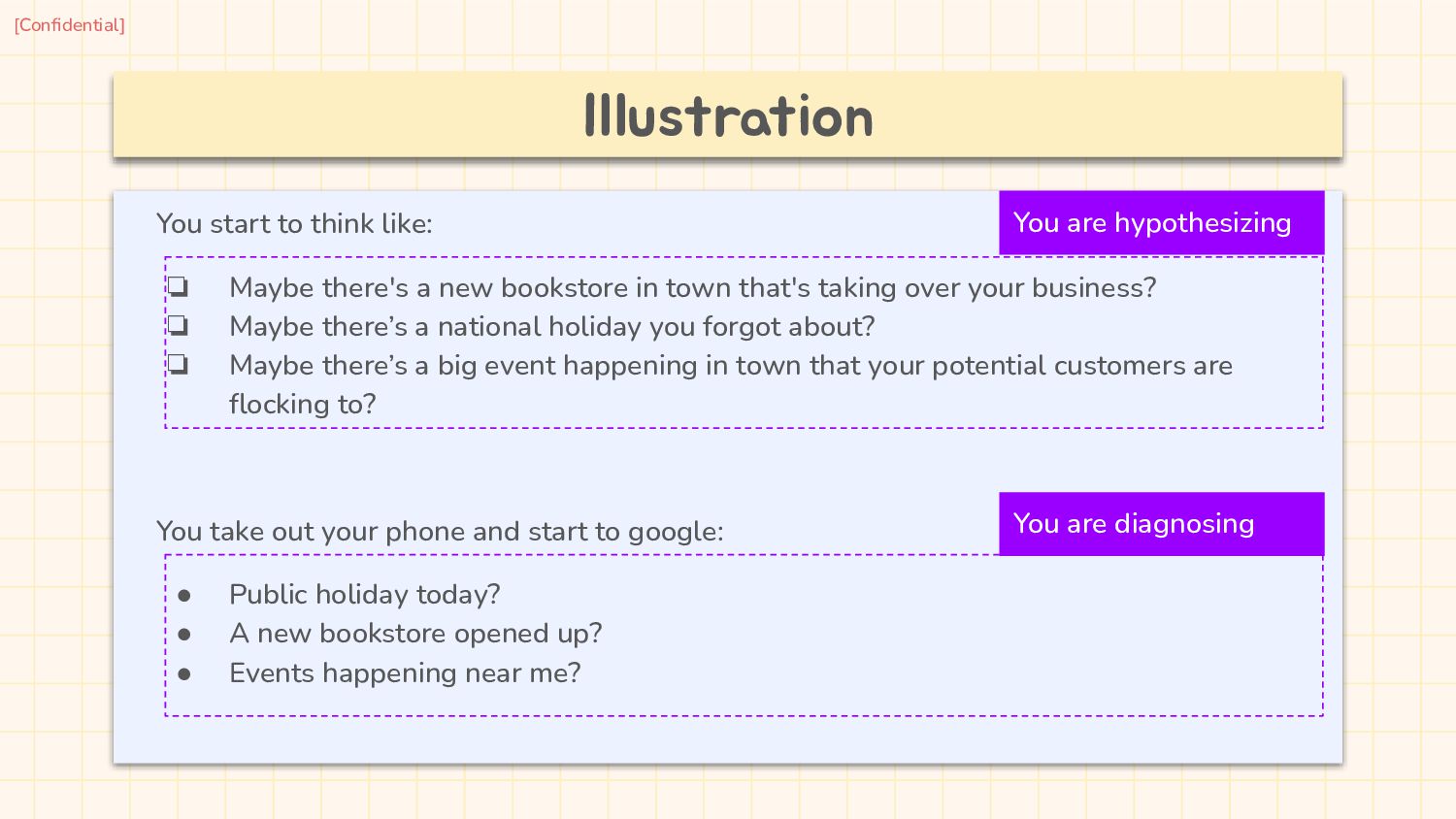
  19. Illustration You start to think like: ❏ Maybe there's a

    new bookstore in town that's taking over your business? ❏ Maybe there’s a national holiday you forgot about? ❏ Maybe there’s a big event happening in town that your potential customers are flocking to? You take out your phone and start to google: • Public holiday today? • A new bookstore opened up? • Events happening near me? You are hypothesizing You are diagnosing [Confidential]
  20. To help analyst on defining the right answer, you can

    follow this steps : Clarify, Hypothesize, Diagnose, Solve, Summarize [Confidential]
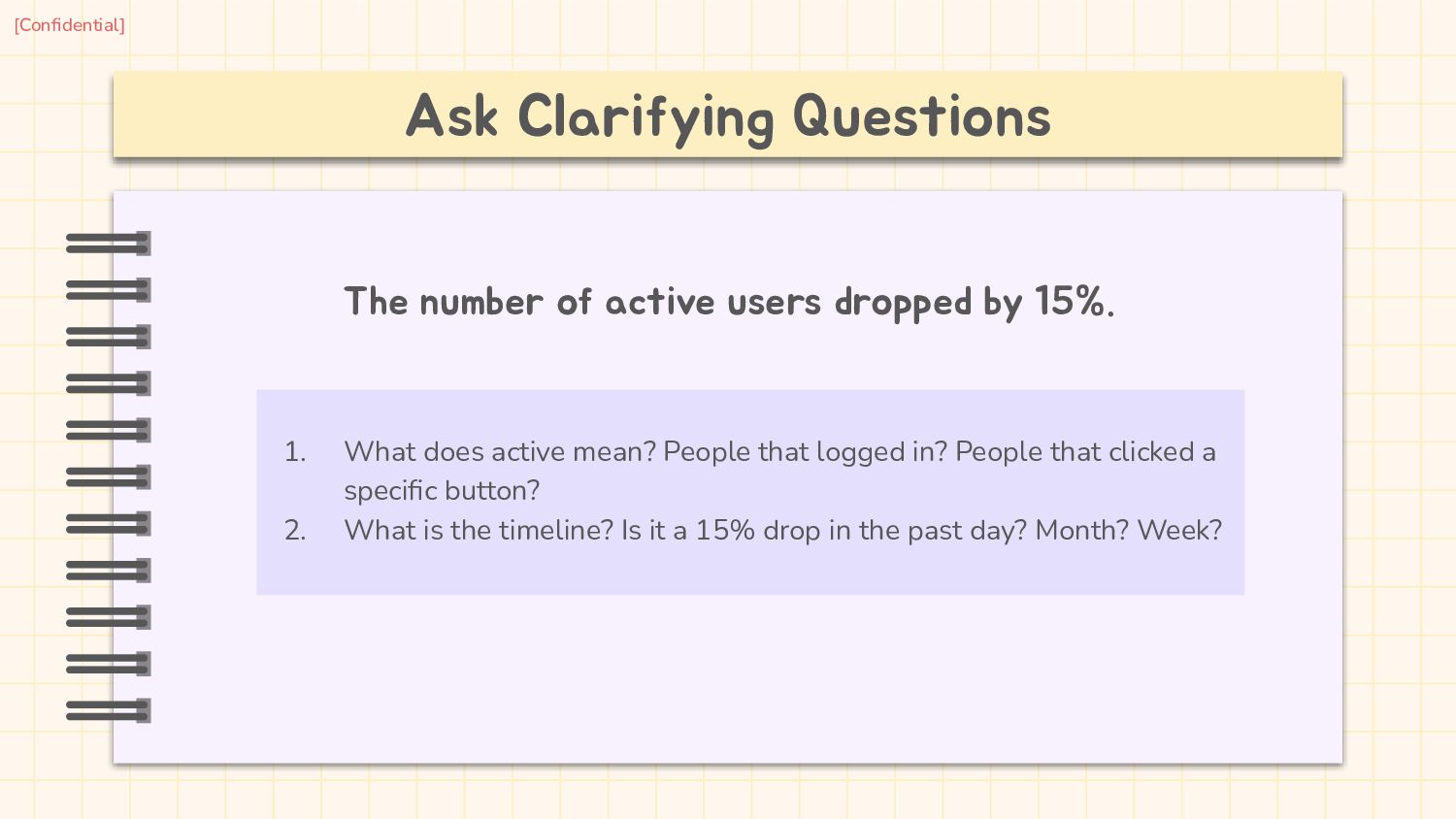
  21. Ask Clarifying Questions 1. What does active mean? People that

    logged in? People that clicked a specific button? 2. What is the timeline? Is it a 15% drop in the past day? Month? Week? The number of active users dropped by 15%. [Confidential]
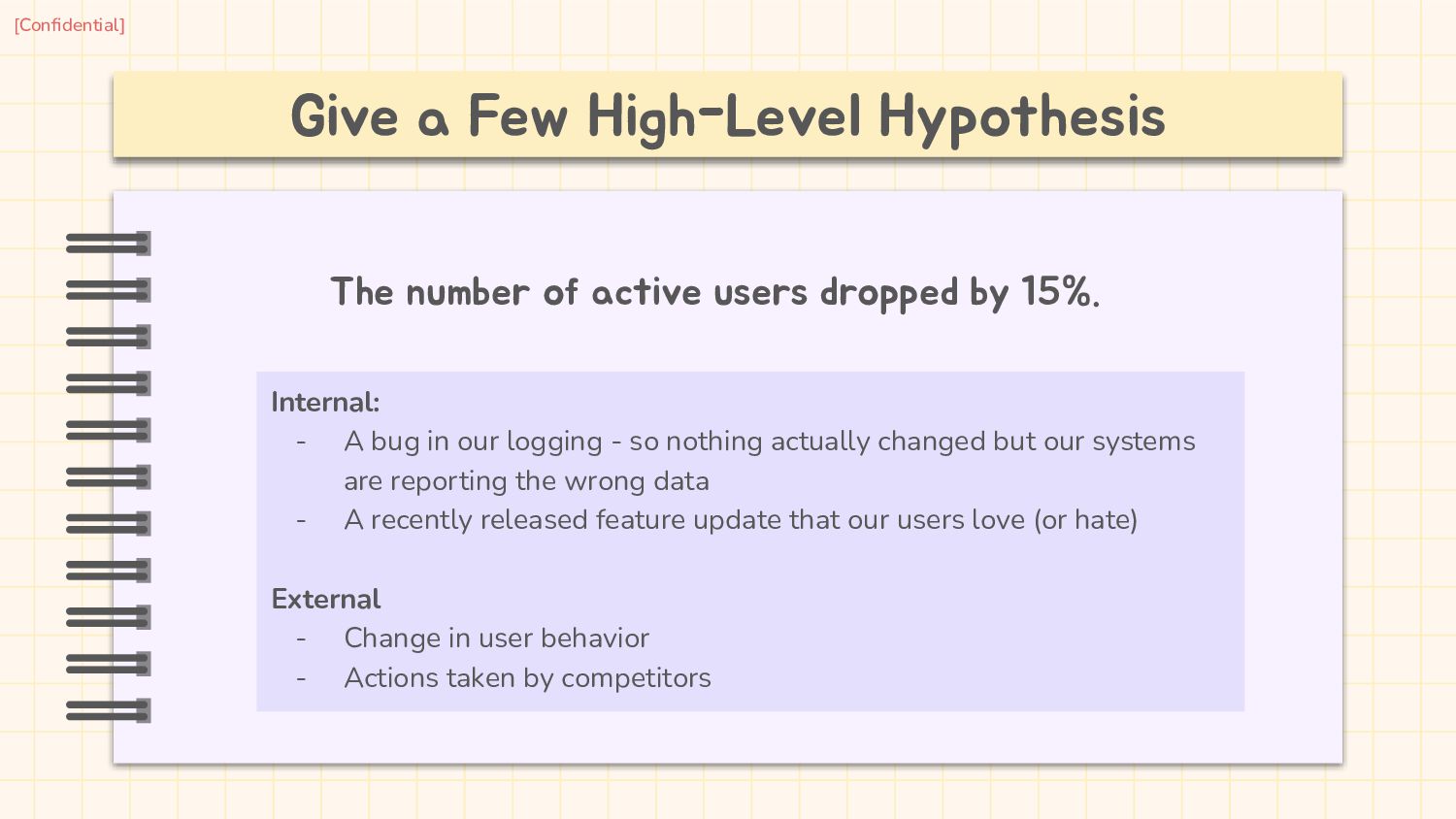
  22. Give a Few High-Level Hypothesis Internal: - A bug in

    our logging - so nothing actually changed but our systems are reporting the wrong data - A recently released feature update that our users love (or hate) External - Change in user behavior - Actions taken by competitors The number of active users dropped by 15%. [Confidential]
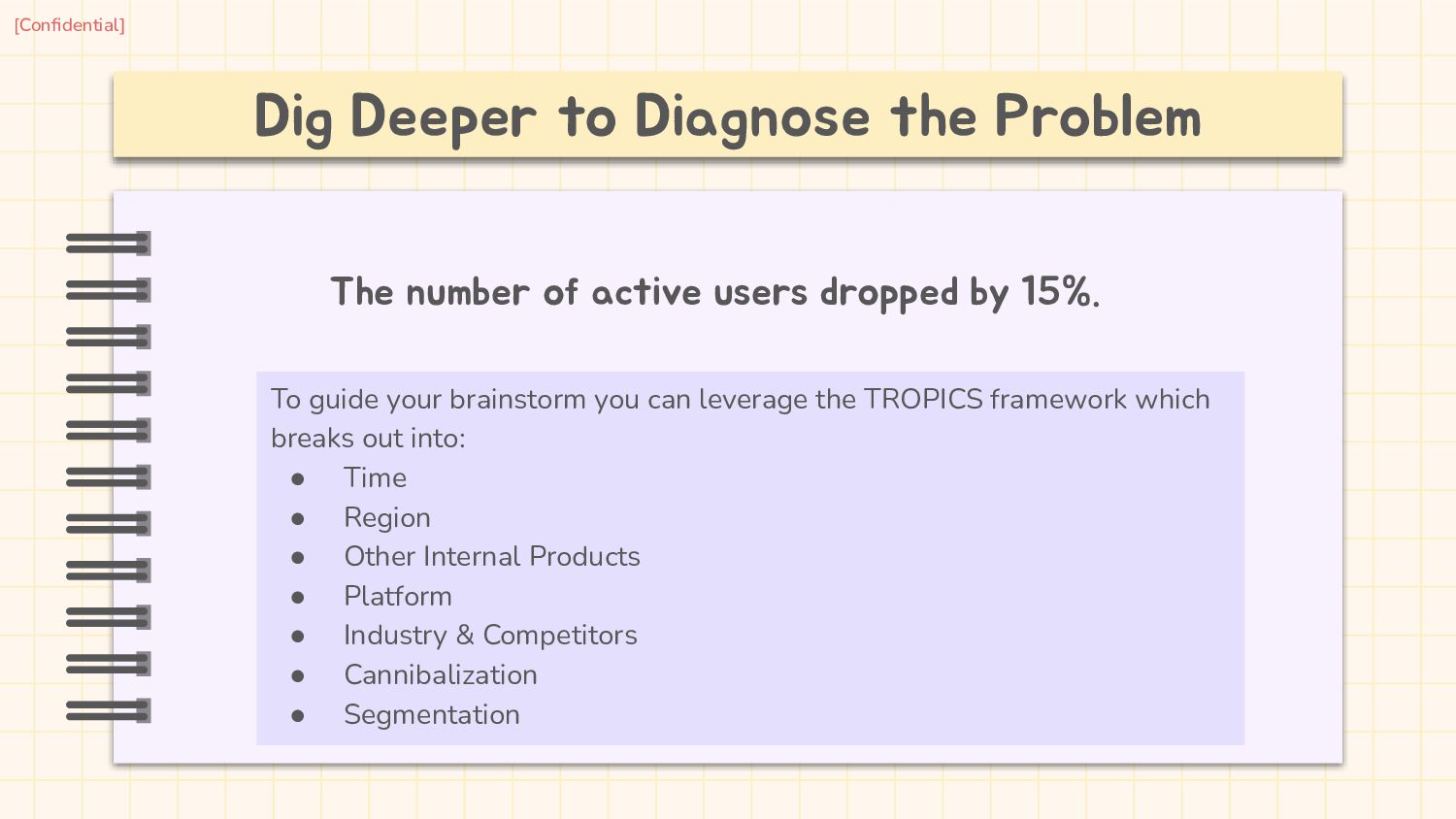
  23. Dig Deeper to Diagnose the Problem To guide your brainstorm

    you can leverage the TROPICS framework which breaks out into: • Time • Region • Other Internal Products • Platform • Industry & Competitors • Cannibalization • Segmentation The number of active users dropped by 15%. [Confidential]
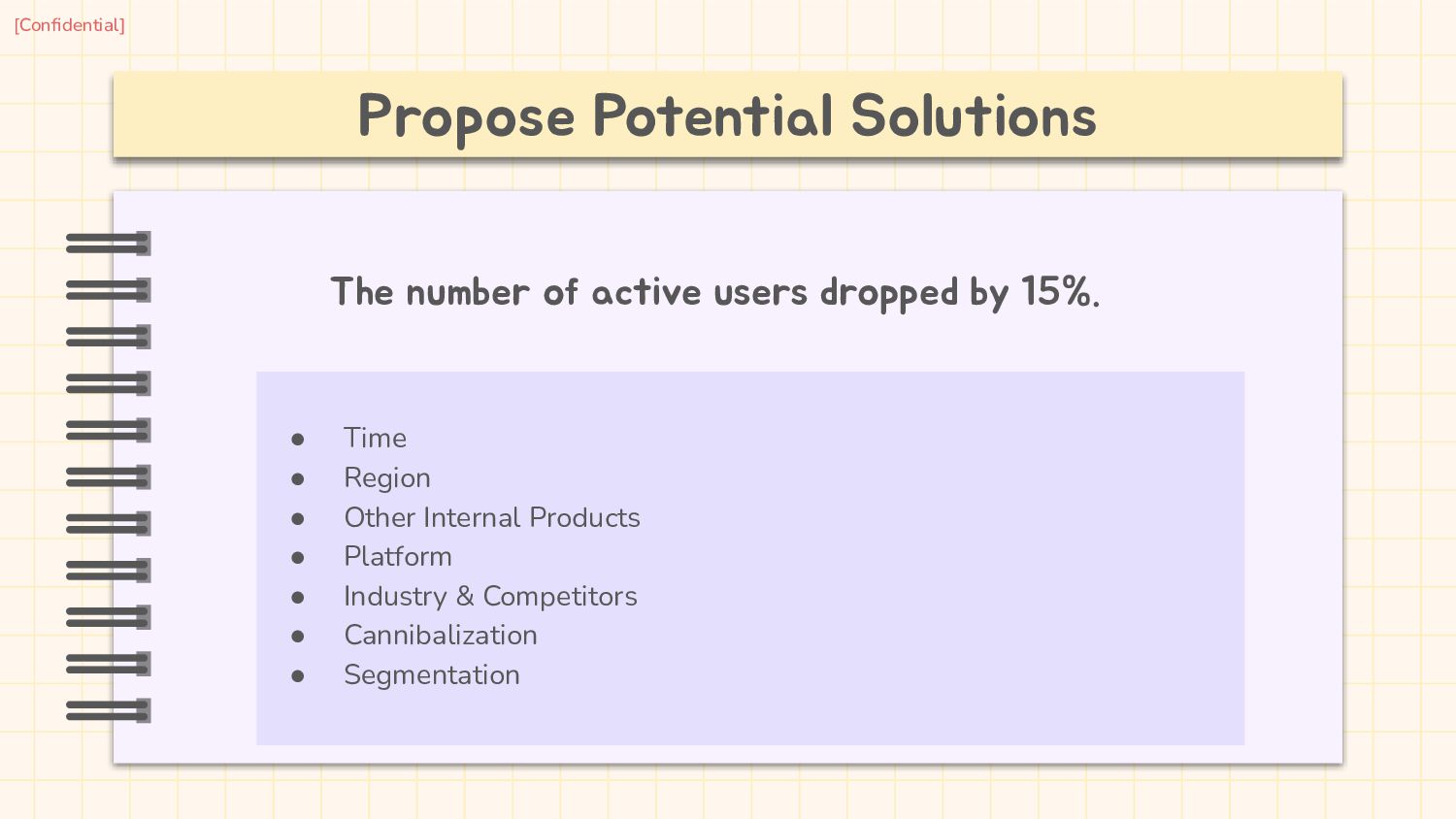
  24. Propose Potential Solutions • Time • Region • Other Internal

    Products • Platform • Industry & Competitors • Cannibalization • Segmentation The number of active users dropped by 15%. [Confidential]
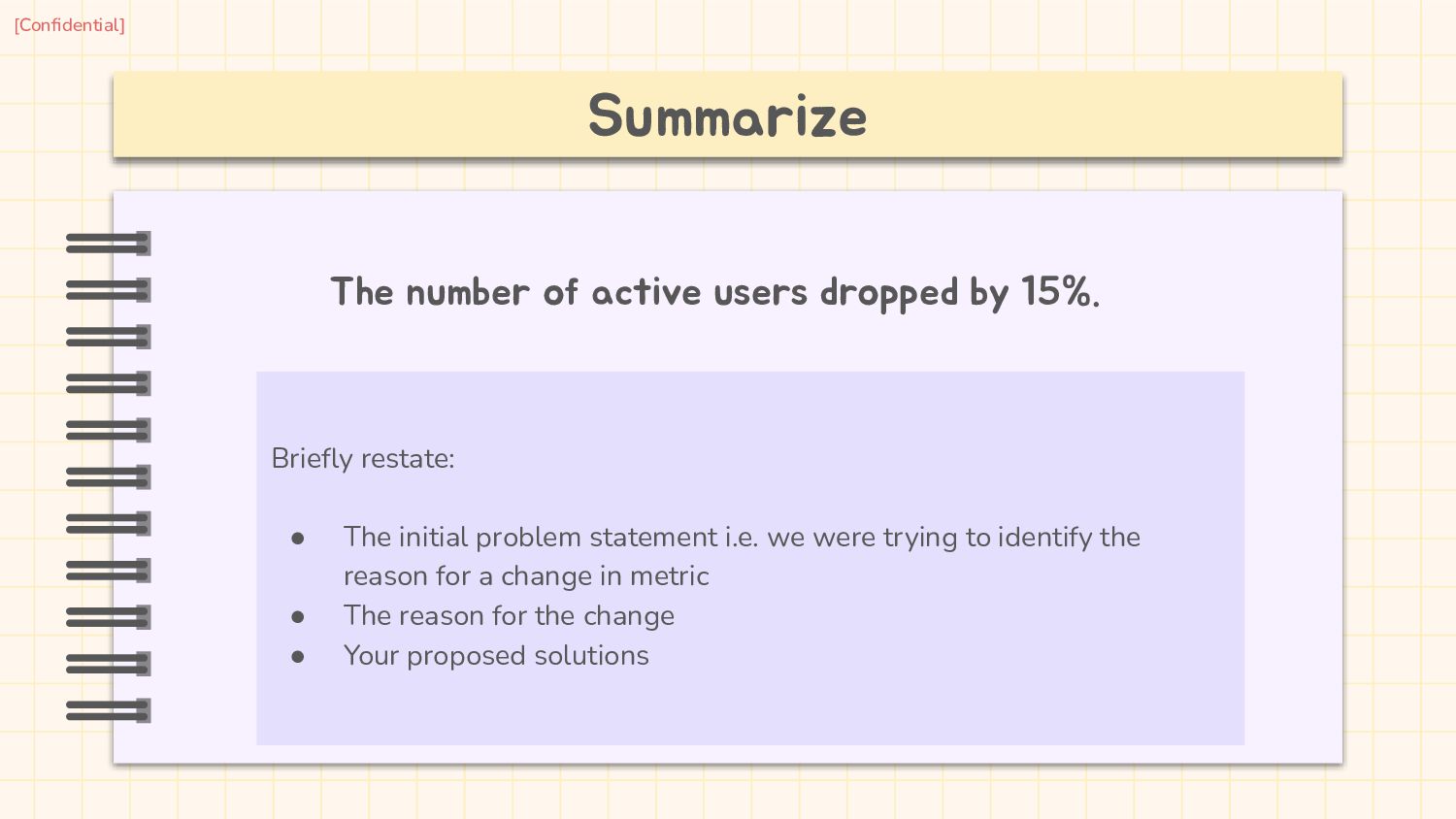
  25. Summarize Briefly restate: • The initial problem statement i.e. we

    were trying to identify the reason for a change in metric • The reason for the change • Your proposed solutions The number of active users dropped by 15%. [Confidential]