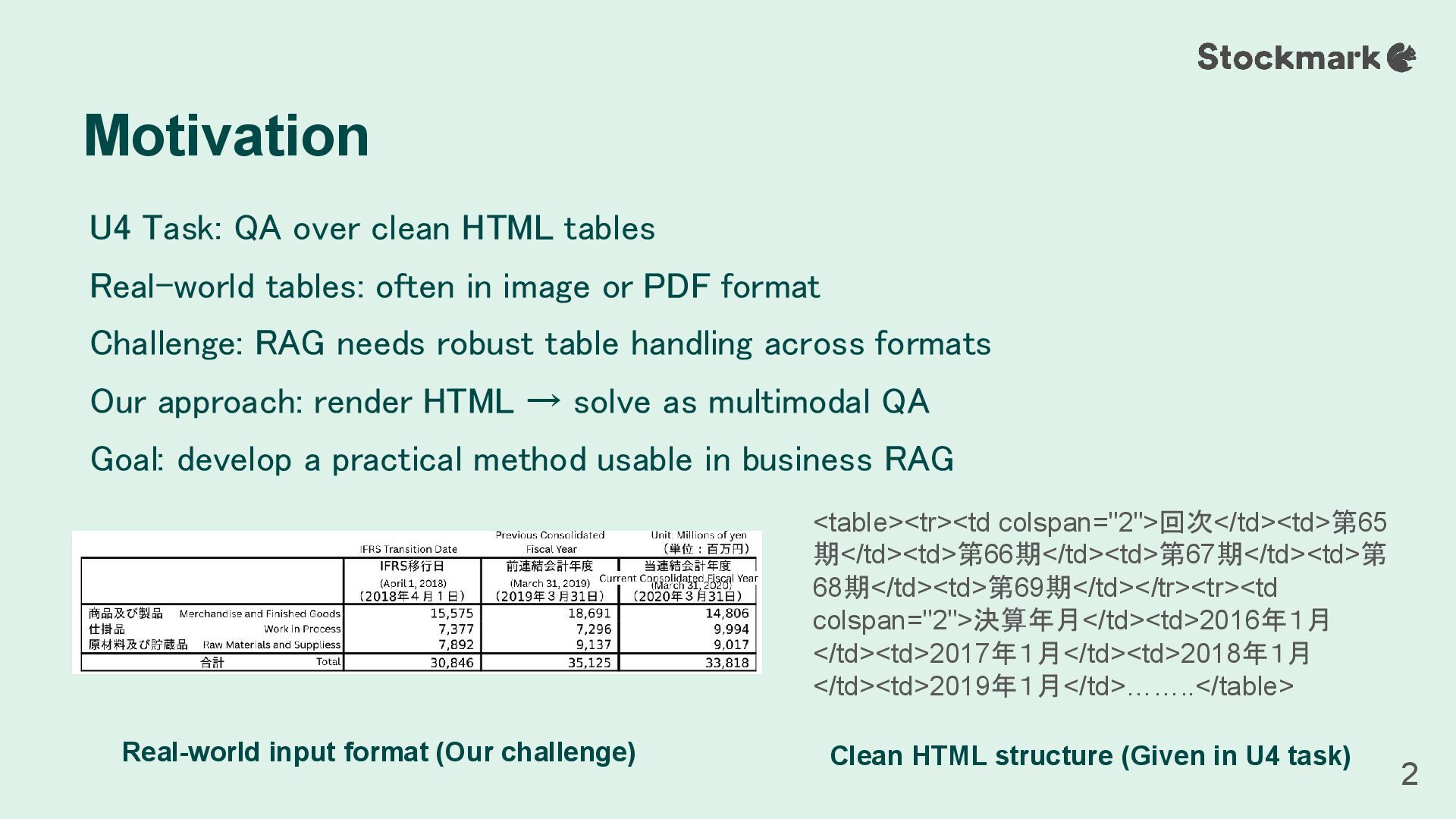
in image or PDF format Challenge: RAG needs robust table handling across formats Our approach: render HTML → solve as multimodal QA Goal: develop a practical method usable in business RAG Motivation 2 Clean HTML structure (Given in U4 task) Real-world input format (Our challenge) <table><tr><td colspan="2">回次</td><td>第65 期</td><td>第66期</td><td>第67期</td><td>第 68期</td><td>第69期</td></tr><tr><td colspan="2">決算年月</td><td>2016年1月 </td><td>2017年1月</td><td>2018年1月 </td><td>2019年1月</td>……..</table>
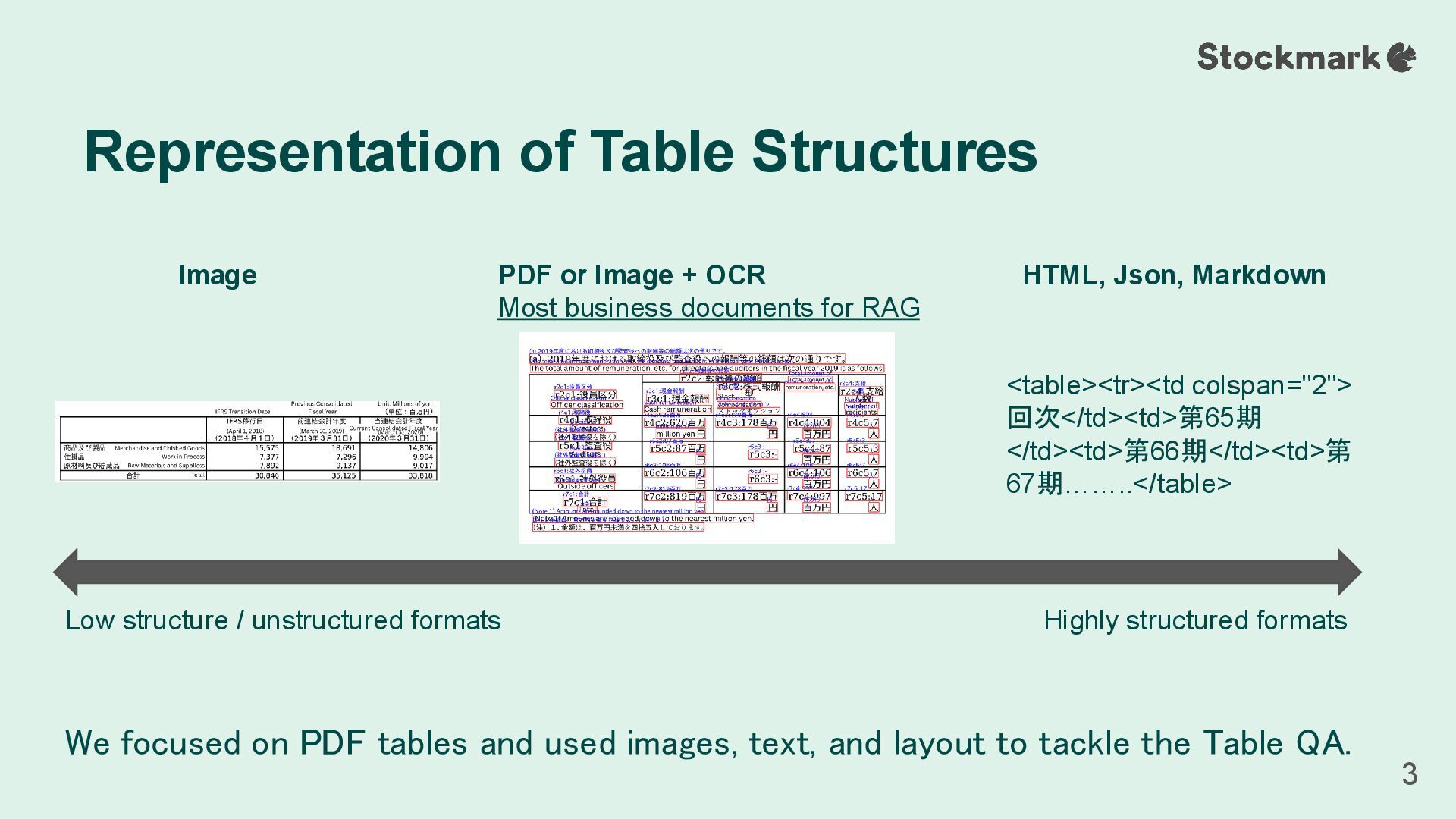
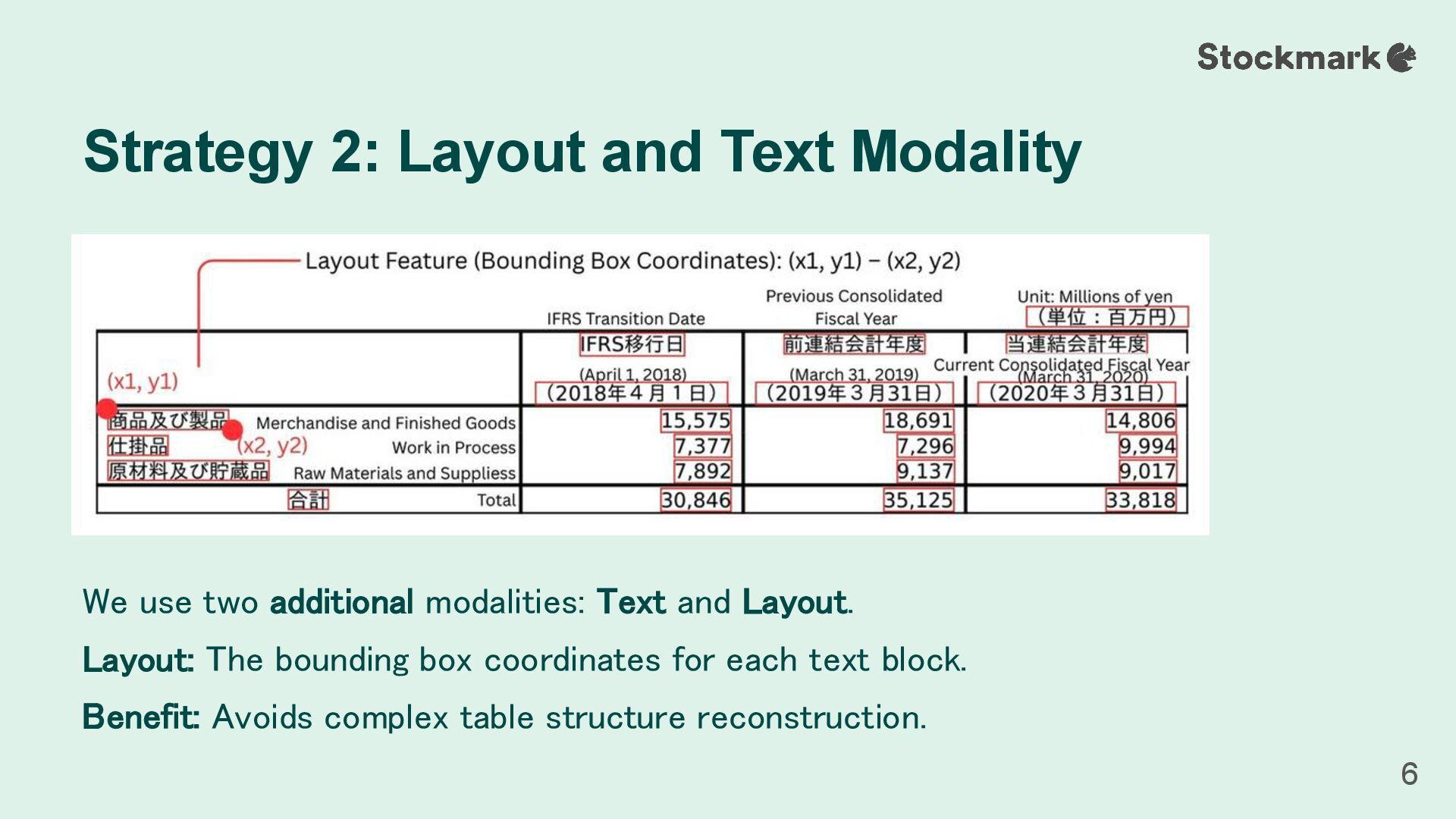
layout to tackle the Table QA. Representation of Table Structures 3 Highly structured formats Low structure / unstructured formats <table><tr><td colspan="2"> 回次</td><td>第65期 </td><td>第66期</td><td>第 67期……..</table> HTML, Json, Markdown Image PDF or Image + OCR Most business documents for RAG
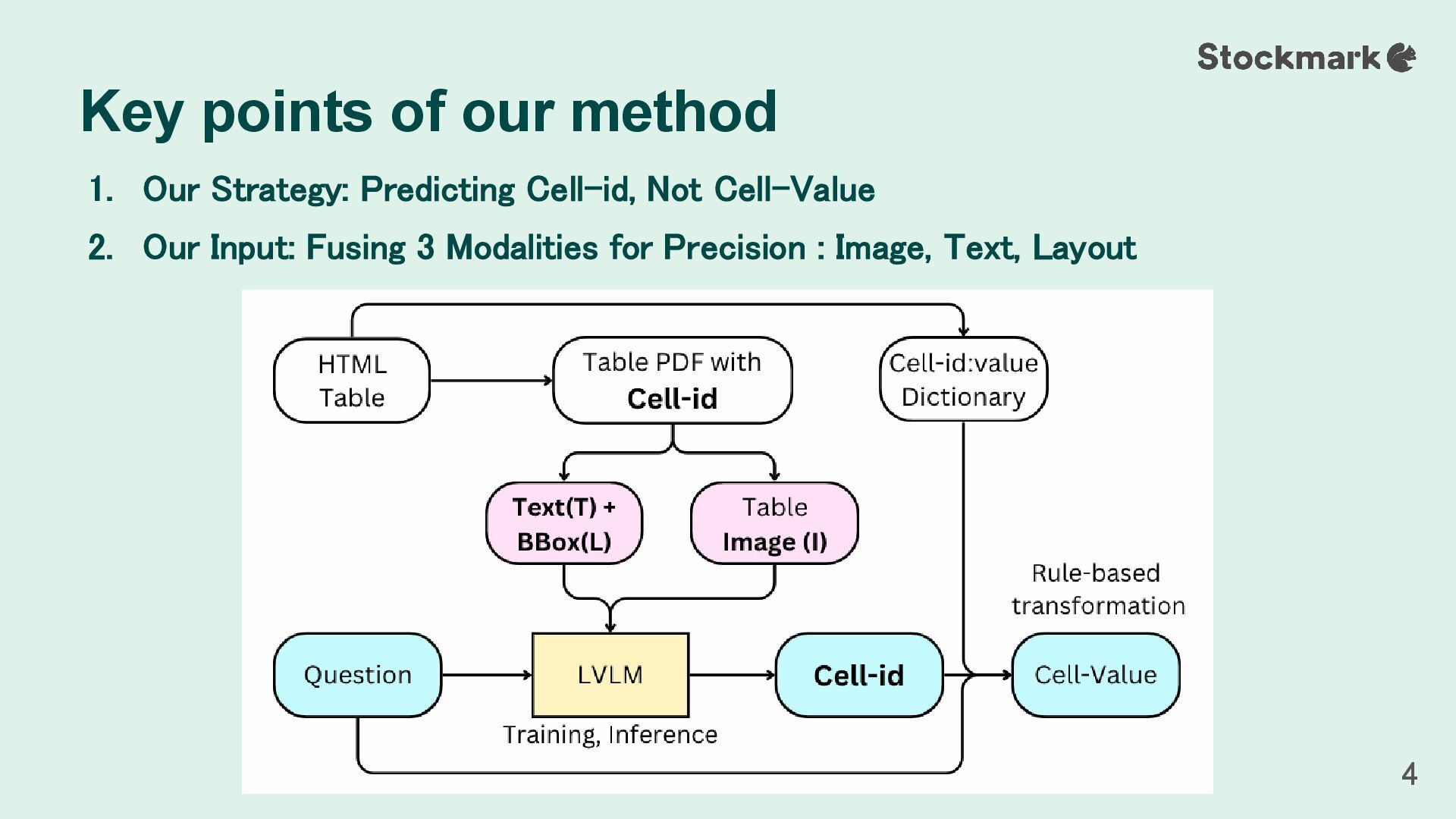
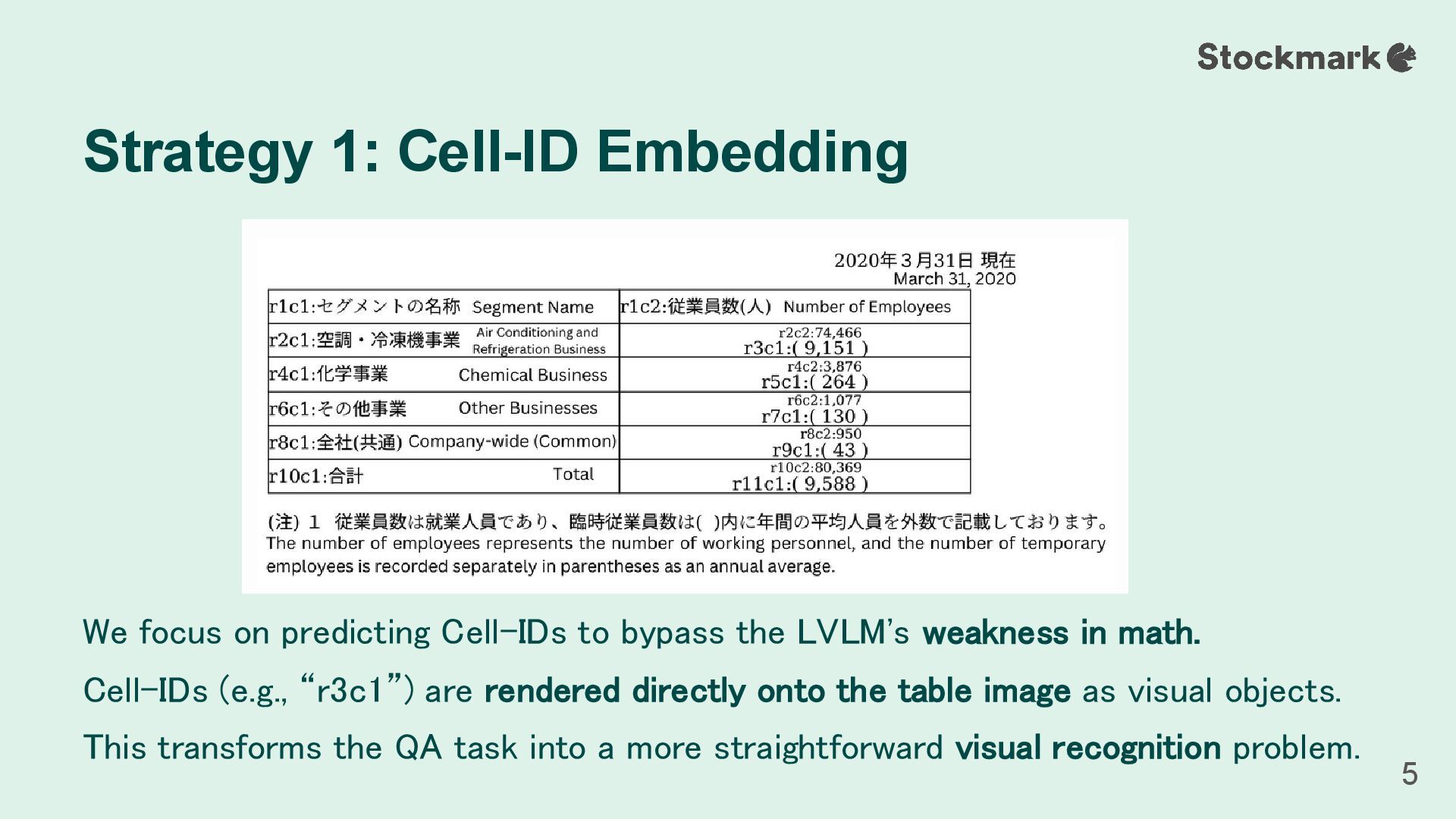
in math. Cell-IDs (e.g., “r3c1”) are rendered directly onto the table image as visual objects. This transforms the QA task into a more straightforward visual recognition problem. Strategy 1: Cell-ID Embedding 5
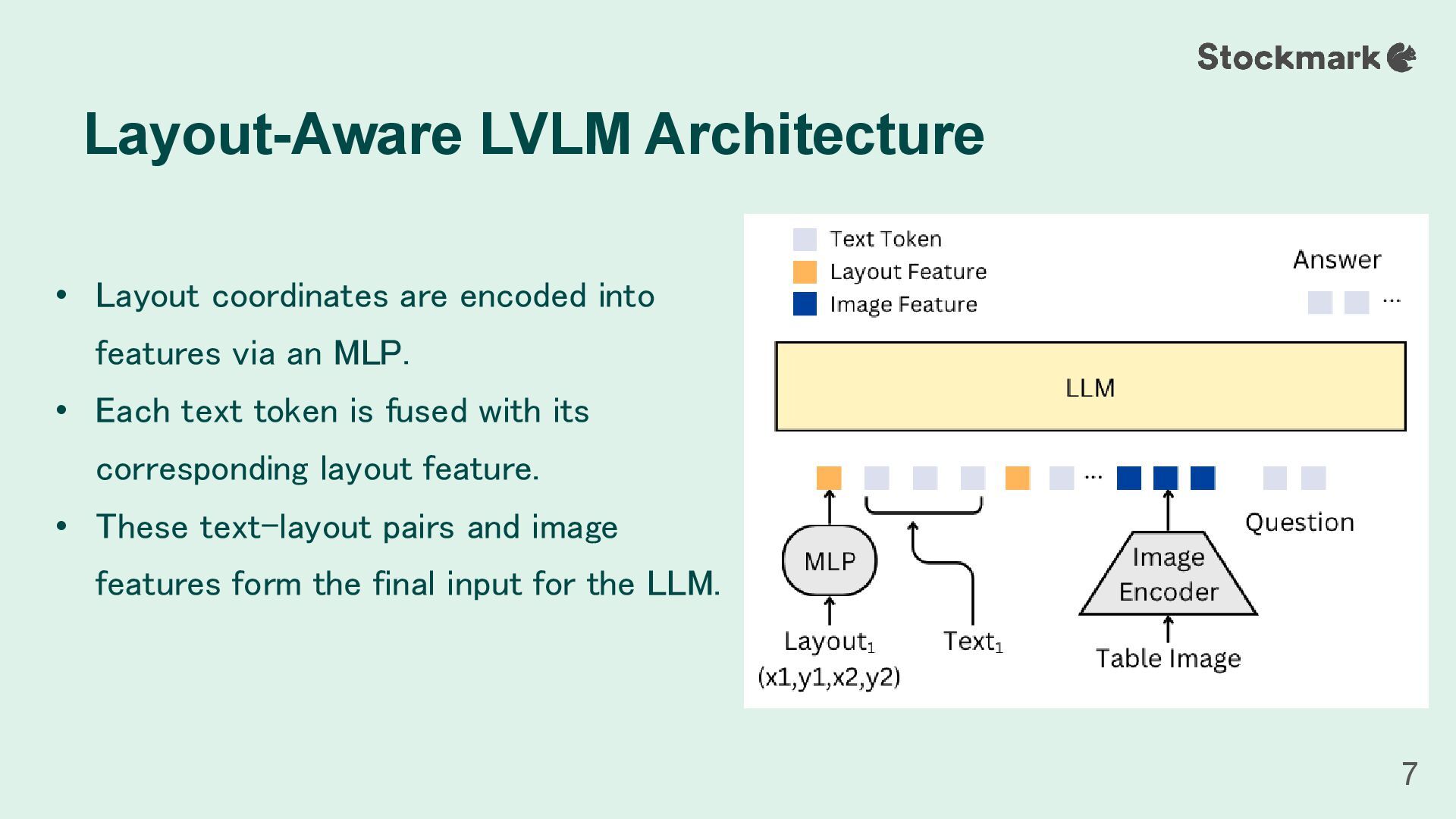
• Each text token is fused with its corresponding layout feature. • These text-layout pairs and image features form the final input for the LLM. Layout-Aware LVLM Architecture 7
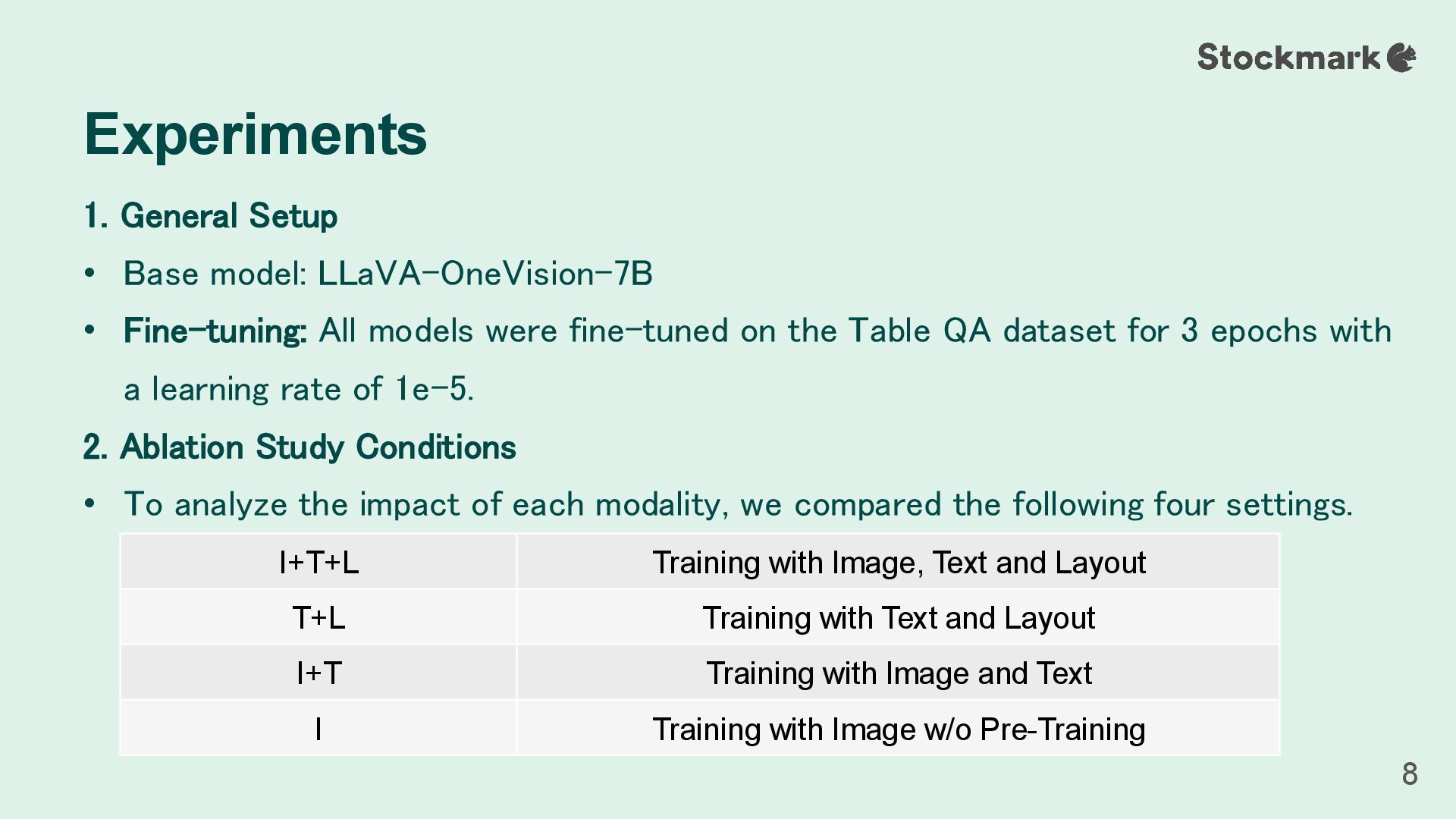
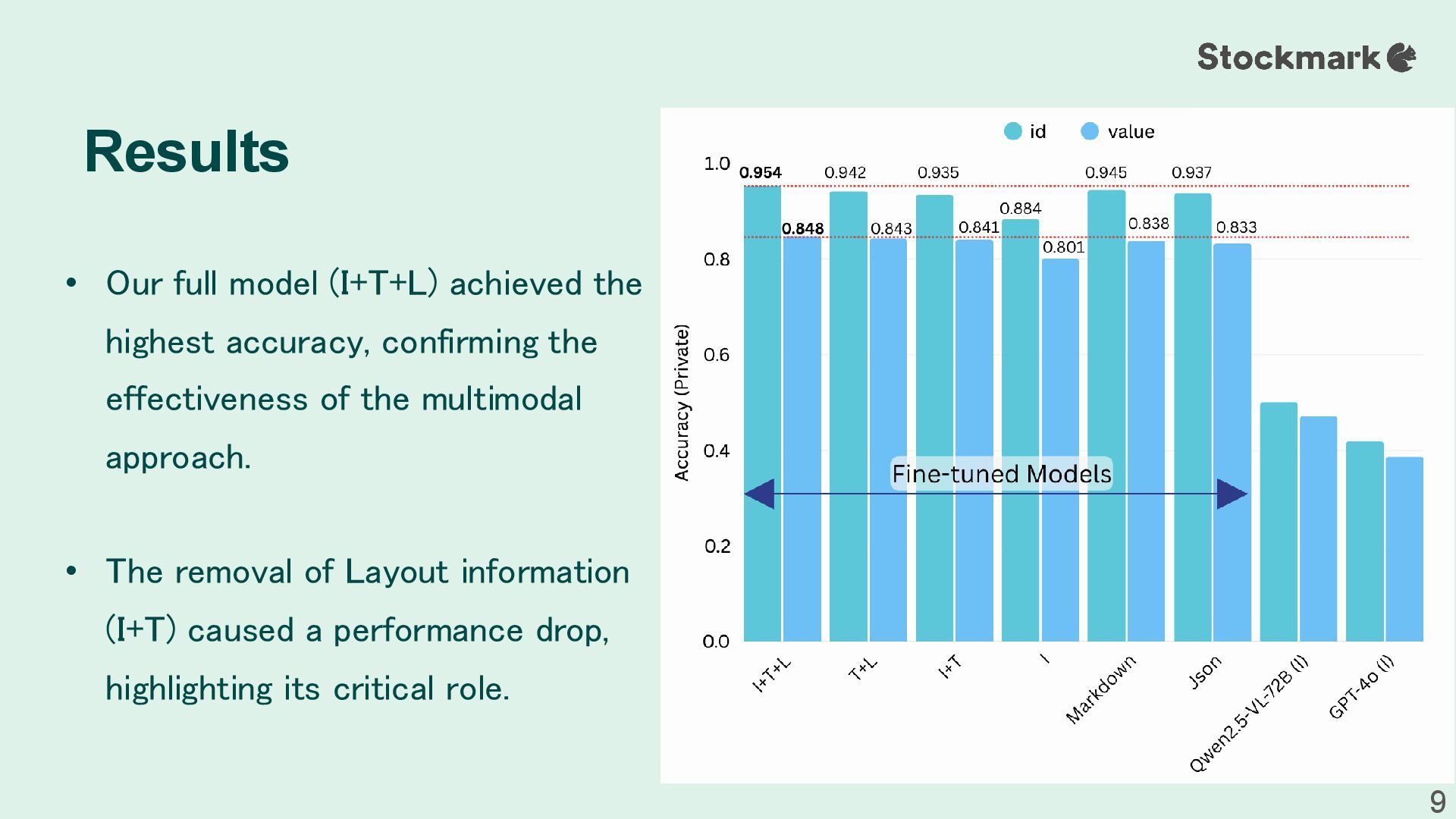
models were fine-tuned on the Table QA dataset for 3 epochs with a learning rate of 1e-5. 2. Ablation Study Conditions • To analyze the impact of each modality, we compared the following four settings. Experiments 8 I+T+L Training with Image, Text and Layout T+L Training with Text and Layout I+T Training with Image and Text I Training with Image w/o Pre-Training
the effectiveness of the multimodal approach. • The removal of Layout information (I+T) caused a performance drop, highlighting its critical role. Results 9
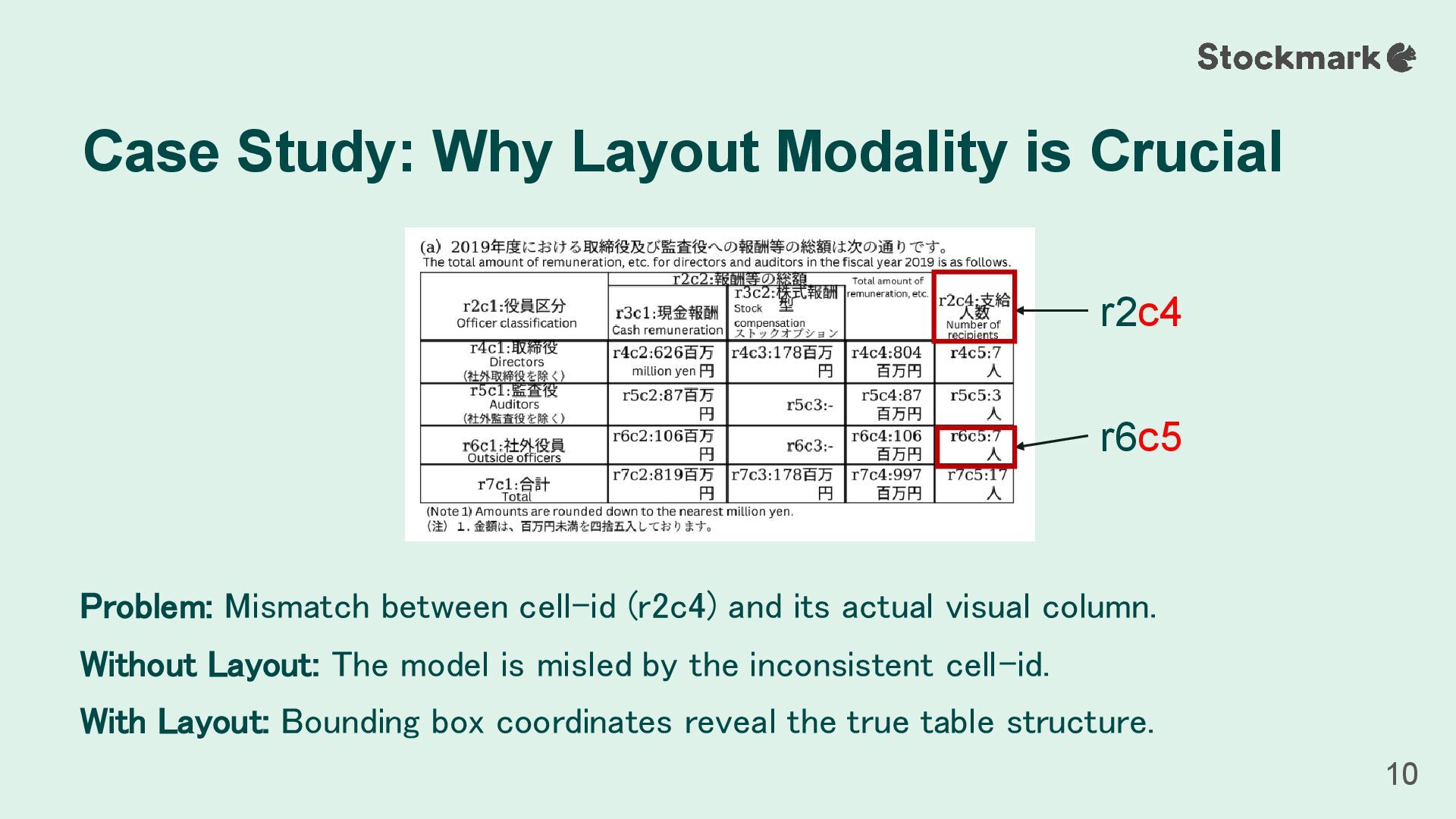
Without Layout: The model is misled by the inconsistent cell-id. With Layout: Bounding box coordinates reveal the true table structure. Case Study: Why Layout Modality is Crucial 10 r2c4 r6c5
documents. • Assumption of Clean Text: Not robust to noisy or handwritten tables with OCR errors. Future Work • Direct Value Prediction: To eliminate the dependency on cell-ids. • Robustness for Noisy Documents: By exploring end-to-end models or enhanced OCR. Limitations / Future Work 11
task, integrating Image, Text, and Layout information. • Our experiments showed this method is highly effective, with Text and Layout proving to be the most critical modalities for achieving high accuracy. • This study highlights that combining visual, textual, and spatial context is key to robustly understanding complex structured data. Conclusion 12


 eida
eida
 mkilby
 jct
jct
 popppiees
 cassininazir
 inesmontani
 tammyeverts
 aleyda
 codingconduct
 livdayseo
 chriscoyier