Upgrade to Pro — share decks privately, control downloads, hide ads and more …

Economic Growth and Development in Ethiopia

Sponsored · Your Podcast. Everywhere. Effortlessly. Share. Educate. Inspire. Entertain. You do you. We'll handle the rest. →
Avatar for Elena Elena
July 03, 2026
250

Economic Growth and Development in Ethiopia

A presentation analysing economic growth and development in Ethiopia, evaluating its key industries, historical factors, effectiveness of growth strategies etc.
Source: Country Economic Transformation Outlook- African Center for Economic Transformation

Avatar for Elena

Elena

July 03, 2026

Transcript

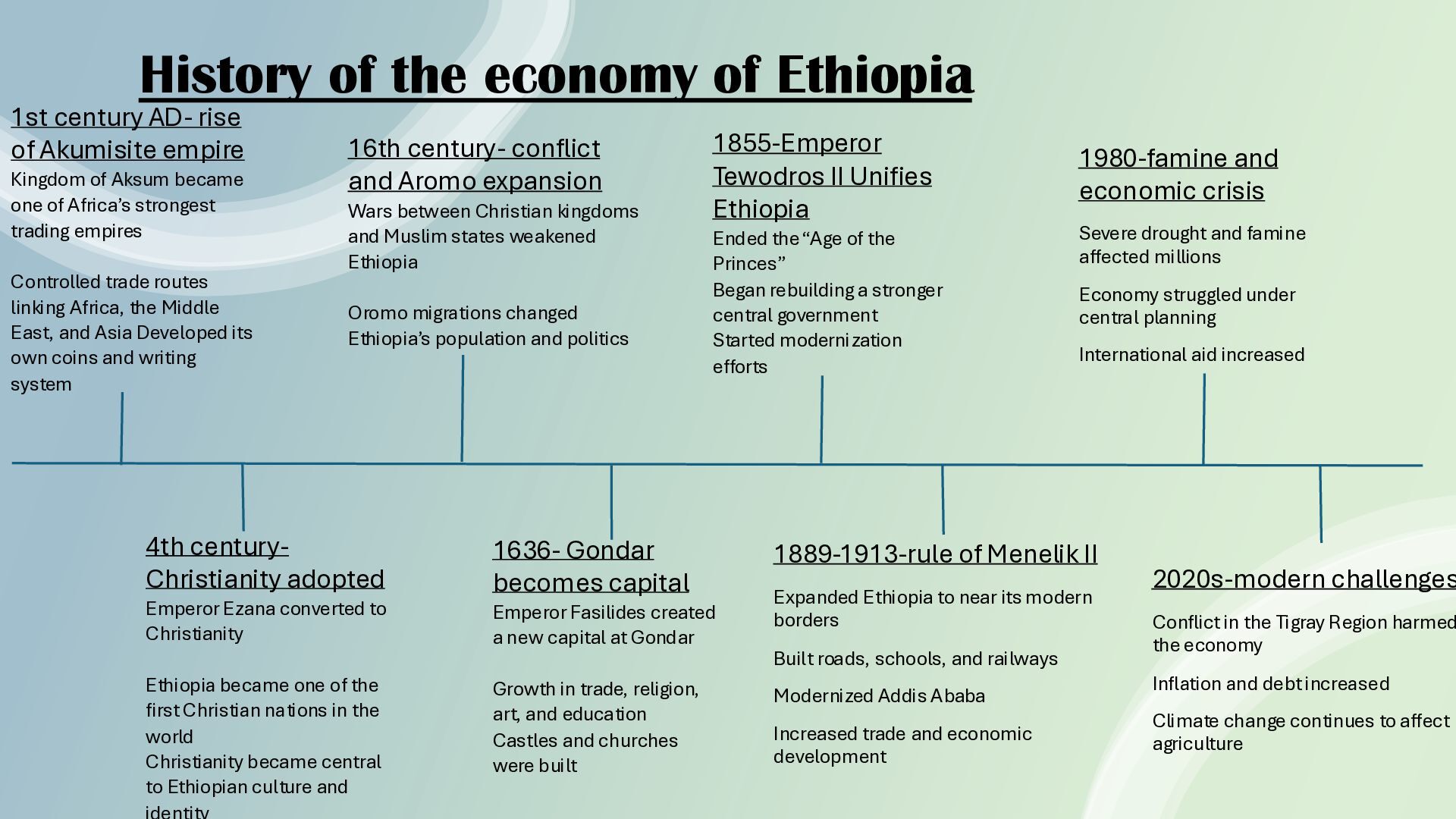
  1. History of the economy of Ethiopia 1st century AD- rise

    of Akumisite empire Kingdom of Aksum became one of Africa’s strongest trading empires Controlled trade routes linking Africa, the Middle East, and Asia Developed its own coins and writing system 4th century- Christianity adopted Emperor Ezana converted to Christianity Ethiopia became one of the first Christian nations in the world Christianity became central to Ethiopian culture and 16th century- conflict and Aromo expansion Wars between Christian kingdoms and Muslim states weakened Ethiopia Oromo migrations changed Ethiopia’s population and politics 1636- Gondar becomes capital Emperor Fasilides created a new capital at Gondar Growth in trade, religion, art, and education Castles and churches were built 1855-Emperor Tewodros II Unifies Ethiopia Ended the “Age of the Princes” Began rebuilding a stronger central government Started modernization efforts 1889-1913-rule of Menelik II Expanded Ethiopia to near its modern borders Built roads, schools, and railways Modernized Addis Ababa Increased trade and economic development 1980-famine and economic crisis Severe drought and famine affected millions Economy struggled under central planning International aid increased 2020s-modern challenges Conflict in the Tigray Region harmed the economy Inflation and debt increased Climate change continues to affect agriculture
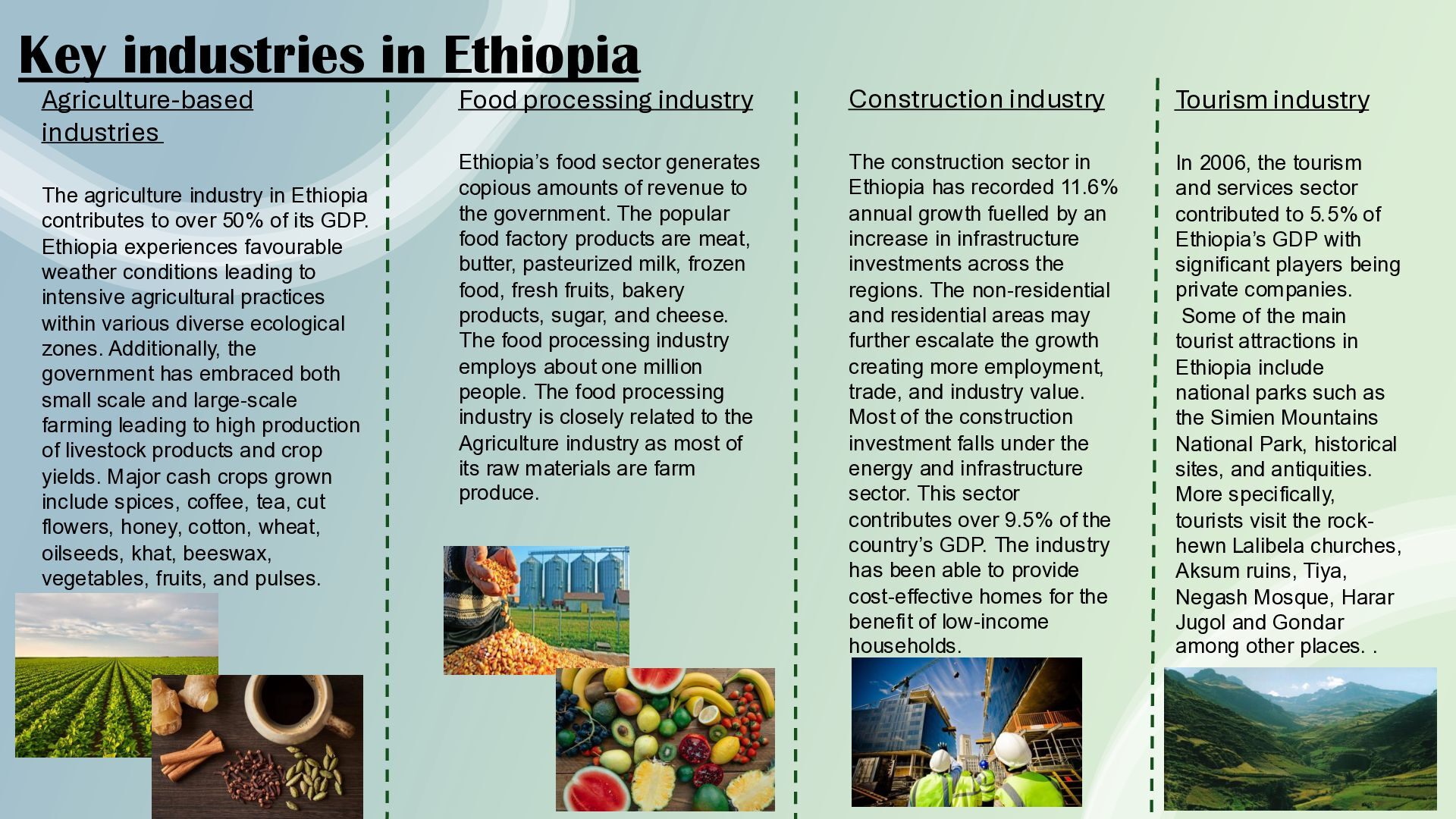
  2. Key industries in Ethiopia Agriculture-based industries The agriculture industry in

    Ethiopia contributes to over 50% of its GDP. Ethiopia experiences favourable weather conditions leading to intensive agricultural practices within various diverse ecological zones. Additionally, the government has embraced both small scale and large-scale farming leading to high production of livestock products and crop yields. Major cash crops grown include spices, coffee, tea, cut flowers, honey, cotton, wheat, oilseeds, khat, beeswax, vegetables, fruits, and pulses. Food processing industry Ethiopia’s food sector generates copious amounts of revenue to the government. The popular food factory products are meat, butter, pasteurized milk, frozen food, fresh fruits, bakery products, sugar, and cheese. The food processing industry employs about one million people. The food processing industry is closely related to the Agriculture industry as most of its raw materials are farm produce. Construction industry The construction sector in Ethiopia has recorded 11.6% annual growth fuelled by an increase in infrastructure investments across the regions. The non-residential and residential areas may further escalate the growth creating more employment, trade, and industry value. Most of the construction investment falls under the energy and infrastructure sector. This sector contributes over 9.5% of the country’s GDP. The industry has been able to provide cost-effective homes for the benefit of low-income households. Tourism industry In 2006, the tourism and services sector contributed to 5.5% of Ethiopia’s GDP with significant players being private companies. Some of the main tourist attractions in Ethiopia include national parks such as the Simien Mountains National Park, historical sites, and antiquities. More specifically, tourists visit the rock- hewn Lalibela churches, Aksum ruins, Tiya, Negash Mosque, Harar Jugol and Gondar among other places. .
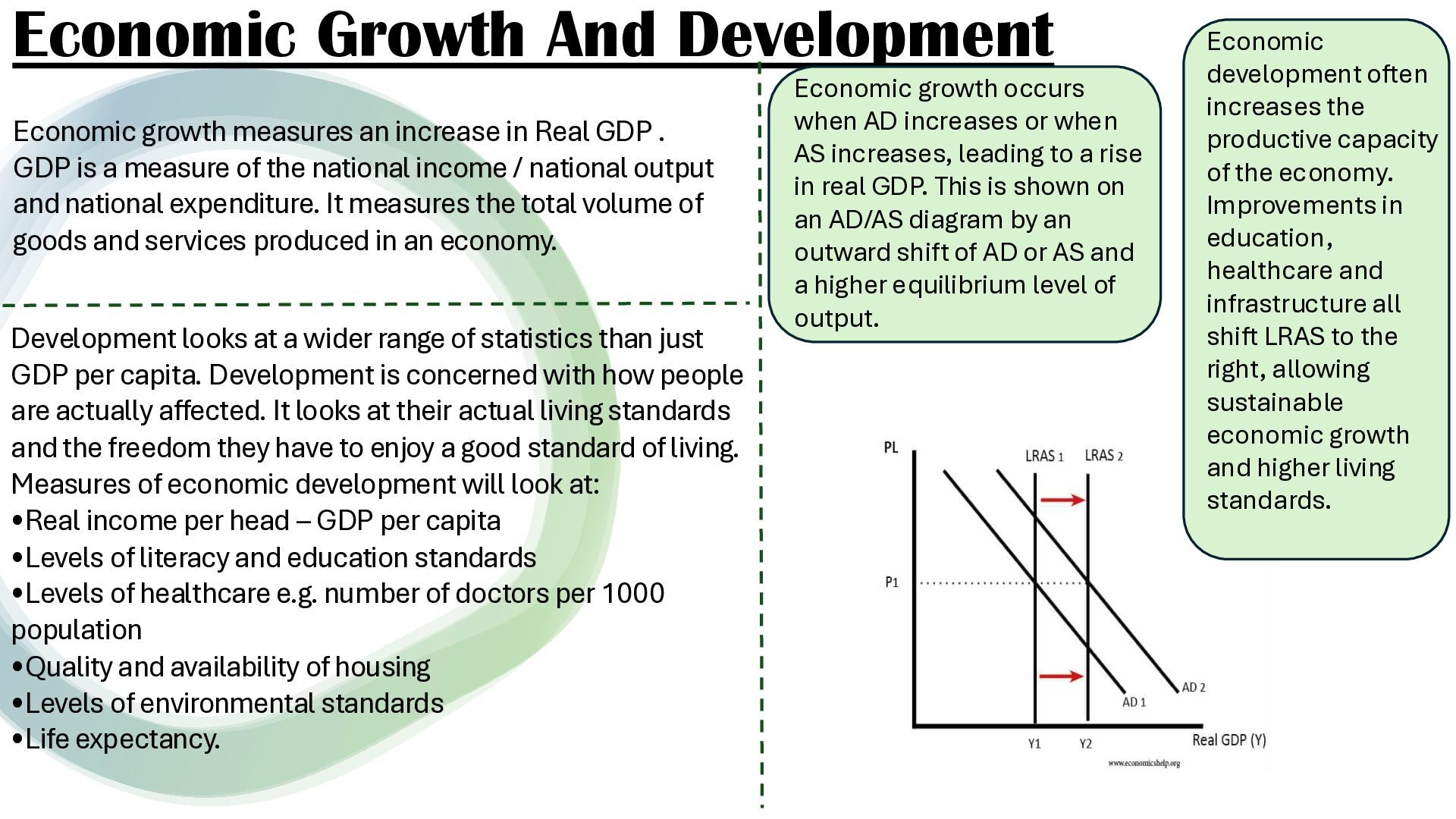
  3. Economic Growth And Development Economic growth measures an increase in

    Real GDP . GDP is a measure of the national income / national output and national expenditure. It measures the total volume of goods and services produced in an economy. Development looks at a wider range of statistics than just GDP per capita. Development is concerned with how people are actually affected. It looks at their actual living standards and the freedom they have to enjoy a good standard of living. Measures of economic development will look at: •Real income per head – GDP per capita •Levels of literacy and education standards •Levels of healthcare e.g. number of doctors per 1000 population •Quality and availability of housing •Levels of environmental standards •Life expectancy. Economic growth occurs when AD increases or when AS increases, leading to a rise in real GDP. This is shown on an AD/AS diagram by an outward shift of AD or AS and a higher equilibrium level of output. Economic development often increases the productive capacity of the economy. Improvements in education, healthcare and infrastructure all shift LRAS to the right, allowing sustainable economic growth and higher living standards.
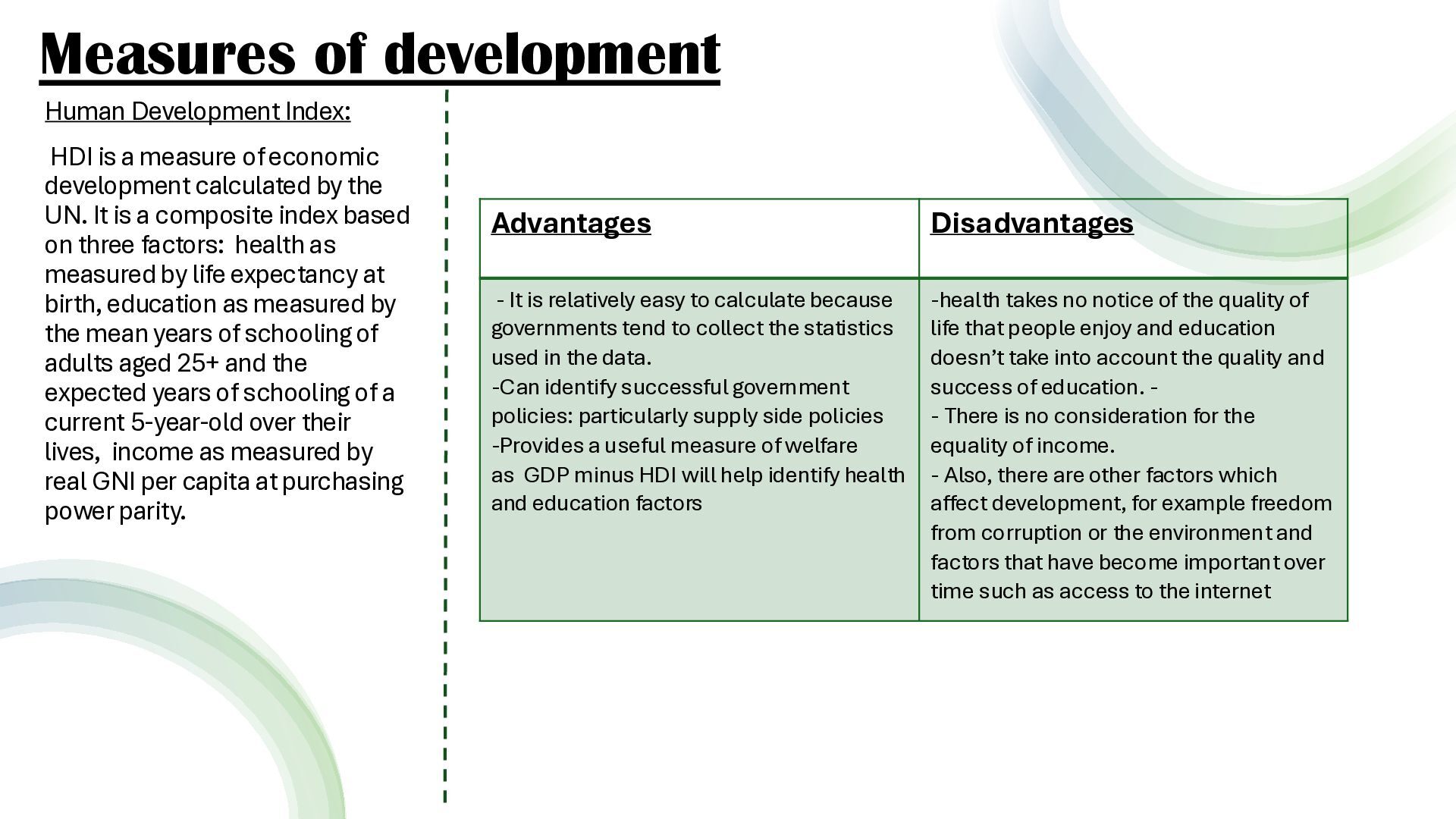
  4. Measures of development Human Development Index: HDI is a measure

    of economic development calculated by the UN. It is a composite index based on three factors: health as measured by life expectancy at birth, education as measured by the mean years of schooling of adults aged 25+ and the expected years of schooling of a current 5-year-old over their lives, income as measured by real GNI per capita at purchasing power parity. Advantages Disadvantages - It is relatively easy to calculate because governments tend to collect the statistics used in the data. -Can identify successful government policies: particularly supply side policies -Provides a useful measure of welfare as GDP minus HDI will help identify health and education factors -health takes no notice of the quality of life that people enjoy and education doesn’t take into account the quality and success of education. - - There is no consideration for the equality of income. - Also, there are other factors which affect development, for example freedom from corruption or the environment and factors that have become important over time such as access to the internet
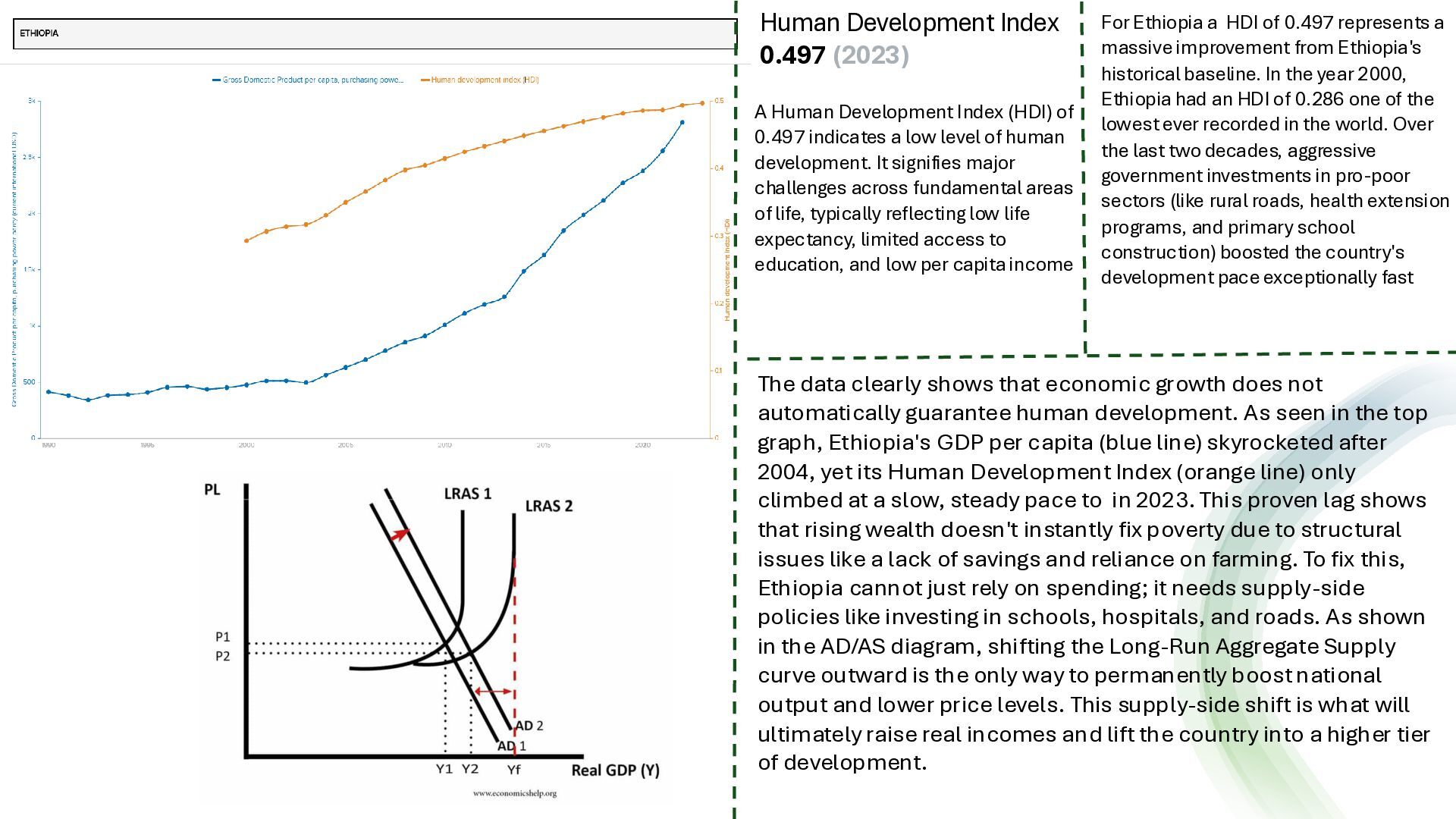
  5. Human Development Index 0.497 (2023) A Human Development Index (HDI)

    of 0.497 indicates a low level of human development. It signifies major challenges across fundamental areas of life, typically reflecting low life expectancy, limited access to education, and low per capita income For Ethiopia a HDI of 0.497 represents a massive improvement from Ethiopia's historical baseline. In the year 2000, Ethiopia had an HDI of 0.286 one of the lowest ever recorded in the world. Over the last two decades, aggressive government investments in pro-poor sectors (like rural roads, health extension programs, and primary school construction) boosted the country's development pace exceptionally fast The data clearly shows that economic growth does not automatically guarantee human development. As seen in the top graph, Ethiopia's GDP per capita (blue line) skyrocketed after 2004, yet its Human Development Index (orange line) only climbed at a slow, steady pace to in 2023. This proven lag shows that rising wealth doesn't instantly fix poverty due to structural issues like a lack of savings and reliance on farming. To fix this, Ethiopia cannot just rely on spending; it needs supply-side policies like investing in schools, hospitals, and roads. As shown in the AD/AS diagram, shifting the Long-Run Aggregate Supply curve outward is the only way to permanently boost national output and lower price levels. This supply-side shift is what will ultimately raise real incomes and lift the country into a higher tier of development.
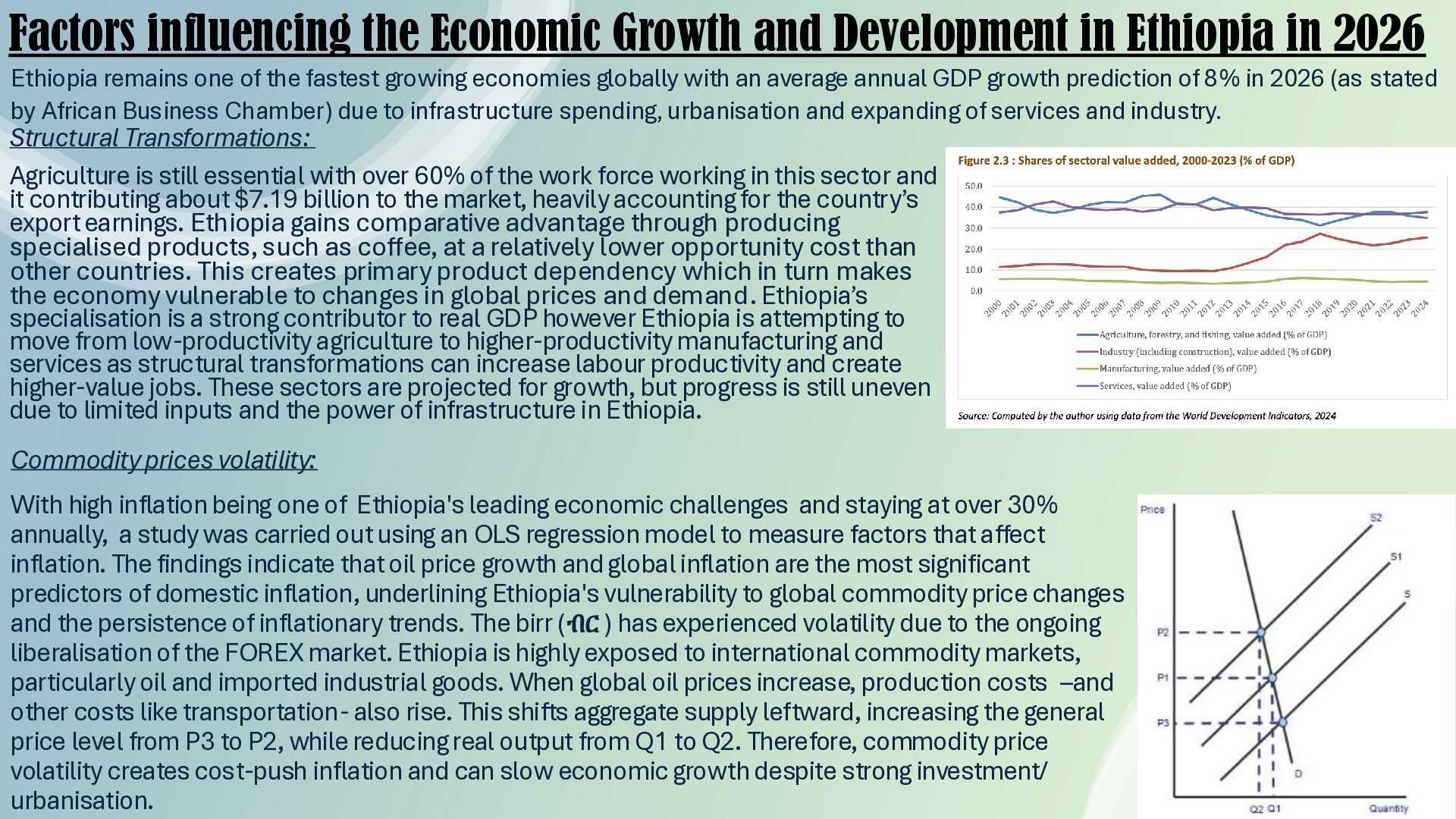
  6. Factors influencing the Economic Growth and Development in Ethiopia in

    2026 Structural Transformations: Agriculture is still essential with over 60% of the work force working in this sector and it contributing about $7.19 billion to the market, heavily accounting for the country’s export earnings. Ethiopia gains comparative advantage through producing specialised products, such as coffee, at a relatively lower opportunity cost than other countries. This creates primary product dependency which in turn makes the economy vulnerable to changes in global prices and demand. Ethiopia’s specialisation is a strong contributor to real GDP however Ethiopia is attempting to move from low-productivity agriculture to higher-productivity manufacturing and services as structural transformations can increase labour productivity and create higher-value jobs. These sectors are projected for growth, but progress is still uneven due to limited inputs and the power of infrastructure in Ethiopia. Commodity prices volatility: With high inflation being one of Ethiopia's leading economic challenges and staying at over 30% annually, a study was carried out using an OLS regression model to measure factors that affect inflation. The findings indicate that oil price growth and global inflation are the most significant predictors of domestic inflation, underlining Ethiopia's vulnerability to global commodity price changes and the persistence of inflationary trends. The birr (ብር ) has experienced volatility due to the ongoing liberalisation of the FOREX market. Ethiopia is highly exposed to international commodity markets, particularly oil and imported industrial goods. When global oil prices increase, production costs –and other costs like transportation- also rise. This shifts aggregate supply leftward, increasing the general price level from P3 to P2, while reducing real output from Q1 to Q2. Therefore, commodity price volatility creates cost-push inflation and can slow economic growth despite strong investment/ urbanisation. Ethiopia remains one of the fastest growing economies globally with an average annual GDP growth prediction of 8% in 2026 (as stated by African Business Chamber) due to infrastructure spending, urbanisation and expanding of services and industry.
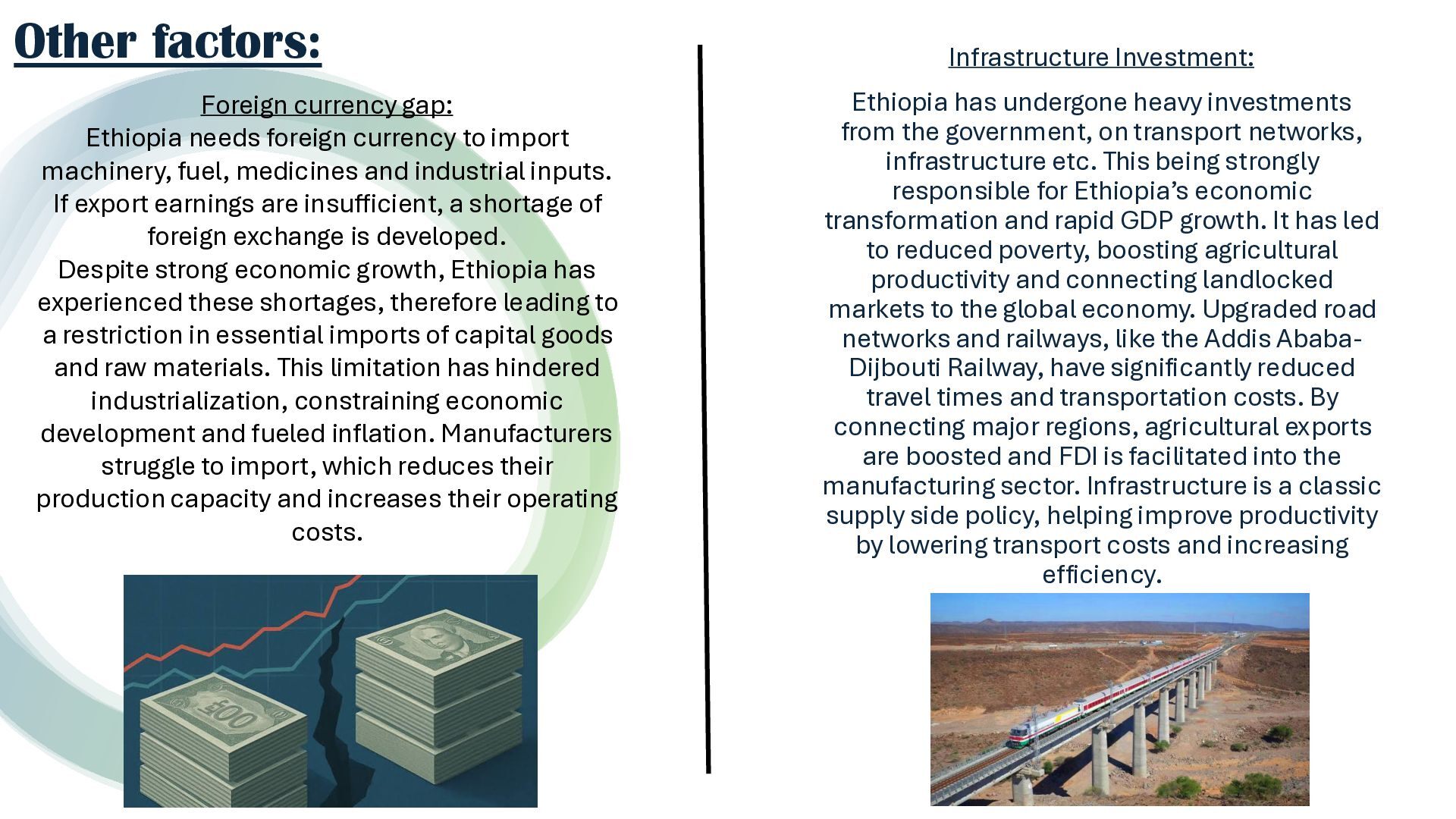
  7. Other factors: Infrastructure Investment: Ethiopia has undergone heavy investments from

    the government, on transport networks, infrastructure etc. This being strongly responsible for Ethiopia’s economic transformation and rapid GDP growth. It has led to reduced poverty, boosting agricultural productivity and connecting landlocked markets to the global economy. Upgraded road networks and railways, like the Addis Ababa- Dijbouti Railway, have significantly reduced travel times and transportation costs. By connecting major regions, agricultural exports are boosted and FDI is facilitated into the manufacturing sector. Infrastructure is a classic supply side policy, helping improve productivity by lowering transport costs and increasing efficiency. Foreign currency gap: Ethiopia needs foreign currency to import machinery, fuel, medicines and industrial inputs. If export earnings are insufficient, a shortage of foreign exchange is developed. Despite strong economic growth, Ethiopia has experienced these shortages, therefore leading to a restriction in essential imports of capital goods and raw materials. This limitation has hindered industrialization, constraining economic development and fueled inflation. Manufacturers struggle to import, which reduces their production capacity and increases their operating costs.
  8. How well is Ethiopia using Strategies to achieve Economic Growth

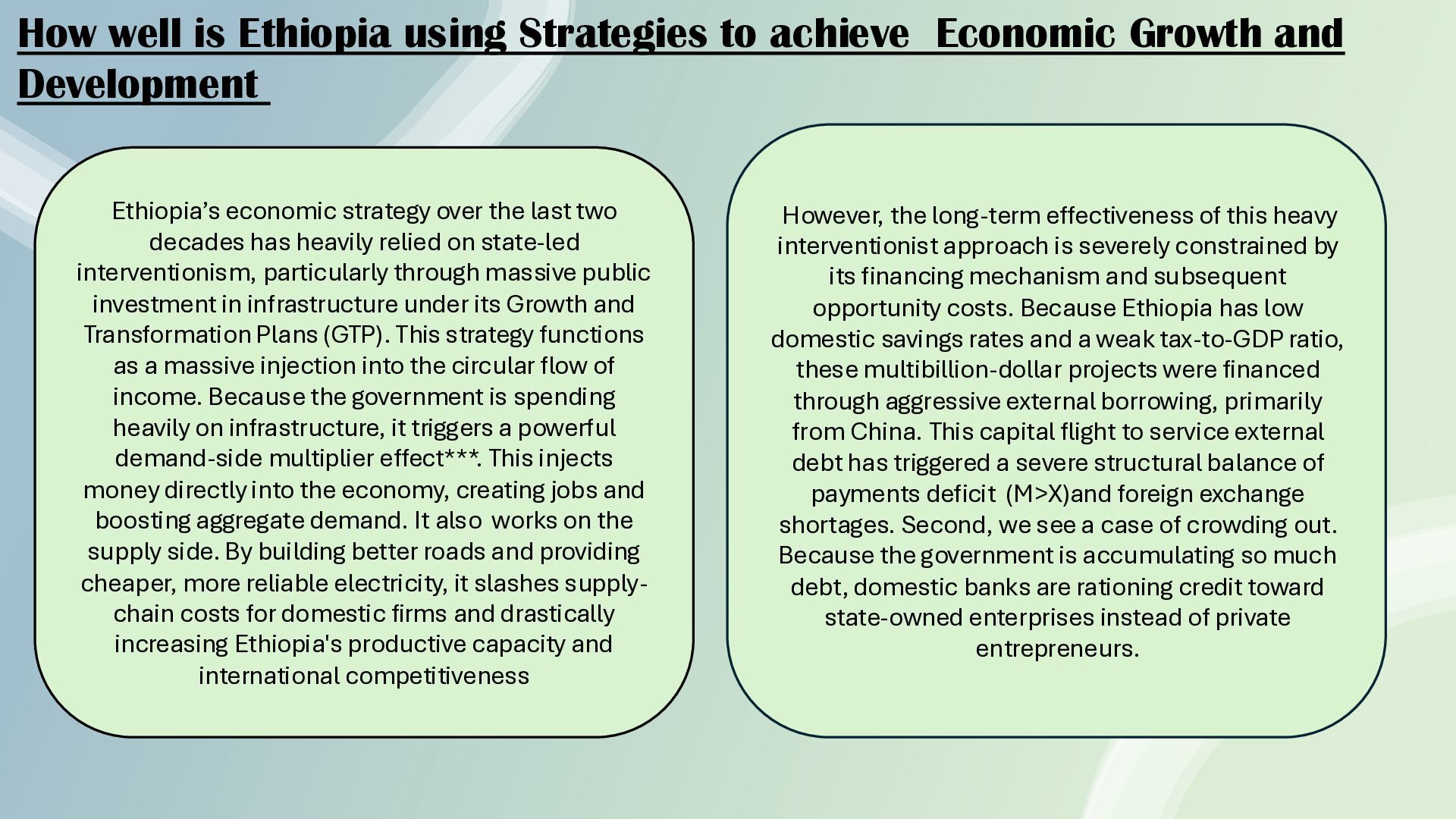
    and Development Ethiopia’s economic strategy over the last two decades has heavily relied on state-led interventionism, particularly through massive public investment in infrastructure under its Growth and Transformation Plans (GTP). This strategy functions as a massive injection into the circular flow of income. Because the government is spending heavily on infrastructure, it triggers a powerful demand-side multiplier effect***. This injects money directly into the economy, creating jobs and boosting aggregate demand. It also works on the supply side. By building better roads and providing cheaper, more reliable electricity, it slashes supply- chain costs for domestic firms and drastically increasing Ethiopia's productive capacity and international competitiveness However, the long-term effectiveness of this heavy interventionist approach is severely constrained by its financing mechanism and subsequent opportunity costs. Because Ethiopia has low domestic savings rates and a weak tax-to-GDP ratio, these multibillion-dollar projects were financed through aggressive external borrowing, primarily from China. This capital flight to service external debt has triggered a severe structural balance of payments deficit (M>X)and foreign exchange shortages. Second, we see a case of crowding out. Because the government is accumulating so much debt, domestic banks are rationing credit toward state-owned enterprises instead of private entrepreneurs.
  9. Ethiopia has tried to attract Foreign Direct Investment (FDI). To

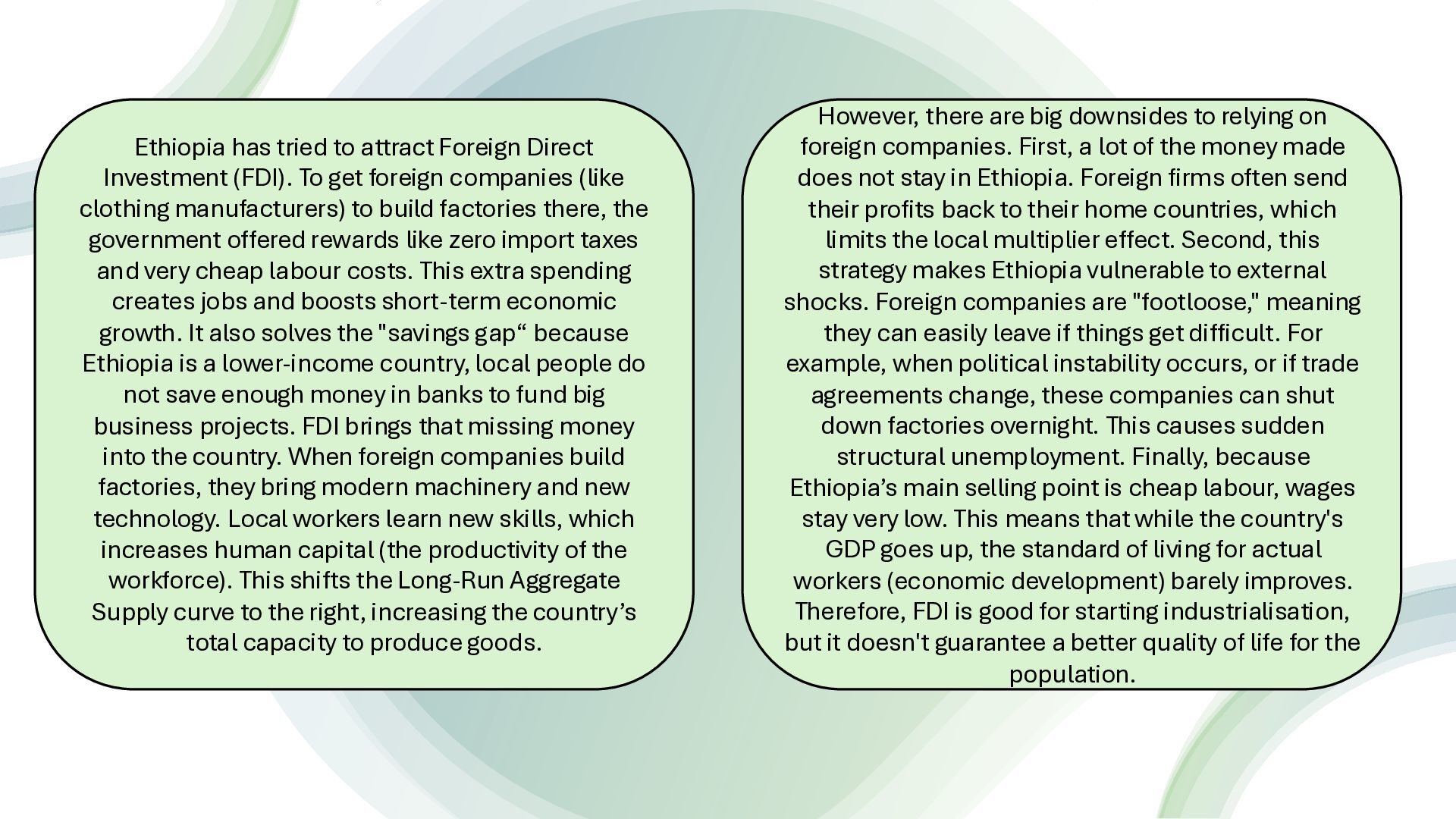
    get foreign companies (like clothing manufacturers) to build factories there, the government offered rewards like zero import taxes and very cheap labour costs. This extra spending creates jobs and boosts short-term economic growth. It also solves the "savings gap“ because Ethiopia is a lower-income country, local people do not save enough money in banks to fund big business projects. FDI brings that missing money into the country. When foreign companies build factories, they bring modern machinery and new technology. Local workers learn new skills, which increases human capital (the productivity of the workforce). This shifts the Long-Run Aggregate Supply curve to the right, increasing the country’s total capacity to produce goods. However, there are big downsides to relying on foreign companies. First, a lot of the money made does not stay in Ethiopia. Foreign firms often send their profits back to their home countries, which limits the local multiplier effect. Second, this strategy makes Ethiopia vulnerable to external shocks. Foreign companies are "footloose," meaning they can easily leave if things get difficult. For example, when political instability occurs, or if trade agreements change, these companies can shut down factories overnight. This causes sudden structural unemployment. Finally, because Ethiopia’s main selling point is cheap labour, wages stay very low. This means that while the country's GDP goes up, the standard of living for actual workers (economic development) barely improves. Therefore, FDI is good for starting industrialisation, but it doesn't guarantee a better quality of life for the population.
  10. Conclusion- will economic development accelerate in the next 5-10 years?

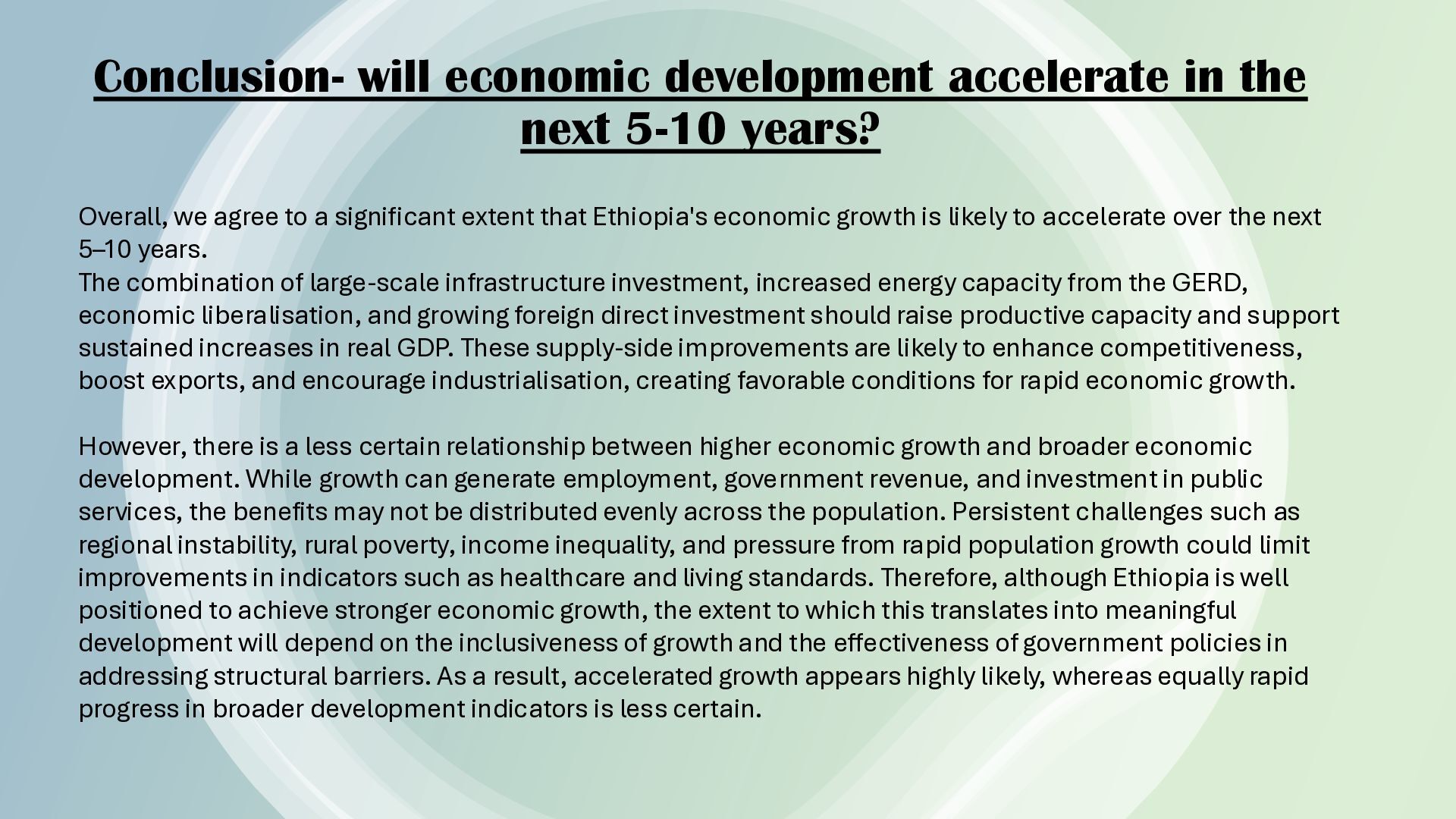
    Overall, we agree to a significant extent that Ethiopia's economic growth is likely to accelerate over the next 5–10 years. The combination of large-scale infrastructure investment, increased energy capacity from the GERD, economic liberalisation, and growing foreign direct investment should raise productive capacity and support sustained increases in real GDP. These supply-side improvements are likely to enhance competitiveness, boost exports, and encourage industrialisation, creating favorable conditions for rapid economic growth. However, there is a less certain relationship between higher economic growth and broader economic development. While growth can generate employment, government revenue, and investment in public services, the benefits may not be distributed evenly across the population. Persistent challenges such as regional instability, rural poverty, income inequality, and pressure from rapid population growth could limit improvements in indicators such as healthcare and living standards. Therefore, although Ethiopia is well positioned to achieve stronger economic growth, the extent to which this translates into meaningful development will depend on the inclusiveness of growth and the effectiveness of government policies in addressing structural barriers. As a result, accelerated growth appears highly likely, whereas equally rapid progress in broader development indicators is less certain.