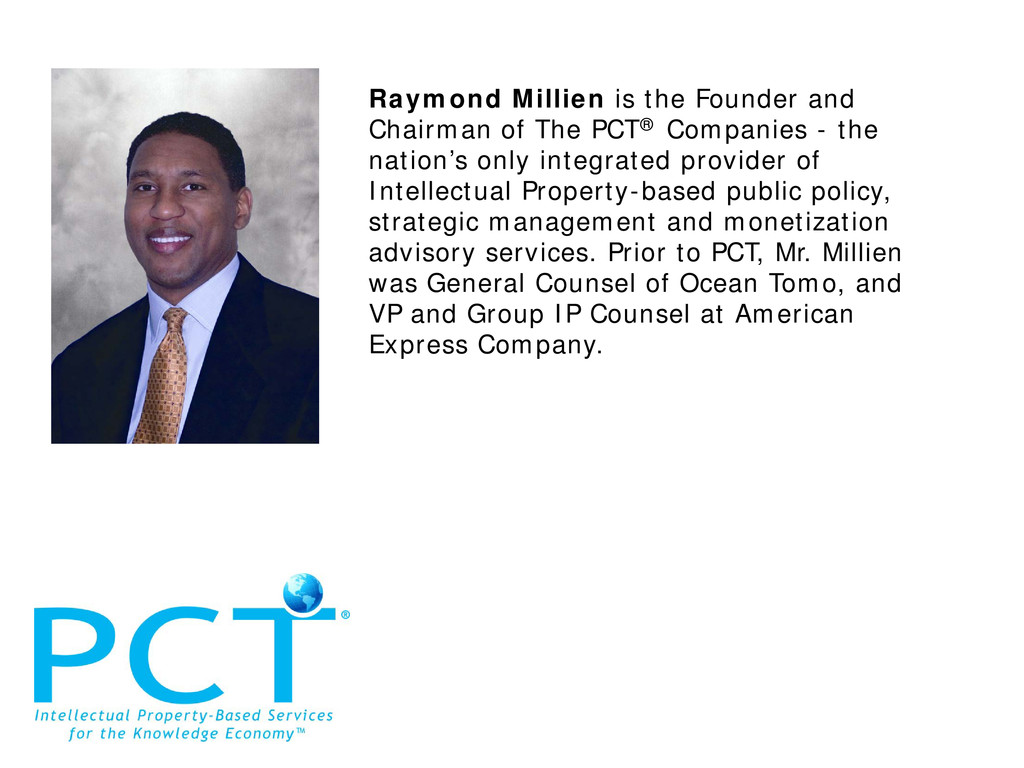
Companies - the nation’s only integrated provider of Intellectual Property-based public policy, strategic management and monetization advisory services. Prior to PCT, Mr. Millien was General Counsel of Ocean Tomo, and VP and Group IP Counsel at American Express Company.
Prior to RPX he established Terrier IP Investments, LLC, a private investment firm focused on intellectual property-based investments in firms backed by hedge funds and private equity. He began his career working as an investment banker on Wall Street, has practiced intellectual property law for Kirkland & Ellis, and has significant intellectual property transaction experience as co-founder and CEO of River West Brands LLC as well as positions at Ocean Tomo and Altitude Capital Partners.
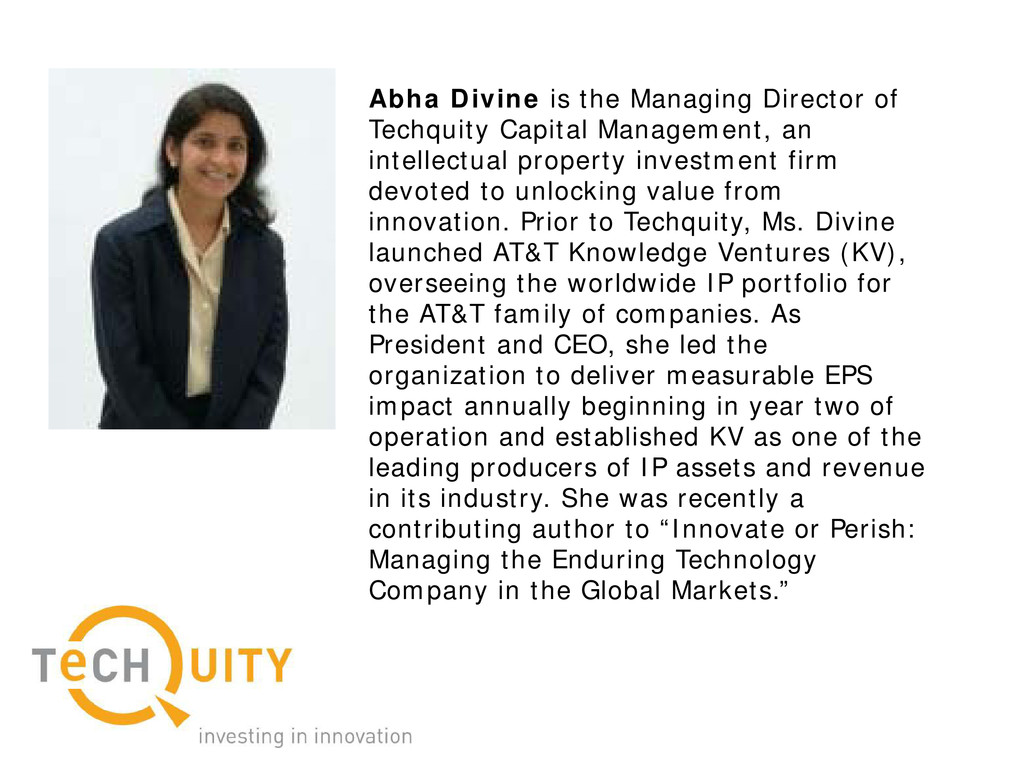
an intellectual property investment firm devoted to unlocking value from innovation. Prior to Techquity, Ms. Divine launched AT&T Knowledge Ventures (KV), overseeing the worldwide IP portfolio for the AT&T family of companies. As President and CEO, she led the organization to deliver measurable EPS impact annually beginning in year two of operation and established KV as one of the leading producers of IP assets and revenue in its industry. She was recently a contributing author to “Innovate or Perish: Managing the Enduring Technology Company in the Global Markets.”
very inefficient marketplace Historically, potential sellers of IP rights have been unable to access a large quantity of buyers who are willing to pay a predictable price under an agreed-upon set of conditions Traditionally, IP transactions are characterized by difficult acquirer identification, long periods of negotiations and endless due diligence activities Lack of Widely-Accepted Valuations The “Problem” with Transacting IP
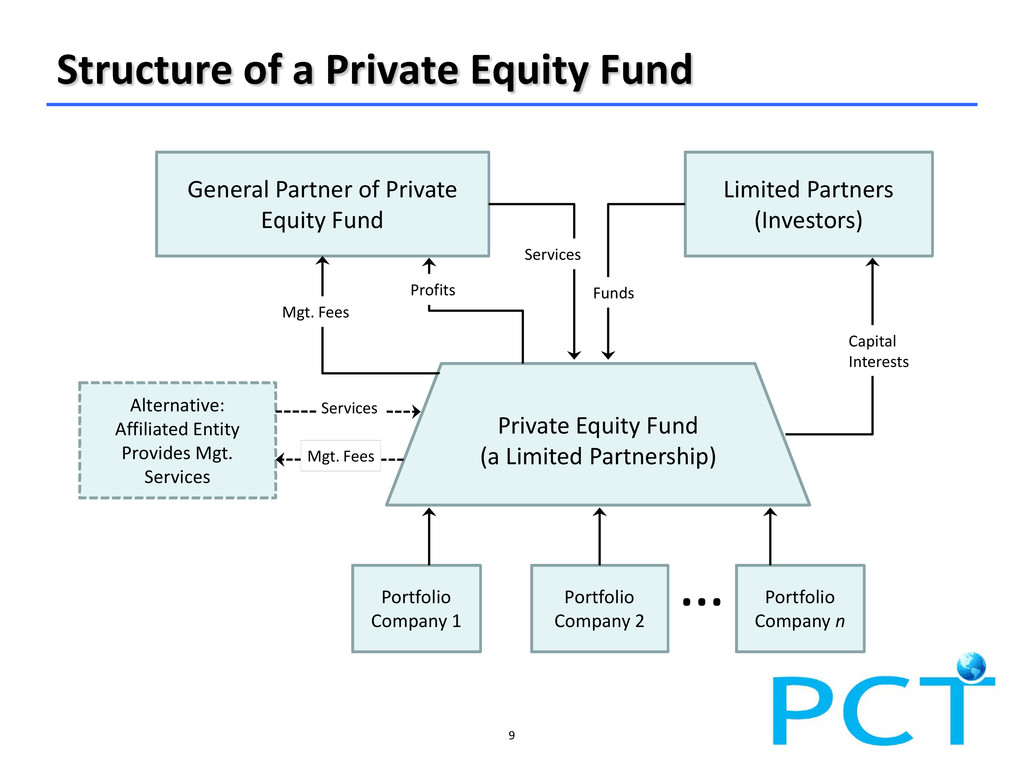
Alternative: Affiliated Entity Provides Mgt. Services Private Equity Fund (a Limited Partnership) Portfolio Company 2 Portfolio Company 1 Portfolio Company n … General Partner of Private Equity Fund Services Funds Profits Capital Interests Services Mgt. Fees Mgt. Fees
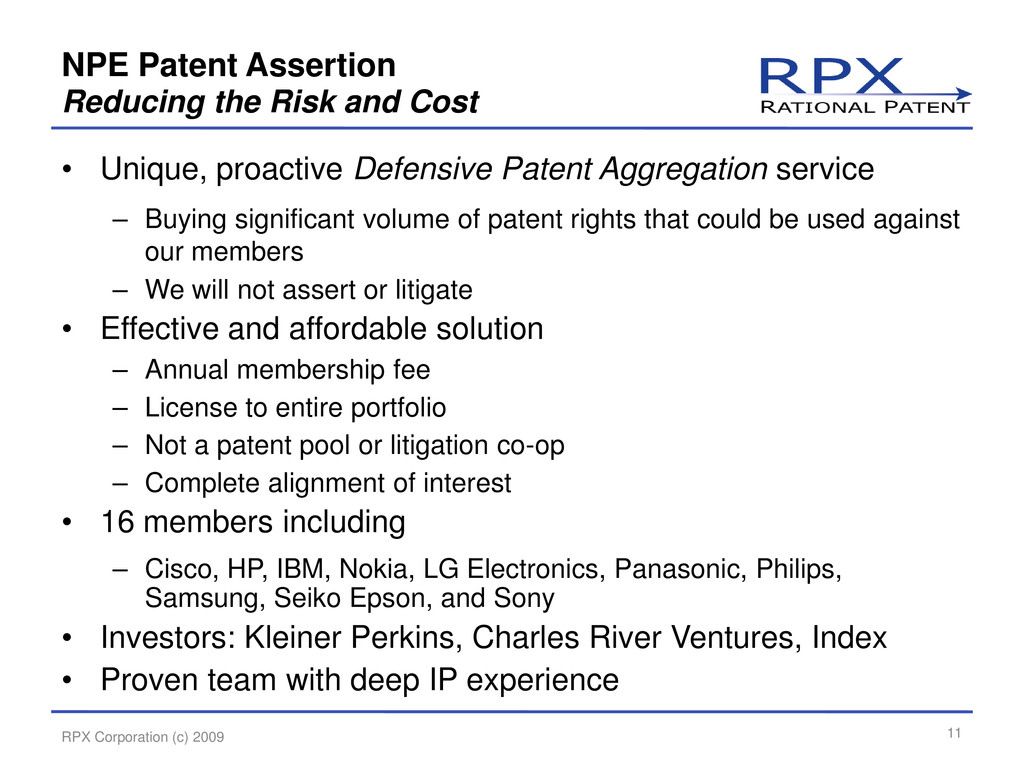
– Buying significant volume of patent rights that could be used against our members – We will not assert or litigate • Effective and affordable solution – Annual membership fee – License to entire portfolio – Not a patent pool or litigation co-op – Complete alignment of interest • 16 members including – Cisco, HP, IBM, Nokia, LG Electronics, Panasonic, Philips, Samsung, Seiko Epson, and Sony • Investors: Kleiner Perkins, Charles River Ventures, Index • Proven team with deep IP experience RPX Corporation (c) 2009 11 Reducing the Risk and Cost
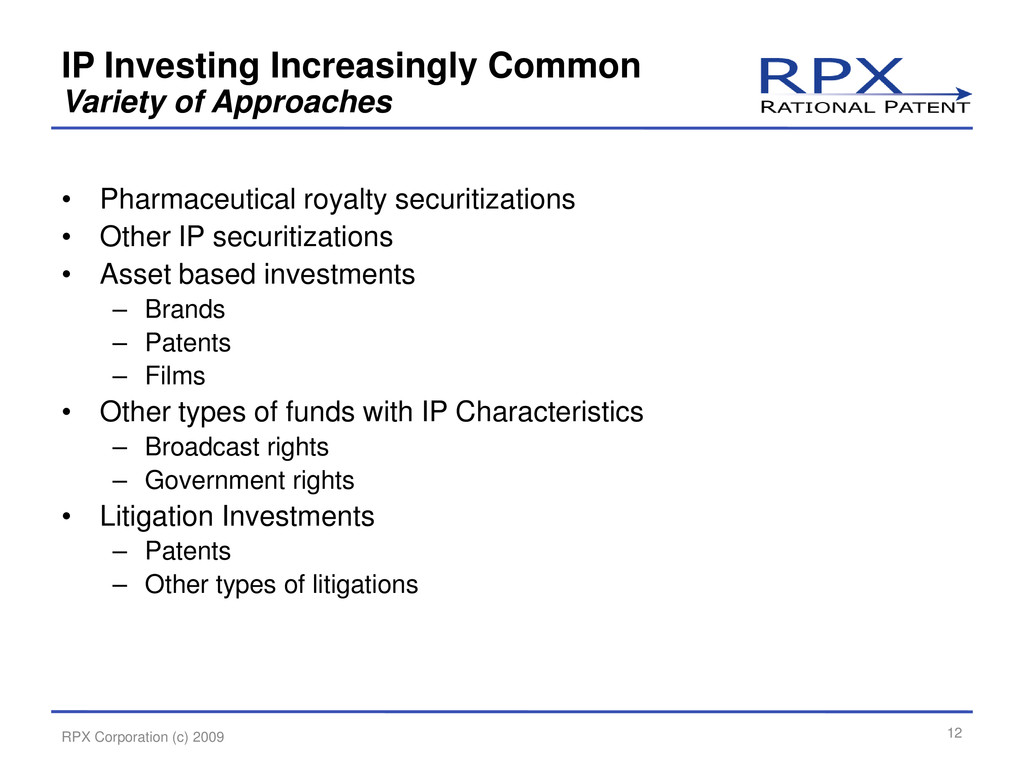
IP securitizations • Asset based investments – Brands – Patents – Films • Other types of funds with IP Characteristics – Broadcast rights – Government rights • Litigation Investments – Patents – Other types of litigations Variety of Approaches RPX Corporation (c) 2009 12
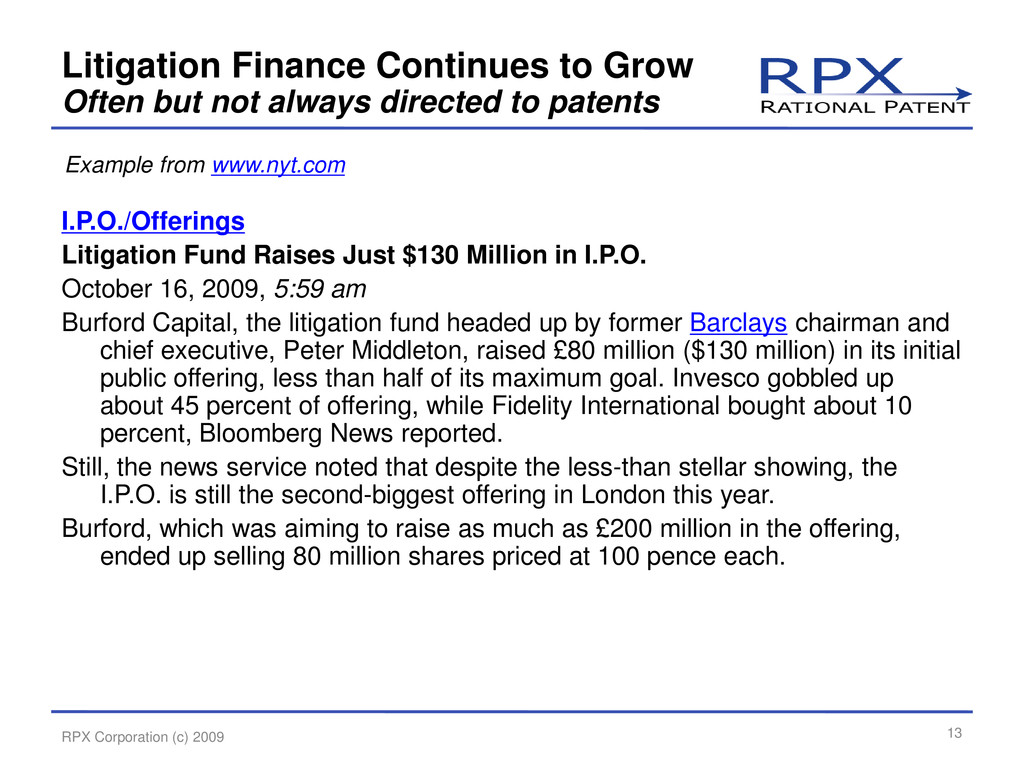
$130 Million in I.P.O. October 16, 2009, 5:59 am Burford Capital, the litigation fund headed up by former Barclays chairman and chief executive, Peter Middleton, raised £80 million ($130 million) in its initial public offering, less than half of its maximum goal. Invesco gobbled up about 45 percent of offering, while Fidelity International bought about 10 percent, Bloomberg News reported. Still, the news service noted that despite the less-than stellar showing, the I.P.O. is still the second-biggest offering in London this year. Burford, which was aiming to raise as much as £200 million in the offering, ended up selling 80 million shares priced at 100 pence each. Often but not always directed to patents RPX Corporation (c) 2009 13 Example from www.nyt.com
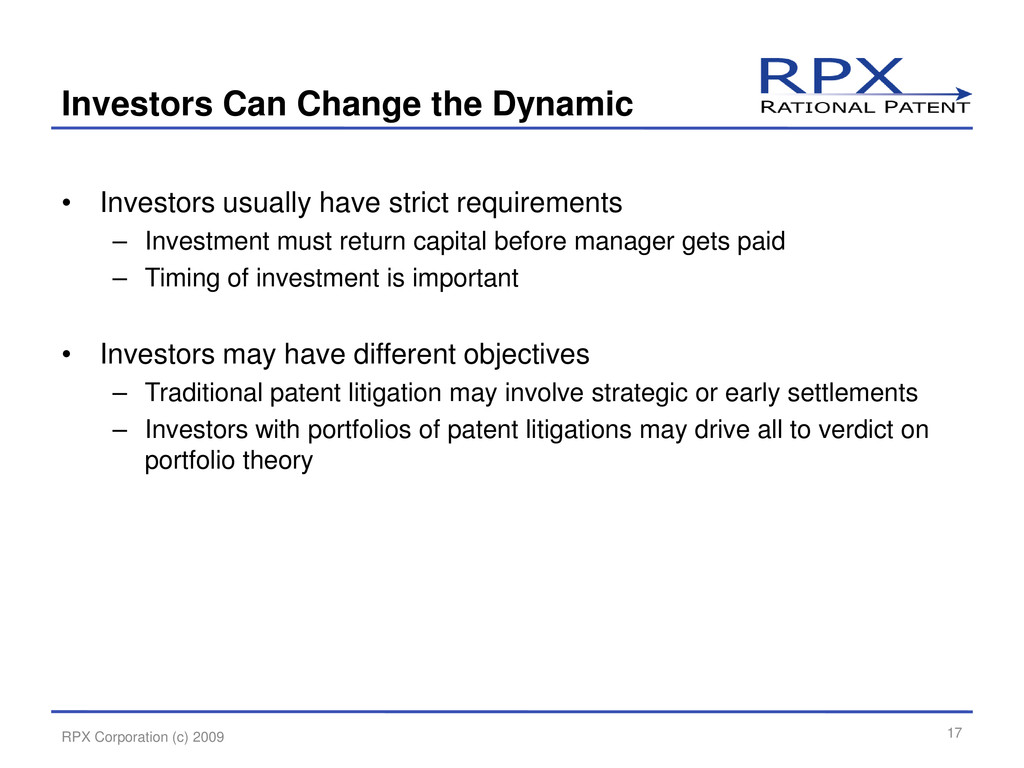
requirements – Investment must return capital before manager gets paid – Timing of investment is important • Investors may have different objectives – Traditional patent litigation may involve strategic or early settlements – Investors with portfolios of patent litigations may drive all to verdict on portfolio theory RPX Corporation (c) 2009 17
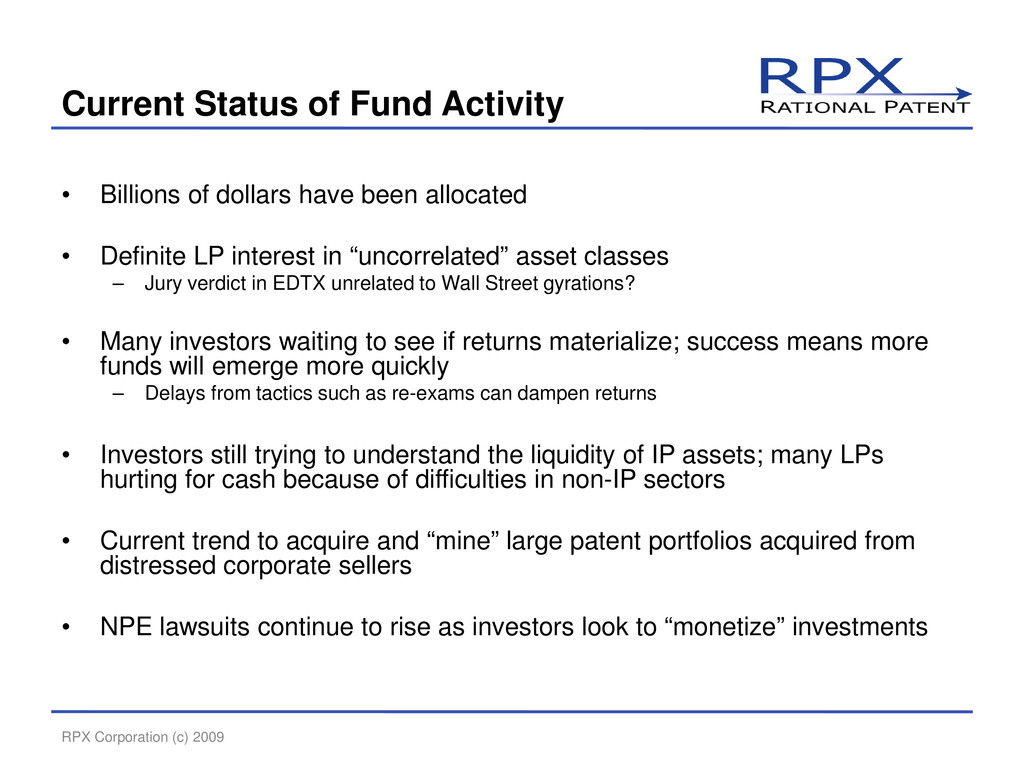
been allocated • Definite LP interest in “uncorrelated” asset classes – Jury verdict in EDTX unrelated to Wall Street gyrations? • Many investors waiting to see if returns materialize; success means more funds will emerge more quickly – Delays from tactics such as re-exams can dampen returns • Investors still trying to understand the liquidity of IP assets; many LPs hurting for cash because of difficulties in non-IP sectors • Current trend to acquire and “mine” large patent portfolios acquired from distressed corporate sellers • NPE lawsuits continue to rise as investors look to “monetize” investments RPX Corporation (c) 2009
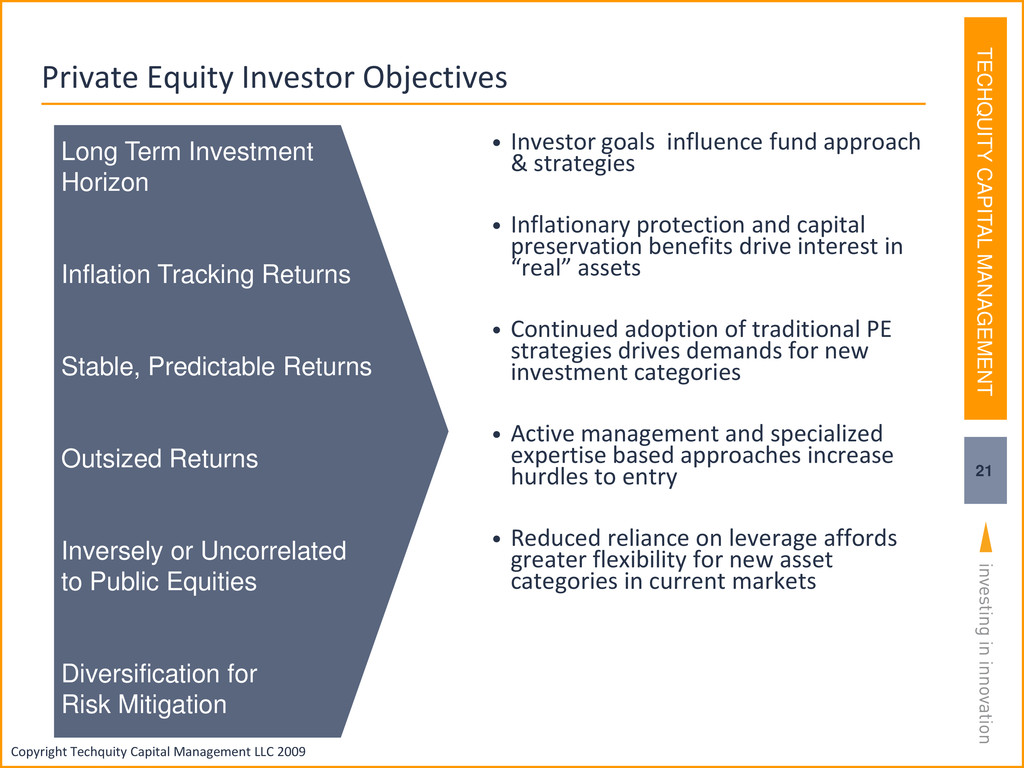
Private Equity Investor Objectives • Investor goals influence fund approach & strategies • Inflationary protection and capital preservation benefits drive interest in “real” assets • Continued adoption of traditional PE strategies drives demands for new investment categories • Active management and specialized expertise based approaches increase hurdles to entry • Reduced reliance on leverage affords greater flexibility for new asset categories in current markets Long Term Investment Horizon Inflation Tracking Returns Stable, Predictable Returns Outsized Returns Inversely or Uncorrelated to Public Equities Diversification for Risk Mitigation
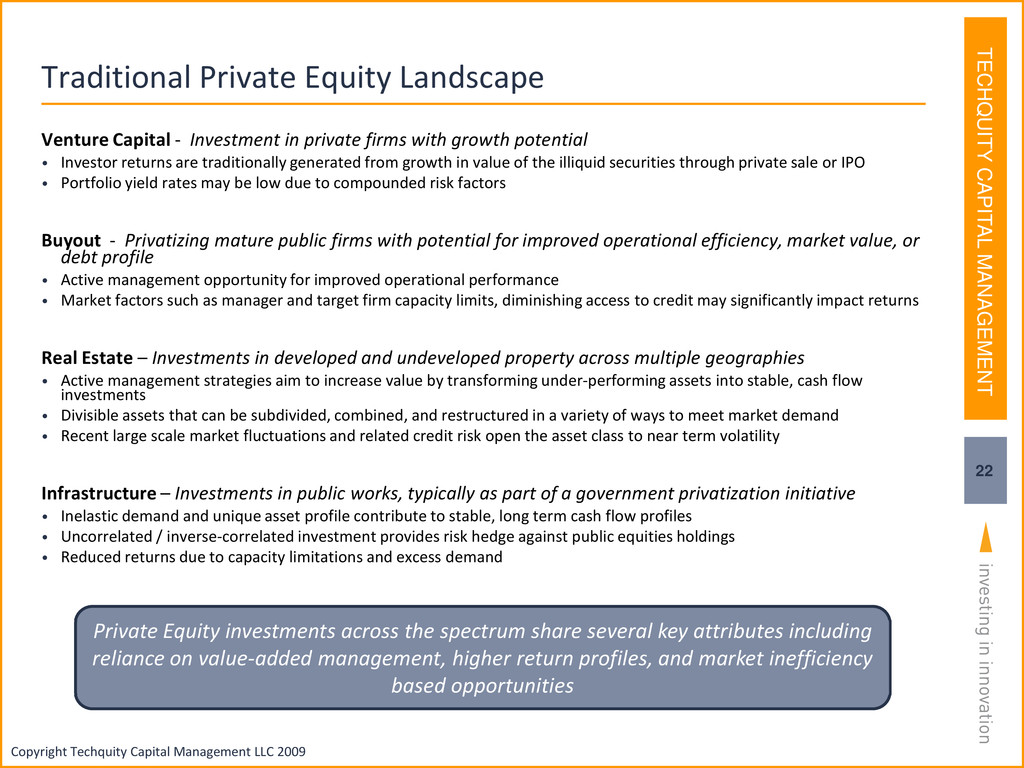
Traditional Private Equity Landscape Venture Capital - Investment in private firms with growth potential • Investor returns are traditionally generated from growth in value of the illiquid securities through private sale or IPO • Portfolio yield rates may be low due to compounded risk factors Buyout - Privatizing mature public firms with potential for improved operational efficiency, market value, or debt profile • Active management opportunity for improved operational performance • Market factors such as manager and target firm capacity limits, diminishing access to credit may significantly impact returns Real Estate – Investments in developed and undeveloped property across multiple geographies • Active management strategies aim to increase value by transforming under-performing assets into stable, cash flow investments • Divisible assets that can be subdivided, combined, and restructured in a variety of ways to meet market demand • Recent large scale market fluctuations and related credit risk open the asset class to near term volatility Infrastructure – Investments in public works, typically as part of a government privatization initiative • Inelastic demand and unique asset profile contribute to stable, long term cash flow profiles • Uncorrelated / inverse-correlated investment provides risk hedge against public equities holdings • Reduced returns due to capacity limitations and excess demand Private Equity investments across the spectrum share several key attributes including reliance on value-added management, higher return profiles, and market inefficiency based opportunities
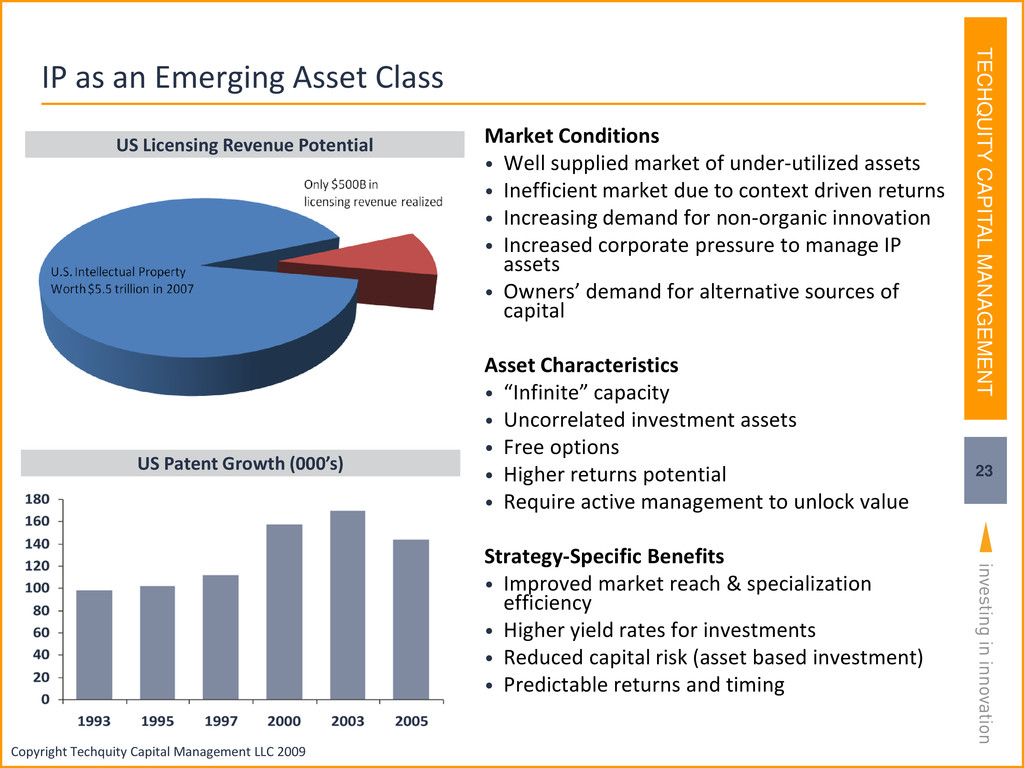
IP as an Emerging Asset Class US Patent Growth (000’s) US Licensing Revenue Potential Market Conditions • Well supplied market of under-utilized assets • Inefficient market due to context driven returns • Increasing demand for non-organic innovation • Increased corporate pressure to manage IP assets • Owners’ demand for alternative sources of capital Asset Characteristics • “Infinite” capacity • Uncorrelated investment assets • Free options • Higher returns potential • Require active management to unlock value Strategy-Specific Benefits • Improved market reach & specialization efficiency • Higher yield rates for investments • Reduced capital risk (asset based investment) • Predictable returns and timing
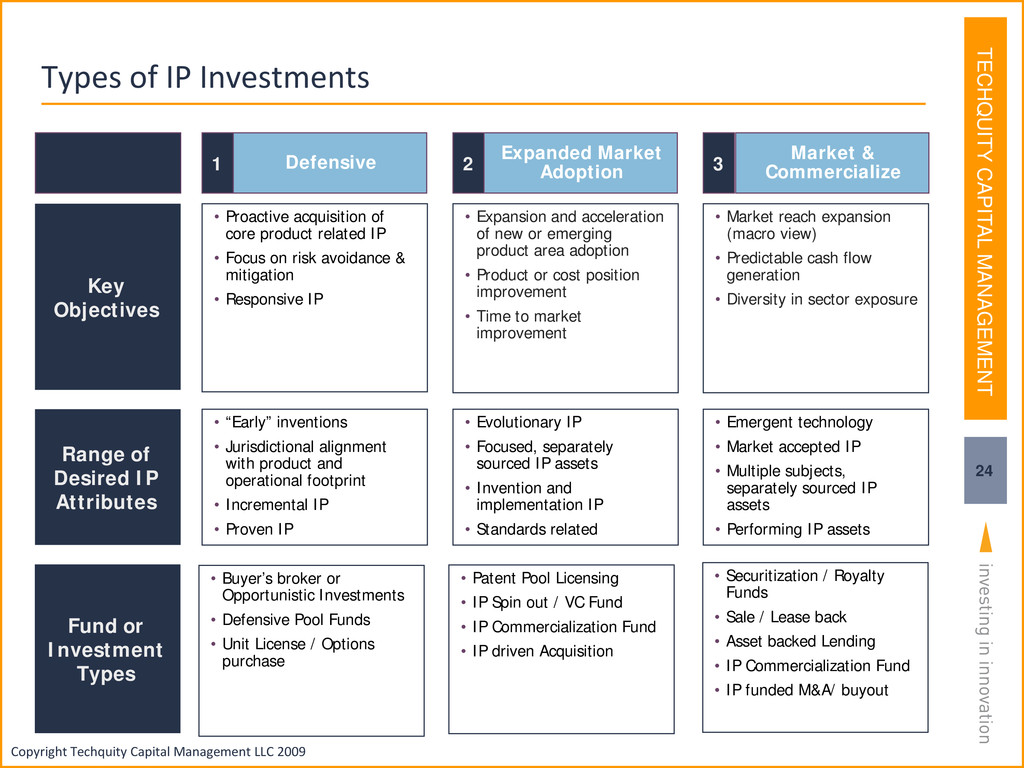
Types of IP Investments Defensive Expanded Market Adoption Market & Commercialize Key Objectives Range of Desired IP Attributes • Expansion and acceleration of new or emerging product area adoption • Product or cost position improvement • Time to market improvement • Market reach expansion (macro view) • Predictable cash flow generation • Diversity in sector exposure 1 2 3 • Proactive acquisition of core product related IP • Focus on risk avoidance & mitigation • Responsive IP • “Early” inventions • Jurisdictional alignment with product and operational footprint • Incremental IP • Proven IP • Evolutionary IP • Focused, separately sourced IP assets • Invention and implementation IP • Standards related • Emergent technology • Market accepted IP • Multiple subjects, separately sourced IP assets • Performing IP assets Fund or Investment Types • Buyer’s broker or Opportunistic Investments • Defensive Pool Funds • Unit License / Options purchase • Patent Pool Licensing • IP Spin out / VC Fund • IP Commercialization Fund • IP driven Acquisition • Securitization / Royalty Funds • Sale / Lease back • Asset backed Lending • IP Commercialization Fund • IP funded M&A/ buyout
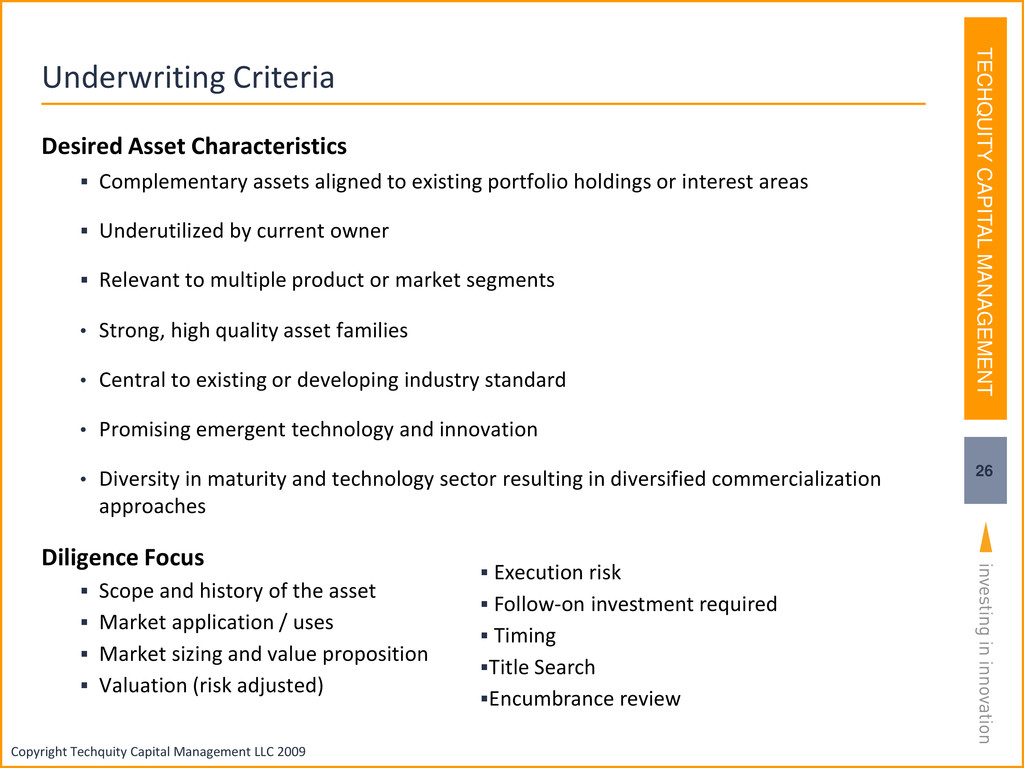
Underwriting Criteria Desired Asset Characteristics Complementary assets aligned to existing portfolio holdings or interest areas Underutilized by current owner Relevant to multiple product or market segments • Strong, high quality asset families • Central to existing or developing industry standard • Promising emergent technology and innovation • Diversity in maturity and technology sector resulting in diversified commercialization approaches Diligence Focus Scope and history of the asset Market application / uses Market sizing and value proposition Valuation (risk adjusted) Execution risk Follow-on investment required Timing Title Search Encumbrance review


 akosma
 shpigford
 skipperchong
 danielanewman
 tammyeverts
 carmenintech
 rasmusluckow
 mza
mza
 trallard
 khoart
 inesmontani
 pedronauck


![Thank You! Questions? Raymond Millien [email protected] www.PCTCompanies.com David Ruder [email protected]](https://files.speakerdeck.com/presentations/500f37367ff2250002014626/slide_26.jpg)