Upgrade to Pro — share decks privately, control downloads, hide ads and more …

AI Agent Trends 2026: 10 Shifts in How Business...

Avatar for Fwdslash Fwdslash
September 30, 2026

AI Agent Trends 2026: 10 Shifts in How Businesses Use AI Agents

AI agents have moved from demos to daily business tools. This AI Agent Trends 2026 report from FwdSlash covers the 10 shifts changing how companies use AI agents for sales, support, and operations, with a practical takeaway for each one.

Inside the deck:
01 Task-specific agents go mainstream
02 From chatbots to action-taking agents
03 Multi-agent orchestration grows up
04 Model-agnostic agents win
05 Human handoff becomes non-negotiable
06 No-code puts business teams in charge
07 Usage and outcome-based pricing takes over
08 Governance and the end of agent washing
09 Agents meet customers everywhere
10 Open protocols (MCP) connect agents to tools

It also includes the key Gartner numbers behind the shift and a 2026 AI agent checklist for choosing, pricing, and securing the right tool.

Avatar for Fwdslash

Fwdslash

September 30, 2026

Other Decks in Technology

Transcript

  1. 2 0 2 6 T R E N D S

    R E P O R T / fwdslash AI Agent Trends 2026 10 shifts changing how businesses use AI agents for sales, support, and operations, and what to do about them. / Build an agent: fwdslash.ai Published by FwdSlash | September 2026
  2. I N T R O D U C T I

    O N / fwdslash 2026 is the year AI agents got to work AI agents have moved from demo videos to daily business tools. Companies now use them to answer customers at 2 a.m., qualify leads while sales teams sleep, and clear internal requests that used to clog inboxes. The question is no longer whether to use AI agents, but which ones to trust with real work. An AI agent is software that uses a large language model (LLM) to understand a goal, decide the steps, and carry them out using tools, data, and connected apps. A chatbot tells you the answer. An agent gets the task done, whether that means booking a meeting, updating a CRM, or handing a conversation to a person. This report covers the ten trends shaping the best AI agents in 2026, drawn from analyst forecasts, vendor pricing changes, and what we see teams actually deploy. Each trend ends with a practical takeaway you can act on this quarter. Inside this report 01 The numbers behind the shift 02 Trend 1: Task-specific agents go mainstream 03 Trend 2: From chatbots to action-taking agents 04 Trend 3: Multi-agent orchestration 05 Trend 4: Model-agnostic agents 06 Trend 5: Human handoff becomes non-negotiable 07 Trend 6: No-code puts business teams in charge 08 Trend 7: Usage and outcome-based pricing 09 Trend 8: Governance and the end of agent washing 10 Trend 9: Agents meet customers everywhere 11 Trend 10: Open protocols connect agents to tools 12 Your 2026 AI agent checklist 13 How FwdSlash fits AI Agent Trends 2026 | fwdslash.ai 2
  3. T H E / fwdslash N U M B E

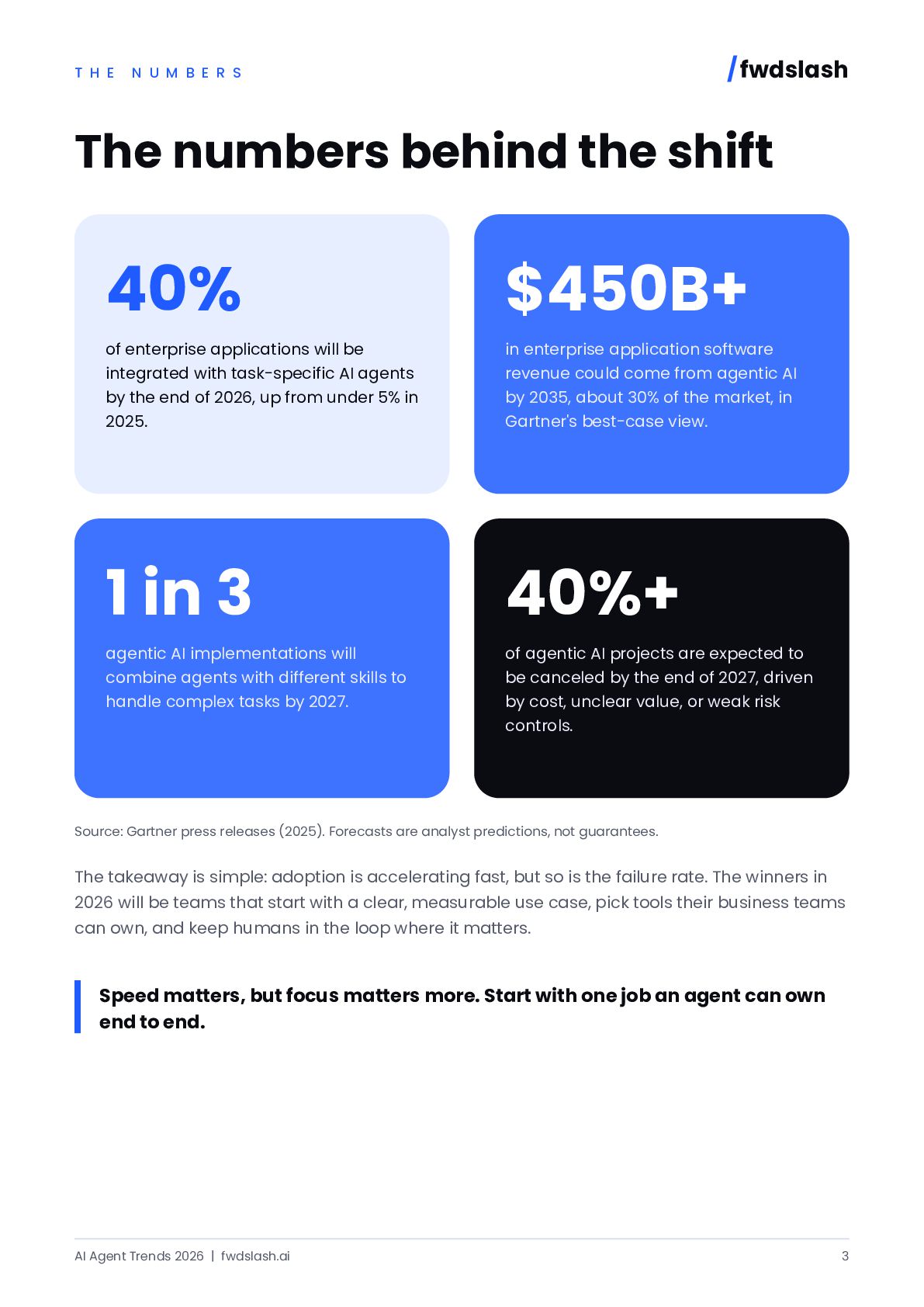
    R S The numbers behind the shift 40% $450B+ of enterprise applications will be in enterprise application software integrated with task-specific AI agents revenue could come from agentic AI by the end of 2026, up from under 5% in by 2035, about 30% of the market, in 2025. Gartner's best-case view. 1 in 3 40%+ agentic AI implementations will of agentic AI projects are expected to combine agents with different skills to be canceled by the end of 2027, driven handle complex tasks by 2027. by cost, unclear value, or weak risk controls. Source: Gartner press releases (2025). Forecasts are analyst predictions, not guarantees. The takeaway is simple: adoption is accelerating fast, but so is the failure rate. The winners in 2026 will be teams that start with a clear, measurable use case, pick tools their business teams can own, and keep humans in the loop where it matters. Speed matters, but focus matters more. Start with one job an agent can own end to end. AI Agent Trends 2026 | fwdslash.ai 3
  4. T R E N D 0 1 / fwdslash Task-specific

    agents go mainstream The biggest shift of 2026 is specialization. Instead of one general assistant bolted onto every app, businesses are deploying agents built for a single job, such as answering support questions, qualifying inbound leads, or handling IT requests. Gartner expects 40% of enterprise apps to include task-specific agents by the end of the year. Focused agents are easier to train, easier to measure, and more accurate, because they answer from a narrow, well-maintained body of knowledge rather than trying to know everything. What a task-specific agent looks like A support agent trained only on your help docs, a lead agent trained on pricing and product pages, and an onboarding agent trained on HR policies. Three agents, three clear goals, three sets of metrics. Takeaway: Pick one high-volume job and give it its own agent with its own knowledge base. AI Agent Trends 2026 | fwdslash.ai 01 4
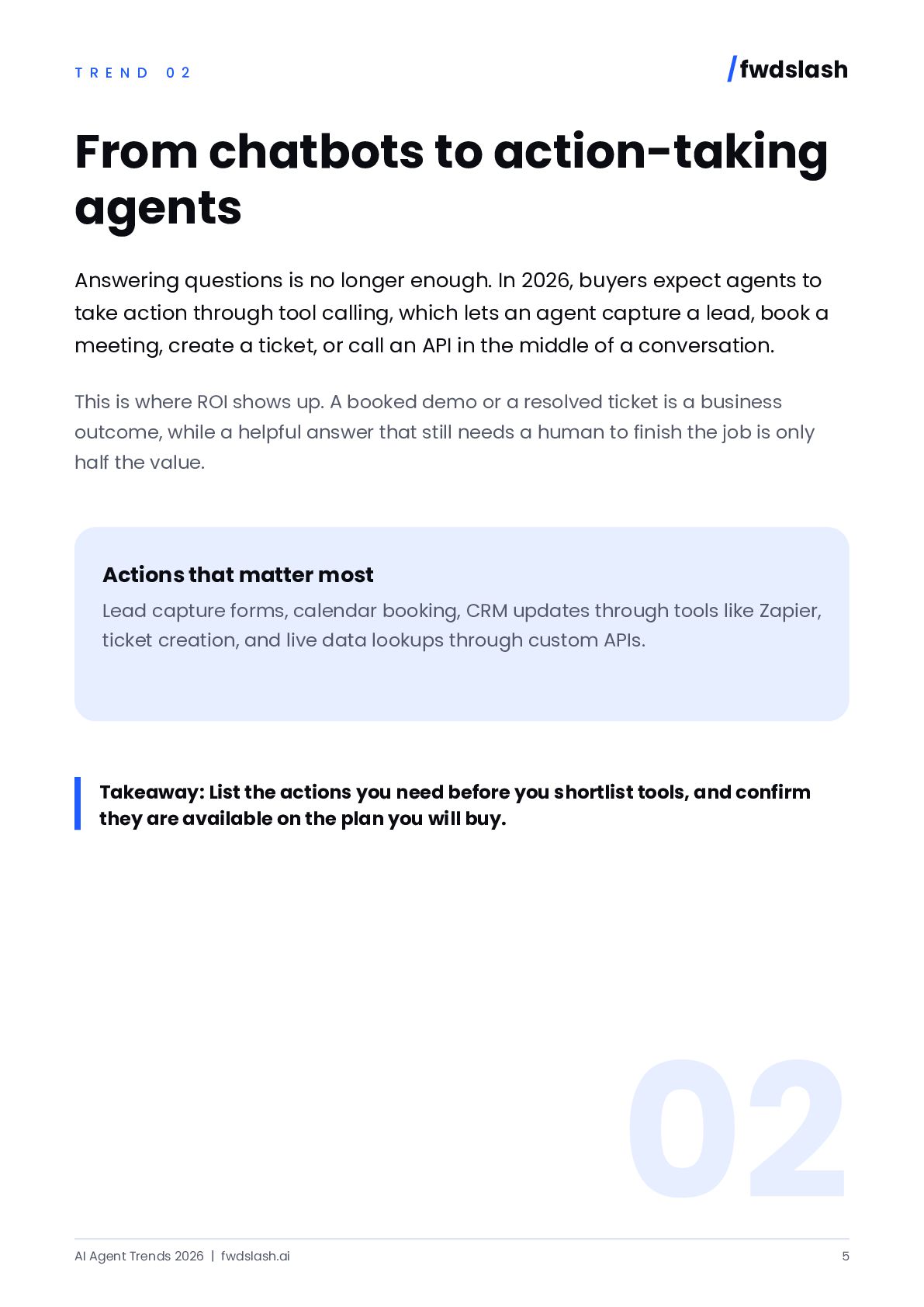
  5. T R E N D / fwdslash 0 2 From

    chatbots to action-taking agents Answering questions is no longer enough. In 2026, buyers expect agents to take action through tool calling, which lets an agent capture a lead, book a meeting, create a ticket, or call an API in the middle of a conversation. This is where ROI shows up. A booked demo or a resolved ticket is a business outcome, while a helpful answer that still needs a human to finish the job is only half the value. Actions that matter most Lead capture forms, calendar booking, CRM updates through tools like Zapier, ticket creation, and live data lookups through custom APIs. Takeaway: List the actions you need before you shortlist tools, and confirm they are available on the plan you will buy. AI Agent Trends 2026 | fwdslash.ai 02 5
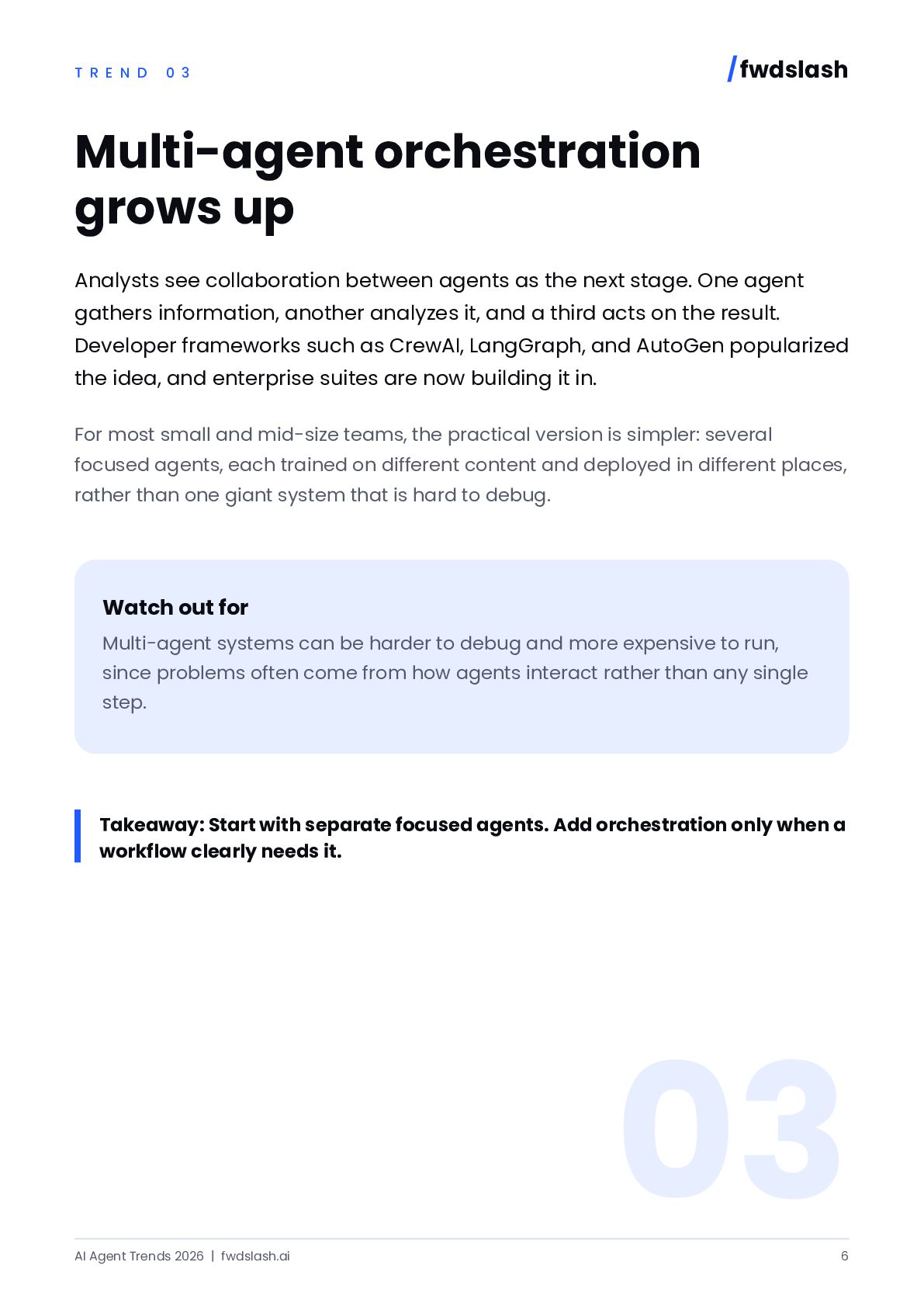
  6. T R E N D / fwdslash 0 3 Multi-agent

    orchestration grows up Analysts see collaboration between agents as the next stage. One agent gathers information, another analyzes it, and a third acts on the result. Developer frameworks such as CrewAI, LangGraph, and AutoGen popularized the idea, and enterprise suites are now building it in. For most small and mid-size teams, the practical version is simpler: several focused agents, each trained on different content and deployed in different places, rather than one giant system that is hard to debug. Watch out for Multi-agent systems can be harder to debug and more expensive to run, since problems often come from how agents interact rather than any single step. Takeaway: Start with separate focused agents. Add orchestration only when a workflow clearly needs it. AI Agent Trends 2026 | fwdslash.ai 03 6
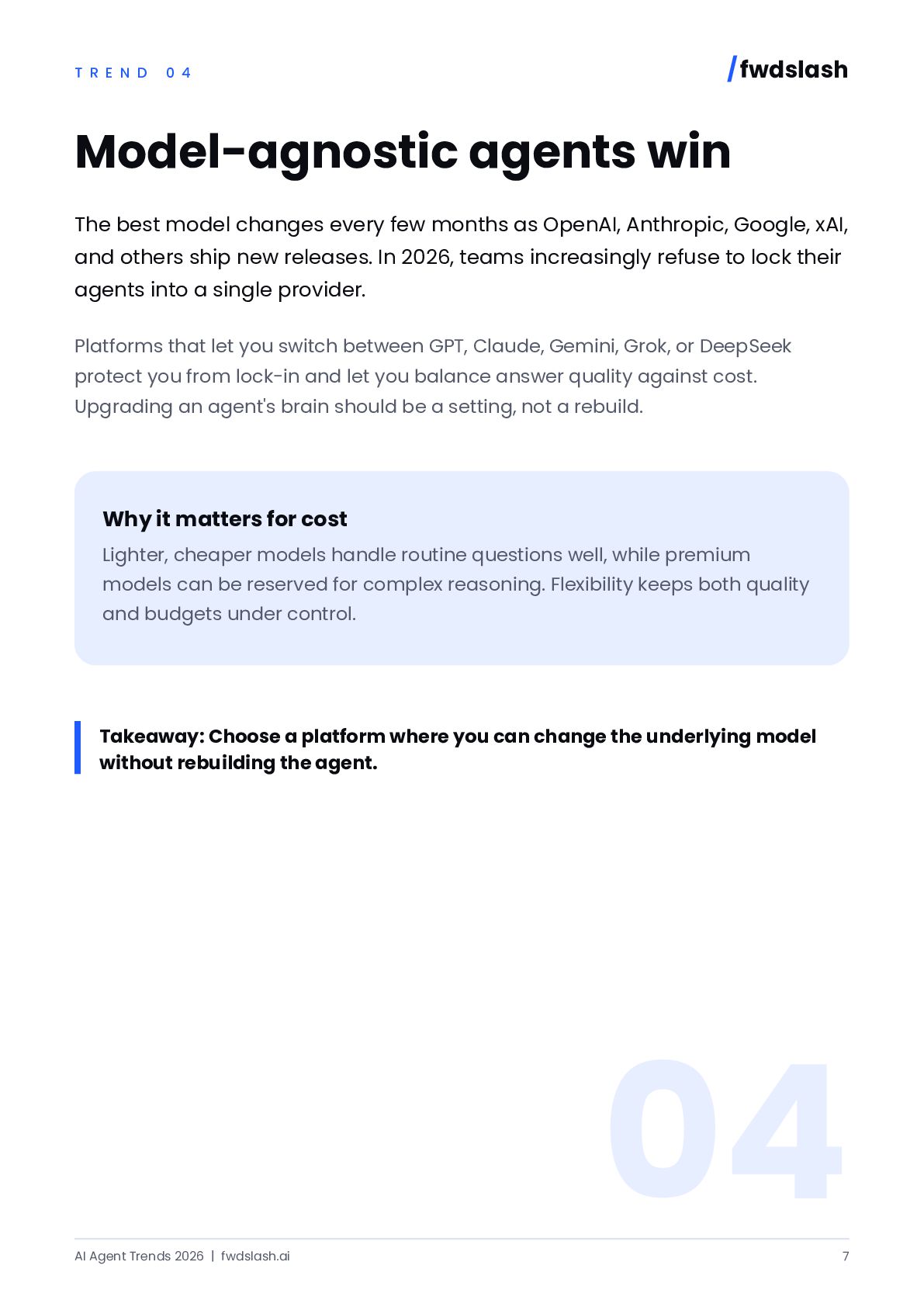
  7. T R E N D / fwdslash 0 4 Model-agnostic

    agents win The best model changes every few months as OpenAI, Anthropic, Google, xAI, and others ship new releases. In 2026, teams increasingly refuse to lock their agents into a single provider. Platforms that let you switch between GPT, Claude, Gemini, Grok, or DeepSeek protect you from lock-in and let you balance answer quality against cost. Upgrading an agent's brain should be a setting, not a rebuild. Why it matters for cost Lighter, cheaper models handle routine questions well, while premium models can be reserved for complex reasoning. Flexibility keeps both quality and budgets under control. Takeaway: Choose a platform where you can change the underlying model without rebuilding the agent. AI Agent Trends 2026 | fwdslash.ai 04 7
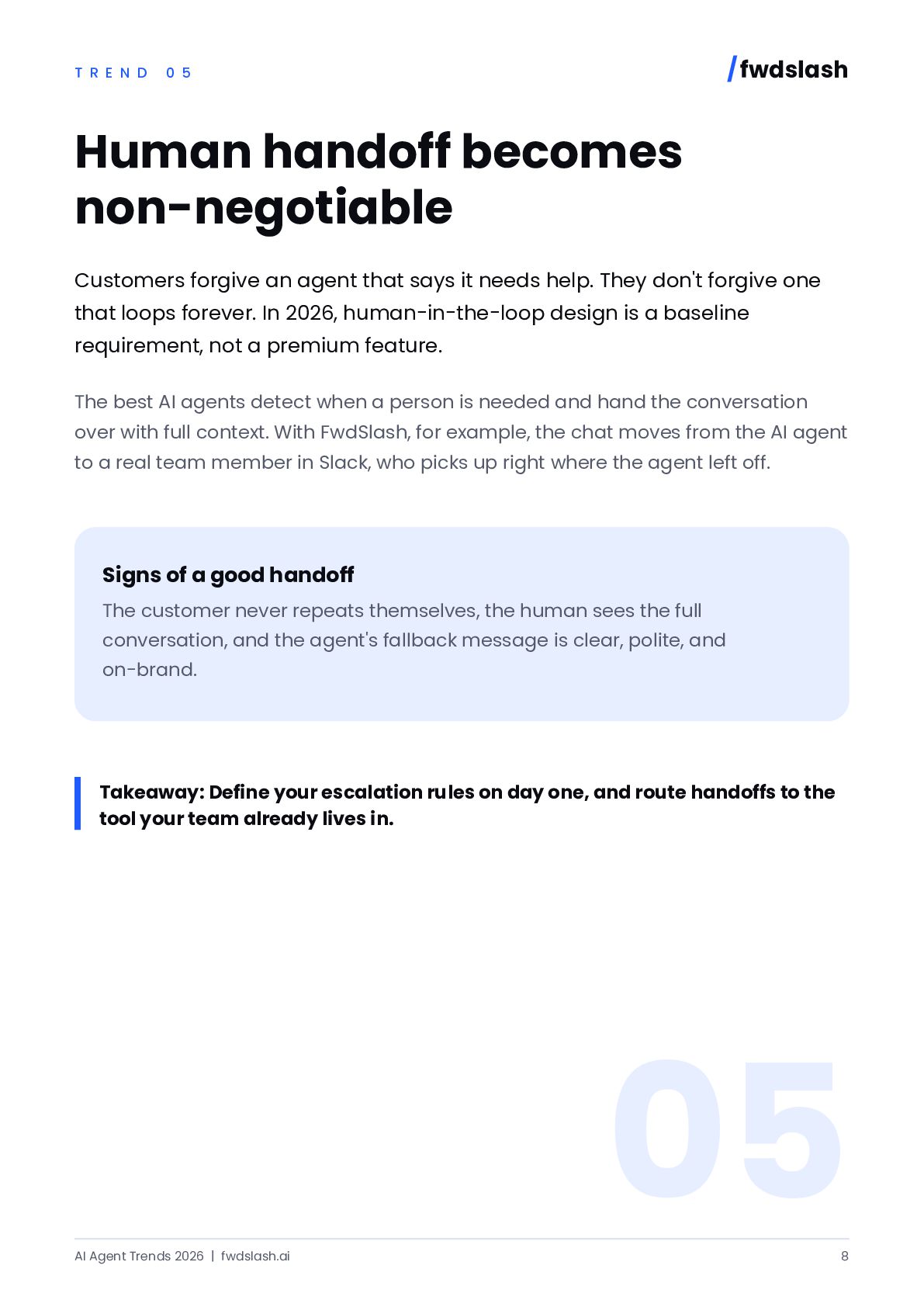
  8. T R E N D / fwdslash 0 5 Human

    handoff becomes non-negotiable Customers forgive an agent that says it needs help. They don't forgive one that loops forever. In 2026, human-in-the-loop design is a baseline requirement, not a premium feature. The best AI agents detect when a person is needed and hand the conversation over with full context. With FwdSlash, for example, the chat moves from the AI agent to a real team member in Slack, who picks up right where the agent left off. Signs of a good handoff The customer never repeats themselves, the human sees the full conversation, and the agent's fallback message is clear, polite, and on-brand. Takeaway: Define your escalation rules on day one, and route handoffs to the tool your team already lives in. AI Agent Trends 2026 | fwdslash.ai 05 8
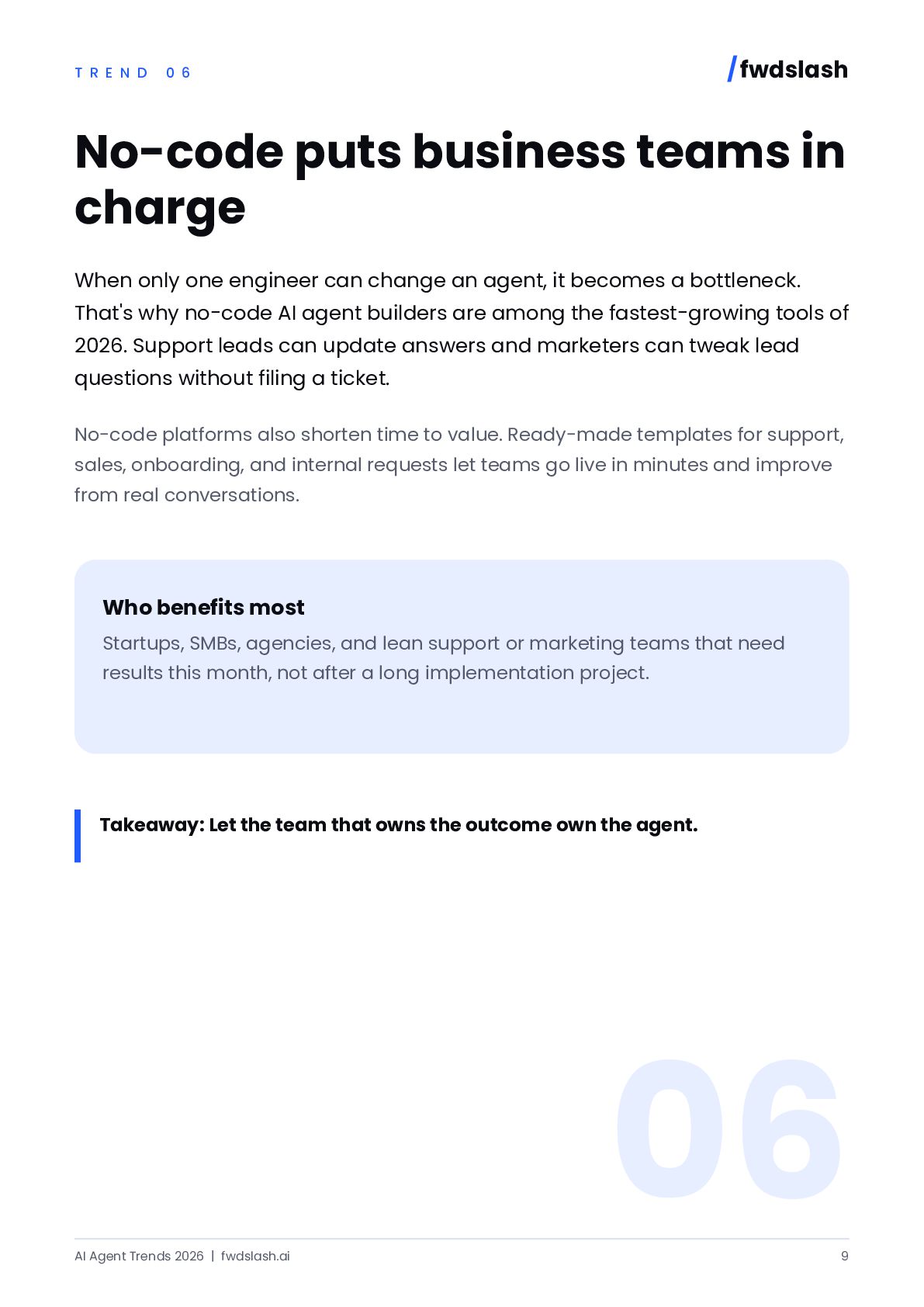
  9. T R E N D / fwdslash 0 6 No-code

    puts business teams in charge When only one engineer can change an agent, it becomes a bottleneck. That's why no-code AI agent builders are among the fastest-growing tools of 2026. Support leads can update answers and marketers can tweak lead questions without filing a ticket. No-code platforms also shorten time to value. Ready-made templates for support, sales, onboarding, and internal requests let teams go live in minutes and improve from real conversations. Who benefits most Startups, SMBs, agencies, and lean support or marketing teams that need results this month, not after a long implementation project. Takeaway: Let the team that owns the outcome own the agent. AI Agent Trends 2026 | fwdslash.ai 06 9
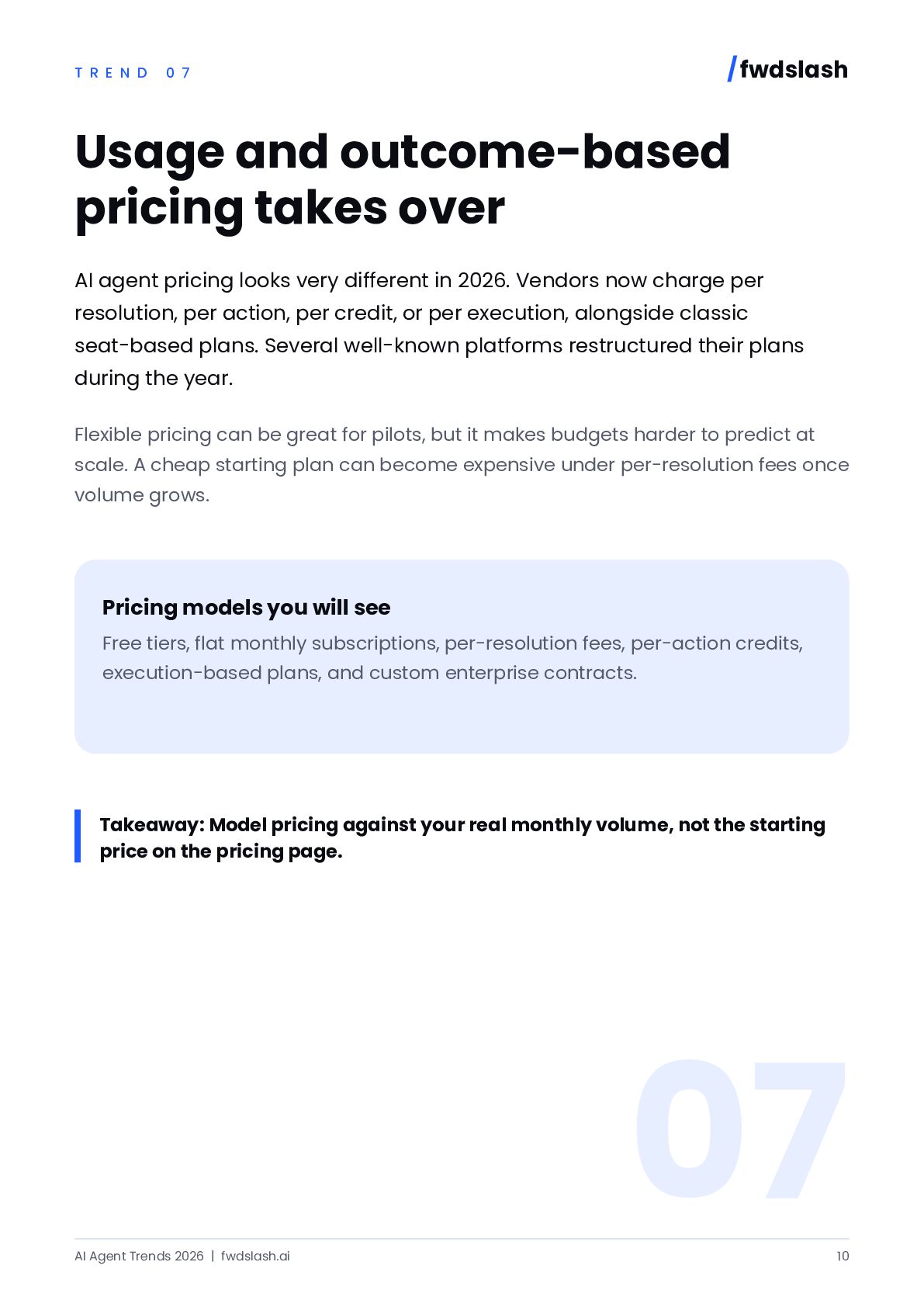
  10. T R E N D / fwdslash 0 7 Usage

    and outcome-based pricing takes over AI agent pricing looks very different in 2026. Vendors now charge per resolution, per action, per credit, or per execution, alongside classic seat-based plans. Several well-known platforms restructured their plans during the year. Flexible pricing can be great for pilots, but it makes budgets harder to predict at scale. A cheap starting plan can become expensive under per-resolution fees once volume grows. Pricing models you will see Free tiers, flat monthly subscriptions, per-resolution fees, per-action credits, execution-based plans, and custom enterprise contracts. Takeaway: Model pricing against your real monthly volume, not the starting price on the pricing page. AI Agent Trends 2026 | fwdslash.ai 07 10
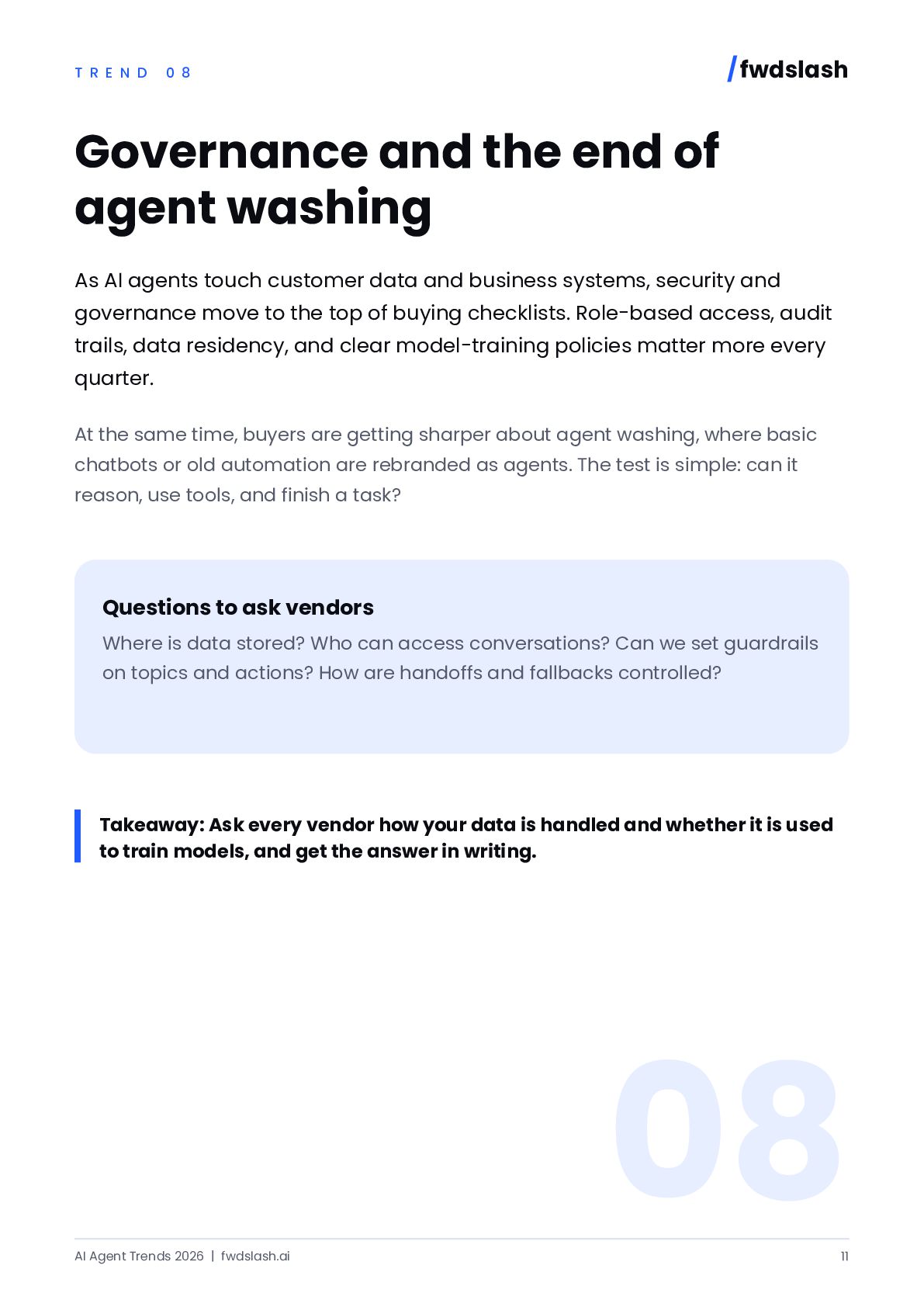
  11. T R E N D / fwdslash 0 8 Governance

    and the end of agent washing As AI agents touch customer data and business systems, security and governance move to the top of buying checklists. Role-based access, audit trails, data residency, and clear model-training policies matter more every quarter. At the same time, buyers are getting sharper about agent washing, where basic chatbots or old automation are rebranded as agents. The test is simple: can it reason, use tools, and finish a task? Questions to ask vendors Where is data stored? Who can access conversations? Can we set guardrails on topics and actions? How are handoffs and fallbacks controlled? Takeaway: Ask every vendor how your data is handled and whether it is used to train models, and get the answer in writing. AI Agent Trends 2026 | fwdslash.ai 08 11
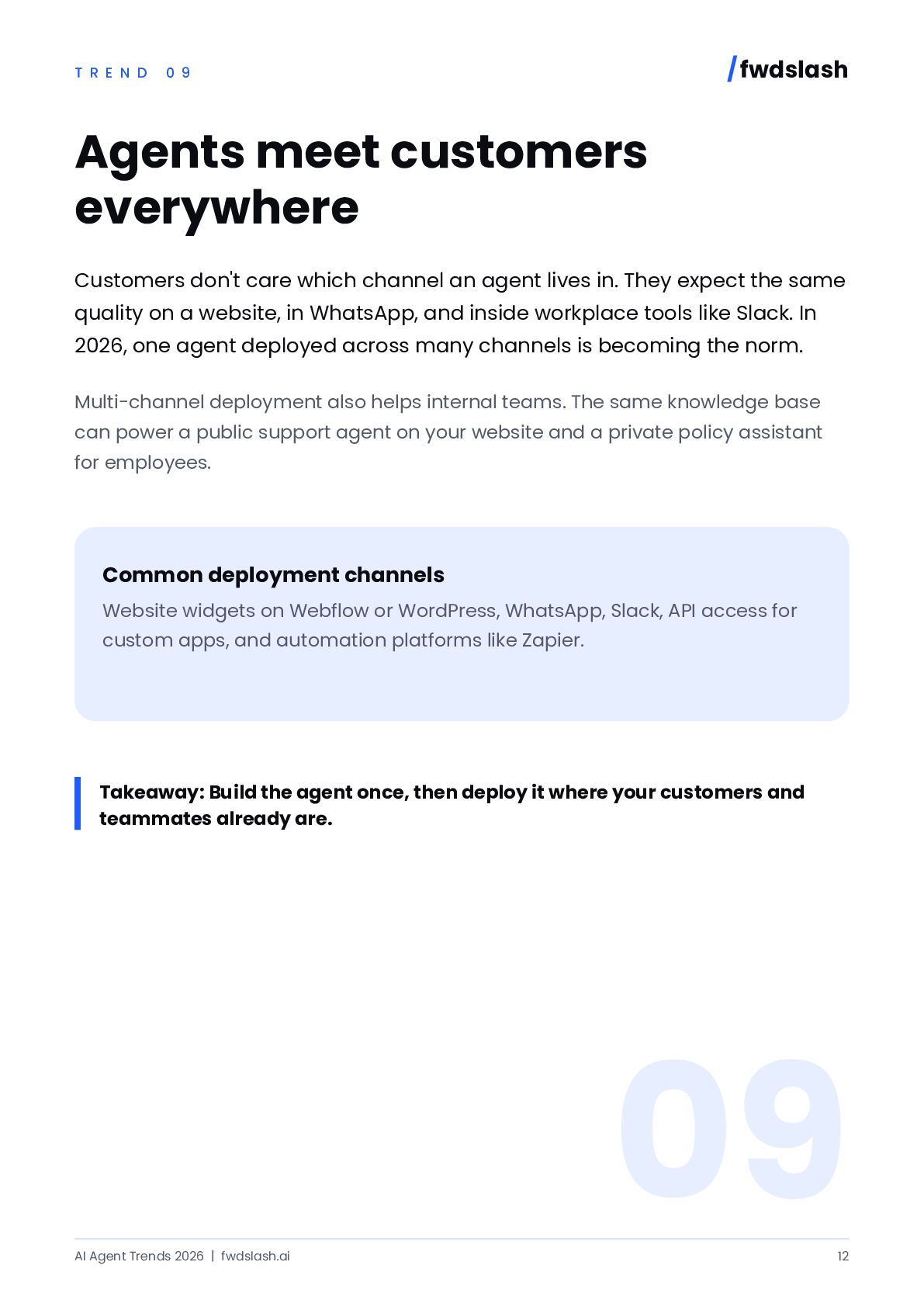
  12. T R E N D / fwdslash 0 9 Agents

    meet customers everywhere Customers don't care which channel an agent lives in. They expect the same quality on a website, in WhatsApp, and inside workplace tools like Slack. In 2026, one agent deployed across many channels is becoming the norm. Multi-channel deployment also helps internal teams. The same knowledge base can power a public support agent on your website and a private policy assistant for employees. Common deployment channels Website widgets on Webflow or WordPress, WhatsApp, Slack, API access for custom apps, and automation platforms like Zapier. Takeaway: Build the agent once, then deploy it where your customers and teammates already are. AI Agent Trends 2026 | fwdslash.ai 09 12
  13. T R E N D / fwdslash 1 0 Open

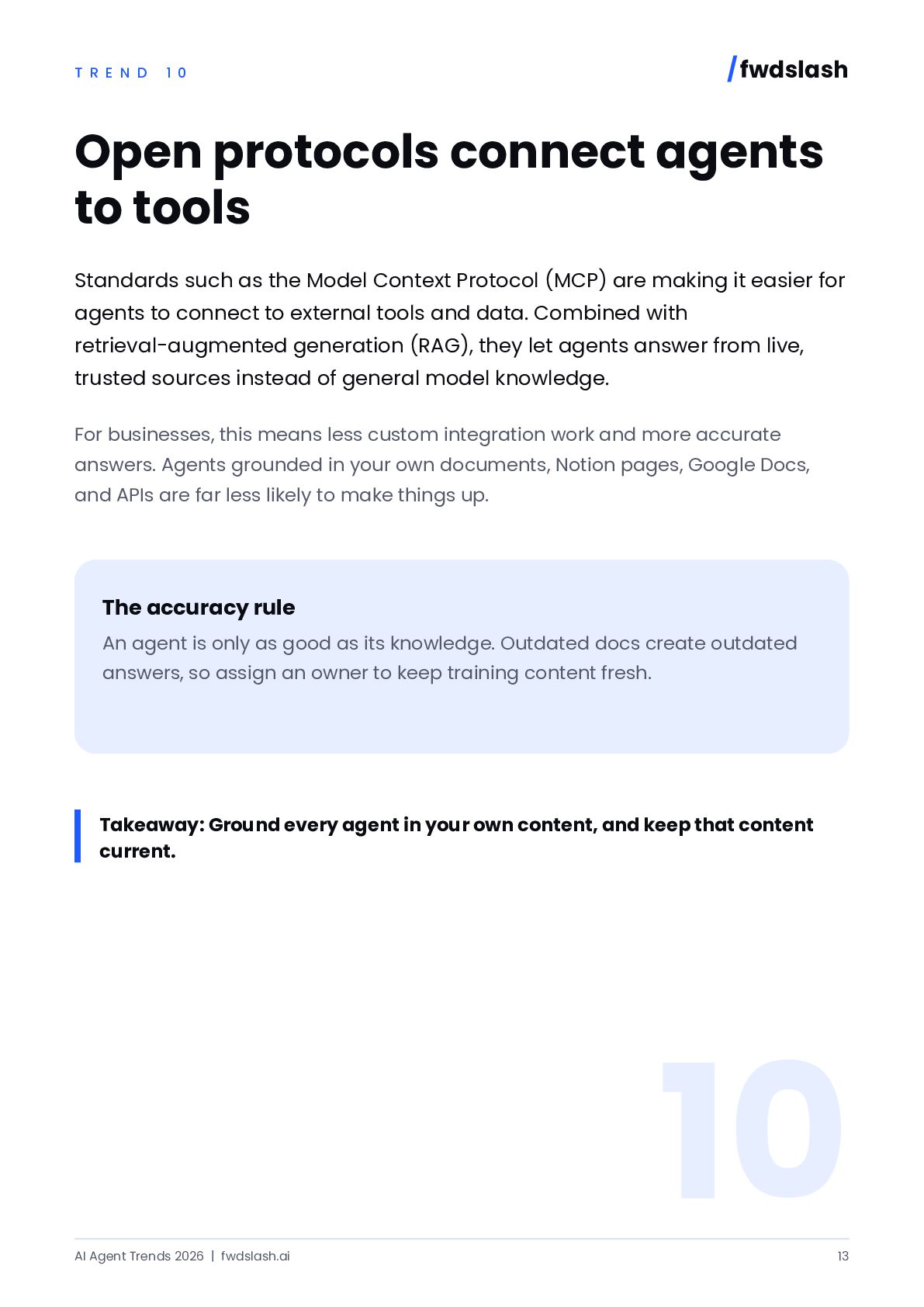
    protocols connect agents to tools Standards such as the Model Context Protocol (MCP) are making it easier for agents to connect to external tools and data. Combined with retrieval-augmented generation (RAG), they let agents answer from live, trusted sources instead of general model knowledge. For businesses, this means less custom integration work and more accurate answers. Agents grounded in your own documents, Notion pages, Google Docs, and APIs are far less likely to make things up. The accuracy rule An agent is only as good as its knowledge. Outdated docs create outdated answers, so assign an owner to keep training content fresh. Takeaway: Ground every agent in your own content, and keep that content current. AI Agent Trends 2026 | fwdslash.ai 10 13
  14. A C T I O N P L A N

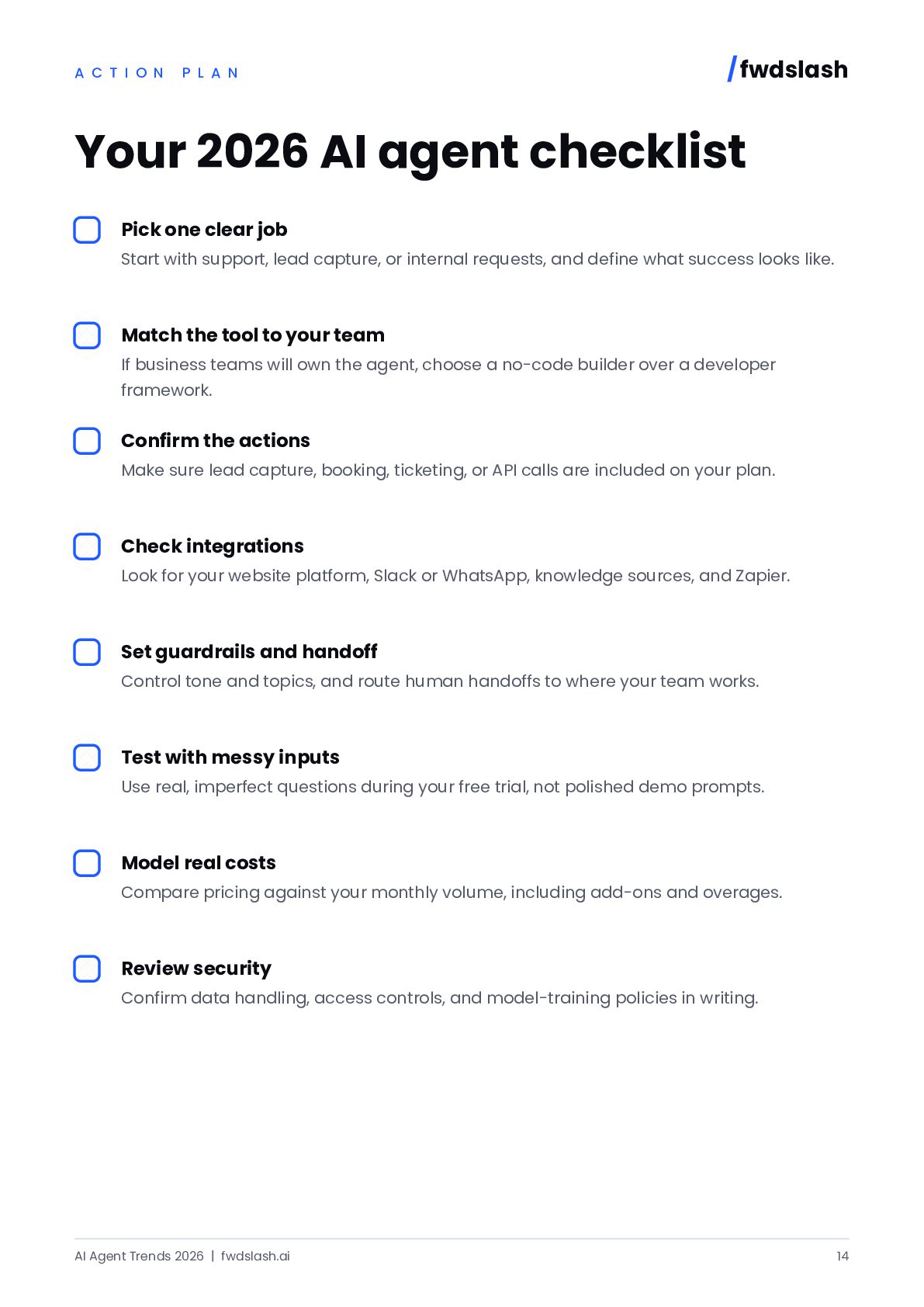
    / fwdslash Your 2026 AI agent checklist Pick one clear job Start with support, lead capture, or internal requests, and define what success looks like. Match the tool to your team If business teams will own the agent, choose a no-code builder over a developer framework. Confirm the actions Make sure lead capture, booking, ticketing, or API calls are included on your plan. Check integrations Look for your website platform, Slack or WhatsApp, knowledge sources, and Zapier. Set guardrails and handoff Control tone and topics, and route human handoffs to where your team works. Test with messy inputs Use real, imperfect questions during your free trial, not polished demo prompts. Model real costs Compare pricing against your monthly volume, including add-ons and overages. Review security Confirm data handling, access controls, and model-training policies in writing. AI Agent Trends 2026 | fwdslash.ai 14
  15. H O W F W D S L A S

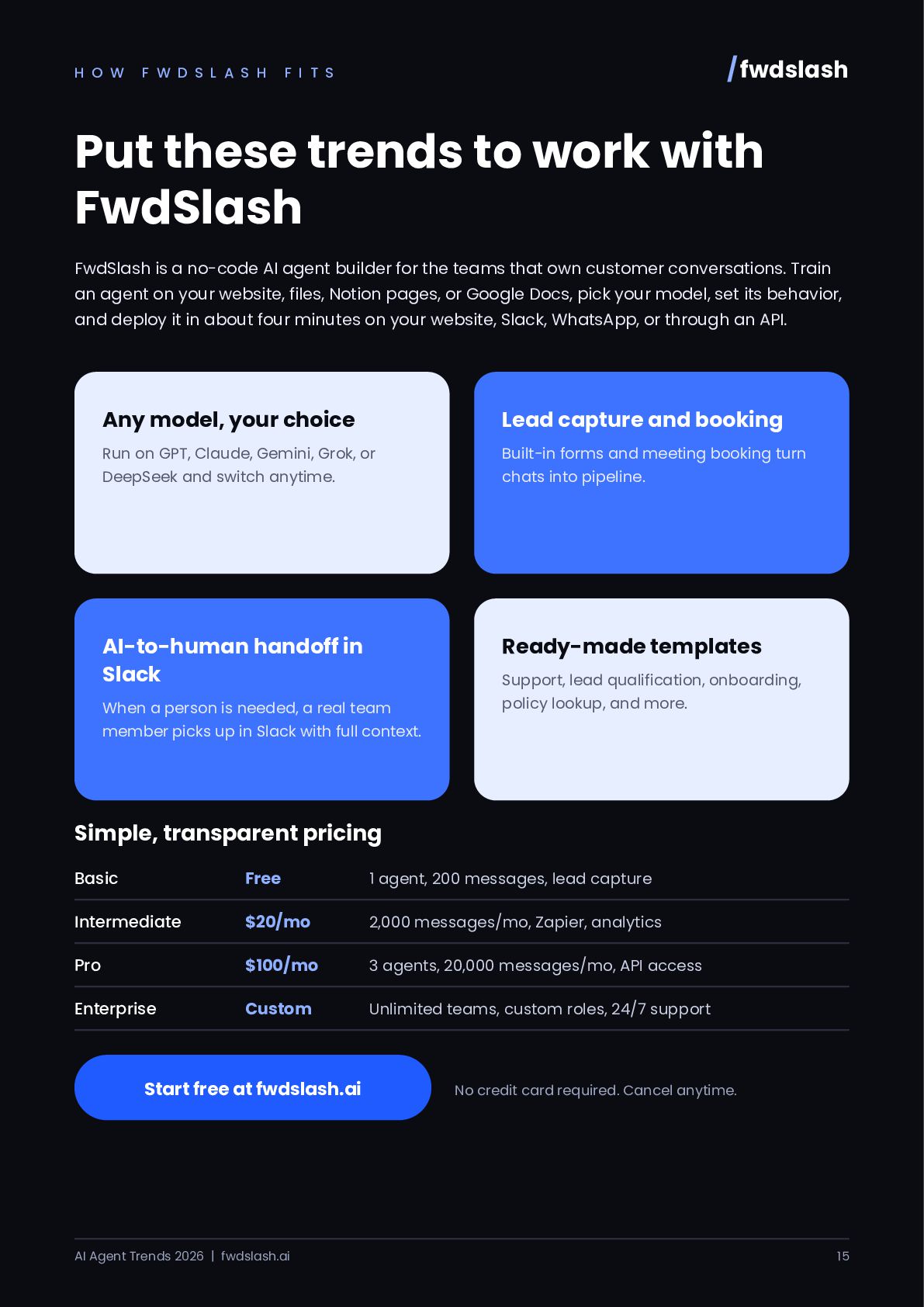
    H / fwdslash F I T S Put these trends to work with FwdSlash FwdSlash is a no-code AI agent builder for the teams that own customer conversations. Train an agent on your website, files, Notion pages, or Google Docs, pick your model, set its behavior, and deploy it in about four minutes on your website, Slack, WhatsApp, or through an API. Any model, your choice Lead capture and booking Run on GPT, Claude, Gemini, Grok, or Built-in forms and meeting booking turn DeepSeek and switch anytime. chats into pipeline. AI-to-human handoff in Slack Ready-made templates When a person is needed, a real team policy lookup, and more. Support, lead qualification, onboarding, member picks up in Slack with full context. Simple, transparent pricing Basic Free 1 agent, 200 messages, lead capture Intermediate $20/mo 2,000 messages/mo, Zapier, analytics Pro $100/mo 3 agents, 20,000 messages/mo, API access Enterprise Custom Unlimited teams, custom roles, 24/7 support Start free at fwdslash.ai AI Agent Trends 2026 | fwdslash.ai No credit card required. Cancel anytime. 15
  16. / fwdslash Your AI sales rep, live in 4 minutes.

    Answer customers instantly, capture qualified leads, book meetings, and hand off to your team in Slack when it matters. www.fwdslash.ai Pricing and statistics accurate as of September 2026. © FwdSlash, powered by Cyces.