Upgrade to Pro — share decks privately, control downloads, hide ads and more …

Situated-VR-Towards-a-Cohesive-Mixed-Reality-Wi...

 Situated-VR-Towards-a-Cohesive-Mixed-Reality-Without-Experiential-Artifacts

The main idea of XR (extended reality) is to live in a world where real and virtual elements blend seamlessly with the context, enhancing our experience of ourselves and the world around us. This integration creates exciting opportunities for XR's future but also brings risks, particularly of disconnection or disruption, which are often seen in VR.

Avatar for Parmida Beiki

Parmida Beiki

May 23, 2026

Other Decks in Technology

Transcript

  1. preencoded.png Situated VR: Towards a Congruent Hybrid Reality without Experiential

    Artifacts Authors: Misha Sra – UC Santa Barbara, Waldemar Danry & Patty Maes – MIT Media Lab As Published: 10.1109/MCG.2022.3154358 Slides by: Parmida Beiki Firouzjahi Course: Research Methods and Presentation 1
  2. preencoded.png Introduction / Motivation The Vision of Extended Reality The

    main idea of XR (extended reality) is to live in a world where real and virtual elements blend seamlessly with the context, enhancing our experience of ourselves and the world around us. This integration creates exciting opportunities for XR's future but also brings risks, particularly of disconnection or disruption, which are often seen in VR. 2
  3. preencoded.png Vision & Industry Sci-Fi & Industry Examples Fiction has

    long shown visions of immersive realities: some fully digital like Snow Crash by Neal Stephenson (1992), and some hybrid real-virtual like Rainbows End by Vernor Vinge. Today, major tech companies such as Meta, Microsoft, Epic, Unity, and Niantic present their own metaverse visions, offering fully connected or hybrid spaces. Understanding the potential impact of these systems on human experience is critical, especially to avoid harmful or disturbing outcomes. Fiction • Snow Crash (Neal Stephenson, 1992) • Rainbows End (Vernor Vinge) Industry Leaders • Meta • Microsoft • Epic • Unity • Niantic 3
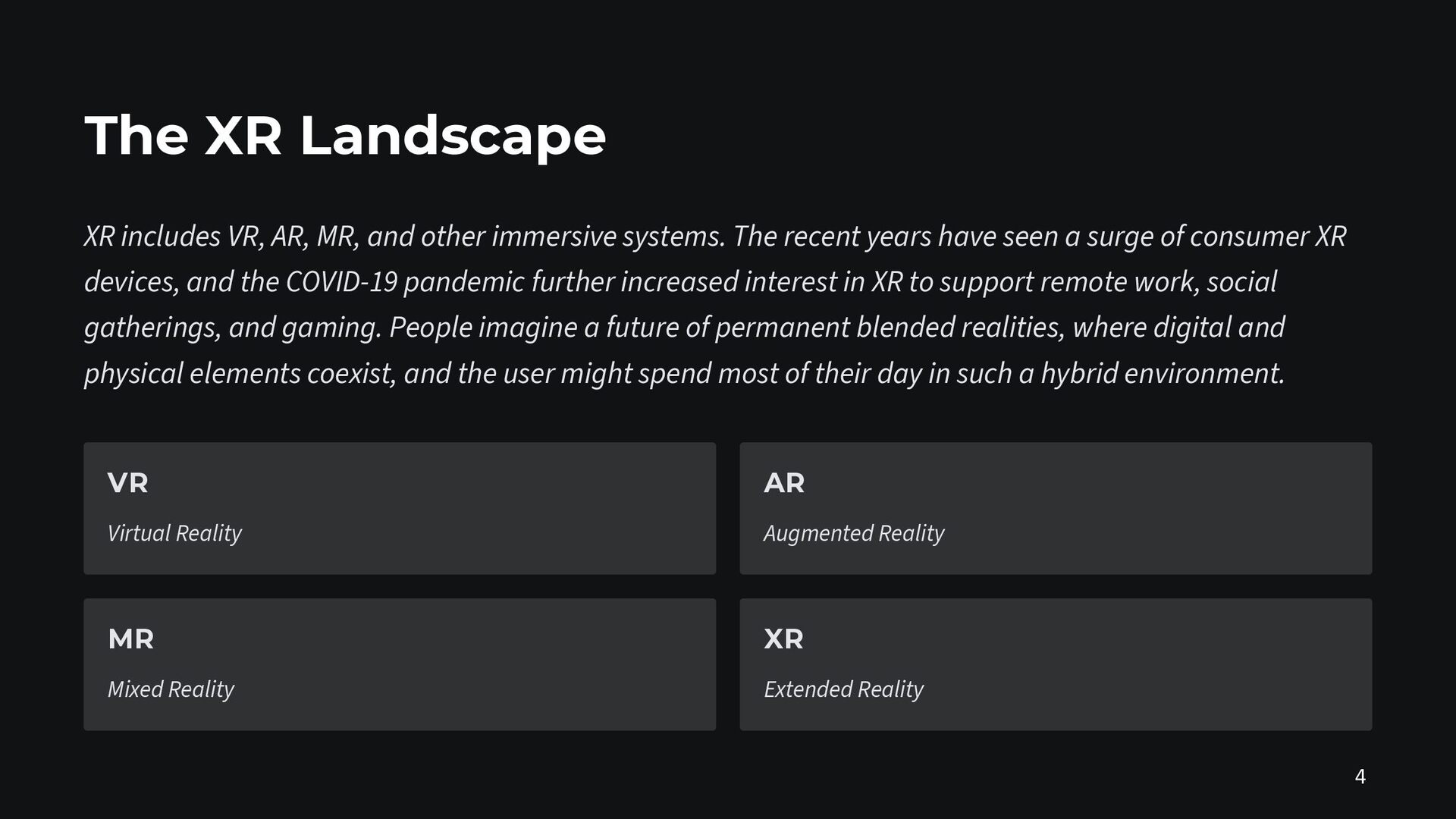
  4. preencoded.png The XR Landscape XR includes VR, AR, MR, and

    other immersive systems. The recent years have seen a surge of consumer XR devices, and the COVID-19 pandemic further increased interest in XR to support remote work, social gatherings, and gaming. People imagine a future of permanent blended realities, where digital and physical elements coexist, and the user might spend most of their day in such a hybrid environment. VR Virtual Reality AR Augmented Reality MR Mixed Reality XR Extended Reality 4
  5. preencoded.png Opportunities Potential of Mixed Reality Mixed reality enables new

    possibilities: digital twins of cities, AI-driven interactive characters entering classrooms, 3D holograms for long-distance interactions, and sensor-equipped devices enhancing real-time body awareness. This paradigm can change not only human-computer interaction scale but also our fundamental understanding of "reality." Digital Twins of Cities Virtual replicas of urban environments AI Characters in Classrooms Interactive learning companions 3D Holograms Long-distance interactions Enhanced Body Awareness Real-time sensor feedback 5
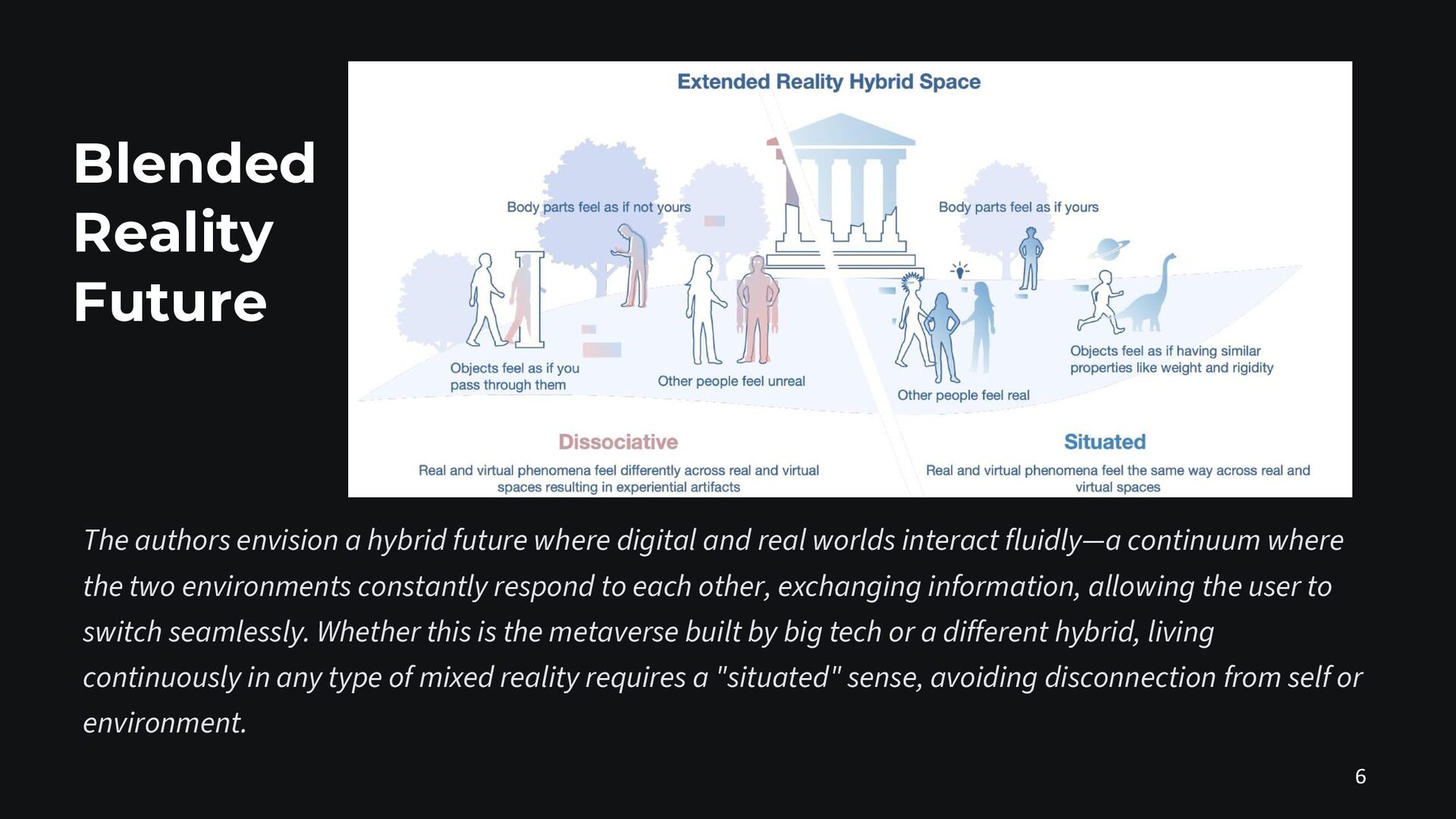
  6. preencoded.png Blended Reality Future The authors envision a hybrid future

    where digital and real worlds interact fluidly—a continuum where the two environments constantly respond to each other, exchanging information, allowing the user to switch seamlessly. Whether this is the metaverse built by big tech or a different hybrid, living continuously in any type of mixed reality requires a "situated" sense, avoiding disconnection from self or environment. 6
  7. preencoded.png Blending Humans and Virtual Entities This reality can mix

    real humans, virtual humans, AI characters, objects, and spaces. Achieving it requires careful design, high responsibility, active questioning, and serious examination of first-person experiences. 7
  8. preencoded.png Barriers Design Challenges Several challenges prevent full immersion in

    a mixed reality. Average VR session time in the US in 2019 was only 19.7 minutes. Cyber sickness—nausea, dizziness, disorientation—reduces user engagement. However, another major challenge lies in experiential artifacts (EA), which persist post-VR and impact perception of body and environment. Short Session Times Average VR session in US (2019): 19.7 minutes Cyber Sickness Nausea, dizziness, and fatigue Experiential Artifacts Persistent post-VR effects on perception 8
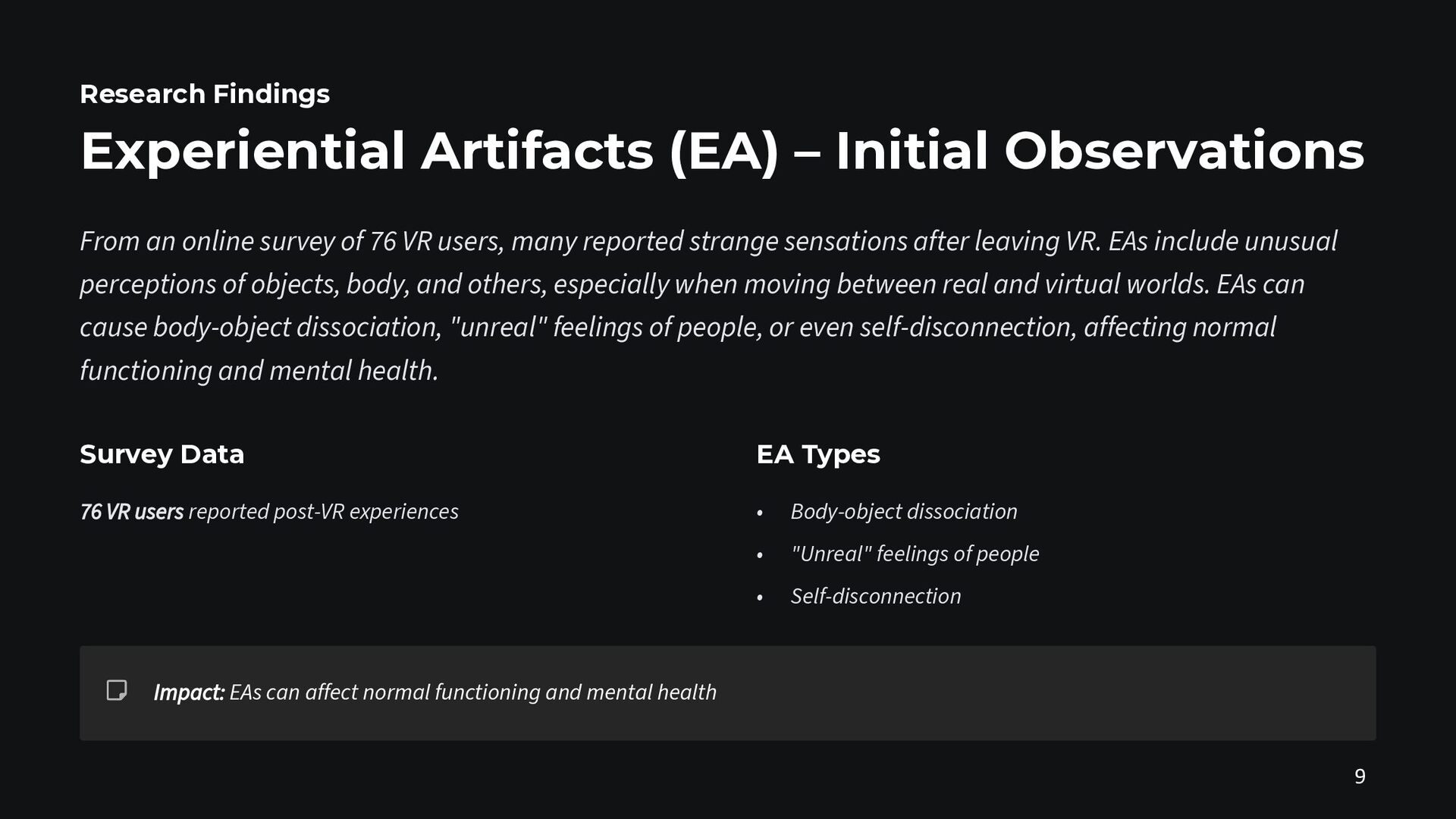
  9. preencoded.png Research Findings Experiential Artifacts (EA) – Initial Observations From

    an online survey of 76 VR users, many reported strange sensations after leaving VR. EAs include unusual perceptions of objects, body, and others, especially when moving between real and virtual worlds. EAs can cause body-object dissociation, "unreal" feelings of people, or even self-disconnection, affecting normal functioning and mental health. Survey Data 76 VR users reported post-VR experiences EA Types • Body-object dissociation • "Unreal" feelings of people • Self-disconnection Impact: EAs can affect normal functioning and mental health 9
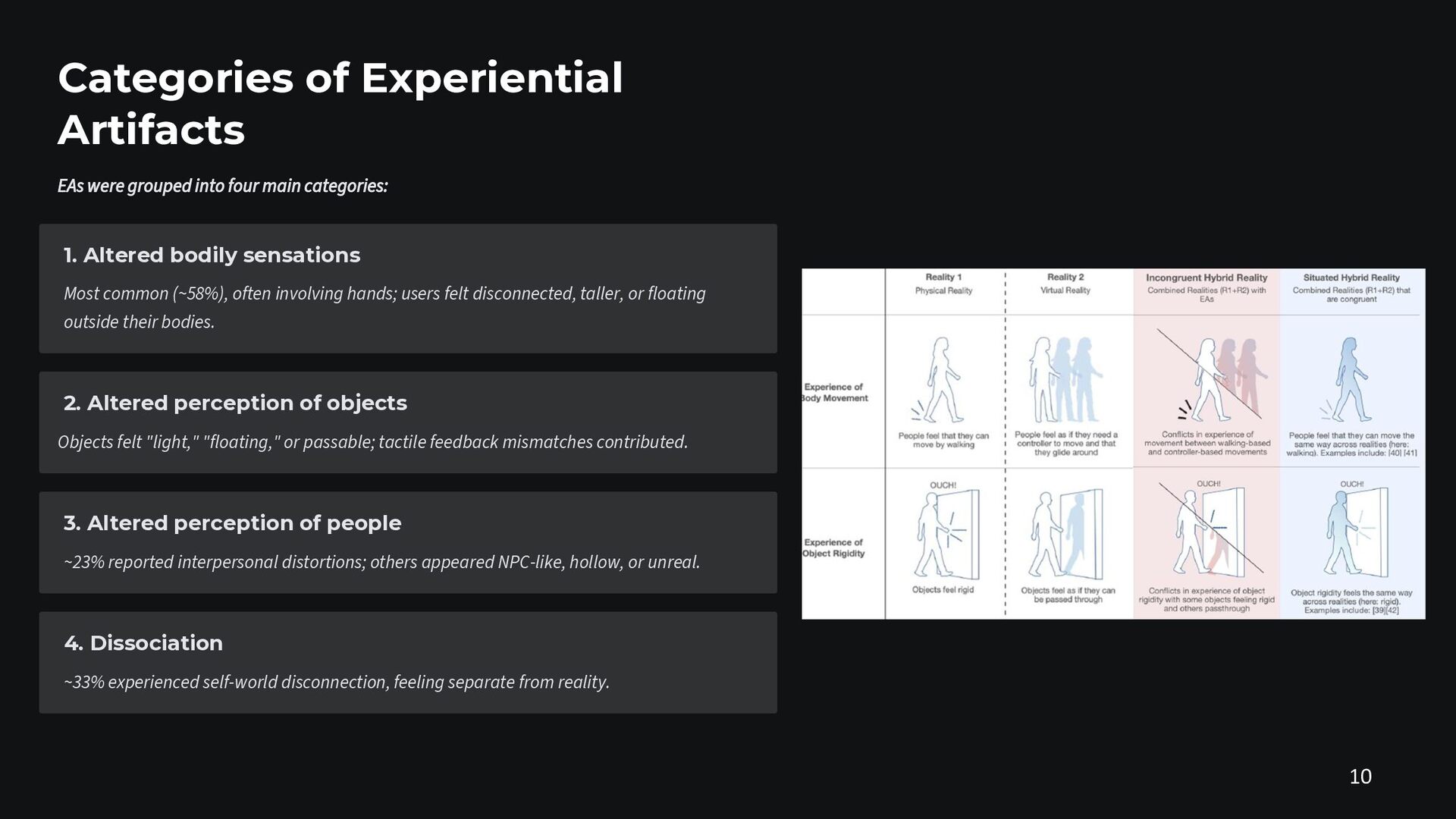
  10. preencoded.png Categories of Experiential Artifacts EAs were grouped into four

    main categories: 1. Altered bodily sensations Most common (~58%), often involving hands; users felt disconnected, taller, or floating outside their bodies. 2. Altered perception of objects Objects felt "light," "floating," or passable; tactile feedback mismatches contributed. 3. Altered perception of people ~23% reported interpersonal distortions; others appeared NPC-like, hollow, or unreal. 4. Dissociation ~33% experienced self-world disconnection, feeling separate from reality. 10
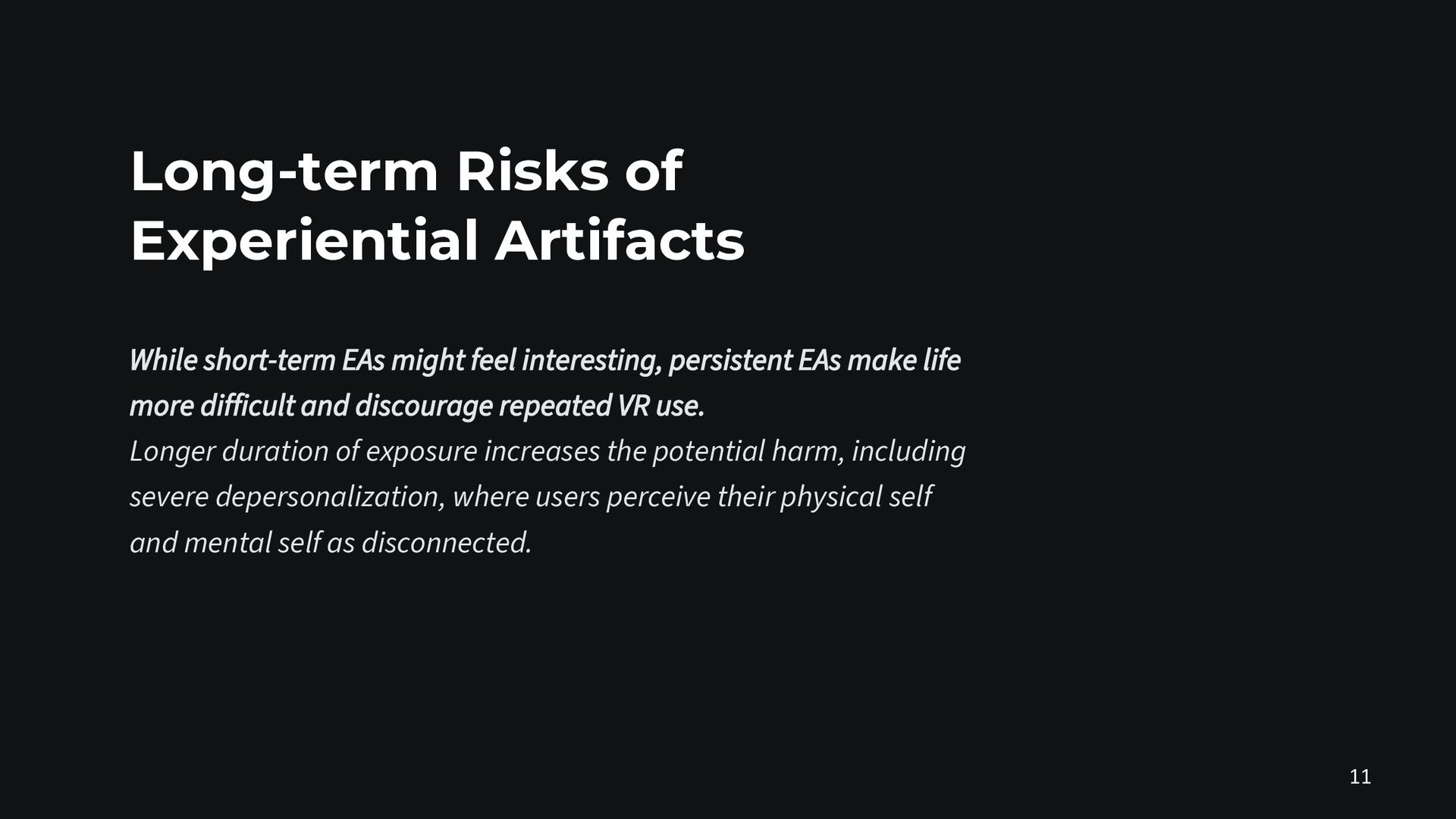
  11. preencoded.png Long-term Risks of Experiential Artifacts While short-term EAs might

    feel interesting, persistent EAs make life more difficult and discourage repeated VR use. Longer duration of exposure increases the potential harm, including severe depersonalization, where users perceive their physical self and mental self as disconnected. 11
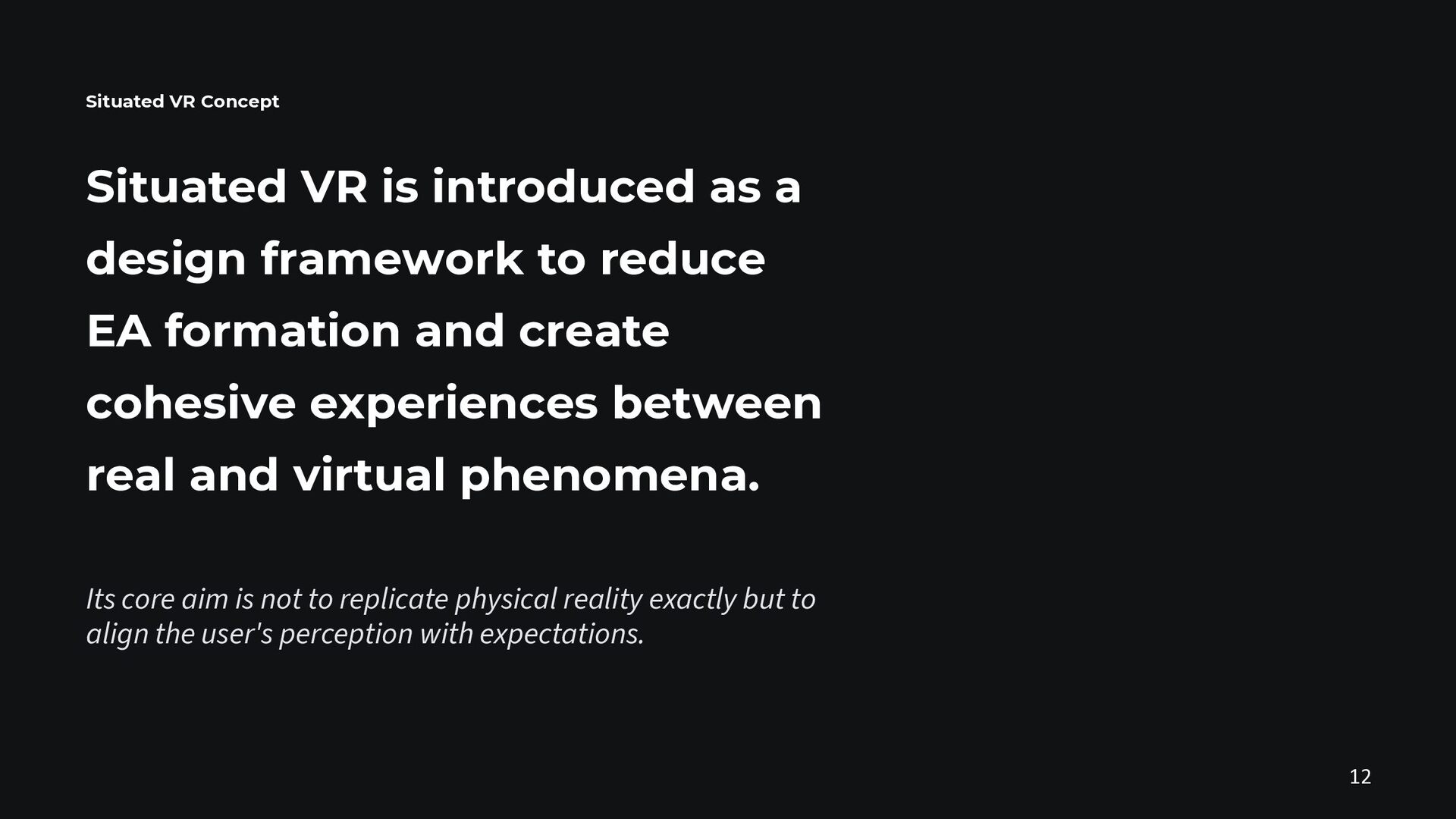
  12. preencoded.png Situated VR Concept Situated VR is introduced as a

    design framework to reduce EA formation and create cohesive experiences between real and virtual phenomena. Its core aim is not to replicate physical reality exactly but to align the user's perception with expectations. 12
  13. preencoded.png Sense of "Situatedness" A key concept is the "sense

    of situatedness"—experiencing self, world, and social phenomena in a stable and non-disruptive way. Focus should be on constructing experiential structures that prevent disorientation, dissociation, or cognitive overload. 13
  14. preencoded.png Design for Experiential Alignment Situated VR reduces discrepancy between

    real and virtual experiences by aligning user expectations. Examples include: • Object solidity and persistence • Body placement in space • Social norms and temporal flow Temporary extraordinary abilities in VR (like moving objects with a wrist flick) must be carefully managed to prevent persistent EA. 14
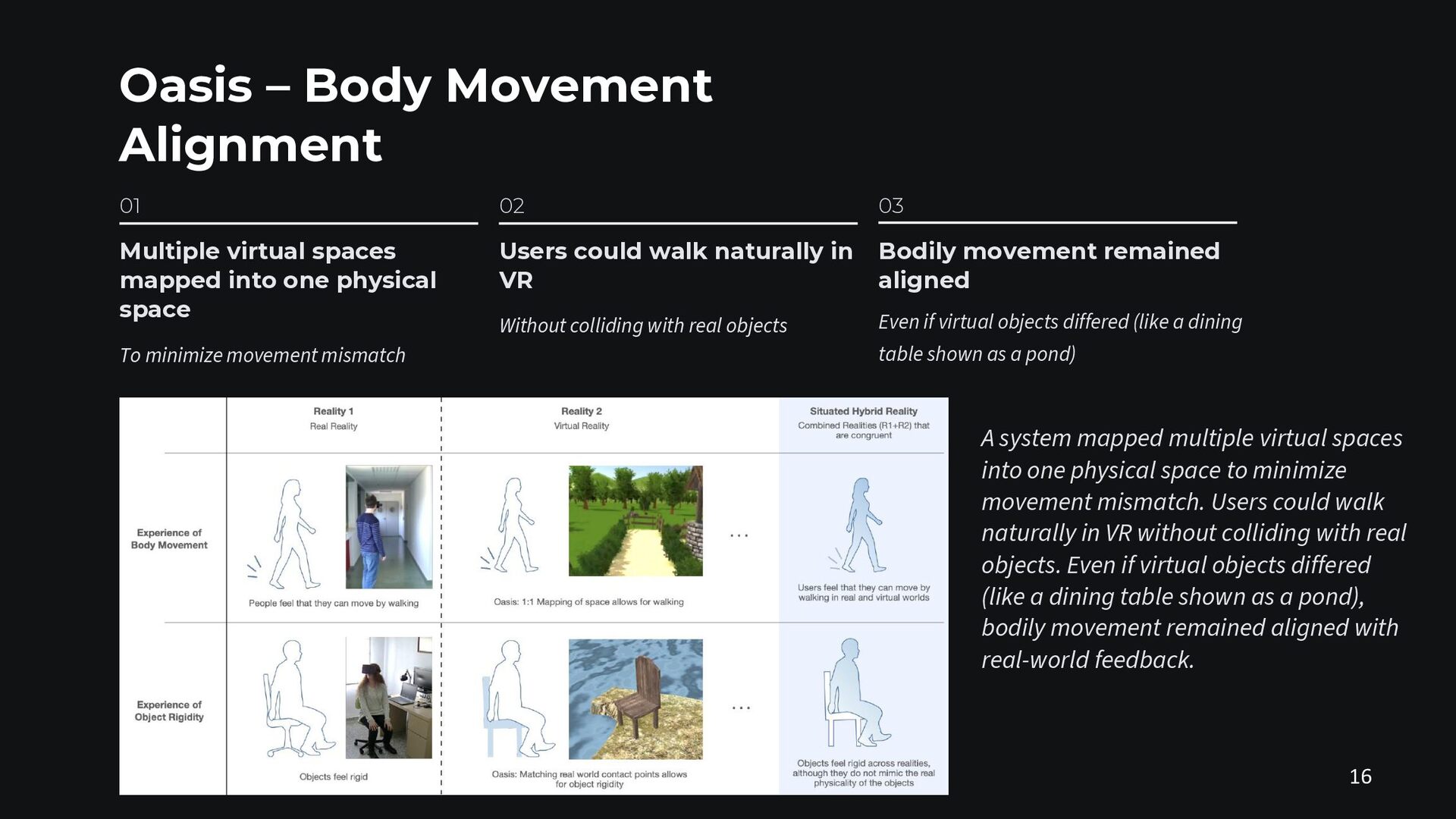
  15. preencoded.png Oasis – Body Movement Alignment 01 Multiple virtual spaces

    mapped into one physical space To minimize movement mismatch 02 Users could walk naturally in VR Without colliding with real objects 03 Bodily movement remained aligned Even if virtual objects differed (like a dining table shown as a pond) A system mapped multiple virtual spaces into one physical space to minimize movement mismatch. Users could walk naturally in VR without colliding with real objects. Even if virtual objects differed (like a dining table shown as a pond), bodily movement remained aligned with real-world feedback. 16
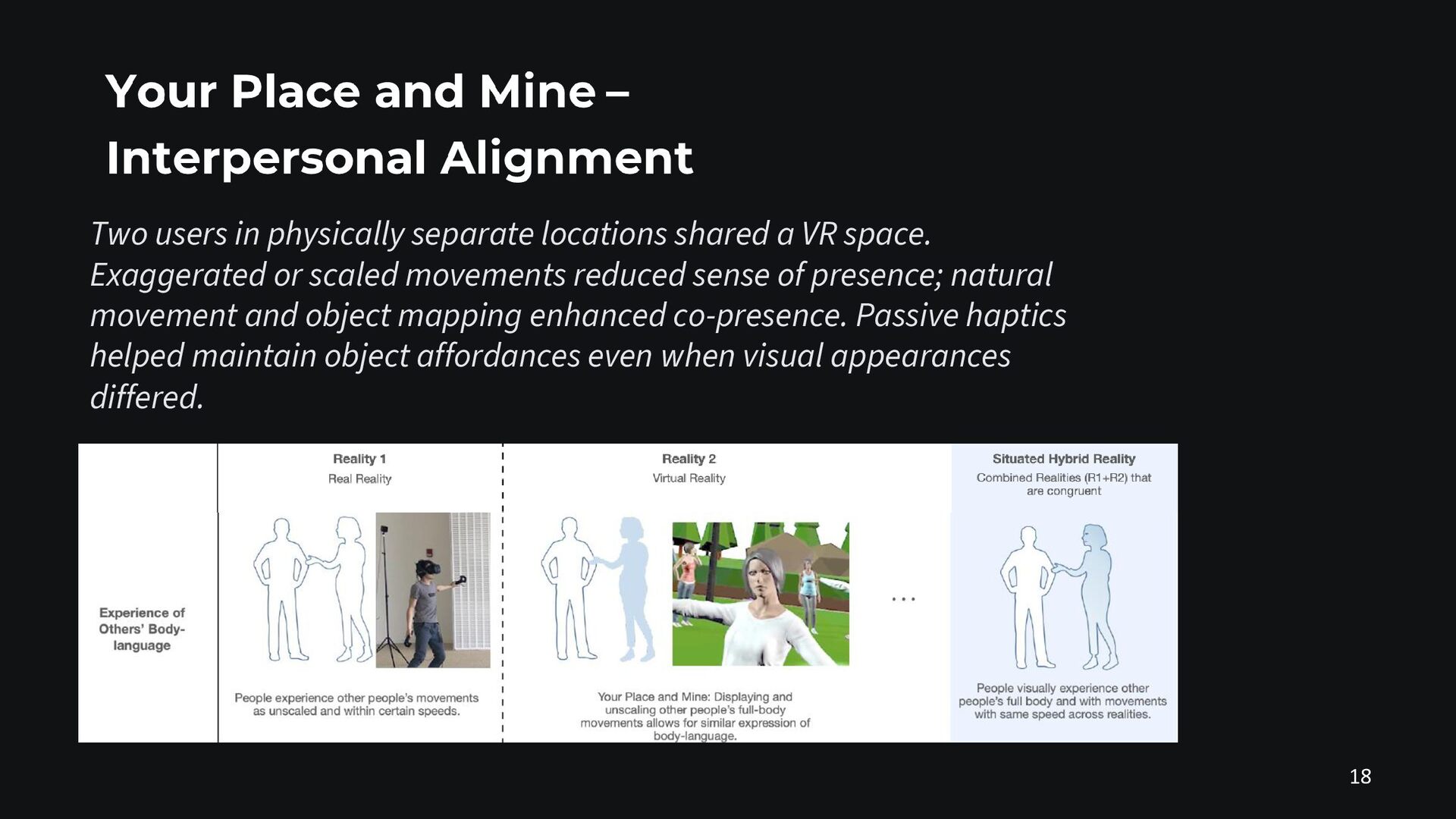
  16. preencoded.png 18 Two users in physically separate locations shared a

    VR space. Exaggerated or scaled movements reduced sense of presence; natural movement and object mapping enhanced co-presence. Passive haptics helped maintain object affordances even when visual appearances differed.
  17. preencoded.png Conclusion & Future Directions The success of future mixed

    reality depends on addressing experiential artifacts. Situated VR emphasizes aligned experiences rather than literal replication. Temporary extraordinary experiences acceptable Like flight or teleportation, if they do not create lasting cognitive disruption Future research focus Categorizing, measuring, and mitigating EAs Goal: Safe, immersive mixed reality Non-disruptive experiences for all users 19