my information from Online, I decide to collect my sources from the internet because I found the most relevant and current information from there. The books I found seemed to be out-dated, and the information was not entirely relevant to the question given. The benefits of using the internet are the fact that it allows me to find more specific and relevant information, which is more current however the reliability from the internet in some circumstances can be less reliable. Pages such as Wikipedia allow anyone to edit the information, whilst some articles are written by opinionated and biased people. For my primary research I undertook a questionnaire, asking people from the demographic for the most popular attendee’s being teenagers. I decided to do this in order to get more relevant answers due to the fact these people attend cinema more so have more knowledge on the subject at hand. I sent my questionnaire online , I felt the sense of anonymous would make people perhaps give more reliable answers, regarding questions such as “do you download films from an unpaid service”. For my interview i contacted over 40 people through twitter all from media and film related backgrounds, due to the time scale many people didn't have enough time to reply , however an independent director and film critic. I found the answers he gave to be useful, especially because he has industry experience and is therefore knowledgeable on the subject.
that, however, 3D exists not to enhance the cinematic experience, but as a pitiful attempt to head off piracy and force audiences to watch films in overpriced, undermanned multiplexes. It is a con designed entirely to protect the bloated bank balances of buck-hungry Hollywood producers. It is not a creative leap on a par with the advent of colour or sound.” (Source 5) From completing questionnaire, I discovered that many people do agree with Mark Kermode. People feel that it is just a means to make profit. I interviewed Devin, an independent film director and film critic. His opinions on 3D and 4D cinemas were “3D I’m a little unsure about. I don’t necessarily hate it but I don’t think every Movie needs to have it. I prefer it in some Computer Animation Films but not so much with live action Movies. 4D I’m not familiar with but just looked it up and apparently it will be “Aromascope” where the audience can scratch a card to smell objects that are in the Film? If that’s true that’s a terrible idea. Idiotic in my opinion and of course it would be attached with a terrible director w/ a terrible franchise (SpyKids) which is aimed at kids which are the most susceptible target audience. I think it’s a bad idea. Many people feel that 3D is a gimmick, however there is no denying that it brings a new element of excitement to cinema, in which a primary audience of children enjoy to watch. “Due to the fast growth of movies, video, and the entertainment industry, 3-D Theatres have been enhanced by the addition of special simulations. The combination of 3-D movies with chair movement (vibration, sway, tilt, drop, wave motion, or movement in any direction) and other chair effects, such as wind blowing, water spraying, leg and back ticklers, is usually considered a 4-D experience.” The introduction to 4d most definitely shows that cinema is coming up with more diverese and innovative ways to attract an audience. The introduction to 4D cinema just goes to show Wikipedia page on the introduction to 4D Cinema.
the picture quality. With film, every imperfection gets shown as the 35 mm print passes through the projector, including scratches, fluff, blotches and so forth; not exactly what the director intended for their creative vision” source 3 The introduction to all cinema now being digital has meant that more films can be screened due to the fact films are no longer on a 35mm reel and can be distributed via cinemas much easier. This is truly a revolutionised idea that shows that cinemas are most definitely changing, the picture quality also means the visual element is attracting more people.
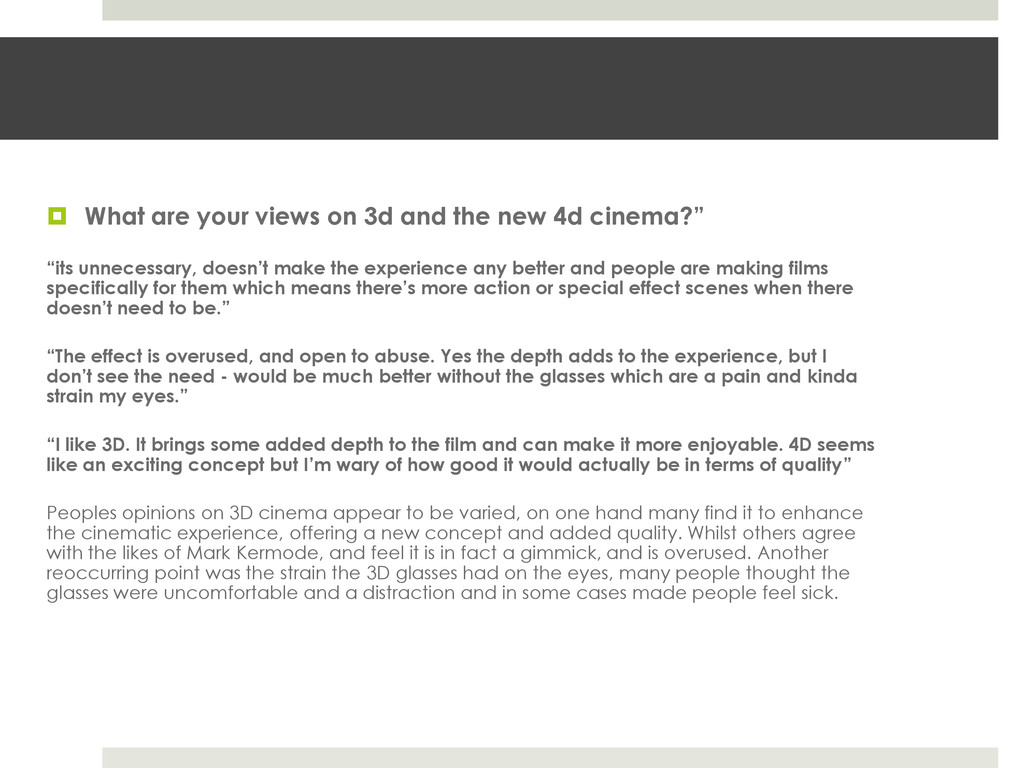
4d cinema?” “its unnecessary, doesn’t make the experience any better and people are making films specifically for them which means there’s more action or special effect scenes when there doesn’t need to be.” “The effect is overused, and open to abuse. Yes the depth adds to the experience, but I don’t see the need - would be much better without the glasses which are a pain and kinda strain my eyes.” “I like 3D. It brings some added depth to the film and can make it more enjoyable. 4D seems like an exciting concept but I’m wary of how good it would actually be in terms of quality” Peoples opinions on 3D cinema appear to be varied, on one hand many find it to enhance the cinematic experience, offering a new concept and added quality. Whilst others agree with the likes of Mark Kermode, and feel it is in fact a gimmick, and is overused. Another reoccurring point was the strain the 3D glasses had on the eyes, many people thought the glasses were uncomfortable and a distraction and in some cases made people feel sick.
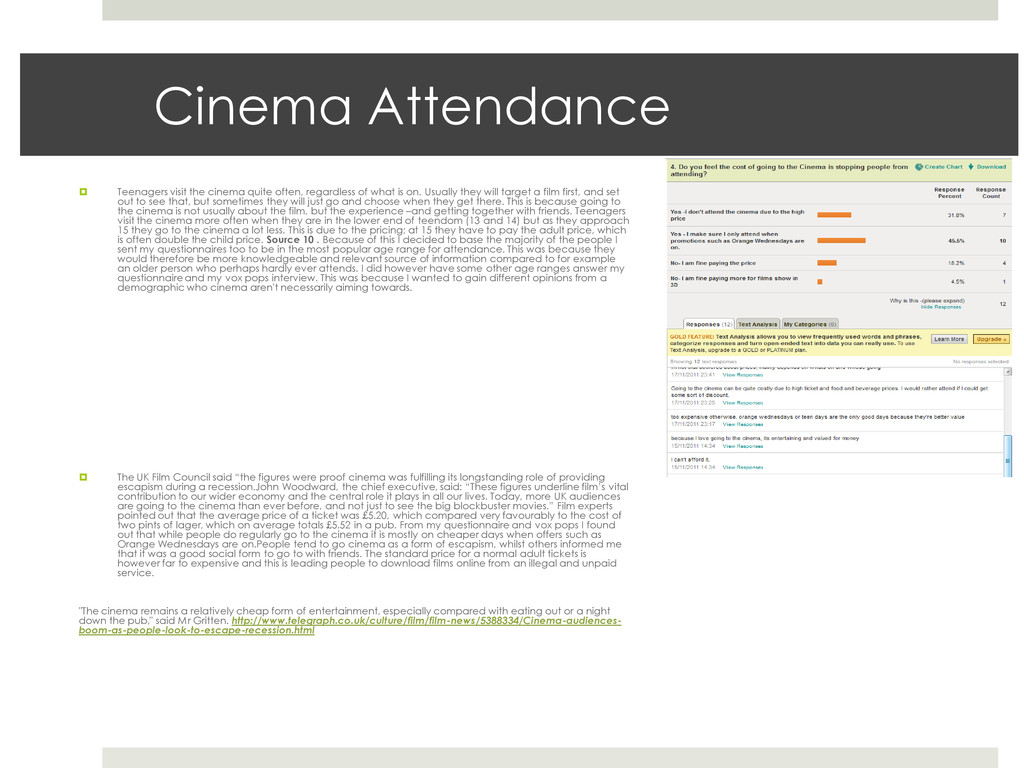
of what is on. Usually they will target a film first, and set out to see that, but sometimes they will just go and choose when they get there. This is because going to the cinema is not usually about the film, but the experience –and getting together with friends. Teenagers visit the cinema more often when they are in the lower end of teendom (13 and 14) but as they approach 15 they go to the cinema a lot less. This is due to the pricing; at 15 they have to pay the adult price, which is often double the child price. Source 10 . Because of this I decided to base the majority of the people I sent my questionnaires too to be in the most popular age range for attendance. This was because they would therefore be more knowledgeable and relevant source of information compared to for example an older person who perhaps hardly ever attends. I did however have some other age ranges answer my questionnaire and my vox pops interview. This was because I wanted to gain different opinions from a demographic who cinema aren't necessarily aiming towards. The UK Film Council said “the figures were proof cinema was fulfilling its longstanding role of providing escapism during a recession.John Woodward, the chief executive, said: “These figures underline film’s vital contribution to our wider economy and the central role it plays in all our lives. Today, more UK audiences are going to the cinema than ever before, and not just to see the big blockbuster movies.” Film experts pointed out that the average price of a ticket was £5.20, which compared very favourably to the cost of two pints of lager, which on average totals £5.52 in a pub. From my questionnaire and vox pops I found out that while people do regularly go to the cinema it is mostly on cheaper days when offers such as Orange Wednesdays are on.People tend to go cinema as a form of escapism, whilst others informed me that it was a good social form to go to with friends. The standard price for a normal adult tickets is however far to expensive and this is leading people to download films online from an illegal and unpaid service. "The cinema remains a relatively cheap form of entertainment, especially compared with eating out or a night down the pub," said Mr Gritten. http://www.telegraph.co.uk/culture/film/film-news/5388334/Cinema-audiences- boom-as-people-look-to-escape-recession.html
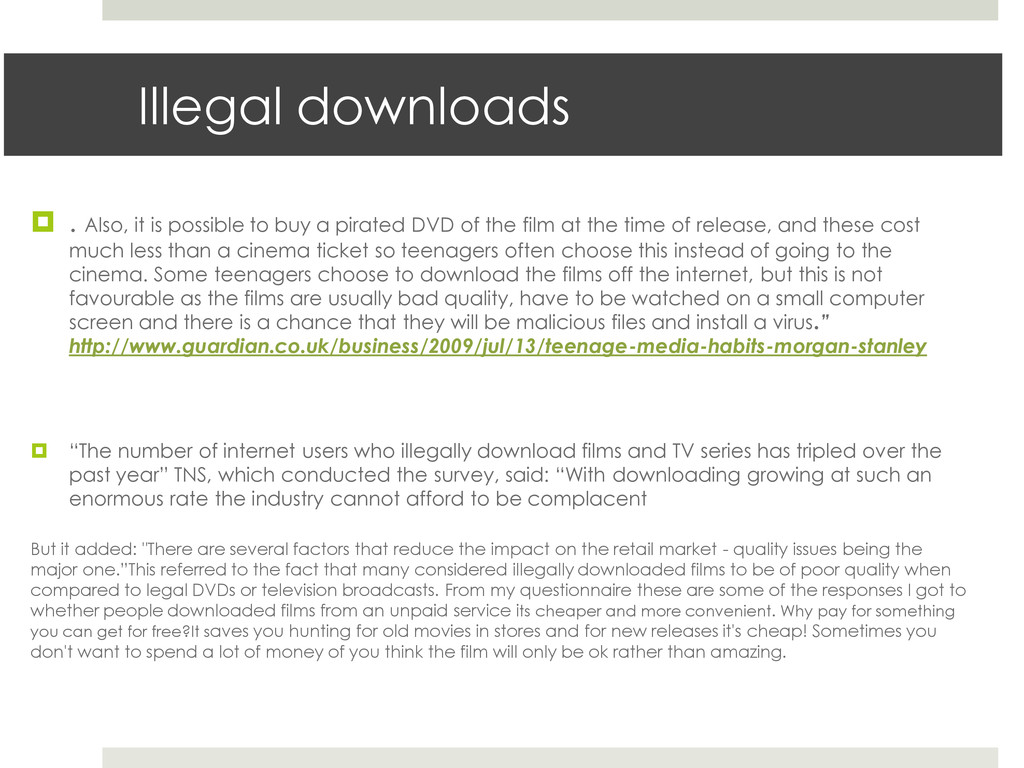
a pirated DVD of the film at the time of release, and these cost much less than a cinema ticket so teenagers often choose this instead of going to the cinema. Some teenagers choose to download the films off the internet, but this is not favourable as the films are usually bad quality, have to be watched on a small computer screen and there is a chance that they will be malicious files and install a virus.” http://www.guardian.co.uk/business/2009/jul/13/teenage-media-habits-morgan-stanley “The number of internet users who illegally download films and TV series has tripled over the past year” TNS, which conducted the survey, said: “With downloading growing at such an enormous rate the industry cannot afford to be complacent But it added: "There are several factors that reduce the impact on the retail market - quality issues being the major one.”This referred to the fact that many considered illegally downloaded films to be of poor quality when compared to legal DVDs or television broadcasts. From my questionnaire these are some of the responses I got to whether people downloaded films from an unpaid service its cheaper and more convenient. Why pay for something you can get for free?It saves you hunting for old movies in stores and for new releases it's cheap! Sometimes you don't want to spend a lot of money of you think the film will only be ok rather than amazing.
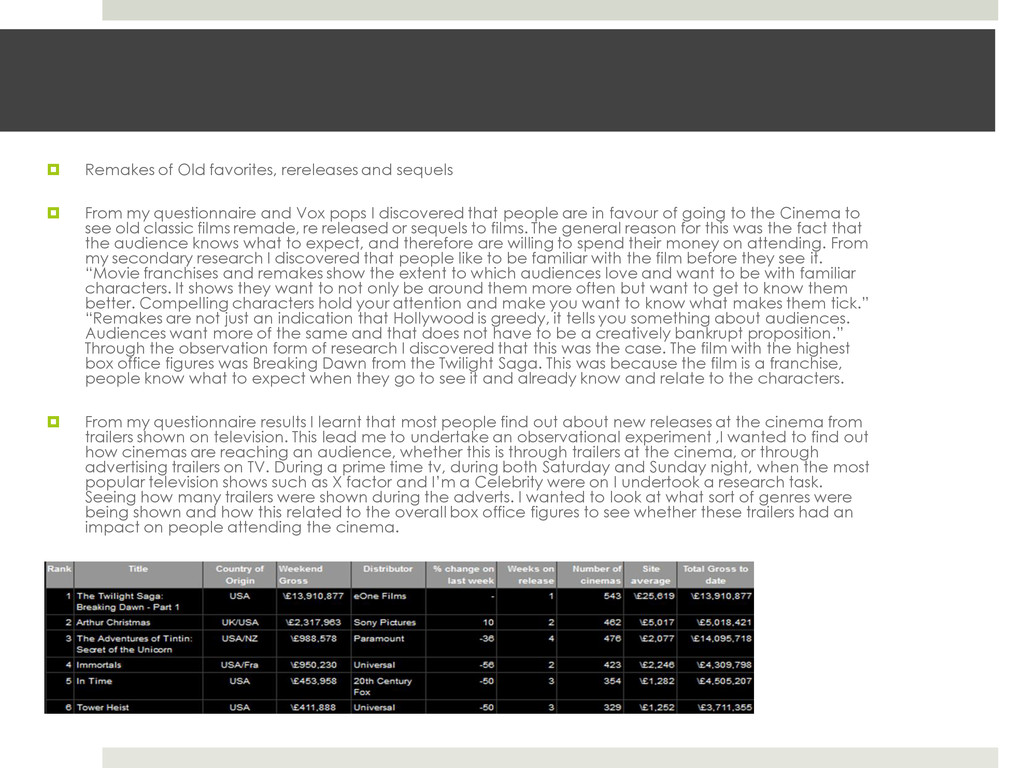
my questionnaire and Vox pops I discovered that people are in favour of going to the Cinema to see old classic films remade, re released or sequels to films. The general reason for this was the fact that the audience knows what to expect, and therefore are willing to spend their money on attending. From my secondary research I discovered that people like to be familiar with the film before they see it. “Movie franchises and remakes show the extent to which audiences love and want to be with familiar characters. It shows they want to not only be around them more often but want to get to know them better. Compelling characters hold your attention and make you want to know what makes them tick.” “Remakes are not just an indication that Hollywood is greedy, it tells you something about audiences. Audiences want more of the same and that does not have to be a creatively bankrupt proposition.” Through the observation form of research I discovered that this was the case. The film with the highest box office figures was Breaking Dawn from the Twilight Saga. This was because the film is a franchise, people know what to expect when they go to see it and already know and relate to the characters. From my questionnaire results I learnt that most people find out about new releases at the cinema from trailers shown on television. This lead me to undertake an observational experiment ,I wanted to find out how cinemas are reaching an audience, whether this is through trailers at the cinema, or through advertising trailers on TV. During a prime time tv, during both Saturday and Sunday night, when the most popular television shows such as X factor and I’m a Celebrity were on I undertook a research task. Seeing how many trailers were shown during the adverts. I wanted to look at what sort of genres were being shown and how this related to the overall box office figures to see whether these trailers had an impact on people attending the cinema.
majority of adverts played were from the action/adventure genre. Children’s films were shown however at an earlier time, around 7.30-8.00ish. This is because X factor is a family show so some of the trailers shown were for families. The trailer shown most times was for the new twilight film, Breaking Dawn. From checking cinema viewing times for this film, it is in no doubt why its being shown so many times. Cinemas were holding midnight viewings for the films release, as well as at least 2-3 screens showing the film every half an hour. Cinemas were aware of the popularity of the film due to the reaction from the first, so therefore knew how much profit it would make, and knew to advertise during prime time TV to add to the hype. This goes back to the point, of sequels with people liking to be familiar with a character and franchise. From looking at this its clear cinemas do use the television as a main platform to show trailers. They are aware of the demographic watching so chose specific genres suited to the programmes and the audience they know will watch it. I also checked on Cinemas twitter pages, to see the sort of things they tweet and how many followers they have. Vue cinema for example have a staggering 15,753 followers. This shows that they can reach a wide audience with a single tweet, cinemas are aware that they need to make changes and adapt so the use of social network websites such as twitter help to modernize their means of communication. From my questionnaire answers I learnt that the many people hear of new releases from social networking websites. Cinemas are clearly aware of the development and popularity of websites such as Twitter and Facebook , and therefore have changed their means of advertising and communication to audiences to match this.
etc, I sent many emails via twitter to many people from the media and film industry. Due to the time scale many people didn’t have time to answer. If I was to repeat this research task and I had more time and more money I would therefore be able to contact more influential and relevant people in the film industry , such as the head of the Bfi for example. Overall I found that whilst my methods of research worked well , I didn’t find overall answers for the main question asked. I found out about new ways that cinema are attracting audiences, however not necessarily in response to change in the film industry in general. If I were to do this research project again with a bigger budget for example, I could therefore look more specifically into the answers for the questions, and explore more in depth. My questionnaires I found to be the most useful piece of information I undertook, this was because it allowed me to specifically contact the prime demographic age range for cinema attendance, being teenagers. Through the use of the internet I contacted a range of teenagers from different social backgrounds and interest in order to get a more general and representational answer. My voxpops were helpful, it gave me an option to discuss further and get a more detailed answer from the people I asked, I found this useful as I also asked different age ranges giving versatile answers.


 jamesmcintyre1
 skipperchong
 michaelherold
 ryanjones
 panda_program
 madoxten
 baasie
 tammielis
 katarinadahlin
 chrislema
 chrisshort
 helenjbeal