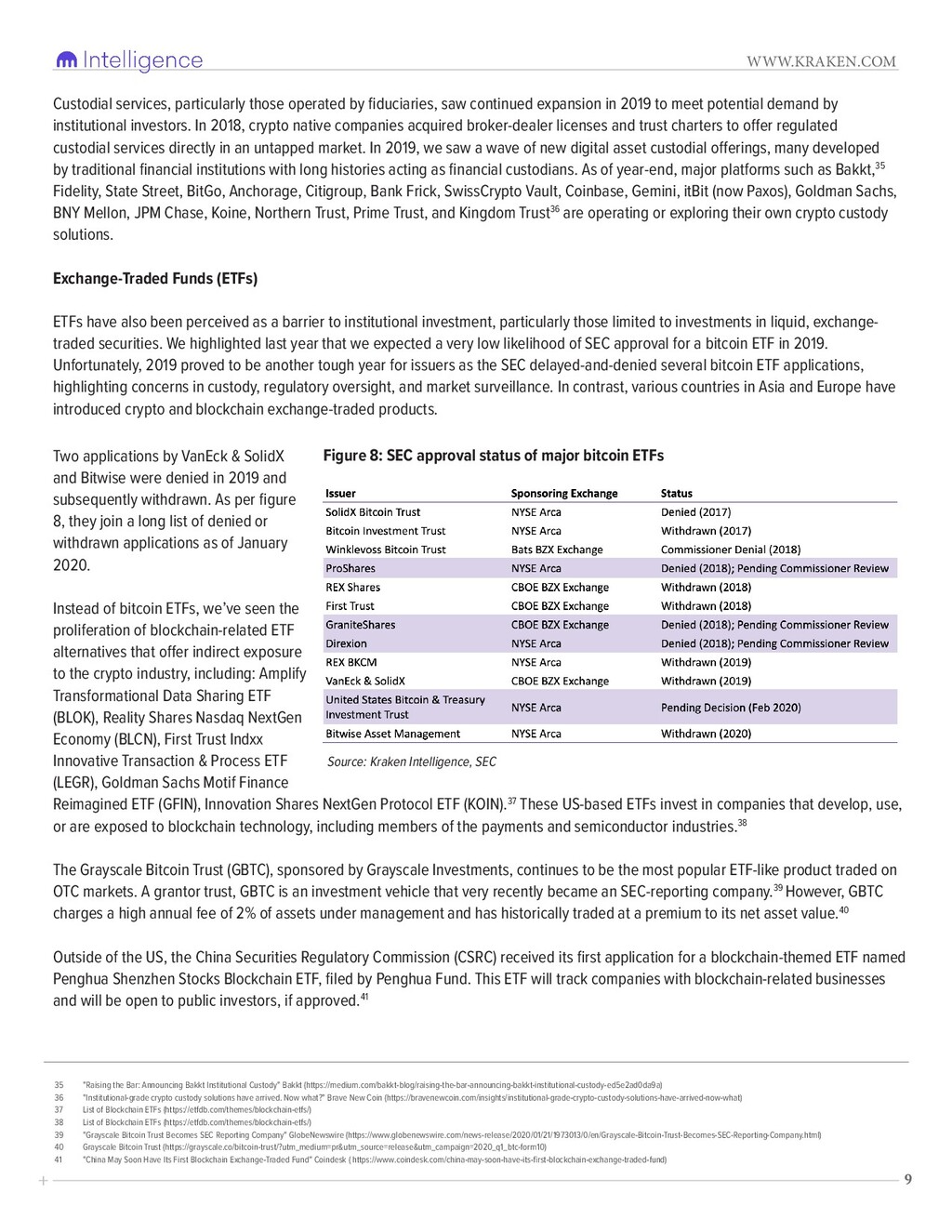
(https://medium.com/bakkt-blog/raising-the-bar-announcing-bakkt-institutional-custody-ed5e2ad0da9a) 36 "Institutional-grade crypto custody solutions have arrived. Now what?" Brave New Coin (https://bravenewcoin.com/insights/institutional-grade-crypto-custody-solutions-have-arrived-now-what) 37 List of Blockchain ETFs (https://etfdb.com/themes/blockchain-etfs/) 38 List of Blockchain ETFs (https://etfdb.com/themes/blockchain-etfs/) 39 "Grayscale Bitcoin Trust Becomes SEC Reporting Company" GlobeNewswire (https://www.globenewswire.com/news-release/2020/01/21/1973013/0/en/Grayscale-Bitcoin-Trust-Becomes-SEC-Reporting-Company.html) 40 Grayscale Bitcoin Trust (https://grayscale.co/bitcoin-trust/?utm_medium=pr&utm_source=release&utm_campaign=2020_q1_btc-form10) 41 "China May Soon Have Its First Blockchain Exchange-Traded Fund" Coindesk ( https://www.coindesk.com/china-may-soon-have-its-first-blockchain-exchange-traded-fund) Custodial services, particularly those operated by fiduciaries, saw continued expansion in 2019 to meet potential demand by institutional investors. In 2018, crypto native companies acquired broker-dealer licenses and trust charters to offer regulated custodial services directly in an untapped market. In 2019, we saw a wave of new digital asset custodial offerings, many developed by traditional financial institutions with long histories acting as financial custodians. As of year-end, major platforms such as Bakkt,35 Fidelity, State Street, BitGo, Anchorage, Citigroup, Bank Frick, SwissCrypto Vault, Coinbase, Gemini, itBit (now Paxos), Goldman Sachs, BNY Mellon, JPM Chase, Koine, Northern Trust, Prime Trust, and Kingdom Trust36 are operating or exploring their own crypto custody solutions. Exchange-Traded Funds (ETFs) ETFs have also been perceived as a barrier to institutional investment, particularly those limited to investments in liquid, exchange- traded securities. We highlighted last year that we expected a very low likelihood of SEC approval for a bitcoin ETF in 2019. Unfortunately, 2019 proved to be another tough year for issuers as the SEC delayed-and-denied several bitcoin ETF applications, highlighting concerns in custody, regulatory oversight, and market surveillance. In contrast, various countries in Asia and Europe have introduced crypto and blockchain exchange-traded products. WWW.KRAKEN.COM Reimagined ETF (GFIN), Innovation Shares NextGen Protocol ETF (KOIN).37 These US-based ETFs invest in companies that develop, use, or are exposed to blockchain technology, including members of the payments and semiconductor industries.38 The Grayscale Bitcoin Trust (GBTC), sponsored by Grayscale Investments, continues to be the most popular ETF-like product traded on OTC markets. A grantor trust, GBTC is an investment vehicle that very recently became an SEC-reporting company.39 However, GBTC charges a high annual fee of 2% of assets under management and has historically traded at a premium to its net asset value.40 Outside of the US, the China Securities Regulatory Commission (CSRC) received its first application for a blockchain-themed ETF named Penghua Shenzhen Stocks Blockchain ETF, filed by Penghua Fund. This ETF will track companies with blockchain-related businesses and will be open to public investors, if approved.41 Figure 8: SEC approval status of major bitcoin ETFs Source: Kraken Intelligence, SEC Two applications by VanEck & SolidX and Bitwise were denied in 2019 and subsequently withdrawn. As per figure 8, they join a long list of denied or withdrawn applications as of January 2020. Instead of bitcoin ETFs, we’ve seen the proliferation of blockchain-related ETF alternatives that offer indirect exposure to the crypto industry, including: Amplify Transformational Data Sharing ETF (BLOK), Reality Shares Nasdaq NextGen Economy (BLCN), First Trust Indxx Innovative Transaction & Process ETF (LEGR), Goldman Sachs Motif Finance


 baasie
 mclloyd
 reverentgeek
 cassininazir
 eileencodes
 addyosmani
 techseoconnect
 elsirapls
 maggiecrowley
 bluesmoon
 nwiizo
 wjessup