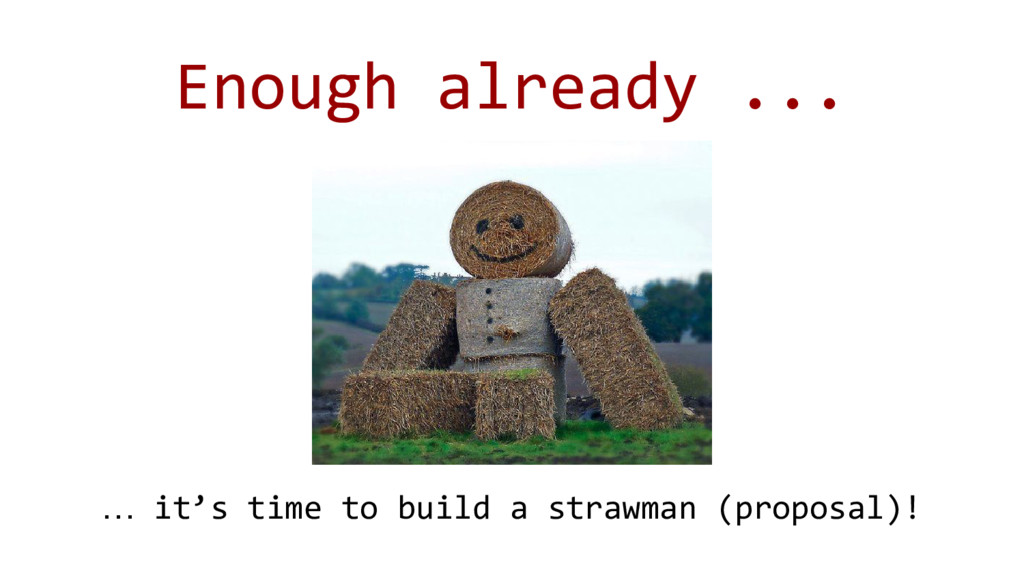
to (sincerely trying to) organize (or at least financially supporting) at least one FLOSS oriented event for your community of choice in the next 12 months! ❏ I agree ❏ Get me out of here!
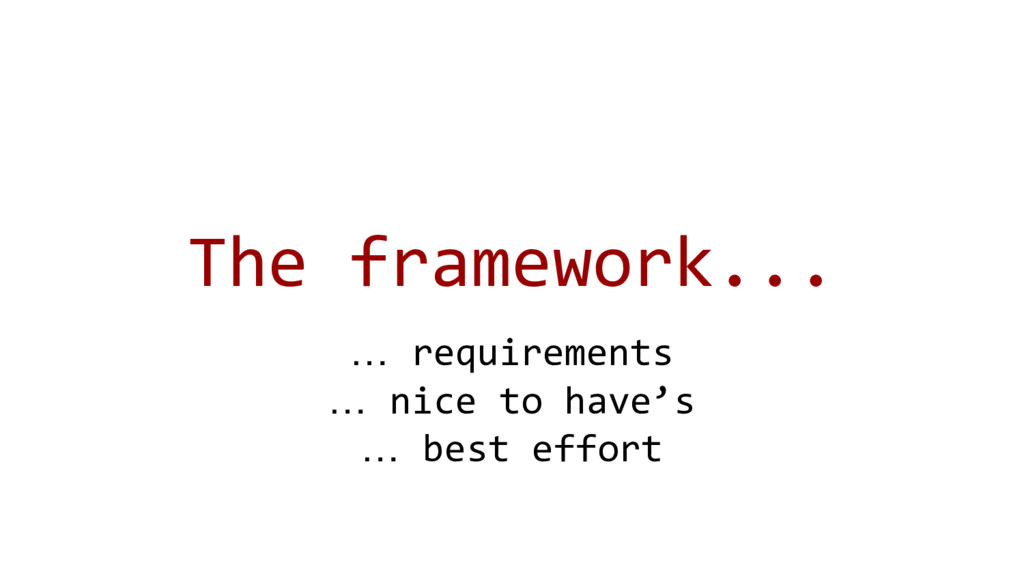
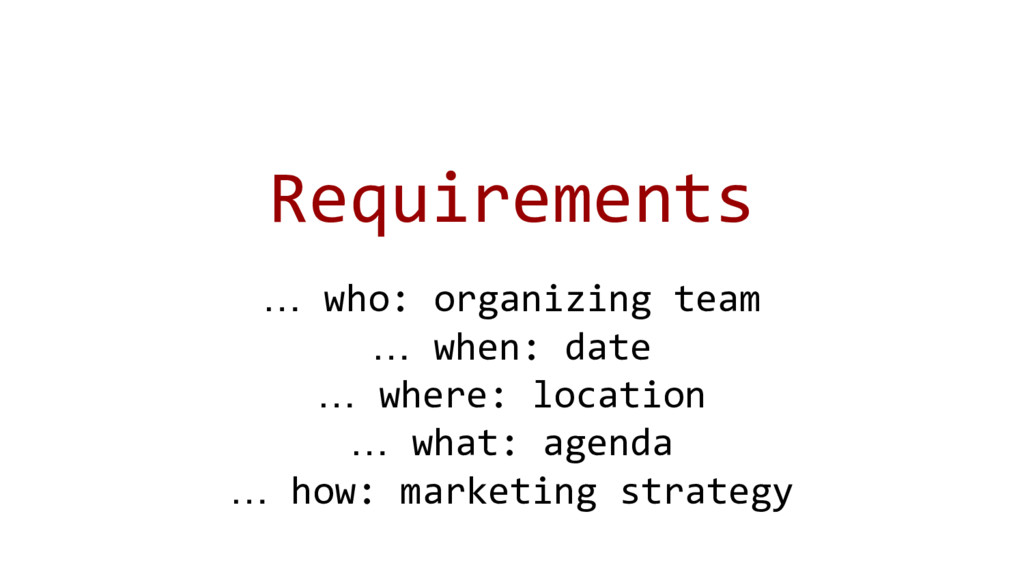
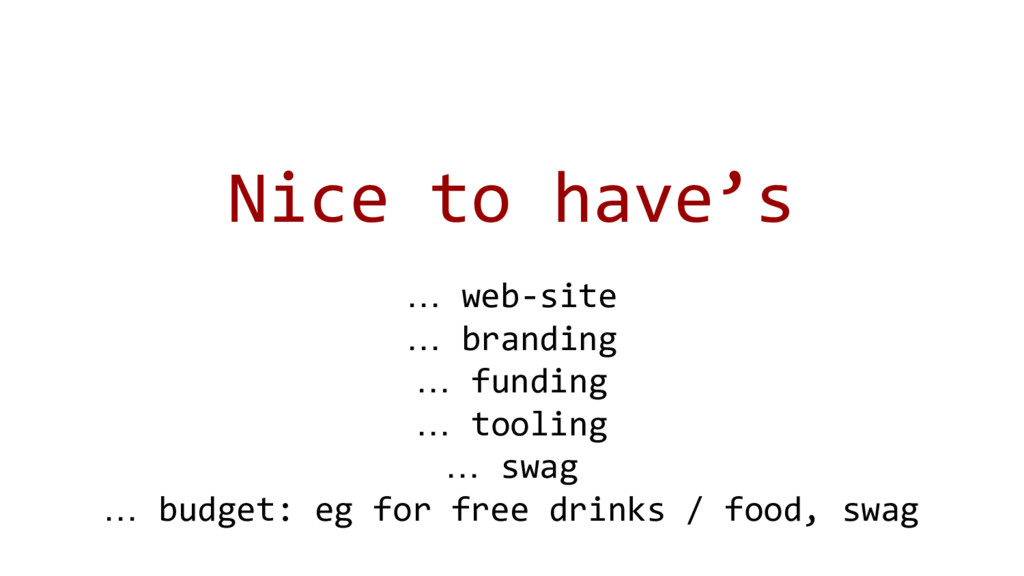
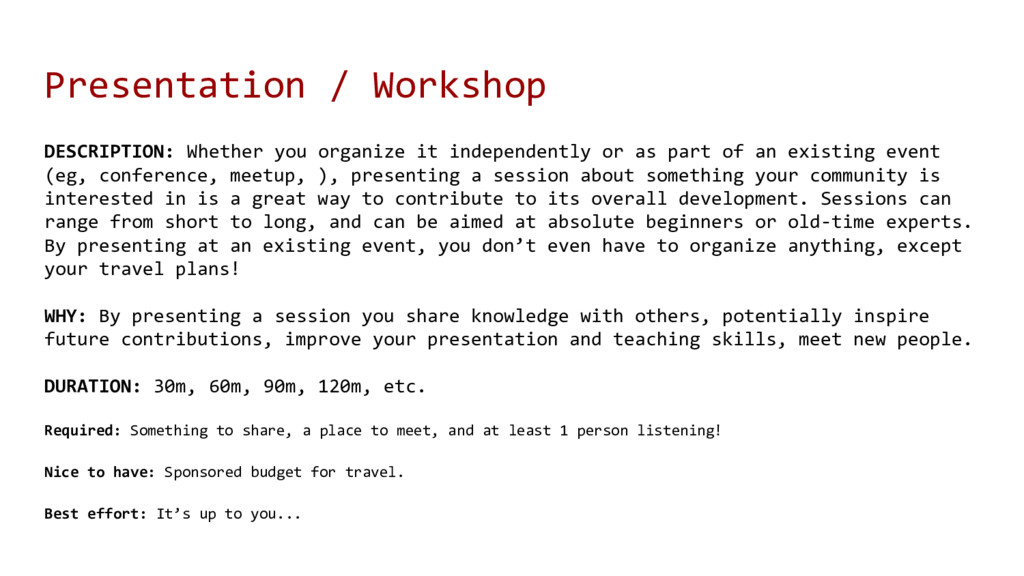
as part of an existing event (eg, conference, meetup, ), presenting a session about something your community is interested in is a great way to contribute to its overall development. Sessions can range from short to long, and can be aimed at absolute beginners or old-time experts. By presenting at an existing event, you don’t even have to organize anything, except your travel plans! WHY: By presenting a session you share knowledge with others, potentially inspire future contributions, improve your presentation and teaching skills, meet new people. DURATION: 30m, 60m, 90m, 120m, etc. Required: Something to share, a place to meet, and at least 1 person listening! Nice to have: Sponsored budget for travel. Best effort: It’s up to you...
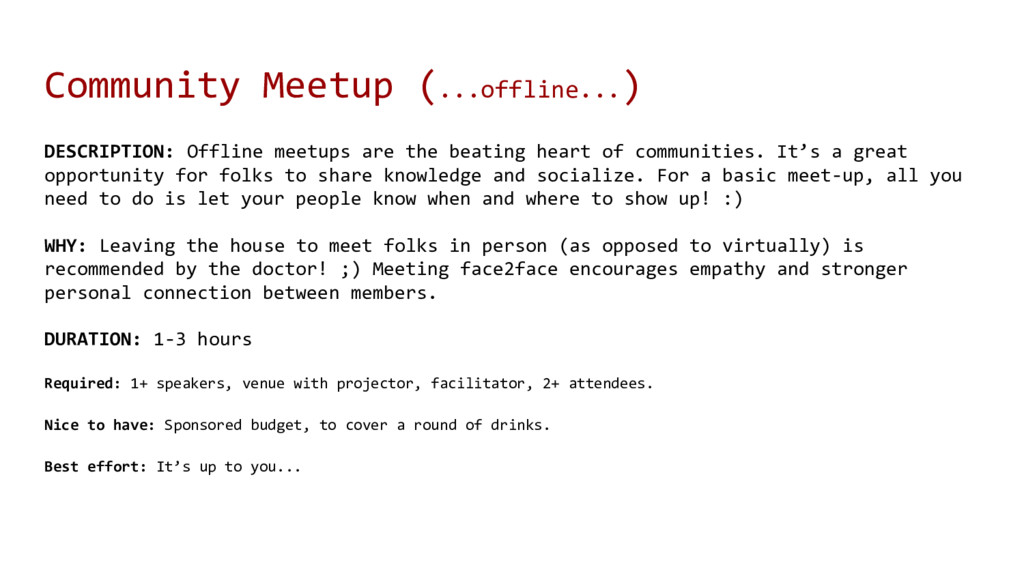
of communities. It’s a great opportunity for folks to share knowledge and socialize. For a basic meet-up, all you need to do is let your people know when and where to show up! :) WHY: Leaving the house to meet folks in person (as opposed to virtually) is recommended by the doctor! ;) Meeting face2face encourages empathy and stronger personal connection between members. DURATION: 1-3 hours Required: 1+ speakers, venue with projector, facilitator, 2+ attendees. Nice to have: Sponsored budget, to cover a round of drinks. Best effort: It’s up to you...
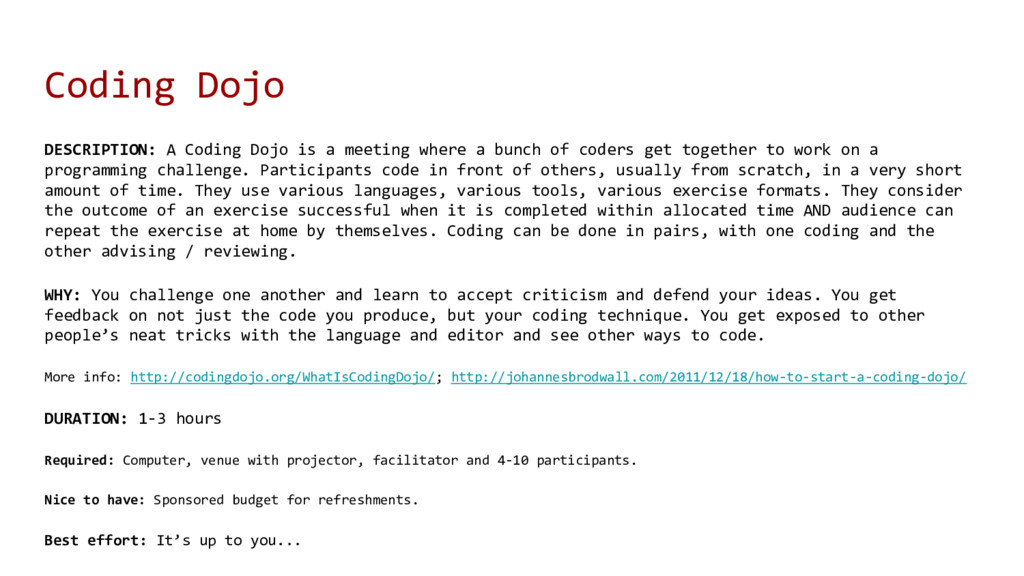
a bunch of coders get together to work on a programming challenge. Participants code in front of others, usually from scratch, in a very short amount of time. They use various languages, various tools, various exercise formats. They consider the outcome of an exercise successful when it is completed within allocated time AND audience can repeat the exercise at home by themselves. Coding can be done in pairs, with one coding and the other advising / reviewing. WHY: You challenge one another and learn to accept criticism and defend your ideas. You get feedback on not just the code you produce, but your coding technique. You get exposed to other people’s neat tricks with the language and editor and see other ways to code. More info: http://codingdojo.org/WhatIsCodingDojo/; http://johannesbrodwall.com/2011/12/18/how-to-start-a-coding-dojo/ DURATION: 1-3 hours Required: Computer, venue with projector, facilitator and 4-10 participants. Nice to have: Sponsored budget for refreshments. Best effort: It’s up to you...
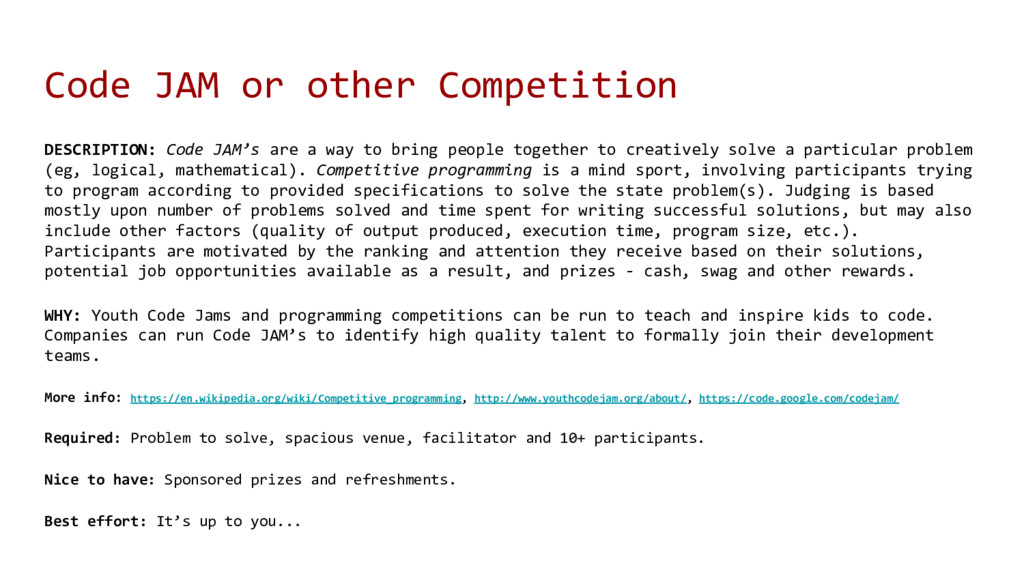
way to bring people together to creatively solve a particular problem (eg, logical, mathematical). Competitive programming is a mind sport, involving participants trying to program according to provided specifications to solve the state problem(s). Judging is based mostly upon number of problems solved and time spent for writing successful solutions, but may also include other factors (quality of output produced, execution time, program size, etc.). Participants are motivated by the ranking and attention they receive based on their solutions, potential job opportunities available as a result, and prizes - cash, swag and other rewards. WHY: Youth Code Jams and programming competitions can be run to teach and inspire kids to code. Companies can run Code JAM’s to identify high quality talent to formally join their development teams. More info: https://en.wikipedia.org/wiki/Competitive_programming, http://www.youthcodejam.org/about/, https://code.google.com/codejam/ Required: Problem to solve, spacious venue, facilitator and 10+ participants. Nice to have: Sponsored prizes and refreshments. Best effort: It’s up to you...
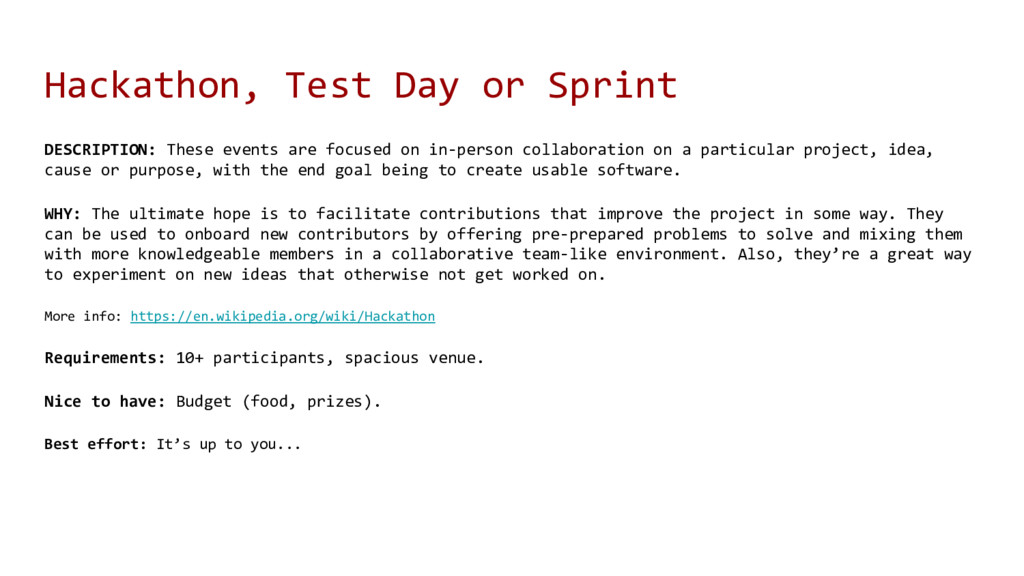
on in-person collaboration on a particular project, idea, cause or purpose, with the end goal being to create usable software. WHY: The ultimate hope is to facilitate contributions that improve the project in some way. They can be used to onboard new contributors by offering pre-prepared problems to solve and mixing them with more knowledgeable members in a collaborative team-like environment. Also, they’re a great way to experiment on new ideas that otherwise not get worked on. More info: https://en.wikipedia.org/wiki/Hackathon Requirements: 10+ participants, spacious venue. Nice to have: Budget (food, prizes). Best effort: It’s up to you...
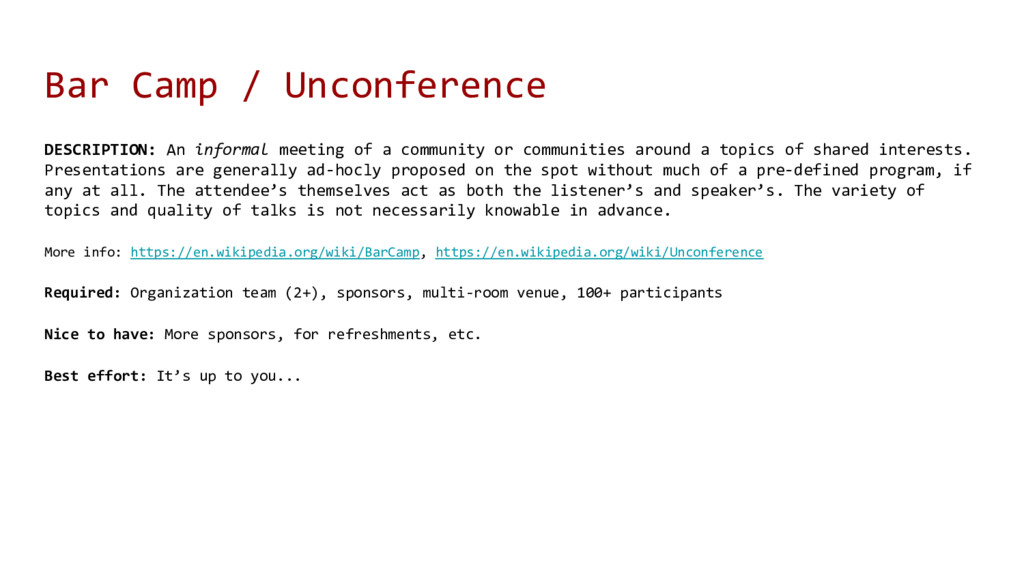
community or communities around a topics of shared interests. Presentations are generally ad-hocly proposed on the spot without much of a pre-defined program, if any at all. The attendee’s themselves act as both the listener’s and speaker’s. The variety of topics and quality of talks is not necessarily knowable in advance. More info: https://en.wikipedia.org/wiki/BarCamp, https://en.wikipedia.org/wiki/Unconference Required: Organization team (2+), sponsors, multi-room venue, 100+ participants Nice to have: More sponsors, for refreshments, etc. Best effort: It’s up to you...
communities around topics of shared interests. A “Call for Papers” (CfP) is issued where speakers formally submit session proposals to be reviewed for inclusion into the official event program by a ‘program panel’. Only a subset of all submissions will be accepted. WHY: Conferences provide an important channel for exchange of information between community members. Required: Organization team (2+), branding, underwriter, sponsors or ticket sales, modern multi-room venue, 100+ participants. Nice to have: On-line tooling (CfP, schedule, registration / ticket sales), “celebrity” speakers. Best effort: It’s up to you...
deadlines, be ready to enforce hard deadlines. … note contact info for everyone who has ever shown interest in the topic … ask for referrals from all rejections … remember, ask ‘is this required?’ … it’s probably NOT!


 greggifford
 sonatard
 inesmontani
 tomoyanonymous
 samlambert
 honzajavorek
 helmedeiros
 addyosmani
 mayatellez
 aarron
 schlessera
 marktimemedia