If you are looking to implement a resource planning process or improve what you already have then this is the guide for you. We cover: • What is resource capacity planning • Resource capacity planning health check • How project prioritisation influences resource planning • Resource capacity planning best practice • Resource planning and portfolio management If you are a resource planner, resource manager, portfolio manager or manage a project management office (PMO) this makes essential reading.
• Planning of human resources and not things like machines, equipment etc. • Process organisations use to determine the resources they need to perform the work they want to do. Answers the question… “Do we have sufficient resource to do the work we want to do and if not do we hire resource, defer work or re-prioritise work.”
• It compares the supply of resource to the demands made on resource. • Supply (also known as capacity) is the total number of resources you have available through a time period. • Demand is the work that resources are required to do. • Look at the variance between your supply and your demand and you will know if you have a problem.
@Kelloo_app • The terms capacity planning and resource planning are often used interchangeably. • They are different processes with different outputs. • Capacity planning has a longer term focus on resource levels and what work the organisation has the capability to do. • Resource planning is concerned with which resources will be working on what projects (also called resource allocation).
• Most organisations have too many projects and not enough resources - they are resource constrained. • Organisation's must align their demand for work with their ability to deliver. • Resource capacity planning is a complicated process to get right. • More often than not it is ignored or done badly.
The benefits for organisation who crack the resource capacity planning problem are immense. • Cost savings. • Improved project throughput. • Improved resource morale. • Better ability to innovate. • Improved customer satisfaction.
Effective resource capacity planning is vital to resource based organisations but is rarely done well. Visit our blog to take the resource capacity planning health check! Take the resource capacity planning health check...
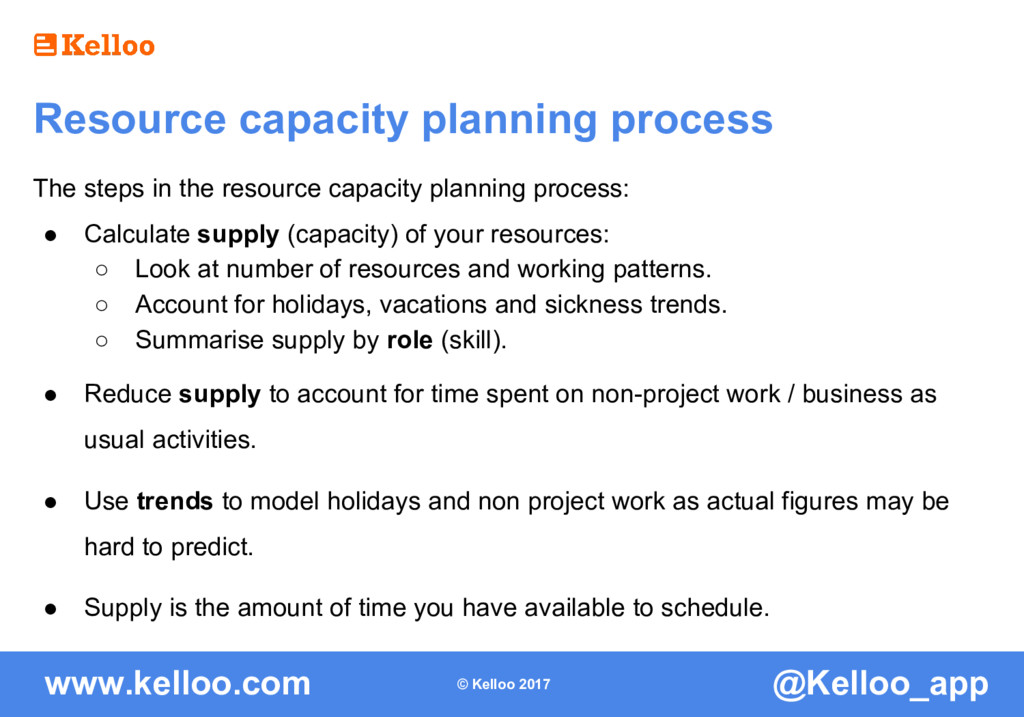
steps in the resource capacity planning process: • Calculate supply (capacity) of your resources: ◦ Look at number of resources and working patterns. ◦ Account for holidays, vacations and sickness trends. ◦ Summarise supply by role (skill). • Reduce supply to account for time spent on non-project work / business as usual activities. • Use trends to model holidays and non project work as actual figures may be hard to predict. • Supply is the amount of time you have available to schedule.
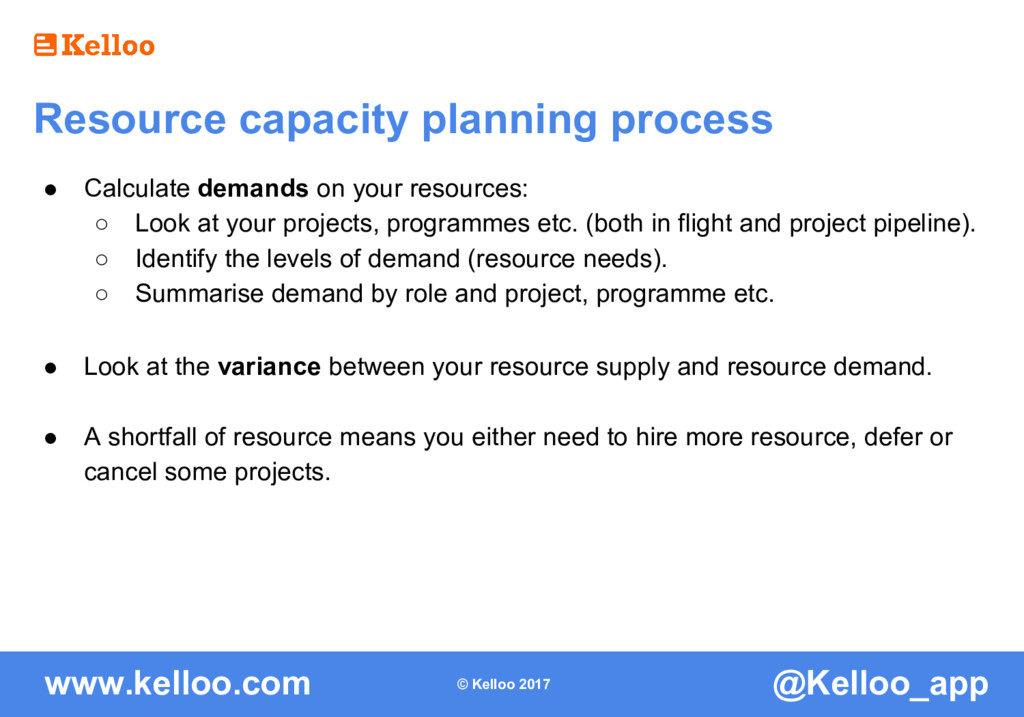
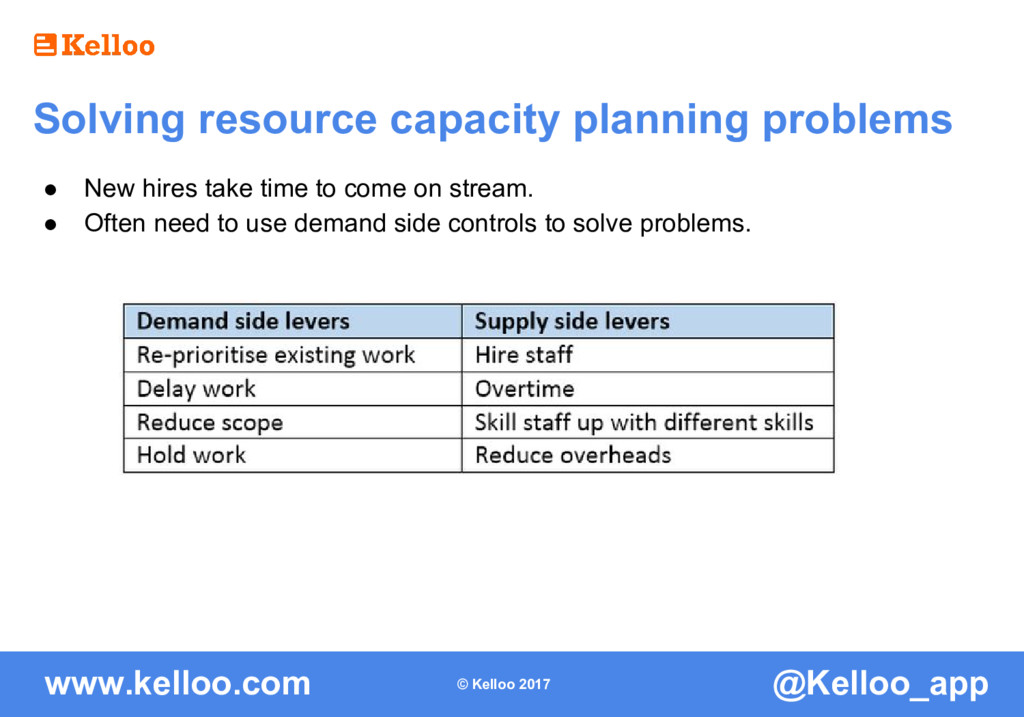
Calculate demands on your resources: ◦ Look at your projects, programmes etc. (both in flight and project pipeline). ◦ Identify the levels of demand (resource needs). ◦ Summarise demand by role and project, programme etc. • Look at the variance between your resource supply and resource demand. • A shortfall of resource means you either need to hire more resource, defer or cancel some projects.
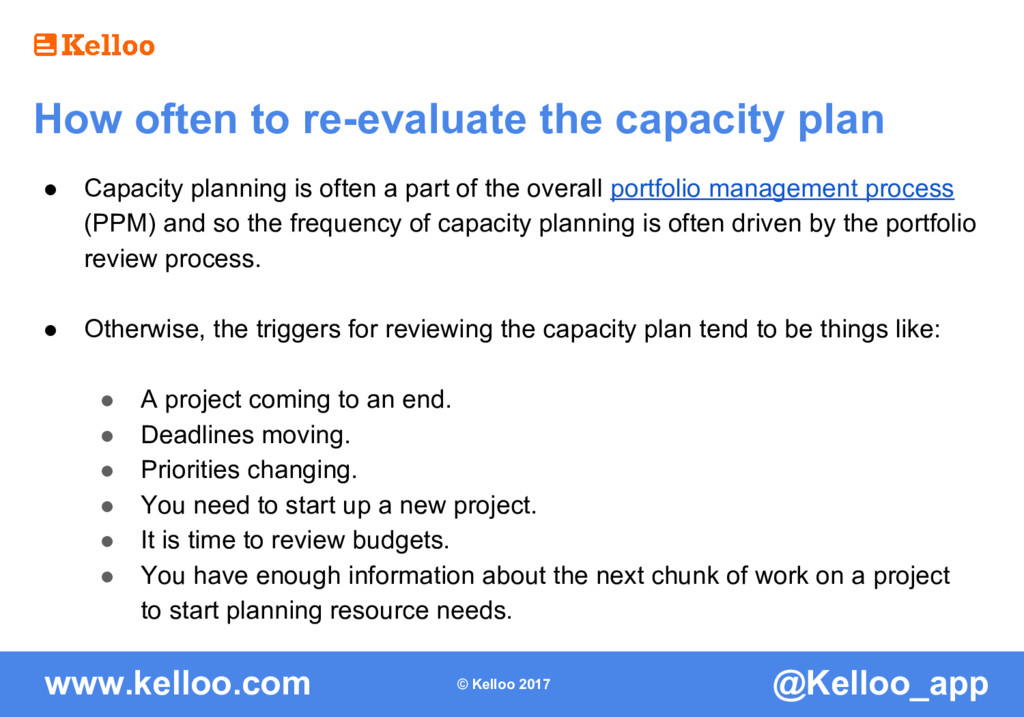
www.kelloo.com @Kelloo_app • Capacity planning is often a part of the overall portfolio management process (PPM) and so the frequency of capacity planning is often driven by the portfolio review process. • Otherwise, the triggers for reviewing the capacity plan tend to be things like: • A project coming to an end. • Deadlines moving. • Priorities changing. • You need to start up a new project. • It is time to review budgets. • You have enough information about the next chunk of work on a project to start planning resource needs.
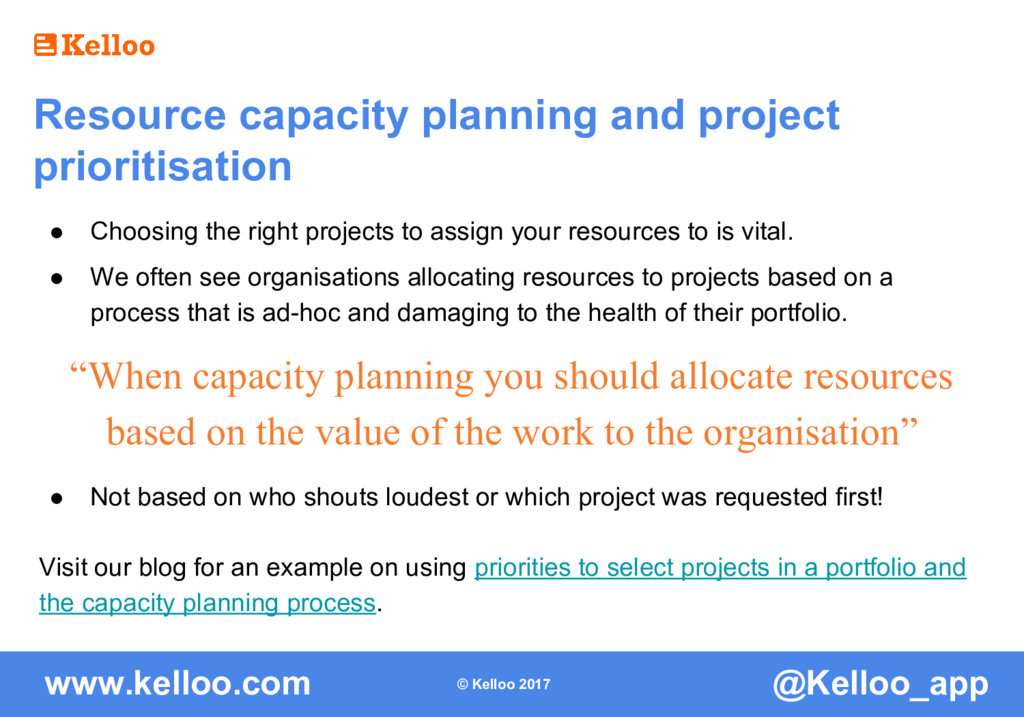
@Kelloo_app • Choosing the right projects to assign your resources to is vital. • We often see organisations allocating resources to projects based on a process that is ad-hoc and damaging to the health of their portfolio. “When capacity planning you should allocate resources based on the value of the work to the organisation” • Not based on who shouts loudest or which project was requested first! Visit our blog for an example on using priorities to select projects in a portfolio and the capacity planning process.
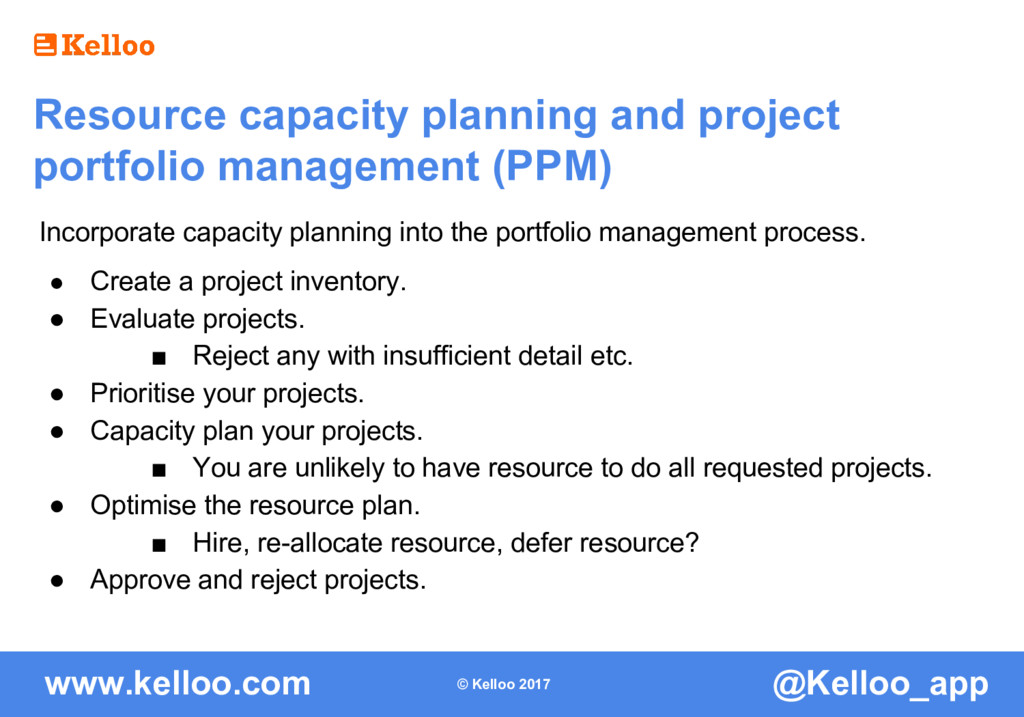
2017 www.kelloo.com @Kelloo_app Incorporate capacity planning into the portfolio management process. • Create a project inventory. • Evaluate projects. ▪ Reject any with insufficient detail etc. • Prioritise your projects. • Capacity plan your projects. ▪ You are unlikely to have resource to do all requested projects. • Optimise the resource plan. ▪ Hire, re-allocate resource, defer resource? • Approve and reject projects.
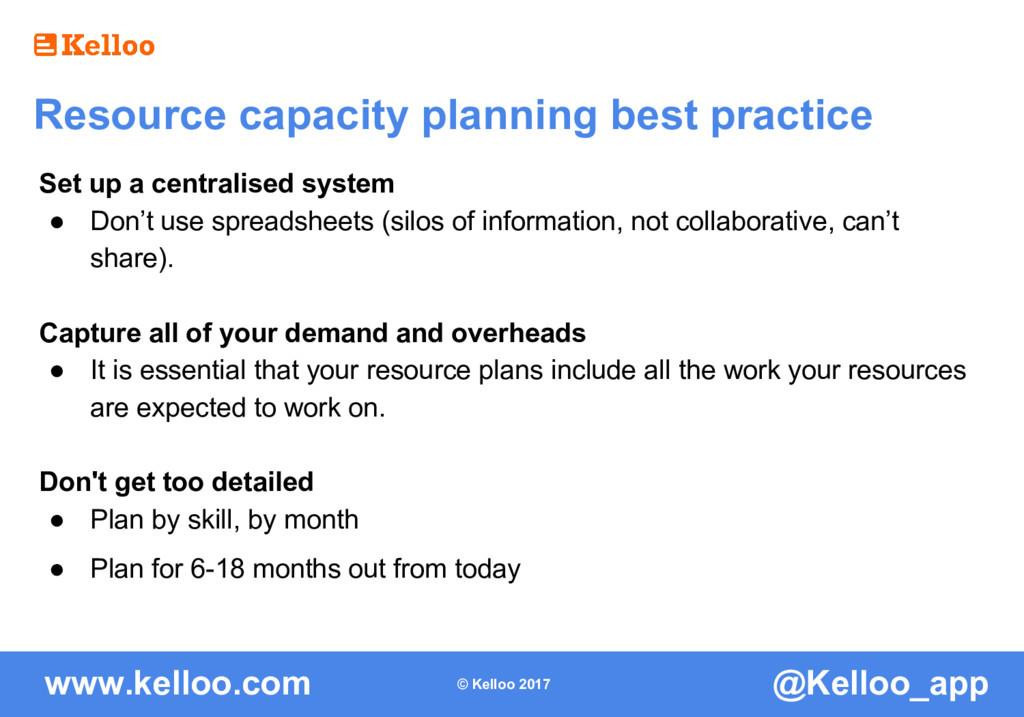
Set up a centralised system • Don’t use spreadsheets (silos of information, not collaborative, can’t share). Capture all of your demand and overheads • It is essential that your resource plans include all the work your resources are expected to work on. Don't get too detailed • Plan by skill, by month • Plan for 6-18 months out from today
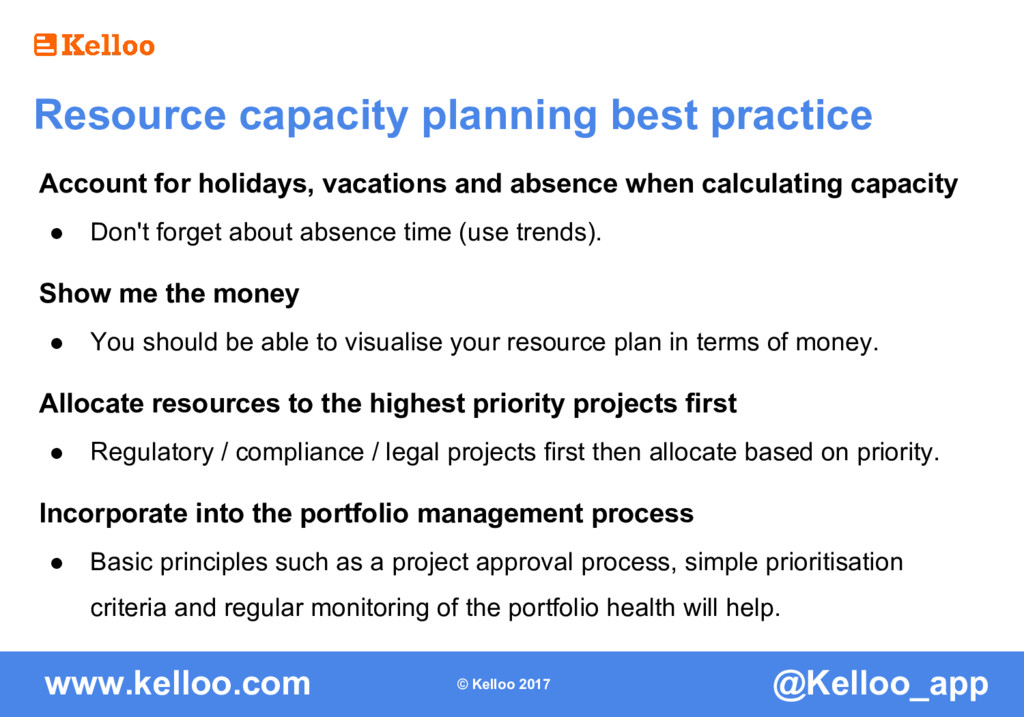
Account for holidays, vacations and absence when calculating capacity • Don't forget about absence time (use trends). Show me the money • You should be able to visualise your resource plan in terms of money. Allocate resources to the highest priority projects first • Regulatory / compliance / legal projects first then allocate based on priority. Incorporate into the portfolio management process • Basic principles such as a project approval process, simple prioritisation criteria and regular monitoring of the portfolio health will help.
Spreadsheets or Excel are commonly used for resource capacity planning and the appeal is obvious. Common problems: ◦ Schedule changes are near impossible ◦ Silos of resource planning data ◦ Simple changes to plans are not simple to do ◦ Inability to model different planning options ◦ Lack of reporting Visit our blog to see some of the common problems resource capacity planning spreadsheets cause.
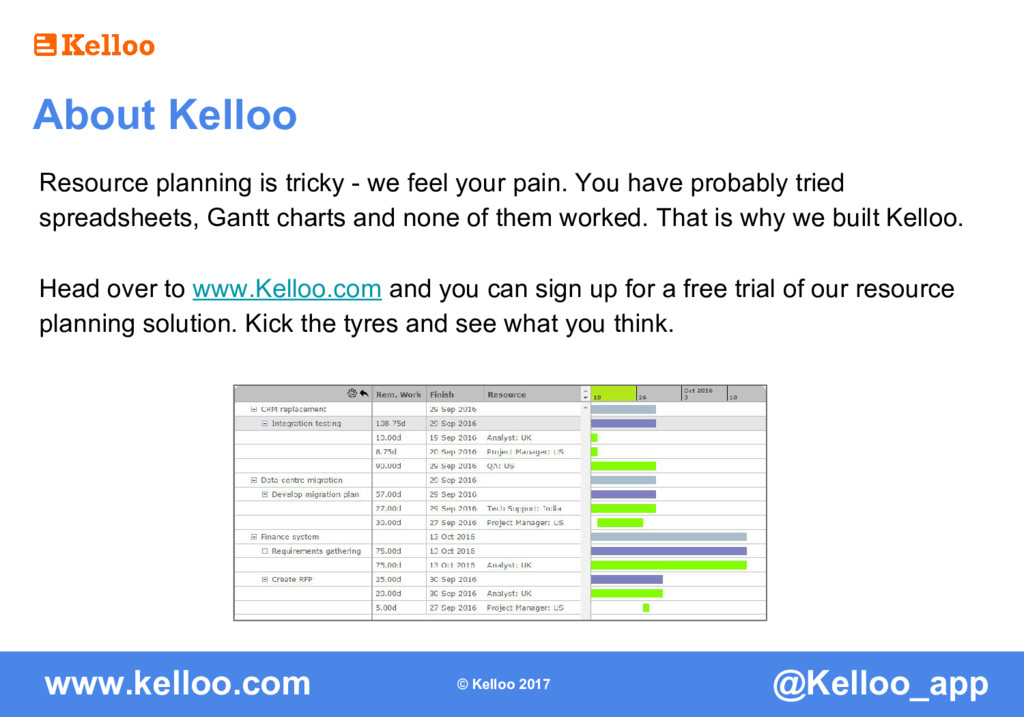
tricky - we feel your pain. You have probably tried spreadsheets, Gantt charts and none of them worked. That is why we built Kelloo. Head over to www.Kelloo.com and you can sign up for a free trial of our resource planning solution. Kick the tyres and see what you think.


 kizawa2020
 yu23ki14
 ueponx
 recruitengineers
 kaminashi
 tokuty
 hiracky16
 yuuuuuuu168
 makocchi
 tomokusaba
 ykanoh
 grimoh
 mfonobong
 tessaabrams
 samtorres
 mlcsv
 inesmontani
 baasie
 chrisshort
 badams
 jct
 techseoconnect
 palkan
 kimpetersen