I had to be very specific at who I asked to take part in my research, I aimed to get a wide audience from 17-60. I did this by making the questionnaire primarily for the elder audience which is where my mum handed them out at her office, the age ranged from 22 to 62. And I aimed my focus group and interview at teenagers around 17- 19. I will be talking about and analysing my results from my research and looking at the my secondary sources to make connections, the reason I will be doing this is so I can back up my primary research. The reason I chose my research plan is because I thought it would be the most effective way of getting information back, I chose to do a questionnaire, an interview and content analysis. Originally I also put together a focus group but had complications and lost the evidence therefore it has not been included in this presentation. I have mainly analysed the research by statistics and gone in to detail about them, as you can see.
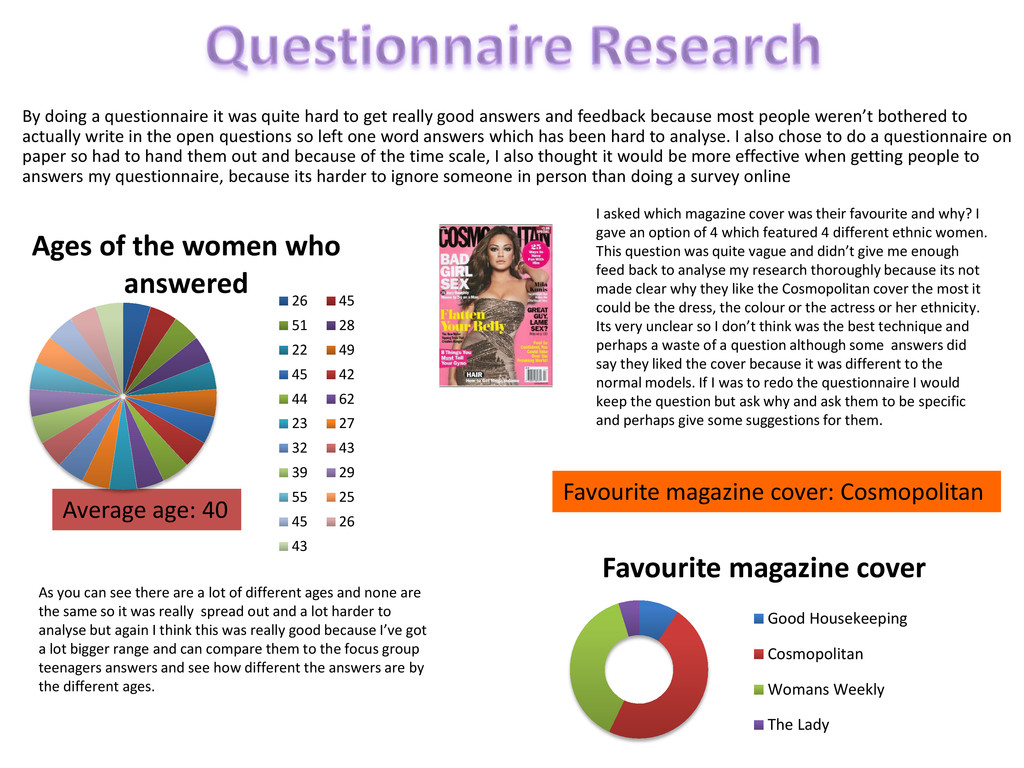
really good answers and feedback because most people weren’t bothered to actually write in the open questions so left one word answers which has been hard to analyse. I also chose to do a questionnaire on paper so had to hand them out and because of the time scale, I also thought it would be more effective when getting people to answers my questionnaire, because its harder to ignore someone in person than doing a survey online Average age: 40 Favourite magazine cover: Cosmopolitan Ages of the women who answered 26 45 51 28 22 49 45 42 44 62 23 27 32 43 39 29 55 25 45 26 43 Favourite magazine cover Good Housekeeping Cosmopolitan Womans Weekly The Lady I asked which magazine cover was their favourite and why? I gave an option of 4 which featured 4 different ethnic women. This question was quite vague and didn’t give me enough feed back to analyse my research thoroughly because its not made clear why they like the Cosmopolitan cover the most it could be the dress, the colour or the actress or her ethnicity. Its very unclear so I don’t think was the best technique and perhaps a waste of a question although some answers did say they liked the cover because it was different to the normal models. If I was to redo the questionnaire I would keep the question but ask why and ask them to be specific and perhaps give some suggestions for them. As you can see there are a lot of different ages and none are the same so it was really spread out and a lot harder to analyse but again I think this was really good because I’ve got a lot bigger range and can compare them to the focus group teenagers answers and see how different the answers are by the different ages.
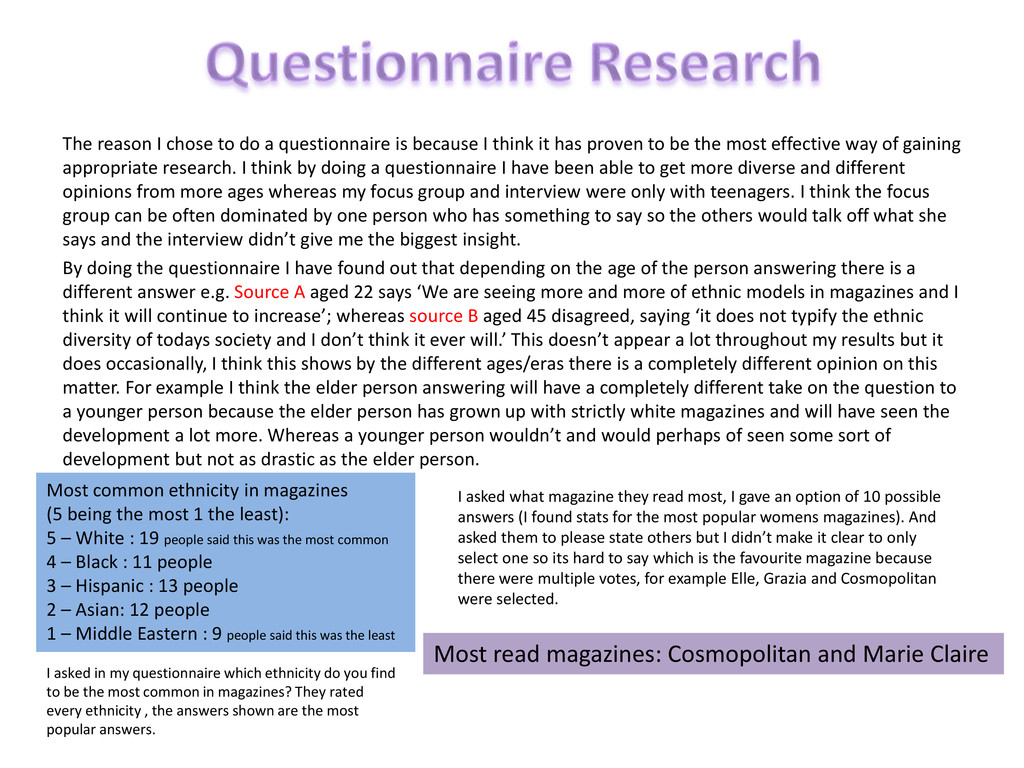
I think it has proven to be the most effective way of gaining appropriate research. I think by doing a questionnaire I have been able to get more diverse and different opinions from more ages whereas my focus group and interview were only with teenagers. I think the focus group can be often dominated by one person who has something to say so the others would talk off what she says and the interview didn’t give me the biggest insight. By doing the questionnaire I have found out that depending on the age of the person answering there is a different answer e.g. Source A aged 22 says ‘We are seeing more and more of ethnic models in magazines and I think it will continue to increase’; whereas source B aged 45 disagreed, saying ‘it does not typify the ethnic diversity of todays society and I don’t think it ever will.’ This doesn’t appear a lot throughout my results but it does occasionally, I think this shows by the different ages/eras there is a completely different opinion on this matter. For example I think the elder person answering will have a completely different take on the question to a younger person because the elder person has grown up with strictly white magazines and will have seen the development a lot more. Whereas a younger person wouldn’t and would perhaps of seen some sort of development but not as drastic as the elder person. Most read magazines: Cosmopolitan and Marie Claire Most common ethnicity in magazines (5 being the most 1 the least): 5 – White : 19 people said this was the most common 4 – Black : 11 people 3 – Hispanic : 13 people 2 – Asian: 12 people 1 – Middle Eastern : 9 people said this was the least I asked in my questionnaire which ethnicity do you find to be the most common in magazines? They rated every ethnicity , the answers shown are the most popular answers. I asked what magazine they read most, I gave an option of 10 possible answers (I found stats for the most popular womens magazines). And asked them to please state others but I didn’t make it clear to only select one so its hard to say which is the favourite magazine because there were multiple votes, for example Elle, Grazia and Cosmopolitan were selected.
currently trying to make it, she has had many jobs just unpaid. I managed to get an idea of what being head first in the modeling industry is like. I asked ‘do you think its been harder for you because youre from a different ethnic group?’ She thinks there is only a certain category for black models, she says it has been a lot harder for her in comparison to friends she knows whom are white. She says she has been persistently trying to break it as a model through competitions and going to agencies. She says she is often told she’s “got an amazing, edgy style, but its not what they are looking for” this has left Courtnie wondering what are they looking for from a black model? And will it ever be something other than the next Naomi Campbell. Source B helps reinforce Courtnies feeling of the modelling world for black models. Carole White, founder of Premier models says “Of course, there is room for more than one successful black model, but it does seem that popular culture can only deal with one at a time.” I think this goes to show why there is alot less black and ethnic models, the modelling world is less accepting and this obviously has an impact of the amount of models willing to face rejection. Carole also says “It's a lot harder to start a black girl than a white girl, for a number of reasons, there's not so much work for them, and sometimes photographers and makeup artists are scared.” I think by what Carole says it is evident that there might be less racism in the magazine industry and its still in development for ethnic models.
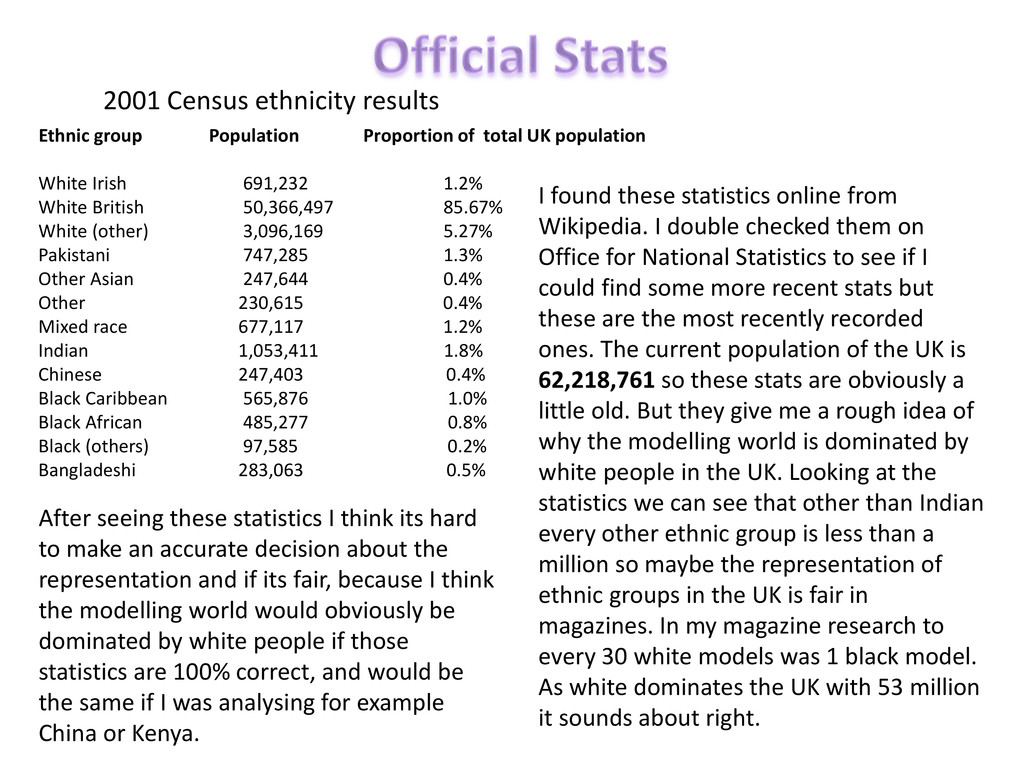
691,232 1.2% White British 50,366,497 85.67% White (other) 3,096,169 5.27% Pakistani 747,285 1.3% Other Asian 247,644 0.4% Other 230,615 0.4% Mixed race 677,117 1.2% Indian 1,053,411 1.8% Chinese 247,403 0.4% Black Caribbean 565,876 1.0% Black African 485,277 0.8% Black (others) 97,585 0.2% Bangladeshi 283,063 0.5% I found these statistics online from Wikipedia. I double checked them on Office for National Statistics to see if I could find some more recent stats but these are the most recently recorded ones. The current population of the UK is 62,218,761 so these stats are obviously a little old. But they give me a rough idea of why the modelling world is dominated by white people in the UK. Looking at the statistics we can see that other than Indian every other ethnic group is less than a million so maybe the representation of ethnic groups in the UK is fair in magazines. In my magazine research to every 30 white models was 1 black model. As white dominates the UK with 53 million it sounds about right. 2001 Census ethnicity results After seeing these statistics I think its hard to make an accurate decision about the representation and if its fair, because I think the modelling world would obviously be dominated by white people if those statistics are 100% correct, and would be the same if I was analysing for example China or Kenya.
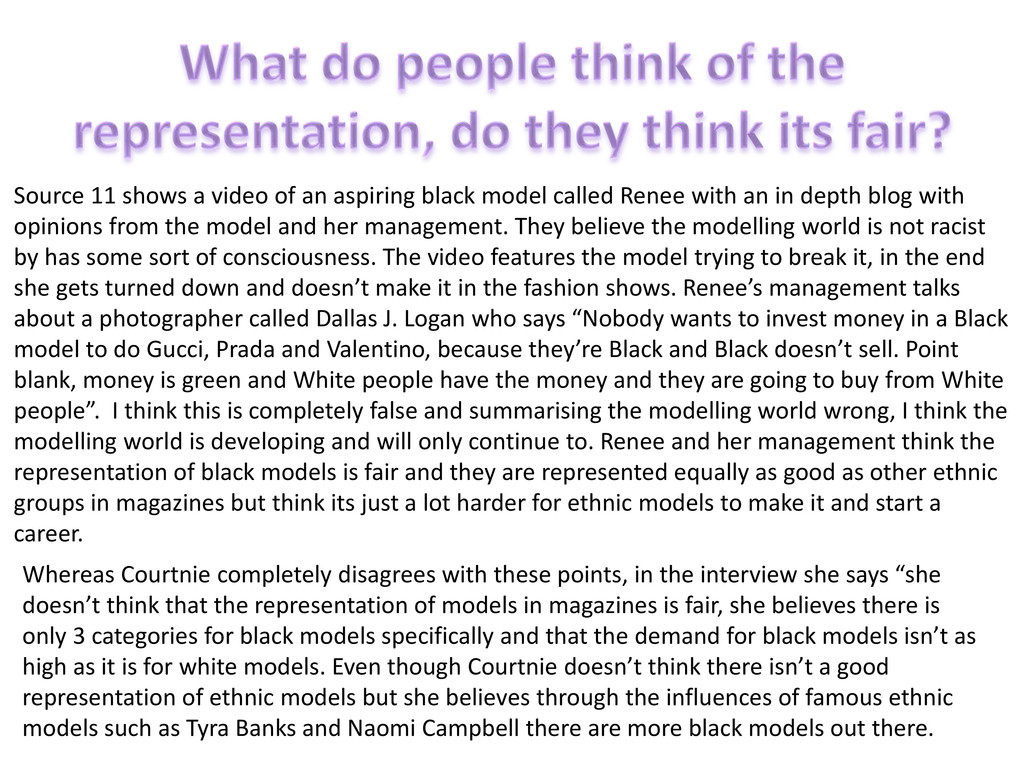
called Renee with an in depth blog with opinions from the model and her management. They believe the modelling world is not racist by has some sort of consciousness. The video features the model trying to break it, in the end she gets turned down and doesn’t make it in the fashion shows. Renee’s management talks about a photographer called Dallas J. Logan who says “Nobody wants to invest money in a Black model to do Gucci, Prada and Valentino, because they’re Black and Black doesn’t sell. Point blank, money is green and White people have the money and they are going to buy from White people”. I think this is completely false and summarising the modelling world wrong, I think the modelling world is developing and will only continue to. Renee and her management think the representation of black models is fair and they are represented equally as good as other ethnic groups in magazines but think its just a lot harder for ethnic models to make it and start a career. Whereas Courtnie completely disagrees with these points, in the interview she says “she doesn’t think that the representation of models in magazines is fair, she believes there is only 3 categories for black models specifically and that the demand for black models isn’t as high as it is for white models. Even though Courtnie doesn’t think there isn’t a good representation of ethnic models but she believes through the influences of famous ethnic models such as Tyra Banks and Naomi Campbell there are more black models out there.
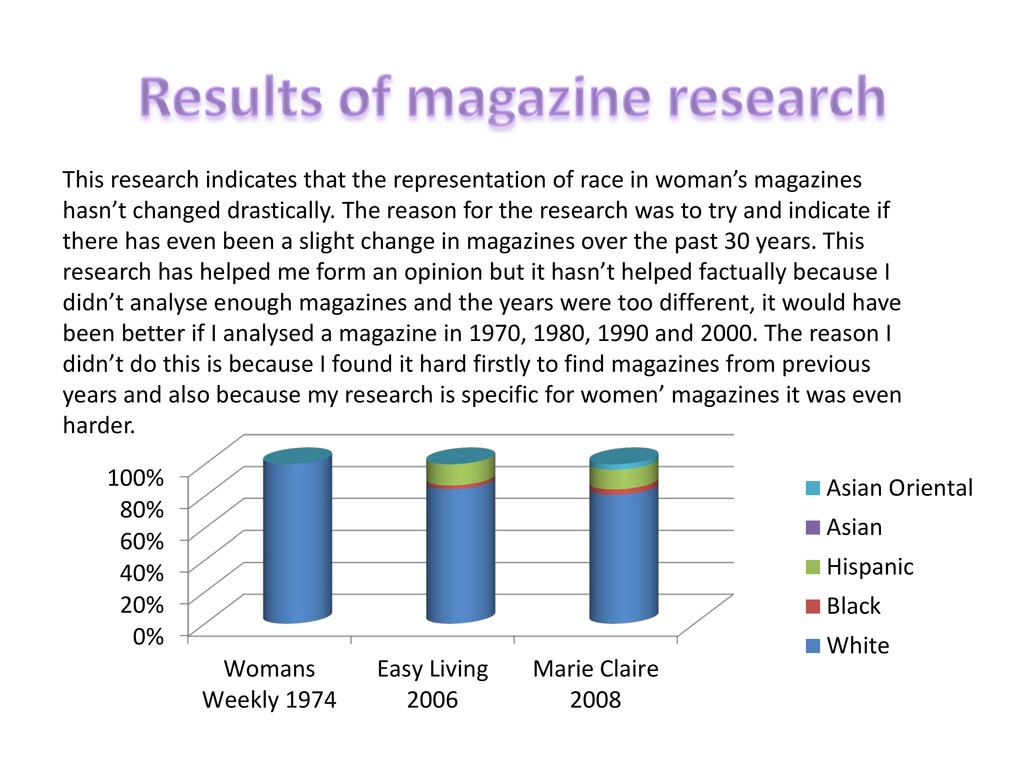
Living 2006 Marie Claire 2008 Asian Oriental Asian Hispanic Black White This research indicates that the representation of race in woman’s magazines hasn’t changed drastically. The reason for the research was to try and indicate if there has even been a slight change in magazines over the past 30 years. This research has helped me form an opinion but it hasn’t helped factually because I didn’t analyse enough magazines and the years were too different, it would have been better if I analysed a magazine in 1970, 1980, 1990 and 2000. The reason I didn’t do this is because I found it hard firstly to find magazines from previous years and also because my research is specific for women’ magazines it was even harder.
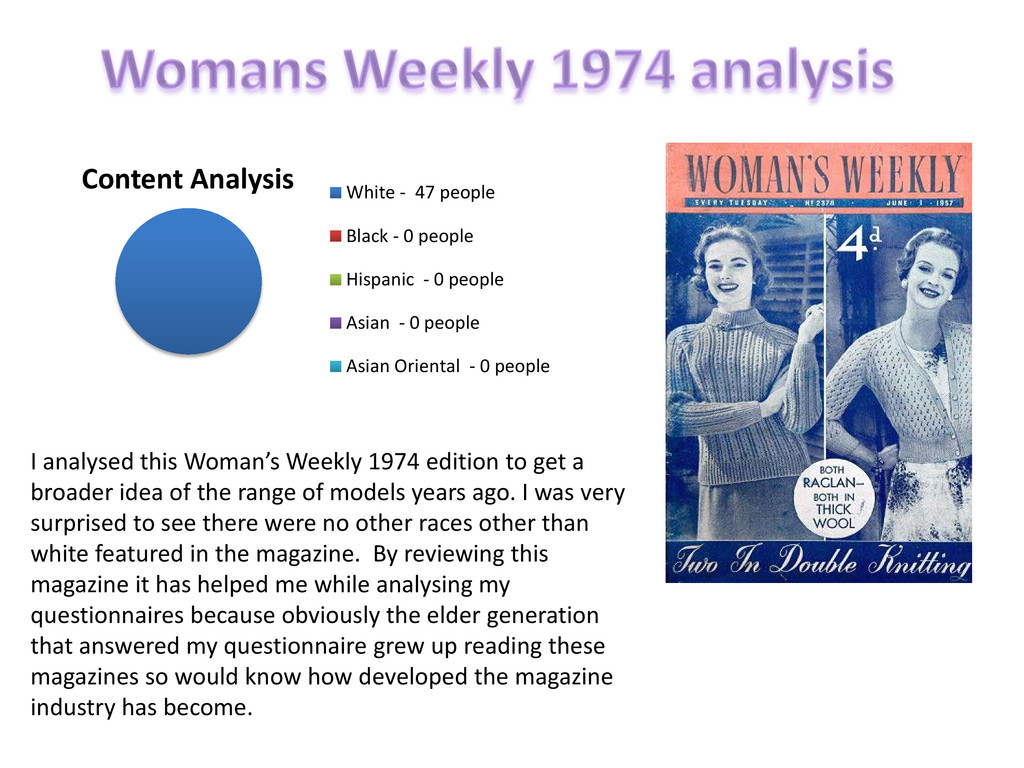
Hispanic - 0 people Asian - 0 people Asian Oriental - 0 people I analysed this Woman’s Weekly 1974 edition to get a broader idea of the range of models years ago. I was very surprised to see there were no other races other than white featured in the magazine. By reviewing this magazine it has helped me while analysing my questionnaires because obviously the elder generation that answered my questionnaire grew up reading these magazines so would know how developed the magazine industry has become.
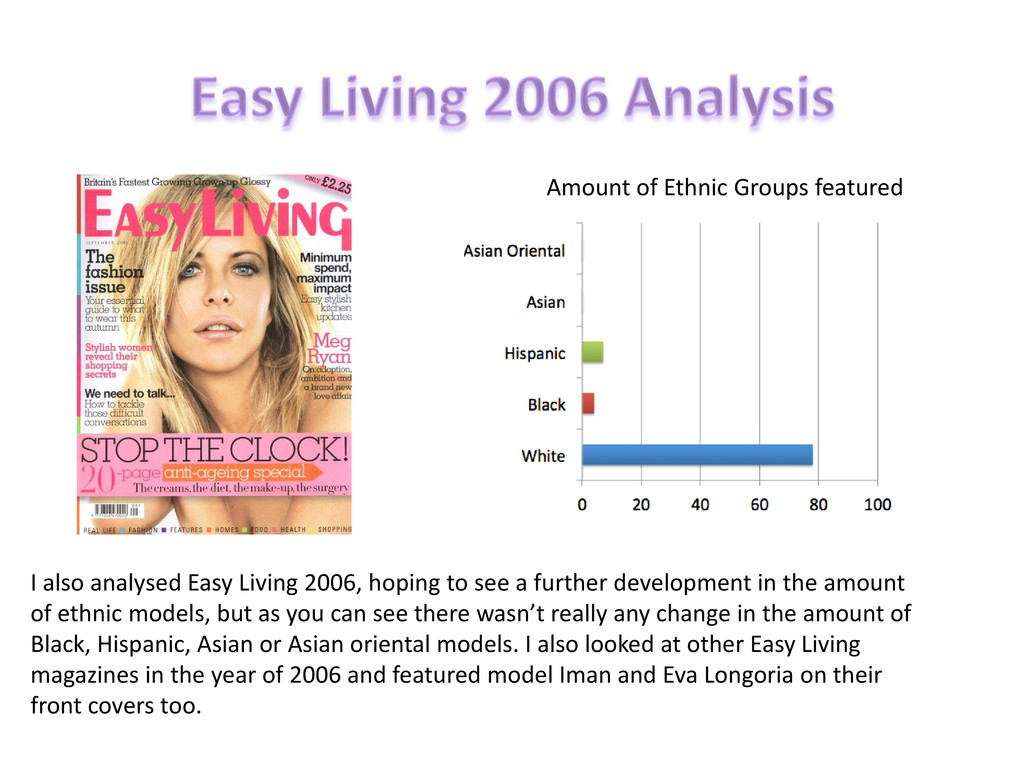
2006, hoping to see a further development in the amount of ethnic models, but as you can see there wasn’t really any change in the amount of Black, Hispanic, Asian or Asian oriental models. I also looked at other Easy Living magazines in the year of 2006 and featured model Iman and Eva Longoria on their front covers too.
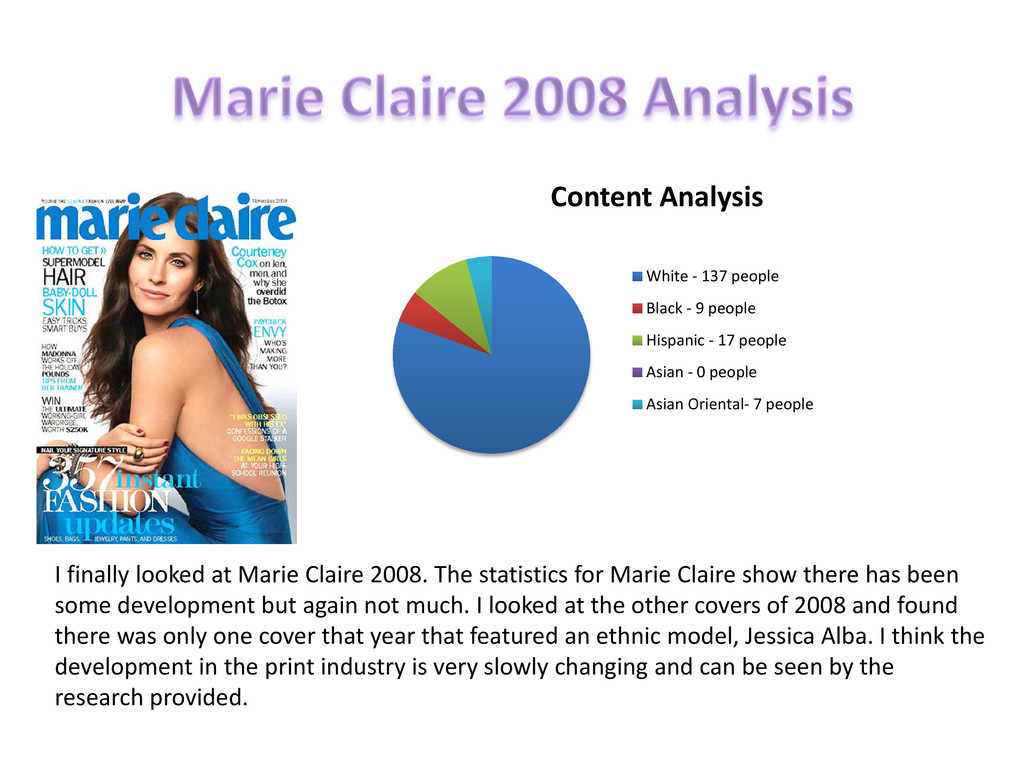
Hispanic - 17 people Asian - 0 people Asian Oriental- 7 people I finally looked at Marie Claire 2008. The statistics for Marie Claire show there has been some development but again not much. I looked at the other covers of 2008 and found there was only one cover that year that featured an ethnic model, Jessica Alba. I think the development in the print industry is very slowly changing and can be seen by the research provided.
an insight in to the daily struggles and advantages of being an aspiring model. I spoke to her about what it takes to be an ethnic model and how she has approached the modelling industry. She said “Its been a hard and long winded process”. She’s been trying for a few years now and is soon to give up on her dream. She has had some recent bookings since cutting her hair, she believes there are only 3 categories for black models and she has finally put herself in one, reluctantly. Looking at source 12, it asks ‘What does it takes to be an Ethnic Model?’ it says ethnic models must be experienced, professional and have top bookings to their name in major markets such as New York, Paris and Milan.’ I showed this to Courtnie and asked her opinion, she expressed annoyance when answering. “All agencies expect this but the thing they don’t understand is I’m only 17 and I haven’t got any experience because no body will give me a chance, if the stakes are this high no ethnic model will ever be able to make it. I think its an unfair process for ethnic models and is a lot harder than it is for white models, even though its easier today than it was say 20 years ago, its not yet easier enough for us ethnic models.” Source 12 says the easiest way for an ethnic model to start is online by uploading snapshots and portfolios online to an agency which anyone can sign up to, because by doing this any one can find you. I think its hard to agree or disagree with either points because I haven’t been through the process myself, but I believe what Courtnie says is true, due to all my research I’ve realised it is a lot harder for ethnic models, the stats and figures prove this too and so do most peoples opinions.
sources as television, cartoons or even comic books.’ This is apparently the official definition said by source 13. Source 13 talks about ethnic groups being stereotyped by a common form called media manipulation and propaganda. Where the media manipulates a certain ethnic group to look a different way. Source 13 explains this by the Egyptians. Source 14 and 15 focus on media portrayals, firstly speaking of the portrayals of Girls and Women, they say ‘whatever the role, television, film and popular magazines are full of images of women and girls who are typically white, desperately thin and made up to the hilt – even after slaying a gang of vampires or dressing down a Greek phalanx.’ I think this is an accurate and reoccurring (similar) quote throughout my research. Throughout my research it seems to resolve back to the fact most models are white and continue to be. Source 14 says the reason media stereotyping is so important in TV or movies for example is because ‘stereotypes act like codes that give audiences a quick, common understanding of a person or group of people – usually relating to their class, ethnicity or race, gender, sexual orientation, social role or occupation’.
I have been able to form a opinion but not a result or conclude if there has actually been a change. I think the representation of models and race in women’s magazines is only going to continue to develop. I think that its very much opinion based and a lot of people believe one way or another. If I could redo my research with more time and money, I would have more sub questions to open up the question more. I would have a research team to help with more interviews and questionnaires so I could get a wider range of answers and data.


 keathley
 rkaga
rkaga
 jnunemaker
 morganepeng
 greggifford
 gr2m
gr2m
 popppiees
 jakevdp
 jct
jct
 aarron
 csswizardry
 inesmontani