Upgrade to Pro
— share decks privately, control downloads, hide ads and more …
Speaker Deck
Sign up for free
Menu
Search
Features
All features
Private URLs
Password Protection
Custom URLS
Scheduled publishing
Remove Branding
Restrict embedding
Deck Collections
Notes
Features
All features
Private URLs
Password Protection
Custom URLS
Scheduled publishing
Remove Branding
Restrict embedding
Deck Collections
Notes
Explore
Featured decks
Featured speakers
Programming
Technology
Storyboards
Explore
Featured decks
Featured speakers
Programming
Technology
Storyboards
Pricing
Search
Sign in
Sign up for free
Ruby Struct
Search
Sponsored
·
Your Podcast. Everywhere. Effortlessly.
Share. Educate. Inspire. Entertain. You do you. We'll handle the rest.
→
Ken Collins
April 11, 2012
680
2
Share
Embed
Copy iframe code
Copy JS code
Copy link
Start on current slide
Ruby Struct
Using Ruby’s Struct Class.
Ken Collins
April 11, 2012
More Decks by Ken Collins
See All by Ken Collins
Experts.js @ Norfolk.js
metaskills
0
120
The Rise of AI Copilots
metaskills
0
230
Real-World AI Automation with Lambda & Bedrock
metaskills
0
200
The Lambda Sidecar Pattern for Event-Driven Kubernetes
metaskills
0
480
The Case for Rails on Lambda v1
metaskills
0
800
Learn to Program The Cloud with Ruby & AWS Lambda
metaskills
0
140
Full-Stack to Functions & Back Again
metaskills
0
430
AWS Lambda & Ruby/Rails with SAM
metaskills
1
4.7k
Turbo Applications - Winning with Ajax + pushState + Rails
metaskills
0
350
Featured
See All Featured
Discover your Explorer Soul
emna__ayadi
2
1.3k
A designer walks into a library…
pauljervisheath
211
25k
職位にかかわらず全員がリーダーシップを発揮するチーム作り / Building a team where everyone can demonstrate leadership regardless of position
madoxten
69
66k
Evolution of real-time – Irina Nazarova, EuRuKo, 2024
irinanazarova
9
1.6k
Mind Mapping
helmedeiros
1
390
Building a Modern Day E-commerce SEO Strategy
aleyda
45
9.2k
Templates, Plugins, & Blocks: Oh My! Creating the theme that thinks of everything
marktimemedia
31
2.9k
The Success of Rails: Ensuring Growth for the Next 100 Years
eileencodes
47
8.4k
How to build a perfect <img>
jonoalderson
1
6.1k
The AI Revolution Will Not Be Monopolized: How open-source beats economies of scale, even for LLMs
inesmontani
PRO
3
3.8k
How to train your dragon (web standard)
notwaldorf
96
6.9k
DevOps and Value Stream Thinking: Enabling flow, efficiency and business value
helenjbeal
2
400
Transcript
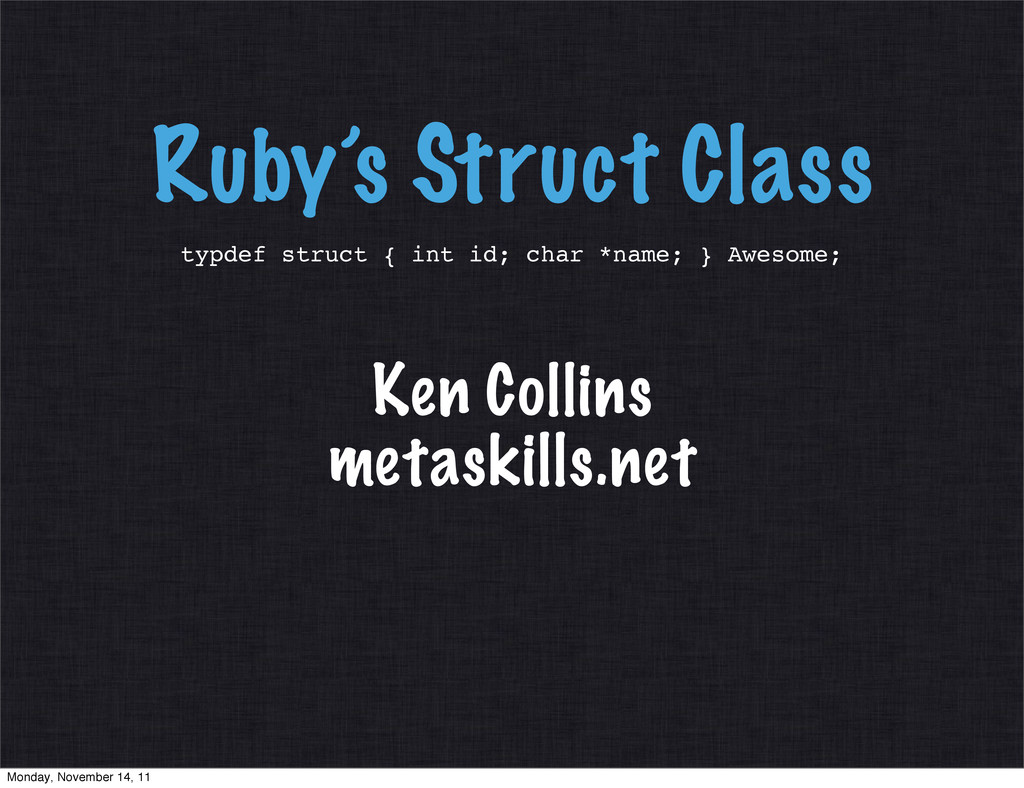
Ruby’s Struct Class Ken Collins metaskills.net typdef struct { int
id; char *name; } Awesome; Monday, November 14, 11
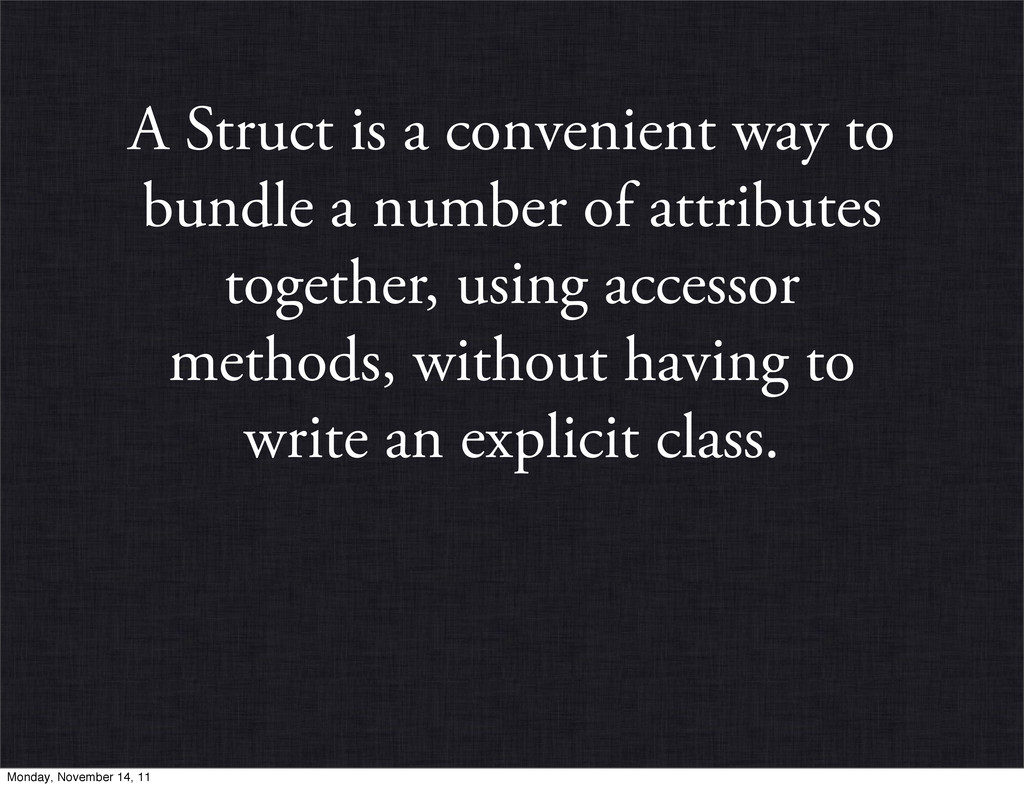
A Struct is a convenient way to bundle a number
of attributes together, using accessor methods, without having to write an explicit class. Monday, November 14, 11
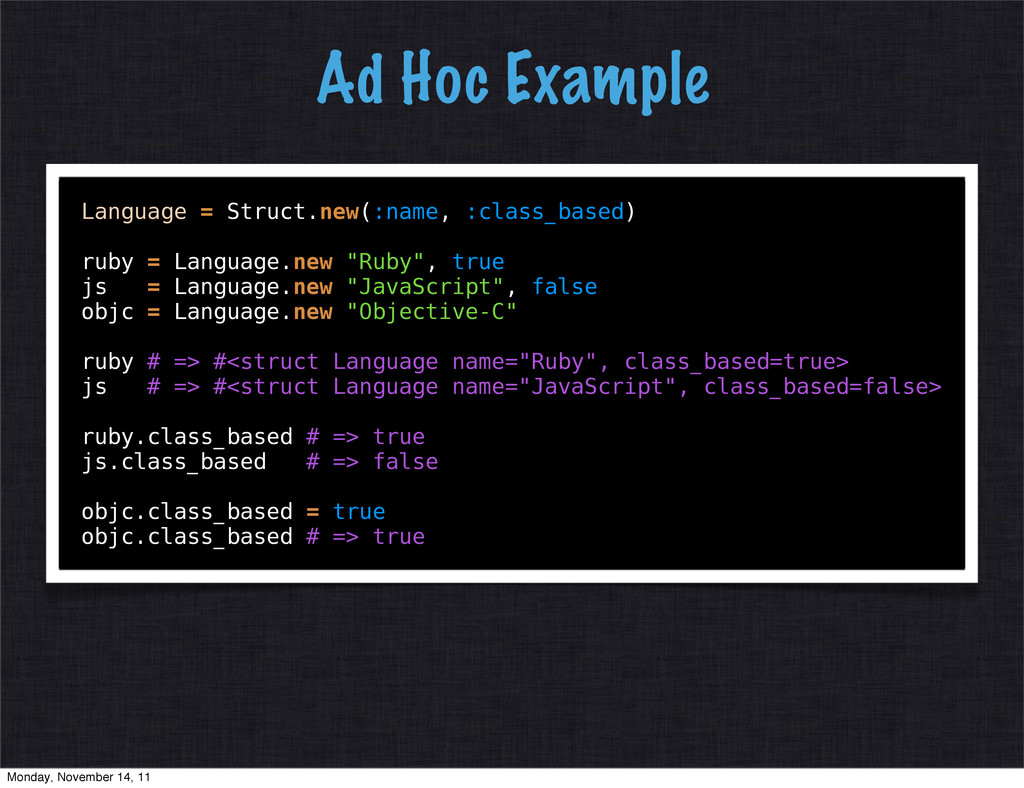
Ad Hoc Example Language = Struct.new(:name, :class_based) ruby = Language.new
"Ruby", true js = Language.new "JavaScript", false objc = Language.new "Objective-C" ruby # => #<struct Language name="Ruby", class_based=true> js # => #<struct Language name="JavaScript", class_based=false> ruby.class_based # => true js.class_based # => false objc.class_based = true objc.class_based # => true Monday, November 14, 11
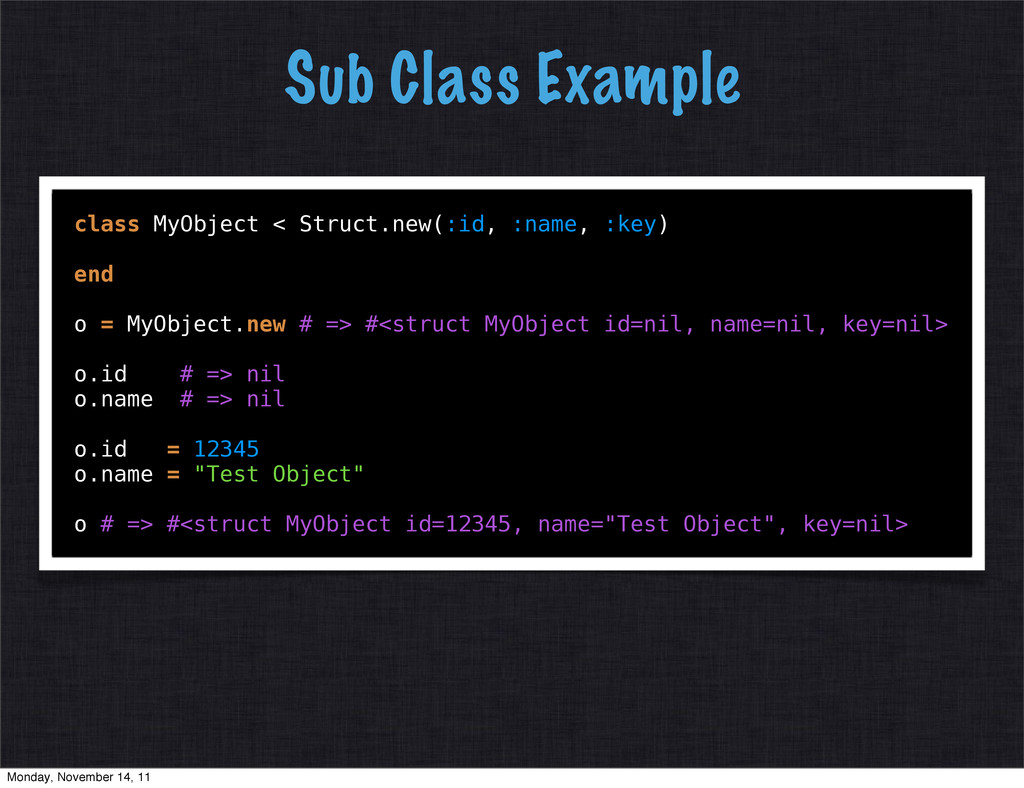
Sub Class Example class MyObject < Struct.new(:id, :name, :key) end
o = MyObject.new # => #<struct MyObject id=nil, name=nil, key=nil> o.id # => nil o.name # => nil o.id = 12345 o.name = "Test Object" o # => #<struct MyObject id=12345, name="Test Object", key=nil> Monday, November 14, 11
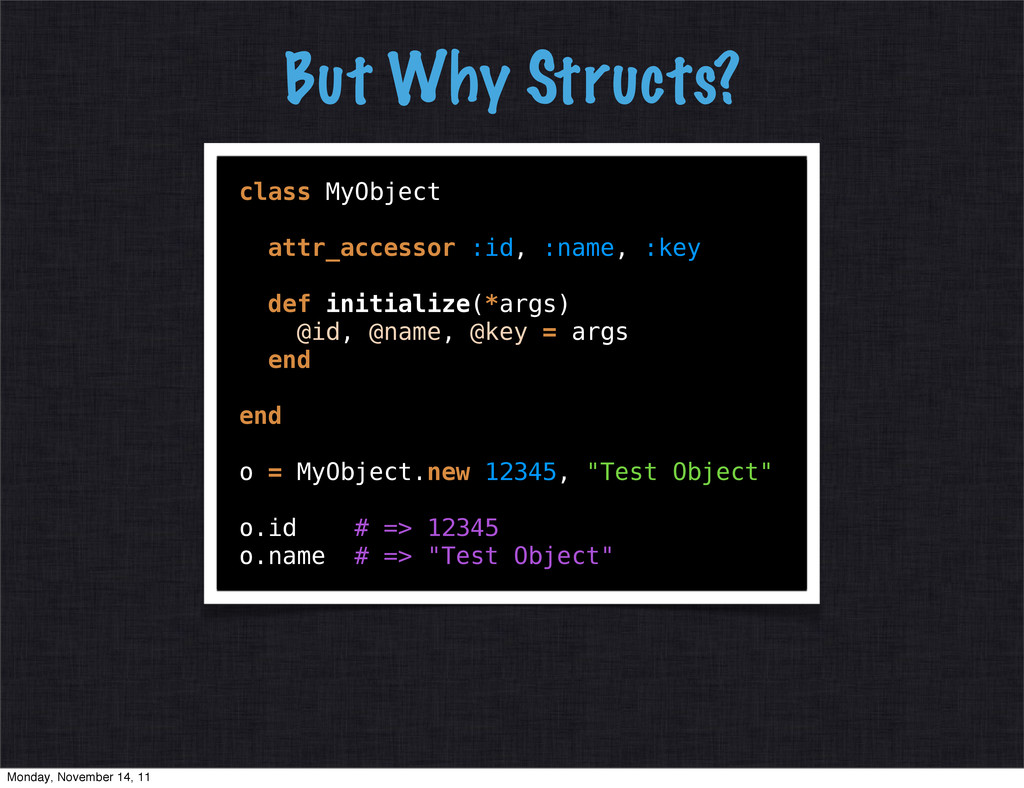
But Why Structs? class MyObject attr_accessor :id, :name, :key def
initialize(*args) @id, @name, @key = args end end o = MyObject.new 12345, "Test Object" o.id # => 12345 o.name # => "Test Object" Monday, November 14, 11
But Why Structs? Monday, November 14, 11
But Why Structs? Convenient Alternative. Monday, November 14, 11
But Why Structs? Convenient Alternative. Attribute Methods With [] &
[]= Can Be Powerful. Not ivar based. Monday, November 14, 11
But Why Structs? Convenient Alternative. Attribute Methods With [] &
[]= Can Be Powerful. Not ivar based. Easy Enumeration Of Attribute Data. Monday, November 14, 11
But Why Structs? Convenient Alternative. Attribute Methods With [] &
[]= Can Be Powerful. Not ivar based. Easy Enumeration Of Attribute Data. Default Equality On All Attributes. Monday, November 14, 11
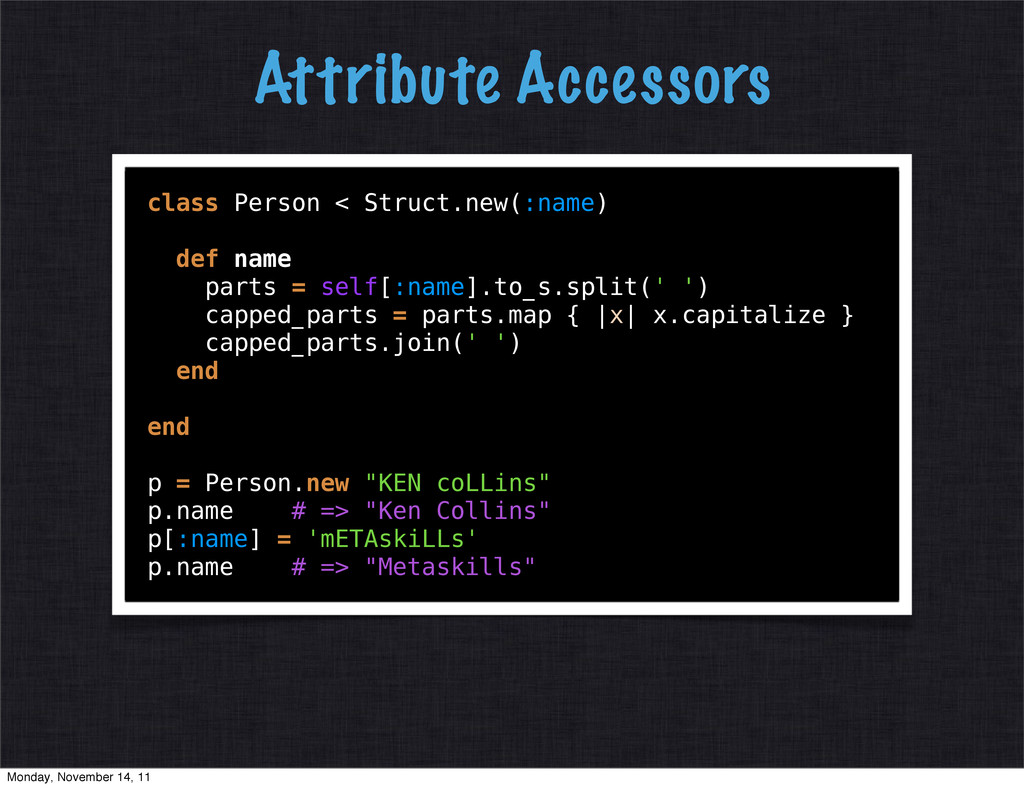
Attribute Accessors class Person < Struct.new(:name) def name parts =
self[:name].to_s.split(' ') capped_parts = parts.map { |x| x.capitalize } capped_parts.join(' ') end end p = Person.new "KEN coLLins" p.name # => "Ken Collins" p[:name] = 'mETAskiLLs' p.name # => "Metaskills" Monday, November 14, 11
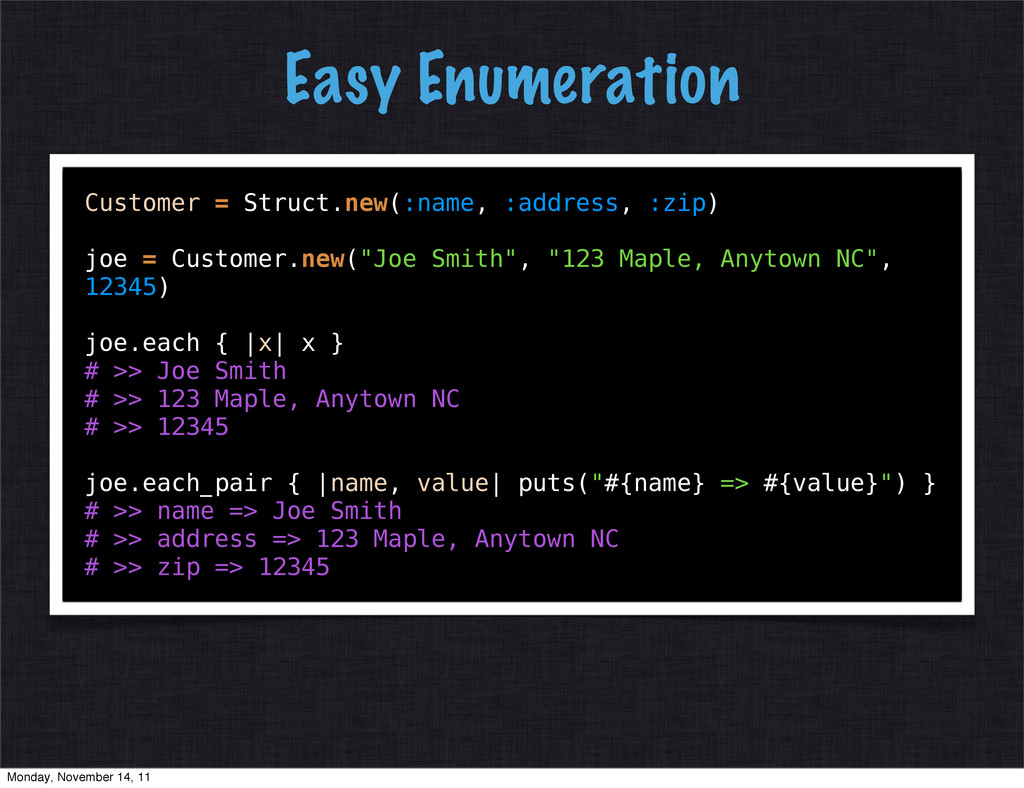
Easy Enumeration Customer = Struct.new(:name, :address, :zip) joe = Customer.new("Joe
Smith", "123 Maple, Anytown NC", 12345) joe.each { |x| x } # >> Joe Smith # >> 123 Maple, Anytown NC # >> 12345 joe.each_pair { |name, value| puts("#{name} => #{value}") } # >> name => Joe Smith # >> address => 123 Maple, Anytown NC # >> zip => 12345 Monday, November 14, 11
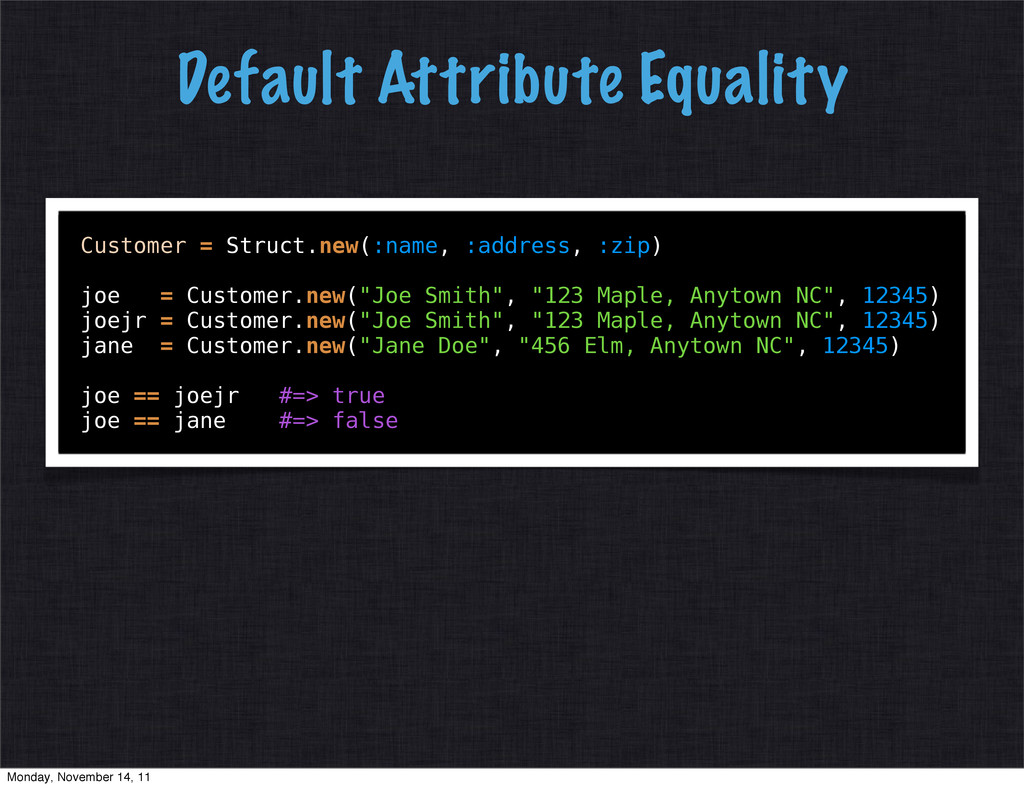
Default Attribute Equality Customer = Struct.new(:name, :address, :zip) joe =
Customer.new("Joe Smith", "123 Maple, Anytown NC", 12345) joejr = Customer.new("Joe Smith", "123 Maple, Anytown NC", 12345) jane = Customer.new("Jane Doe", "456 Elm, Anytown NC", 12345) joe == joejr #=> true joe == jane #=> false Monday, November 14, 11
Thanks! Ken Collins metaskills.net Monday, November 14, 11


 metaskills
 emna__ayadi
 pauljervisheath
 madoxten
 irinanazarova
 helmedeiros
 aleyda
 marktimemedia
 eileencodes
 jonoalderson
 inesmontani
 notwaldorf
.png) helenjbeal
helenjbeal
![But Why Structs? Convenient Alternative. Attribute Methods With [] &](https://files.speakerdeck.com/presentations/4f856b204976b8001f01b3f7/slide_7.jpg)
![But Why Structs? Convenient Alternative. Attribute Methods With [] &](https://files.speakerdeck.com/presentations/4f856b204976b8001f01b3f7/slide_8.jpg)
![But Why Structs? Convenient Alternative. Attribute Methods With [] &](https://files.speakerdeck.com/presentations/4f856b204976b8001f01b3f7/slide_9.jpg)