Share
Embed
Responsive Webdesing and the little dirty secret behind fluid-grids
Get a small overview about responsive Webdesign, dive into the problem of rounding errors in browsers, and see the dirt behind fluid-grids.
Marcel Hauri
November 15, 2012
Transcript
27 slides
-
Responsive WebDesign and the dirty little secret behind fluid-grids Liip
AG, Marcel Hauri twitter.com/mhauri -
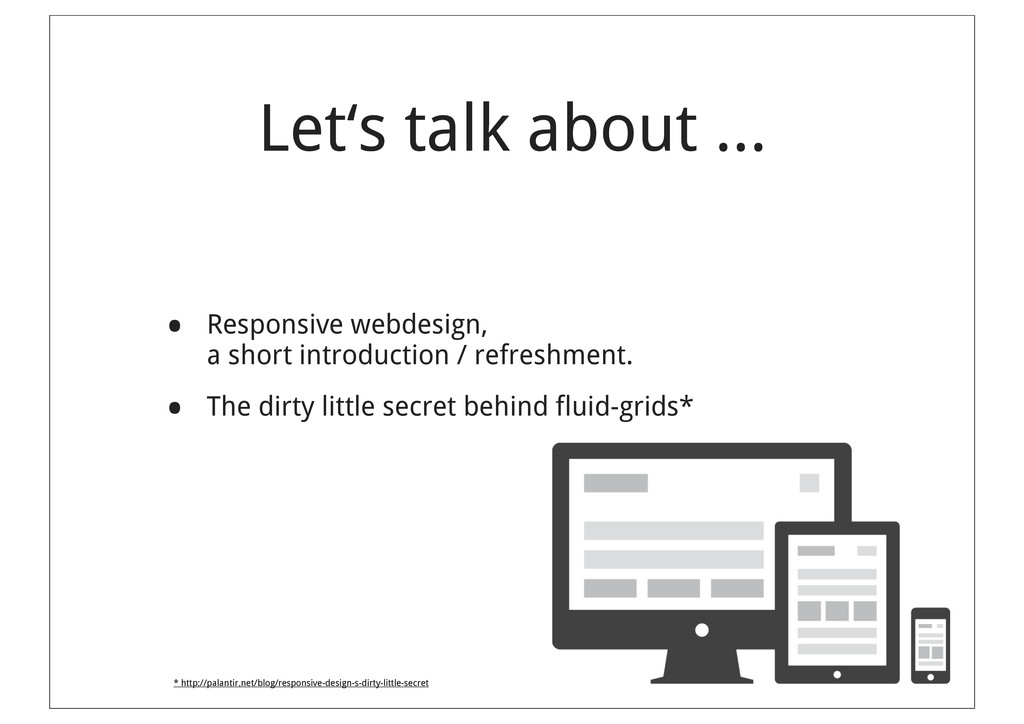
Let‘s talk about ... • Responsive webdesign, a short introduction
/ refreshment. • The dirty little secret behind fluid-grids* * http://palantir.net/blog/responsive-design-s-dirty-little-secret -
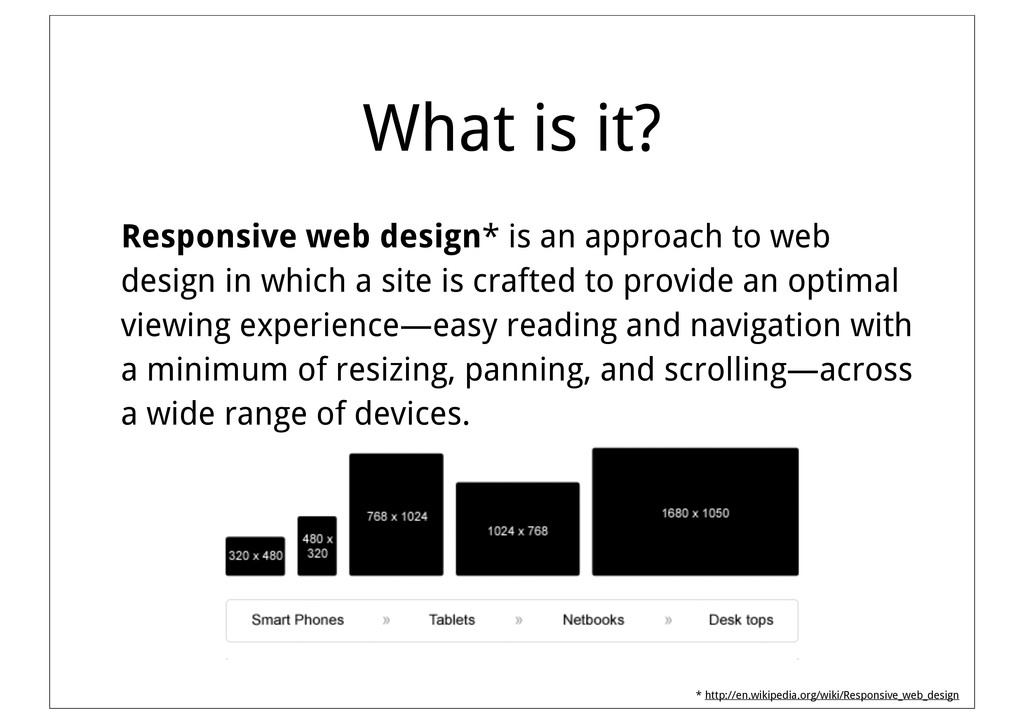
What is it? Responsive web design* is an approach to
web design in which a site is crafted to provide an optimal viewing experience—easy reading and navigation with a minimum of resizing, panning, and scrolling—across a wide range of devices. * http://en.wikipedia.org/wiki/Responsive_web_design -
What not? • It‘s not a special site/subdomain for mobile
devices like m.domain.com • Responsive webdesign is not mobile design. • That means: It loads more content than necessary -
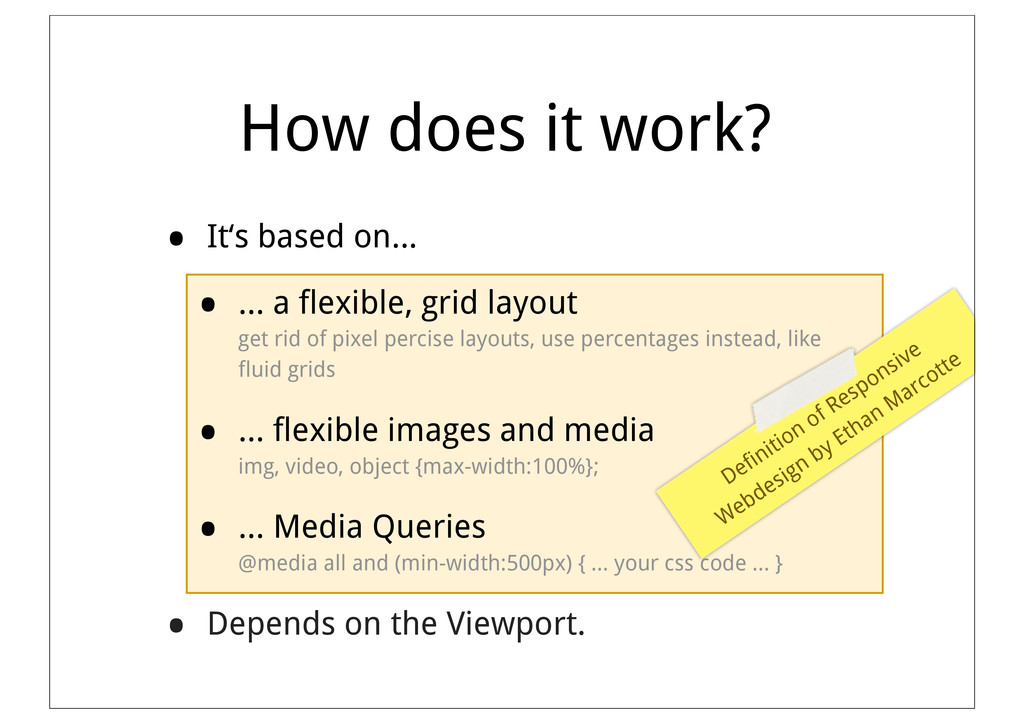
How does it work? • It‘s based on... • ...
a flexible, grid layout get rid of pixel percise layouts, use percentages instead, like fluid grids • ... flexible images and media img, video, object {max-width:100%}; • ... Media Queries @media all and (min-width:500px) { ... your css code ... } • Depends on the Viewport. Definition of Responsive Webdesign by Ethan Marcotte -
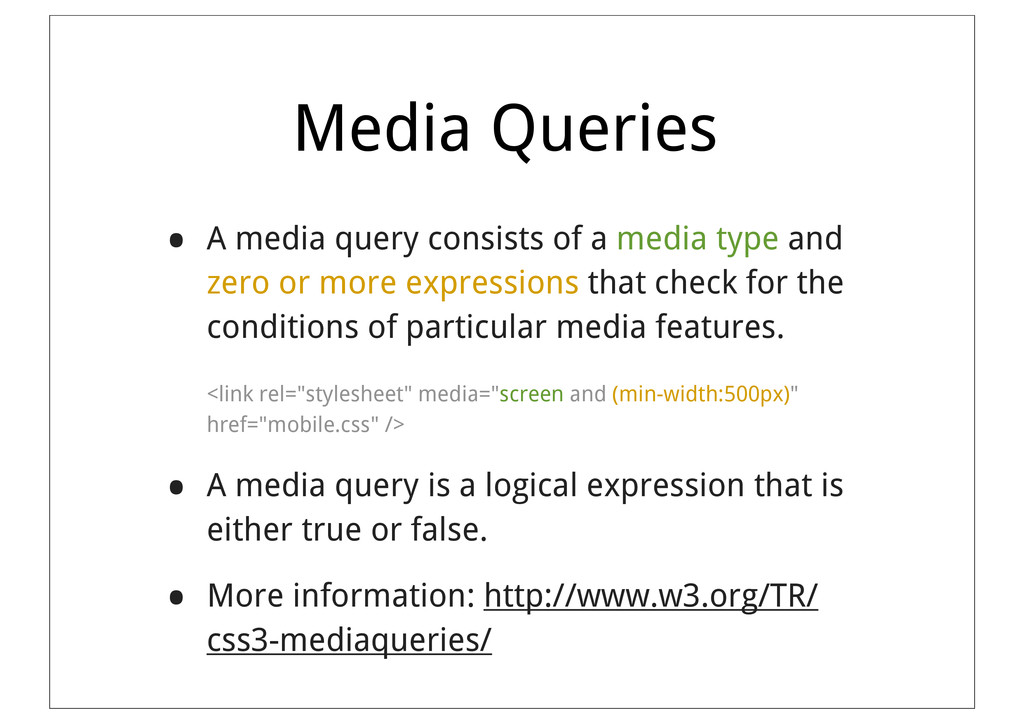
Media Queries • A media query consists of a media
type and zero or more expressions that check for the conditions of particular media features. <link rel="stylesheet" media="screen and (min-width:500px)" href="mobile.css" /> • A media query is a logical expression that is either true or false. • More information: http://www.w3.org/TR/ css3-mediaqueries/ -
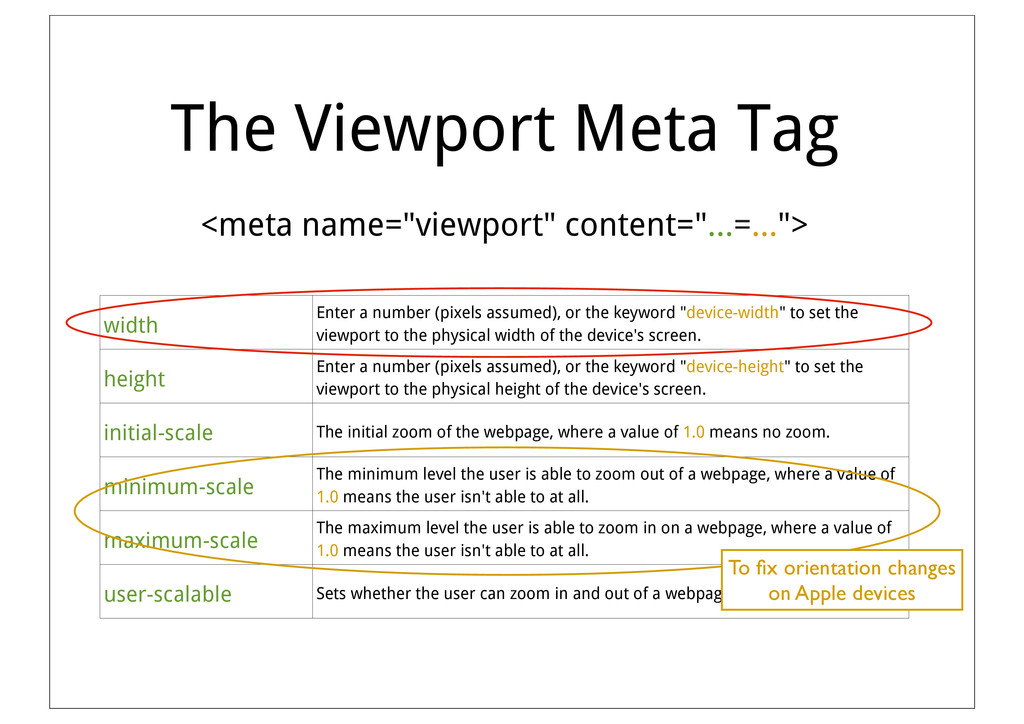
The Viewport Meta Tag <meta name="viewport" content="...=..."> width Enter a
number (pixels assumed), or the keyword "device-width" to set the viewport to the physical width of the device's screen. height Enter a number (pixels assumed), or the keyword "device-height" to set the viewport to the physical height of the device's screen. initial-scale The initial zoom of the webpage, where a value of 1.0 means no zoom. minimum-scale The minimum level the user is able to zoom out of a webpage, where a value of 1.0 means the user isn't able to at all. maximum-scale The maximum level the user is able to zoom in on a webpage, where a value of 1.0 means the user isn't able to at all. user-scalable Sets whether the user can zoom in and out of a webpage. Set to yes or no. To fix orientation changes on Apple devices -
The Viewport Meta Tag • Is the key to prepare
a page for mobile devices optimization. • If you forget it, your mobile browser still thinks it's a desktop browser. -
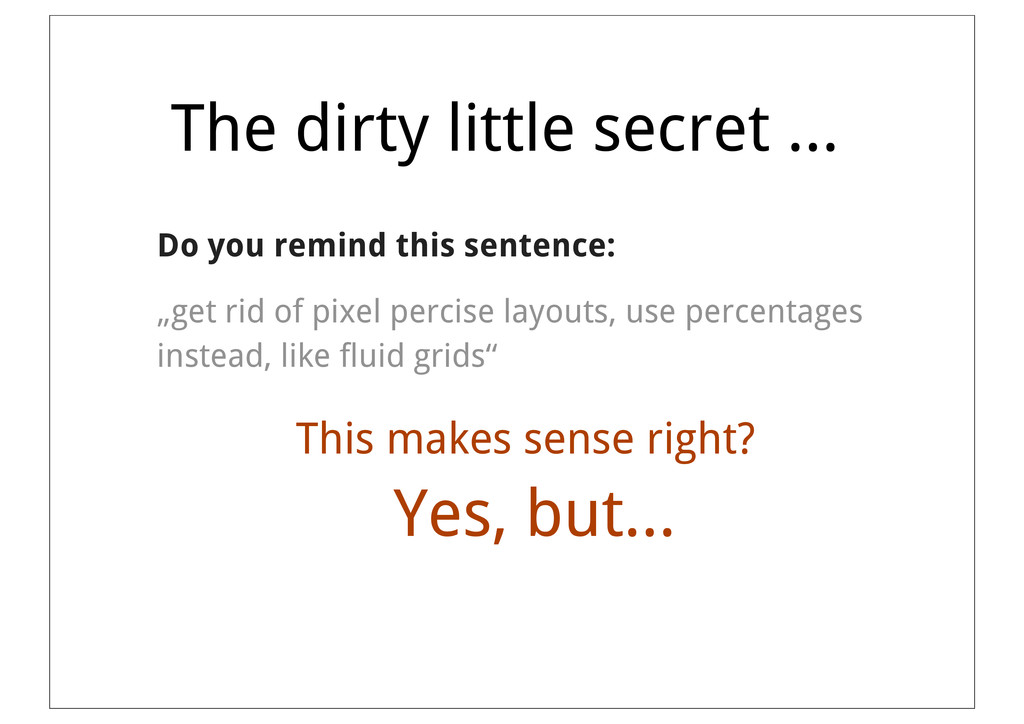
The dirty little secret ... Do you remind this sentence:
„get rid of pixel percise layouts, use percentages instead, like fluid grids“ This makes sense right? Yes, but... -
The dirty little secret ... The truth is that fluid
grids are broken. Because fluid grids have a dirty little secret rounding errors -
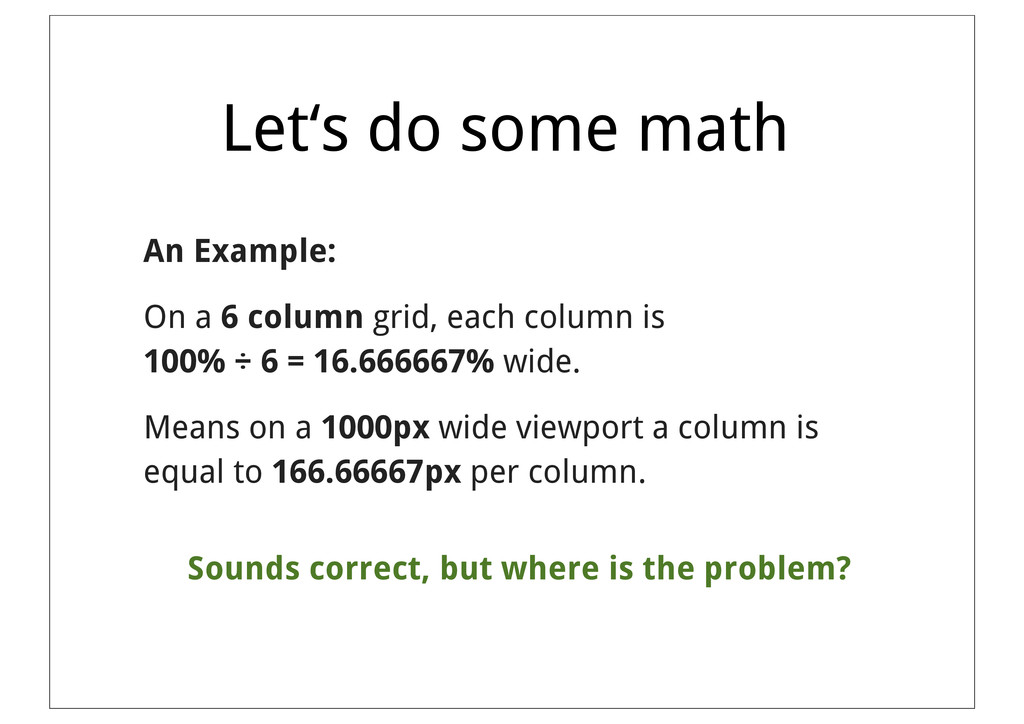
Let‘s do some math An Example: On a 6 column
grid, each column is 100% ÷ 6 = 16.666667% wide. Means on a 1000px wide viewport a column is equal to 166.66667px per column. Sounds correct, but where is the problem? -
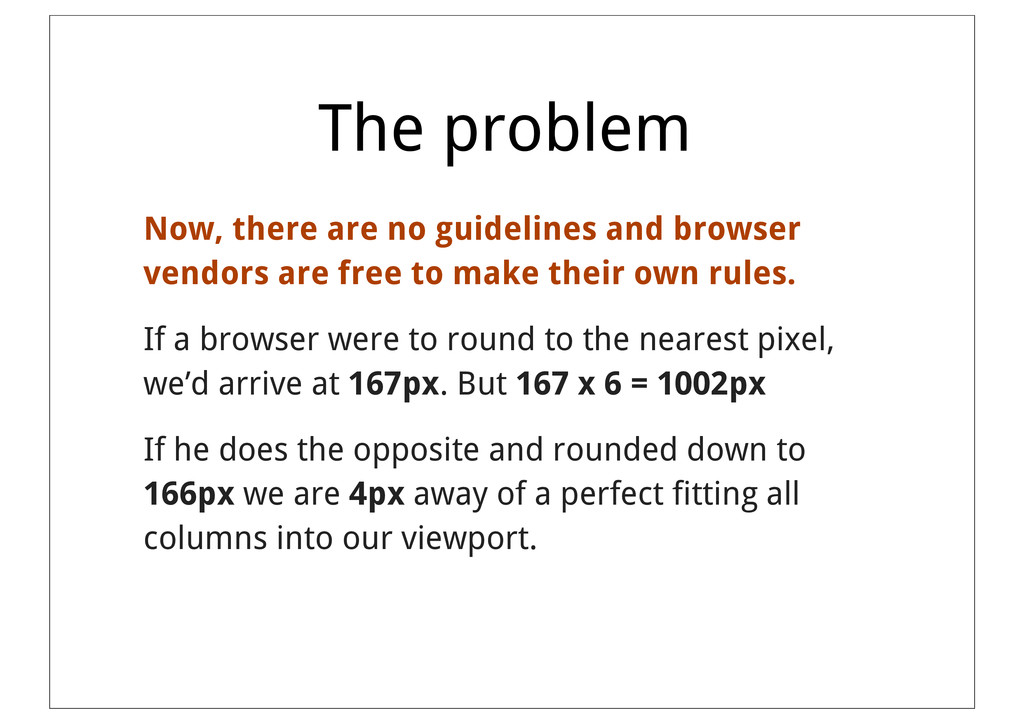
The problem Now, there are no guidelines and browser vendors
are free to make their own rules. If a browser were to round to the nearest pixel, we’d arrive at 167px. But 167 x 6 = 1002px If he does the opposite and rounded down to 166px we are 4px away of a perfect fitting all columns into our viewport. -
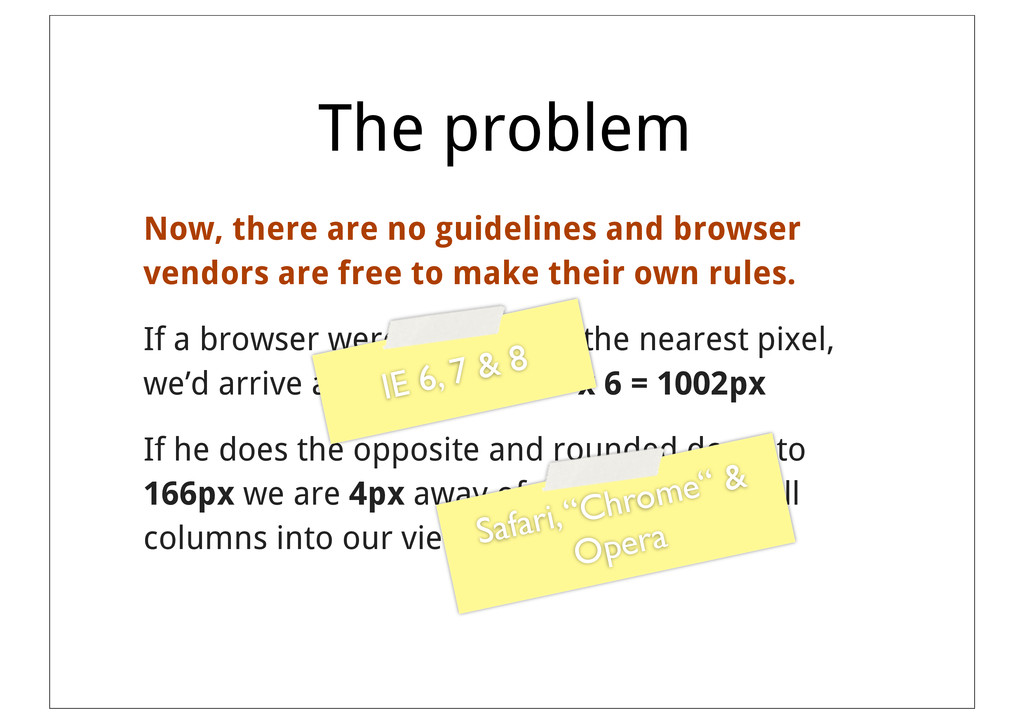
The problem Now, there are no guidelines and browser vendors
are free to make their own rules. If a browser were to round to the nearest pixel, we’d arrive at 167px. But 167 x 6 = 1002px If he does the opposite and rounded down to 166px we are 4px away of a perfect fitting all columns into our viewport. IE 6, 7 & 8 Safari, “Chrome“ & Opera -
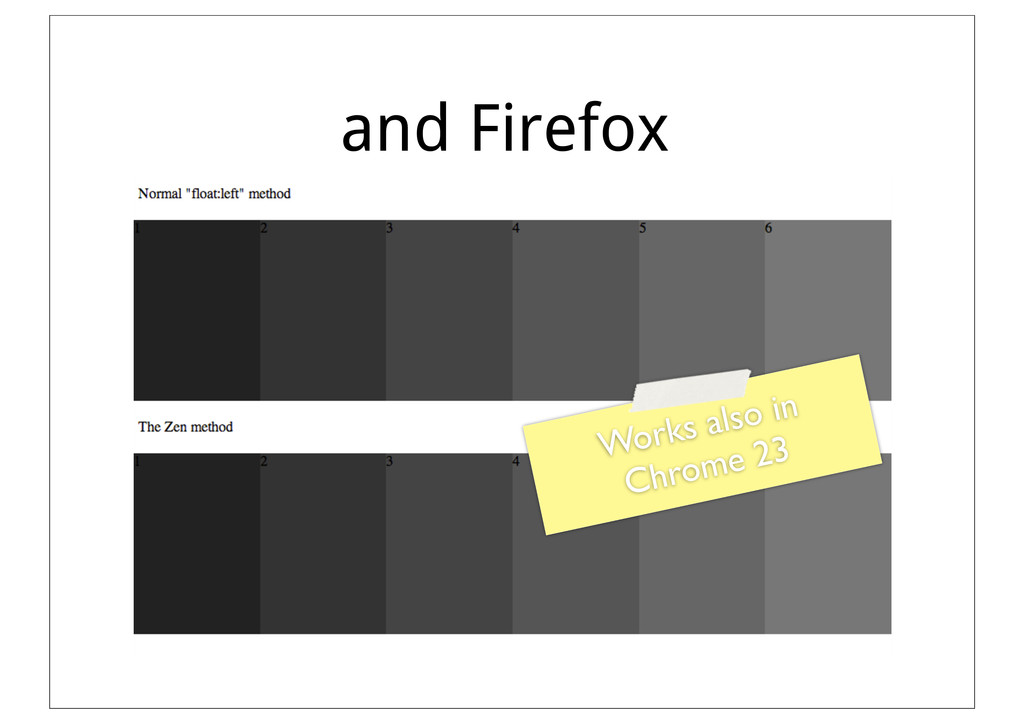
What‘s about... .. Firefox? Firefox implemented a innovative solution called
sub-pixel rendering. This will retain the sub-pixel values for all CSS properties. When an element's positioning depends on the properties of previous elements, the sub-pixel values will be used in the calculations. -
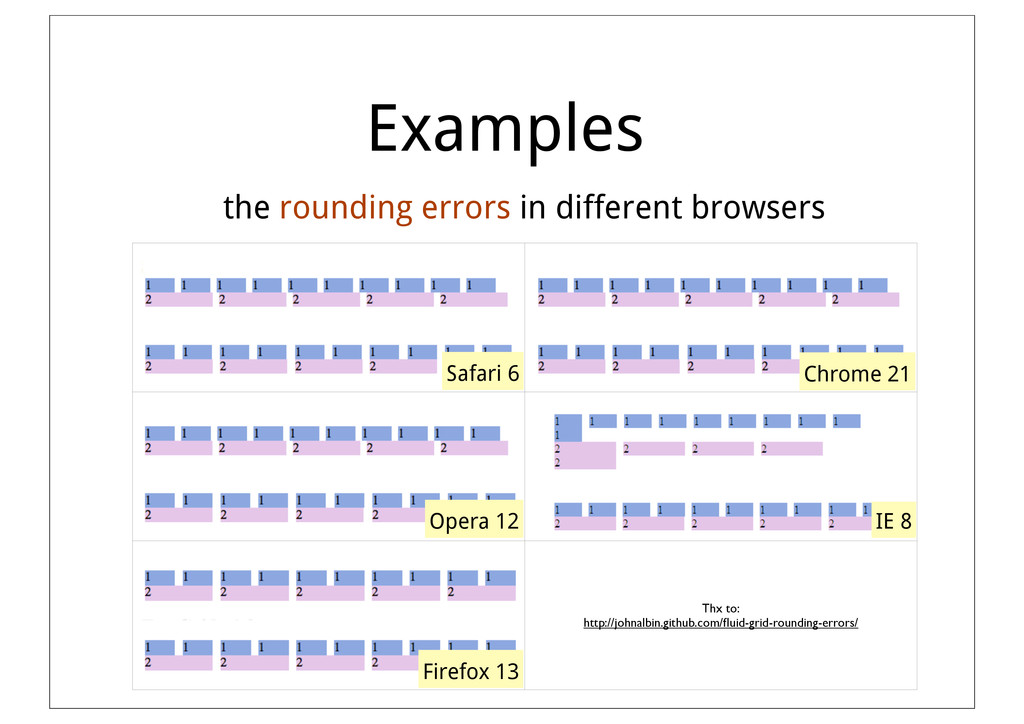
Examples Safari 6 Chrome 21 Opera 12 IE 8 Firefox
13 the rounding errors in different browsers Thx to: http://johnalbin.github.com/fluid-grid-rounding-errors/ -
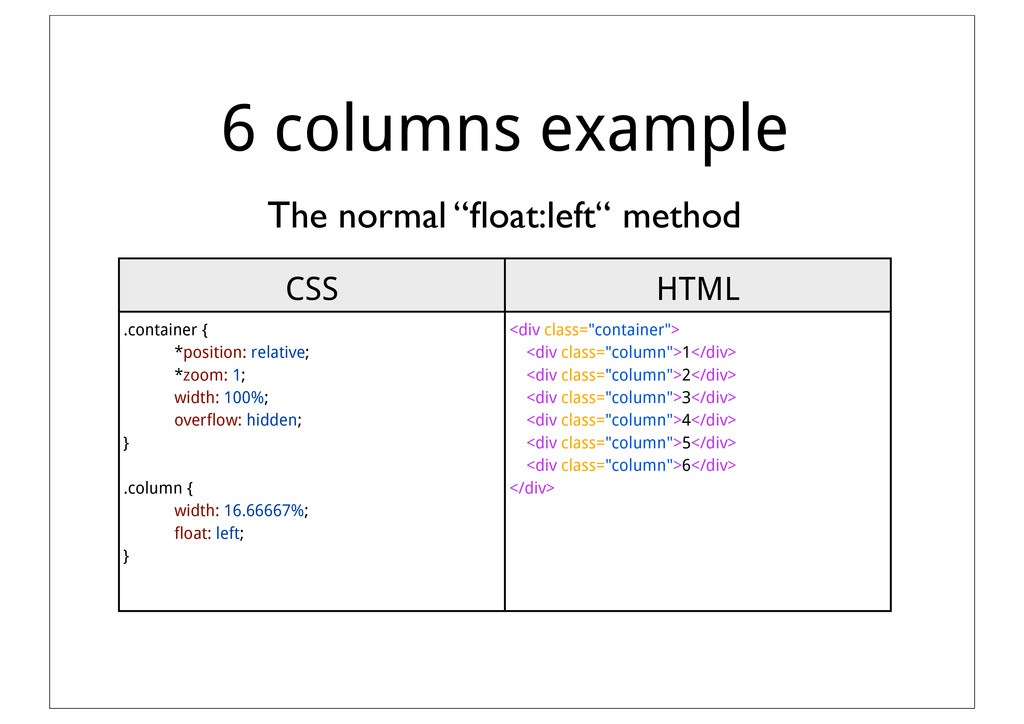
6 columns example CSS HTML .container { *position: relative; *zoom:
1; width: 100%; overflow: hidden; } .column { width: 16.66667%; float: left; } <div class="container"> <div class="column">1</div> <div class="column">2</div> <div class="column">3</div> <div class="column">4</div> <div class="column">5</div> <div class="column">6</div> </div> The normal “float:left“ method -
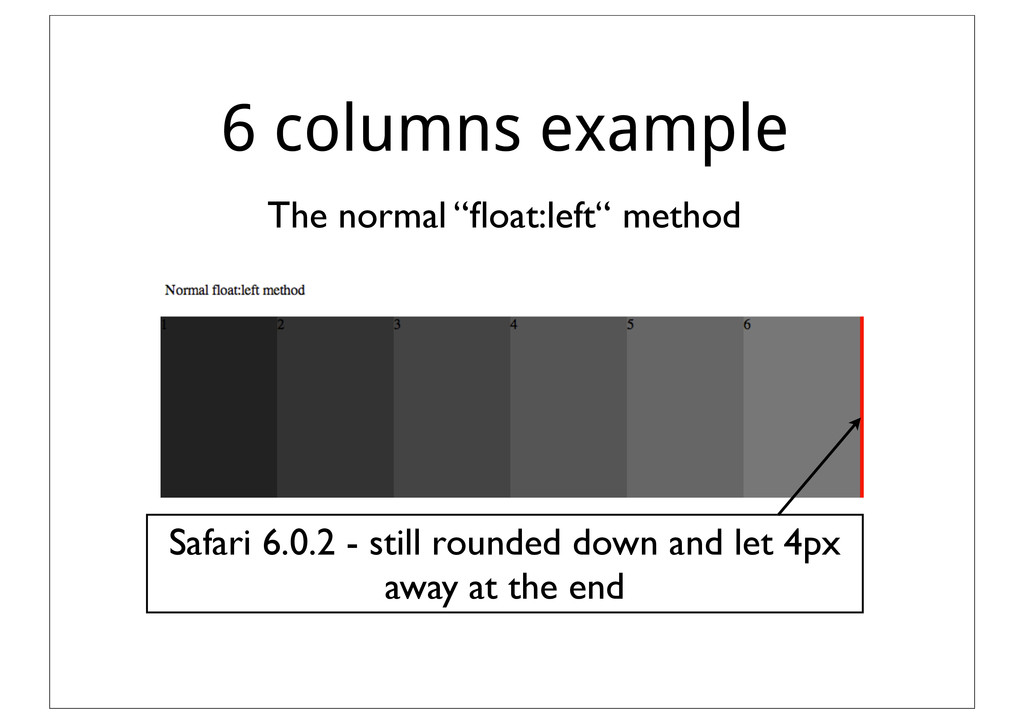
6 columns example The normal “float:left“ method Safari 6.0.2 -
still rounded down and let 4px away at the end -
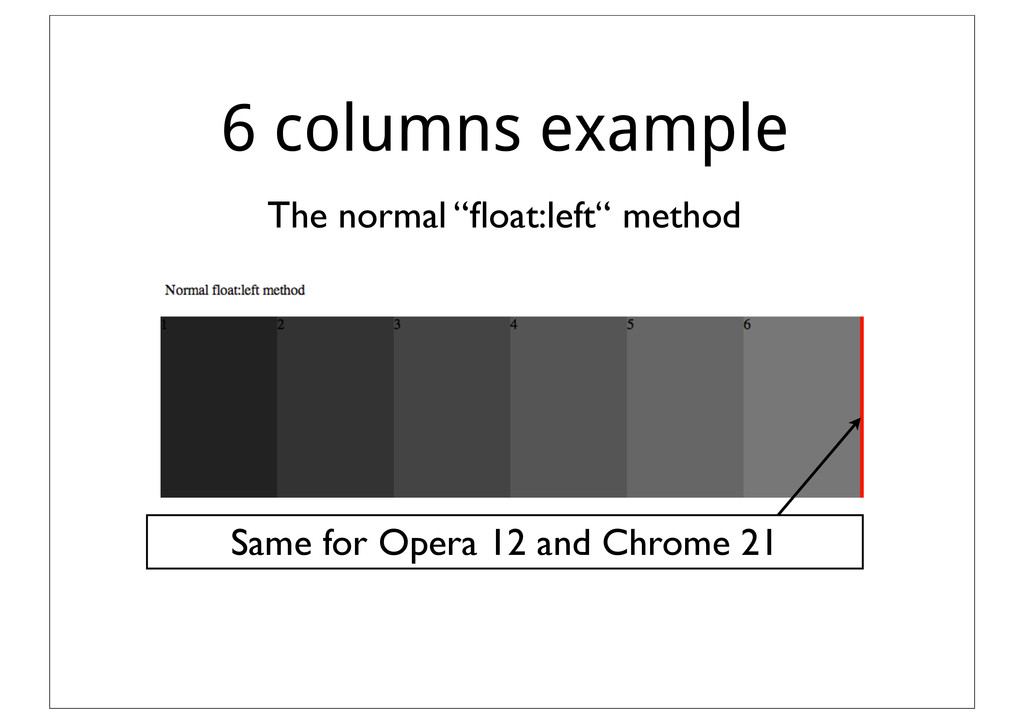
6 columns example The normal “float:left“ method Same for Opera
12 and Chrome 21 -
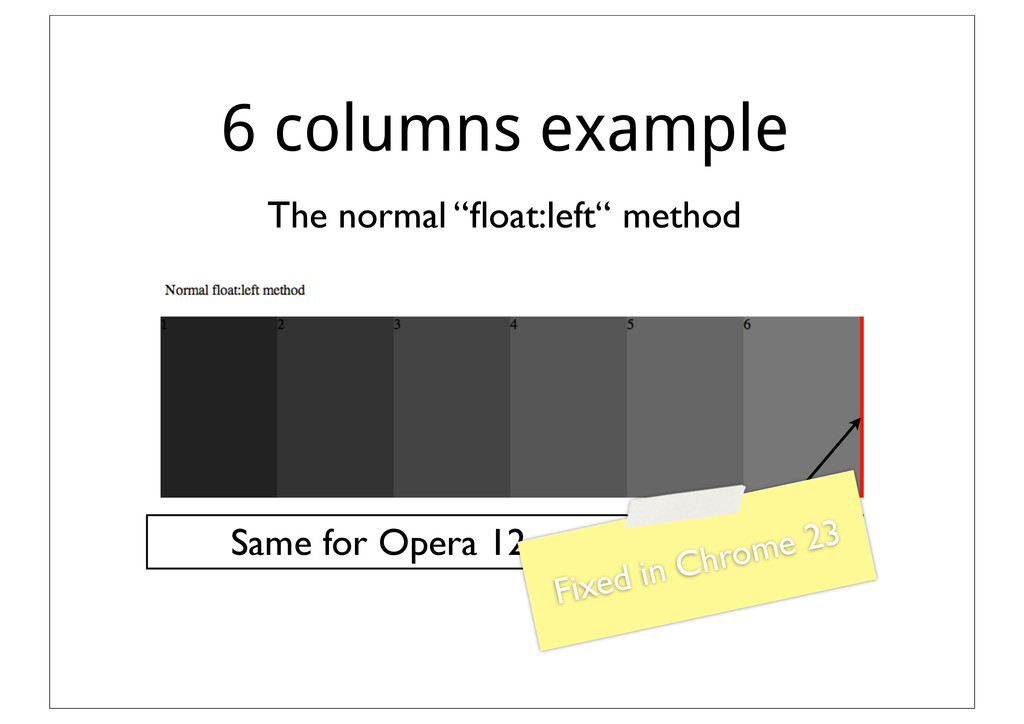
6 columns example The normal “float:left“ method Same for Opera
12 and Chrome 21 Fixed in Chrome 23 -
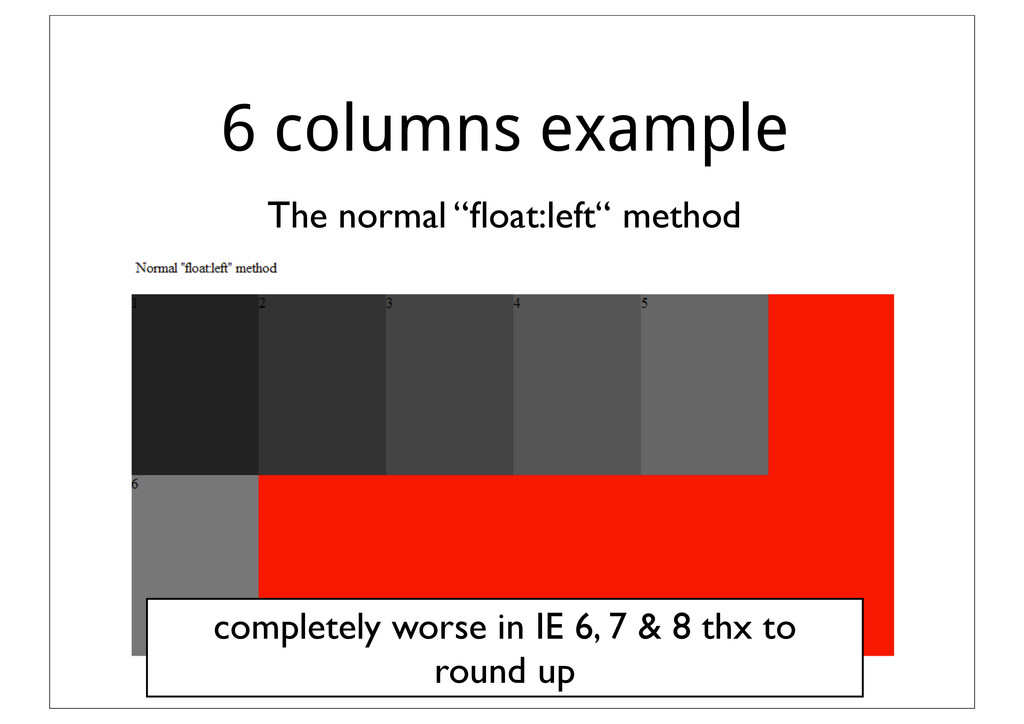
6 columns example The normal “float:left“ method completely worse in
IE 6, 7 & 8 thx to round up -
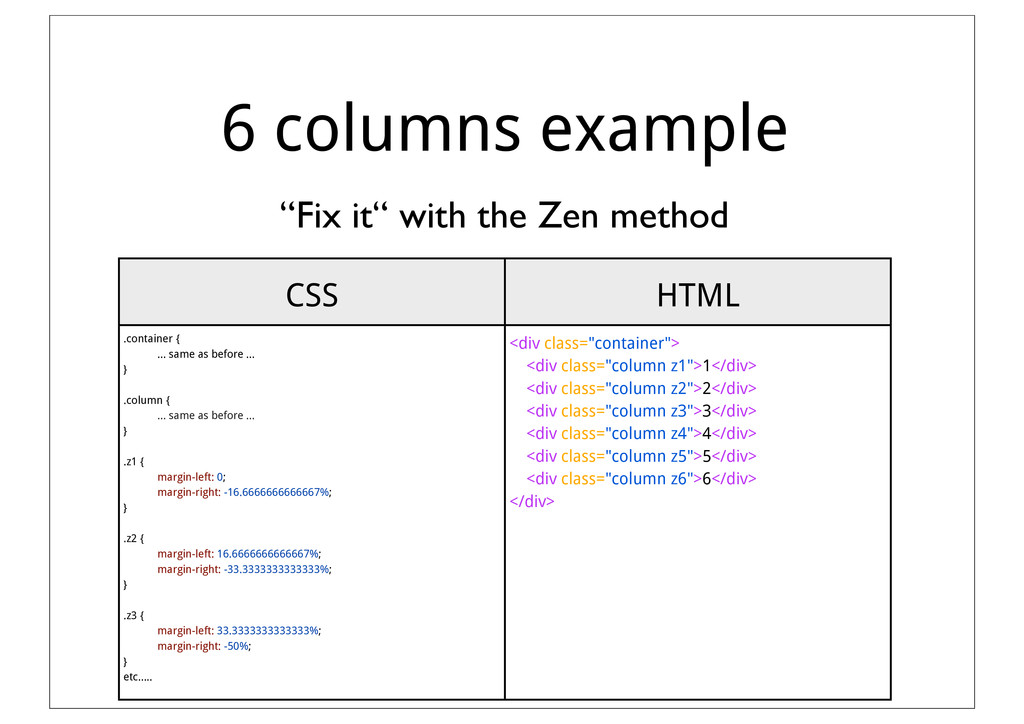
6 columns example CSS HTML .container { ... same as
before ... } .column { ... same as before ... } .z1 { margin-left: 0; margin-right: -16.6666666666667%; } .z2 { margin-left: 16.6666666666667%; margin-right: -33.3333333333333%; } .z3 { margin-left: 33.3333333333333%; margin-right: -50%; } etc..... <div class="container"> <div class="column z1">1</div> <div class="column z2">2</div> <div class="column z3">3</div> <div class="column z4">4</div> <div class="column z5">5</div> <div class="column z6">6</div> </div> “Fix it“ with the Zen method -
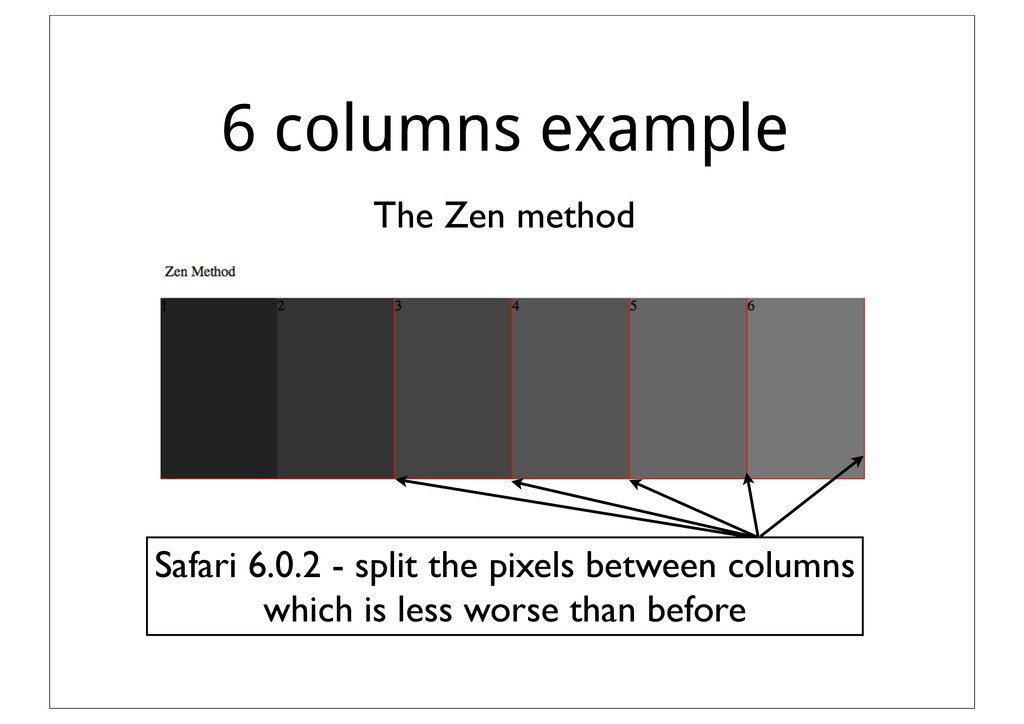
6 columns example The Zen method Safari 6.0.2 - split
the pixels between columns which is less worse than before -
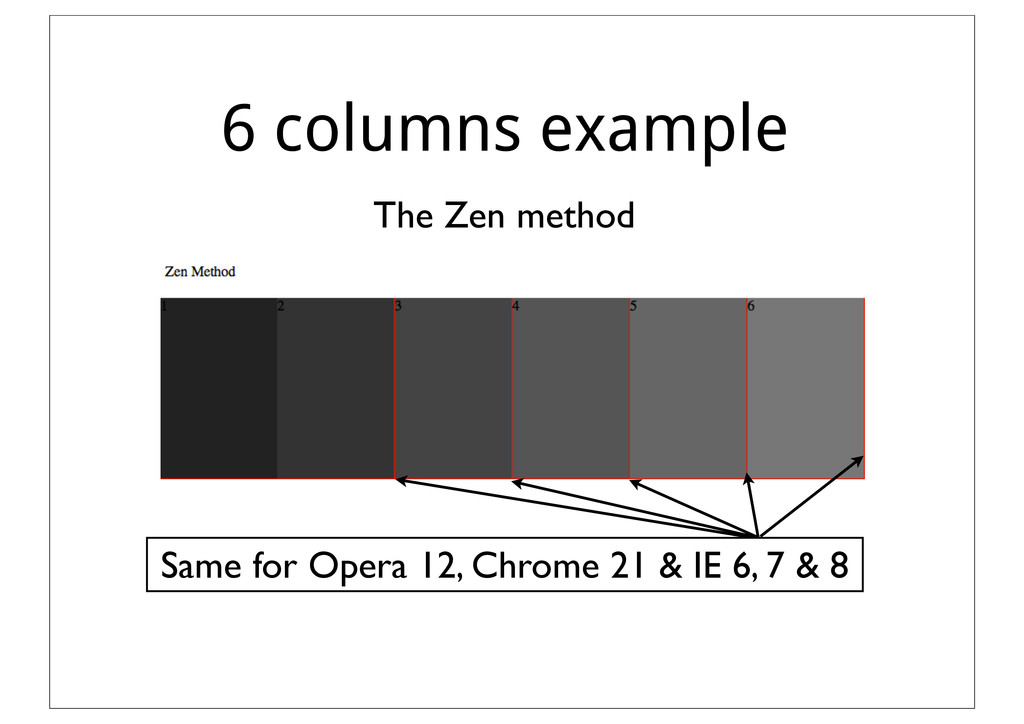
6 columns example The Zen method Same for Opera 12,
Chrome 21 & IE 6, 7 & 8 -
Conclusion If you have to be “pixel precise“ in a
responsive webdesign (mostly thx to designers) don‘t forget this rounding error in browsers and how you can solve it. If you start a new project and you have the option to use a Framework like Twitter‘s Bootstrap, Foundation, CSS grid etc. use it! It already solves these kind of problems for you.