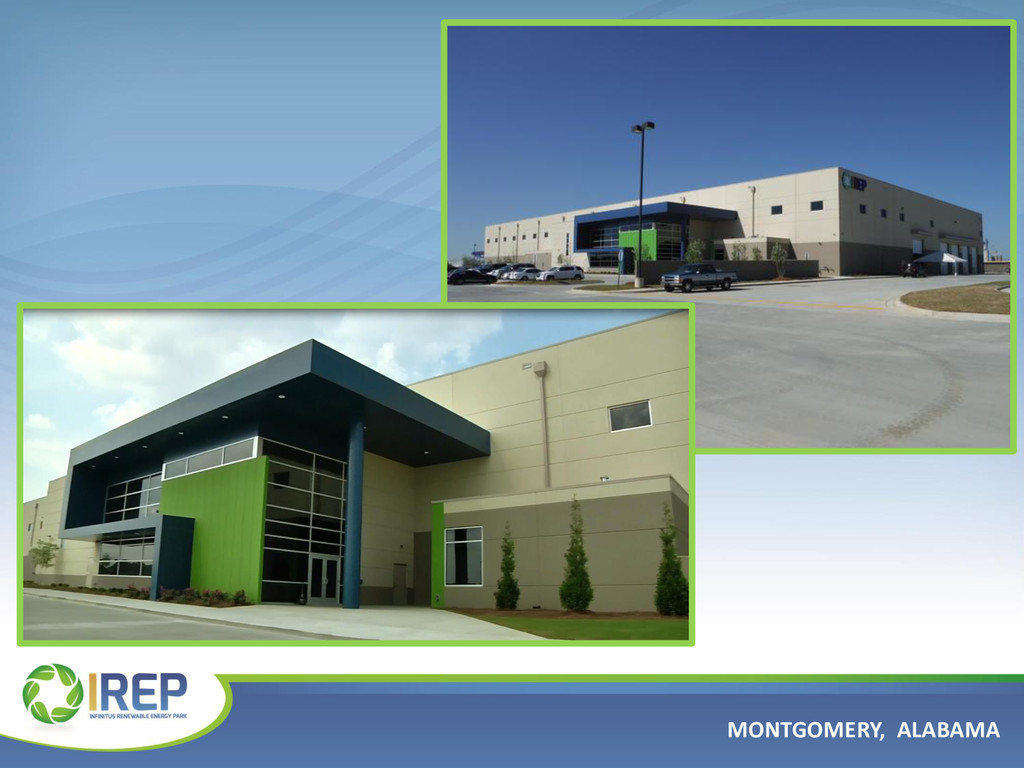
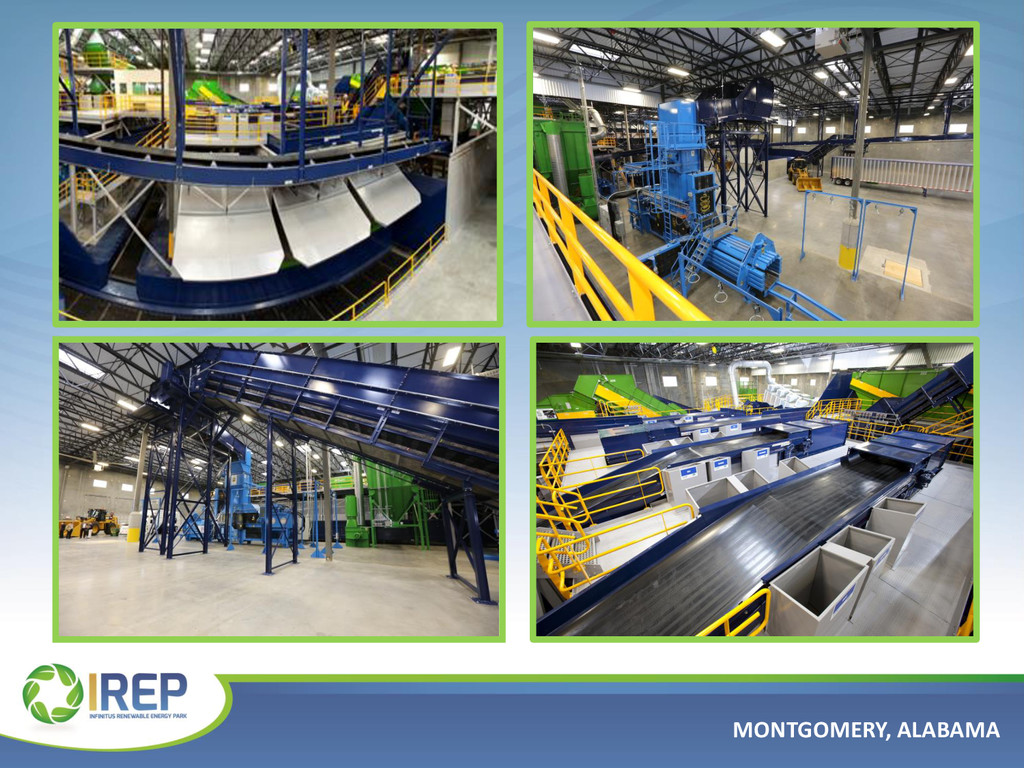
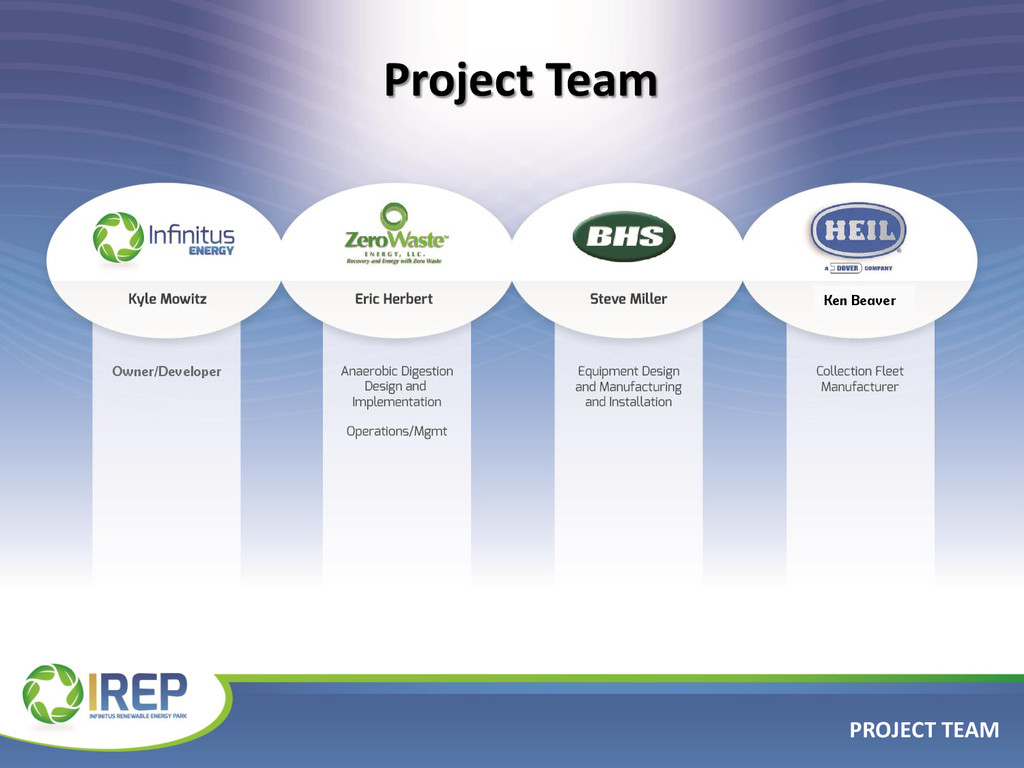
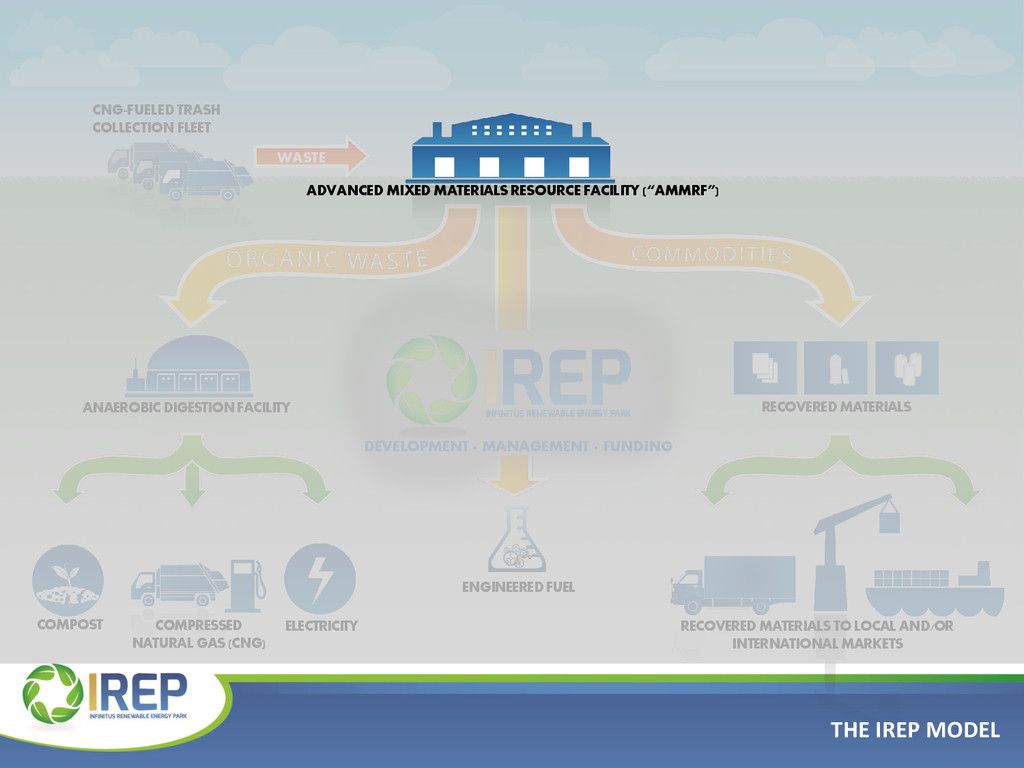
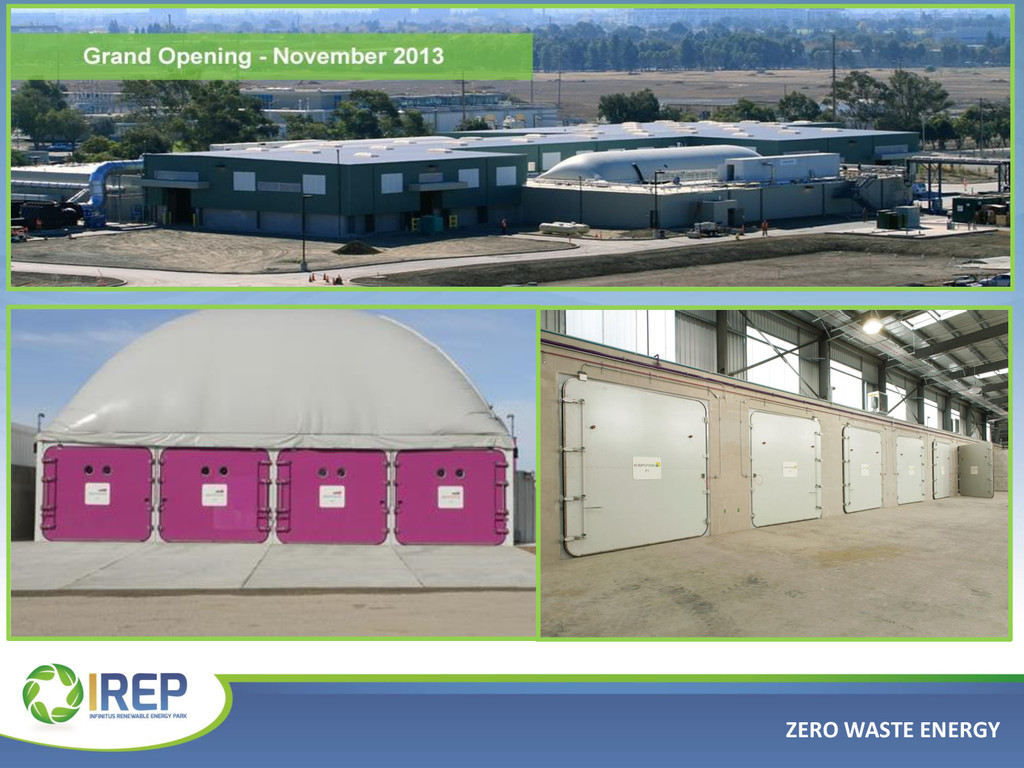
for Recycling and Processing of Solid Waste Collaborated with award-winning architectural and technology systems design professionals J.R. Miller & Associates, Bulk Handling Systems and Zero Waste Energy Enlisted The Conlan Company to implement construction of $35 Million, 82,000+ sq. ft. state-of-the-art manufacturing facility Began processing MSW at the rate of 30-35 tph and created 125 new jobs with salaries, ranging from $9/hr to $180,000 per year Post-opening, have garnered interest from multiple city, state and federal governments
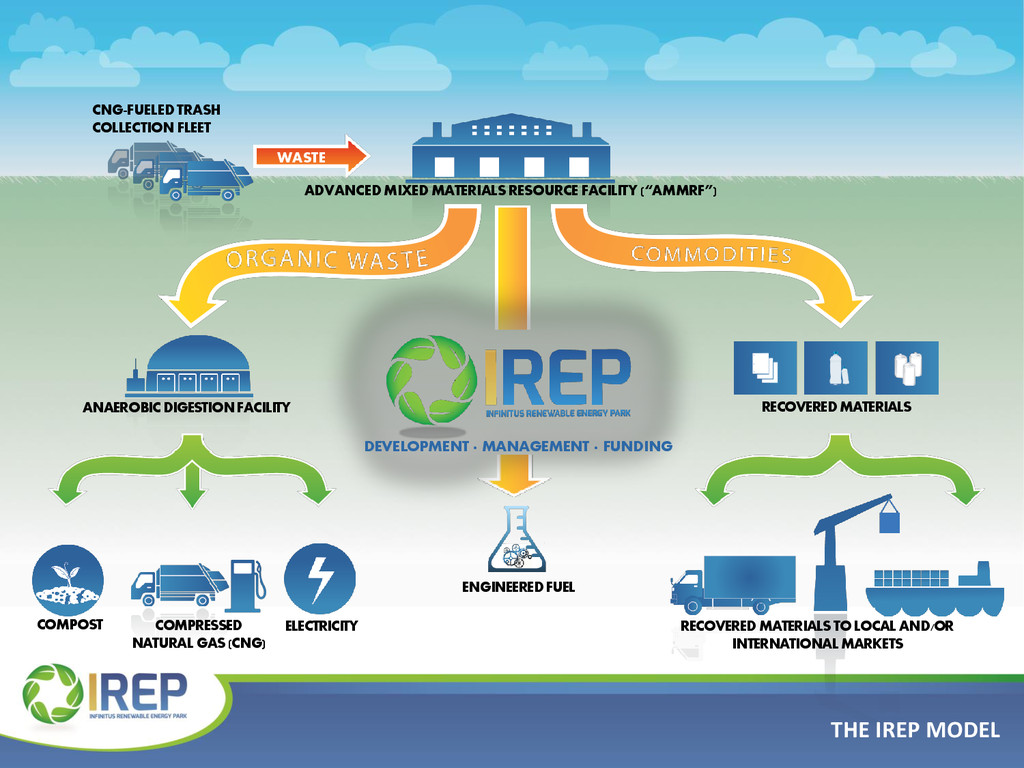
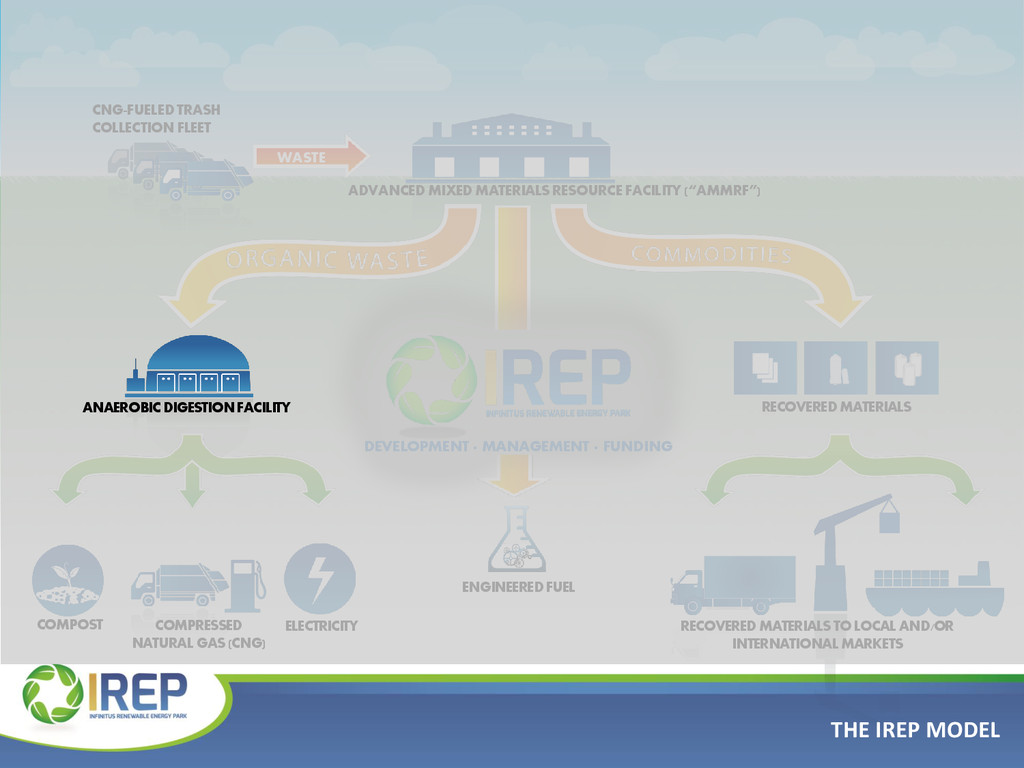
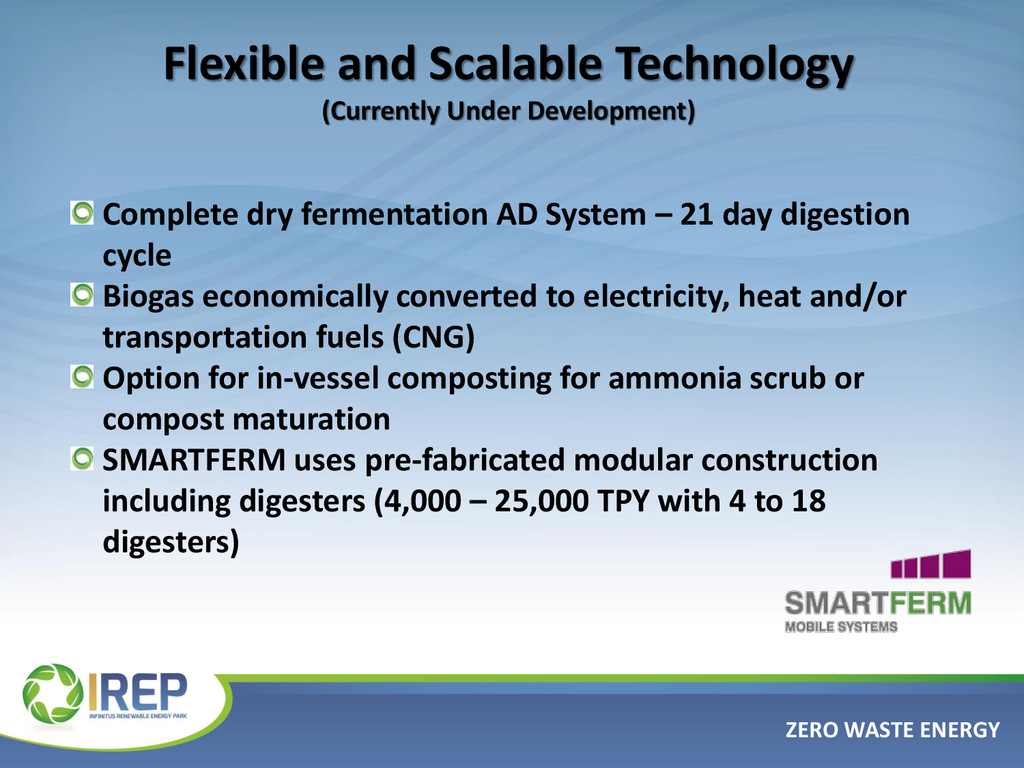
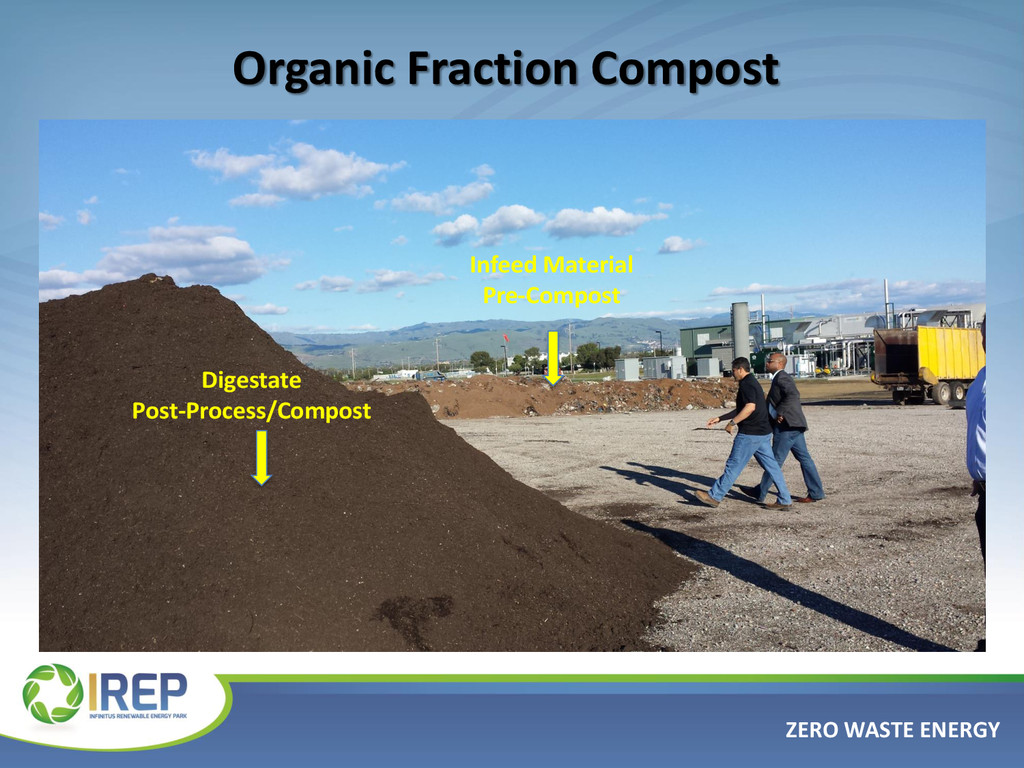
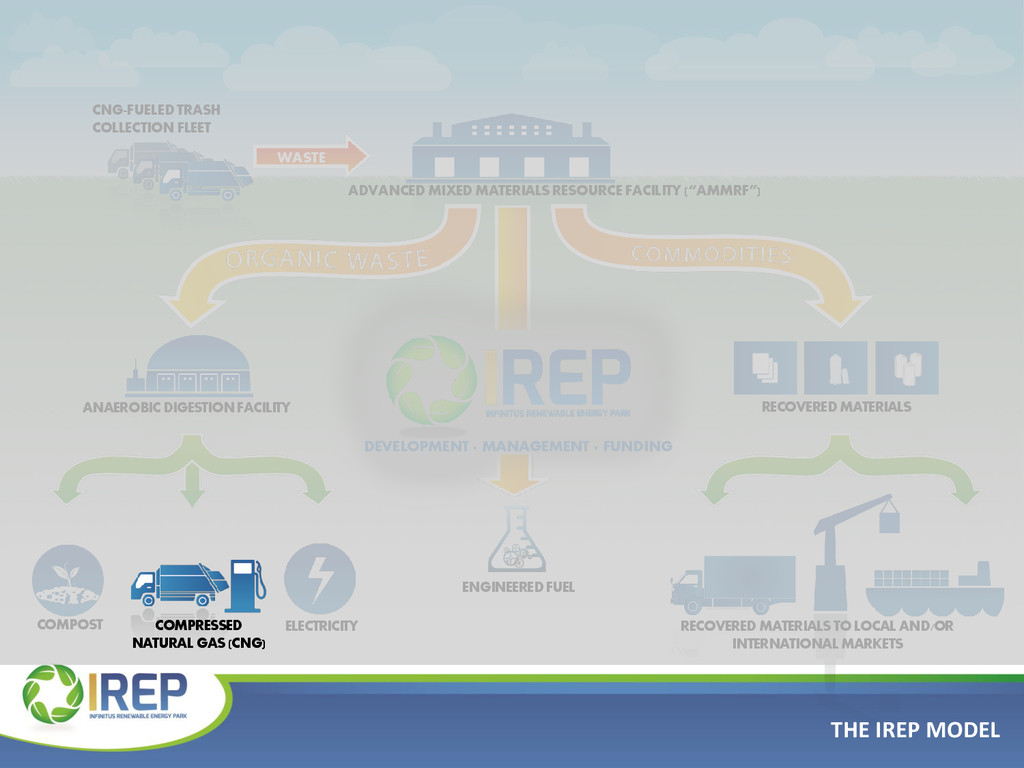
Complete dry fermentation AD System – 21 day digestion cycle Biogas economically converted to electricity, heat and/or transportation fuels (CNG) Option for in-vessel composting for ammonia scrub or compost maturation SMARTFERM uses pre-fabricated modular construction including digesters (4,000 – 25,000 TPY with 4 to 18 digesters)
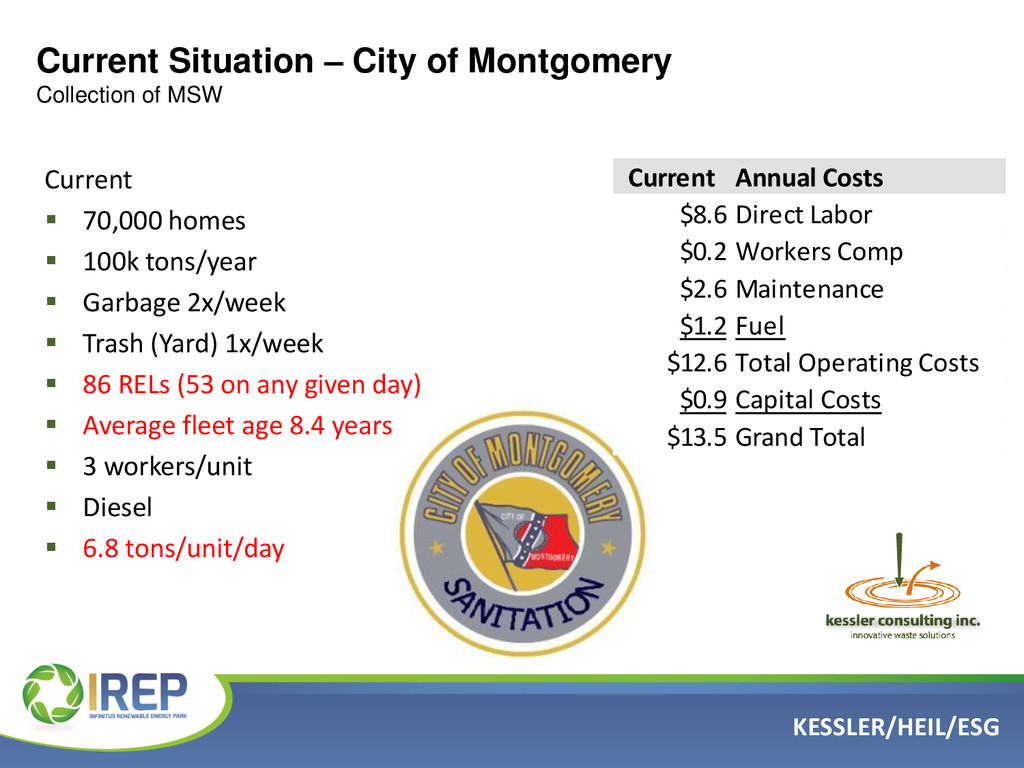
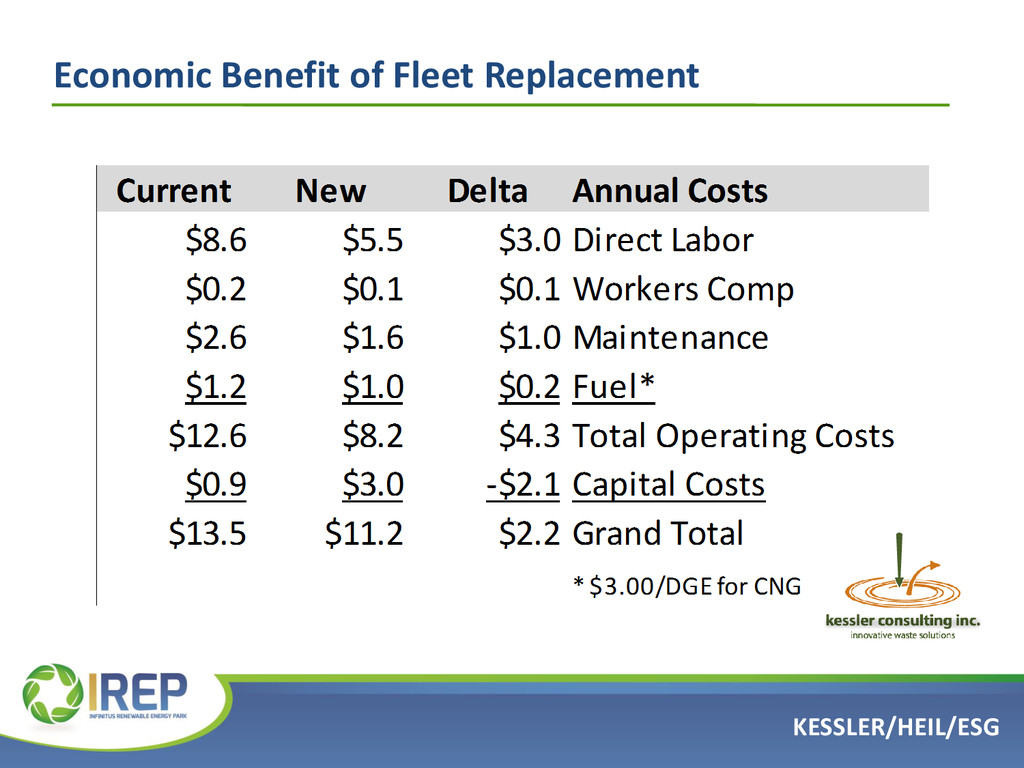
70,000 homes 100k tons/year Garbage 2x/week Trash (Yard) 1x/week 86 RELs (53 on any given day) Average fleet age 8.4 years 3 workers/unit Diesel 6.8 tons/unit/day Current Annual Costs $8.6 Direct Labor $0.2 Workers Comp $2.6 Maintenance $1.2 Fuel $12.6 Total Operating Costs $0.9 Capital Costs $13.5 Grand Total KESSLER/HEIL/ESG
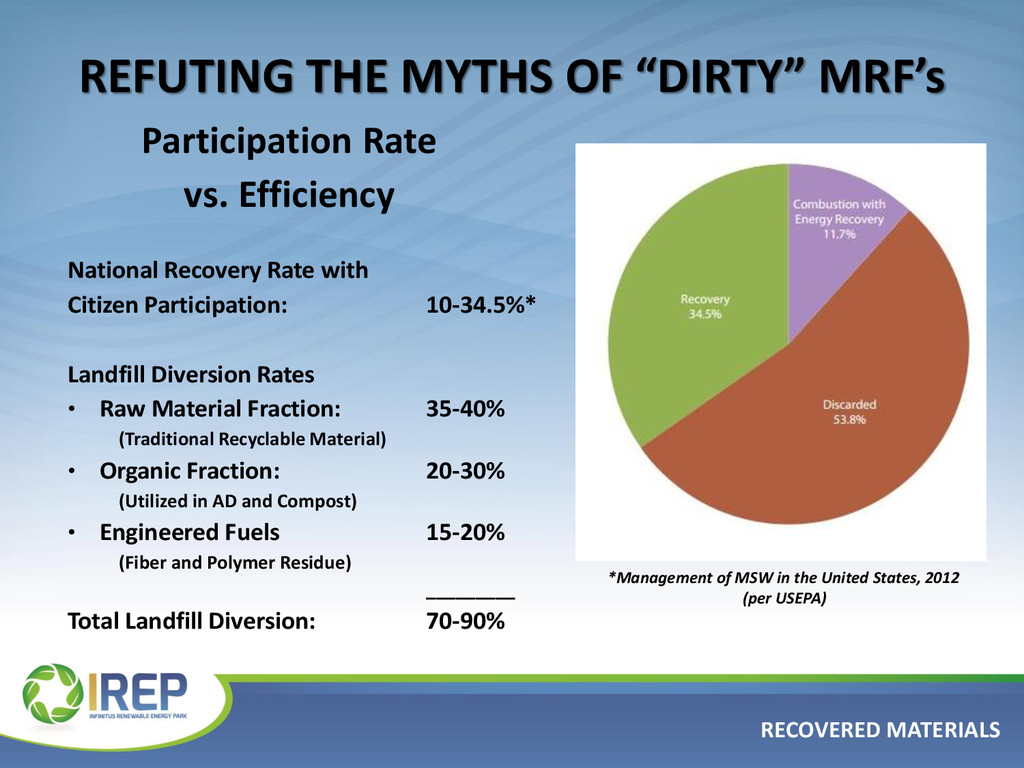
MSW in the United States, 2012 (per USEPA) Participation Rate vs. Efficiency National Recovery Rate with Citizen Participation: 10-34.5%* Landfill Diversion Rates • Raw Material Fraction: 35-40% (Traditional Recyclable Material) • Organic Fraction: 20-30% (Utilized in AD and Compost) • Engineered Fuels 15-20% (Fiber and Polymer Residue) _________ Total Landfill Diversion: 70-90%
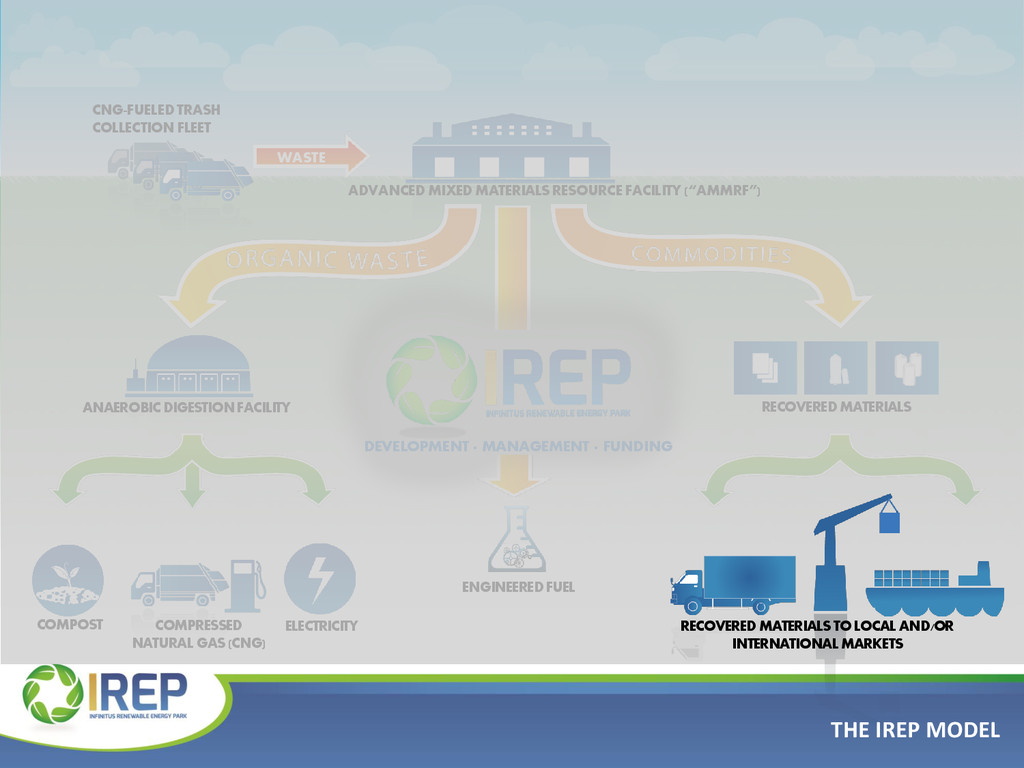
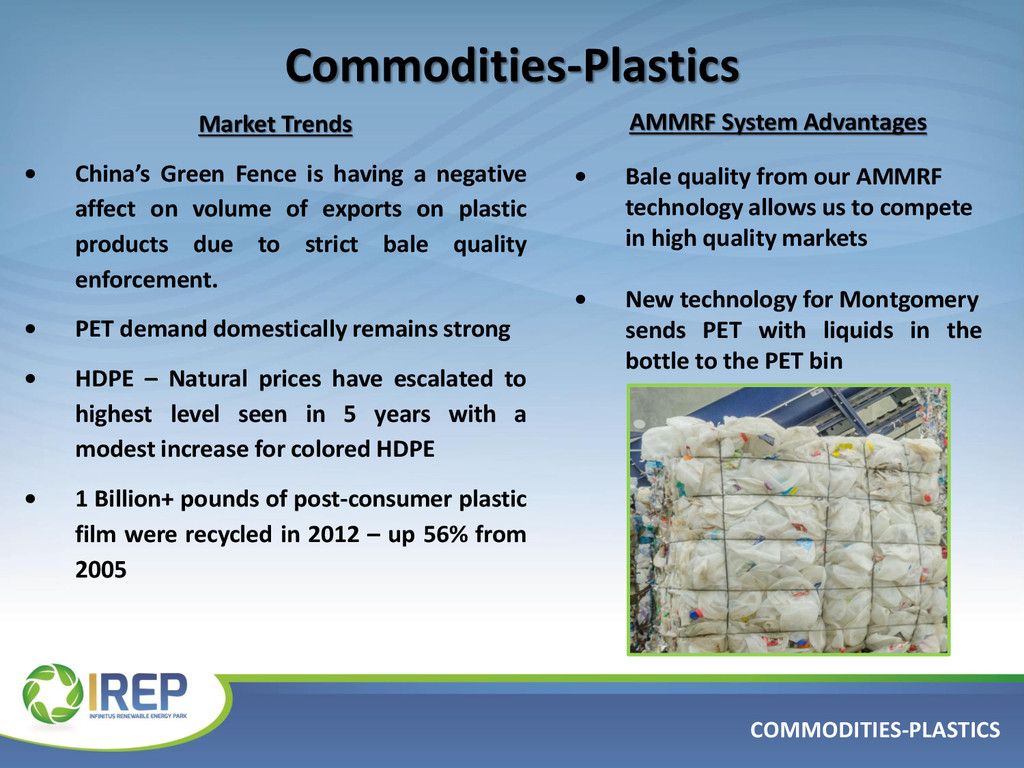
a negative affect on volume of exports on plastic products due to strict bale quality enforcement. • PET demand domestically remains strong • HDPE – Natural prices have escalated to highest level seen in 5 years with a modest increase for colored HDPE • 1 Billion+ pounds of post-consumer plastic film were recycled in 2012 – up 56% from 2005 AMMRF System Advantages • Bale quality from our AMMRF technology allows us to compete in high quality markets • New technology for Montgomery sends PET with liquids in the bottle to the PET bin
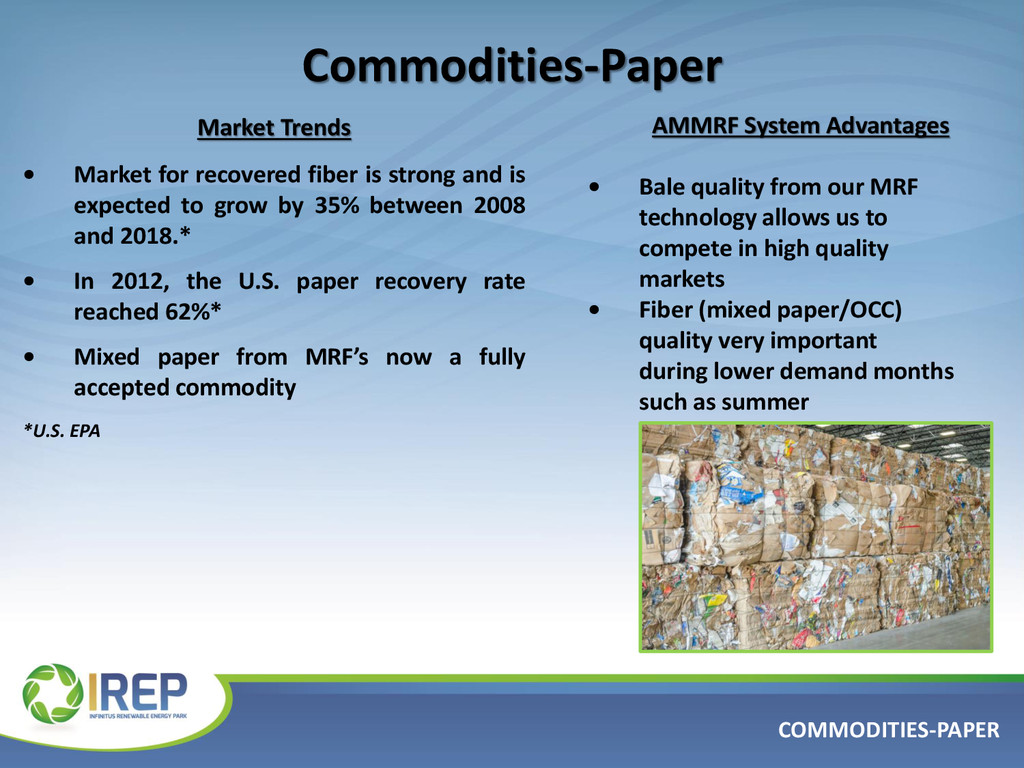
strong and is expected to grow by 35% between 2008 and 2018.* • In 2012, the U.S. paper recovery rate reached 62%* • Mixed paper from MRF’s now a fully accepted commodity *U.S. EPA AMMRF System Advantages • Bale quality from our MRF technology allows us to compete in high quality markets • Fiber (mixed paper/OCC) quality very important during lower demand months such as summer
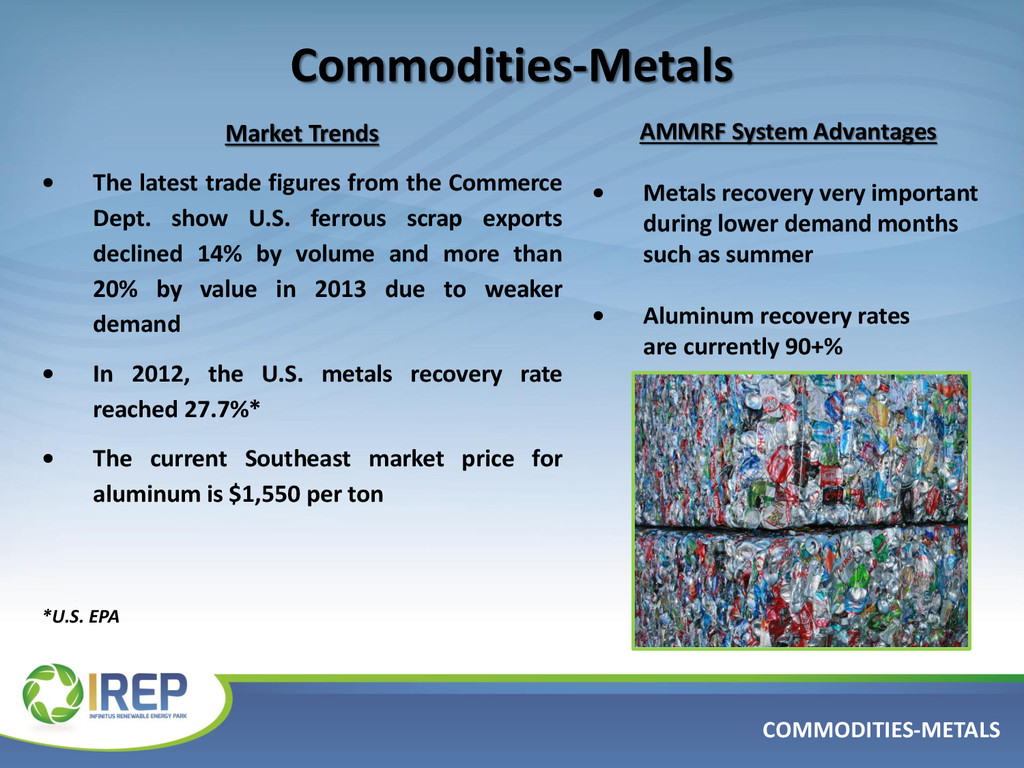
the Commerce Dept. show U.S. ferrous scrap exports declined 14% by volume and more than 20% by value in 2013 due to weaker demand • In 2012, the U.S. metals recovery rate reached 27.7%* • The current Southeast market price for aluminum is $1,550 per ton *U.S. EPA AMMRF System Advantages • Metals recovery very important during lower demand months such as summer • Aluminum recovery rates are currently 90+%
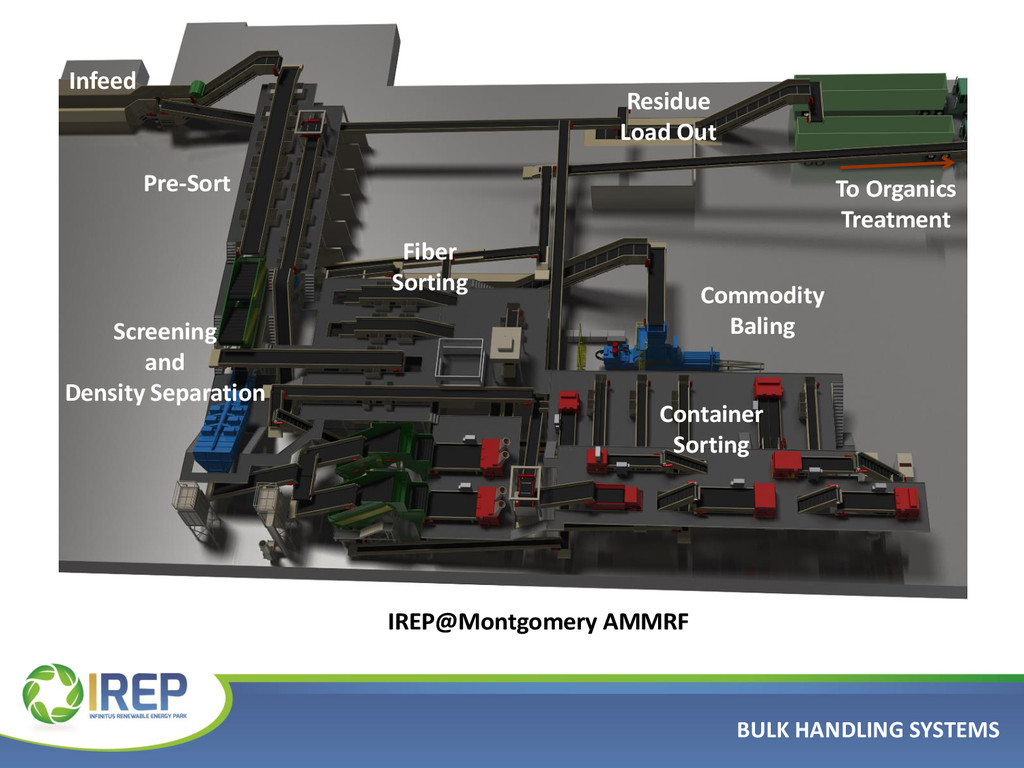
to process either mixed waste and single-stream, collectively, or provide a separate infeed for source separated recyclables, depending on the requirements of each municipality Plastic sorting can change within 24 hours to reflect market conditions (i.e., #4’s and #5’s) through optical technology
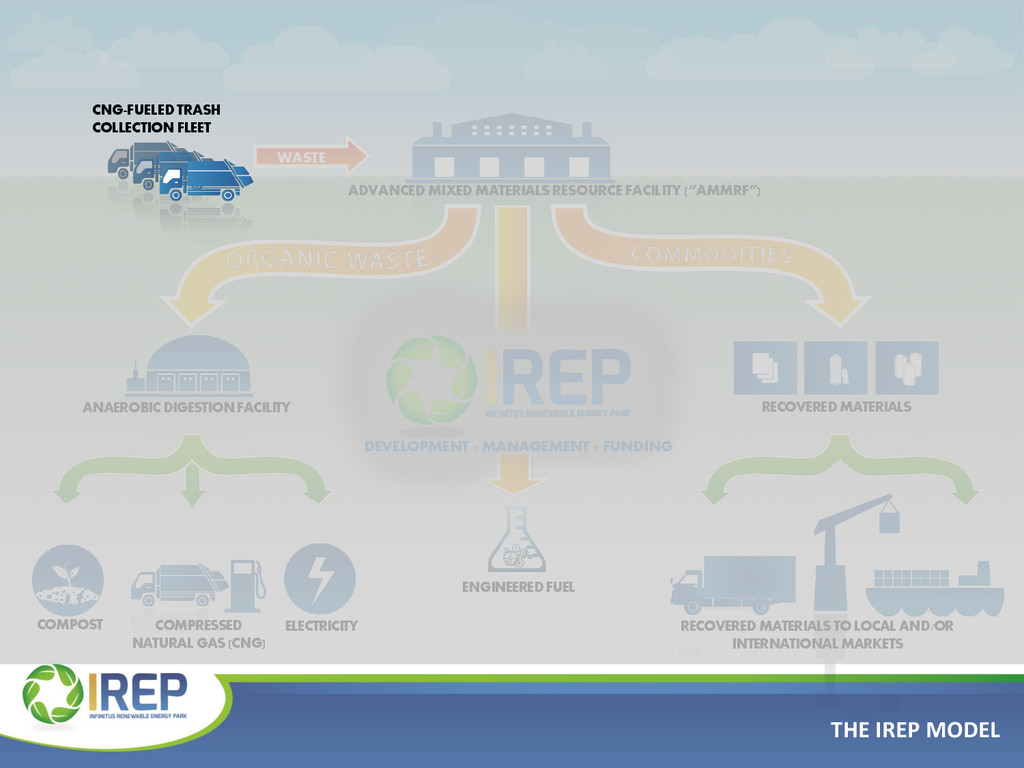
and Operational Impacts • 90% reduction in material to landfill (at system optimization) • 95% of organic fraction from MSW diverted to AD system to produce CNG • Safety enhancements for collections with conversion to automated loaders • City will operate one of the Country’s first carbon negative collection fleets • Financial Impacts • Up to $1.6 M annual savings in landfill operations • $2.2 M net annual reduction in collection fleet operating costs • No capital investment required by the City • No capital investment from the City- 100% Private Investment • No risk to the City- no funds expended until project systems are delivered • Municipal obligation for tipping fee payment upon delivery of the facility • Purchase of CNG as delivered • Recovery rates and system performance guarantees in Contract
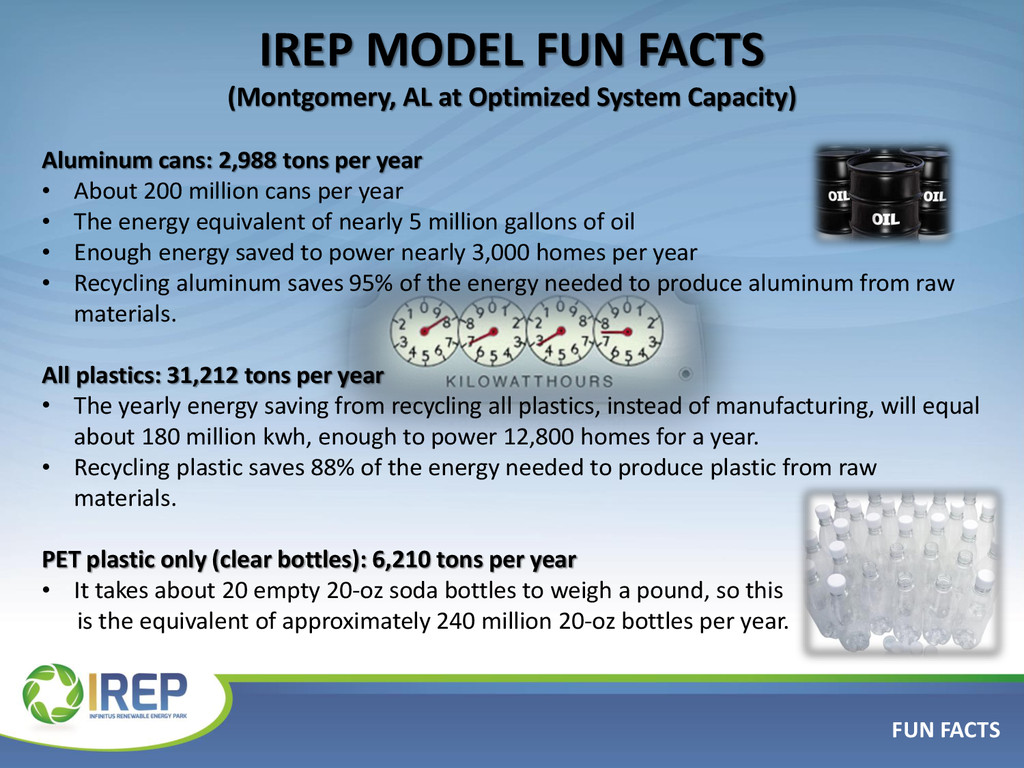
System Capacity) Aluminum cans: 2,988 tons per year • About 200 million cans per year • The energy equivalent of nearly 5 million gallons of oil • Enough energy saved to power nearly 3,000 homes per year • Recycling aluminum saves 95% of the energy needed to produce aluminum from raw materials. All plastics: 31,212 tons per year • The yearly energy saving from recycling all plastics, instead of manufacturing, will equal about 180 million kwh, enough to power 12,800 homes for a year. • Recycling plastic saves 88% of the energy needed to produce plastic from raw materials. PET plastic only (clear bottles): 6,210 tons per year • It takes about 20 empty 20-oz soda bottles to weigh a pound, so this is the equivalent of approximately 240 million 20-oz bottles per year.
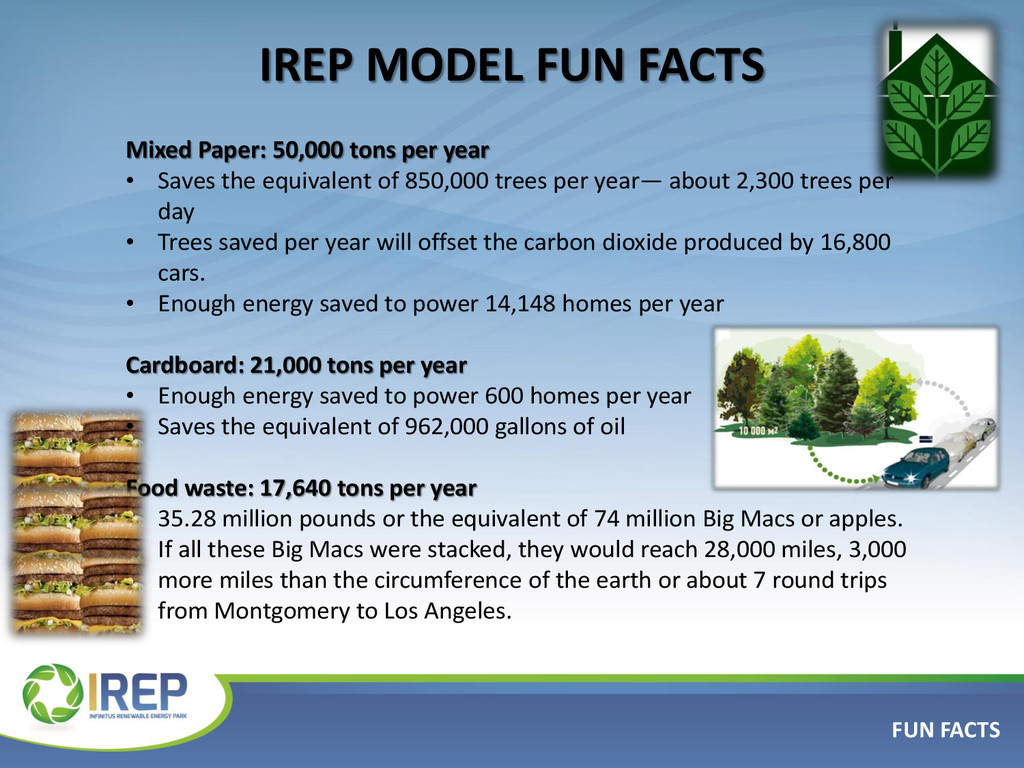
the equivalent of 850,000 trees per year— about 2,300 trees per day • Trees saved per year will offset the carbon dioxide produced by 16,800 cars. • Enough energy saved to power 14,148 homes per year Cardboard: 21,000 tons per year • Enough energy saved to power 600 homes per year • Saves the equivalent of 962,000 gallons of oil Food waste: 17,640 tons per year • 35.28 million pounds or the equivalent of 74 million Big Macs or apples. • If all these Big Macs were stacked, they would reach 28,000 miles, 3,000 more miles than the circumference of the earth or about 7 round trips from Montgomery to Los Angeles. IREP MODEL FUN FACTS
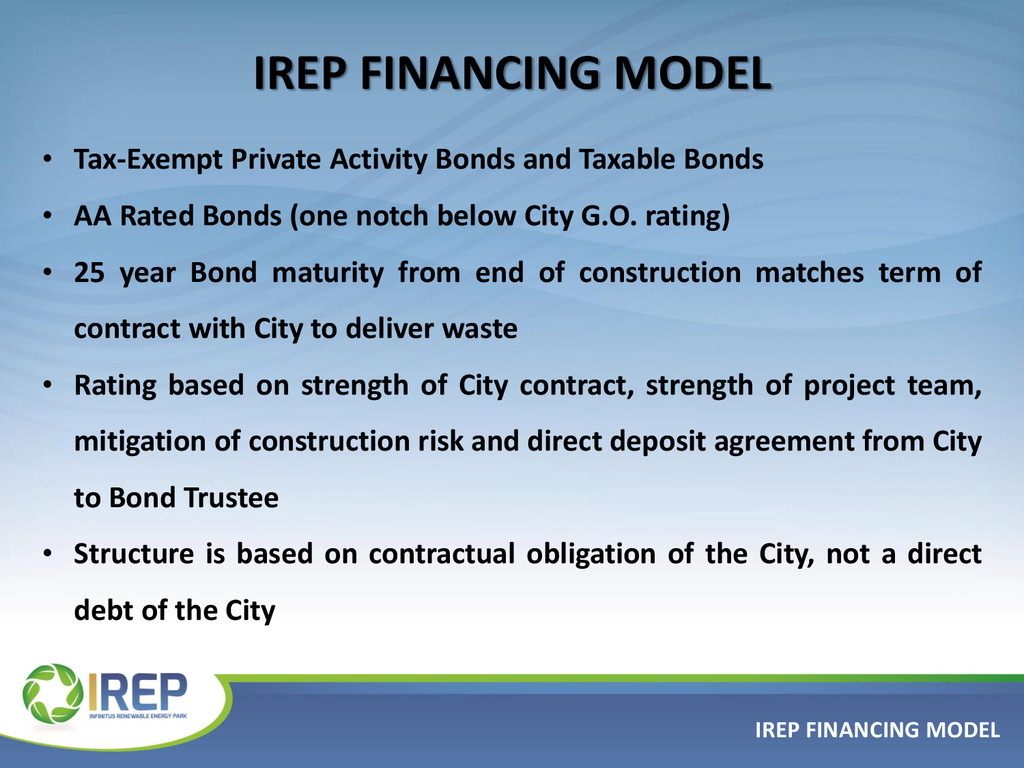
Bonds and Taxable Bonds • AA Rated Bonds (one notch below City G.O. rating) • 25 year Bond maturity from end of construction matches term of contract with City to deliver waste • Rating based on strength of City contract, strength of project team, mitigation of construction risk and direct deposit agreement from City to Bond Trustee • Structure is based on contractual obligation of the City, not a direct debt of the City
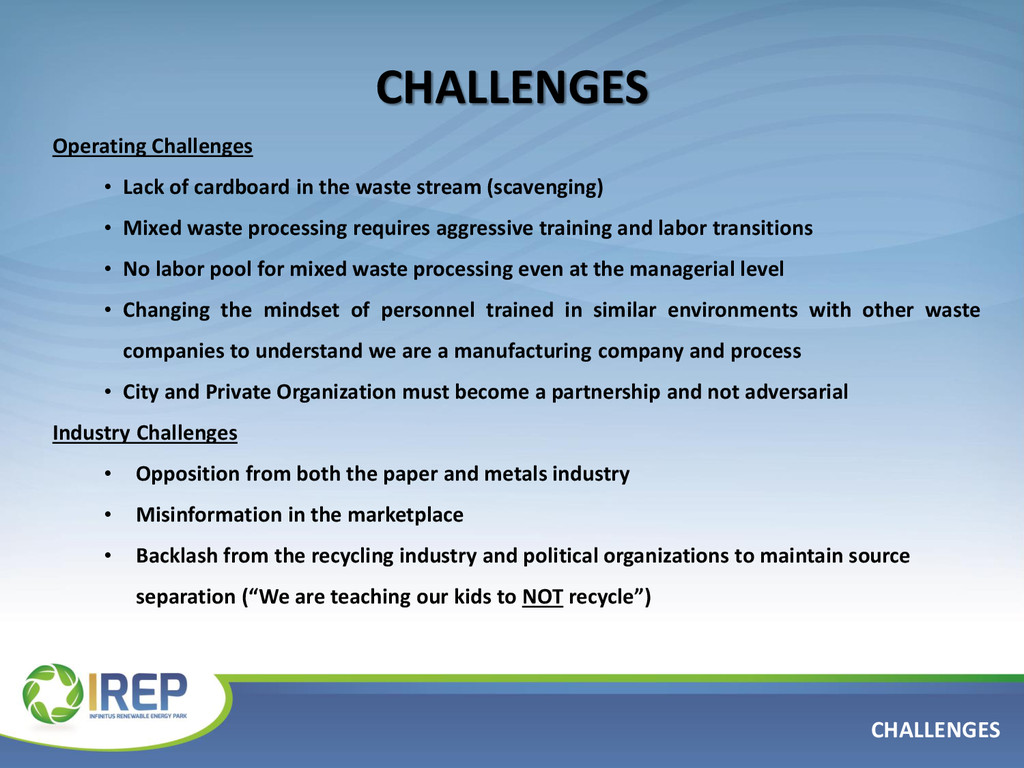
(scavenging) • Mixed waste processing requires aggressive training and labor transitions • No labor pool for mixed waste processing even at the managerial level • Changing the mindset of personnel trained in similar environments with other waste companies to understand we are a manufacturing company and process • City and Private Organization must become a partnership and not adversarial Industry Challenges • Opposition from both the paper and metals industry • Misinformation in the marketplace • Backlash from the recycling industry and political organizations to maintain source separation (“We are teaching our kids to NOT recycle”) CHALLENGES CHALLENGES


 pfn
 ueponx
 genda
 jozono
 yamanoku
 yuuuuuuu168
 takuroabe
 masakiokuda
 ykanoh
 shuta13
 kenichiodo
 willnet
 lfama
 greggifford
 cassininazir
 jonoalderson
 rocio
 coloredviolet
 garrettdimon
 jonrohan
 lemiorhan
 kneath
 baasie
 axbom