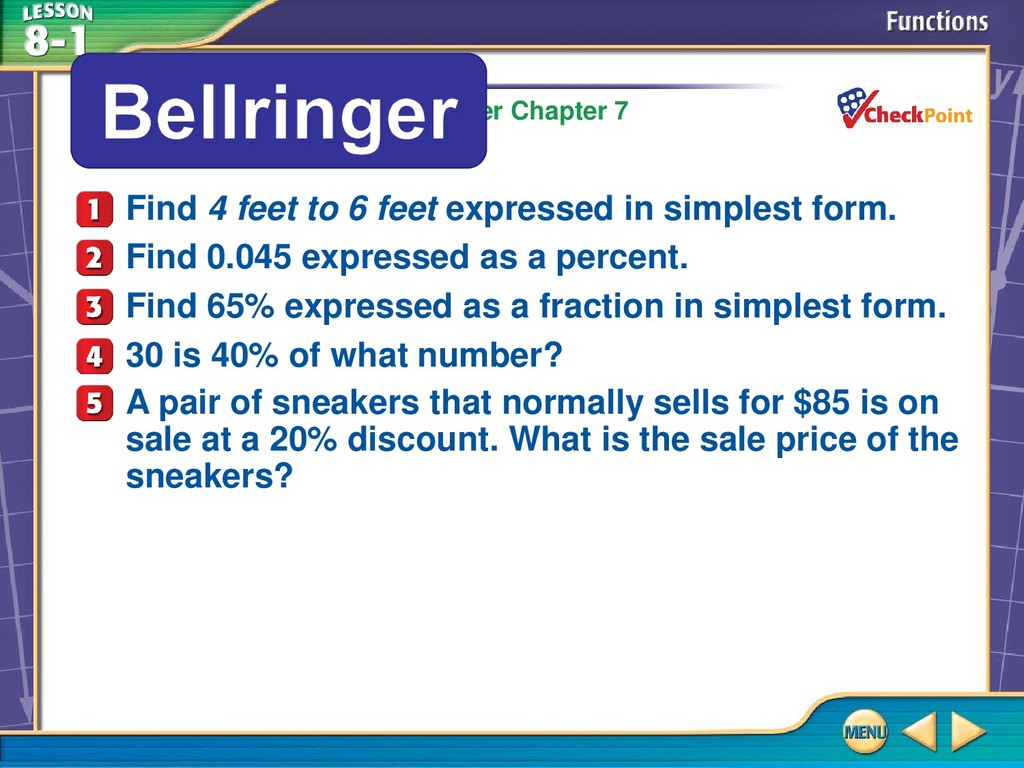
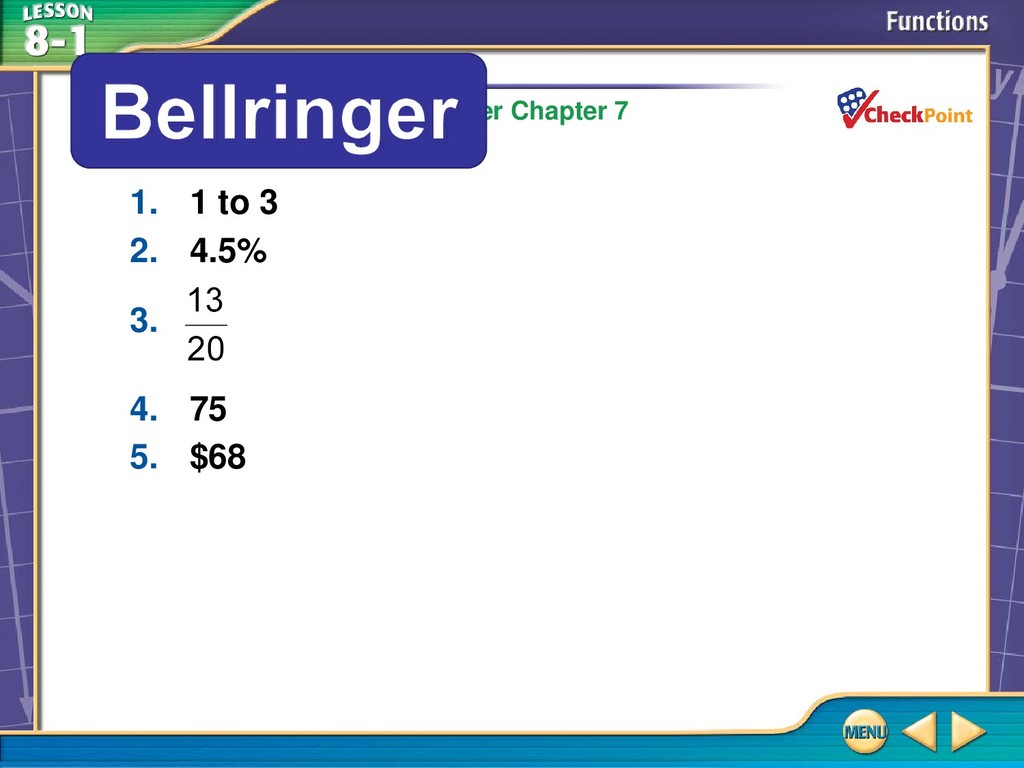
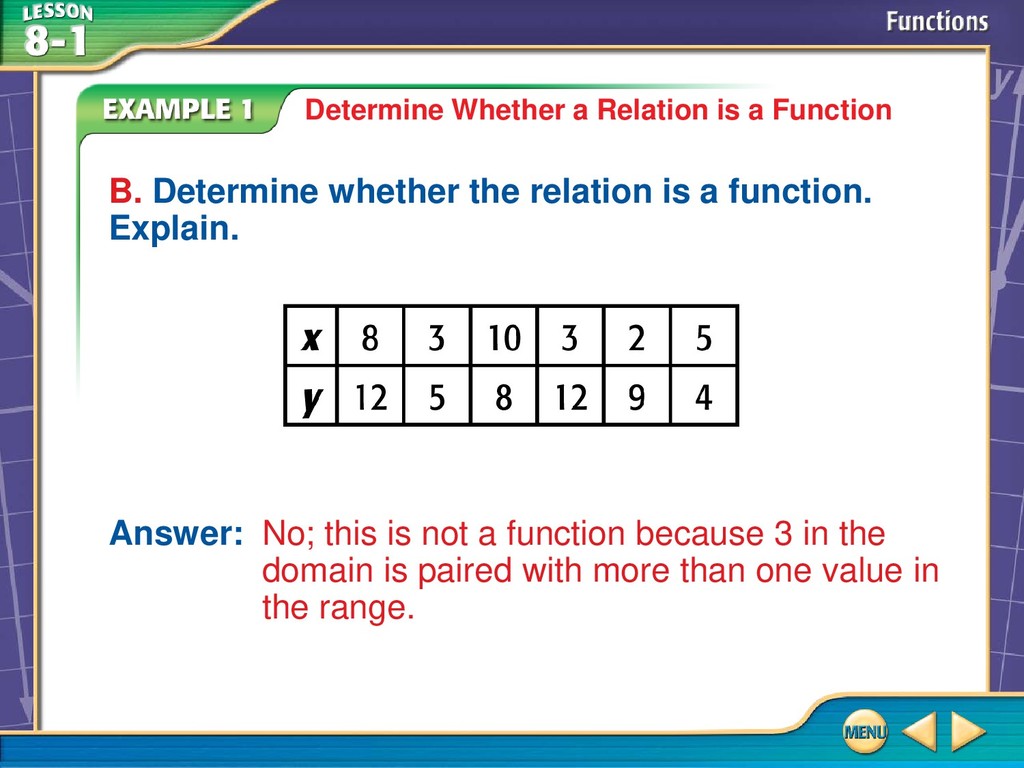
in simplest form. Find 0.045 expressed as a percent. Find 65% expressed as a fraction in simplest form. 30 is 40% of what number? A pair of sneakers that normally sells for $85 is on sale at a 20% discount. What is the sale price of the sneakers?
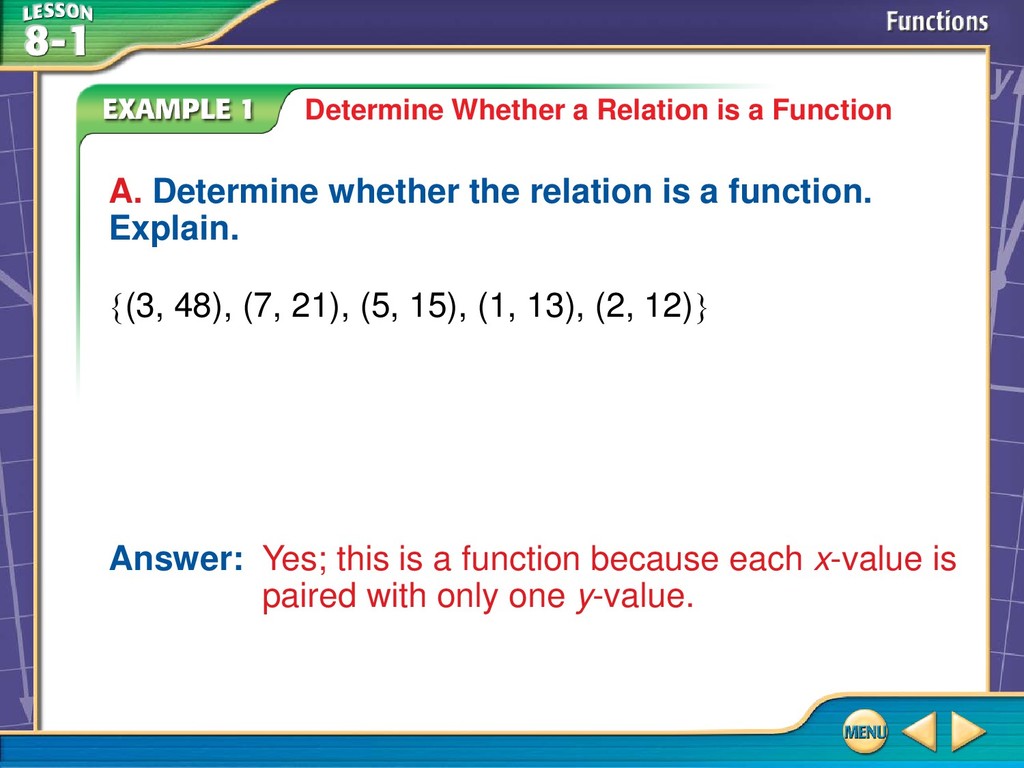
the relation is a function. Explain. {(3, 48), (7, 21), (5, 15), (1, 13), (2, 12)} Answer: Yes; this is a function because each x-value is paired with only one y-value.
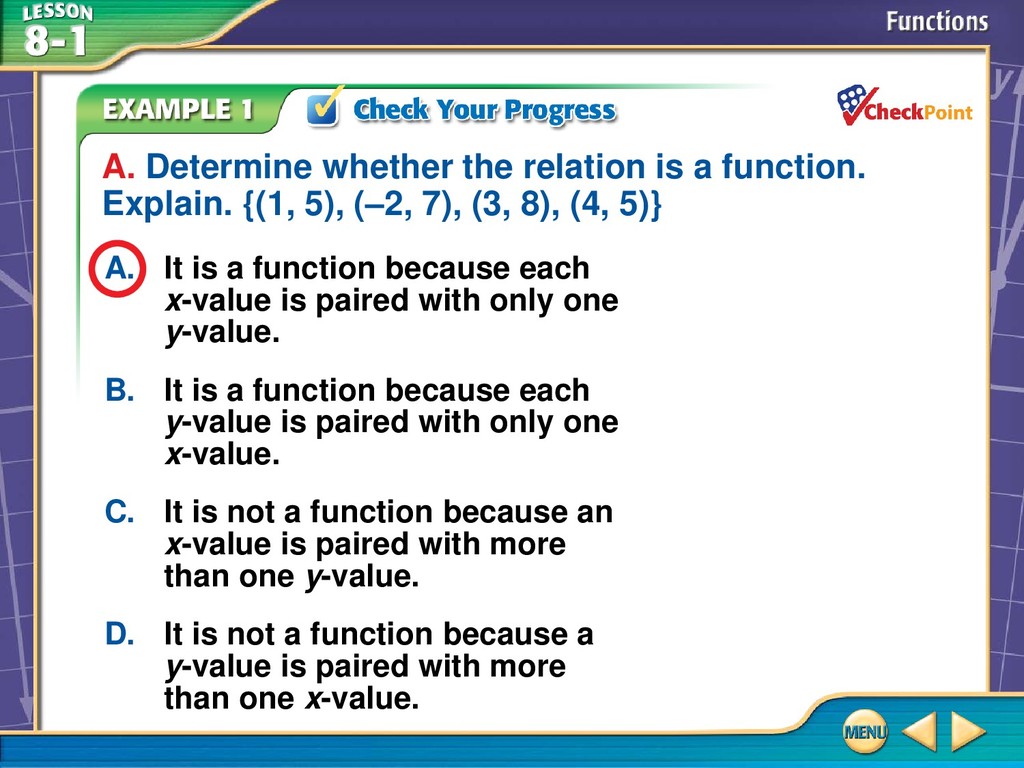
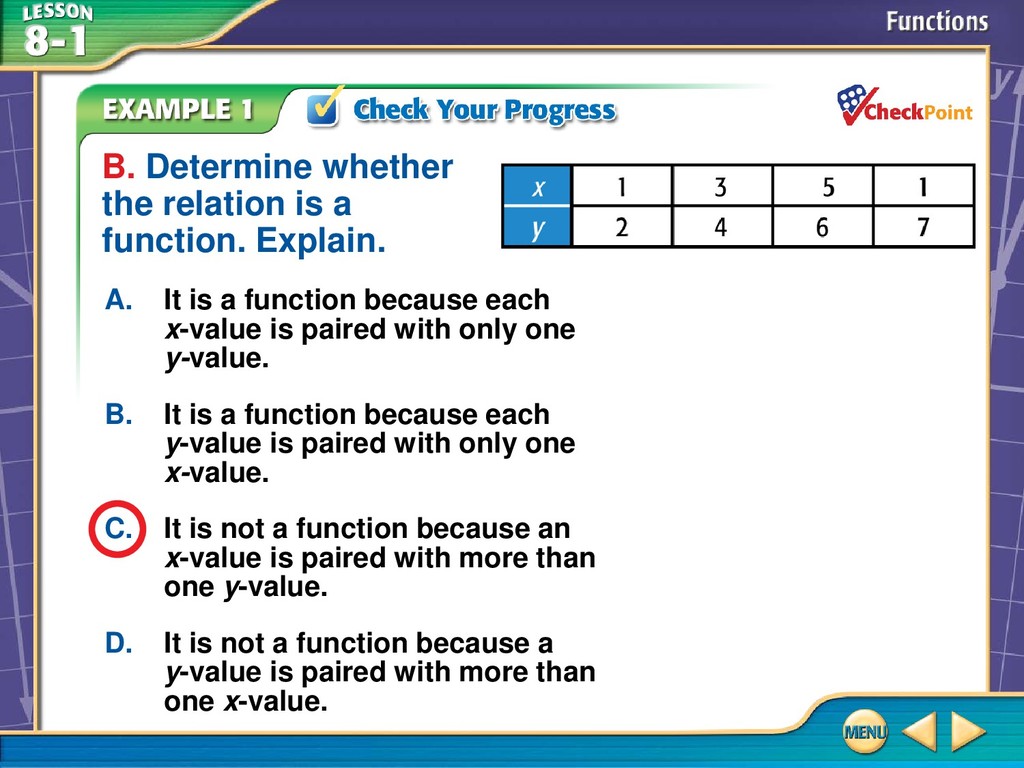
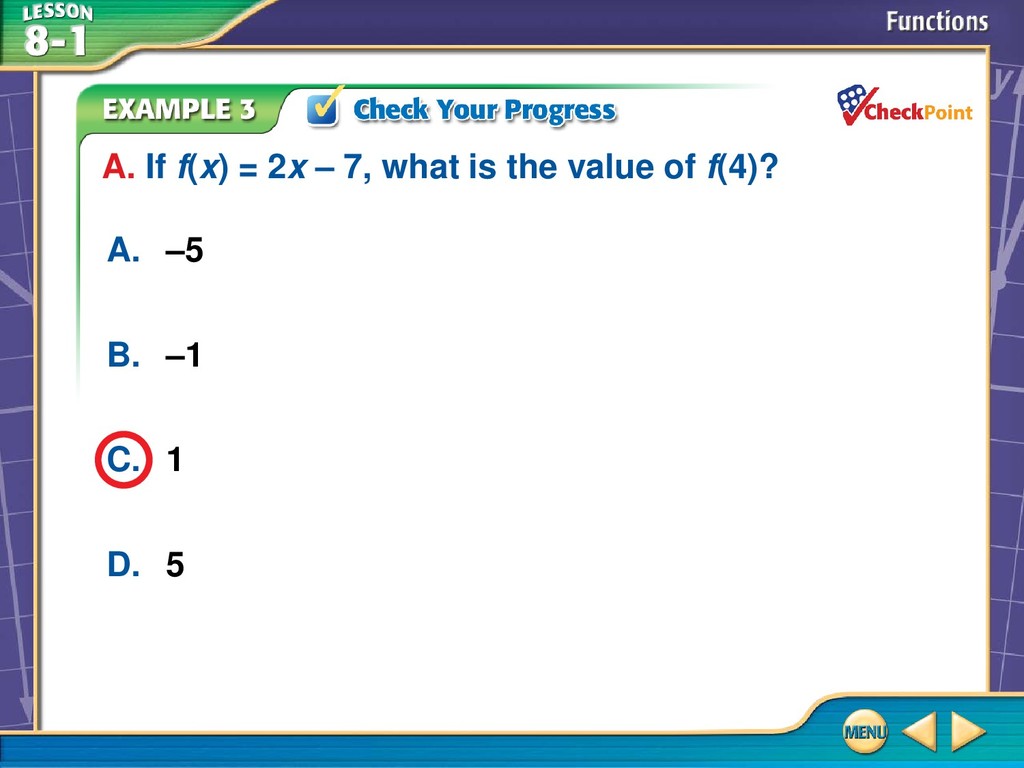
with only one y-value. B. It is a function because each y-value is paired with only one x-value. C. It is not a function because an x-value is paired with more than one y-value. D. It is not a function because a y-value is paired with more than one x-value. A. Determine whether the relation is a function. Explain. {(1, 5), (–2, 7), (3, 8), (4, 5)}
It is a function because each x-value is paired with only one y-value. B. It is a function because each y-value is paired with only one x-value. C. It is not a function because an x-value is paired with more than one y-value. D. It is not a function because a y-value is paired with more than one x-value.
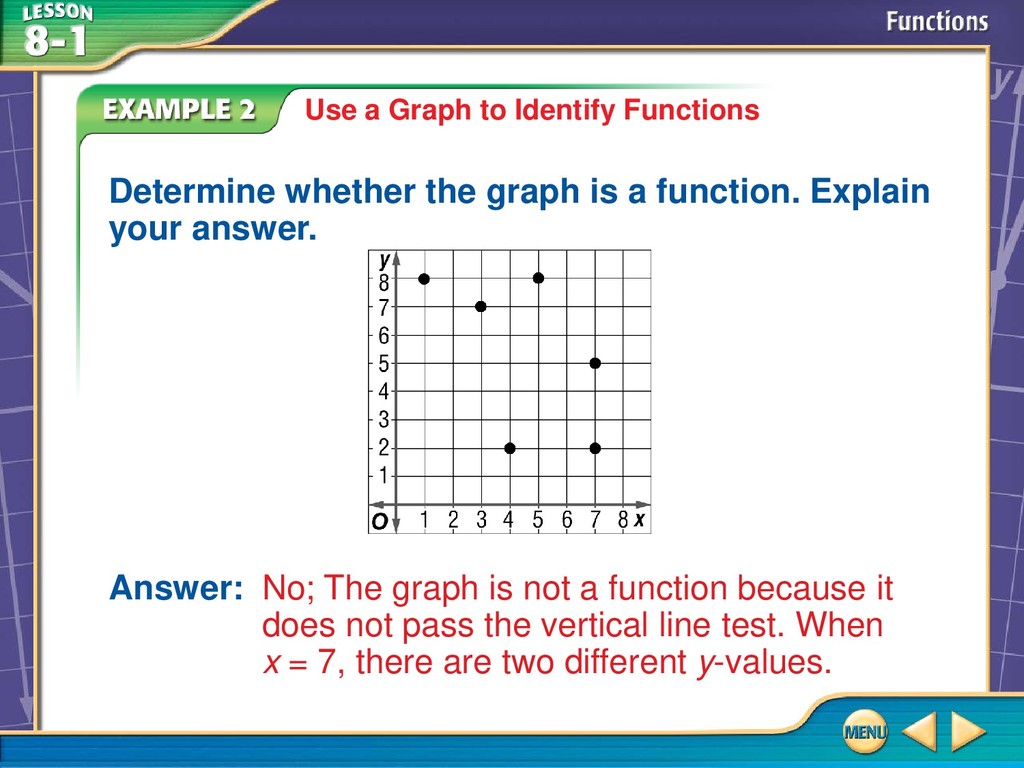
is a function. Explain your answer. Answer: No; The graph is not a function because it does not pass the vertical line test. When x = 7, there are two different y-values.
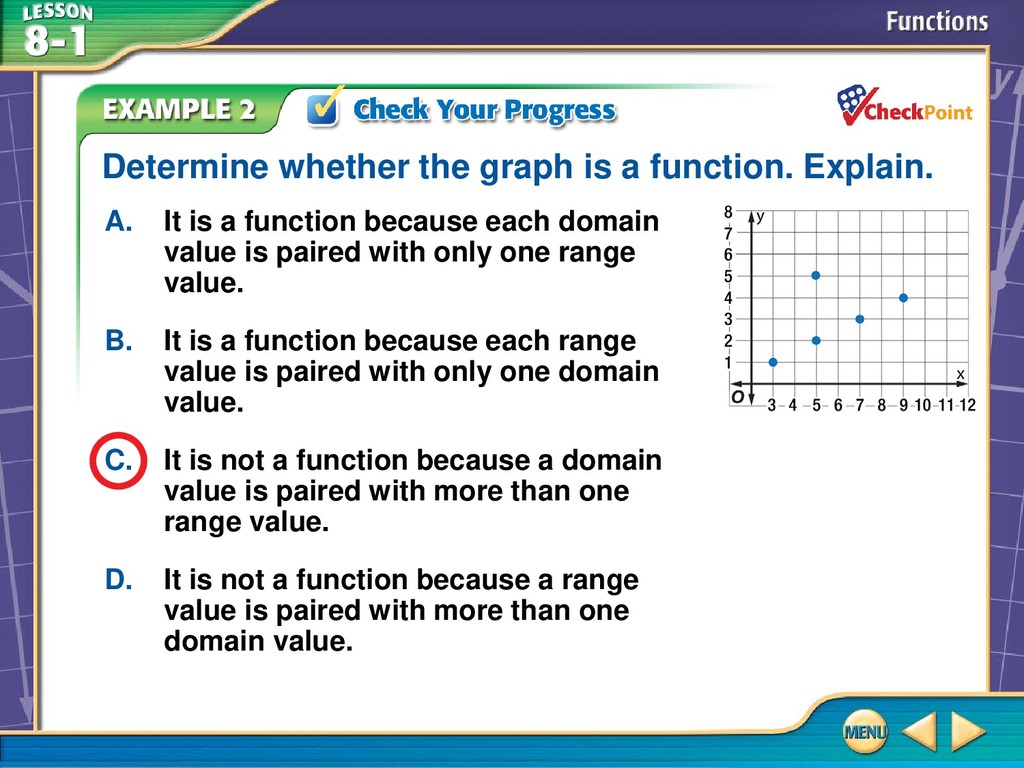
is a function because each domain value is paired with only one range value. B. It is a function because each range value is paired with only one domain value. C. It is not a function because a domain value is paired with more than one range value. D. It is not a function because a range value is paired with more than one domain value.
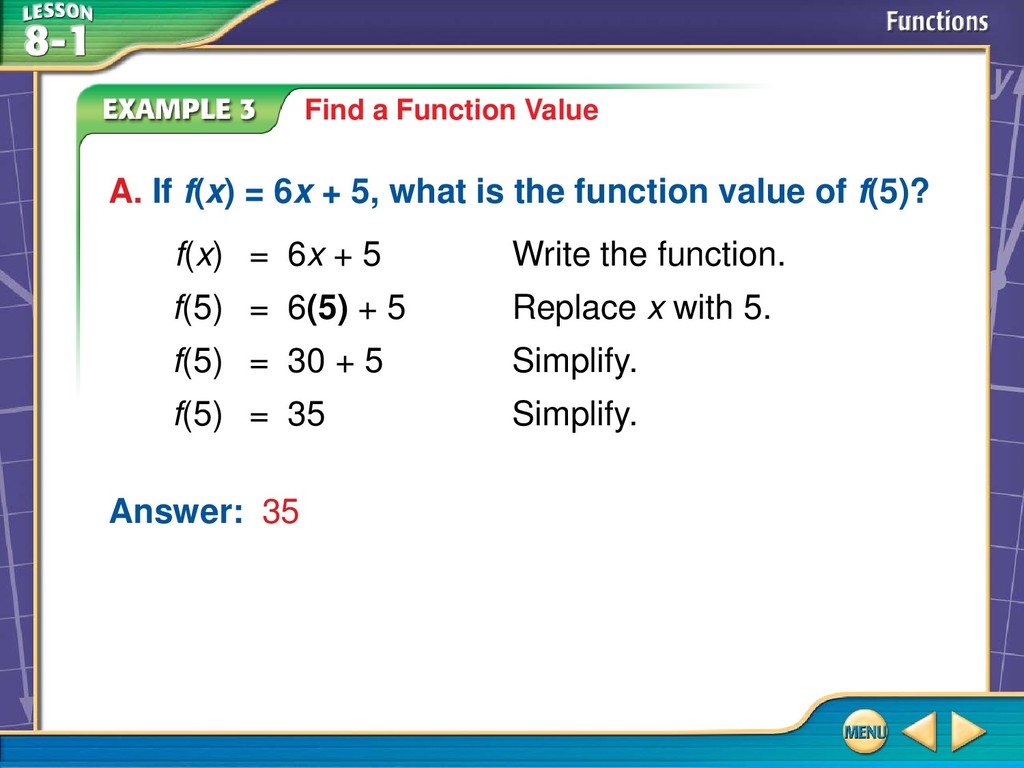
5, what is the function value of f(5)? f(x) = 6x + 5 Write the function. f(5) = 6(5) + 5 Replace x with 5. f(5) = 30 + 5 Simplify. f(5) = 35 Simplify. Answer: 35
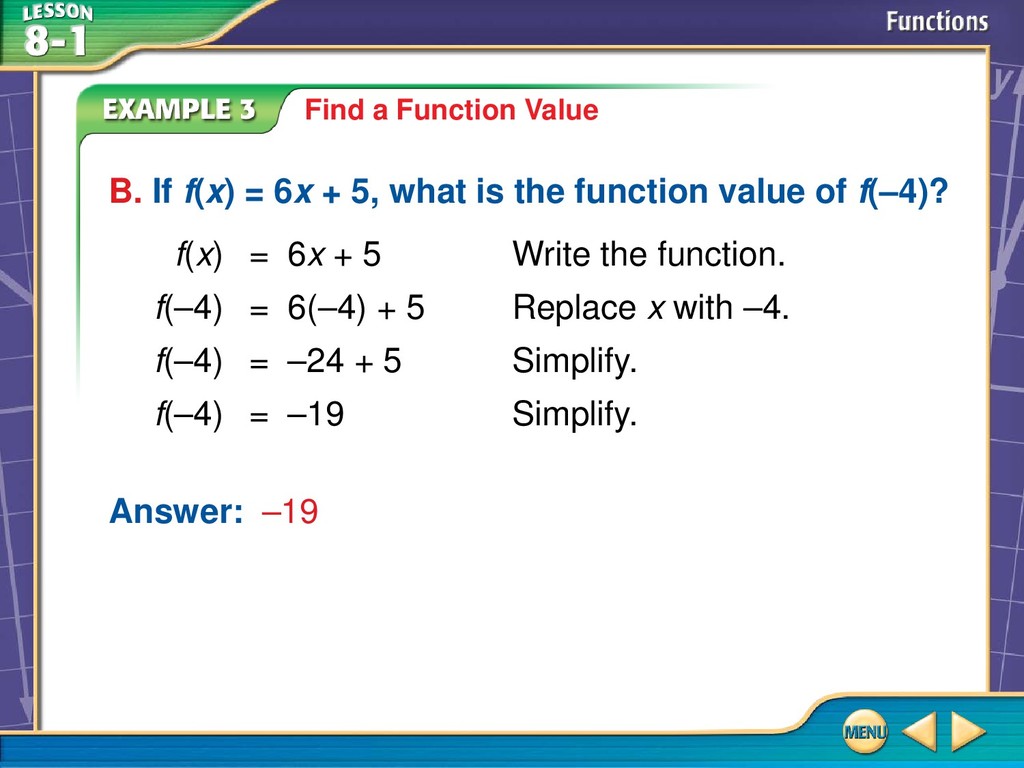
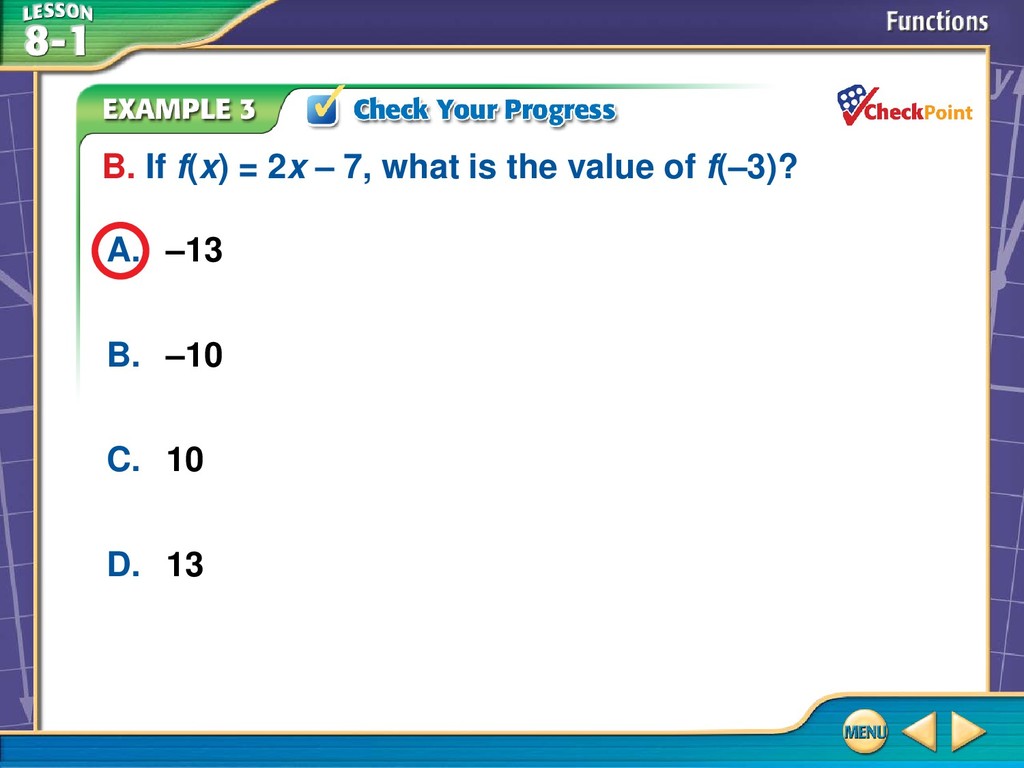
5, what is the function value of f(–4)? f(x) = 6x + 5 Write the function. f(–4) = 6(–4) + 5 Replace x with –4. f(–4) = –24 + 5 Simplify. f(–4) = –19 Simplify. Answer: –19
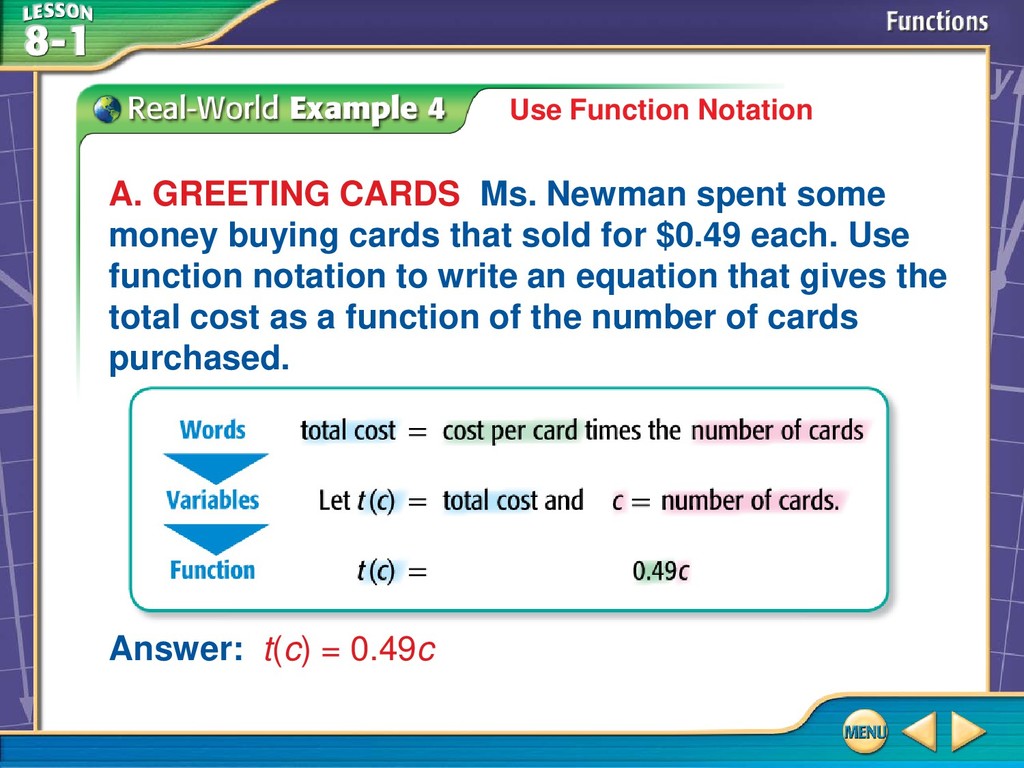
money buying cards that sold for $0.49 each. Use function notation to write an equation that gives the total cost as a function of the number of cards purchased. Answer: t(c) = 0.49c
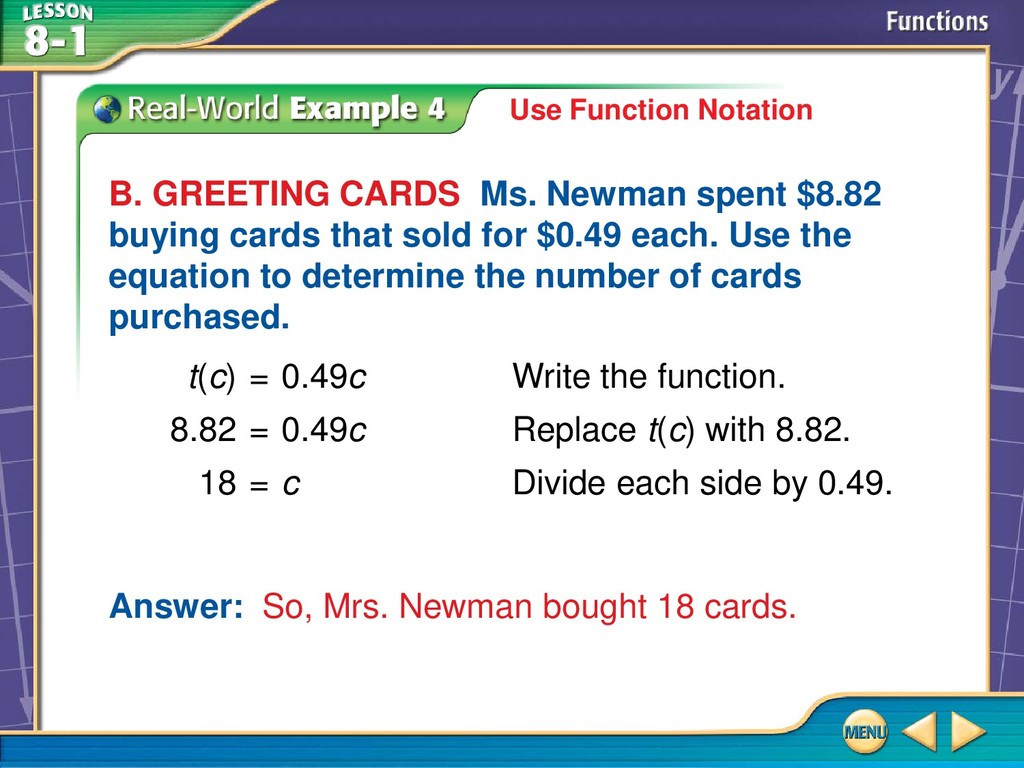
buying cards that sold for $0.49 each. Use the equation to determine the number of cards purchased. t(c) = 0.49c Write the function. 8.82 = 0.49c Replace t(c) with 8.82. 18 = c Divide each side by 0.49. Answer: So, Mrs. Newman bought 18 cards.
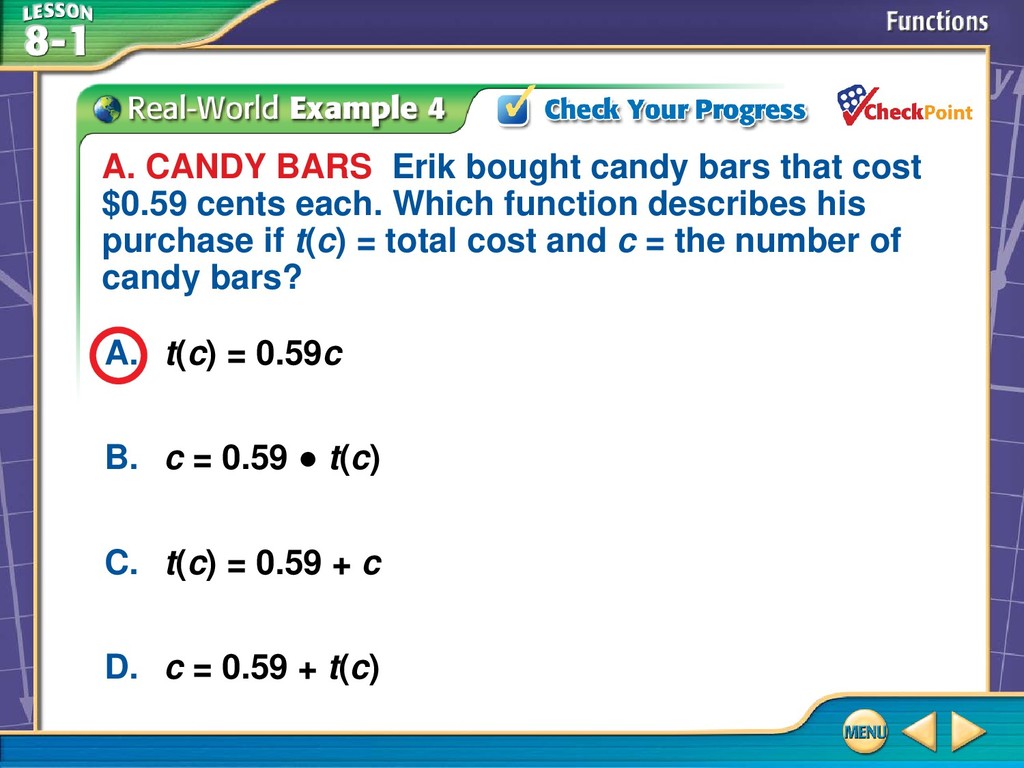
C. t(c) = 0.59 + c D. c = 0.59 + t(c) A. CANDY BARS Erik bought candy bars that cost $0.59 cents each. Which function describes his purchase if t(c) = total cost and c = the number of candy bars?
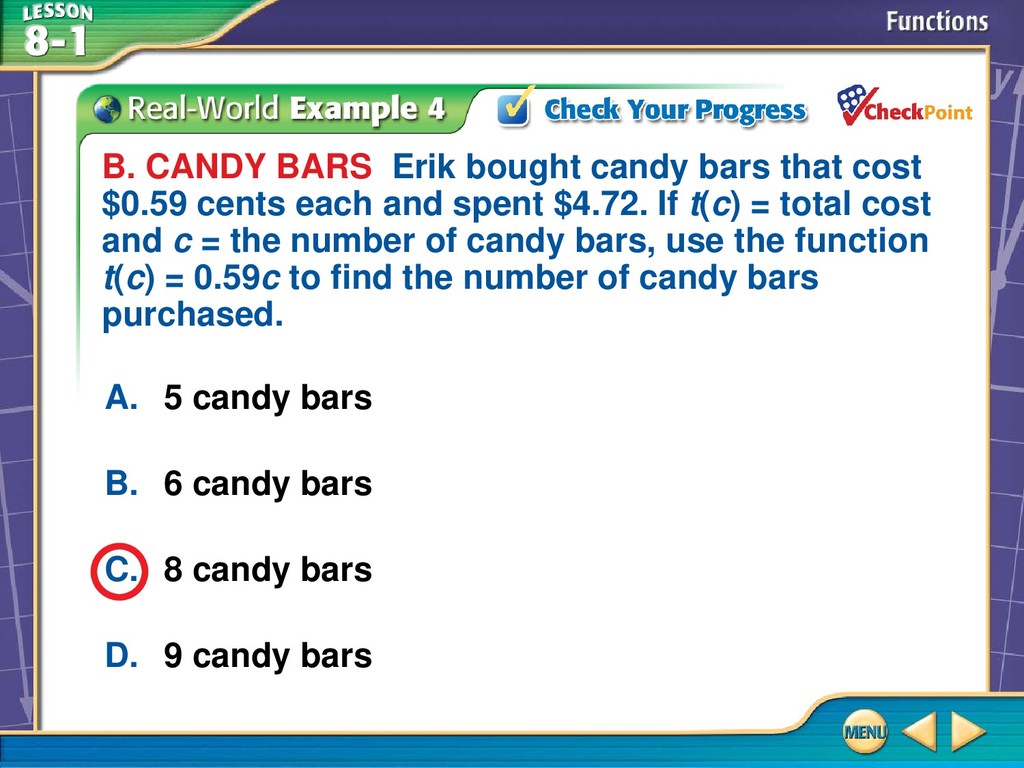
candy bars D. 9 candy bars B. CANDY BARS Erik bought candy bars that cost $0.59 cents each and spent $4.72. If t(c) = total cost and c = the number of candy bars, use the function t(c) = 0.59c to find the number of candy bars purchased.


 livdayseo
 leimatthew05
 tonyrice
 skipperchong
 tamaranovitovic
 minecr
 pedronauck
 csswizardry
 chriscoyier
 garrettdimon
 kristinabergwall1