of Linear Algebra that is applicable in Data Science and Artificial Intelligence. OUTLINE ▪ Tensors, Scalars, Vector and Matrices ▪ Relevance in Data Science and Machine Learning or Artificial Intelligence
equation such as and their representations through matrices and vector spaces. (wikipedia.com) Differentiate between Elementary Algebra and Linear Algebra Class Discussion
mathematics, natural sciences, computer science, and social science. Such as Geometry Chemistry Coding theory Economics Genetics MACHINE LEARNING
any machine learning algorithm. Hence it is important that we attain an in-depth understanding Linear Algebra as Data Science and Artificial Intelligence experts. But why should we learn Linear Algebra?
of machine learning algorithms. ▪ Its concepts are a crucial prerequisite for understanding the theory behind Machine Learning, especially if you are working with Deep Learning Algorithms ▪ In order to be able to read and interpret statistics, you must learn the notation and operations of linear algebra. ▪ Algorithms written in standard 'for-loop' notation can be reformulated as matrix equations providing significant gains in computational efficiency.
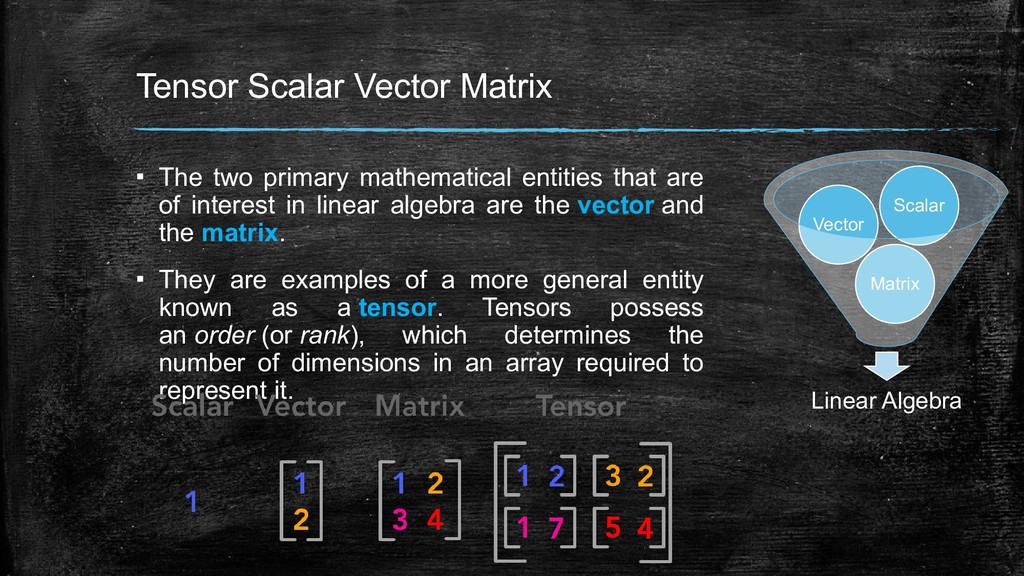
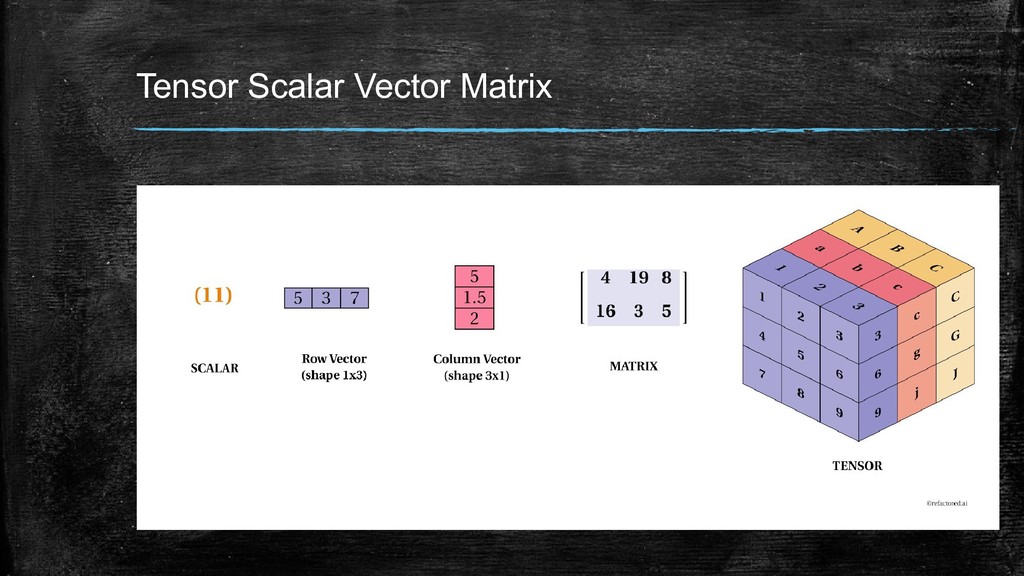
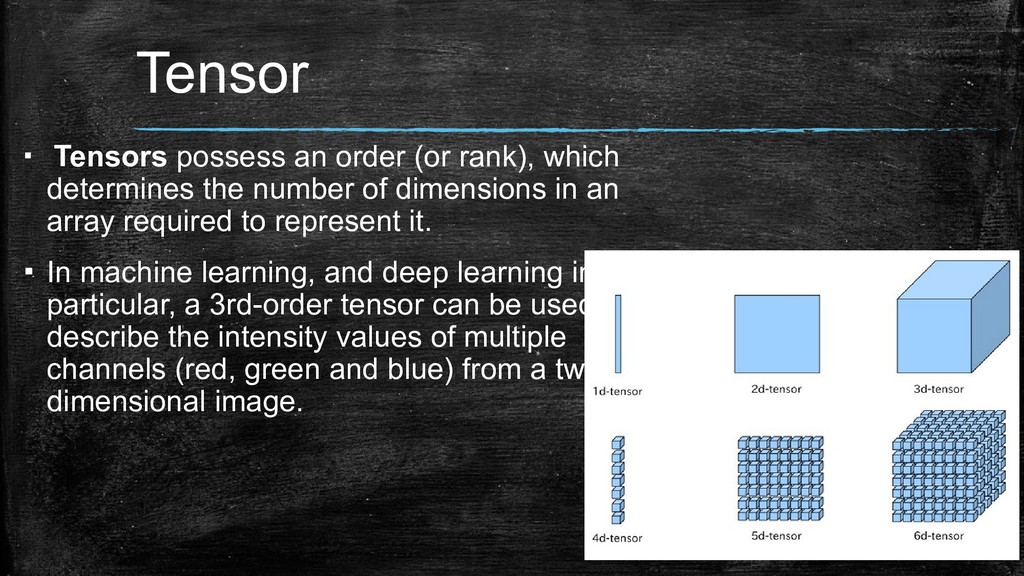
The two primary mathematical entities that are of interest in linear algebra are the vector and the matrix. ▪ They are examples of a more general entity known as a tensor. Tensors possess an order (or rank), which determines the number of dimensions in an array required to represent it.
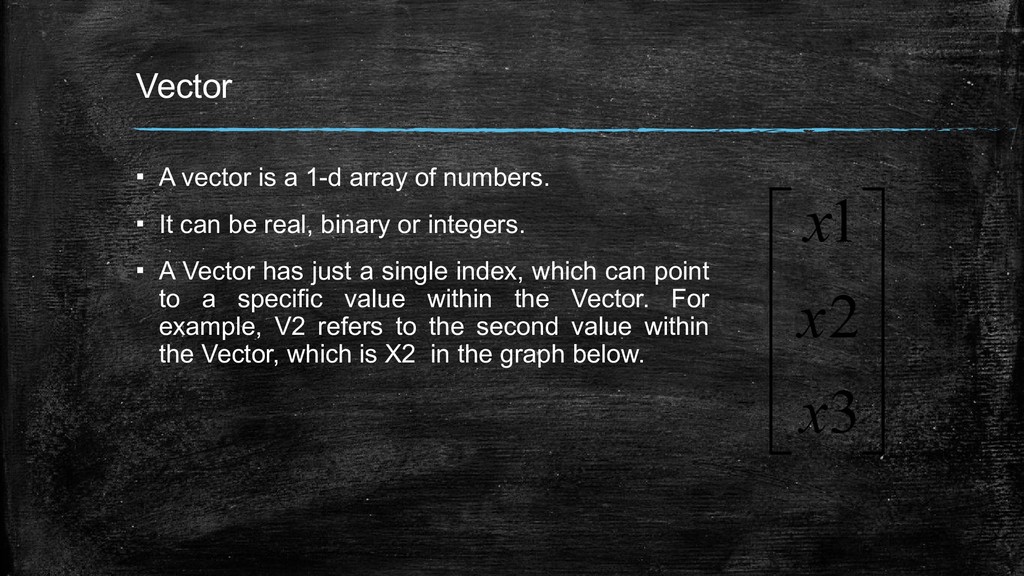
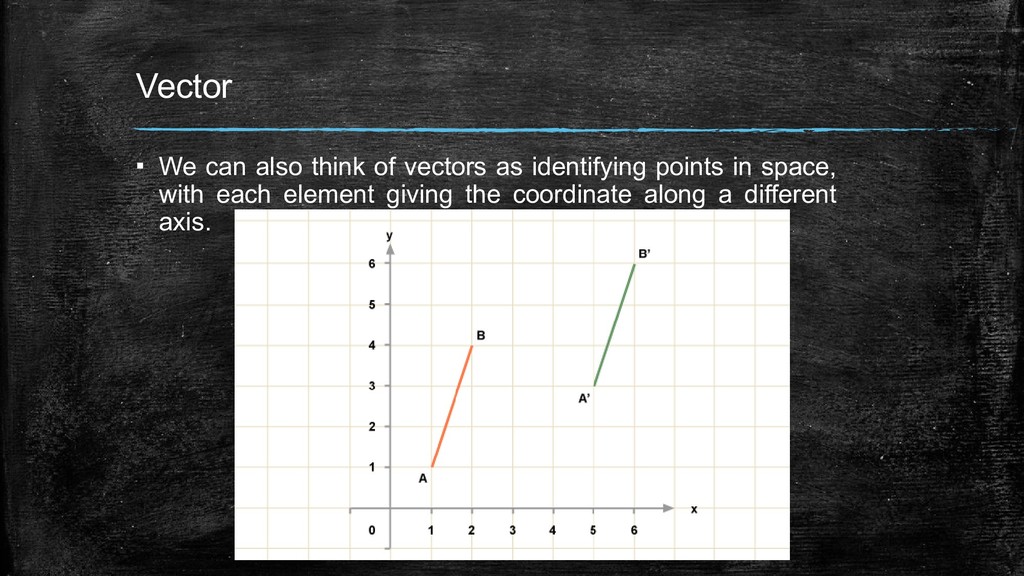
▪ It can be real, binary or integers. ▪ A Vector has just a single index, which can point to a specific value within the Vector. For example, V2 refers to the second value within the Vector, which is X2 in the graph below.
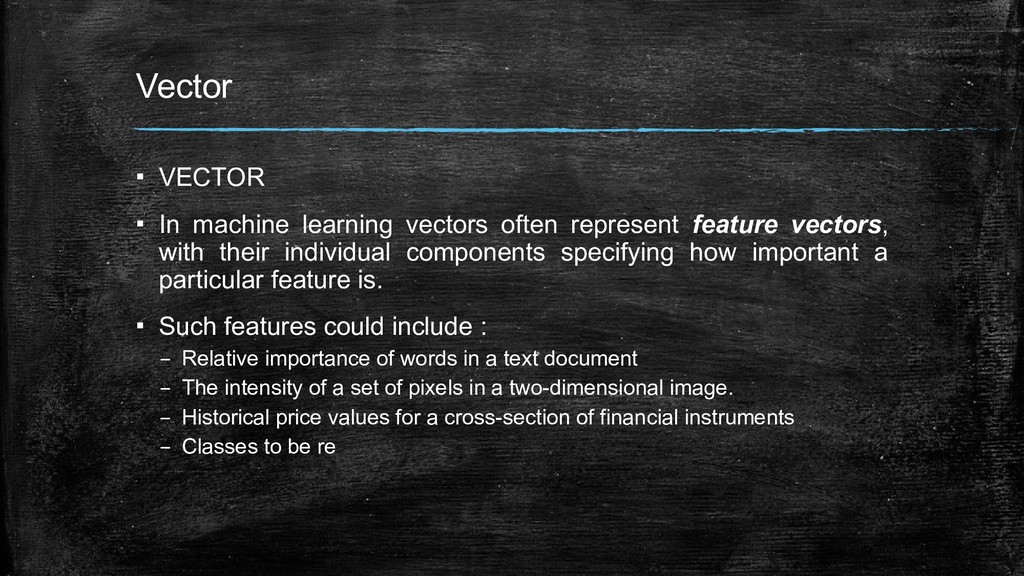
feature vectors, with their individual components specifying how important a particular feature is. ▪ Such features could include : – Relative importance of words in a text document – The intensity of a set of pixels in a two-dimensional image. – Historical price values for a cross-section of financial instruments – Classes to be re
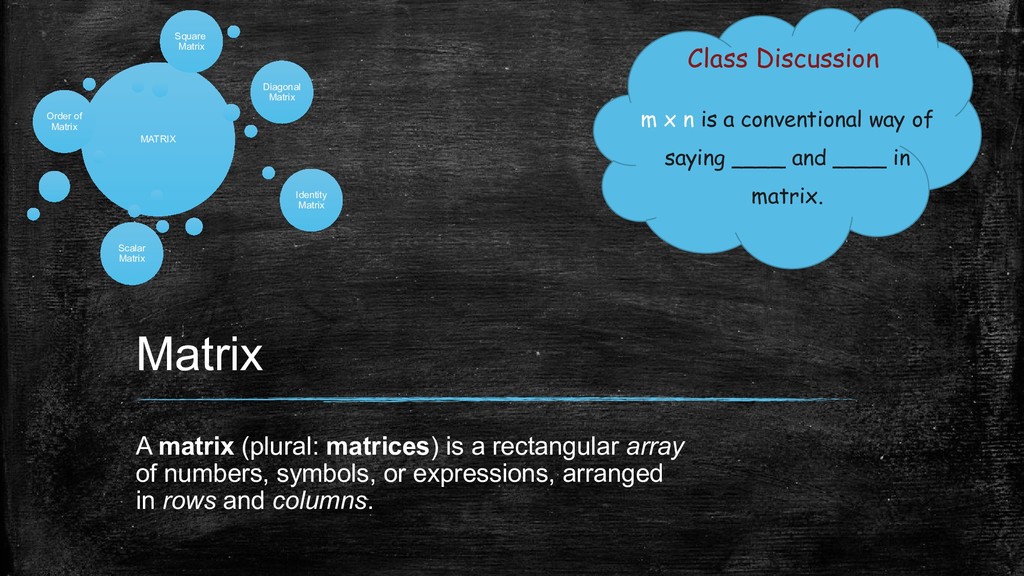
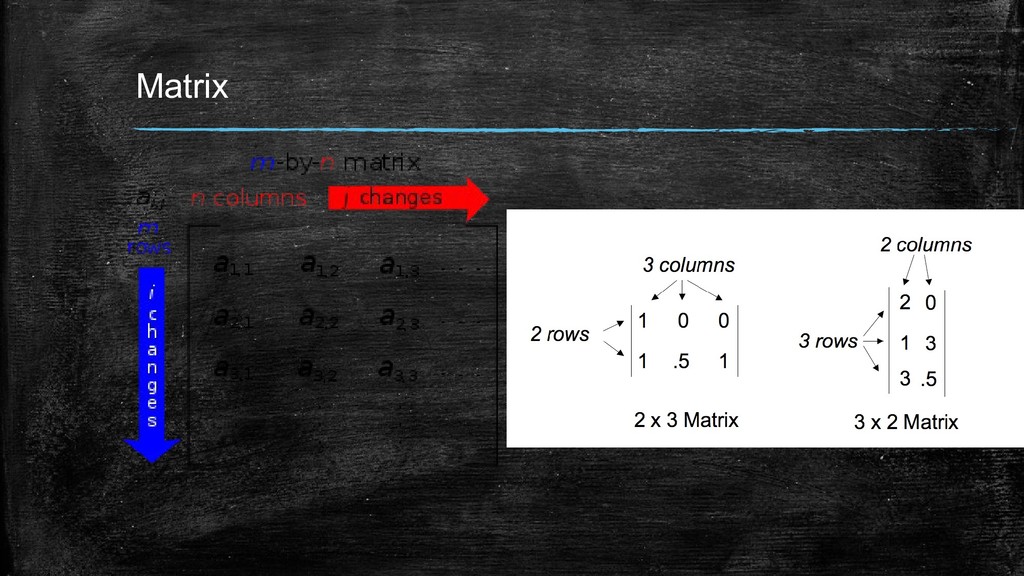
numbers, symbols, or expressions, arranged in rows and columns. m x n is a conventional way of saying ____ and ____ in matrix. Class Discussion MATRIX Order of Matrix Diagonal Matrix Identity Matrix Scalar Matrix Square Matrix
matrix operations will be useful in the context of deep learning. ▪ But general and more broadly, linear algebra is the ‘language in which machine learning was written’. If we can understand the basics of the language, we'll be in a much better position to grasp the more complex ideas that form the backbone of neural network models in lectures. ▪ We will begin by looking at matrix addition and then consider matrix multiplication. These operations will eventually allow us to discuss a topic known as matrix inversion, which will form the foundation we need.
scalars, vectors and other matrices. ▪ Each of these operations has a precise definition. ▪ These techniques are used frequently in machine learning and deep learning so it is worth familiarising yourself with them.
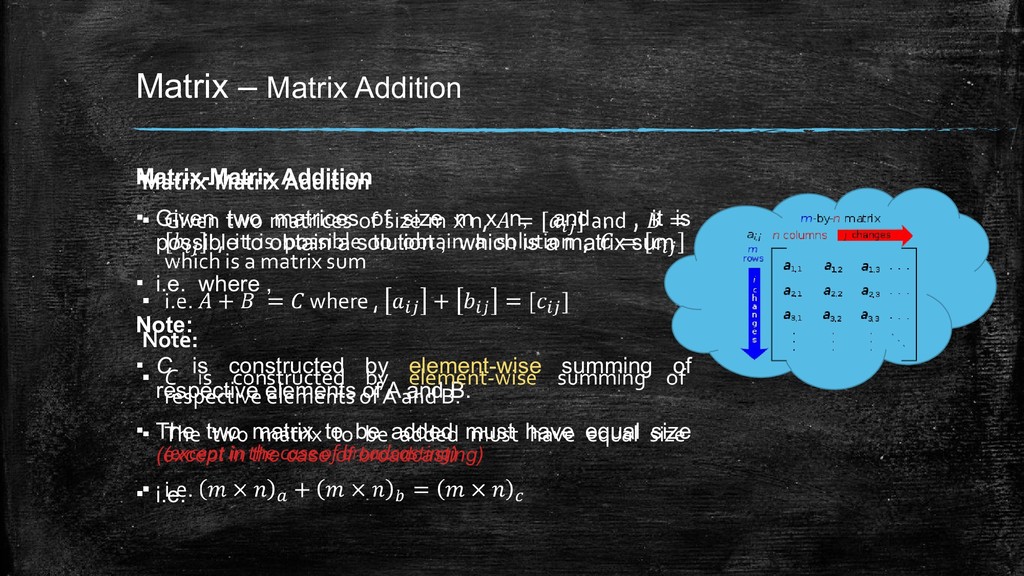
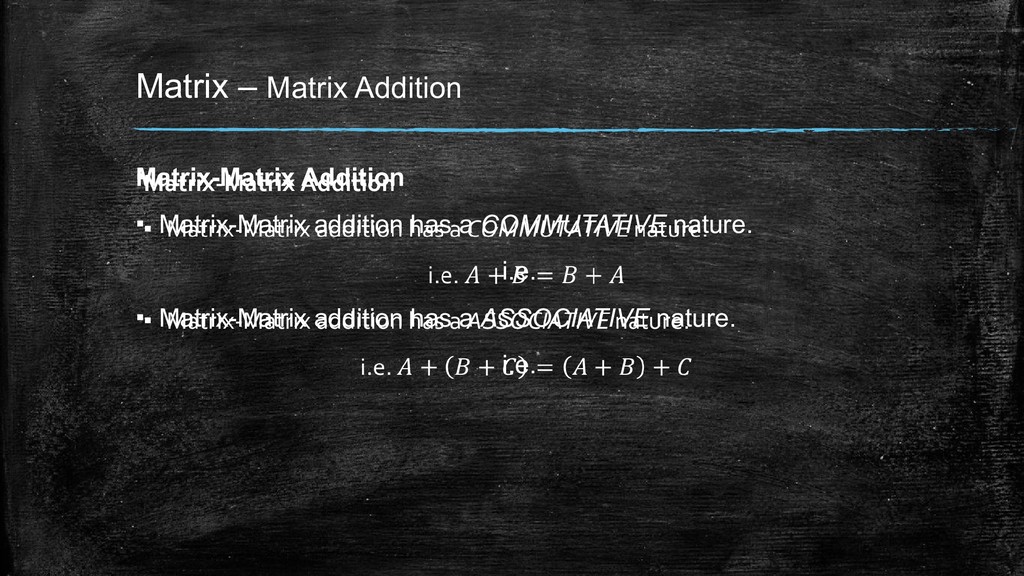
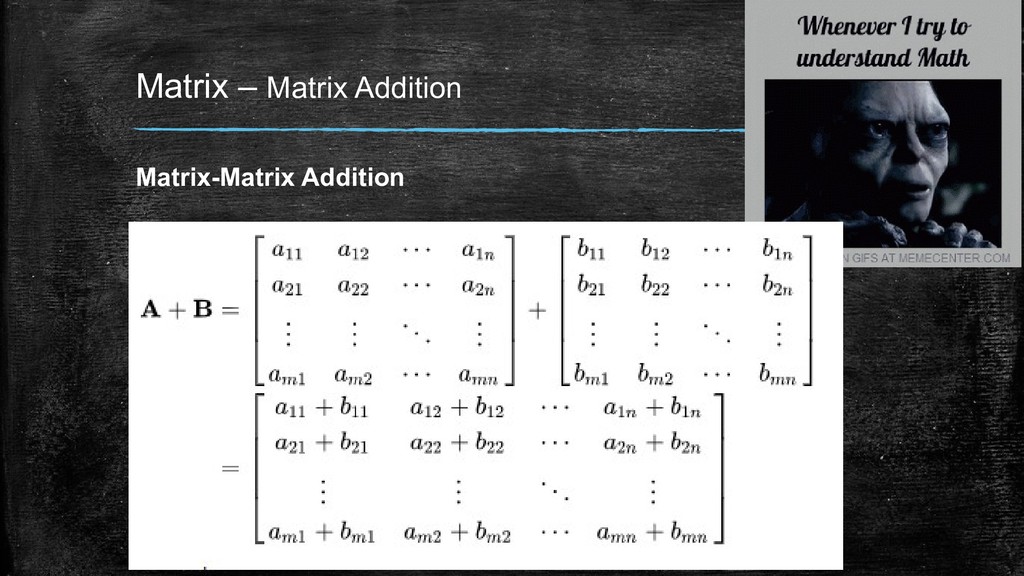
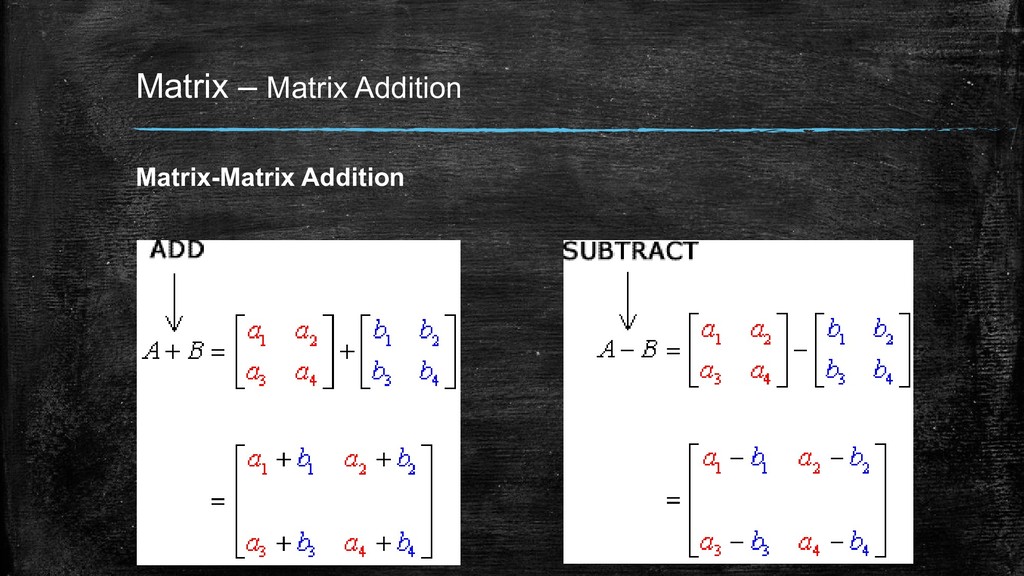
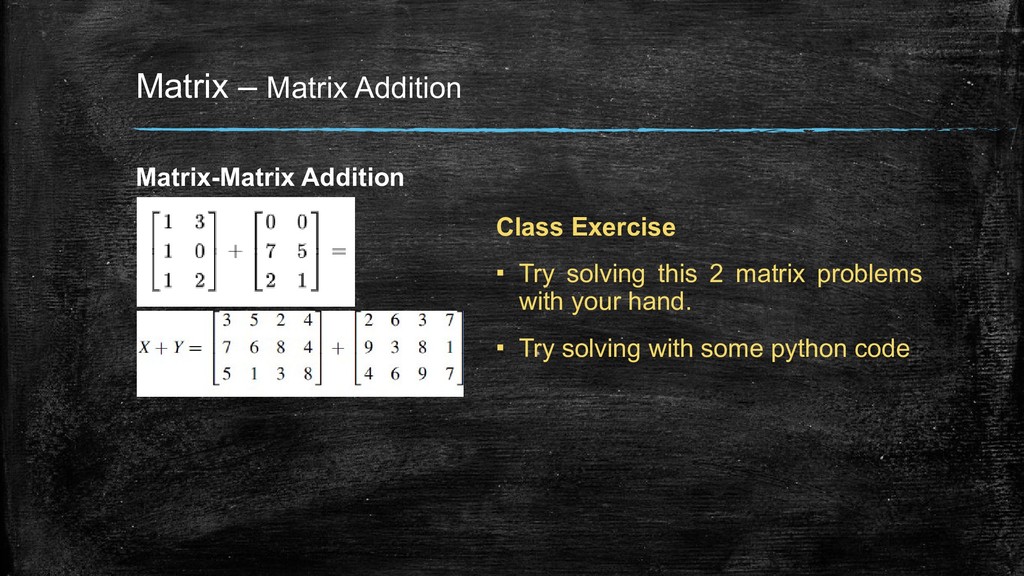
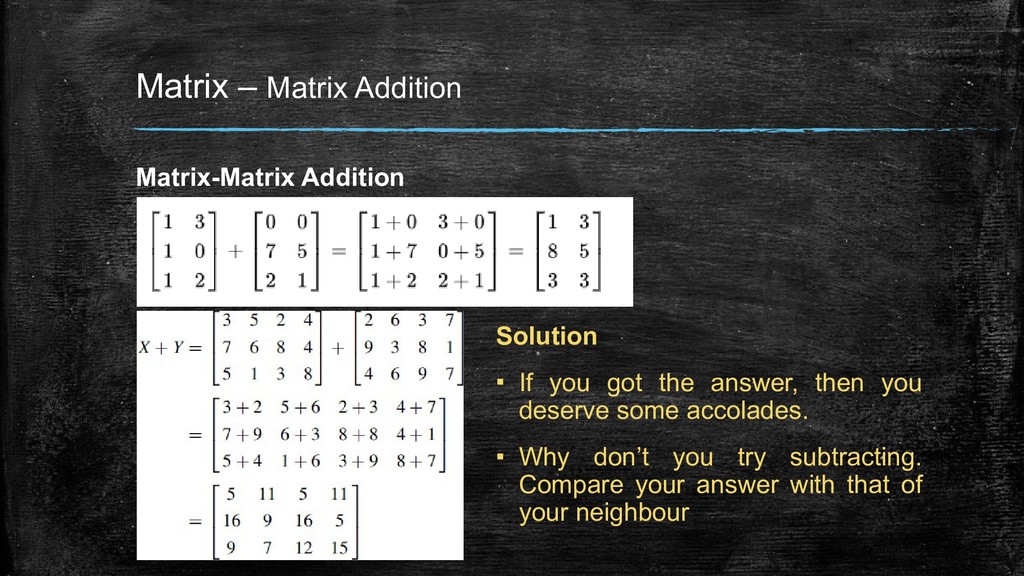
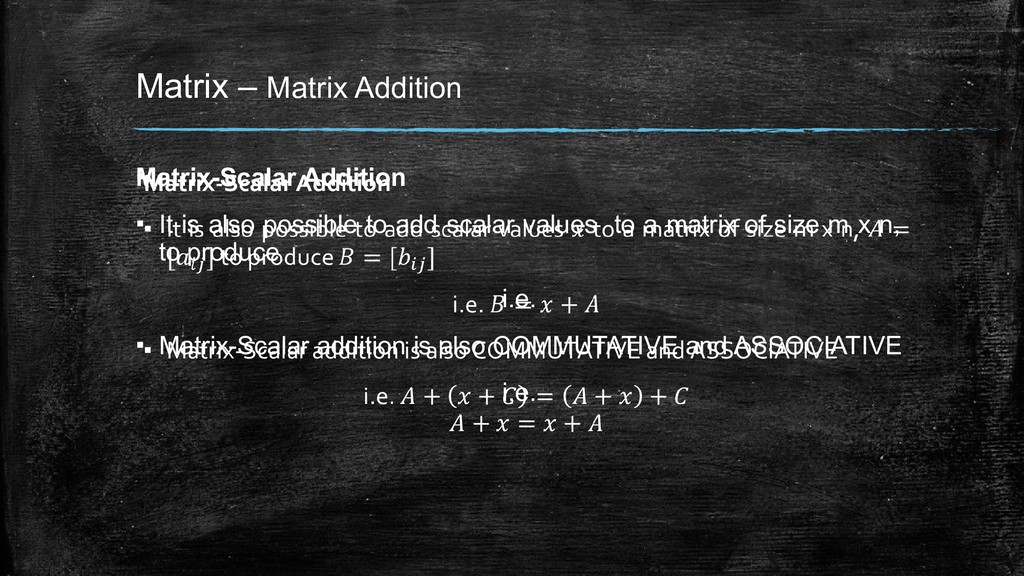
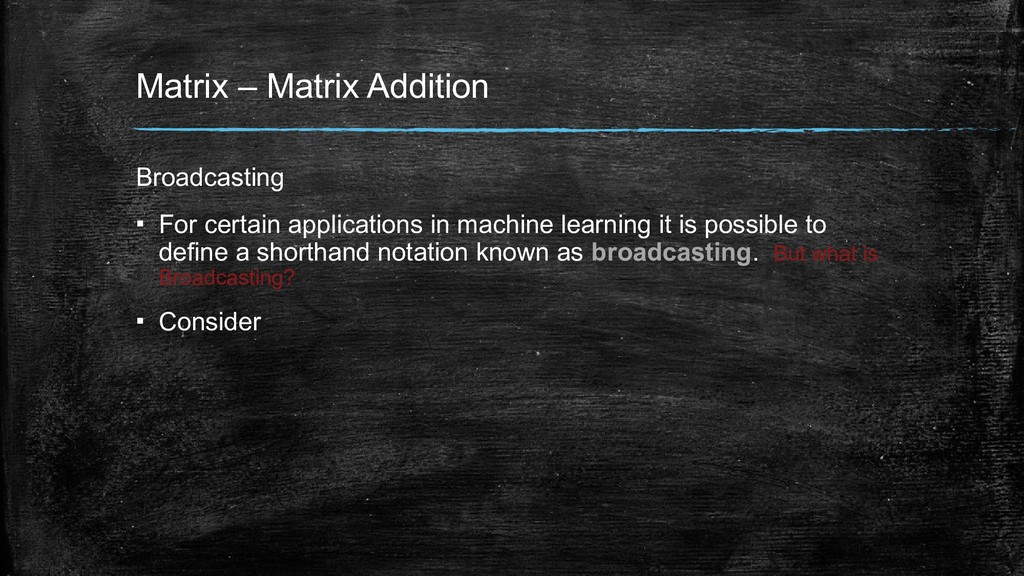
of size m x n, and , , it is possible to obtain a solution , which is a matrix sum ▪ i.e. where , Note: ▪ C is constructed by element-wise summing of respective elements of A and B. ▪ The two matrix to be added must have equal size (except in the case of broadcasting) ▪ i.e. ▪
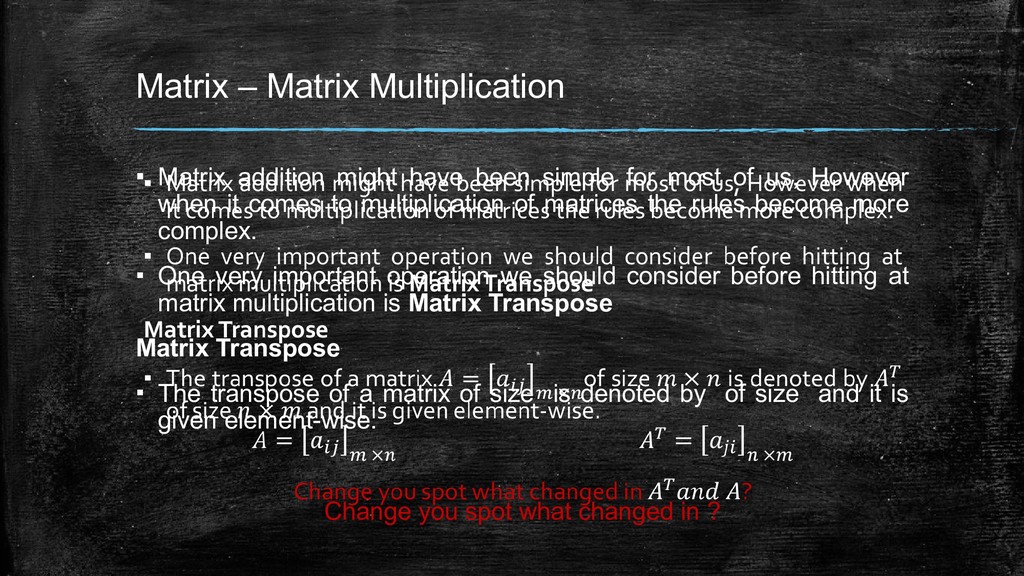
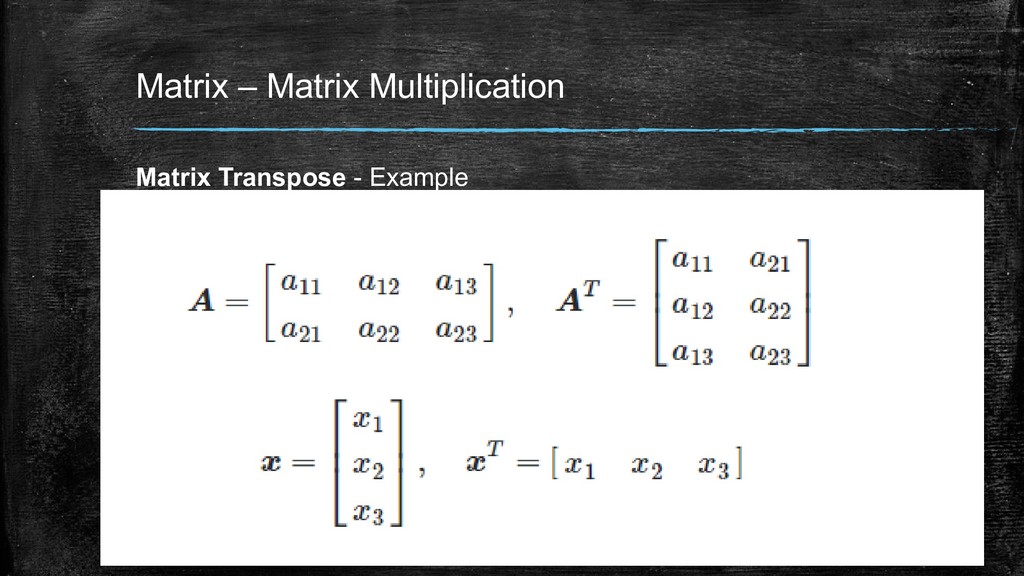
simple for most of us, However when it comes to multiplication of matrices the rules become more complex. ▪ One very important operation we should consider before hitting at matrix multiplication is Matrix Transpose Matrix Transpose ▪ The transpose of a matrix of size is denoted by of size and it is given element-wise. Change you spot what changed in ? ▪
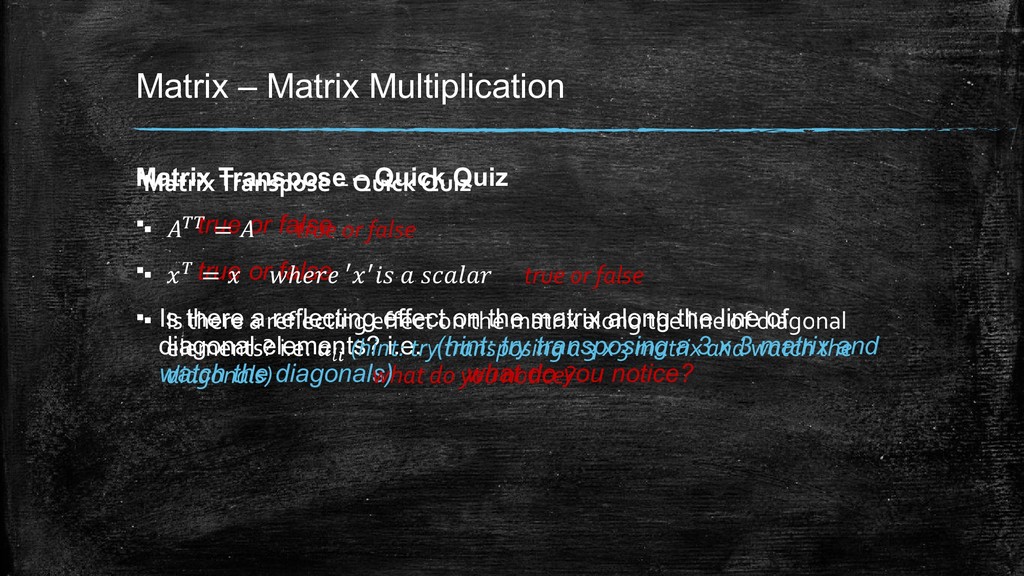
true or false ▪ true or false ▪ Is there a reflecting effect on the matrix along the line of diagonal elements? i.e. (hint: try transposing a 3 x 3 matrix and watch the diagonals) what do you notice? ▪
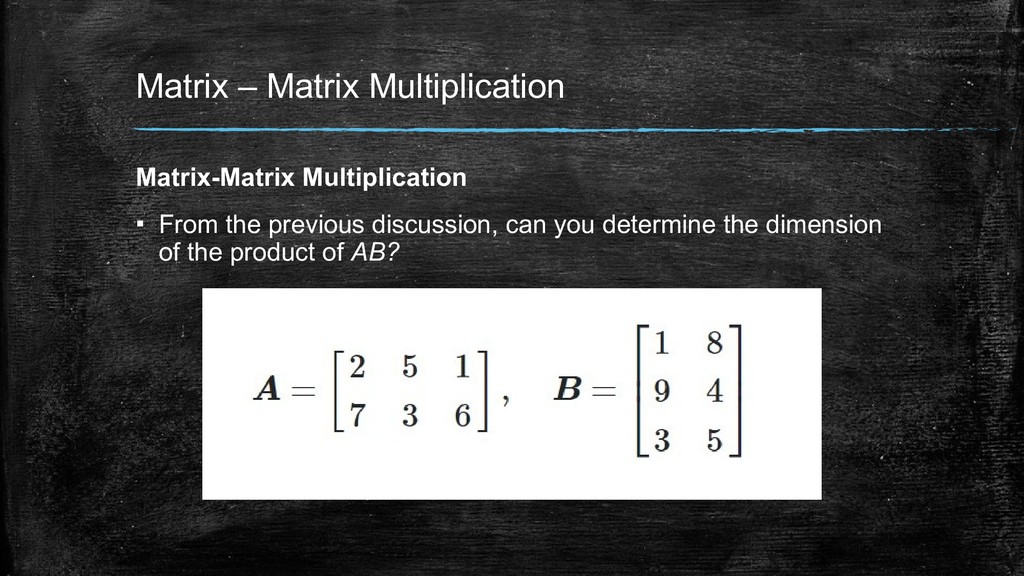
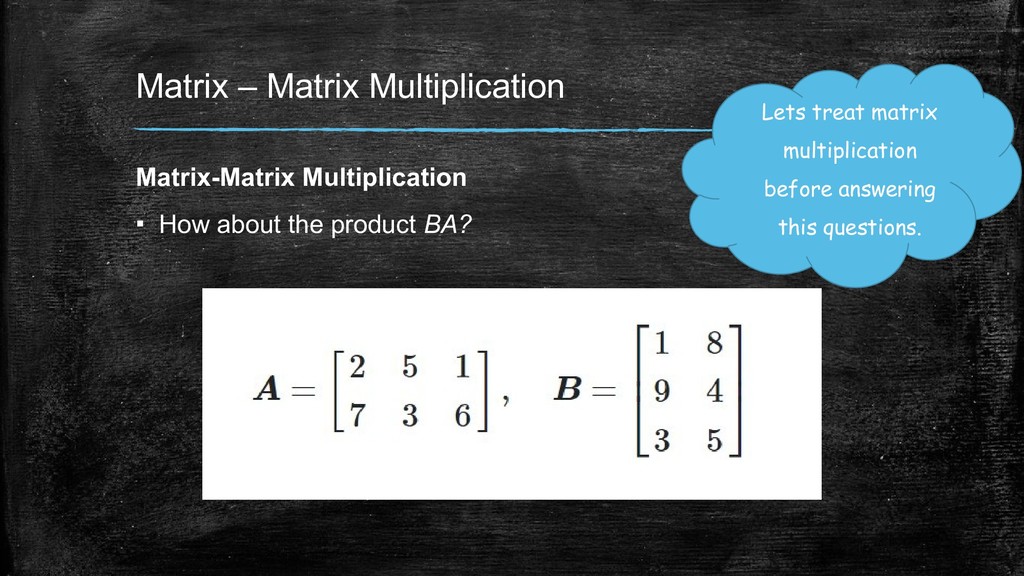
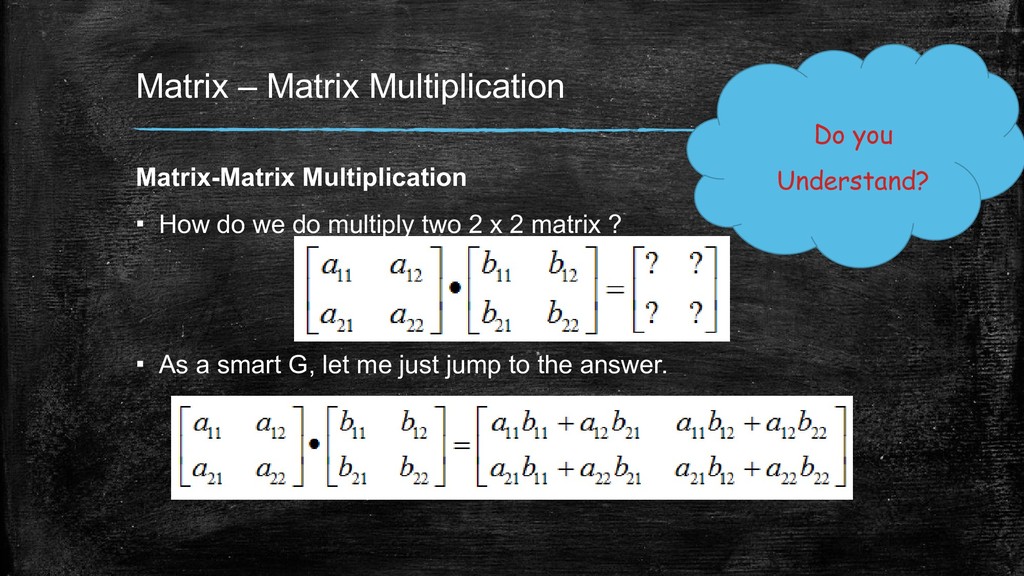
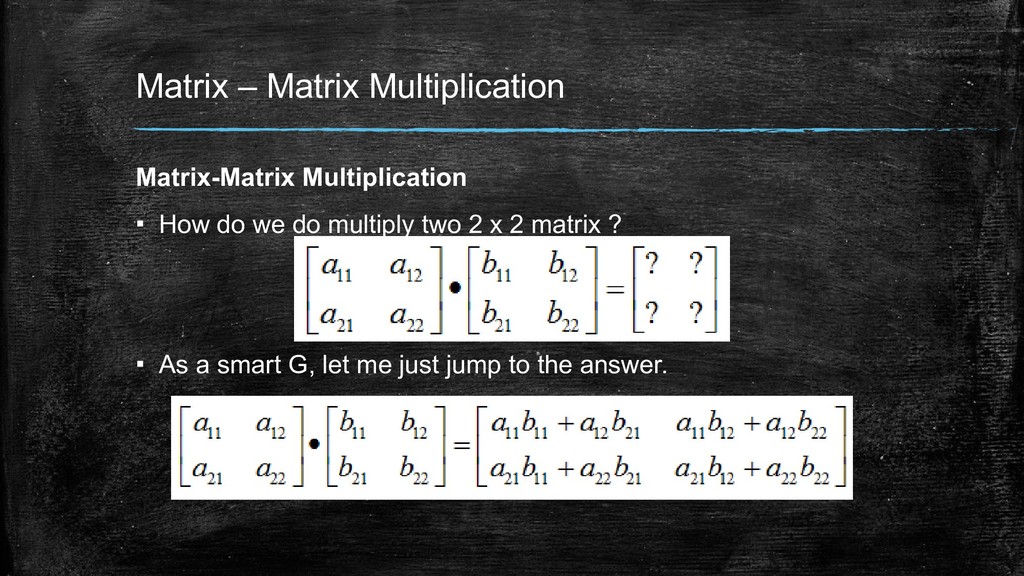
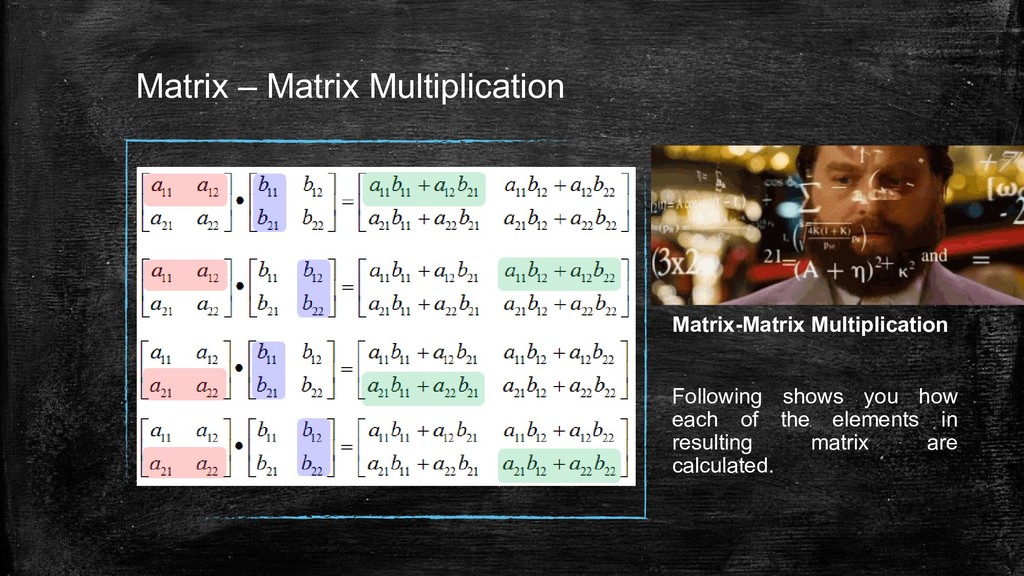
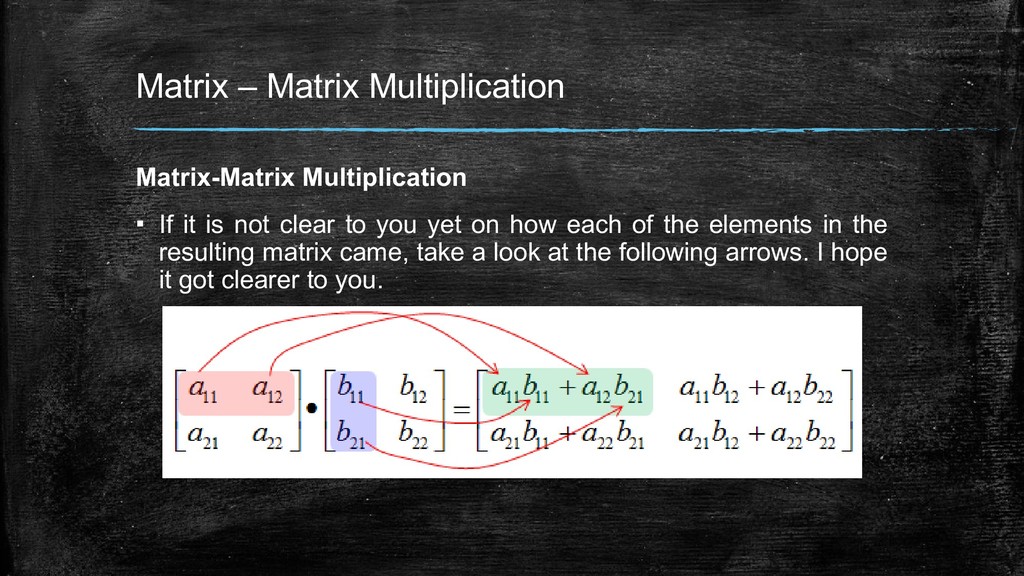
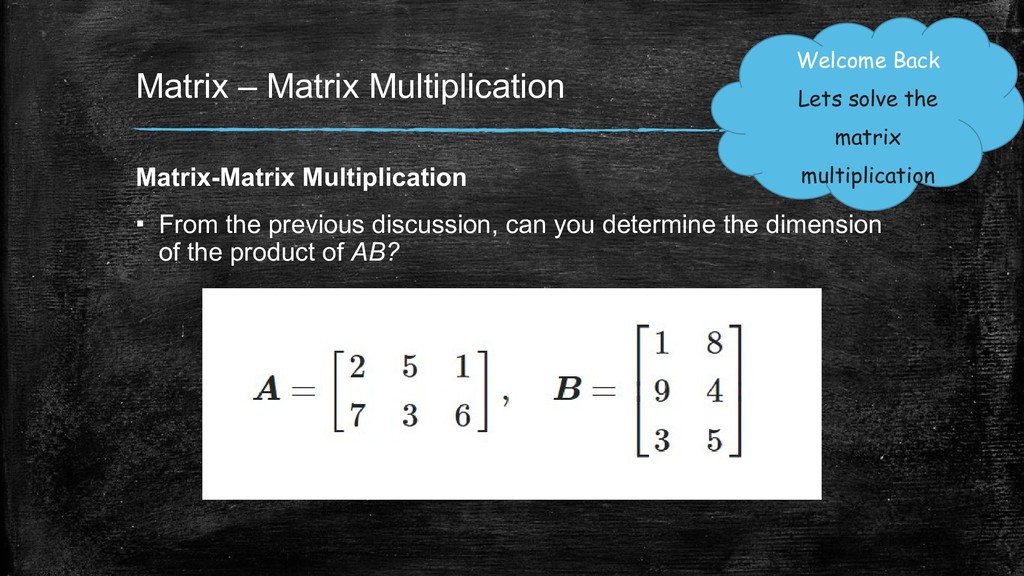
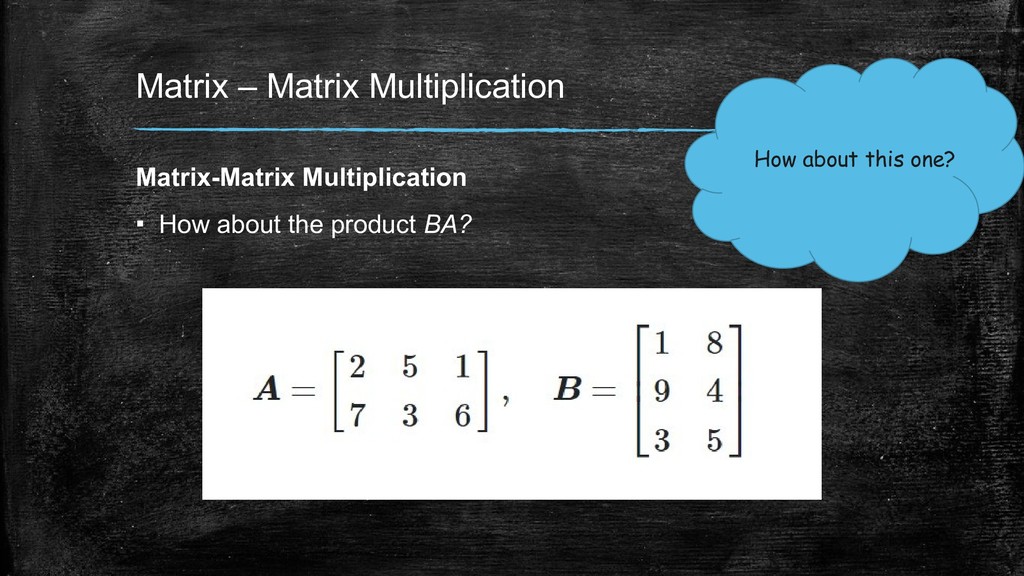
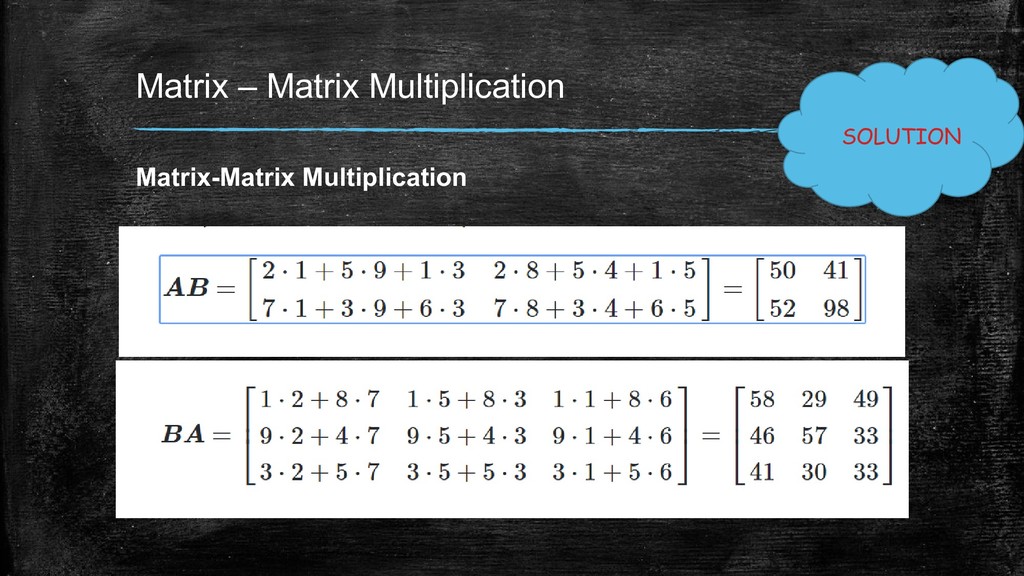
matrix multiplication is a complex operation compared to matrix addition is because it doesn't involve multiplying the matrices element-wise. ▪ Instead, a more complex procedure is utilised, for each element, involving an entire row of one matrix and an entire column of the other. Note: ▪ Given a matrix and a matrix the matrix product ▪
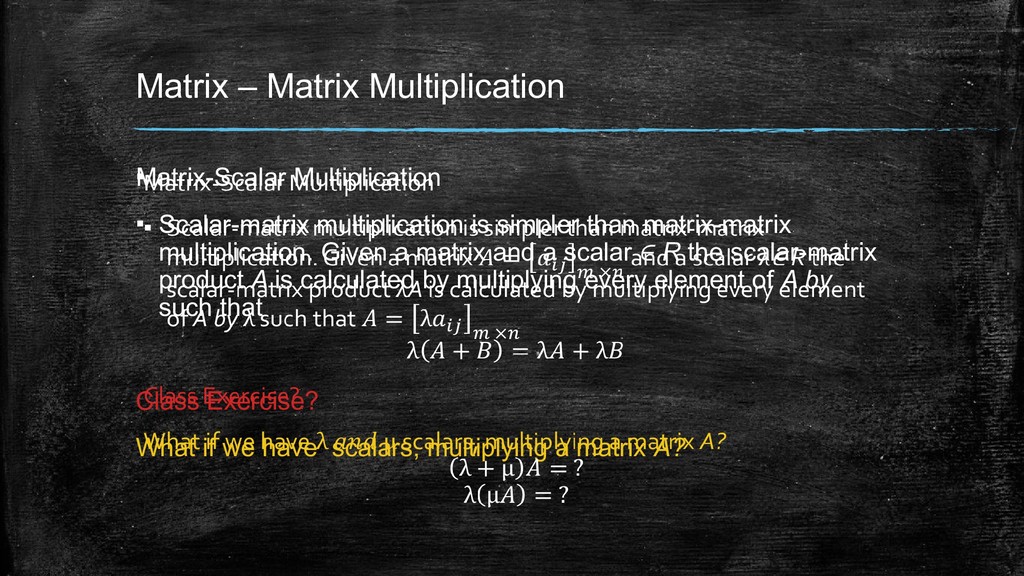
simpler than matrix-matrix multiplication. Given a matrix and a scalar R ∈ R the scalar-matrix product A is calculated by multiplying every element of A by such that Class Exercise? What if we have scalars, multiplying a matrix A? ▪
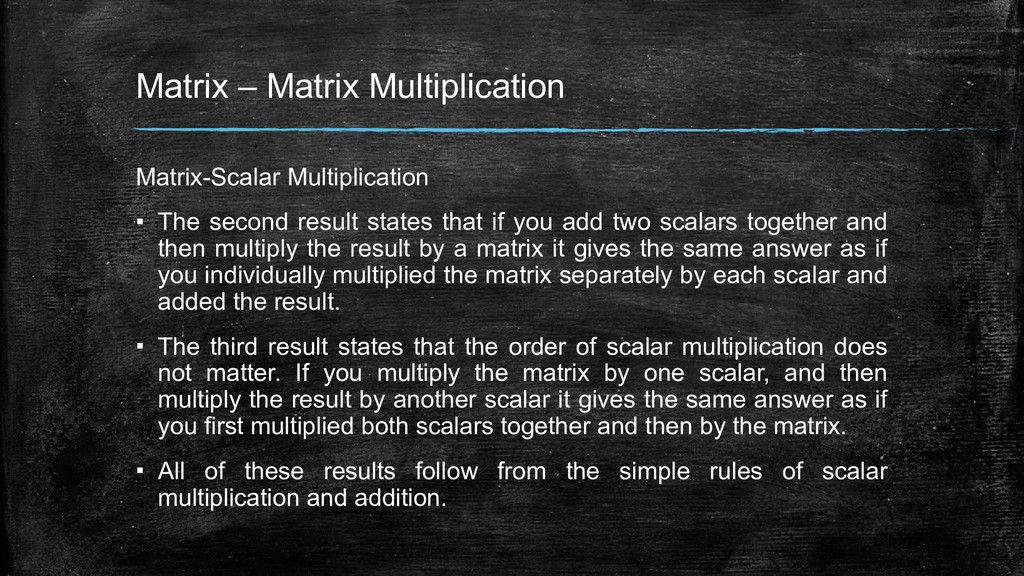
add two scalars together and then multiply the result by a matrix it gives the same answer as if you individually multiplied the matrix separately by each scalar and added the result. ▪ The third result states that the order of scalar multiplication does not matter. If you multiply the matrix by one scalar, and then multiply the result by another scalar it gives the same answer as if you first multiplied both scalars together and then by the matrix. ▪ All of these results follow from the simple rules of scalar multiplication and addition. Matrix – Matrix Multiplication
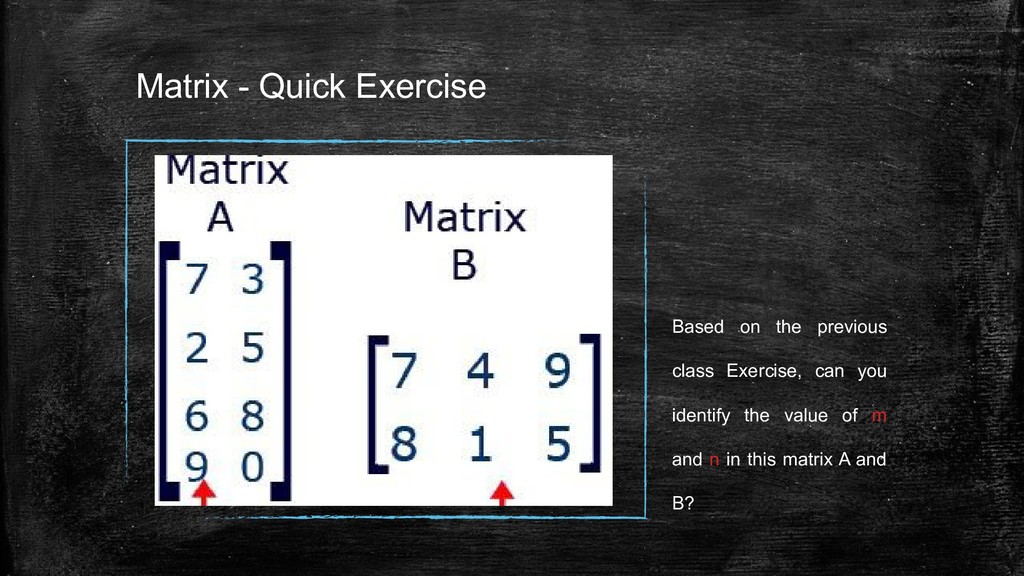
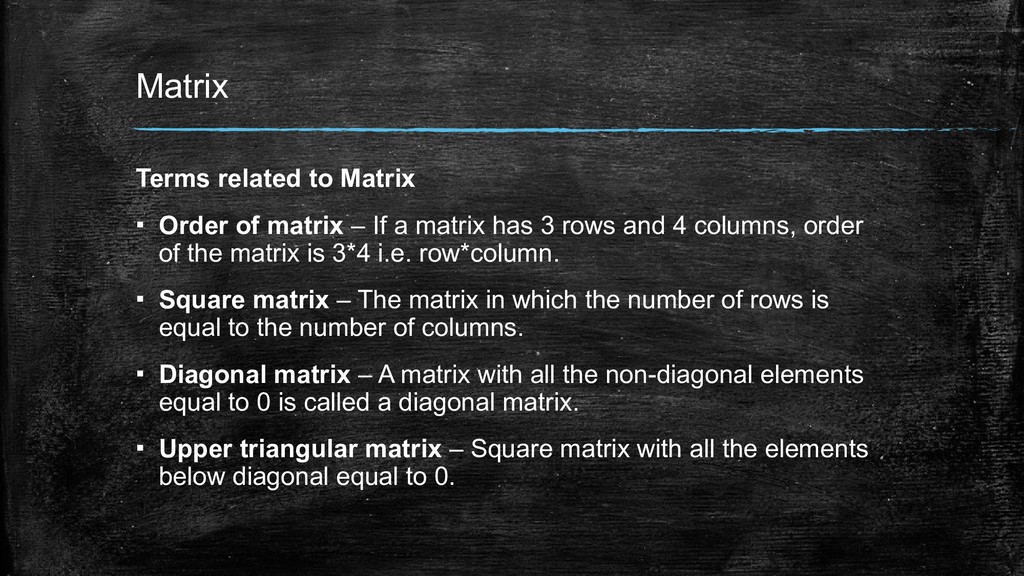
If a matrix has 3 rows and 4 columns, order of the matrix is 3*4 i.e. row*column. ▪ Square matrix – The matrix in which the number of rows is equal to the number of columns. ▪ Diagonal matrix – A matrix with all the non-diagonal elements equal to 0 is called a diagonal matrix. ▪ Upper triangular matrix – Square matrix with all the elements below diagonal equal to 0.
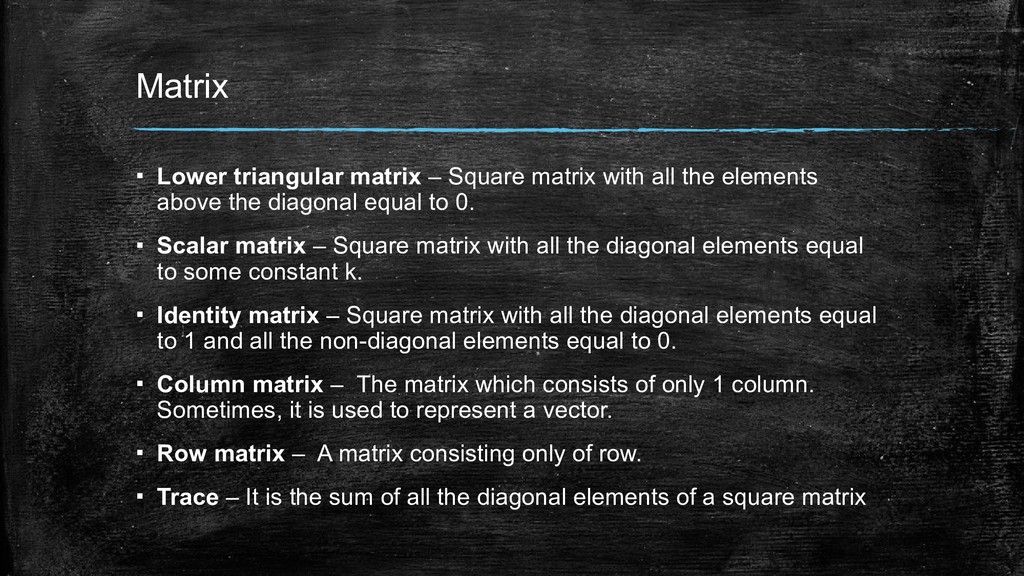
the elements above the diagonal equal to 0. ▪ Scalar matrix – Square matrix with all the diagonal elements equal to some constant k. ▪ Identity matrix – Square matrix with all the diagonal elements equal to 1 and all the non-diagonal elements equal to 0. ▪ Column matrix – The matrix which consists of only 1 column. Sometimes, it is used to represent a vector. ▪ Row matrix – A matrix consisting only of row. ▪ Trace – It is the sum of all the diagonal elements of a square matrix
the number of dimensions in an array required to represent it. ▪ In machine learning, and deep learning in particular, a 3rd-order tensor can be used to describe the intensity values of multiple channels (red, green and blue) from a two- dimensional image.
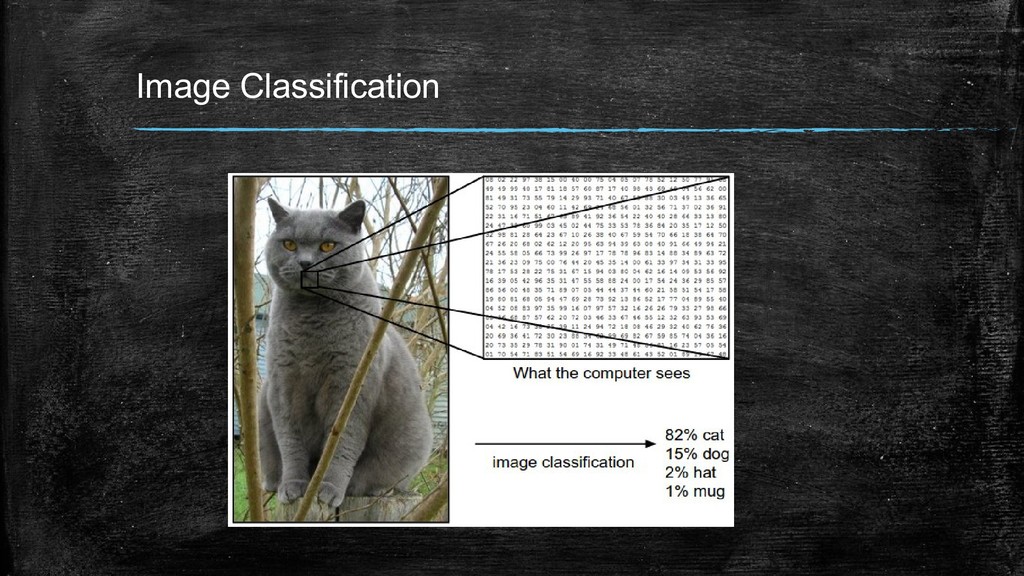
to recognize images. ▪ But making a computer recognize images is not an easy task, and is an active area of research in Machine Learning and Computer Science in general. ▪ So how can an image such as above with multiple attributes like colour be stored in a computer? ▪ This is achieved by storing the pixel intensities in a construct called Matrix. Then, this matrix can be processed to identify colours etc. ▪ So any operation which you want to perform on this image would likely use Linear Algebra and matrices at the back end.
Science domain, you might have heard about the word “XGBOOST” ▪ It is an algorithm employed most frequently by winners of Data Science Competitions. ▪ It stores the numeric data in the form of Matrix to give predictions. ▪ This enables XGBOOST to process data faster and provide more accurate results. Moreover, not just XGBOOST but various other algorithms use Matrices to store and process data.
Machine Learning is dealing with text and the most common techniques employed are Bag of Words, Term Document Matrix etc. ▪ All these techniques in a very similar manner store counts(or something similar) of words in documents and store this frequency count in a Matrix form to perform tasks like Semantic analysis, Language translation, Language generation etc.
in machine learning. ▪ We have seen image, text or any data, in general, employing matrices to store and process data. This should be motivation enough to familiarize ourselves with it.


 makocchi
 raspython3
 odashi
 sudoakiy
 shugo
 takonda
 daidaidai
 ishikawa_satoru
 kash1064
 terurou
 maimyyym
 4o1sobblue
 lara
 ryanjones
 emna__ayadi
 axbom
 letsgokoyo
 carmenintech
 427marketing
 badams
 mraible
 tammyeverts
 cromwellryan
 smashingmag