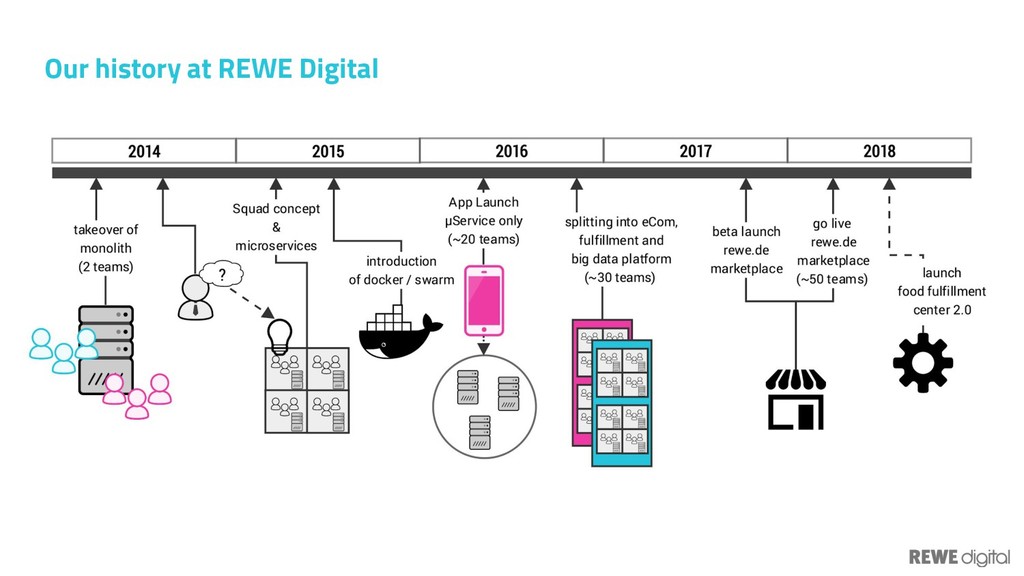
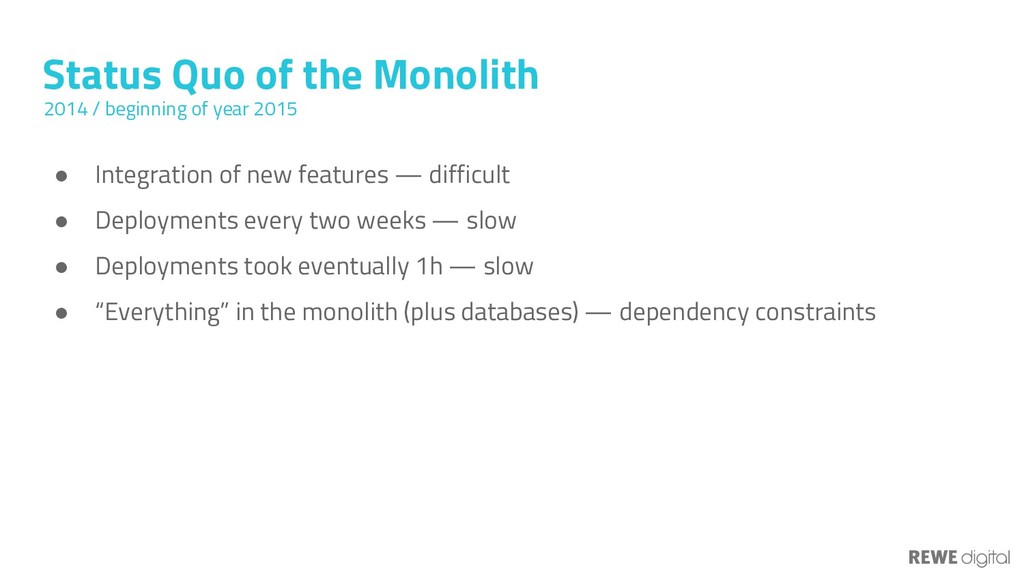
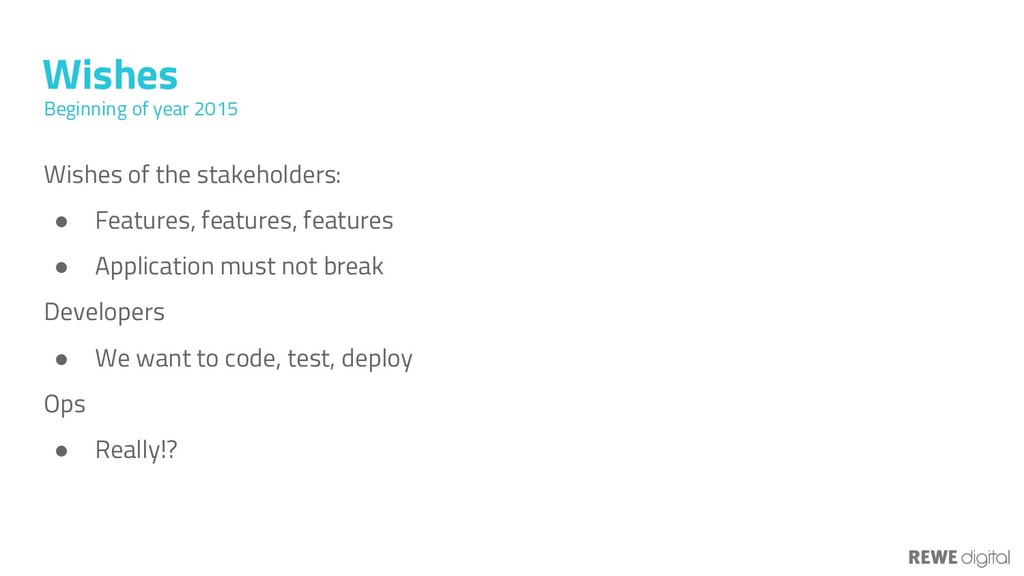
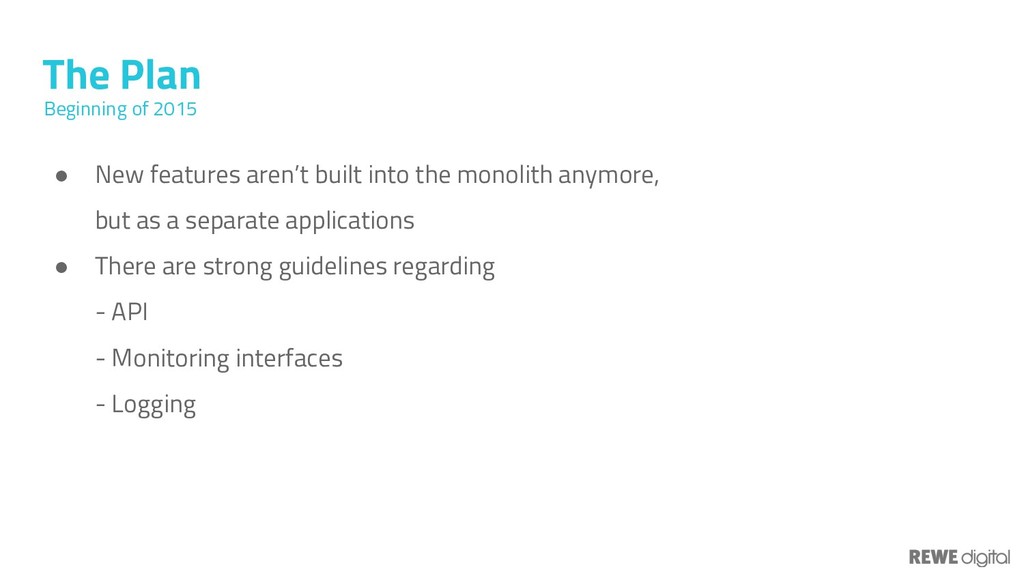
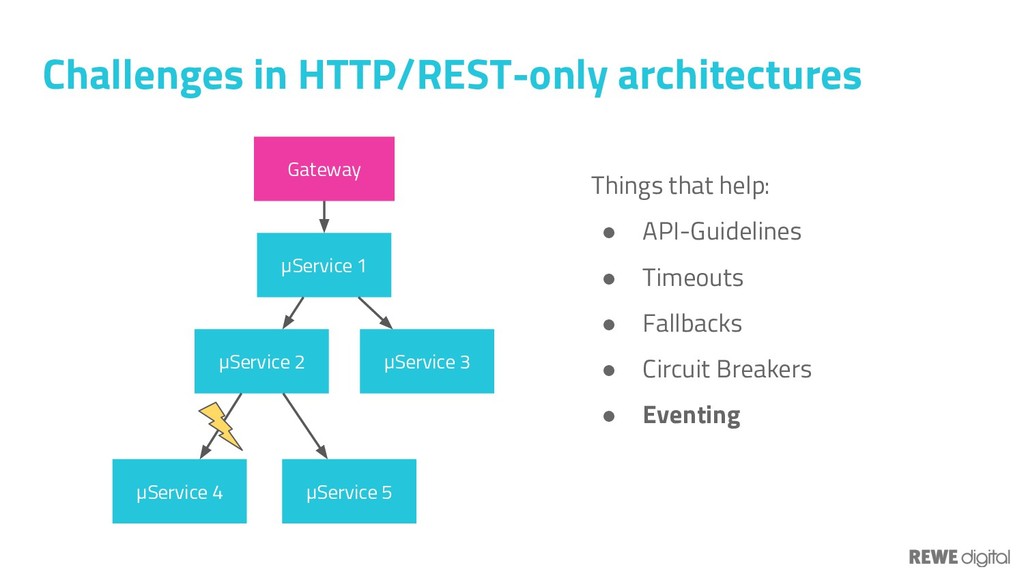
two weeks — slow • Deployments took eventually 1h — slow • “Everything” in the monolith (plus databases) — dependency constraints Status Quo of the Monolith 2014 / beginning of year 2015
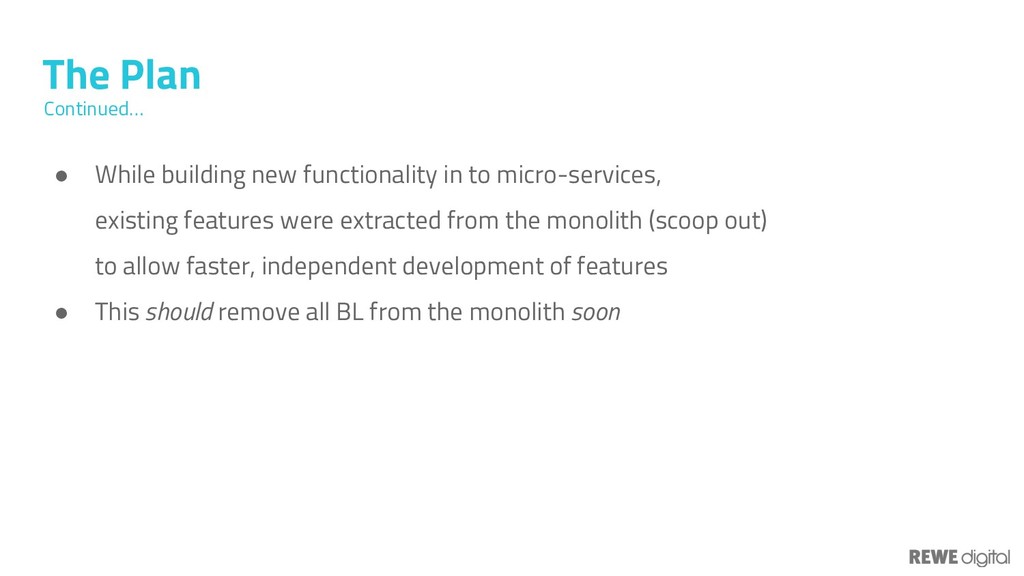
were extracted from the monolith (scoop out) to allow faster, independent development of features • This should remove all BL from the monolith soon Continued… The Plan
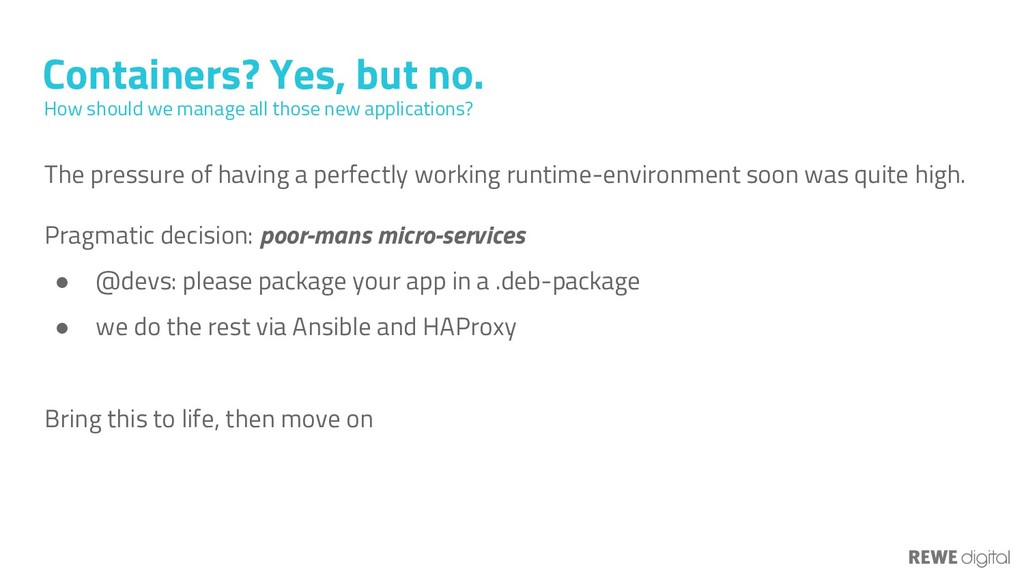
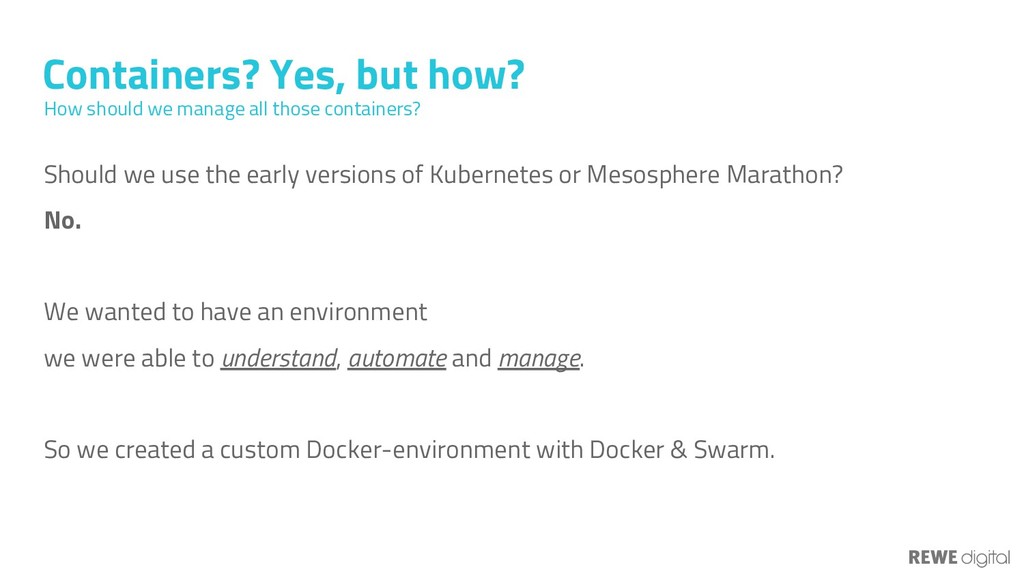
quite high. Pragmatic decision: poor-mans micro-services • @devs: please package your app in a .deb-package • we do the rest via Ansible and HAProxy Bring this to life, then move on Containers? Yes, but no. How should we manage all those new applications?
Marathon? No. We wanted to have an environment we were able to understand, automate and manage. So we created a custom Docker-environment with Docker & Swarm. Containers? Yes, but how? How should we manage all those containers?
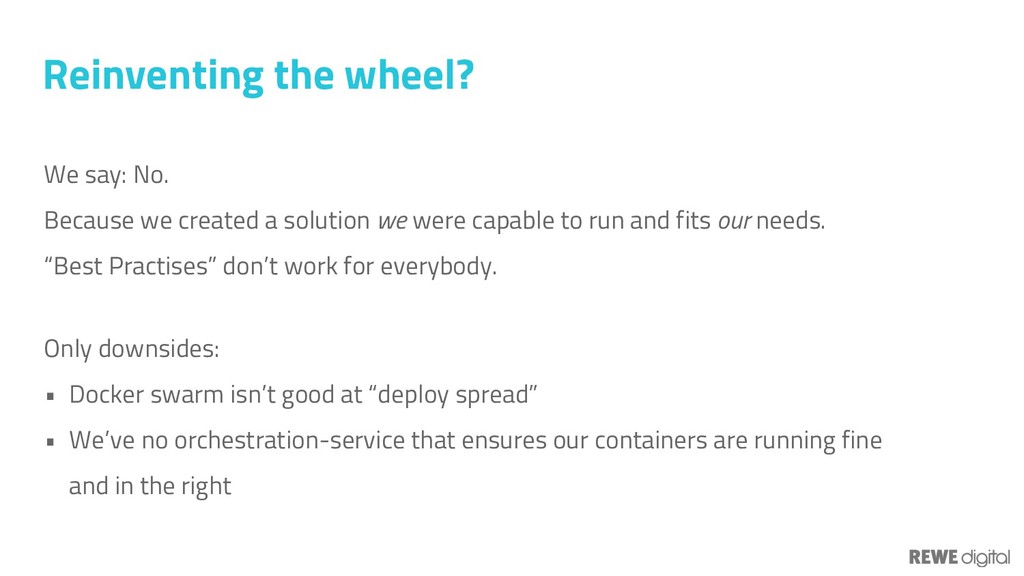
capable to run and fits our needs. “Best Practises” don’t work for everybody. Only downsides: • Docker swarm isn’t good at “deploy spread” • We’ve no orchestration-service that ensures our containers are running fine and in the right Reinventing the wheel?
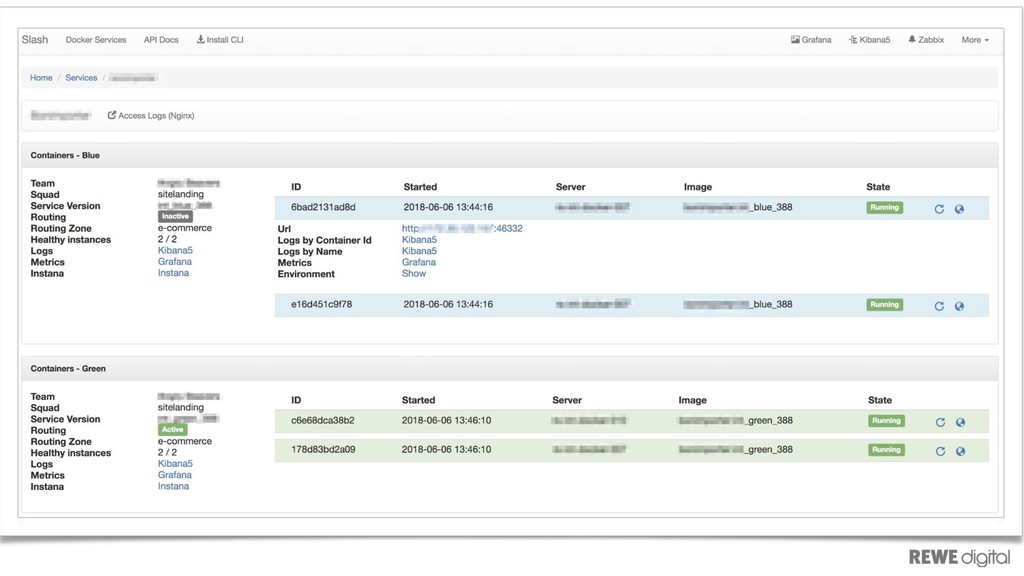
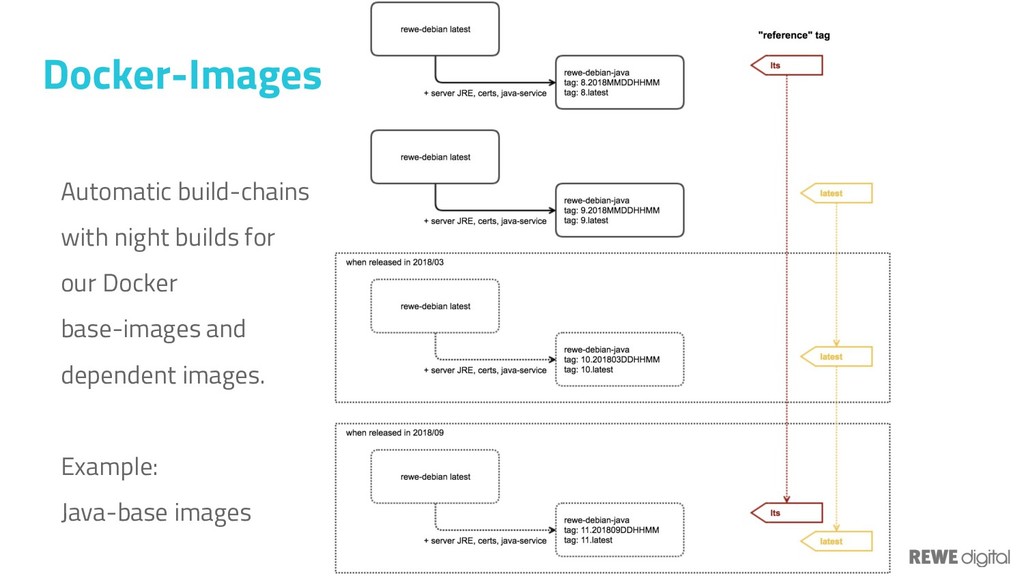
of new databases • Fully automated set-up of Team-Jenkins instances (even at GCP) • A custom-built platform-service called “Slash” as a service-interface for our developers • Use a common set of Docker base-images with daily builds Additional goodies
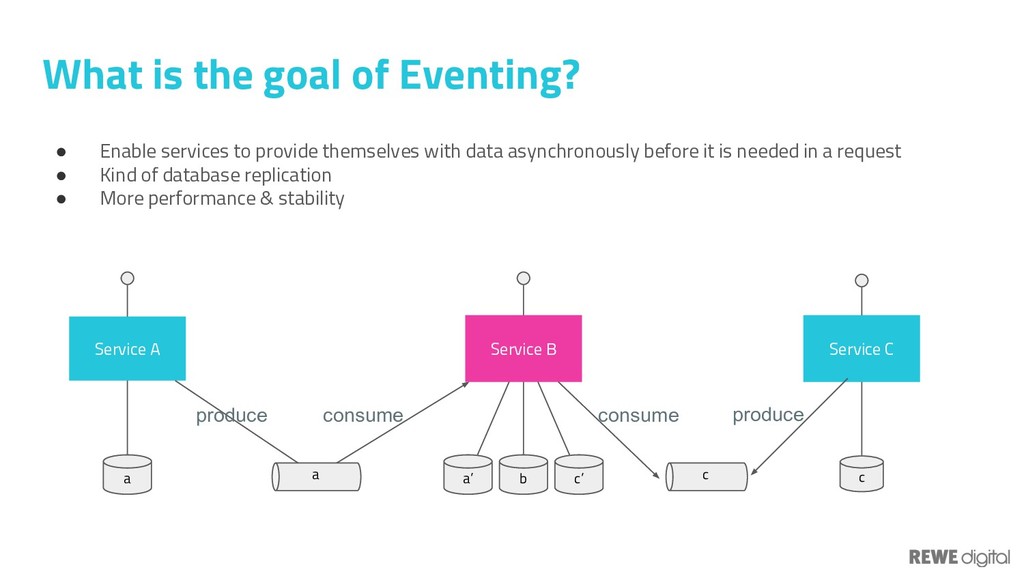
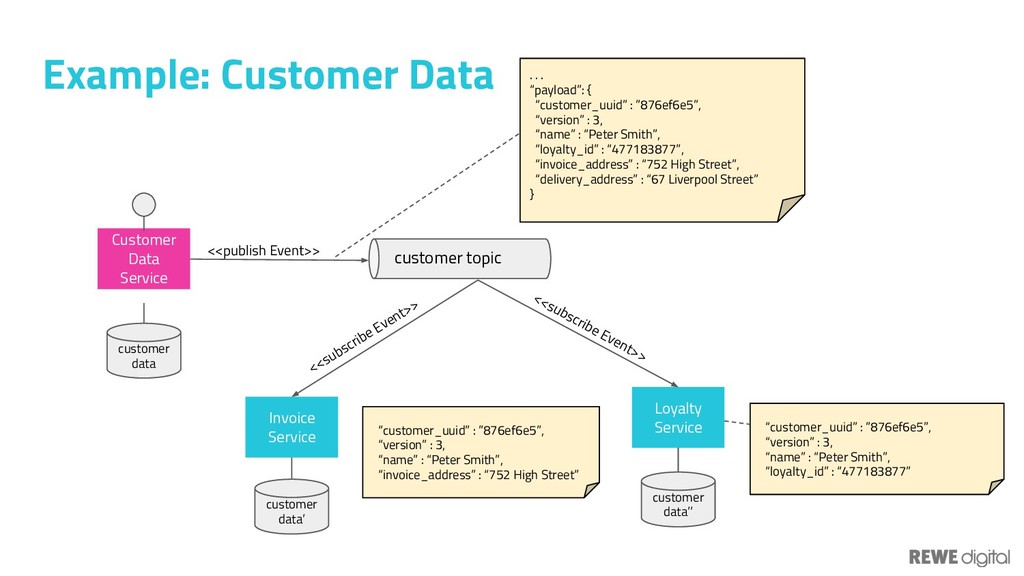
it is needed in a request • Kind of database replication • More performance & stability Service A a Service B Service C c a c b a’ c’ What is the goal of Eventing? produce produce consume consume
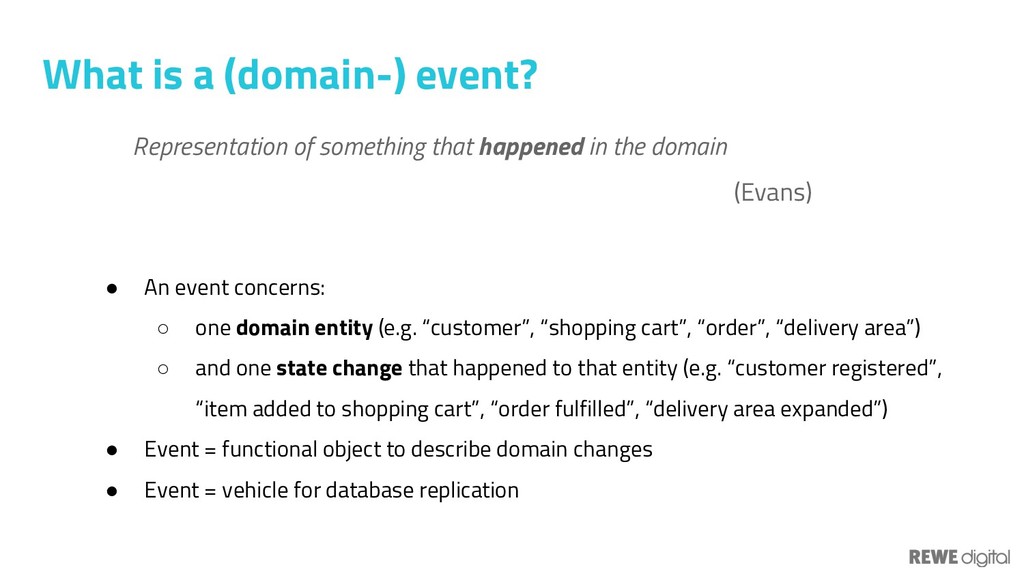
An event concerns: ◦ one domain entity (e.g. “customer”, “shopping cart”, “order”, “delivery area”) ◦ and one state change that happened to that entity (e.g. “customer registered”, “item added to shopping cart”, “order fulfilled”, “delivery area expanded”) • Event = functional object to describe domain changes • Event = vehicle for database replication What is a (domain-) event?
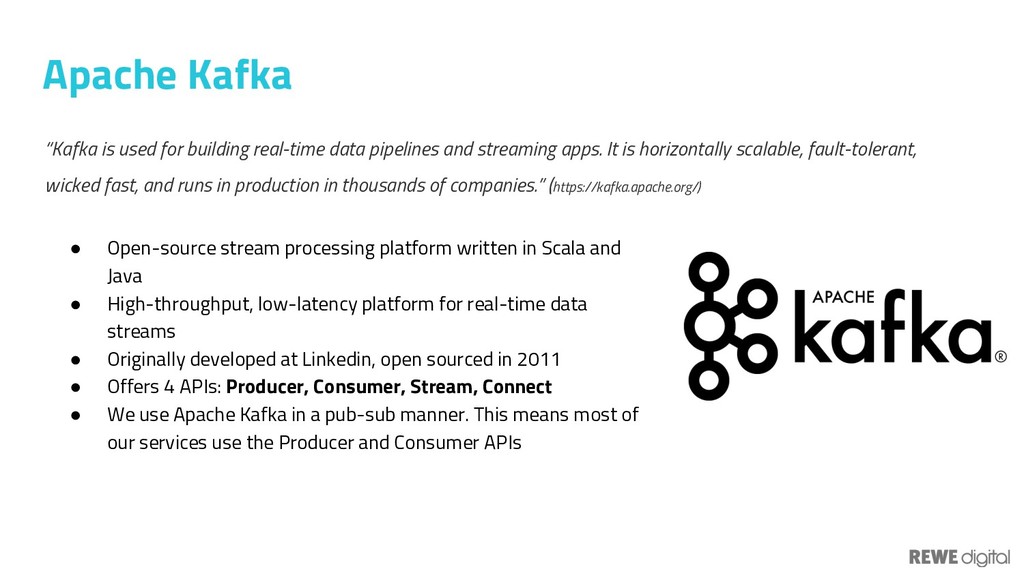
• High-throughput, low-latency platform for real-time data streams • Originally developed at Linkedin, open sourced in 2011 • Offers 4 APIs: Producer, Consumer, Stream, Connect • We use Apache Kafka in a pub-sub manner. This means most of our services use the Producer and Consumer APIs “Kafka is used for building real-time data pipelines and streaming apps. It is horizontally scalable, fault-tolerant, wicked fast, and runs in production in thousands of companies.” (https://kafka.apache.org/) Apache Kafka
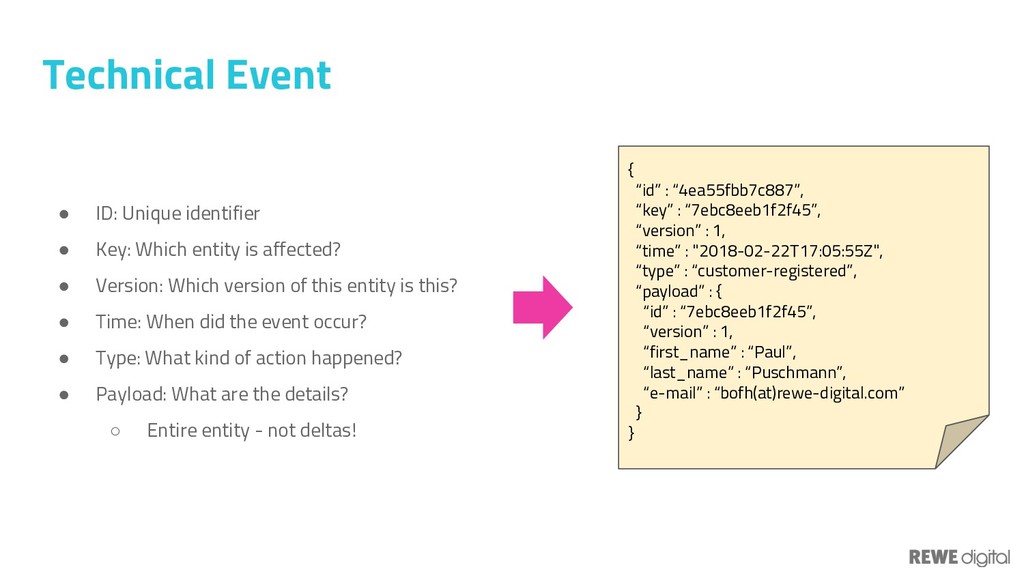
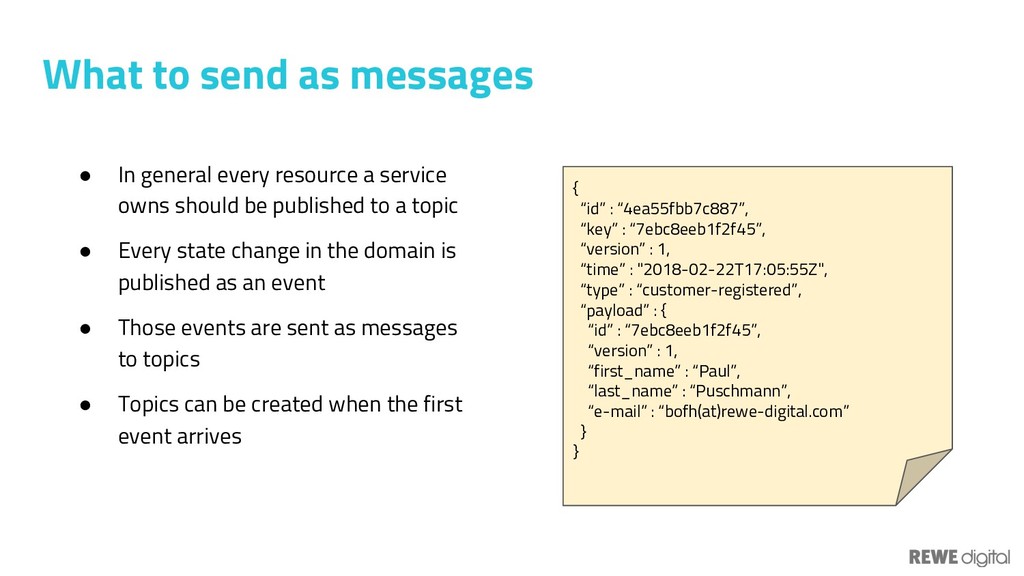
published to a topic • Every state change in the domain is published as an event • Those events are sent as messages to topics • Topics can be created when the first event arrives { “id” : “4ea55fbb7c887”, “key” : “7ebc8eeb1f2f45”, “version” : 1, “time” : "2018-02-22T17:05:55Z", “type” : “customer-registered”, “payload” : { “id” : “7ebc8eeb1f2f45”, “version” : 1, “first_name” : “Paul”, “last_name” : “Puschmann”, “e-mail” : “bofh(at)rewe-digital.com” } } What to send as messages
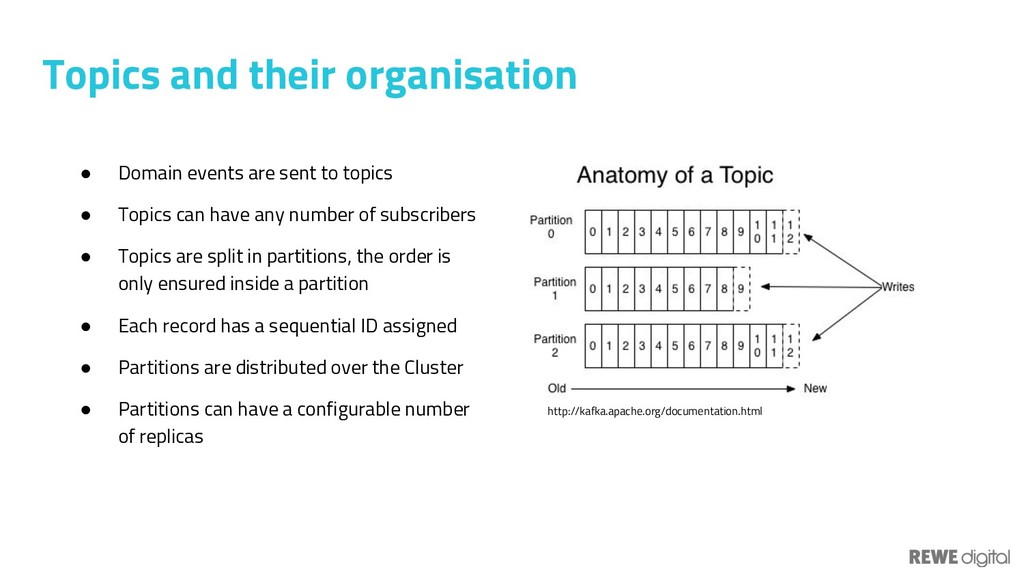
have any number of subscribers • Topics are split in partitions, the order is only ensured inside a partition • Each record has a sequential ID assigned • Partitions are distributed over the Cluster • Partitions can have a configurable number of replicas http://kafka.apache.org/documentation.html Topics and their organisation
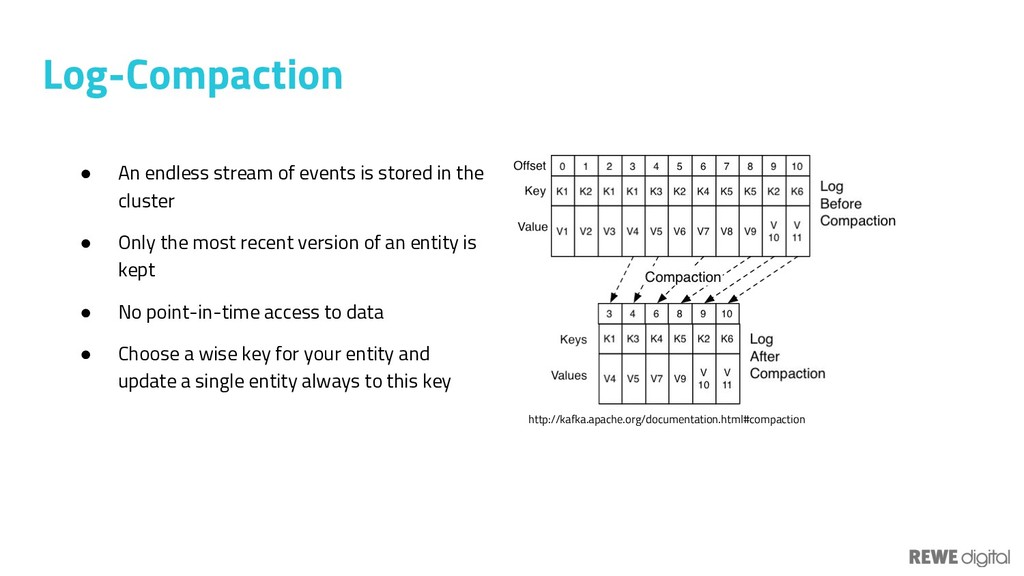
cluster • Only the most recent version of an entity is kept • No point-in-time access to data • Choose a wise key for your entity and update a single entity always to this key http://kafka.apache.org/documentation.html#compaction Log-Compaction
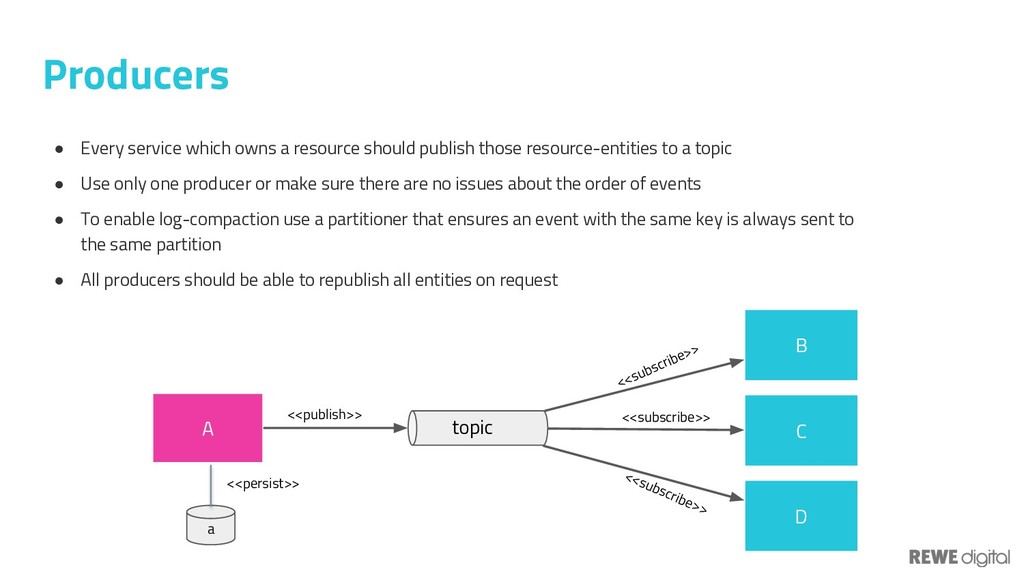
resource-entities to a topic • Use only one producer or make sure there are no issues about the order of events • To enable log-compaction use a partitioner that ensures an event with the same key is always sent to the same partition • All producers should be able to republish all entities on request A B C D <<publish>> <<subscribe>> <<subscribe>> <<subscribe>> topic Producers a <<persist>>
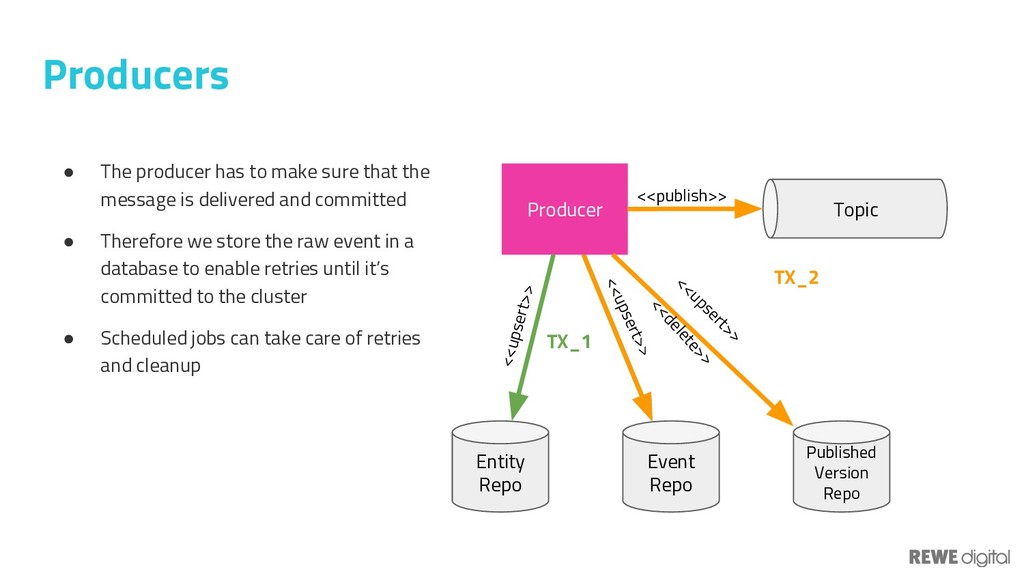
TX_1 <<delete>> Topic <<upsert>> TX_2 <<publish>> • The producer has to make sure that the message is delivered and committed • Therefore we store the raw event in a database to enable retries until it’s committed to the cluster • Scheduled jobs can take care of retries and cleanup Producers
consume all data it needs to fulfill a request - having data at request time is better than trying to get it from another service • The consumer has to process events idempotently. An event could be consumed more than once. The infrastructure ensures at-least-once delivery • Consumers have to take care of deployment specialties like blue/green • Consumers should be able to re-consume from the beginning. For instance more data is needed • Consumers only should persist the data they really need Consumers
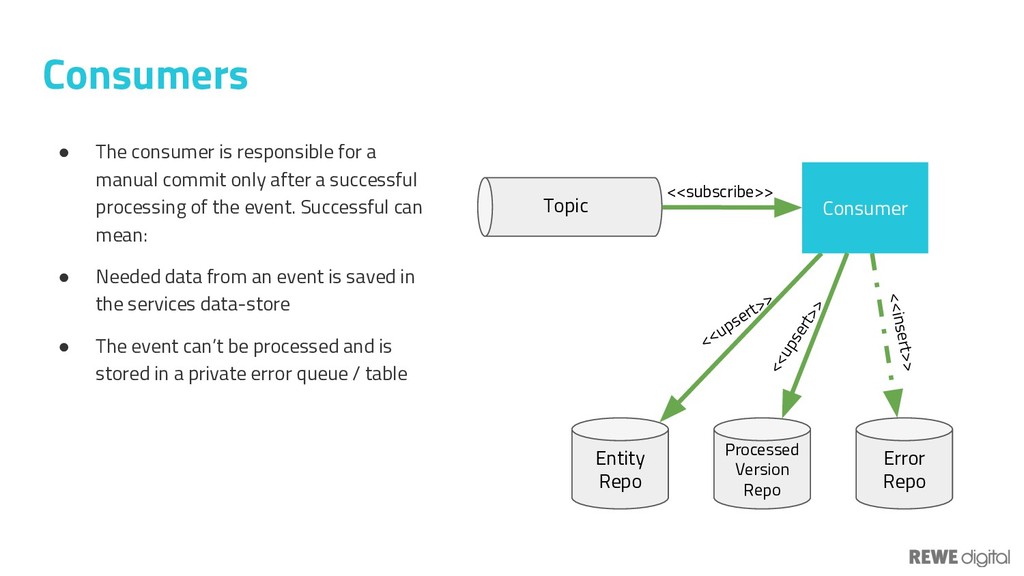
after a successful processing of the event. Successful can mean: • Needed data from an event is saved in the services data-store • The event can’t be processed and is stored in a private error queue / table Entity Repo Error Repo Processed Version Repo Consumer <<upsert>> Topic <<subscribe>> <<upsert>> <<insert>> Consumers
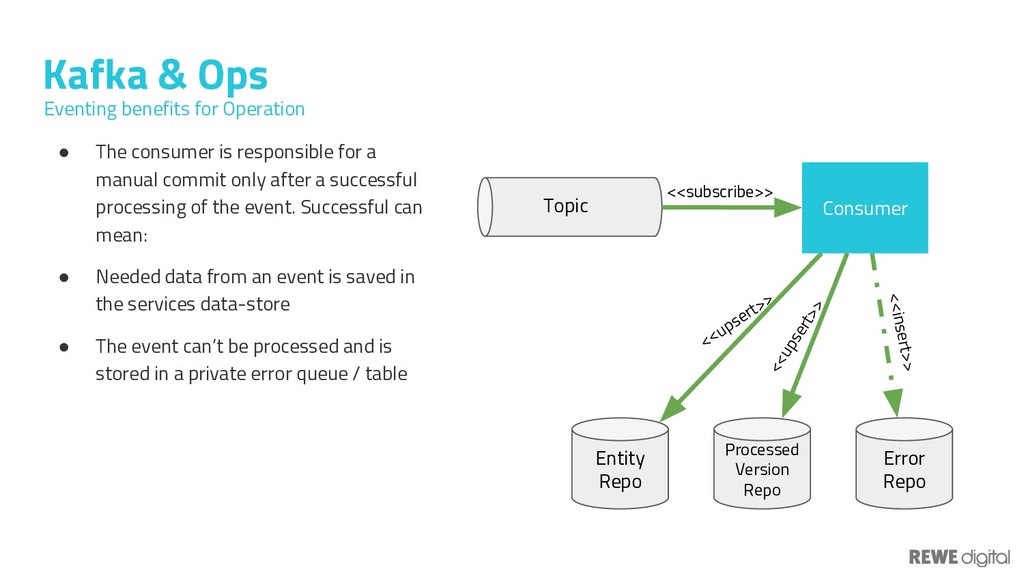
after a successful processing of the event. Successful can mean: • Needed data from an event is saved in the services data-store • The event can’t be processed and is stored in a private error queue / table Entity Repo Error Repo Processed Version Repo Consumer <<upsert>> Topic <<subscribe>> <<upsert>> <<insert>> Kafka & Ops Eventing benefits for Operation
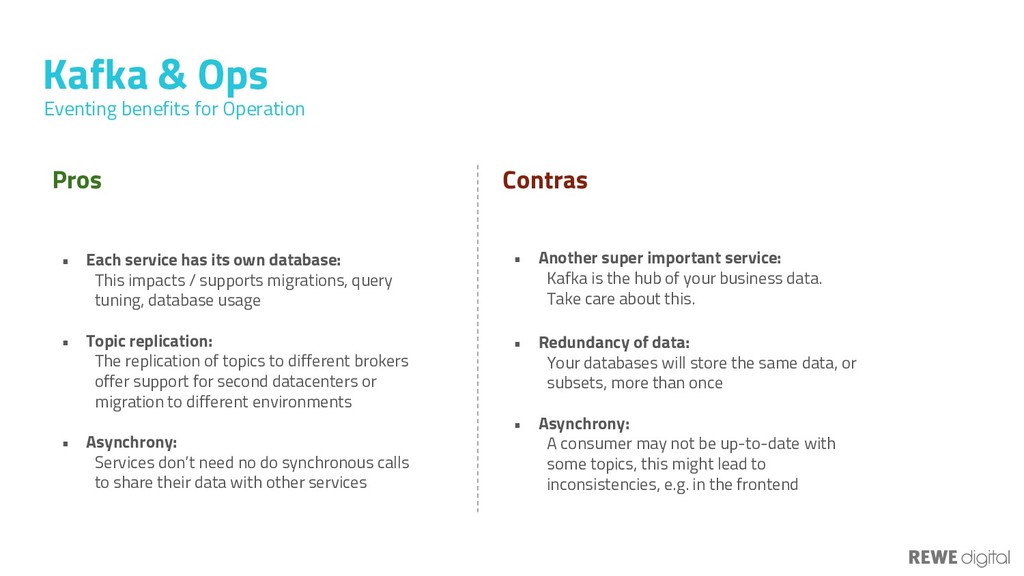
impacts / supports migrations, query tuning, database usage • Topic replication: The replication of topics to different brokers offer support for second datacenters or migration to different environments • Asynchrony: Services don’t need no do synchronous calls to share their data with other services • Another super important service: Kafka is the hub of your business data. Take care about this. • Redundancy of data: Your databases will store the same data, or subsets, more than once • Asynchrony: A consumer may not be up-to-date with some topics, this might lead to inconsistencies, e.g. in the frontend Kafka & Ops Eventing benefits for Operation
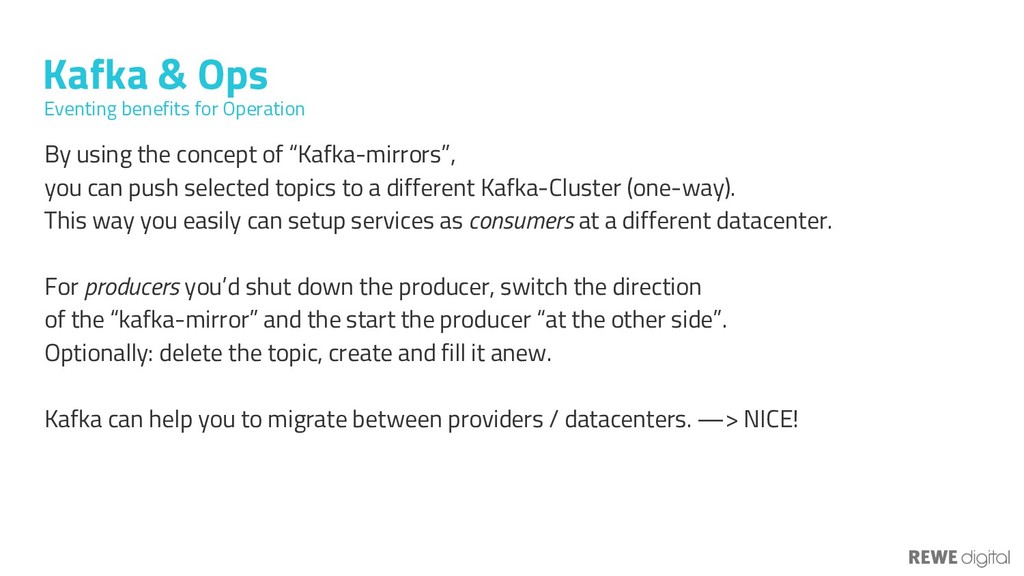
concept of “Kafka-mirrors”, you can push selected topics to a different Kafka-Cluster (one-way). This way you easily can setup services as consumers at a different datacenter. For producers you’d shut down the producer, switch the direction of the “kafka-mirror” and the start the producer “at the other side”. Optionally: delete the topic, create and fill it anew. Kafka can help you to migrate between providers / datacenters. —> NICE!
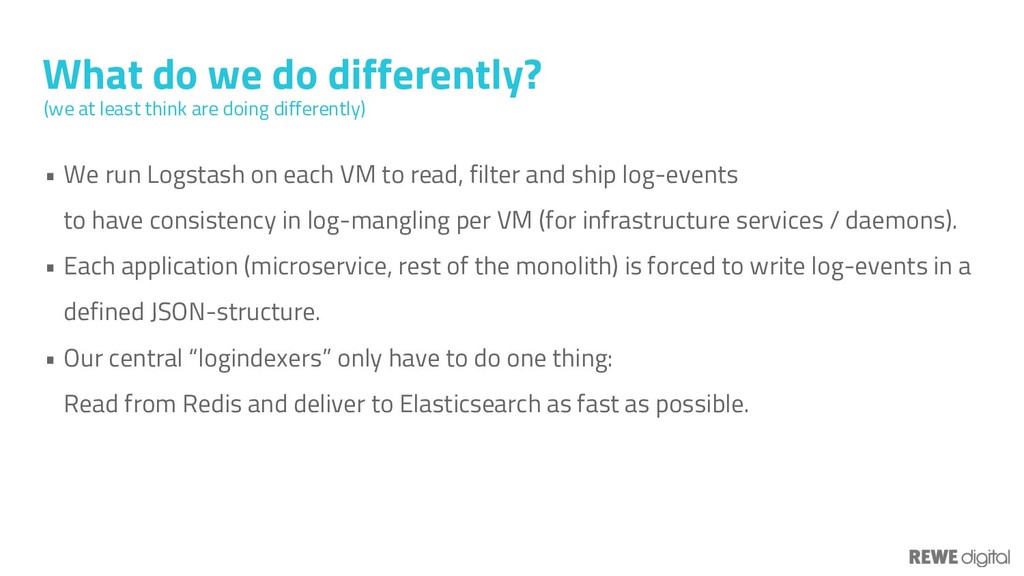
and ship log-events to have consistency in log-mangling per VM (for infrastructure services / daemons). • Each application (microservice, rest of the monolith) is forced to write log-events in a defined JSON-structure. • Our central “logindexers” only have to do one thing: Read from Redis and deliver to Elasticsearch as fast as possible. (we at least think are doing differently) What do we do differently?
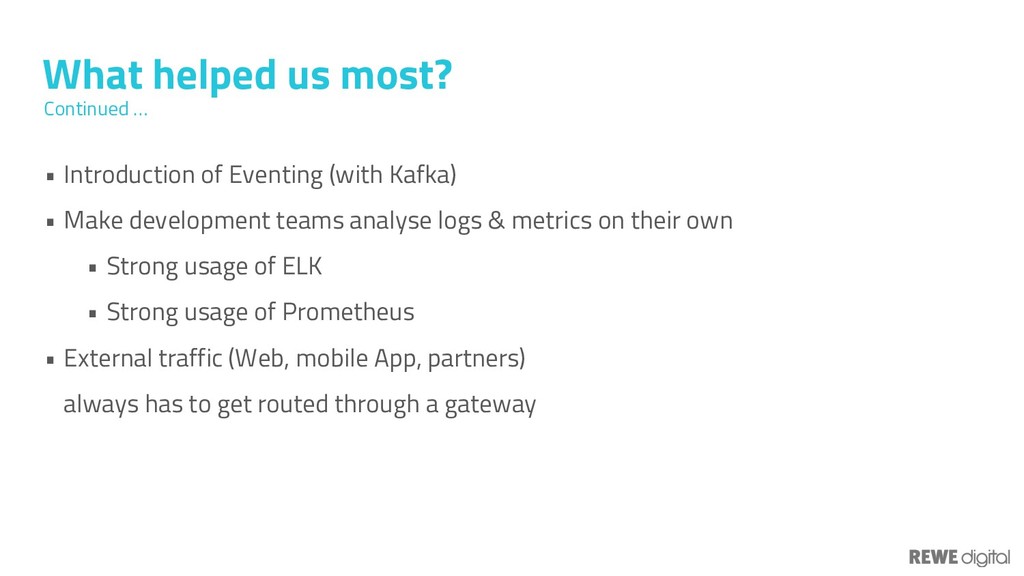
analyse logs & metrics on their own • Strong usage of ELK • Strong usage of Prometheus • External traffic (Web, mobile App, partners) always has to get routed through a gateway Continued … What helped us most?
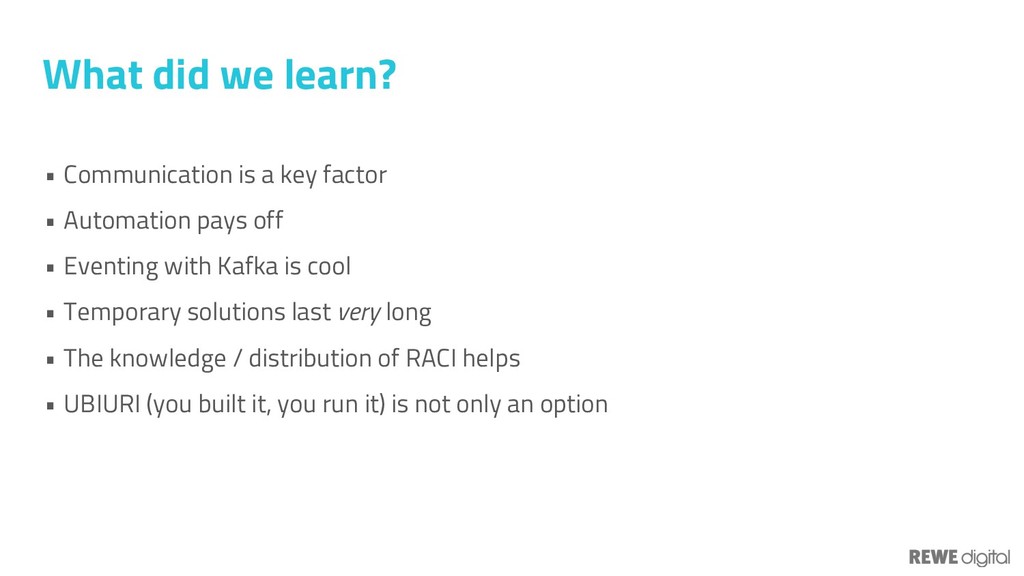
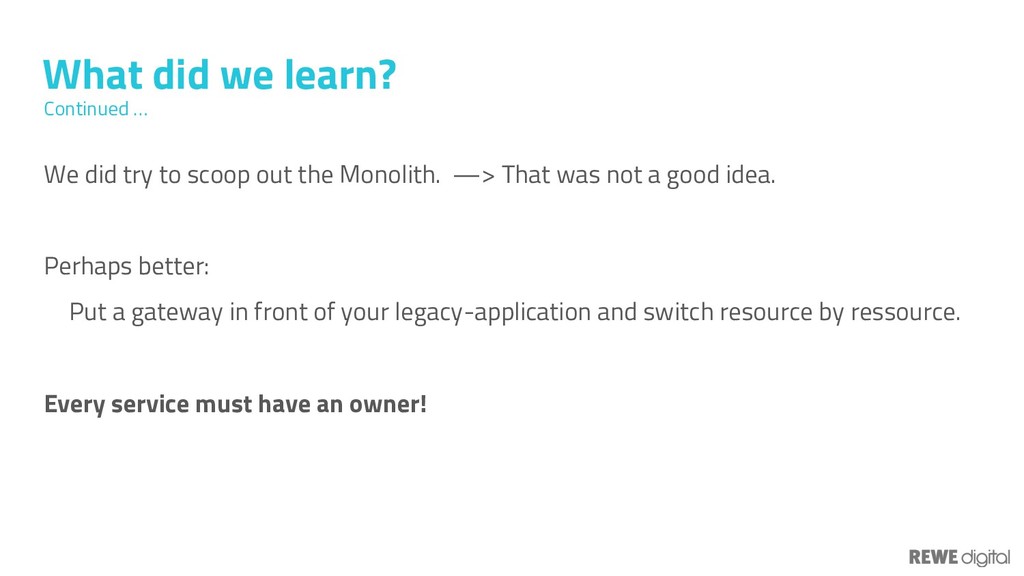
• Eventing with Kafka is cool • Temporary solutions last very long • The knowledge / distribution of RACI helps • UBIURI (you built it, you run it) is not only an option What did we learn?
was not a good idea. Perhaps better: Put a gateway in front of your legacy-application and switch resource by ressource. Every service must have an owner! What did we learn? Continued …


 ppuschmann
 occhi
 yamanoku
 bgpat
 satomasahiro2005
 codatum
 shogo4131
 recruitengineers
 gionn
 kakehashi
 kaminashi
 moznion
 akhino
 mlcsv
 lfama
 inesmontani
 mfonobong
 davetheseo
 aleyda
 chriscoyier
 3n
 pedronauck
 ipullrank
 nmsamuel
 takai