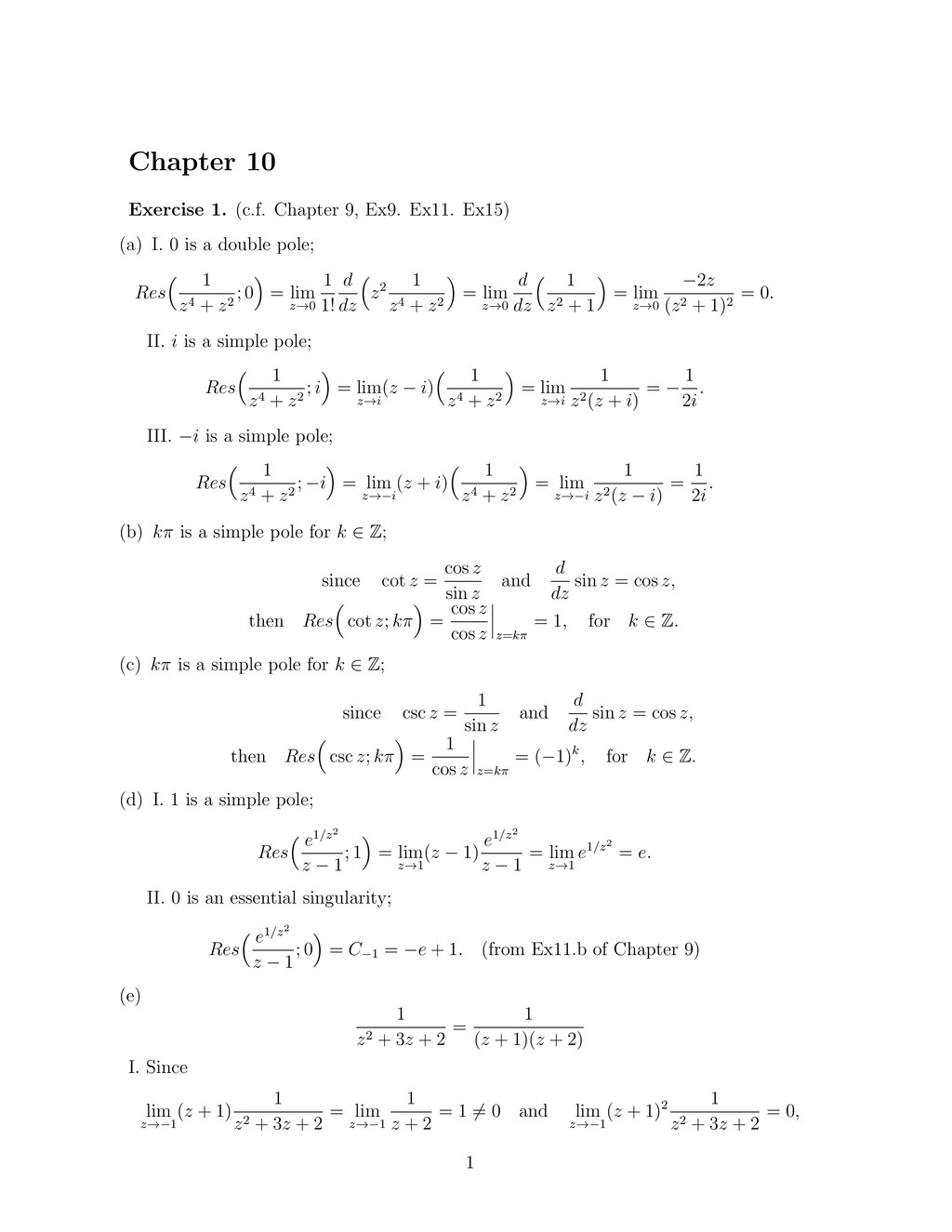
(a) I. 0 is a double pole; Res 1 z4 + z2 ; 0 = lim z→0 1 1! d dz z2 1 z4 + z2 = lim z→0 d dz 1 z2 + 1 = lim z→0 −2z (z2 + 1)2 = 0. II. i is a simple pole; Res 1 z4 + z2 ; i = lim z→i (z − i) 1 z4 + z2 = lim z→i 1 z2(z + i) = − 1 2i . III. −i is a simple pole; Res 1 z4 + z2 ; −i = lim z→−i (z + i) 1 z4 + z2 = lim z→−i 1 z2(z − i) = 1 2i . (b) kπ is a simple pole for k ∈ Z; since cot z = cos z sin z and d dz sin z = cos z, then Res cot z; kπ = cos z cos z z=kπ = 1, for k ∈ Z. (c) kπ is a simple pole for k ∈ Z; since csc z = 1 sin z and d dz sin z = cos z, then Res csc z; kπ = 1 cos z z=kπ = (−1)k, for k ∈ Z. (d) I. 1 is a simple pole; Res e1/z2 z − 1 ; 1 = lim z→1 (z − 1) e1/z2 z − 1 = lim z→1 e1/z2 = e. II. 0 is an essential singularity; Res e1/z2 z − 1 ; 0 = C−1 = −e + 1. (from Ex11.b of Chapter 9) (e) 1 z2 + 3z + 2 = 1 (z + 1)(z + 2) I. Since lim z→−1 (z + 1) 1 z2 + 3z + 2 = lim z→−1 1 z + 2 = 1 = 0 and lim z→−1 (z + 1)2 1 z2 + 3z + 2 = 0, 1
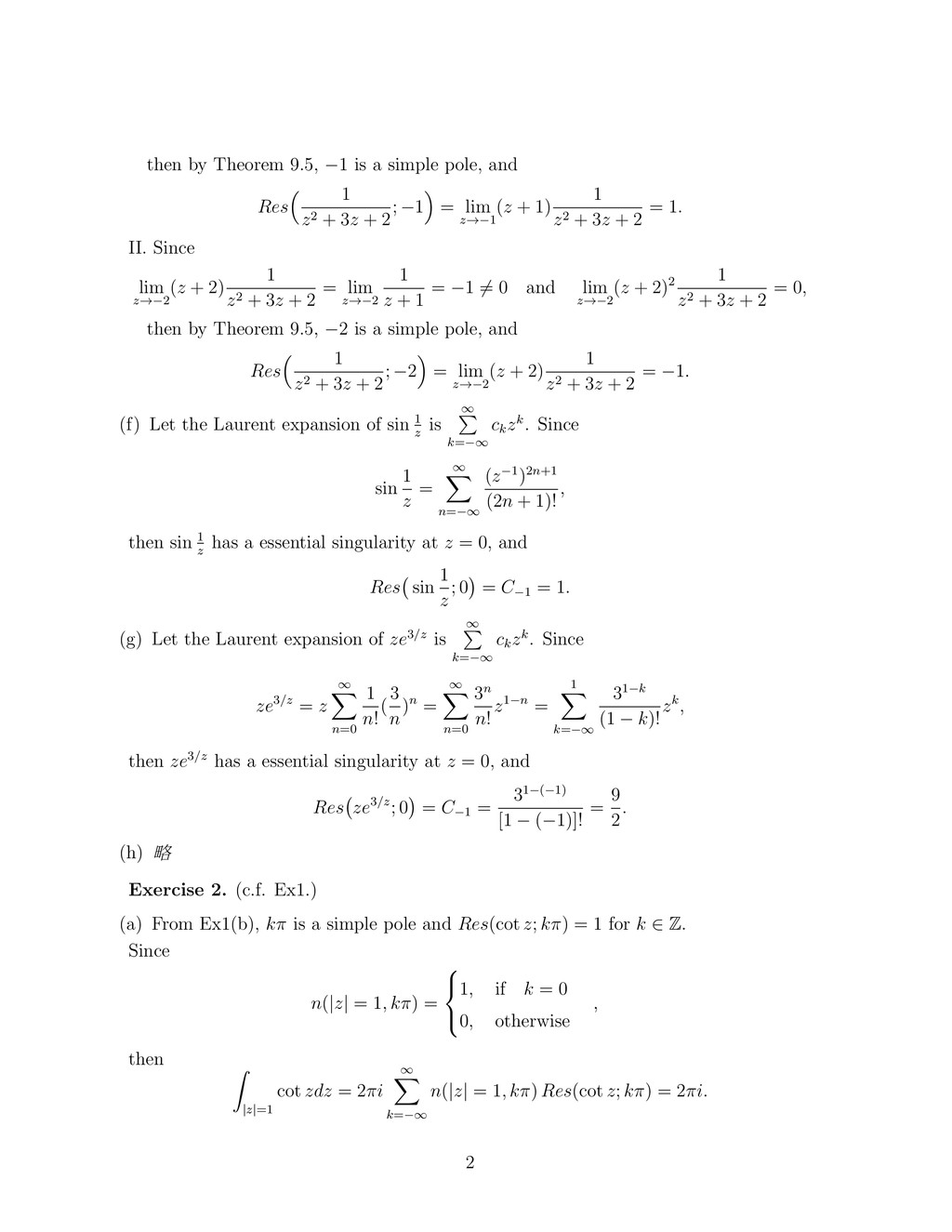
Res 1 z2 + 3z + 2 ; −1 = lim z→−1 (z + 1) 1 z2 + 3z + 2 = 1. II. Since lim z→−2 (z + 2) 1 z2 + 3z + 2 = lim z→−2 1 z + 1 = −1 = 0 and lim z→−2 (z + 2)2 1 z2 + 3z + 2 = 0, then by Theorem 9.5, −2 is a simple pole, and Res 1 z2 + 3z + 2 ; −2 = lim z→−2 (z + 2) 1 z2 + 3z + 2 = −1. (f) Let the Laurent expansion of sin 1 z is ∞ k=−∞ ck zk. Since sin 1 z = ∞ n=−∞ (z−1)2n+1 (2n + 1)! , then sin 1 z has a essential singularity at z = 0, and Res sin 1 z ; 0 = C−1 = 1. (g) Let the Laurent expansion of ze3/z is ∞ k=−∞ ck zk. Since ze3/z = z ∞ n=0 1 n! ( 3 n )n = ∞ n=0 3n n! z1−n = 1 k=−∞ 31−k (1 − k)! zk, then ze3/z has a essential singularity at z = 0, and Res ze3/z; 0 = C−1 = 31−(−1) [1 − (−1)]! = 9 2 . (h) 略 Exercise 2. (c.f. Ex1.) (a) From Ex1(b), kπ is a simple pole and Res(cot z; kπ) = 1 for k ∈ Z. Since n(|z| = 1, kπ) = 1, if k = 0 0, otherwise , then |z|=1 cot zdz = 2πi ∞ k=−∞ n(|z| = 1, kπ) Res(cot z; kπ) = 2πi. 2
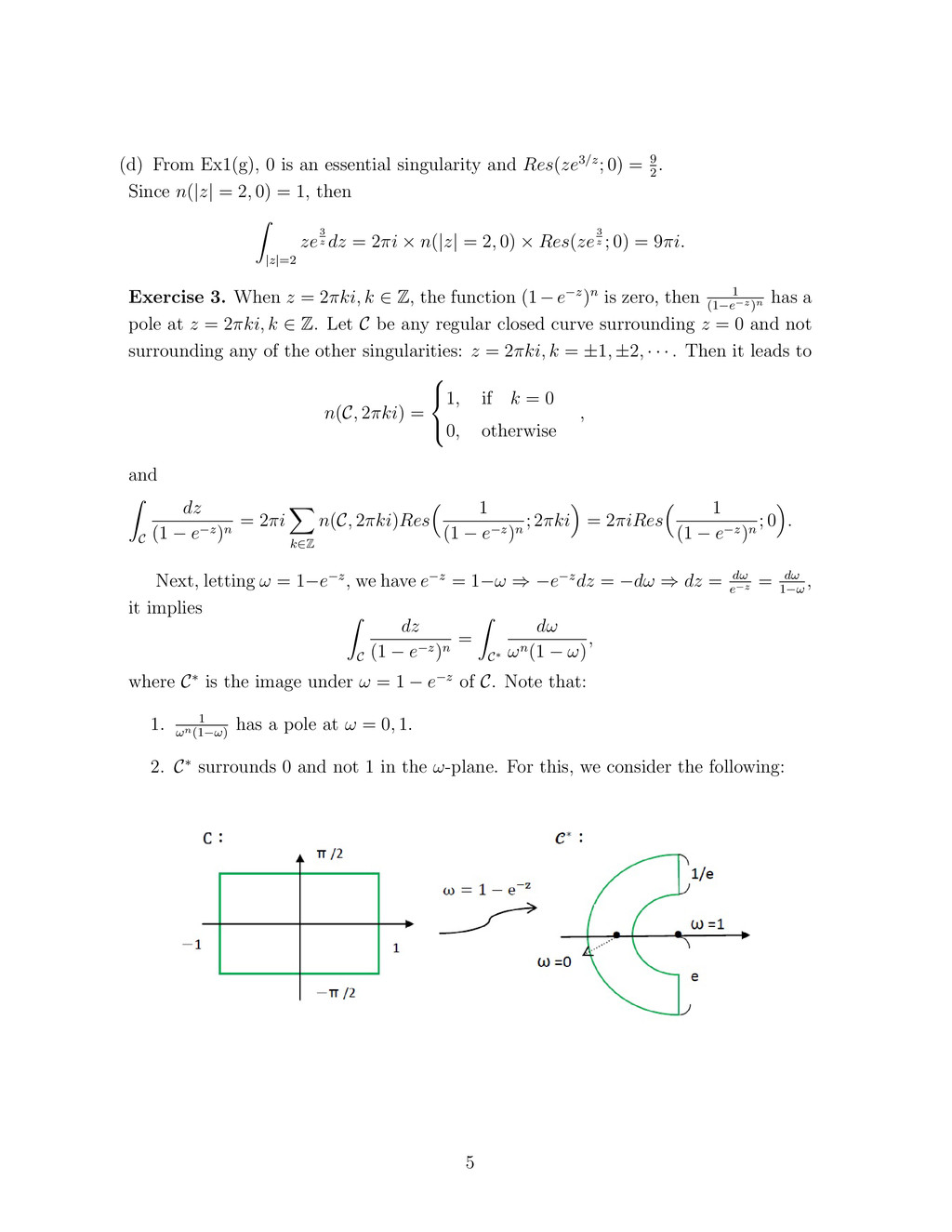
0) = 9 2 . Since n(|z| = 2, 0) = 1, then |z|=2 ze3 z dz = 2πi × n(|z| = 2, 0) × Res(ze3 z ; 0) = 9πi. Exercise 3. When z = 2πki, k ∈ Z, the function (1−e−z)n is zero, then 1 (1−e−z)n has a pole at z = 2πki, k ∈ Z. Let C be any regular closed curve surrounding z = 0 and not surrounding any of the other singularities: z = 2πki, k = ±1, ±2, · · · . Then it leads to n(C, 2πki) = 1, if k = 0 0, otherwise , and C dz (1 − e−z)n = 2πi k∈Z n(C, 2πki)Res 1 (1 − e−z)n ; 2πki = 2πiRes 1 (1 − e−z)n ; 0 . Next, letting ω = 1−e−z, we have e−z = 1−ω ⇒ −e−zdz = −dω ⇒ dz = dω e−z = dω 1−ω , it implies C dz (1 − e−z)n = C∗ dω ωn(1 − ω) , where C∗ is the image under ω = 1 − e−z of C. Note that: 1. 1 ωn(1−ω) has a pole at ω = 0, 1. 2. C∗ surrounds 0 and not 1 in the ω-plane. For this, we consider the following: 5


 prettyface
 codingconduct
 kevinliebholz
 marktimemedia
 inesmontani
 sarafernandez
 soysaucechin
 elsirapls
 caitiem20
 quramy
 tessaabrams
 bcantrill