Upgrade to Pro — share decks privately, control downloads, hide ads and more …

SEO HUNTER

Avatar for SEO HUNTER SEO HUNTER
February 18, 2025
2

SEO HUNTER

Artificial Intelligence (AI) has emerged as one of the most transformative technologies of the 21st century. From self-driving cars to intelligent virtual assistants, AI is reshaping industries and redefining the way humans interact with technology. As we look toward the future, the role of AI in our world is expected to grow exponentially, bringing both opportunities and challenges. This article explores the potential of AI in various sectors, its impact on society, ethical concerns, and the advancements that will shape the future world.

Avatar for SEO HUNTER

SEO HUNTER

February 18, 2025

Transcript

  1. Artificial Intelligence in the Future World Artificial Intelligence (AI) has

    emerged as one of the most transformative technologies of the 21st century. From self-driving cars to intelligent virtual assistants, AI is reshaping industries and redefining the way humans interact with technology. As we look toward the future, the role of AI in our world is expected to grow exponentially, bringing both opportunities and challenges. This article explores the potential of AI in various sectors, its impact on society, ethical concerns, and the advancements that will shape the future world. The Evolution of Artificial Intelligence in the Future World The journey of AI began in the mid-20th century with the development of early computing machines and theoretical foundations. Over the decades, advancements in machine learning, deep learning, and neural networks have propelled to new heights. Today, AI is integrated into numerous applications, including healthcare, finance, education, and entertainment. Future developments in AI will likely focus on enhancing cognitive abilities, improving decision-making, and making AI systems more autonomous and adaptable. AI in Different Sectors 1. Healthcare AI is revolutionizing healthcare by enabling early disease detection, personalized treatments, and robotic-assisted surgeries. Machine learning algorithms analyze vast amounts of medical data to identify patterns and predict health risks. Artificial Intelligence in the Future World-driven chatbots and virtual doctors provide instant medical advice, reducing the burden on healthcare professionals. In the future, AI could help in drug discovery, mental health therapy, and advanced prosthetics, enhancing overall healthcare outcomes. 2. Education
  2. AI-powered learning platforms offer personalized education experiences tailored to individual

    students' needs. Virtual tutors, automated grading systems, and intelligent course recommendations improve learning efficiency. AI can bridge the educational gap by providing access to quality education in remote areas through adaptive learning technologies. Future AI applications may include virtual reality classrooms and AI-driven mentors capable of providing real-time guidance. 3. Transportation Autonomous vehicles and AI-powered traffic management systems are set to revolutionize transportation. Self-driving cars, drones, and AI-assisted public transport will enhance safety, reduce congestion, and lower emissions.AI-driven logistics optimization will improve supply chain efficiency, reducing costs and environmental impact. As AI continues to evolve, smart cities will integrate AI into urban planning, making transportation more sustainable and efficient.4. Business and Finance AI-driven analytics are transforming business decision-making by providing deep insights into market trends, consumer behavior, and risk management. Artificial Intelligence in the Future World-powered chatbots enhance customer service, while robotic process automation (RPA) streamlines administrative tasks. In finance, AI-driven fraud detection systems, algorithmic trading, and automated wealth management platforms are revolutionizing the industry. The future of AI in business will likely include hyper-personalized marketing and AI-driven strategic planning. 5. Entertainment and Media AI is reshaping the entertainment industry by personalizing content recommendations, enhancing video game experiences, and creating generated art and music. Deep learning algorithms are used for movie editing, scriptwriting, and even digital human actors. AI-driven journalism is emerging, where AI-generated news articles provide real-time updates. The future may see AI-generated movies, interactive virtual experiences, and fully autonomous content creation.
  3. The Impact of Artificial Intelligence in the Future World on

    Society 1. Employment and Workforce Transformation AI will automate many routine tasks, leading to job displacement in certain industries. However, it will also create new job opportunities in AI development, data science, and AI ethics. Reskilling and upskilling initiatives will be essential to prepare the workforce for an AI-driven future. The rise of AI-powered collaborative work environments will change traditional job roles and redefine workplace dynamics. 2. Ethical and Privacy Concerns AI raises significant ethical concerns, including bias in algorithms, data privacy issues, amisuse nd the potential of AI technologies. Ensuring fairness and transparency will be critical in preventing discrimination and unethical practices. Governments and organizations must establish robust regulations to govern AI usage and protect individual rights. AI explainability and accountability will be key areas of focus in future AI governance.
  4. 3. AI and Human Interaction As AI becomes more integrated

    into daily life, human interaction will evolve. AI-driven personal assistants, humanoid robots, and emotional AI will change the way people interact with technology. Emotional intelligence in AI will enable machines to understand human emotions and respond empathetically. The future will see deeper AI-human collaboration in various aspects of life, from healthcare to companionship. Future Advancements 1. General AI (AGI)
  5. Artificial General Intelligence (AGI) refers to systems that possess human-like

    cognitive abilities, enabling them to understand, learn, and adapt to various tasks. While current AI is specialized (narrow AI), AGI aims to replicate human intelligence across multiple domains. The development of AGI could revolutionize industries but also raise concerns about control, ethics, and coexistence with human intelligence. 2. Artificial Intelligence in the Future World and Quantum Computing Quantum computing has the potential to accelerate Artificial Intelligence in the Future World advancements by processing vast amounts of data at unprecedented speeds. Quantum-enhanced AI could solve complex problems in healthcare, cryptography, and materials science. As quantum computing matures, AI algorithms will become more efficient and capable of tackling challenges beyond classical computing capabilities. 3. Artificial Intelligence in the Future World Space Exploration AI is playing a crucial role in space exploration by assisting in data analysis, autonomous navigation, and robotic missions. AI-powered rovers, satellites, and space probes are gathering valuable insights about the universe. Future AI applications may include fully autonomous space missions, AI-driven exoplanet discovery, and intelligent space habitats for astronauts. 4. AI in Cybersecurity With the rise of cyber threats, Artificial Intelligence in the Future World-driven cybersecurity solutions are becoming essential. AI can detect and prevent cyberattacks in real-time by analyzing patterns and identifying anomalies. Future advancements in AI-driven threat intelligence will enhance digital security, protecting sensitive data from cybercriminals. AI-powered encryption and automated threat response systems will strengthen global cybersecurity measures. Conclusion
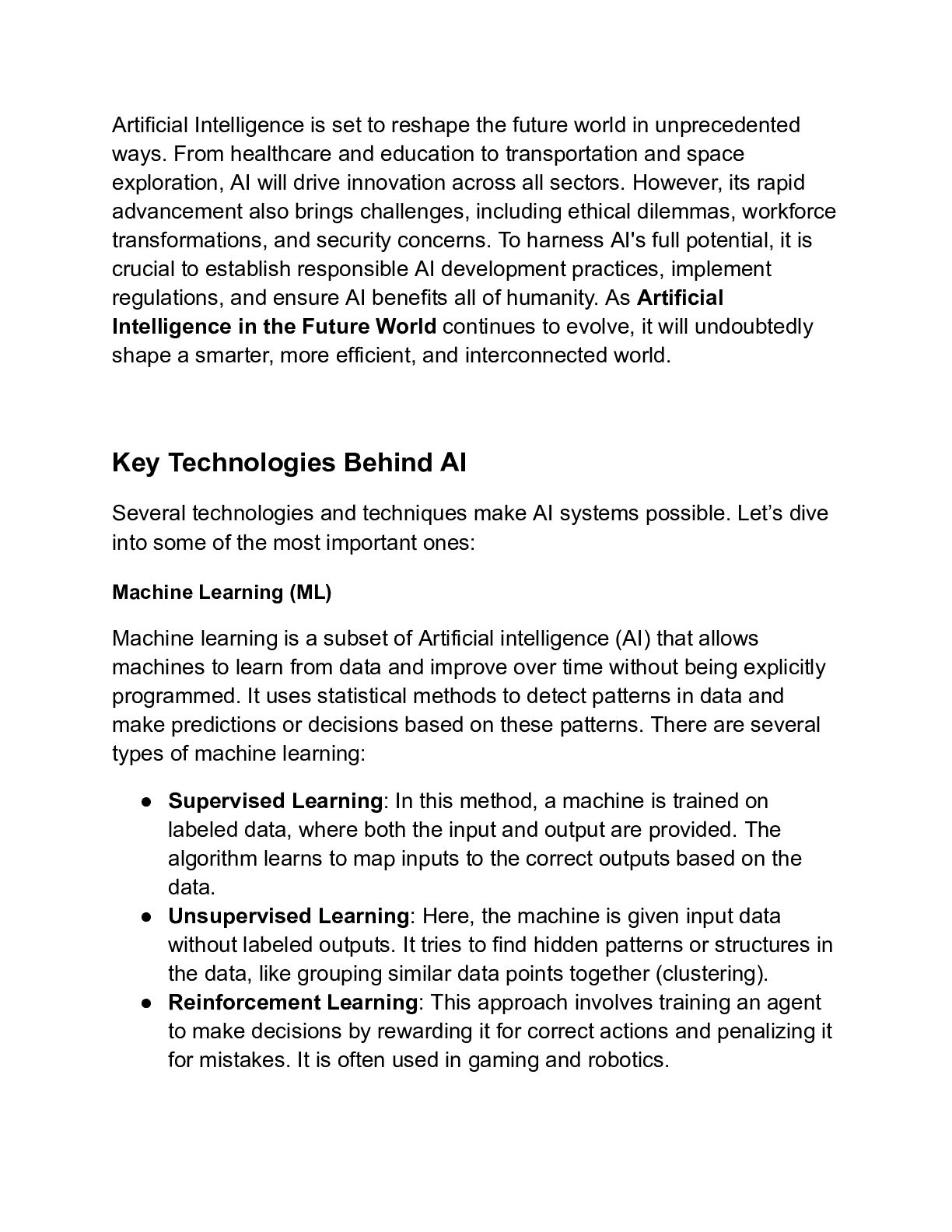
  6. Artificial Intelligence is set to reshape the future world in

    unprecedented ways. From healthcare and education to transportation and space exploration, AI will drive innovation across all sectors. However, its rapid advancement also brings challenges, including ethical dilemmas, workforce transformations, and security concerns. To harness AI's full potential, it is crucial to establish responsible AI development practices, implement regulations, and ensure AI benefits all of humanity. As Artificial Intelligence in the Future World continues to evolve, it will undoubtedly shape a smarter, more efficient, and interconnected world. Key Technologies Behind AI Several technologies and techniques make AI systems possible. Let’s dive into some of the most important ones: Machine Learning (ML) Machine learning is a subset of Artificial intelligence (AI) that allows machines to learn from data and improve over time without being explicitly programmed. It uses statistical methods to detect patterns in data and make predictions or decisions based on these patterns. There are several types of machine learning: •​ Supervised Learning: In this method, a machine is trained on labeled data, where both the input and output are provided. The algorithm learns to map inputs to the correct outputs based on the data. •​ Unsupervised Learning: Here, the machine is given input data without labeled outputs. It tries to find hidden patterns or structures in the data, like grouping similar data points together (clustering). •​ Reinforcement Learning: This approach involves training an agent to make decisions by rewarding it for correct actions and penalizing it for mistakes. It is often used in gaming and robotics.
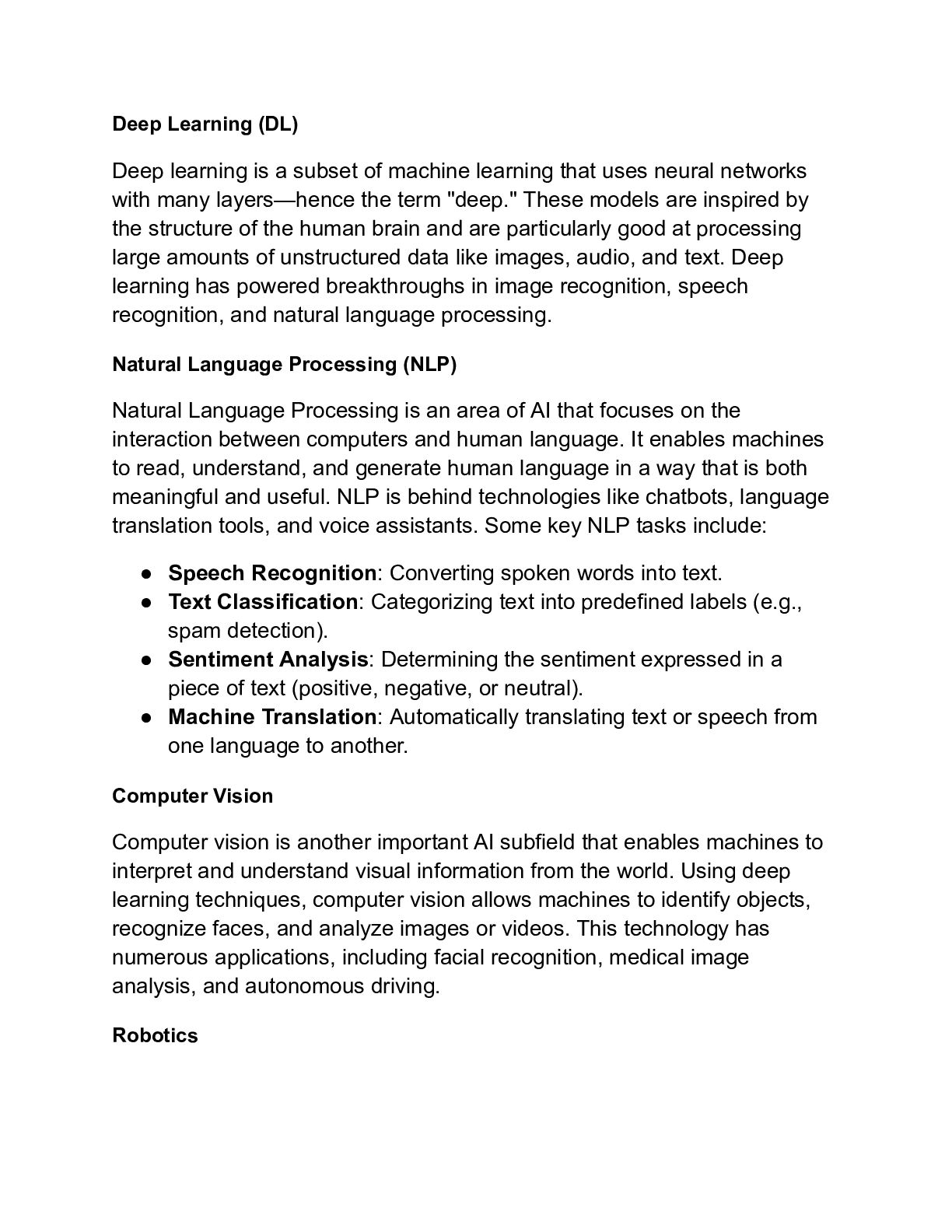
  7. Deep Learning (DL) Deep learning is a subset of machine

    learning that uses neural networks with many layers—hence the term "deep." These models are inspired by the structure of the human brain and are particularly good at processing large amounts of unstructured data like images, audio, and text. Deep learning has powered breakthroughs in image recognition, speech recognition, and natural language processing. Natural Language Processing (NLP) Natural Language Processing is an area of AI that focuses on the interaction between computers and human language. It enables machines to read, understand, and generate human language in a way that is both meaningful and useful. NLP is behind technologies like chatbots, language translation tools, and voice assistants. Some key NLP tasks include: •​ Speech Recognition: Converting spoken words into text. •​ Text Classification: Categorizing text into predefined labels (e.g., spam detection). •​ Sentiment Analysis: Determining the sentiment expressed in a piece of text (positive, negative, or neutral). •​ Machine Translation: Automatically translating text or speech from one language to another. Computer Vision Computer vision is another important AI subfield that enables machines to interpret and understand visual information from the world. Using deep learning techniques, computer vision allows machines to identify objects, recognize faces, and analyze images or videos. This technology has numerous applications, including facial recognition, medical image analysis, and autonomous driving. Robotics
  8. Robotics involves the design, construction, and operation of robots, which

    are programmable machines capable of performing tasks autonomously or semi-autonomously. AI plays a significant role in robotics by allowing robots to perceive their environment, make decisions, and adapt to new situations. Autonomous robots are being used in fields like manufacturing, healthcare, and logistics.