later. A self-contained version of the talk. Why AI disappoints in the short term — and why its longterm effect on the economy, law, geopolitics and people is still underestimated. Denis Afanasev · Director, 10xT 10xt.tech
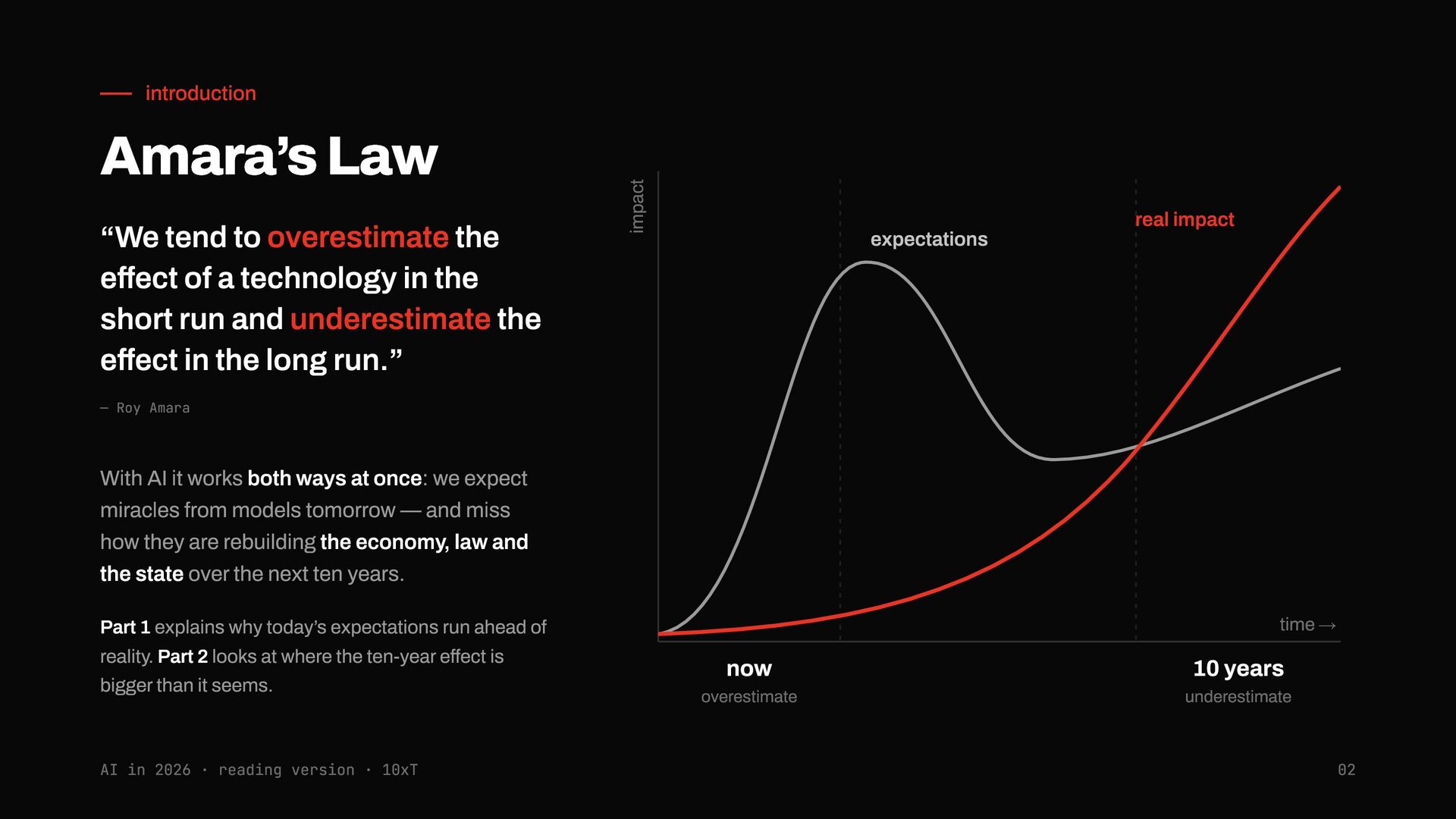
in the short run and underestimate the effect in the long run.” tcapmi Amara’s Law expectations real impact — Roy Amara With AI it works both ways at once: we expect miracles from models tomorrow — and miss how they are rebuilding the economy, law and the state over the next ten years. Part 1 explains why today’s expectations run ahead of reality. Part 2 looks at where the ten-year effect is bigger than it seems. AI in 2026 · reading version · 10xT time → now overestimate 10 years underestimate 02
than usefulness. Models get smarter every quarter, but their real-world value is capped by missing context, by physical limits on scaling, and by the fact that people don’t want chat to replace the tools they already use. AI in 2026 · reading version · 10xT 03
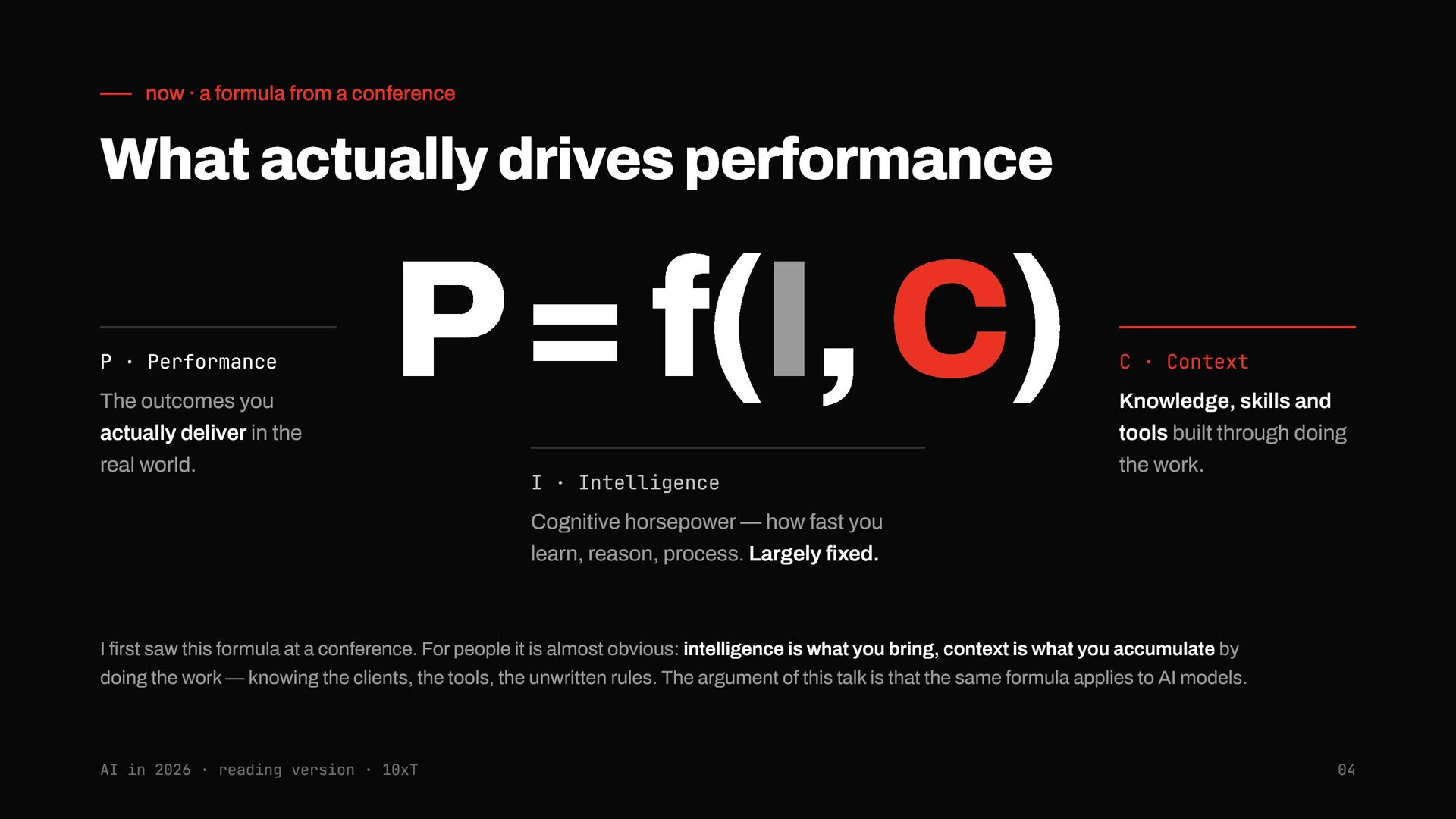
performance P · Performance The outcomes you actually deliver in the real world. P = f(I, C) I · Intelligence C · Context Knowledge, skills and tools built through doing the work. Cognitive horsepower — how fast you learn, reason, process. Largely fixed. I first saw this formula at a conference. For people it is almost obvious: intelligence is what you bring, context is what you accumulate by doing the work — knowing the clients, the tools, the unwritten rules. The argument of this talk is that the same formula applies to AI models. AI in 2026 · reading version · 10xT 04
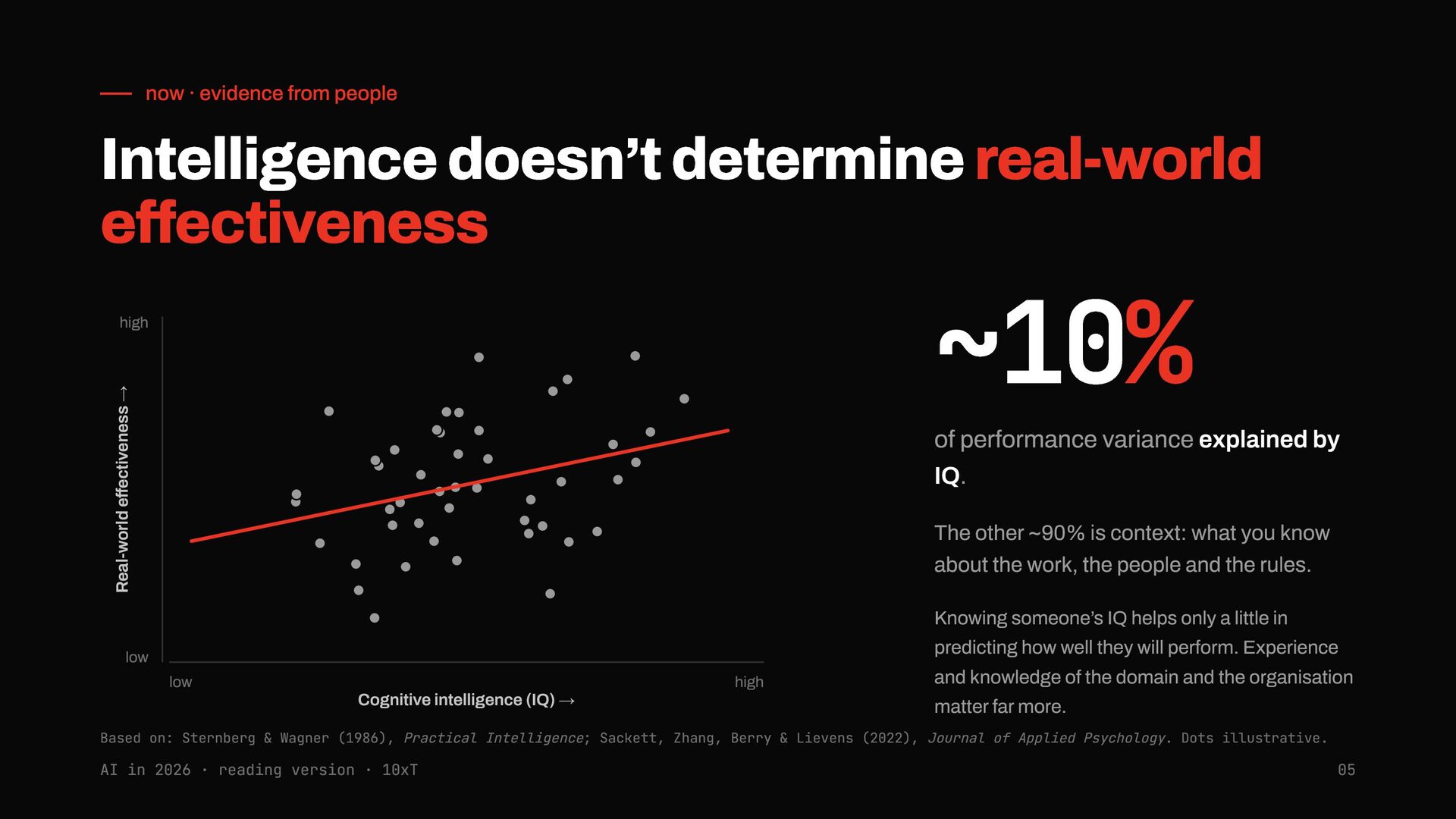
~10% → high ssenevitceffe dlrow-laeR low of performance variance explained by IQ. The other ~90% is context: what you know about the work, the people and the rules. low Cognitive intelligence (IQ) → high Knowing someone’s IQ helps only a little in predicting how well they will perform. Experience and knowledge of the domain and the organisation matter far more. Based on: Sternberg & Wagner (1986), Practical Intelligence; Sackett, Zhang, Berry & Lievens (2022), Journal of Applied Psychology. Dots illustrative. AI in 2026 · reading version · 10xT 05
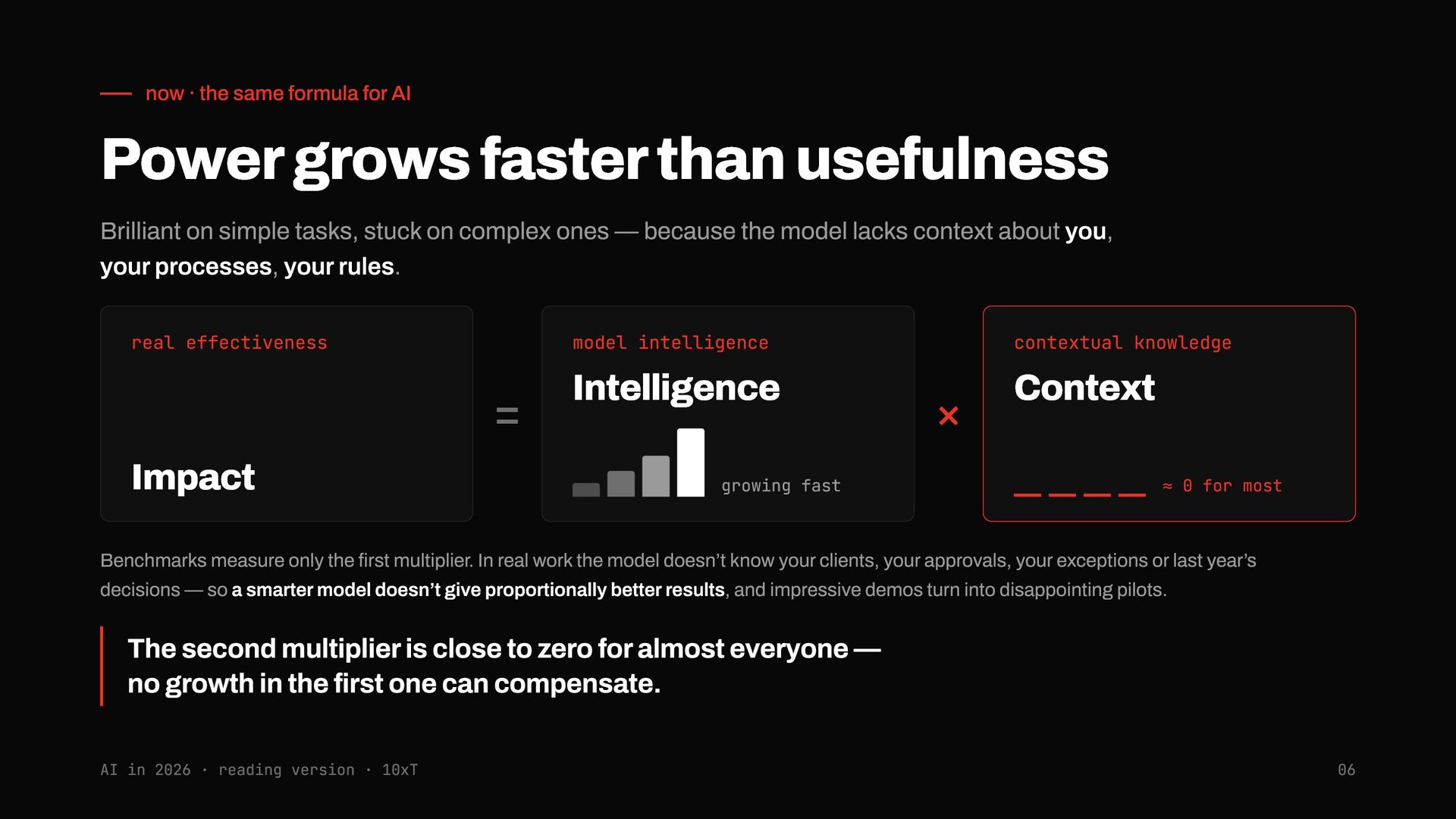
than usefulness Brilliant on simple tasks, stuck on complex ones — because the model lacks context about you, your processes, your rules. real effectiveness Impact model intelligence = Intelligence growing fast contextual knowledge × Context ≈ 0 for most Benchmarks measure only the first multiplier. In real work the model doesn’t know your clients, your approvals, your exceptions or last year’s decisions — so a smarter model doesn’t give proportionally better results, and impressive demos turn into disappointing pilots. The second multiplier is close to zero for almost everyone — no growth in the first one can compensate. AI in 2026 · reading version · 10xT 06
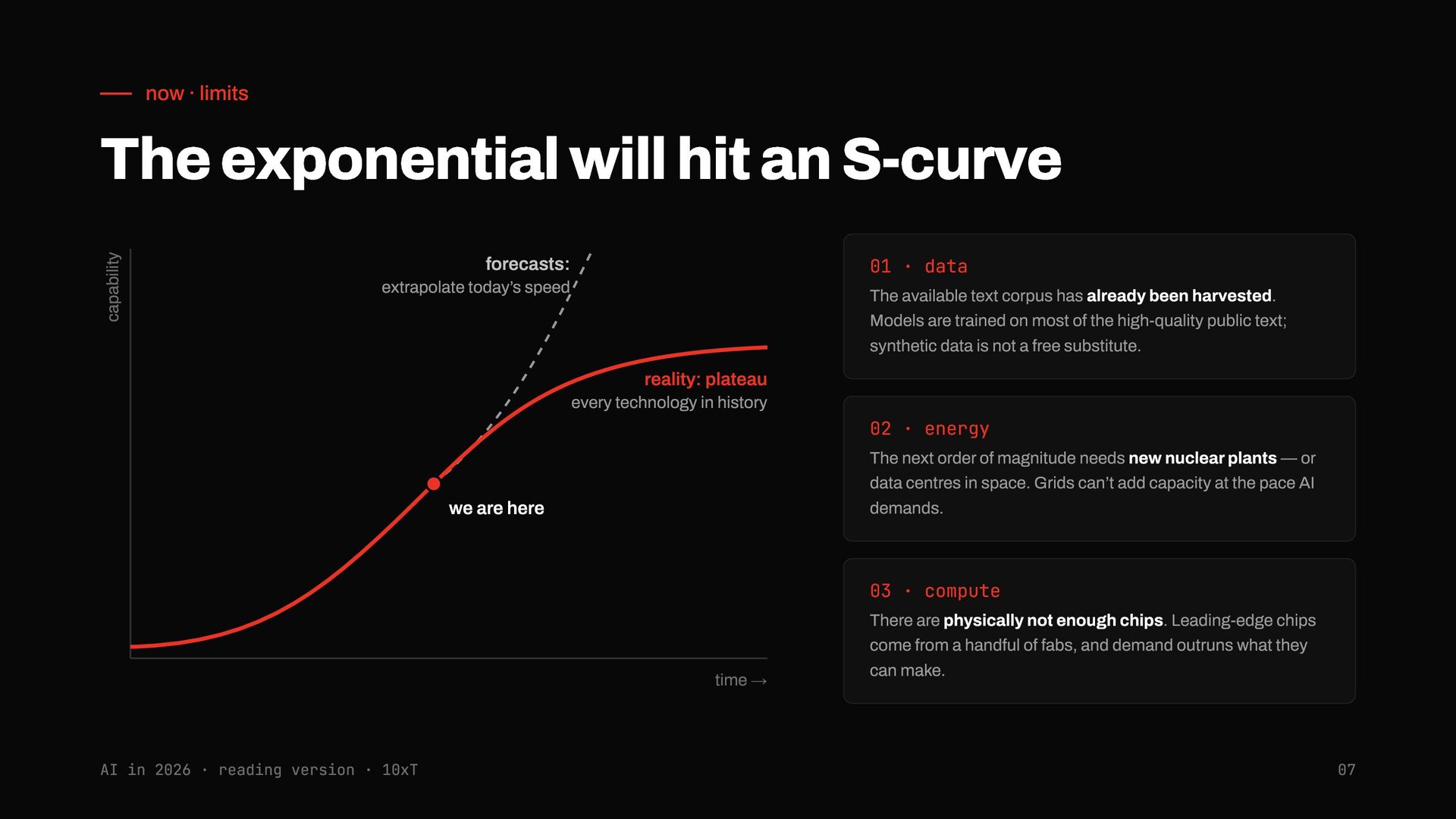
forecasts: 01 · data The available text corpus has already been harvested. Models are trained on most of the high-quality public text; synthetic data is not a free substitute. extrapolate today’s speed reality: plateau every technology in history we are here time → AI in 2026 · reading version · 10xT 02 · energy The next order of magnitude needs new nuclear plants — or data centres in space. Grids can’t add capacity at the pace AI demands. 03 · compute There are physically not enough chips. Leading-edge chips come from a handful of fabs, and demand outruns what they can make. 07
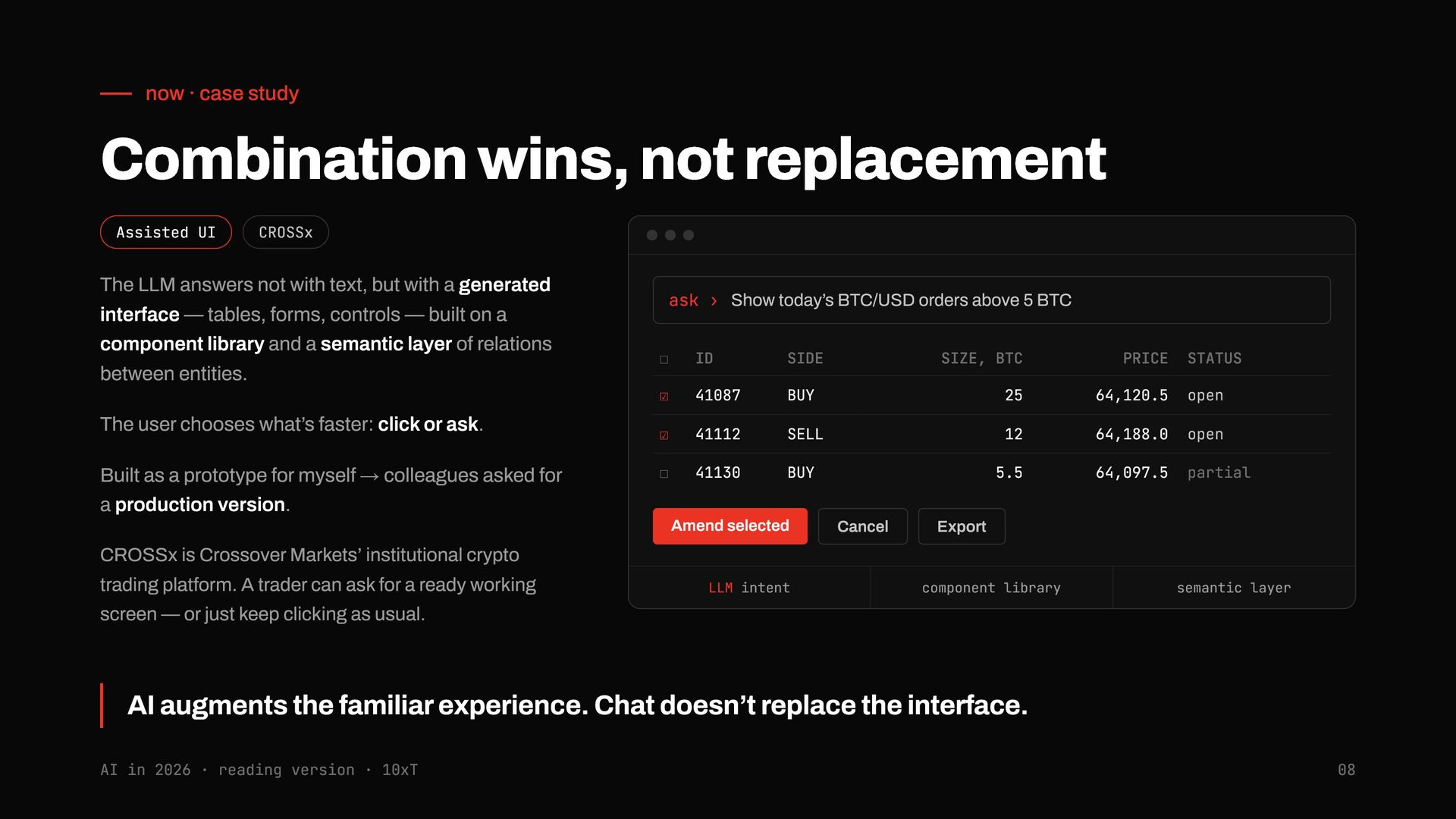
CROSSx The LLM answers not with text, but with a generated interface — tables, forms, controls — built on a component library and a semantic layer of relations between entities. The user chooses what’s faster: click or ask. Built as a prototype for myself → colleagues asked for a production version. CROSSx is Crossover Markets’ institutional crypto trading platform. A trader can ask for a ready working screen — or just keep clicking as usual. ask › Show today’s BTC/USD orders above 5 BTC ☐ ID SIDE SIZE, BTC PRICE ☑ 41087 BUY 25 64,120.5 open ☑ 41112 SELL 12 64,188.0 open ☐ 41130 BUY 5.5 64,097.5 partial Amend selected LLM intent Cancel STATUS Export component library semantic layer AI augments the familiar experience. Chat doesn’t replace the interface. AI in 2026 · reading version · 10xT 08
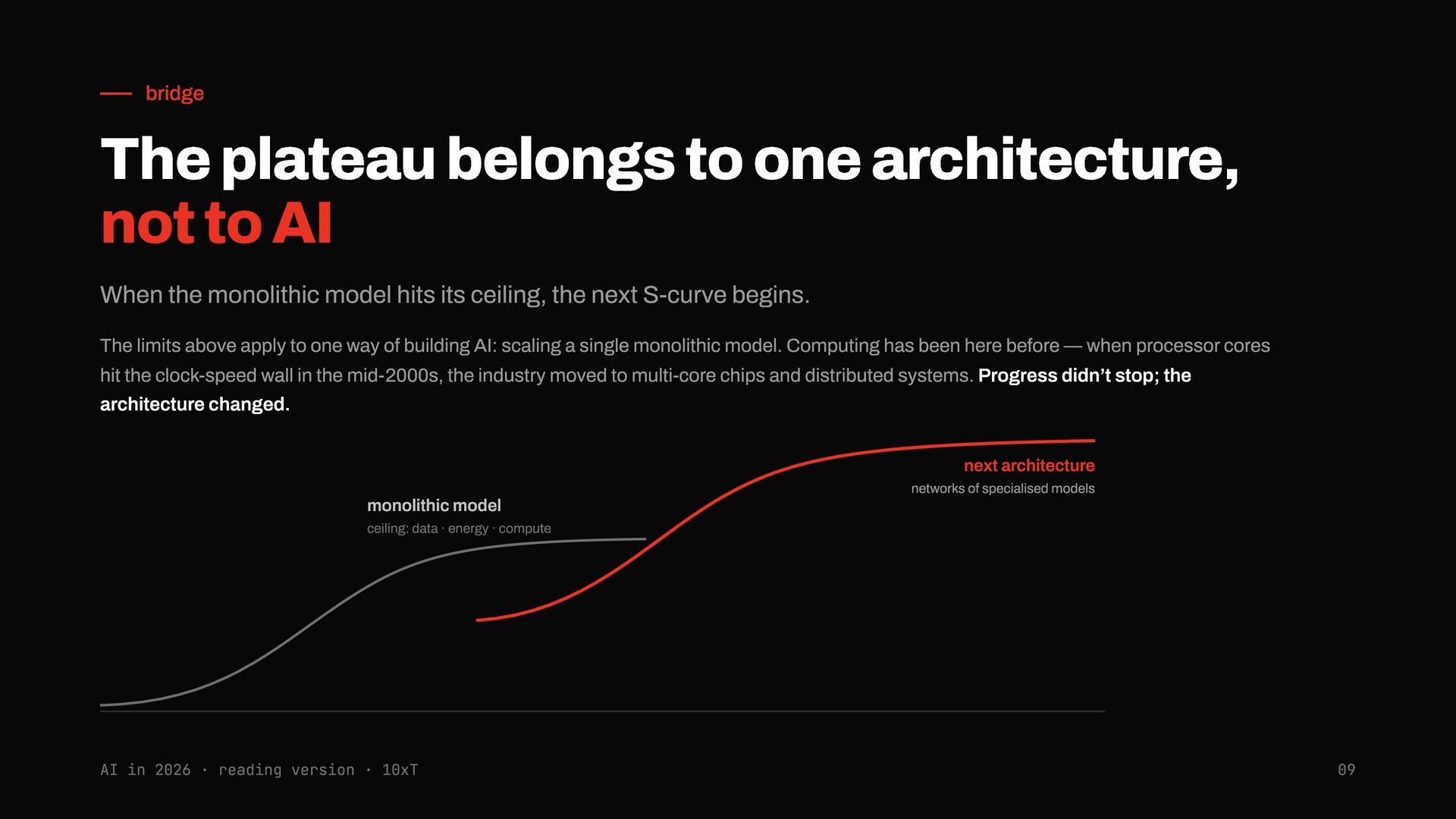
When the monolithic model hits its ceiling, the next S-curve begins. The limits above apply to one way of building AI: scaling a single monolithic model. Computing has been here before — when processor cores hit the clock-speed wall in the mid-2000s, the industry moved to multi-core chips and distributed systems. Progress didn’t stop; the architecture changed. next architecture monolithic model networks of specialised models ceiling: data · energy · compute AI in 2026 · reading version · 10xT 09
· Geopolitics · People Once the architecture changes, the effects spread far beyond technology: how software is made and owned, who wins in the economy, how states depend on each other, and how people learn and grow. AI in 2026 · reading version · 10xT 10
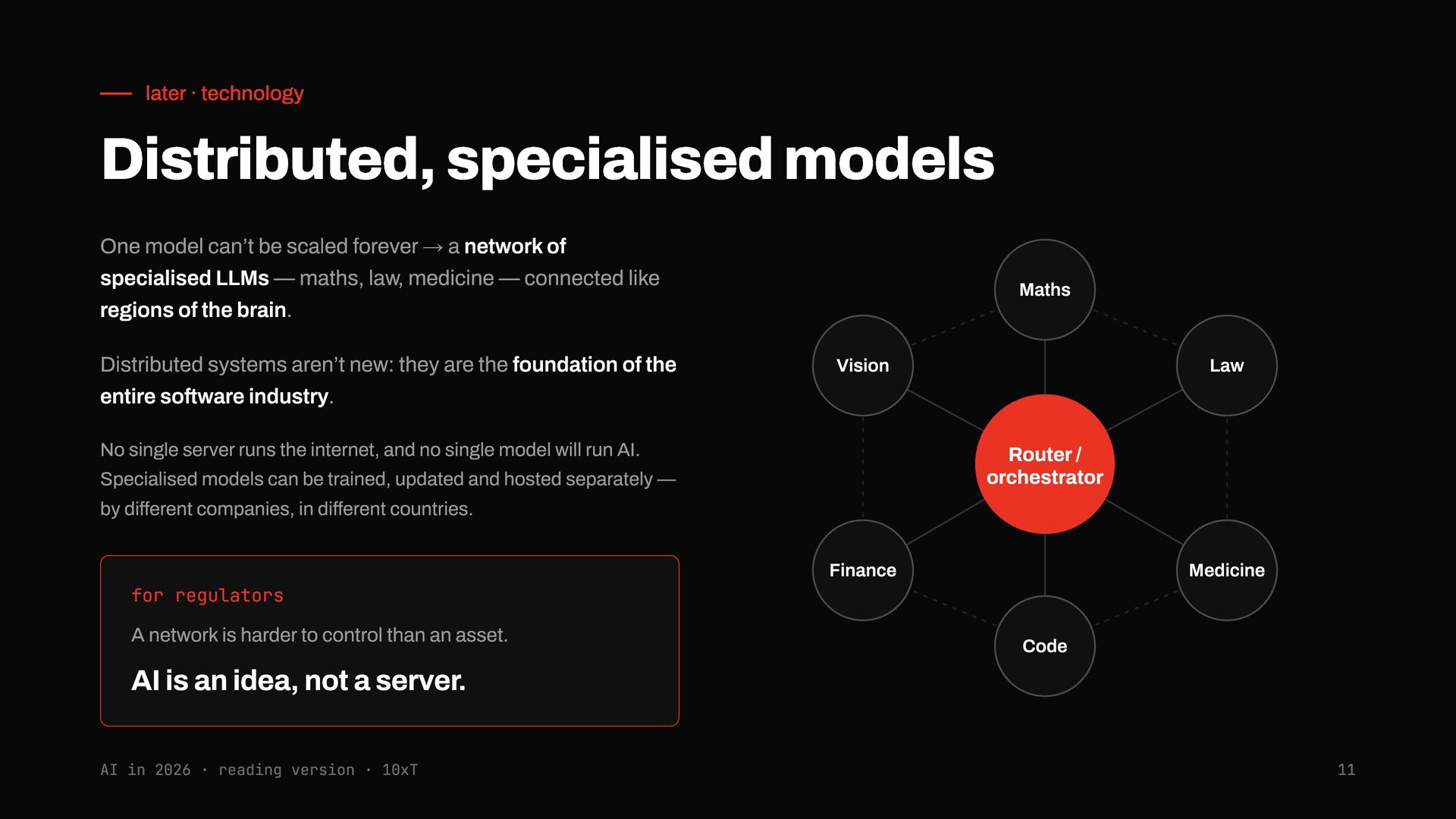
scaled forever → a network of specialised LLMs — maths, law, medicine — connected like regions of the brain. Distributed systems aren’t new: they are the foundation of the entire software industry. Maths Vision No single server runs the internet, and no single model will run AI. Specialised models can be trained, updated and hosted separately — by different companies, in different countries. for regulators A network is harder to control than an asset. AI is an idea, not a server. AI in 2026 · reading version · 10xT Law Router / orchestrator Finance Medicine Code 11
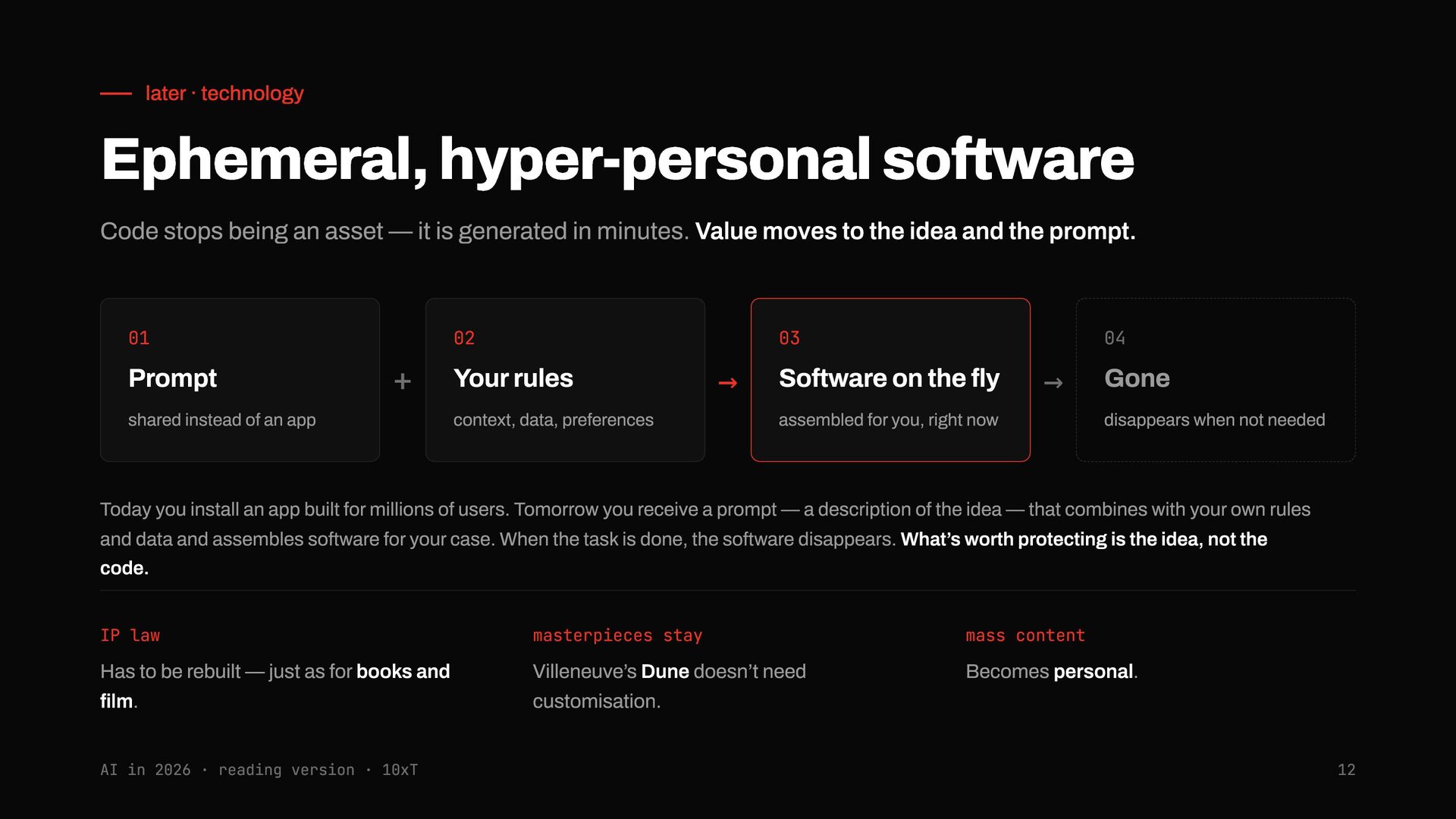
asset — it is generated in minutes. Value moves to the idea and the prompt. 01 Prompt shared instead of an app 02 + 03 Your rules context, data, preferences → 04 Software on the fly → assembled for you, right now Gone disappears when not needed Today you install an app built for millions of users. Tomorrow you receive a prompt — a description of the idea — that combines with your own rules and data and assembles software for your case. When the task is done, the software disappears. What’s worth protecting is the idea, not the code. IP law masterpieces stay mass content Has to be rebuilt — just as for books and film. Villeneuve’s Dune doesn’t need customisation. Becomes personal. AI in 2026 · reading version · 10xT 12
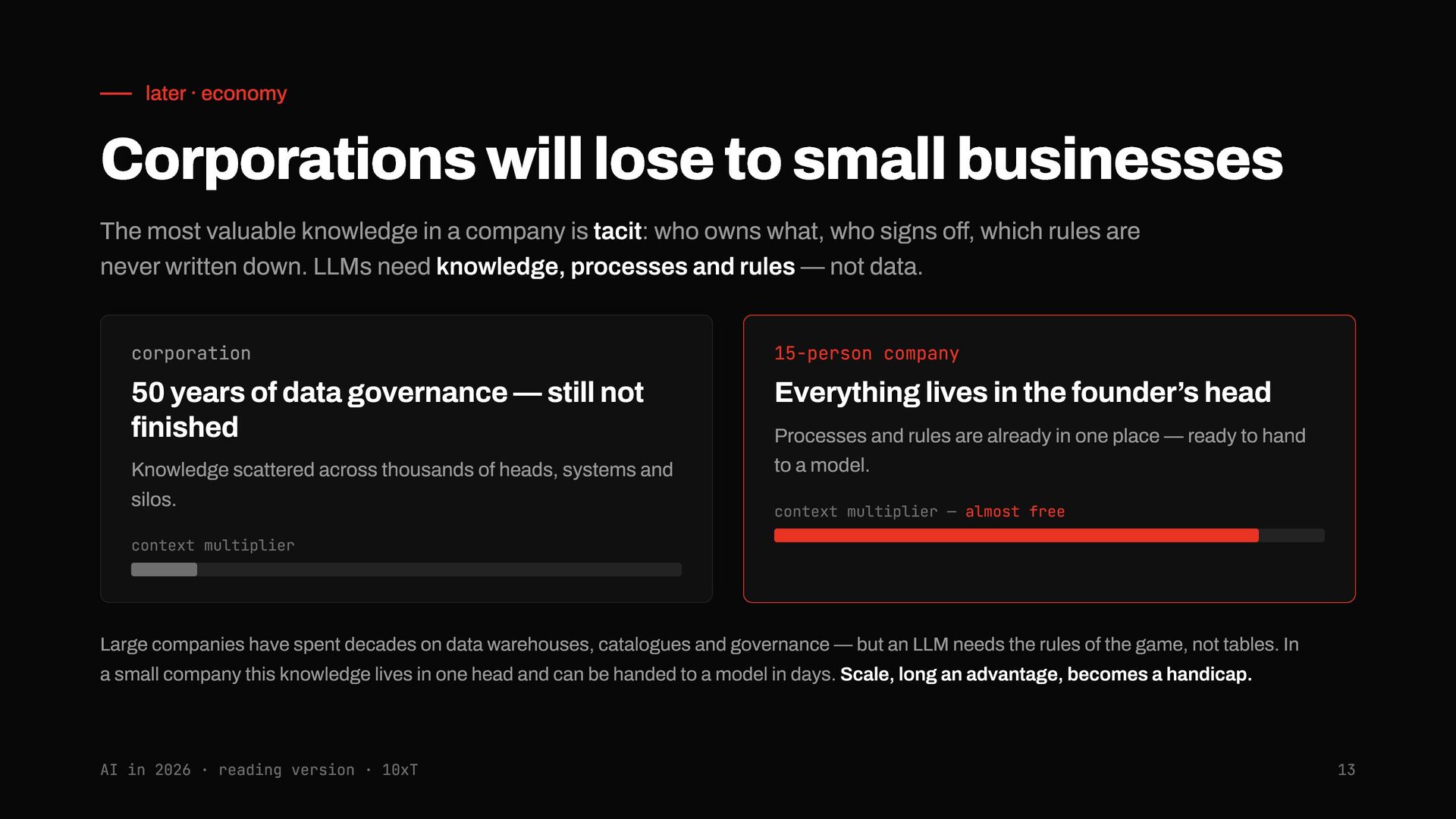
most valuable knowledge in a company is tacit: who owns what, who signs off, which rules are never written down. LLMs need knowledge, processes and rules — not data. corporation 50 years of data governance — still not finished Knowledge scattered across thousands of heads, systems and silos. 15-person company Everything lives in the founder’s head Processes and rules are already in one place — ready to hand to a model. context multiplier — almost free context multiplier Large companies have spent decades on data warehouses, catalogues and governance — but an LLM needs the rules of the game, not tables. In a small company this knowledge lives in one head and can be handed to a model in days. Scale, long an advantage, becomes a handicap. AI in 2026 · reading version · 10xT 13
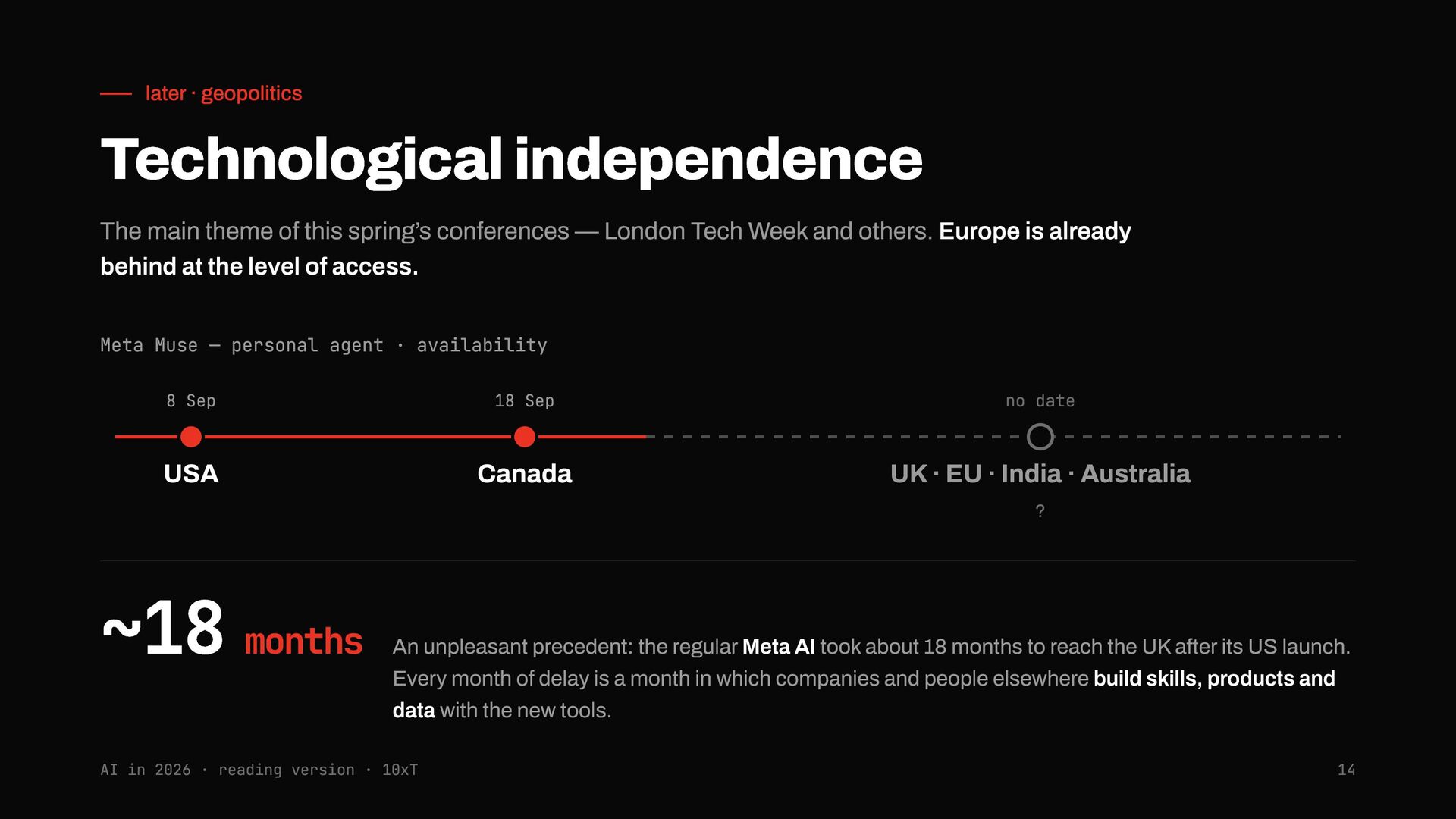
spring’s conferences — London Tech Week and others. Europe is already behind at the level of access. Meta Muse — personal agent · availability 8 Sep 18 Sep no date USA Canada UK · EU · India · Australia ~18 months ? An unpleasant precedent: the regular Meta AI took about 18 months to reach the UK after its US launch. Every month of delay is a month in which companies and people elsewhere build skills, products and data with the new tools. AI in 2026 · reading version · 10xT 14
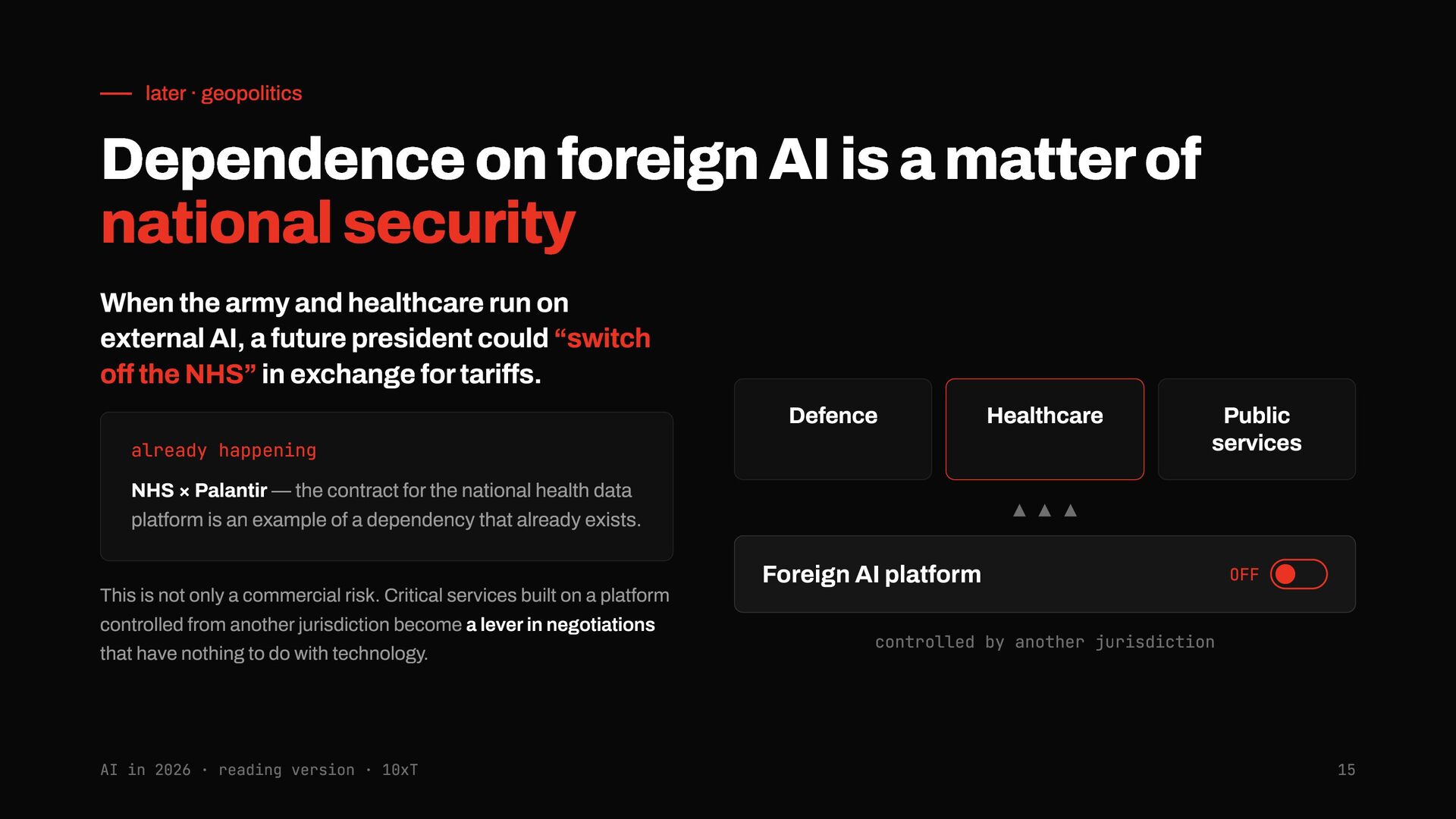
of national security When the army and healthcare run on external AI, a future president could “switch off the NHS” in exchange for tariffs. Defence Healthcare already happening NHS × Palantir — the contract for the national health data platform is an example of a dependency that already exists. This is not only a commercial risk. Critical services built on a platform controlled from another jurisdiction become a lever in negotiations that have nothing to do with technology. AI in 2026 · reading version · 10xT Public services ▲ ▲ ▲ Foreign AI platform OFF controlled by another jurisdiction 15
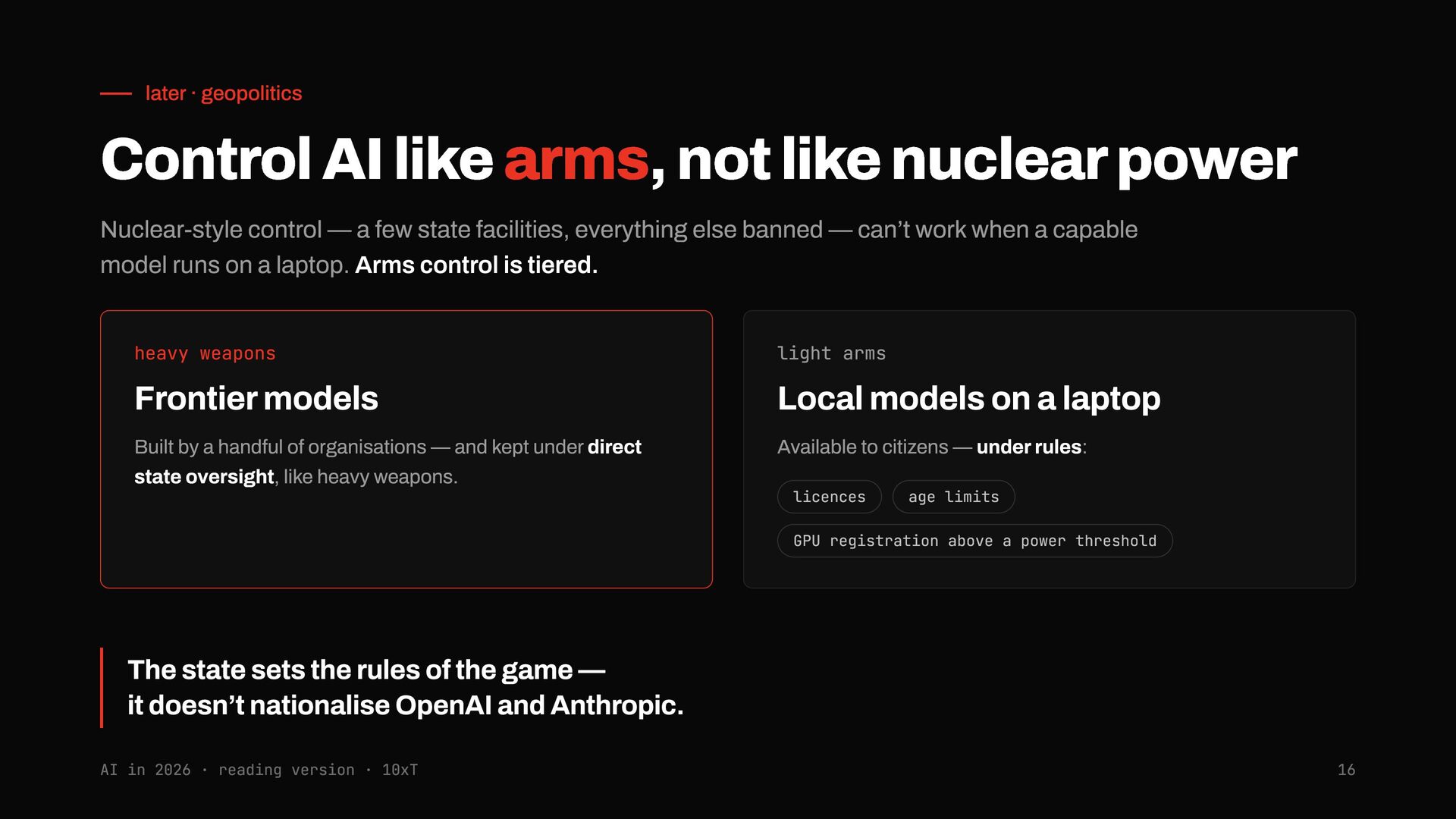
power Nuclear-style control — a few state facilities, everything else banned — can’t work when a capable model runs on a laptop. Arms control is tiered. heavy weapons light arms Frontier models Local models on a laptop Built by a handful of organisations — and kept under direct state oversight, like heavy weapons. Available to citizens — under rules: licences age limits GPU registration above a power threshold The state sets the rules of the game — it doesn’t nationalise OpenAI and Anthropic. AI in 2026 · reading version · 10xT 16
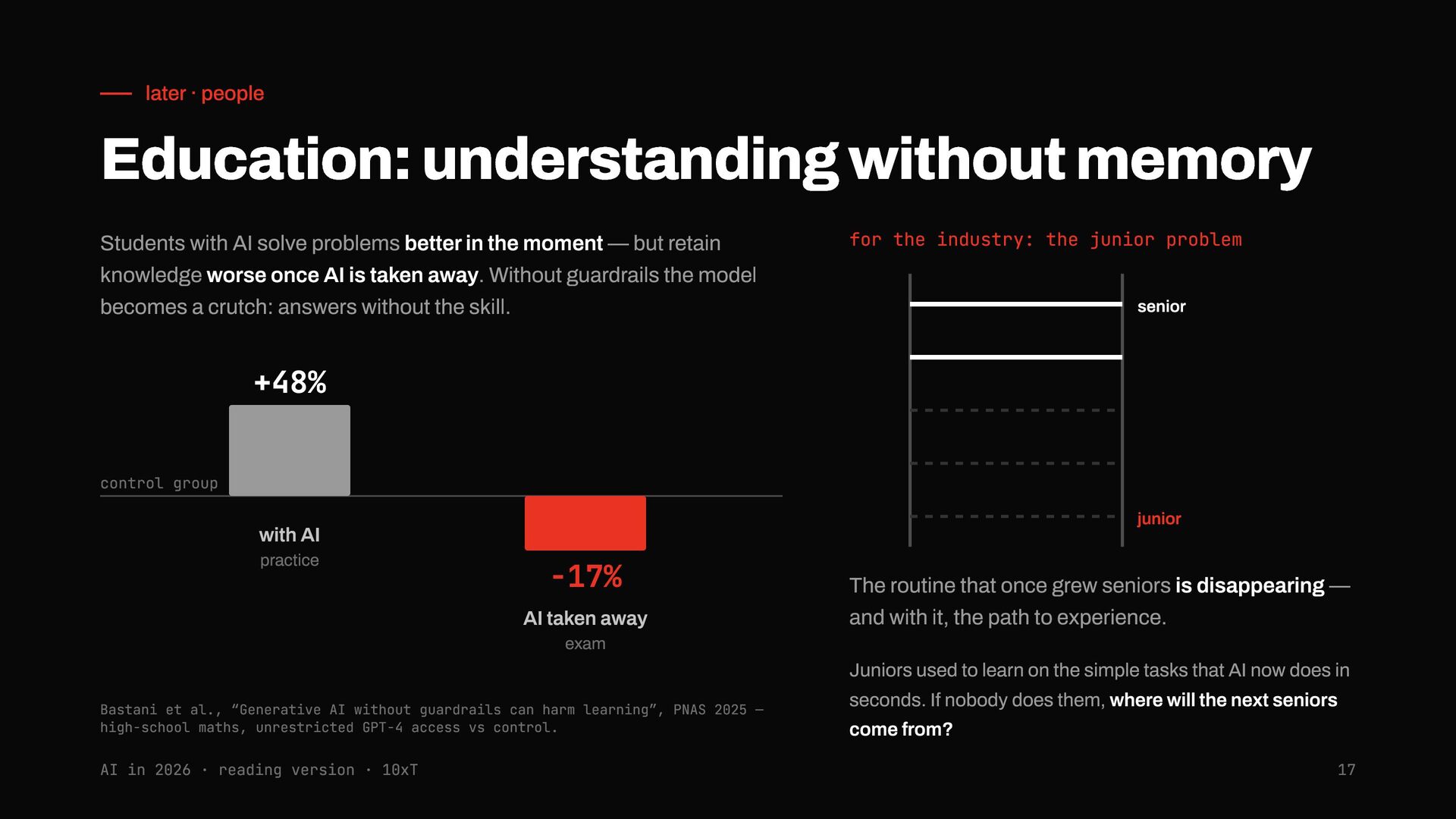
solve problems better in the moment — but retain knowledge worse once AI is taken away. Without guardrails the model becomes a crutch: answers without the skill. for the industry: the junior problem senior +48% control group junior with AI practice −17% AI taken away exam Bastani et al., “Generative AI without guardrails can harm learning”, PNAS 2025 — high-school maths, unrestricted GPT-4 access vs control. AI in 2026 · reading version · 10xT The routine that once grew seniors is disappearing — and with it, the path to experience. Juniors used to learn on the simple tasks that AI now does in seconds. If nobody does them, where will the next seniors come from? 17
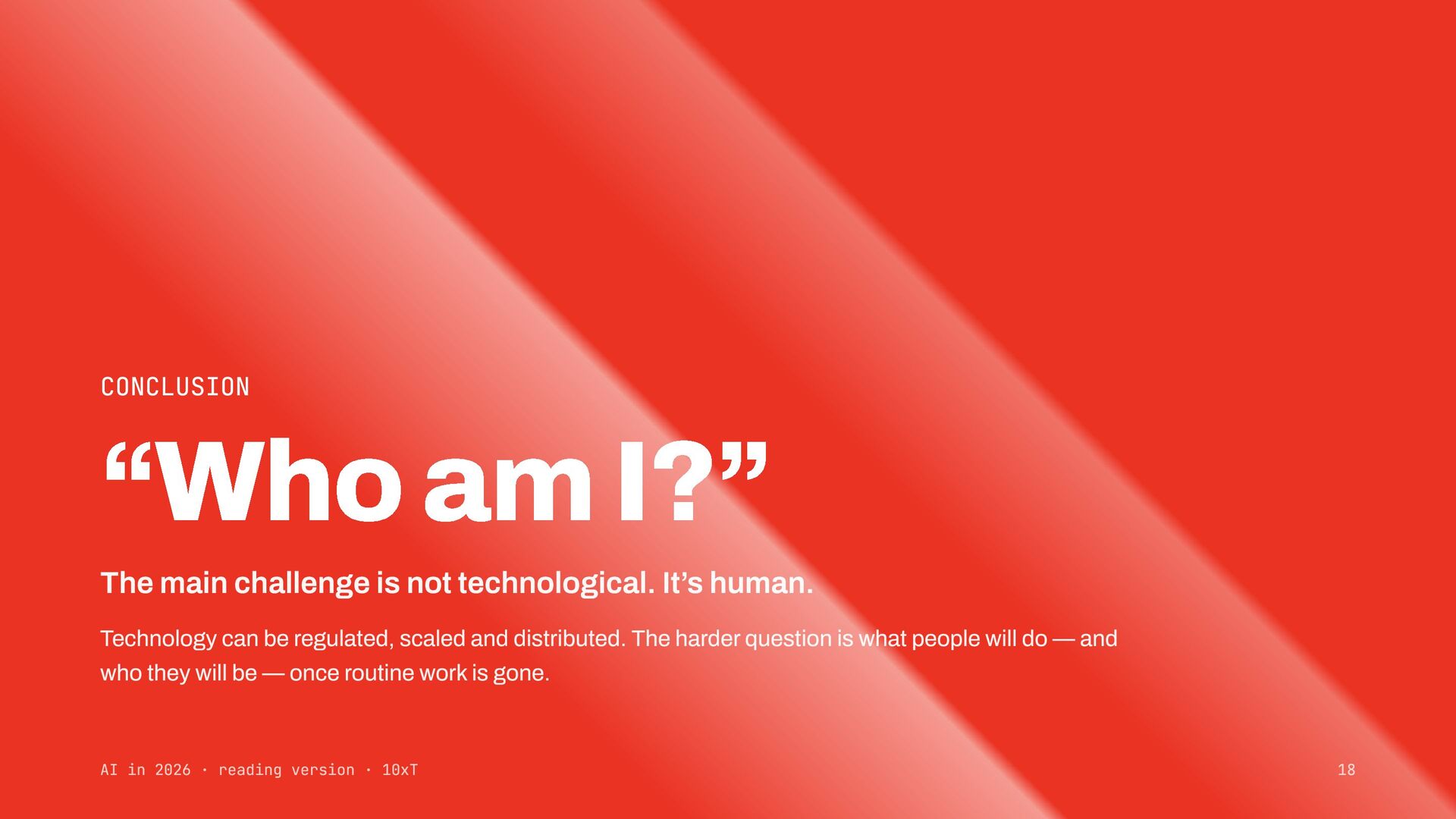
It’s human. Technology can be regulated, scaled and distributed. The harder question is what people will do — and who they will be — once routine work is gone. AI in 2026 · reading version · 10xT 18
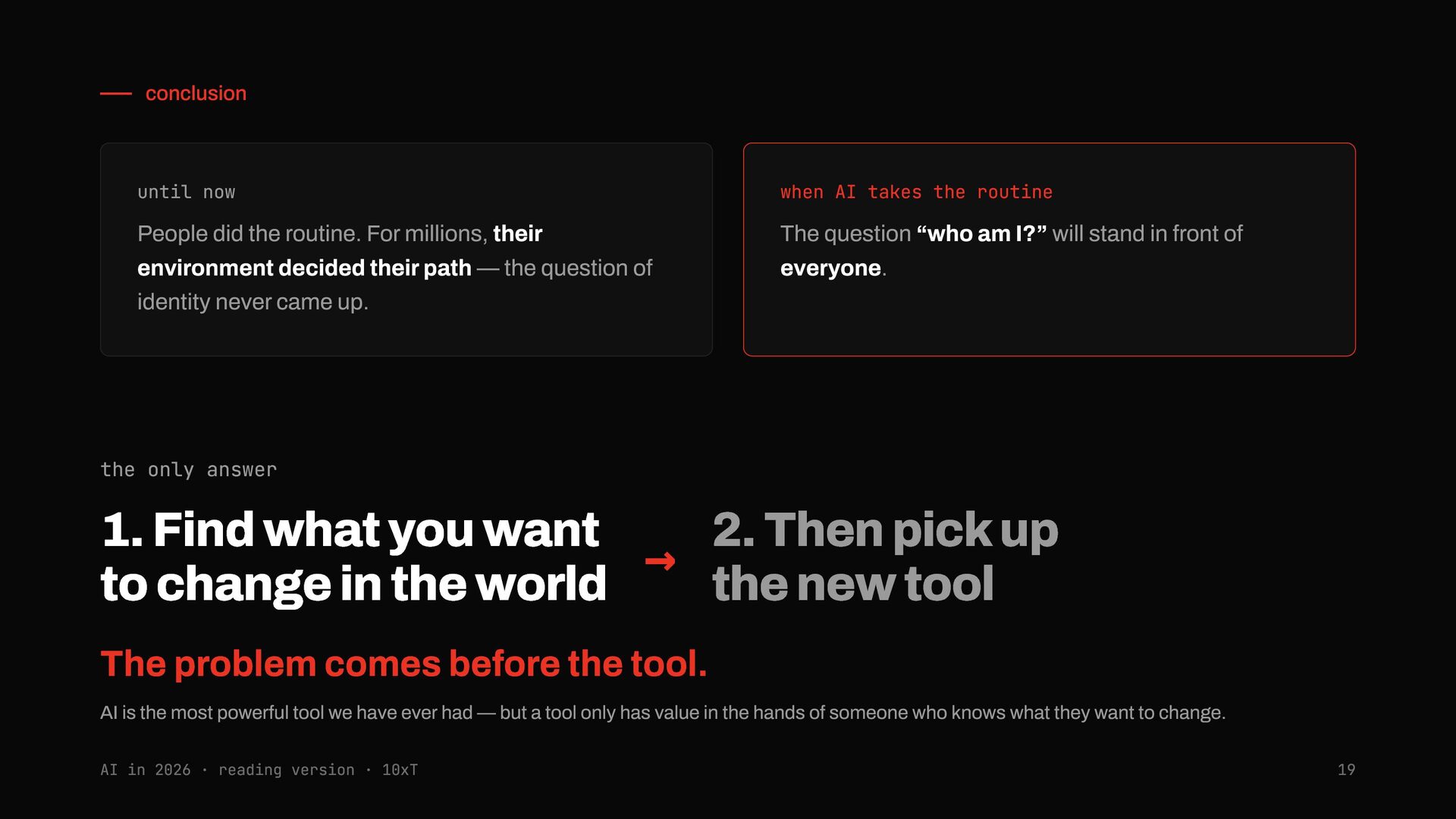
the routine. For millions, their environment decided their path — the question of identity never came up. The question “who am I?” will stand in front of everyone. the only answer 1. Find what you want → 2. Then pick up to change in the world the new tool The problem comes before the tool. AI is the most powerful tool we have ever had — but a tool only has value in the hands of someone who knows what they want to change. AI in 2026 · reading version · 10xT 19


 ryanjones
 jlugia
 destraynor
 jcasabona
 cassininazir
 rkendrick25
 shlominoach
 bryan
bryan
 eileencodes
 marktimemedia
 jdejongh
 katarinadahlin
![Thank you Let’s talk. Denis Afanasev · [email protected] 10xt.tech 40](https://files.speakerdeck.com/presentations/459d2fc7c00c4f15b594409b0f7f343e/slide_19.jpg)