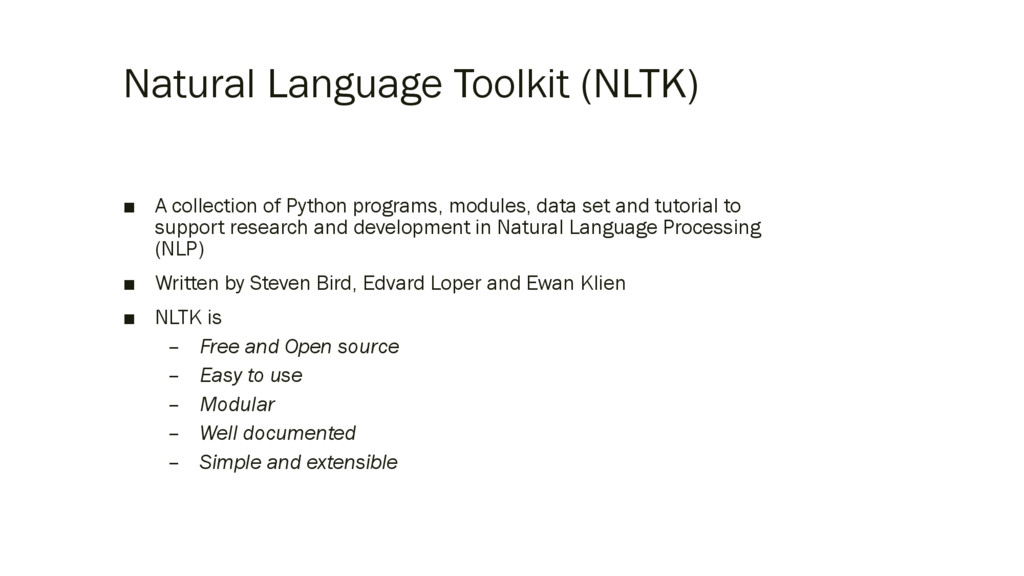
modules, data set and tutorial to support research and development in Natural Language Processing (NLP) ▪ Written by Steven Bird, Edvard Loper and Ewan Klien ▪ NLTK is – Free and Open source – Easy to use – Modular – Well documented – Simple and extensible
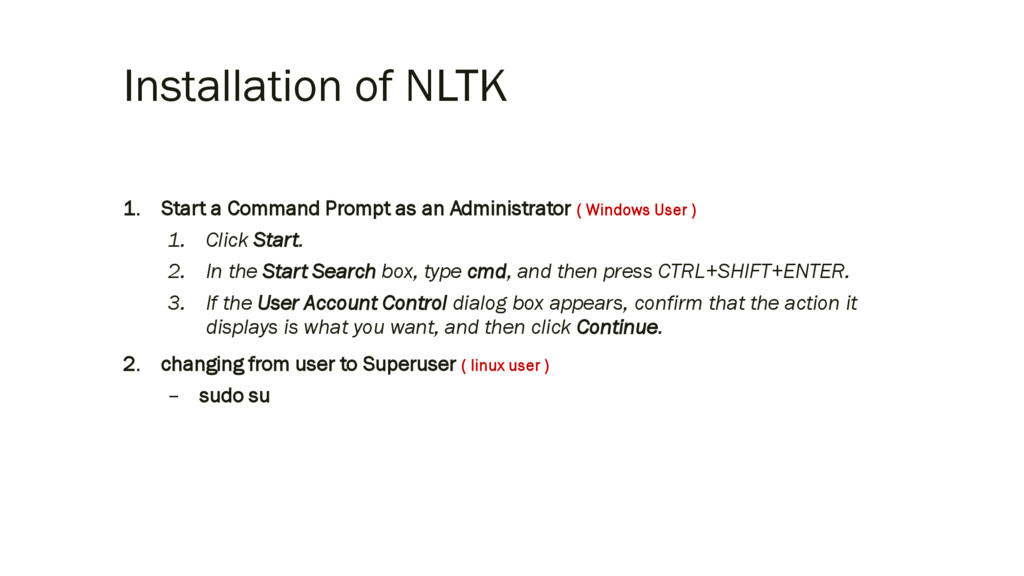
Administrator ( Windows User ) 1. Click Start. 2. In the Start Search box, type cmd, and then press CTRL+SHIFT+ENTER. 3. If the User Account Control dialog box appears, confirm that the action it displays is what you want, and then click Continue. 2. changing from user to Superuser ( linux user ) – sudo su
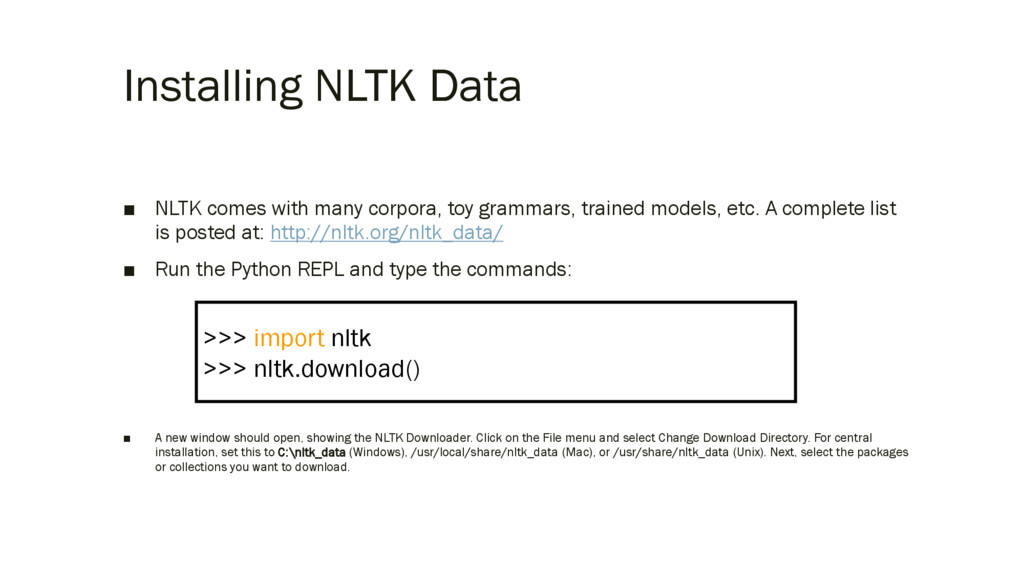
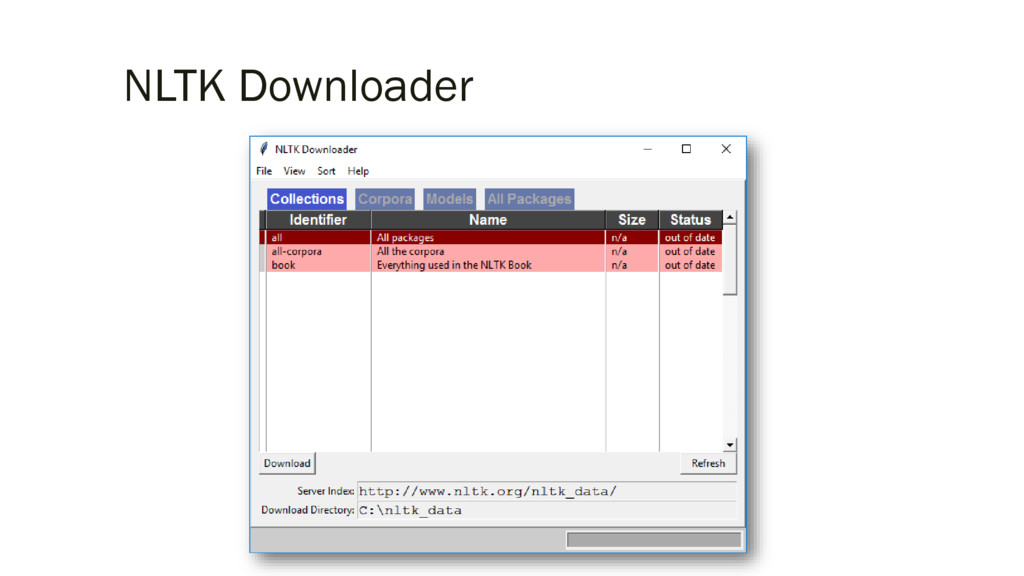
grammars, trained models, etc. A complete list is posted at: http://nltk.org/nltk_data/ ▪ Run the Python REPL and type the commands: ▪ A new window should open, showing the NLTK Downloader. Click on the File menu and select Change Download Directory. For central installation, set this to C:\nltk_data (Windows), /usr/local/share/nltk_data (Mac), or /usr/share/nltk_data (Unix). Next, select the packages or collections you want to download. >>> import nltk >>> nltk.download()
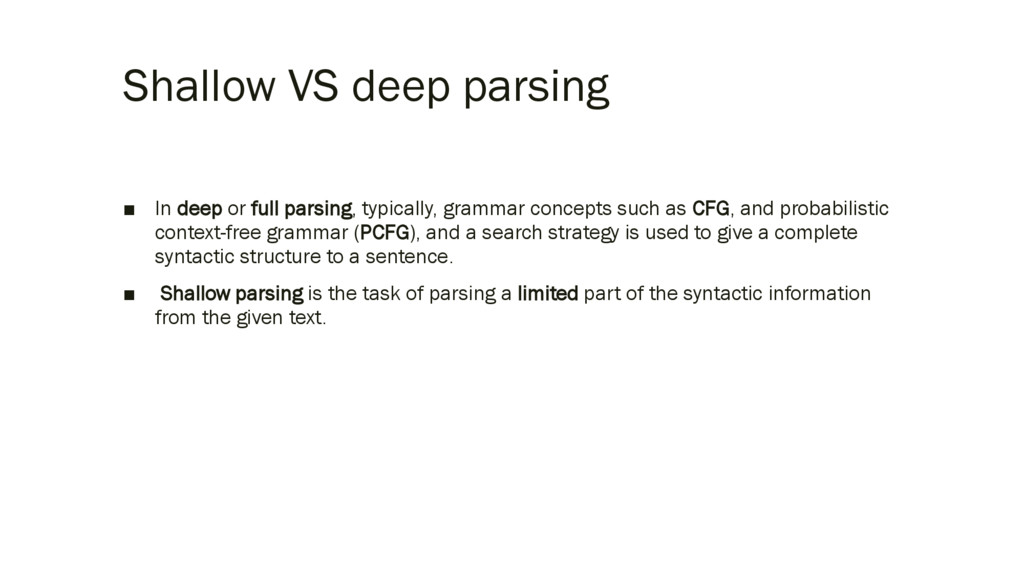
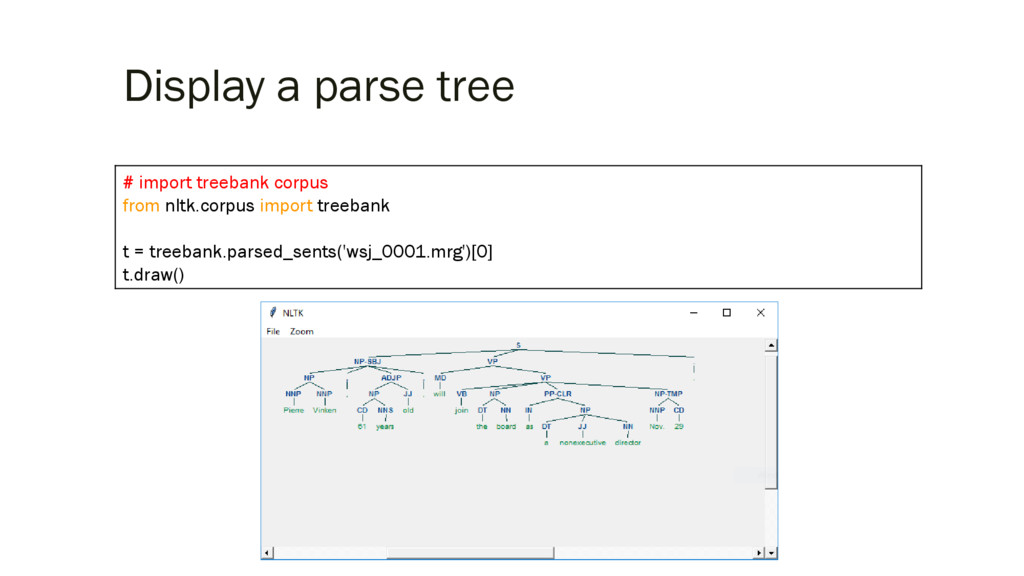
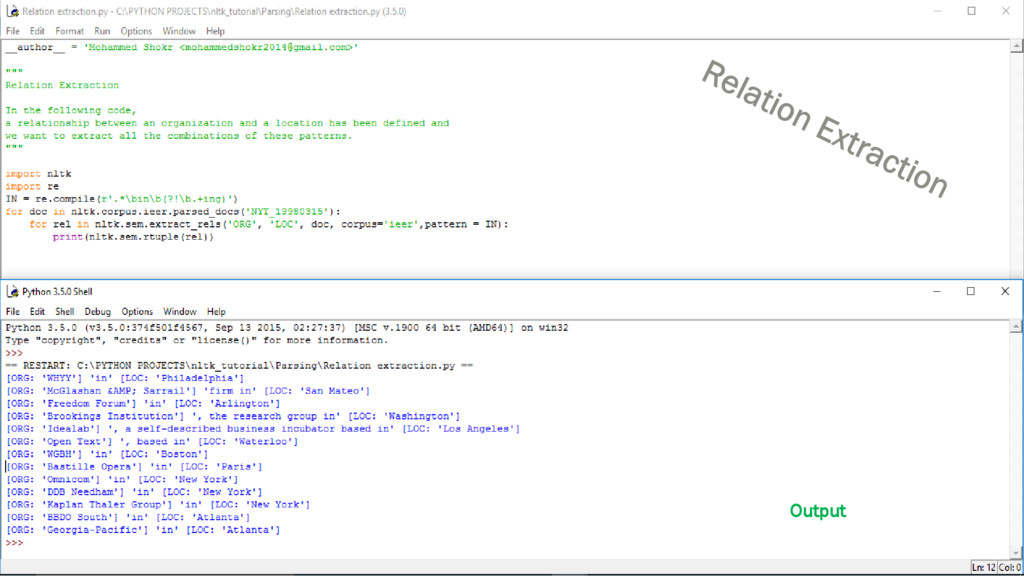
typically, grammar concepts such as CFG, and probabilistic context-free grammar (PCFG), and a search strategy is used to give a complete syntactic structure to a sentence. ▪ Shallow parsing is the task of parsing a limited part of the syntactic information from the given text.
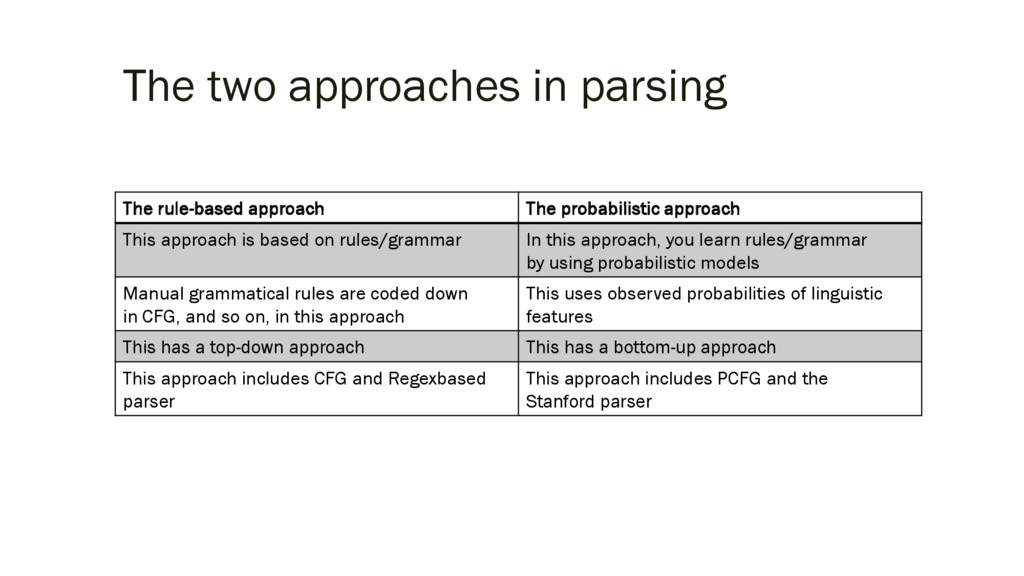
approach This approach is based on rules/grammar In this approach, you learn rules/grammar by using probabilistic models Manual grammatical rules are coded down in CFG, and so on, in this approach This uses observed probabilities of linguistic features This has a top-down approach This has a bottom-up approach This approach includes CFG and Regexbased parser This approach includes PCFG and the Stanford parser
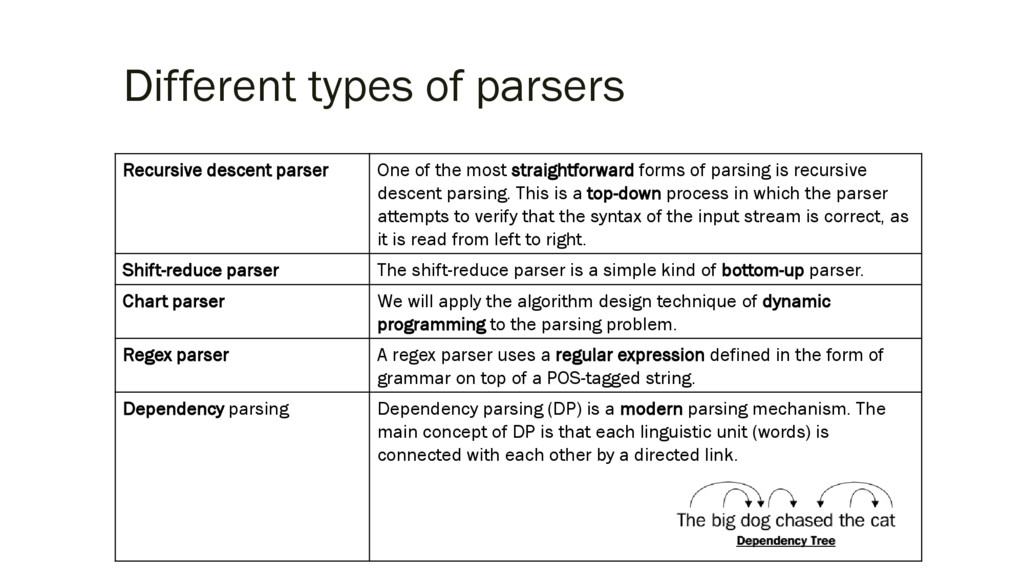
most straightforward forms of parsing is recursive descent parsing. This is a top-down process in which the parser attempts to verify that the syntax of the input stream is correct, as it is read from left to right. Shift-reduce parser The shift-reduce parser is a simple kind of bottom-up parser. Chart parser We will apply the algorithm design technique of dynamic programming to the parsing problem. Regex parser A regex parser uses a regular expression defined in the form of grammar on top of a POS-tagged string. Dependency parsing Dependency parsing (DP) is a modern parsing mechanism. The main concept of DP is that each linguistic unit (words) is connected with each other by a directed link.
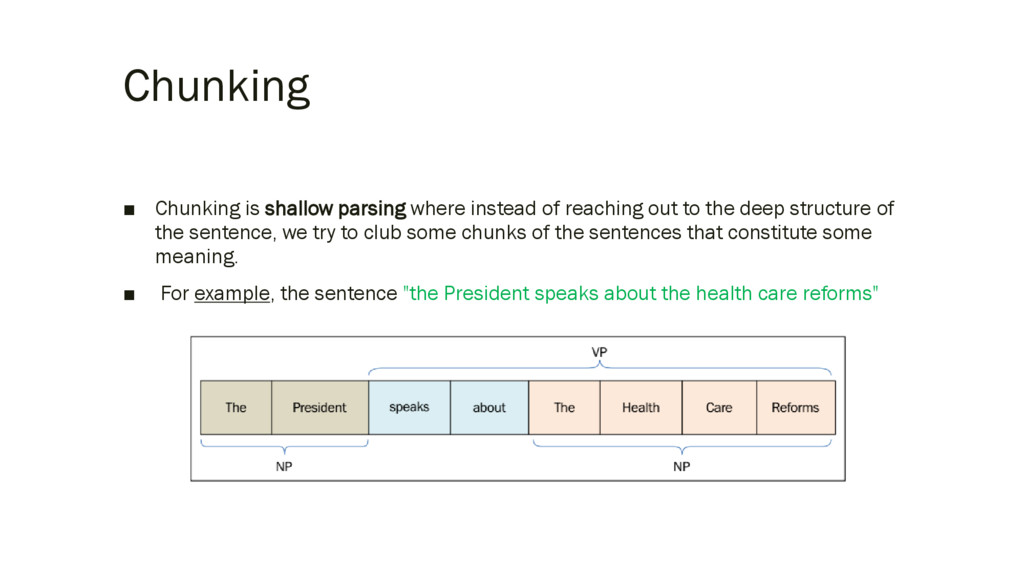
out to the deep structure of the sentence, we try to club some chunks of the sentences that constitute some meaning. ▪ For example, the sentence "the President speaks about the health care reforms"


 shokr
shokr
 a_matsuda
 oniak3ibm
 tosite
 y0hgi
y0hgi
 timakin
 siroemk
 kishida
 ryu1013
 kaityo256
 irinanazarova
 akit37
 frankvandijk
 reverentgeek
 palkan
 bkeepers
 marcelosomers
 helmedeiros
 techseoconnect
 aleyda
 mza
mza
 davidcarrasco
 cassininazir
 csswizardry