Upgrade to Pro
— share decks privately, control downloads, hide ads and more …
Speaker Deck
Sign up for free
Menu
Search
Features
All features
Private URLs
Password Protection
Custom URLS
Scheduled publishing
Remove Branding
Restrict embedding
Deck Collections
Notes
Features
All features
Private URLs
Password Protection
Custom URLS
Scheduled publishing
Remove Branding
Restrict embedding
Deck Collections
Notes
Explore
Featured decks
Featured speakers
Programming
Technology
Storyboards
Explore
Featured decks
Featured speakers
Programming
Technology
Storyboards
Pricing
Search
Sign in
Sign up for free
D言語に入門した話 / Introduction to D language
Search
Sponsored
·
Ship Features Fearlessly
Turn features on and off without deploys. Used by thousands of Ruby developers.
→
chapati
April 19, 2022
Technology
440
0
Share
Embed
Copy iframe code
Copy JS code
Copy link
Start on current slide
D言語に入門した話 / Introduction to D language
D言語に入門した話です
Twitterでご指摘いただいたのですが
- スライド15ページに記載のCTFEの実行について,バイトコードへの変換は特に行っていないようです
chapati
April 19, 2022
More Decks by chapati
See All by chapati
GCCのプラグインを作る / I Made a GCC Plugin
shouth
1
290
Other Decks in Technology
See All in Technology
生成AIと進める探索的データ分析(2026.10.03 第122回Tokyo.R勉強会)
tatamiya
2
1.5k
1万名の社員が使う認証基盤で どう信頼性を担保するか?
kairim0
0
220
AgentCoreで実践するハーネスエンジニアリング
yakumo
1
300
DevelopersIO 2026 知識の地図を描く ─ オントロジーとは何か?
ishikawa_satoru
1
1.3k
継続的なAIコスト最適化
bgpat
1
280
今こそ知りたいAmplifyGen2
mkdev10
2
160
freeeらしさをAIとともに作る / Creating the freee Experience with AI
ymrl
0
220
Essential architectural thinking (revised edition)
ufried
0
110
AIがコードを書く時代に、エンジニアは何で自分の価値を証明するのか / In an era where AI writes code how do engineers prove their value
carta_engineering
1
760
MCPゲートウェイを作って運用してわかったこと — Agent時代の権限管理の現在地
mtpooh
10
3.3k
分析の民主化を支えるメタデータ整備の実践
kakehashi
PRO
4
1.2k
V8のArray.prototype.flatを最大約20倍速くするまでと、巨大OSSへの大規模コミットの道のり
riyaamemiya
0
160
Featured
See All Featured
Money Talks: Using Revenue to Get Sh*t Done
nikkihalliwell
0
520
The Power of CSS Pseudo Elements
geoffreycrofte
82
6.6k
Jess Joyce - The Pitfalls of Following Frameworks
techseoconnect
PRO
1
440
Templates, Plugins, & Blocks: Oh My! Creating the theme that thinks of everything
marktimemedia
31
2.9k
Intergalactic Javascript Robots from Outer Space
tanoku
273
27k
DBのスキルで生き残る技術 - AI時代におけるテーブル設計の勘所
soudai
PRO
68
58k
Design of three-dimensional binary manipulators for pick-and-place task avoiding obstacles (IECON2024)
konakalab
0
610
From π to Pie charts
rasagy
1
390
DevOps and Value Stream Thinking: Enabling flow, efficiency and business value
helenjbeal
2
400
How to train your dragon (web standard)
notwaldorf
96
6.9k
Google's AI Overviews - The New Search
badams
0
1.6k
Paper Plane (Part 1)
katiecoart
PRO
2
11k
Transcript
D言語に入門した話 チャパティ
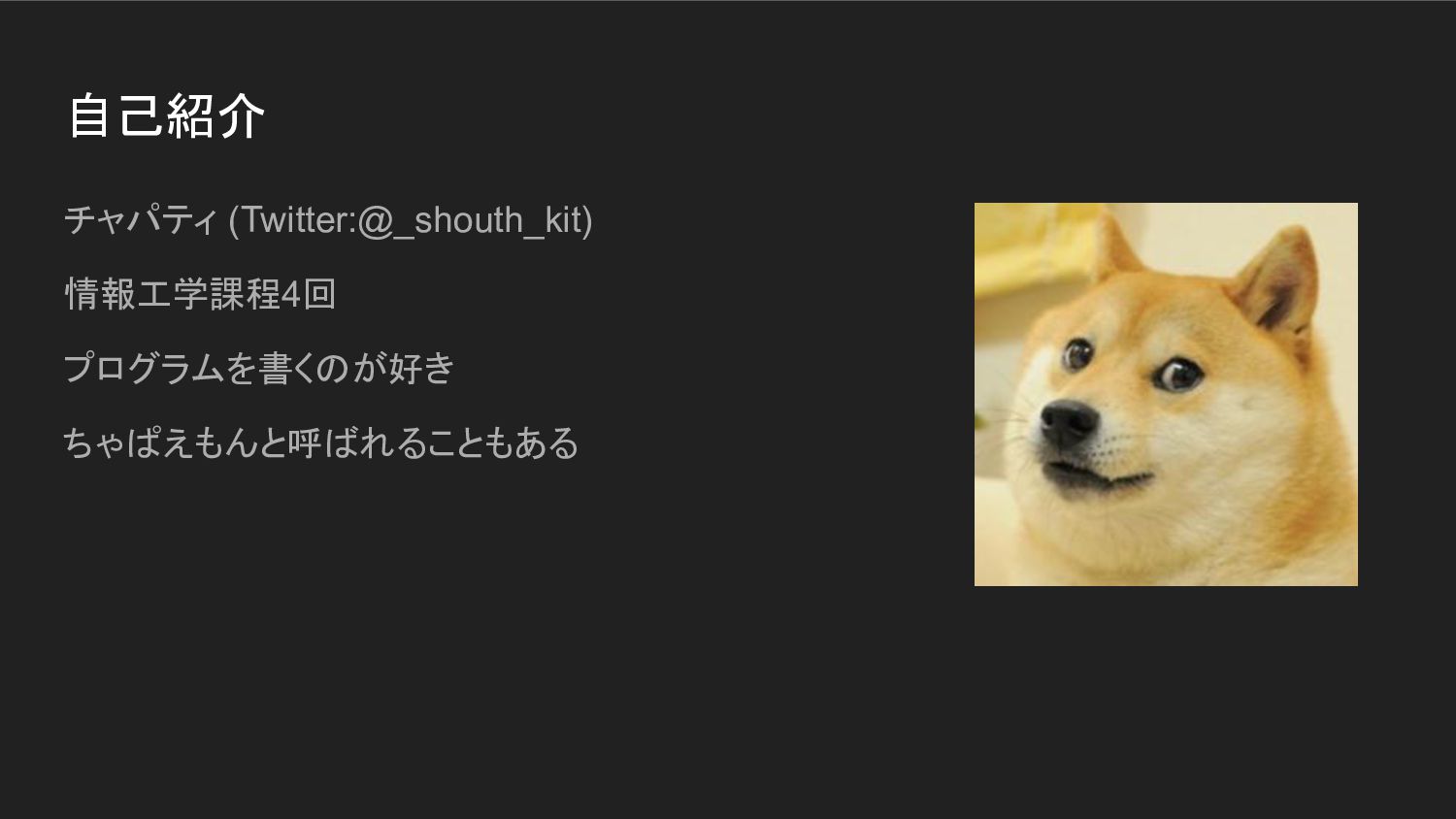
自己紹介 チャパティ (Twitter:@_shouth_kit) 情報工学課程4回 プログラムを書くのが好き ちゃぱえもんと呼ばれることもある
D言語って 知ってますか?
None
None
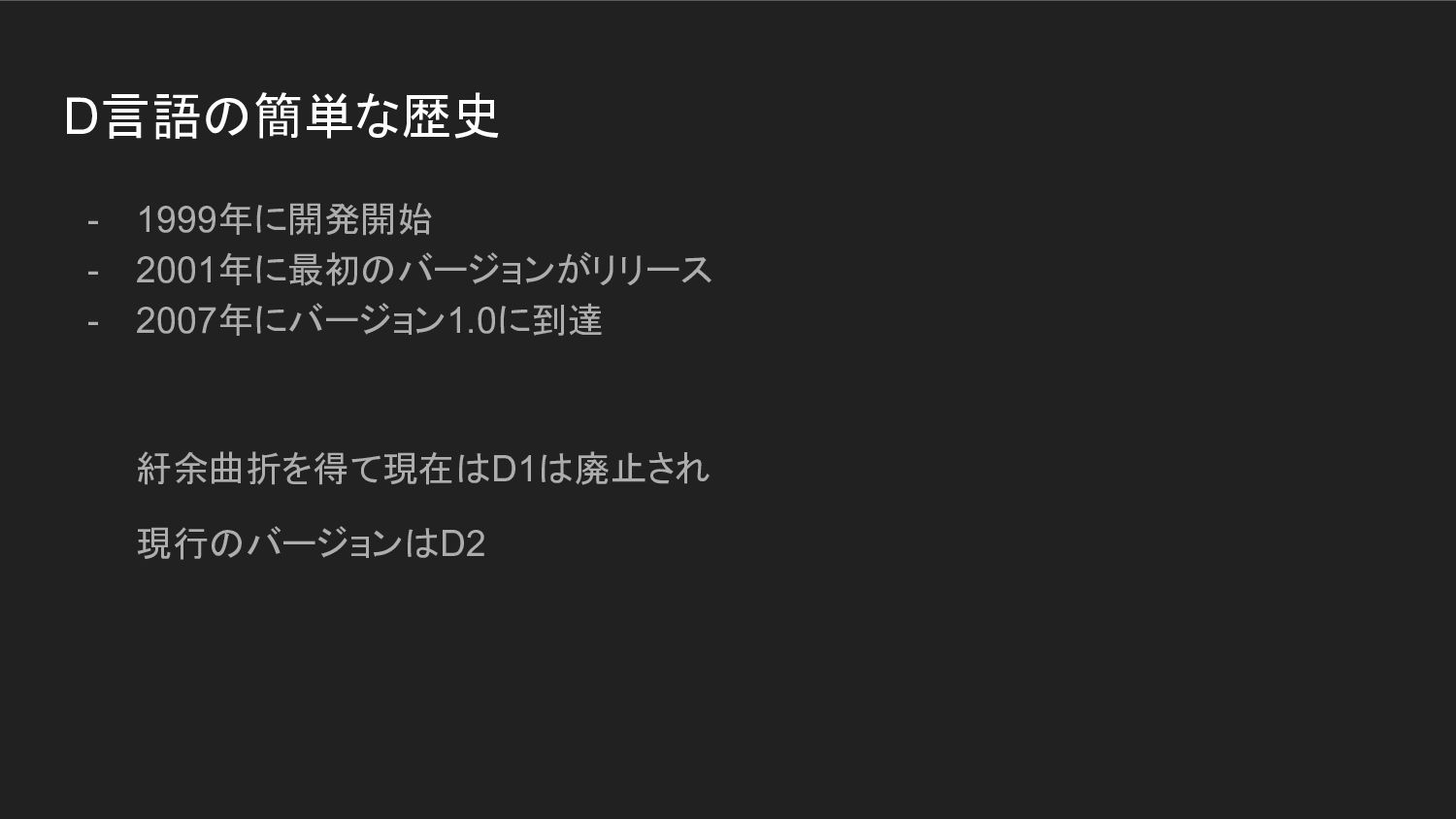
D言語の簡単な歴史 - 1999年に開発開始 - 2001年に最初のバージョンがリリース - 2007年にバージョン1.0に到達 紆余曲折を得て現在はD1は廃止され 現行のバージョンはD2
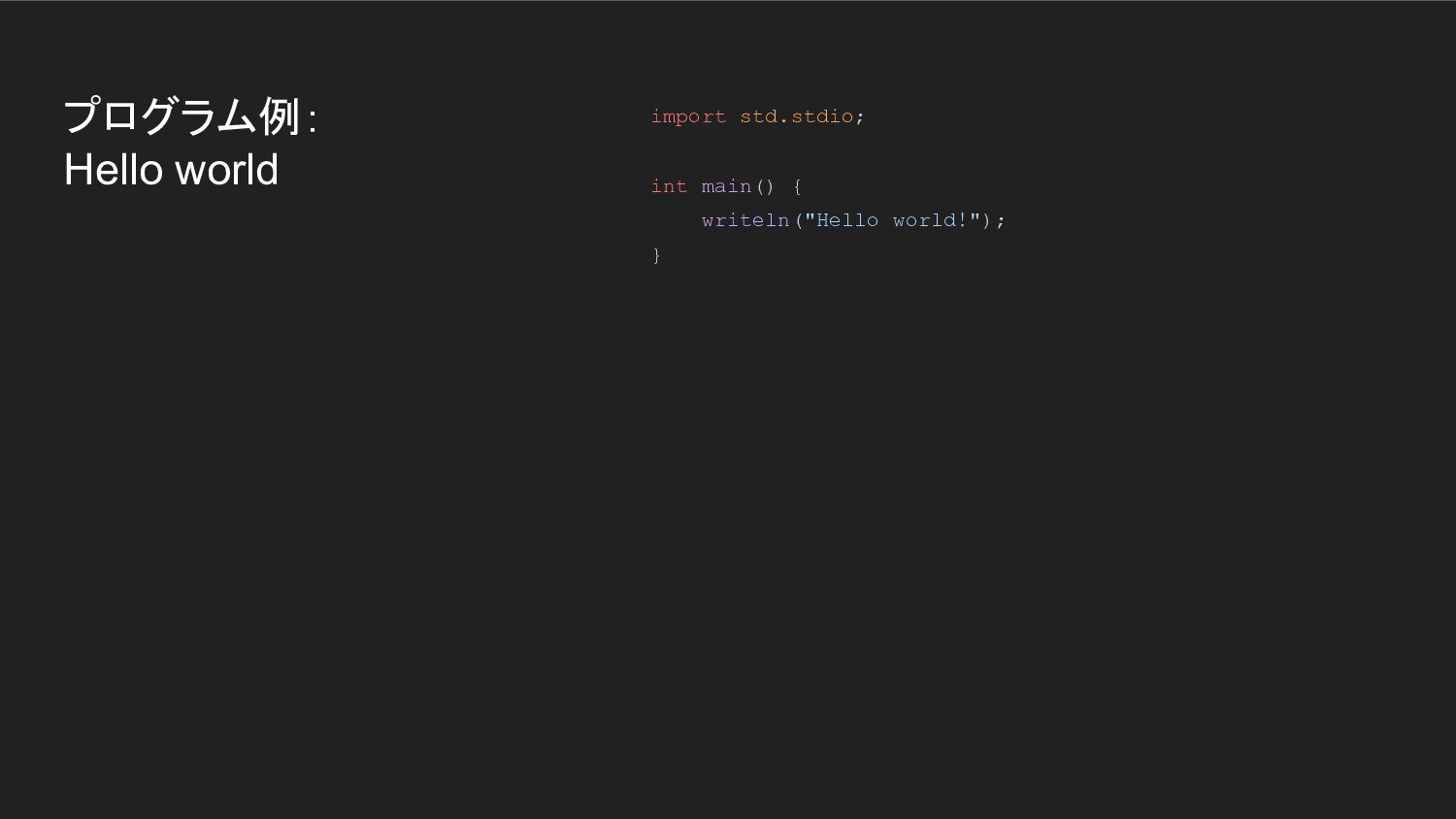
プログラム例: Hello world import std.stdio; int main() { writeln("Hello world!");
}
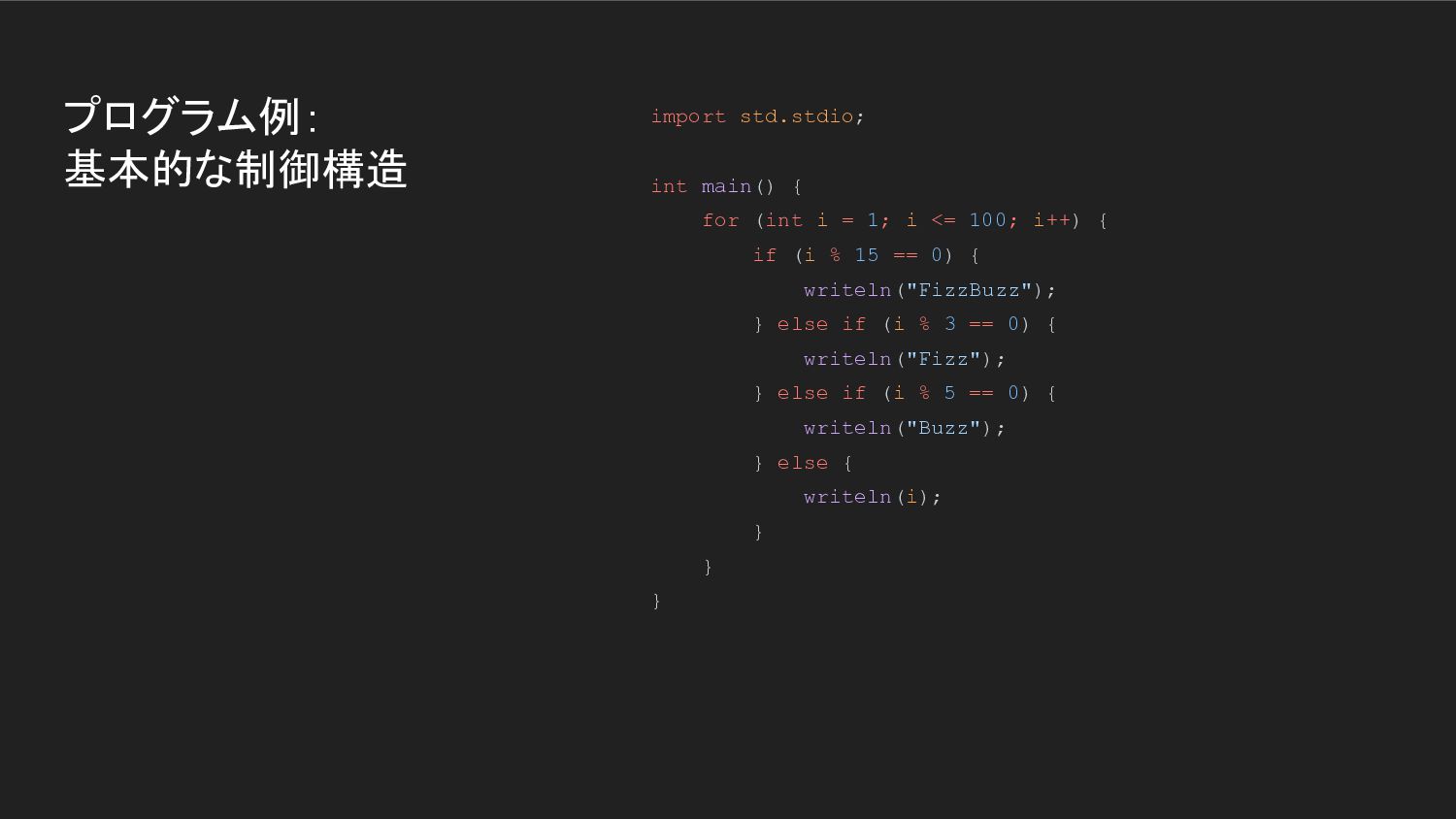
プログラム例: 基本的な制御構造 import std.stdio; int main() { for (int i
= 1; i <= 100; i++) { if (i % 15 == 0) { writeln("FizzBuzz"); } else if (i % 3 == 0) { writeln("Fizz"); } else if (i % 5 == 0) { writeln("Buzz"); } else { writeln(i); } } }
ね,簡単でしょう?
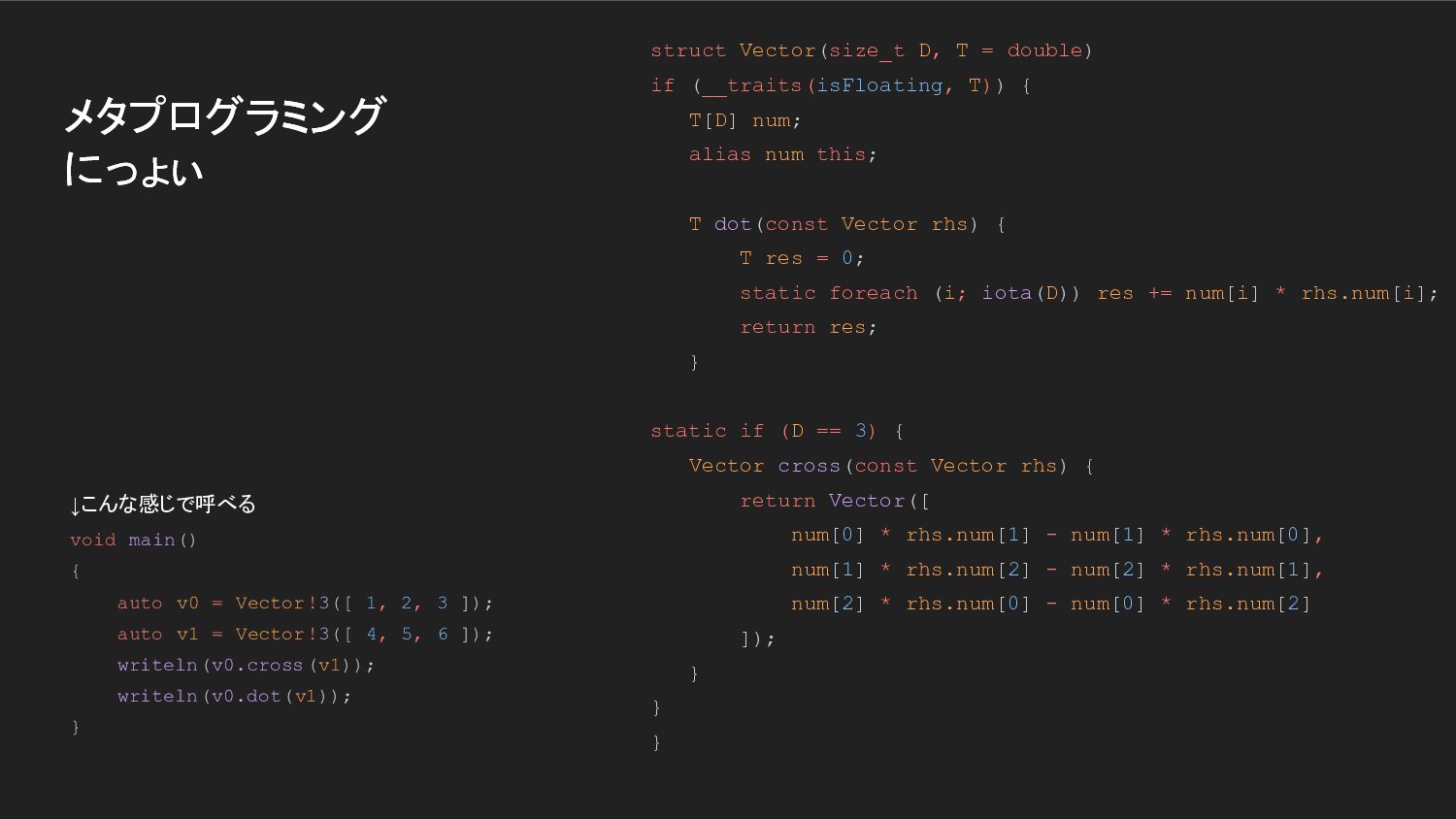
メタプログラミング にっょぃ struct Vector(size_t D, T = double) if (__traits(isFloating,
T)) { T[D] num; alias num this; T dot(const Vector rhs) { T res = 0; static foreach (i; iota(D)) res += num[i] * rhs.num[i]; return res; } static if (D == 3) { Vector cross(const Vector rhs) { return Vector([ num[0] * rhs.num[1] - num[1] * rhs.num[0], num[1] * rhs.num[2] - num[2] * rhs.num[1], num[2] * rhs.num[0] - num[0] * rhs.num[2] ]); } } } void main() { auto v0 = Vector!3([ 1, 2, 3 ]); auto v1 = Vector!3([ 4, 5, 6 ]); writeln(v0.cross(v1)); writeln(v0.dot(v1)); } メタプログラミング にっょぃ ↓こんな感じで呼べる
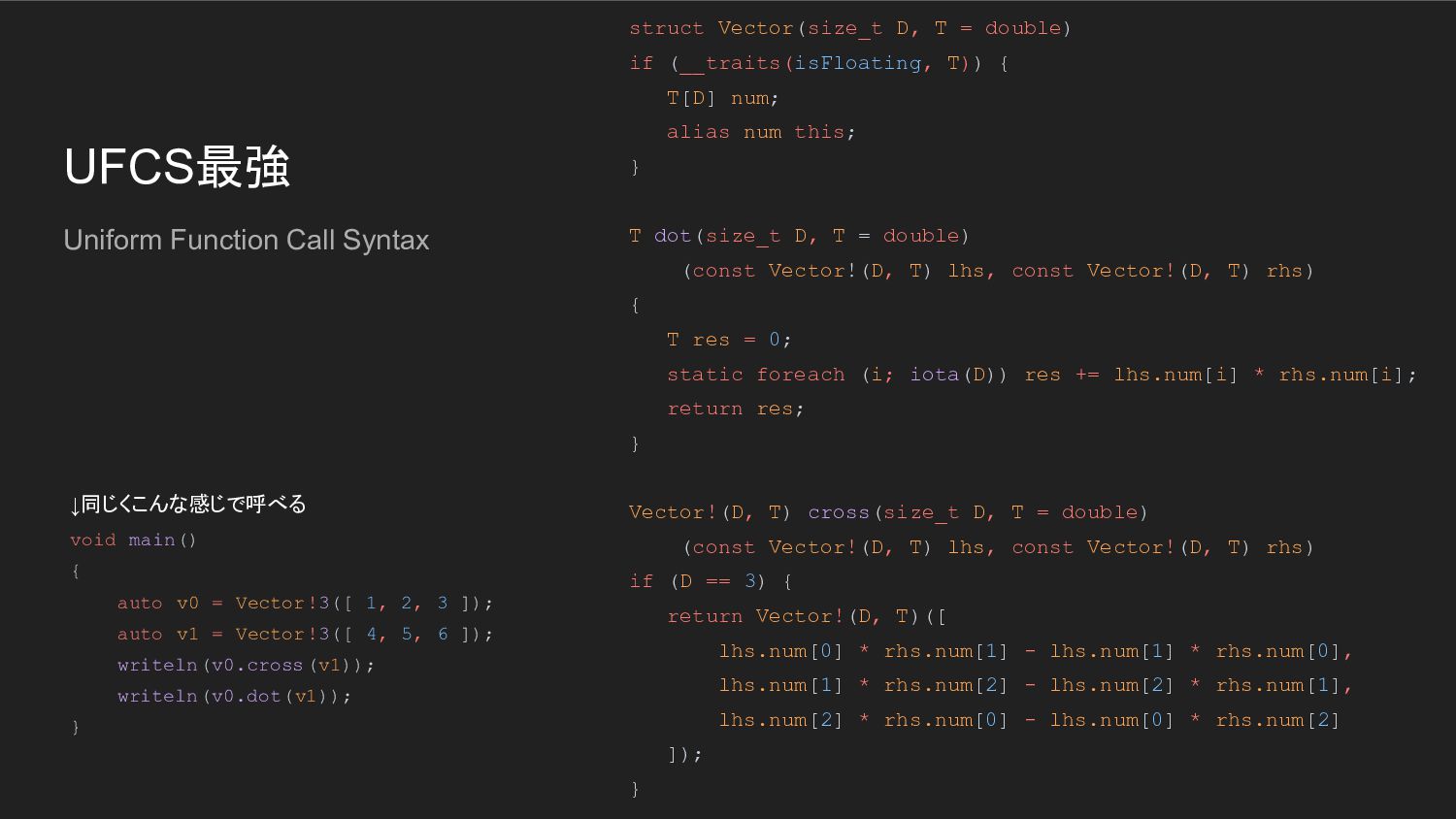
UFCS最強 struct Vector(size_t D, T = double) if (__traits(isFloating, T))
{ T[D] num; alias num this; } T dot(size_t D, T = double) (const Vector!(D, T) lhs, const Vector!(D, T) rhs) { T res = 0; static foreach (i; iota(D)) res += lhs.num[i] * rhs.num[i]; return res; } Vector!(D, T) cross(size_t D, T = double) (const Vector!(D, T) lhs, const Vector!(D, T) rhs) if (D == 3) { return Vector!(D, T)([ lhs.num[0] * rhs.num[1] - lhs.num[1] * rhs.num[0], lhs.num[1] * rhs.num[2] - lhs.num[2] * rhs.num[1], lhs.num[2] * rhs.num[0] - lhs.num[0] * rhs.num[2] ]); } Uniform Function Call Syntax void main() { auto v0 = Vector!3([ 1, 2, 3 ]); auto v1 = Vector!3([ 4, 5, 6 ]); writeln(v0.cross(v1)); writeln(v0.dot(v1)); } ↓同じくこんな感じで呼べる
UFCS最強 import std.stdio; string repeat(string s, size_t times) { char[]
res; for (size_t i = 0; i < times; i++) res ~= s; return cast(string) res; } void main() { "Hello world\n".repeat(3).write(); } 要はこんなことができる
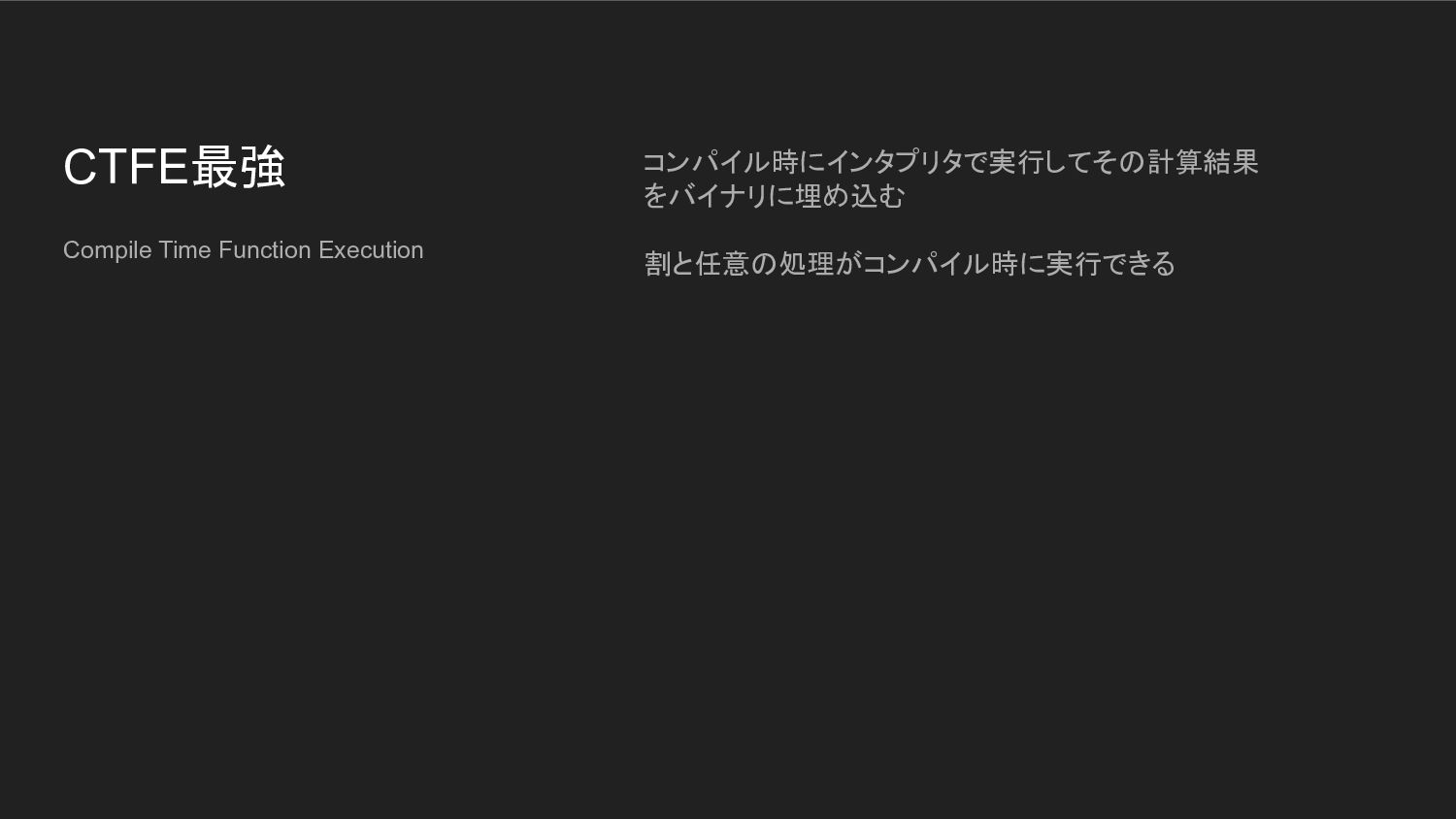
CTFE最強 Compile Time Function Execution コンパイル時にインタプリタで実行してその計算結果 をバイナリに埋め込む 割と任意の処理がコンパイル時に実行できる
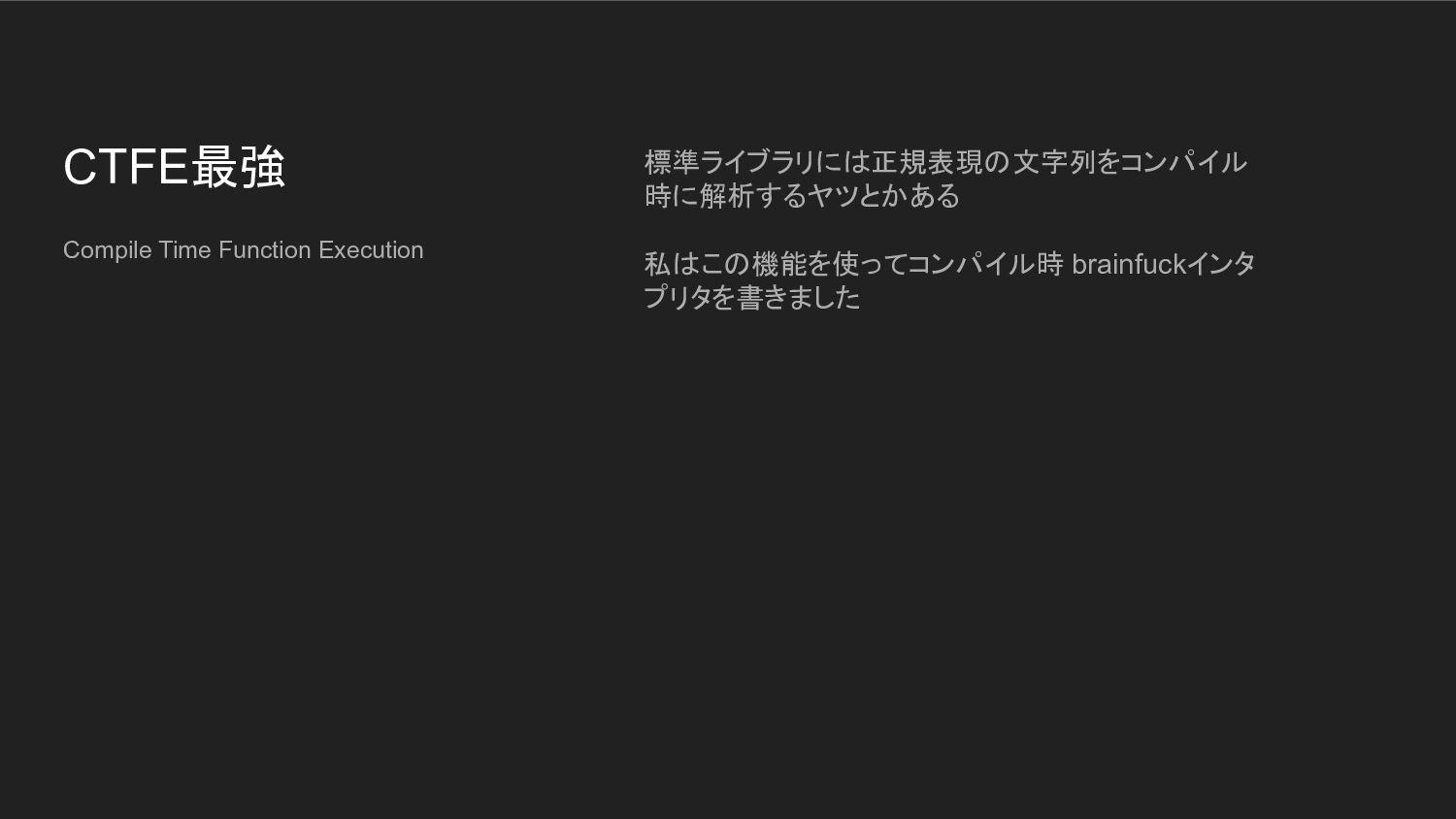
CTFE最強 Compile Time Function Execution 標準ライブラリには正規表現の文字列をコンパイル 時に解析するヤツとかある 私はこの機能を使ってコンパイル時 brainfuckインタ プリタを書きました
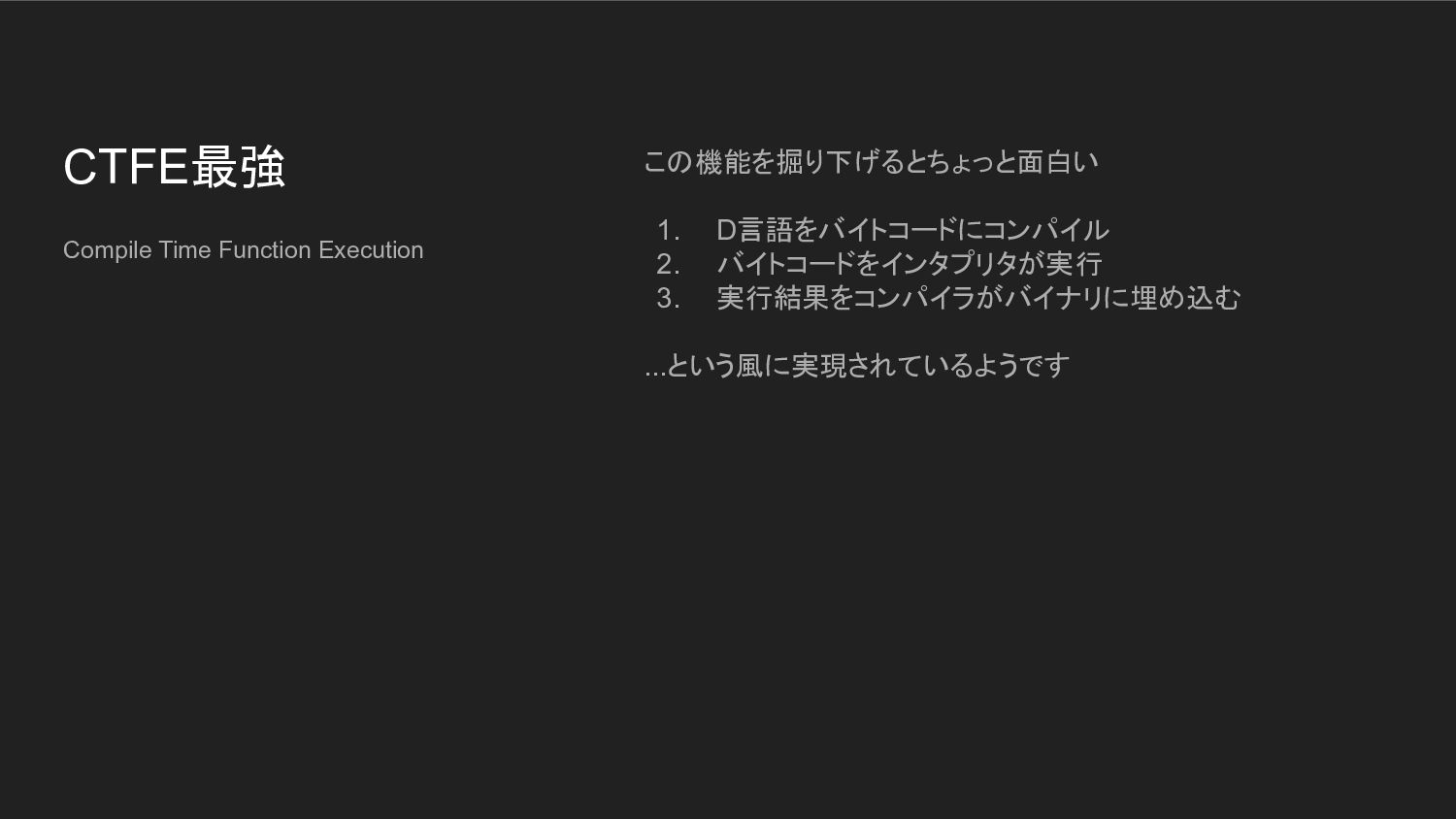
CTFE最強 Compile Time Function Execution この機能を掘り下げるとちょっと面白い 1. D言語をバイトコードにコンパイル 2. バイトコードをインタプリタが実行
3. 実行結果をコンパイラがバイナリに埋め込む ...という風に実現されているようです
微妙だと思う点もある あくまで私の主観ですが ...
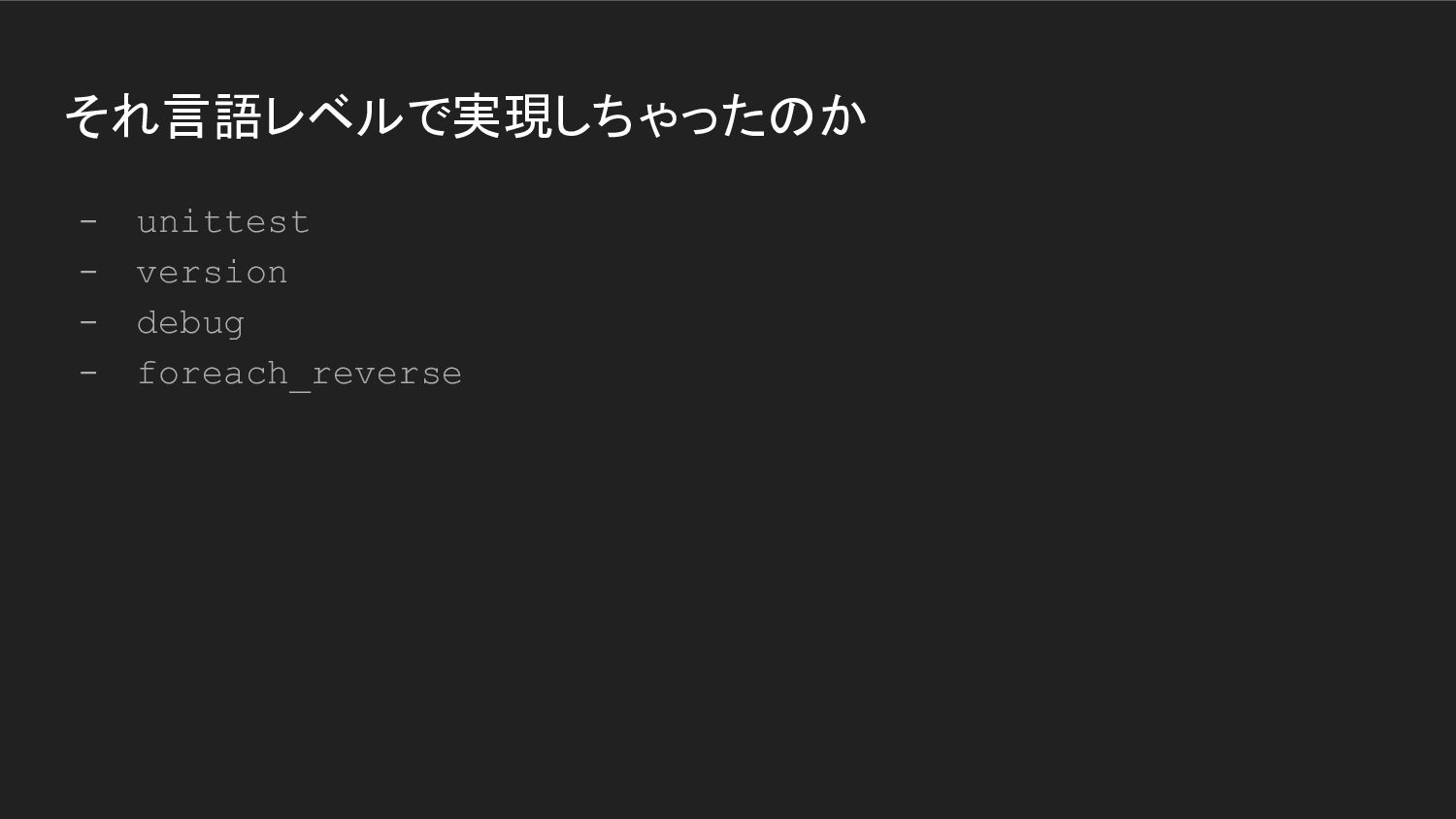
それ言語レベルで実現しちゃったのか - unittest - version - debug - foreach_reverse
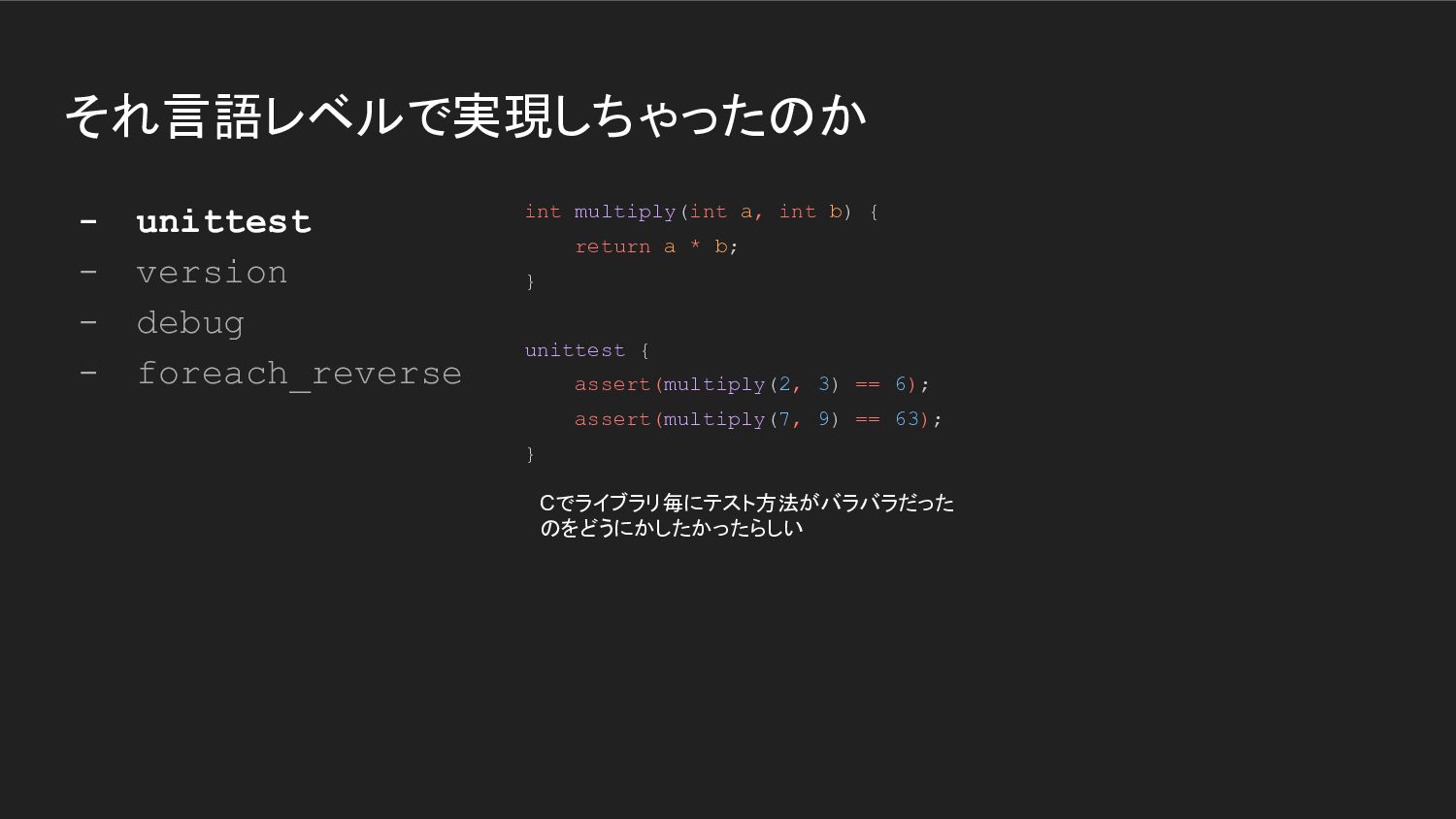
それ言語レベルで実現しちゃったのか - unittest - version - debug - foreach_reverse int
multiply(int a, int b) { return a * b; } unittest { assert(multiply(2, 3) == 6); assert(multiply(7, 9) == 63); } Cでライブラリ毎にテスト方法がバラバラだった のをどうにかしたかったらしい
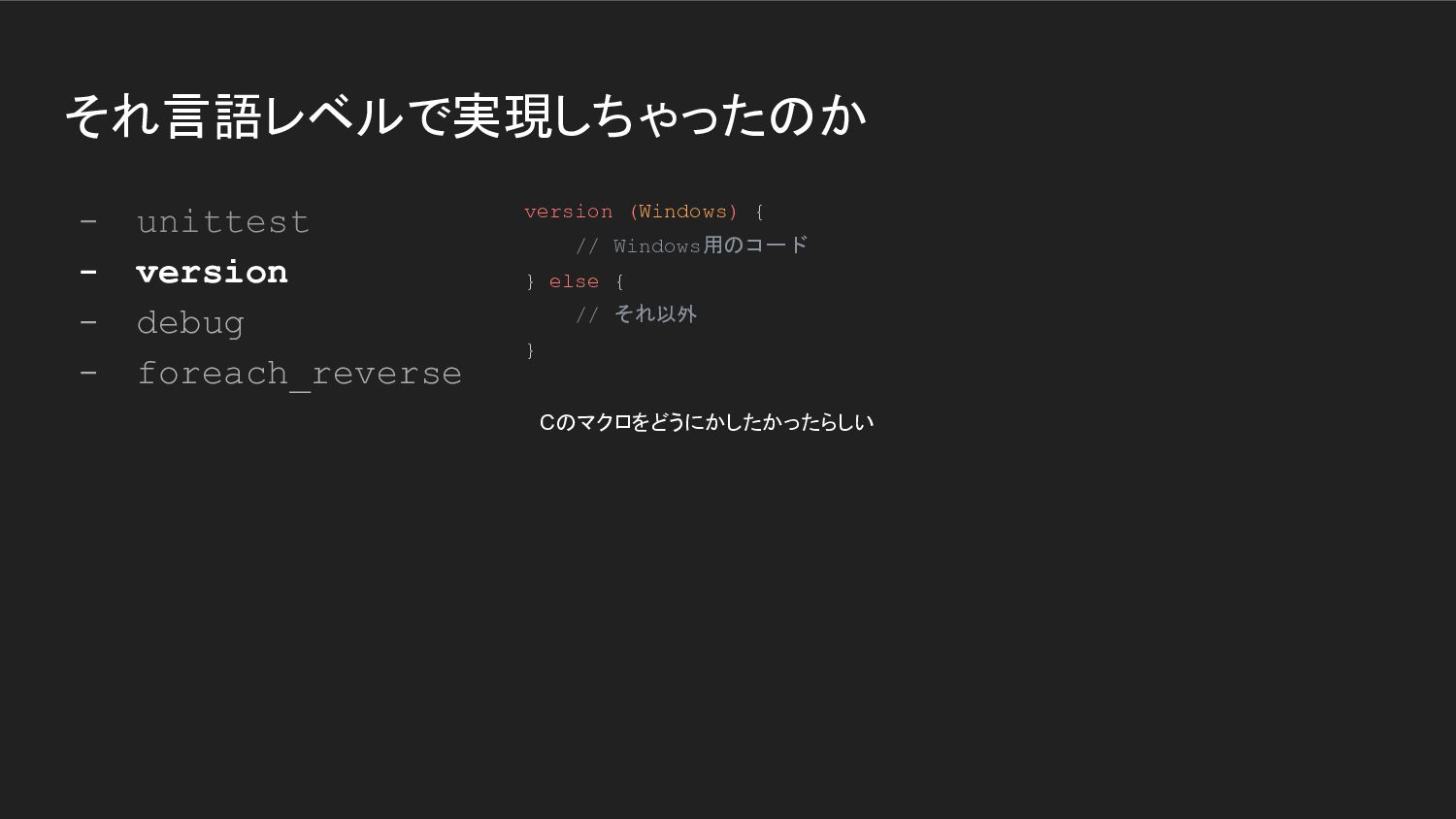
それ言語レベルで実現しちゃったのか - unittest - version - debug - foreach_reverse version
(Windows) { // Windows用のコード } else { // それ以外 } Cのマクロをどうにかしたかったらしい
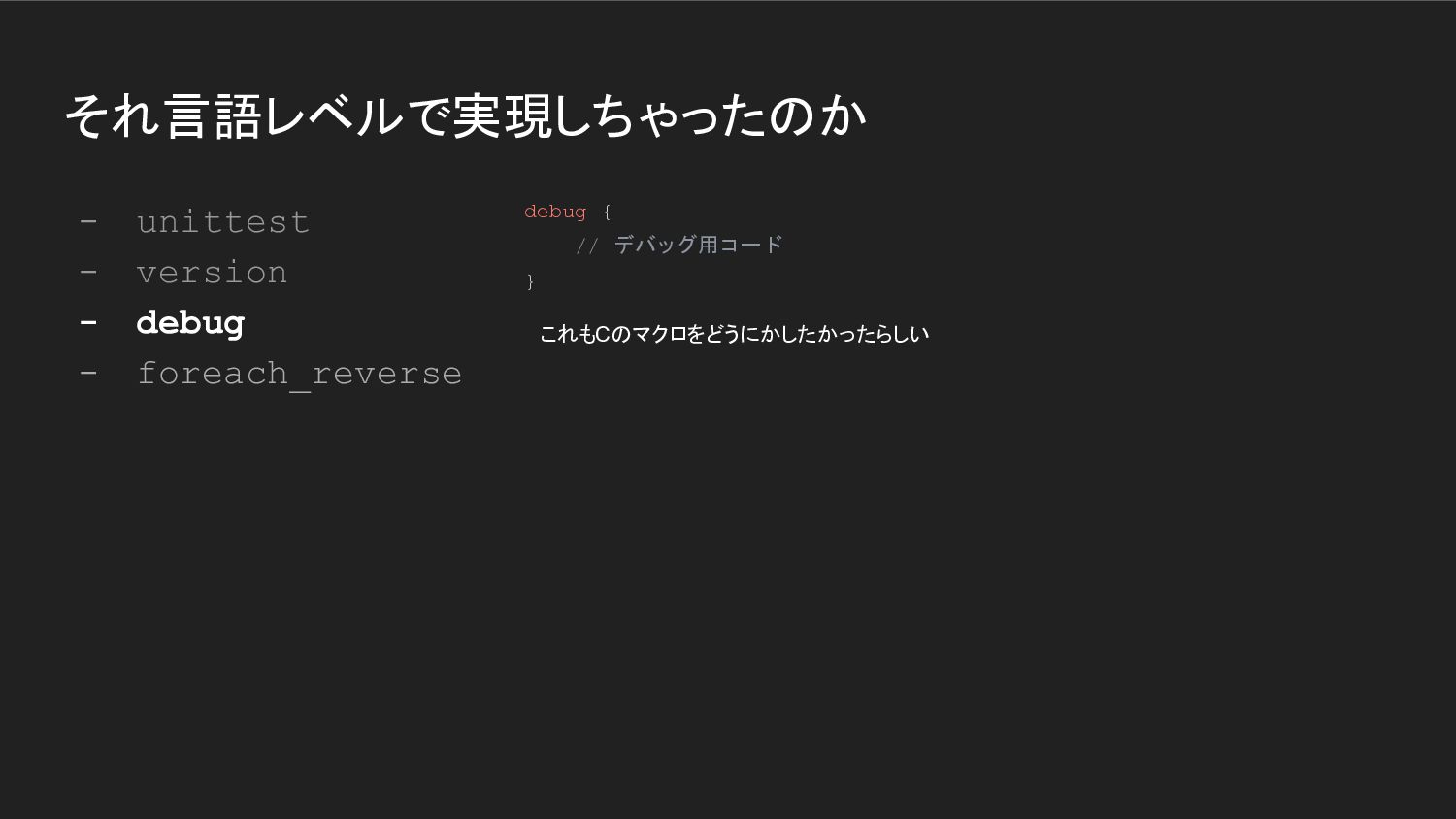
それ言語レベルで実現しちゃったのか - unittest - version - debug - foreach_reverse debug
{ // デバッグ用コード } これもCのマクロをどうにかしたかったらしい
それ言語レベルで実現しちゃったのか - unittest - version - debug - foreach_reverse int[]
arr = [ 1, 2, 3, 4, 5 ]; foreach_reverse (i, e; arr) { // 逆向きに反復 } 「順方向」と「逆方向」を相補的なモノとして捉えたようだ
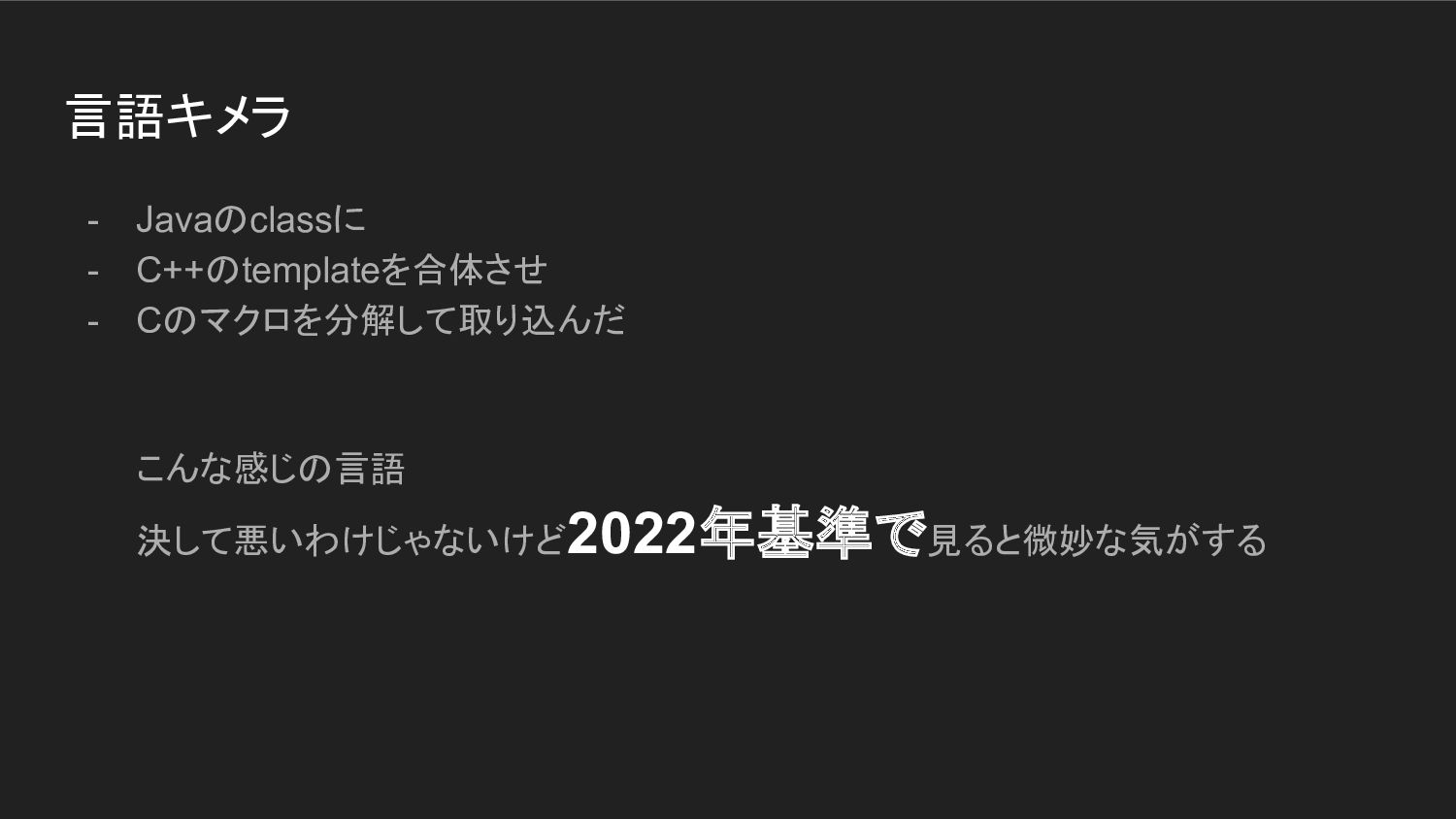
言語キメラ - Javaのclassに - C++のtemplateを合体させ - Cのマクロを分解して取り込んだ こんな感じの言語 決して悪いわけじゃないけど2022年基準で見ると微妙な気がする
質疑応答とか 一通り Origins of the D Programming Language を読み込んだので D言語の歴史とかも触りだけ話せます
参考 - Origins of the D Programming Language https://dl.acm.org/doi/pdf/10.1145/3386323 -
Dlang Tour https://tour.dlang.org


 shouth
 tatamiya
 kairim0
 yakumo
 ishikawa_satoru
 bgpat
bgpat
 mkdev10
 ymrl
ymrl
 ufried
 carta_engineering
 mtpooh
 kakehashi
 riyaamemiya
 nikkihalliwell
 geoffreycrofte
 techseoconnect
 marktimemedia
 tanoku
 soudai
 konakalab
 rasagy
.png) helenjbeal
helenjbeal
 notwaldorf
 badams
 katiecoart





![UFCS最強 import std.stdio; string repeat(string s, size_t times) { char[]](https://files.speakerdeck.com/presentations/5ecbad5ae8be41658673358cac13d272/slide_11.jpg)

![それ言語レベルで実現しちゃったのか - unittest - version - debug - foreach_reverse int[]](https://files.speakerdeck.com/presentations/5ecbad5ae8be41658673358cac13d272/slide_20.jpg)