chance and furthermore the need for progressively refined manipulation and analysis of data. Notwithstanding, adapting to information has gotten progressively challenging. The new data reality carries numerous difficulties for conventional ways to deal with empirical research and data analysis, making it clear that the ‘new reality’ cannot be met without new, technology- driven, techniques. ❖Then again, attention to new technological capacities and opportunities is making developing interest for increasingly advanced types of data utilization, for example, real-time analytics, automated data processing and decision-making through machine learning and the like. This gap between the new opportunities that have risen up out of contemporary information and the innovation scene and the old analytical techniques has as of late been loaded up with so-called data science. ❖The scope of procedures that make up data science, new tools for analyzing information, new datasets, and novel types of information can possibly be utilized in public policy. Notwithstanding, until this point, these tools have chiefly been the domain of academics, and, where they have been put to utilize, the private segment has driven the way.
a better policy making process and lead to more adequate, more efficient and more effective public policies. Therefore, policymakers and policy advocates often tend to provide data-based arguments for particular policy solutions, usually gained through sound empirical research or analysis on that topic. A significant number of the uses of machine learning have been of fairly abstract interest to the government. For instance, identifying trends on Twitter is useful yet not naturally significant. Projects showcasing the power of new data and new tools, for example, utilizing machine learning algorithms to beat human specialists at the game Go, or to identify the prevalence of cat videos supporting some political candidate, have been some good ways from application to government ends. Even when they have been appropriate, regularly they have not been sufficiently tried in the field and the tools built from them have not been founded on a comprehension of the necessities of end-users.
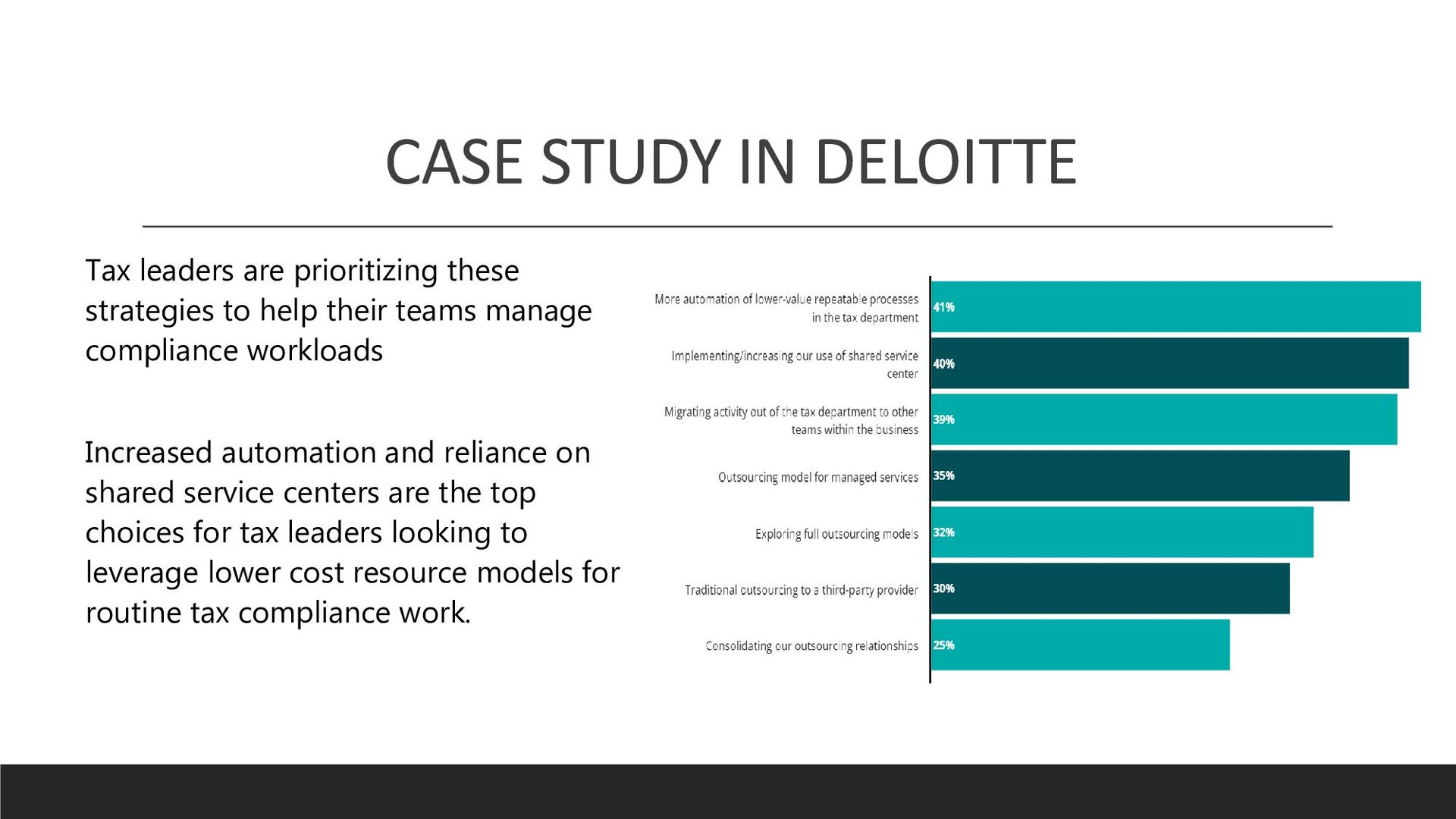
to help their teams manage compliance workloads Increased automation and reliance on shared service centers are the top choices for tax leaders looking to leverage lower cost resource models for routine tax compliance work.
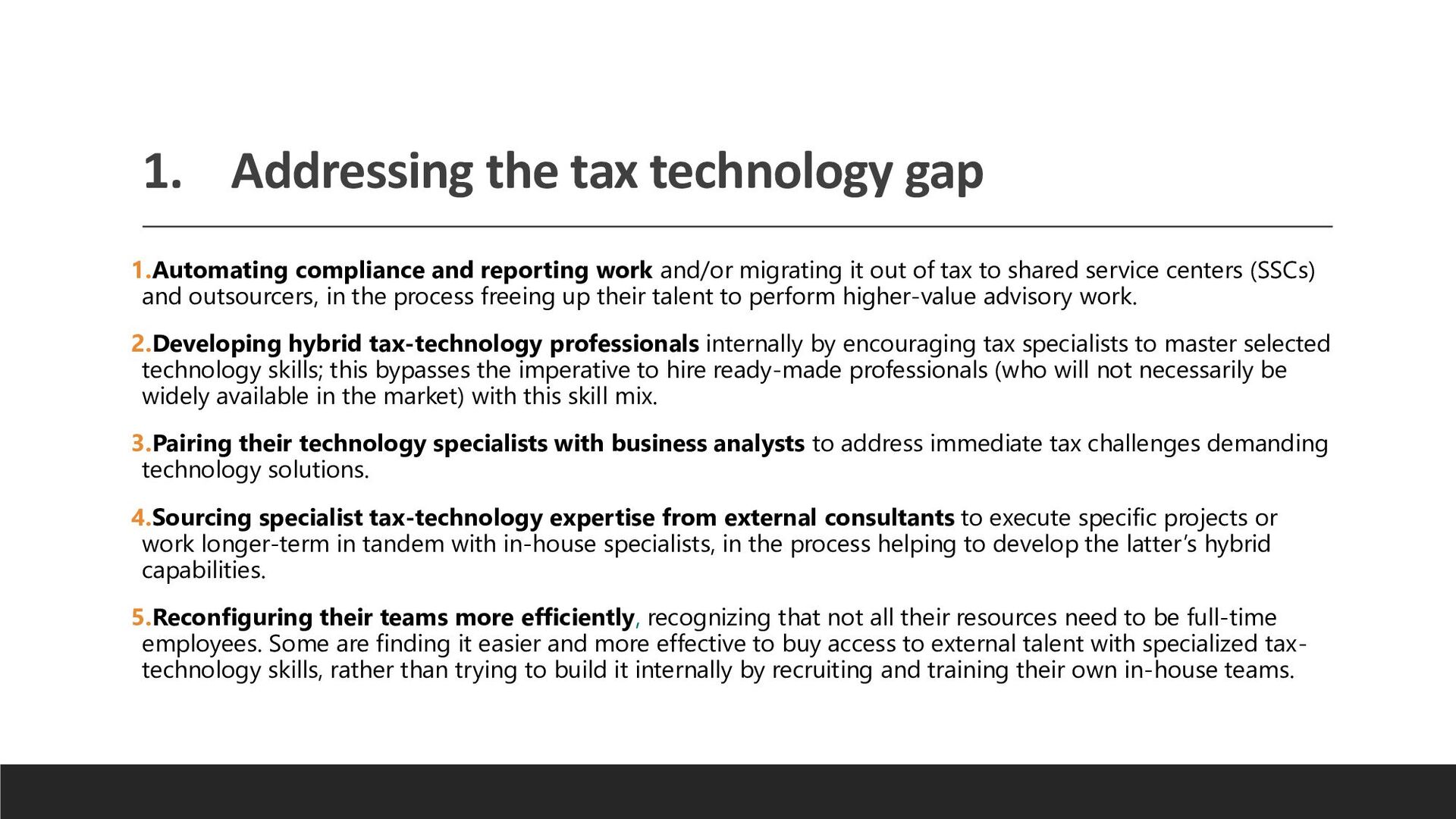
work and/or migrating it out of tax to shared service centers (SSCs) and outsourcers, in the process freeing up their talent to perform higher-value advisory work. 2.Developing hybrid tax-technology professionals internally by encouraging tax specialists to master selected technology skills; this bypasses the imperative to hire ready-made professionals (who will not necessarily be widely available in the market) with this skill mix. 3.Pairing their technology specialists with business analysts to address immediate tax challenges demanding technology solutions. 4.Sourcing specialist tax-technology expertise from external consultants to execute specific projects or work longer-term in tandem with in-house specialists, in the process helping to develop the latter’s hybrid capabilities. 5.Reconfiguring their teams more efficiently, recognizing that not all their resources need to be full-time employees. Some are finding it easier and more effective to buy access to external talent with specialized tax- technology skills, rather than trying to build it internally by recruiting and training their own in-house teams.
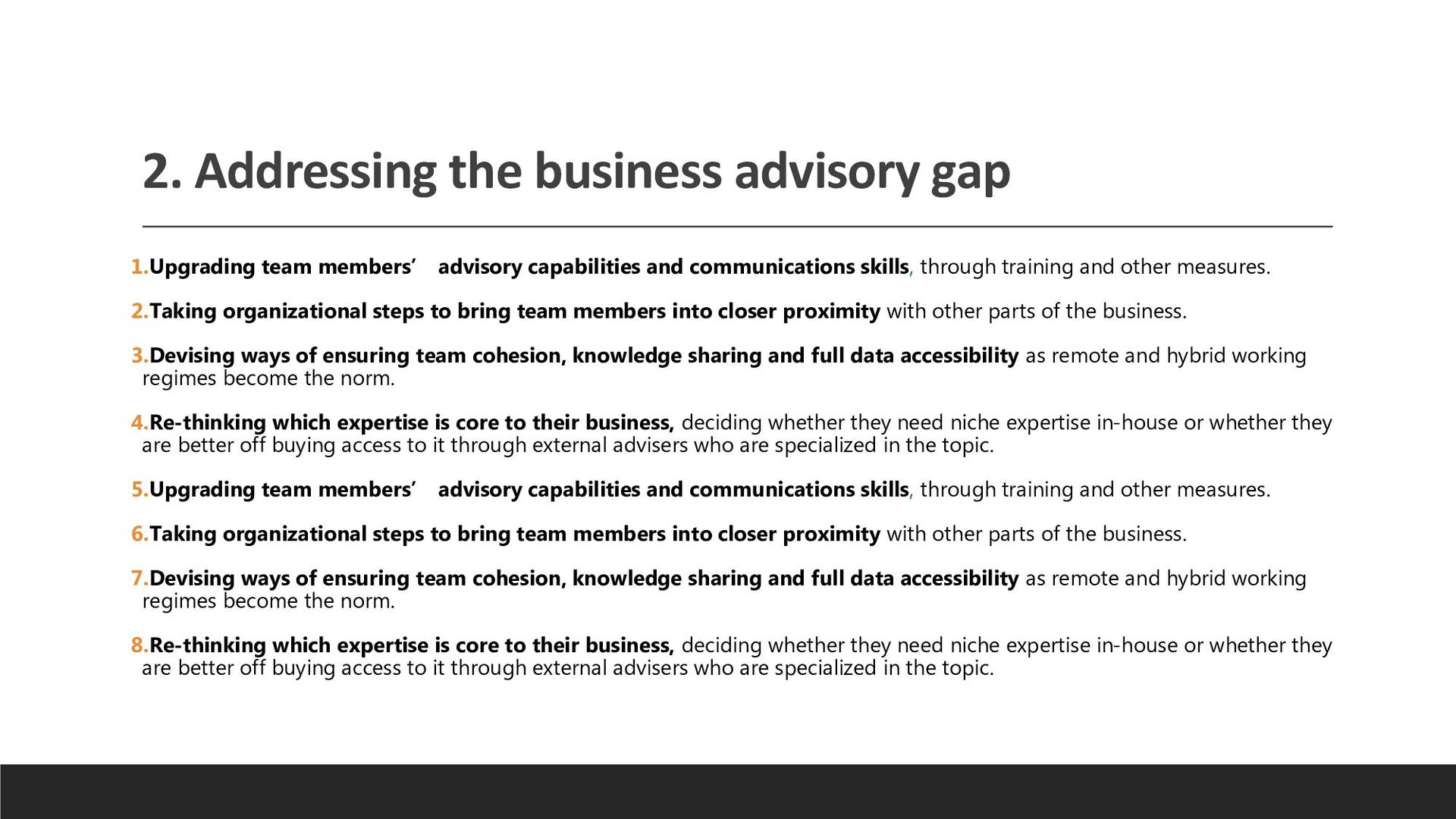
capabilities and communications skills, through training and other measures. 2.Taking organizational steps to bring team members into closer proximity with other parts of the business. 3.Devising ways of ensuring team cohesion, knowledge sharing and full data accessibility as remote and hybrid working regimes become the norm. 4.Re-thinking which expertise is core to their business, deciding whether they need niche expertise in-house or whether they are better off buying access to it through external advisers who are specialized in the topic. 5.Upgrading team members’ advisory capabilities and communications skills, through training and other measures. 6.Taking organizational steps to bring team members into closer proximity with other parts of the business. 7.Devising ways of ensuring team cohesion, knowledge sharing and full data accessibility as remote and hybrid working regimes become the norm. 8.Re-thinking which expertise is core to their business, deciding whether they need niche expertise in-house or whether they are better off buying access to it through external advisers who are specialized in the topic.
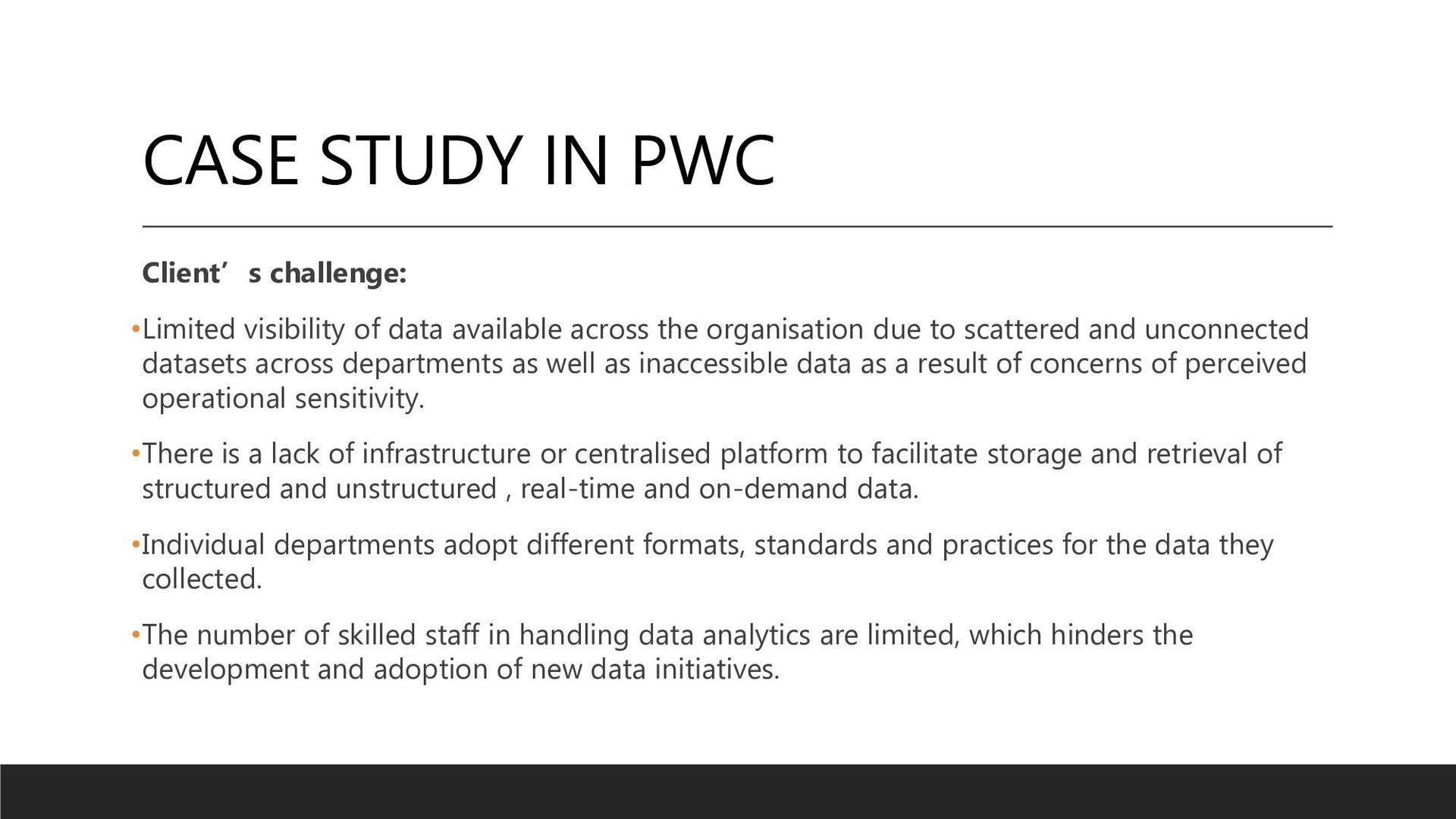
available across the organisation due to scattered and unconnected datasets across departments as well as inaccessible data as a result of concerns of perceived operational sensitivity. •There is a lack of infrastructure or centralised platform to facilitate storage and retrieval of structured and unstructured , real-time and on-demand data. •Individual departments adopt different formats, standards and practices for the data they collected. •The number of skilled staff in handling data analytics are limited, which hinders the development and adoption of new data initiatives.
was performed which helped formulate a multi-year transformation roadmap. The vision, mission, functions and KPIs of the data department were suggested. Different organisation models of the data department were analysed and a preferred organisation model was proposed with the desired structure, size, hierarchy, and detailed roles , responsibilities and skillset requirements. A change management plan was formulated to drive data analytics culture within the organisation including enterprise wide training and the rolled out of citizen data scientists.
focus of the data department to evaluate analytic initiatives and act as a bridge to coordinate internal resources. •Development of a new centralised analytics platform supporting the process of establishing individual business intelligence dashboards for all departments. •Introduction of the concept of “ Citizen Data Scientist” which firmly embeds fundamental data analytics capabilities in user departments to allow insights to be generated more efficiently and facilitate data scientists to focus on complex data modelling activities.
financial loss to the governments. Fraud has become a common thing. This fact may seem striking to you but let's look around. All operations that are more or less related to money present interest to potential fraudsters. The key feature of the fraud on the governmental level is that the consequences to some extent will touch each citizen. To mitigate the risks of fraud and following threats, governments apply smart data solutions and data analytics.
individuals or companies to misrepresent the real affairs to the tax authorities. Dishonesty in tax reporting like declaring less income helps to reduce tax liability. In other words, people or companies show less money with the purpose to pay less money to the state. Just imagine the amount of data that should be processed and analyzed to find an evader. This is really beyond human competence. Luckily, modern analytical platforms and solution are capable of detecting tax evasion. The analytical algorithms used for this purpose rely not only on the financial data but also on social media information. The algorithms carefully go through the data and match the spenders' patterns to the incomes they declare. Thus, those who spend far more than they have are easily detected.
that are not enrolled in the register anymore, gave up trading and are not subjects to legal liabilities and taxation. However, such firms can be easily brought back to life in case of need. This fact provides a vast field for fraudulent activities. Quite often, the companies are no longer in the register, yet they continue their operation and finally, get income. Analytical algorithms and AI-powered solutions are helping the governments in this respect. The algorithms track the activity even for those companies that seem inactive and alarm in case of suspicious actions taken. The algorithms detect the appearance of the company name or other information among the financial data. The disclosure of the de-registered firms helps the state to minimize and even prevent illegal avoidance from tax payment.
world. Every year governments all over the world spend billions of dollars for defense. A significant part of this money is spent on the introduction of big data, machine learning algorithms, and AI- powered solutions to improve the performance of various military departments and institutions. Empowered by the smart data solutions these institutions can improve the decision-making process and reduce the time spent on the solution of a particular matter. In the field of defense, the importance of big data is enormous. With the introduction of real-time analytics, the states got an opportunity to watch, track and monitor the borders, create multiple video streams from various strategically important objects, and watch over the air and navy spaces. Smart solutions are more attentive, accurate and reliable in their monitoring results. Predictive analytics appears to be a game-changing factor in the defense logistics and prevention of possible threats. The algorithms build possible scenarios calculating possible threats or damage.
of numerous terrorist incidents all over the world. These matters need severe measures to be taken, as the security and well being of people are under threat. Terrorism has become a kind of business for some groups of people. Terrorist organizations even recruit young people through social media platforms. Big data analytics, machine learning algorithms, and text mining are widely applied to detect such activity. Vast amounts of data on potential terrorist behavior are collected and carefully processed. This data includes unusual conversations, texts, interaction and contacts, purchases or movements in the potentially dangerous locations, etc. Security agencies are working on real-time detection of data patterns and linking these patterns into systems. These smart data solutions screen all the available data and form reports on possibly dangerous individuals or groups taking into account the data concerning previous cases of extremism, crime or terrorism.
by the state authorities has changed the whole picture of the criminal world. Fingerprints, DNA samples, ballistic analysis opened new opportunities for those who investigate crimes and strive to prevent them from happening. The police departments all over the world utilize big data to predict crime mapping. These systems use previous data on crime type, location, date and time to create the hotspots. The maps with the hotspots prove to be much more efficient than pure guessing. Also, smart city systems allow monitoring of multiple locations under conditions of real-time streaming. Highly sensitive cameras and movements detectors spot suspicious actions and send alarms to the police.
an issue of the governmental level. We collect and analyze the vast amount of data to reveal its valuable insights. But the results of our careful processing and analysis may become interesting for someone who wants to use it for a particular aim. Moreover, these people are planning to take the data illegally via theft or hackers attack. Just imagine the amount and importance of data possessed by the governmental institutions. In case this data becomes available to the public or at least to particular individuals, or if the data disappears the consequences may be distracting. Therefore, big data analytics and particular machine learning tools are used to monitor and examine carefully all the operations involving valuable data to reveal trends and patterns in these actions. The systems monitor the users and devices on the network and flag suspicious individuals or actions. It allows the state to take more operative, reliable and secure measures to prevent cyber attacks.
These cameras have already proved their efficiency on smaller objects. Now they are making their ways to the darkest and smallest streets and corners of cities and villages. Surveillance cameras are not just recording the videos. Today their capabilities get wider. For instance, now they can recognize violence or criminal activity and distinguish fight or physical abuse from other actions and movements after that the smart recognition system sends the message to the police. Also, similar algorithms are used to recognize traumatic falling or other injuries and can inform about the emergency. This proves to be very helpful for elderly people and people suffering from severe chronicle diseases.
more intensive every day, the idea of using big data for the benefit of society seems more and more attractive. The data becomes a more reliable source presenting great value for the state. Thus, and becoming a matter of national security. Undoubtedly, big data analytics supports national security and brings opportunities for different areas. Among them are the anomaly detection, association mining for disclosure of the patterns and interconnection between the datasets, classification, and clustering of the data. Also, it can be used for link analysis and disclosure of hidden message from the texts or documents. Thus, it makes visible for people the information, relations, and patterns that people can overlook. In combination with human judgments, big data analytics helps in decision making.
law enforcement. Law enforcement agencies can achieve significant results in work having at hand the huge databases filled with data concerning number plates, identities of the criminal, crime statistics and access to social media platforms. With the help of modern analytics tools, law enforcement agencies can turn the available data into actionable intelligence. Thus, the phenomenon of predictive policing appears. It means that big data analytics allows preventing crimes from happening. Nowadays, predictive policing is on its rise, despite all the disputes and arguments against it.
health and human services use big data analytics as efficiently as other governmental authorities do. Not to analyze the available data in this area would be a significant loss. Provision of high-quality services to the citizens is the priority task for the government. Therefore, the activities of the health and human services (HHS) agencies are regulated by the state. HHS agencies work hard to provide transparency in their operations and satisfy all the needs of their customers. The application of the real-time analytics empowers the employees to collect, process, analyze and visualize data and get the real view on the services they provide and the satisfaction level of their customers. It is much easier to draw conclusions and identify the matters for further improvement relying on the results of accurate analysis.
gives a significant advantage to local governments and authorities under conditions of emergencies. Real-time analytics helps to make immediate decisions under stressful situations. Control over multiple communication channels and use of smart tools that recognize possible threats and send alarms give a chance for local authorities to warn the citizens and advise them about further actions.


 vanstee
 watany
 keithpitt
 aleyda
 malarkey
 dugsong
 baasie
 thekraken
 hatefulcrawdad
 swwweet
 dougneiner
 maltzj