Share
Embed
Code & Design Your First Website
Thinkful
March 16, 2017
Transcript
56 slides
-
About me • Jasjit Singh • Self-taught developer • Worked
in finance & tech • Co-Founder Hotspot • Thinkful General Manager -
About us Thinkful prepares students for web development & data
science jobs through 1-on-1 mentorship programs -
What’s your goal? • Do you want to work better
with developers? • Do you want to start working in tech? • Do you have an idea that you want to build? -
What’s your programming background? • First lines of code will
be written tonight? • Been self teaching for 1-3 months? • Been at this for 3+ months -
Goals • Basics of design • Introduction to HTML and
CSS • Lots of practice building • Take home challenges to keep going -
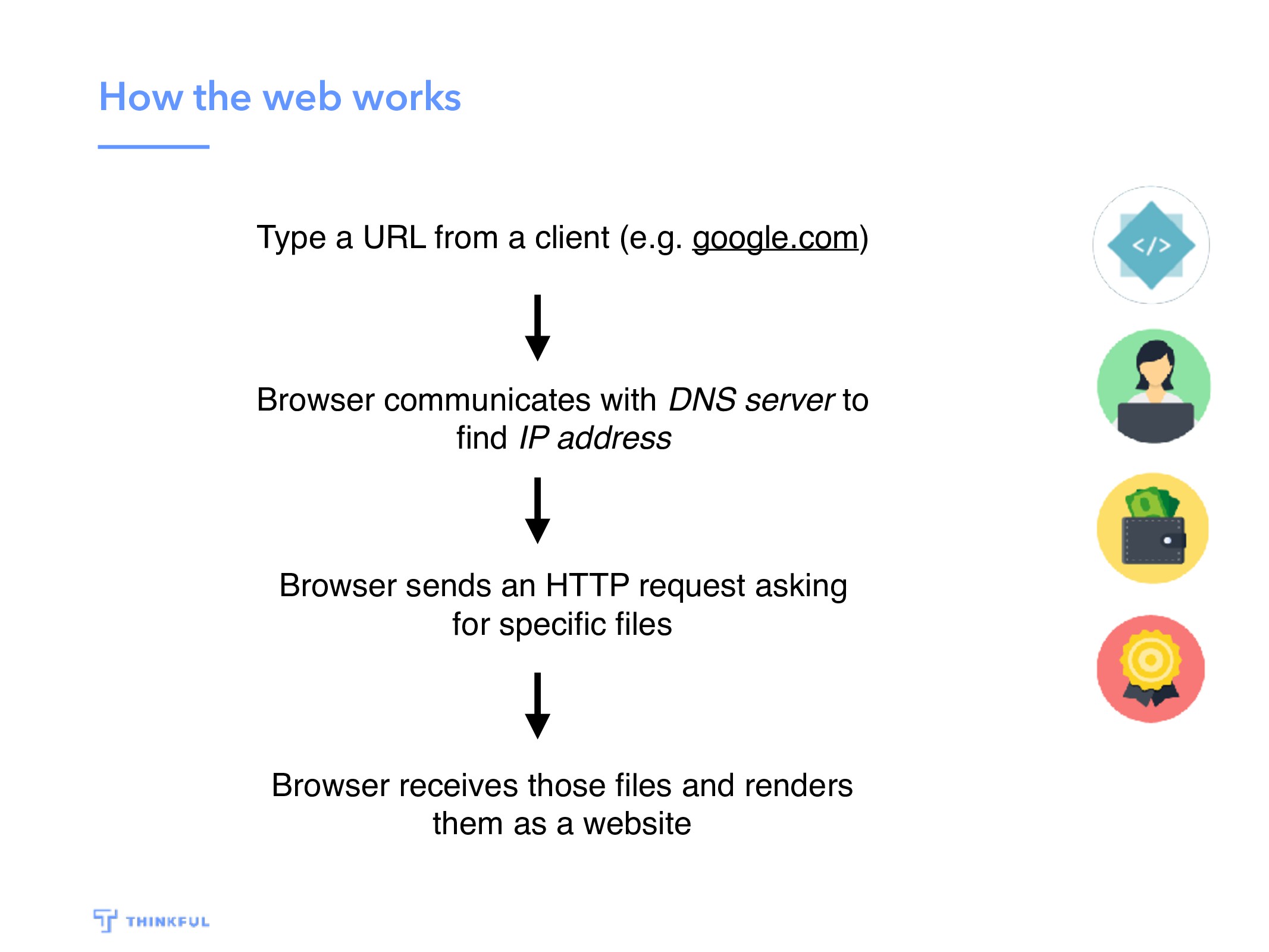
How the web works Type a URL from a client
(e.g. google.com) Browser communicates with DNS server to find IP address Browser sends an HTTP request asking for specific files Browser receives those files and renders them as a website -
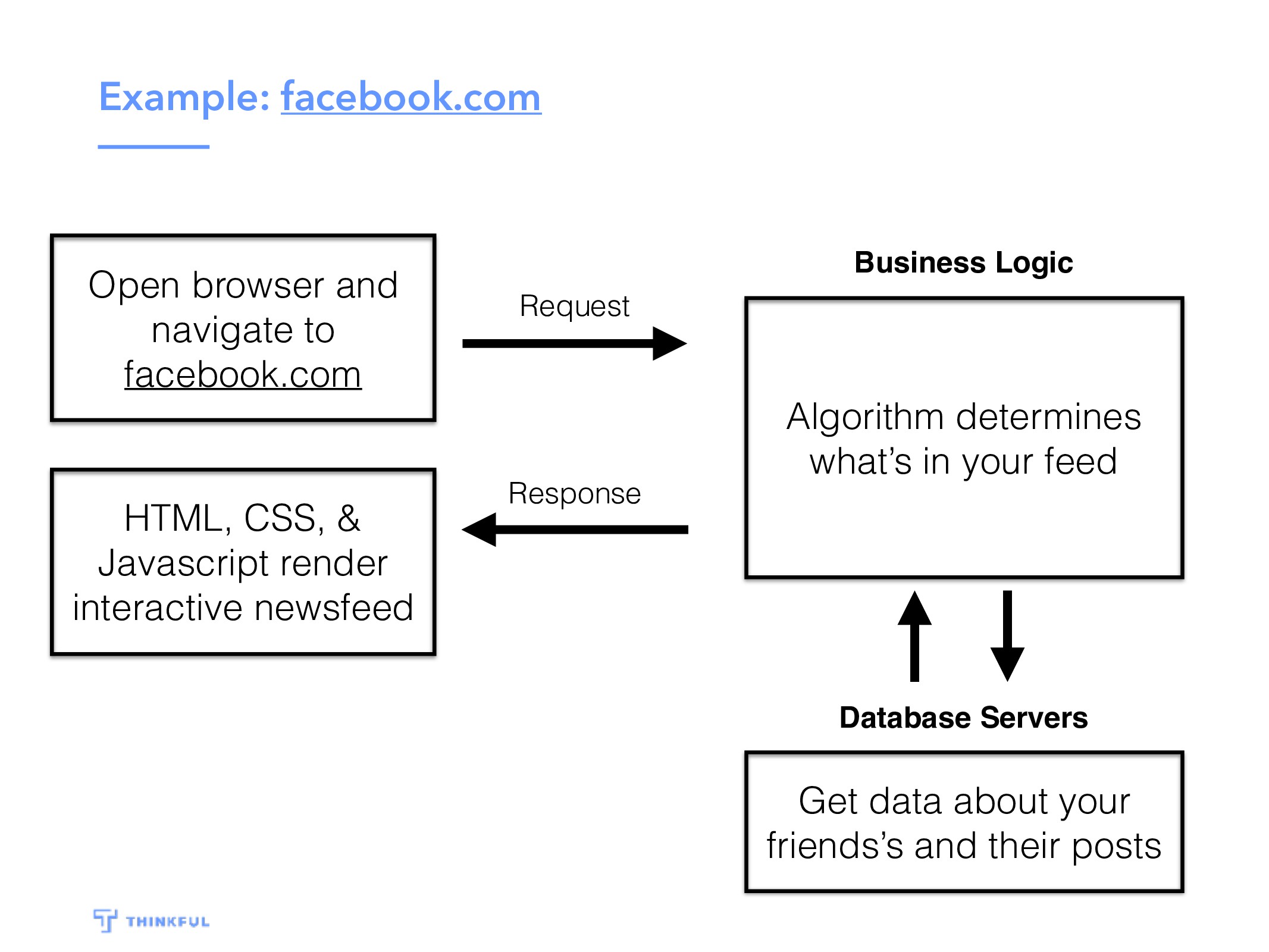
Programming fundamentals Request Response Client - UI Logic Server -
Business Logic Database Servers -
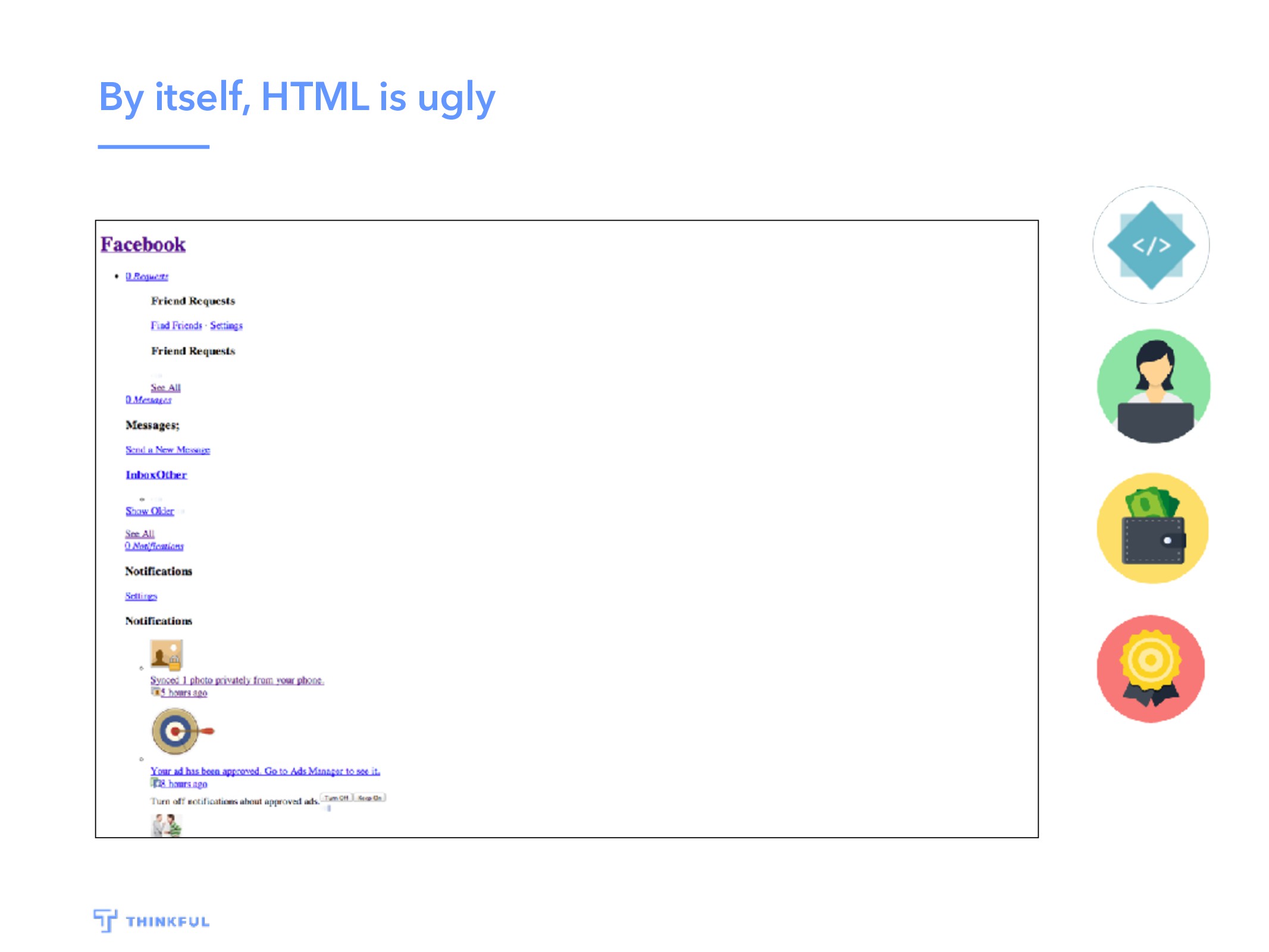
Example: facebook.com HTML, CSS, & Javascript render interactive newsfeed Algorithm
determines what’s in your feed Request Get data about your friends’s and their posts Open browser and navigate to facebook.com Business Logic Database Servers Response -
How that relates to what we’re doing today HTML &
CSS are the files that are stored on a server, sent to the client, and then rendered by your browser. Today, we’ll be writing these files. -
Why start by learning “Frontend”? • Accessible way to see
if coding is for you • Get clear & immediate gratification • Job opportunities -
Tonight’s project Design & build an “about me” webpage —
your personal homepage on the internet -
Step 1: Define the scope • What problem am I
trying to solve? • Who is the target user? • How do I want that person to use the product? -
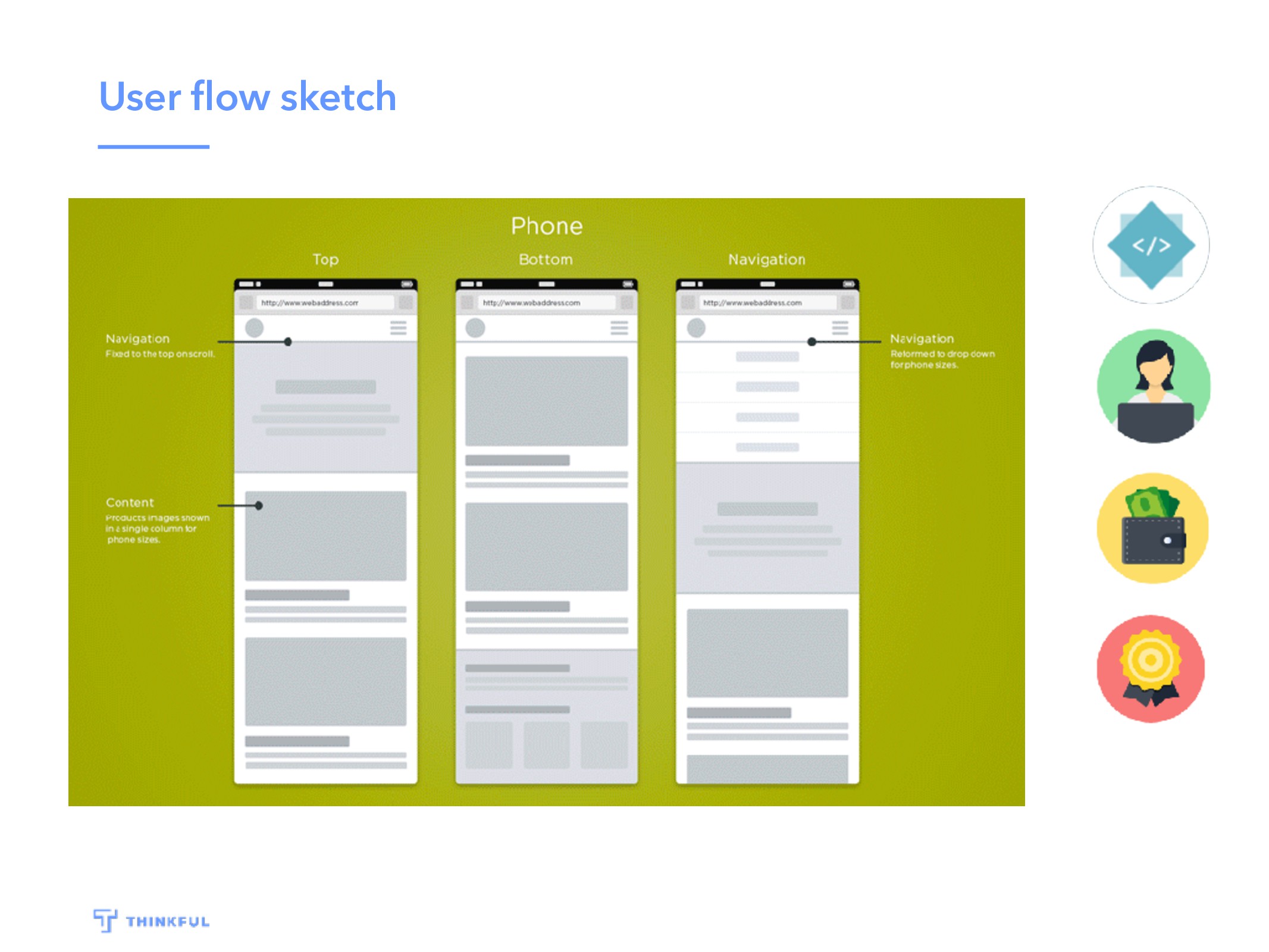
Step 2: Sketching & wireframing • Answer the question of
user flows • Answer the question of layout -
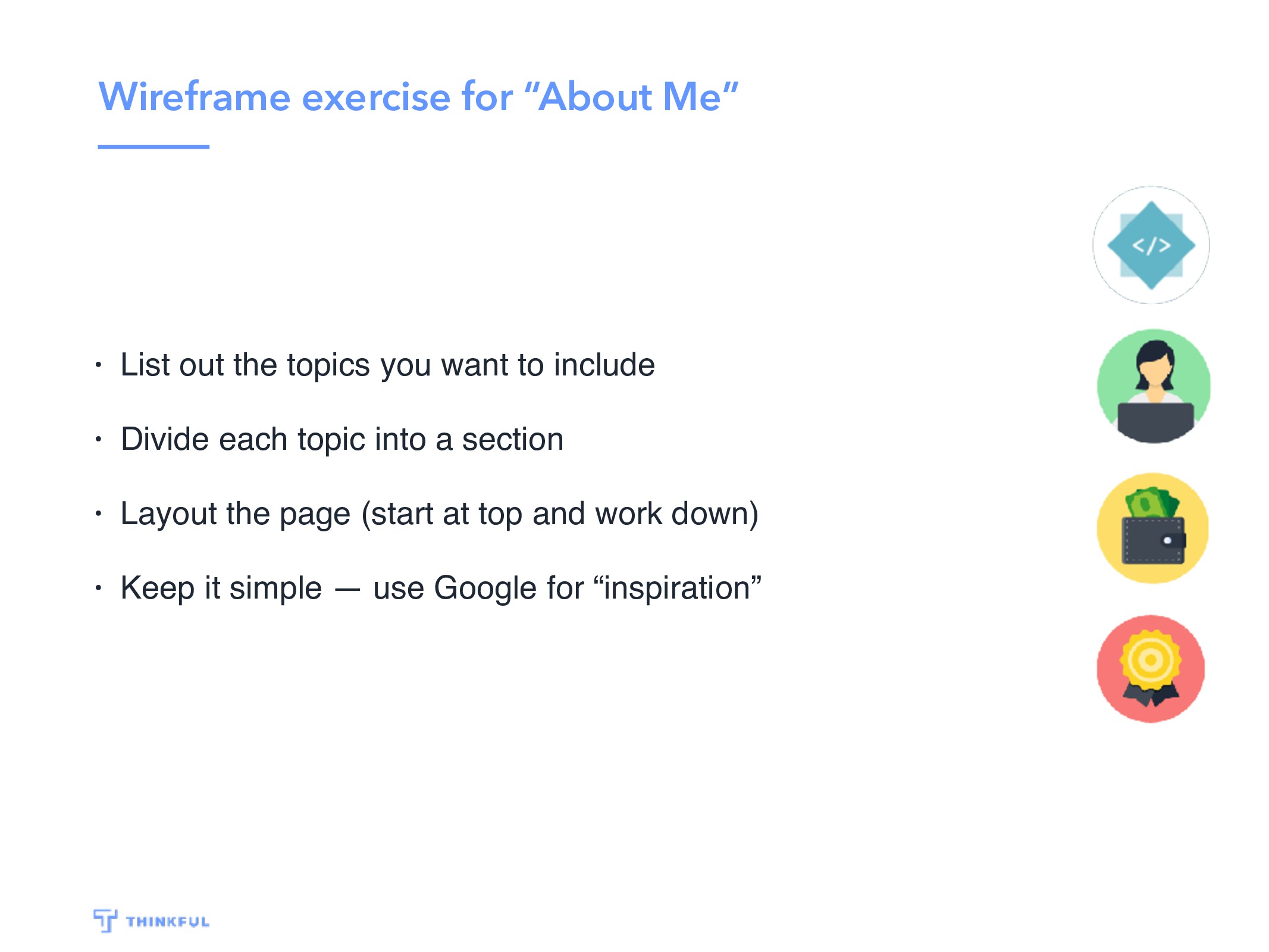
Wireframe exercise for “About Me” • List out the topics
you want to include • Divide each topic into a section • Layout the page (start at top and work down) • Keep it simple — use Google for “inspiration” -
Let’s start with HTML HTML is the content and structure
of a webpage It’s the skeleton of your website -
We’ll make it pretty later We will start with just
HTML — we’ll then add a Cascading Style Sheet (CSS) file to “style” our website. More on that later… -
Getting Started with Codepen • Normally developers use a text
editor • Codepen lets us write HTML/CSS and see the results instantly • Create an account: codepen.io/signup/free • Skip profile info => Go to create a new “Pen” -
HTML tags Every tag starts with a “less than” sign
and ends with a “greater than” sign <html> #this is an HTML opening tag <body> #this is a body opening tag <h1>Hello world!</h1> #this is set of H1 tags </body> #this is a body closing tag </html> #this is an HTML closing tag -
More about tags • There are opening tags and closing
tags — closing tags have a backslash before the tag name (</html> versus <html>) • Tags instruct a browser about the structure of our website • There are hundreds of built-in tags though you’ll use the same few a lot -
Non-exhaustive list of HTML tags • <html> #html tags wrap
your entire page • <head> #head tags holds info about the page • <body> #body tags wrap around your content • <h1> #signifies the largest headline (through h6) • <p> #wraps a paragraph of writing • <div> #div tags are generic container tags • <a> #anchor tags for text to be a link • <ul><li> #unordered list of items • <button> #this is a button -
HTML elements HTML elements usually consist of an opening tag,
closing tag, and some content <html> #html element starts here <body> #body element starts here <h1>Hello world!</h1> #this is an HTML element </body> #body element ends here </html> #html element ends here -
More about elements Some consist of just a self-closing tag
<img src=“http://i.imgur.com/Th5404r.jpg"> -
A note about <div>’s We use <div> tags to separate
sections of our site. This will allow for sophisticated styling. It’s a good habit to “wrap” most sections into a <div> <div> <h1>Hello world!</h1> </div> -
HTML attributes HTML attributes set properties on an element —
the are attached in the opening tag <a href=“https://somewhere.com">This is a link</a> href is an attribute that sets the destination of a link <h1 class=“headline”>This is a headline</h1> class is one attribute that identifies element (for CSS & Javascript) <h1 id=“headline”>This is a headline</h1> id is another attribute that identifies element (for CSS & Javascript) -
“About Me” website — HTML http://codepen.io/jasjitsingh85/pen/XMdbgY • “Fork” this code
and lets walk through it together • Drill — Add another section of your choosing • Drill — Add a title and a paragraph in that section • Drill — Try and add an image underneath “About Me” -
What is CSS? Cascading Style Sheets (CSS) interact with your
HTML to determine the visual presentation of your webpages -
CSS solves two problems • Visual presentation of each element
• Layout of elements -
Key CSS concepts • Selectors • Property • Value •
Declaration / Declaration Block -
CSS selectors • Determine HTML elements to target for styles
• Can target tags, classes, id’s and many more! • Selectors can be combined -
Example selectors p (selects all paragraph tags) .name (selects HTML
elements with class “name”) #intro (selects HTML elements with id “intro”) p.name (selects paragraph tags with class “name”) -
CSS properties Determines the aspect of the element’s appearance to
change • color (set the font color) • font-family (sets main typeface and backup typefaces) • background-image (sets background image) • height (sets the height of an element) -
More on CSS properties • Each property has a default
value — when you write CSS, you override that default with a new value • There are lots of CSS properties! For a full list see http://www.htmldog.com/references/css/properties/ -
CSS values Determines the aspect of the element’s appearance we
wish to change • color: red, blue, green, #CCCCCC acceptable values for the color property • font-family: helvetica, arial, sans-serif acceptable values for the font-family property • background-image: url(“imageFile.jpg") looks for a URL value for image file • height: 40px, 50% set in pixels or percentage of container height -
Declarations and declaration blocks This is a declaration block containing
two declarations p { color: red; font-size: 36px; } -
CSS challenge • Pick a typeface, color, and size for
the words • Add a “More About Me” section and put a border around it • Add background colors to each section to separate them -
From Codepen to reality • Download Sublime Text (or another
text editor) • Create a new folder (“First Website”) • Create a new HTML file in First Website folder (index.html) • Copy & paste your Codepen HTML into this file • Create a new css file in First Website folder (index.css) • Copy & paste your Codepen CSS into this file • Add link to your CSS in your HTML <head> section • Save both files • Double-click & open your index.html file -
Layouts (time permitting) • Display — inline vs. block •
The box model • Positioning -
In-line vs block • Every element is either inline-block or
block • Block: element starts a new line and stretches to full width • Inline: element doesn’t start new line, only as wide as need be -
More on in-line vs block • For a full list
of inline elements, see: https://developer.mozilla.org/ en-US/docs/Web/HTML/Inline_elements • For a full list of block-level elements, see: https:// developer.mozilla.org/en-US/docs/Web/HTML/Block- level_elements -
Box model & position • Static: normal flow. Block elements
stack on top of each other. Inline elements are as large as the content they contain. • Fixed: outside of normal flow. Stays in same place no matter what. • Relative: normal flow. Unlike static, can use left, right, top, bottom properties to move the elements around relative to where they’d otherwise sit. • Absolute: outside of normal flow. Stays in a specific spot on a page. -
General learning tips for coding • Google is your friend
• Practice at the edge of your abilities • Ignore the hot new thing — depth matters more than breadth -
More about Thinkful • Anyone who’s committed can learn to
code • 1-on-1 mentorship is the best way to learn • Flexibility matters — learn anywhere, anytime • We only make money when you get a job -
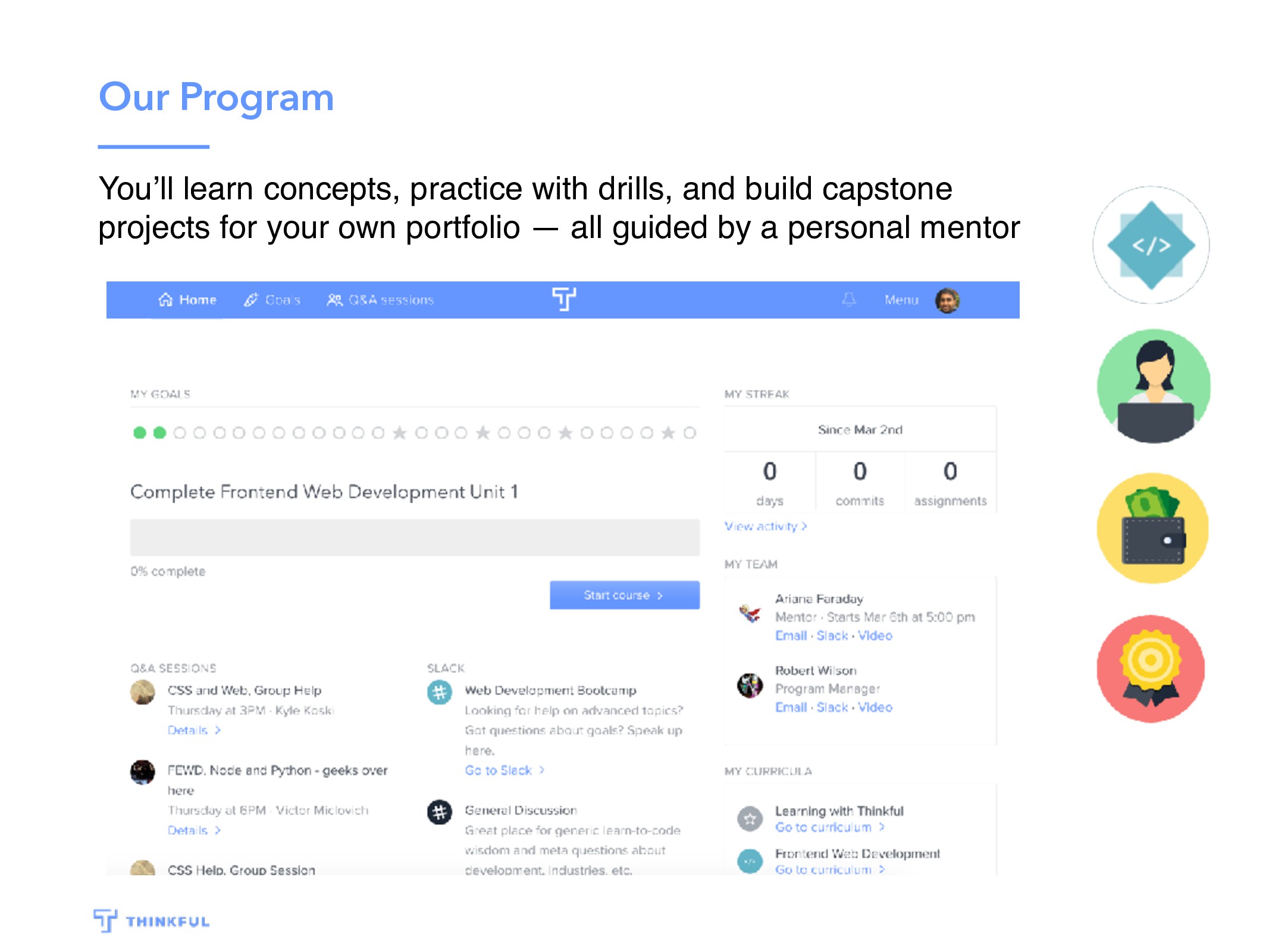
Our Program You’ll learn concepts, practice with drills, and build
capstone projects for your own portfolio — all guided by a personal mentor -
Special Prep Course Offer • Three-week program, includes six mentor
sessions • Covers HTML/CSS, Javascript, jQuery, Responsive Design • Option to continue into web development bootcamp • Prep course costs $500 (can apply to cost of full bootcamp) • Talk to me (or email me) about special offer -
October 2015 Questions? email me at [email protected] or schedule a
call through thinkful.com