Share
Embed
Transcript
55 slides
-
自己紹介 • @k_tsj • 好きな言語: Ruby/Scheme/Scala • CRubyコミッタ Self introduction
Favorite languages: A CRuby committer -
新しい人参が必要 • Multiple VM • JIT • 世代別/並列GC • …
• パターンマッチ We need a new carrot Generational/Parallel GC Pattern matching -
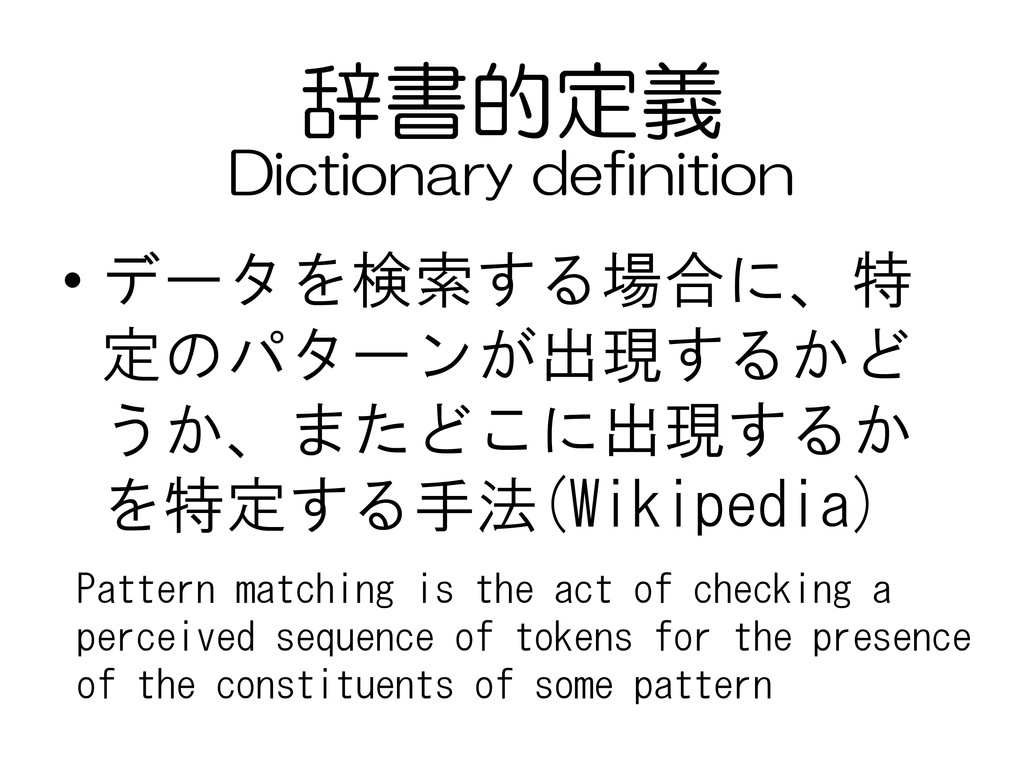
辞書的定義 • データを検索する場合に、特 定のパターンが出現するかど うか、またどこに出現するか を特定する手法(Wikipedia) Dictionary definition Pattern matching
is the act of checking a perceived sequence of tokens for the presence of the constituents of some pattern -
パターンマッチ Array(1, Array(2, 3)) match { case Array(a, Array(b, c))
=> ... } Pattern matching -
比較 a, (b, c) = [1, [2, 3]] Array(1, Array(2,
3)) match { case Array(a, Array(b, c)) => ... } Comparing 多重代入 Multiple assignment パターンマッチ Pattern matching -
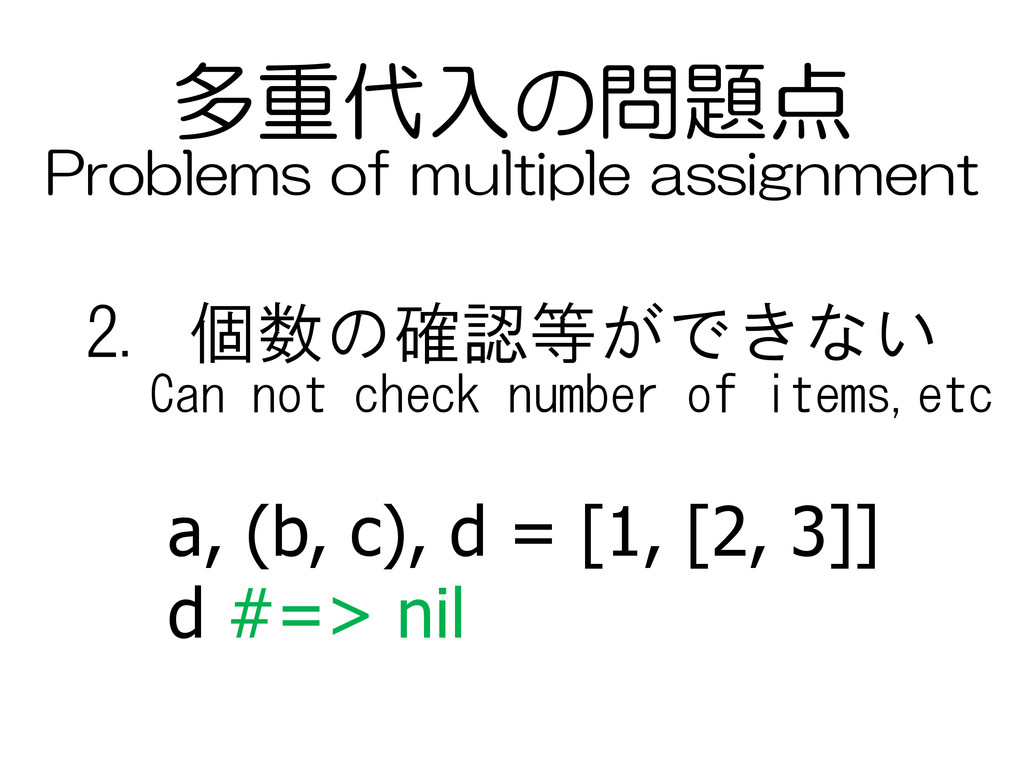
多重代入の問題点 a, (b, c), d = [1, [2, 3]] d
#=> nil Problems of multiple assignment 2. 個数の確認等ができない Can not check number of items,etc -
多重代入の問題点 a, (b, c) = [1, [2, 3]] これが欲しい Problems
of multiple assignment Need it 3. 途中の値が代入できない Can not assign nonterminal value -
多重代入の問題点 1. Arrayに限定される 2. 個数の確認等ができない 3. 途中の式を代入できない 分解機能が弱い 照合機能がない 代入機能が弱い
Lack of deconstructuring mechanism No matching mechanism Lack of assignment mechanism Problems of multiple assignment -
パターンマッチとは (多重代入 + α) + case 分解 + 代入 照合
Deconstructuring Assignment Matching Multiple assignment What is pattern matching -
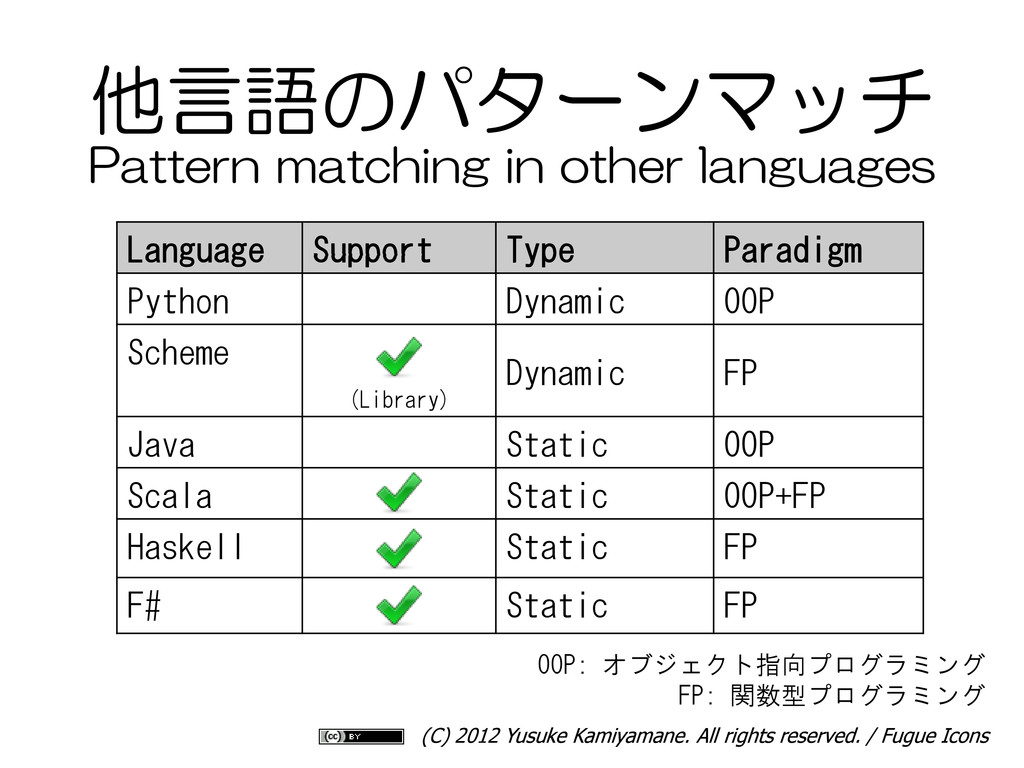
他言語のパターンマッチ Language Support Type Paradigm Python Dynamic OOP Scheme (Library)
Dynamic FP Java Static OOP Scala Static OOP+FP Haskell Static FP F# Static FP (C) 2012 Yusuke Kamiyamane. All rights reserved. / Fugue Icons Pattern matching in other languages OOP: オブジェクト指向プログラミング FP: 関数型プログラミング -
基本的な使い方 Array(1, Array(2, 3)) match { case Array(a, Array(b, c))
=> Array(a, b, c) case _ => null } // => Array(1, 2, 3) Basic usage -
分解 • ArrayをArrayとして Array(1, Array(2, 3)) match { case Array(a,
Array(b, c)) => ... } Deconstructuring Array as Array -
分解 • ListをListとして List(1, List(2, 3)) match { case List(a,
List(b, c)) => ... } Deconstructuring List as List -
分解 • StringをEMailとして "[email protected]" match { case EMail(user, domain) =>
(user, domain) } //=> ("foo", "example.com") String as EMail Deconstructuring -
分解 • StringをEMailとして "invalid e-mail address" match { case EMail(user,
domain) => (user, domain) } //=> MatchError String as EMail Deconstructuring -
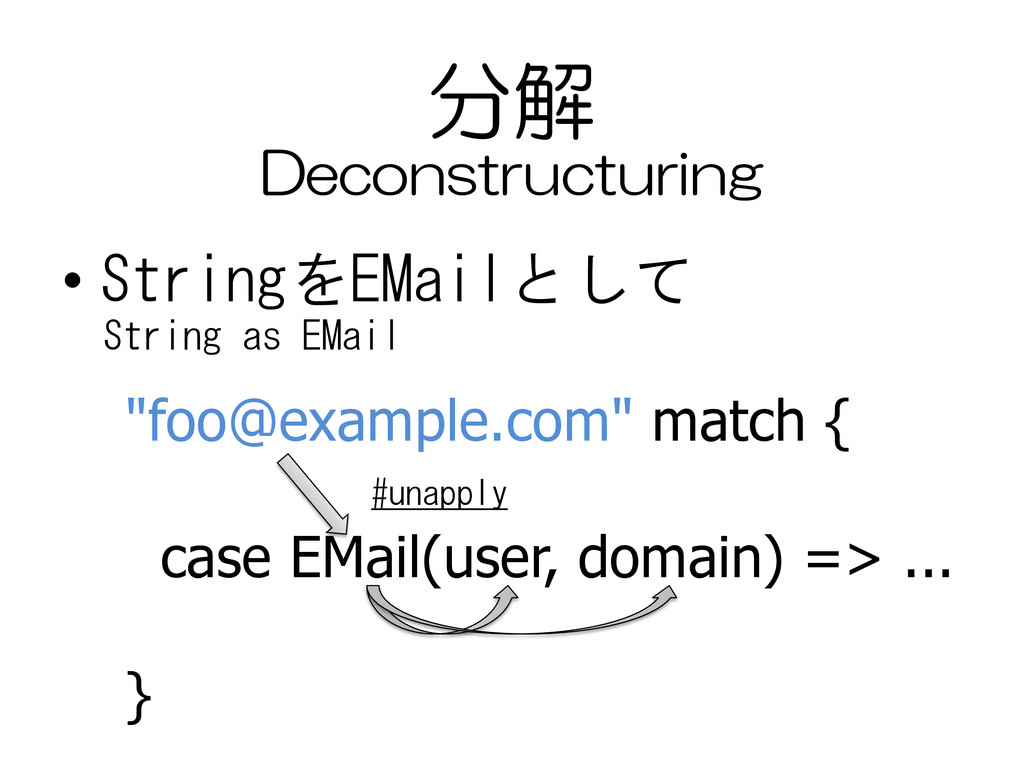
分解 • StringをEMailとして "[email protected]" match { case EMail(user, domain) =>
... } #unapply String as EMail Deconstructuring -
分解 • StringをEMailとして object EMail { def unapply(str: String): Option[(String,
String)] = { val parts = str split "@" if (parts.length == 2) Some(parts(0), parts(1)) else None } } String as EMail Deconstructuring -
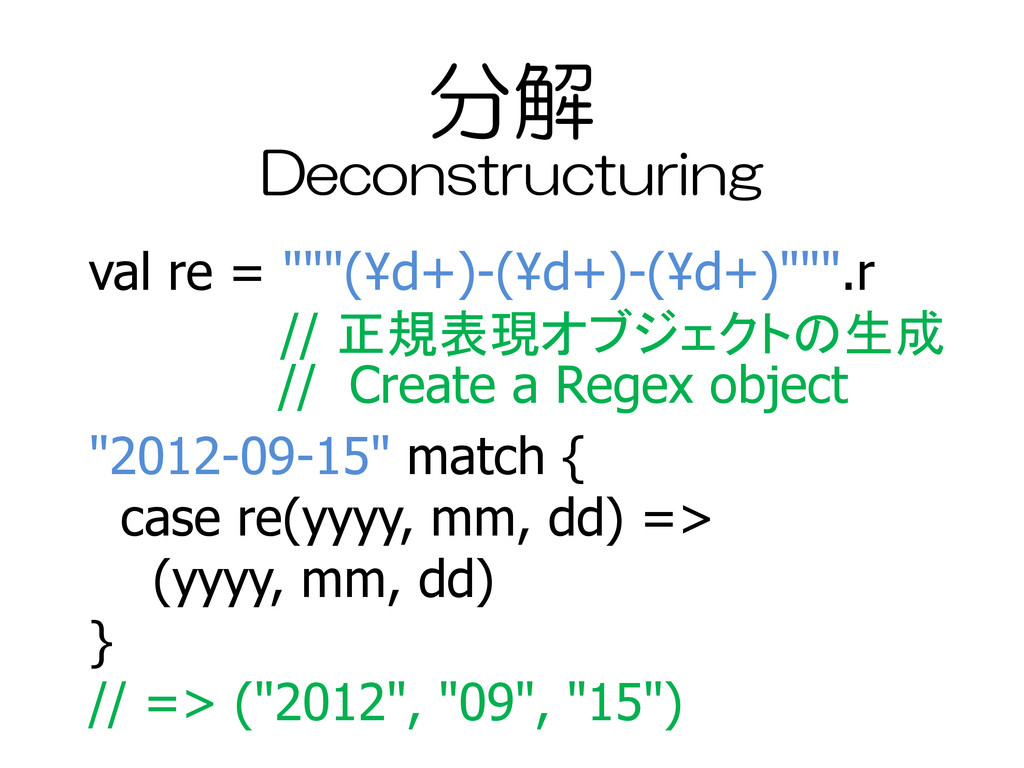
分解 val re = """(¥d+)-(¥d+)-(¥d+)""".r // 正規表現オブジェクトの生成 "2012-09-15" match {
case re(yyyy, mm, dd) => (yyyy, mm, dd) } // => ("2012", "09", "15") // Create a Regex object Deconstructuring -
照合 Array(1, Array(2, 3)) match { case Array(a, Array(b, c),
d) => null case Array(a, List(b, c)) => null case Array(0, Array(b, c)) => null } // => MatchError Matching -
代入 Array(1, Array(2, 3)) match { case Array(a, d @
Array(b, c)) => Array(a, b, c, d) } // => Array(1, 2, 3, Array(2, 3)) Assignment -
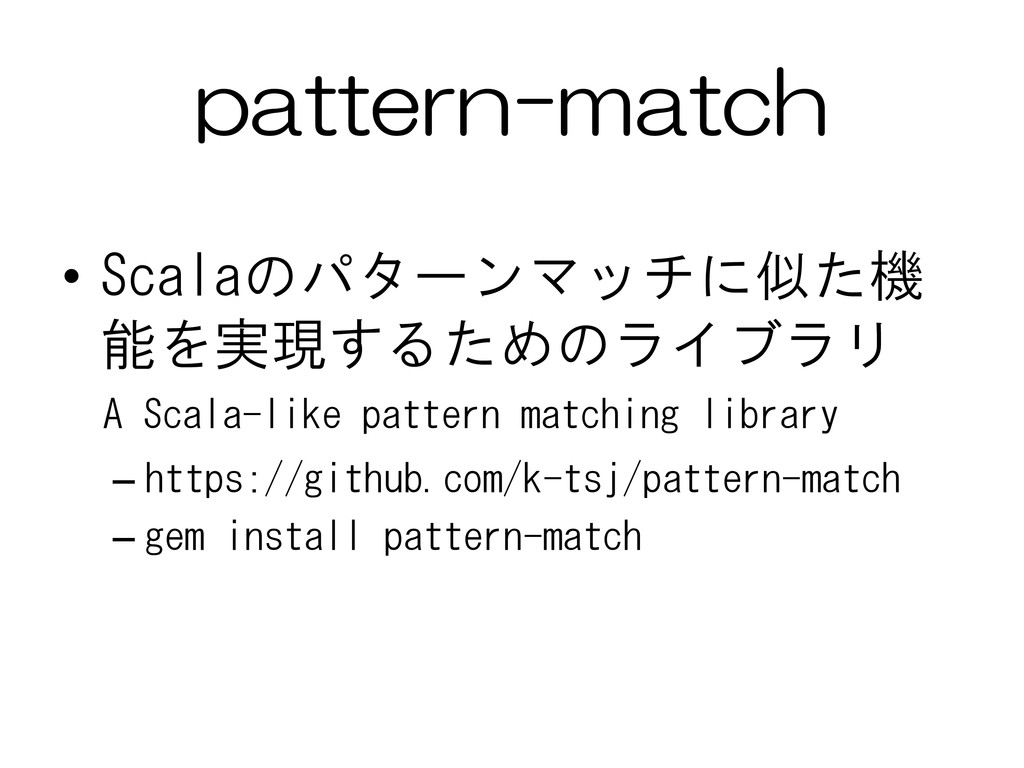
pattern-match • Scalaのパターンマッチに似た機 能を実現するためのライブラリ – https://github.com/k-tsj/pattern-match – gem install pattern-match
A Scala-like pattern matching library -
基本的な使い方 require 'pattern-match' match([0, [1, 2]]) { with(Array.(a, Array.(b, 2))
{ [a, b] #=> [0, 1] } with(_[a, _[b, 2]]) { # 上記と同様 ... } } Same as above Basic usage -
基本的な使い方 proc = match { with(_[a, _[b, 2]]) { [a,
b] } } proc.call([0, [1, 2]]) #=> [0, 1] 引数なし No argument Basic usage -
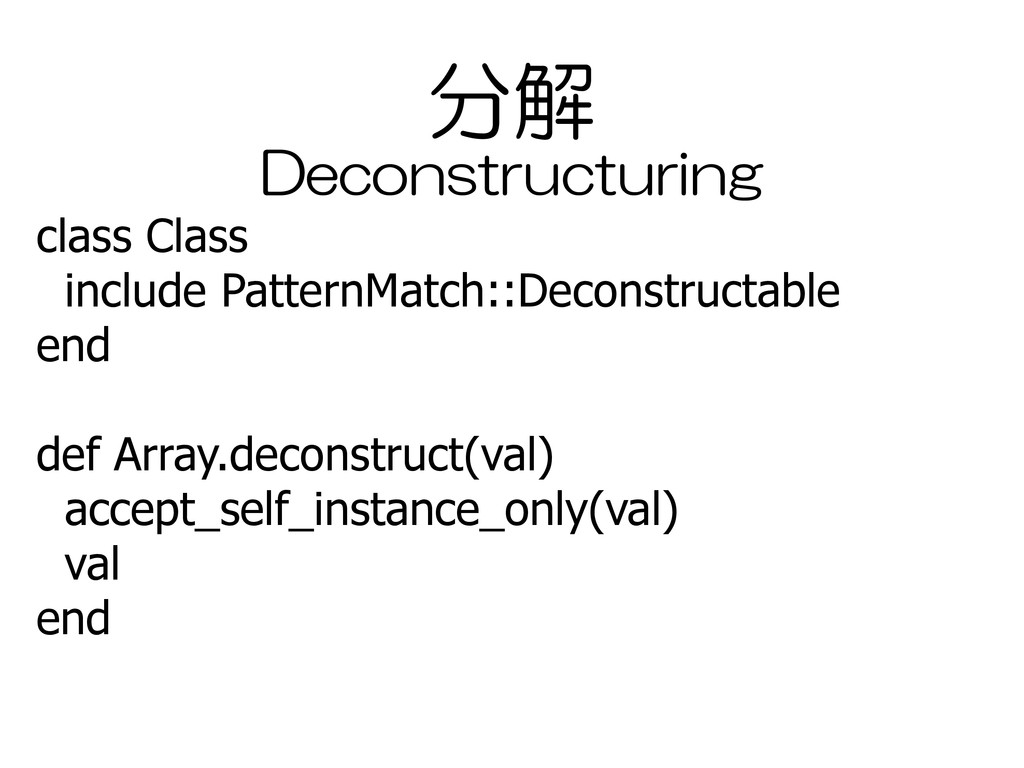
分解 • 分解するために必要なこと – Deconstructorのクラスに Deconstructableをincludeする – Deconstructorに deconstructメソッドを定義する with(Array.(a,
b)) Deconstructor Deconstructuring What you need to deconstruct an object Include Deconstructable in a class of Deconstructor Define deconstruct method for Deconstructor -
分解 class Regexp include PatternMatch::Deconstructable def deconstruct(val) m = Regexp.new("¥¥A#{source}¥¥z",
options).match(val.to_s) raise PatternNotMatch unless m m.captures.empty? ? [m[0]] : m.captures end end Deconstructuring -
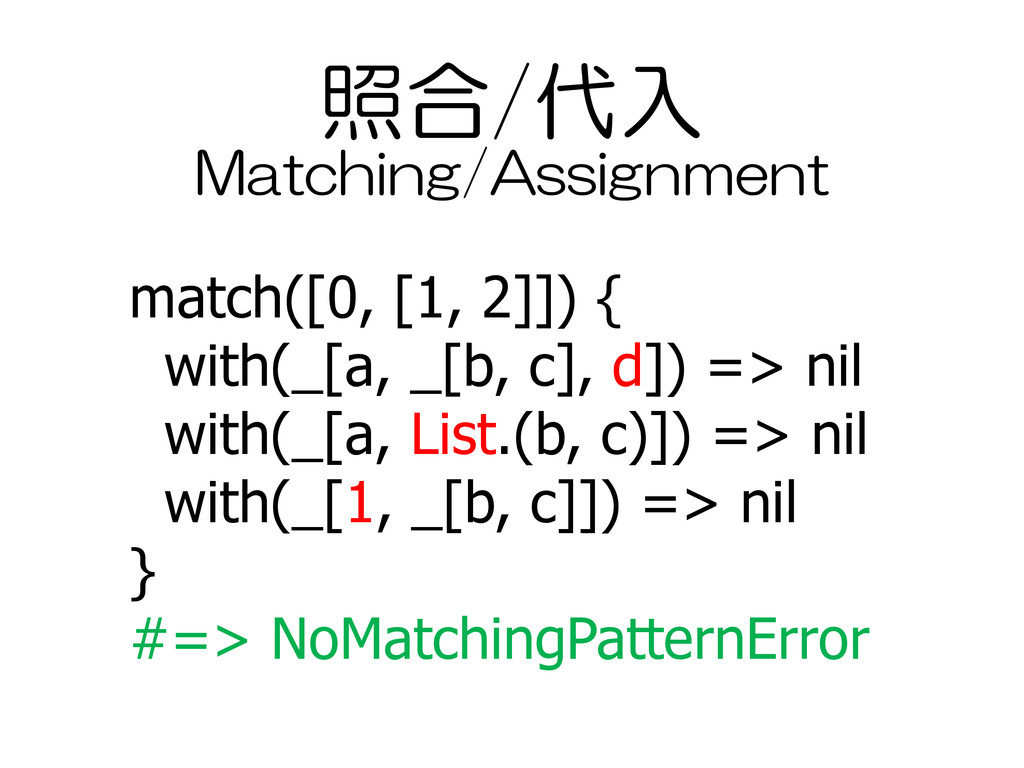
照合/代入 match([0, [1, 2]]) { with(_[a, _[b, c], d]) =>
nil with(_[a, List.(b, c)]) => nil with(_[1, _[b, c]]) => nil } #=> NoMatchingPatternError Matching/Assignment -
照合/代入 • オブジェクトの比較は#=== match([0, 1]) { with(_[Fixnum, 1..10]) { true
} with(_) { false } } #=> true Matching/Assignment Compare objects by #=== -
照合/代入 • 繰り返し match([[0, 1], [2, 3]]) { with(_[_[a, b],
___]) { [a, b] #=> [[0, 2], [1, 3]] } } Matching/Assignment Repetition -
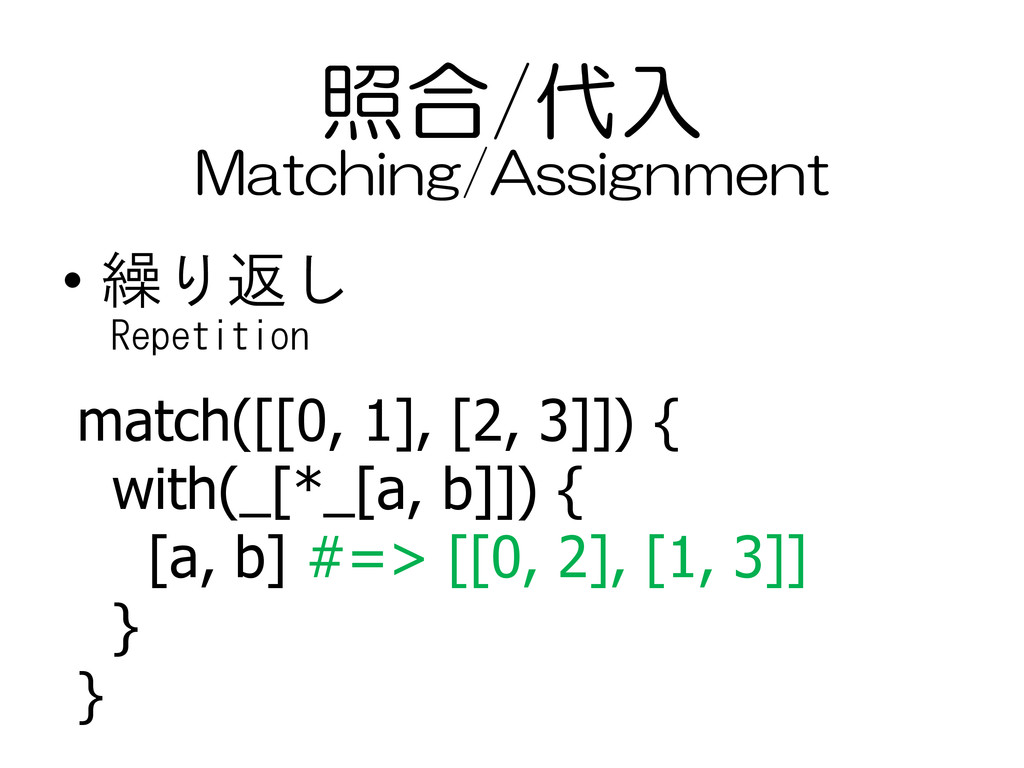
照合/代入 • 繰り返し match([[0, 1], [2, 3]]) { with(_[*_[a, b]])
{ [a, b] #=> [[0, 2], [1, 3]] } } Matching/Assignment Repetition -
照合/代入 • AND(&)/OR(|)/NOT(!) match([0, [1]]) { with(_[(a & Fixnum), !(_[2]
| _[3])]) { a #=> 0 } } Matching/Assignment -
照合/代入 • Hash.() –Destructuring Assignment(#6414) john = {name: "John", last:
"Smith"} {name: n, last: l} = john n // => "John" l // => "Smith" Matching/Assignment -
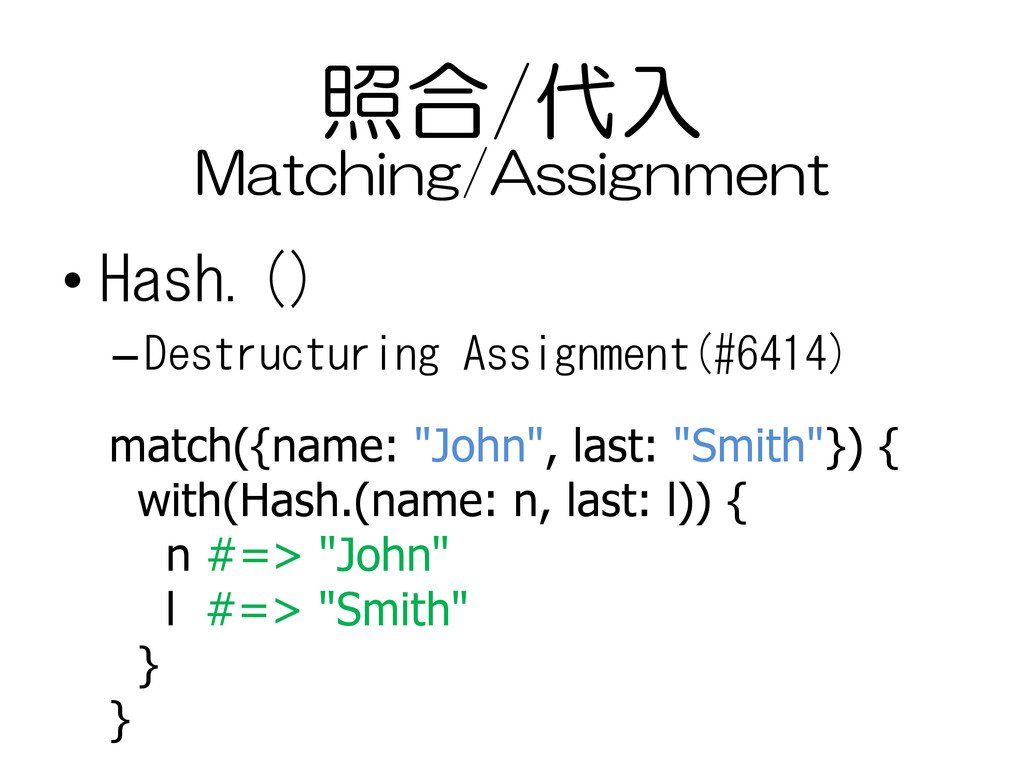
照合/代入 • Hash.() –Destructuring Assignment(#6414) match({name: "John", last: "Smith"}) {
with(Hash.(name: n, last: l)) { n #=> "John" l #=> "Smith" } } Matching/Assignment -
照合/代入 • Object.() –Duck typing style match(10) { with(Object.(:to_i =>
i, :to_s.(16) => s)) { [i, s] #=> [10, "a"] } } Matching/Assignment -
利用例(テキスト処理) birthday,fullname 2012/4/1,John Smith 2011/6/3,Jane Smith 2012/9/15,Pater Smith 2012/5/22,Mary Smith
Year: 2012 Month: 1 - 6 Month: 4, Name: John, Last: Smith Month: 5, Name: Mary, Last: Smith Examples(Text processing) 入力 Input 出力 Output -
利用例(テキスト処理) • パターンマッチあり ARGF.each(&match { with(CSV.(Date.(2012, mm & 1..6, _),
/(¥w+) (¥w+)/.(name, last))) { ... } with(_) { ... } }) Examples(Text processing) With pattern matching -
利用例(テキスト処理) • パターンマッチなし ARGF.each do |i| cols = CSV.parse_line(i) if
cols.length == 2 date = Date.parse(cols[0]) rescue nil m = cols[1].match(/(¥w+) (¥w+)/) if date and date.year == 2012 and (1..6).includes?(date.month) and m mm = date.month name, last = m.captures ... Examples(Text processing) Without pattern matching -
利用例(ノード処理) doc = REXML::Document.new( '<ul><li>a</li><li>b</li></ul>' ) match(doc.root) { with(Element('ul', attrs,
*Element('li', _, Text(txts)))) { txts #=> ["a", "b"] } } Examples(Node processing) -
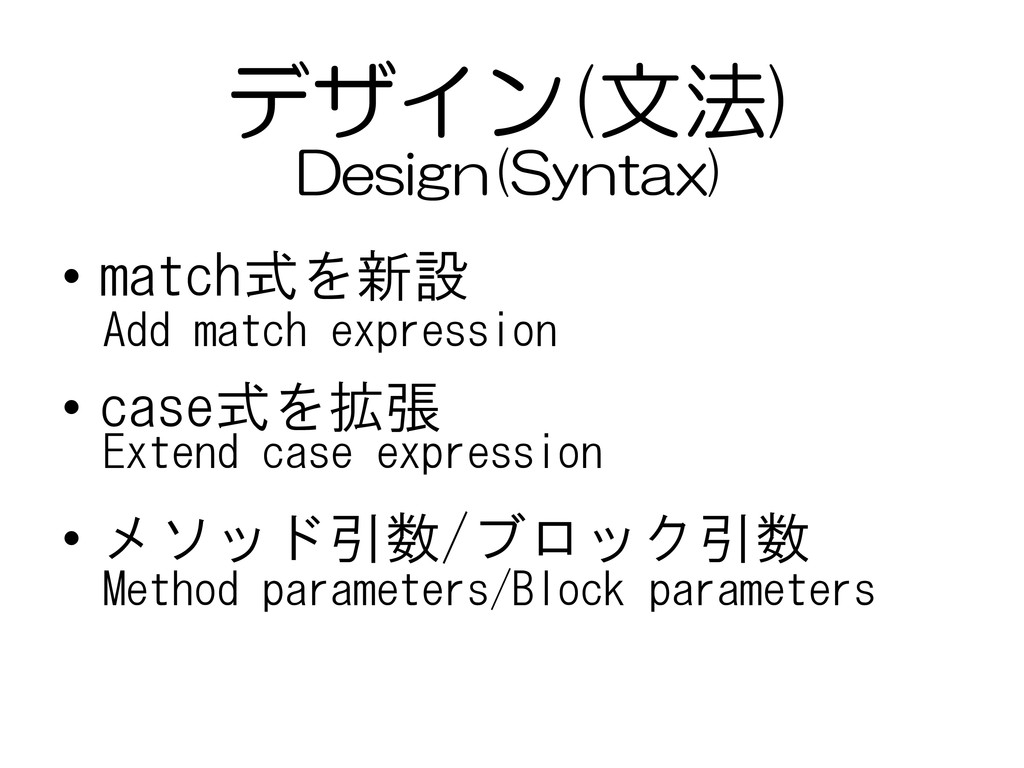
デザイン(文法) • match式を新設 • case式を拡張 • メソッド引数/ブロック引数 Design(Syntax) Add match
expression Extend case expression Method parameters/Block parameters -
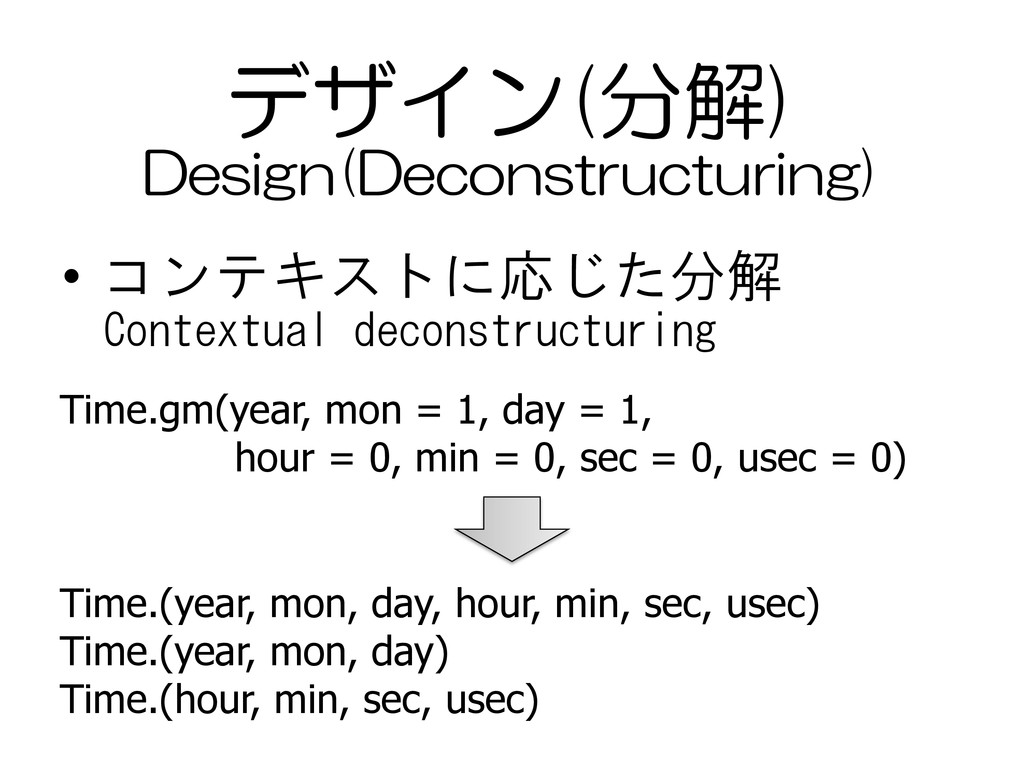
デザイン(分解) • コンテキストに応じた分解 Time.gm(year, mon = 1, day = 1,
hour = 0, min = 0, sec = 0, usec = 0) Time.(year, mon, day, hour, min, sec, usec) Time.(year, mon, day) Time.(hour, min, sec, usec) Design(Deconstructuring) Contextual deconstructuring -
デザイン(照合) • 正規表現 match(["a", "b", 0, "c", "d"]) { with(_[*i,
Fixnum, *j]) { [i, j] #=> [["a", "b"], ["c", "d"]] } } Design(Matching) Regular expression -
デザイン(照合) • Mathematicaの例 Replace[{1, {2, 3}}, (* List *) {a_,
{b_, c_}} -> (* Pattern *) {a, b, c}] (* {1, 2, 3} *) Design(Matching) Examples of Mathematica -
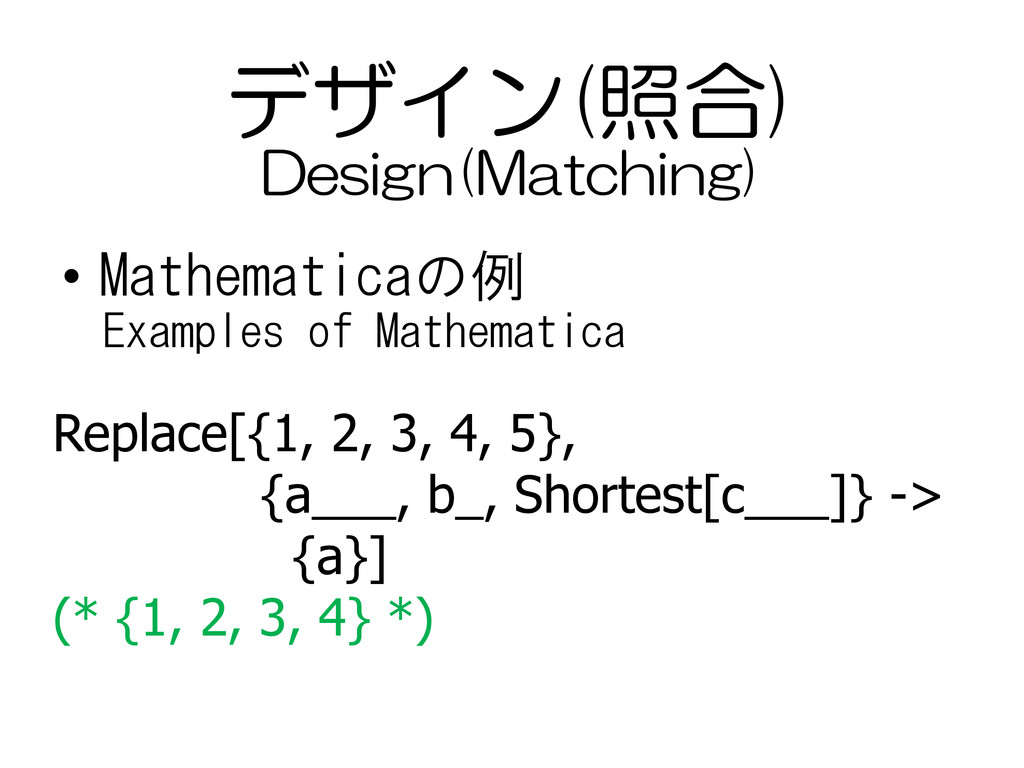
デザイン(照合) • Mathematicaの例 Replace[{1, 2, 3, 4, 5}, {a___, b_,
Shortest[c___]} -> {a}] (* {1, 2, 3, 4} *) Design(Matching) Examples of Mathematica -
デザイン(照合) • Mathematicaの例 Replace[{1, 2, 3, 4, 5}, {a___, b_,
c___}/;b>2 -> {a}] (* {1, 2} *) Design(Matching) Examples of Mathematica -
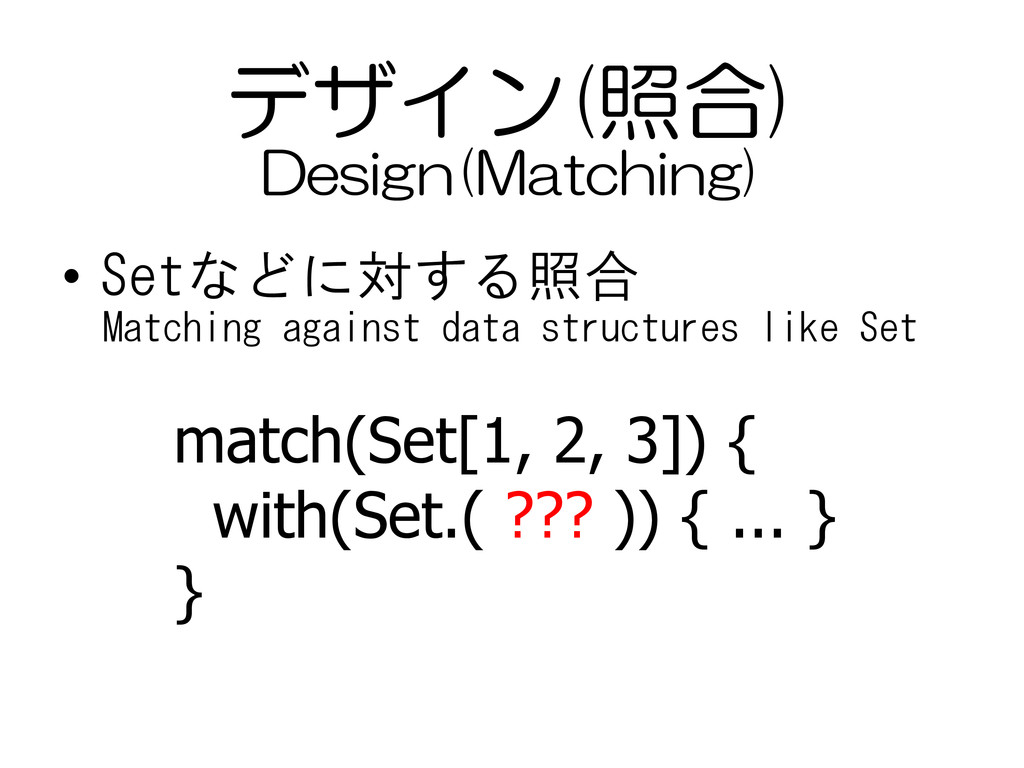
デザイン(照合) • Setなどに対する照合 match(Set[1, 2, 3]) { with(Set.( ??? ))
{ ... } } Design(Matching) Matching against data structures like Set -
まとめ • パターンマッチは非常に強力 • ぜひ実際にコードを書いてユース ケースを共有してください Conclusions You know the
power of pattern matching We Code.