Upgrade to Pro — share decks privately, control downloads, hide ads and more …

Empowering Families Through Investment: LIFT's ...

Sponsored · Your Podcast. Everywhere. Effortlessly. Share. Educate. Inspire. Entertain. You do you. We'll handle the rest.
Avatar for LIFT LIFT
April 09, 2026
68

Empowering Families Through Investment: LIFT's Family Goal Fund

Avatar for LIFT

LIFT

April 09, 2026

Transcript

  1. Since 1998, LIFT has proudly partnered with over 100,000 families

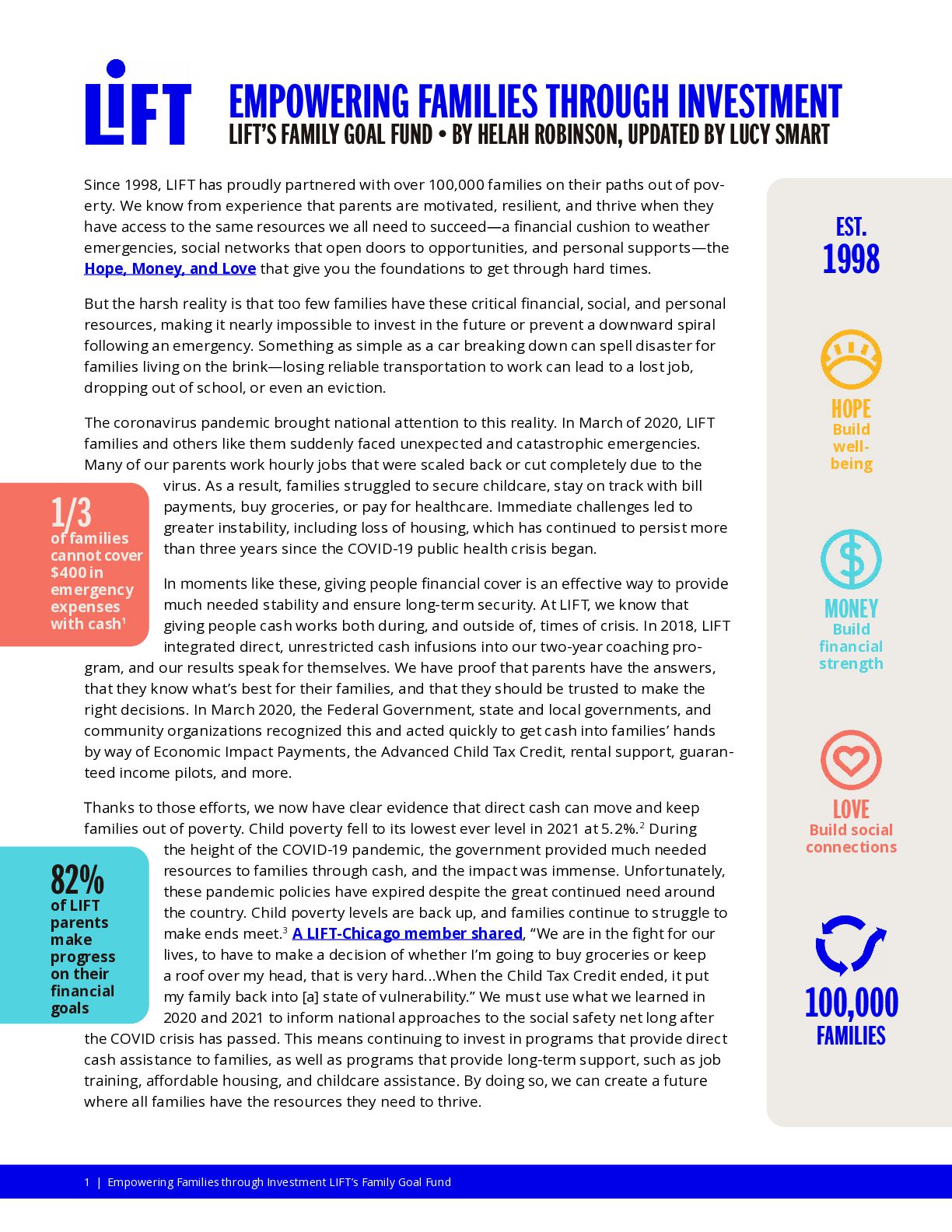
    on their paths out of pov- erty. We know from experience that parents are motivated, resilient, and thrive when they have access to the same resources we all need to succeed—a financial cushion to weather emergencies, social networks that open doors to opportunities, and personal supports—the Hope, Money, and Love that give you the foundations to get through hard times. But the harsh reality is that too few families have these critical financial, social, and personal resources, making it nearly impossible to invest in the future or prevent a downward spiral following an emergency. Something as simple as a car breaking down can spell disaster for families living on the brink—losing reliable transportation to work can lead to a lost job, dropping out of school, or even an eviction. The coronavirus pandemic brought national attention to this reality. In March of 2020, LIFT families and others like them suddenly faced unexpected and catastrophic emergencies. Many of our parents work hourly jobs that were scaled back or cut completely due to the virus. As a result, families struggled to secure childcare, stay on track with bill payments, buy groceries, or pay for healthcare. Immediate challenges led to greater instability, including loss of housing, which has continued to persist more than three years since the COVID-19 public health crisis began. In moments like these, giving people financial cover is an effective way to provide much needed stability and ensure long-term security. At LIFT, we know that giving people cash works both during, and outside of, times of crisis. In 2018, LIFT integrated direct, unrestricted cash infusions into our two-year coaching pro- gram, and our results speak for themselves. We have proof that parents have the answers, that they know what’s best for their families, and that they should be trusted to make the right decisions. In March 2020, the Federal Government, state and local governments, and community organizations recognized this and acted quickly to get cash into families’ hands by way of Economic Impact Payments, the Advanced Child Tax Credit, rental support, guaran- teed income pilots, and more. Thanks to those efforts, we now have clear evidence that direct cash can move and keep families out of poverty. Child poverty fell to its lowest ever level in 2021 at 5.2%.2 During the height of the COVID-19 pandemic, the government provided much needed resources to families through cash, and the impact was immense. Unfortunately, these pandemic policies have expired despite the great continued need around the country. Child poverty levels are back up, and families continue to struggle to make ends meet.3 A LIFT-Chicago member shared, “We are in the fight for our lives, to have to make a decision of whether I’m going to buy groceries or keep a roof over my head, that is very hard...When the Child Tax Credit ended, it put my family back into [a] state of vulnerability.” We must use what we learned in 2020 and 2021 to inform national approaches to the social safety net long after the COVID crisis has passed. This means continuing to invest in programs that provide direct cash assistance to families, as well as programs that provide long-term support, such as job training, affordable housing, and childcare assistance. By doing so, we can create a future where all families have the resources they need to thrive. EST. 1998 100,000 FAMILIES HOPE Build well- being LOVE Build social connections MONEY Build financial strength 1 | Empowering Families through Investment LIFT’s Family Goal Fund 1/3 of families cannot cover $400 in emergency expenses with cash1 82% of LIFT parents make progress on their financial goals EMPOWERING FAMILIES THROUGH INVESTMENT LIFT’S FAMILY GOAL FUND • BY HELAH ROBINSON, UPDATED BY LUCY SMART
  2. THE PROBLEM: FINANCIAL VOLATILITY CANNOT BE PROGRAMMED AWAY Racial and

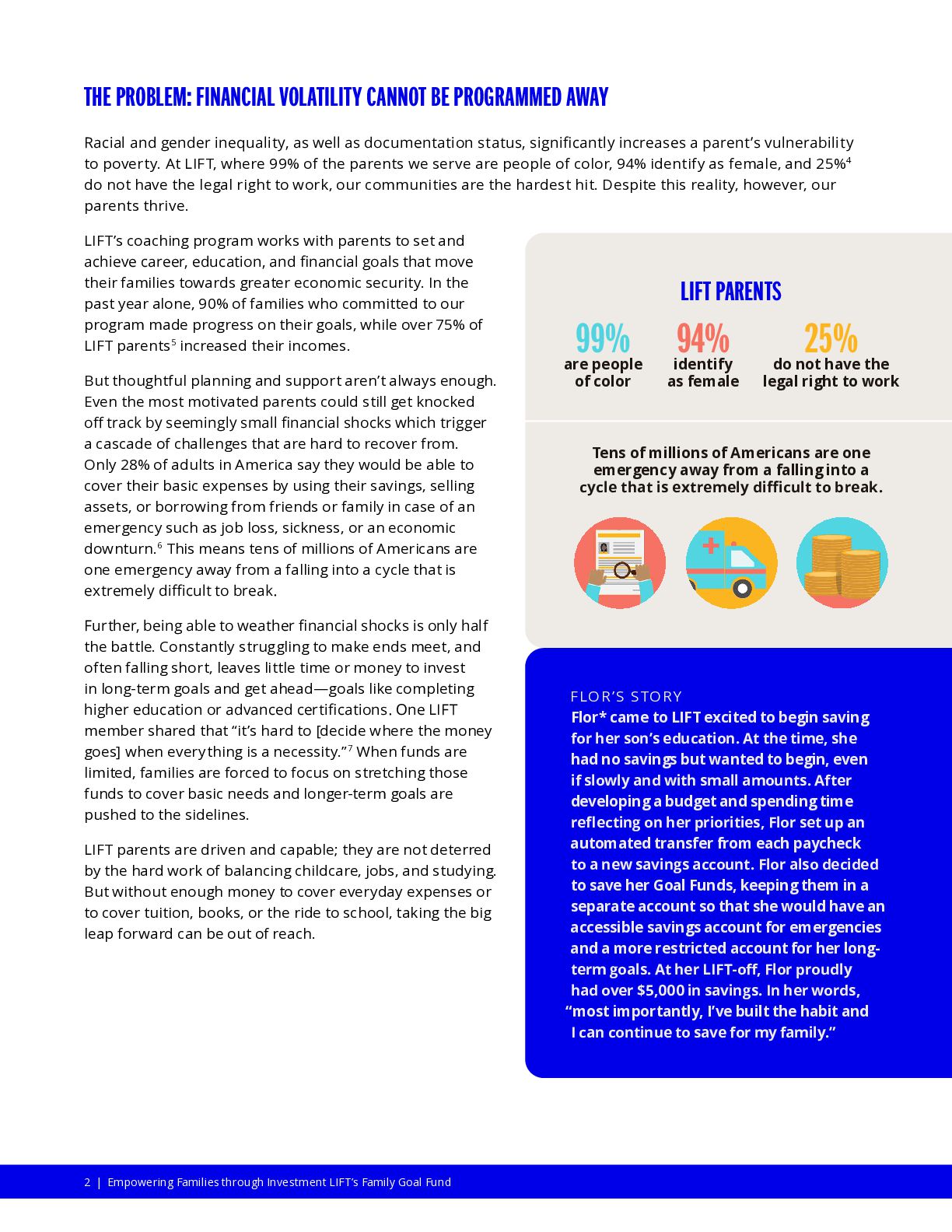
    gender inequality, as well as documentation status, significantly increases a parent’s vulnerability to poverty. At LIFT, where 99% of the parents we serve are people of color, 94% identify as female, and 25%4 do not have the legal right to work, our communities are the hardest hit. Despite this reality, however, our parents thrive. LIFT’s coaching program works with parents to set and achieve career, education, and financial goals that move their families towards greater economic security. In the past year alone, 90% of families who committed to our program made progress on their goals, while over 75% of LIFT parents5 increased their incomes. But thoughtful planning and support aren’t always enough. Even the most motivated parents could still get knocked off track by seemingly small financial shocks which trigger a cascade of challenges that are hard to recover from. Only 28% of adults in America say they would be able to cover their basic expenses by using their savings, selling assets, or borrowing from friends or family in case of an emergency such as job loss, sickness, or an economic downturn.6 This means tens of millions of Americans are one emergency away from a falling into a cycle that is extremely difficult to break. Further, being able to weather financial shocks is only half the battle. Constantly struggling to make ends meet, and often falling short, leaves little time or money to invest in long-term goals and get ahead—goals like completing higher education or advanced certifications. One LIFT member shared that “it’s hard to [decide where the money goes] when everything is a necessity.”7 When funds are limited, families are forced to focus on stretching those funds to cover basic needs and longer-term goals are pushed to the sidelines. LIFT parents are driven and capable; they are not deterred by the hard work of balancing childcare, jobs, and studying. But without enough money to cover everyday expenses or to cover tuition, books, or the ride to school, taking the big leap forward can be out of reach. LIFT PARENTS 94% identify as female 25% do not have the legal right to work 99% are people of color Tens of millions of Americans are one emergency away from a falling into a cycle that is extremely difficult to break. 2 | Empowering Families through Investment LIFT’s Family Goal Fund FLOR’S STORY Flor* came to LIFT excited to begin saving for her son’s education. At the time, she had no savings but wanted to begin, even if slowly and with small amounts. After developing a budget and spending time reflecting on her priorities, Flor set up an automated transfer from each paycheck to a new savings account. Flor also decided to save her Goal Funds, keeping them in a separate account so that she would have an accessible savings account for emergencies and a more restricted account for her long- term goals. At her LIFT-off, Flor proudly had over $5,000 in savings. In her words, “most importantly, I’ve built the habit and I can continue to save for my family.”
  3. THE SOLUTION: LIFT’S FAMILY GOAL FUND Recognizing that parents know

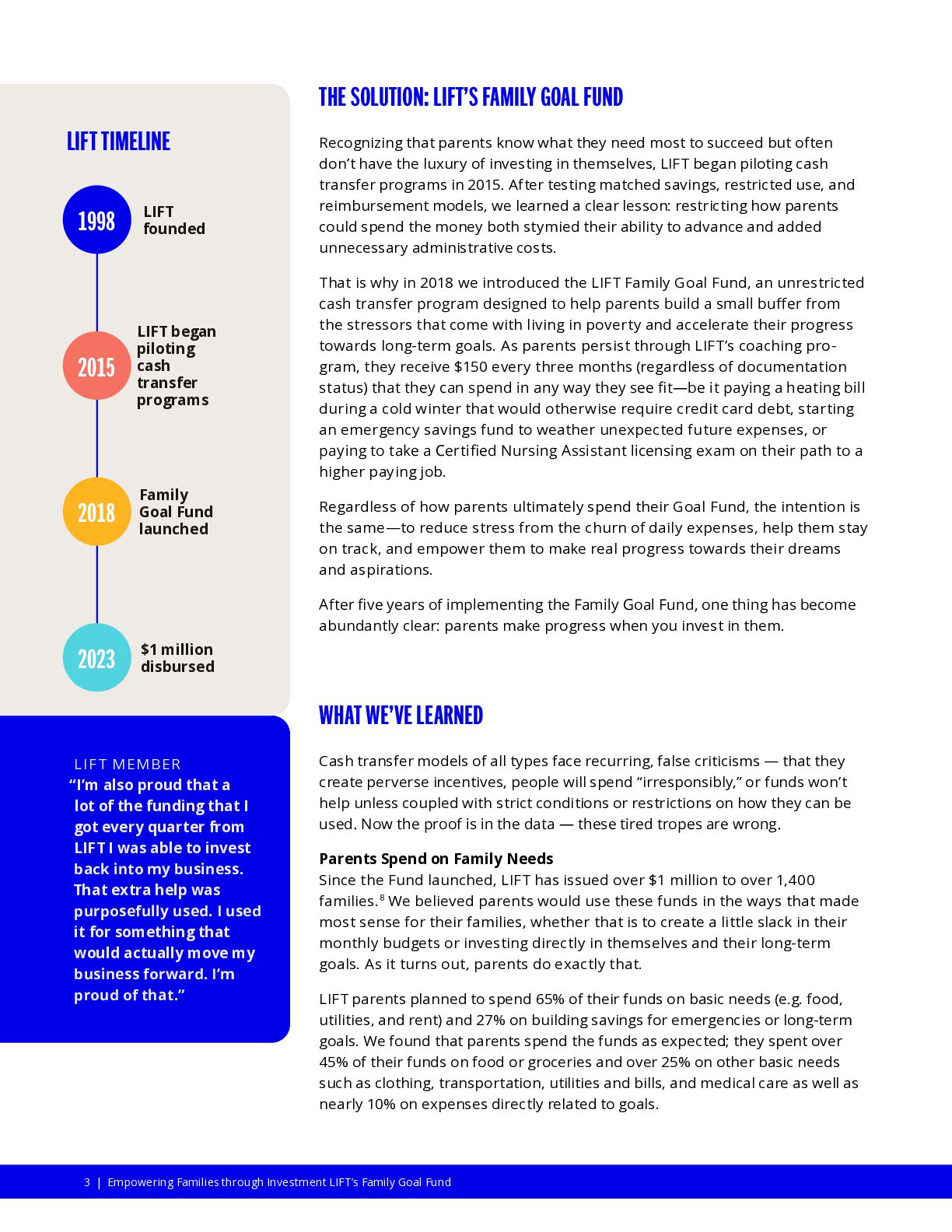
    what they need most to succeed but often don’t have the luxury of investing in themselves, LIFT began piloting cash transfer programs in 2015. After testing matched savings, restricted use, and reimbursement models, we learned a clear lesson: restricting how parents could spend the money both stymied their ability to advance and added unnecessary administrative costs. That is why in 2018 we introduced the LIFT Family Goal Fund, an unrestricted cash transfer program designed to help parents build a small buffer from the stressors that come with living in poverty and accelerate their progress towards long-term goals. As parents persist through LIFT’s coaching pro- gram, they receive $150 every three months (regardless of documentation status) that they can spend in any way they see fit—be it paying a heating bill during a cold winter that would otherwise require credit card debt, starting an emergency savings fund to weather unexpected future expenses, or paying to take a Certified Nursing Assistant licensing exam on their path to a higher paying job. Regardless of how parents ultimately spend their Goal Fund, the intention is the same—to reduce stress from the churn of daily expenses, help them stay on track, and empower them to make real progress towards their dreams and aspirations. After five years of implementing the Family Goal Fund, one thing has become abundantly clear: parents make progress when you invest in them. WHAT WE’VE LEARNED Cash transfer models of all types face recurring, false criticisms — that they create perverse incentives, people will spend “irresponsibly,” or funds won’t help unless coupled with strict conditions or restrictions on how they can be used. Now the proof is in the data — these tired tropes are wrong. Parents Spend on Family Needs Since the Fund launched, LIFT has issued over $1 million to over 1,400 families.8 We believed parents would use these funds in the ways that made most sense for their families, whether that is to create a little slack in their monthly budgets or investing directly in themselves and their long-term goals. As it turns out, parents do exactly that. LIFT parents planned to spend 65% of their funds on basic needs (e.g. food, utilities, and rent) and 27% on building savings for emergencies or long-term goals. We found that parents spend the funds as expected; they spent over 45% of their funds on food or groceries and over 25% on other basic needs such as clothing, transportation, utilities and bills, and medical care as well as nearly 10% on expenses directly related to goals. 3 | Empowering Families through Investment LIFT’s Family Goal Fund LIFT TIMELINE 2015 2018 2023 1998 LIFT began piloting cash transfer programs LIFT founded Family Goal Fund launched $1 million disbursed LIFT MEMBER “I’m also proud that a lot of the funding that I got every quarter from LIFT I was able to invest back into my business. That extra help was purposefully used. I used it for something that would actually move my business forward. I’m proud of that.”
  4. Parents have also used the cash infusion to change the

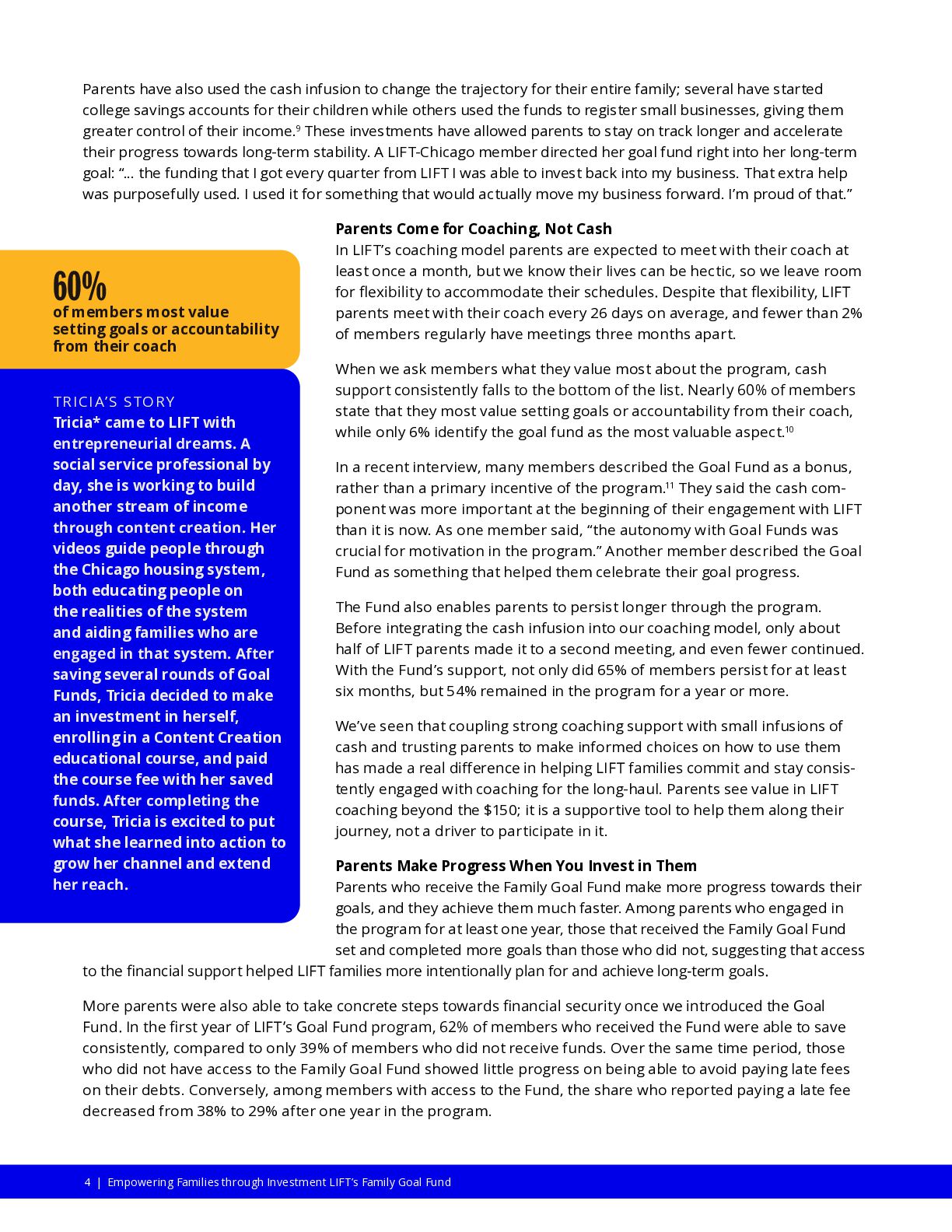
    trajectory for their entire family; several have started college savings accounts for their children while others used the funds to register small businesses, giving them greater control of their income.9 These investments have allowed parents to stay on track longer and accelerate their progress towards long-term stability. A LIFT-Chicago member directed her goal fund right into her long-term goal: “... the funding that I got every quarter from LIFT I was able to invest back into my business. That extra help was purposefully used. I used it for something that would actually move my business forward. I’m proud of that.” Parents Come for Coaching, Not Cash In LIFT’s coaching model parents are expected to meet with their coach at least once a month, but we know their lives can be hectic, so we leave room for flexibility to accommodate their schedules. Despite that flexibility, LIFT parents meet with their coach every 26 days on average, and fewer than 2% of members regularly have meetings three months apart. When we ask members what they value most about the program, cash support consistently falls to the bottom of the list. Nearly 60% of members state that they most value setting goals or accountability from their coach, while only 6% identify the goal fund as the most valuable aspect.10 In a recent interview, many members described the Goal Fund as a bonus, rather than a primary incentive of the program.11 They said the cash com- ponent was more important at the beginning of their engagement with LIFT than it is now. As one member said, “the autonomy with Goal Funds was crucial for motivation in the program.” Another member described the Goal Fund as something that helped them celebrate their goal progress. The Fund also enables parents to persist longer through the program. Before integrating the cash infusion into our coaching model, only about half of LIFT parents made it to a second meeting, and even fewer continued. With the Fund’s support, not only did 65% of members persist for at least six months, but 54% remained in the program for a year or more. We’ve seen that coupling strong coaching support with small infusions of cash and trusting parents to make informed choices on how to use them has made a real difference in helping LIFT families commit and stay consis- tently engaged with coaching for the long-haul. Parents see value in LIFT coaching beyond the $150; it is a supportive tool to help them along their journey, not a driver to participate in it. Parents Make Progress When You Invest in Them Parents who receive the Family Goal Fund make more progress towards their goals, and they achieve them much faster. Among parents who engaged in the program for at least one year, those that received the Family Goal Fund set and completed more goals than those who did not, suggesting that access to the financial support helped LIFT families more intentionally plan for and achieve long-term goals. More parents were also able to take concrete steps towards financial security once we introduced the Goal Fund. In the first year of LIFT’s Goal Fund program, 62% of members who received the Fund were able to save consistently, compared to only 39% of members who did not receive funds. Over the same time period, those who did not have access to the Family Goal Fund showed little progress on being able to avoid paying late fees on their debts. Conversely, among members with access to the Fund, the share who reported paying a late fee decreased from 38% to 29% after one year in the program. 4 | Empowering Families through Investment LIFT’s Family Goal Fund TRICIA’S STORY Tricia* came to LIFT with entrepreneurial dreams. A social service professional by day, she is working to build another stream of income through content creation. Her videos guide people through the Chicago housing system, both educating people on the realities of the system and aiding families who are engaged in that system. After saving several rounds of Goal Funds, Tricia decided to make an investment in herself, enrolling in a Content Creation educational course, and paid the course fee with her saved funds. After completing the course, Tricia is excited to put what she learned into action to grow her channel and extend her reach. 60% of members most value setting goals or accountability from their coach
  5. The positive impact on parents and families from a cash

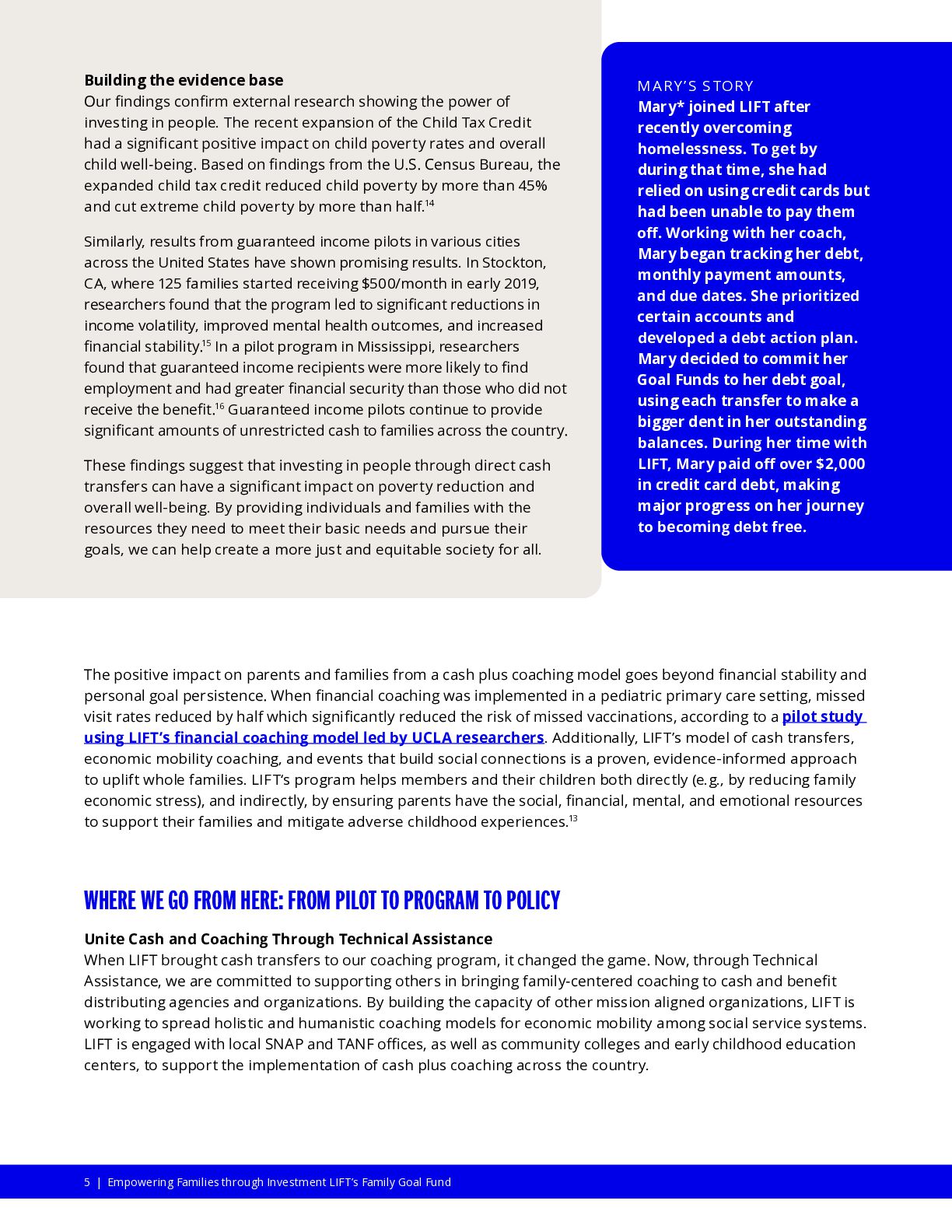
    plus coaching model goes beyond financial stability and personal goal persistence. When financial coaching was implemented in a pediatric primary care setting, missed visit rates reduced by half which significantly reduced the risk of missed vaccinations, according to a pilot study using LIFT’s financial coaching model led by UCLA researchers. Additionally, LIFT’s model of cash transfers, economic mobility coaching, and events that build social connections is a proven, evidence-informed approach to uplift whole families. LIFT‘s program helps members and their children both directly (e.g., by reducing family economic stress), and indirectly, by ensuring parents have the social, financial, mental, and emotional resources to support their families and mitigate adverse childhood experiences.13 WHERE WE GO FROM HERE: FROM PILOT TO PROGRAM TO POLICY Unite Cash and Coaching Through Technical Assistance When LIFT brought cash transfers to our coaching program, it changed the game. Now, through Technical Assistance, we are committed to supporting others in bringing family-centered coaching to cash and benefit distributing agencies and organizations. By building the capacity of other mission aligned organizations, LIFT is working to spread holistic and humanistic coaching models for economic mobility among social service systems. LIFT is engaged with local SNAP and TANF offices, as well as community colleges and early childhood education centers, to support the implementation of cash plus coaching across the country. Building the evidence base Our findings confirm external research showing the power of investing in people. The recent expansion of the Child Tax Credit had a significant positive impact on child poverty rates and overall child well-being. Based on findings from the U.S. Census Bureau, the expanded child tax credit reduced child poverty by more than 45% and cut extreme child poverty by more than half.14 Similarly, results from guaranteed income pilots in various cities across the United States have shown promising results. In Stockton, CA, where 125 families started receiving $500/month in early 2019, researchers found that the program led to significant reductions in income volatility, improved mental health outcomes, and increased financial stability.15 In a pilot program in Mississippi, researchers found that guaranteed income recipients were more likely to find employment and had greater financial security than those who did not receive the benefit.16 Guaranteed income pilots continue to provide significant amounts of unrestricted cash to families across the country. These findings suggest that investing in people through direct cash transfers can have a significant impact on poverty reduction and overall well-being. By providing individuals and families with the resources they need to meet their basic needs and pursue their goals, we can help create a more just and equitable society for all. MARY’S STORY Mary* joined LIFT after recently overcoming homelessness. To get by during that time, she had relied on using credit cards but had been unable to pay them off. Working with her coach, Mary began tracking her debt, monthly payment amounts, and due dates. She prioritized certain accounts and developed a debt action plan. Mary decided to commit her Goal Funds to her debt goal, using each transfer to make a bigger dent in her outstanding balances. During her time with LIFT, Mary paid off over $2,000 in credit card debt, making major progress on her journey to becoming debt free. 5 | Empowering Families through Investment LIFT’s Family Goal Fund
  6. Key Lessons for Policy Makers LIFT parents have the agency

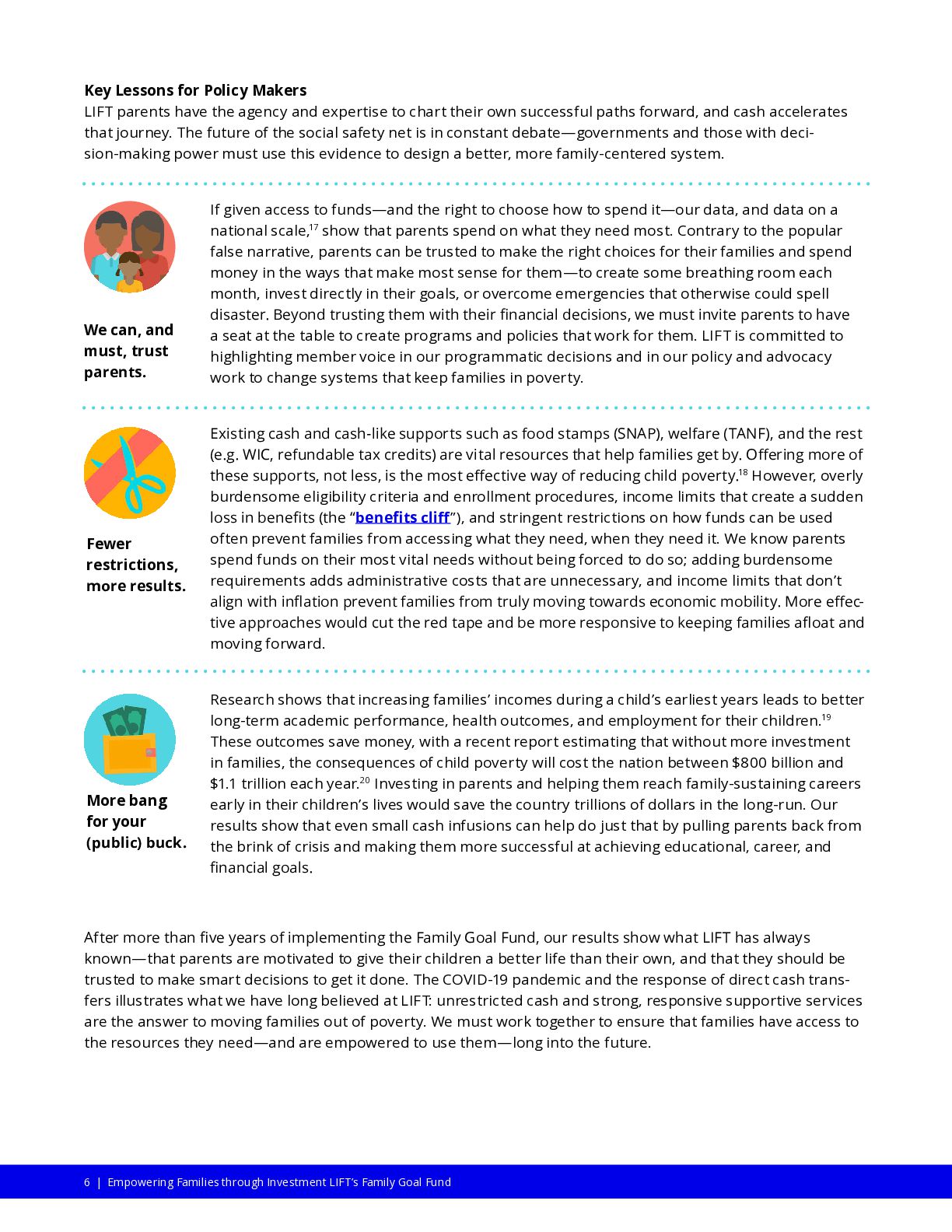
    and expertise to chart their own successful paths forward, and cash accelerates that journey. The future of the social safety net is in constant debate—governments and those with deci- sion-making power must use this evidence to design a better, more family-centered system. If given access to funds—and the right to choose how to spend it—our data, and data on a national scale,17 show that parents spend on what they need most. Contrary to the popular false narrative, parents can be trusted to make the right choices for their families and spend money in the ways that make most sense for them—to create some breathing room each month, invest directly in their goals, or overcome emergencies that otherwise could spell disaster. Beyond trusting them with their financial decisions, we must invite parents to have a seat at the table to create programs and policies that work for them. LIFT is committed to highlighting member voice in our programmatic decisions and in our policy and advocacy work to change systems that keep families in poverty. Existing cash and cash-like supports such as food stamps (SNAP), welfare (TANF), and the rest (e.g. WIC, refundable tax credits) are vital resources that help families get by. Offering more of these supports, not less, is the most effective way of reducing child poverty.18 However, overly burdensome eligibility criteria and enrollment procedures, income limits that create a sudden loss in benefits (the “benefits cliff”), and stringent restrictions on how funds can be used often prevent families from accessing what they need, when they need it. We know parents spend funds on their most vital needs without being forced to do so; adding burdensome requirements adds administrative costs that are unnecessary, and income limits that don’t align with inflation prevent families from truly moving towards economic mobility. More effec- tive approaches would cut the red tape and be more responsive to keeping families afloat and moving forward. Research shows that increasing families’ incomes during a child’s earliest years leads to better long-term academic performance, health outcomes, and employment for their children.19 These outcomes save money, with a recent report estimating that without more investment in families, the consequences of child poverty will cost the nation between $800 billion and $1.1 trillion each year.20 Investing in parents and helping them reach family-sustaining careers early in their children’s lives would save the country trillions of dollars in the long-run. Our results show that even small cash infusions can help do just that by pulling parents back from the brink of crisis and making them more successful at achieving educational, career, and financial goals. After more than five years of implementing the Family Goal Fund, our results show what LIFT has always known—that parents are motivated to give their children a better life than their own, and that they should be trusted to make smart decisions to get it done. The COVID-19 pandemic and the response of direct cash trans- fers illustrates what we have long believed at LIFT: unrestricted cash and strong, responsive supportive services are the answer to moving families out of poverty. We must work together to ensure that families have access to the resources they need—and are empowered to use them—long into the future. We can, and must, trust parents. Fewer restrictions, more results. 6 | Empowering Families through Investment LIFT’s Family Goal Fund More bang for your (public) buck.
  7. *Names have been changed to protect members’ confidentiality. 7 |

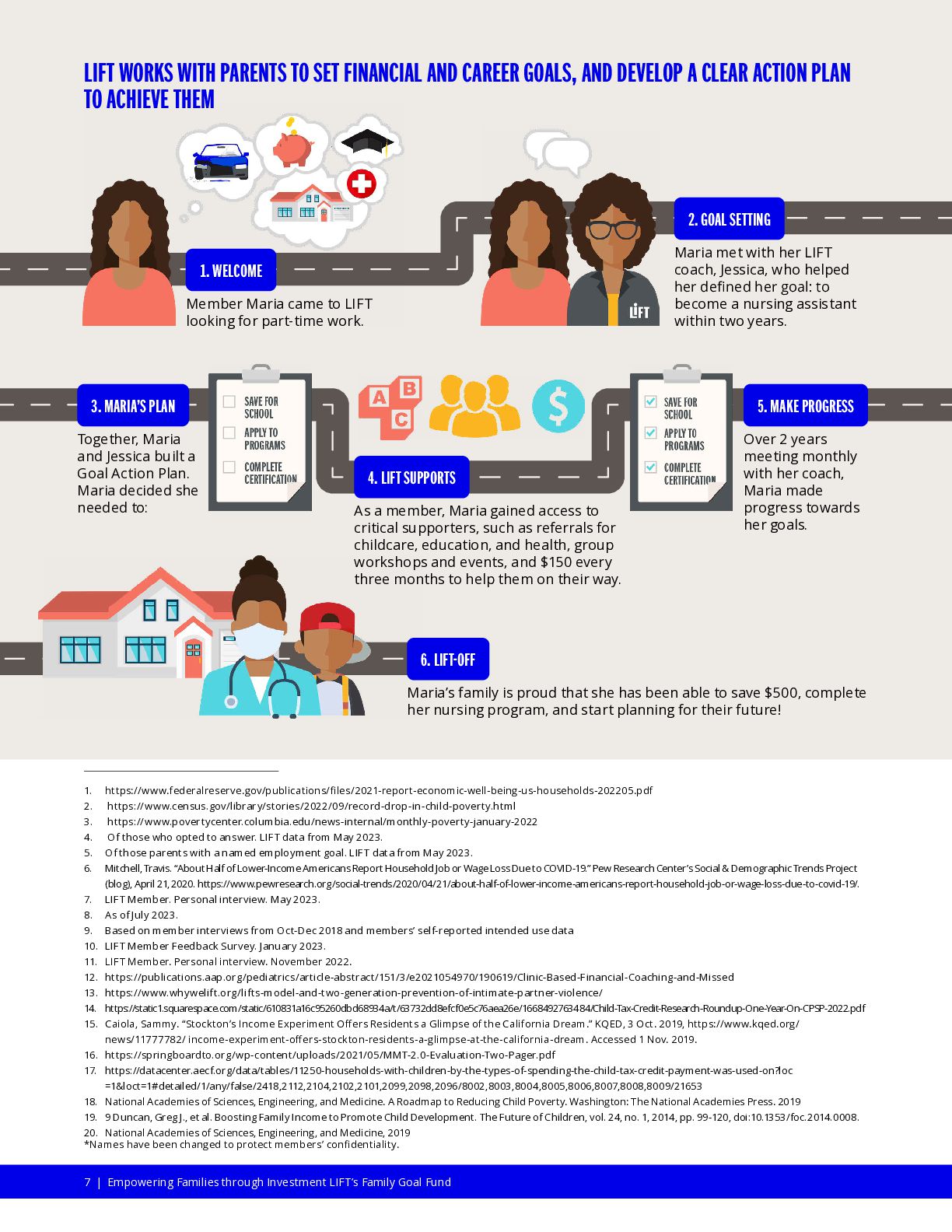
    Empowering Families through Investment LIFT’s Family Goal Fund 1. https://www.federalreserve.gov/publications/files/2021-report-economic-well-being-us-households-202205.pdf 2. https://www.census.gov/library/stories/2022/09/record-drop-in-child-poverty.html 3. https://www.povertycenter.columbia.edu/news-internal/monthly-poverty-january-2022 4. Of those who opted to answer. LIFT data from May 2023. 5. Of those parents with a named employment goal. LIFT data from May 2023. 6. Mitchell, Travis. “About Half of Lower-Income Americans Report Household Job or Wage Loss Due to COVID-19.” Pew Research Center’s Social & Demographic Trends Project (blog), April 21, 2020. https://www.pewresearch.org/social-trends/2020/04/21/about-half-of-lower-income-americans-report-household-job-or-wage-loss-due-to-covid-19/. 7. LIFT Member. Personal interview. May 2023. 8. As of July 2023. 9. Based on member interviews from Oct-Dec 2018 and members’ self-reported intended use data 10. LIFT Member Feedback Survey. January 2023. 11. LIFT Member. Personal interview. November 2022. 12. https://publications.aap.org/pediatrics/article-abstract/151/3/e2021054970/190619/Clinic-Based-Financial-Coaching-and-Missed 13. https://www.whywelift.org/lifts-model-and-two-generation-prevention-of-intimate-partner-violence/ 14. https://static1.squarespace.com/static/610831a16c95260dbd68934a/t/63732dd8efcf0e5c76aea26e/1668492763484/Child-Tax-Credit-Research-Roundup-One-Year-On-CPSP-2022.pdf 15. Caiola, Sammy. “Stockton’s Income Experiment Offers Residents a Glimpse of the California Dream.” KQED, 3 Oct. 2019, https://www.kqed.org/ news/11777782/ income-experiment-offers-stockton-residents-a-glimpse-at-the-california-dream. Accessed 1 Nov. 2019. 16. https://springboardto.org/wp-content/uploads/2021/05/MMT-2.0-Evaluation-Two-Pager.pdf 17. https://datacenter.aecf.org/data/tables/11250-households-with-children-by-the-types-of-spending-the-child-tax-credit-payment-was-used-on?loc =1&loct=1#detailed/1/any/false/2418,2112,2104,2102,2101,2099,2098,2096/8002,8003,8004,8005,8006,8007,8008,8009/21653 18. National Academies of Sciences, Engineering, and Medicine. A Roadmap to Reducing Child Poverty. Washington: The National Academies Press. 2019 19. 9 Duncan, Greg J., et al. Boosting Family Income to Promote Child Development. The Future of Children, vol. 24, no. 1, 2014, pp. 99-120, doi:10.1353/foc.2014.0008. 20. National Academies of Sciences, Engineering, and Medicine, 2019 LIFT WORKS WITH PARENTS TO SET FINANCIAL AND CAREER GOALS, AND DEVELOP A CLEAR ACTION PLAN TO ACHIEVE THEM 1. WELCOME 2. GOAL SETTING 3. MARIA’S PLAN 4. LIFT SUPPORTS 6. LIFT-OFF Member Maria came to LIFT looking for part-time work. Maria met with her LIFT coach, Jessica, who helped her defined her goal: to become a nursing assistant within two years. Together, Maria and Jessica built a Goal Action Plan. Maria decided she needed to: As a member, Maria gained access to critical supporters, such as referrals for childcare, education, and health, group workshops and events, and $150 every three months to help them on their way. 5. MAKE PROGRESS Over 2 years meeting monthly with her coach, Maria made progress towards her goals. Maria’s family is proud that she has been able to save $500, complete her nursing program, and start planning for their future!