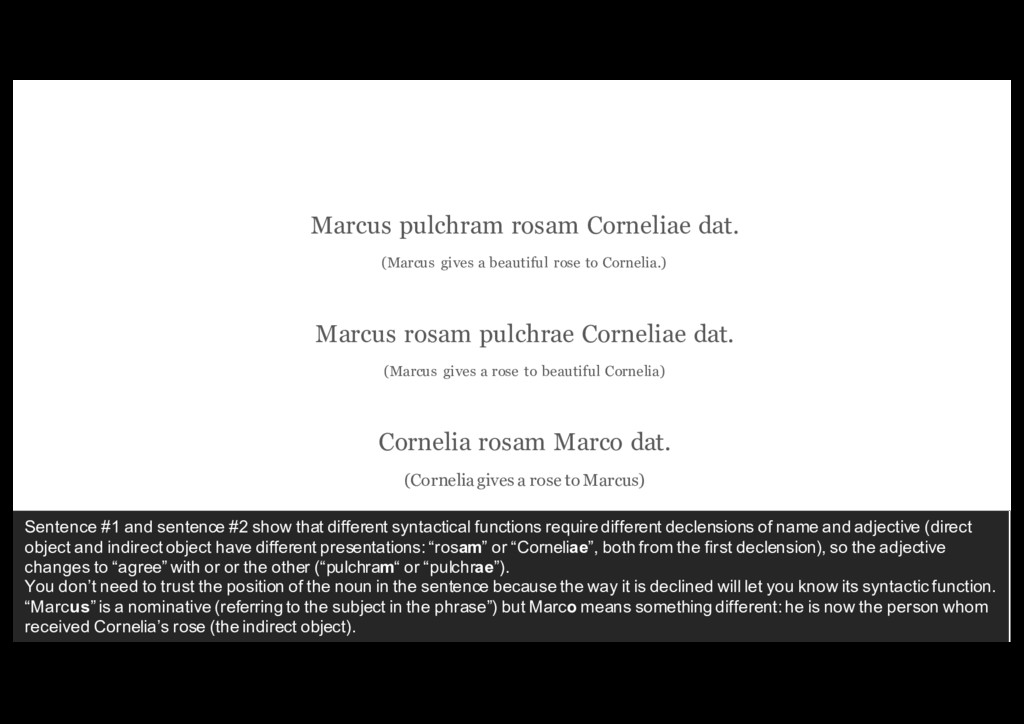
SOV (subject, object, verb) order Three genders (masculine, feminine and neutral) Five declensions and six cases for nouns and adjectives A fusional language is one that has a different way to say every single noun, adjective or verb. Verb conjugation changes in person (if it is “I”, or “you” or “him/her/it”) and in number (singular or plural). Nouns and adjectives are declensed differently according to number and the syntactic place of the name in the phrase (whether it is the subject or a complement, namely). These differences appear in the end of the words.
to Cornelia.) Marcus rosam pulchrae Corneliae dat. (Marcus gives a rose to beautiful Cornelia) Cornelia rosam Marco dat. (Corneliagivesa rose to Marcus) Sentence #1 and sentence #2 show that different syntactical functions require different declensions of name and adjective (direct object and indirect object have different presentations: “rosam” or “Corneliae”, both from the first declension), so the adjective changes to “agree” with or or the other (“pulchram“ or “pulchrae”). You don’t need to trust the position of the noun in the sentence because the way it is declined will let you know its syntactic function. “Marcus” is a nominative (referring to the subject in the phrase”) but Marco means something different: he is now the person whom received Cornelia’s rose (the indirect object).
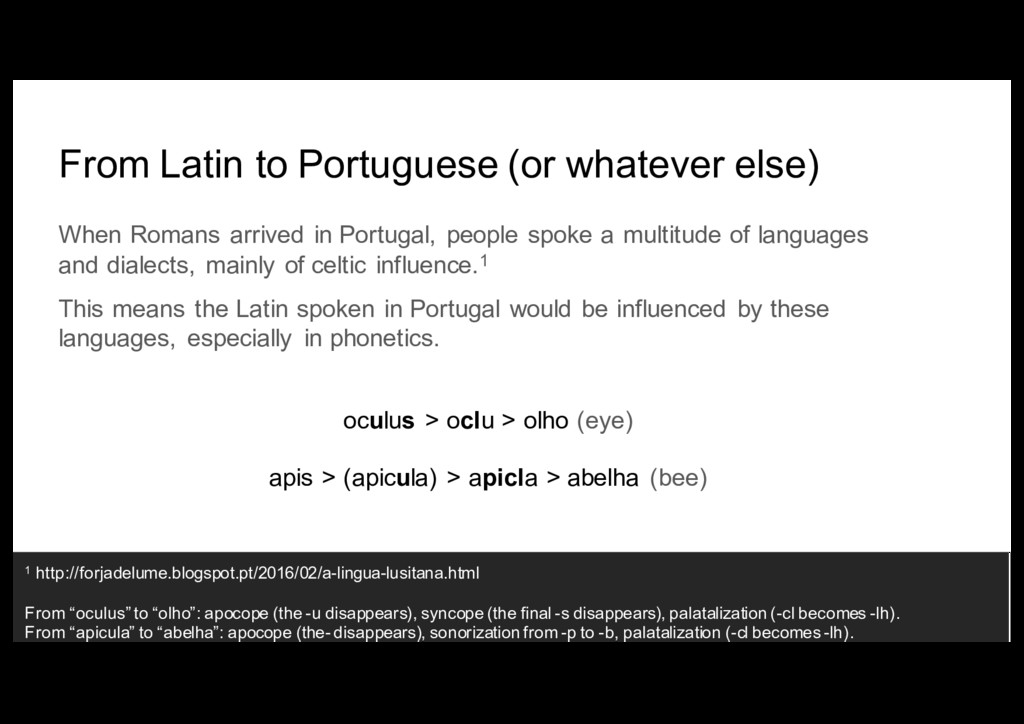
in Portugal, people spoke a multitude of languages and dialects, mainly of celtic influence.1 This means the Latin spoken in Portugal would be influenced by these languages, especially in phonetics. 1 http://forjadelume.blogspot.pt/2016/02/a-lingua-lusitana.html From “oculus” to “olho”: apocope (the -u disappears), syncope (the final -s disappears), palatalization (-cl becomes -lh). From “apicula” to “abelha”: apocope (the- disappears), sonorization from -p to -b, palatalization (-cl becomes -lh). oculus > oclu > olho (eye) apis > (apicula) > apicla > abelha (bee)
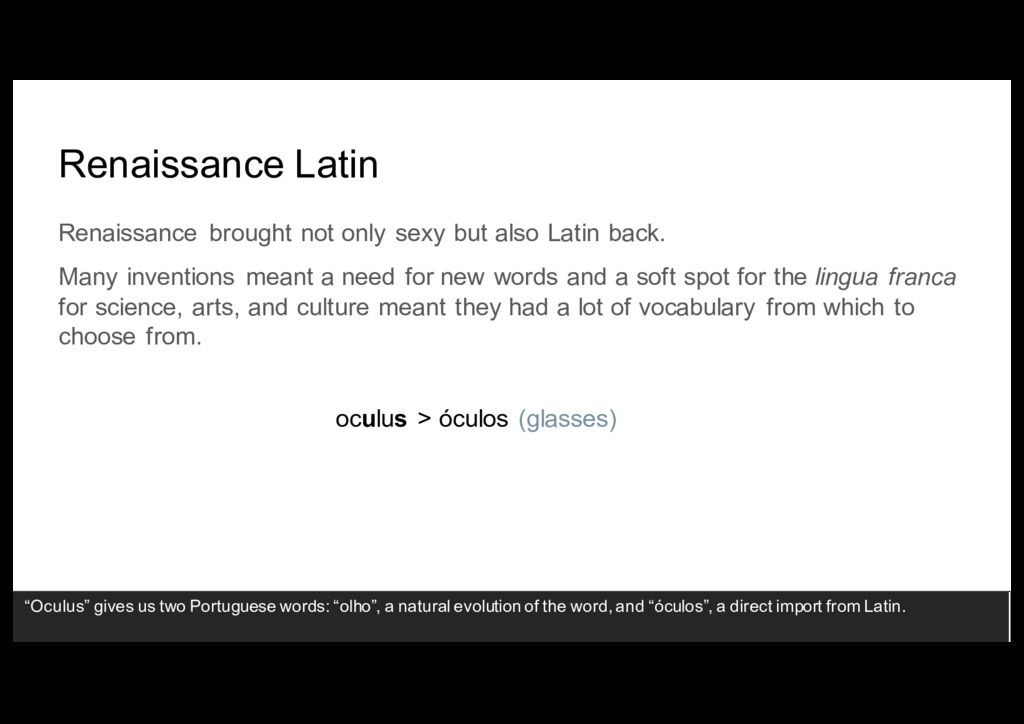
back. Many inventions meant a need for new words and a soft spot for the lingua franca for science, arts, and culture meant they had a lot of vocabulary from which to choose from. oculus > óculos (glasses) “Oculus” gives us two Portuguese words: “olho”, a natural evolution of the word, and “óculos”, a direct import from Latin.
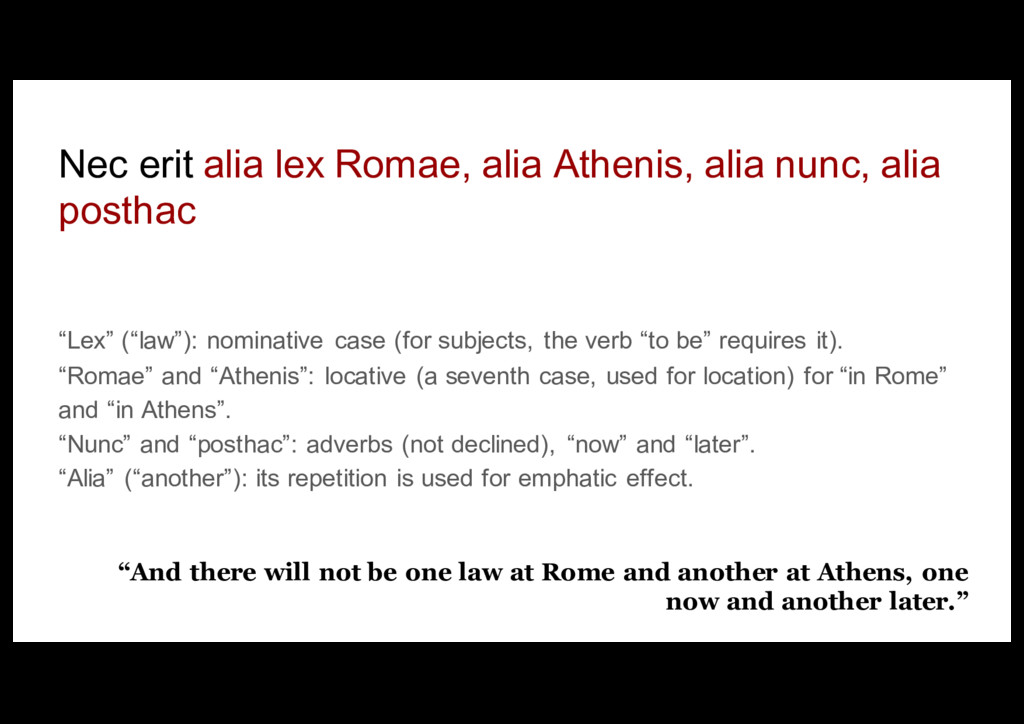
alia Athenis, alia nunc, alia posthac, sed et omnes gentes et omni tempore una lex et sempiterna et immutabilis continebit.” Cicero, De Re Publica (liber III, 33) Marcus Tullius Cicerus (106-43 BC) was a lawyer, politician, consul and one of the most prominent Latin writers. His “De Re Publica” (“On the Public Thing”, “On the Commonwealth”) largely debates the most relevant political questions of his time. I will break these sentences into two parts, to make the translation easier.
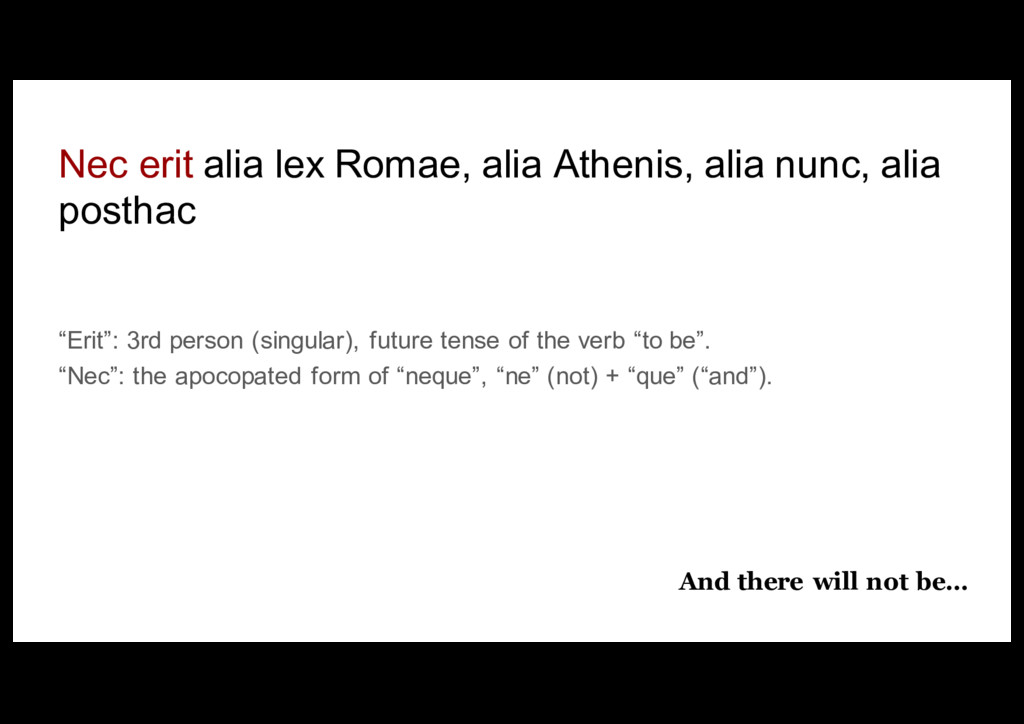
posthac “Erit”: 3rd person (singular), future tense of the verb “to be”. “Nec”: the apocopated form of “neque”, “ne” (not) + “que” (“and”). And there will not be…
posthac “Lex” (“law”): nominative case (for subjects, the verb “to be” requires it). “Romae” and “Athenis”: locative (a seventh case, used for location) for “in Rome” and “in Athens”. “Nunc” and “posthac”: adverbs (not declined), “now” and “later”. “Alia” (“another”): its repetition is used for emphatic effect. “And there will not be one law at Rome and another at Athens, one now and another later.”
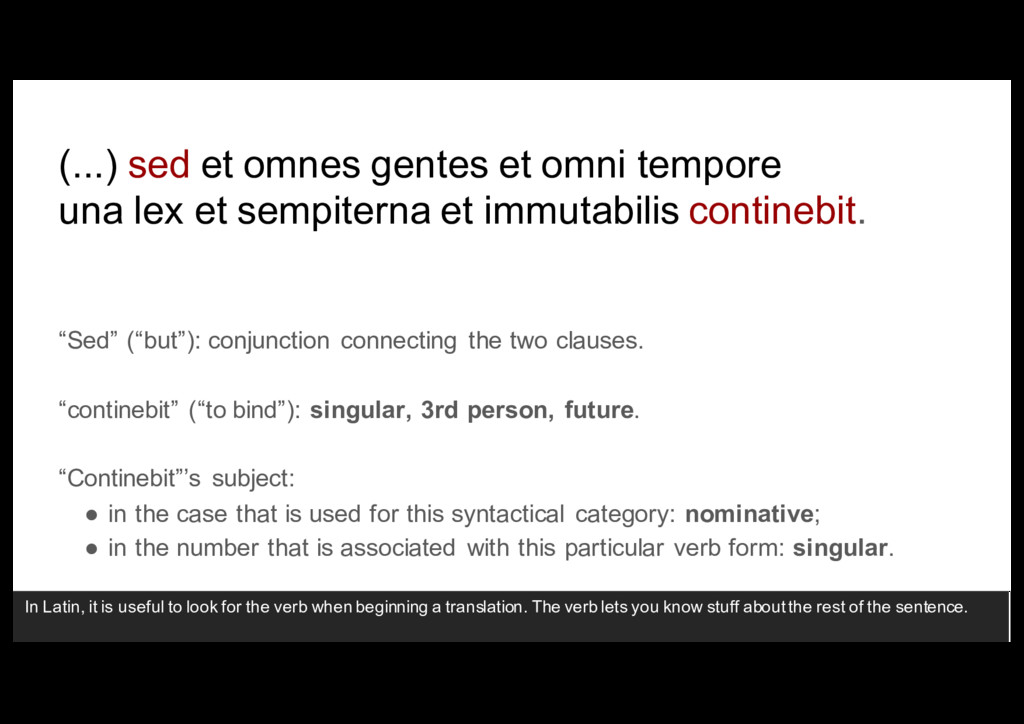
et sempiterna et immutabilis continebit. “Sed” (“but”): conjunction connecting the two clauses. “continebit” (“to bind”): singular, 3rd person, future. “Continebit”’s subject: • in the case that is used for this syntactical category: nominative; • in the number that is associated with this particular verb form: singular. In Latin, it is useful to look for the verb when beginning a translation. The verb lets you know stuff about the rest of the sentence.
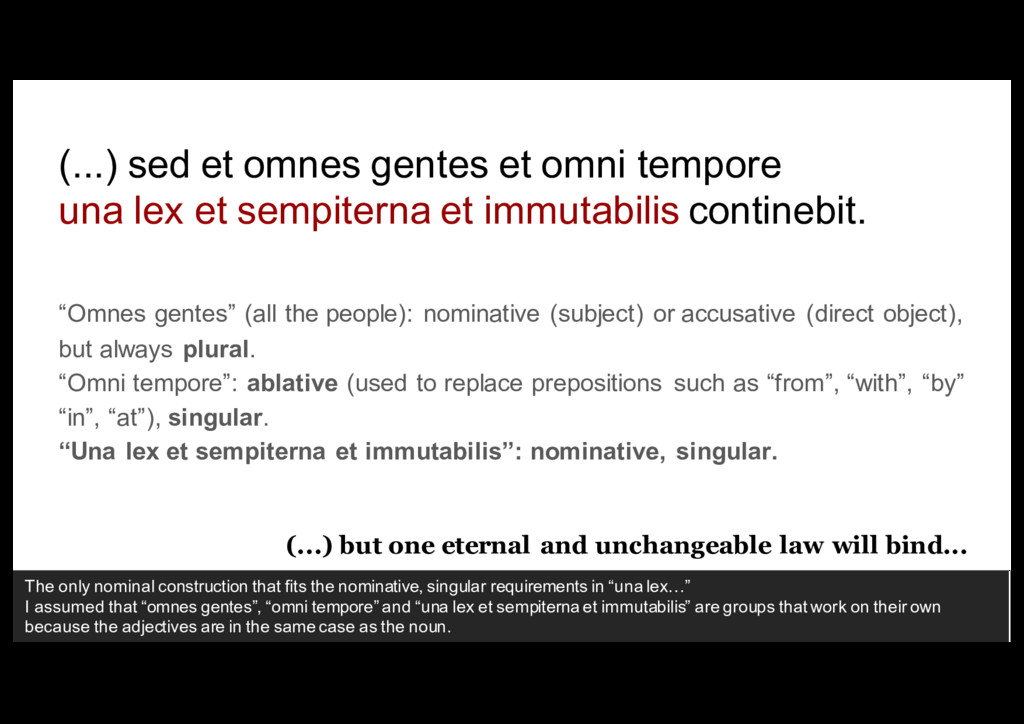
et sempiterna et immutabilis continebit. “Omnes gentes” (all the people): nominative (subject) or accusative (direct object), but always plural. “Omni tempore”: ablative (used to replace prepositions such as “from”, “with”, “by” “in”, “at”), singular. “Una lex et sempiterna et immutabilis”: nominative, singular. (...) but one eternal and unchangeable law will bind... The only nominal construction that fits the nominative, singular requirements in “una lex…” I assumed that “omnes gentes”, “omni tempore” and “una lex et sempiterna et immutabilis” are groups that work on their own because the adjectives are in the same case as the noun.
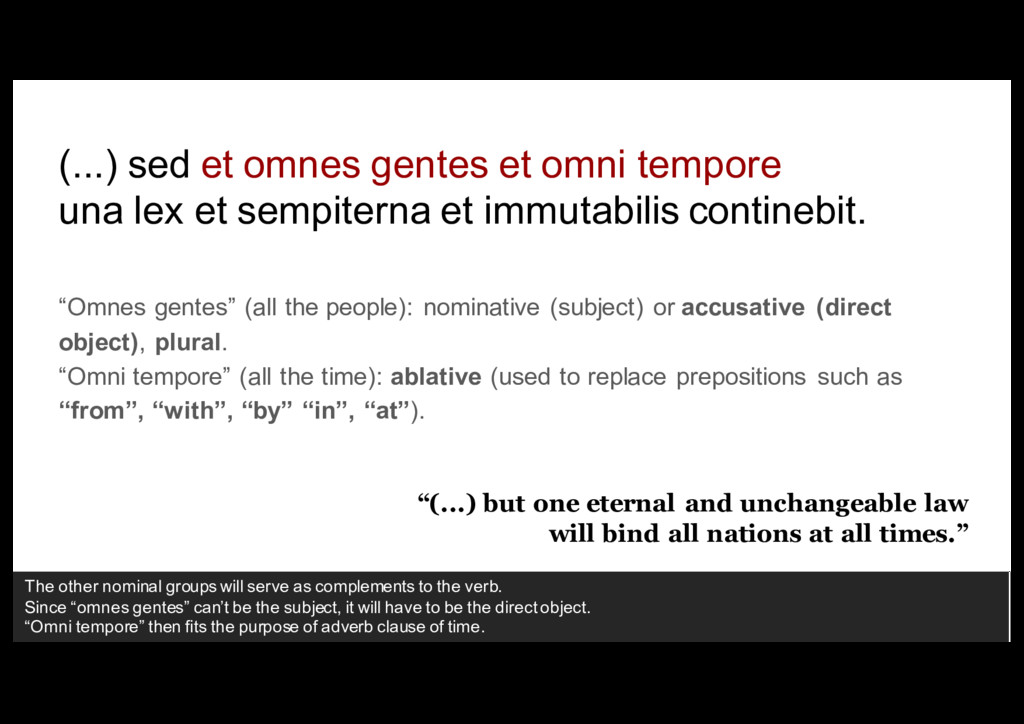
et sempiterna et immutabilis continebit. “Omnes gentes” (all the people): nominative (subject) or accusative (direct object), plural. “Omni tempore” (all the time): ablative (used to replace prepositions such as “from”, “with”, “by” “in”, “at”). “(...) but one eternal and unchangeable law will bind all nations at all times.” The other nominal groups will serve as complements to the verb. Since “omnes gentes” can’t be the subject, it will have to be the direct object. “Omni tempore” then fits the purpose of adverb clause of time.
posthac, sed et omnes gentes et omni tempore una lex et sempiterna et immutabilis continebit.” “And there will not be one law at Rome and another at Athens, one now and another later, but one eternal and unchangeable law will bind all nations at all times.” Cicero, De Re Publica (liber III, 33)
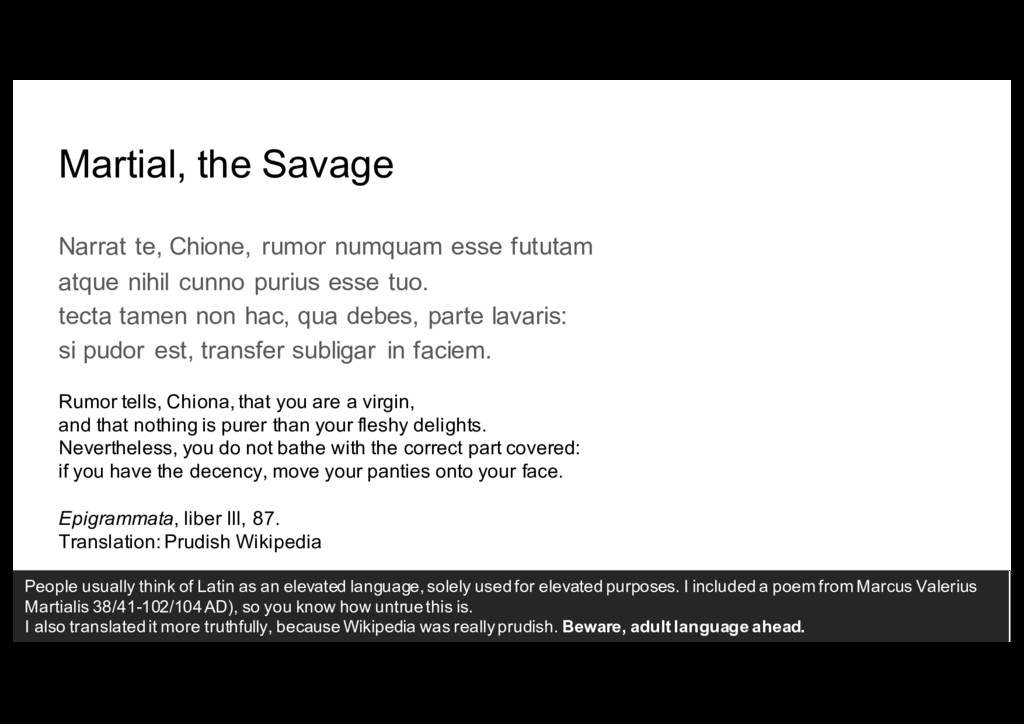
atque nihil cunno purius esse tuo. tecta tamen non hac, qua debes, parte lavaris: si pudor est, transfer subligar in faciem. Rumor tells, Chiona, that you are a virgin, and that nothing is purer than your fleshy delights. Nevertheless, you do not bathe with the correct part covered: if you have the decency, move your panties onto your face. Epigrammata, liber III, 87. Translation: Prudish Wikipedia People usually think of Latin as an elevated language, solely used for elevated purposes. I included a poem from Marcus Valerius Martialis 38/41-102/104 AD), so you know how untrue this is. I also translated it more truthfully, because Wikipedia was really prudish. Beware, adult language ahead.
atque nihil cunno purius esse tuo. tecta tamen non hac, qua debes, parte lavaris: si pudor est, transfer subligar in faciem. Rumor tells, Chiona, that you were never f****ed, and that nothing is purer than your c**t. Nevertheless, you do not bathe with the correct part covered: if you have the decency, move your panties onto your face. Epigrammata, liber III, 87. Translation: Savage Vanessa, after Prudish Wikipedia


 marktimemedia
 schroneko
 lemiorhan
 codingconduct
 tammyeverts
 brettharned
 gurzu
 mfonobong
 eileencodes
 bryan
 caitiem20
 afnizarnur