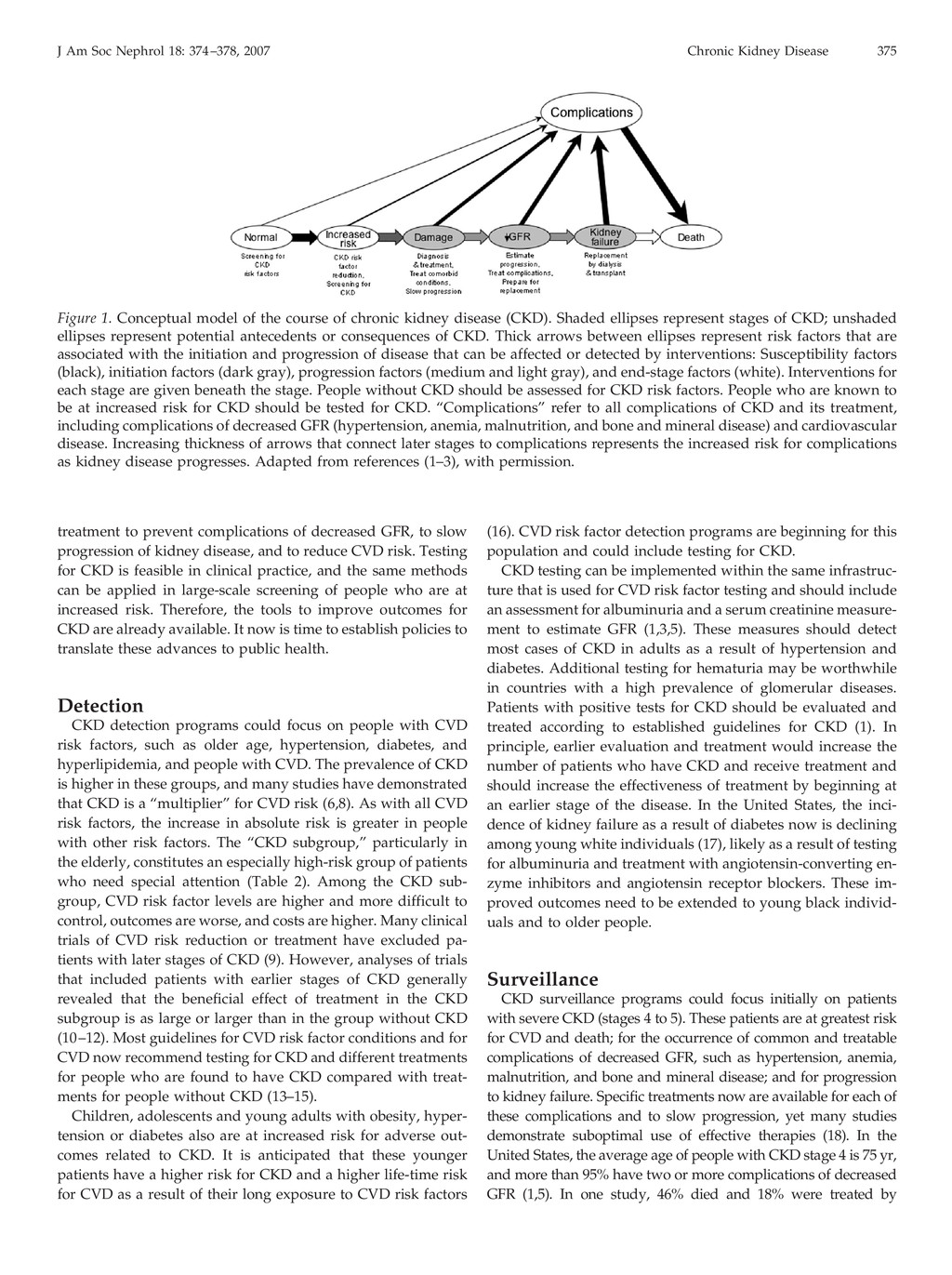
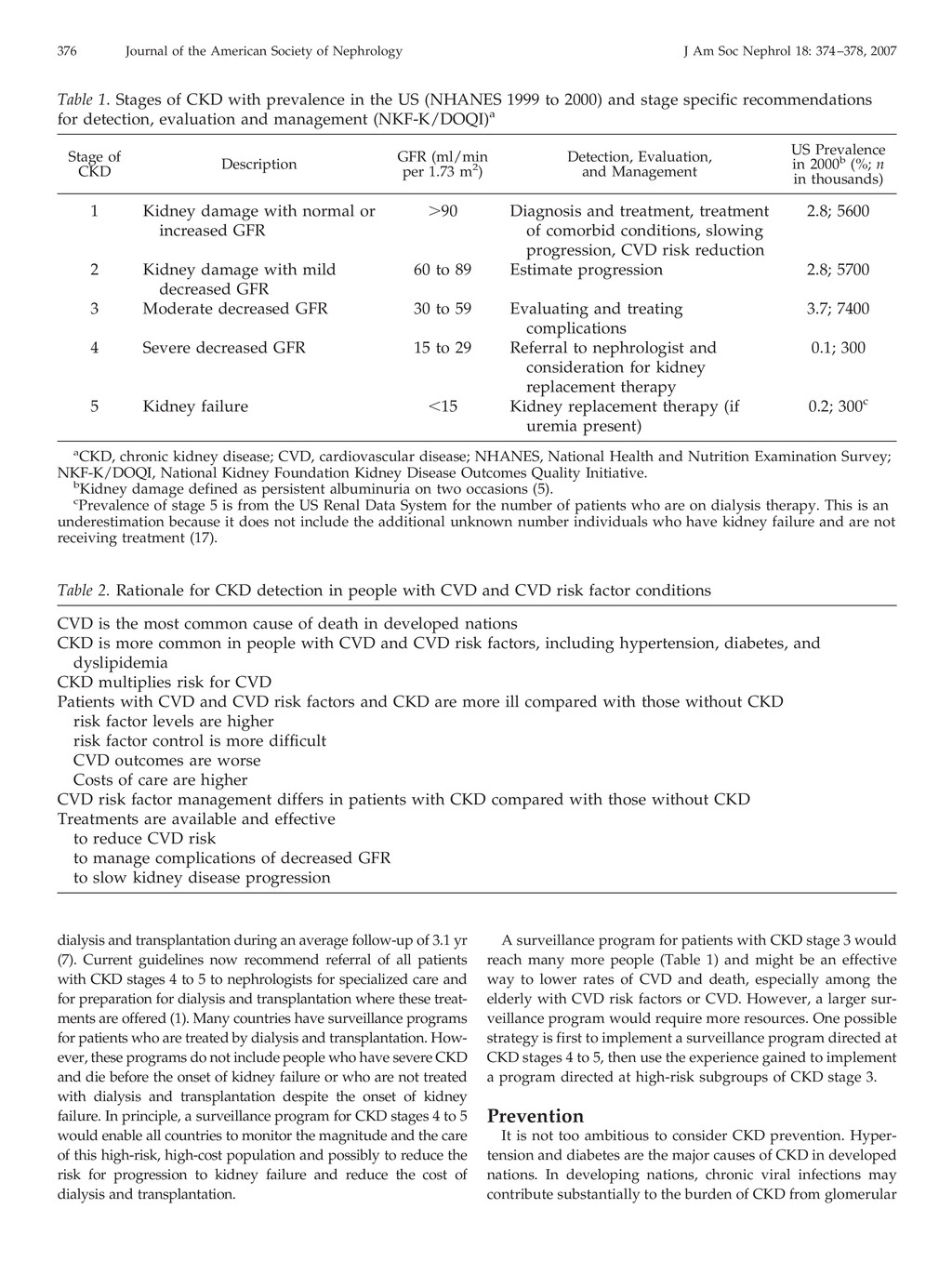
detection, and treatment of these common chronic diseases may reduce the risk for development of CKD. Reduc- tion in the incidence and the prevalence of CKD could be a measure of success of public health programs for these other chronic diseases. Improving and Paying for Patient Care Detection, surveillance, and prevention programs will bring more patients with CKD and CKD risk factors into the health care delivery system. As for all chronic diseases, commitment and innovation will be necessary to treat more patients, im- prove quality, and remain within public and employer group health plan budgets. Partnerships with government and payers are necessary to establish appropriate measures, standardized information technology platforms, appropriate incentives for improving quality, responsible analysis of the cost of care, and novel reimbursement methods. Research Finally, a health care policy for CKD must include invest- ment in basic and clinical research. Research priorities could include studies of causes of CKD and its progression, compli- cations, and relationship to CVD and aging; new markers of kidney damage and better estimating equations for GFR; new treatments to slow progression, ameliorate complications of decreased GFR, and reduce CVD risk; and more effective strat- egies to implement existing and new treatments across popu- lations. What Should Nephrologists Do? Nephrologists cannot care for all those with CKD, but we must join the effort to focus worldwide attention on CKD. We can educate our colleagues, government officials, and the pub- lic that CKD is common and harmful and, most important, that we have treatment. We can participate with professional, pub- lic, and governmental groups to develop public health policy for CKD. We can work collaboratively with primary care phy- sicians and other specialists to establish care models, within nephrology and within primary care, including clear recom- mendations for consultation, co-management, and communica- tion among treating physicians. We can develop estimates for the nephrology workforce to care for CKD, and we can develop strategies to train and maintain the workforce. We can improve the quality of care for patients with CKD stages 4 to 5. Neph- rologists will continue to shoulder the burden of care for these severely ill and challenging patients, and we must strive to do so with diligence, technical skill, and compassion. We must recognize that improving the care and outcomes for CKD is a long process. World Kidney Day 2007 is an opportunity to begin this process. Hereafter, each year on World Kidney Day, we should measure our progress. Disclosures None. References 1. National Kidney Foundation: K/DOQI clinical practice guidelines for chronic kidney disease: Evaluation, classifi- cation and stratification. Am J Kidney Dis 39: S1–S266, 2002 2. Levey AS, Coresh J, Balk E, Kausz AT, Levin A, Steffes MW, Hogg RJ, Perrone RD, Lau J, Eknoyan G; National Kidney Foundation: National Kidney Foundation practice guidelines for chronic kidney disease: Evaluation, classifi- cation, and stratification. Ann Intern Med 139: 137–147, 2003 3. Levey AS, Eckardt KU, Tsukamoto Y, Levin A, Coresh J, Rossert J, De Zeeuw D, Hostetter TH, Lameire N, Eknoyan G: Definition and classification of chronic kidney disease: A position statement from Kidney Disease: Improving Global Outcomes (KDIGO). Kidney Int 67: 2089–2100, 2005 4. Coresh J, Byrd-Holt D, Astor BC, Briggs JP, Eggers PW, Lacher DA, Hostetter TH: Chronic kidney disease aware- ness, prevalence, and trends among US adults, 1999 to 2000. J Am Soc Nephrol 16: 180–188, 2005 5. Stevens LA, Coresh J, Greene T, Levey AS: Assessing kid- ney function: Measured and estimated glomerular filtra- tion rate. N Engl J Med 354: 2473–2483, 2006 6. Sarnak MJ, Levey AS, Schoolwerth AC, Coresh J, Culleton B, Hamm LL, McCullough PA, Kasiske BL, Kelepouris E, Klag MJ, Parfrey P, Pfeffer M, Raij L, Spinosa DJ, Wilson PW; American Heart Association Councils on Kidney in Cardiovascular Disease, High Blood Pressure Research, Clinical Cardiology, and Epidemiology and Prevention: Kidney disease as a risk factor for development of cardio- vascular disease: A statement from the American Heart Association Councils on Kidney in Cardiovascular Disease, High Blood Pressure Research, Clinical Cardiology, and Epidemiology and Prevention. Circulation 108: 2154–2169, 2003 7. Keith D, Nicholls G, Guillion C, Brown JB, Smith DH: Longitudinal follow-up and outcomes among a population with chronic kidney disease in a large managed care orga- nization. Arch Intern Med 164: 659–663, 2004 8. Go AS, Chertow G, Dongjie F,McCulloch CE, Hsu CY: Chronic kidney disease and risks of death, cardiovascular events and hospitalizations. N Engl J Med 351: 1296–1305, 2004 9. Coca SG, Krumholz HM, Garg AX, Parikh CR: Underrep- resentation of renal disease in randomized controlled trials of cardiovascular disease. JAMA 296: 1377–1384, 2006 10. Mann JF, Gerstein HC, Pogue J, Bosch J, Yusuf S: Renal insufficiency as a predictor of cardiovascular outcomes and the impact of ramipril: The HOPE randomized trial. Ann Intern Med 134: 629–636, 2001 11. Solomon SD, Rice MM, Jablonski KA, Jose P, Domanski M, Sabatine M, Gersh BJ, Rouleau J, Pfeffer MA, Braunwald E; Prevention of Events with ACE inhibition (PEACE) Inves- tigators: Renal function and effectiveness of angiotensin- converting enzyme inhibitor therapy in patients with chronic stable coronary disease in the Prevention of Events with ACE inhibition (PEACE) trial. Circulation 114: 26–31, 2006 12. Tonelli M, Moye L, Sacks FM, Kiberd B, Curhan G; Cho- lesterol and Recurrent Events (CARE) Trial Investigators: Pravastatin for secondary prevention of cardiovascular events in persons with mild chronic renal insufficiency. Ann Intern Med 138: 98–104, 2003 J Am Soc Nephrol 18: 374–378, 2007 Chronic Kidney Disease 377


 sugarenia
 swwweet
 jeffersonlam
 marktimemedia
 wjessup
 baasie
 ianozsvald
 kristinabergwall1
 soudai
 brettharned
 tammyeverts
 tanoku