Upgrade to Pro — share decks privately, control downloads, hide ads and more …

Java, Go, and TypeScript Comparison: A Language...

Avatar for Daisuke Masuda Daisuke Masuda PRO
January 15, 2026
10

Java, Go, and TypeScript Comparison: A Language Selection Guide for Senior Engineers

Japanese Edition
https://daisuke.masuda.tokyo/article-2026-01-15-1629

This presentation guides senior Java engineers in comparing Java, Go, and TypeScript for modern backend development. It analyzes Java's robust ecosystem, Go's concurrency and simplicity, and TypeScript's flexibility. By examining performance and use cases, it provides strategic insights for selecting the right language for enterprise, cloud-native, or rapid development scenarios.

Avatar for Daisuke Masuda

Daisuke Masuda PRO

January 15, 2026
Tweet

More Decks by Daisuke Masuda

Transcript

  1. Java, Go, and TypeScript Comparison A Language Selection Guide for

    Senior Engineers 2025 LANGUAGE TRENDS AND IMPLEMENTATION STRATEGIES
  2. Three Major Languages in Modern Backend Development As a Java

    engineer, you benefit from a mature ecosystem and strong typing; the landscape in 2025 also emphasizes cloud-native and developer productivity. Go and TypeScript offer distinct approaches for cloud-native and full-stack needs. This comparison highlights design philosophy, performance, implementation complexity, and real-world use cases to guide technical decisions.
  3. Java Continues to Evolve: Innovative Improvements in Java 25 Java

    25 (September 2025) significantly enhances the language's expressiveness and conciseness.  Enhanced structured concurrency and scoped values dramatically improve adaptability for cloud-native development.  Pattern matching with primitive type support  Module import declarations for clearer dependencies  Compact source files for rapid prototyping
  4. The JVM's Decades of Optimization Underpin Java's Competitiveness Java's greatest

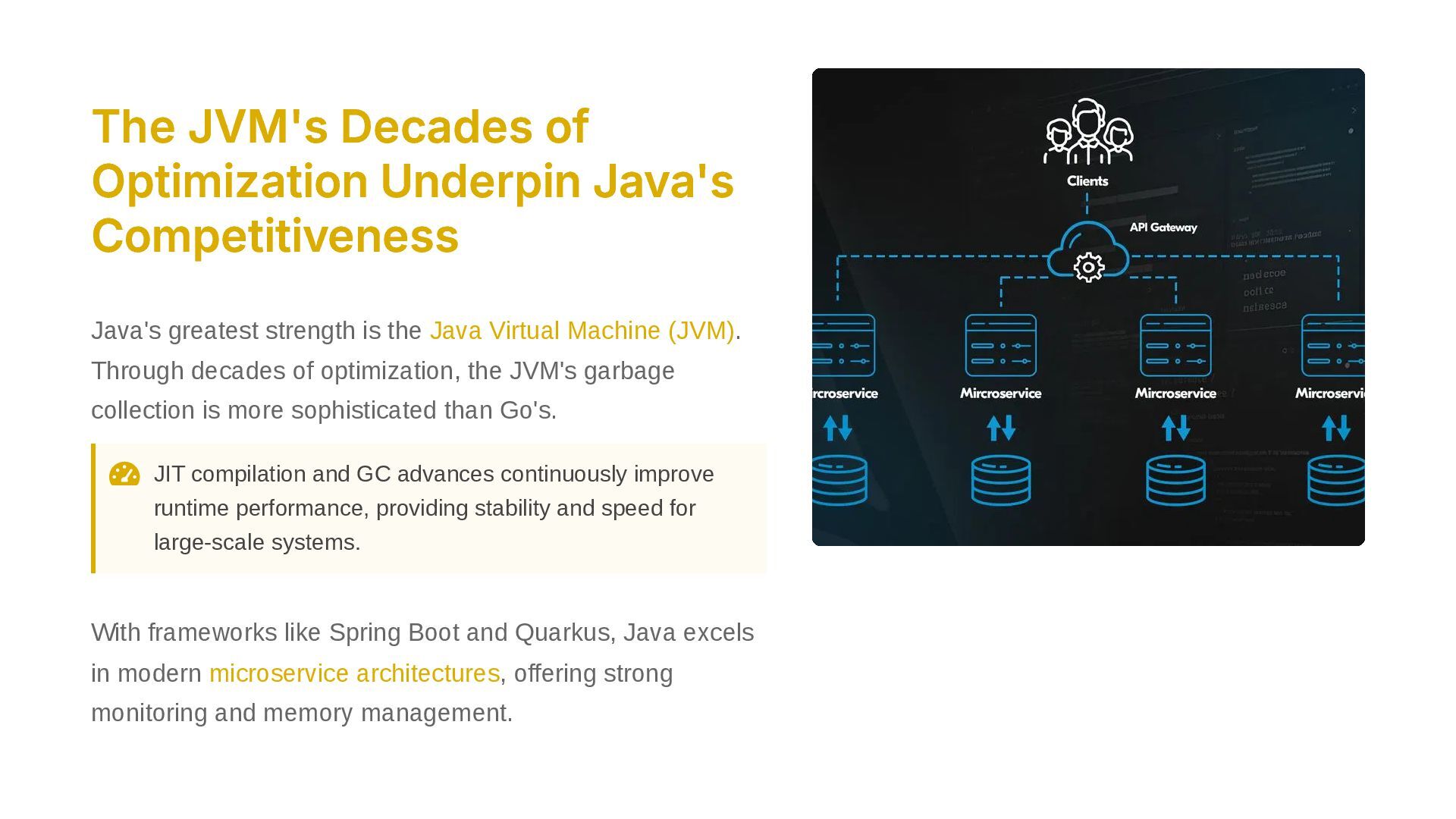
    strength is the Java Virtual Machine (JVM). Through decades of optimization, the JVM's garbage collection is more sophisticated than Go's.  JIT compilation and GC advances continuously improve runtime performance, providing stability and speed for large-scale systems. With frameworks like Spring Boot and Quarkus, Java excels in modern microservice architectures, offering strong monitoring and memory management.
  5. Java's Ecosystem A Mature Ecosystem and Rich Libraries Accelerate Development

    Speed  Vast Libraries Thousands of high-quality libraries like Spring Framework, Hibernate, and Kafka are readily available.  Proven Reliability Leverage solutions with verified security, performance, and scalability for enterprise needs.  Speed & Quality Avoid reinventing the wheel by effectively combining existing resources to focus on business value.
  6. Go's Design Philosophy: Simplicity and Explicitness Prioritizing readability and maintainability

    over feature complexity—a pragmatic approach for large-scale engineering.  Simplicity Eliminates classes and inheritance to keep the language specification small and reduce learning costs.  Explicitness Avoids implicit behaviors; error handling and dependencies are explicitly stated in the code.  Composition Encourages composition via interfaces and struct embedding instead of complex inheritance hierarchies.  Readability Prioritizes "clear code" over "clever code" to ensure maintainability in team development.  Tooling Powerful toolchain like gofmt ensures consistent style and eliminates formatting debates.
  7. Goroutines and Channels: Go's Concurrency Model Go's greatest strength is

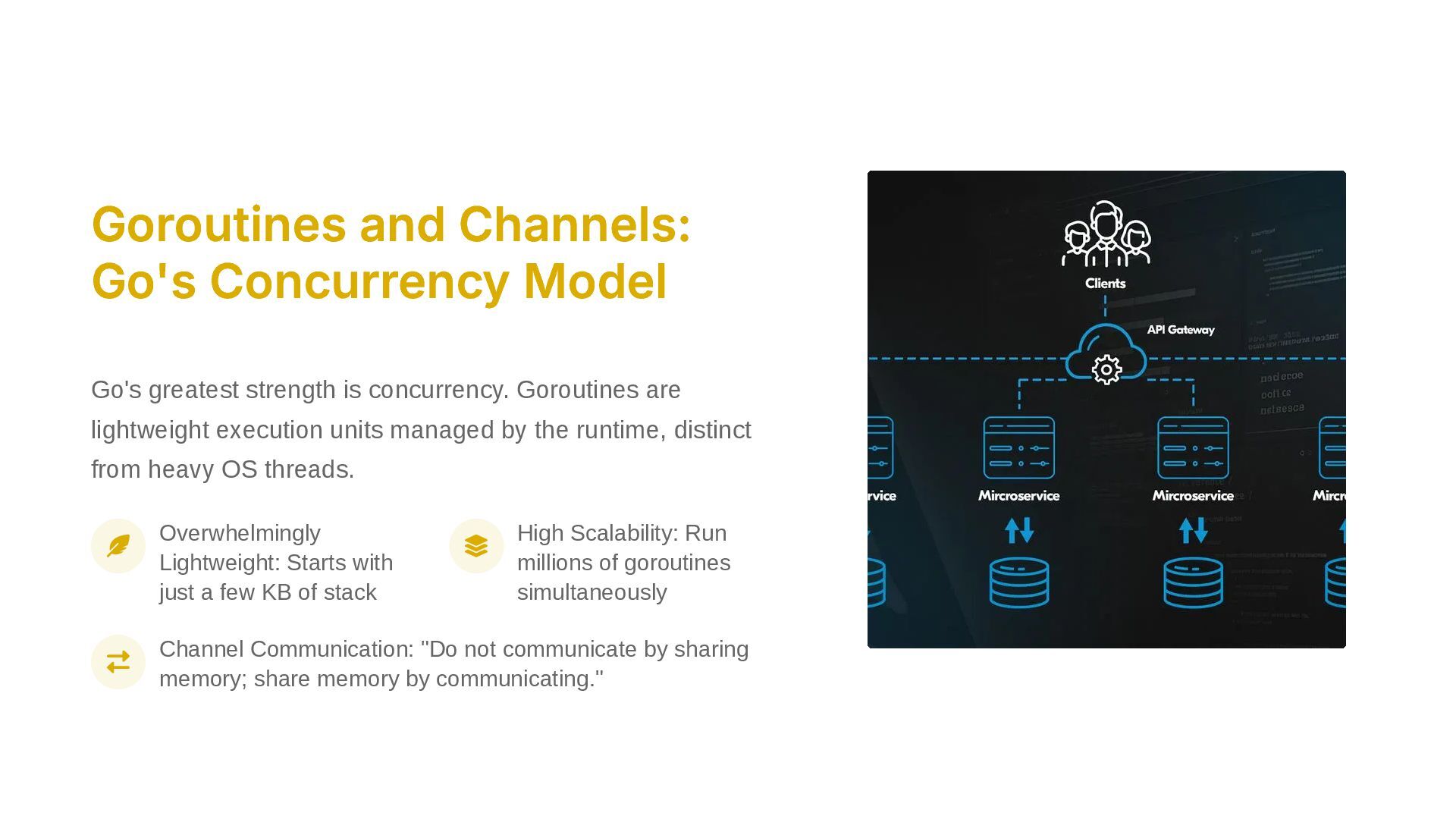
    concurrency. Goroutines are lightweight execution units managed by the runtime, distinct from heavy OS threads.  Overwhelmingly Lightweight: Starts with just a few KB of stack  High Scalability: Run millions of goroutines simultaneously  Channel Communication: "Do not communicate by sharing memory; share memory by communicating."
  8. Go's Performance: Compilation and Execution Speed  Fast Compilation Efficient

    dependency resolution allows builds to complete in seconds, even for large projects, keeping development cycles moving.  Efficient Execution Compiles directly to machine code, resulting in instant startup times and a minimal memory footprint.  Cloud Native Optimized Single binary output simplifies deployment and makes it ideal for serverless environments where cold start times matter.
  9. Go's Limitations: Type System and Error Handling While Go's simplicity

    is a strength, it comes with trade-offs in expressiveness and verbosity that Java engineers may find challenging.  Type System Constraints Generics (v1.18) are less mature than Java's. The lack of inheritance and union types limits architectural flexibility.  Error Handling Go lacks exceptions. The frequent if err != nil pattern can lead to verbose and repetitive boilerplate code.
  10. TypeScript's Positioning - JavaScript's Evolution TypeScript adds static typing to

    JavaScript and is widely adopted across frontend and increasingly on the backend.  Typed JavaScript Adds type safety to reduce runtime bugs.  Full-Stack Development Runs on Node.js, Bun, and Deno for unified development. Bridge for Java Engineers Familiar concepts like classes and interfaces ease adoption.
  11. TypeScript's Type System - Advanced Features TypeScript's type system possesses

    advanced and flexible expressiveness that surpasses Java in many aspects.  Leveraging union types, intersection types, conditional types, and mapped types allows for writing highly flexible and reusable code. However, this expressiveness accompanies complexity, making team balance and discipline crucial to maintain code quality.
  12. TypeScript's Ecosystem - The Power of npm TypeScript grants full

    access to the npm ecosystem, the world's largest software registry.  With millions of packages available, solutions for almost any problem likely already exist, dramatically accelerating development speed. However, this scale brings quality variance and security risks (like supply chain attacks), requiring stricter governance than Java's curated ecosystem.
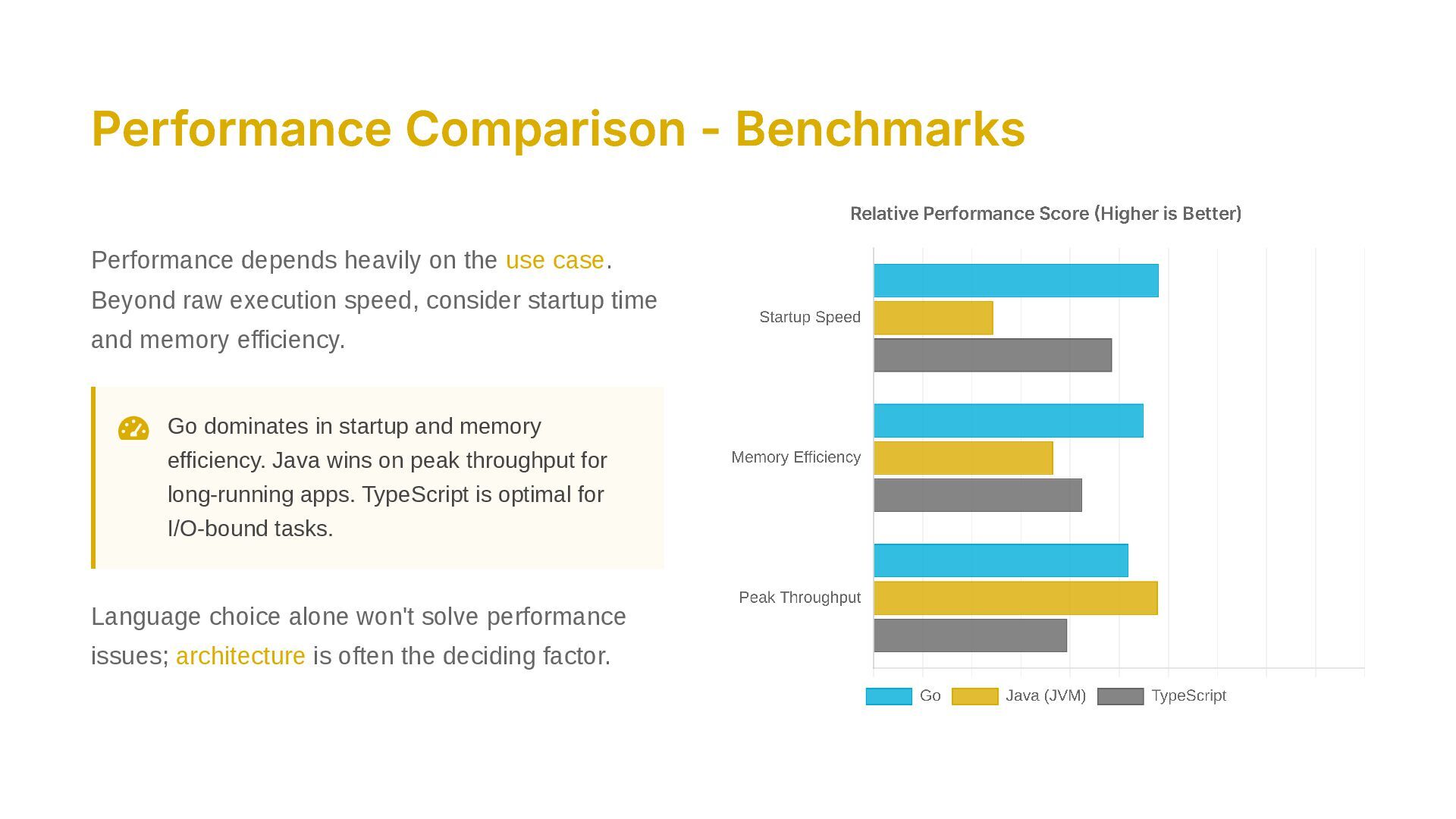
  13. Performance Comparison - Benchmarks Performance depends heavily on the use

    case. Beyond raw execution speed, consider startup time and memory efficiency.  Go dominates in startup and memory efficiency. Java wins on peak throughput for long-running apps. TypeScript is optimal for I/O-bound tasks. Language choice alone won't solve performance issues; architecture is often the deciding factor.
  14. Learning Curve and Development Productivity Language characteristics determine team onboarding

    speed and long-term efficiency  Go: Fastest Learning Curve Simple syntax allows new engineers to be production- ready in weeks, making team scaling effortless.  Java: High Productivity for Experts While the learning curve is steep, powerful IDEs and ecosystems make it overwhelmingly efficient for large- scale development.  TypeScript: Gradual Adoption Easy entry with JavaScript knowledge, but mastering the advanced type system requires time and discipline.
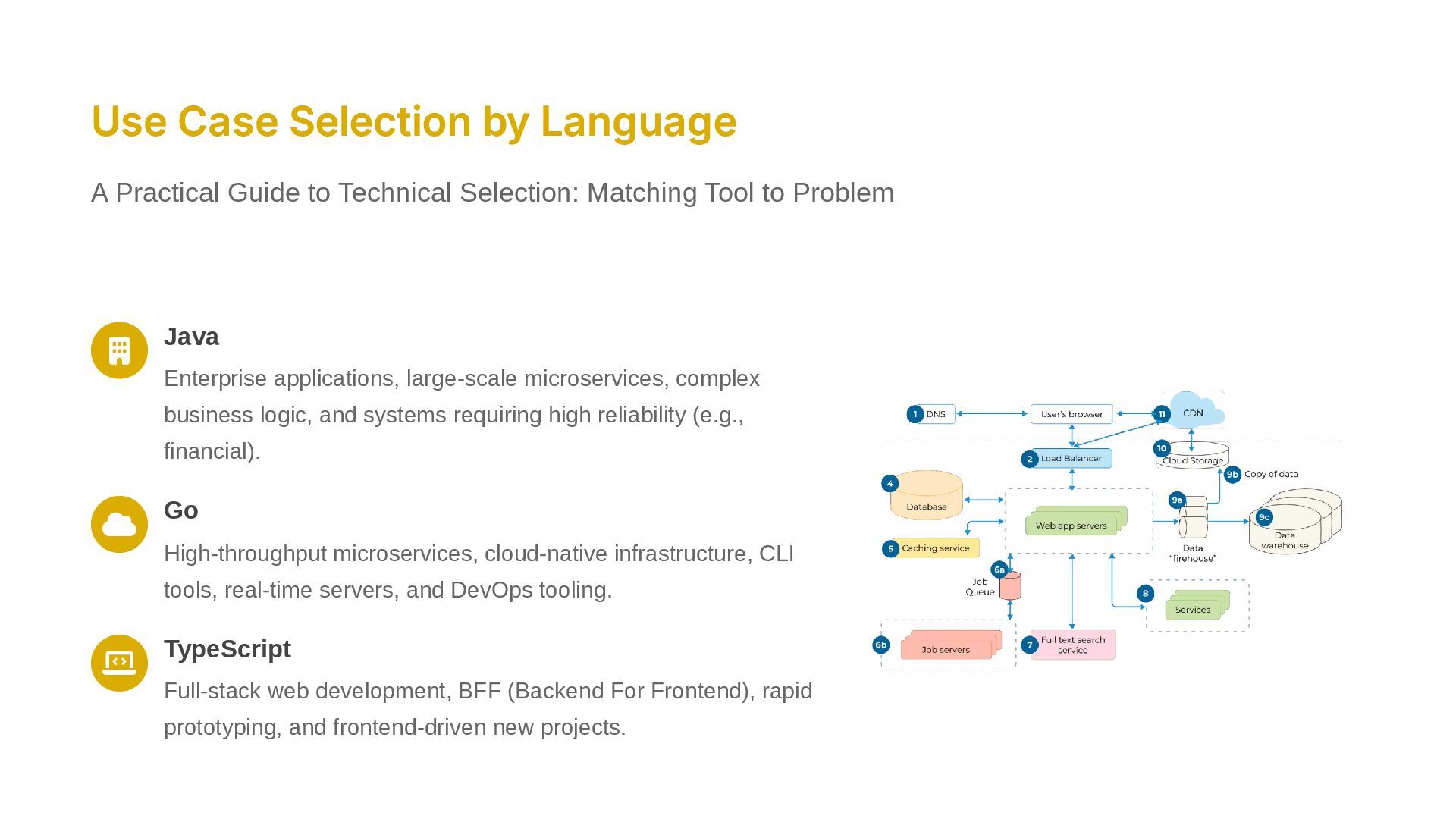
  15. Use Case Selection by Language A Practical Guide to Technical

    Selection: Matching Tool to Problem  Java Enterprise applications, large-scale microservices, complex business logic, and systems requiring high reliability (e.g., financial).  Go High-throughput microservices, cloud-native infrastructure, CLI tools, real-time servers, and DevOps tooling.  TypeScript Full-stack web development, BFF (Backend For Frontend), rapid prototyping, and frontend-driven new projects.
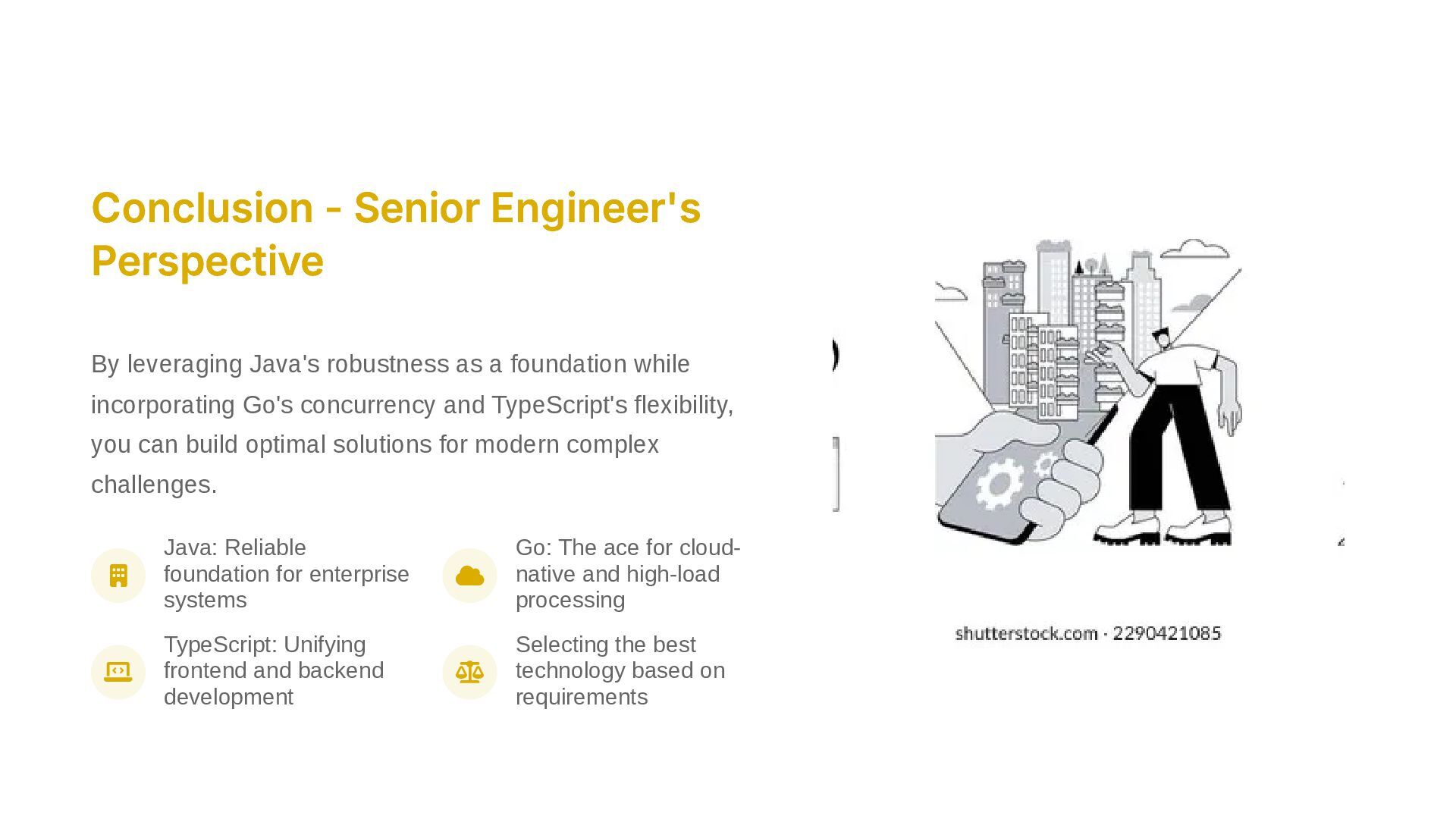
  16. Conclusion - Senior Engineer's Perspective By leveraging Java's robustness as

    a foundation while incorporating Go's concurrency and TypeScript's flexibility, you can build optimal solutions for modern complex challenges.  Java: Reliable foundation for enterprise systems  Go: The ace for cloud- native and high-load processing  TypeScript: Unifying frontend and backend development  Selecting the best technology based on requirements
  17. Recommendations - Implementation Strategy  Gradual Adoption Start with pilot

    projects to introduce Go or TypeScript safely.  Clear Guidelines Define use cases and interoperability rules for each language.  Talent Development Senior engineers lead focused knowledge-sharing sessions.