Upgrade to Pro — share decks privately, control downloads, hide ads and more …

lab4.pdf

Sponsored · Your Podcast. Everywhere. Effortlessly. Share. Educate. Inspire. Entertain. You do you. We'll handle the rest. →
Avatar for Yulong Yang Yulong Yang
November 05, 2012
37

 lab4.pdf

Avatar for Yulong Yang

Yulong Yang

November 05, 2012

Transcript

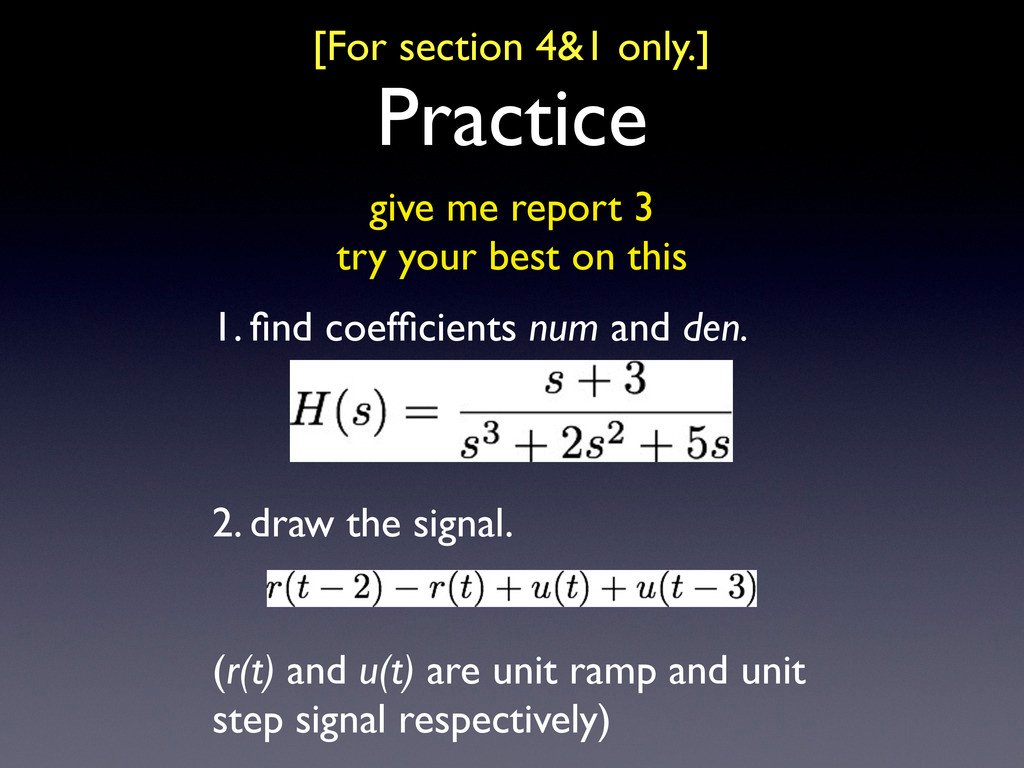
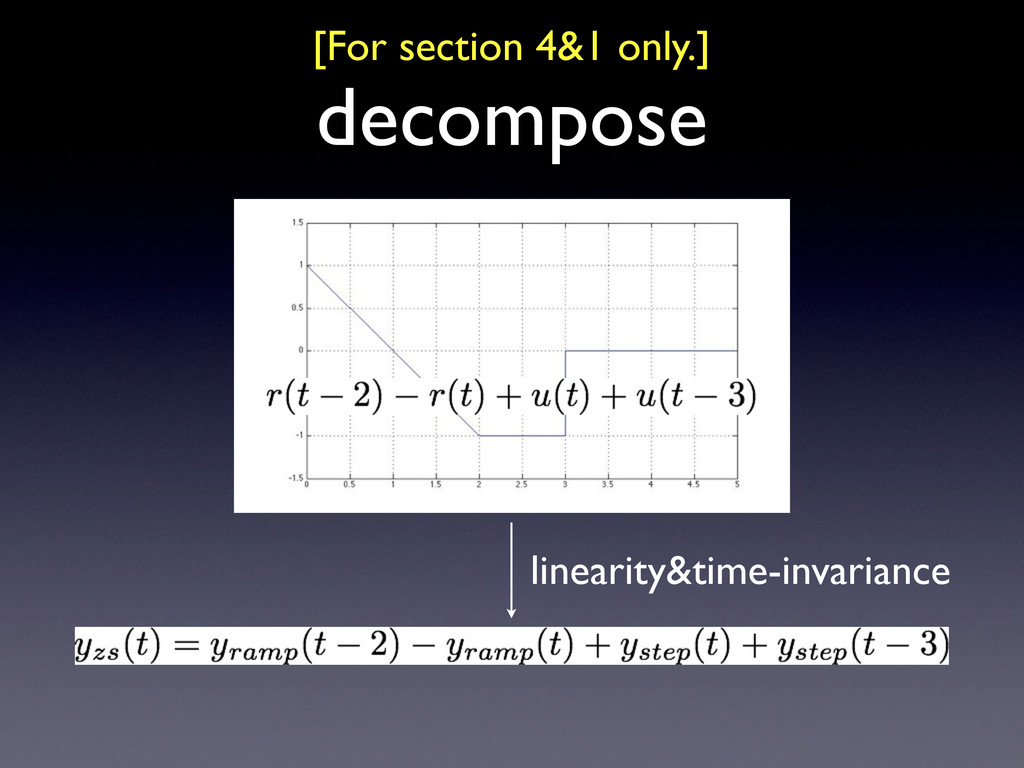
  1. Practice 1. find coefficients num and den. 2. draw the

    signal. (r(t) and u(t) are unit ramp and unit step signal respectively) give me report 3 try your best on this [For section 4&1 only.]
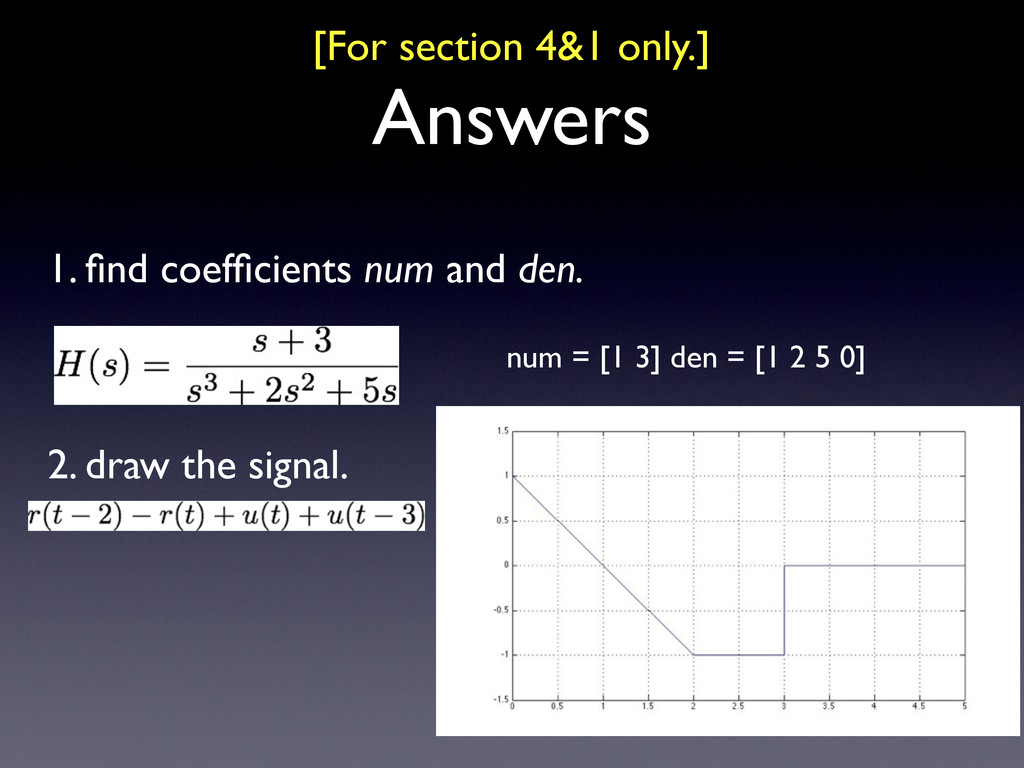
  2. Answers 1. find coefficients num and den. 2. draw the

    signal. num = [1 3] den = [1 2 5 0] [For section 4&1 only.]
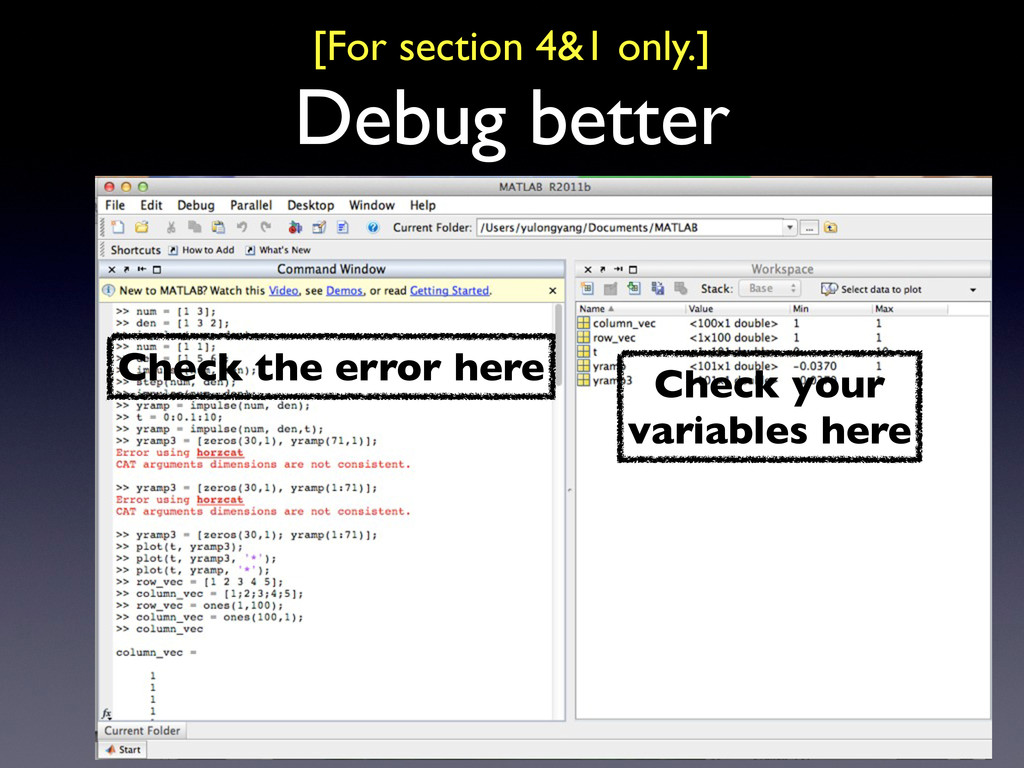
  3. Debug better • same name for different variables? • typo?

    • error when running several programs in one script file? [For section 4&1 only.]
  4. Lab 4 • part I: system response to basic signals

    • part II: system response to signals with non-standard analytical form • part IV: zero-input response with initial conditions [For section 4&1 only.]
  5. System response •transfer function -> num, den •impulse response •step

    response •zero-state response to different input signals [For section 4&1 only.]
  6. num&den • how to find them? refer to example 4.20

    on p169 and our practice before [For section 4&1 only.]
  7. Impulse&step response • impulse(num, den) • step(num, den) • no

    time series • no plot() - both functions will calculate and plot the response at the same time [For section 4&1 only.]
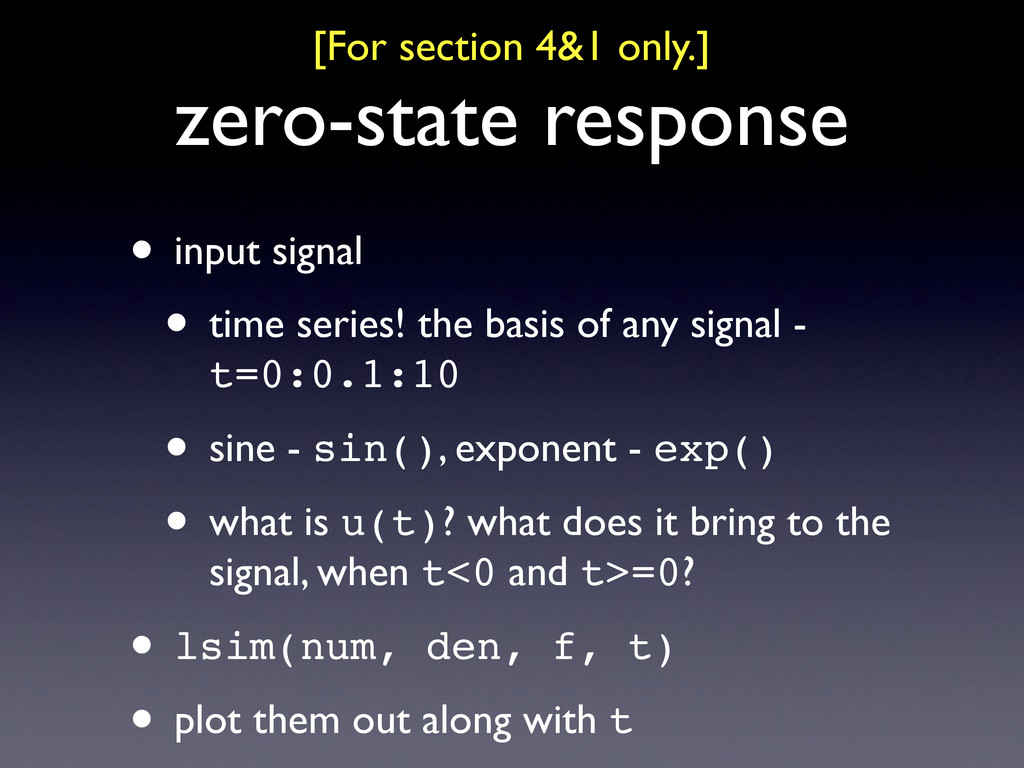
  8. zero-state response • input signal • time series! the basis

    of any signal - t=0:0.1:10 • sine - sin(), exponent - exp() • what is u(t)? what does it bring to the signal, when t<0 and t>=0? • lsim(num, den, f, t) • plot them out along with t [For section 4&1 only.]
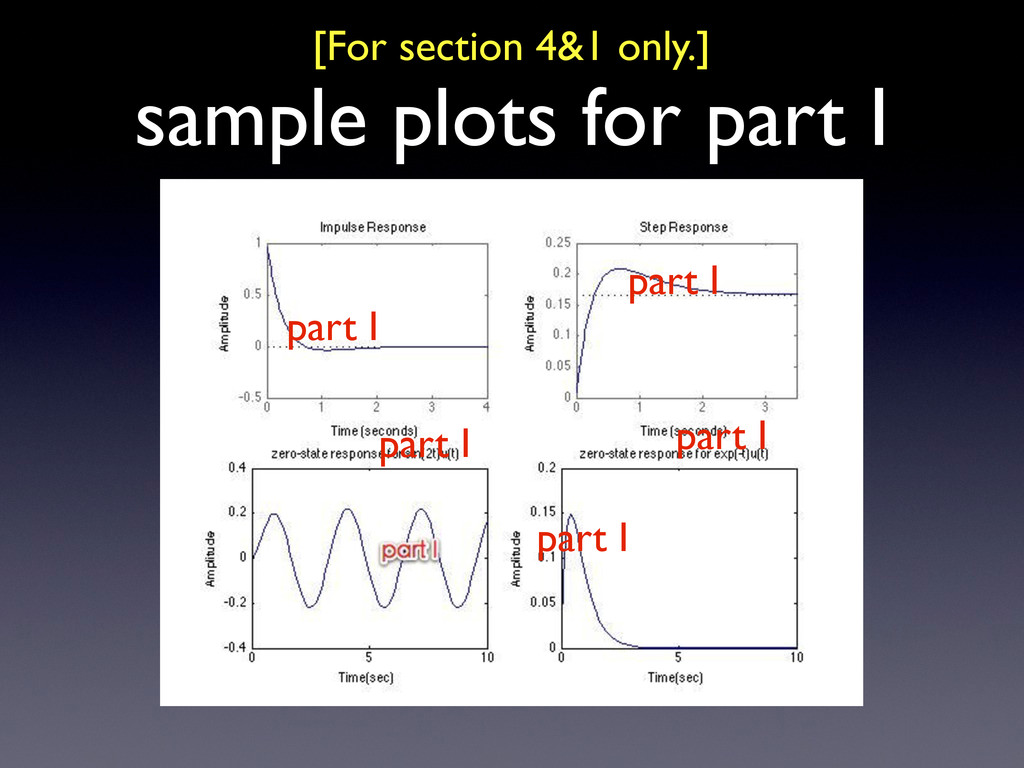
  9. sample plots for part I part I part I part

    I part I part I [For section 4&1 only.]
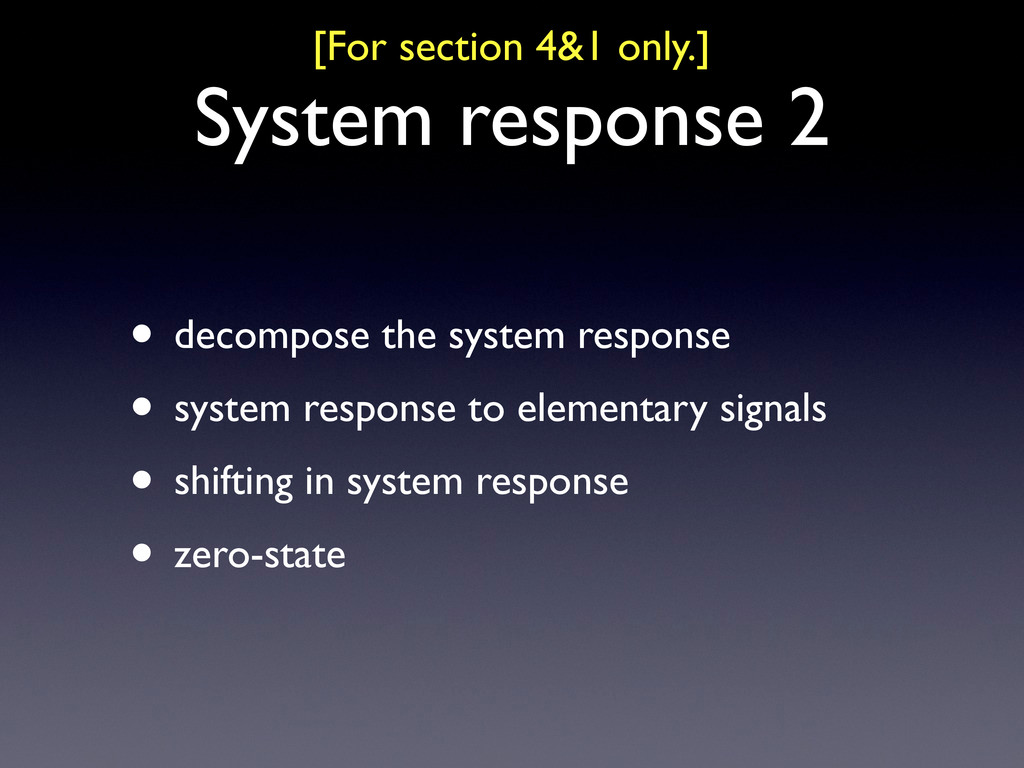
  10. System response 2 • decompose the system response • system

    response to elementary signals • shifting in system response • zero-state [For section 4&1 only.]
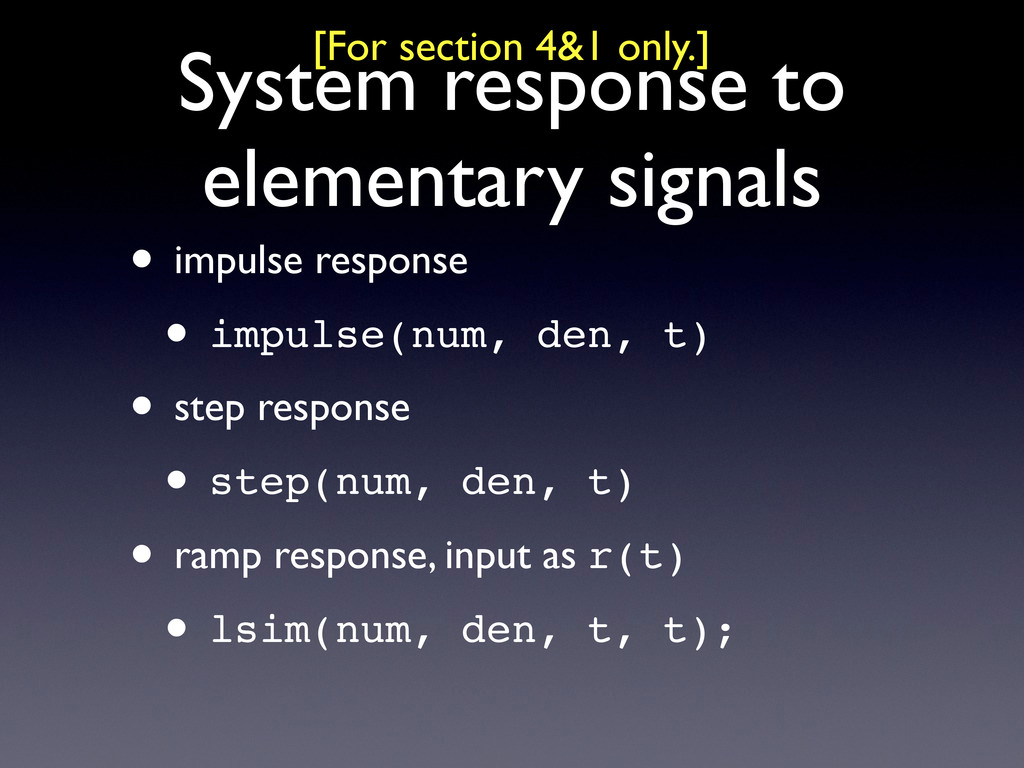
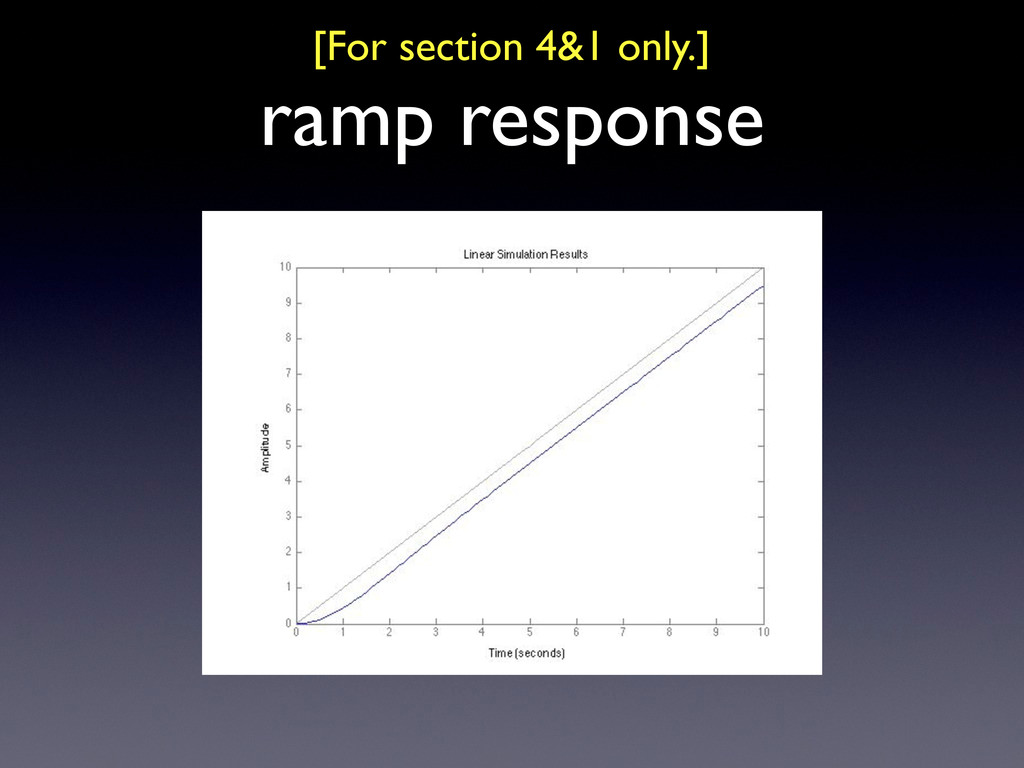
  11. System response to elementary signals • impulse response • impulse(num,

    den, t) • step response • step(num, den, t) • ramp response, input as r(t) • lsim(num, den, t, t); [For section 4&1 only.]
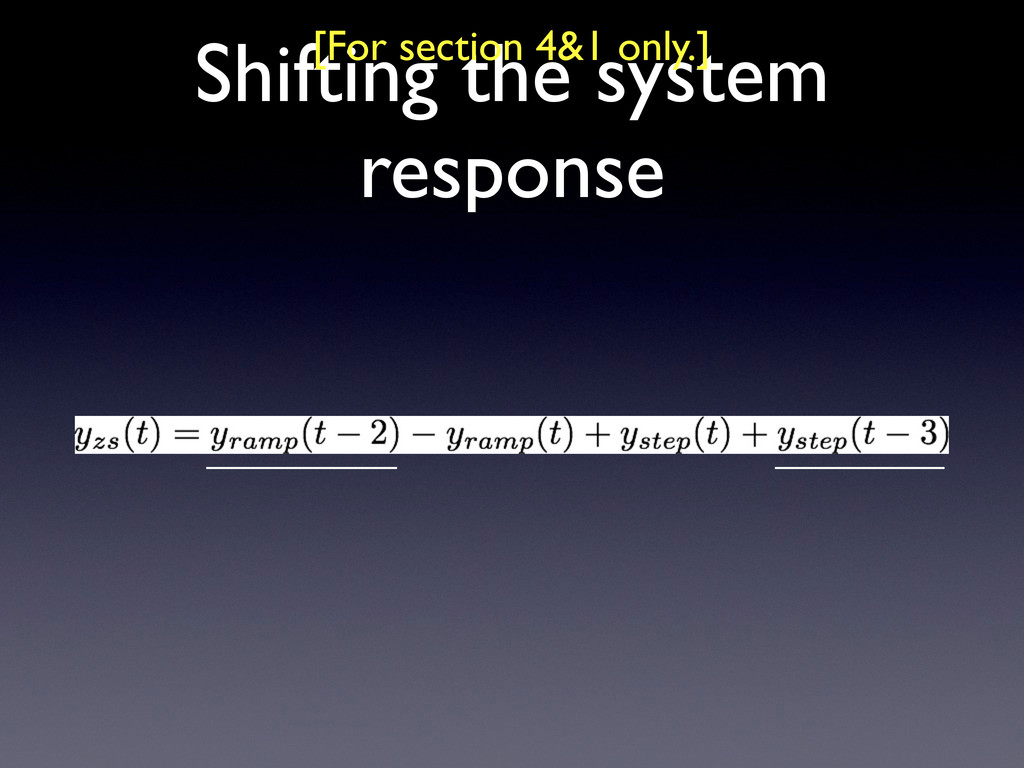
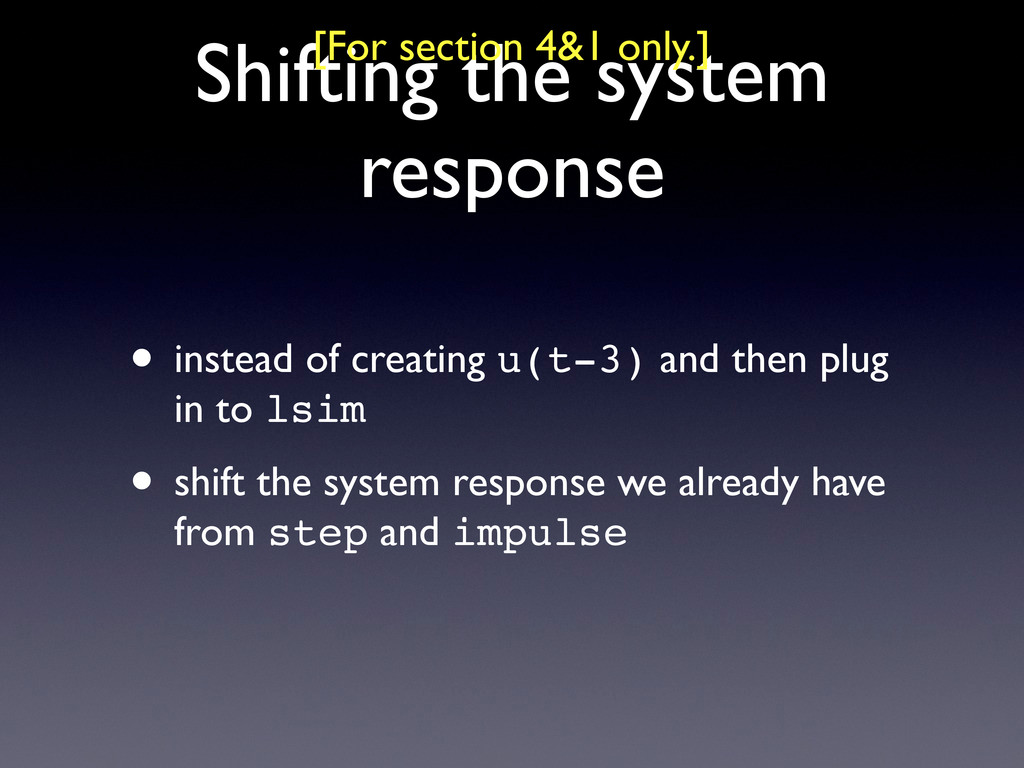
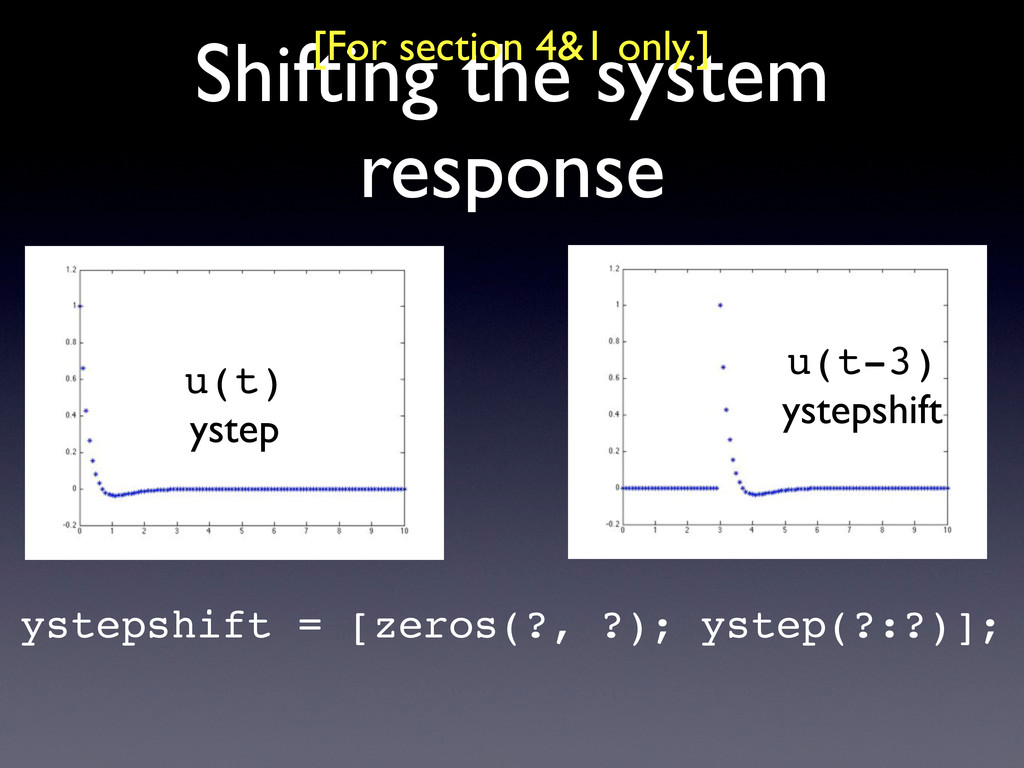
  12. Shifting the system response • instead of creating u(t-3) and

    then plug in to lsim • shift the system response we already have from step and impulse [For section 4&1 only.]
  13. Shifting the system response ystepshift = [zeros(?, ?); ystep(?:?)]; u(t)

    ystep u(t-3) ystepshift [For section 4&1 only.]
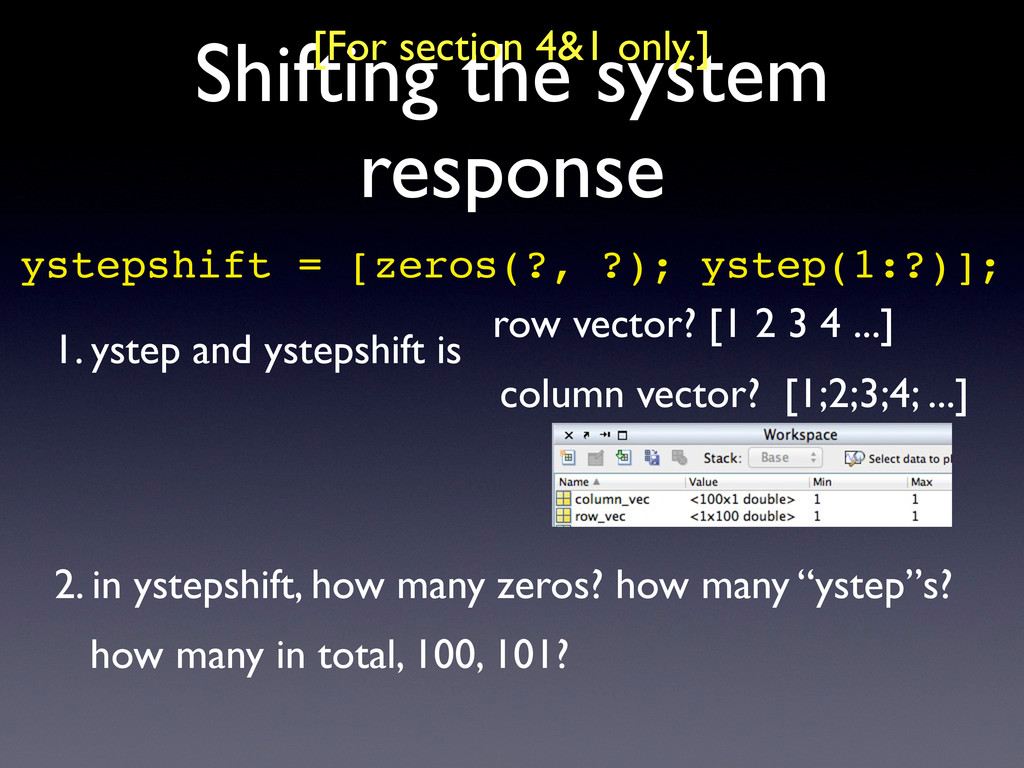
  14. Shifting the system response ystepshift = [zeros(?, ?); ystep(1:?)]; row

    vector? [1 2 3 4 ...] column vector? [1;2;3;4; ...] 1. ystep and ystepshift is 2. in ystepshift, how many zeros? how many “ystep”s? how many in total, 100, 101? [For section 4&1 only.]
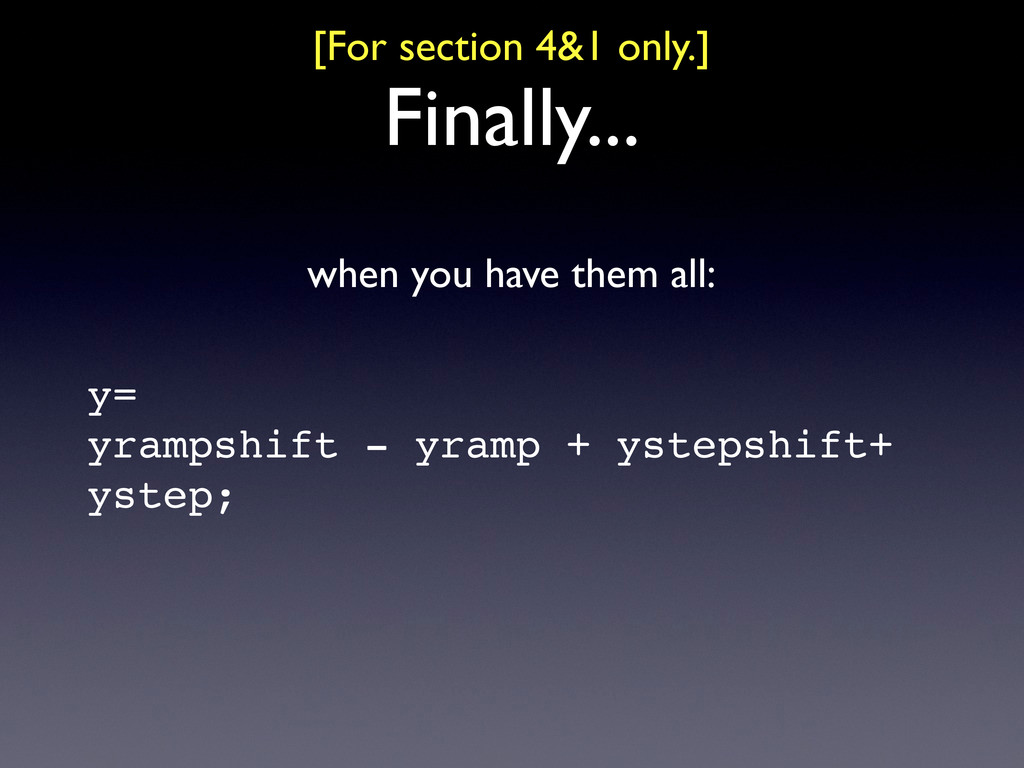
  15. Finally... when you have them all: y= yrampshift - yramp

    + ystepshift+ ystep; [For section 4&1 only.]
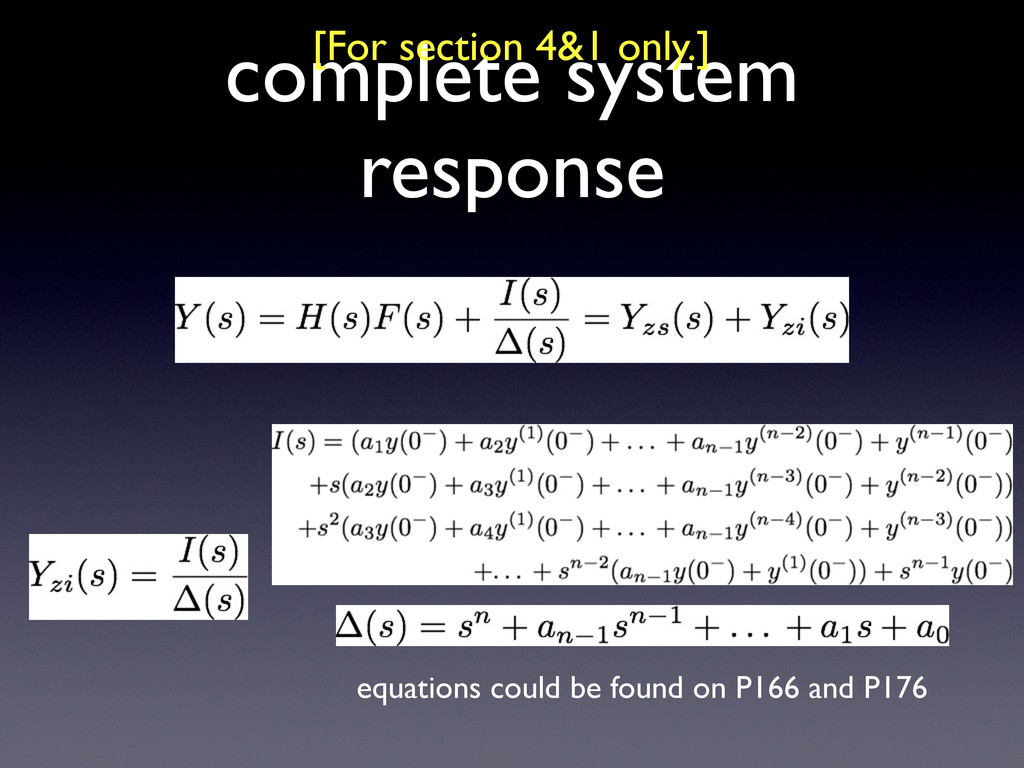
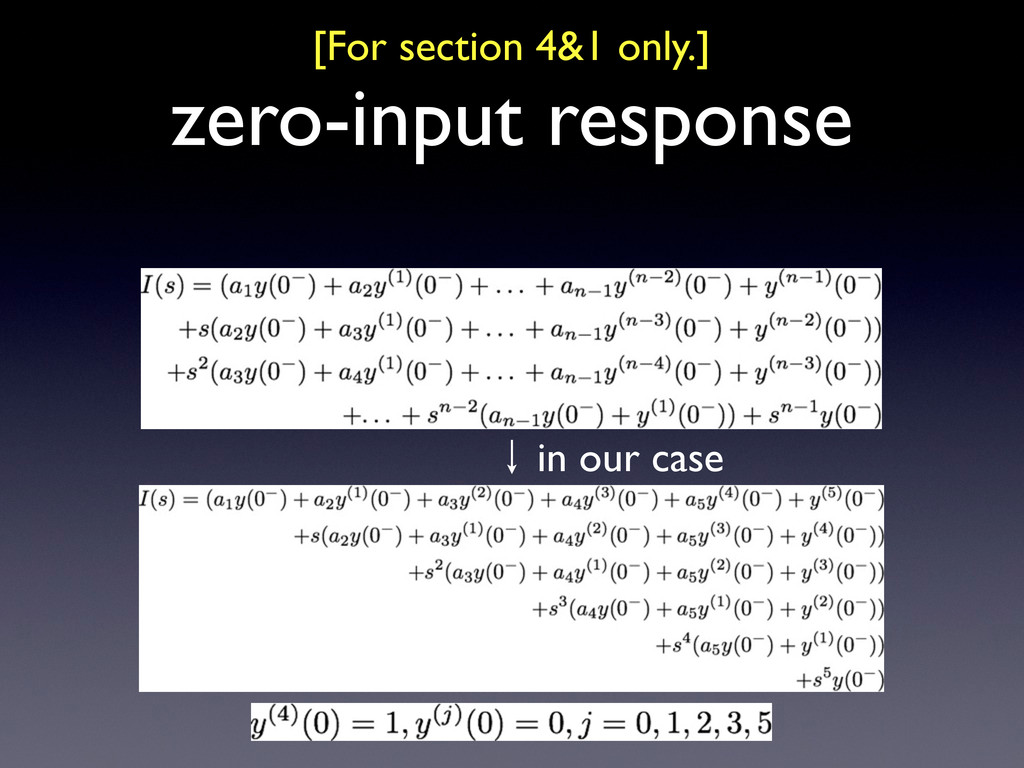
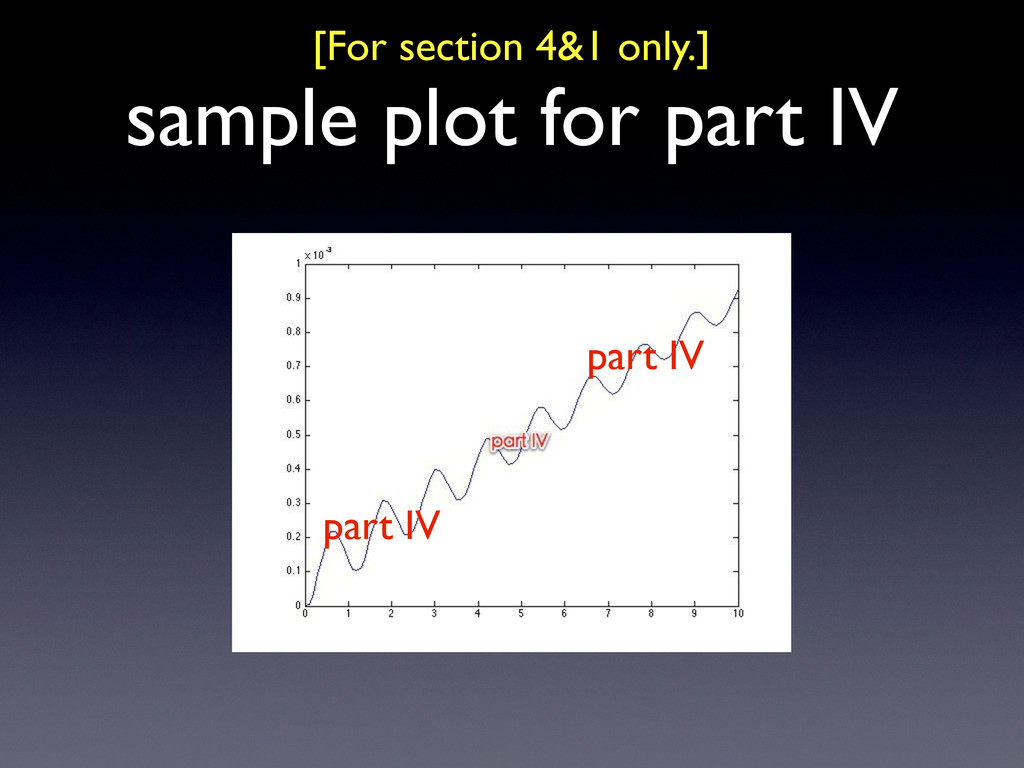
  16. zero-input response • complete system response equation 4.53 on p176

    • find coefficients • get response by impulse [For section 4&1 only.]
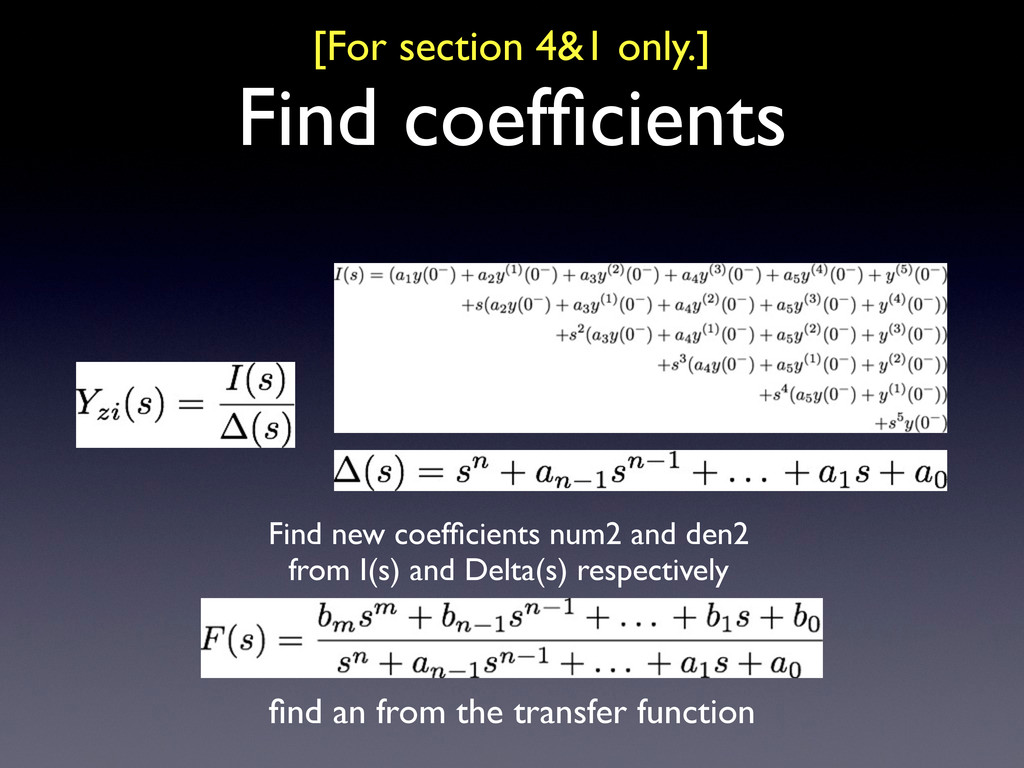
  17. Find coefficients Find new coefficients num2 and den2 from I(s)

    and Delta(s) respectively find an from the transfer function [For section 4&1 only.]
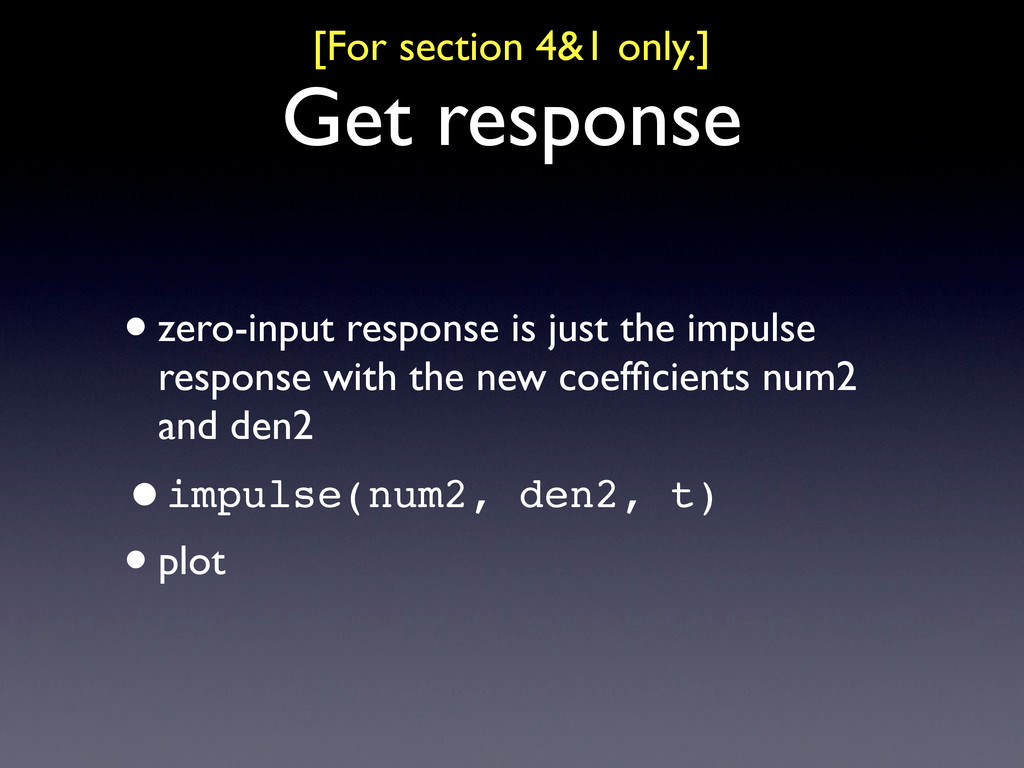
  18. Get response •zero-input response is just the impulse response with

    the new coefficients num2 and den2 •impulse(num2, den2, t) •plot [For section 4&1 only.]
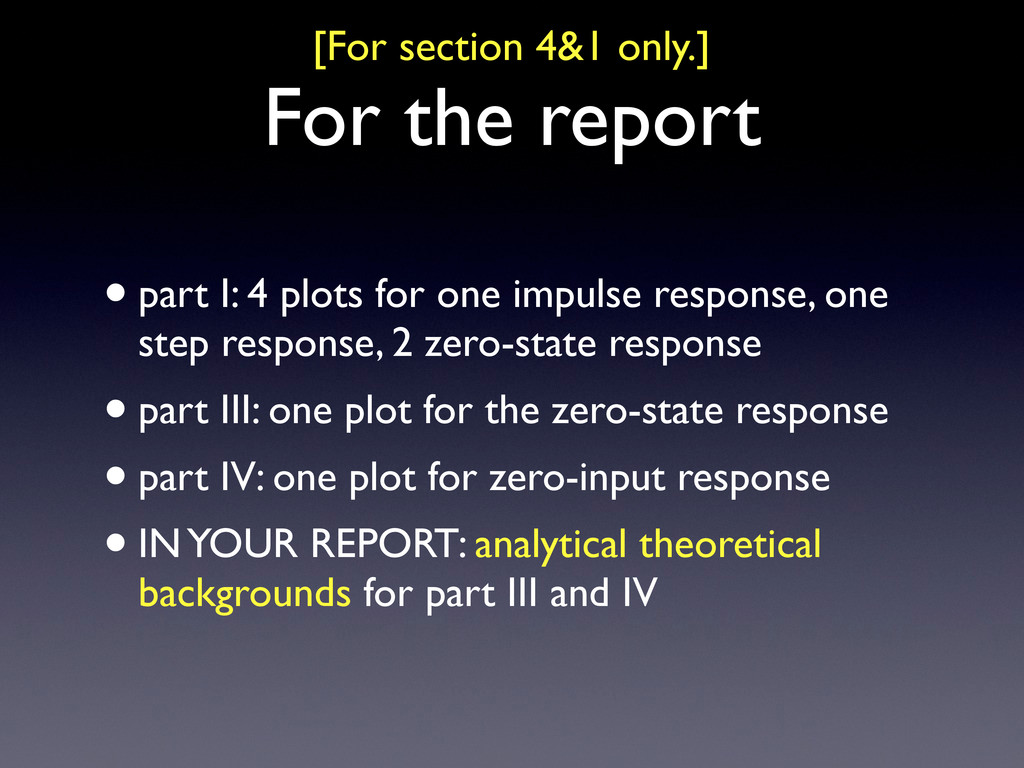
  19. For the report •part I: 4 plots for one impulse

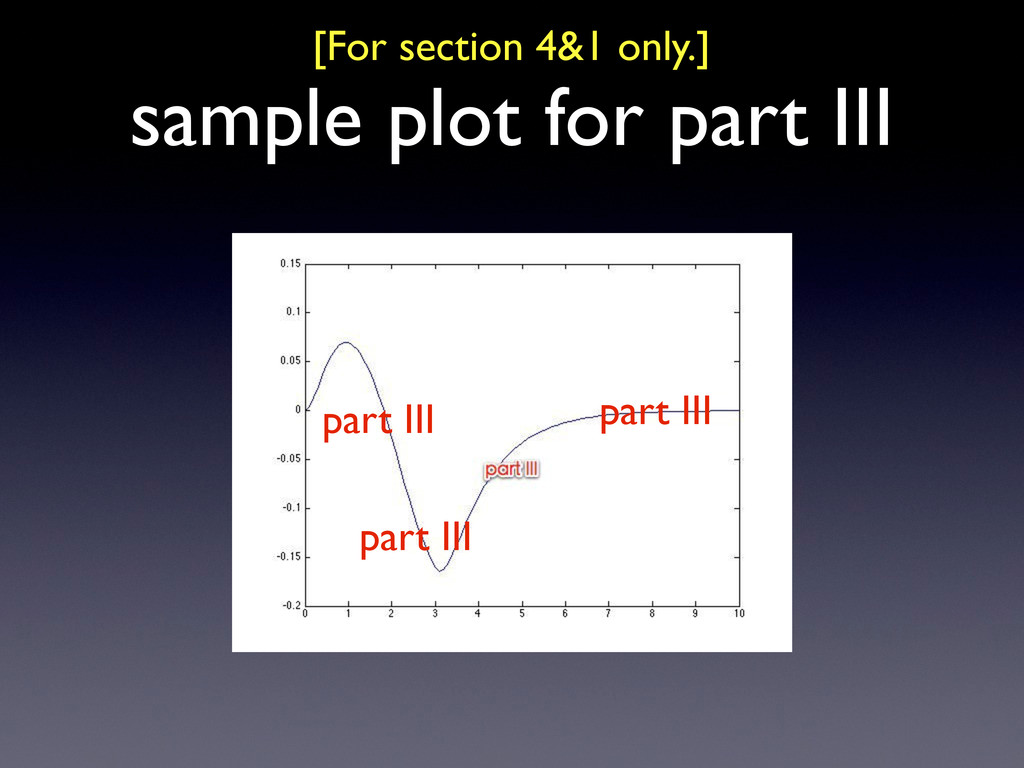
    response, one step response, 2 zero-state response •part III: one plot for the zero-state response •part IV: one plot for zero-input response •IN YOUR REPORT: analytical theoretical backgrounds for part III and IV [For section 4&1 only.]