Upgrade to Pro — share decks privately, control downloads, hide ads and more …

Data analytics

Avatar for Aditya Mourya Aditya Mourya
June 17, 2026
0

Data analytics

Data Analytics Training in Chandigarh imparts practical skills through hands-on projects, providing an avenue to apply theoretical knowledge to real-world scenarios. Participants learn to interpret data and derive actionable recommendations, fostering critical thinking and problem-solving abilities.

Avatar for Aditya Mourya

Aditya Mourya

June 17, 2026

Transcript

  1. Data Analytics: A Complete Guide to Understanding Business Data Introduction

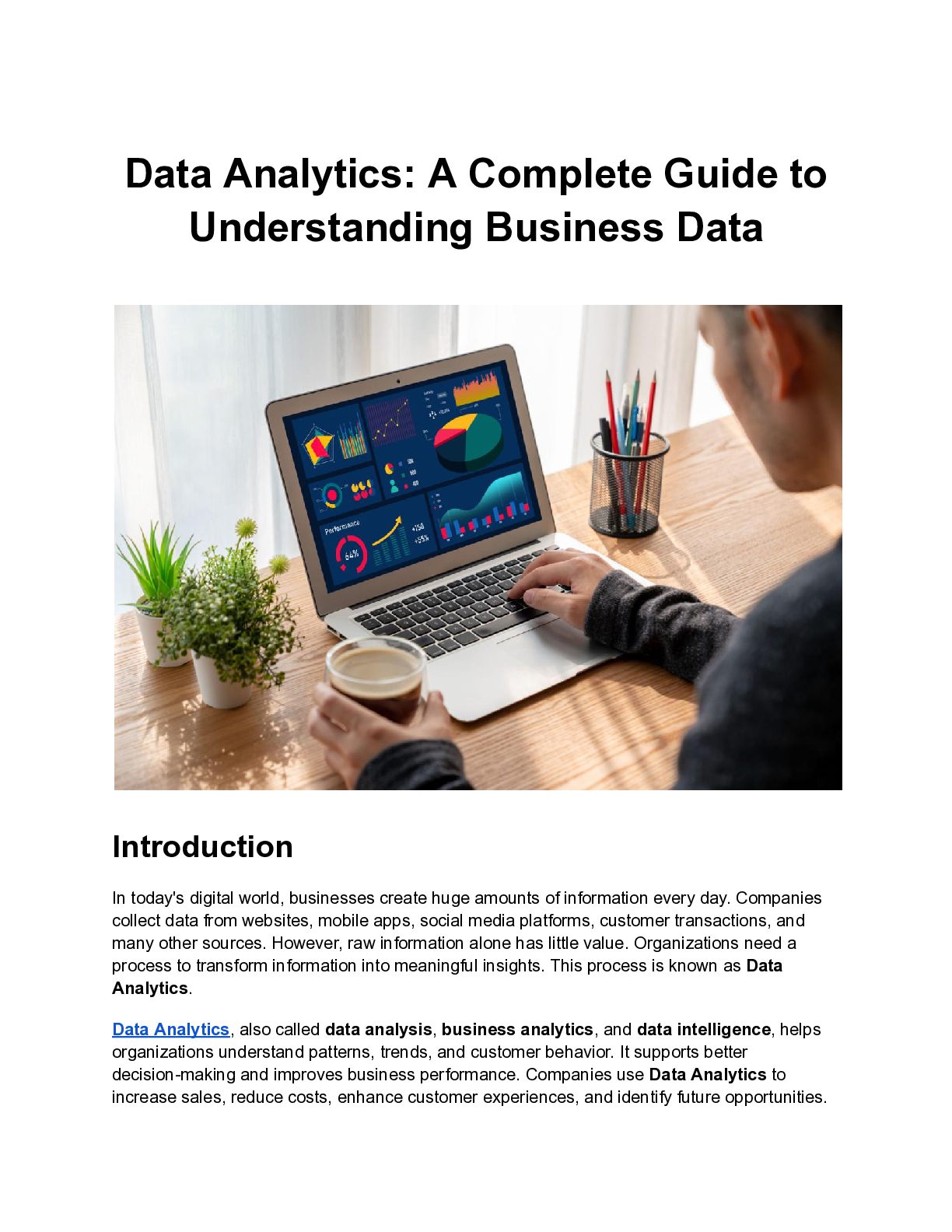
    In today's digital world, businesses create huge amounts of information every day. Companies collect data from websites, mobile apps, social media platforms, customer transactions, and many other sources. However, raw information alone has little value. Organizations need a process to transform information into meaningful insights. This process is known as Data Analytics. Data Analytics, also called data analysis, business analytics, and data intelligence, helps organizations understand patterns, trends, and customer behavior. It supports better decision-making and improves business performance. Companies use Data Analytics to increase sales, reduce costs, enhance customer experiences, and identify future opportunities.
  2. This article explains the meaning, importance, types, process, tools, benefits,

    challenges, and future of Data Analytics. What is Data Analytics? Data Analytics is the process of examining, organizing, and interpreting data to discover useful information. Businesses use analytical techniques to identify patterns and make informed decisions. The goal of Data Analytics is simple. It helps organizations convert raw data into valuable business insights. Through proper analysis, companies can understand customer needs, improve operations, and achieve business objectives. Today, Data Analytics plays an important role in almost every industry. Healthcare, finance, retail, education, manufacturing, and technology companies rely on data-driven decisions. Why is Data Analytics Important? Modern businesses operate in highly competitive markets. Organizations need accurate information to make smart decisions. Data Analytics provides that information. Better Decision-Making Managers use Data Analytics to understand business performance. Data-driven decisions are usually more accurate than assumptions. Improved Customer Experience Companies study customer behavior through data analysis. This helps them deliver personalized products and services. Increased Efficiency Businesses identify process weaknesses through business analytics. They can remove inefficiencies and improve productivity. Higher Revenue
  3. Organizations use Data Analytics to discover profitable opportunities. Better targeting

    often leads to increased sales. Risk Management Companies analyze data to detect risks before problems become serious. This improves business stability and planning. Types of Data Analytics There are four main types of Data Analytics. Each type serves a different purpose. 1. Descriptive Analytics Descriptive analytics explains what happened in the past. Examples include: •​ Monthly sales reports •​ Website traffic reports •​ Customer purchase summaries This form of data analysis provides historical insights. 2. Diagnostic Analytics Diagnostic analytics explains why something happened. Businesses use this method to identify reasons behind success or failure. It helps uncover hidden causes of business outcomes. 3. Predictive Analytics Predictive analytics forecasts future events using historical data. Examples include: •​ Demand forecasting •​ Sales predictions •​ Customer behavior forecasting Many organizations use predictive models to improve planning.
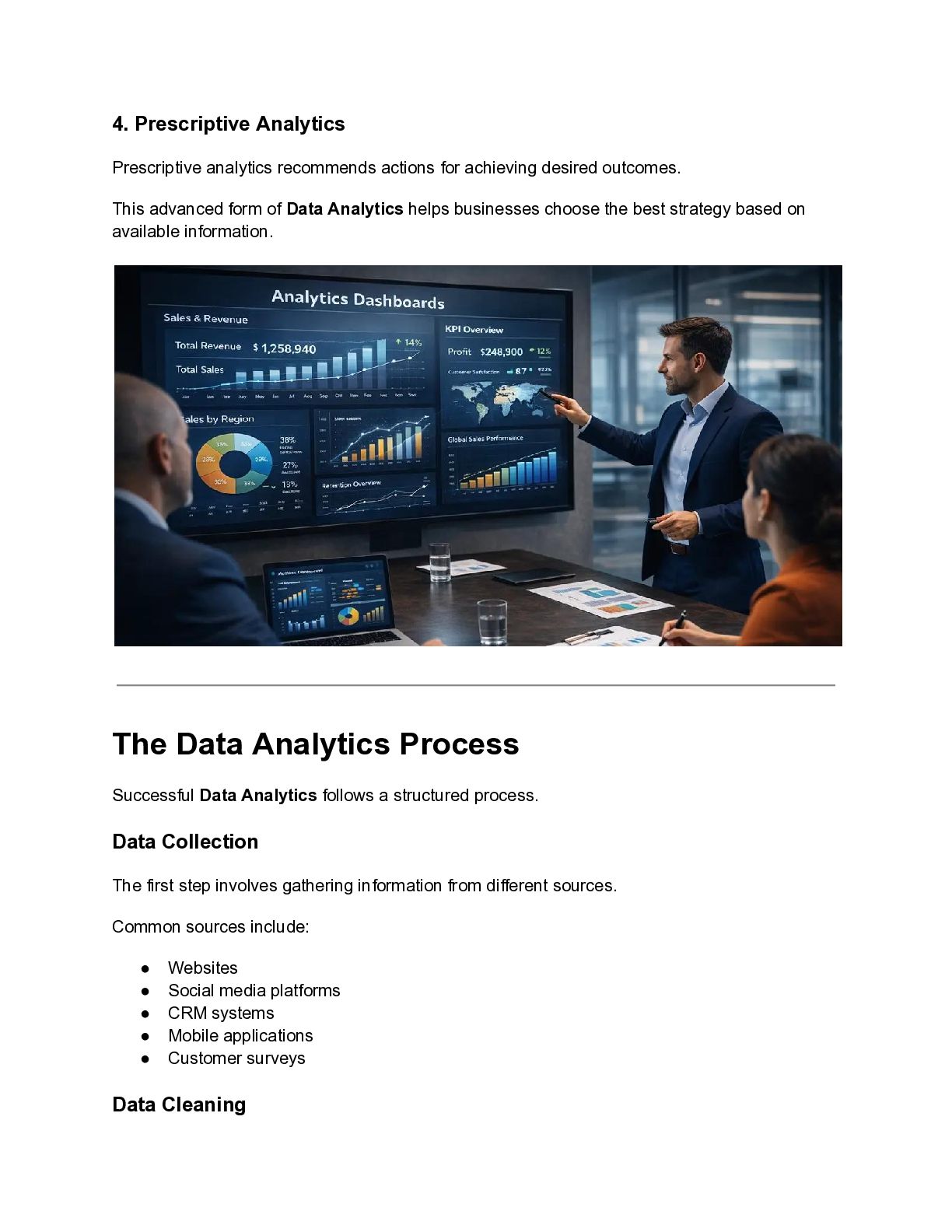
  4. 4. Prescriptive Analytics Prescriptive analytics recommends actions for achieving desired

    outcomes. This advanced form of Data Analytics helps businesses choose the best strategy based on available information. The Data Analytics Process Successful Data Analytics follows a structured process. Data Collection The first step involves gathering information from different sources. Common sources include: •​ Websites •​ Social media platforms •​ CRM systems •​ Mobile applications •​ Customer surveys Data Cleaning
  5. Raw information often contains errors or duplicate records. Data cleaning

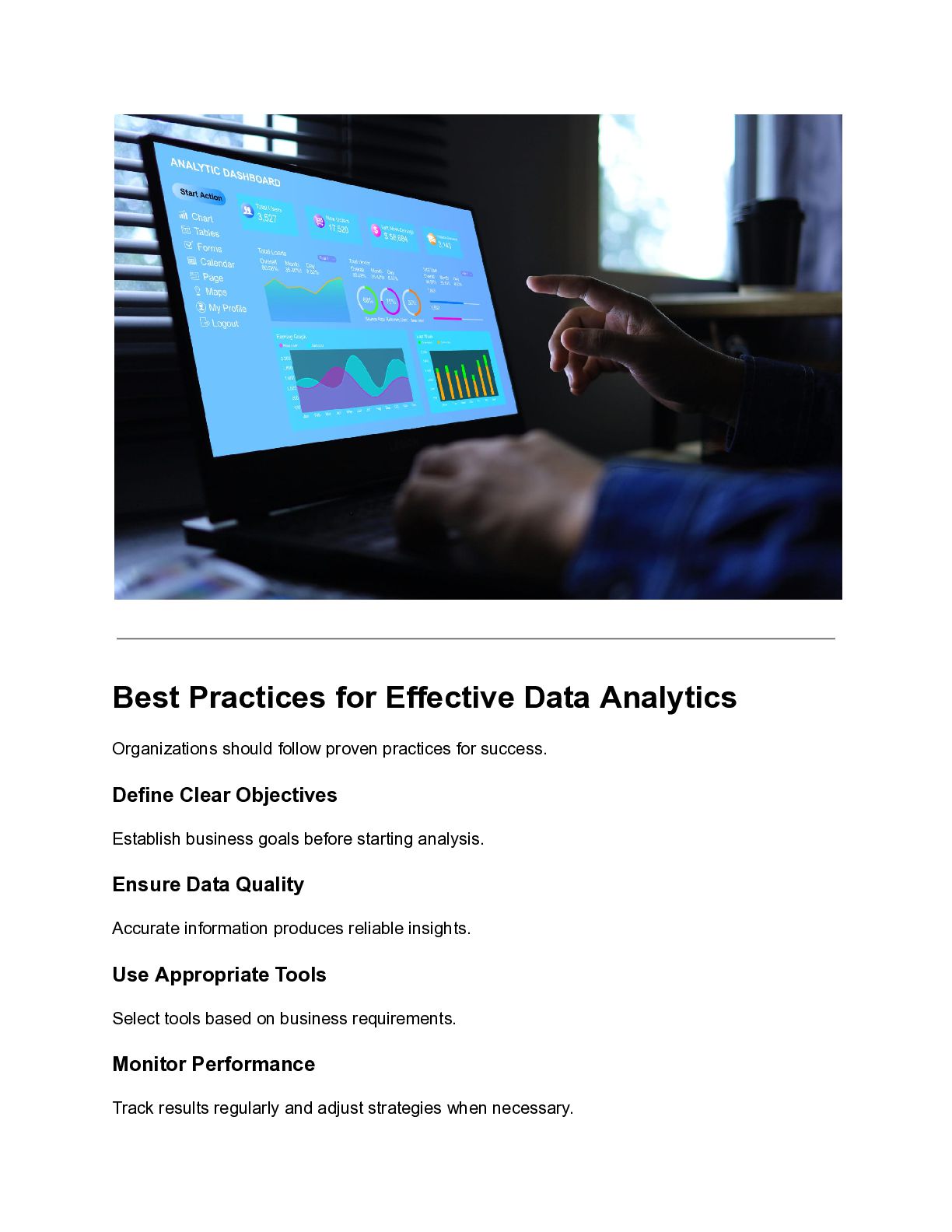
    improves accuracy and reliability before analysis begins. Data Processing After cleaning, data is organized into useful formats. Analysts prepare information for deeper examination. Data Analysis Professionals apply statistical methods and analytical techniques. The objective is finding meaningful patterns and trends. Data Visualization Results are displayed using charts, graphs, and dashboards. Visual reports make information easier to understand. Decision-Making Organizations use insights from Data Analytics to make business decisions.
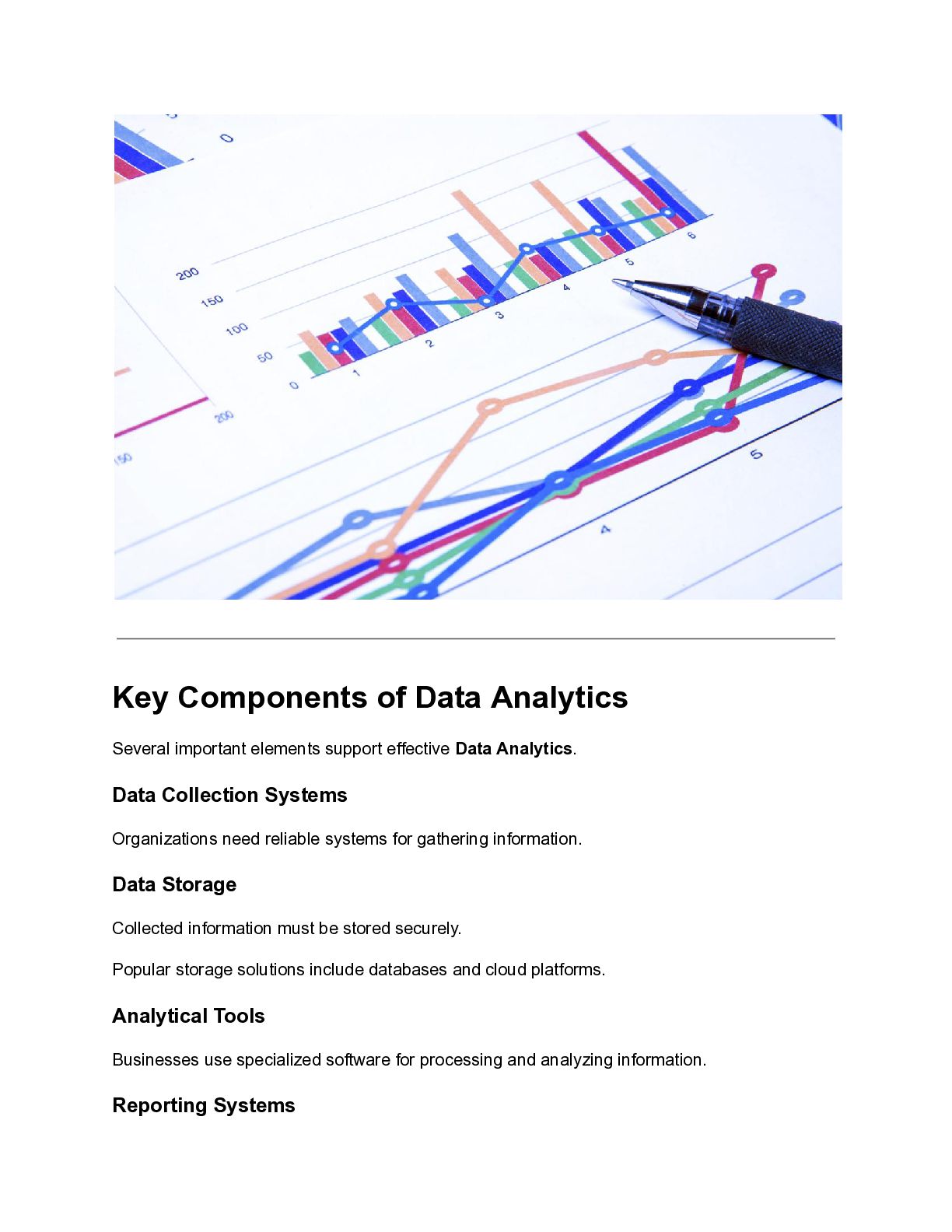
  6. Key Components of Data Analytics Several important elements support effective

    Data Analytics. Data Collection Systems Organizations need reliable systems for gathering information. Data Storage Collected information must be stored securely. Popular storage solutions include databases and cloud platforms. Analytical Tools Businesses use specialized software for processing and analyzing information. Reporting Systems
  7. Reports help stakeholders understand findings and take action. Popular Data

    Analytics Tools Many software solutions support Data Analytics activities. Microsoft Power BI Power BI helps users create dashboards and reports. It is widely used for business intelligence projects. Tableau Tableau offers advanced data visualization capabilities. Organizations use it to create interactive reports. Microsoft Excel Excel remains a popular tool for basic data analysis. Small businesses often use Excel for reporting. Python Python supports advanced analytics and machine learning. Many data professionals use Python for large datasets. R Programming R is designed specifically for statistical analysis. Researchers frequently use R for analytical projects.
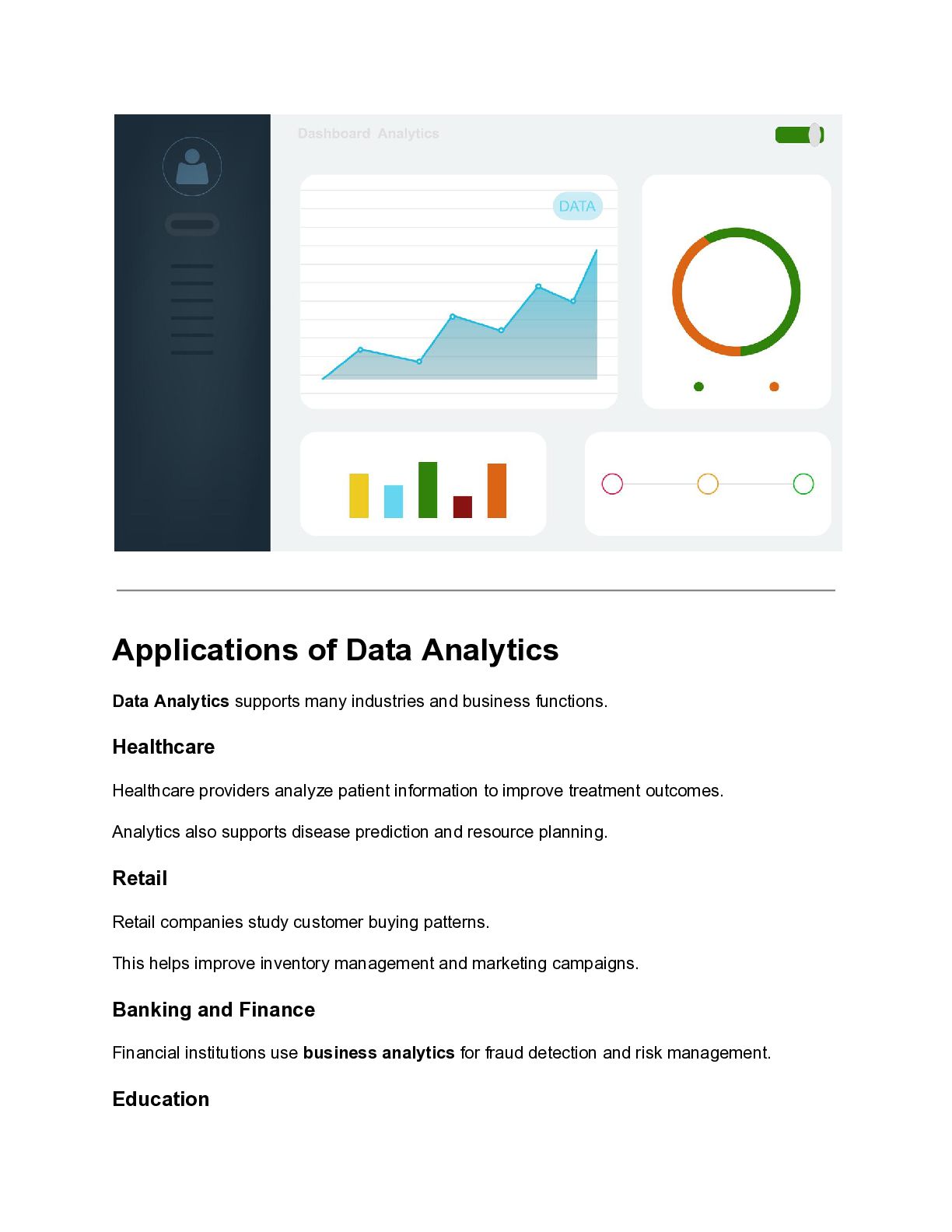
  8. Applications of Data Analytics Data Analytics supports many industries and

    business functions. Healthcare Healthcare providers analyze patient information to improve treatment outcomes. Analytics also supports disease prediction and resource planning. Retail Retail companies study customer buying patterns. This helps improve inventory management and marketing campaigns. Banking and Finance Financial institutions use business analytics for fraud detection and risk management. Education
  9. Educational organizations analyze student performance data. Insights help improve learning

    outcomes. Manufacturing Manufacturers use analytics to optimize production processes and reduce waste. Benefits of Data Analytics Organizations gain many advantages from effective Data Analytics. Better Business Performance Data-driven strategies often improve overall performance. Enhanced Customer Understanding Businesses gain deeper knowledge of customer preferences. Faster Decision-Making Real-time information supports quicker business responses. Cost Reduction Companies identify unnecessary expenses through analytical insights. Competitive Advantage Organizations using data intelligence often outperform competitors. Improved Marketing Marketing teams use Data Analytics to target the right audience. This increases campaign effectiveness.
  10. Challenges in Data Analytics Although beneficial, Data Analytics presents several

    challenges. Data Quality Issues Poor-quality information produces unreliable results. Data Security Concerns Organizations must protect sensitive information. Strong security measures are essential. Skill Gaps Many businesses struggle to find experienced analytics professionals. Large Data Volumes
  11. Managing massive datasets requires advanced infrastructure. Integration Problems Combining information

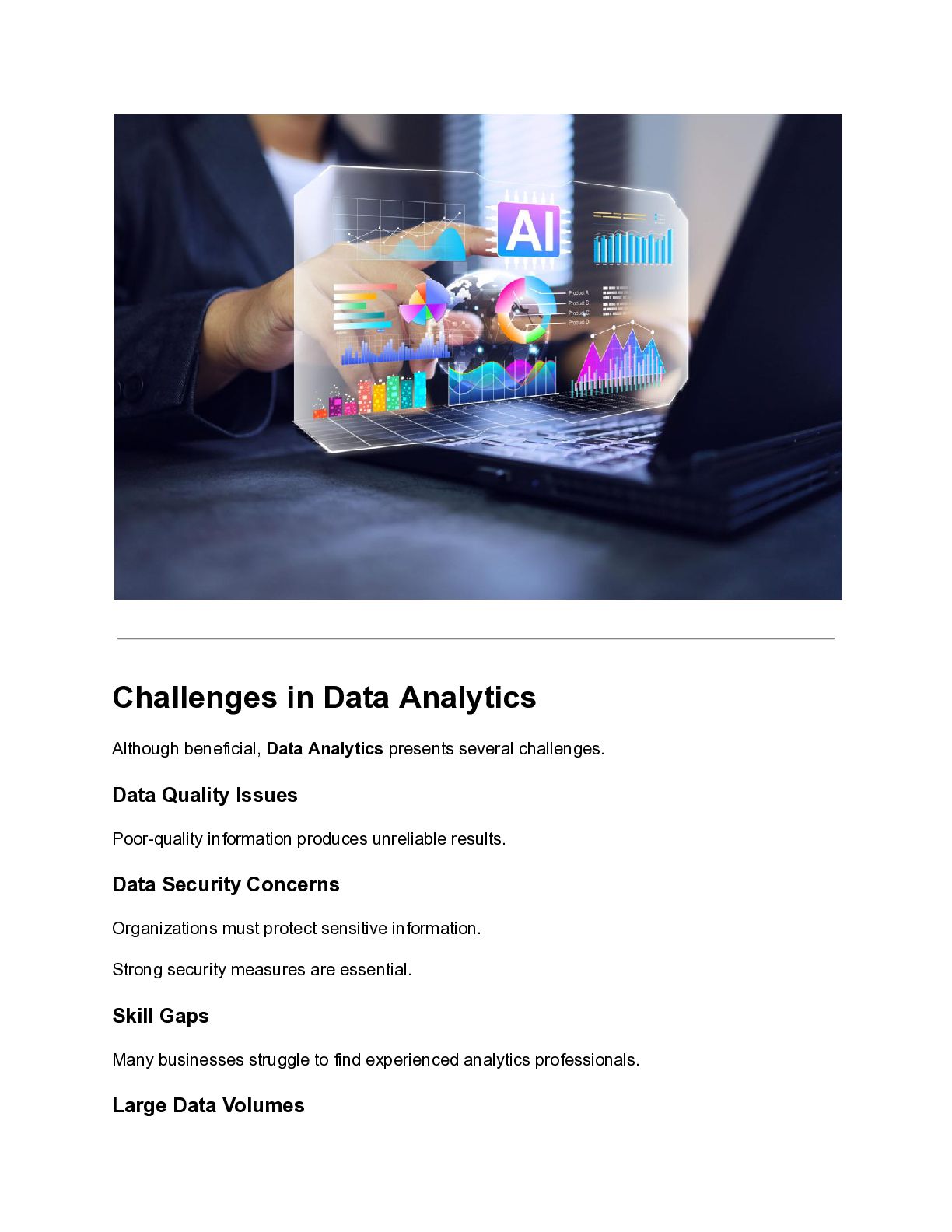
    from different systems can be difficult. Data Analytics and Artificial Intelligence Artificial Intelligence is transforming Data Analytics. AI systems process large datasets quickly and accurately. Machine learning algorithms identify patterns that humans may overlook. Benefits include: •​ Faster analysis •​ Better predictions •​ Improved automation •​ Enhanced decision-making Many organizations combine AI with Data Analytics to achieve stronger business outcomes. Future Trends in Data Analytics The future of Data Analytics looks promising. Real-Time Analytics Businesses increasingly require immediate insights. Real-time reporting supports faster responses. Cloud Analytics Cloud-based solutions offer flexibility and scalability. Many organizations are moving analytics operations to cloud platforms. Predictive Intelligence
  12. Advanced predictive models continue improving business forecasting. Automated Analytics Automation

    reduces manual work and increases efficiency. Data Democratization More employees can access and understand data insights. This improves organization-wide decision-making. Skills Required for Data Analytics Professionals need several skills to succeed in Data Analytics. Statistical Knowledge Statistics helps analysts understand patterns and relationships. Data Visualization Clear visual reports improve communication. Programming Skills Languages like Python and R support advanced analysis. Problem-Solving Ability Analysts must identify business challenges and propose solutions. Communication Skills Insights must be presented clearly to stakeholders.
  13. Best Practices for Effective Data Analytics Organizations should follow proven

    practices for success. Define Clear Objectives Establish business goals before starting analysis. Ensure Data Quality Accurate information produces reliable insights. Use Appropriate Tools Select tools based on business requirements. Monitor Performance Track results regularly and adjust strategies when necessary.
  14. Protect Data Security Implement strong security controls to safeguard information.

    Conclusion Data Analytics has become a critical business function in the modern digital economy. Organizations use data analysis, business analytics, and data intelligence to understand customer behavior, improve operations, and make informed decisions. From healthcare and finance to retail and manufacturing, analytics creates value across industries. As technology continues evolving, the importance of Data Analytics will increase further. Businesses that invest in analytical capabilities can improve efficiency, reduce risks, and gain a strong competitive advantage. By turning raw information into actionable insights, Data Analytics helps organizations achieve sustainable growth and long-term success.