Artificial Intelligence, Human Dignity and Power
 Ship Features Fearlessly
Turn features on and off without deploys. Used by thousands of Ruby developers.
→

Share
Artificial Intelligence, Human Dignity and Power
What kind of civilization do we want to build with artificial intelligence? Who controls its tools, and who takes responsibility for their consequences?
In this thought-provoking talk, Agustín Argelich brings engineering, ethics, and Catholic social teaching into conversation to explore how human dignity can guide the digital transformation. Taking Magnífica Humanitas of Leo XIV as its starting point, the presentation examines AI’s capabilities, limitations, and implications for human freedom.
The talk offers an accessible introduction to language models, algorithms and pattern recognition, before addressing misinformation, the concentration of technological power, military applications and shared responsibility. It also explores competition between the United States and China, Europe’s technological dependence, and the physical infrastructure behind AI: chips, telecommunications networks, data centers and energy.
Drawing on his experience in digital infrastructure and his interest in Gaudí’s approach to nature and design, Argelich connects technological choices with a broader question: how can innovation serve the common good?
The closing message is a personal call to action: invest in education, beginning with ourselves. Lifelong learning, critical thinking and individual responsibility are essential to shaping a future in which technology strengthens human freedom and dignity.

Agustin Argelich Casals
Transcript
38 slides
-
A VISION OF AI AND THE ENCYCLICAL Magnífica Humanitas Human
dignity in the age of artificial intelligence Agustín Argelich Casals President & Principal, Argelich Networks · Senior Member, Intelligent Community Forum -
BEFORE WE BEGIN An honest disclaimer This presentation contains reflections
and ideas that are clear, concrete, concise and compelling on a boundless subject that overwhelms us all. This is neither a treatise on theology nor a technical manual on artificial intelligence. It is an attempt to look at both worlds at once, with the rigor engineering deserves and the respect faith deserves. It seeks to shake us up and to encourage personal and communal reflection. It contains no investment or divestment recommendation. A Vision of AI and the Encyclical Magnífica Humanitas – Agustín Argelich Casals 02 -
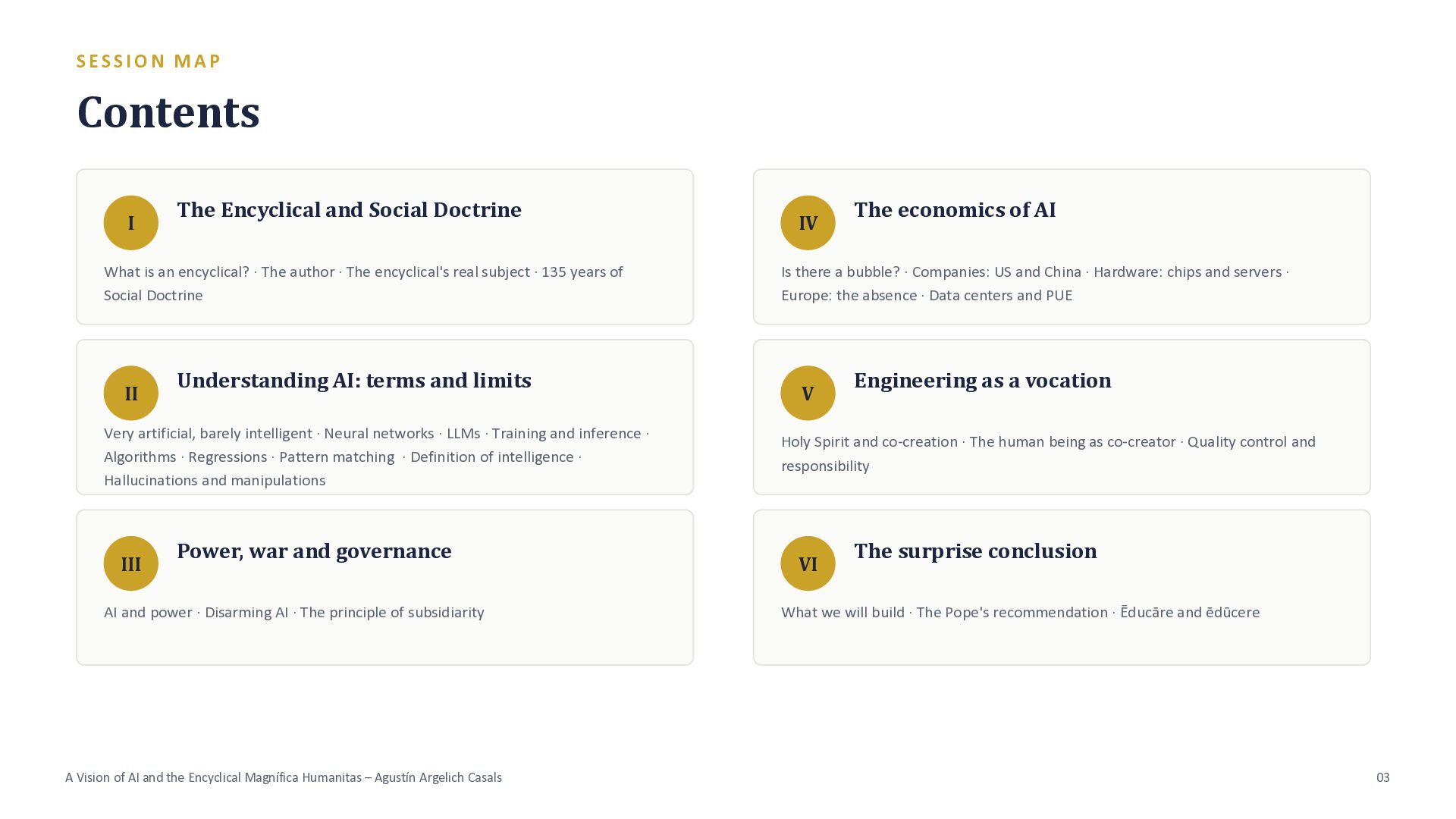
SESSION MAP Contents I The Encyclical and Social Doctrine What
is an encyclical? · The author · The encyclical's real subject · 135 years of Social Doctrine II Understanding AI: terms and limits Very artificial, barely intelligent · Neural networks · LLMs · Training and inference · Algorithms · Regressions · Pattern matching · Definition of intelligence · Hallucinations and manipulations III Power, war and governance AI and power · Disarming AI · The principle of subsidiarity A Vision of AI and the Encyclical Magnífica Humanitas – Agustín Argelich Casals IV The economics of AI Is there a bubble? · Companies: US and China · Hardware: chips and servers · Europe: the absence · Data centers and PUE V Engineering as a vocation Holy Spirit and co-creation · The human being as co-creator · Quality control and responsibility VI The surprise conclusion What we will build · The Pope's recommendation · Ēducāre and ēdūcere 03 -
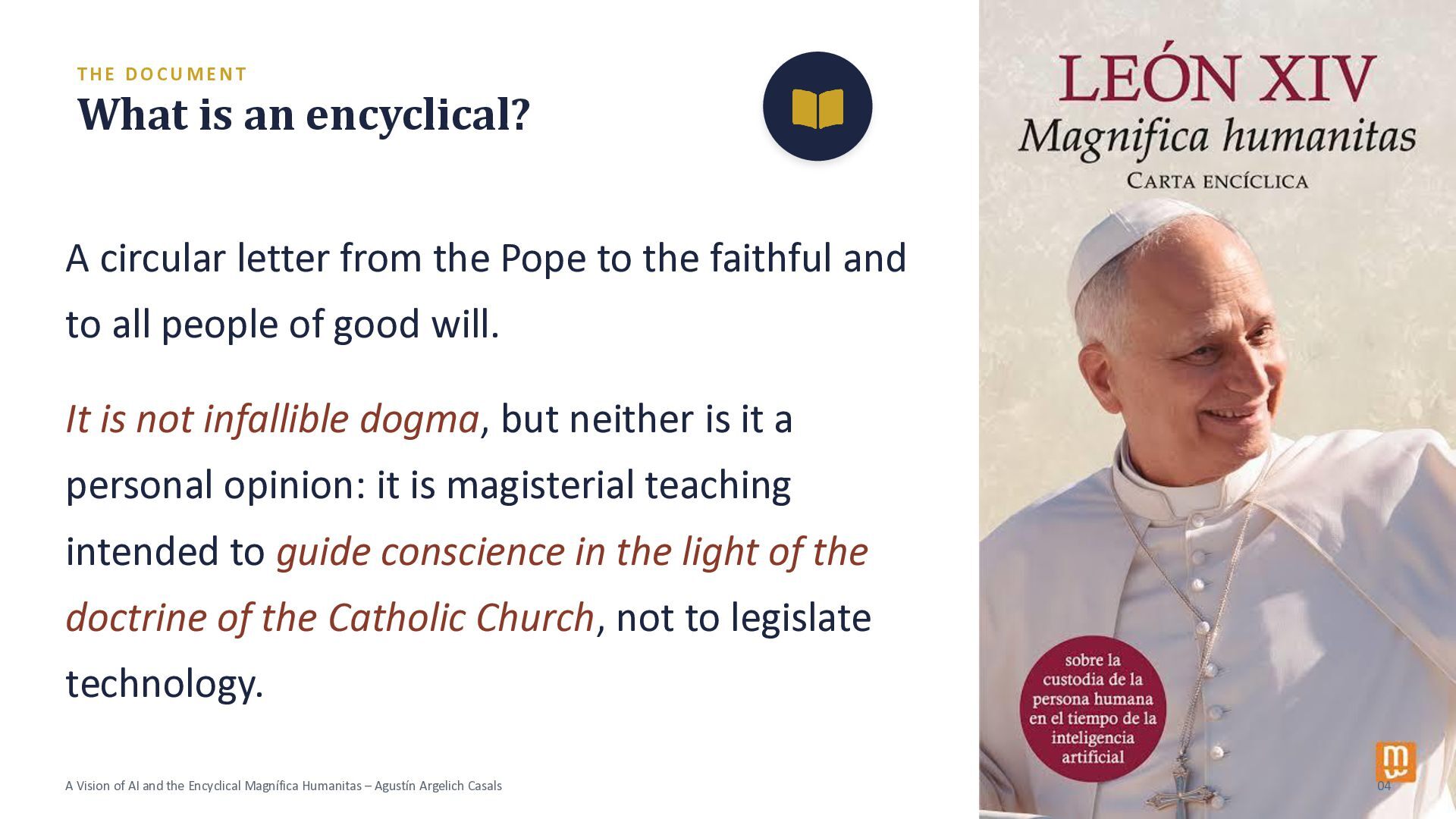
THE DOCUMENT What is an encyclical? A circular letter from
the Pope to the faithful and to all people of good will. It is not infallible dogma, but neither is it a personal opinion: it is magisterial teaching intended to guide conscience in the light of the doctrine of the Catholic Church, not to legislate technology. A Vision of AI and the Encyclical Magnífica Humanitas – Agustín Argelich Casals 04 -
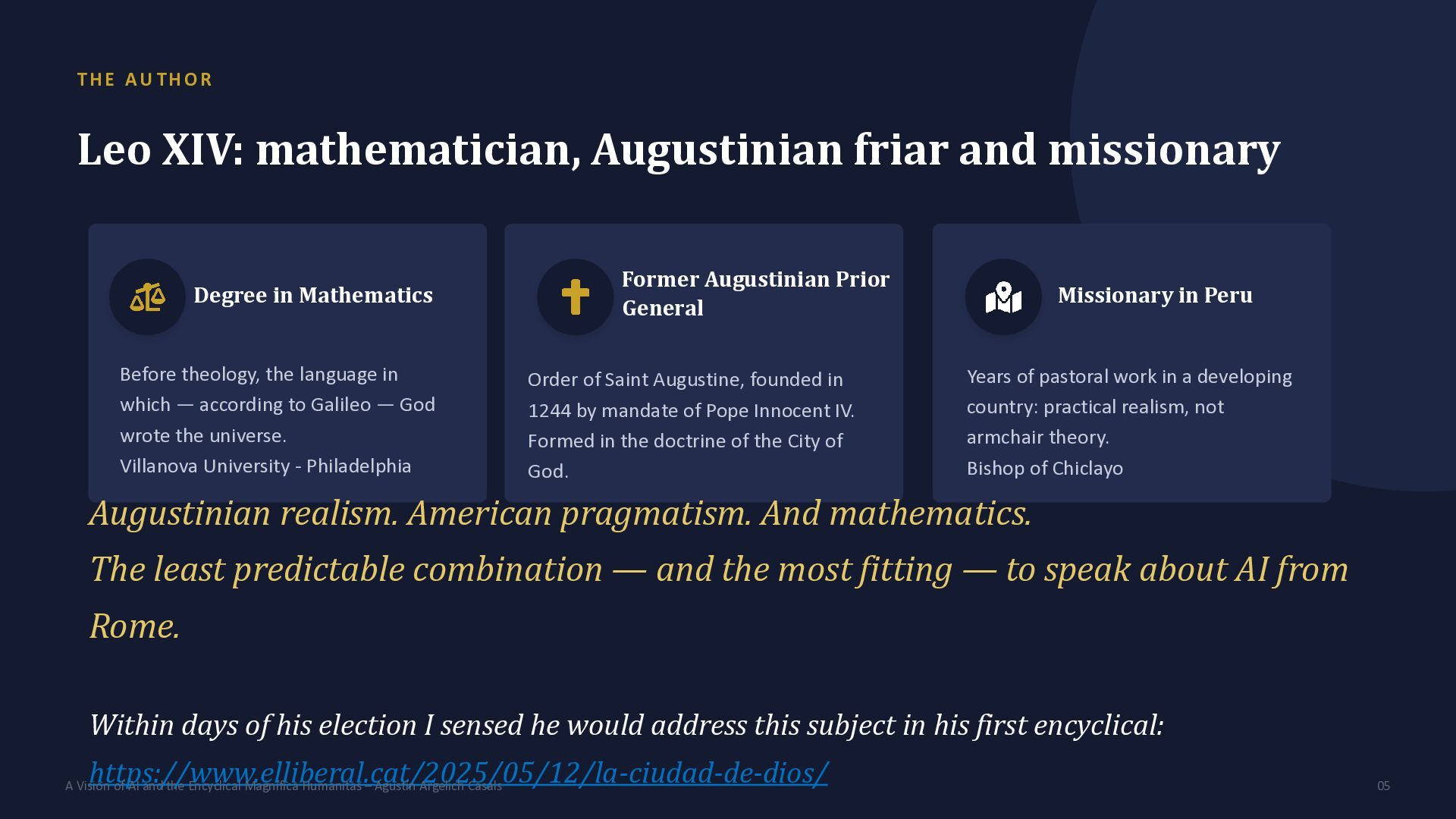
THE AUTHOR Leo XIV: mathematician, Augustinian friar and missionary Degree
in Mathematics Before theology, the language in which — according to Galileo — God wrote the universe. Villanova University - Philadelphia Former Augustinian Prior General Order of Saint Augustine, founded in 1244 by mandate of Pope Innocent IV. Formed in the doctrine of the City of God. Missionary in Peru Years of pastoral work in a developing country: practical realism, not armchair theory. Bishop of Chiclayo Augustinian realism. American pragmatism. And mathematics. The least predictable combination — and the most fitting — to speak about AI from Rome. Within days of his election I sensed he would address this subject in his first encyclical: https://www.elliberal.cat/2025/05/12/la-ciudad-de-dios/ A Vision of AI and the Encyclical Magnífica Humanitas – Agustín Argelich Casals 05 -
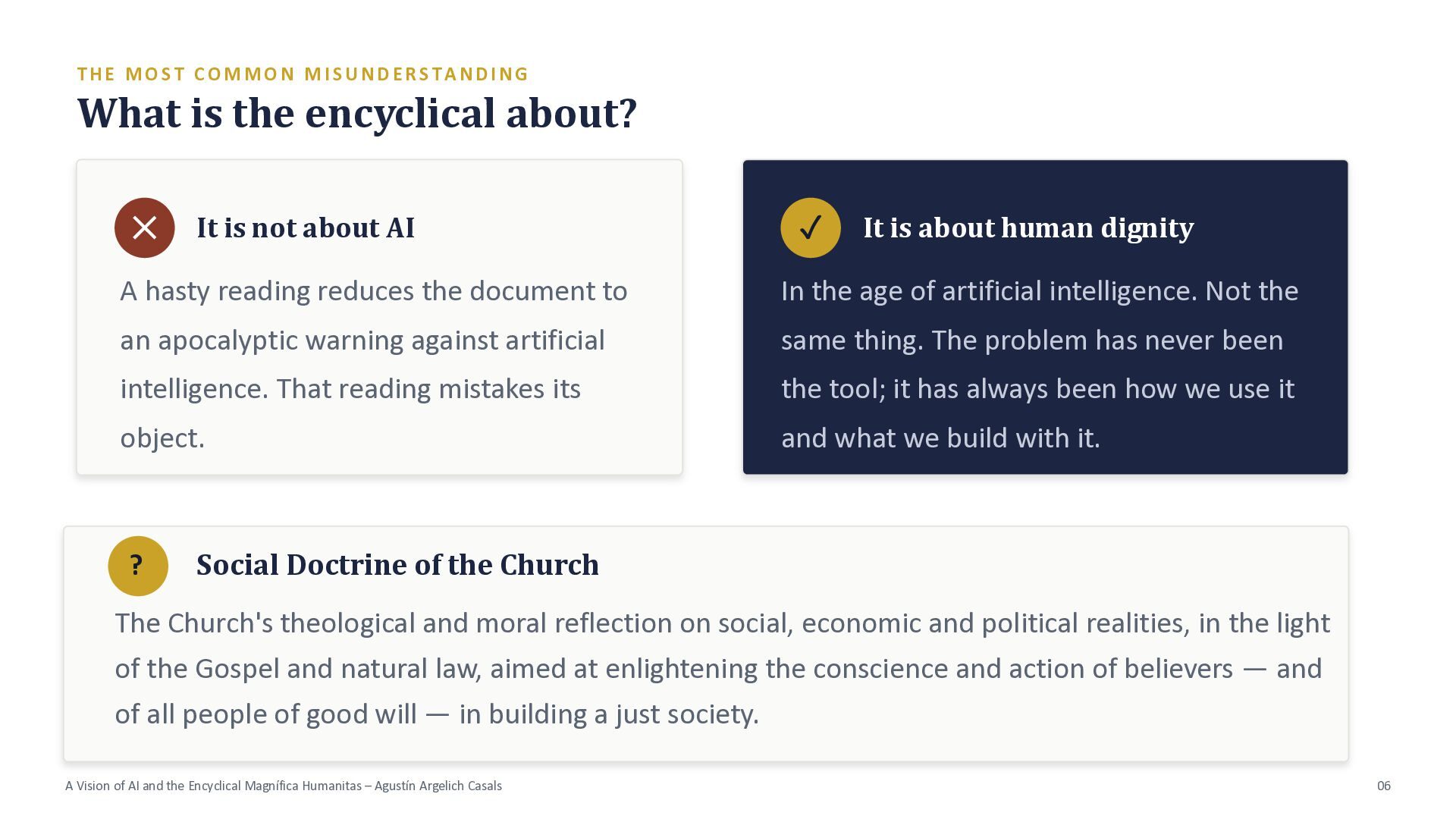
THE MOST COMMON MISUNDERSTANDING What is the encyclical about? ✕
It is not about AI ✓ It is about human dignity A hasty reading reduces the document to In the age of artificial intelligence. Not the an apocalyptic warning against artificial same thing. The problem has never been intelligence. That reading mistakes its the tool; it has always been how we use it object. and what we build with it. ? Social Doctrine of the Church The Church's theological and moral reflection on social, economic and political realities, in the light of the Gospel and natural law, aimed at enlightening the conscience and action of believers — and of all people of good will — in building a just society. A Vision of AI and the Encyclical Magnífica Humanitas – Agustín Argelich Casals 06 -
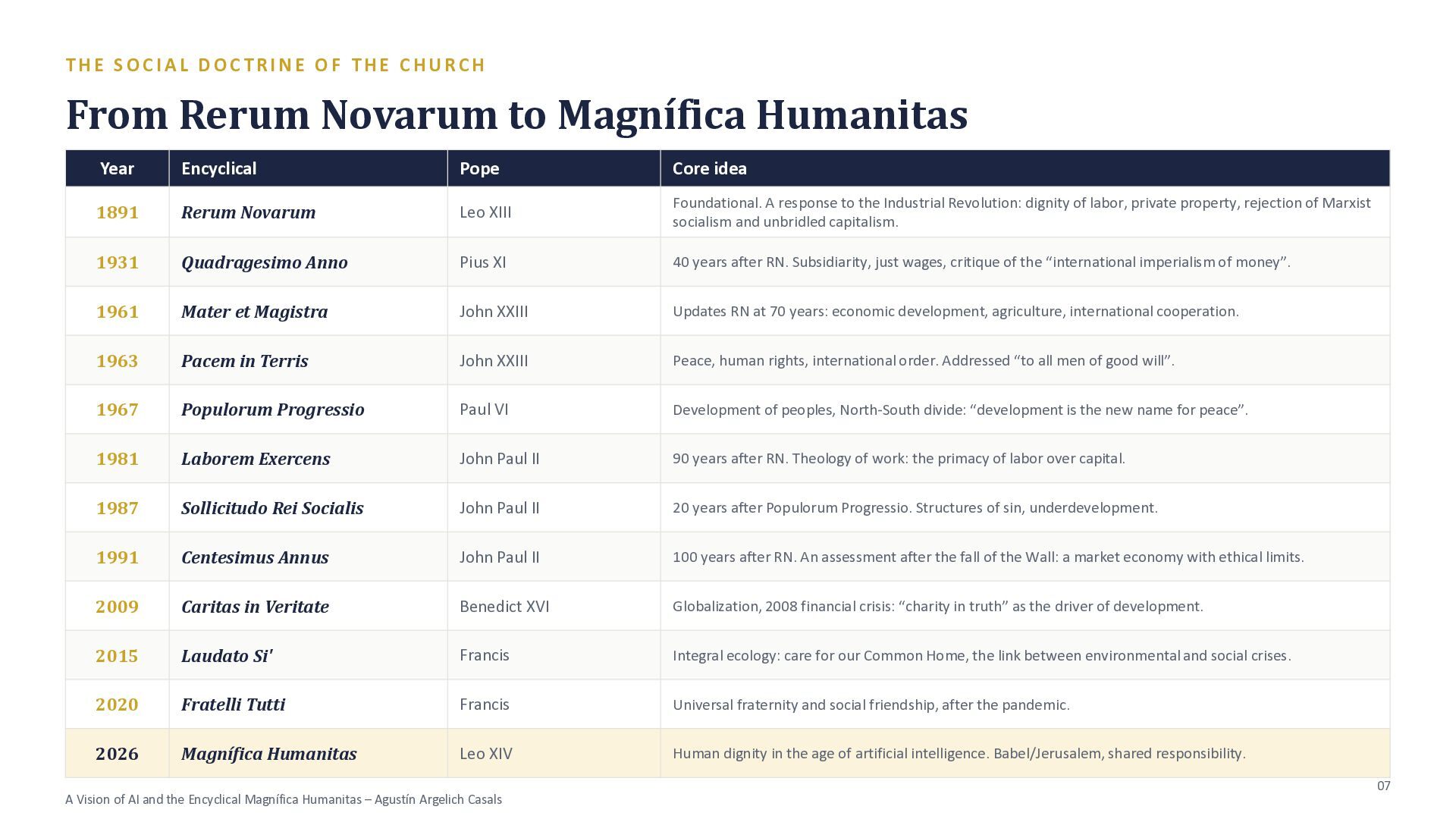
THE SOCIAL DOCTRINE OF THE CHURCH From Rerum Novarum to
Magnífica Humanitas Year Encyclical Pope Core idea 1891 Rerum Novarum Leo XIII Foundational. A response to the Industrial Revolution: dignity of labor, private property, rejection of Marxist socialism and unbridled capitalism. 1931 Quadragesimo Anno Pius XI 40 years after RN. Subsidiarity, just wages, critique of the “international imperialism of money”. 1961 Mater et Magistra John XXIII Updates RN at 70 years: economic development, agriculture, international cooperation. 1963 Pacem in Terris John XXIII Peace, human rights, international order. Addressed “to all men of good will”. 1967 Populorum Progressio Paul VI Development of peoples, North-South divide: “development is the new name for peace”. 1981 Laborem Exercens John Paul II 90 years after RN. Theology of work: the primacy of labor over capital. 1987 Sollicitudo Rei Socialis John Paul II 20 years after Populorum Progressio. Structures of sin, underdevelopment. 1991 Centesimus Annus John Paul II 100 years after RN. An assessment after the fall of the Wall: a market economy with ethical limits. 2009 Caritas in Veritate Benedict XVI Globalization, 2008 financial crisis: “charity in truth” as the driver of development. 2015 Laudato Si' Francis Integral ecology: care for our Common Home, the link between environmental and social crises. 2020 Fratelli Tutti Francis Universal fraternity and social friendship, after the pandemic. 2026 Magnífica Humanitas Leo XIV Human dignity in the age of artificial intelligence. Babel/Jerusalem, shared responsibility. 07 A Vision of AI and the Encyclical Magnífica Humanitas – Agustín Argelich Casals -
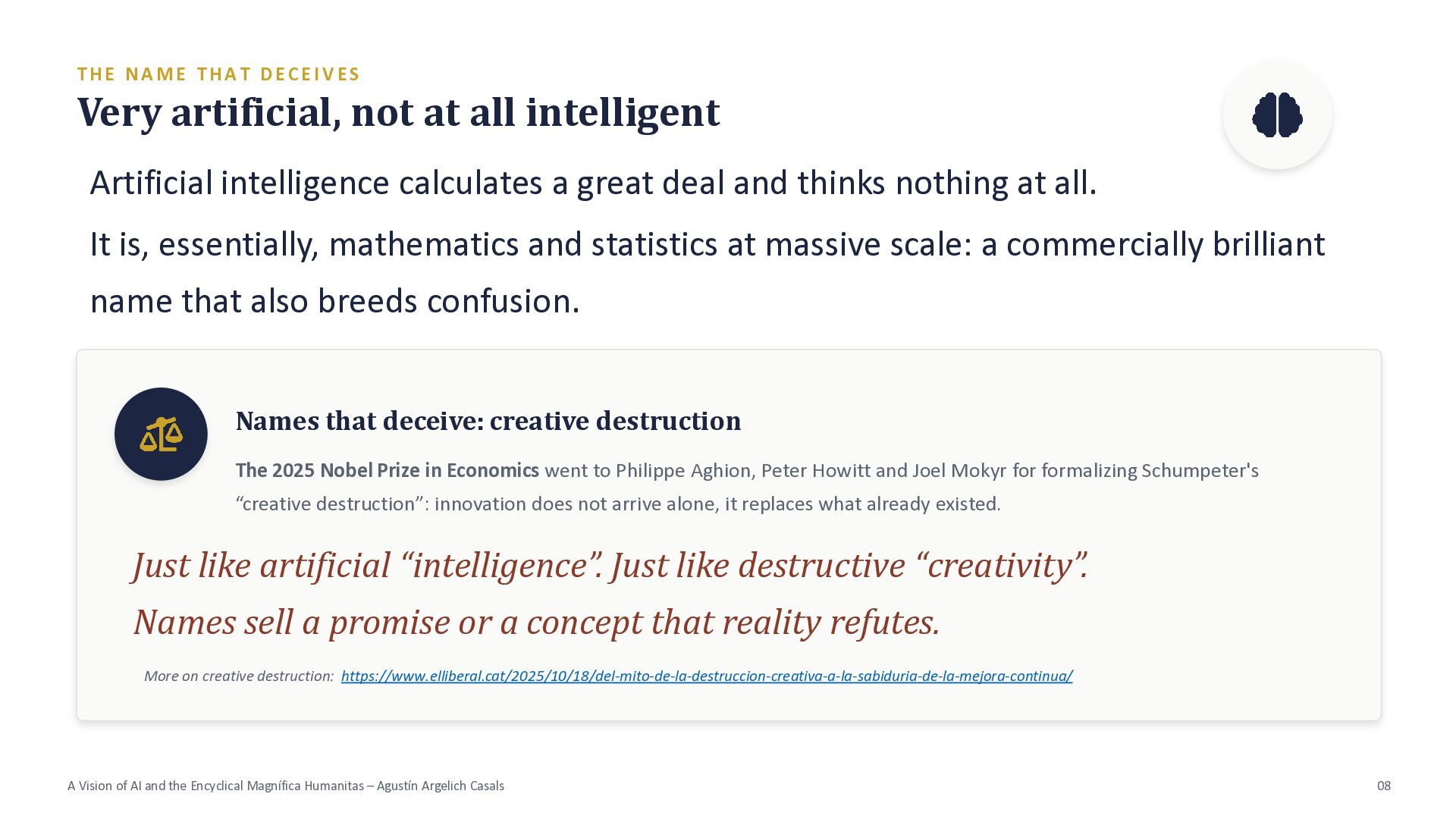
THE NAME THAT DECEIVES Very artificial, not at all intelligent
Artificial intelligence calculates a great deal and thinks nothing at all. It is, essentially, mathematics and statistics at massive scale: a commercially brilliant name that also breeds confusion. Names that deceive: creative destruction The 2025 Nobel Prize in Economics went to Philippe Aghion, Peter Howitt and Joel Mokyr for formalizing Schumpeter's “creative destruction”: innovation does not arrive alone, it replaces what already existed. Just like artificial “intelligence”. Just like destructive “creativity”. Names sell a promise or a concept that reality refutes. More on creative destruction: https://www.elliberal.cat/2025/10/18/del-mito-de-la-destruccion-creativa-a-la-sabiduria-de-la-mejora-continua/ A Vision of AI and the Encyclical Magnífica Humanitas – Agustín Argelich Casals 08 -
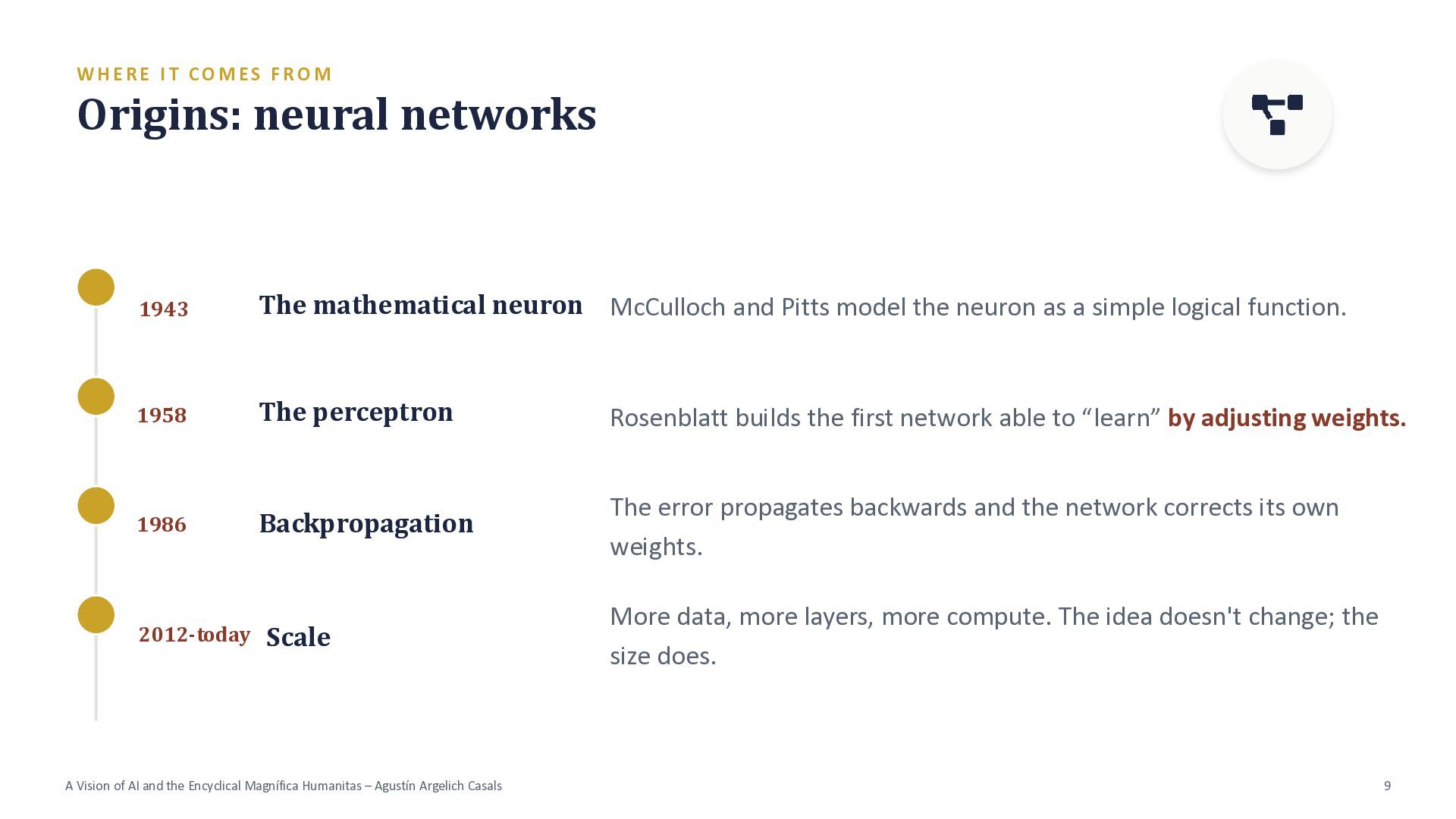
WHERE IT COMES FROM Origins: neural networks 1943 The mathematical
neuron McCulloch and Pitts model the neuron as a simple logical function. 1958 The perceptron Rosenblatt builds the first network able to “learn” by adjusting weights. 1986 Backpropagation The error propagates backwards and the network corrects its own weights. 2012-today Scale More data, more layers, more compute. The idea doesn't change; the size does. A Vision of AI and the Encyclical Magnífica Humanitas – Agustín Argelich Casals 9 -
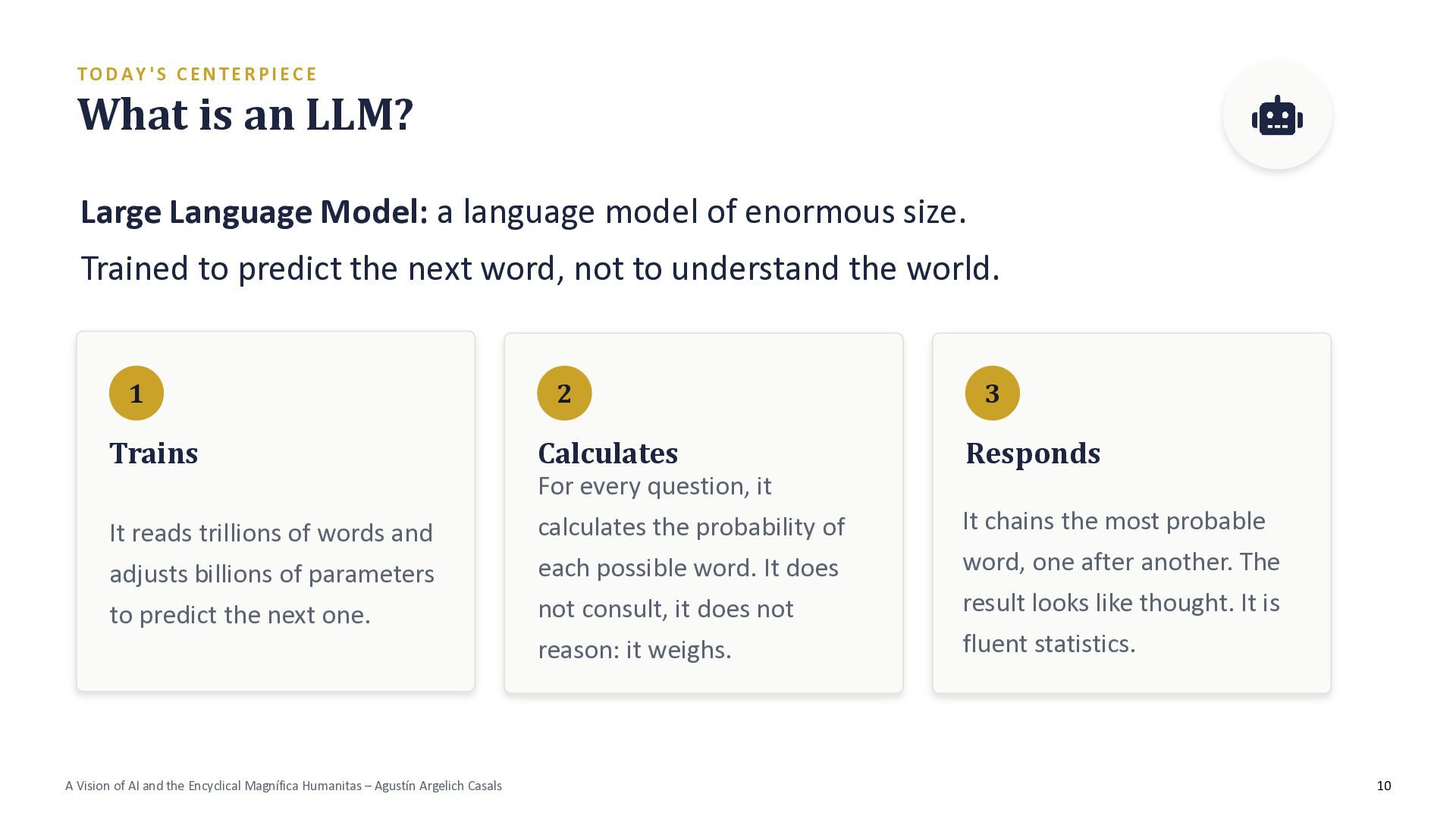
TODAY'S CENTERPIECE What is an LLM? Large Language Model: a
language model of enormous size. Trained to predict the next word, not to understand the world. 1 Trains 2 Calculates 3 Responds For every question, it It reads trillions of words and adjusts billions of parameters to predict the next one. A Vision of AI and the Encyclical Magnífica Humanitas – Agustín Argelich Casals calculates the probability of each possible word. It does not consult, it does not reason: it weighs. It chains the most probable word, one after another. The result looks like thought. It is fluent statistics. 10 -
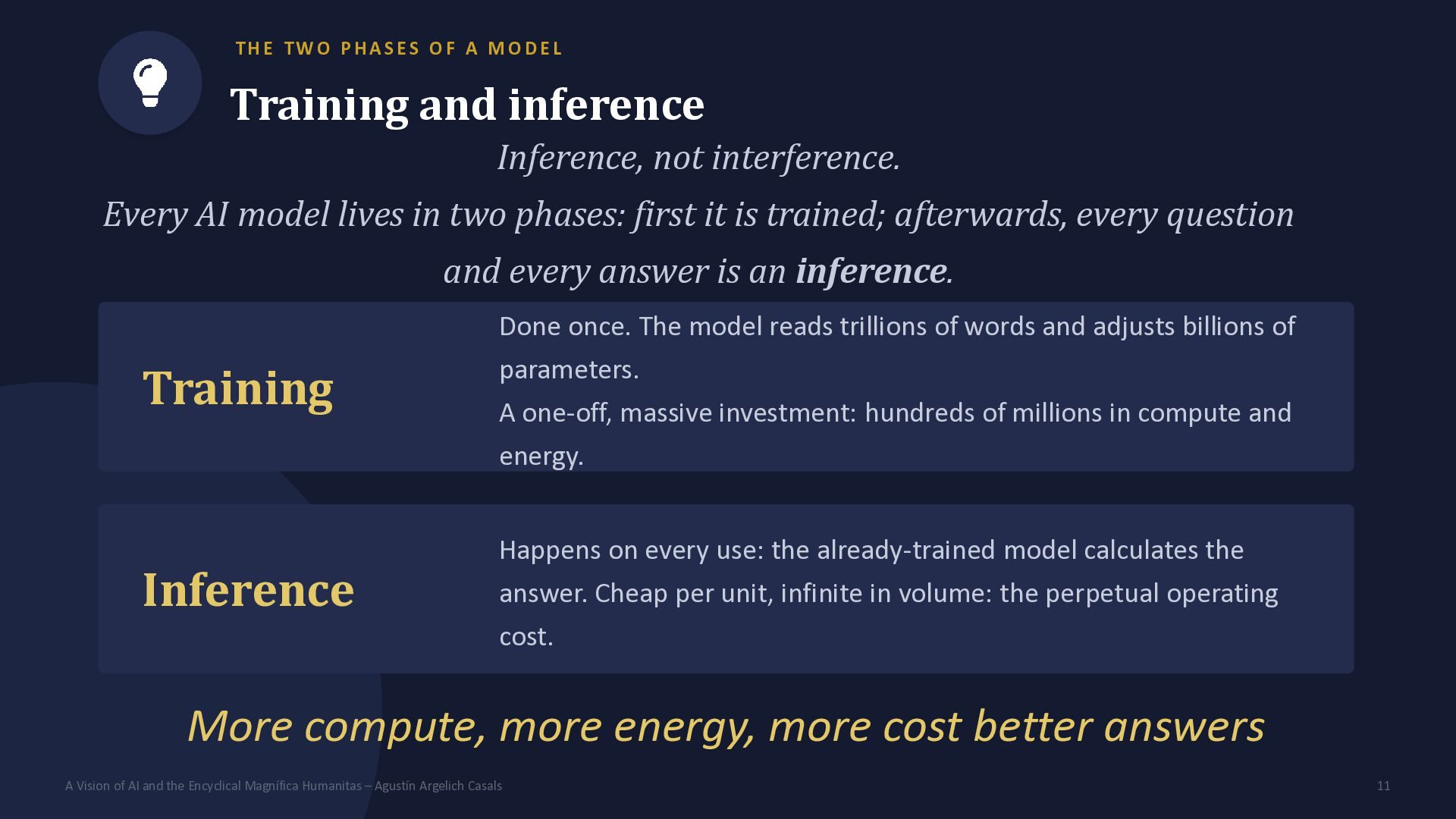
THE TWO PHASES OF A MODEL Training and inference Inference,
not interference. Every AI model lives in two phases: first it is trained; afterwards, every question and every answer is an inference. Done once. The model reads trillions of words and adjusts billions of Training parameters. A one-off, massive investment: hundreds of millions in compute and energy. Inference Happens on every use: the already-trained model calculates the answer. Cheap per unit, infinite in volume: the perpetual operating cost. More compute, more energy, more cost better answers A Vision of AI and the Encyclical Magnífica Humanitas – Agustín Argelich Casals 11 -
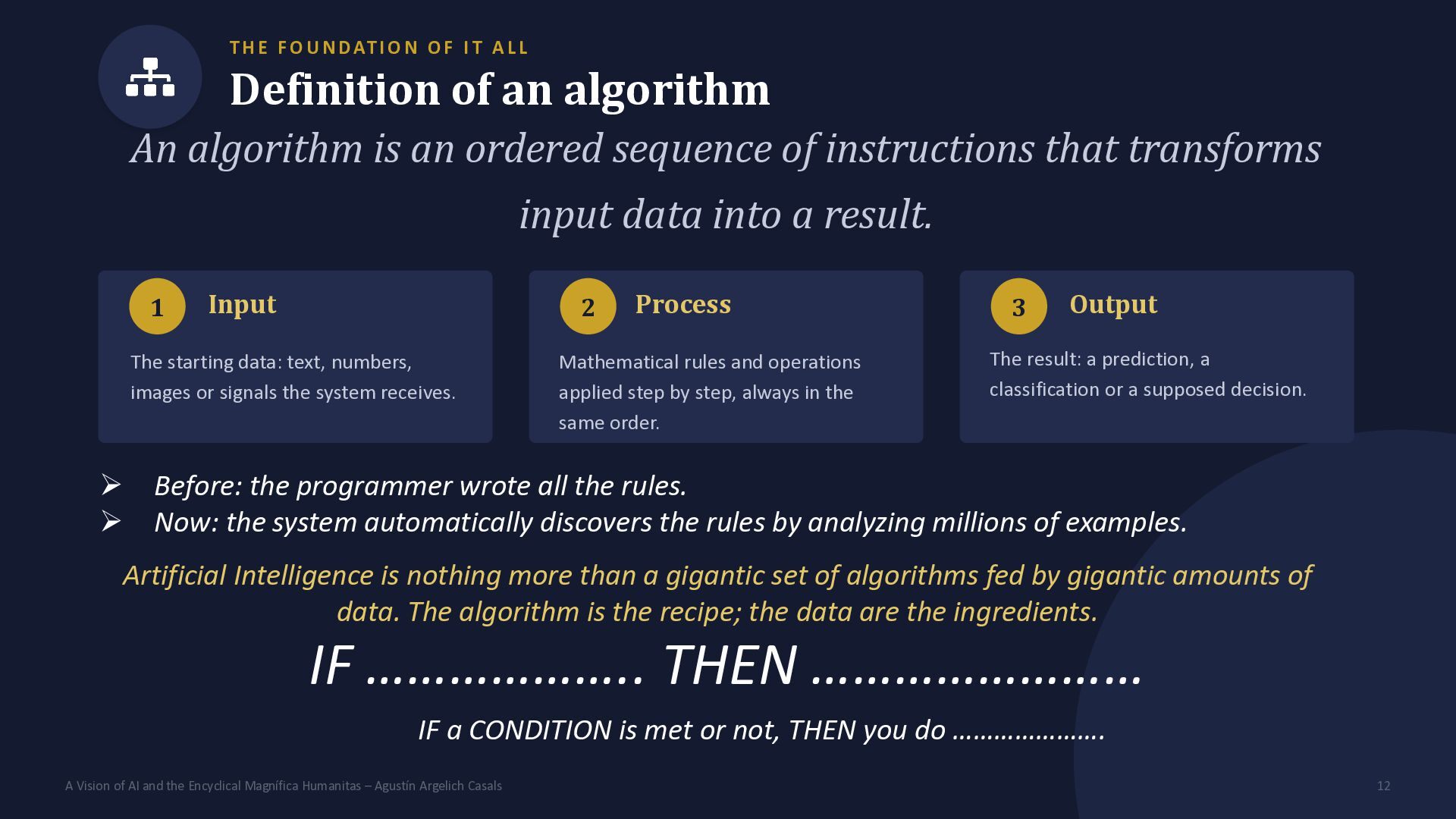
T H E F O U N D AT I
O N O F I T A L L Definition of an algorithm An algorithm is an ordered sequence of instructions that transforms input data into a result. 1 Input 2 The starting data: text, numbers, images or signals the system receives. ➢ ➢ Process Mathematical rules and operations applied step by step, always in the same order. 3 Output The result: a prediction, a classification or a supposed decision. Before: the programmer wrote all the rules. Now: the system automatically discovers the rules by analyzing millions of examples. Artificial Intelligence is nothing more than a gigantic set of algorithms fed by gigantic amounts of data. The algorithm is the recipe; the data are the ingredients. IF ……………….. THEN …………………… IF a CONDITION is met or not, THEN you do …………………. A Vision of AI and the Encyclical Magnífica Humanitas – Agustín Argelich Casals 12 -
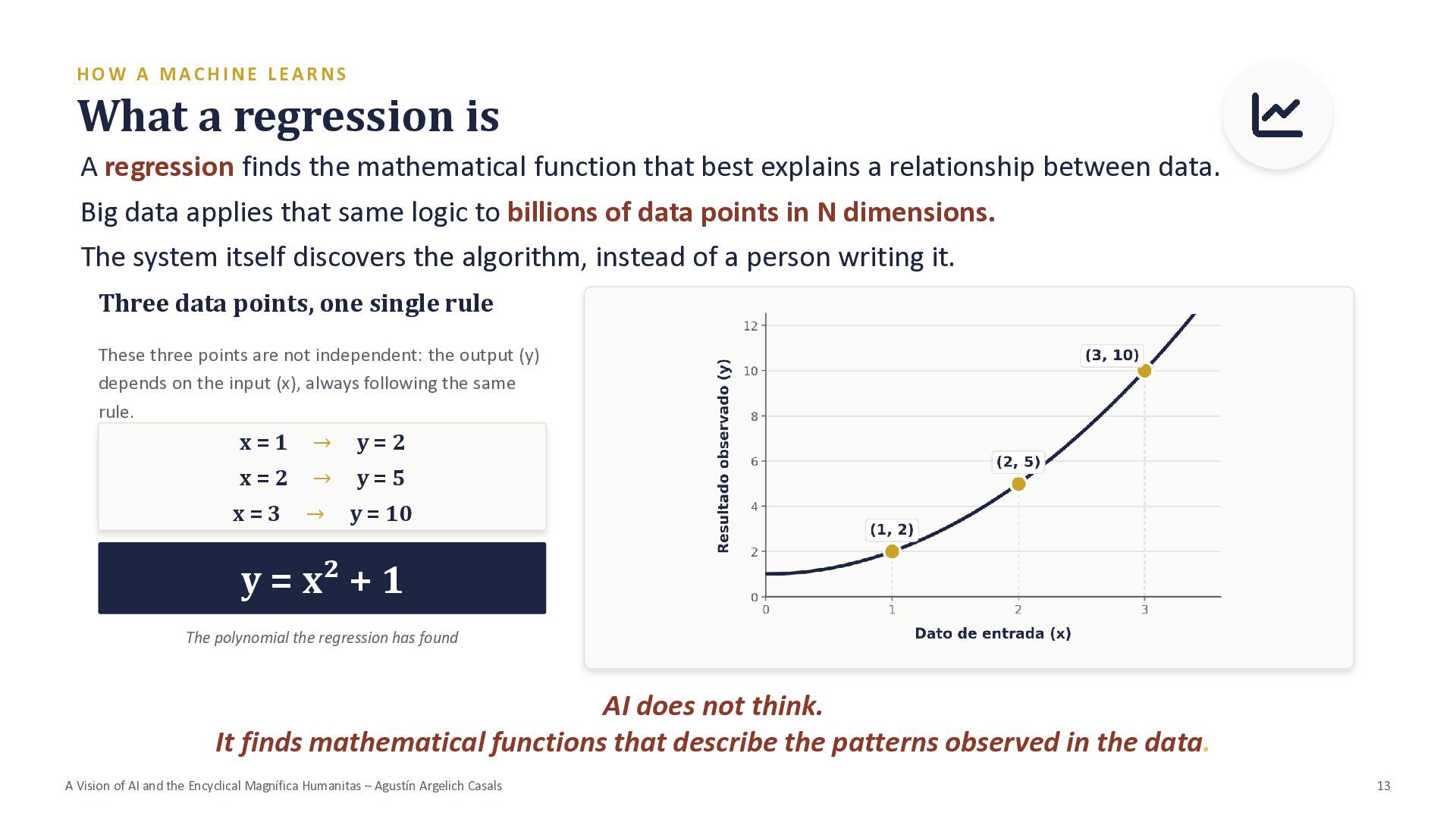
HOW A MACHINE LEARNS What a regression is A regression
finds the mathematical function that best explains a relationship between data. Big data applies that same logic to billions of data points in N dimensions. The system itself discovers the algorithm, instead of a person writing it. Three data points, one single rule These three points are not independent: the output (y) depends on the input (x), always following the same rule. x=1 → y=2 x=2 → y=5 x=3 → y = 10 y = x² + 1 The polynomial the regression has found AI does not think. It finds mathematical functions that describe the patterns observed in the data. A Vision of AI and the Encyclical Magnífica Humanitas – Agustín Argelich Casals 13 -
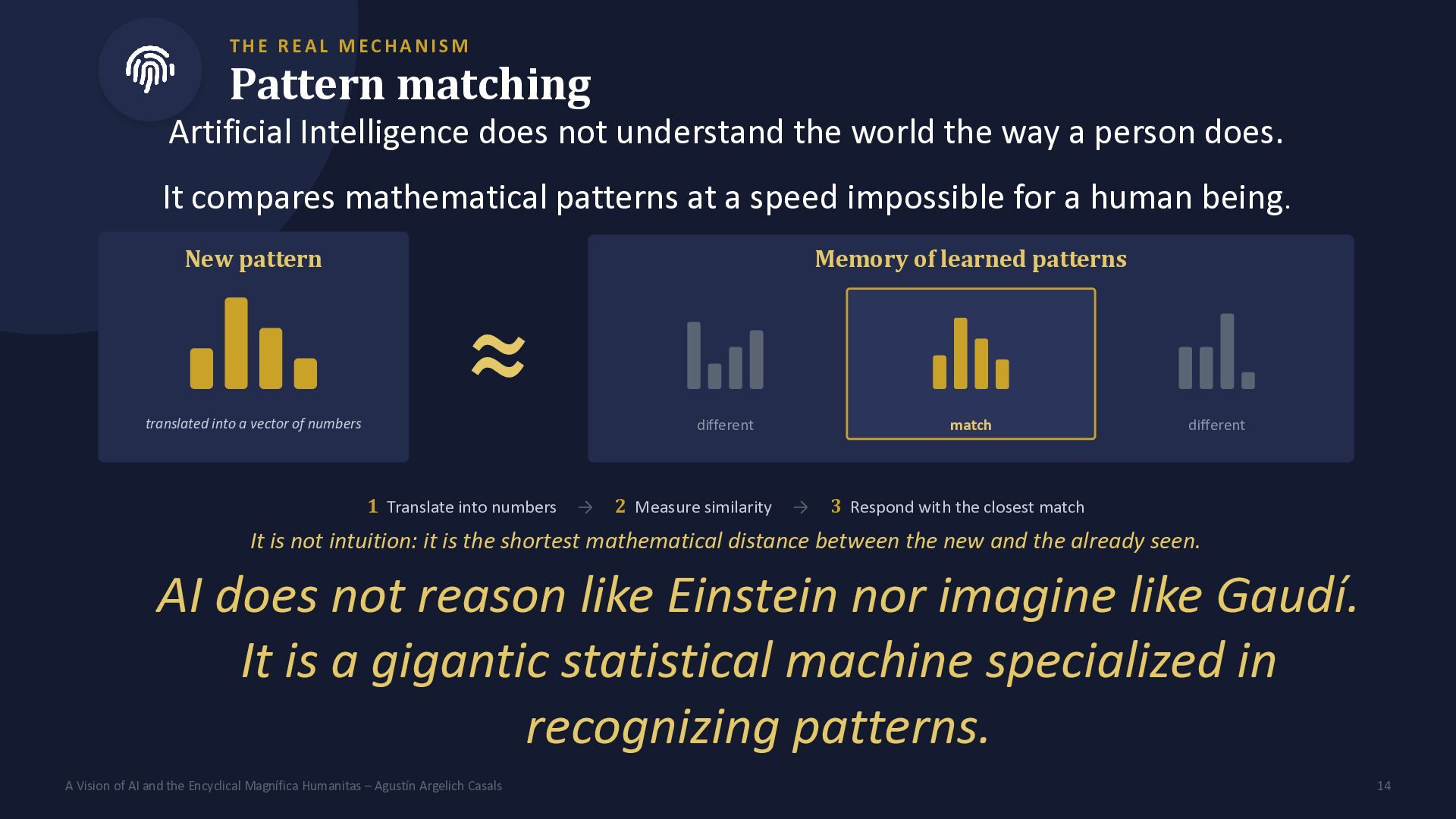
THE REAL MECHANISM Pattern matching Artificial Intelligence does not understand
the world the way a person does. It compares mathematical patterns at a speed impossible for a human being. . New pattern Memory of learned patterns ≈ translated into a vector of numbers different 1 Translate into numbers → 2 Measure similarity match → different 3 Respond with the closest match It is not intuition: it is the shortest mathematical distance between the new and the already seen. AI does not reason like Einstein nor imagine like Gaudí. It is a gigantic statistical machine specialized in recognizing patterns. A Vision of AI and the Encyclical Magnífica Humanitas – Agustín Argelich Casals 14 -
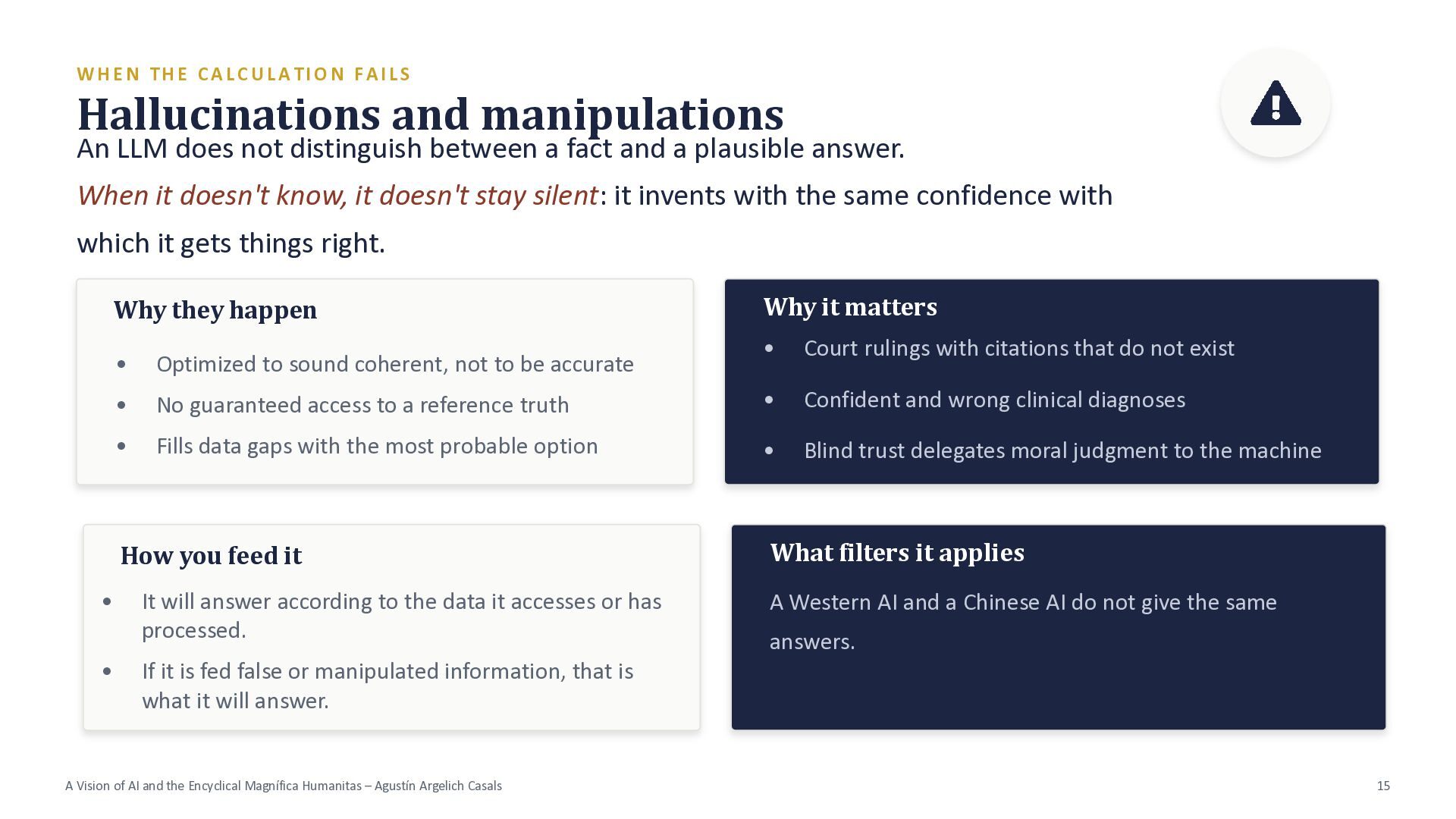
WHEN THE CALCULATION FAILS Hallucinations and manipulations An LLM does
not distinguish between a fact and a plausible answer. When it doesn't know, it doesn't stay silent: it invents with the same confidence with which it gets things right. Why they happen • Court rulings with citations that do not exist No guaranteed access to a reference truth • Confident and wrong clinical diagnoses Fills data gaps with the most probable option • Blind trust delegates moral judgment to the machine • Optimized to sound coherent, not to be accurate • • How you feed it • • Why it matters It will answer according to the data it accesses or has processed. What filters it applies A Western AI and a Chinese AI do not give the same answers. If it is fed false or manipulated information, that is what it will answer. A Vision of AI and the Encyclical Magnífica Humanitas – Agustín Argelich Casals 15 -
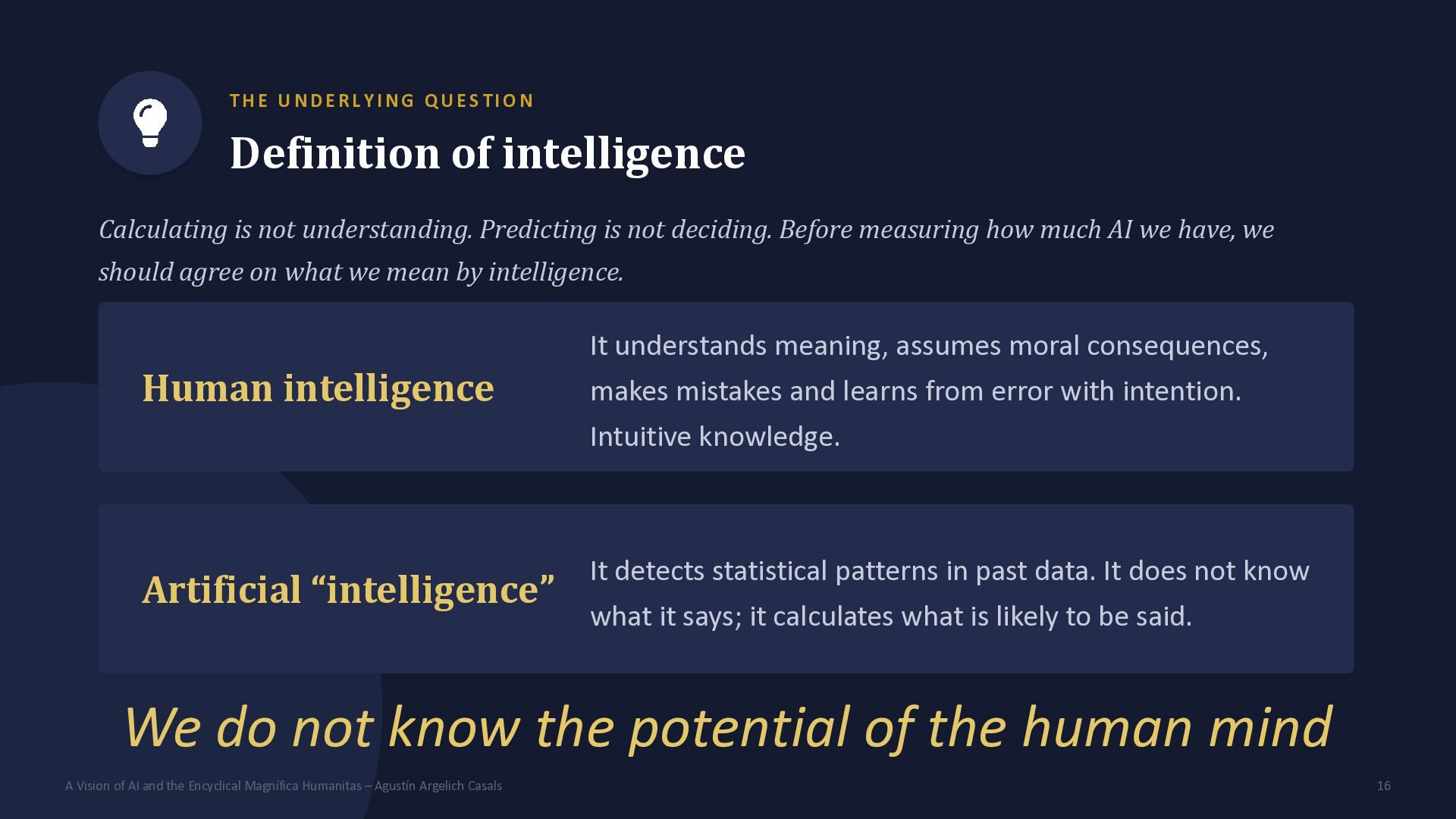
THE UNDERLYING QUESTION Definition of intelligence Calculating is not understanding.
Predicting is not deciding. Before measuring how much AI we have, we should agree on what we mean by intelligence. Human intelligence It understands meaning, assumes moral consequences, makes mistakes and learns from error with intention. Intuitive knowledge. Artificial “intelligence” It detects statistical patterns in past data. It does not know what it says; it calculates what is likely to be said. We do not know the potential of the human mind A Vision of AI and the Encyclical Magnífica Humanitas – Agustín Argelich Casals 16 -
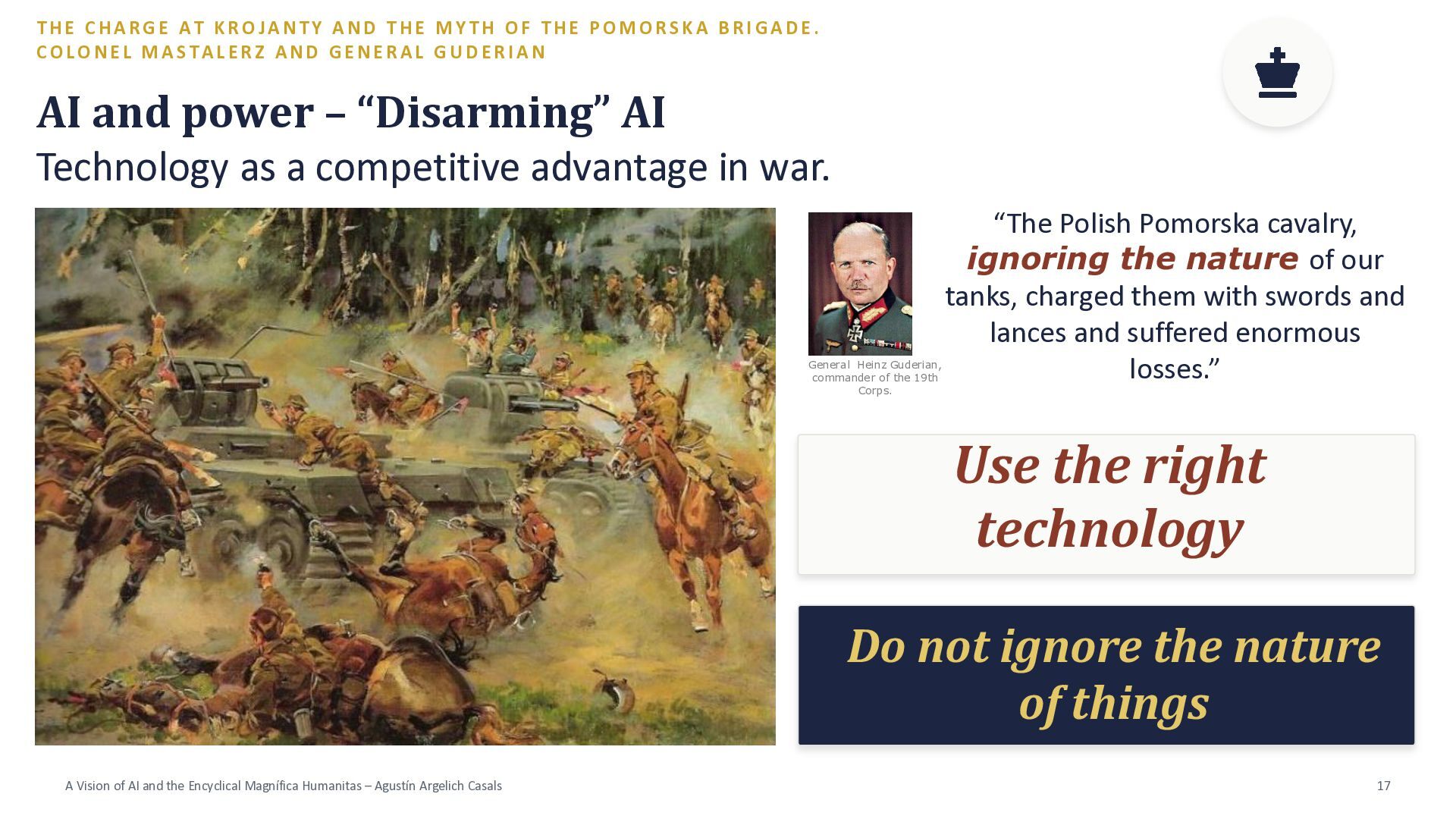
THE CHARGE AT KROJANTY AND THE MYTH OF THE POMORSKA
BRIGADE. COLONEL MASTALERZ AND GENERAL GUDERIAN AI and power – “Disarming” AI Technology as a competitive advantage in war. General Heinz Guderian, commander of the 19th Corps. “The Polish Pomorska cavalry, ignoring the nature of our tanks, charged them with swords and lances and suffered enormous losses.” Use the right technology Do not ignore the nature of things A Vision of AI and the Encyclical Magnífica Humanitas – Agustín Argelich Casals 17 -
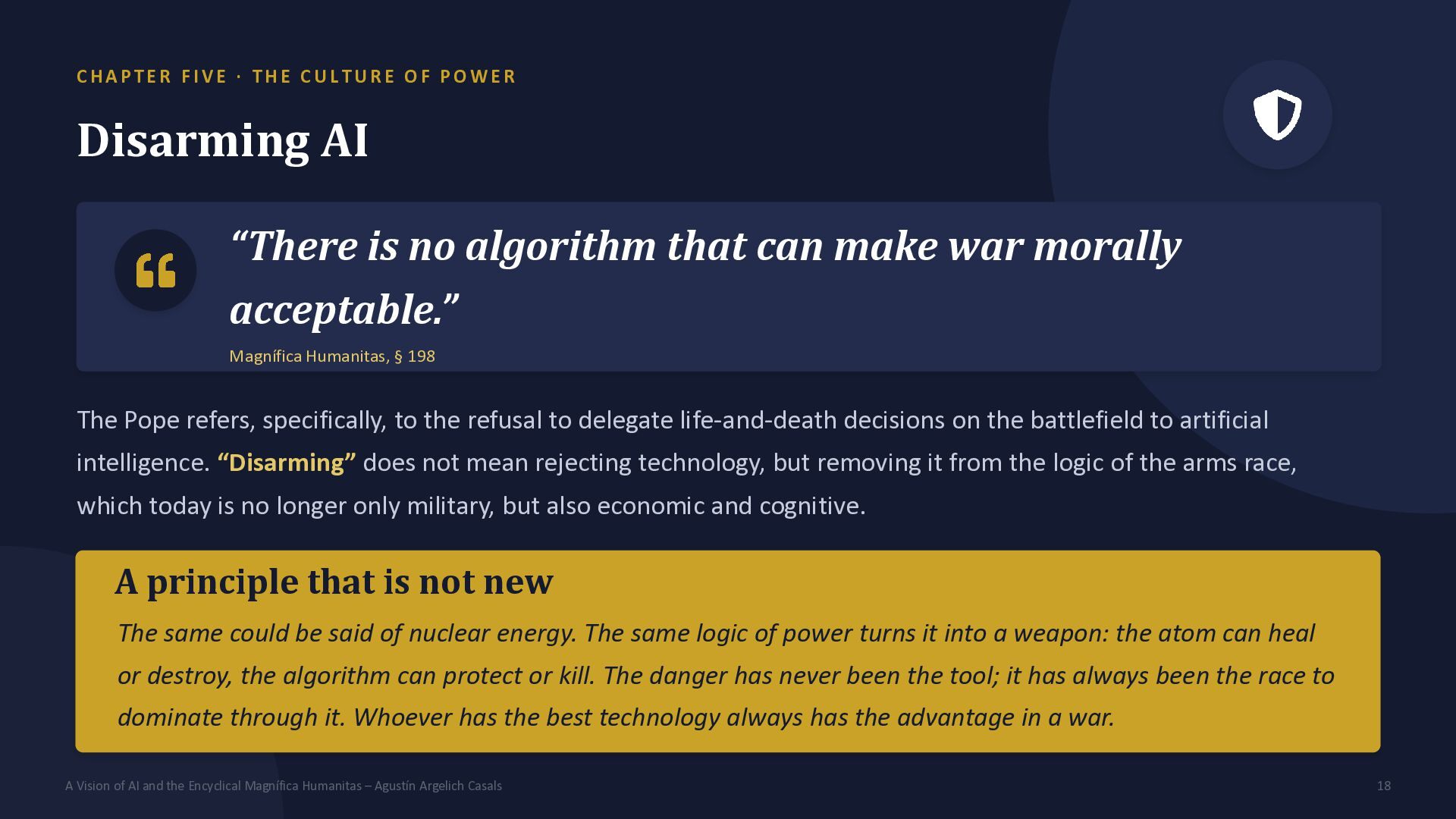
CHAPTER FIVE · THE CULTURE OF POWER Disarming AI “There
is no algorithm that can make war morally acceptable.” Magnífica Humanitas, § 198 The Pope refers, specifically, to the refusal to delegate life-and-death decisions on the battlefield to artificial intelligence. “Disarming” does not mean rejecting technology, but removing it from the logic of the arms race, which today is no longer only military, but also economic and cognitive. A principle that is not new The same could be said of nuclear energy. The same logic of power turns it into a weapon: the atom can heal or destroy, the algorithm can protect or kill. The danger has never been the tool; it has always been the race to dominate through it. Whoever has the best technology always has the advantage in a war. A Vision of AI and the Encyclical Magnífica Humanitas – Agustín Argelich Casals 18 -
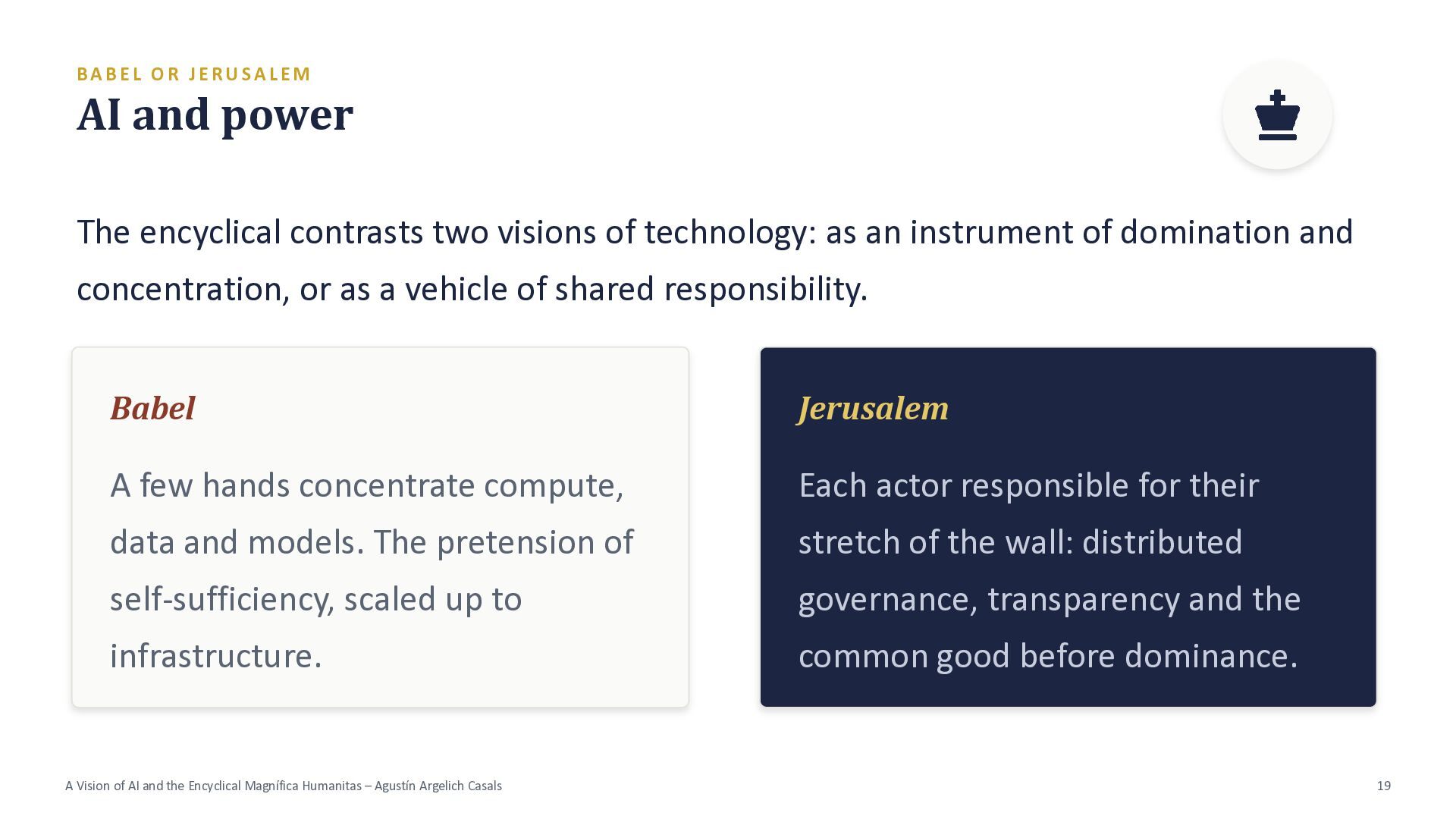
BABEL OR JERUSALEM AI and power The encyclical contrasts two
visions of technology: as an instrument of domination and concentration, or as a vehicle of shared responsibility. Babel Jerusalem A few hands concentrate compute, Each actor responsible for their data and models. The pretension of stretch of the wall: distributed self-sufficiency, scaled up to governance, transparency and the infrastructure. common good before dominance. A Vision of AI and the Encyclical Magnífica Humanitas – Agustín Argelich Casals 19 -
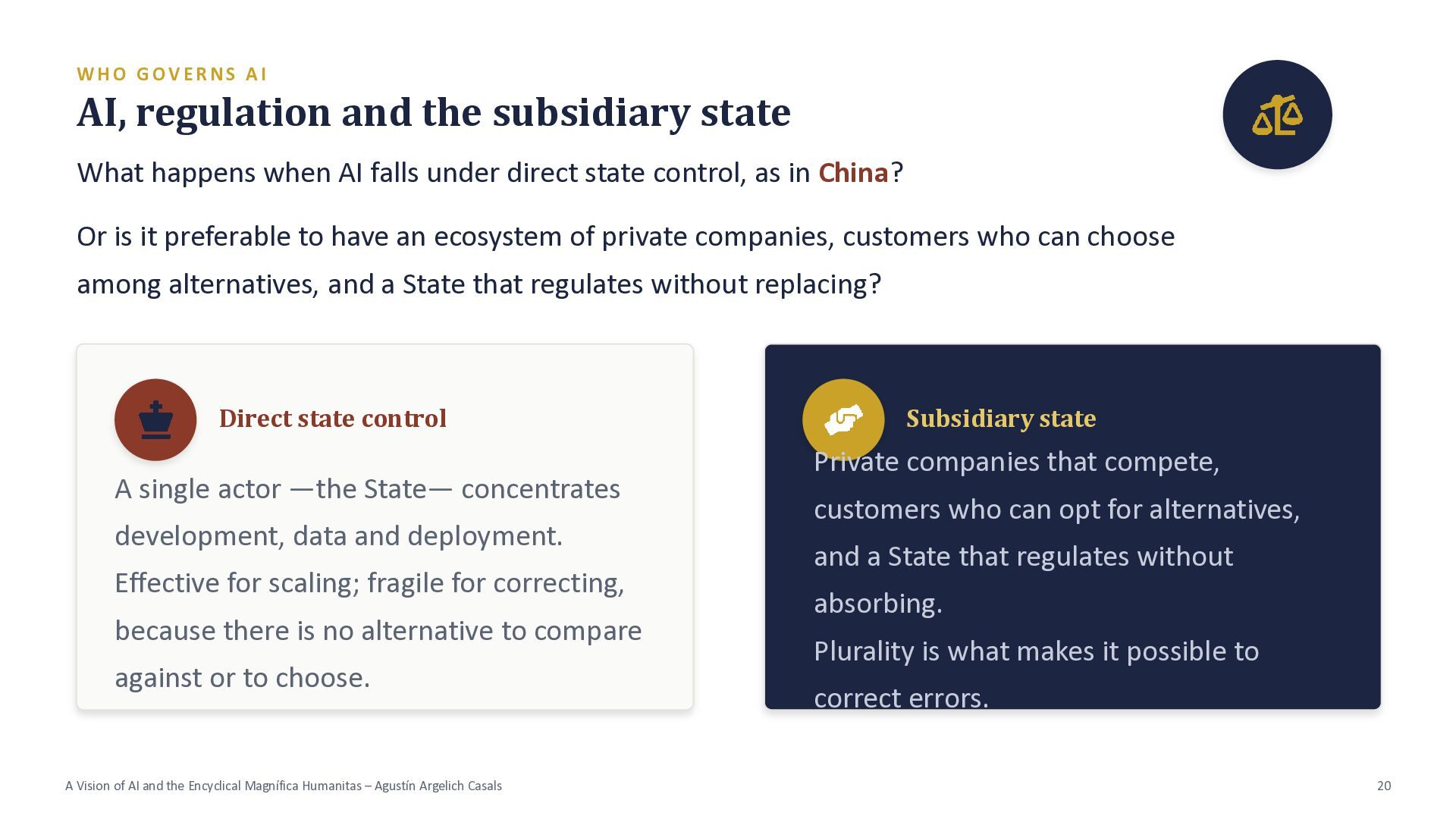
WHO GOVERNS AI AI, regulation and the subsidiary state What
happens when AI falls under direct state control, as in China? Or is it preferable to have an ecosystem of private companies, customers who can choose among alternatives, and a State that regulates without replacing? Direct state control A single actor —the State— concentrates development, data and deployment. Effective for scaling; fragile for correcting, because there is no alternative to compare against or to choose. A Vision of AI and the Encyclical Magnífica Humanitas – Agustín Argelich Casals Subsidiary state Private companies that compete, customers who can opt for alternatives, and a State that regulates without absorbing. Plurality is what makes it possible to correct errors. 20 -
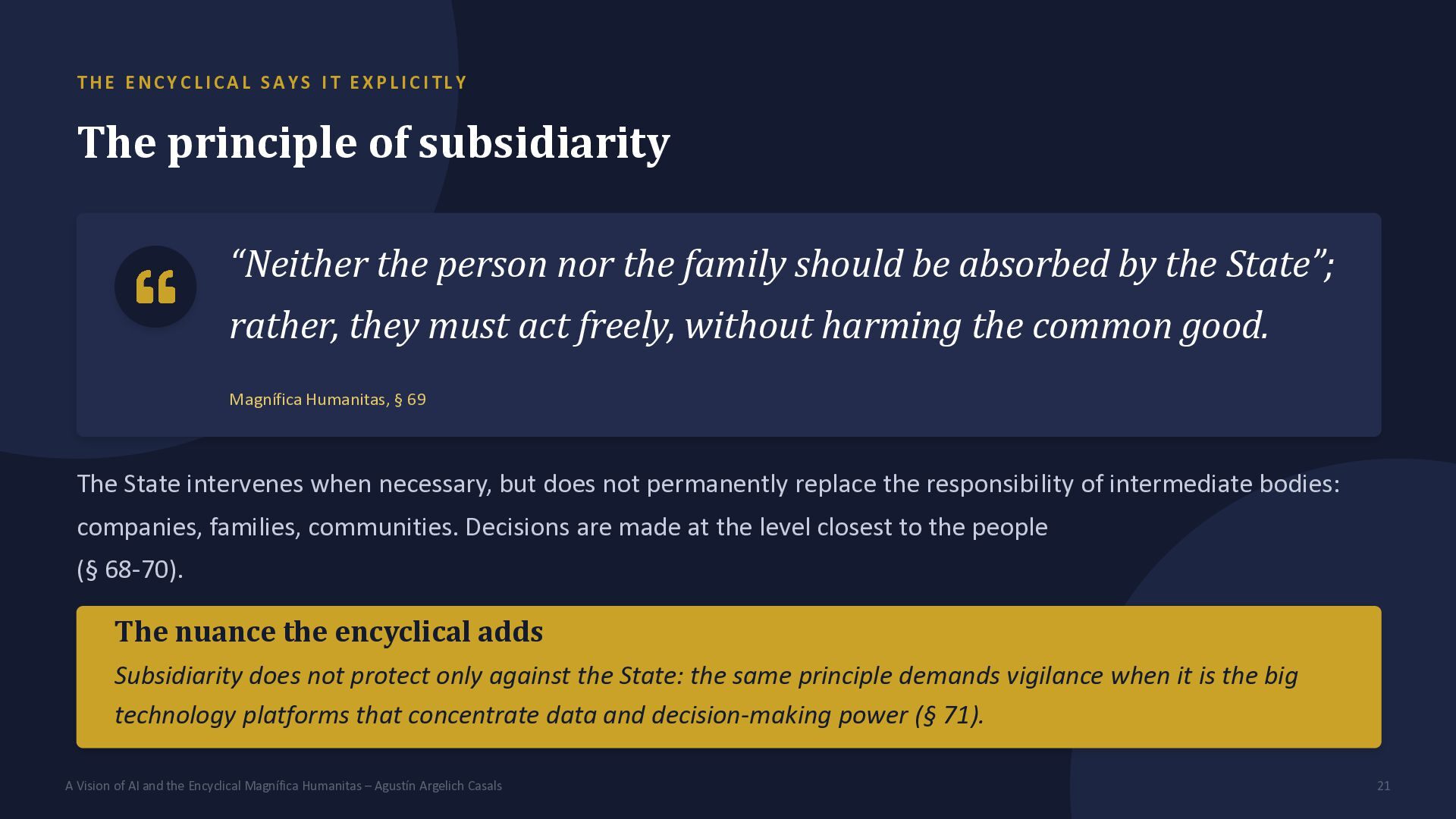
THE ENCYCLICAL SAYS IT EXPLICITLY The principle of subsidiarity “Neither
the person nor the family should be absorbed by the State”; rather, they must act freely, without harming the common good. Magnífica Humanitas, § 69 The State intervenes when necessary, but does not permanently replace the responsibility of intermediate bodies: companies, families, communities. Decisions are made at the level closest to the people (§ 68-70). The nuance the encyclical adds Subsidiarity does not protect only against the State: the same principle demands vigilance when it is the big technology platforms that concentrate data and decision-making power (§ 71). A Vision of AI and the Encyclical Magnífica Humanitas – Agustín Argelich Casals 21 -
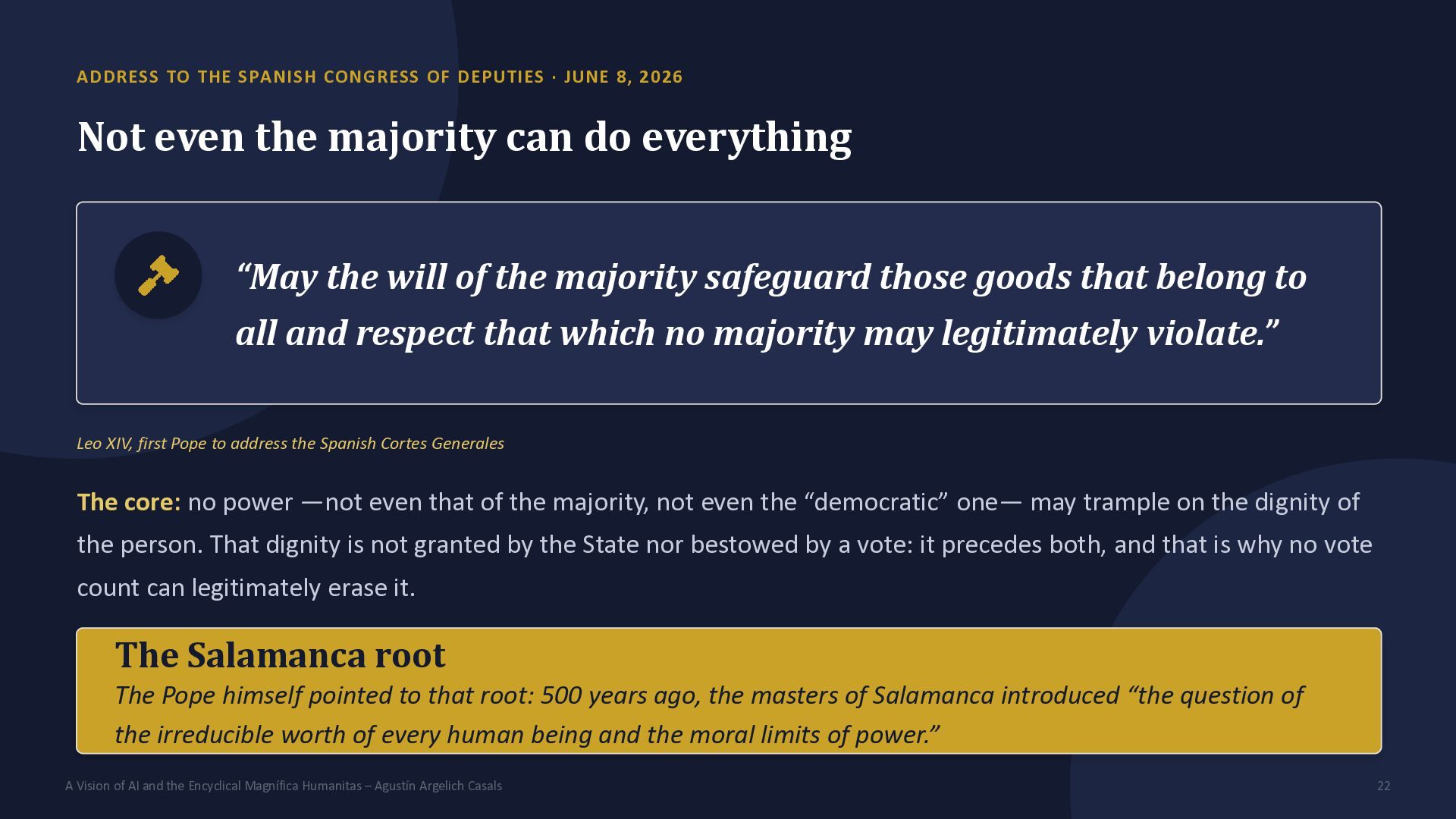
ADDRESS TO THE SPANISH CONGRESS OF DEPUTIES · JUNE 8,
2026 Not even the majority can do everything “May the will of the majority safeguard those goods that belong to all and respect that which no majority may legitimately violate.” Leo XIV, first Pope to address the Spanish Cortes Generales The core: no power —not even that of the majority, not even the “democratic” one— may trample on the dignity of the person. That dignity is not granted by the State nor bestowed by a vote: it precedes both, and that is why no vote count can legitimately erase it. The Salamanca root The Pope himself pointed to that root: 500 years ago, the masters of Salamanca introduced “the question of the irreducible worth of every human being and the moral limits of power.” A Vision of AI and the Encyclical Magnífica Humanitas – Agustín Argelich Casals 22 -
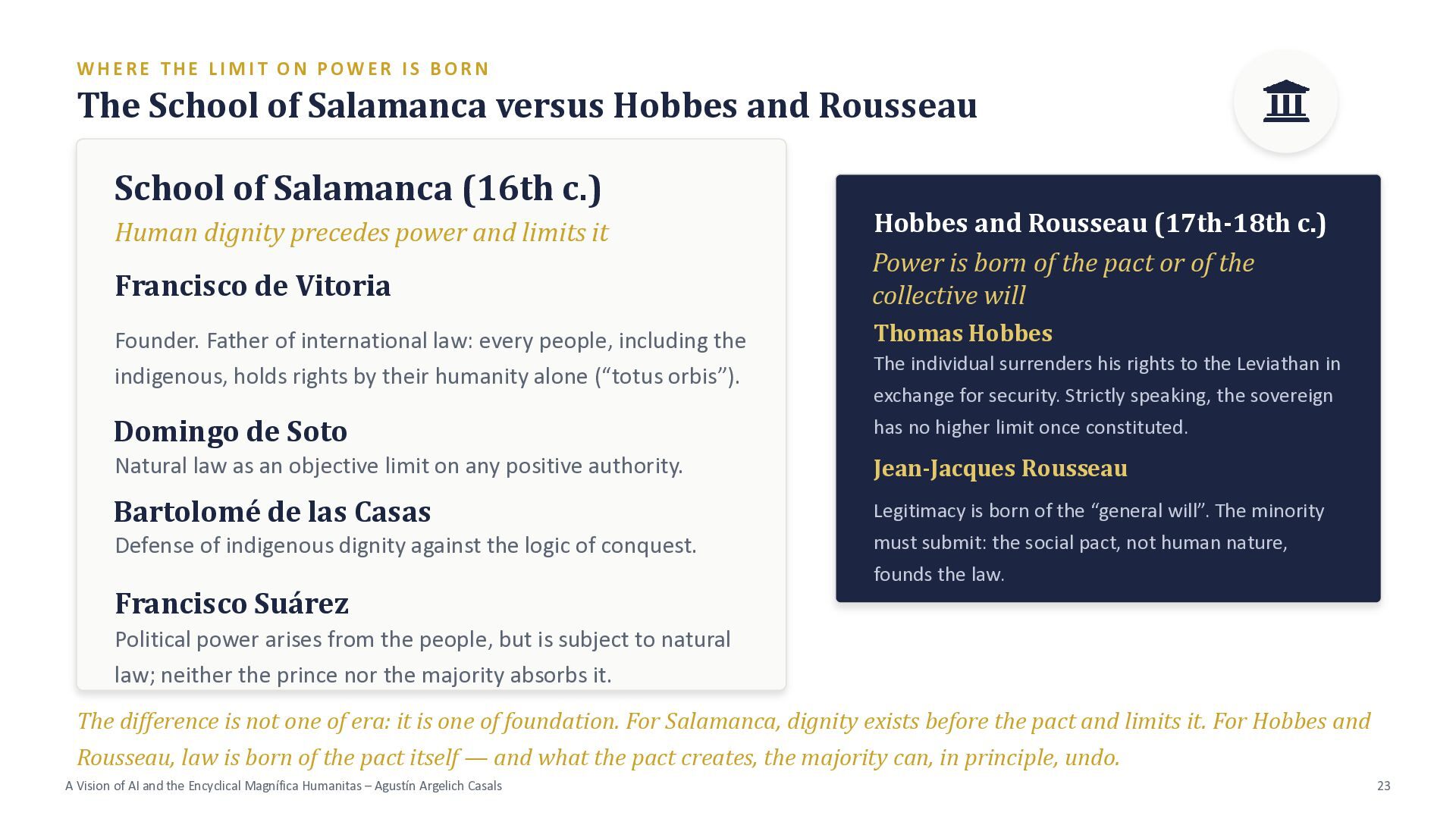
WHERE THE LIMIT ON POWER IS BORN The School of
Salamanca versus Hobbes and Rousseau School of Salamanca (16th c.) Human dignity precedes power and limits it Francisco de Vitoria Founder. Father of international law: every people, including the indigenous, holds rights by their humanity alone (“totus orbis”). Hobbes and Rousseau (17th-18th c.) Power is born of the pact or of the collective will Thomas Hobbes Domingo de Soto The individual surrenders his rights to the Leviathan in exchange for security. Strictly speaking, the sovereign has no higher limit once constituted. Natural law as an objective limit on any positive authority. Jean-Jacques Rousseau Bartolomé de las Casas Legitimacy is born of the “general will”. The minority must submit: the social pact, not human nature, founds the law. Defense of indigenous dignity against the logic of conquest. Francisco Suárez Political power arises from the people, but is subject to natural law; neither the prince nor the majority absorbs it. The difference is not one of era: it is one of foundation. For Salamanca, dignity exists before the pact and limits it. For Hobbes and Rousseau, law is born of the pact itself — and what the pact creates, the majority can, in principle, undo. A Vision of AI and the Encyclical Magnífica Humanitas – Agustín Argelich Casals 23 -
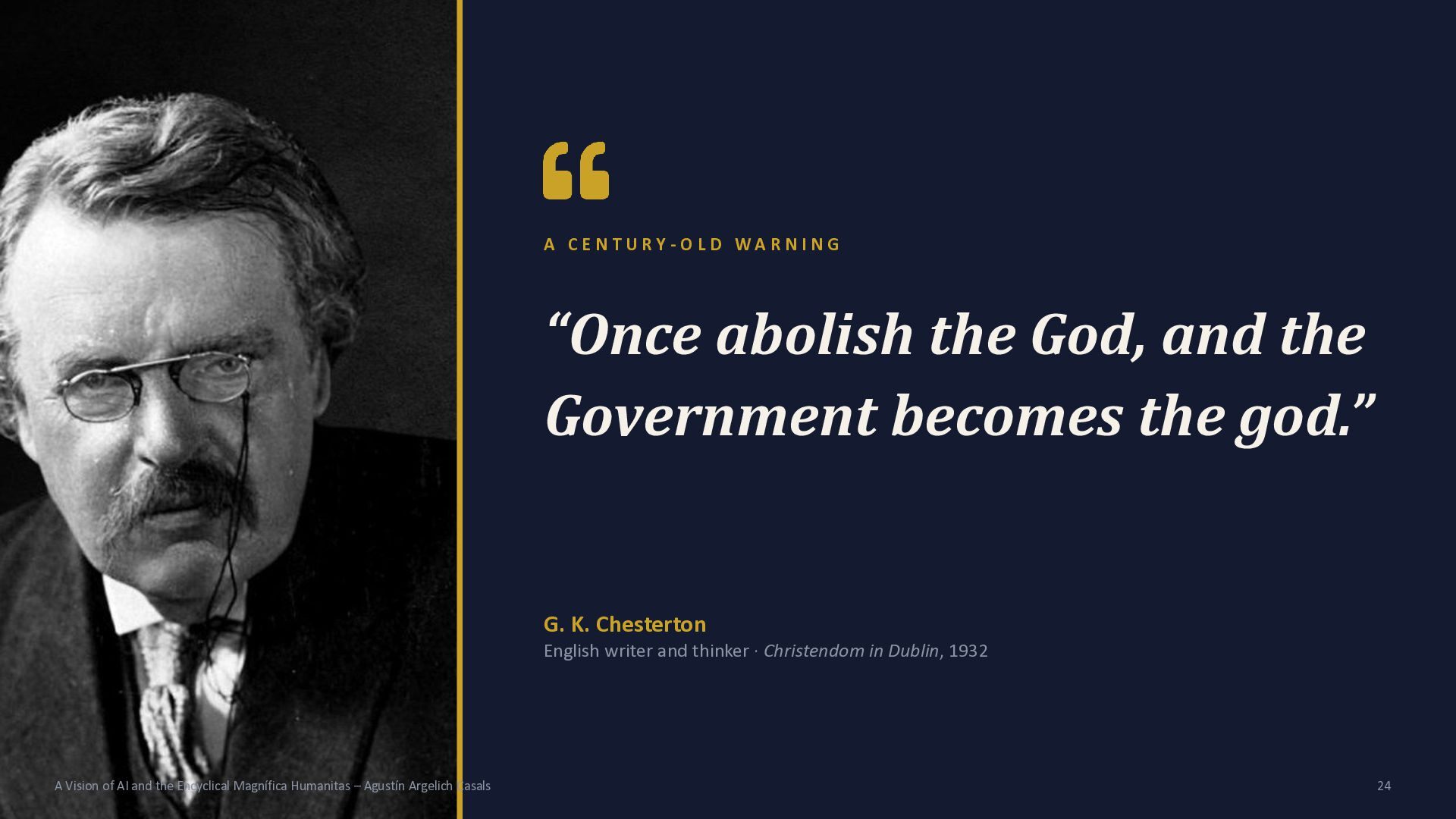
A CENTURY-OLD WARNING “Once abolish the God, and the Government
becomes the god.” G. K. Chesterton English writer and thinker · Christendom in Dublin, 1932 A Vision of AI and the Encyclical Magnífica Humanitas – Agustín Argelich Casals 24 -
THE MASTER WHO COPIED NATURE Technology succeeds when it imitates
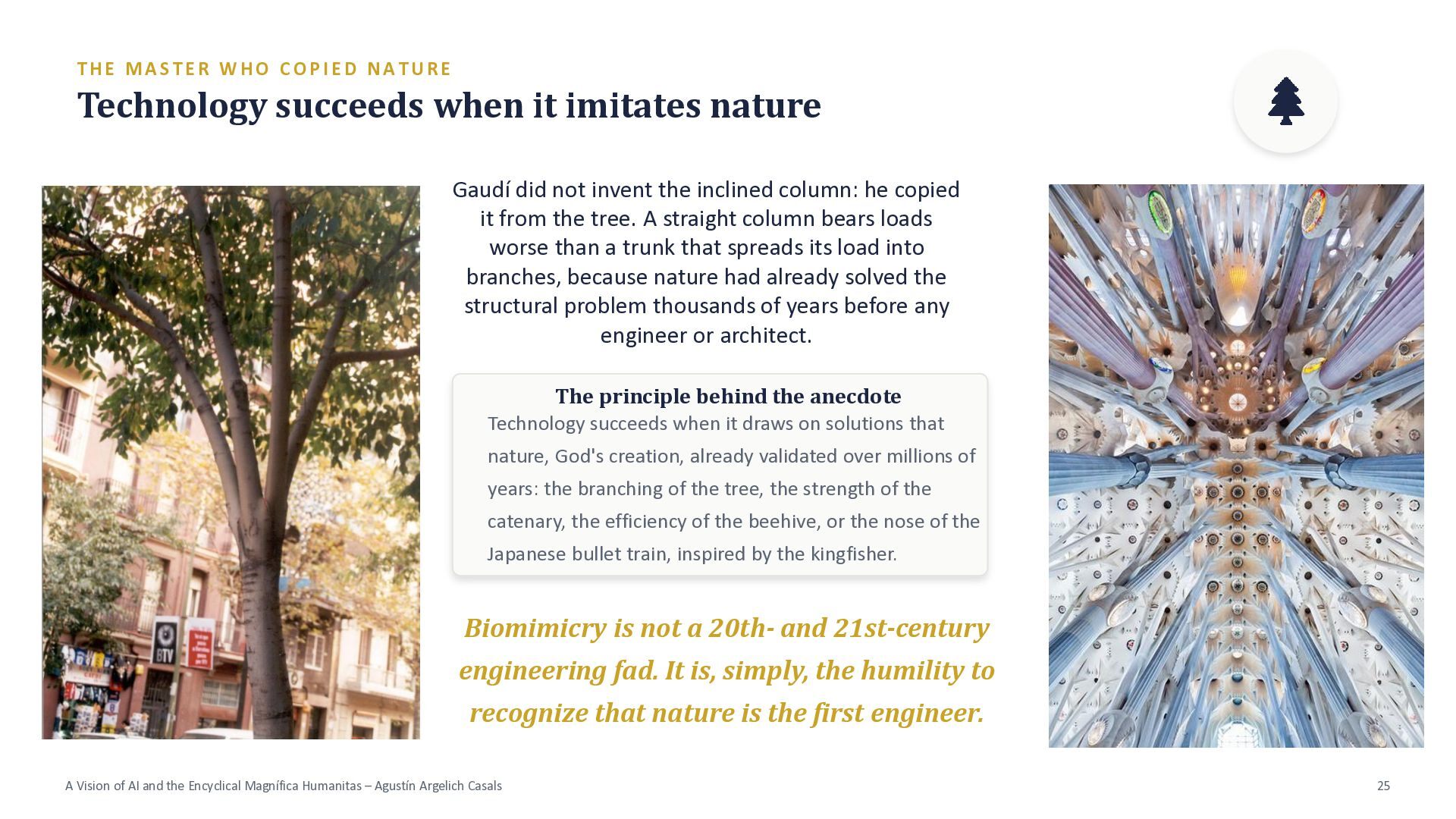
nature Gaudí did not invent the inclined column: he copied it from the tree. A straight column bears loads worse than a trunk that spreads its load into branches, because nature had already solved the structural problem thousands of years before any engineer or architect. The principle behind the anecdote Technology succeeds when it draws on solutions that nature, God's creation, already validated over millions of years: the branching of the tree, the strength of the catenary, the efficiency of the beehive, or the nose of the Japanese bullet train, inspired by the kingfisher. Biomimicry is not a 20th- and 21st-century engineering fad. It is, simply, the humility to recognize that nature is the first engineer. A Vision of AI and the Encyclical Magnífica Humanitas – Agustín Argelich Casals 25 -
THE ORGANIC METAPHOR Networks are the nervous system; data centers,
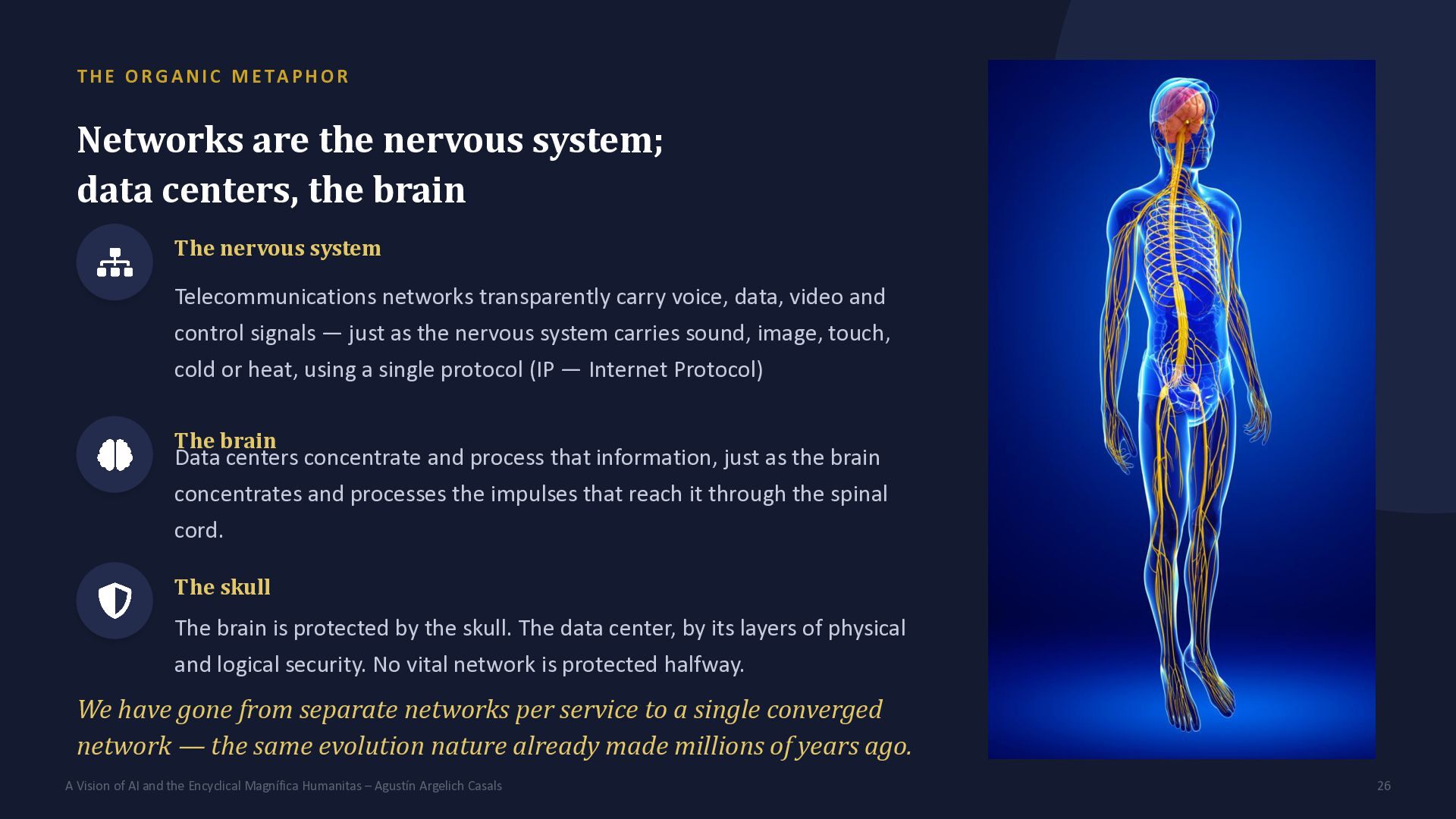
the brain The nervous system Telecommunications networks transparently carry voice, data, video and control signals — just as the nervous system carries sound, image, touch, cold or heat, using a single protocol (IP — Internet Protocol) The brain Data centers concentrate and process that information, just as the brain concentrates and processes the impulses that reach it through the spinal cord. The skull The brain is protected by the skull. The data center, by its layers of physical and logical security. No vital network is protected halfway. We have gone from separate networks per service to a single converged network — the same evolution nature already made millions of years ago. A Vision of AI and the Encyclical Magnífica Humanitas – Agustín Argelich Casals 26 -
THE TWO POLES OF DEVELOPMENT AI companies: United States and
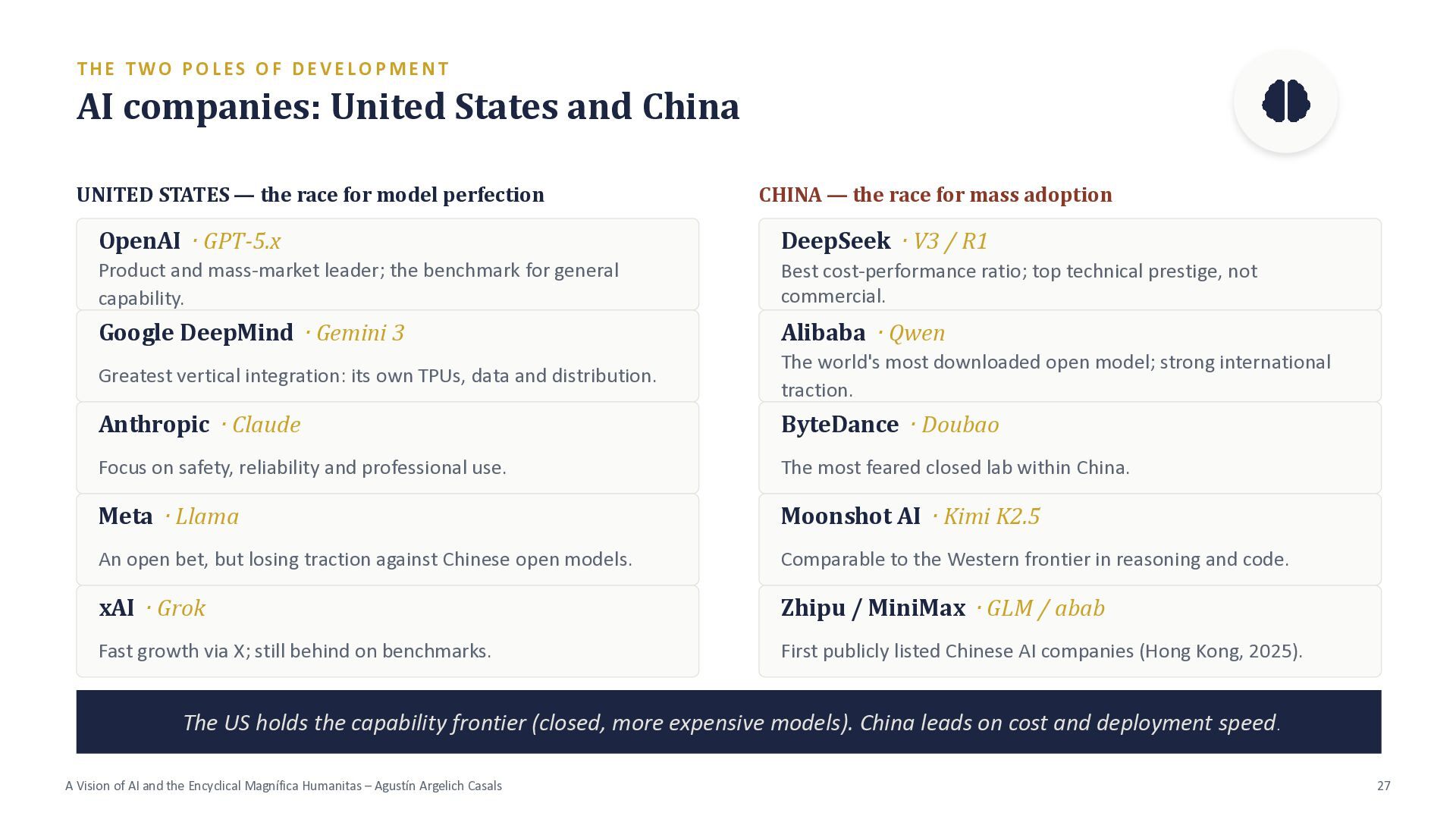
China UNITED STATES — the race for model perfection CHINA — the race for mass adoption OpenAI · GPT-5.x DeepSeek · V3 / R1 Product and mass-market leader; the benchmark for general capability. Best cost-performance ratio; top technical prestige, not commercial. Google DeepMind · Gemini 3 Alibaba · Qwen Greatest vertical integration: its own TPUs, data and distribution. The world's most downloaded open model; strong international traction. Anthropic · Claude ByteDance · Doubao Focus on safety, reliability and professional use. The most feared closed lab within China. Meta · Llama Moonshot AI · Kimi K2.5 An open bet, but losing traction against Chinese open models. Comparable to the Western frontier in reasoning and code. xAI · Grok Zhipu / MiniMax · GLM / abab Fast growth via X; still behind on benchmarks. First publicly listed Chinese AI companies (Hong Kong, 2025). The US holds the capability frontier (closed, more expensive models). China leads on cost and deployment speed. A Vision of AI and the Encyclical Magnífica Humanitas – Agustín Argelich Casals 27 -
WHO MANUFACTURES ARTIFICIAL INTELLIGENCE AI hardware: chips and servers Chip
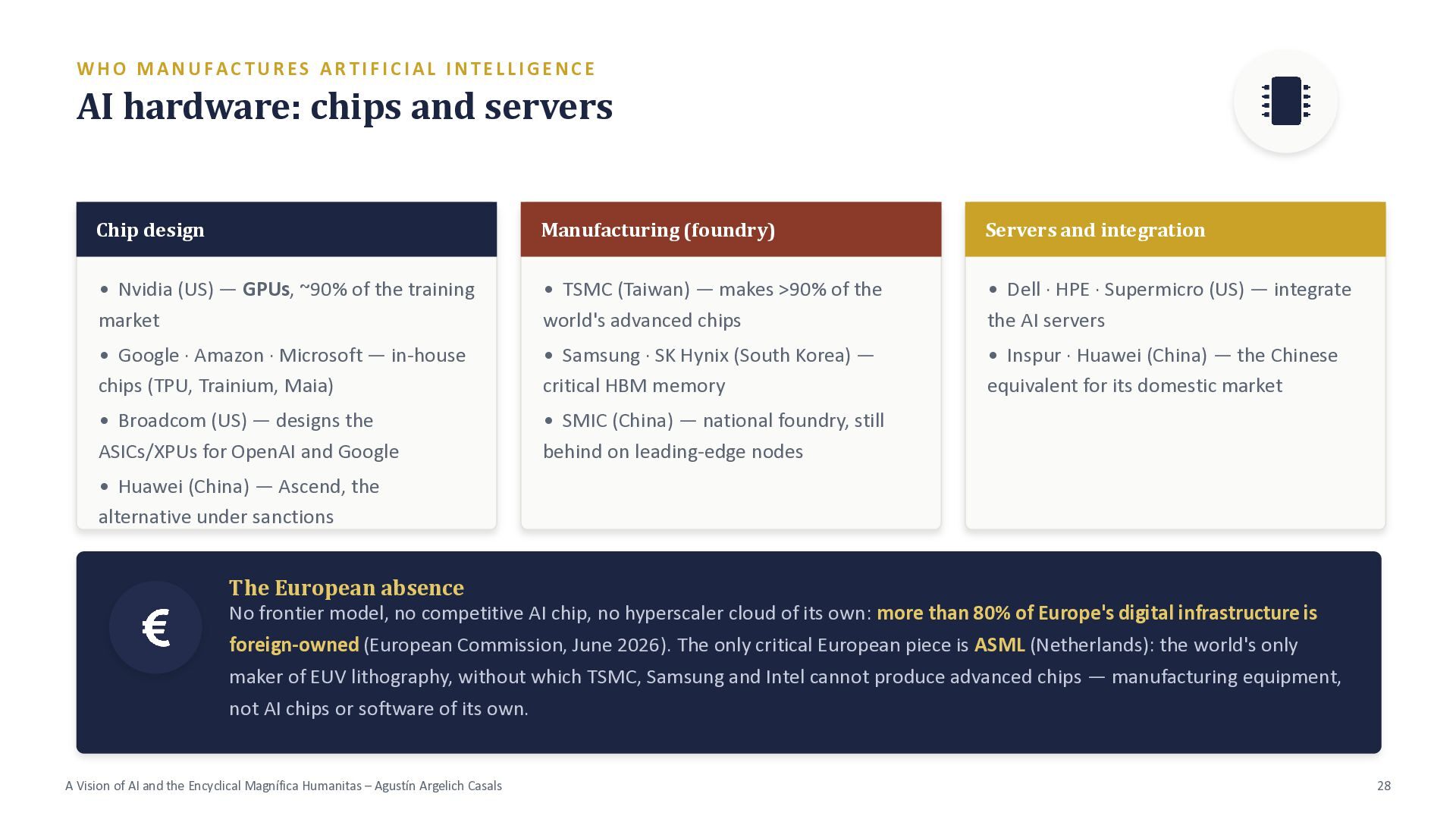
design Manufacturing (foundry) Servers and integration • Nvidia (US) — GPUs, ~90% of the training market • TSMC (Taiwan) — makes >90% of the world's advanced chips • Dell · HPE · Supermicro (US) — integrate the AI servers • Google · Amazon · Microsoft — in-house chips (TPU, Trainium, Maia) • Samsung · SK Hynix (South Korea) — critical HBM memory • Inspur · Huawei (China) — the Chinese equivalent for its domestic market • Broadcom (US) — designs the ASICs/XPUs for OpenAI and Google • SMIC (China) — national foundry, still behind on leading-edge nodes • Huawei (China) — Ascend, the alternative under sanctions The European absence No frontier model, no competitive AI chip, no hyperscaler cloud of its own: more than 80% of Europe's digital infrastructure is foreign-owned (European Commission, June 2026). The only critical European piece is ASML (Netherlands): the world's only maker of EUV lithography, without which TSMC, Samsung and Intel cannot produce advanced chips — manufacturing equipment, not AI chips or software of its own. A Vision of AI and the Encyclical Magnífica Humanitas – Agustín Argelich Casals 28 -
EUROPE'S ONLY HEAVYWEIGHT ASSET, UNDER THREAT Europe holds a single
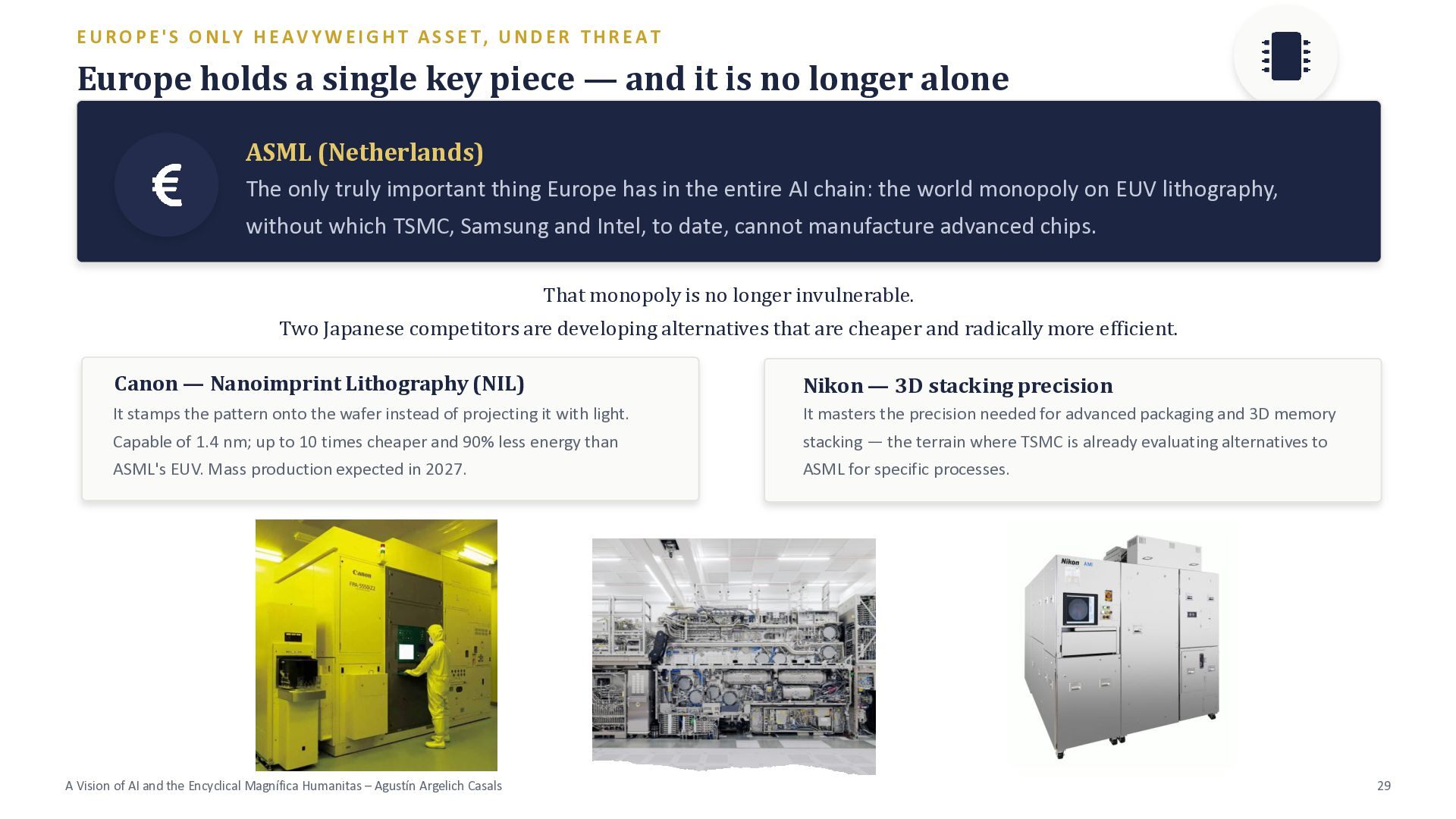
key piece — and it is no longer alone ASML (Netherlands) The only truly important thing Europe has in the entire AI chain: the world monopoly on EUV lithography, without which TSMC, Samsung and Intel, to date, cannot manufacture advanced chips. That monopoly is no longer invulnerable. Two Japanese competitors are developing alternatives that are cheaper and radically more efficient. Canon — Nanoimprint Lithography (NIL) Nikon — 3D stacking precision It stamps the pattern onto the wafer instead of projecting it with light. It masters the precision needed for advanced packaging and 3D memory Capable of 1.4 nm; up to 10 times cheaper and 90% less energy than stacking — the terrain where TSMC is already evaluating alternatives to ASML's EUV. Mass production expected in 2027. ASML for specific processes. A Vision of AI and the Encyclical Magnífica Humanitas – Agustín Argelich Casals 29 -
THE ABSENT CONTINENT Why does Europe count for nothing? No
clouds of its own It regulates before it builds It depends on cloud infrastructure, software and chips The AI Act arrived before a single European frontier designed and manufactured outside its borders. lab comparable to those of the US or China. Fragmented market Scattered capital Twenty-seven regulations, languages and systems European savings finance the growth of other where the United States and China have one. continents instead of its own technological frontier. A Vision of AI and the Encyclical Magnífica Humanitas – Agustín Argelich Casals 30 -
INVESTOR EUPHORIA Is there an AI bubble? Bloomberg report A
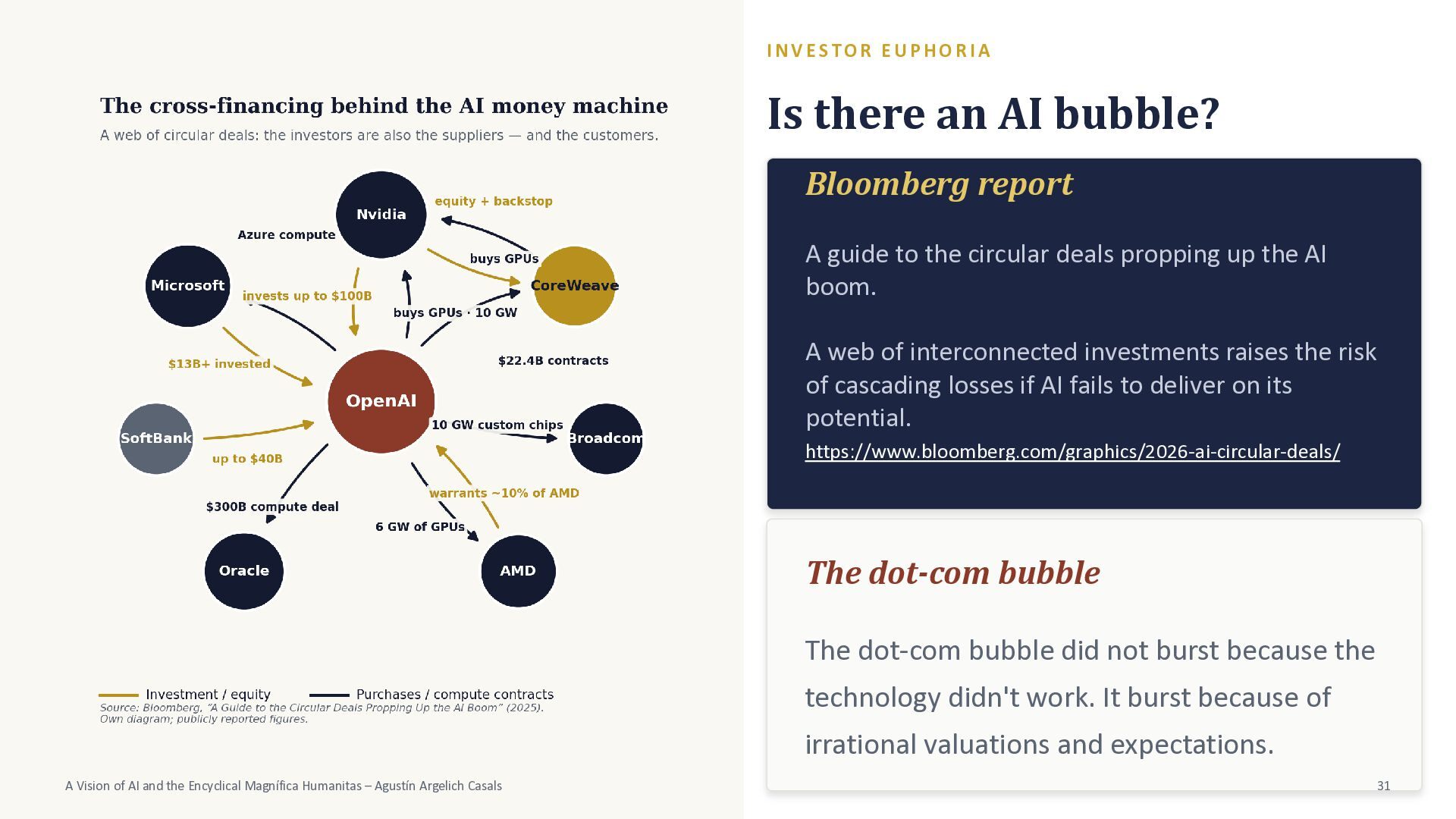
guide to the circular deals propping up the AI boom. A web of interconnected investments raises the risk of cascading losses if AI fails to deliver on its potential. https://www.bloomberg.com/graphics/2026-ai-circular-deals/ The dot-com bubble The dot-com bubble did not burst because the technology didn't work. It burst because of irrational valuations and expectations. A Vision of AI and the Encyclical Magnífica Humanitas – Agustín Argelich Casals 31 -
THE PHYSICAL COST OF COMPUTATION The AI bubble and data
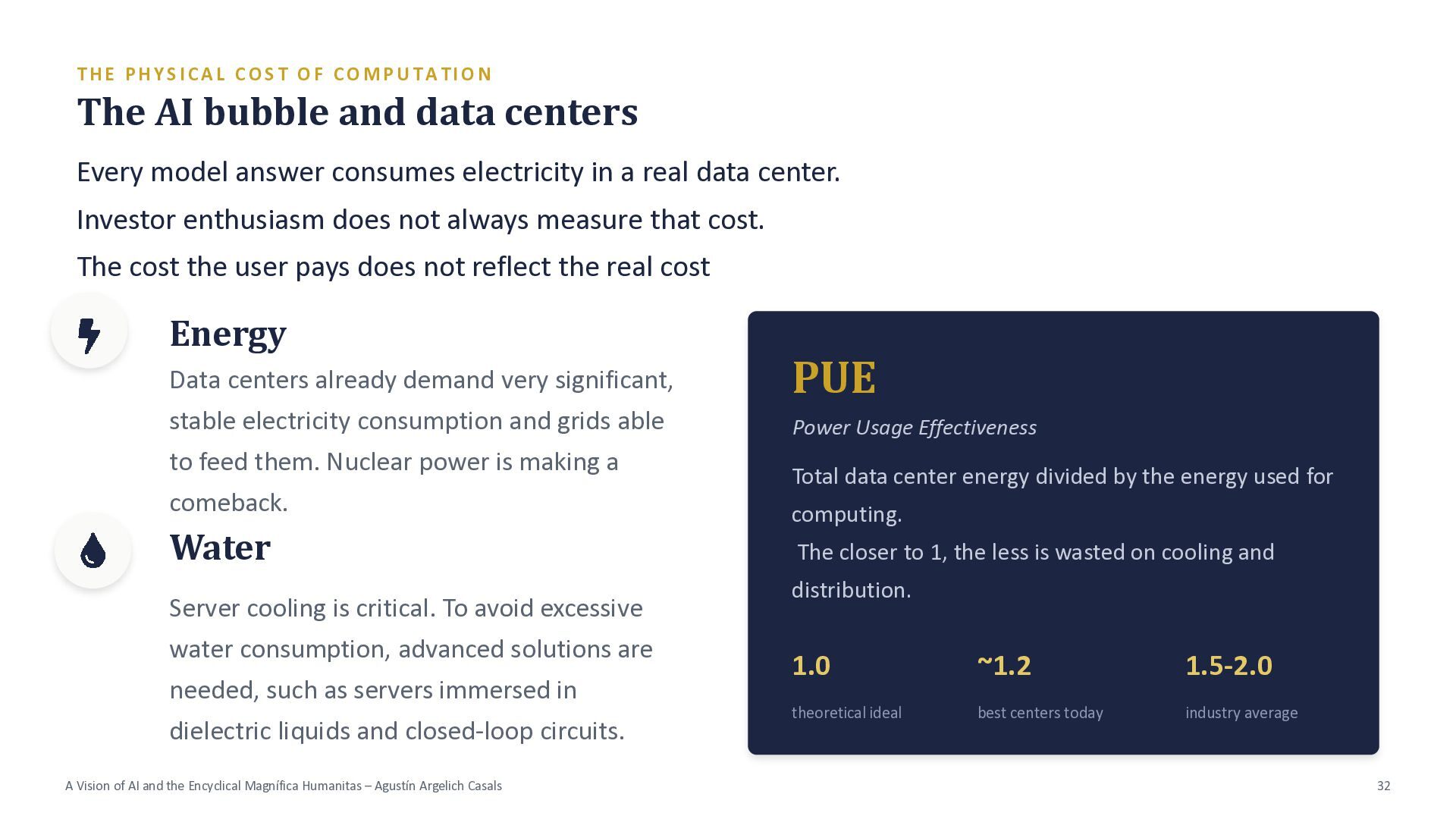
centers Every model answer consumes electricity in a real data center. Investor enthusiasm does not always measure that cost. The cost the user pays does not reflect the real cost Energy Data centers already demand very significant, stable electricity consumption and grids able to feed them. Nuclear power is making a comeback. Water Server cooling is critical. To avoid excessive water consumption, advanced solutions are needed, such as servers immersed in dielectric liquids and closed-loop circuits. A Vision of AI and the Encyclical Magnífica Humanitas – Agustín Argelich Casals PUE Power Usage Effectiveness Total data center energy divided by the energy used for computing. The closer to 1, the less is wasted on cooling and distribution. 1.0 ~1.2 1.5-2.0 theoretical ideal best centers today industry average 32 -
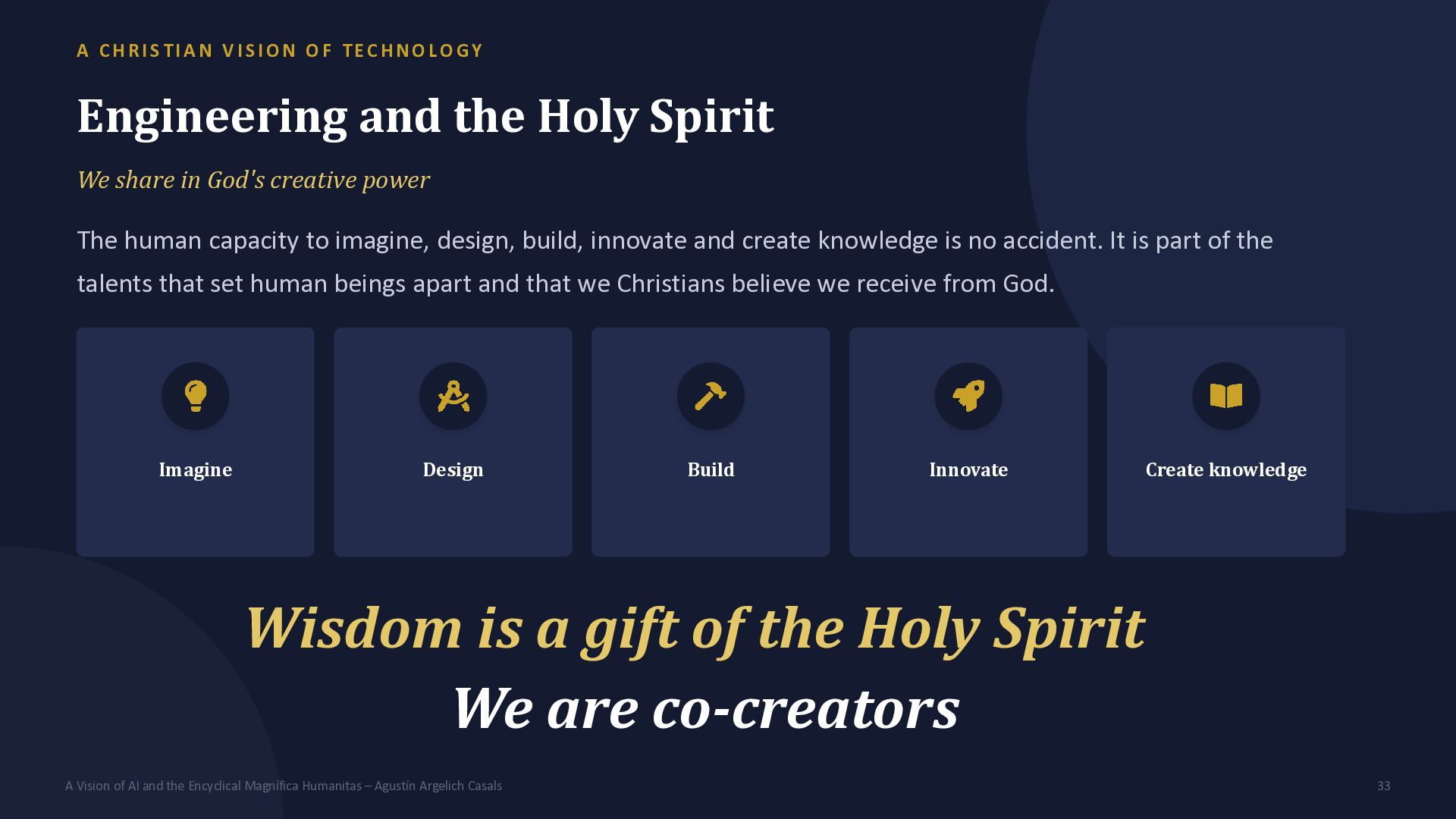
A CHRISTIAN VISION OF TECHNOLOGY Engineering and the Holy Spirit
We share in God's creative power The human capacity to imagine, design, build, innovate and create knowledge is no accident. It is part of the talents that set human beings apart and that we Christians believe we receive from God. Imagine Design Build Innovate Create knowledge Wisdom is a gift of the Holy Spirit We are co-creators A Vision of AI and the Encyclical Magnífica Humanitas – Agustín Argelich Casals 33 -
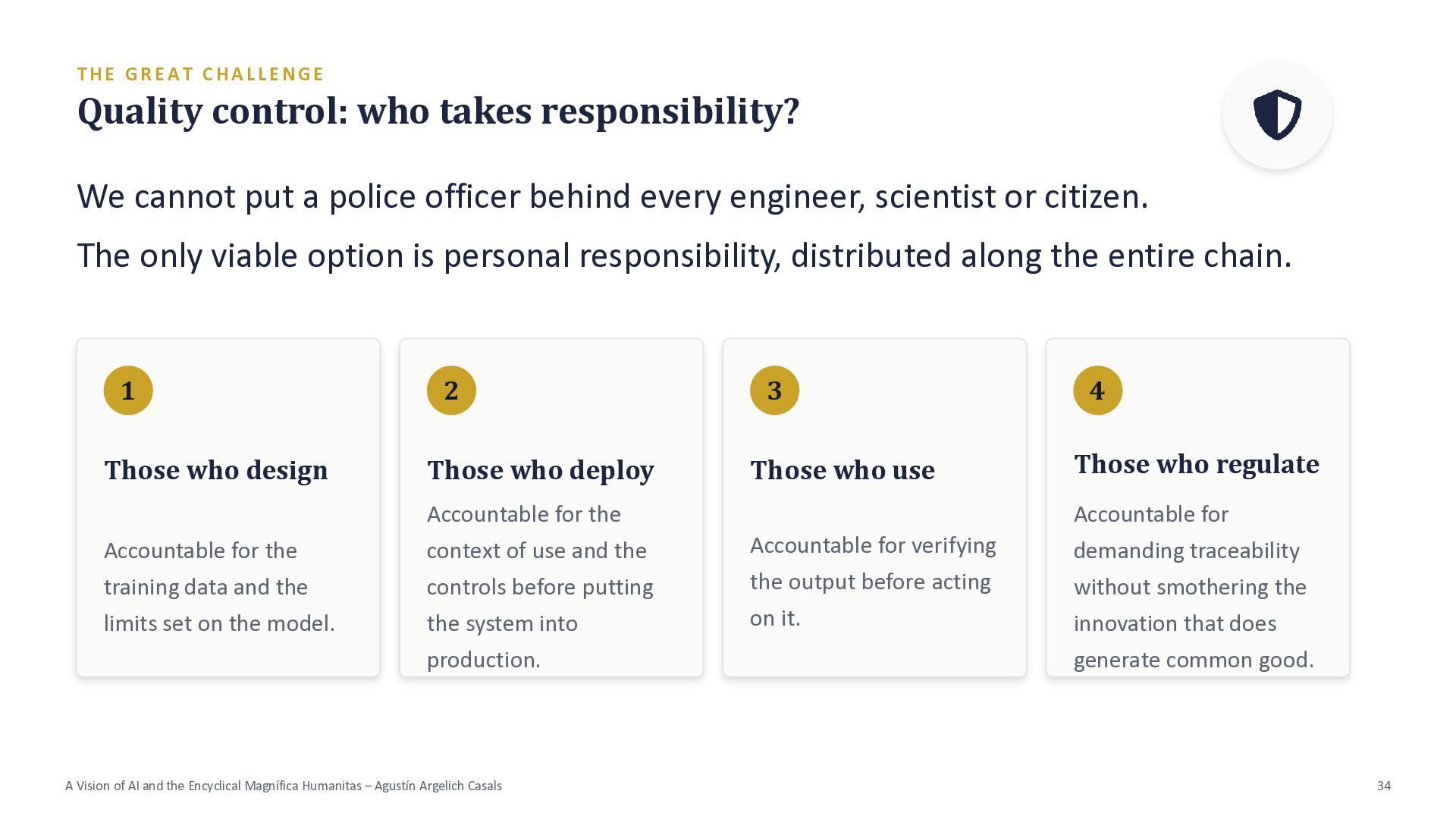
THE GREAT CHALLENGE Quality control: who takes responsibility? We cannot
put a police officer behind every engineer, scientist or citizen. The only viable option is personal responsibility, distributed along the entire chain. 1 2 3 4 Those who design Those who deploy Those who use Those who regulate Accountable for the Accountable for Accountable for the context of use and the Accountable for verifying demanding traceability training data and the controls before putting the output before acting without smothering the limits set on the model. the system into on it. innovation that does production. A Vision of AI and the Encyclical Magnífica Humanitas – Agustín Argelich Casals generate common good. 34 -
THE TRANSITION Which technology, or which civilization If technology is
an expression of our creative capacity, the decisive question is not which technology we will build. The decisive question is which civilization we will build. Artificial Intelligence is an extraordinary human creation. But true innovation is not about making smarter machines; it is about forming wiser people. Engineering, medicine, law, architecture allow us to transform the world. What allows us to transform ourselves? A Vision of AI and the Encyclical Magnífica Humanitas – Agustín Argelich Casals 35 -
THE CONCLUSION The Pope's surprising recommendation: education Let us invest
in the education that begins with ourselves! Magnífica Humanitas, § 238 Before educating the young, we must educate ourselves. The best defense against the risks of AI will not be regulation alone. It will be the capacity to form free, critical and responsible citizens. Lifelong education is, probably, the deepest form of technological governance. Digital Economy, Infinite Learning (Nanjing, September 2019): https://www.youtube.com/watch?v=Y4ZP1yTZLBk A Vision of AI and the Encyclical Magnífica Humanitas – Agustín Argelich Casals 36 -
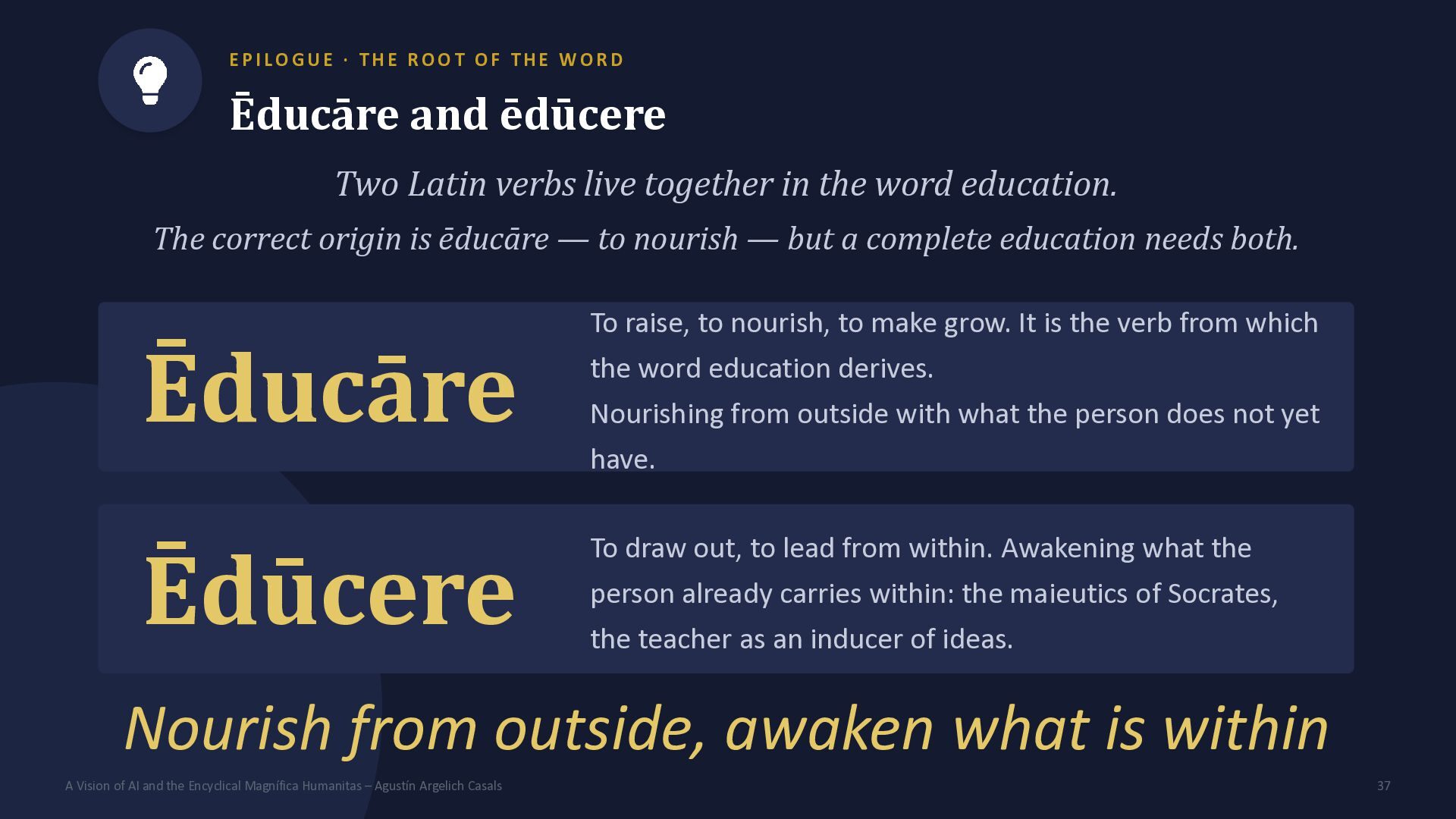
EPILOGUE · THE ROOT OF THE WORD Ēducāre and ēdūcere
Two Latin verbs live together in the word education. The correct origin is ēducāre — to nourish — but a complete education needs both. Ēducāre To raise, to nourish, to make grow. It is the verb from which the word education derives. Nourishing from outside with what the person does not yet have. Ēdūcere To draw out, to lead from within. Awakening what the person already carries within: the maieutics of Socrates, the teacher as an inducer of ideas. Nourish from outside, awaken what is within A Vision of AI and the Encyclical Magnífica Humanitas – Agustín Argelich Casals 37 -
CONTACT · THANK YOU FOR YOUR ATTENTION Agustín Argelich Casals
Telecommunications engineer, independent consultant in technologies, infrastructures and digital business, expert in project leadership and innovation. Member of the Intelligent Community Forum think tank. Author of Analizar Actuar Avanzar (Analyze, Act and Advance). International keynote speaker. Contact [email protected] argelich.com sctcconsultants.org intelligentcommunity.org @aargelich linkedin.com/in/agustinargelich Office (+34) 610 59 50 50 Mobile (+34) 610 59 50 53 Writings Analizar Actuar Avanzar · free download Google Books · tinyurl.com/45zdf8b4 Español Amazon · amzn.to/2UuSkGp Audiobook · tinyurl.com/mpnetf59 Google Books · tinyurl.com/ypyu6x8y English Amazon · a.co/d/eMw0tGl Audiobook · tinyurl.com/2t492pk4 More than 50 opinion articles https://argelich.com/noticias/f/si-me-callo-exploto--art%C3%ADculos-opini%C3%B3n Don't hesitate to contact me: I'm here to collaborate with you. Thank you! A Vision of AI and the Encyclical Magnífica Humanitas – Agustín Argelich Casals
 aargelich
 kaminashi
 110y
 yoshimura_datam
 ivry_presentationmaterials
 miriamschwab
 ota1022
 ren8k
 tomoki10
 oracle4engineer
 uhyo
 legalontechnologies
 everpeace
 jdejongh
 cassininazir
 mayunak
 codingconduct
 reverentgeek
 jeffersonlam
 aleyda
 holman
 livdayseo
 techseoconnect
 baasie
 mclloyd