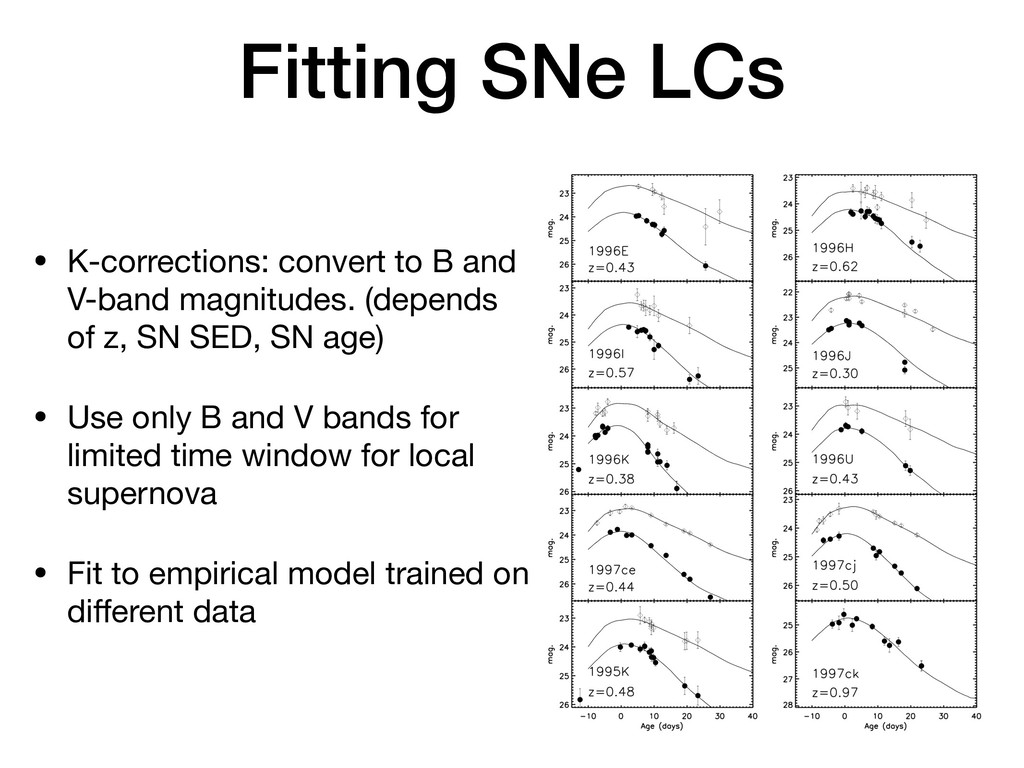
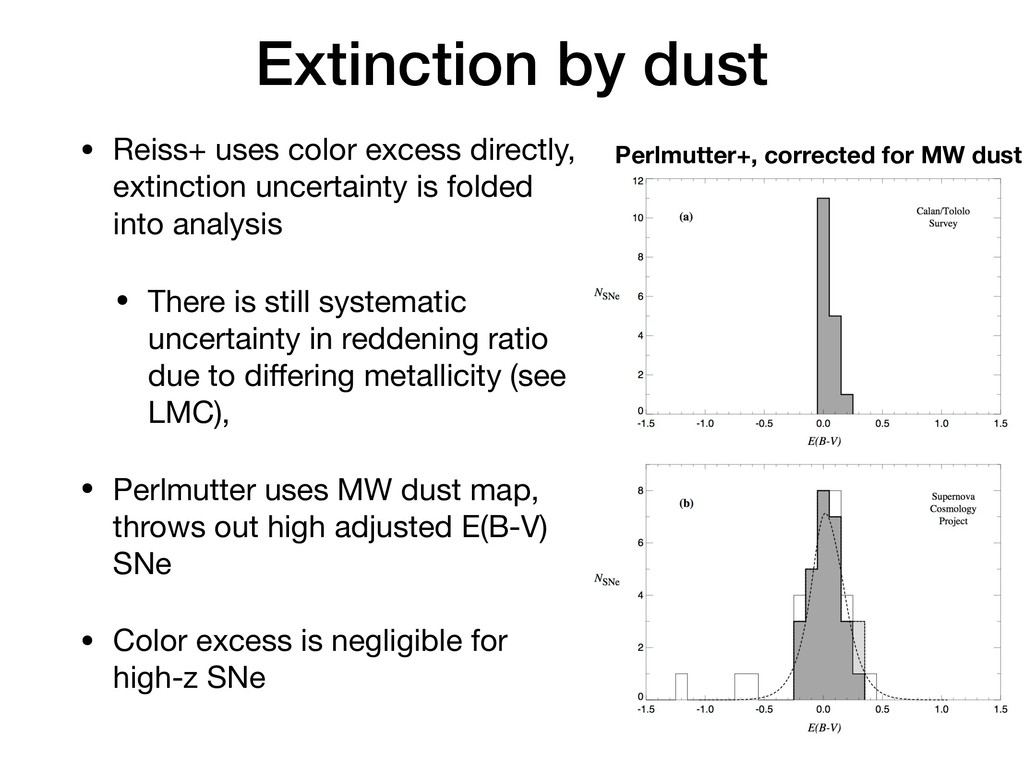
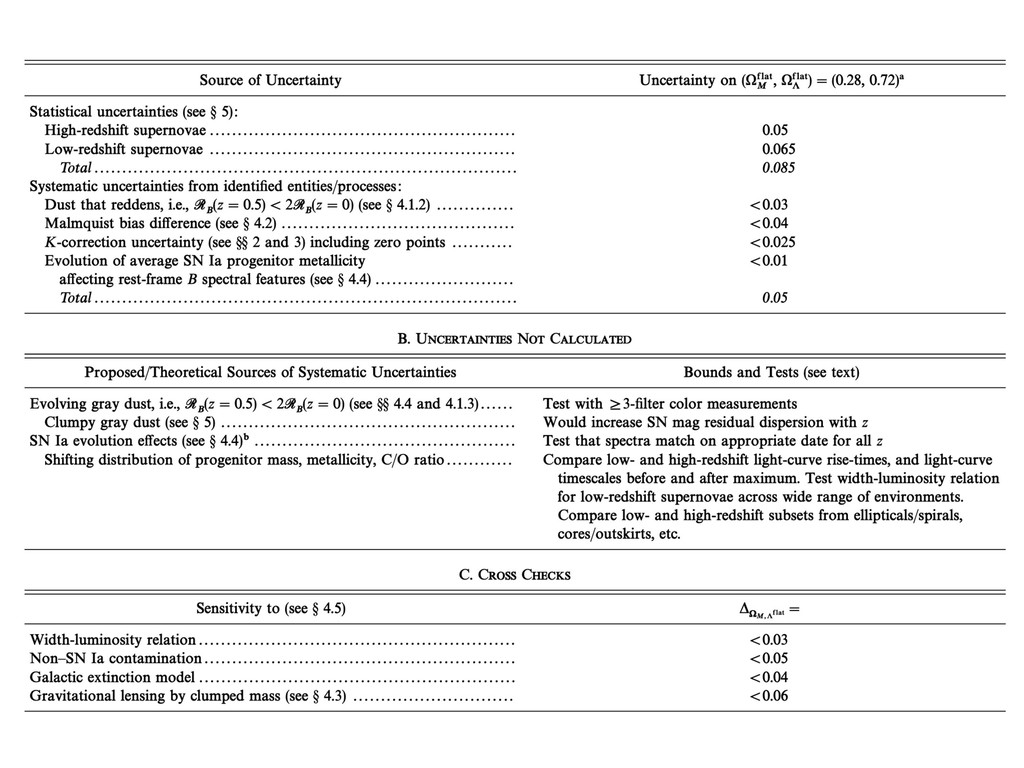
magnitudes. (depends of z, SN SED, SN age) • Use only B and V bands for limited time window for local supernova • Fit to empirical model trained on different data
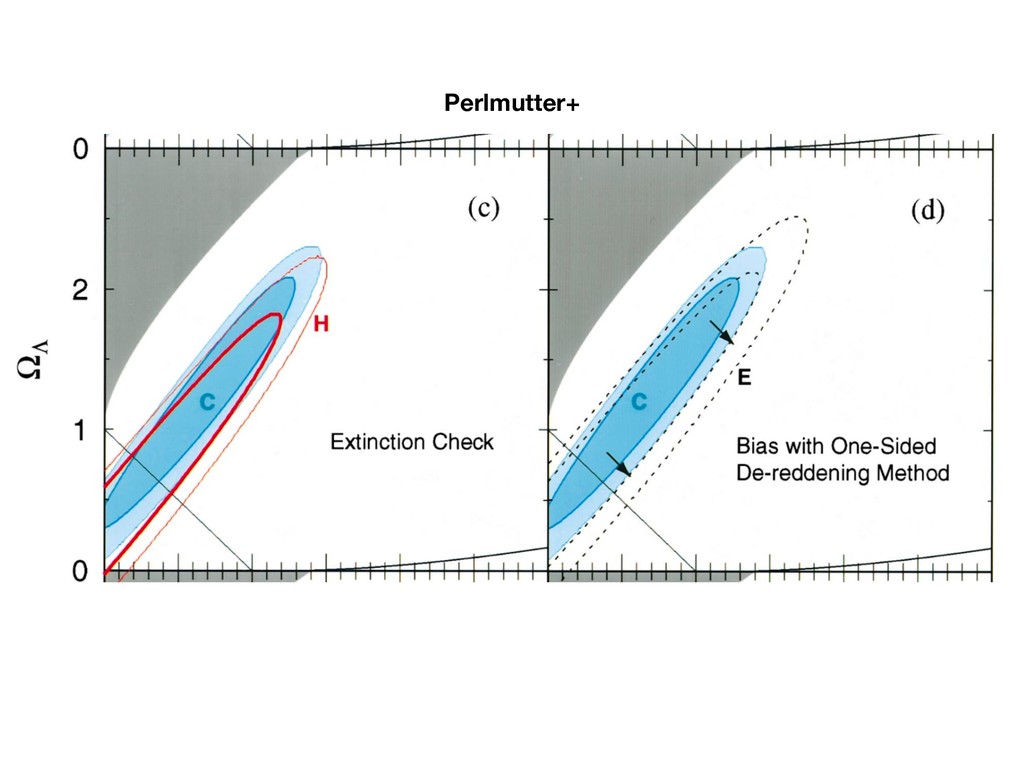
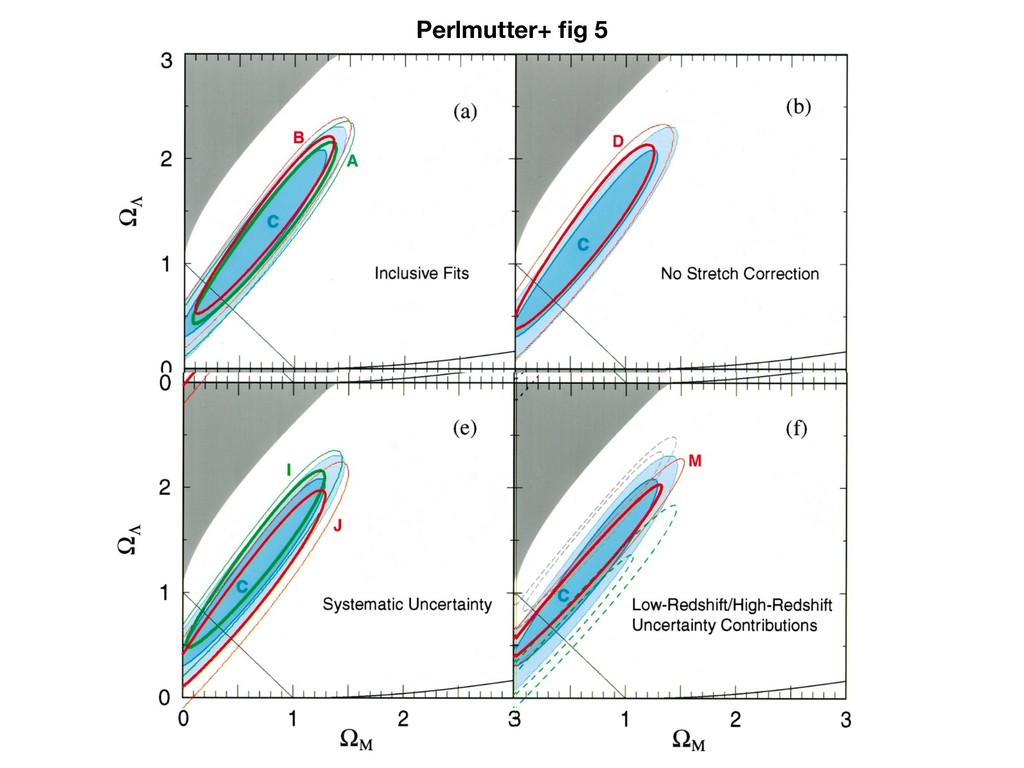
uncertainty is folded into analysis • There is still systematic uncertainty in reddening ratio due to differing metallicity (see LMC), • Perlmutter uses MW dust map, throws out high adjusted E(B-V) SNe • Color excess is negligible for high-z SNe Perlmutter+, corrected for MW dust
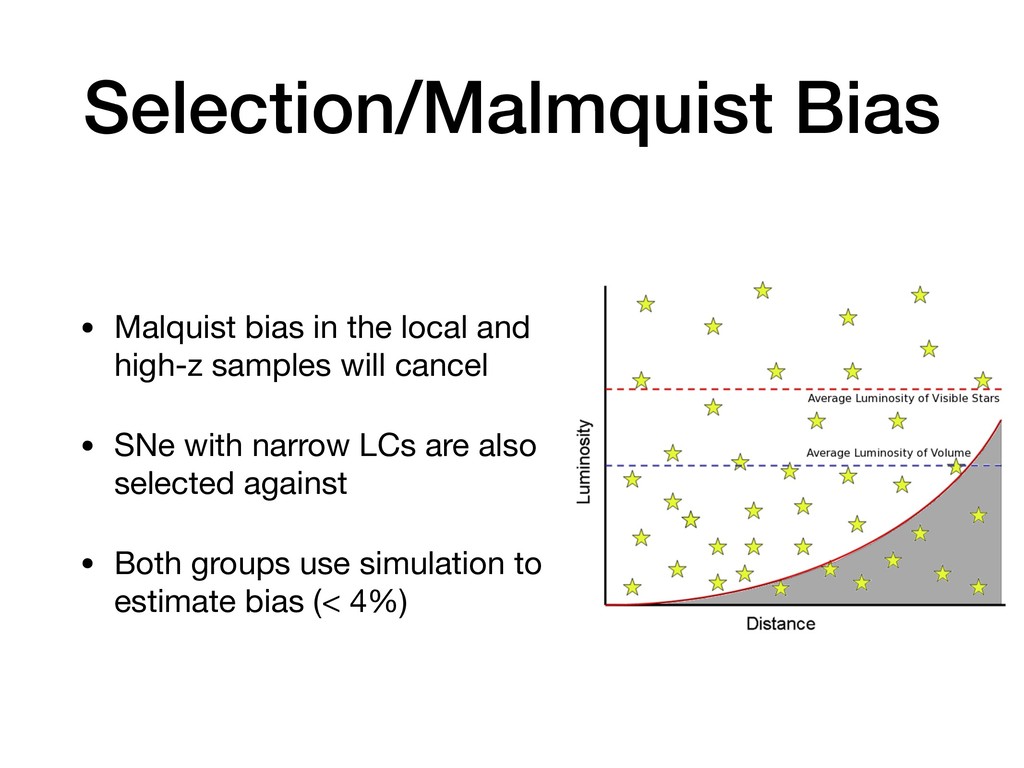
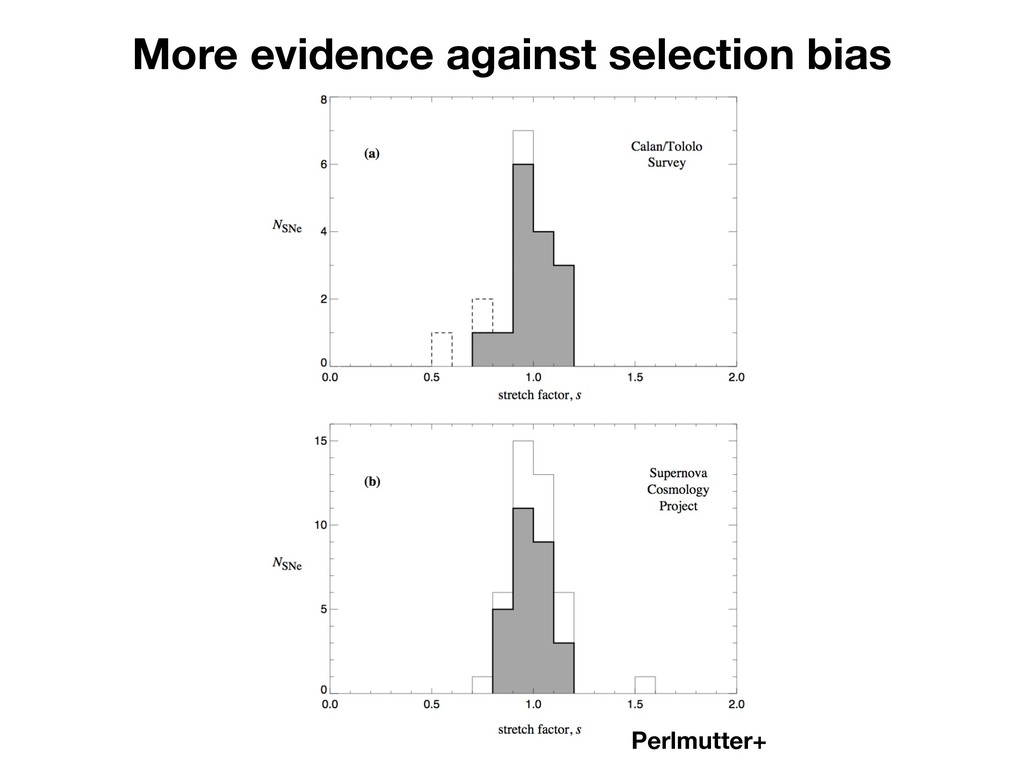
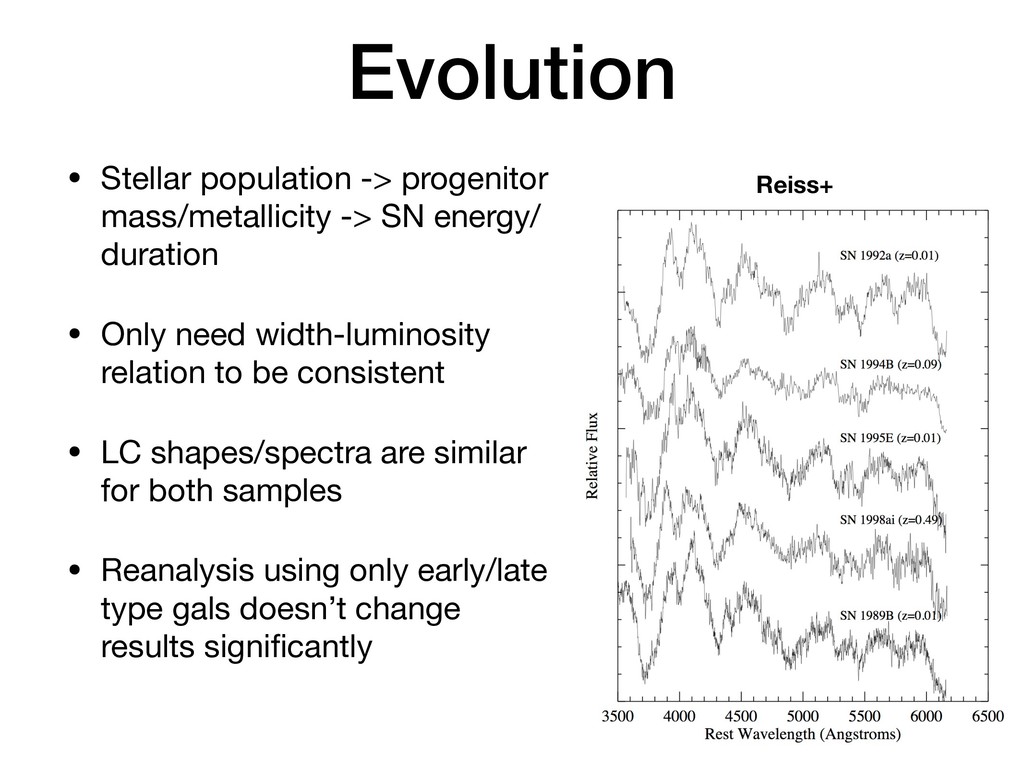
duration • Only need width-luminosity relation to be consistent • LC shapes/spectra are similar for both samples • Reanalysis using only early/late type gals doesn’t change results significantly Reiss+
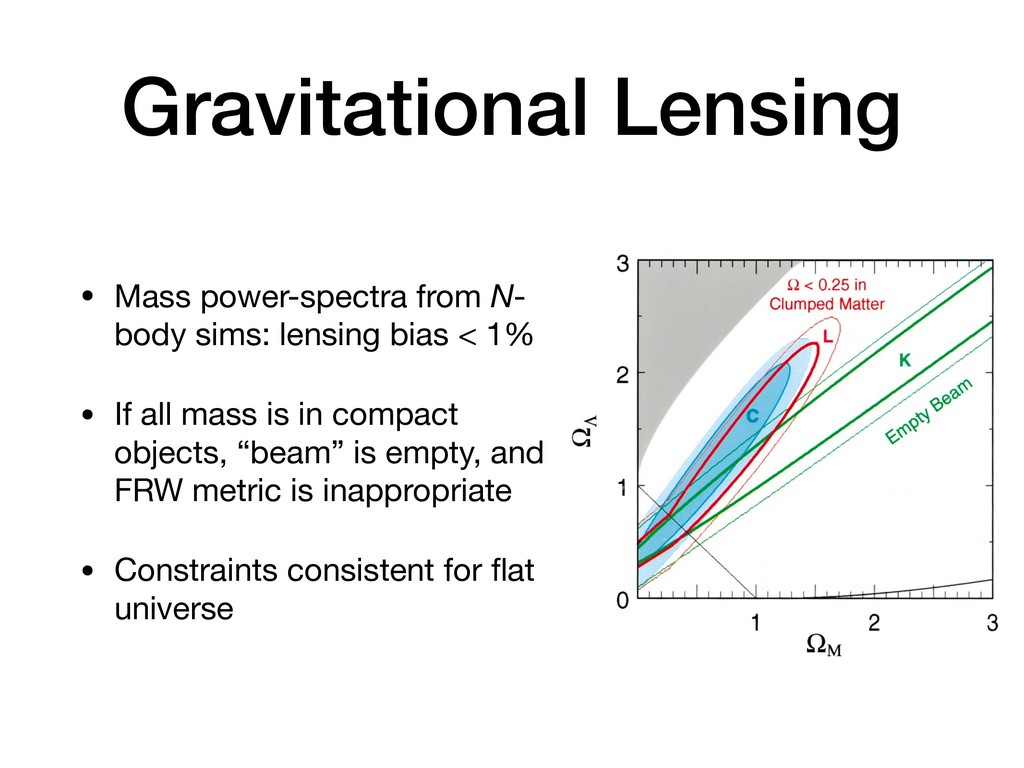
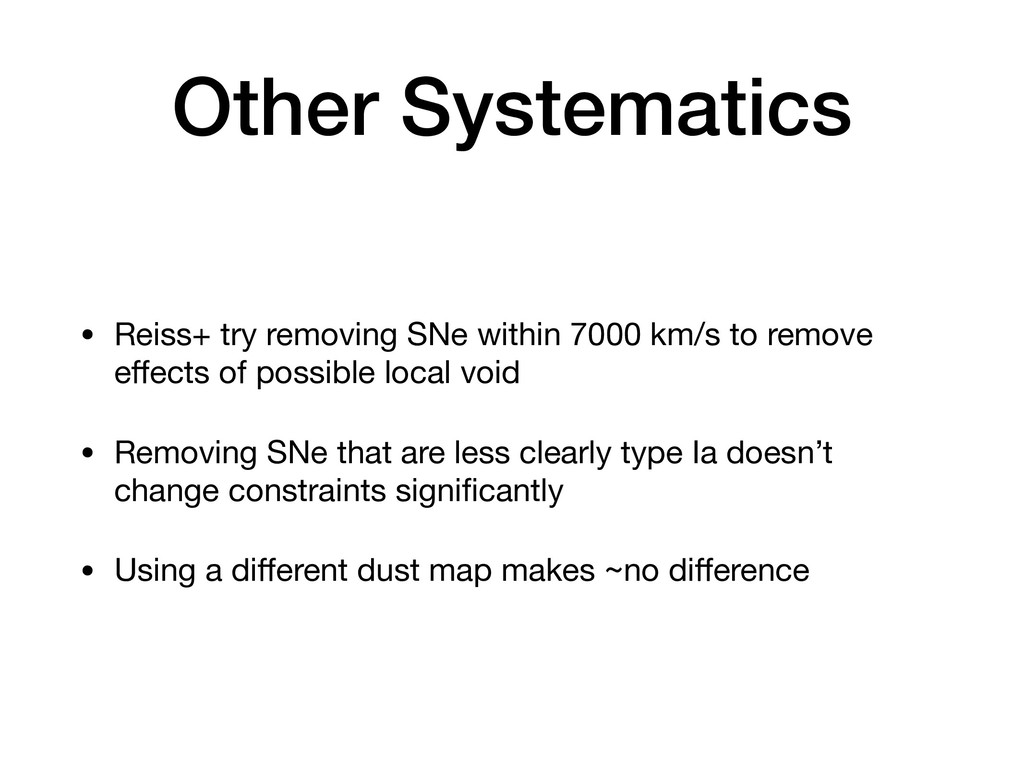
to remove effects of possible local void • Removing SNe that are less clearly type Ia doesn’t change constraints significantly • Using a different dust map makes ~no difference
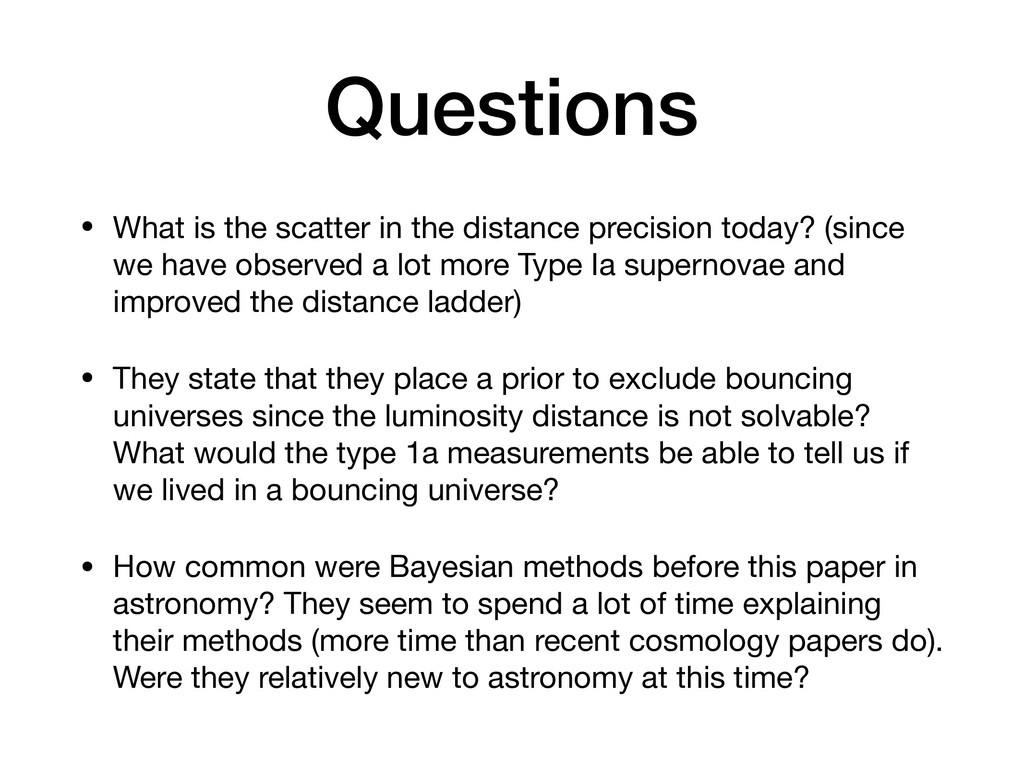
today? (since we have observed a lot more Type Ia supernovae and improved the distance ladder) • They state that they place a prior to exclude bouncing universes since the luminosity distance is not solvable? What would the type 1a measurements be able to tell us if we lived in a bouncing universe? • How common were Bayesian methods before this paper in astronomy? They seem to spend a lot of time explaining their methods (more time than recent cosmology papers do). Were they relatively new to astronomy at this time?
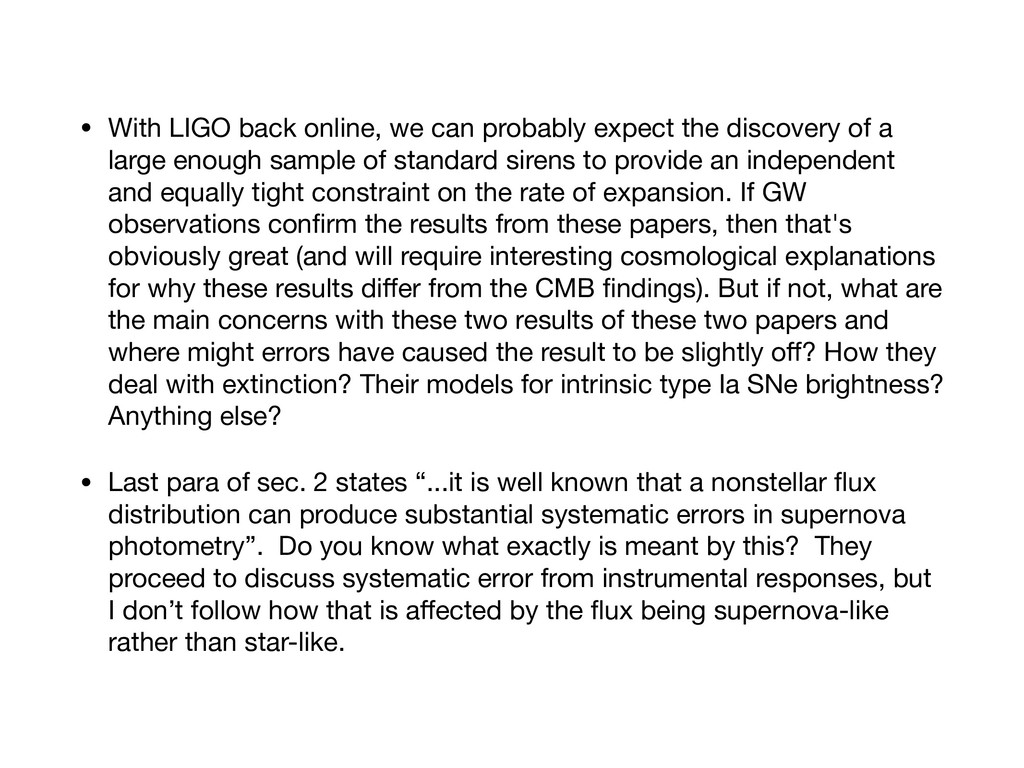
discovery of a large enough sample of standard sirens to provide an independent and equally tight constraint on the rate of expansion. If GW observations confirm the results from these papers, then that's obviously great (and will require interesting cosmological explanations for why these results differ from the CMB findings). But if not, what are the main concerns with these two results of these two papers and where might errors have caused the result to be slightly off? How they deal with extinction? Their models for intrinsic type Ia SNe brightness? Anything else? • Last para of sec. 2 states “...it is well known that a nonstellar flux distribution can produce substantial systematic errors in supernova photometry”. Do you know what exactly is meant by this? They proceed to discuss systematic error from instrumental responses, but I don’t follow how that is affected by the flux being supernova-like rather than star-like.
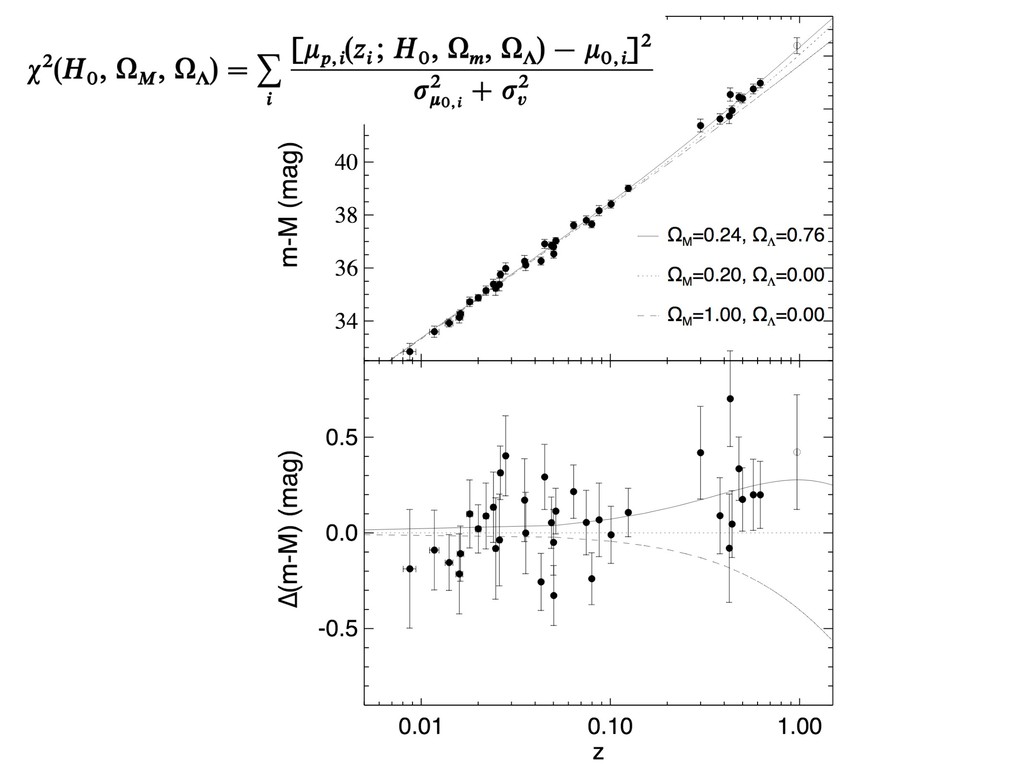
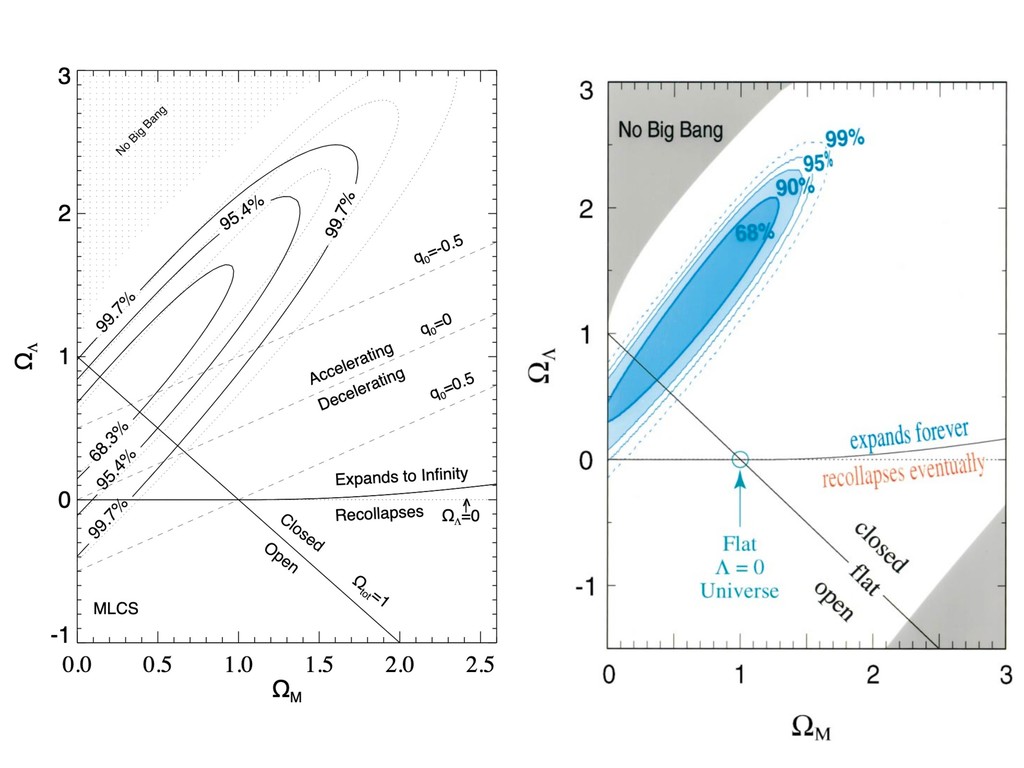
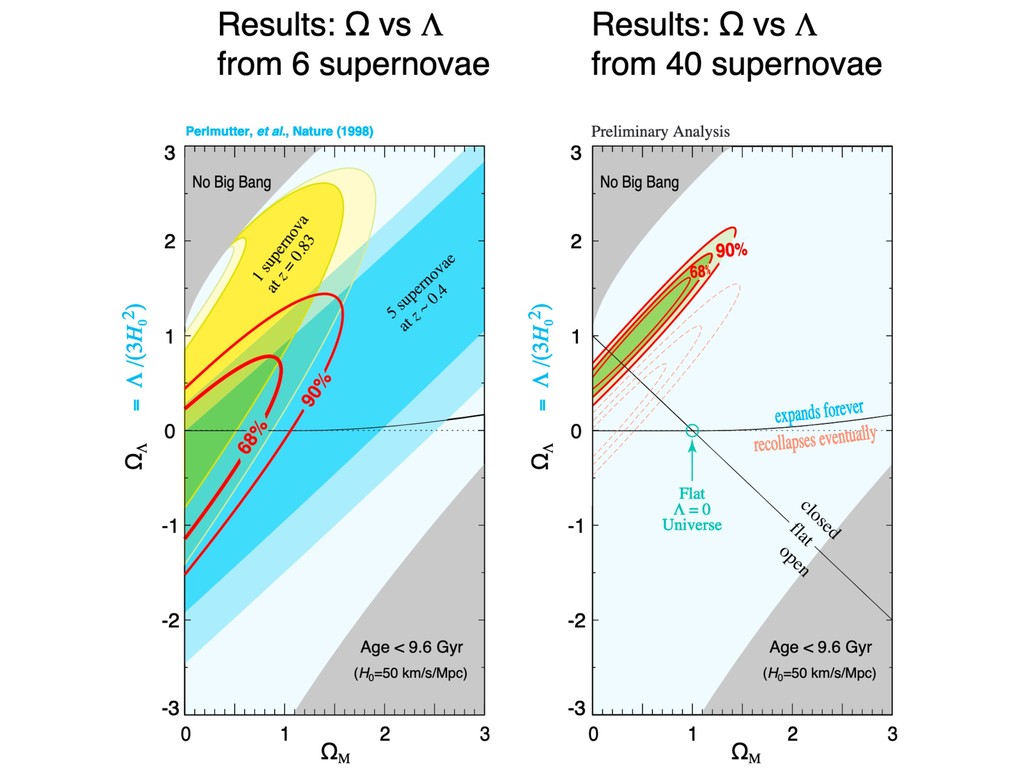
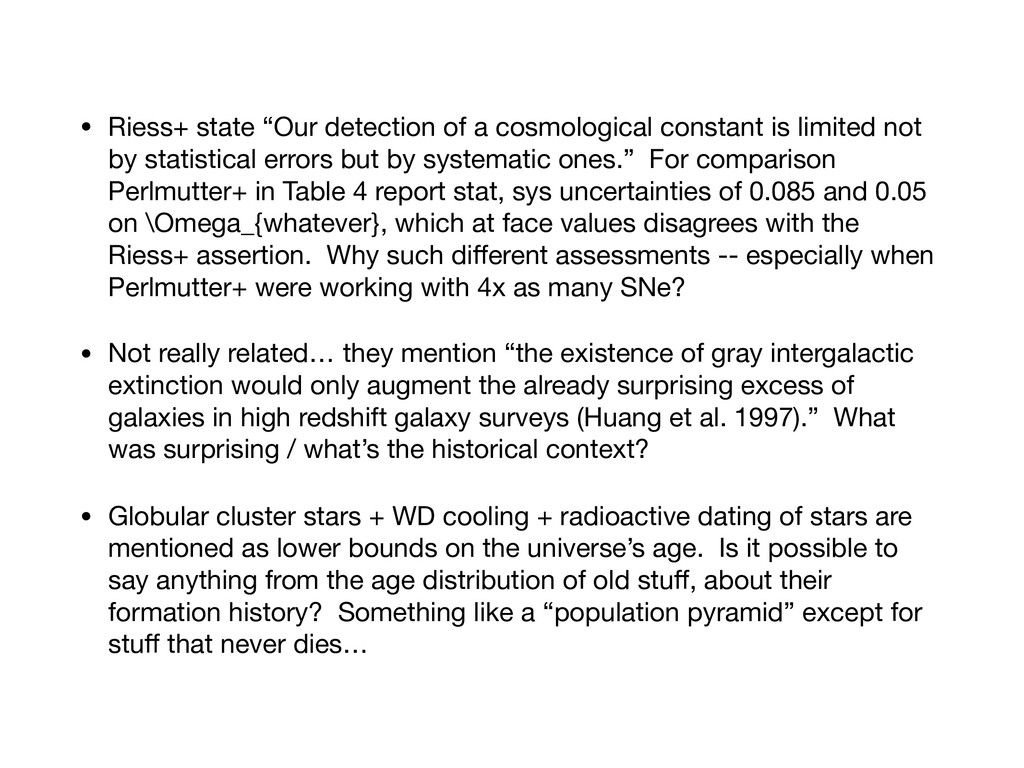
limited not by statistical errors but by systematic ones.” For comparison Perlmutter+ in Table 4 report stat, sys uncertainties of 0.085 and 0.05 on \Omega_{whatever}, which at face values disagrees with the Riess+ assertion. Why such different assessments -- especially when Perlmutter+ were working with 4x as many SNe? • Not really related… they mention “the existence of gray intergalactic extinction would only augment the already surprising excess of galaxies in high redshift galaxy surveys (Huang et al. 1997).” What was surprising / what’s the historical context? • Globular cluster stars + WD cooling + radioactive dating of stars are mentioned as lower bounds on the universe’s age. Is it possible to say anything from the age distribution of old stuff, about their formation history? Something like a “population pyramid” except for stuff that never dies…
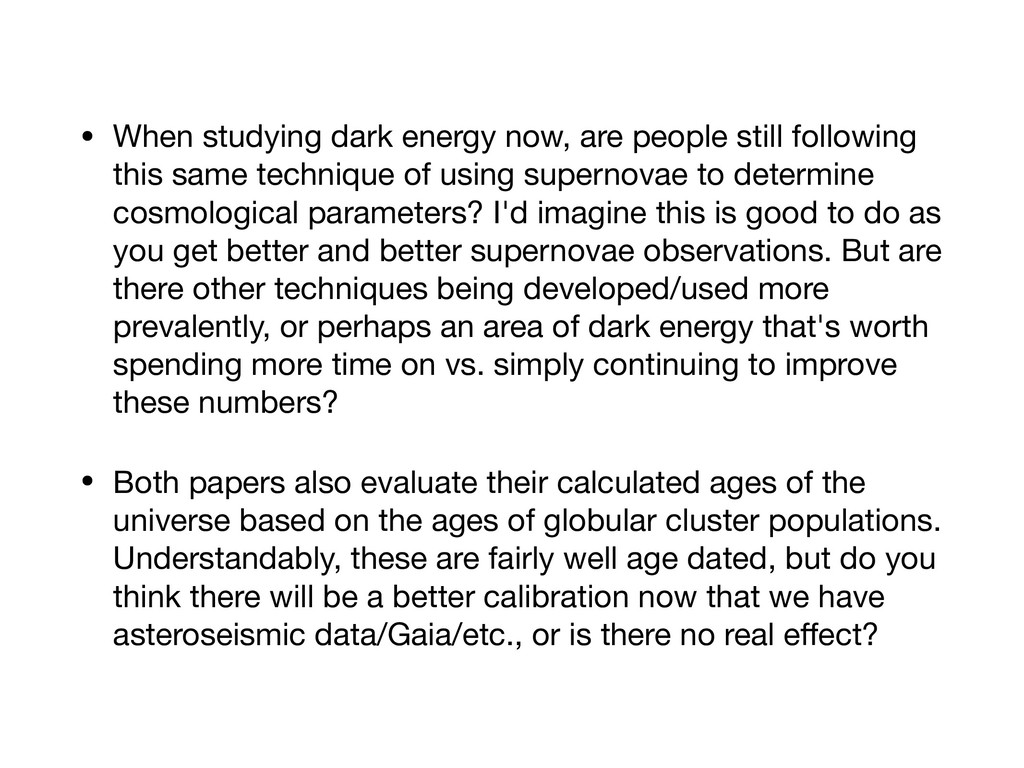
this same technique of using supernovae to determine cosmological parameters? I'd imagine this is good to do as you get better and better supernovae observations. But are there other techniques being developed/used more prevalently, or perhaps an area of dark energy that's worth spending more time on vs. simply continuing to improve these numbers? • Both papers also evaluate their calculated ages of the universe based on the ages of globular cluster populations. Understandably, these are fairly well age dated, but do you think there will be a better calibration now that we have asteroseismic data/Gaia/etc., or is there no real effect?
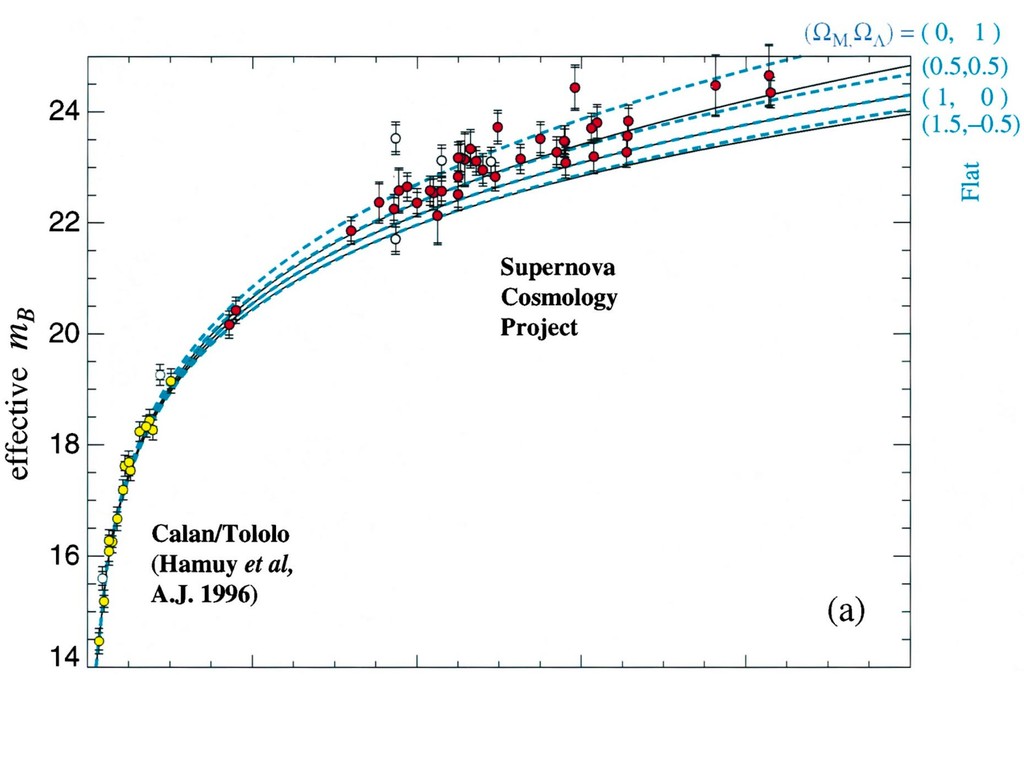
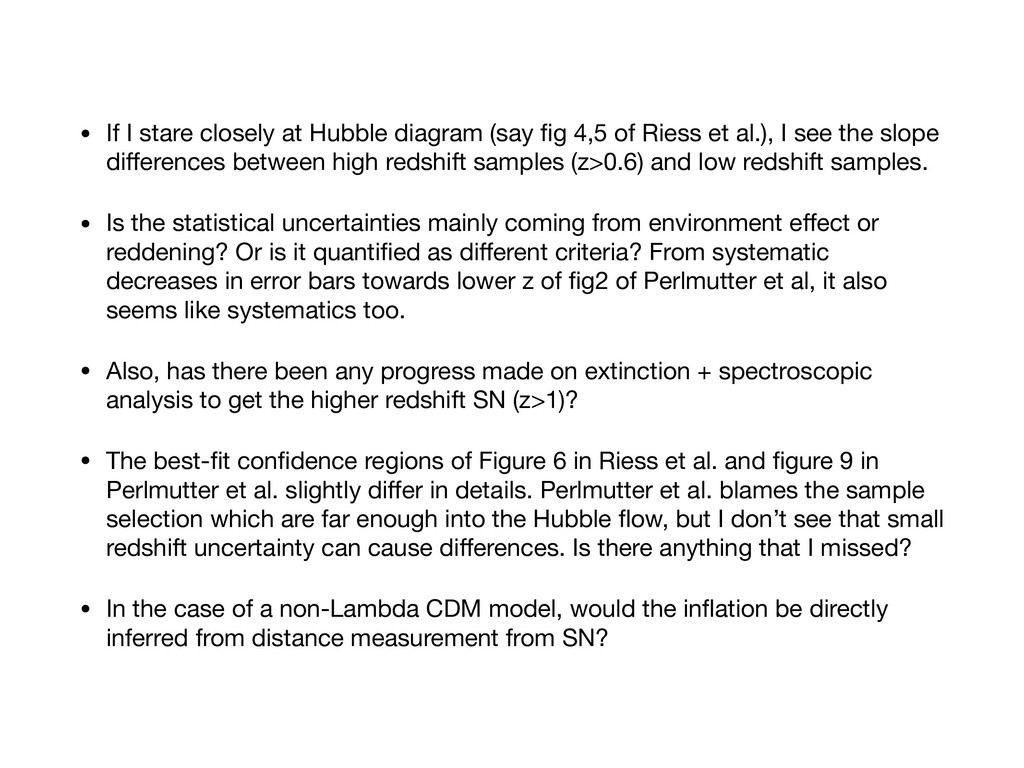
4,5 of Riess et al.), I see the slope differences between high redshift samples (z>0.6) and low redshift samples. • Is the statistical uncertainties mainly coming from environment effect or reddening? Or is it quantified as different criteria? From systematic decreases in error bars towards lower z of fig2 of Perlmutter et al, it also seems like systematics too. • Also, has there been any progress made on extinction + spectroscopic analysis to get the higher redshift SN (z>1)? • The best-fit confidence regions of Figure 6 in Riess et al. and figure 9 in Perlmutter et al. slightly differ in details. Perlmutter et al. blames the sample selection which are far enough into the Hubble flow, but I don’t see that small redshift uncertainty can cause differences. Is there anything that I missed? • In the case of a non-Lambda CDM model, would the inflation be directly inferred from distance measurement from SN?


 trishagee
 chriscoyier
 lara
 mraible
 chikuwait
 mayunak
 aleyda
 rabernat
 katiecoart
 garrettdimon
 thekraken
 inesmontani