Upgrade to Pro — share decks privately, control downloads, hide ads and more …

WHY AFRICANS HAVE FAILED TO IMPLEMENT NATIONAL ...

Avatar for akora4 akora4
September 09, 2020

WHY AFRICANS HAVE FAILED TO IMPLEMENT NATIONAL DATABASE MANAGEMENT SYSTEM (ESPECIALLY GHANA).

Each year, about one third of births go unregistered, adding to the growing number of its population who live and die without leaving a trace of their existence and/or their characteristics on any legal document or statistical record. Also, only one in five deaths each year gets recorded. The registration system does not therefore provide the data that can generate reliable estimates of the population size and growth, throwing off critical indicators for planning and monitoring of development agenda, and more specifically the management and delivery of social services, described as “scandal of invisibility”.

Avatar for akora4

akora4

September 09, 2020

Other Decks in Technology

Transcript

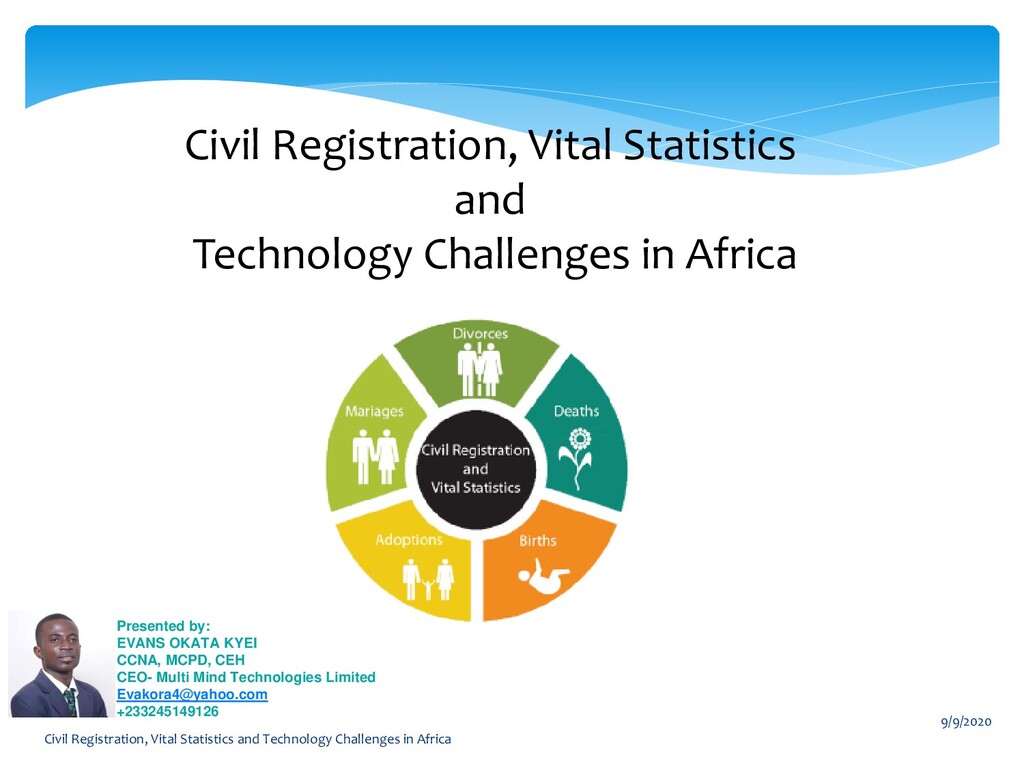
  1. Civil Registration, Vital Statistics and Technology Challenges in Africa Presented

    by: EVANS OKATA KYEI CCNA, MCPD, CEH CEO- Multi Mind Technologies Limited [email protected] +233245149126 9/9/2020 Civil Registration, Vital Statistics and Technology Challenges in Africa
  2. Introduction Each year, about one third of births go unregistered,

    adding to the growing number of its population who live and die without leaving a trace of their existence and/or their characteristics on any legal document or statistical record. Also, only one in five deaths each year gets recorded. The registration system does not therefore provide the data that can generate reliable estimates of the population size and growth, throwing off critical indicators for planning and monitoring of development agenda, and more specifically the management and delivery of social services, described as “scandal of invisibility”. The benefits of a functional civil registration and vital statistics system to any given nation for furthering the development agenda are immense. Specifically, the registration of vital events like birth, marriage, divorce, and death, including causes of death, is important for legal matters, public administration, development planning, and statistical services. It provides the fundamental basis for the state in the planning, provision and monitoring of basic development facilities and services for the citizenry. Yet, Ghana, like many African countries, has failed to develop its civil registration system to a state of completeness. (GSS JULY 2015)
  3. According to IBM, over 90 percent of the data in

    the world today have been created in the last two years alone (IBM). Companies, governments, and civil society organizations are increasingly aware of the power of big data and analytics. There is growing attention to the multiple uses of data coming from social media sites, videos, and cell phone GPS signals, among others. While governments are important producers and users of data, some seem to overlook the enormous potential of an important source of information at their fingertips: civil registration and vital statistics (CRVS). Civil registration, a well - established government activity in many countries, is often limited to the issuance of birth certificates and ID cards, and not considered for its broad linkages with other aspects of social and economic development (Carr-Hill, 2013). Introduction
  4. Civil Registration and Vital Statistics as a Foundation for National

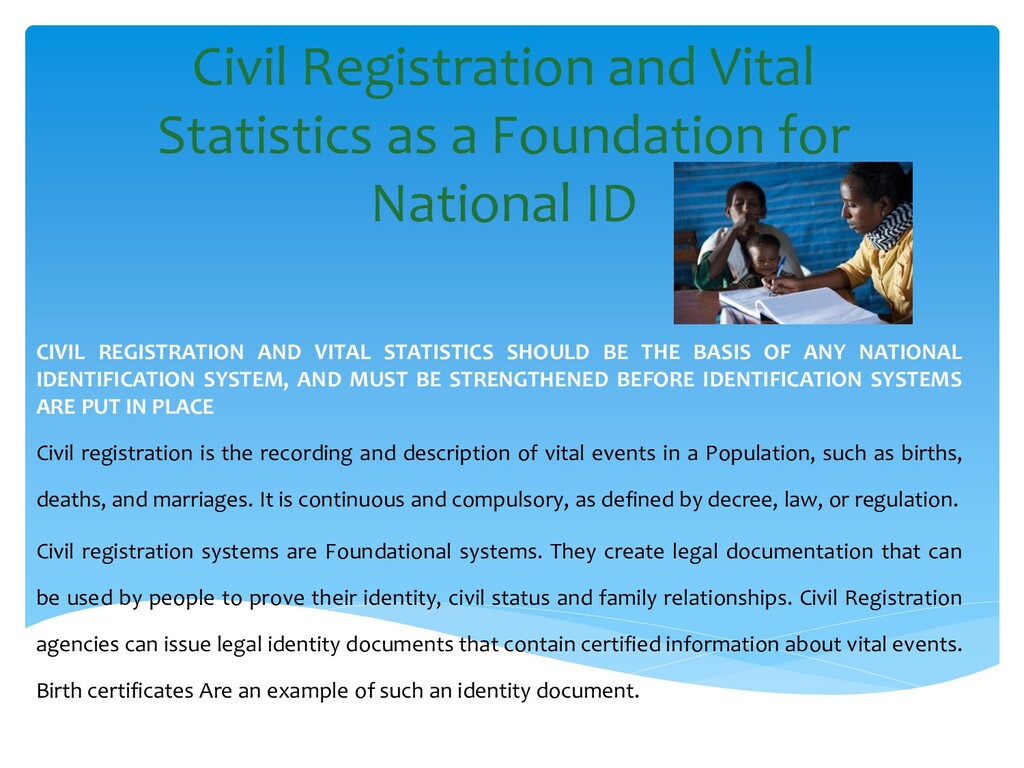
    ID CIVIL REGISTRATION AND VITAL STATISTICS SHOULD BE THE BASIS OF ANY NATIONAL IDENTIFICATION SYSTEM, AND MUST BE STRENGTHENED BEFORE IDENTIFICATION SYSTEMS ARE PUT IN PLACE Civil registration is the recording and description of vital events in a Population, such as births, deaths, and marriages. It is continuous and compulsory, as defined by decree, law, or regulation. Civil registration systems are Foundational systems. They create legal documentation that can be used by people to prove their identity, civil status and family relationships. Civil Registration agencies can issue legal identity documents that contain certified information about vital events. Birth certificates Are an example of such an identity document.
  5. A national identification system is the system or combination of

    systems, rules and procedures that govern the relationship between individuals and organizations regarding the entitlement, use and protection of personal information. Identification systems should be based on information from the civil register, and usually include a unique personal number and/or biometric data. both civil registers and identification registers need to be regulated and protected by law. Civil Registration and Vital Statistics as a Foundation for National ID
  6. Civil Registration and Vital Statistics as a Foundation for National

    ID Civil register of a Country contains information on vital events and is continuously updated. This allows for the recording of ‘entry into’ (births) and ‘exit from’ (deaths) population registers. A civil register provides the basis for individual identification from birth to death, through its issuance of legal identity documents. The birth certificate is considered the foundational document for all other identity systems and as such, serves multiple purposes. The death certificate permits the removal of individuals from the population and other registers, such as electoral rolls, pensions and social security mechanisms.
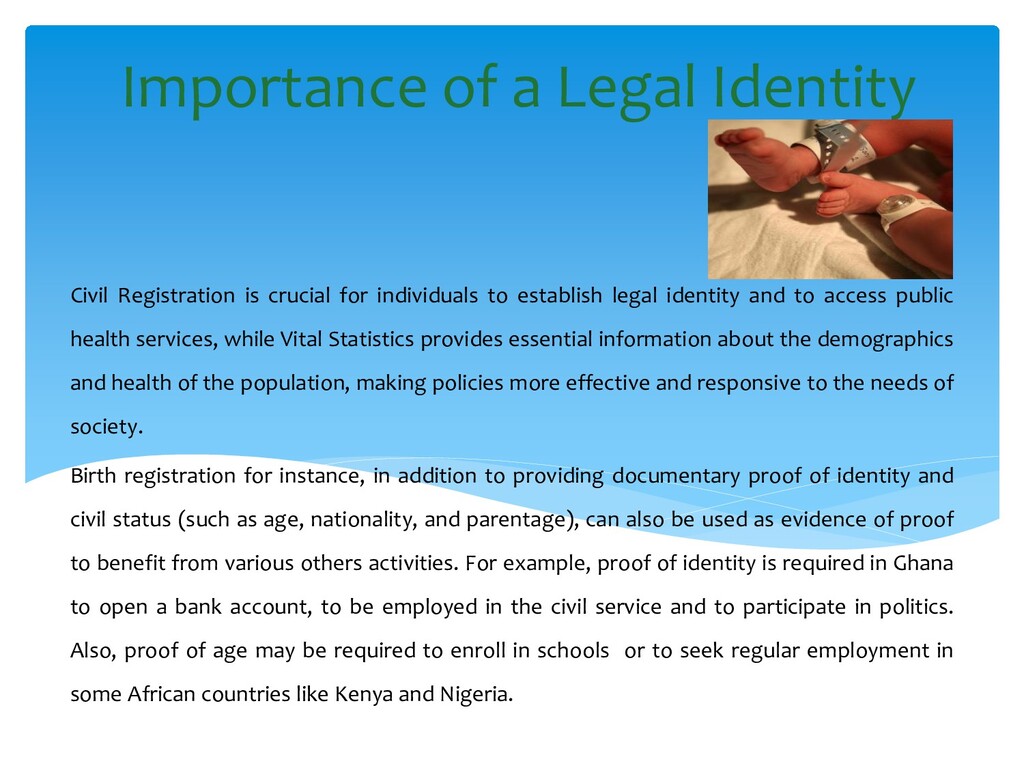
  7. Importance of a Legal Identity Civil Registration is crucial for

    individuals to establish legal identity and to access public health services, while Vital Statistics provides essential information about the demographics and health of the population, making policies more effective and responsive to the needs of society. Birth registration for instance, in addition to providing documentary proof of identity and civil status (such as age, nationality, and parentage), can also be used as evidence of proof to benefit from various others activities. For example, proof of identity is required in Ghana to open a bank account, to be employed in the civil service and to participate in politics. Also, proof of age may be required to enroll in schools or to seek regular employment in some African countries like Kenya and Nigeria.
  8. Civil registration and national ID should be treated as subsystems

    of a single system. For the efficient implementation and evaluation of health projects in many African countries, vital records such as birth registration, are needed. Those records are used to monitor progress in public health programmes in such areas as the control of communicable diseases and maternal and child health. As already noted, birth registration information is used to determine fertility rates. Accordingly, figures collected through birth registration over a period of time, can be used to estimate the growth, structure and geographic distribution of the population. Importance of a Legal Identity
  9. Technology Challenges in Africa and Political Interventions CRVS represents key

    institutions of a country as well as providing a basis for assessing a country’s status and development in general. Most low and middle income countries have inadequate CRVS IS, contributing to the unfortunate situation where many births and deaths are not being registered, described as the “scandal of invisibility”. A well-functioning CRVS IS has in recent times been recognized as a key ingredient in strengthening CRVS activity in general, exemplified by the CoIA recommendations. There is emerging evidence that technology can play a critical role in ensuring that births, deaths and causes of deaths are registered and that quality information is available to inform country and global development priorities. Both the United Nations Children’s Fund (UNICEF) and HMN have sponsored activities in countries to strengthen CRVS systems through innovative use of ICT initiatives.
  10. TECHNOLOGY There is yet no guidance for countries, international development

    partners or donors regarding appropriate technologies and architecture designs and principles to be promoted or invested in a CRVS system. So, despite increasing emphasis on CRVS IS, and growing investments in technology, it can broadly be inferred that the state of these systems in most low and middle income countries tends to be below desired satisfaction levels, and that ICT interventions have not yielded desired benefits – as yet. (WHO 2013). Technology Challenges in Africa and Political Interventions
  11. POLITICAL High-level political backing and long-term budgetary funding commitments are

    essential for creating and maintaining civil registration and vital statistics systems. The 2010 Conference of African Ministers Responsible for Civil Registration was seen as a watershed event as it resulted in a ministerial declaration in support of strengthening civil registration and vital statistics systems on the continent, and the endorsement of a medium-term plan to guide the implementation of a regional initiative. For the first time in many years, a high-level commitment by countries to improving civil registration and vital statistics systems was evident across the continent. Technology Challenges in Africa and Political Interventions
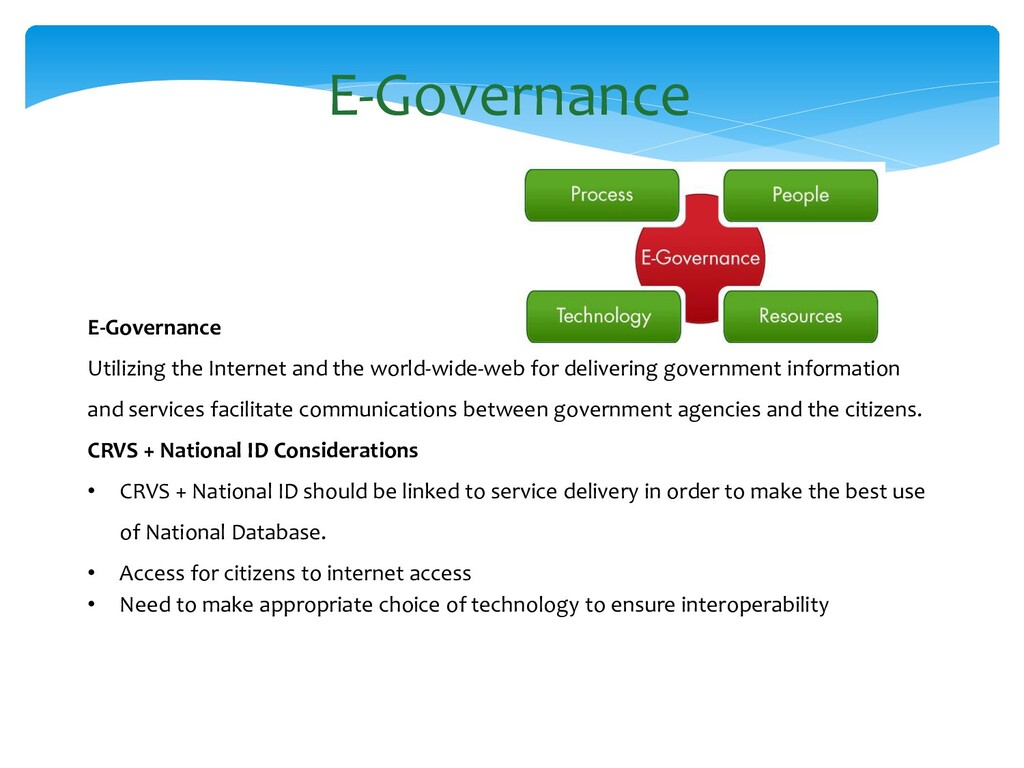
  12. E-Governance E-Governance Utilizing the Internet and the world-wide-web for delivering

    government information and services facilitate communications between government agencies and the citizens. CRVS + National ID Considerations • CRVS + National ID should be linked to service delivery in order to make the best use of National Database. • Access for citizens to internet access • Need to make appropriate choice of technology to ensure interoperability
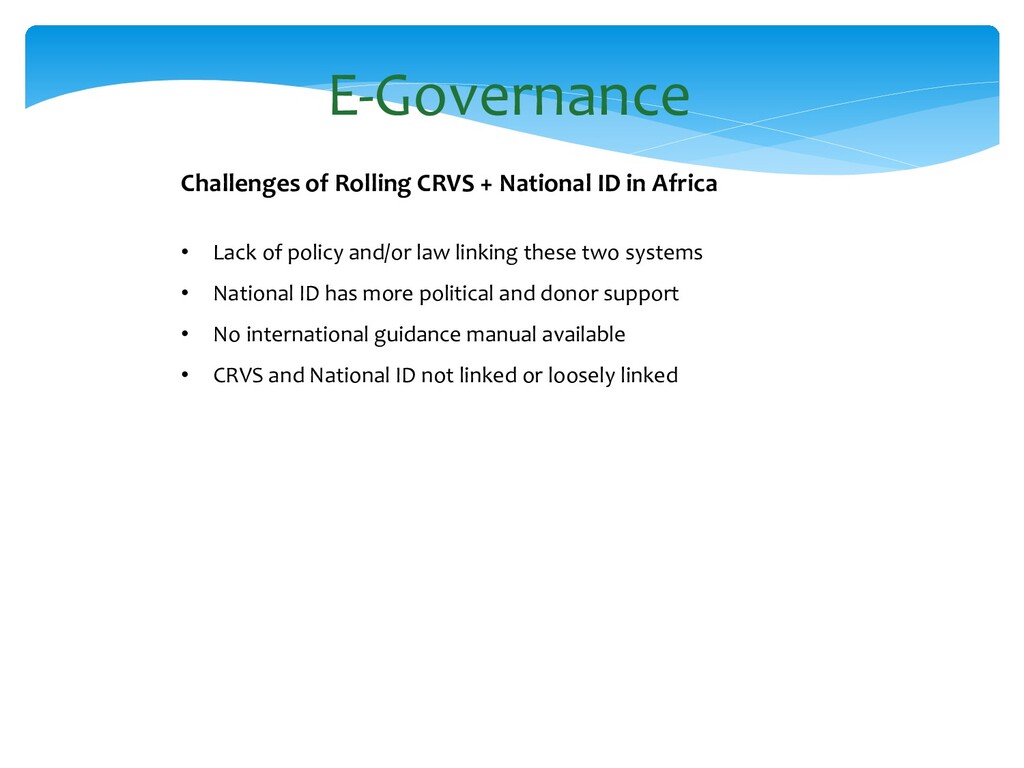
  13. E-Governance Challenges of Rolling CRVS + National ID in Africa

    • Lack of policy and/or law linking these two systems • National ID has more political and donor support • No international guidance manual available • CRVS and National ID not linked or loosely linked
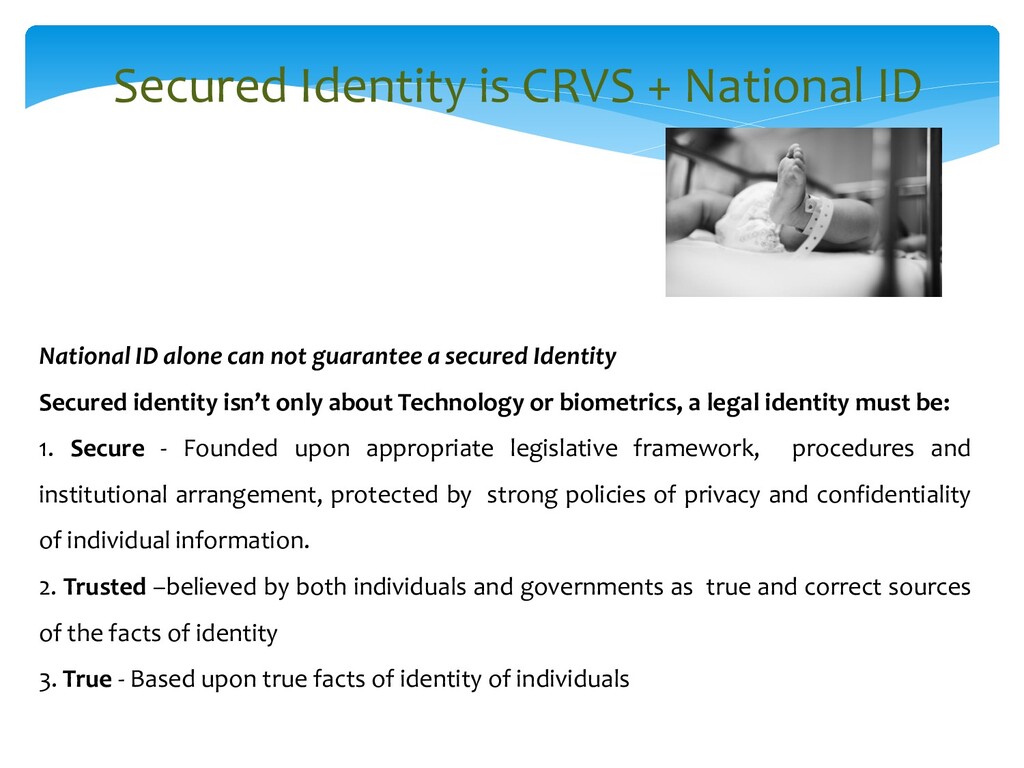
  14. Secured Identity is CRVS + National ID National ID alone

    can not guarantee a secured Identity Secured identity isn’t only about Technology or biometrics, a legal identity must be: 1. Secure - Founded upon appropriate legislative framework, procedures and institutional arrangement, protected by strong policies of privacy and confidentiality of individual information. 2. Trusted –believed by both individuals and governments as true and correct sources of the facts of identity 3. True - Based upon true facts of identity of individuals
  15. Government Policy and Law Policy and law considerations • Need

    for one policy on CRVS + National ID with clear statement on purpose • Need for a law on National ID that provides for linkages between CRVS and National ID • Need for Governance to coordinate exchange of information between the two systems
  16. Declaration by Ministers responsible for civil registration in their third

    conference in Yamoussoukro February 2015 Establish solid linkages between civil registration and national identity systems in efforts to manage one legal identity and to improve governance and service delivery. THANK YOU. Conclusion