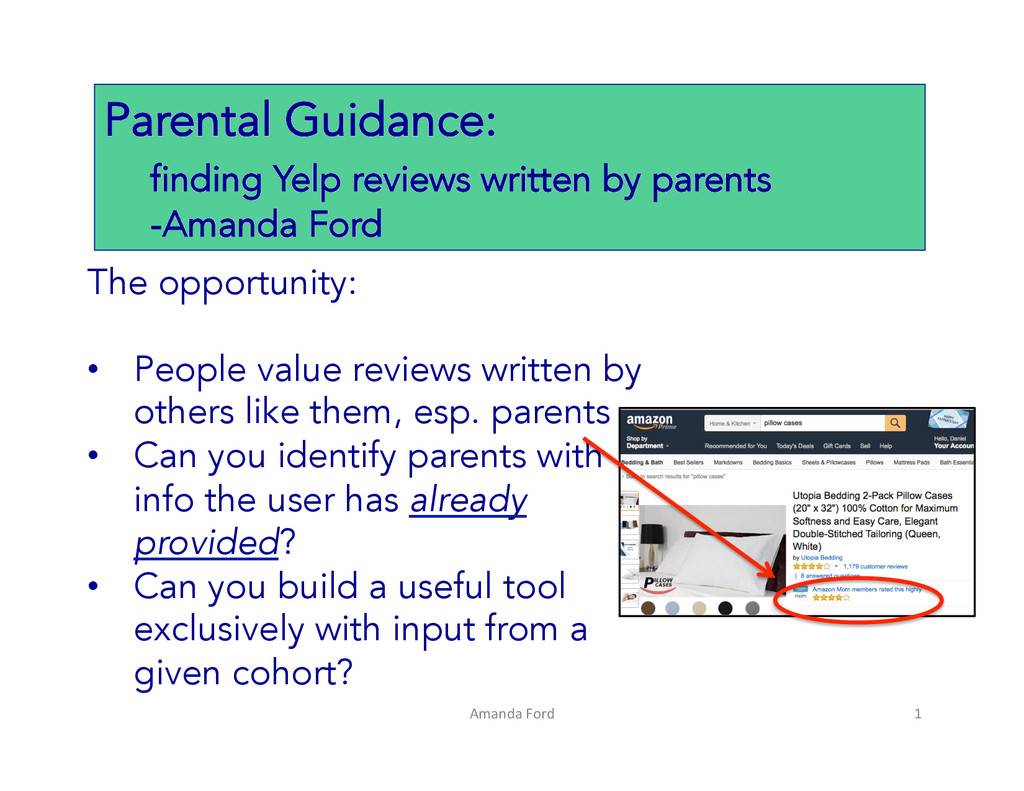
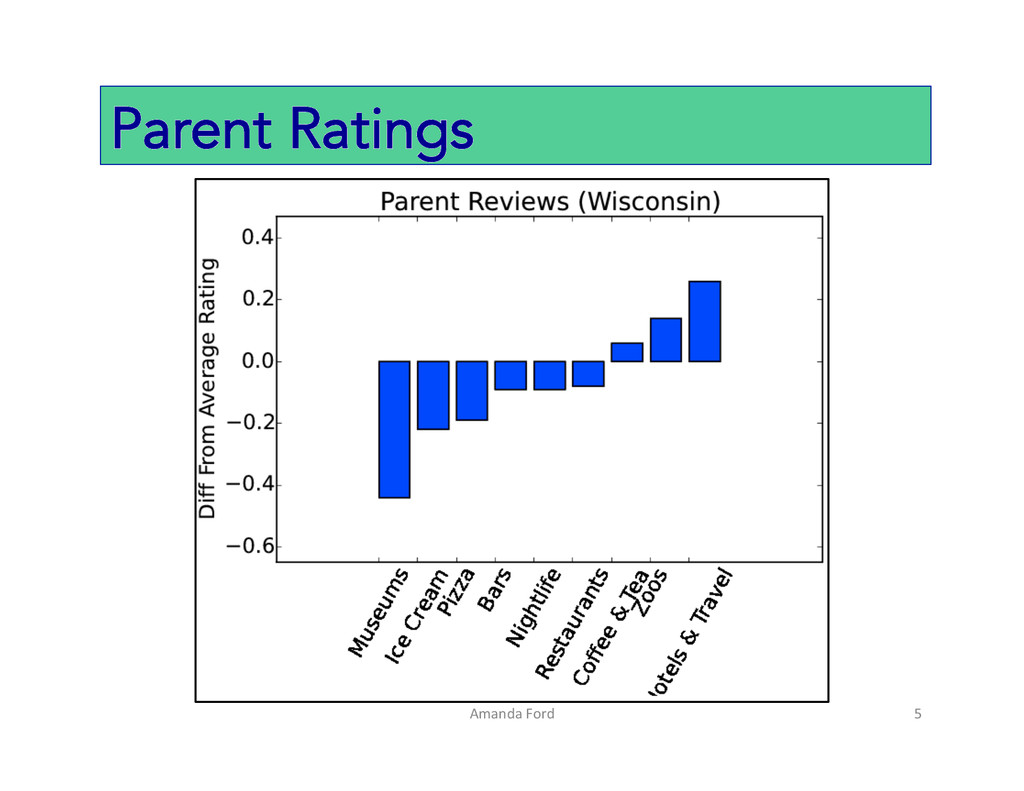
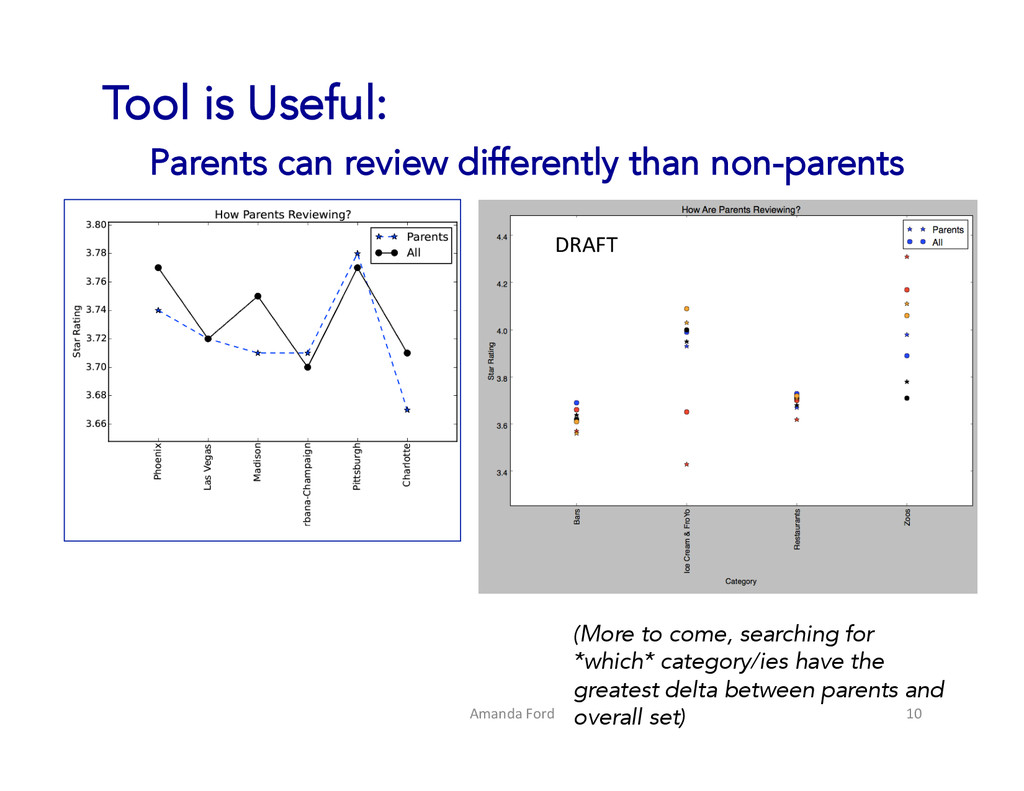
The opportunity: • People value reviews written by others like them, esp. parents • Can you identify parents with info the user has already provided? • Can you build a useful tool exclusively with input from a given cohort? 1 Amanda Ford
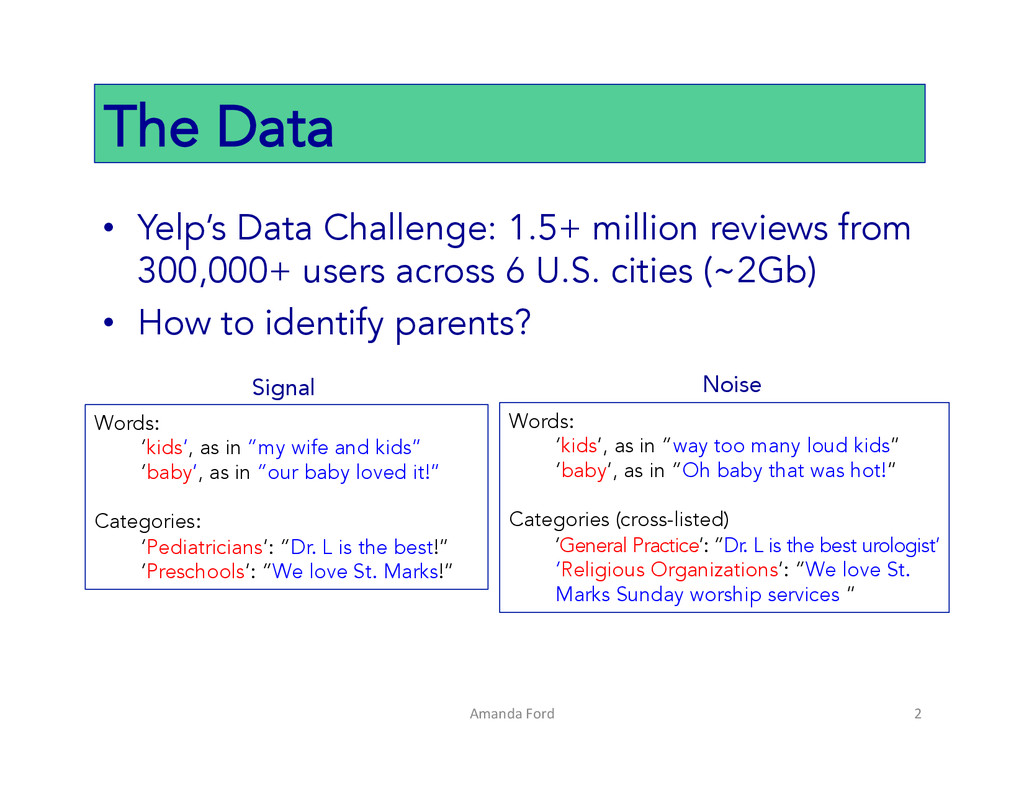
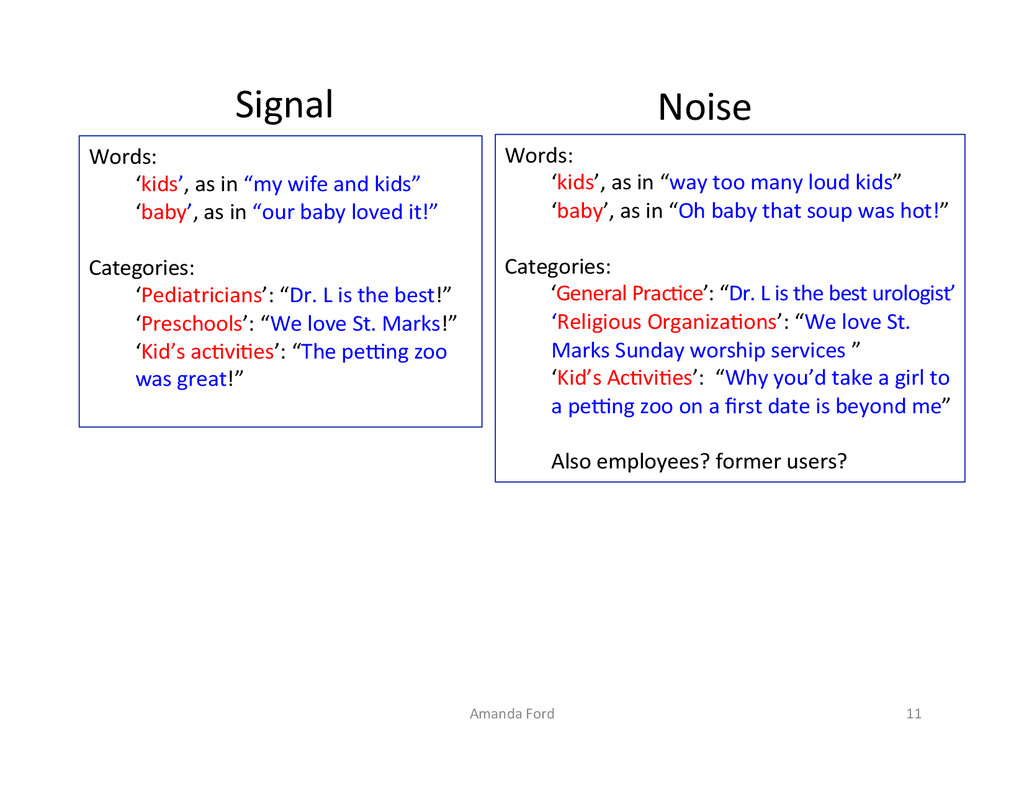
across 6 U.S. cities (~2Gb) • How to identify parents? 2 Words: ‘kids’, as in “my wife and kids” ‘baby’, as in “our baby loved it!” Categories: ‘Pediatricians’: “Dr. L is the best!” ‘Preschools’: “We love St. Marks!” Signal Words: ‘kids’, as in “way too many loud kids” ‘baby’, as in “Oh baby that was hot!” Categories (cross-listed) ‘General Practice’: “Dr. L is the best urologist’ ‘Religious Organizations’: “We love St. Marks Sunday worship services ” Noise Amanda Ford The Data
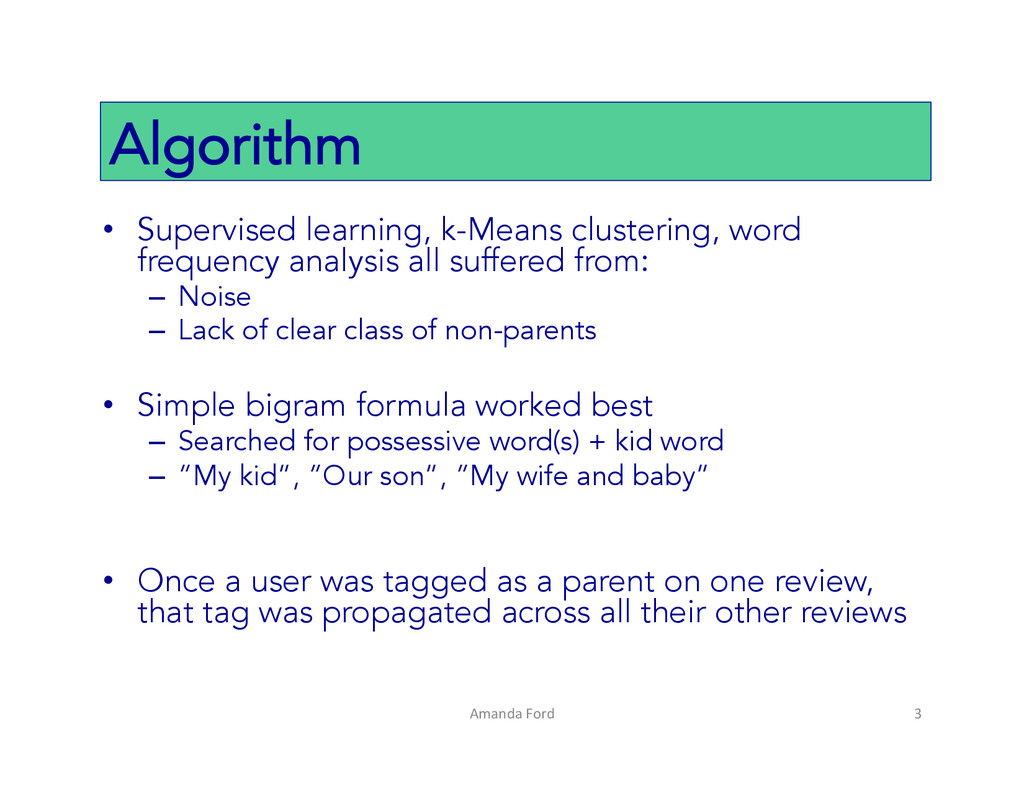
from: – Noise – Lack of clear class of non-parents • Simple bigram formula worked best – Searched for possessive word(s) + kid word – “My kid”, “Our son”, “My wife and baby” • Once a user was tagged as a parent on one review, that tag was propagated across all their other reviews 3 Amanda Ford Algorithm
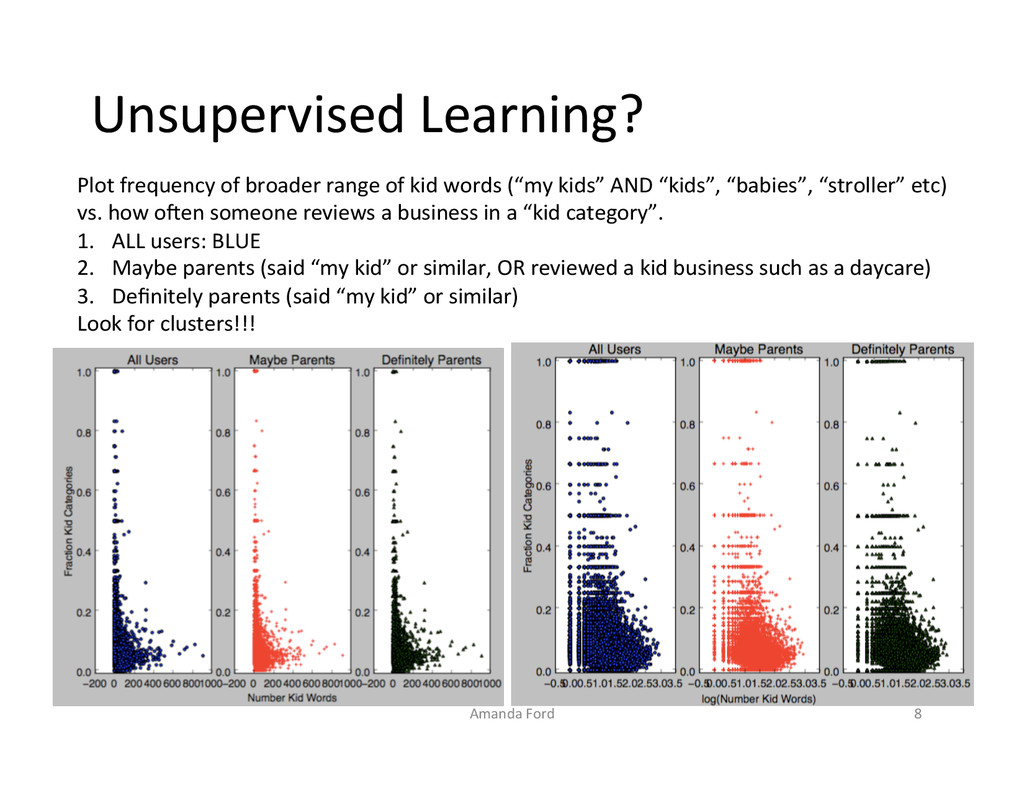
words (“my kids” AND “kids”, “babies”, “stroller” etc) vs. how oRen someone reviews a business in a “kid category”. 1. ALL users: BLUE 2. Maybe parents (said “my kid” or similar, OR reviewed a kid business such as a daycare) 3. Definitely parents (said “my kid” or similar) Look for clusters!!! 8 Amanda Ford
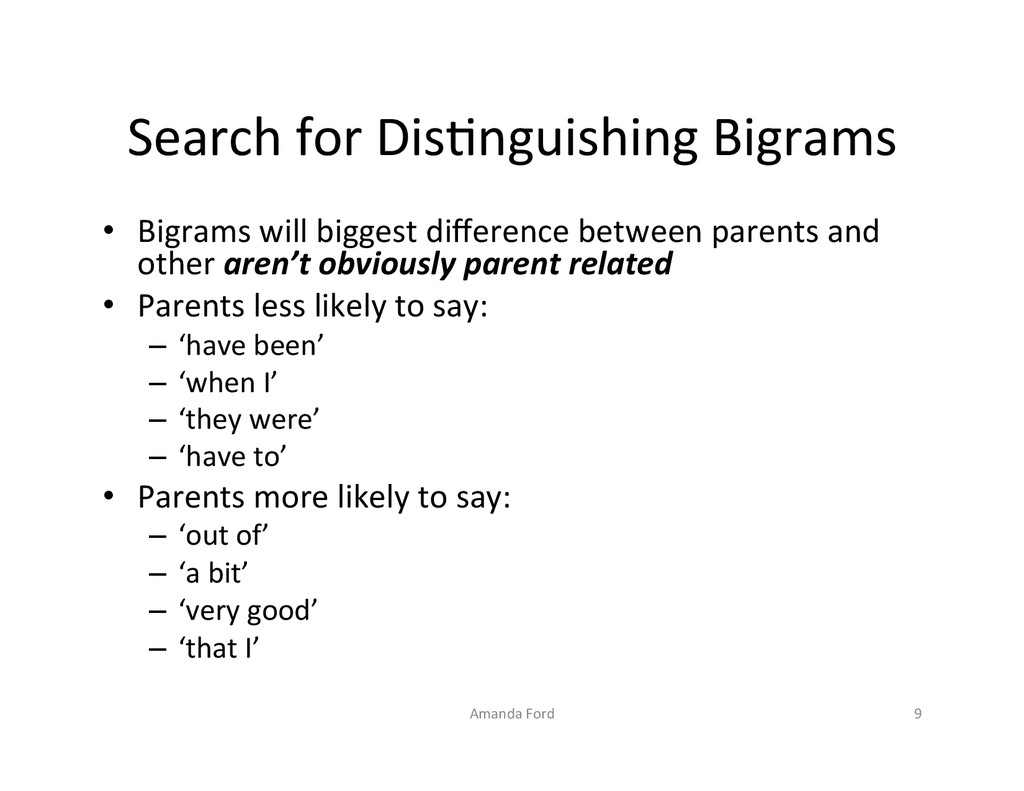
between parents and other aren’t obviously parent related • Parents less likely to say: – ‘have been’ – ‘when I’ – ‘they were’ – ‘have to’ • Parents more likely to say: – ‘out of’ – ‘a bit’ – ‘very good’ – ‘that I’ Amanda Ford 9
wife and kids” ‘baby’, as in “our baby loved it!” Categories: ‘Pediatricians’: “Dr. L is the best!” ‘Preschools’: “We love St. Marks!” ‘Kid’s ac[vi[es’: “The pedng zoo was great!” Words: ‘kids’, as in “way too many loud kids” ‘baby’, as in “Oh baby that soup was hot!” Categories: ‘General Prac[ce’: “Dr. L is the best urologist’ ‘Religious Organiza[ons’: “We love St. Marks Sunday worship services ” ‘Kid’s Ac[vi[es’: “Why you’d take a girl to a pedng zoo on a first date is beyond me” Also employees? former users? 11 Amanda Ford
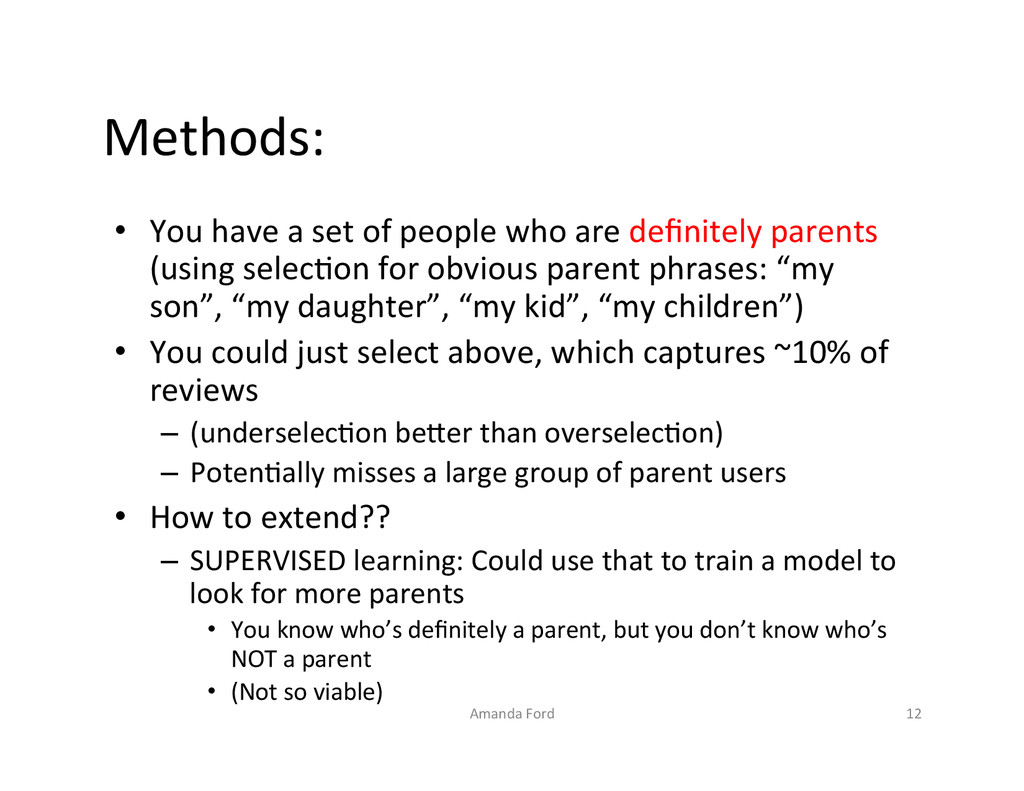
are definitely parents (using selec[on for obvious parent phrases: “my son”, “my daughter”, “my kid”, “my children”) • You could just select above, which captures ~10% of reviews – (underselec[on beker than overselec[on) – Poten[ally misses a large group of parent users • How to extend?? – SUPERVISED learning: Could use that to train a model to look for more parents • You know who’s definitely a parent, but you don’t know who’s NOT a parent • (Not so viable) 12 Amanda Ford
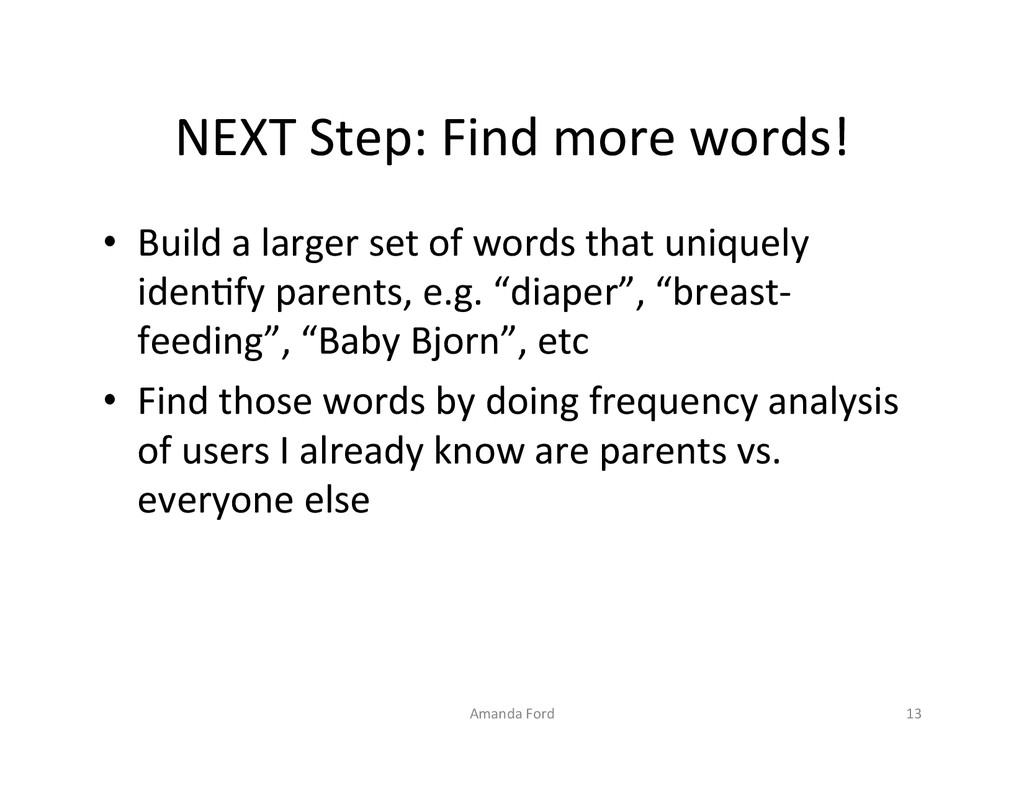
set of words that uniquely iden[fy parents, e.g. “diaper”, “breast-‐ feeding”, “Baby Bjorn”, etc • Find those words by doing frequency analysis of users I already know are parents vs. everyone else 13 Amanda Ford


 amandajbf
 michielstock
 geoffreycrofte
 aemeredith
 inesmontani
 reverentgeek
 stephaniewalter
 jonoalderson
 lauravandoore
 portentint
 tessaabrams
 emna__ayadi
 katiecoart