Upgrade to Pro — share decks privately, control downloads, hide ads and more …

Application of Data Science in Monetary Policy

Avatar for AnittaSunil AnittaSunil
September 28, 2024
21

Application of Data Science in Monetary Policy

Avatar for AnittaSunil

AnittaSunil

September 28, 2024

Transcript

  1. Role of Data Science in Monetary Policy Role of Data

    Science in Monetary Policy Monetary policy involves actions taken by central banks to manage inflation, interest rates, and money supply effectively. By employing data science techniques, central banks can analyze real-time, large datasets, which include historical economic indicators, commodity prices, and consumer sentiment. This capability enhances the decision-making process, enabling more precise, faster, and adaptable responses to changing economic conditions compared to traditional methods. As a result, policymakers can better anticipate inflationary pressures, assess the impact of external shocks, and implement targeted monetary interventions to stabilize the economy and promote sustainable growth. Monetary policy involves actions taken by central banks to manage inflation, interest rates, and money supply effectively. By employing data science techniques, central banks can analyze real-time, large datasets, which include historical economic indicators, commodity prices, and consumer sentiment. This capability enhances the decision-making process, enabling more precise, faster, and adaptable responses to changing economic conditions compared to traditional methods. As a result, policymakers can better anticipate inflationary pressures, assess the impact of external shocks, and implement targeted monetary interventions to stabilize the economy and promote sustainable growth.
  2. 1. Machine Learning Models for Inflation Forecasting 1. Machine Learning

    Models for Inflation Forecasting Central banks are increasingly leveraging machine learning algorithms to enhance their inflation forecasting models. Traditional models, such as Phillips Curve or autoregressive models, often struggle to adapt to real-time changes in complex economic systems. Example: The Bank of England has employed machine learning models to improve its inflation forecasting accuracy. By using Random Forests and Gradient Boosting models, the BoE integrates a vast array of economic variables such as Global commodity prices, Housing market trends, Labor market data and Exchange rate fluctuations. Central banks are increasingly leveraging machine learning algorithms to enhance their inflation forecasting models. Traditional models, such as Phillips Curve or autoregressive models, often struggle to adapt to real-time changes in complex economic systems. Example: The Bank of England has employed machine learning models to improve its inflation forecasting accuracy. By using Random Forests and Gradient Boosting models, the BoE integrates a vast array of economic variables such as Global commodity prices, Housing market trends, Labor market data and Exchange rate fluctuations.
  3. 2. Dynamic Pricing Models 2. Dynamic Pricing Models Data science

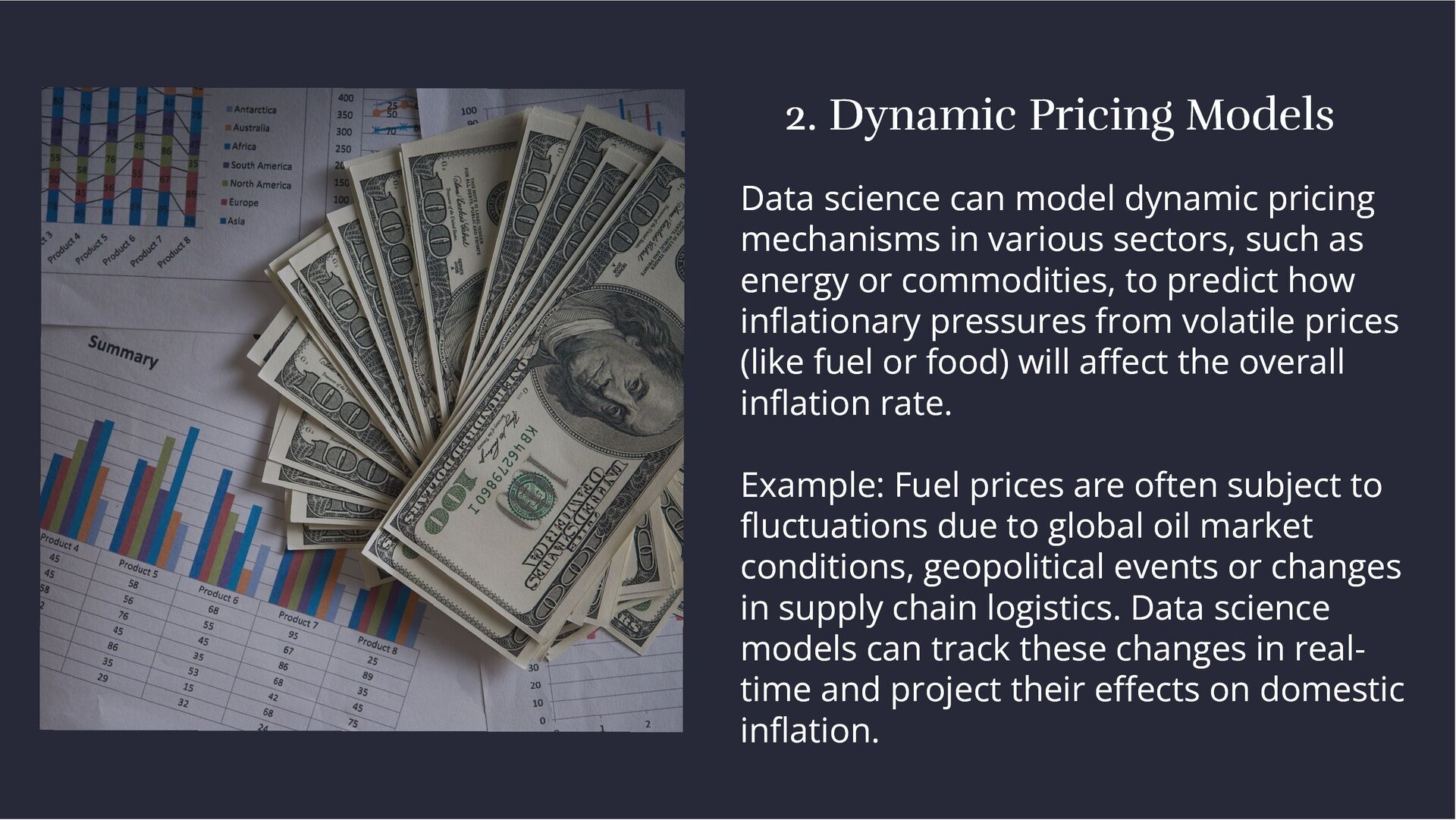
    can model dynamic pricing mechanisms in various sectors, such as energy or commodities, to predict how inflationary pressures from volatile prices (like fuel or food) will affect the overall inflation rate. Example: Fuel prices are often subject to fluctuations due to global oil market conditions, geopolitical events or changes in supply chain logistics. Data science models can track these changes in real- time and project their effects on domestic inflation. Data science can model dynamic pricing mechanisms in various sectors, such as energy or commodities, to predict how inflationary pressures from volatile prices (like fuel or food) will affect the overall inflation rate. Example: Fuel prices are often subject to fluctuations due to global oil market conditions, geopolitical events or changes in supply chain logistics. Data science models can track these changes in real- time and project their effects on domestic inflation.
  4. 3. Stress Testing Financial Systems 3. Stress Testing Financial Systems

    Data science enables comprehensive stress testing of financial institutions. By simulating various economic scenarios, policymakers can identify vulnerabilities and ensure the resilience of the financial system Example: The European Banking Authority (EBA) conducts regular stress tests on European banks. Data science tools help simulate scenarios such as a severe recession in the eurozone or Brexit-related economic shocks. In the 2018 EBA stress tests, data science models simulated a scenario involving a 3- year economic downturn, with sharp declines in GDP and property prices. This allowed European regulators to identify which banks were most vulnerable and needed to shore up their capital buffers.. Data science enables comprehensive stress testing of financial institutions. By simulating various economic scenarios, policymakers can identify vulnerabilities and ensure the resilience of the financial system Example: The European Banking Authority (EBA) conducts regular stress tests on European banks. Data science tools help simulate scenarios such as a severe recession in the eurozone or Brexit-related economic shocks. In the 2018 EBA stress tests, data science models simulated a scenario involving a 3- year economic downturn, with sharp declines in GDP and property prices. This allowed European regulators to identify which banks were most vulnerable and needed to shore up their capital buffers..
  5. 4. Predictive Analytics for Inflation 4. Predictive Analytics for Inflation

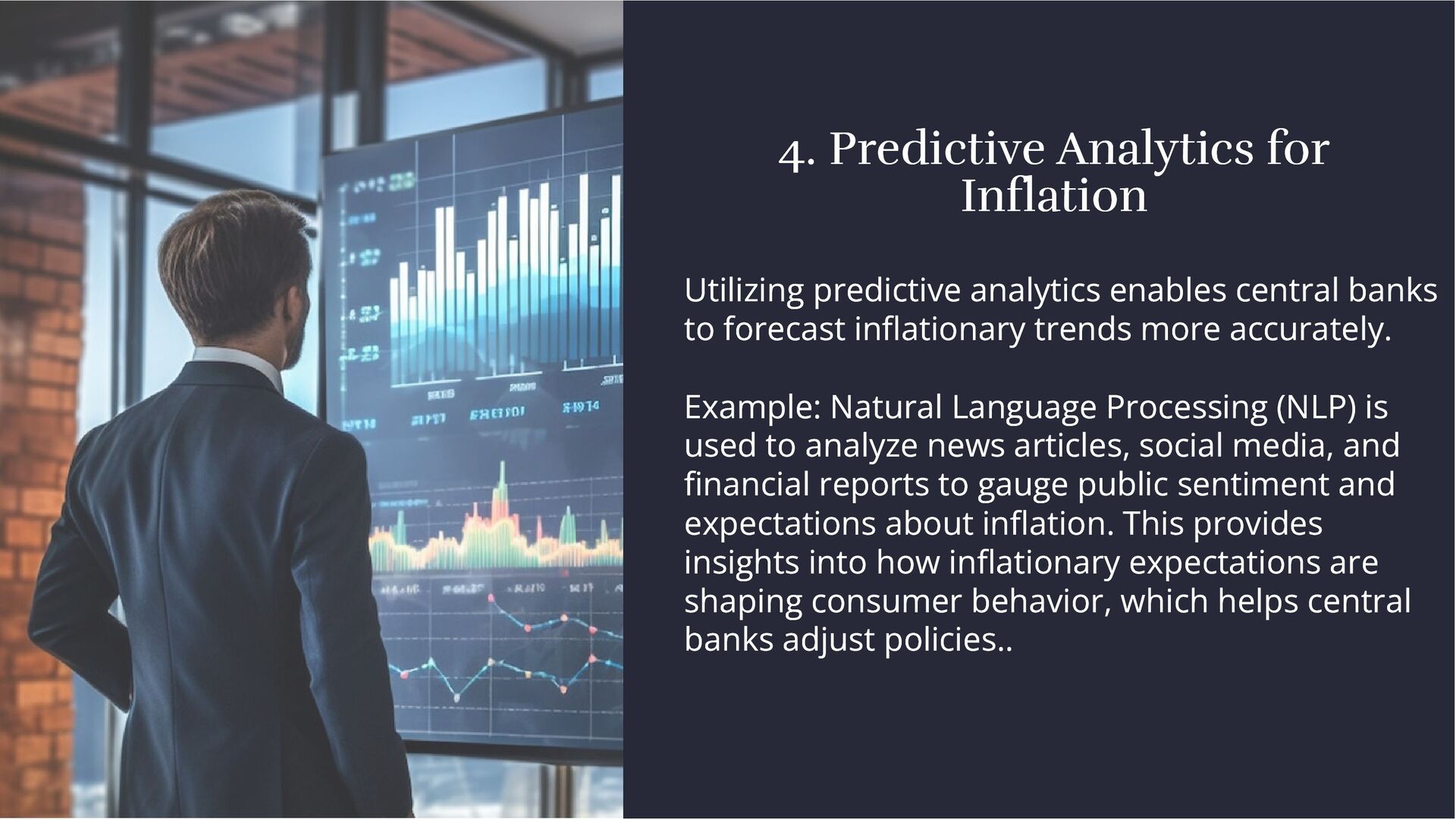
    Utilizing predictive analytics enables central banks to forecast inflationary trends more accurately. Example: Natural Language Processing (NLP) is used to analyze news articles, social media, and financial reports to gauge public sentiment and expectations about inflation. This provides insights into how inflationary expectations are shaping consumer behavior, which helps central banks adjust policies.. Utilizing predictive analytics enables central banks to forecast inflationary trends more accurately. Example: Natural Language Processing (NLP) is used to analyze news articles, social media, and financial reports to gauge public sentiment and expectations about inflation. This provides insights into how inflationary expectations are shaping consumer behavior, which helps central banks adjust policies..
  6. 5. Real-Time Economic Monitoring 5. Real-Time Economic Monitoring Big data

    sourceslike credit card transactions, online retail prices, and transportation data are processed in real- time using data science tools. These data sets provide instant indicators of price changes, allowing policymakers to track inflation developments much faster than traditional surveys. Big data sourceslike credit card transactions, online retail prices, and transportation data are processed in real- time using data science tools. These data sets provide instant indicators of price changes, allowing policymakers to track inflation developments much faster than traditional surveys.
  7. Limitations and Challenges Limitations and Challenges Despite its advantages, data

    science in monetary policy faces challenges such as data quality and availability, model interpretability, and potential overfitting. Reliance on historical data may not capture unprecedented events, like pandemics or geopolitical crises. Additionally, central banks must ensure ethical data use, safeguard privacy, and maintain transparency to build public trust and avoid biases in decision-making. Continuous model validation is essential to adapt to rapidly changing economic conditions. Despite its advantages, data science in monetary policy faces challenges such as data quality and availability, model interpretability, and potential overfitting. Reliance on historical data may not capture unprecedented events, like pandemics or geopolitical crises. Additionally, central banks must ensure ethical data use, safeguard privacy, and maintain transparency to build public trust and avoid biases in decision-making. Continuous model validation is essential to adapt to rapidly changing economic conditions.
  8. As data science continues to evolve, its integration into monetary

    policy will deepen. Embracing these transformative use cases will empower policymakers to navigate complex economic challenges with greater precision and agility. As data science continues to evolve, its integration into monetary policy will deepen. Embracing these transformative use cases will empower policymakers to navigate complex economic challenges with greater precision and agility. Conclusion: The Future of Data Science in Monetary policy Conclusion: The Future of Data Science in Monetary policy