millions of people share articles, videos, and images — but what drives that impulse? Behind every viral post lies a complex interplay of neuroscience, emotion, and social psychology. This document explores the science of sharing: why we do it, what triggers it, and how the world's most successful campaigns harness these forces to create content that spreads like wildfire. PSYCHOLOGY MARKETING CASE STUDIES
more than a digital habit — it is a deeply social act rooted in how humans relate to one another. We share to signal who we are, what we value, and how we wish to be perceived. Every post, retweet, or forwarded article is a small act of selfpresentation, carefully curated to shape our reputation within our social circles. Social Signalling Shared Reality Neural Reward Sharing is motivated by Humans share to align their inner Neuroscience confirms that sharing reputational concerns and self- states with others. By broadcasting activates social processing centres presentation. We curate content to what we feel, we seek validation in the brain. The act of transmitting reflect our identity, values, and and connection — creating a information to others triggers social standing. A shared article collective experience that dopamine release, making sharing about climate change signals reinforces social bonds and intrinsically rewarding — much like environmental awareness; a funny reduces isolation. a social currency we spend to gain meme signals humour and cultural fluency. approval.
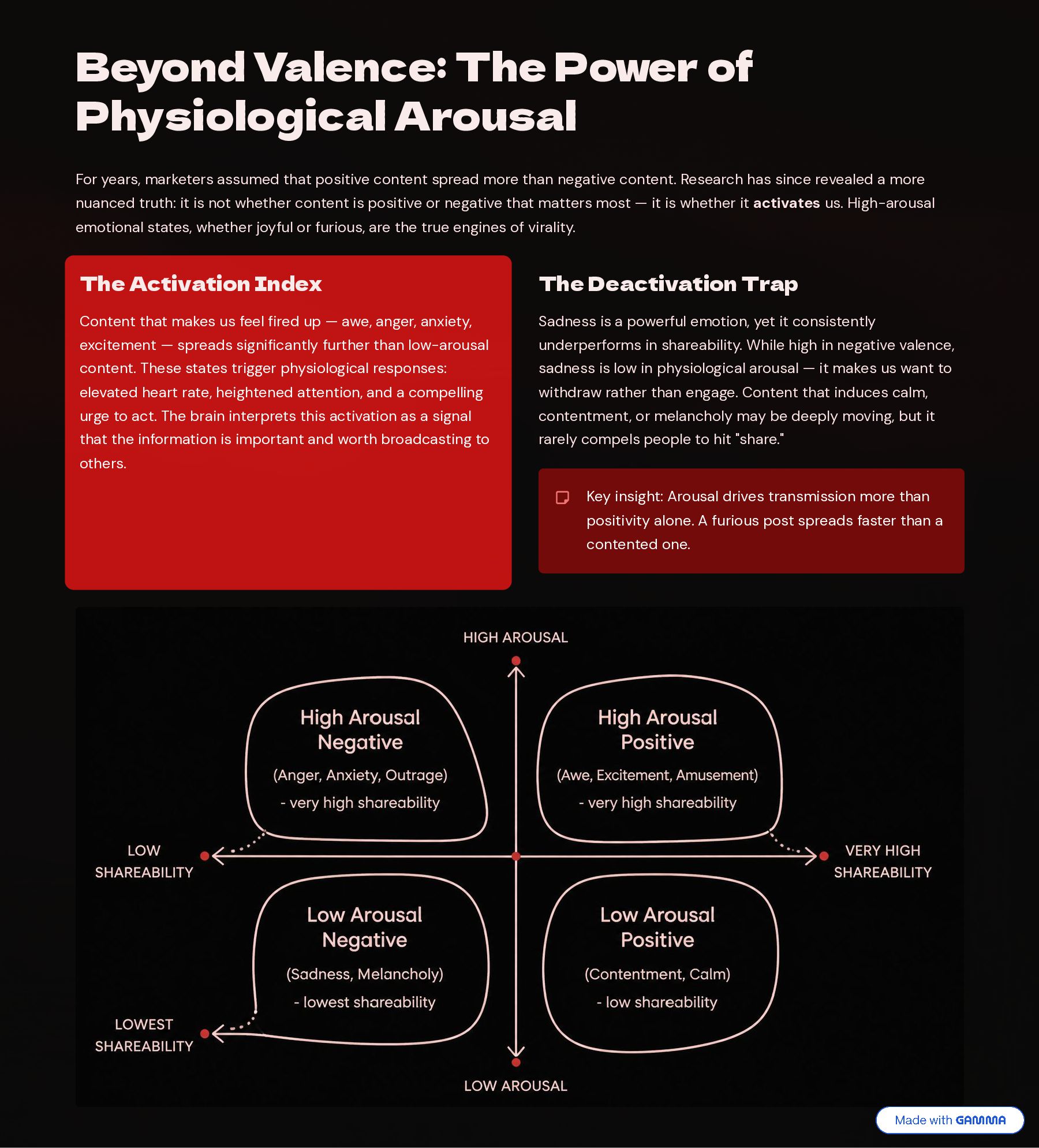
assumed that positive content spread more than negative content. Research has since revealed a more nuanced truth: it is not whether content is positive or negative that matters most — it is whether it activates us. High-arousal emotional states, whether joyful or furious, are the true engines of virality. The Activation Index The Deactivation Trap Content that makes us feel fired up — awe, anger, anxiety, Sadness is a powerful emotion, yet it consistently excitement — spreads significantly further than low-arousal underperforms in shareability. While high in negative valence, content. These states trigger physiological responses: sadness is low in physiological arousal — it makes us want to elevated heart rate, heightened attention, and a compelling withdraw rather than engage. Content that induces calm, urge to act. The brain interprets this activation as a signal contentment, or melancholy may be deeply moving, but it that the information is important and worth broadcasting to rarely compels people to hit "share." others. Key insight: Arousal drives transmission more than positivity alone. A furious post spreads faster than a contented one.
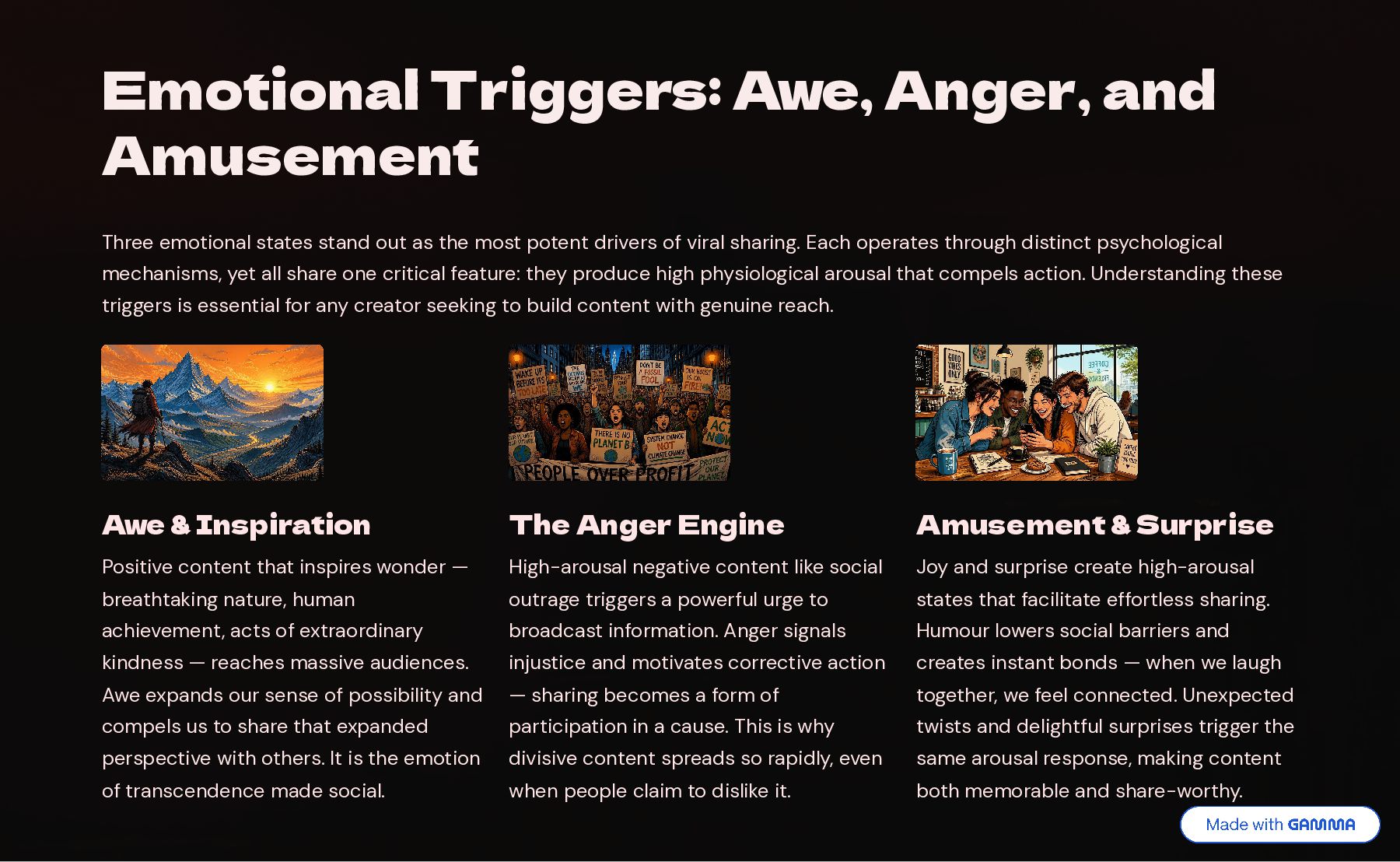
out as the most potent drivers of viral sharing. Each operates through distinct psychological mechanisms, yet all share one critical feature: they produce high physiological arousal that compels action. Understanding these triggers is essential for any creator seeking to build content with genuine reach. Awe & Inspiration The Anger Engine Amusement & Surprise Positive content that inspires wonder — High-arousal negative content like social Joy and surprise create high-arousal breathtaking nature, human outrage triggers a powerful urge to states that facilitate effortless sharing. achievement, acts of extraordinary broadcast information. Anger signals Humour lowers social barriers and kindness — reaches massive audiences. injustice and motivates corrective action creates instant bonds — when we laugh Awe expands our sense of possibility and — sharing becomes a form of together, we feel connected. Unexpected compels us to share that expanded participation in a cause. This is why twists and delightful surprises trigger the perspective with others. It is the emotion divisive content spreads so rapidly, even same arousal response, making content of transcendence made social. when people claim to dislike it. both memorable and share-worthy.
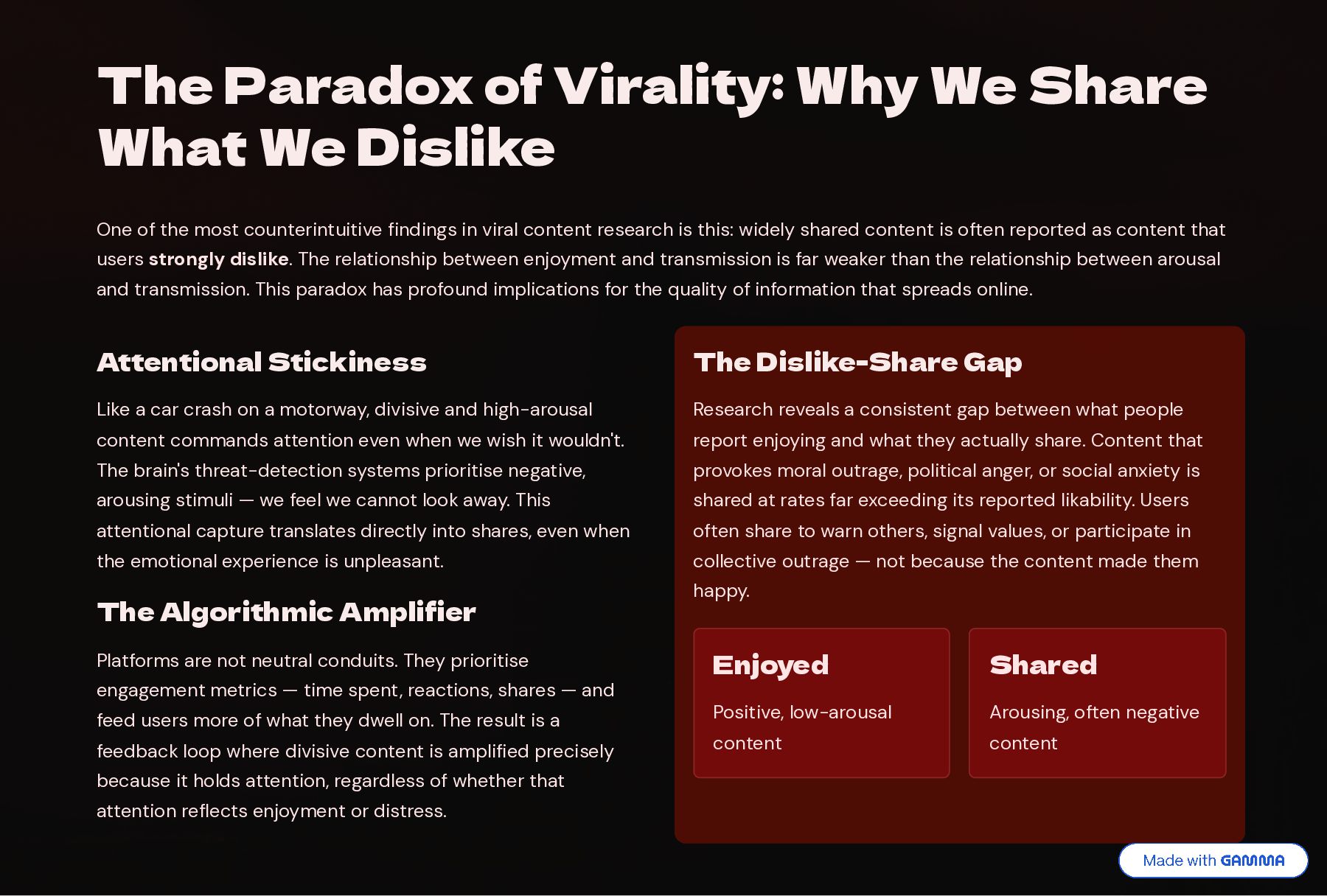
One of the most counterintuitive findings in viral content research is this: widely shared content is often reported as content that users strongly dislike. The relationship between enjoyment and transmission is far weaker than the relationship between arousal and transmission. This paradox has profound implications for the quality of information that spreads online. Attentional Stickiness The Dislike-Share Gap Like a car crash on a motorway, divisive and high-arousal Research reveals a consistent gap between what people content commands attention even when we wish it wouldn't. report enjoying and what they actually share. Content that The brain's threat-detection systems prioritise negative, provokes moral outrage, political anger, or social anxiety is arousing stimuli — we feel we cannot look away. This shared at rates far exceeding its reported likability. Users attentional capture translates directly into shares, even when often share to warn others, signal values, or participate in the emotional experience is unpleasant. collective outrage — not because the content made them The Algorithmic Amplifier Platforms are not neutral conduits. They prioritise engagement metrics — time spent, reactions, shares — and feed users more of what they dwell on. The result is a feedback loop where divisive content is amplified precisely because it holds attention, regardless of whether that attention reflects enjoyment or distress. happy. Enjoyed Shared Positive, low-arousal Arousing, often negative content content
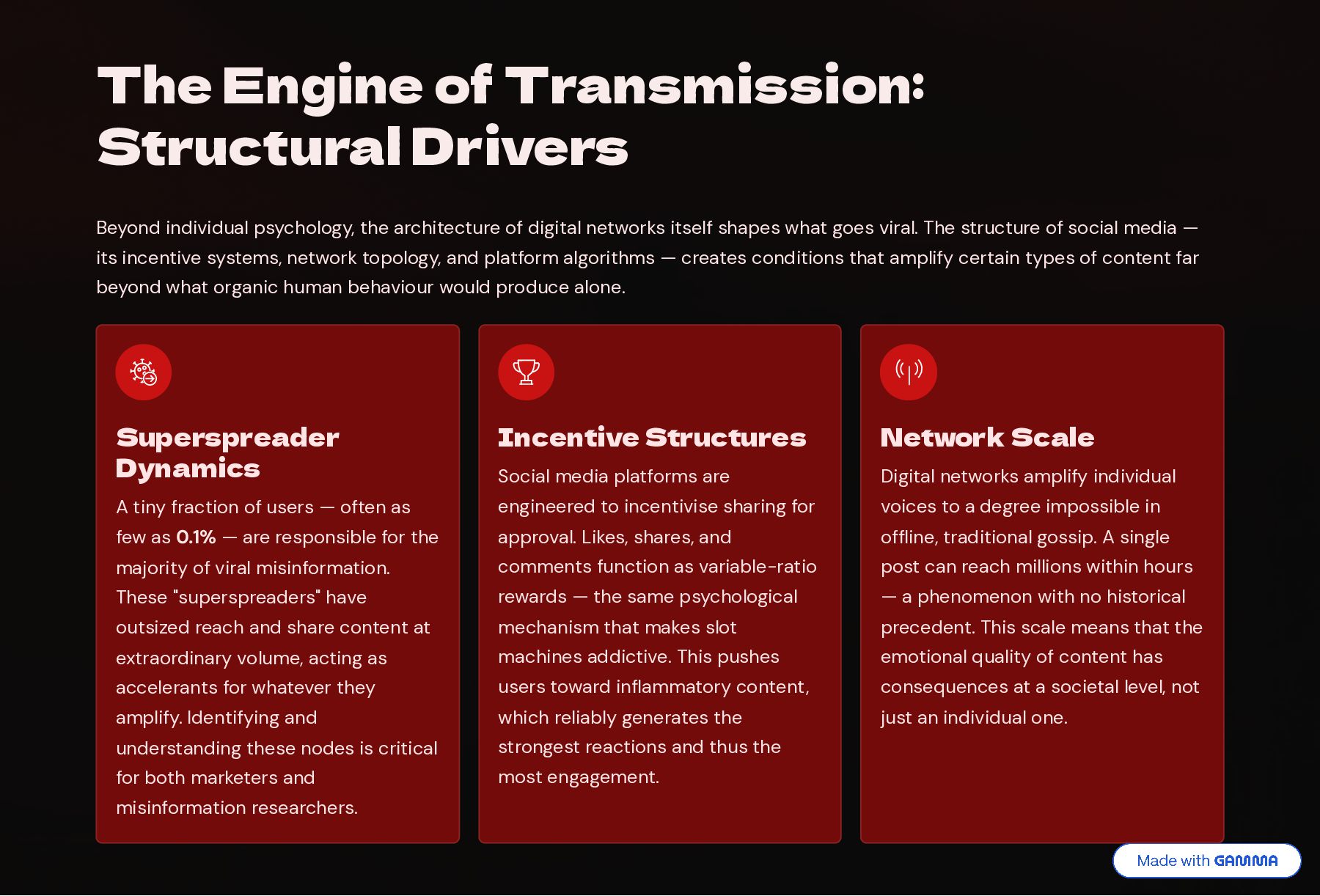
architecture of digital networks itself shapes what goes viral. The structure of social media — its incentive systems, network topology, and platform algorithms — creates conditions that amplify certain types of content far beyond what organic human behaviour would produce alone. Superspreader Dynamics Incentive Structures Network Scale Social media platforms are Digital networks amplify individual A tiny fraction of users — often as engineered to incentivise sharing for voices to a degree impossible in few as 0.1% — are responsible for the approval. Likes, shares, and offline, traditional gossip. A single majority of viral misinformation. comments function as variable-ratio post can reach millions within hours These "superspreaders" have rewards — the same psychological — a phenomenon with no historical outsized reach and share content at mechanism that makes slot precedent. This scale means that the extraordinary volume, acting as machines addictive. This pushes emotional quality of content has accelerants for whatever they users toward inflammatory content, consequences at a societal level, not amplify. Identifying and which reliably generates the just an individual one. understanding these nodes is critical strongest reactions and thus the for both marketers and most engagement. misinformation researchers.
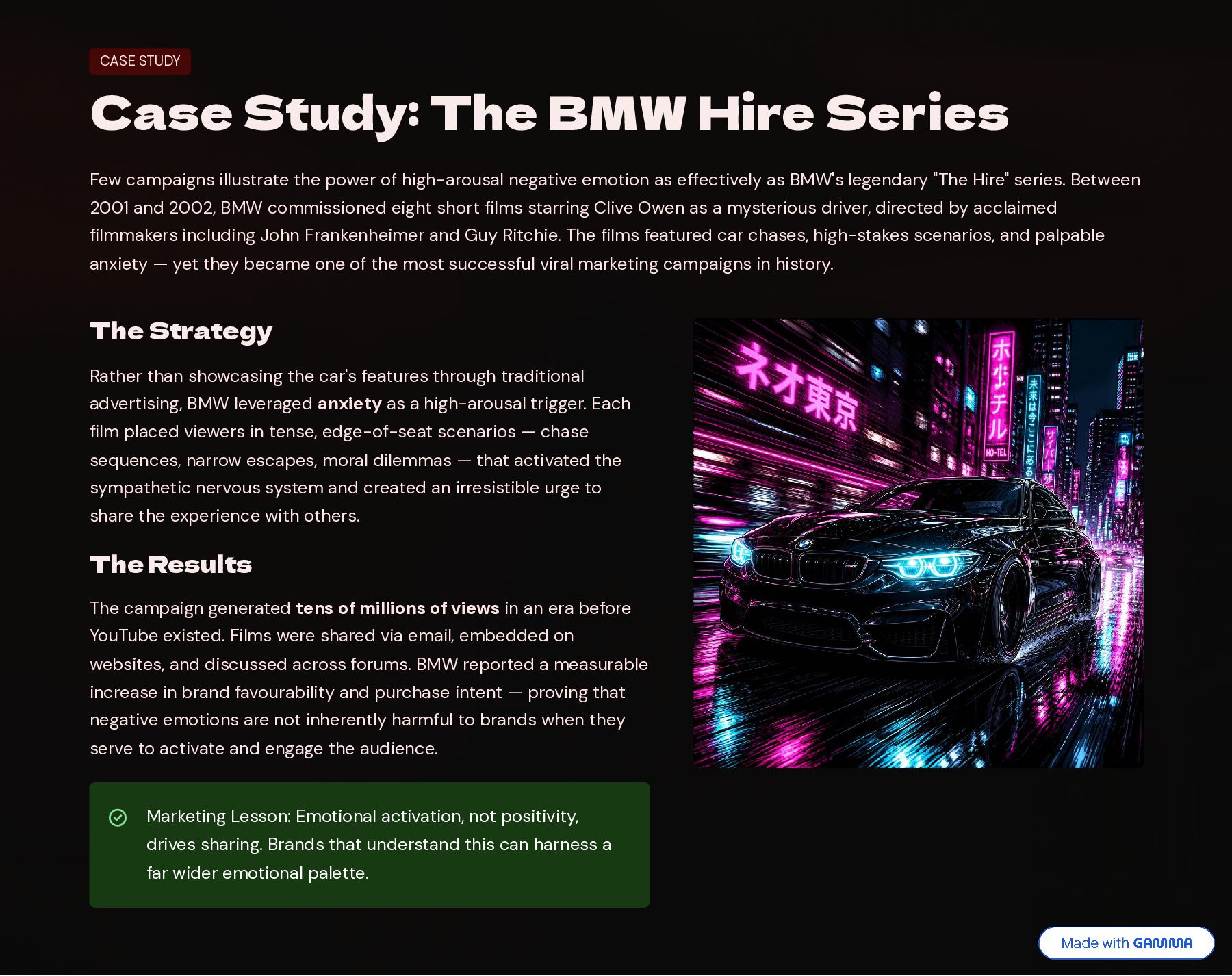
illustrate the power of high-arousal negative emotion as effectively as BMW's legendary "The Hire" series. Between 2001 and 2002, BMW commissioned eight short films starring Clive Owen as a mysterious driver, directed by acclaimed filmmakers including John Frankenheimer and Guy Ritchie. The films featured car chases, high-stakes scenarios, and palpable anxiety — yet they became one of the most successful viral marketing campaigns in history. The Strategy Rather than showcasing the car's features through traditional advertising, BMW leveraged anxiety as a high-arousal trigger. Each film placed viewers in tense, edge-of-seat scenarios — chase sequences, narrow escapes, moral dilemmas — that activated the sympathetic nervous system and created an irresistible urge to share the experience with others. The Results The campaign generated tens of millions of views in an era before YouTube existed. Films were shared via email, embedded on websites, and discussed across forums. BMW reported a measurable increase in brand favourability and purchase intent — proving that negative emotions are not inherently harmful to brands when they serve to activate and engage the audience. Marketing Lesson: Emotional activation, not positivity, drives sharing. Brands that understand this can harness a far wider emotional palette.
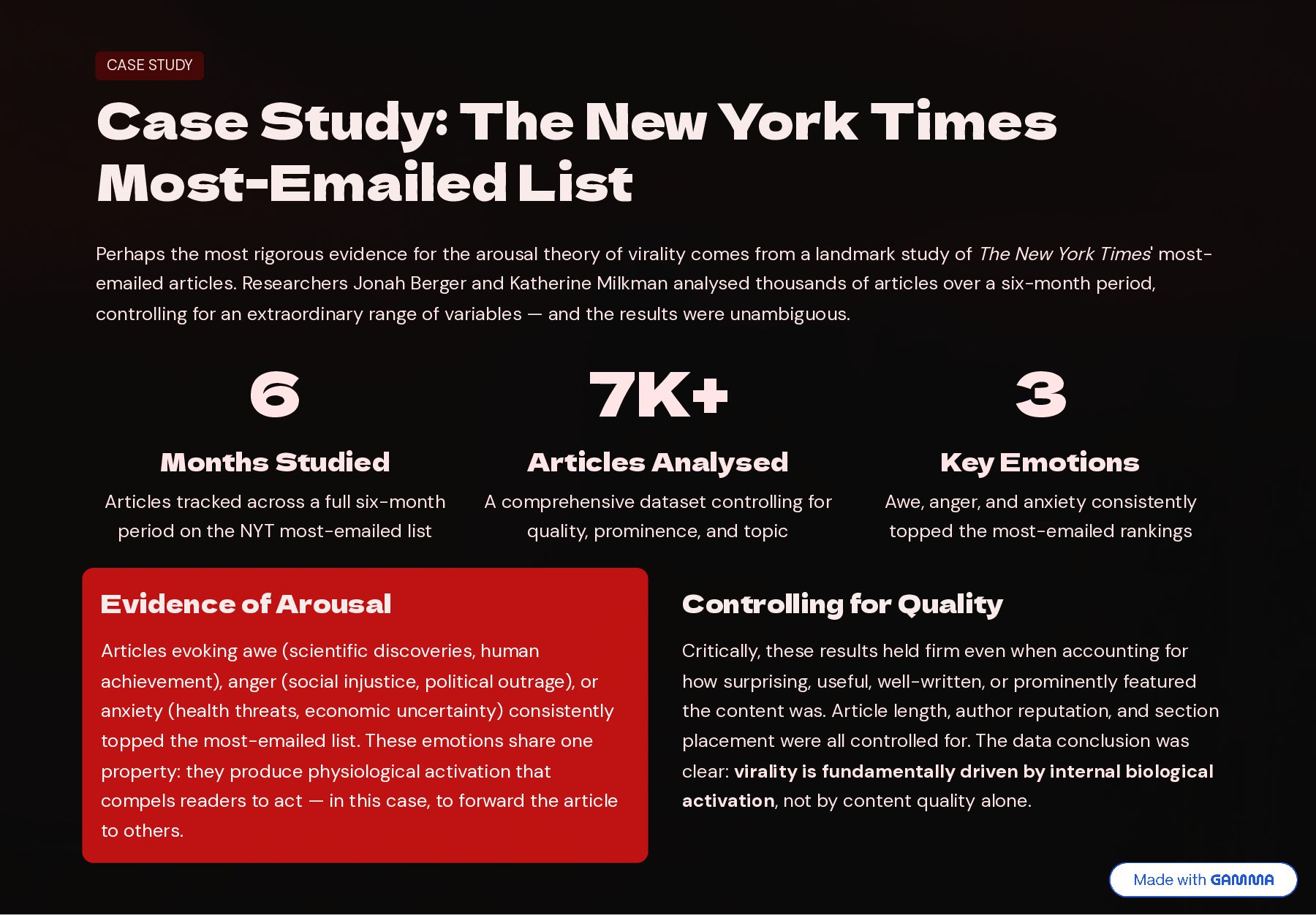
Perhaps the most rigorous evidence for the arousal theory of virality comes from a landmark study of The New York Times' mostemailed articles. Researchers Jonah Berger and Katherine Milkman analysed thousands of articles over a six-month period, controlling for an extraordinary range of variables — and the results were unambiguous. 6 7K+ 3 Months Studied Articles Analysed Key Emotions Articles tracked across a full six-month A comprehensive dataset controlling for Awe, anger, and anxiety consistently period on the NYT most-emailed list quality, prominence, and topic topped the most-emailed rankings Evidence of Arousal Controlling for Quality Articles evoking awe (scientific discoveries, human Critically, these results held firm even when accounting for achievement), anger (social injustice, political outrage), or how surprising, useful, well-written, or prominently featured anxiety (health threats, economic uncertainty) consistently the content was. Article length, author reputation, and section topped the most-emailed list. These emotions share one placement were all controlled for. The data conclusion was property: they produce physiological activation that clear: virality is fundamentally driven by internal biological compels readers to act — in this case, to forward the article activation, not by content quality alone. to others.
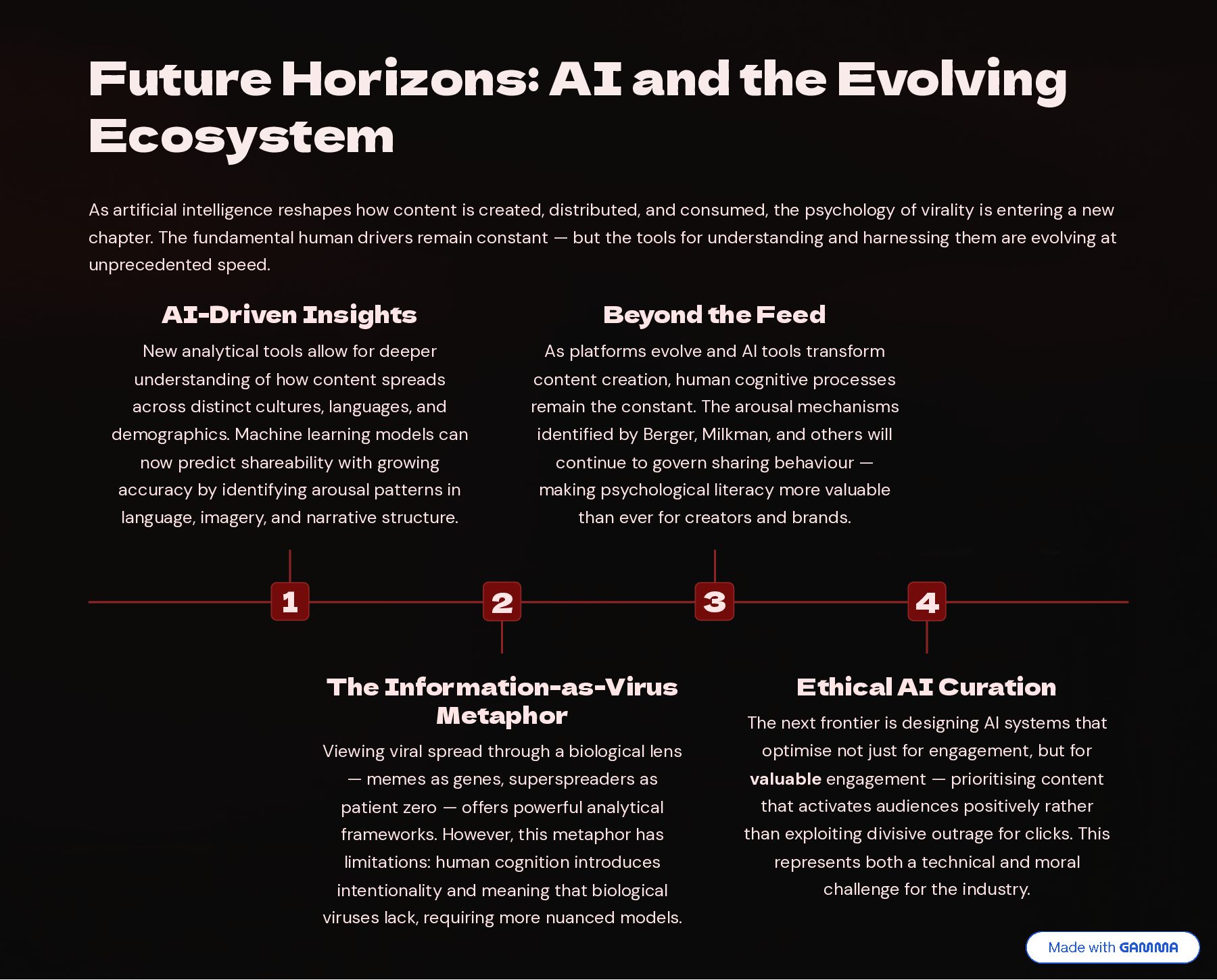
reshapes how content is created, distributed, and consumed, the psychology of virality is entering a new chapter. The fundamental human drivers remain constant — but the tools for understanding and harnessing them are evolving at unprecedented speed. AI-Driven Insights Beyond the Feed New analytical tools allow for deeper As platforms evolve and AI tools transform understanding of how content spreads content creation, human cognitive processes across distinct cultures, languages, and remain the constant. The arousal mechanisms demographics. Machine learning models can identified by Berger, Milkman, and others will now predict shareability with growing continue to govern sharing behaviour — accuracy by identifying arousal patterns in making psychological literacy more valuable language, imagery, and narrative structure. than ever for creators and brands. 1 2 3 4 The Information-as-Virus Metaphor The next frontier is designing AI systems that Viewing viral spread through a biological lens optimise not just for engagement, but for — memes as genes, superspreaders as valuable engagement — prioritising content patient zero — offers powerful analytical that activates audiences positively rather frameworks. However, this metaphor has than exploiting divisive outrage for clicks. This limitations: human cognition introduces represents both a technical and moral intentionality and meaning that biological challenge for the industry. viruses lack, requiring more nuanced models. Ethical AI Curation
content is not merely an academic exercise — it is a responsibility. Creators, marketers, and platforms hold the power to shape what spreads through our collective consciousness. With that power comes the obligation to choose wisely. Beyond Clicks The Ethical Call The goal is not merely to achieve Integral Brand Presence high shares, but to create content Emotional appeals perform best empowers creators to make that achieves both reach and when the brand is woven into the conscious choices. High-arousal positive brand impact. Virality narrative, not merely appended to it. positive triggers — awe, inspiration, without value is hollow — and As the BMW case demonstrates, the amusement — can achieve the same potentially harmful. Sustainable most effective viral content makes transmission rates as divisive success requires aligning emotional the brand an inseparable part of the outrage, without the societal cost. activation with genuine brand emotional experience — not a Choosing these triggers is not just purpose and audience benefit. sponsor of it. good ethics; it is good long-term Recognising the paradox of virality strategy for building lasting brand value. The most powerful viral content does not merely capture attention — it elevates the audience. Awe, inspiration, and genuine amusement activate us without dividing us. That is the highest form of virality to aspire to.


 eitanlees
 jonoalderson
 addyosmani
 sabderemane
 akademiya2063
 nwiizo
 bryan
 eileencodes
 sergeychernyshev
 katarinadahlin
 notwaldorf
 signer