Upgrade to Pro — share decks privately, control downloads, hide ads and more …

Лекция 2. Шаблоны (ч. 2)

Sponsored · Your Podcast. Everywhere. Effortlessly. Share. Educate. Inspire. Entertain. You do you. We'll handle the rest.
Avatar for Oleg Dashevskii Oleg Dashevskii
February 15, 2016
390

Лекция 2. Шаблоны (ч. 2)

ООП АФТИ 2015-2016. Семестр 2

Avatar for Oleg Dashevskii

Oleg Dashevskii

February 15, 2016
Tweet

More Decks by Oleg Dashevskii

Transcript

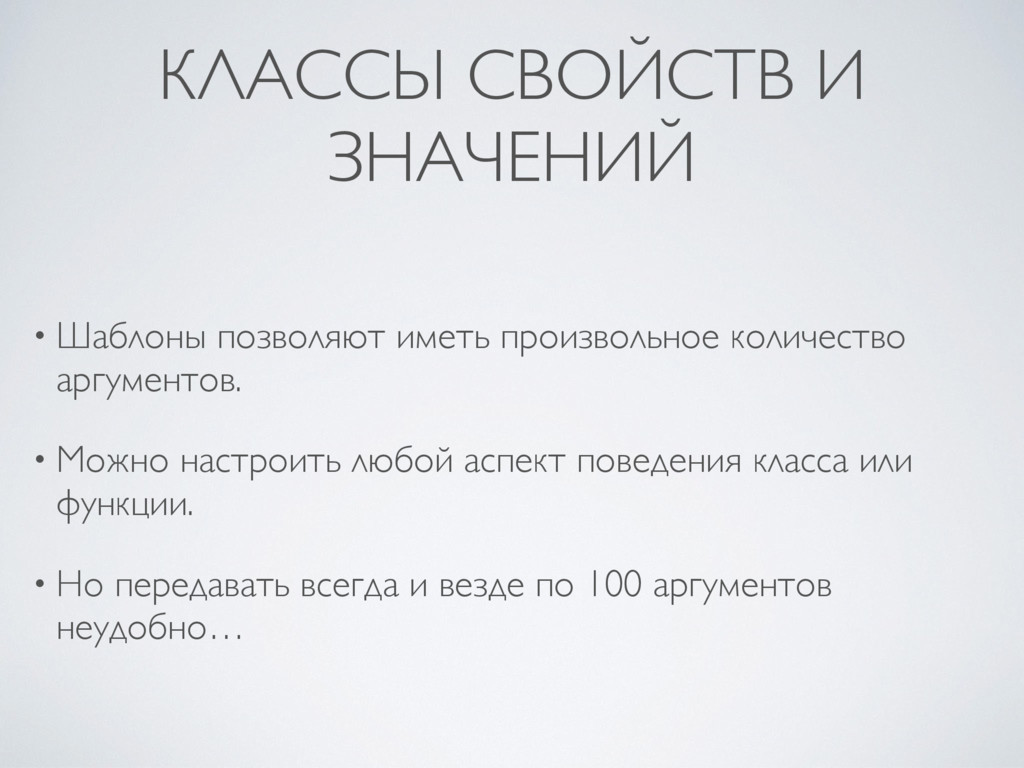
  1. КЛАССЫ СВОЙСТВ И ЗНАЧЕНИЙ • Шаблоны позволяют иметь произвольное количество

    аргументов. • Можно настроить любой аспект поведения класса или функции. • Но передавать всегда и везде по 100 аргументов неудобно…
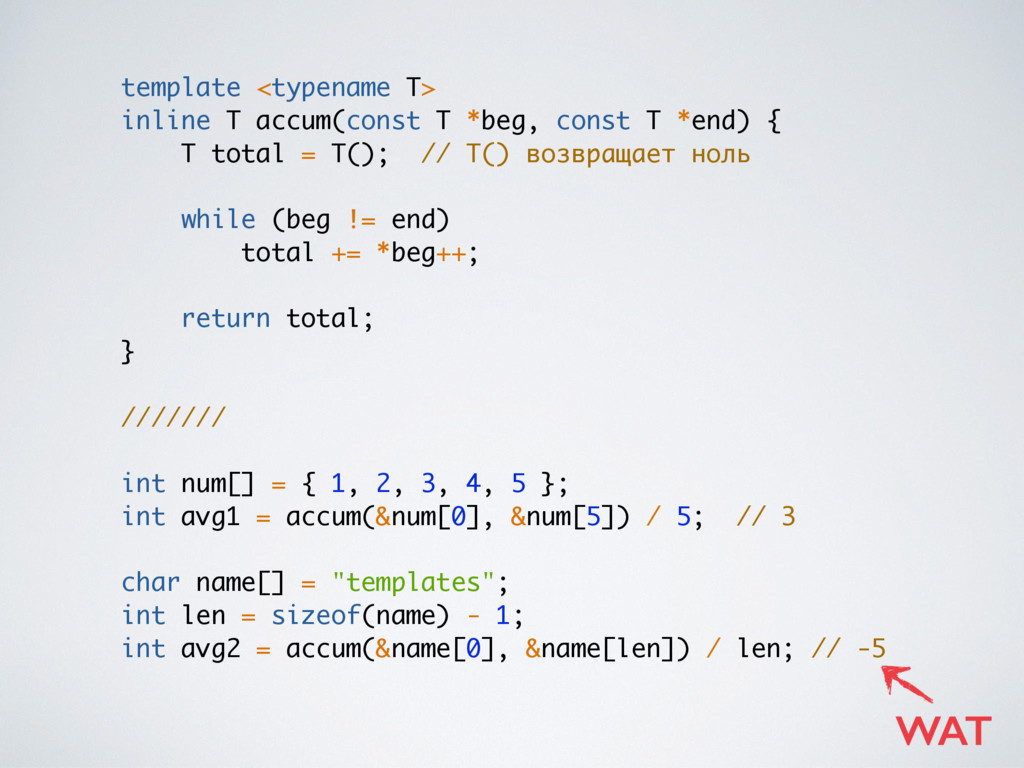
  2. WAT template <typename T> inline T accum(const T *beg, const

    T *end) { T total = T(); // T() возвращает ноль while (beg != end) total += *beg++; return total; } /////// int num[] = { 1, 2, 3, 4, 5 }; int avg1 = accum(&num[0], &num[5]) / 5; // 3 char name[] = "templates"; int len = sizeof(name) - 1; int avg2 = accum(&name[0], &name[len]) / len; // -5
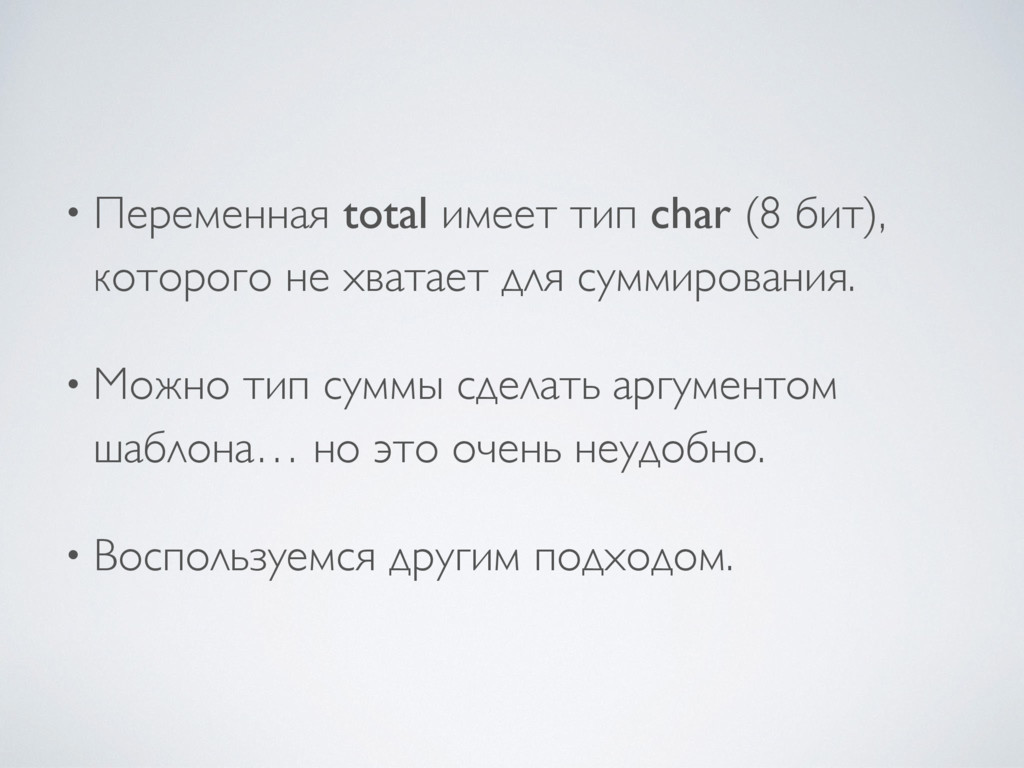
  3. • Переменная total имеет тип char (8 бит), которого не

    хватает для суммирования. • Можно тип суммы сделать аргументом шаблона… но это очень неудобно. • Воспользуемся другим подходом.
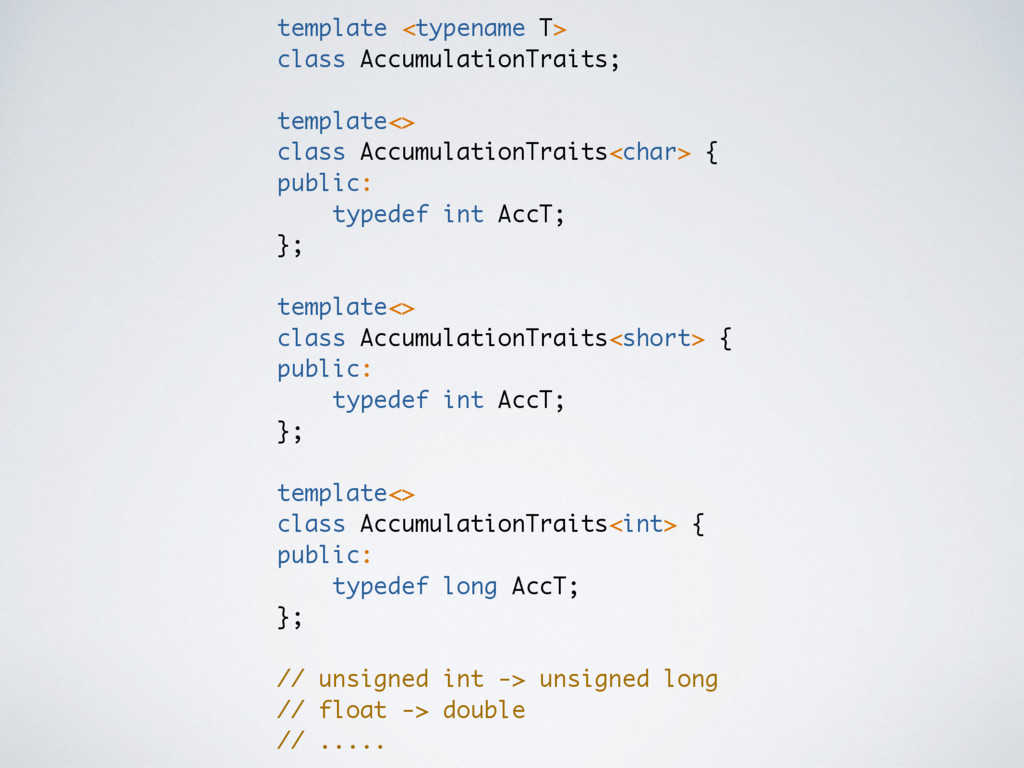
  4. template <typename T> class AccumulationTraits; template<> class AccumulationTraits<char> { public:

    typedef int AccT; }; template<> class AccumulationTraits<short> { public: typedef int AccT; }; template<> class AccumulationTraits<int> { public: typedef long AccT; }; // unsigned int -> unsigned long // float -> double // .....
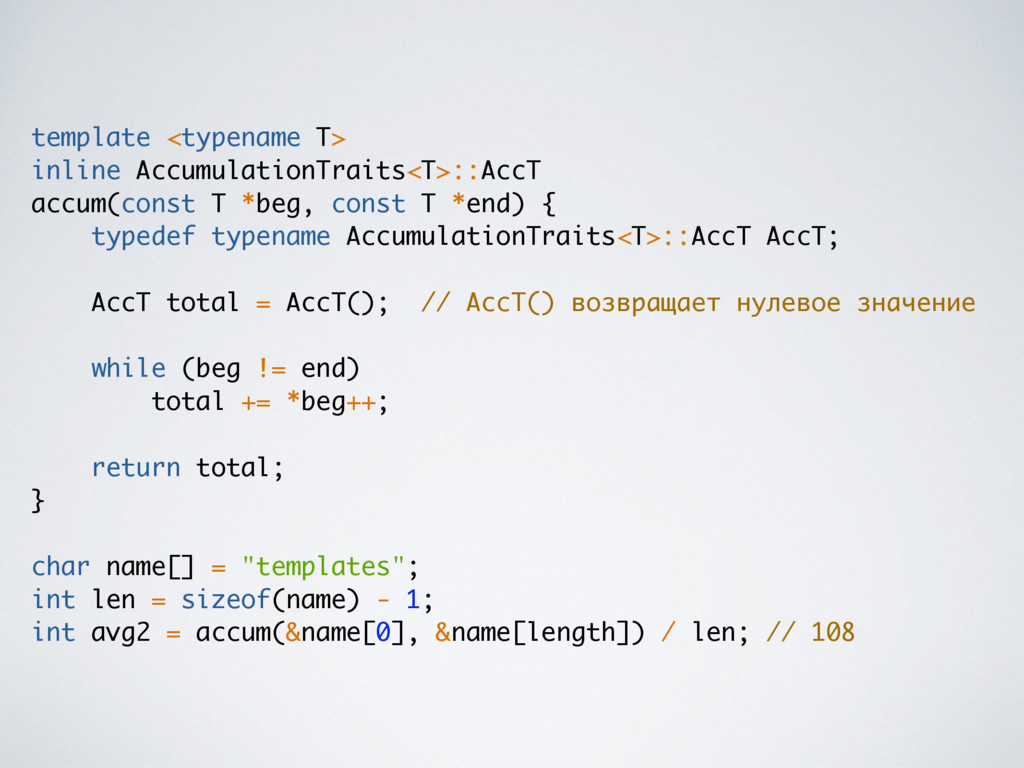
  5. template <typename T> inline AccumulationTraits<T>::AccT accum(const T *beg, const T

    *end) { typedef typename AccumulationTraits<T>::AccT AccT; AccT total = AccT(); // AccT() возвращает нулевое значение while (beg != end) total += *beg++; return total; } char name[] = "templates"; int len = sizeof(name) - 1; int avg2 = accum(&name[0], &name[length]) / len; // 108
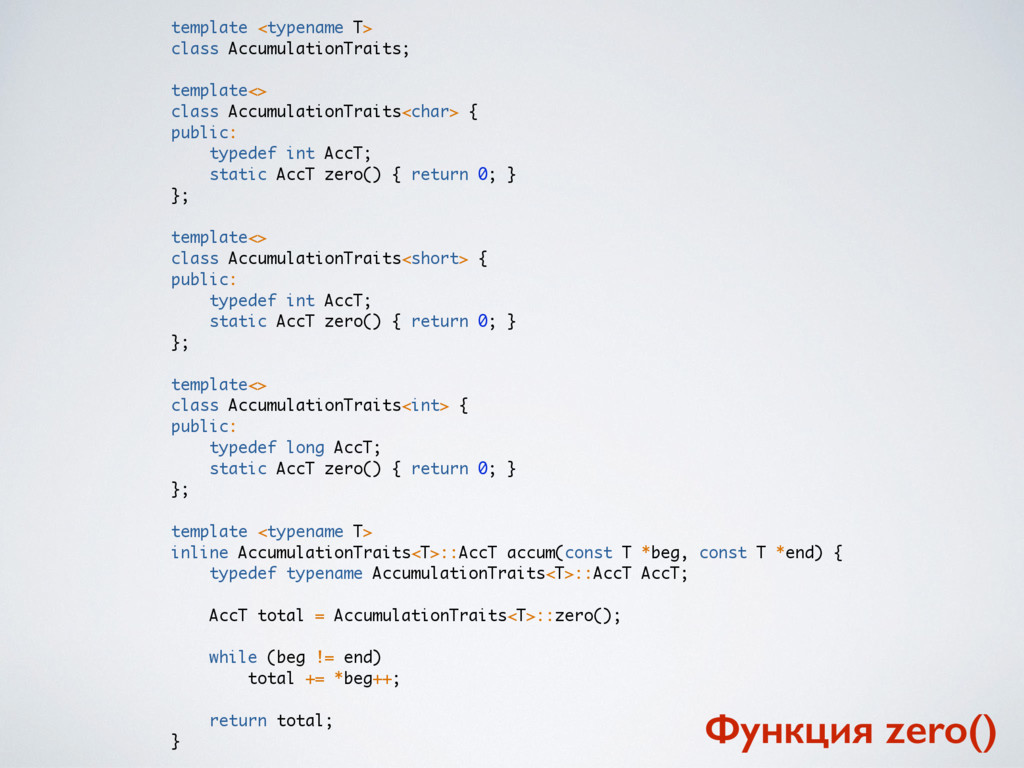
  6. template <typename T> class AccumulationTraits; template<> class AccumulationTraits<char> { public:

    typedef int AccT; static AccT zero() { return 0; } }; template<> class AccumulationTraits<short> { public: typedef int AccT; static AccT zero() { return 0; } }; template<> class AccumulationTraits<int> { public: typedef long AccT; static AccT zero() { return 0; } }; template <typename T> inline AccumulationTraits<T>::AccT accum(const T *beg, const T *end) { typedef typename AccumulationTraits<T>::AccT AccT; AccT total = AccumulationTraits<T>::zero(); while (beg != end) total += *beg++; return total; } Функция zero()
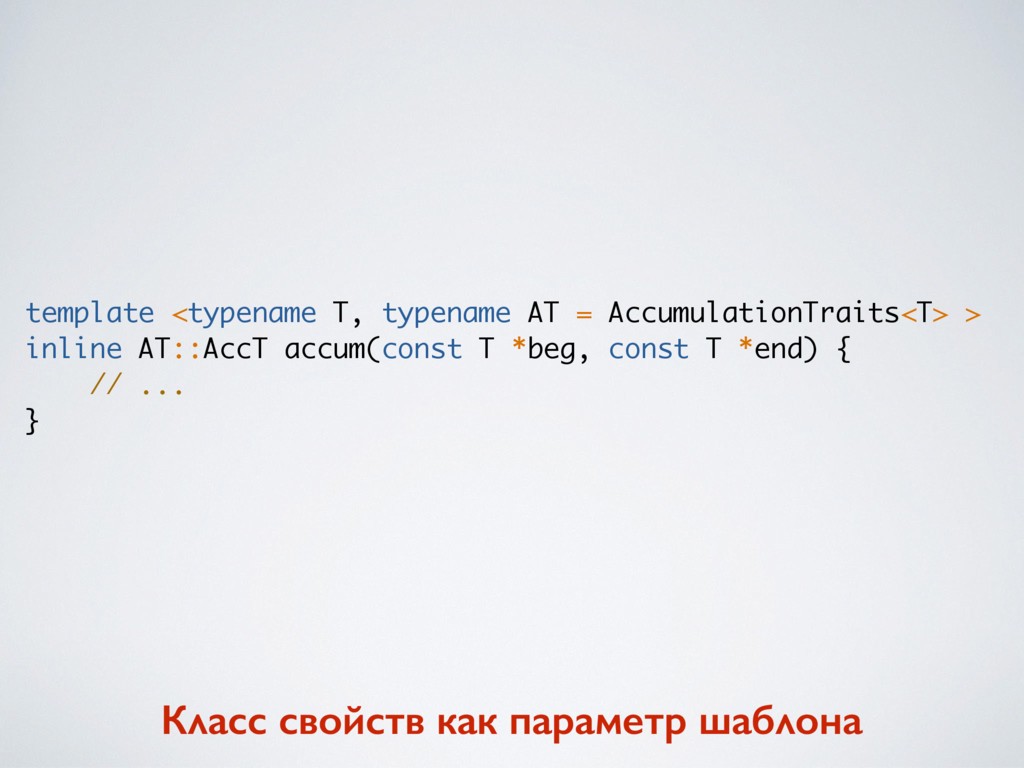
  7. template <typename T, typename AT = AccumulationTraits<T> > inline AT::AccT

    accum(const T *beg, const T *end) { // ... } Класс свойств как параметр шаблона
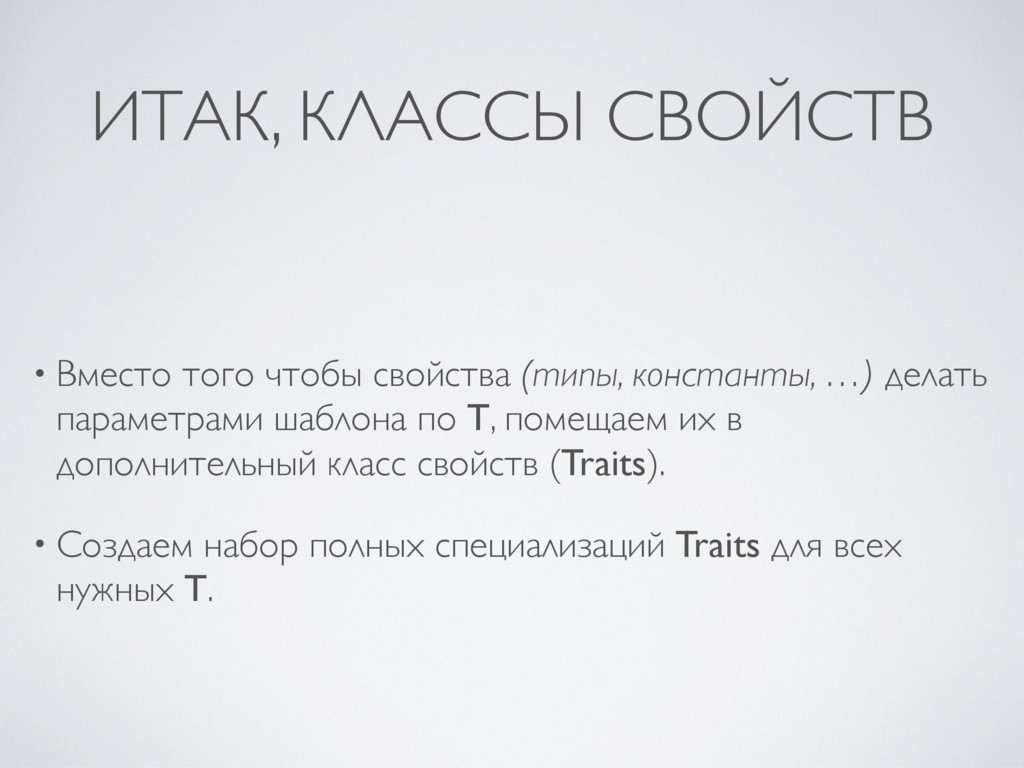
  8. • Вместо того чтобы свойства (типы, константы, …) делать параметрами

    шаблона по T, помещаем их в дополнительный класс свойств (Traits). • Создаем набор полных специализаций Traits для всех нужных T. ИТАК, КЛАССЫ СВОЙСТВ
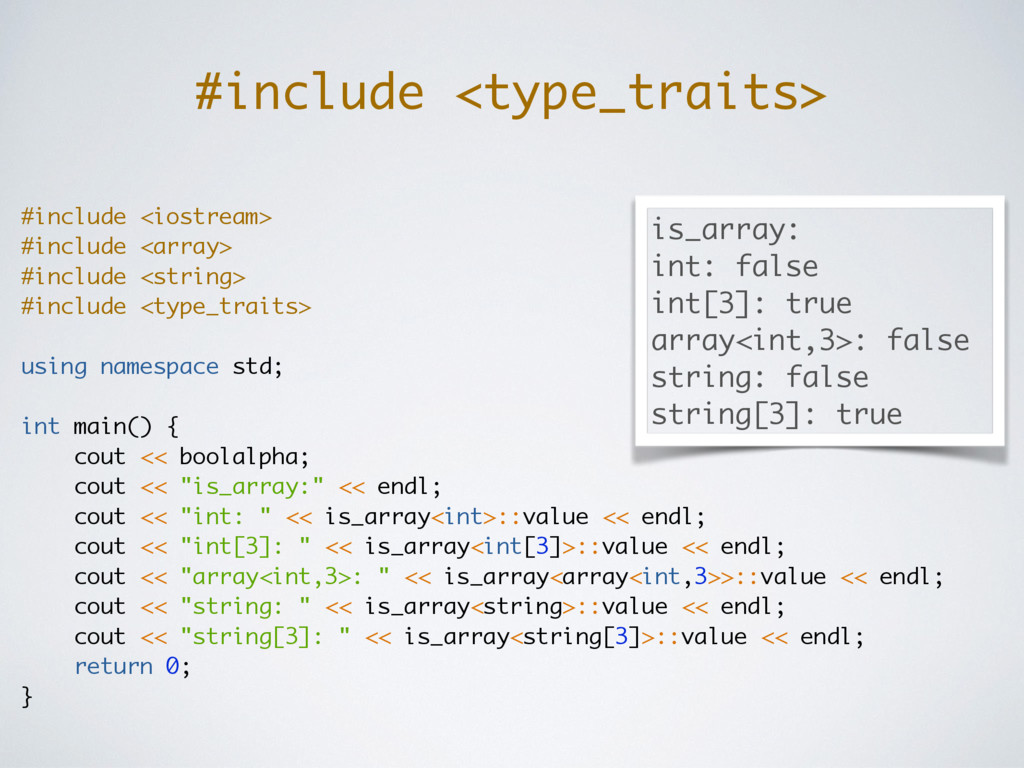
  9. #include <type_traits> #include <iostream> #include <array> #include <string> #include <type_traits>

    using namespace std; int main() { cout << boolalpha; cout << "is_array:" << endl; cout << "int: " << is_array<int>::value << endl; cout << "int[3]: " << is_array<int[3]>::value << endl; cout << "array<int,3>: " << is_array<array<int,3>>::value << endl; cout << "string: " << is_array<string>::value << endl; cout << "string[3]: " << is_array<string[3]>::value << endl; return 0; } is_array: int: false int[3]: true array<int,3>: false string: false string[3]: true
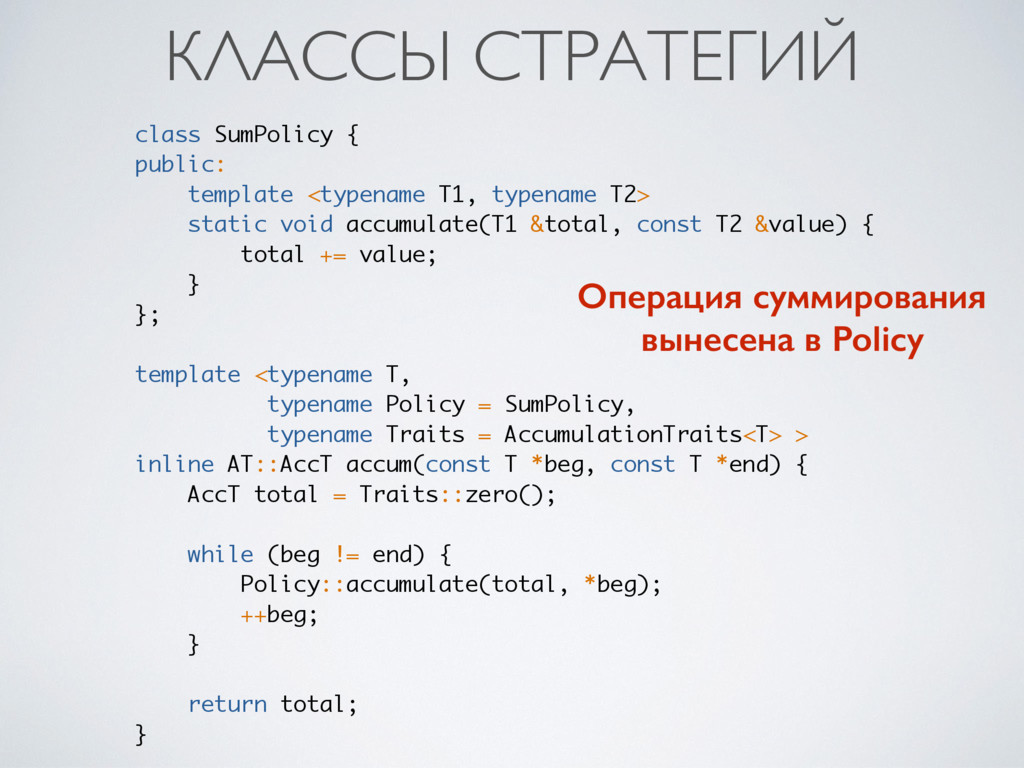
  10. КЛАССЫ СТРАТЕГИЙ Операция суммирования 
 вынесена в Policy class SumPolicy

    { public: template <typename T1, typename T2> static void accumulate(T1 &total, const T2 &value) { total += value; } }; template <typename T, typename Policy = SumPolicy, typename Traits = AccumulationTraits<T> > inline AT::AccT accum(const T *beg, const T *end) { AccT total = Traits::zero(); while (beg != end) { Policy::accumulate(total, *beg); ++beg; } return total; }
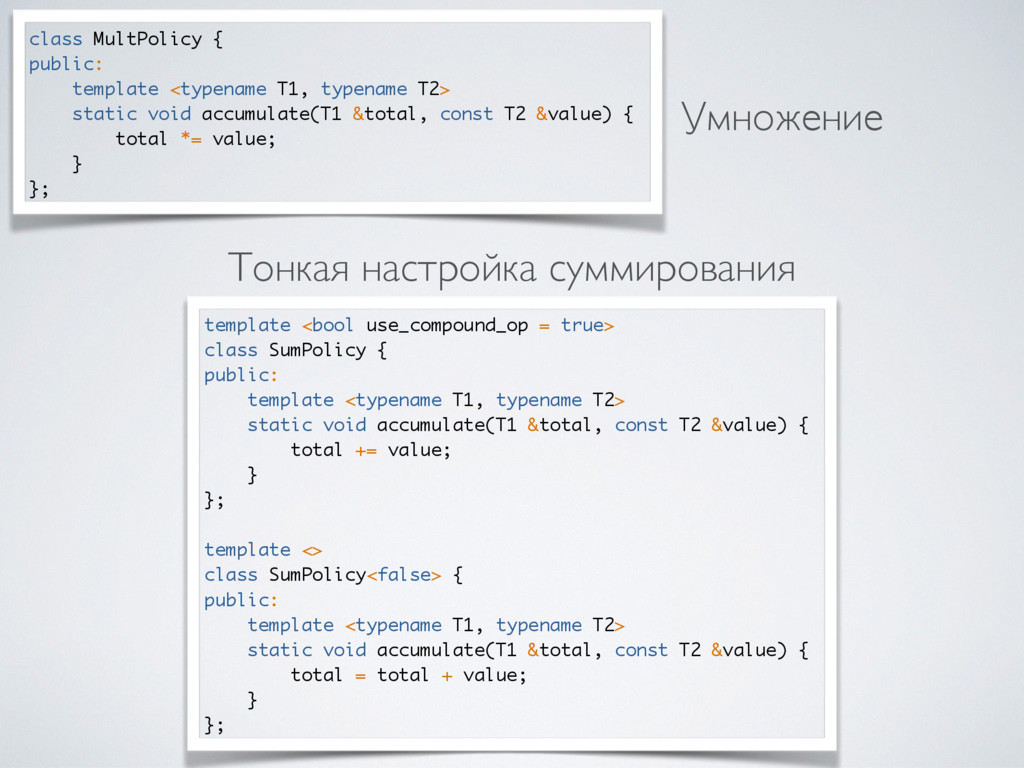
  11. template <bool use_compound_op = true> class SumPolicy { public: template

    <typename T1, typename T2> static void accumulate(T1 &total, const T2 &value) { total += value; } }; template <> class SumPolicy<false> { public: template <typename T1, typename T2> static void accumulate(T1 &total, const T2 &value) { total = total + value; } }; class MultPolicy { public: template <typename T1, typename T2> static void accumulate(T1 &total, const T2 &value) { total *= value; } }; Умножение Тонкая настройка суммирования
  12. #include <iostream> // std::cout int main() { int first[] =

    { 1, 2, 3, 4, 5}; int second[] = { 10, 20, 30, 40, 50}; int results[5]; for (int i = 0; i < 5; ++i) results[i] = first[i] + second[i]; for (int i = 0; i < 5; i++) std::cout << results[i] << ' '; std::cout << '\n'; return 0; }
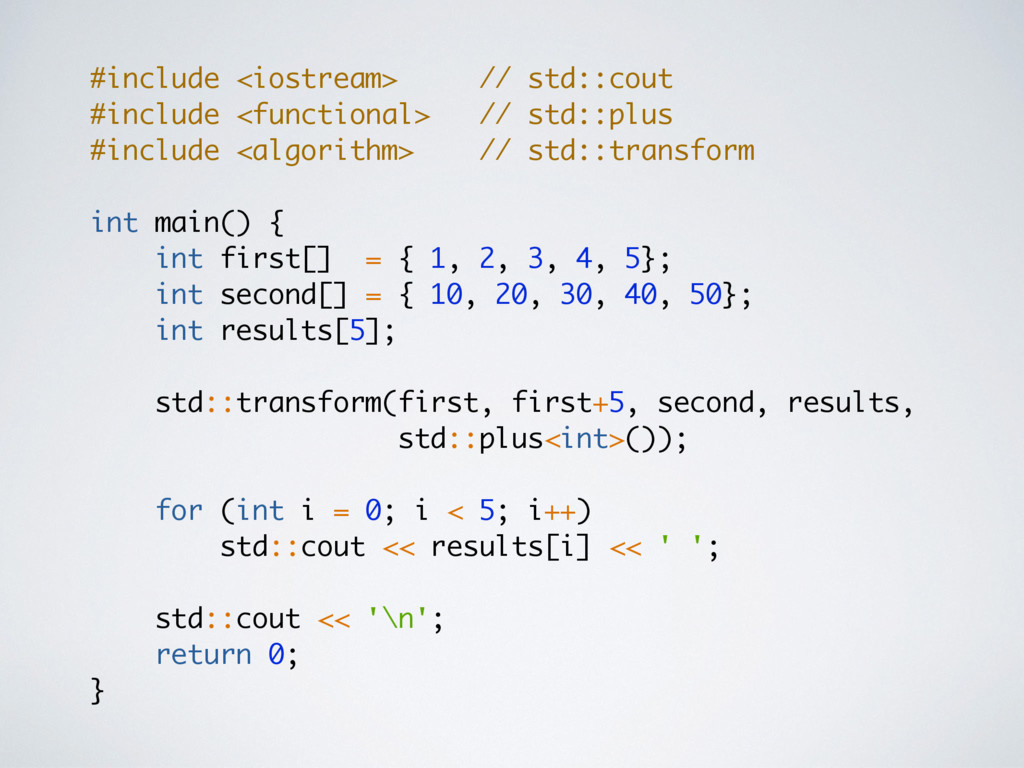
  13. #include <iostream> // std::cout #include <functional> // std::plus #include <algorithm>

    // std::transform int main() { int first[] = { 1, 2, 3, 4, 5}; int second[] = { 10, 20, 30, 40, 50}; int results[5]; std::transform(first, first+5, second, results, std::plus<int>()); for (int i = 0; i < 5; i++) std::cout << results[i] << ' '; std::cout << '\n'; return 0; }
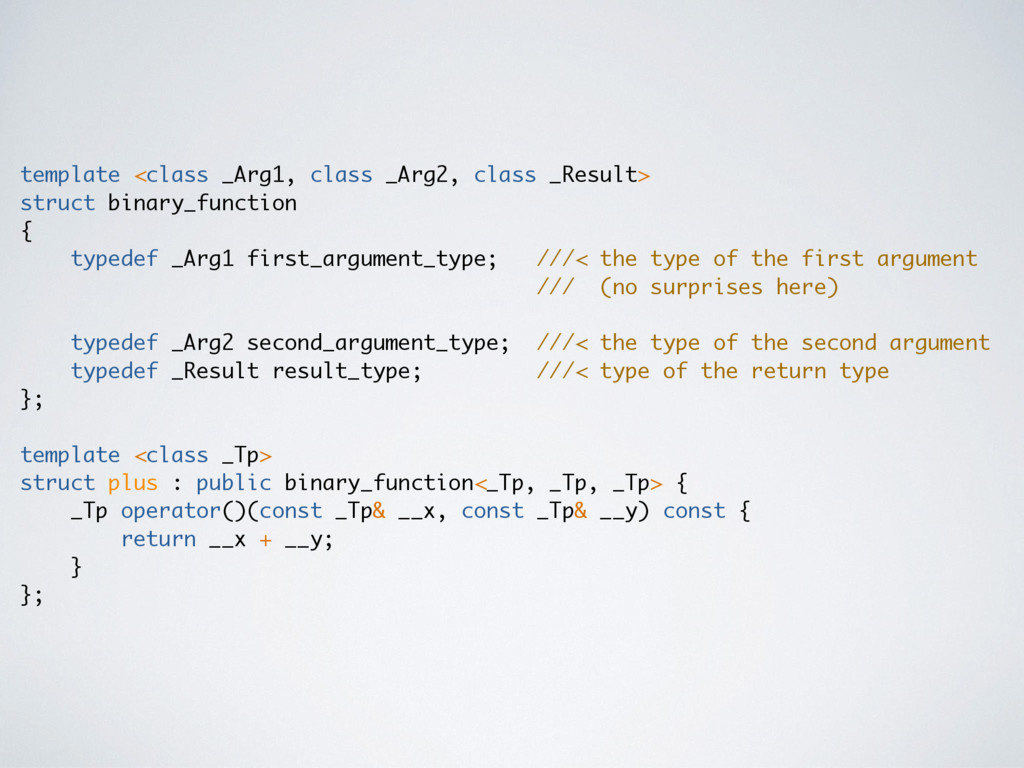
  14. template <class _Arg1, class _Arg2, class _Result> struct binary_function {

    typedef _Arg1 first_argument_type; ///< the type of the first argument /// (no surprises here) typedef _Arg2 second_argument_type; ///< the type of the second argument typedef _Result result_type; ///< type of the return type }; template <class _Tp> struct plus : public binary_function<_Tp, _Tp, _Tp> { _Tp operator()(const _Tp& __x, const _Tp& __y) const { return __x + __y; } };
  15. #include <iostream> #include <functional> int main() { int ary[] =

    { 1, 2, 3, 4, 5 }, res[5]; using namespace std::placeholders; // _1, _2, _3,... auto inc_10 = std::bind(std::plus<int>(), _1, 10); std::transform(ary, ary+5, res, inc_10); for (int x: res) std::cout << x << std::endl; // 11… 12… 13… 14… 15 return 0; } } Каррирование
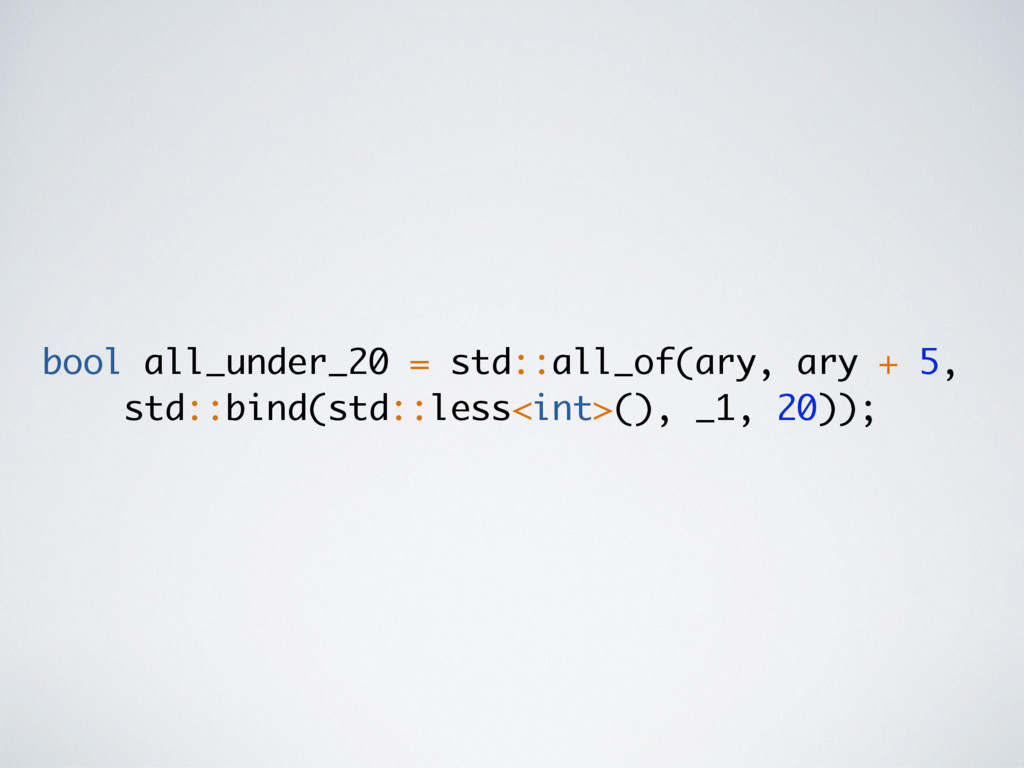
  16. bool all_under_20 = std::all_of(ary, ary + 5, [](int n) {

    return n < 20; }); Лямбда-функции
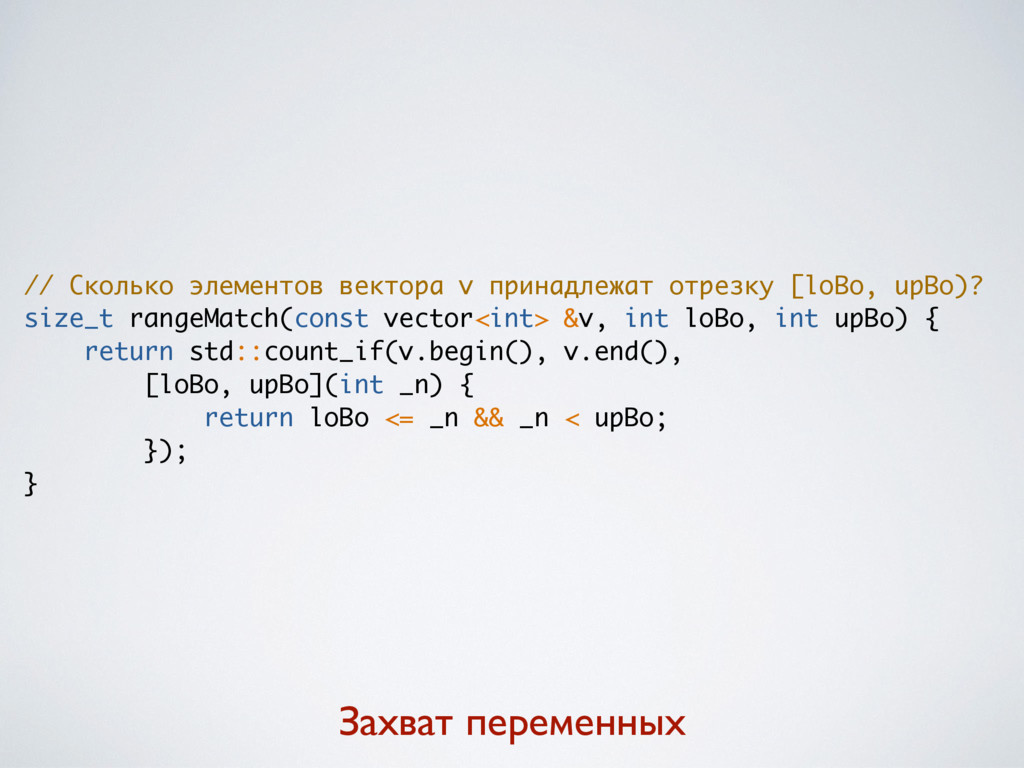
  17. // Сколько элементов вектора v принадлежат отрезку [loBo, upBo)? size_t

    rangeMatch(const vector<int> &v, int loBo, int upBo) { return std::count_if(v.begin(), v.end(), [loBo, upBo](int _n) { return loBo <= _n && _n < upBo; }); } Захват переменных
  18. [loBo, upBo](int _n) { return loBo <= _n && _n

    < upBo; } // примерно соответствует: struct AutomaticallyGenerated { AutomaticallyGenerated(int lo, int up) : loBo(lo), upBo(up) {} bool operator()(int _n) { return loBo <= _n && _n < upBo; } int loBo, upBo; };
  19. #include <iostream> #include <functional> int main() { int ary[] =

    { 1, 2, 3, 4, 5 }, res[5]; auto incGen = [] (int _val) -> std::function<int (int)> { return [_val] (int _n) -> int { return _n + _val; }; }; auto inc_10 = incGen(10); std::transform(ary, ary+5, res, inc_10); for (int x: res) std::cout << x << std::endl; // 11… 12… 13… 14… 15 return 0; } } Лямбды, генерирующие лямбды
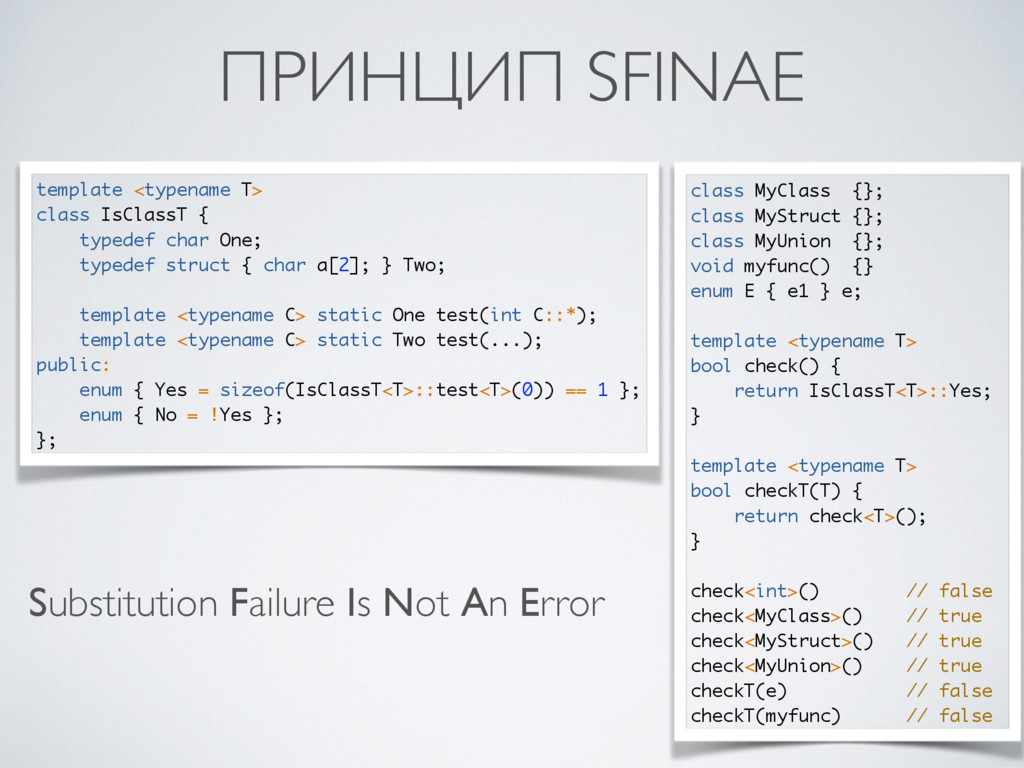
  20. ПРИНЦИП SFINAE class MyClass {}; class MyStruct {}; class MyUnion

    {}; void myfunc() {} enum E { e1 } e; template <typename T> bool check() { return IsClassT<T>::Yes; } template <typename T> bool checkT(T) { return check<T>(); } check<int>() // false check<MyClass>() // true check<MyStruct>() // true check<MyUnion>() // true checkT(e) // false checkT(myfunc) // false Substitution Failure Is Not An Error template <typename T> class IsClassT { typedef char One; typedef struct { char a[2]; } Two; template <typename C> static One test(int C::*); template <typename C> static Two test(...); public: enum { Yes = sizeof(IsClassT<T>::test<T>(0)) == 1 }; enum { No = !Yes }; };
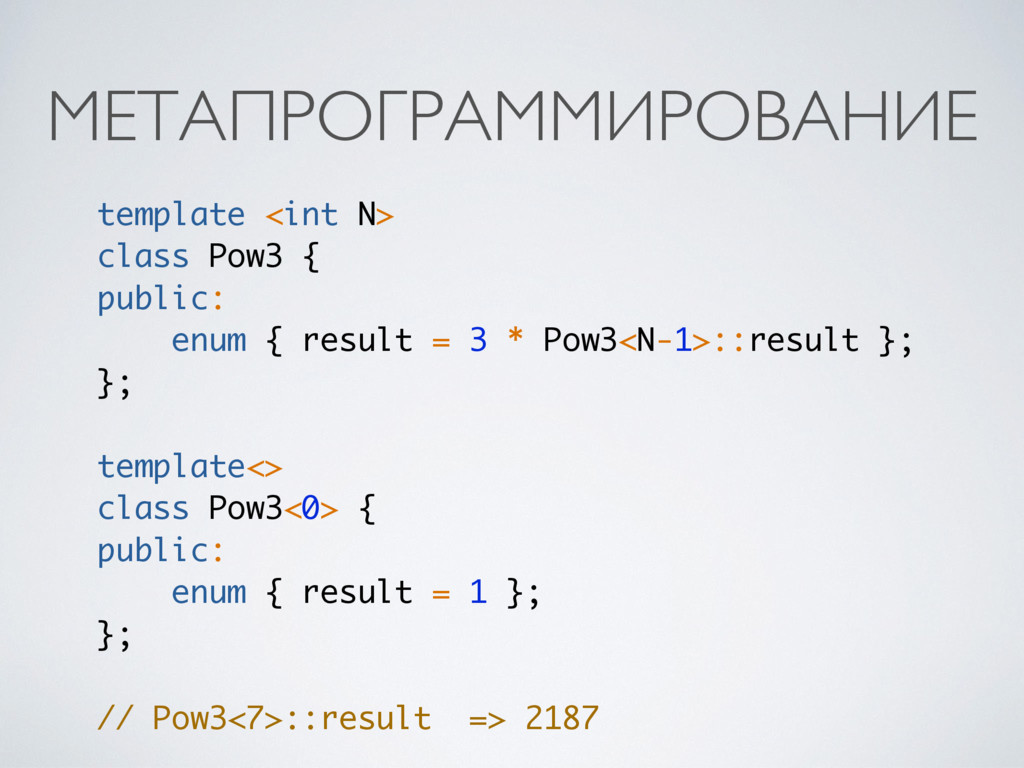
  21. МЕТАПРОГРАММИРОВАНИЕ template <int N> class Pow3 { public: enum {

    result = 3 * Pow3<N-1>::result }; }; template<> class Pow3<0> { public: enum { result = 1 }; }; // Pow3<7>::result => 2187
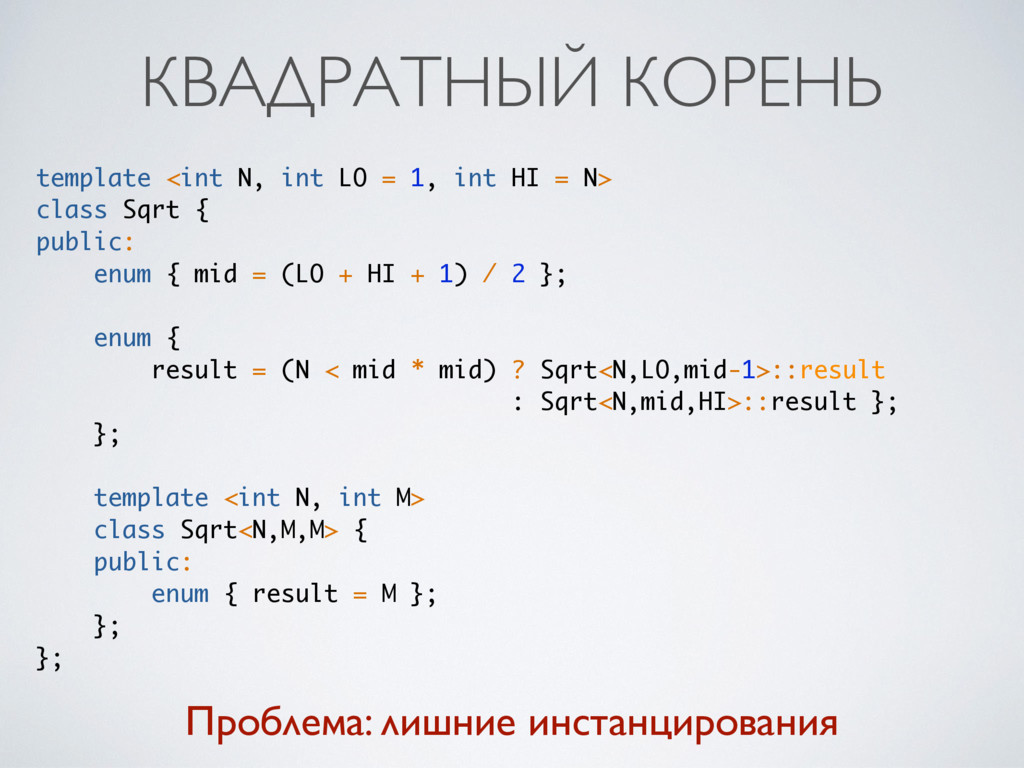
  22. КВАДРАТНЫЙ КОРЕНЬ template <int N, int LO = 1, int

    HI = N> class Sqrt { public: enum { mid = (LO + HI + 1) / 2 }; enum { result = (N < mid * mid) ? Sqrt<N,LO,mid-1>::result : Sqrt<N,mid,HI>::result }; }; template <int N, int M> class Sqrt<N,M,M> { public: enum { result = M }; }; }; Проблема: лишние инстанцирования
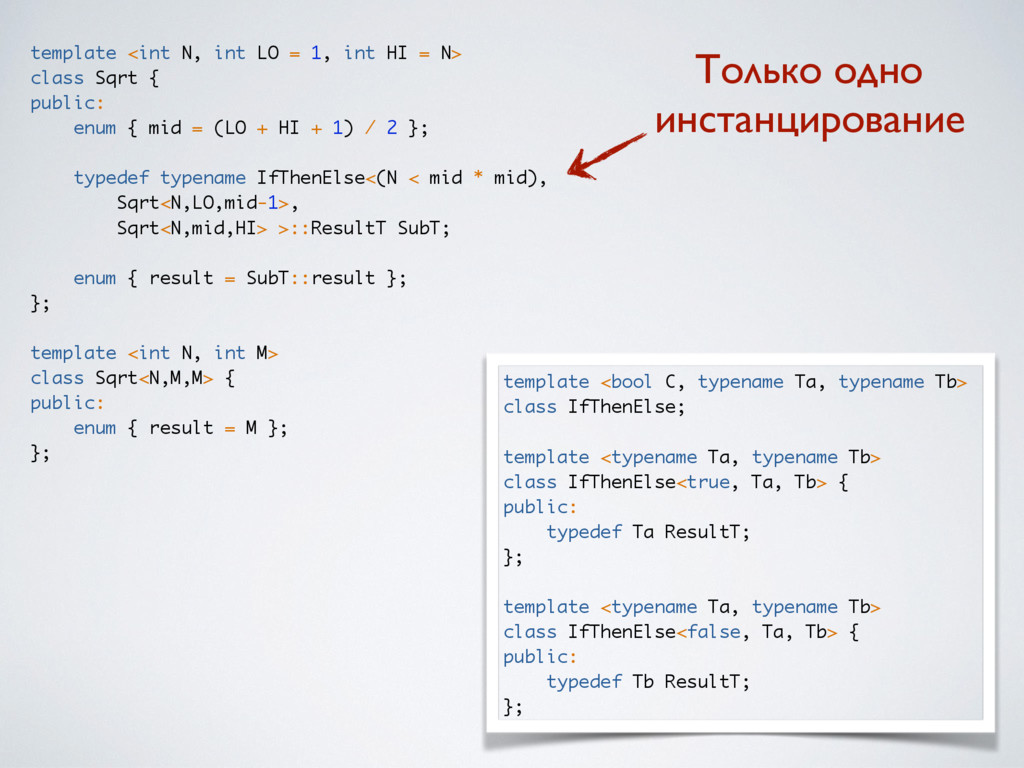
  23. template <int N, int LO = 1, int HI =

    N> class Sqrt { public: enum { mid = (LO + HI + 1) / 2 }; typedef typename IfThenElse<(N < mid * mid), Sqrt<N,LO,mid-1>, Sqrt<N,mid,HI> >::ResultT SubT; enum { result = SubT::result }; }; template <int N, int M> class Sqrt<N,M,M> { public: enum { result = M }; }; template <bool C, typename Ta, typename Tb> class IfThenElse; template <typename Ta, typename Tb> class IfThenElse<true, Ta, Tb> { public: typedef Ta ResultT; }; template <typename Ta, typename Tb> class IfThenElse<false, Ta, Tb> { public: typedef Tb ResultT; }; Только одно инстанцирование