Upgrade to Pro — share decks privately, control downloads, hide ads and more …

Minson_Mueller(in press)_cost of collaboration.pdf

Avatar for bettyliu bettyliu
December 15, 2011
37

Minson_Mueller(in press)_cost of collaboration.pdf

Avatar for bettyliu

bettyliu

December 15, 2011

Transcript

  1. 1 RUNNING HEAD: COLLABORATIVE JUDGMENT The cost of collaboration: Why

    joint decision-making exacerbates rejection of outside information Julia A. Minson and Jennifer S. Mueller The Wharton School, University of Pennsylvania Word count: 2,497 Citation count: 27 **In press at Psychological Science. Correspondence: Julia A. Minson The Wharton School University of Pennsylvania 3730 Walnut St. 553 Jon M. Huntsman Hall [email protected]
  2. 2 Abstract Existing research asserts that specific group characteristics cause

    members to disregard outside information, which leads to diminished performance. We demonstrate that the very process of making a judgment collaboratively rather than individually contributes to such myopic underweighting of external viewpoints. Dyad members exposed to the numerical judgments made by peers gave significantly less weight to those judgments than did individuals working alone. The difference in the willingness to use peer input shown by individuals versus dyads was mediated by the greater confidence that the dyad members reported in the accuracy of their own estimates. Furthermore, dyads were no more effective at judging relative accuracy of own and peer inputs than individuals. Our analyses demonstrate that relative to individuals, dyads suffered an accuracy cost. Specifically, had dyad members given as much weight to peer input as individuals, their revised estimates would have been significantly more accurate. (145 words)
  3. 3 Although most major decisions are made collaboratively, in domains

    as diverse as business, public policy, and international relations examples of poor joint judgment abound. And because many collaborative decision failures can be traced back to rejection of outside information (Ancona & Caldwell, 1992), researchers have closely investigated group characteristics that foster myopic disregard of alternative viewpoints (Ancona, 1990; Cronin & Weingart, 2007; Janis, 1982; Kane, Argote, & Levine, 2005; Katz, 1982). Whereas such research has identified several factors that increase or decrease this tendency (Ancona, 1990), we pose a novel question. What if the mere act of collaboration discourages the use of outside input? Research on quantitative judgment has shown that individuals often improve decision-making by integrating outside input in part because they can determine the relative accuracy of own and others’ judgments (Soll & Larrick, 2009) and in part because aggregating independently-made judgments reduces average error (Armstrong, 2001; Bonaccio & Dalal, 2006; Einhorn & Hogarth, 1978). However, this work has exclusively focused on individual level processes (Gino & Moore, 2007; Gino & Schweitzer, 2008; Mannes, 2009; Soll & Mannes, 2011). While accepting advice can improve performance, the question of whether individuals or collaborators are more likely to integrate advisor input remains unanswered. At first blush, one might suggest that collaborative decisions would be more amenable to revision than individual ones. Individuals may underweight peer input because they are overly attached to their own views (Harvey & Harries, 2004; Lord, Ross, & Lepper, 1979). By contrast, because collaboration requires that individuals cede prior opinions to reach consensus, collaborators may be less satisfied with, and more
  4. 4 open to revising joint judgments. Additionally, collaborative judgment requires

    discussion, which might enhance decision makers’ ability to realize that the judgments of peers must on average be as accurate as their own. Alternatively, collaborators may devalue outside input more than individuals. Brainstorming research notes that discussion and collaboration can increase conformity pressures (Goncalo & Staw, 2006). Furthermore, collaborators may choose to disregard outside advice to preserve and reinforce feelings of cohesion and rapport (Ancona, 1990; Janis, 1982; Katz, 1982). However, we propose one additional possibility: namely that the mere act of collaborating enhances confidence, and thereby limits receptivity to outside advice. The role of confidence Relative to working alone, people believe that working collaboratively allows for greater resource acquisition, avoidance of negative outcomes, and goal achievement (Moreland, 1987). Collaboration increases efficacy beliefs – beliefs about a person’s ability to produce a desired result – including confidence in decision-making (Forsyth, 1999; Park & Hinsz, 2006), and beliefs about overall capability (Stroebe, Diehl, & Abakoumkin, 1992). We propose that the act of collaborating on a judgment task may promote confidence in the accuracy of the judgments produced. Greater confidence has previously been linked to the propensity to disregard outside input in the advice-taking literature (Gino & Moore, 2007; Harvey & Fischer, 1997; Soll & Larrick, 2009). High confidence in one’s own estimates might cue that advice is not needed or appropriate (Sniezek & Van Swol, 2001). And while it may be logical to adhere to judgments one feels confident about, it would be folly to overlook the
  5. 5 fact that one’s peers might have similar reasons to

    feel confident. We thus hypothesize that collaborators will feel more confident in the accuracy of their judgments than individuals, and thus be less open to peer input, with deleterious effects for judgment accuracy. The benefits and costs of collaborative judgment The higher confidence experienced by collaborators relative to individuals working alone may be partly justified. The belief that two heads are better than one has received substantial support from experiments in which independently-made judgments are combined to show the benefits of statistical aggregation (Soll & Larrick, 2009; Surowiecki, 2004; see Bonaccio & Dalal, 2006 for a review). However, much of this benefit is lost when estimators influence each other’s judgments (Lorenz, Rauhut, Schweitzer, and Helbing, 2011). Therefore judgments made jointly may not exhibit the accuracy of aggregated independent judgments. Even assuming that collaborators produce highly accurate initial estimates, collaboration may come with a cost in contexts where judgments require outside input. If collaborators integrate outside advice less than individuals they may lose their initial accuracy advantage. The magnitude of this cost becomes apparent when comparing the accuracy of revised collaborative estimates to the accuracy which could have been achieved, had collaborators yielded as much as individuals. Given that joint decision- making requires greater human capital, money, and time, this lost accuracy is nontrivial. In the present research we compare the willingness of individuals and collaborators to revise judgments, their confidence in those judgments, and the accuracy of the revised estimates. We predicted that the greater confidence resultant from making a decision
  6. 6 jointly rather than alone limits receptivity to outside advice,

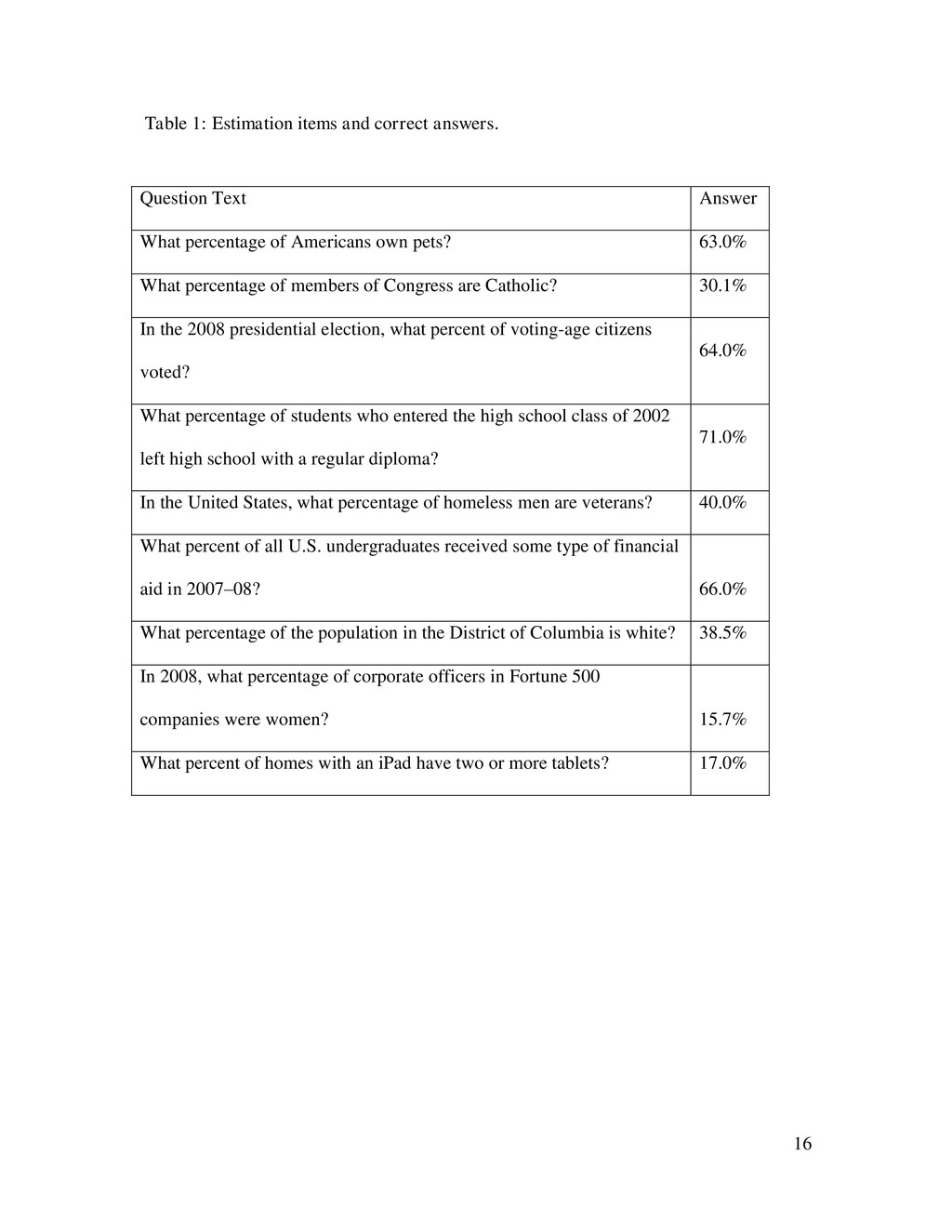
    and lowers accuracy relative to what could have been achieved had dyads yielded as much as individuals. Method Participants Participants (N = 252) were members of a university research pool, compensated with $10. We offered a $30 bonus for each of two estimation rounds, which decreased by $1 for each percentage point any estimate deviated from the truth. Design The study featured a 2 (individual judge vs. dyad judge) x 2 (individual advisor vs. dyad advisor) design that allowed us to assess whether any observed differences were due to the identity of the judge or the identity of the advisor. Procedure During each session participants sat in a partitioned room and estimated nine numerical quantities related to U. S. geography, demography, and commerce. We worded the questions to solicit percentage estimates in order to ensure that data across items could be easily combined (see Table 1). Participants were randomly assigned to make initial estimates either individually or jointly through discussion with a dyad partner. They were then provided with a set of estimates made by another individual or dyad and given the option to revise their initial estimates to any degree they felt appropriate. Variables and analyses To quantify yielding to peer input for each item we determined the distance between participants’ and advisors’ initial estimates, and then calculated the percentage
  7. 7 of the distance participants adjusted towards their advisor’s estimate1.

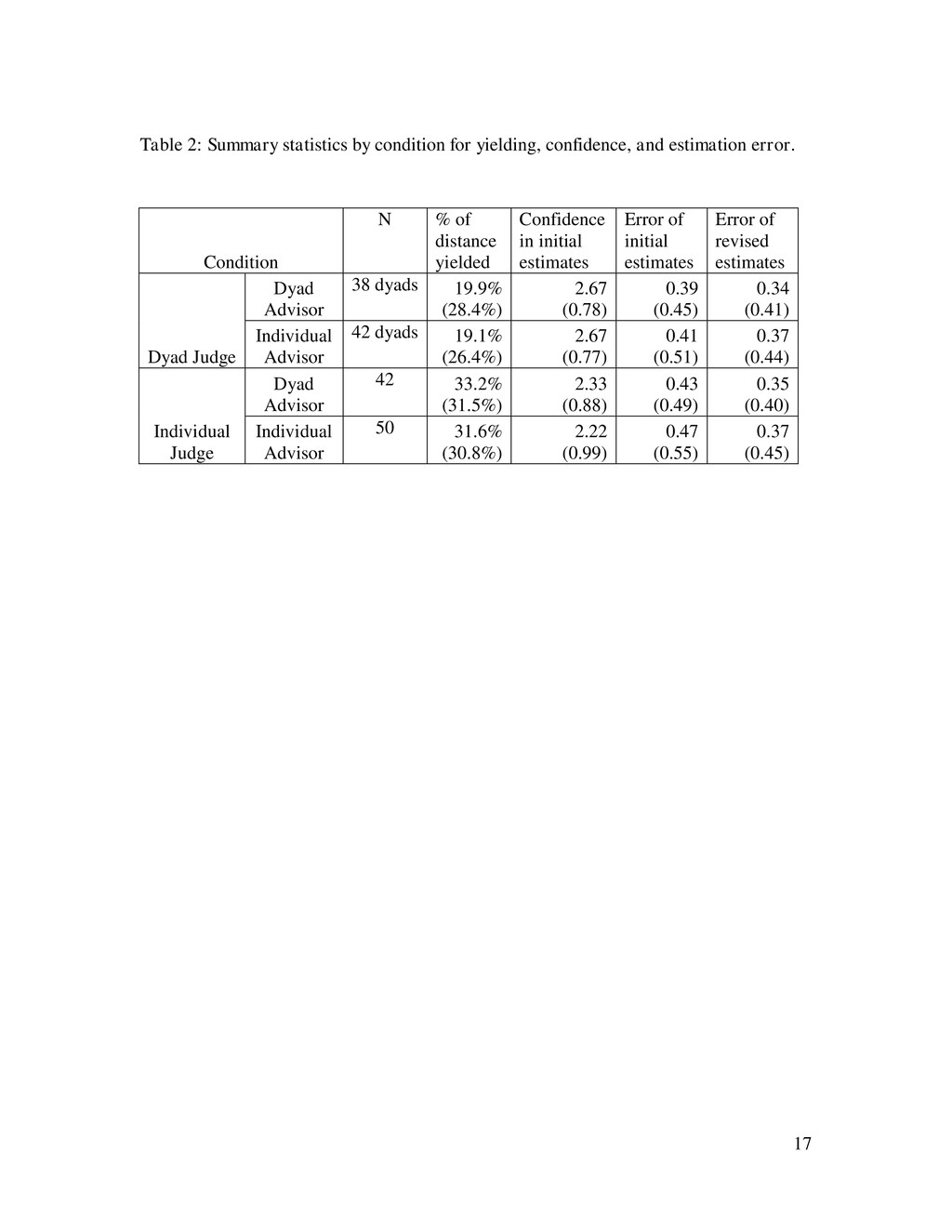
    Following prior research (Bonaccio & Dalal, 2006), we winsorized this measure to be between 0% and 100% and dropped from analysis the 7% of observations on which participants offered the same initial estimate as their advisors. For each item, participants reported their confidence that their estimate fell within 10 percentage points of the answer on a five-point scale from “Not at all confident” to “Extremely confident.” Although all confidence ratings were made individually, in the dyad condition we averaged the partners’ confidence ratings to arrive at a single rating for each dyad for each item. We used hierarchical linear modeling in Stata due to the fact that each of our participants (whether working alone or with a partner) provided estimates for nine items. This approach allowed us to control for non-independence of multiple observations being provided by each participant while maximizing statistical power. We entered confidence and yielding to peer input as item-level (Level 1) variables and the two independent factor variables, Identity of Judge and Identity of Advisor as participant-level (Level 2) variables. Within each factor we coded “0” for Individual and “1” for Dyad. Results Use of peer input Collapsing across whether judgments were made individually or collaboratively, participants yielded an average of 25.8% (SD = 29.5%) to the advice of individuals and an average of 26.9% (SD = 30.8%) to the advice of dyads (Table 2). Thus there was no effect of the identity of advisor on yielding (B = .01, z = .60, ns). In line with our predictions, collapsing across the identity of advisor, participants working individually
  8. 8 yielded an average of 32.3% (SD = 31.1%), whereas

    participants working collaboratively yielded significantly less (M = 19.5, SD = 27.3), (B = -.12, z = -6.42, p < 0.001). There was no significant interaction between identity of judge and identity of advisor (B = -.01, z = -0.26, ns). The mediating role of confidence Participants who made estimates collaboratively were more confident in their initial estimates (M = 2.67, SD = 0.78) than participants who made estimates individually (M = 2.27, SD = 0.94), (B = 0.397, z = 4.30, p < 0.001). To demonstrate that confidence mediates the effect of identity of judge on use of peer input, we next tested whether confidence predicts yielding, entering both as item-level variables. When participants were more confident in their initial estimates, they yielded less (B = -.069, z = -7.14, p < .001). Finally, when we regressed yielding to peer input on identity of judge, identity of advisor and initial confidence, we found a significant effect of confidence (B = -.059, z = -6.19, p < 0.001), a significant but diminished effect of identity of judge (B = -.106, z = - 5.20, p < 0.001), and no effect of identity of advisor (B = .016, z = 0.78, ns). To test the significance of the indirect effect of identity of judge on yielding via confidence, we used the Monte Carlo bootstrapping method (Selig & Preacher, 2008). The test returned a 95% confidence interval for the indirect effect not containing zero (lower bound: -.04, upper bound: - .01), confirming that confidence significantly mediated the effect of identity of judge on yielding. Estimation Accuracy
  9. 9 We measured estimation error as absolute percentage point deviation

    from the correct answer. Participants who made their initial estimates working with a dyad partner showed marginally less error (M = 40.4 percentage points, SD = 0.02 percentage points) than participants who made their initial estimates working alone (M = 45.3 percentage points, SD = 0.02 percentage points), (B = -.05, z = -1.89, p = 0.06). Were dyads superior to individuals at giving greater weight to the more accurate estimates? To address this question we coded the relative accuracy of own and peers’ estimates (+1: own more accurate; -1: own less accurate) and entered this variable into our model predicting yielding, along with the two factor variables and the interactions terms between each factor and relative accuracy (Identity of Judge X relative accuracy, Identity of Advisor X relative accuracy). The model returned a significant effect of relative accuracy on yielding (B = -.05, z = -3.65, p < 0.01). When participants’ own estimates were more accurate than those of their peers, they yielded less, and vice versa. We again observed that dyads yielded significantly less than individuals (B = -.129, z = -6.42, p < 0.001), irrespective of the identity of advisor (B = .012, z = 0.58, ns). However, neither identity of judge nor of advisor interacted with relative accuracy to predict yielding (Identity of judge: B = .02, z = 1.45, ns; Identity of advisor: B = .018, z = 1.16, ns). Although participants across conditions gave greater weight to more accurate estimates than less accurate ones, dyads were no better at this task than individuals. The Cost of Collaboration Given that dyad members gave significantly less weight to peer input than individuals and were no wiser in discriminating more versus less accurate estimates, it is
  10. 10 perhaps not surprising that in offering their revised estimates

    they lost the small accuracy advantage observed in the initial estimates. Neither the identity of the judge (B = -.004, z = -0.18, ns), nor the identity of the advisor (B = -.02, z = -0.92, ns) significantly influenced the accuracy of the revised estimates. Dyads’ final estimates were no more accurate than those offered by individuals. In order to more directly assess whether dyad members paid a price for greater underweighting of peer input, we calculated hypothetical estimates that dyad members could have produced had they yielded to input as much as individuals did (i.e. an additional 12.8 percentage points). For each item we took the actual amount that dyad members yielded and calculated their accuracy had they yielded the additional distance. Indeed, those hypothetical revised estimates would have been significantly more accurate than dyads’ actual revised estimates (Dyad judge and Individual advisor: B = .02, z = 2.68, p < 0.01; Dyad judge and Dyad advisor: B = .02, z = 3.21, p < 0.01). Thus dyad members in each condition paid a significant accuracy cost for failing to yield as much as individuals. Discussion Collaboration is not free. Greater time, money and effort go into making judgments together rather than alone. Often this is done on the assumption that the results will be superior to decisions made individually. In our study dyads were more reluctant than individuals to revise their judgments, and as a result their revised estimates were less accurate than they could have been were they more willing to accept peer input. In fact, in our study revised judgments made with the combined inputs of four individuals were no more accurate than those made with the inputs of three or even two. This
  11. 11 unwillingness to integrate peer input was explained by dyad

    members’ greater confidence in their estimates. Dyads confidence was somewhat warranted given the greater accuracy of their initial estimates, yet proved detrimental to the accuracy of their revised estimates. Furthermore, dyads were no better than individuals at identifying more accurate estimates. In prior research, feelings of confidence or efficacy have been shown to promote performance (Bandura, 1977). Yet, new research proposes that this may not be the case when individuals or groups are engaged in a novel task where feelings of high efficacy may inhibit the exploration that results in improved outcomes (Goncalo, Polman, & Maslach, 2010; Moore & Healy, 2008). The current investigation shows that confidence may also inhibit the extent to which decision-makers consider novel information. A large literature shows that knowledge transfer in organizations is difficult because groups are resistant to outside information (Kane et al., 2005). This prior work proposes that the quality of collaboration – not the mere act of collaborating, explains why members are reluctant to change their mind. The current study suggests that collaborators may resist incorporating outside input in part because the collaborative process itself increases confidence about the accuracy of own responses, while potentially minimizing some of the benefits of judgment aggregation. Prior research suggests that groups may be more self-attentive and disregard outside information due to high cohesion (Ancona & Caldwell, 1992). To address this alternative explanation, we measured the extent to which dyads felt cohesive. Supplementary analyses revealed that within the dyad conditions cohesion was not
  12. 12 correlated with yielding. This suggests that rather than wishing

    to maintain cohesion, dyads may reject outside information simply because they do not believe it adds value. Many of our most important decisions are made collaboratively, following the intuition that “two heads are better than one.” Every aspect of law, policy and corporate governance relies on the ability of individuals to jointly make effective judgments. Our study demonstrates that collaborators’ reluctance to integrate external input may severely impair their ability to achieve their goals.
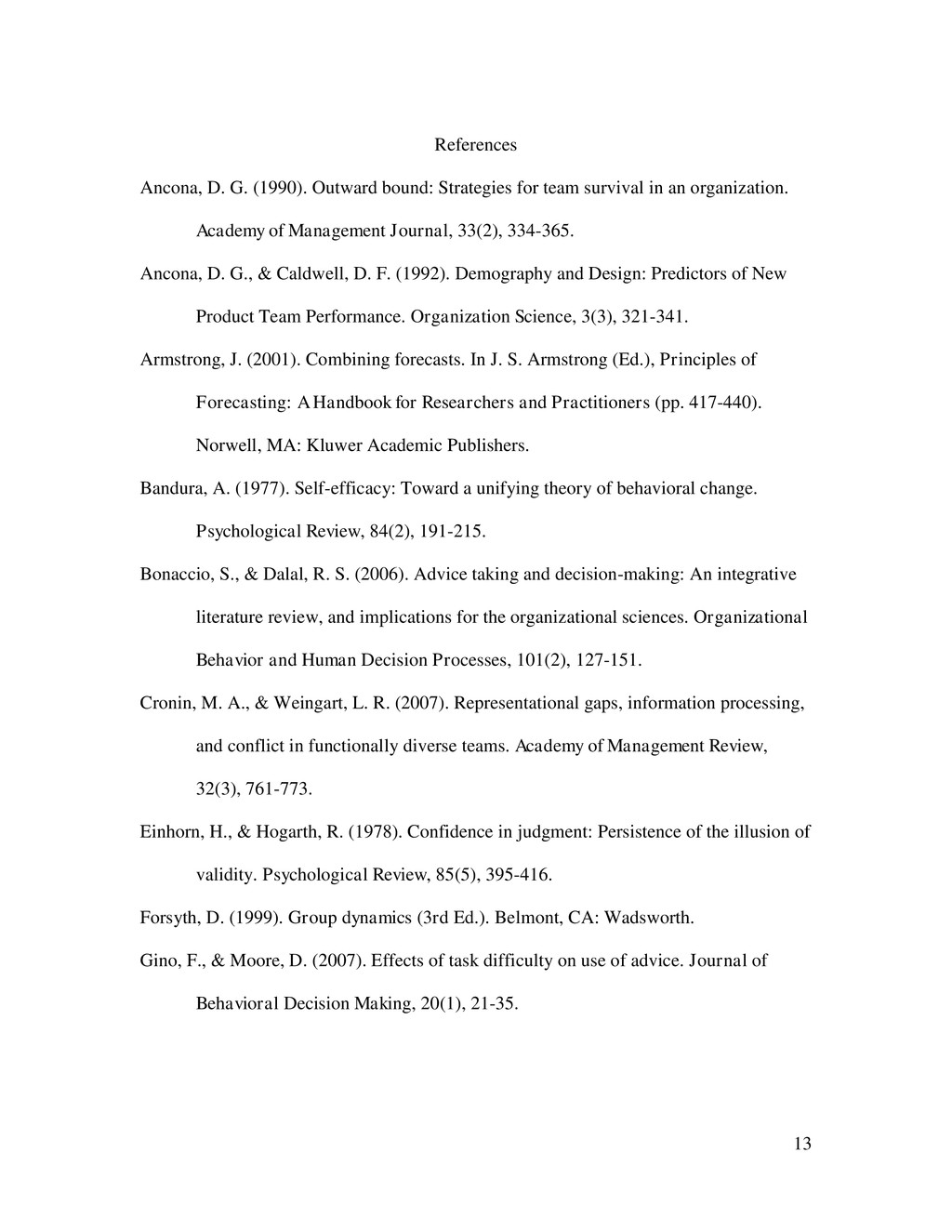
  13. 13 References Ancona, D. G. (1990). Outward bound: Strategies for

    team survival in an organization. Academy of Management Journal, 33(2), 334-365. Ancona, D. G., & Caldwell, D. F. (1992). Demography and Design: Predictors of New Product Team Performance. Organization Science, 3(3), 321-341. Armstrong, J. (2001). Combining forecasts. In J. S. Armstrong (Ed.), Principles of Forecasting: A Handbook for Researchers and Practitioners (pp. 417-440). Norwell, MA: Kluwer Academic Publishers. Bandura, A. (1977). Self-efficacy: Toward a unifying theory of behavioral change. Psychological Review, 84(2), 191-215. Bonaccio, S., & Dalal, R. S. (2006). Advice taking and decision-making: An integrative literature review, and implications for the organizational sciences. Organizational Behavior and Human Decision Processes, 101(2), 127-151. Cronin, M. A., & Weingart, L. R. (2007). Representational gaps, information processing, and conflict in functionally diverse teams. Academy of Management Review, 32(3), 761-773. Einhorn, H., & Hogarth, R. (1978). Confidence in judgment: Persistence of the illusion of validity. Psychological Review, 85(5), 395-416. Forsyth, D. (1999). Group dynamics (3rd Ed.). Belmont, CA: Wadsworth. Gino, F., & Moore, D. (2007). Effects of task difficulty on use of advice. Journal of Behavioral Decision Making, 20(1), 21-35.
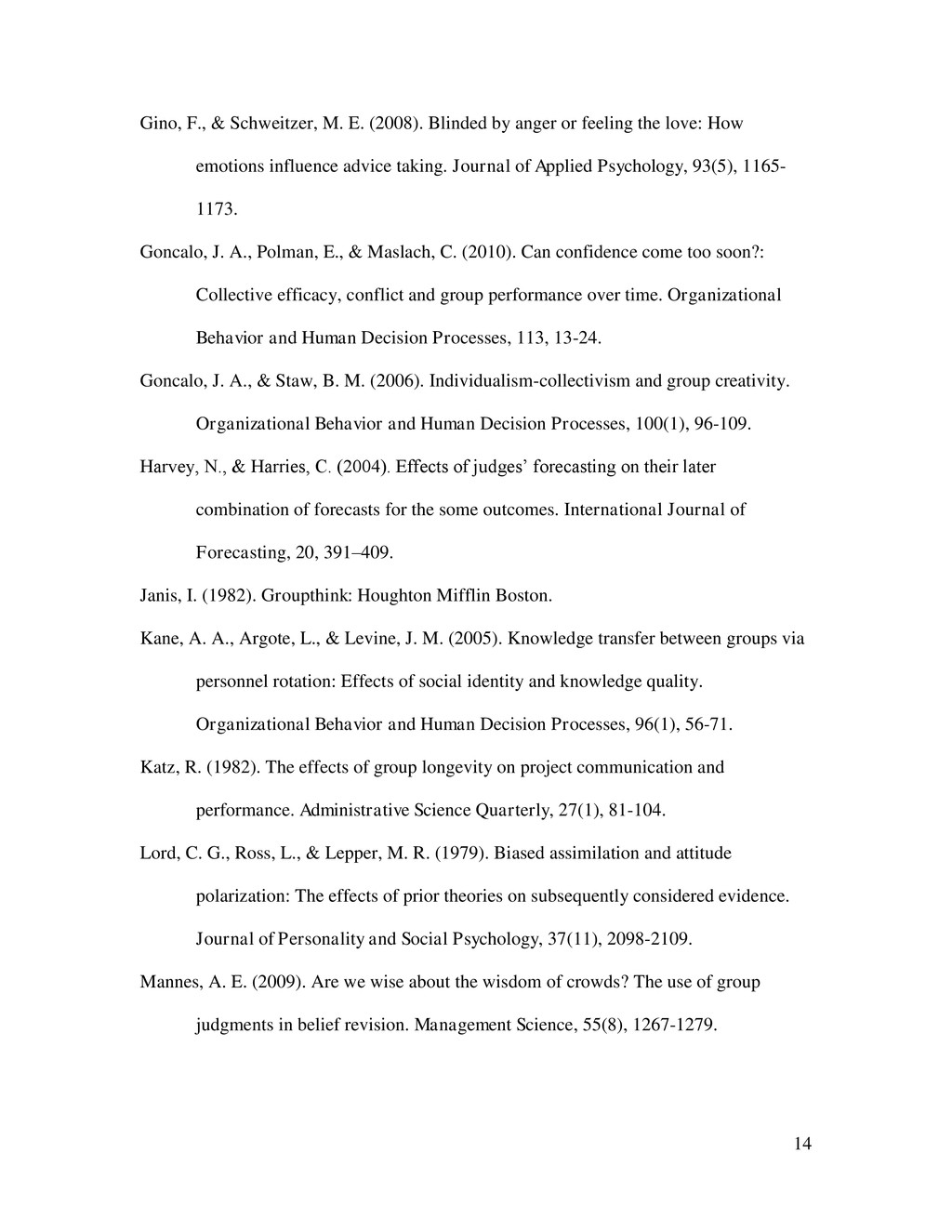
  14. 14 Gino, F., & Schweitzer, M. E. (2008). Blinded by

    anger or feeling the love: How emotions influence advice taking. Journal of Applied Psychology, 93(5), 1165- 1173. Goncalo, J. A., Polman, E., & Maslach, C. (2010). Can confidence come too soon?: Collective efficacy, conflict and group performance over time. Organizational Behavior and Human Decision Processes, 113, 13-24. Goncalo, J. A., & Staw, B. M. (2006). Individualism-collectivism and group creativity. Organizational Behavior and Human Decision Processes, 100(1), 96-109. Harvey, N., & Harries, C. (2004). Effects of judges’ forecasting on their later combination of forecasts for the some outcomes. International Journal of Forecasting, 20, 391–409. Janis, I. (1982). Groupthink: Houghton Mifflin Boston. Kane, A. A., Argote, L., & Levine, J. M. (2005). Knowledge transfer between groups via personnel rotation: Effects of social identity and knowledge quality. Organizational Behavior and Human Decision Processes, 96(1), 56-71. Katz, R. (1982). The effects of group longevity on project communication and performance. Administrative Science Quarterly, 27(1), 81-104. Lord, C. G., Ross, L., & Lepper, M. R. (1979). Biased assimilation and attitude polarization: The effects of prior theories on subsequently considered evidence. Journal of Personality and Social Psychology, 37(11), 2098-2109. Mannes, A. E. (2009). Are we wise about the wisdom of crowds? The use of group judgments in belief revision. Management Science, 55(8), 1267-1279.
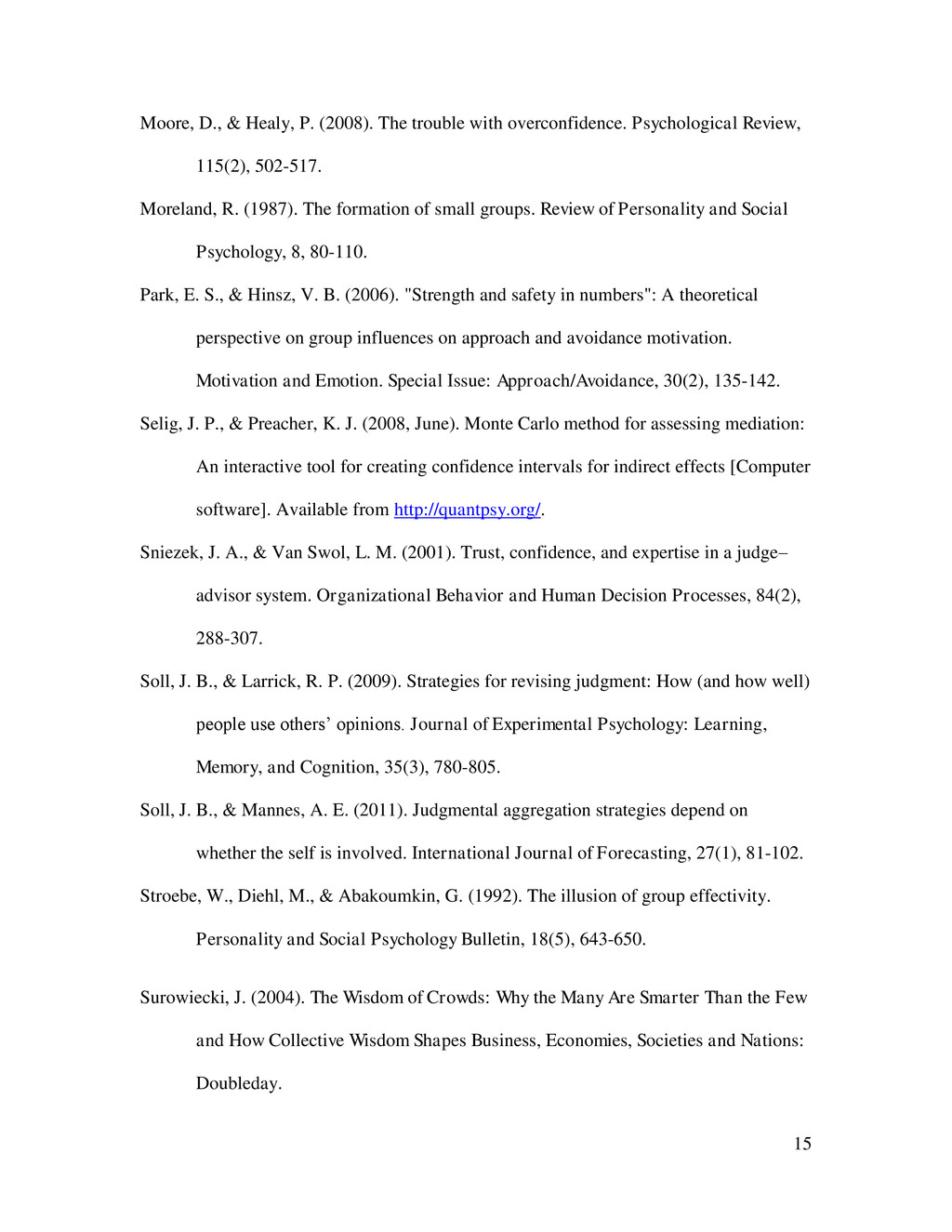
  15. 15 Moore, D., & Healy, P. (2008). The trouble with

    overconfidence. Psychological Review, 115(2), 502-517. Moreland, R. (1987). The formation of small groups. Review of Personality and Social Psychology, 8, 80-110. Park, E. S., & Hinsz, V. B. (2006). "Strength and safety in numbers": A theoretical perspective on group influences on approach and avoidance motivation. Motivation and Emotion. Special Issue: Approach/Avoidance, 30(2), 135-142. Selig, J. P., & Preacher, K. J. (2008, June). Monte Carlo method for assessing mediation: An interactive tool for creating confidence intervals for indirect effects [Computer software]. Available from http://quantpsy.org/. Sniezek, J. A., & Van Swol, L. M. (2001). Trust, confidence, and expertise in a judge– advisor system. Organizational Behavior and Human Decision Processes, 84(2), 288-307. Soll, J. B., & Larrick, R. P. (2009). Strategies for revising judgment: How (and how well) people use others’ opinions. Journal of Experimental Psychology: Learning, Memory, and Cognition, 35(3), 780-805. Soll, J. B., & Mannes, A. E. (2011). Judgmental aggregation strategies depend on whether the self is involved. International Journal of Forecasting, 27(1), 81-102. Stroebe, W., Diehl, M., & Abakoumkin, G. (1992). The illusion of group effectivity. Personality and Social Psychology Bulletin, 18(5), 643-650. Surowiecki, J. (2004). The Wisdom of Crowds: Why the Many Are Smarter Than the Few and How Collective Wisdom Shapes Business, Economies, Societies and Nations: Doubleday.
  16. 16 Table 1: Estimation items and correct answers. Question Text

    Answer What percentage of Americans own pets? 63.0% What percentage of members of Congress are Catholic? 30.1% In the 2008 presidential election, what percent of voting-age citizens voted? 64.0% What percentage of students who entered the high school class of 2002 left high school with a regular diploma? 71.0% In the United States, what percentage of homeless men are veterans? 40.0% What percent of all U.S. undergraduates received some type of financial aid in 2007–08? 66.0% What percentage of the population in the District of Columbia is white? 38.5% In 2008, what percentage of corporate officers in Fortune 500 companies were women? 15.7% What percent of homes with an iPad have two or more tablets? 17.0%
  17. 17 Table 2: Summary statistics by condition for yielding, confidence,

    and estimation error. Condition N % of distance yielded Confidence in initial estimates Error of initial estimates Error of revised estimates Dyad Judge Dyad Advisor 38 dyads 19.9% (28.4%) 2.67 (0.78) 0.39 (0.45) 0.34 (0.41) Individual Advisor 42 dyads 19.1% (26.4%) 2.67 (0.77) 0.41 (0.51) 0.37 (0.44) Individual Judge Dyad Advisor 42 33.2% (31.5%) 2.33 (0.88) 0.43 (0.49) 0.35 (0.40) Individual Advisor 50 31.6% (30.8%) 2.22 (0.99) 0.47 (0.55) 0.37 (0.45)
  18. 18 Footnote 1 The discrepancy between participants’ and advisors’ initial

    estimates were not significantly different between conditions.